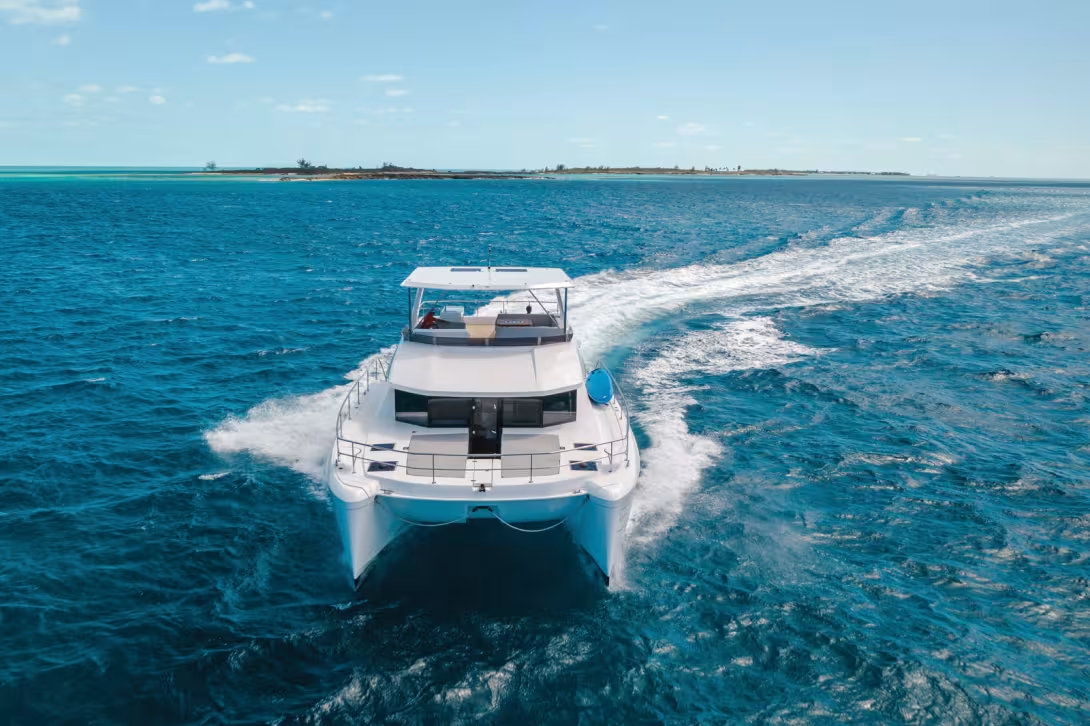
Renewed design, but specifically with hulls 100% designed as a motor boat, and XXL-sized volume: this new 53 PC is clearly taking on the luxury power monohull sector. And her arguments are very convincing.
Infos pratiques
- Le chantier : Leopard 53 PC
- La fiche technique
-
 Découvrez notre vidéo exclusive
- Financez votre Leopard 53 PC
- Assuez votre Leopard 53 PC
- Articles autour du Leopard 53 PC
The Leopard 53 PC made her world debut at this year’s Miami Boat Show. And a quick look at the order book shows this to have been a good choice: six units have been sold! Is the power catamaran market becoming the new niche to invest in? It’s certainly the choice of many multihull builders. For Robertson & Caine, this isn’t a recent phenomenon, having launched their first powercats back in the 1990s. The success was mixed - so much so that in 2002, Leopard Catamarans, with their Lion 43 and 46, weren’t really believing in it anymore. Business improved with the Leopard Cat 47, similar to the 46’ sailing version. The after end of the hulls were redesigned and the keels shortened. The same operation was carried out on the 39 PC, a variant of the 39. For models that followed, the 51 and 43 PC, the naval architects borrowed the same tools as the corresponding sailing versions but adopted specific hulls - and therefore specific hull form. These two models have proved very popular: 120 units to date for the 43 PC and 137 for the 51 PC - the latter could well be the most widely distributed powercat in the world to date. Our all-new 53 PC we’re testing here is that boat’s replacement, so the pressure’s on!
Advances in design
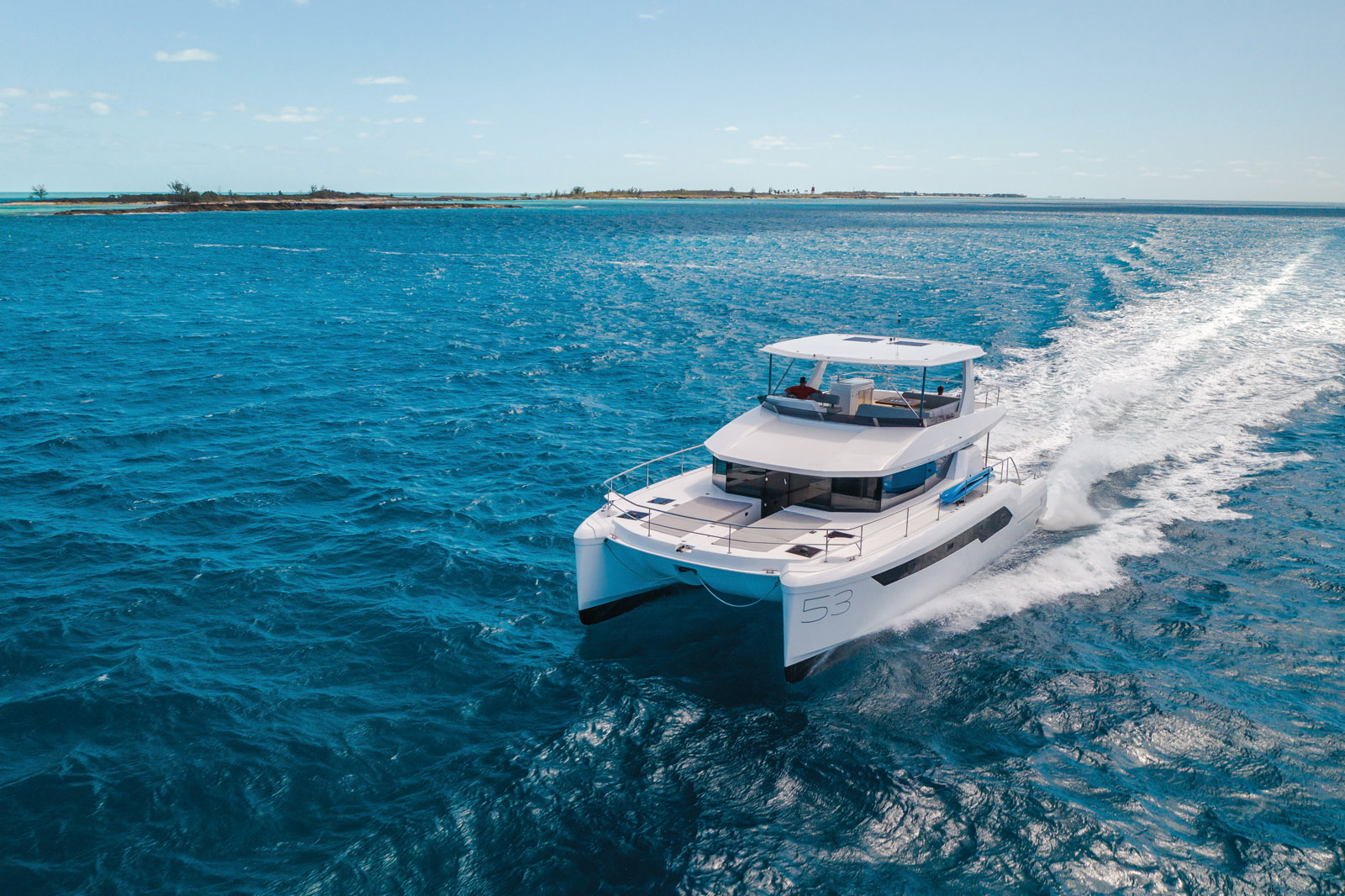
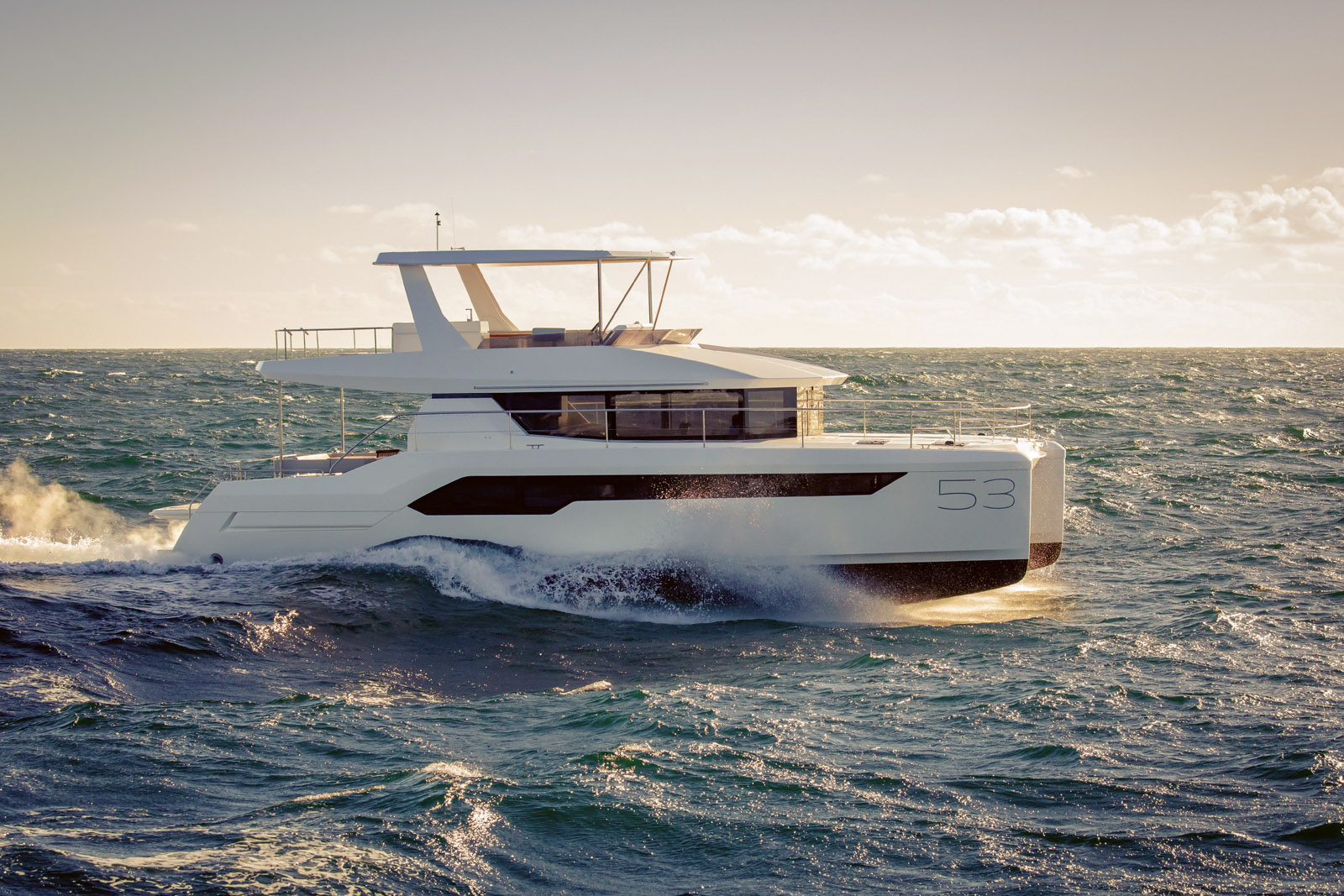
With the Miami Boat Show having just closed its doors, we had an appointment at Dania Beach Marina - Leopard’s US base camp - a few miles to the north. Compared to previous models, the 53 PC is much neater in terms of design: the windows in the hulls follow the line of the deck edge, as do the those of the saloon - with an inverse slope, which follows the bimini supports dedicated to the flybridge. Despite significant freeboard and overall volume, the 53 PC remains elegant. Visually, the coachroof comes across as lighter than on the previous model. A great deal of effort has also been put into the finish - a host of luxurious options are available to give you a proper twin-hulled yacht. While the Leopard 51 PC was an engine evolution of the 48, its replacement, the 53 PC, assumes a real powercat status, with her own unique design and hulls - and therefore her own molds. She nevertheless maintains a respectable beam, at 3 cm (1¼”) wider than her predecessor.
Fluid deck plan
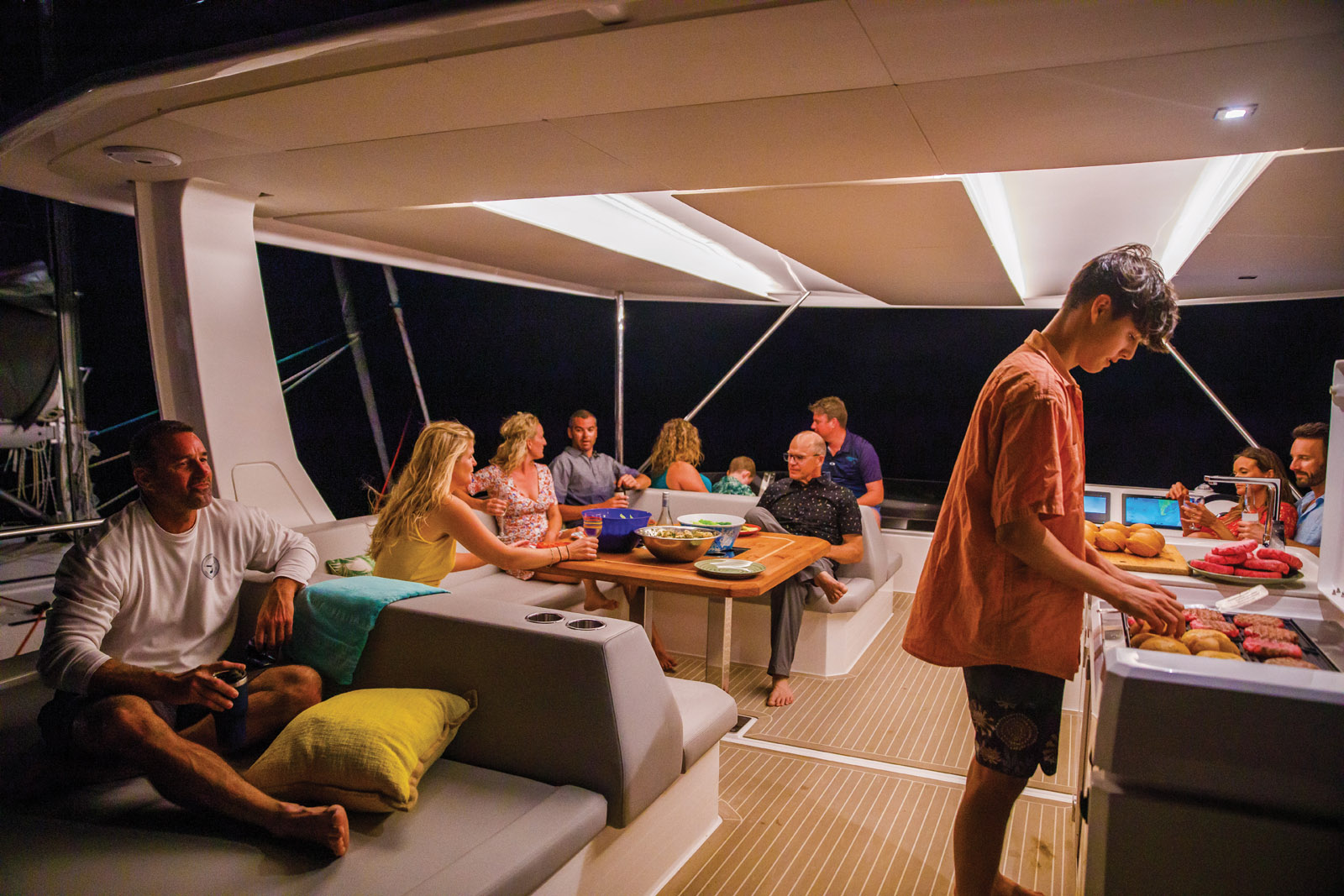
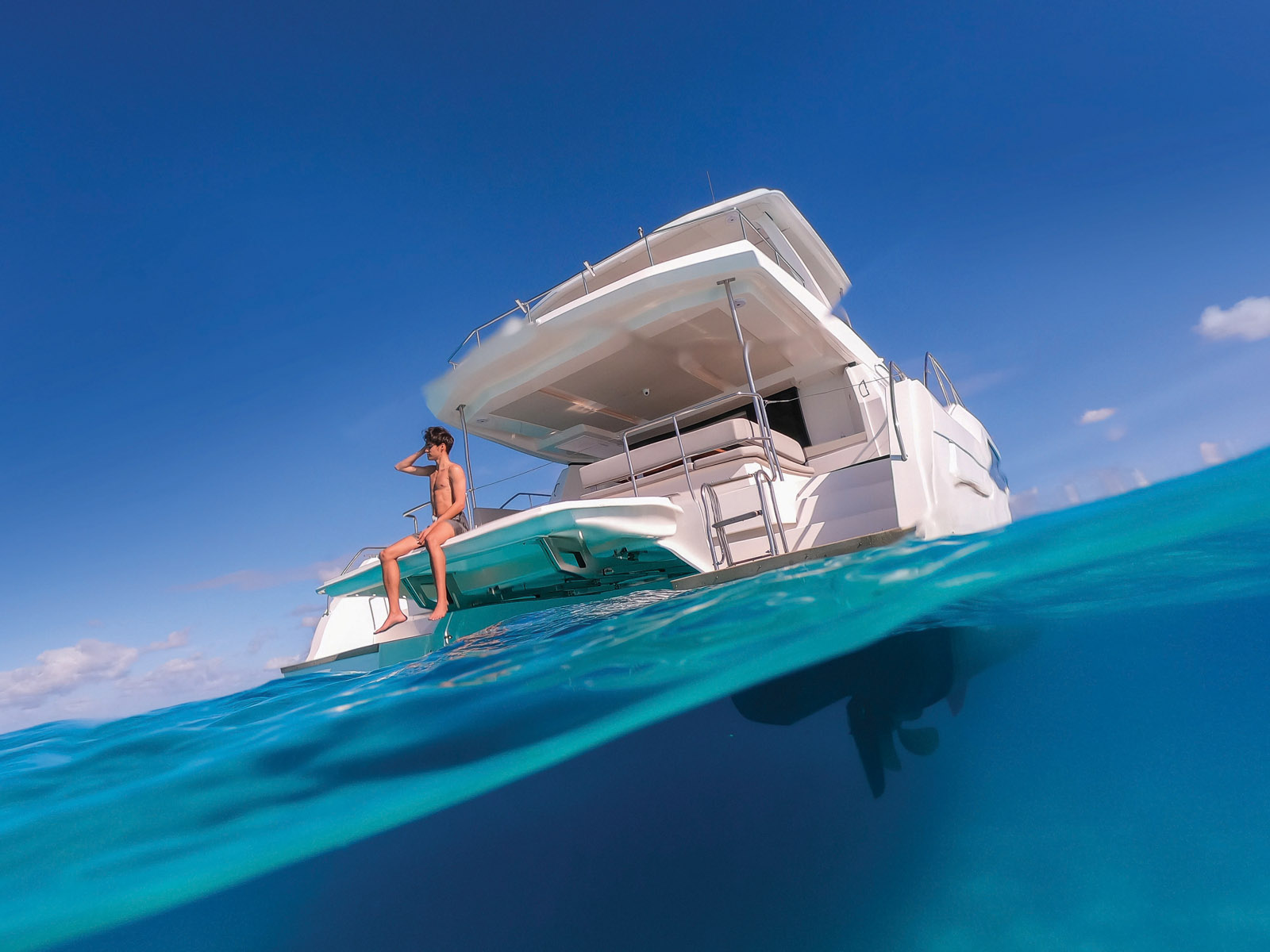
The cockpit is largely protected by the rigid bimini. The deck area is clear - almost too clear with just a small triangular cockpit table. With a large crew or for entertaining, a bigger table – either in polyester or teak - is available as an option. There is nevertheless plenty of seating and great access to the sea, thanks to the large sugarscoops and the hydraulic platform. A staircase with wide steps leads to the impressive flybridge. There is a large sundeck, a bench seat with a U-shaped table that can seat 8, a galley/bar module and of course the helm station, with its own large bench seat for two people. The entire deck is made safe by a sturdy stainless-steel guardrail. From the aft cockpit, a few steps give access to the wide and clear side-decks, and at the bow, no trampolines but a solid deck. This houses the chain lead, two impressive storage spaces (convertible into a crew cabin and head) and a locker for the gas bottles. Two large sunbathing areas with lifting backrests are here to be enjoyed.
Optimized performance
Power! The brand-new owner of this 53 PC is venturing out on his first trip. The marina may be crowded, but Ron is doing very well despite the cross current. From the flybridge, visibility over the water is excellent. Just one detail to note: the movement of our powercat causes the rainwater puddled on the bimini to be suddenly “drained” – some sort of gutter system might be an idea. A lengthy trip up the Intracoastal Waterway is taking us almost to Fort Lauderdale: that’s where we reach the Atlantic Ocean. The two Yanmars are now picking up speed - a little more noise in the aft cabins and in the cockpit, of course: some more soundproofing would be welcome. But don’t worry, on board there’s nowhere you need to shout to have a conversation... At the helm, there are many positives. To begin with, the steering is very direct without being heavy. Putting the helm hard over results in an about-turn with a radius of only 50 meters (150’). With the throttles hard down, we see 24 knots, and the 53 PC barely takes any spray, and the small inverted windshield effectively stops the breeze. Residual chop results in a little pitching, but the hulls immediately ease the effect and the underside of the nacelle doesn’t slam. We are convinced by the seakeeping qualities of this powercat. The skipper, who has just completed a delivery trip of a few hundred nautical miles, is equally enthusiastic. He also notes the structural rigidity and particularly of the bimini - much better than the one on the 51 PC. In fact, with the same engines as her predecessor, the 53 PC has gained three knots in top speed, even though this is a considerably heavier boat. Proof that the naval architects have done a good job. Looking outside, the feeling of gliding is evident from 16 knots of speed: the catamaran pitches up slightly and seems to encounter very little resistance. Consumption data moreover shows that between 13 and 18 knots, the range remains constant - around 450 nautical miles. To increase that, obviously you need to reduce the throttle: at 8 knots, you can cover 1,550 nm. That’s plenty enough for traditional summer use - you can count on a month’s boating and 1,000 nm. On the other hand, to undertake an Atlantic crossing, you’ll probably need to run only one engine - the leeward one if the wind angle allows it. Or to take on board extra cans of fuel.
Plenty of light
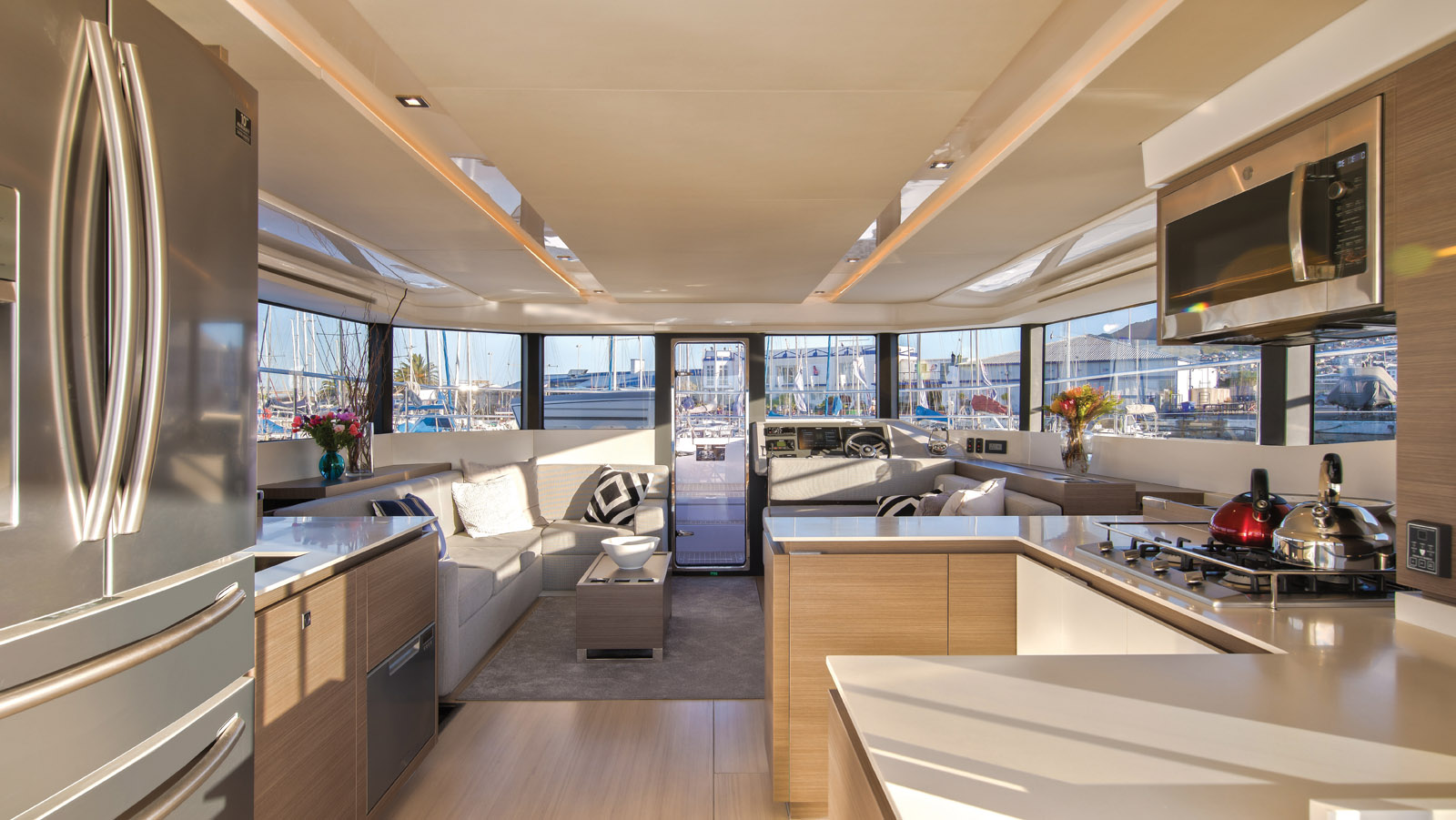
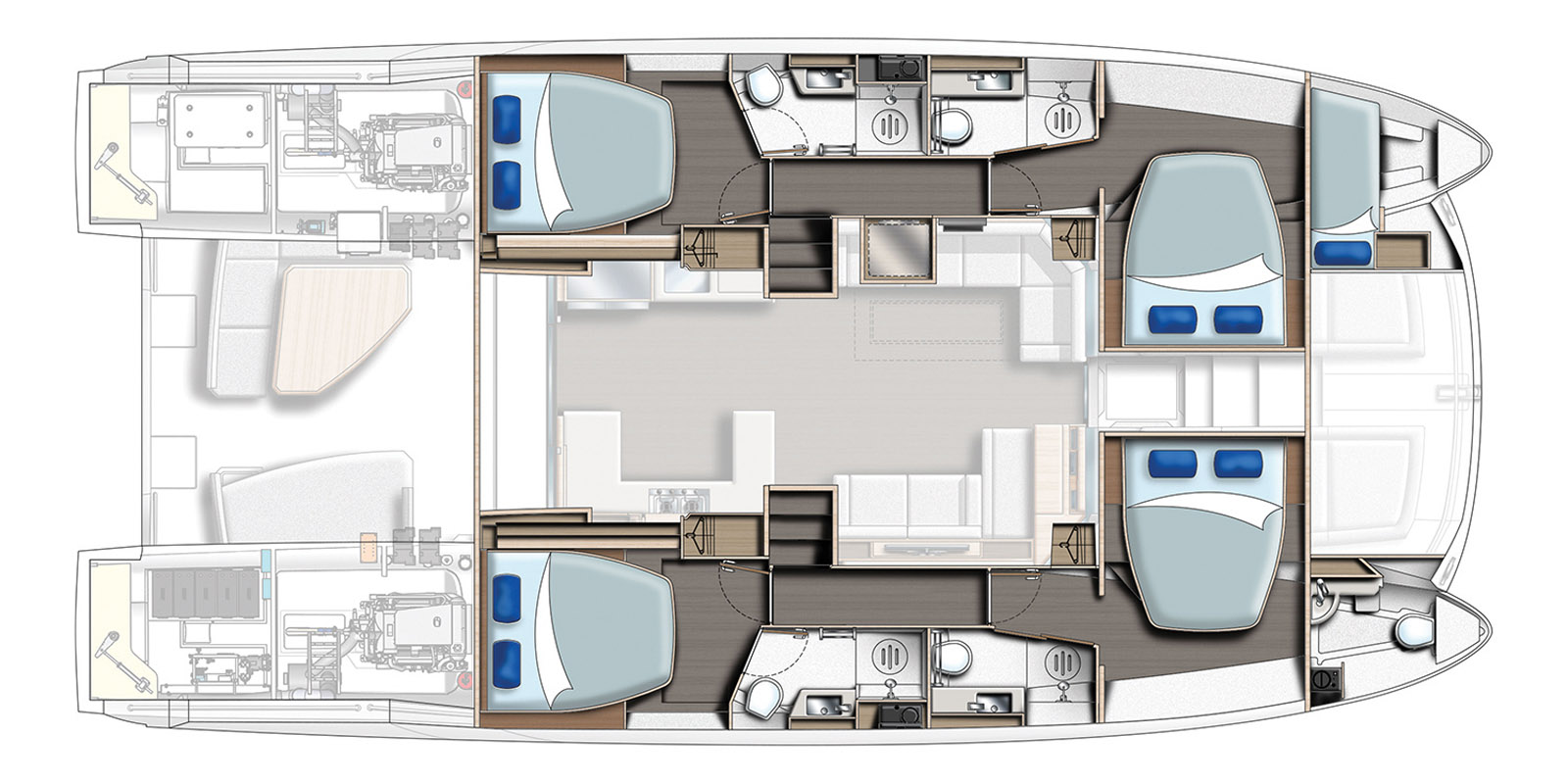
The entrance to the nacelle is obviously flush-decked, and the bay windows offer a wide opening. The impression of volume is striking - largely due to the headroom, which is well over two meters (6½ feet). The manufacturer claims an increase of 31% in volume, no less! The large glazed areas offer a breathtaking panoramic view. The builder has opted for a galley close to the aft cockpit with a U-shaped module to starboard with a four-burner stove, oven, microwave and storage space (and there’s also more of this under the floors). On the port side, a second module integrates a sink and an imposing double-opening refrigerator. The front of the nacelle is occupied by a huge lounge area with seating on each side - to port, the bench seats form an L around the coffee table, which can be replaced by a larger folding version. Forward, to starboard, an optional helm station is available. Visibility through the windows is excellent. A double seating area and chart table are still standard. In the center, the famous watertight bow door, a Leopard hallmark, offers direct access to the foredeck. This configuration revolutionizes moving around on board - no more need to use the side-decks to reach the anchoring or mooring gear, for example. The hulls offer three or four cabins; the first version sees the owner installed in the starboard hull - he can be isolated from the nacelle by a sliding door. Unsurprisingly, the double bunk is aft, the desk and sofa in the passageway, while the bathroom - equipped with two washbasins - is fitted in the forepeak. Here again, the level of finish is superior to that of the most recent Leopard models. Indirect lighting, the precision of the features, the quality of materials: this is beautiful work. In order not to spoil a nything, there are no gimmicky gadgets: the yard has far too much experience with the charter world to be tempted by such things. Everything here is solid and well thoughtout. The port hull houses two cabins, which are of course not quite so luxurious, but nevertheless very comfortable, with plenty of storage space, well ventilated and lit. The queen-size forward bed is installed athwartships. The passageway houses the electrical panel (with the option to fit a washing machine) and two bathrooms. Please note: each bunk offers a great sea view.
Conclusion
Having built 367 powercats to date, Robertson & Caine are illustrating their know-how and expertise with their new Leopard 53 PC. This new model will win over boaters from a multihull sailing background, but also monohull powerboat enthusiasts. Seaworthy, (relatively) fuelefficient, comfortable, and robust, the Leopard 53 PC opens the door to any boating program: coastal cruising, far-flung expeditions, tropical bohemia... Currently, sales of Leopard powercats to private individuals represent over a quarter of total production; let’s bet that this model is going to seduce many more.
TECHNICAL SPECIFICATIONS
Builder: Robertson & Caine
Architect: Simonis Voogd
Overall length: 15.4/16.19 m (50’6”/53’1”)
Waterline length: 15.24 m (50’)
Beam: 7.67 m (25’2”)
Draft: 0.97 m (3’2”)
Air draft: 8 m (26’3”)
Displacement: 18.63 t (41,070 lbs)
Engines: 2 x 370 hp Yanmar
Fuel capacity: 2,200 L (581 US gal)
Water capacity: 700 L (185 US gal)
Speed: 17.5/25 knots
Price: $ 969,000 ex-tax
Main options:
Forepeaks fitted-out: $ 6,782
Saloon blinds: $ 6,741
Bow thruster (port side): $ 11,878
Electrics pack: $ 10,162
3,000W inverter: $ 5,580
Lithium service batteries instead of standard ones: $ 22,660
9kW Generator 9 and installation: $ 33,060
Air conditioning and installation: $ 35,357
Watermaker: $ 25,431 Washing machine: $ 3,389
2 x 150W solar panels and charge regulator: $ 6,491
Blue underwater lighting: $ 4,239
Fusion Radio system: $ 3,815
Raymarine electronics pack: $ 16,695
Interior helm station: $ 10,737
Axiom 12 screen at the interior helm station: $ 4,358
P70 autopilot with engine control repeaters inside: $ 7,632
Large aft cockpit table and two seats: $ 7,079
Synthetic teak (cockpits, flybridge, stairs, sugarscoop and platform): $ 30 173
Electric bathing platform and tender support: $ 55,644
Radar: $ 3,731
Depth sounder: $ 2,714
Forward and aft cameras: $ 2,089
Ground tackle, bridle and fenders: $ 2,910
USCG safety equipment: $ 5,189
Preparation and delivery, Cape Town: $ 20,684
The pluses
Hulls really optimized for sailing at 16/20 knots
Ease of handling
Comfort both at sea and at anchor
The minuses
Not quite enough range to cross the Atlantic
Engine soundproofing could be improved
Rainwater drainage from the bimini needs reviewing