
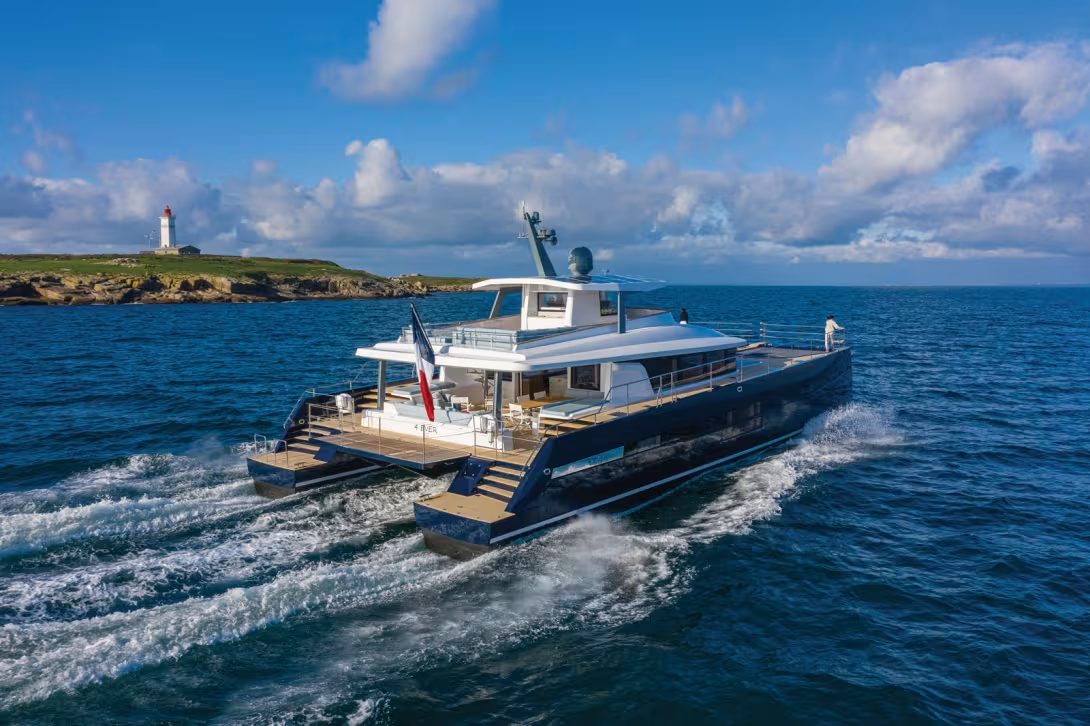
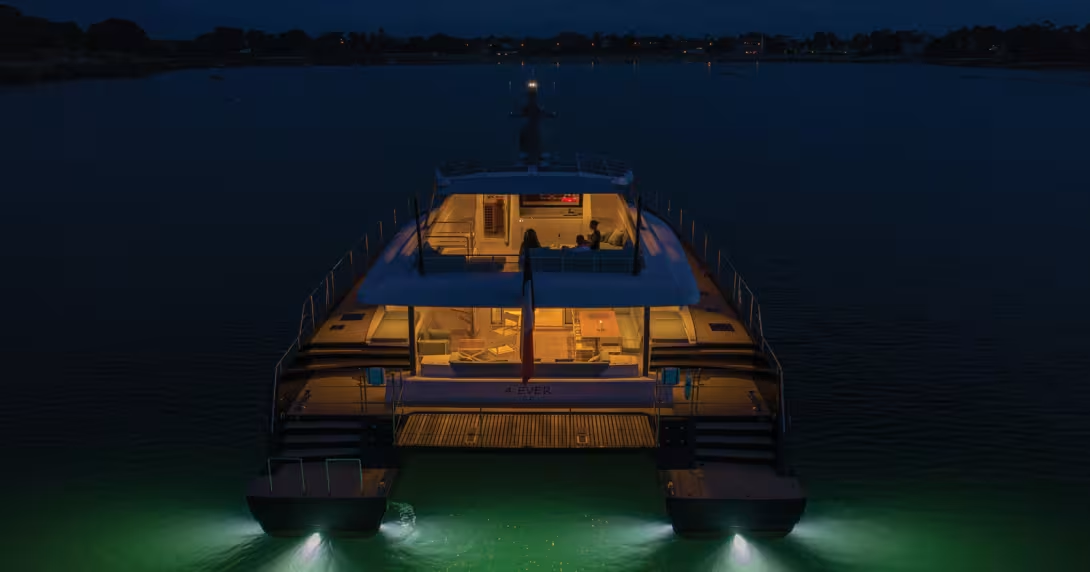
The specifications of an owner of numerous large sailing catamarans who is switching to motor power is necessarily demanding, especially given that his objective is to pursue a program of long passages. Only a top-of-the-range one-off could really meet his requirements. JFA shipyard, architect Marc Lombard, and designer Franck Darnet took up the challenge. In the heart of the magnificent natural setting of the Glénans archipelago in southern Brittany, deserted on the eve of winter, we discovered 4 EVER.
Infos pratiques
- Le chantier : Long Island 78' Power
- La fiche technique
-
 Découvrez notre vidéo exclusive
- Financez votre Long Island 78 Power
- Assuez votre Long Island 78 Power
- Articles autour du Long Island 78 Power
There are not many shipyards in the world that have the know-how to produce a 78-foot catamaran, truly tailor-made and very top-ofthe-range. French shipyard JFA is undeniably one of them. The boats coming out of its workshops are unique pieces, from all points of view. Do they come from the goldsmith’s trade, of which a thousand inhouse details bear witness? Or are we talking industrial in terms of size, displacement and the tens of thousands of hours required to build such a ship? Probably a bit of both, and this is the difficulty of the exercise for Fred Jaouen and his team. 75,000 hours of work to create a giant over 75 feet (23 meters) long, 38’5” (11.17 m) wide, and weighing 48 tons. Industrial-scale data, and yet every switch, every bracket and every tiny part is made to order, in-house. Because nothing on the market corresponds to the style or quality required. As is often the case in the superyacht industry, the hulls and the nacelle are built of aluminum - the deck is made in composite. Strong, light, and not requiring molds, aluminum is the ideal material for high-end single-unit projects. Rather rustic in appearance when left untreated, it disappears completely and only retains its mechanical qualities. The perfect rendering of the magnificent navy-blue paint highlights the excellence of the metalwork work carried out upstream on this project.
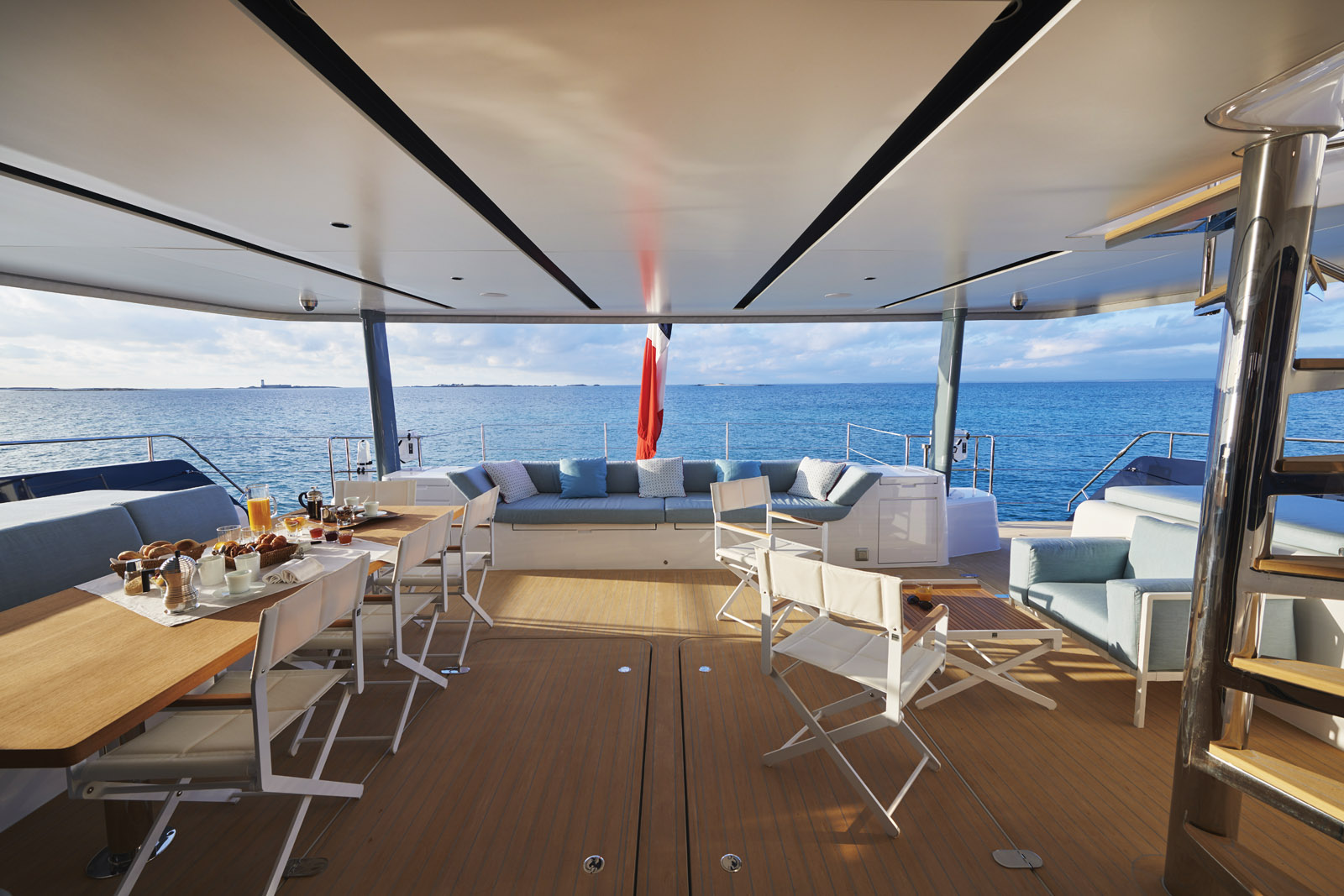
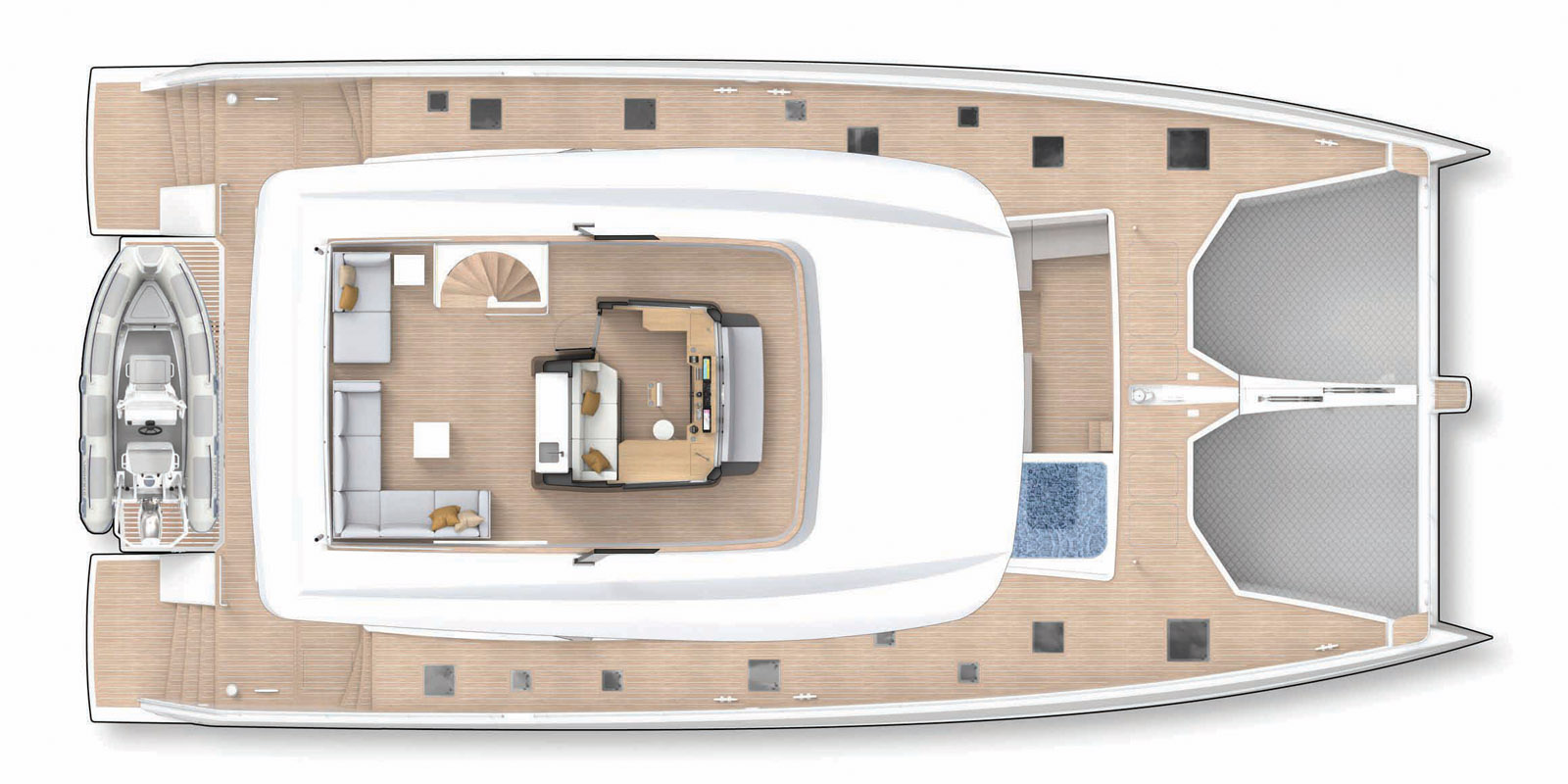
A spiral staircase leads from the aft cockpit to the flybridge.
15 to 20 tons less than its equivalent in small production runs
Because a boat, let alone a multihull, has to be as light as possible, the bulkheads are in sandwich, just as Plexiglass was preferred to regular glass for the windows. As a result, the Long Island 78 Power weighs one ton less than the Marc Lombard Yacht Design Group’s calculations, even though known to be particularly demanding in this field. Better still, compared with equivalent small production units, it is lighter by 15 to 20 tons, leading to a more than significant gain in performance and/or fuel consumption. In fact, both shipowner and shipyard are serene, the targeted speed of 15.5 knots has been largely achieved, 12 knots cruising speed is a formality, and a 3,000 nm range at 8 knots is within reach of the two 500 HP Cummins engines.
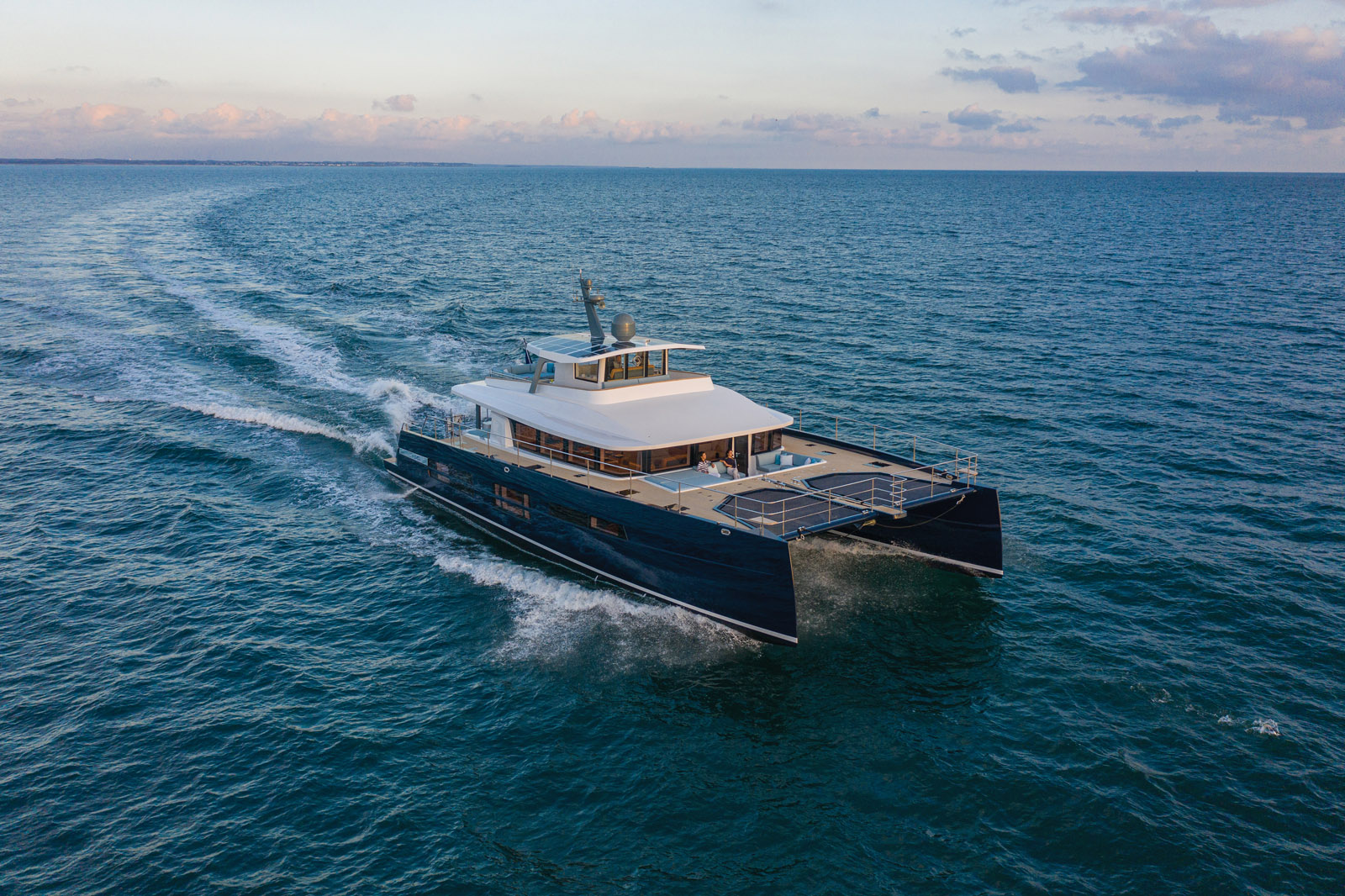
The maximum speed of the Long Island 78 is limited to 15 knots. But it’s capable of covering 3,000 nautical miles at 8 knots
A helm station on the upper deck
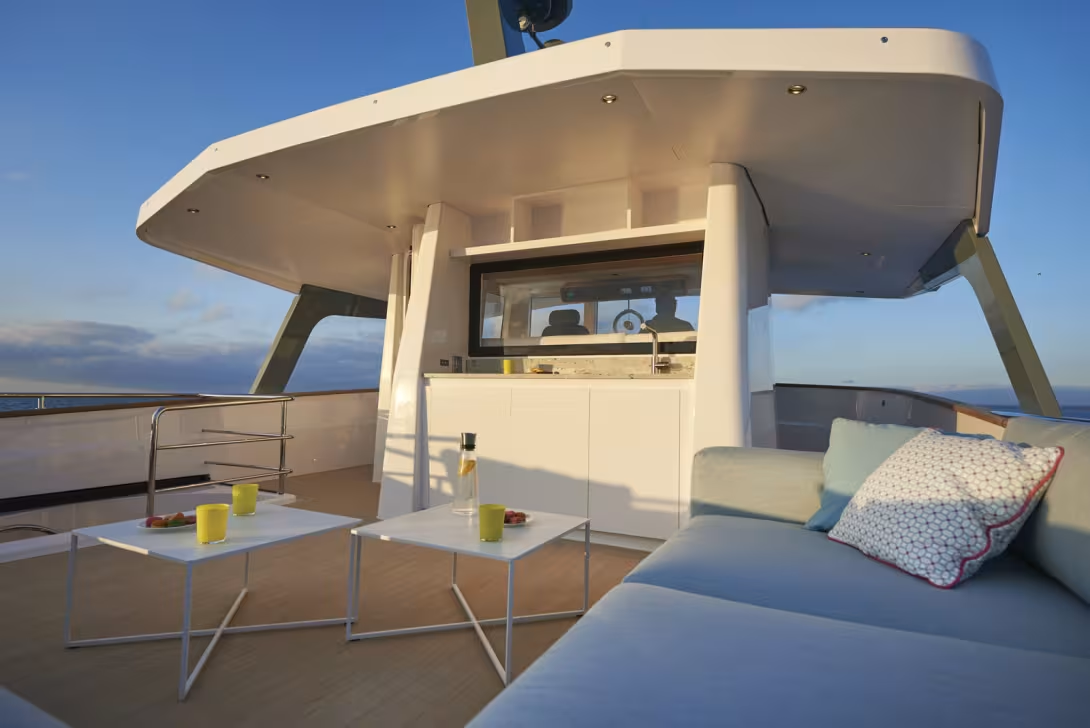
These transoceanic capabilities will allow for discovering distant horizons and, above all, latitudes much further north than that of Concarneau (France), where the JFA shipyard is based. The helm station on the upper deck will be a marvel. A key element of the specifications established by the owner, it integrates rather elegantly into the overall lines of the Long Island 78. The angle of inclination, the thickness, and the fore and aft canopy extensions are all subtly balanced for both aesthetic and practical reasons. From the inside, you can helm without being hindered by the light - the corridor around it is completely covered and discreet blinds conceal even the most horizontal rays of sunlight. Even the rain will not spoil the view thanks to the rotating porthole - a very professional touch - attached to the central glazing. The electronics are neatly integrated on two consoles with rounded corners for the most beautiful effect: one in front of you, the other suspended from the ceiling, like huge touch-screen tablets. A design gimmick that will delight is found at the main deck chart table: the swiveling helm seat, pullman model, slides on two Harken rails on the floor. We would have lauded this feature had it been integrated rather than protruding, but we are still impressed by the function. Indeed, what an incredible space of conviviality it forms, once offset, with the long bench seat located at the rear of the cabin! Sheltered from any apparent wind, heated, far from the hum of the engines, with a 360-degree view of the sea and all the controls at hand, this helm station will undoubtedly be a place as sought-after as it is cozy for all passengers. The large composite helm station elegantly reflects the owner’s sailing past. It should be noted in passing that the 270 square feet (25 square meters) covering this space house 3,800 W of solar panels. This strongly limits the use of the generator at anchor, where, in good weather, the aft deck of this flybridge is an invitation to relax between the bench seats, sunbathing area and outdoor galley.
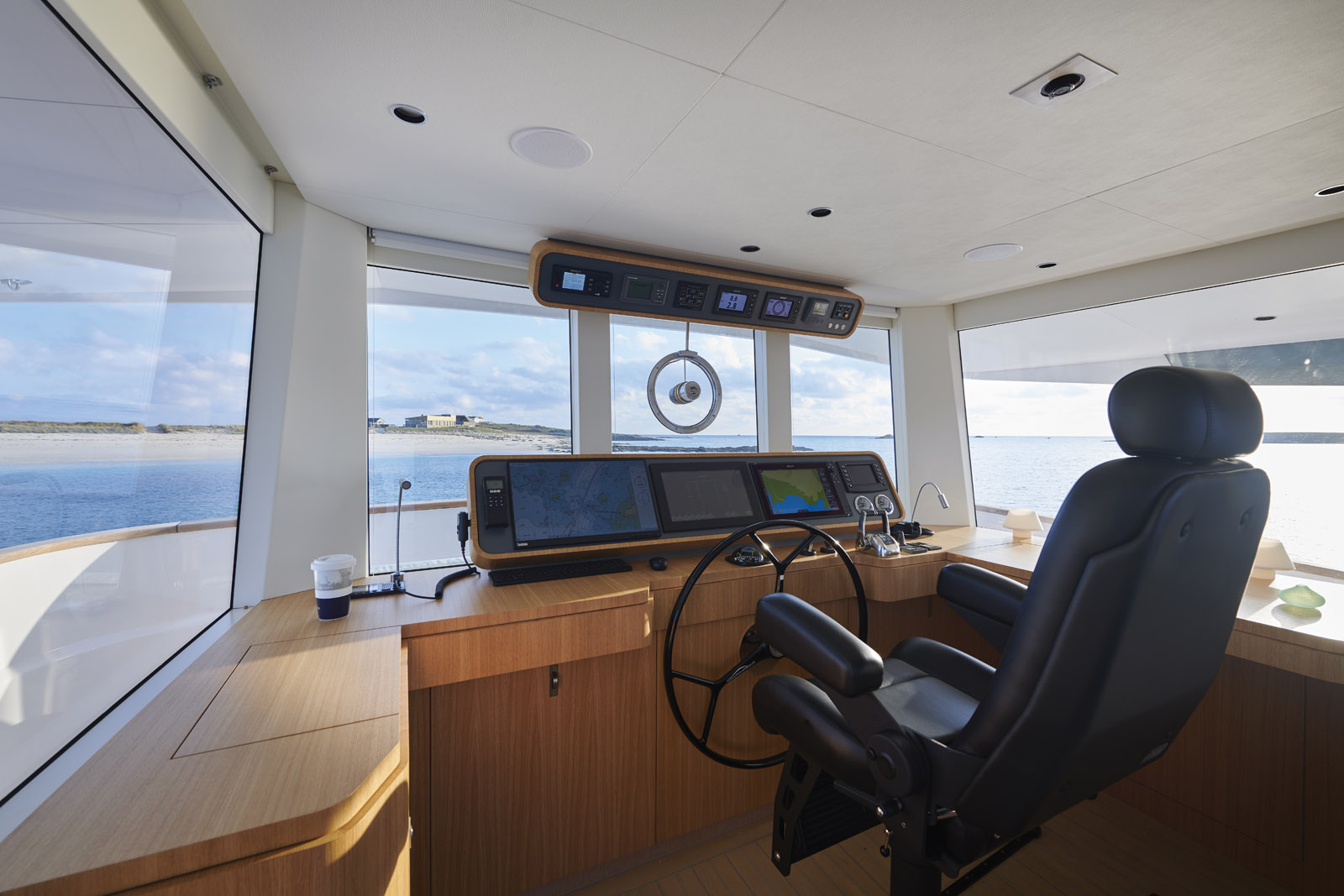
Sober and contemporary luxury
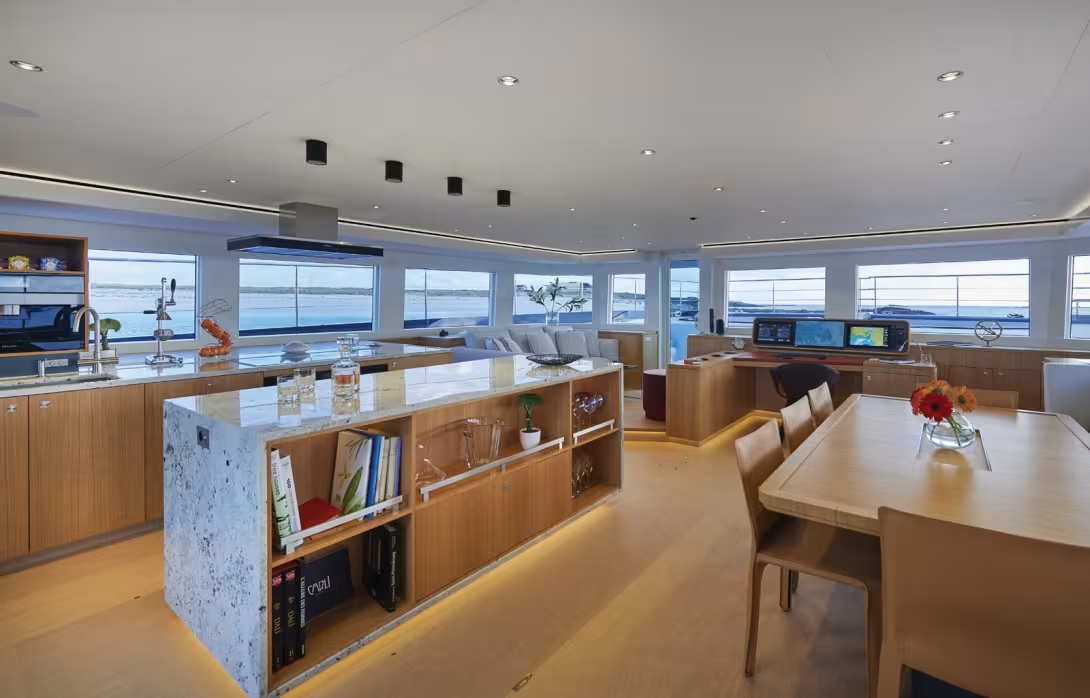
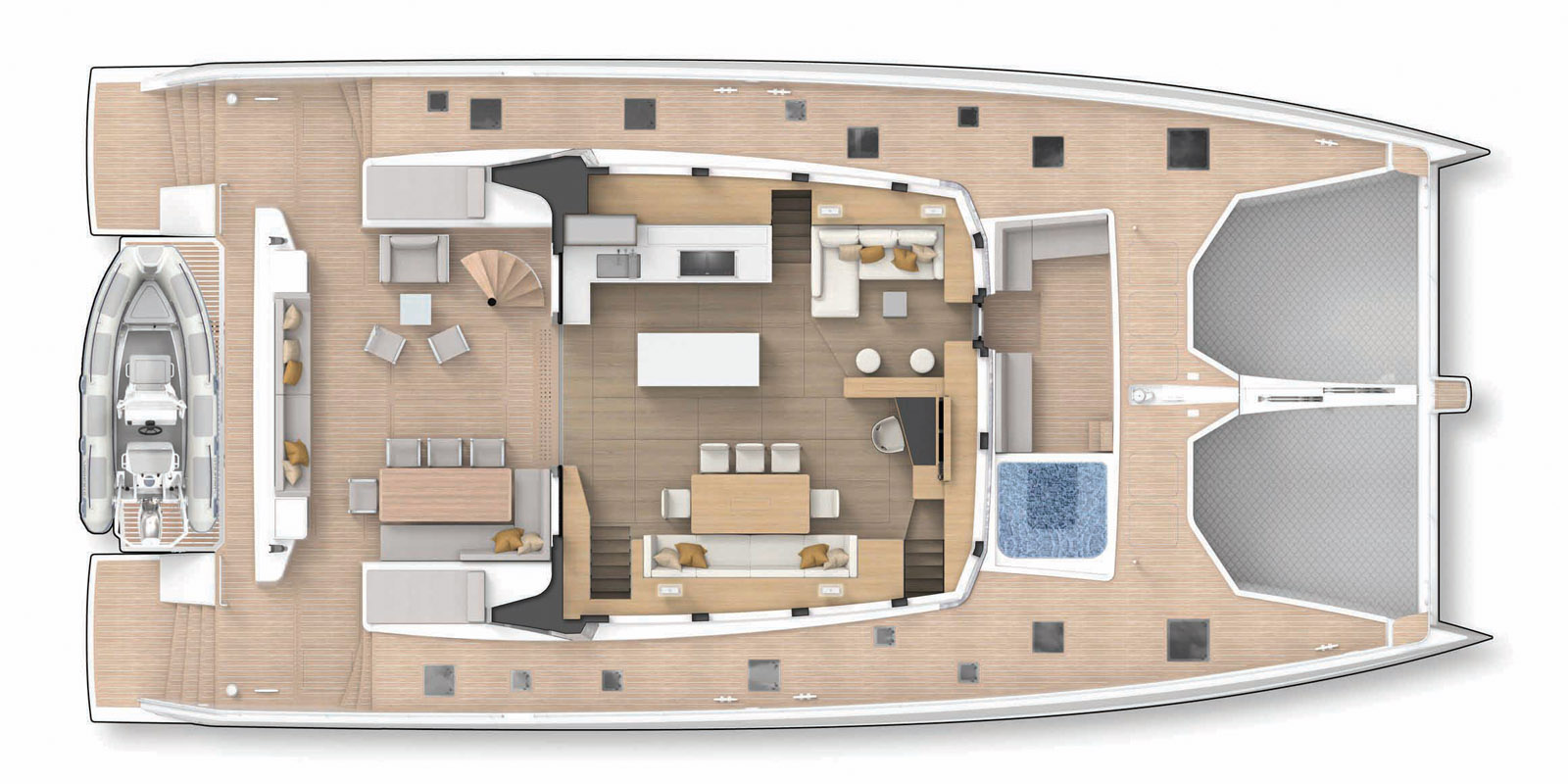
The spiral staircase, whose stainless-steel structure celebrates like a trophy the know-how of the shipyard’s metalworkers, leads you to the main deck. From the stern to the bow, from the wide sugarscoops to the pulpits, from the vast cockpit to the nacelle, and even to the forward cockpit, the layout is most traditional. But isn’t luxury hidden in the details? Yes, certainly, just like the cockpit ceiling: it integrates two inserts for the electronics so that the main navigational data is always within view. But also, by discovering the storage space dedicated to the cockpit enclosure covers: elegant and subtle. Once you get past the wide (7’10” / 2.38 m) electric bay window, the sober and contemporary luxury of the interior is revealed. The proportions of the central island, a granite monolith, allow perfect circulation between the galley on the port side and the dining table to starboard. Around the latter, 10 guests will dine in absolute comfort. Here too, the view is truly panoramic, thanks in particular to the impressive telescopic galley unit. The same is true once you are comfortably seated in the forward saloon. This has been raised by only a few inches, which makes all the difference. A detail which is not really a detail, as noted by Fred Jaouen – JFA manager - during an express return trip to the Caribbean for a very short stay aboard the owner’s previous catamaran. In a similar position, the glazing being too high, one lost all vision of the outside - an inexcusable lack of taste which has been carefully avoided on this new opus.
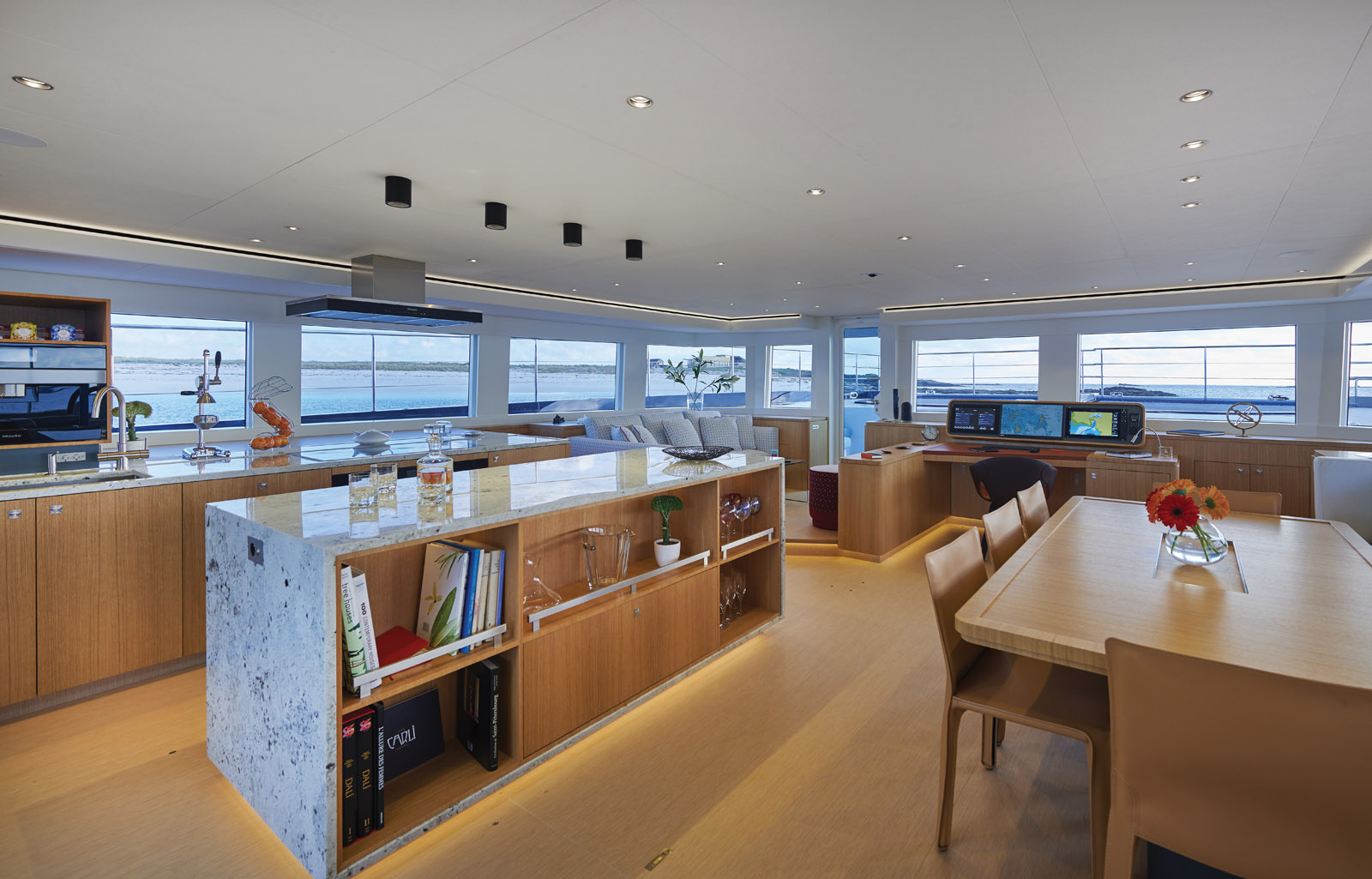
The nacelle incorporates an imposing galley with a central island, a large saloon, and a navigation station.
Seawater bathing rather than jacuzzi
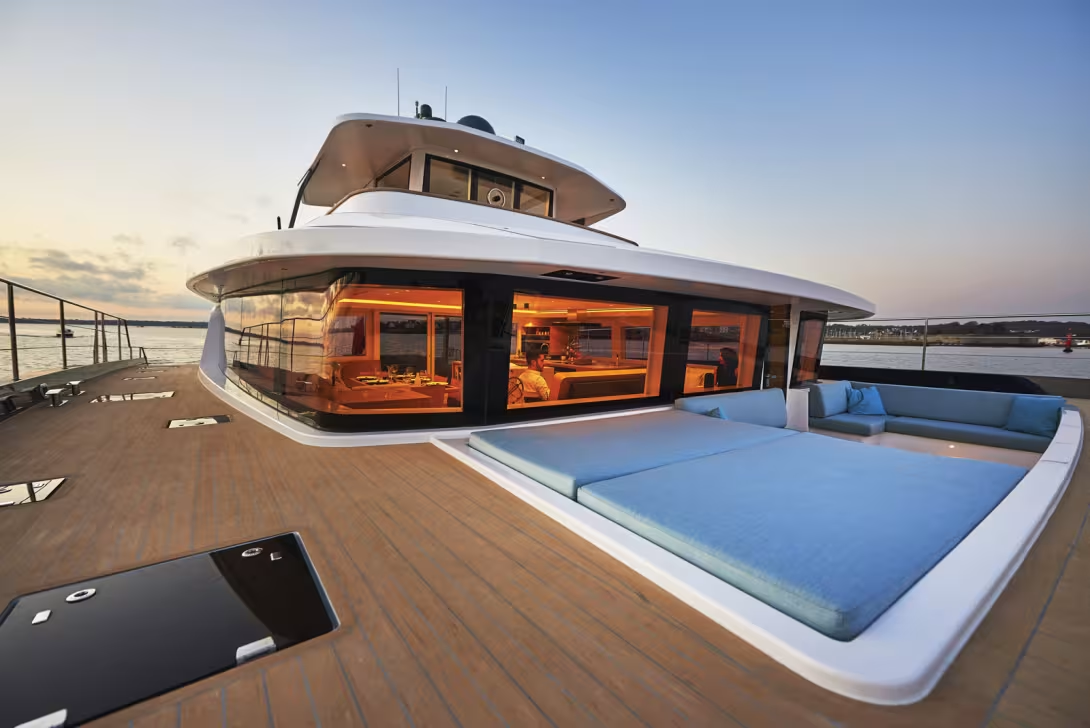
To starboard, the long chart table/desk stands out by the use of the same leather upholstery on the seat as on the furniture. The skipper will be able, among other possibilities, to share navigation information on the very large central TV screen. Capable of swiveling 360 degrees, it can also be discreetly stowed away in its storage area. Towards the bow, a solid door gives access to the forward cockpit. Two very large U-shaped benches face each other over two thirds of the surface area. On the starboard third, a sunbathing area - flush with the deck - hides a simple and pleasant seawater bath. Shipyard and owner are on the same wavelength to avoid the complexity of a real Jacuzzi. Since we have been on board, we have been looking for a defect in this vessel... We finally found one: no steps have been provided to go from this cockpit to deck level. What make this worse, you’ll have to stand on the comfortable benches and their delicate white opaline upholstery. Of course, the teak deck with its distinguished light grey caulking is never interrupted by a single deck hatch. Like the large storage lockers, all openings have the good taste of being perfectly flush. In the midships axis, a longitudinal beam houses the two solid anchoring lines and the no less imposing windlass. The mooring cleats are reassuring and elegant, if not discreet. The rigid upper stainless-steel railing will win you over: secure in the pulpit, you’re on board the king of the oceans!
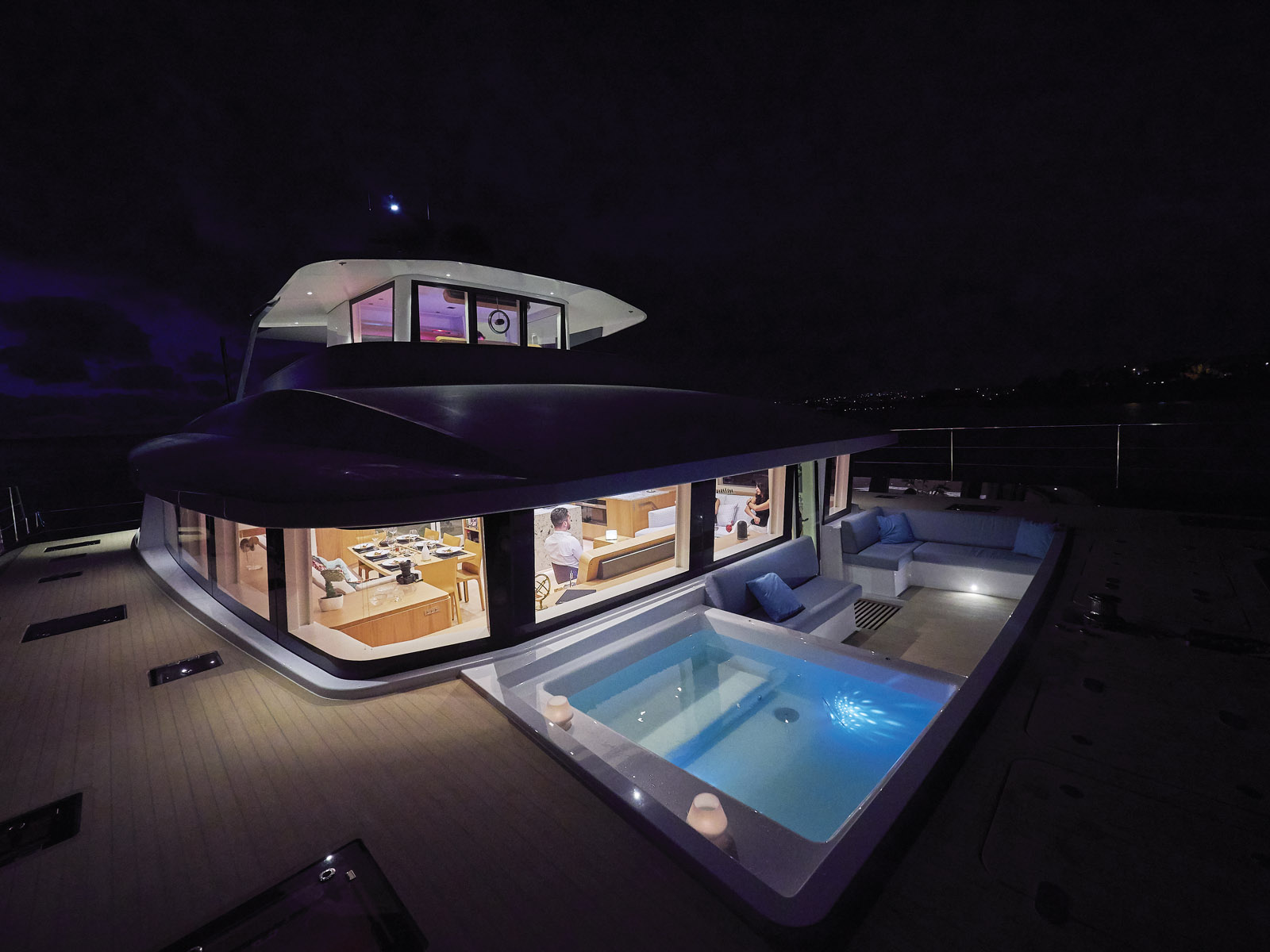
The forward cockpit offers a large sunbathing area on the starboard side - which overlooks a mini seawater pool.
Half a hull for the owner
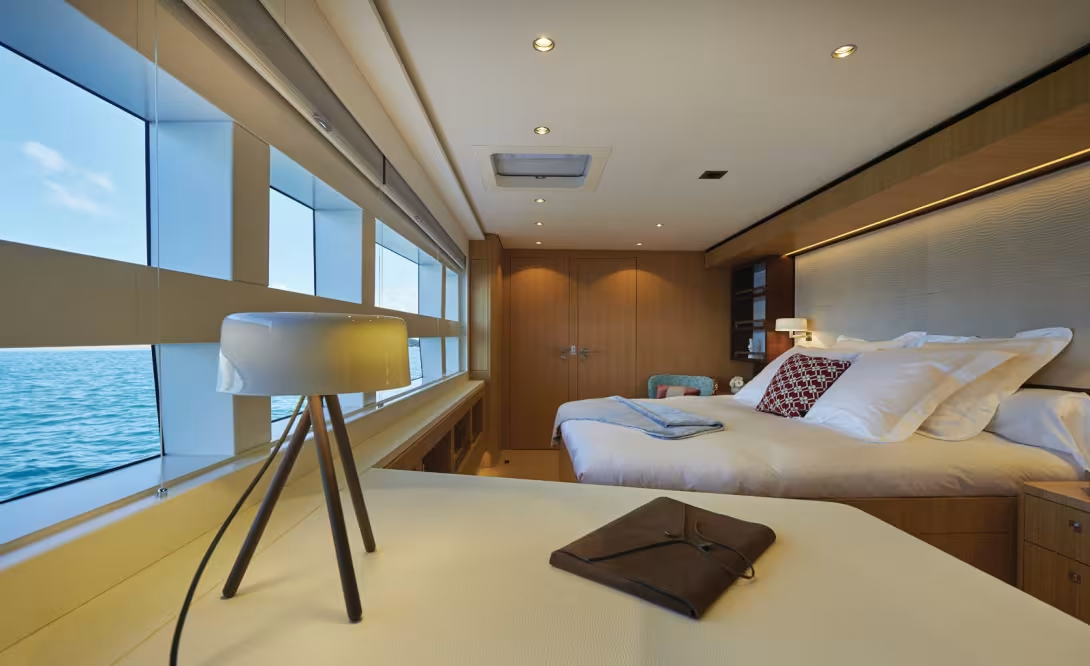
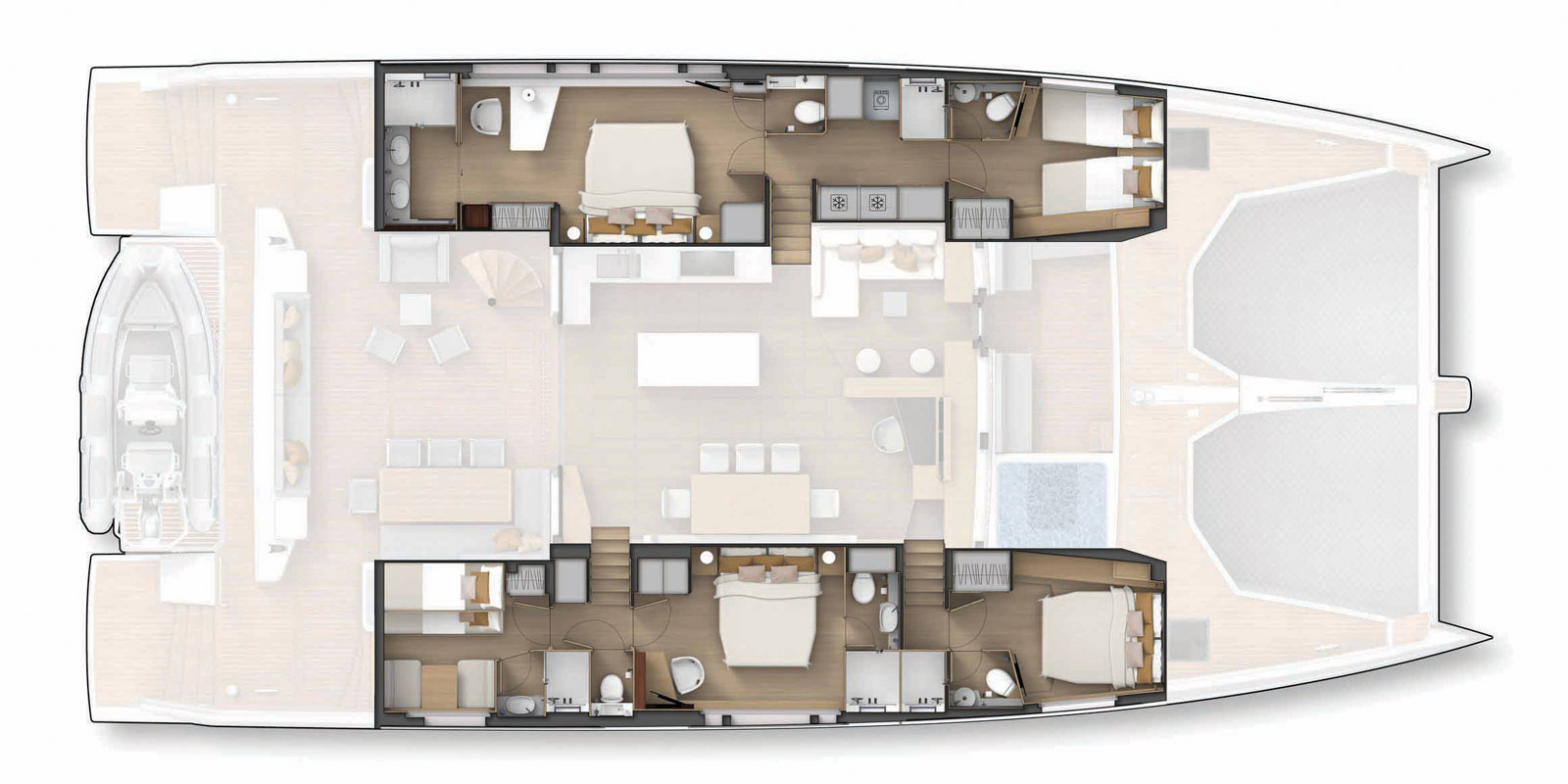
And if you still had any doubts, a short visit to the owner’s apartment will be able to clear up your uncertainty. Occupying the aft section of the port hull, this real suite offers a breathtaking view of the sea from the king size bed (6’x6’7” / 180 x 200 cm). At 13 feet (4 meters) long, in double height, the windows flood the cabin with light. The footless desk, suspended from the topsides, is as if weightless; it is light, like the woodwork. Also built in-house, they are in sandwich for lightness, and incorporate a thickness of rubber to improve sound insulation. The veneers have the blond color of real light oak - less uniform, and warmer than Alpi. On the bedside tables, desk and shelves, 3/8” (10 mm) circles of darker areas mark the induction zones for recharging cell phones; a delicate attention to detail. A large sliding door gives access to the bathroom: the double washbasin, XXL mirror, towel warmer on hot water circuit and walk-in shower would not be out of place in a 5-star hotel. The extra trick: the mirror slides out, revealing a cinemascope format porthole with a direct view of the wake. Even the most luxurious hotel can’t offer you that... Guests will be divided among the three other cabins. The most spacious one occupies the central space of the starboard hull. With its wide side windows facing the Queensize bed (5’3” x 6’7” / 160 x 200 cm), its bathroom with large separate shower and desk area, the VIP cabin qualification is really not inappropriate. The two forepeaks are occupied by a twin cabin on the port side, ideal for children, and a double cabin with a private companionway from the nacelle to starboard. As for the crew, they have two bunk beds on the aft starboard side, a small independent saloon and a shower room just as comfortable as the guests enjoy. The toilets are separate and accessible directly from the passageway at the bottom of the companionway, making them easily accessible for any temporary guests.
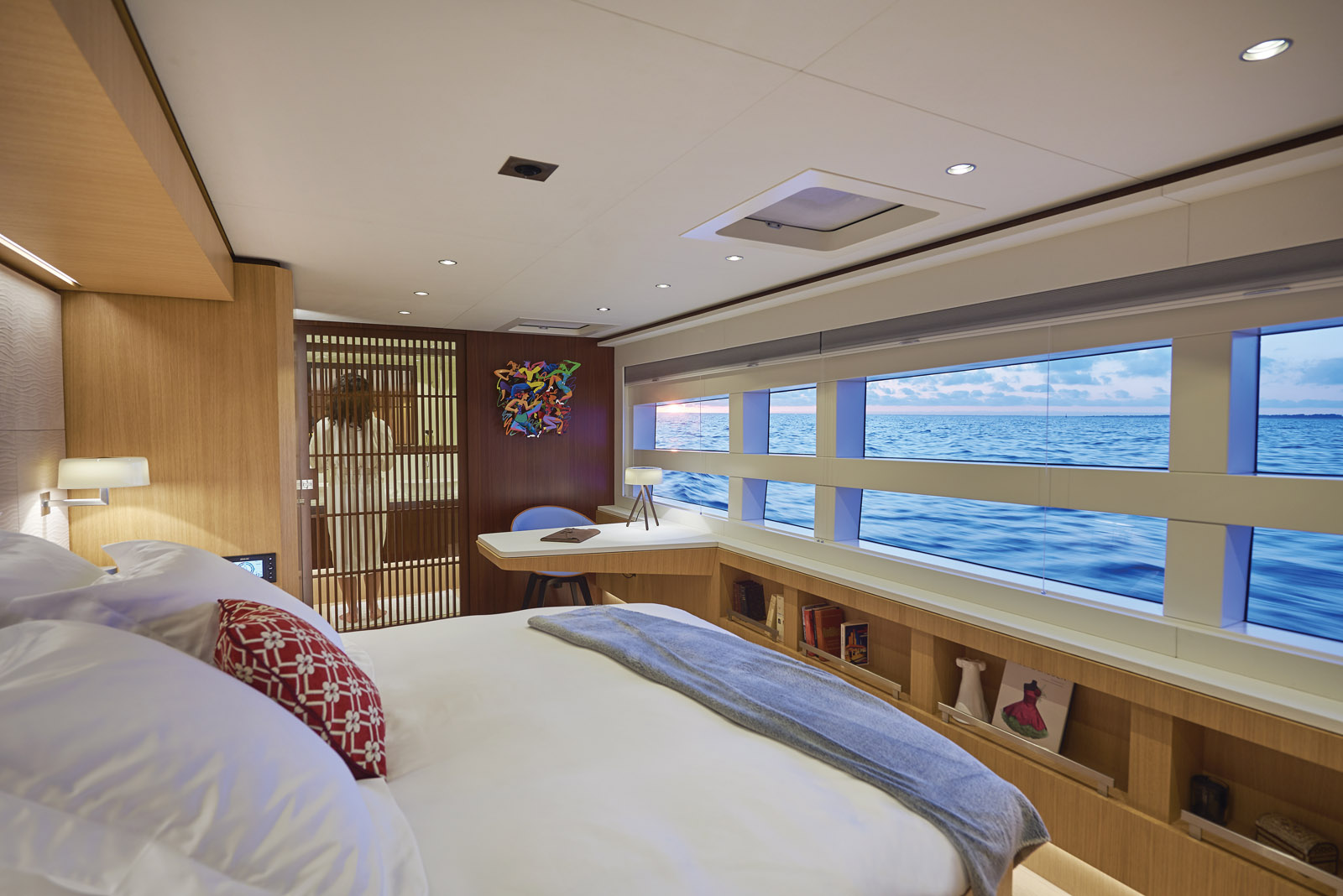
The privilege of the Owner’s cabin? To have half of the hull, a king size bed, and a breathtaking sea view…
Technical mastery
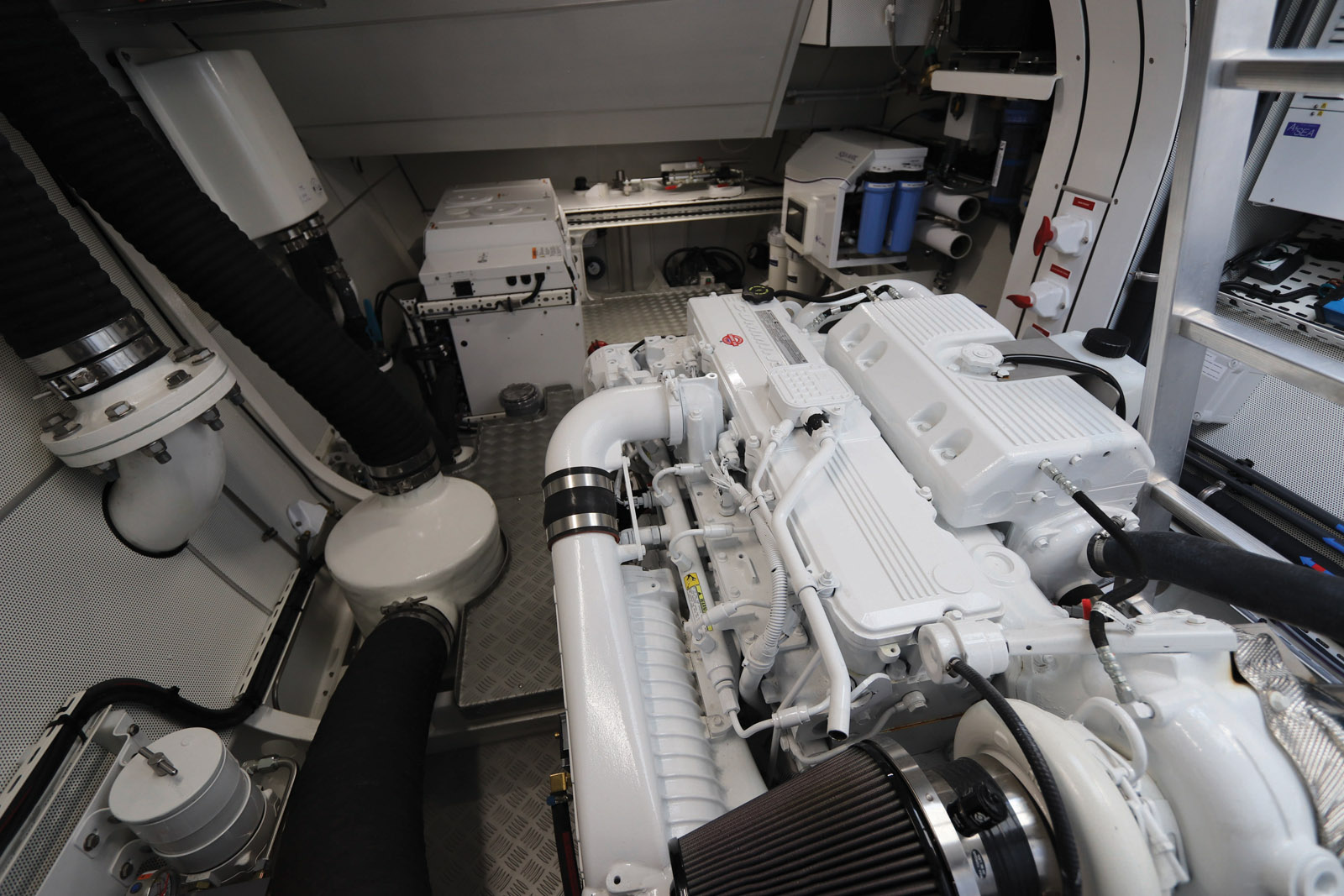
After such a taste of luxury and voluptuousness, plunging into the technical mysteries of the vessel might seem tedious. But this is not the case. Going down to the engine rooms gives yet further confidence, if it were needed, in the know-how of the JFA shipyard. The care given to the installation is highlighted by the clinical white: Cummins 500 HP V-Drive engines, Onan generators of 17.5 kW each, Sea Recovery watermaker, painted aluminum structure and soundproofing panels, all these elements are therefore white. Though the headroom is limited, there is enough space to move around and work efficiently. The batteries are hidden in their watertight boxes under the non-slip aluminum floors. Nothing is missing, not even a 30 HP retractable electric bow thruster in one of the two huge forward storage lockers. It’s quite an outfit but everything seems to be understandable. On purpose, the electrical circuit remains conventional, as Ethernet networks do not offer the same level of reliability according to the manufacturer’s criteria. Between the two large 43 sq ft (4m²) sugarscoops, a hydraulic platform raises a tender that can be up to 16’ (5 m) long. Even when in place and under way, a gangway allows for crossing from one hull to the other without going through the cockpit. The crew will appreciate this.
 |
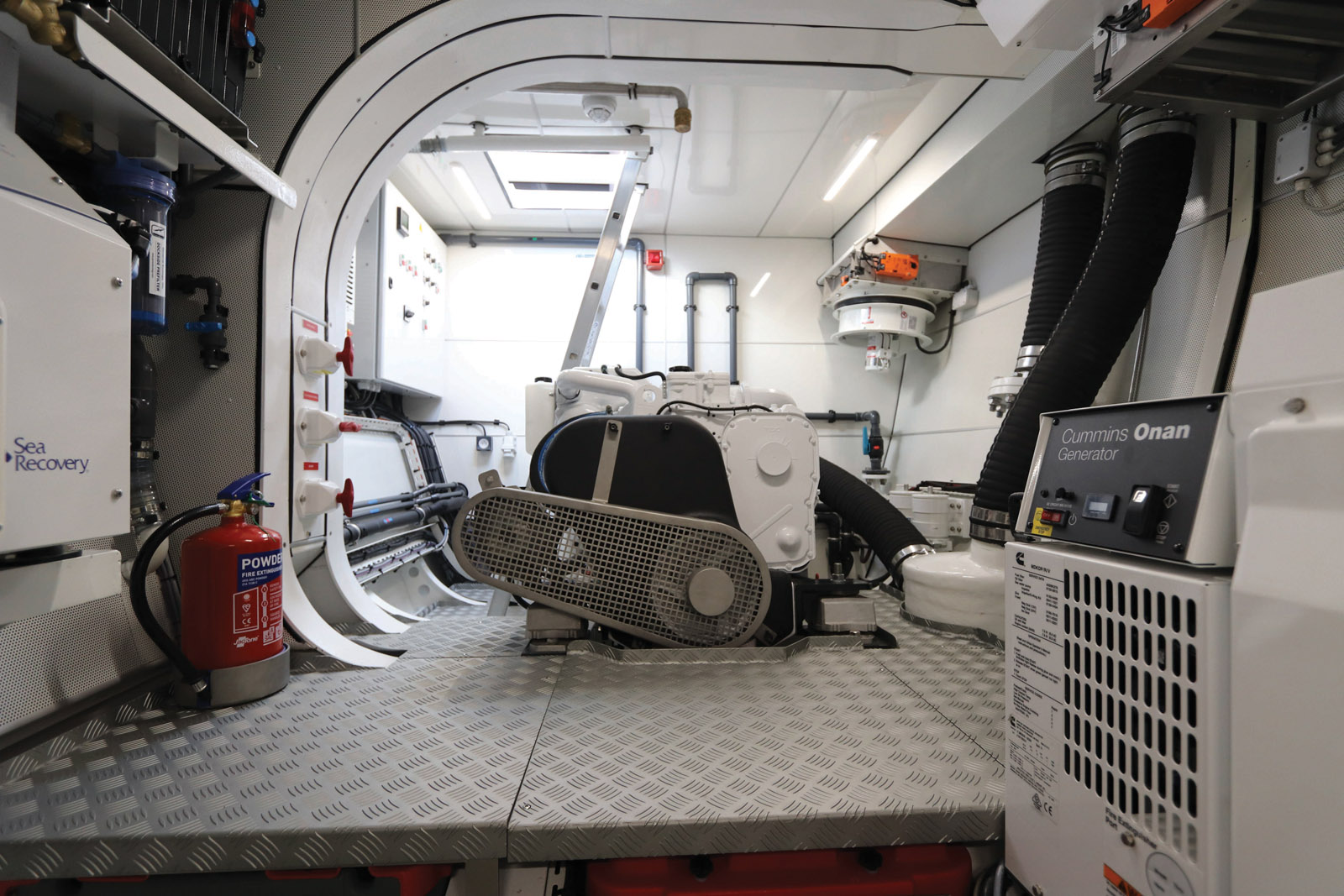 |
Most of the technical equipment is white - the message is clear: cleanliness, reliability, and ease of maintenance.
Conclusion
Everything is just perfect for exploring lagoons, rias, and fjords, with the Long Island 78 Power serving as a luxurious base camp. With its shallow draft and well-centered weights ensuring serene passage through the sea, the happy owners of this elegant catamaran can put their finger on any point on the globe and get there in a very reasonable time. The comfort on board is irreproachable. At the price of extremely thorough integration in production, the finish is equally high-end. We are struggling to find any defect in this catamaran that is still unique to this day. “It’s a proper boat” concludes Fred Jaouen: including, among other things, very nice lines and with weight under control. If other owners are quickly seduced, we would not be surprised.
The pluses
+ The helm station is a must
+ Standard of finish in every detail
+ Almost unlimited program
The minuses
- Access to the deck from the forward cockpit
- A hunt for weight that is sometimes too extreme? Plexiglass instead of glass, lower guardwires in fiber…
- “Laundry” to port, crew to starboard
TECHNICAL SPECIFICATIONS
Builder: JFA Yachts
Naval architecture: Marc Lombard Design Group
Interior design: Darnet Design
Length overall: 77’10” (23.72 m)
Hull length: 75’8” (23.06 m)
Waterline length: 75’6” (23.0 m)
Beam: 36’8” (11.17 m)
Draft: 4’1” (1.24 m)
Light displacement: 50 t
Laden displacement: 64 t
Hull material: aluminum
Deck: polyester composite
Capacity: 10 people
Propulsion: 2 x 500 HP Cummins QSC 8.3
Generator: 2 x 17.5 kW Onan
Diesel tanks: 2 x 1,055 US gal (2 x 4,000 l)
Water tanks: 2 x 210 US gal (2 x 800 l)
Cruising speed: 12 knots
Max speed: 15 knots
Range at 8 knots: 3,000 nautical miles
Price: on quotation
 |
 |
 |