Designed and built for long-distance cruising, this powercat is re-establishing the tradition of trawler yachts, bringing space, unprecedented versatility and a good dose of customization possibilities.
Infos pratiques
- Le chantier : Longreach 1900
- La fiche technique
-
 Découvrez notre vidéo exclusive
- Financez votre Longreach 1900
- Assuez votre Longreach 1900
- Articles autour du Longreach 1900
Conditions: sea calm then moderate from ahead
While the power catamaran market is orienting itself ever more toward fast, planing hulls, there are still a few trawler catamarans designed with displacement hulls. Trawler versions, like this Longreach 1900, use displacement to add stability and frugality, so make for ideal passage-making vessels.
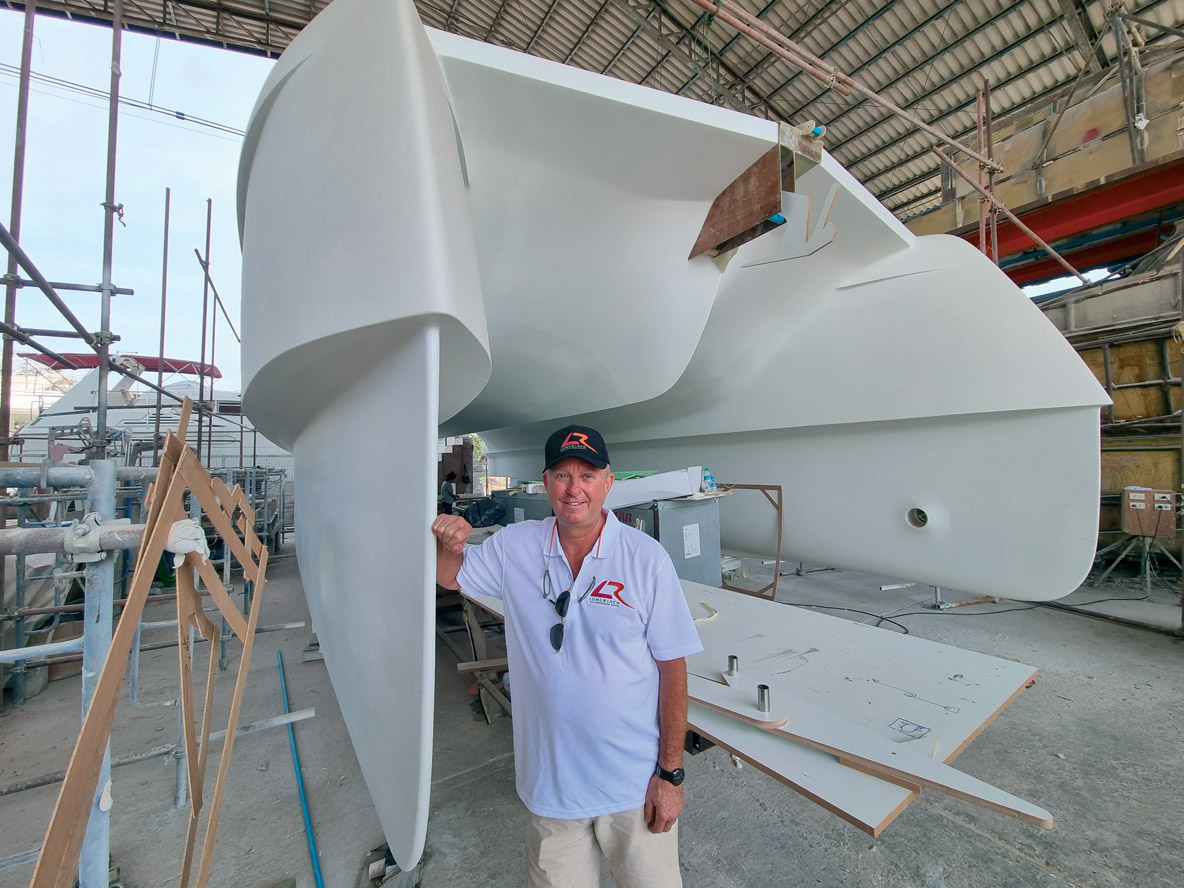
Longreach’s concept was the brainchild of Australia’s experienced team at Multihull Central in Sydney who combined with the well credentialled PowerPlay yard. Owned and run by designer/master builder James Dewing for 20 years and now based in Thailand after moving from his original yard in Queensland, where his naval architect Tim Withrington still resides. “I visited the Ocean Marina marine precinct and thought, this really is fantastic – for services and nearby water access,” explained James. Australian boaters will be acquainted with his sleek and curvaceous PowerPlay designs, the most recent of which launched in 2020 from his well- established yard an hour south of Bangkok on the Gulf of Thailand. Andrew McLeod, along with Brent Vaughan, clearly saw a gap in the market for a long- range trawler catamaran. They decided to create Longreach, with the goal of producing powercats offering a range of around 3,000 nautical miles at a speed of 8 knots. Three years later, as the first hulls are just being splashed, the objective seems to have been reached. To push the concept even further, Longreach offer two versions of the boat, Bluewater and Expedition. The latter of these gives a lot more autonomy via solar, more all-weather protection thanks to an enclosed cockpit and flybridge, something fairly unique.
A profile reconciling elegance and aerodynamics
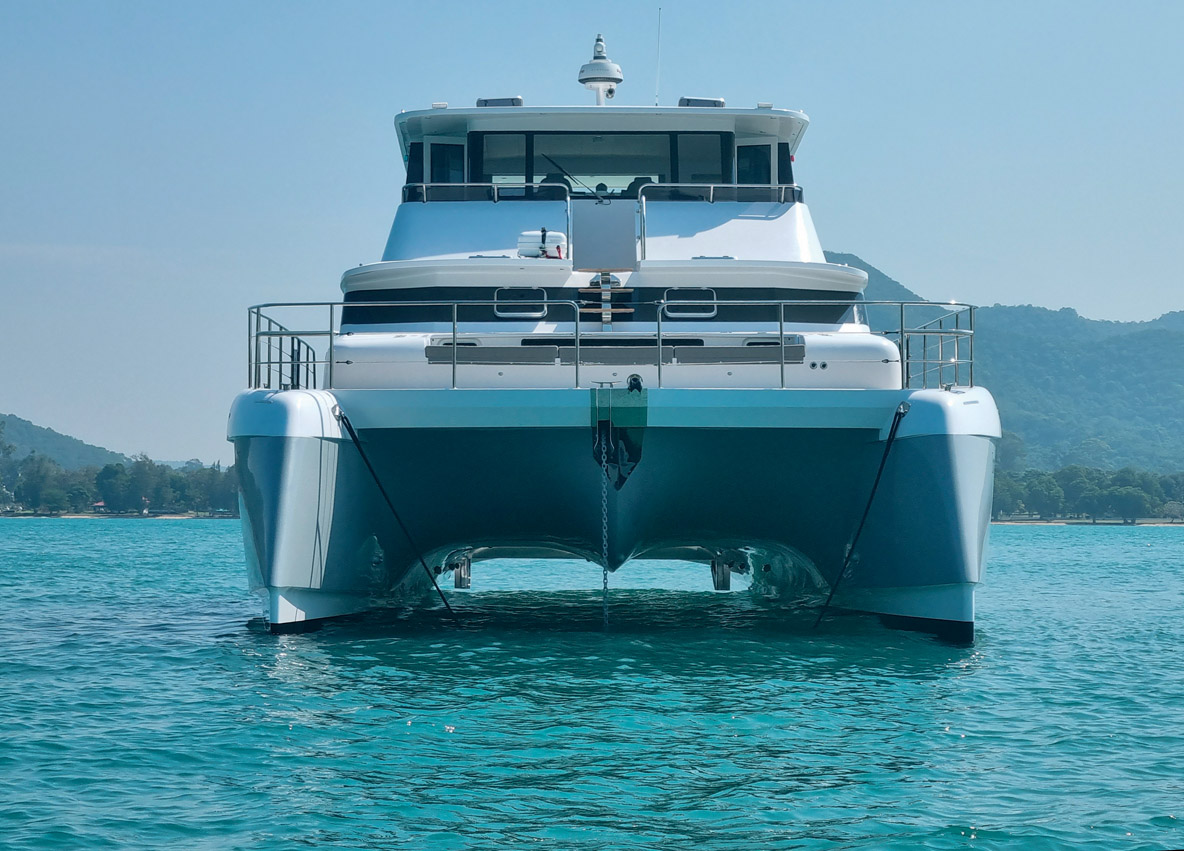
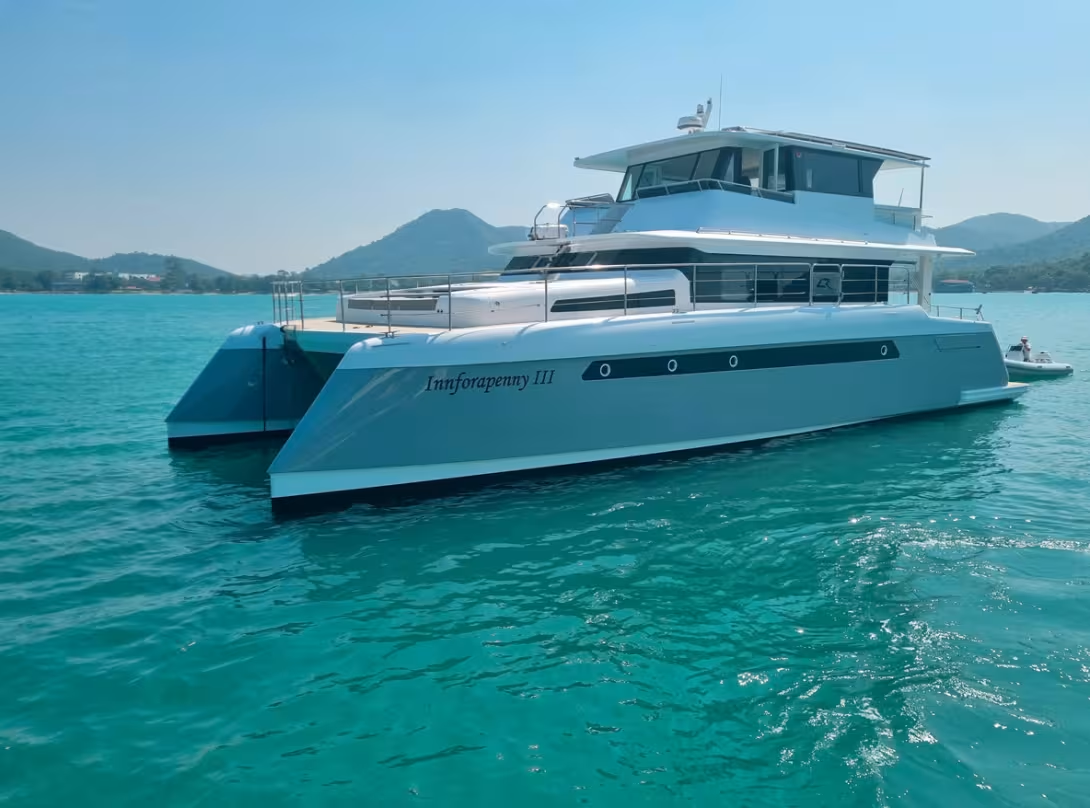
The model lineup consists of the Longreach 1200 (12m/40ft), the Longreach 1400 (14m/44ft) and the Longreach 1900 (19m/62ft). All use a development of the proven PowerPlay hulls that James Dewing designed to minimize drag while having enough volume to take a substantial cruising load. In addition, the Longreach range also has reverse bows and raked-back bulkheads, above deck and through the flybridge. The aesthetics were striking to my eye and very pretty. But this was not merely style over substance because those raked lines reduce windage; always the bane of flybridge boats.
Suntanning forward, entertaining aft
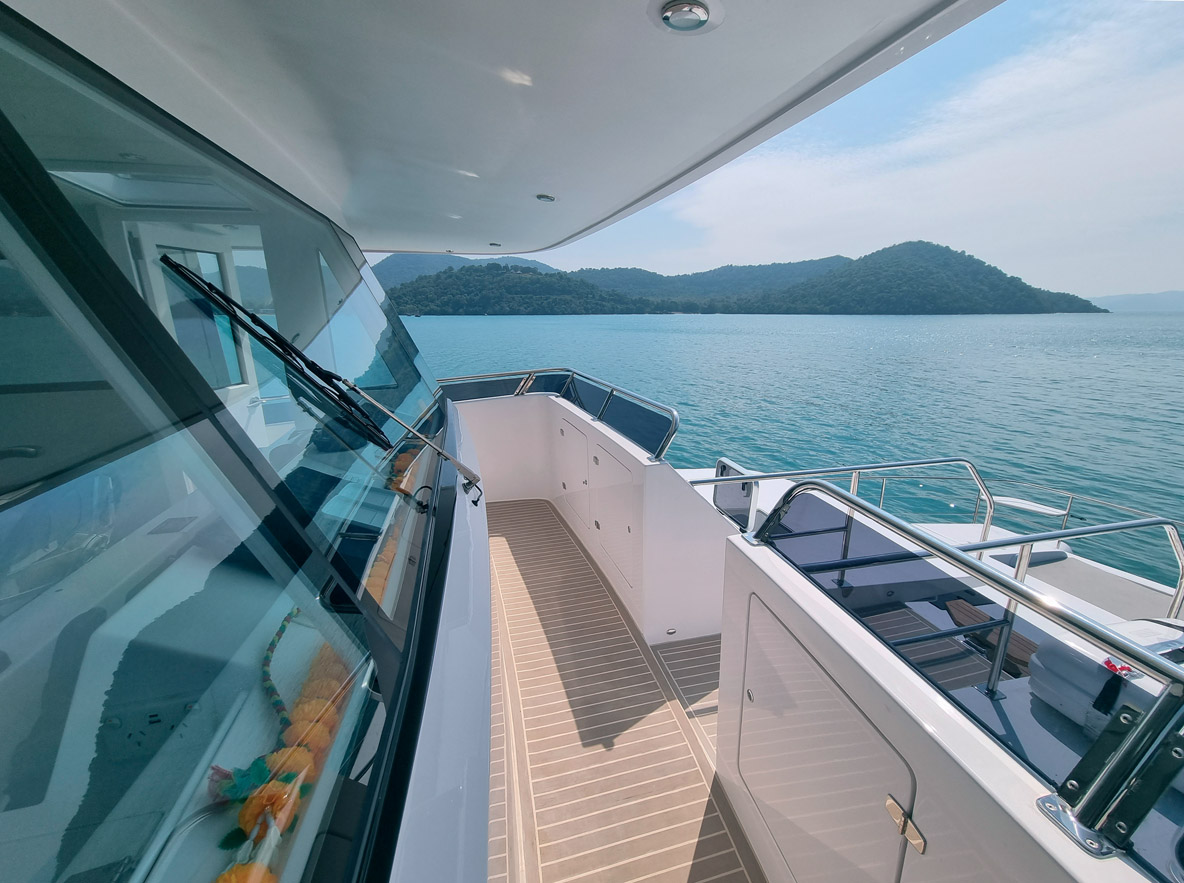
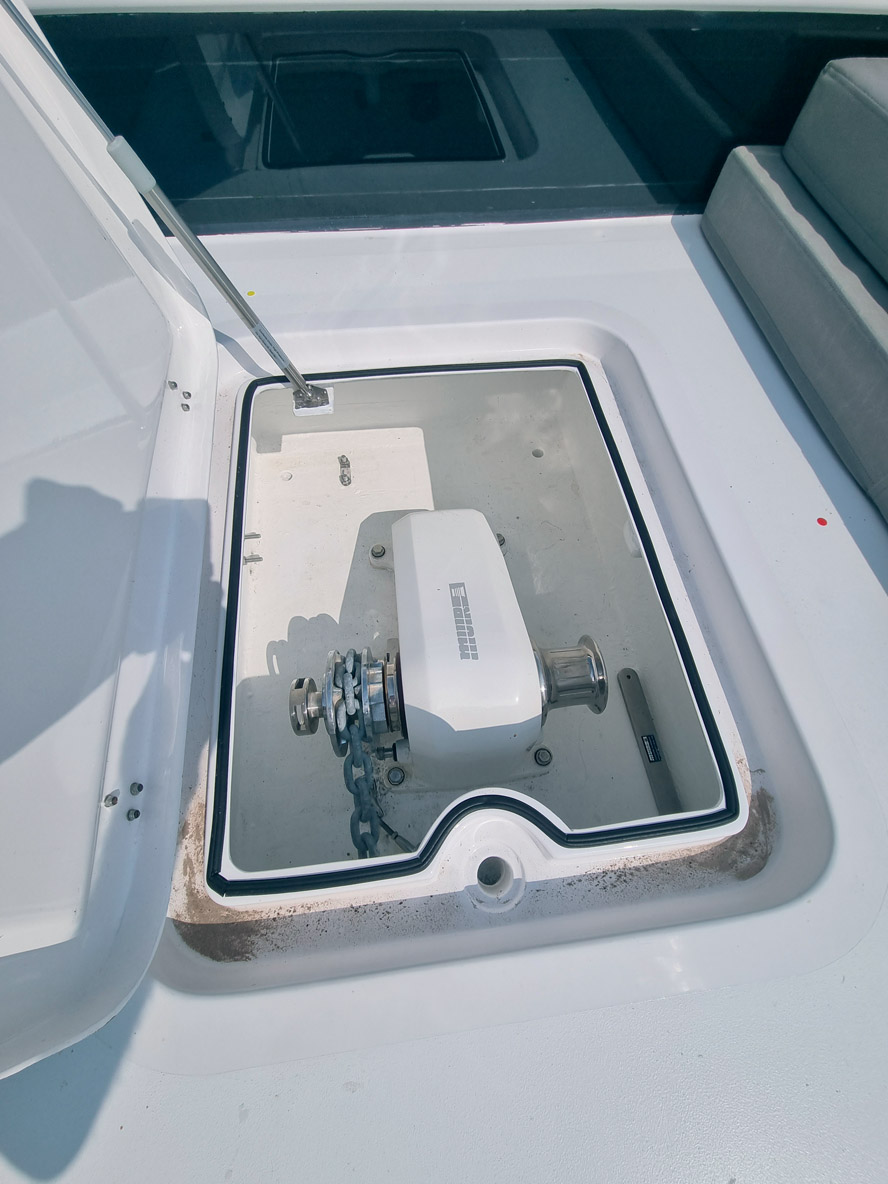
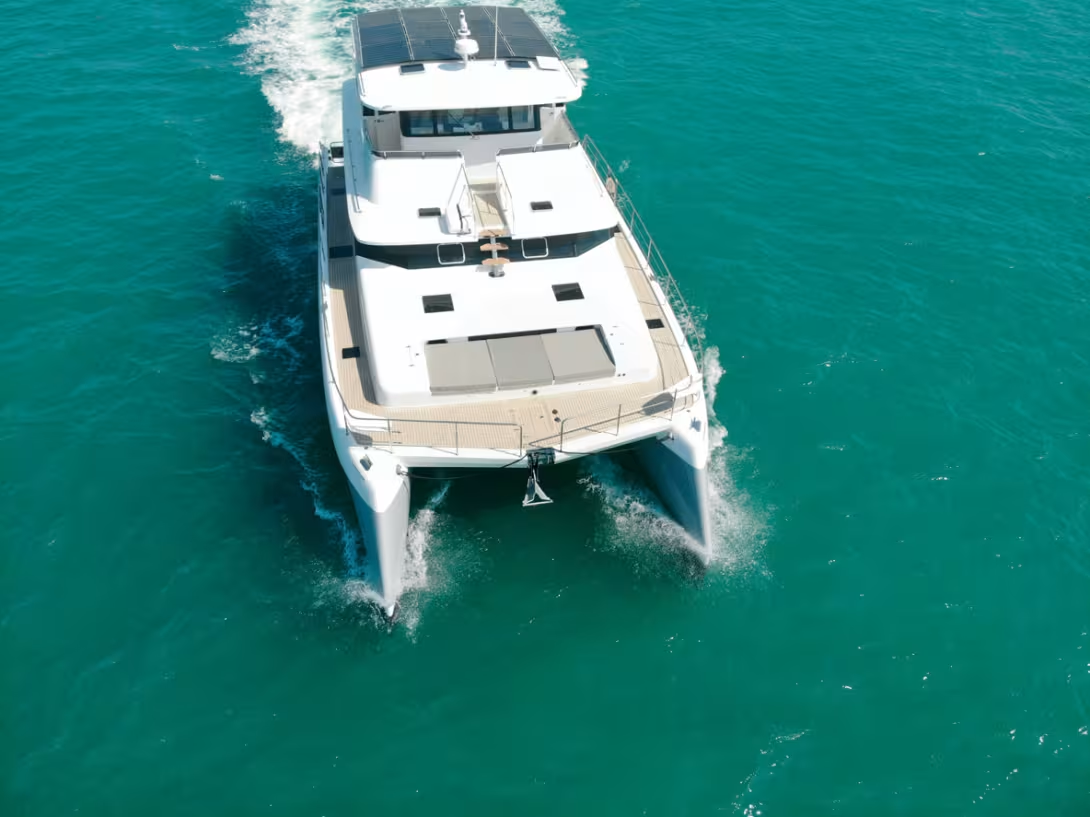
Even though the Longreach is a fairly enclosed catamaran, it features good cockpit areas, starting up on the foredeck. Sturdy handrails offer plenty of space for sunloungers and a walkway directly accessing the flybridge. Good practicalities include deep locker space for the fenders and much more, while the essentials are also good – a 4,000w Muir horizontal windlass inside a deep chain locker with a short run of the rode to a hefty 65kg/145 lb Excel anchor below the alloy cross beam. Other essentials are cleating all round, although I would up-size them. Moving back to the stern with Plasdeck cladding underfoot, the area is fully covered from the flybridge overhang. Here, the Expedition boat has this enclosed on all sides with doors, while the more conventional open design is on the Bluewater boat with transom bench seating and alfresco table space with engine hatches on each side.
A fully open main deck
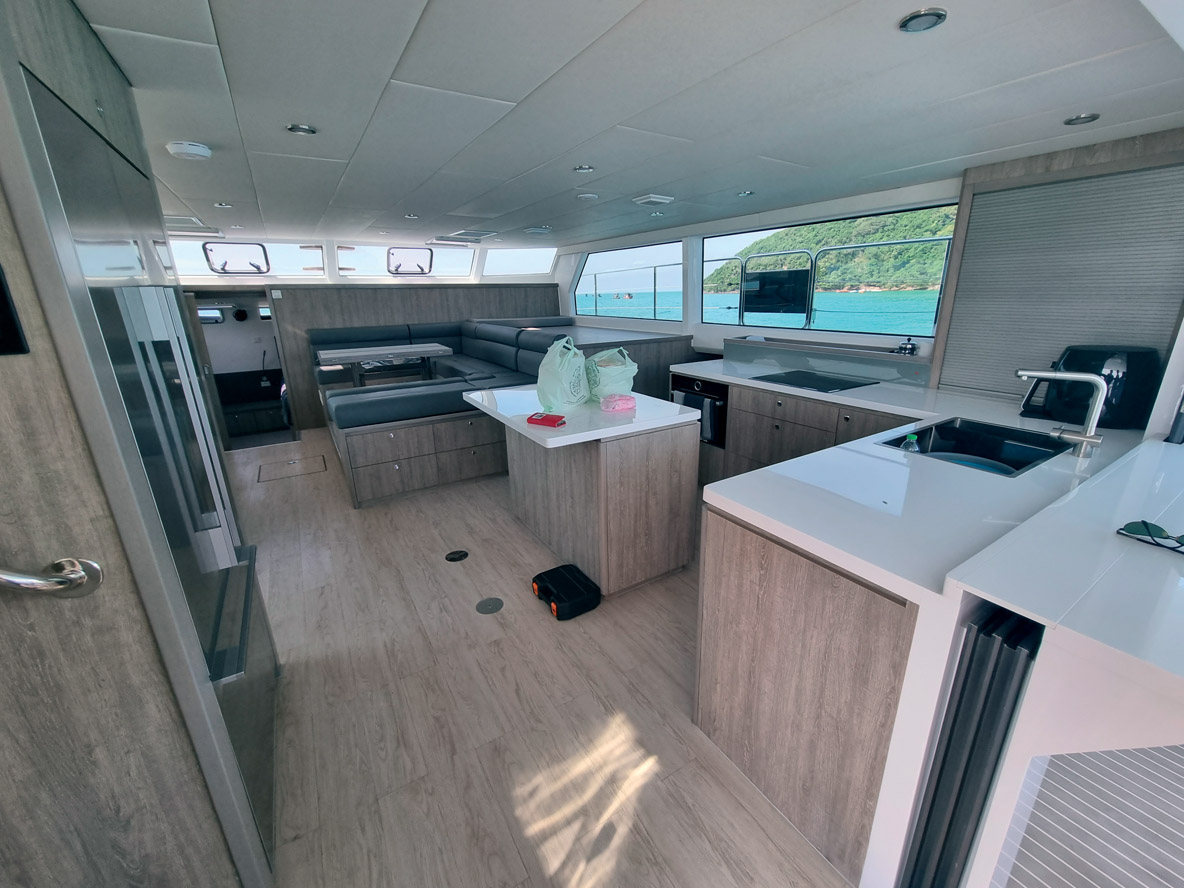
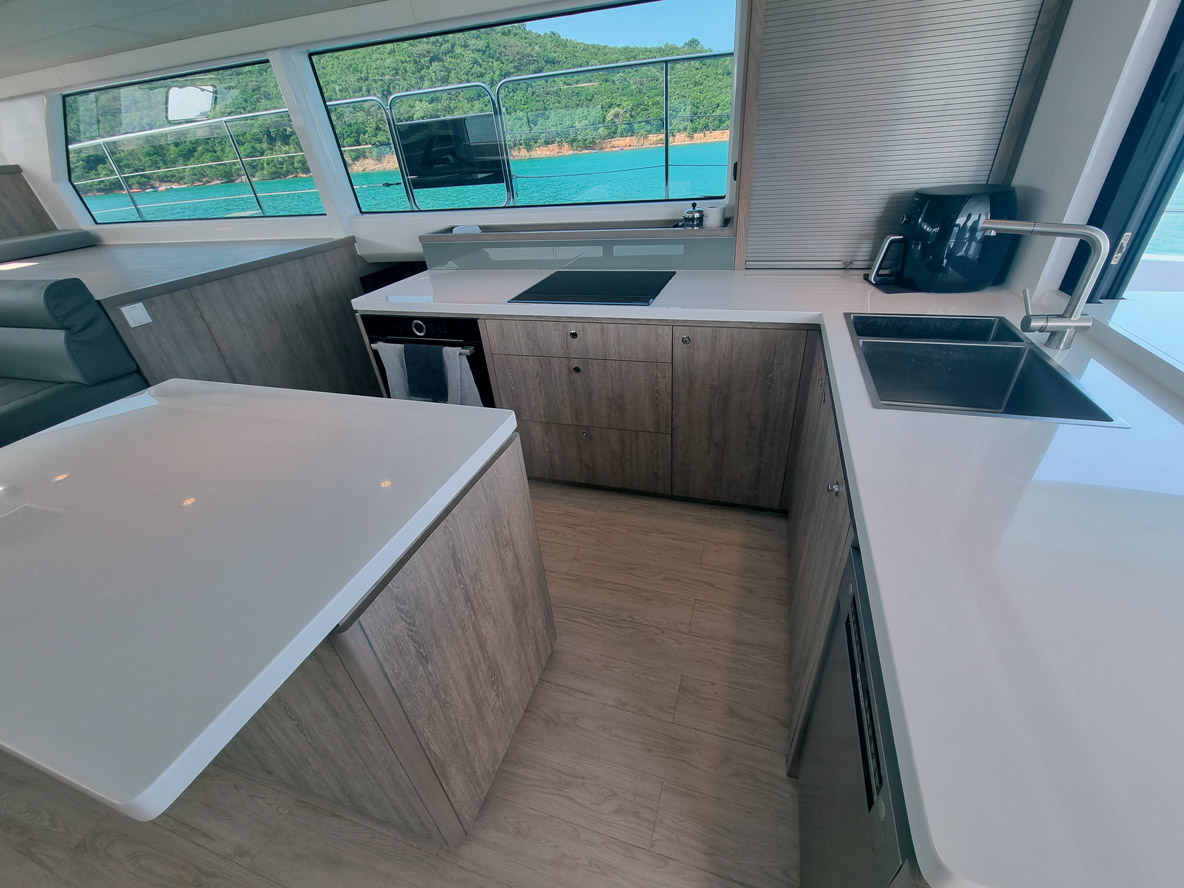
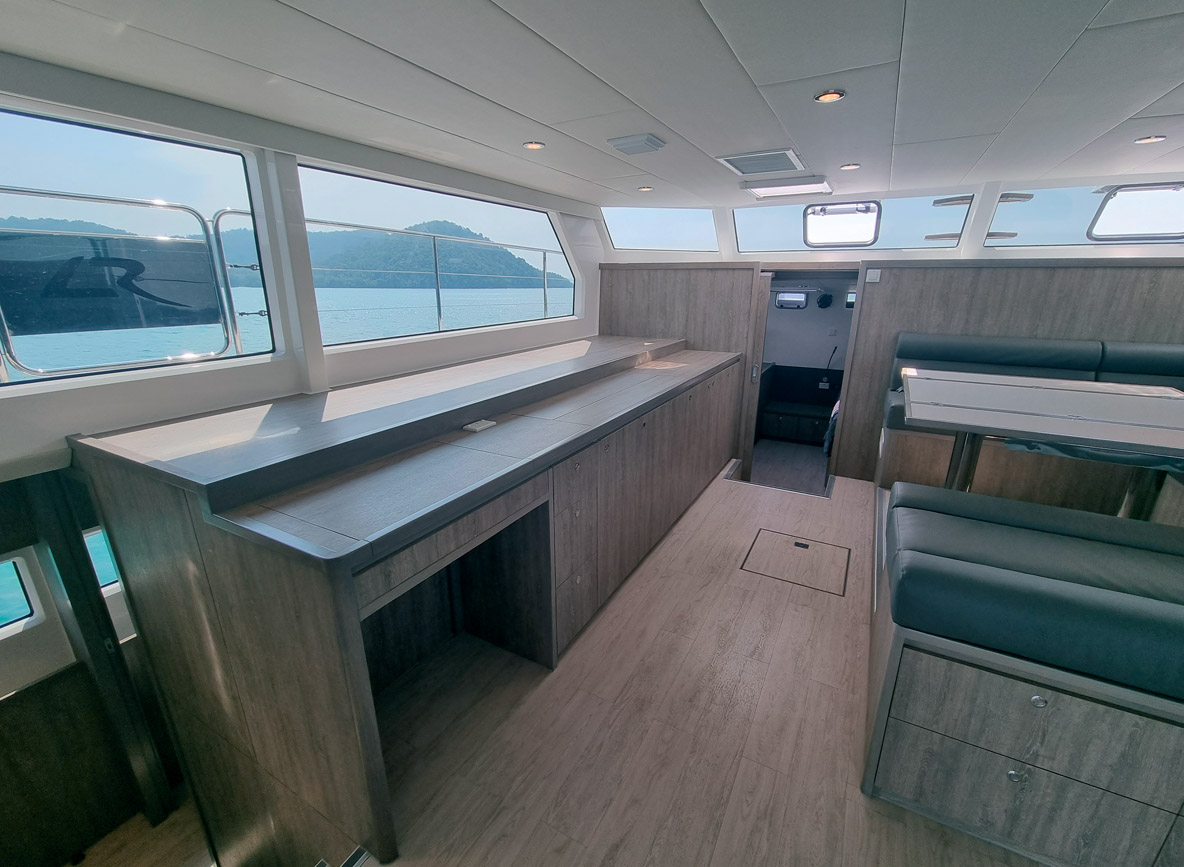
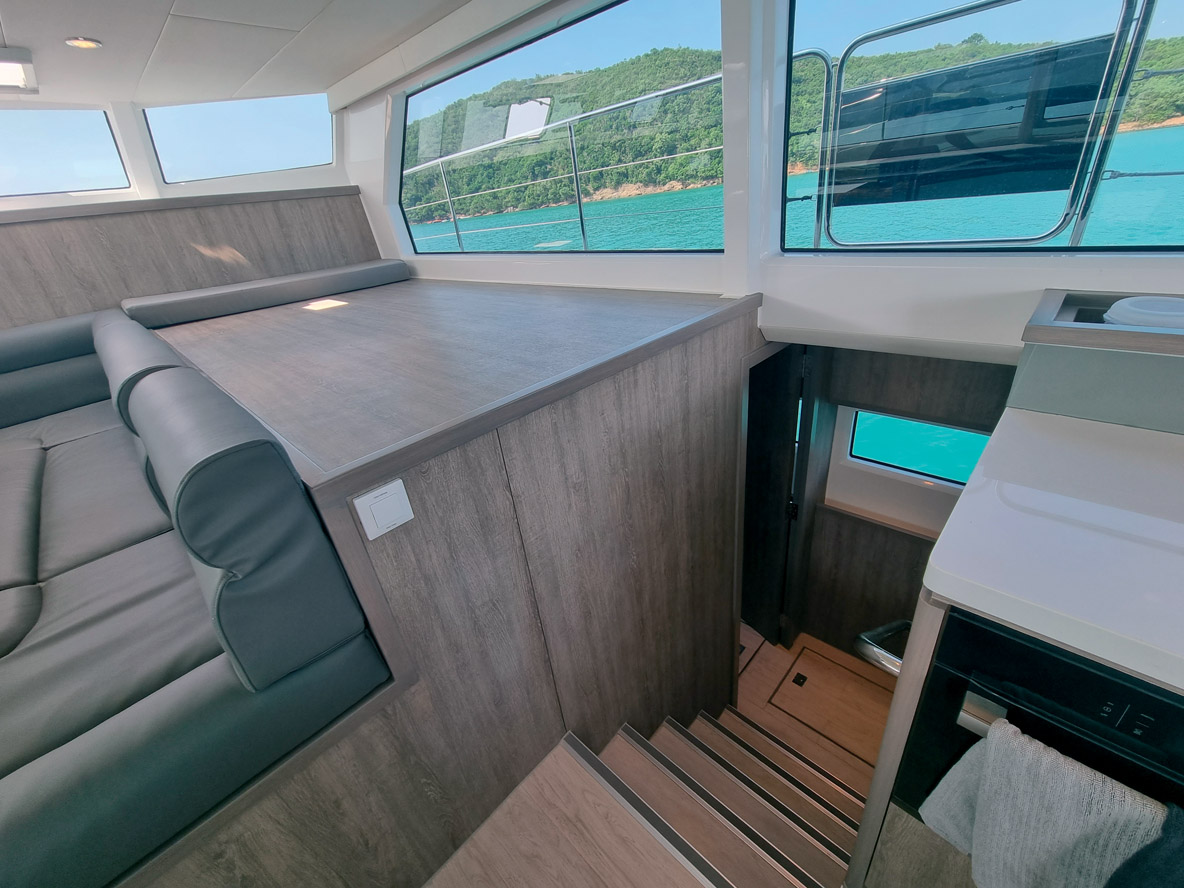
Livability is a key part of the Longreach philosophy, so the saloon layout - and the owner’s accommodation especially - demonstrate this. The 25-foot (7.62 m) wide topside creates a vast saloon and galley area, while the deck-level master cabin forward also has the beam to maximize the living space. This deck is also home to the large L-shaped galley with central island. The galley features a large refrigerator and all the domestic appliances required for long-term cruising, namely an oven, a freezer and even a dishwasher. The Corian countertops provide a neat surface that’s easy to keep clean.
Forward of this, the adjustable dinette table is surrounded by bench seating, while opposite on port is storage - including an elevating television - while on starboard there’s a large daybed base (that uses cushions from the bow cockpit), making a great spot for a siesta. This area also enjoys great light, thanks to the large lateral windows.
The finish is Delano Oak Formica veneers, though other choices are available, the Longreach being largely customizable. The other model features a lighter Romania Oak and a different layout, with the galley forward. “We can’t move the bulkheads, but we can customize most other aspects of this powercat,” explains Dewing. As mentioned earlier, the Expedition and Bluewater version differ in having an enclosed flybridge and cockpit of the former, as opposed to the open spaces of the latter – as seen in the first two models delivered.
Generous and welcoming accommodation
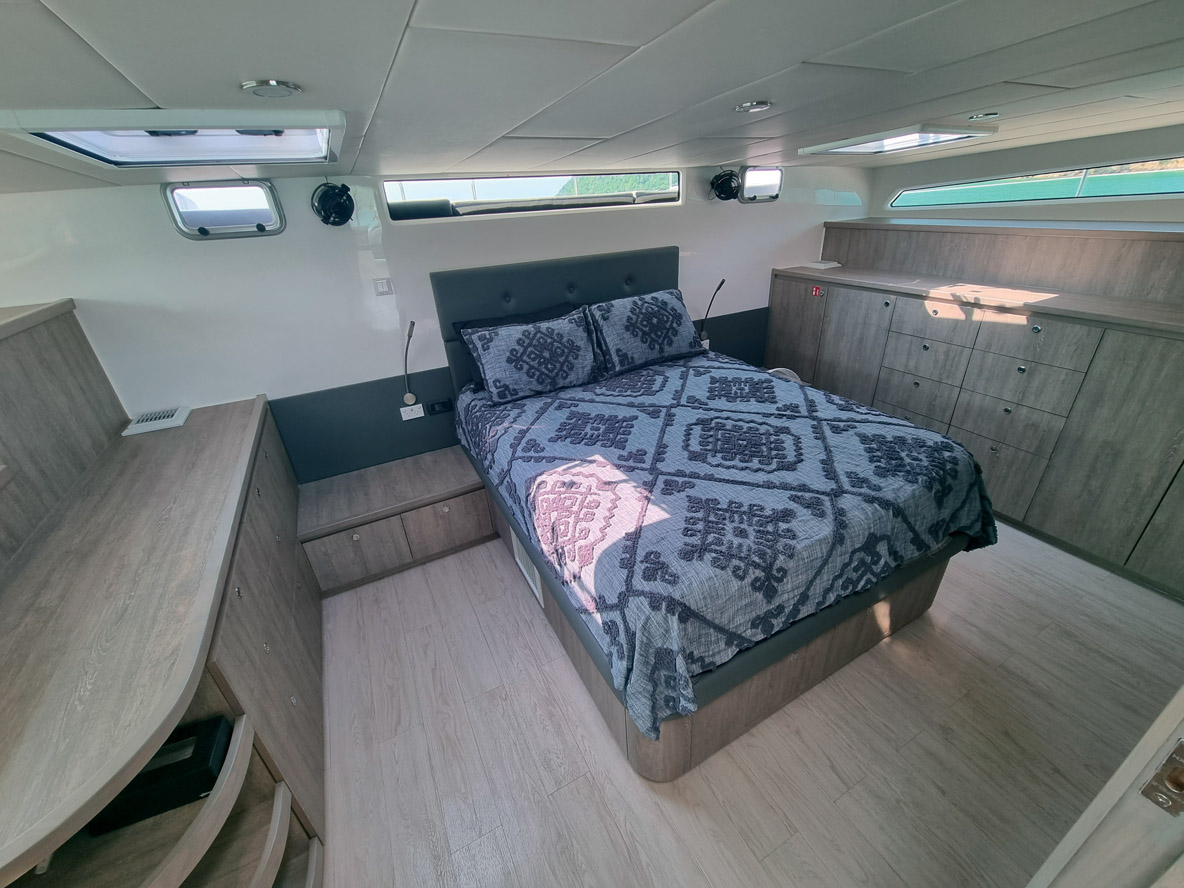
The deck-level master cabin is a major feature of the 1900 range. This space incorporates a king-sized bed, windows on three sides and bathroom a few steps below on port. The large shower cubicle aft is divided by the vanity sink between it and the forward located head, which creates a spacious area. I did wonder about adding a second sink, to complete the luxury. Back at the bed area, it is surrounded by round edged cabinetry and television embedded into the aft bulkhead. This master also has generous headroom. Opening hatches, including forward facing ones, create a good airflow and I also liked the sturdy veneered flooring – that could easily be carpeted. Ducted air-conditioning and various smarts, especially on the Expedition version, finish this area off nicely (see inset for details).
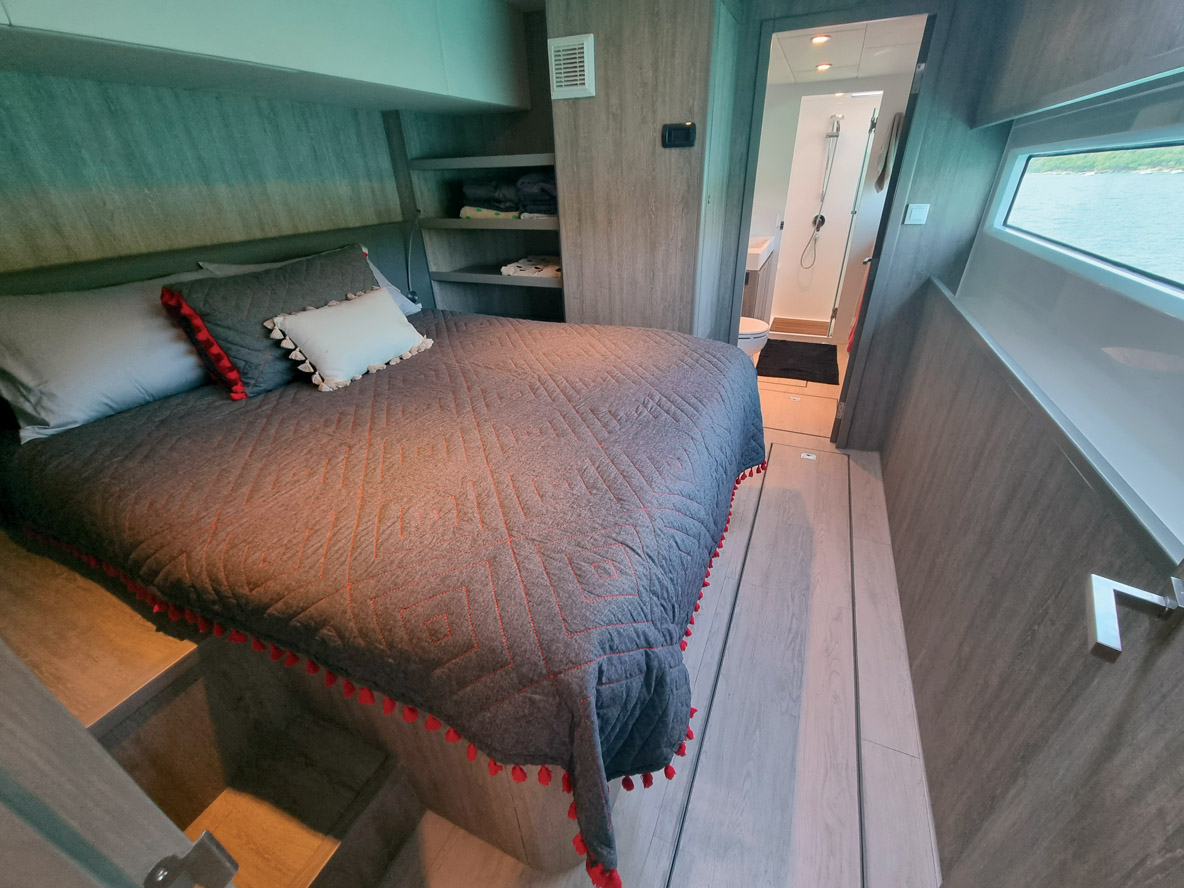
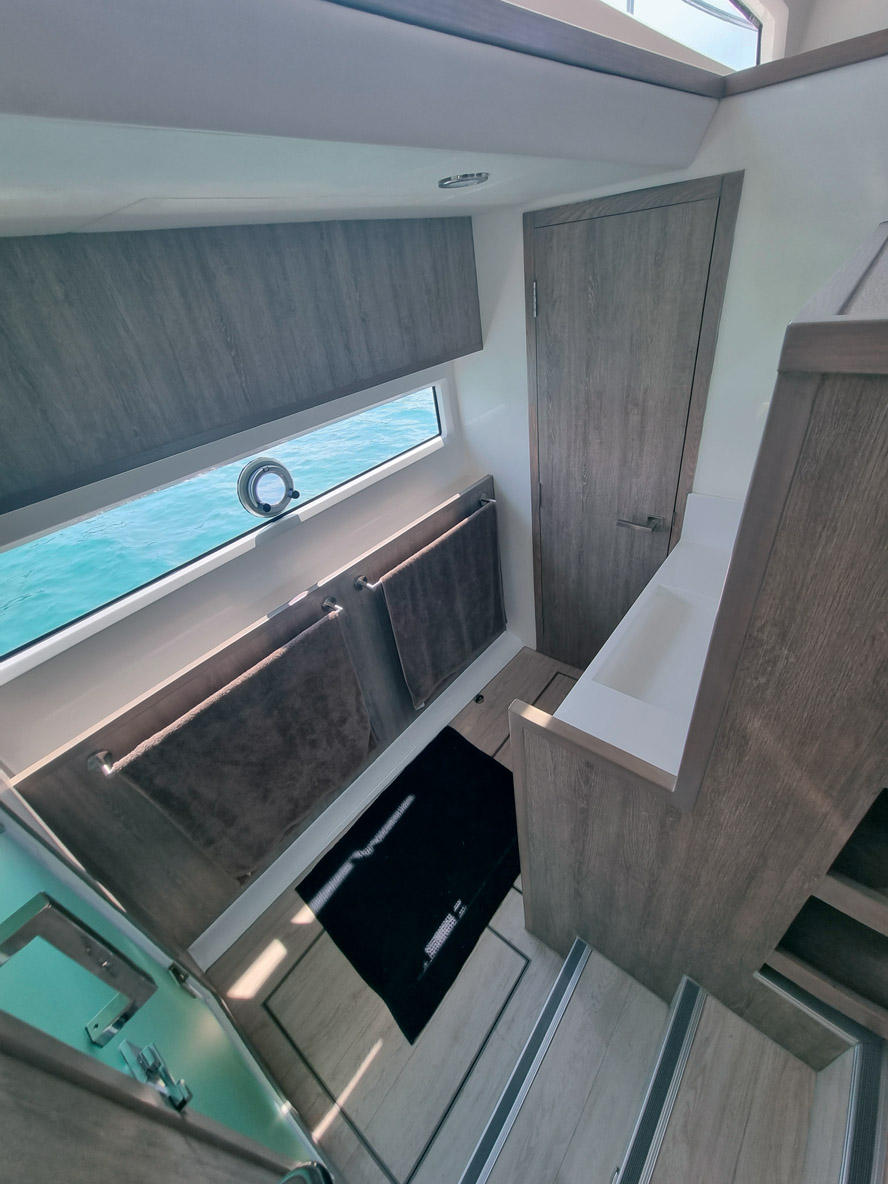
Other than the Owner’s area, the Longreach has two other cabins, one in each hull Delving into the starboard side of the Expedition, I walk along its wide corridor to the forward double athwartships berth with queen bed and longitudinal bathroom forward, while at the stern is a utility room with bench and washer-dryer. Notable features in this hull include large rectangular portlights, the electric freshwater flush head, wipe-down surfaces, and deep vanity sink.
Moving across to the starboard hull, there’s a three-quarter berth lying fore and aft at the bow and spacious bathroom at the stern. Bedroom floor space is limited here but when the corridor is included and door open, it’s reasonable. There is plenty of storage space, however.
And last but not least, this boat is equipped with a high-output watermaker, so ablution time need not be limited.
Flybridge open or closed
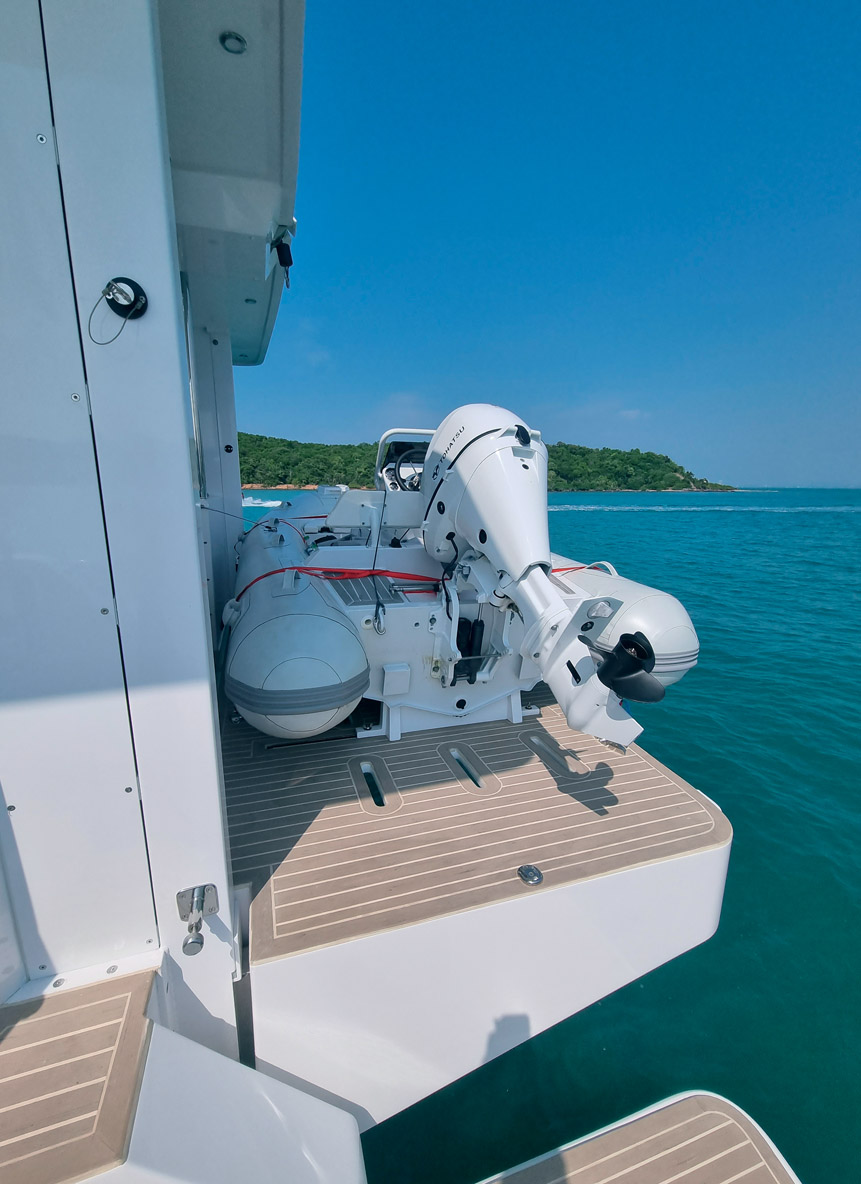
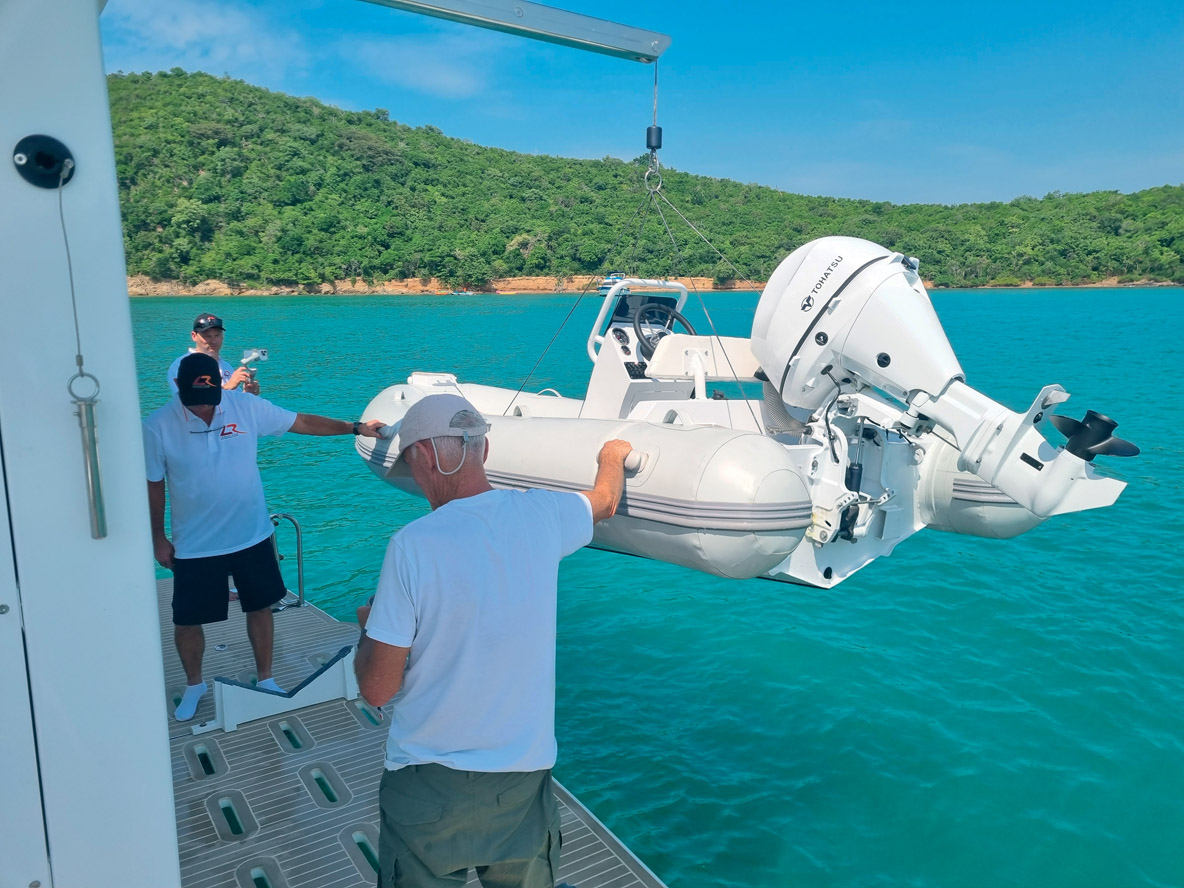
Returning to the saloon, I have yet another interior corridor to explore - the one leading up to the flybridge that completes the third floor of this Longreach 1900. All navigation is done up here, yet it also is a usable entertaining area, either open or partly closed. This space can house chairs, table, and other accoutrements; while behind on a ledge, there’s room to hoist a tender or kayaks thanks to a crane.
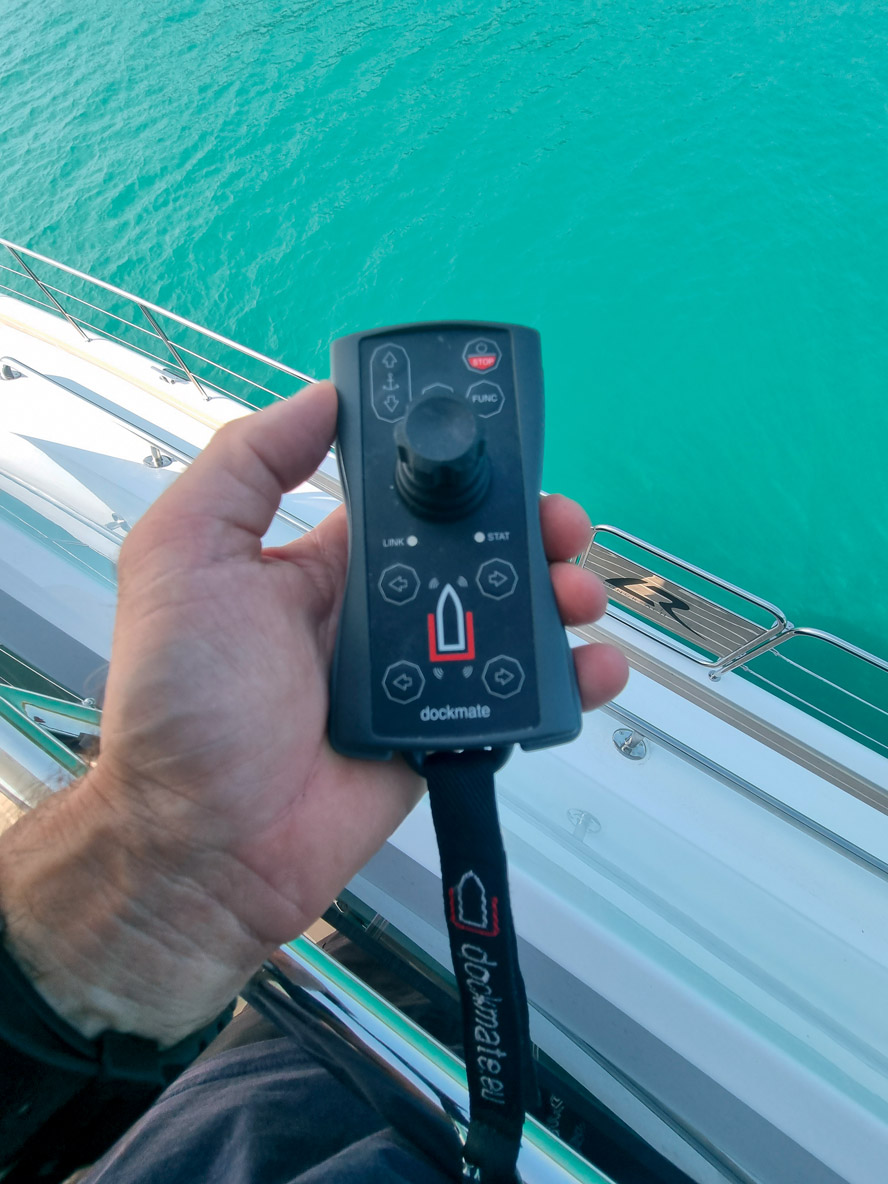
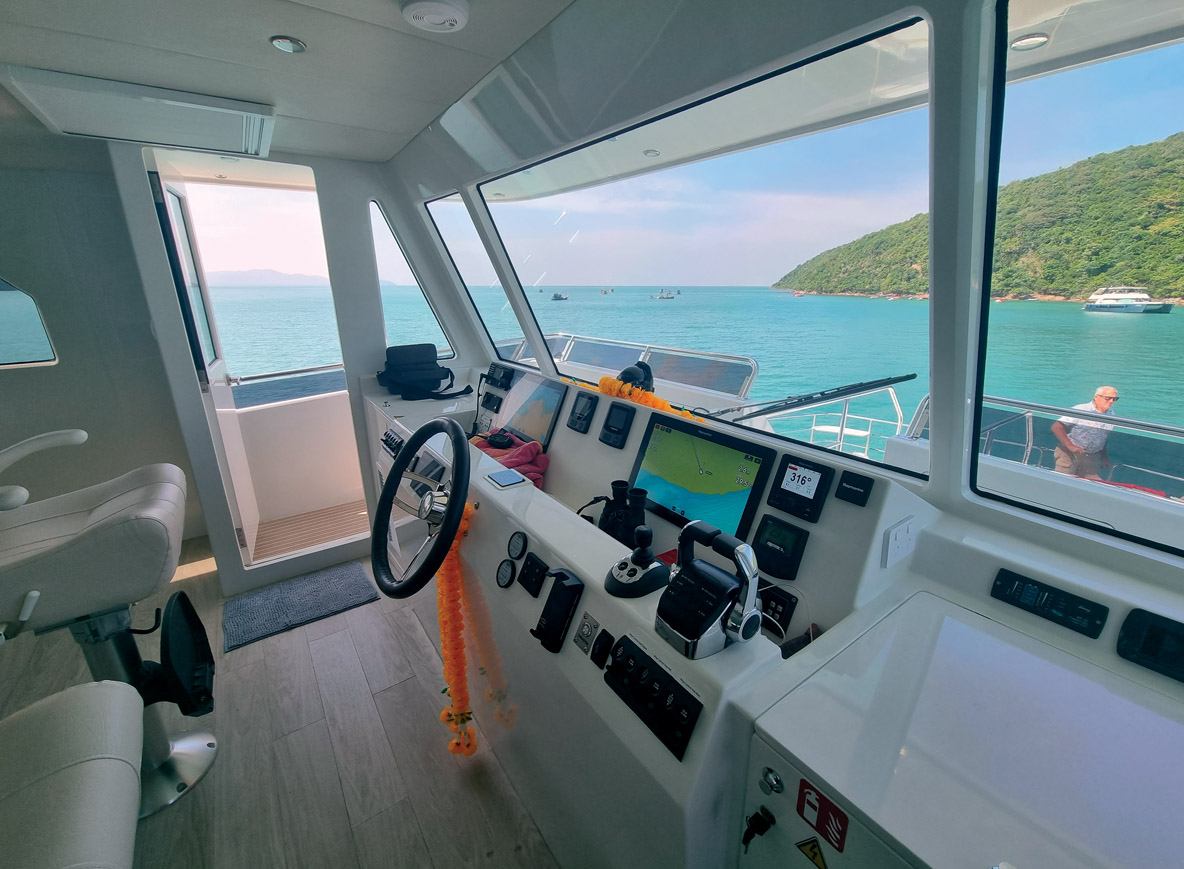
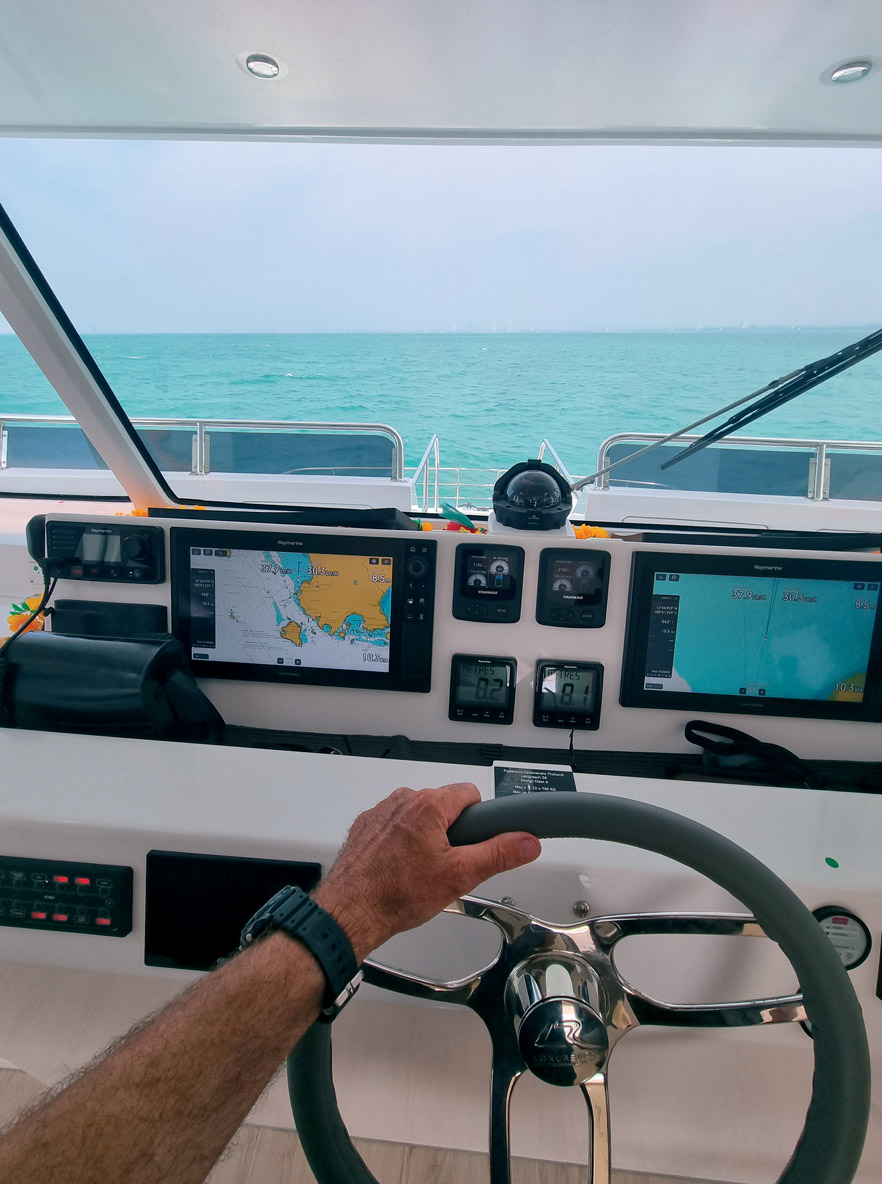
At the steering console, two bucket chairs ensures command need not be lonely, while along the bulkhead is an extensive array, dominated by twin Raymarine screens with four readouts between showing Yanmar engine data. Alongside the steering wheel sits a joystick for controlling the twin bow thrusters combined with the shaft driven propellers. Most usefully, a Dockmate remote controller is also used. This allows the skipper to roam the deck for close-quarter maneuvering, although the clever use of a Portuguese bridge means each side is viewable from here as well, via doors each side.
Solid and comfortable under way
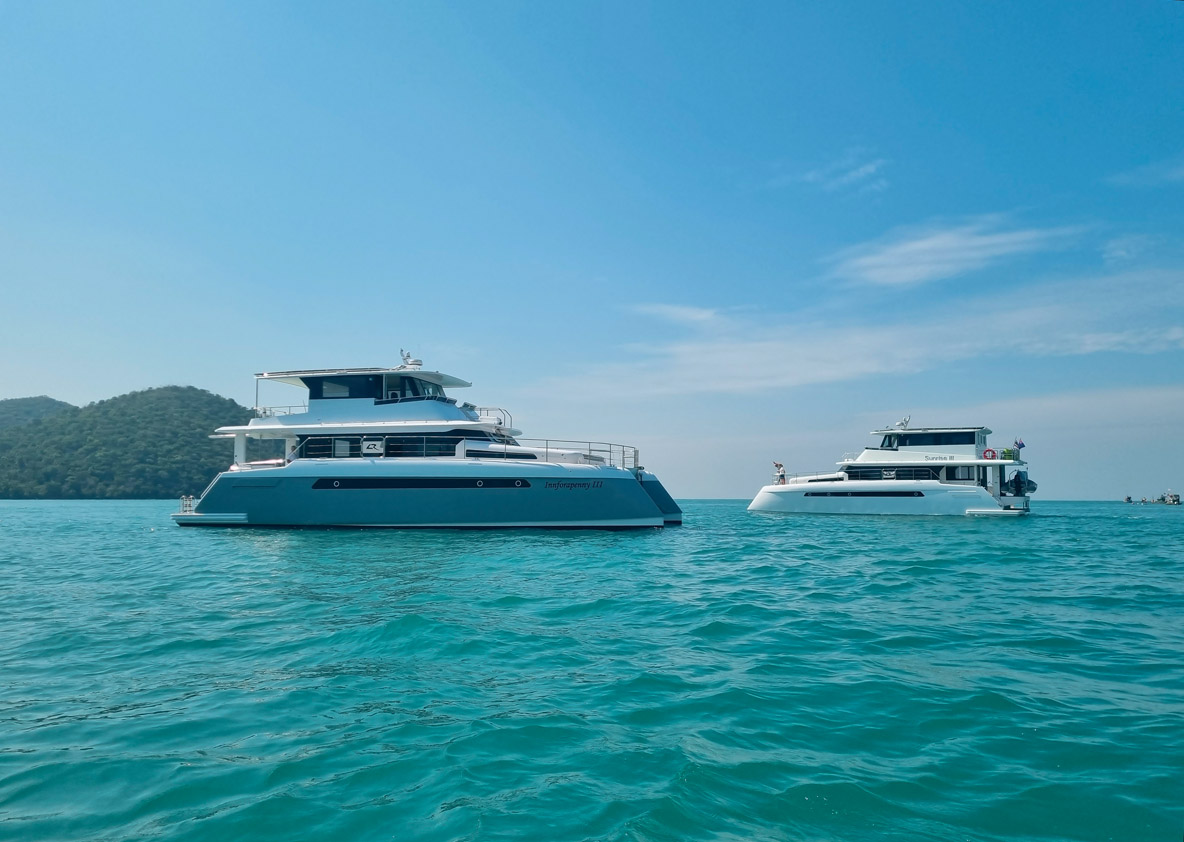
Easing ourselves out of the tight berth at Ocean Marina on the Gulf of Thailand was done without drama, thanks to the Dockmate remote that harnesses the twin tunnel thrusters with the propellers. Aboard the Expedition boat and with our sistership alongside we sped west towards the islands, a convenient cruising ground only an hour by car outside Bangkok. The hydraulic steering did our bidding as I watched the revs rise to a cruising speed of eight knots, showing a fuel burn of 3.3 Us gallons (12.5 liters) per hour, giving an impressive range of about 3,500 nm. Speeding to outrun a storm is also there if needed with about 17 knots the best I managed on the heavily laden Expedition hull. Excellent visibility for the steerer and low engine noise created a convivial atmosphere on the flybridge as we neared the jungle-clad islet where we anchored.
The return voyage on the Bluewater boat was also interesting because the wind and seas had risen significantly. Initially, this caused some wallowing and yawing, until the helm was put up and we approached the seas at a 30-degree angle and used more power, vastly improving the ride; with the tall bridgedeck clearance and gullwing nacelle minimizing the waveslap, and ultimately, you can enjoy a comfortable catamaran that’s at ease either for coast hopping or setting off on long passages.
Conclusion
Well-built and optimally fitted-out, the Longreach 1900 is truly ideal for escaping to the farthest reaches of the world and setting off on a transoceanic adventure. Thanks to its living space and spacious decks, the Longreach is also perfect for hosting a party on board. Last but not least, the cherry on top of the Pavlova (a meringue-based dessert, topped with whipped cream and covered with fresh fruit, - Ed.), thanks to its sturdiness, the Longreach is even capable of taking the ground, which is quite incredible for a 57-foot boat!
Technical focus
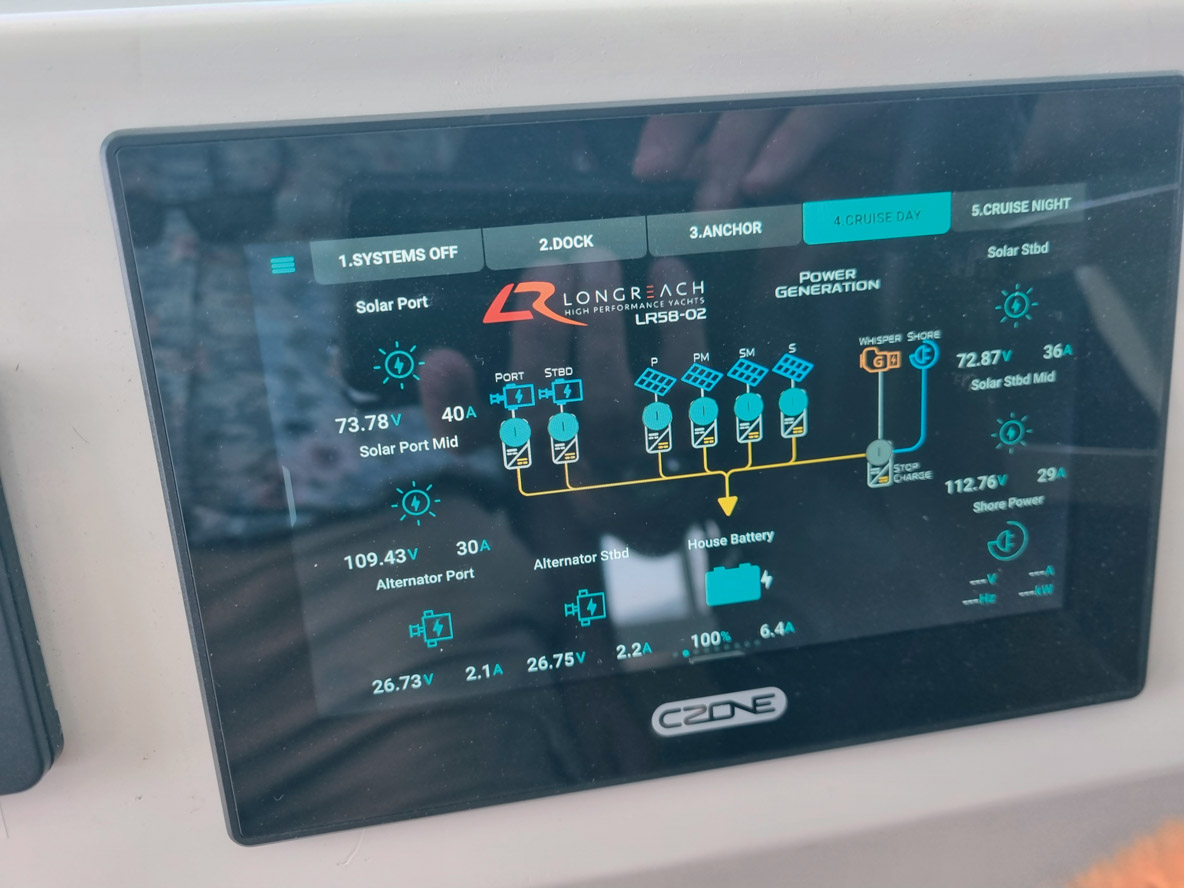
These boats bristle with smart systems including a digital bus, via the Czone management system, that uses menus and modes to control all house systems and some engine features. Wiring is minimized by the use of wireless light switches and inverted air conditioning maximizes the cooling efficiency. Both the Bluewater and Expedition are largely autonomous from the shore between fills of diesel, thanks to 4.9 to 6kW of solar on the roof, a bank of four to six Mastervolt lithium batteries and large inverters that can run all household systems, including the air conditioners.
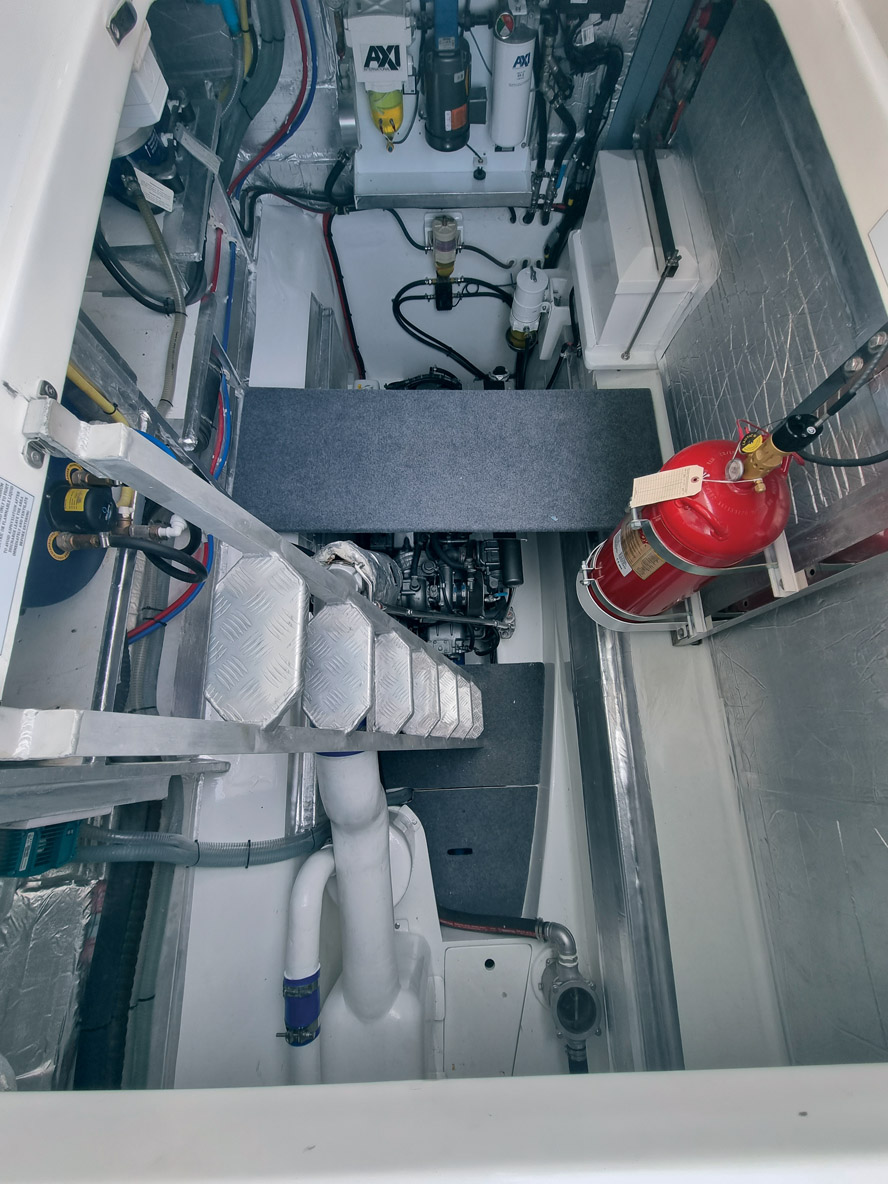
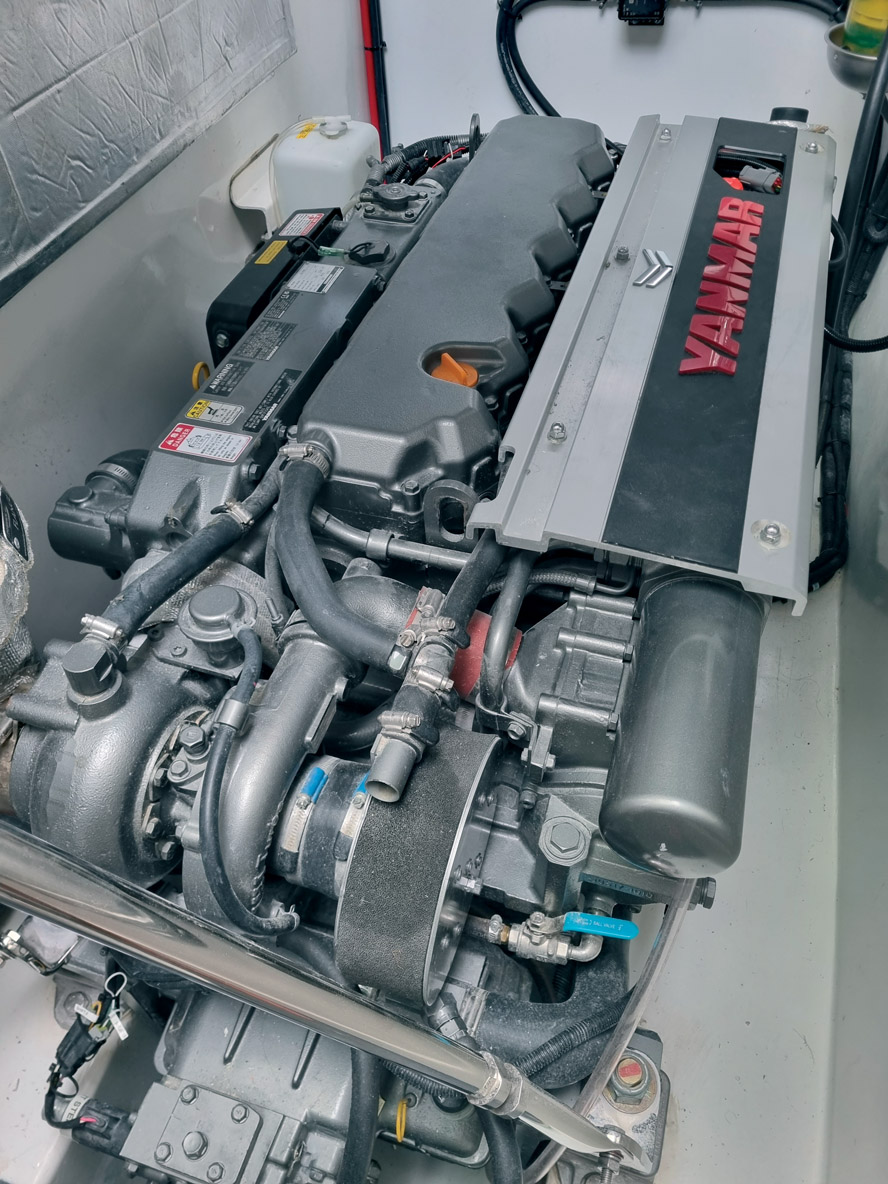
Assuming reasonable sunny weather, this negates the need to use the small backup Whisper generator located in the engine room. Another power source is the optioned twin alternators on the Yanmars, that can also quickly replenish the lithium batteries during cloudy weather. The engine rooms are spacious around the 440HP twin turbo Yanmars that use a coupled ‘Python Drive’ to lower the shaft drive to parallel with the hull, creating a more effective angle of attack for the propellers. Given these boats operate in displacement mode, with little bow rise, this is a good idea.
While climbing around I also noticed good access to all service points, including the oversize steering linkages to the twin rudders. Tankage is another commendable design with central integrated tanks each side, along with forward ones, allowing the use of the fuel polishing systems and the ability to change the trim by moving the fuel. Hull builds comply with CE class A, Lloyds and later models are in-survey for Australian charter. The build uses foam infusion with monolithic structure in key sections, such as round the molded fiberglass fuel tanks and engine beds. The keel line has reinforced bilge sections for grounding with the aft section fully protecting the propellers and twin rudders.
Customization options
Management of the interior space
High displacement
Technical specifications
Design: Longreach/PowerPlay Catamarans
Length overall: 62’6” (19.06m)
Beam: 24’11” (7.6m)
Draft: 5’6” (1.7m)
Bridgedeck clearance: 2’11” (0.9m)
Air draft: 21’10” (6.6m)
Lightship displacement: 66,140 lbs (30t)
Laden displacement: 83,775 lbs (38 t)
Engines: Twin Yanmar 6LY 440HP or Twin Cummins 600 QSC 8.3
Fuel: 2,641 US gal (10,000 l)
Water: 475 US gal (1,800 l)
Black water: 2 x 47 Us gal (2 x 180 l)
Price: US$ 3.25
3.7 million ex-yard Thailand