The new Millikan Boats brand presented a generator-free powercat at last fall’s boat shows. This prototype, named the “M.9,” that we were able to test in Cannes, served as the basis for designing the “production” version, the M.10.
Infos pratiques
- Le chantier : Millikan M.9
- La fiche technique
-
 Découvrez notre vidéo exclusive
- Financez votre M.9 (M.10’s Prototype)
- Assuez votre M.9 (M.10’s Prototype)
- Articles autour du M.9 (M.10’s Prototype)
Conditions: Calm, residual chop
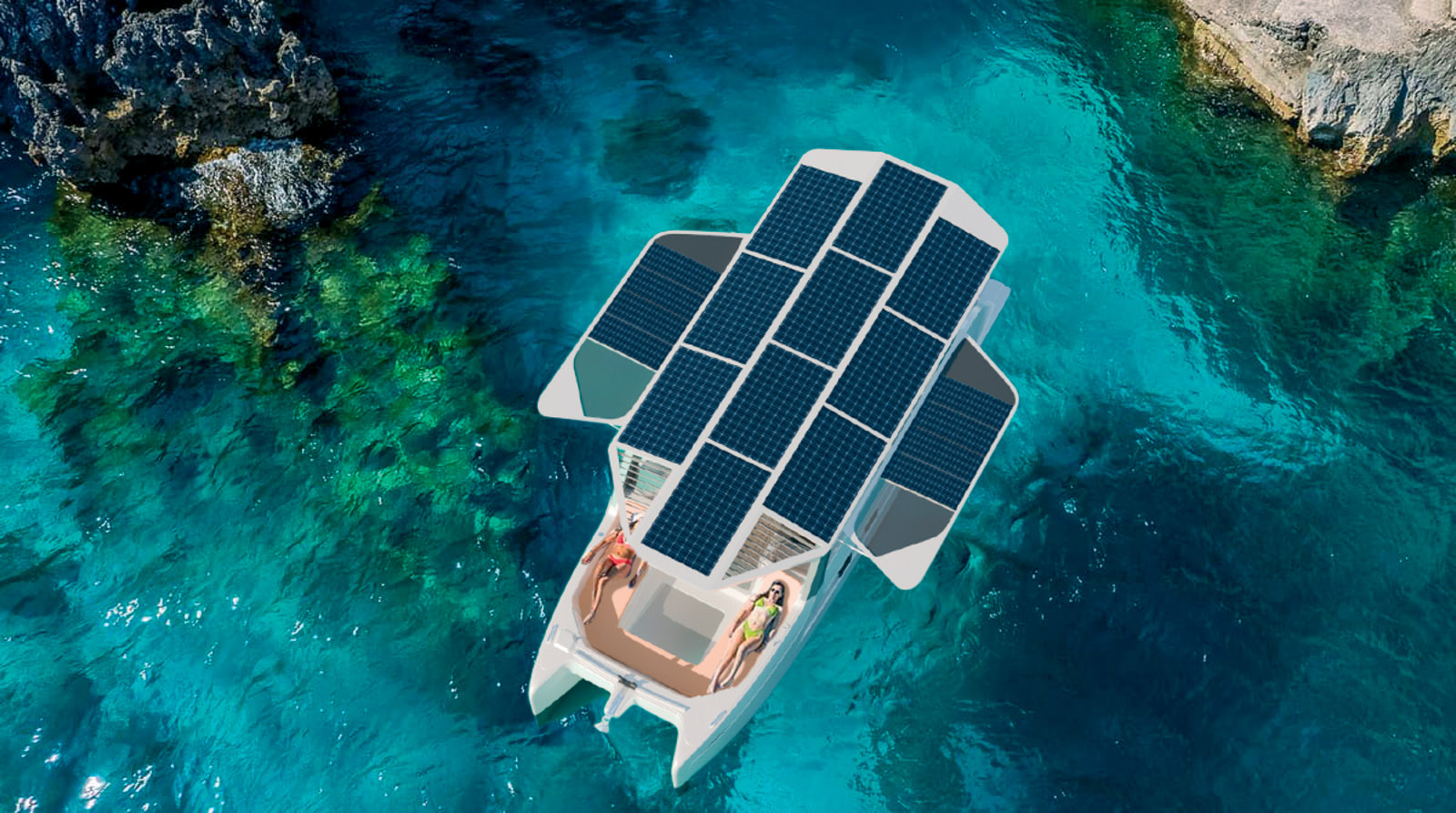
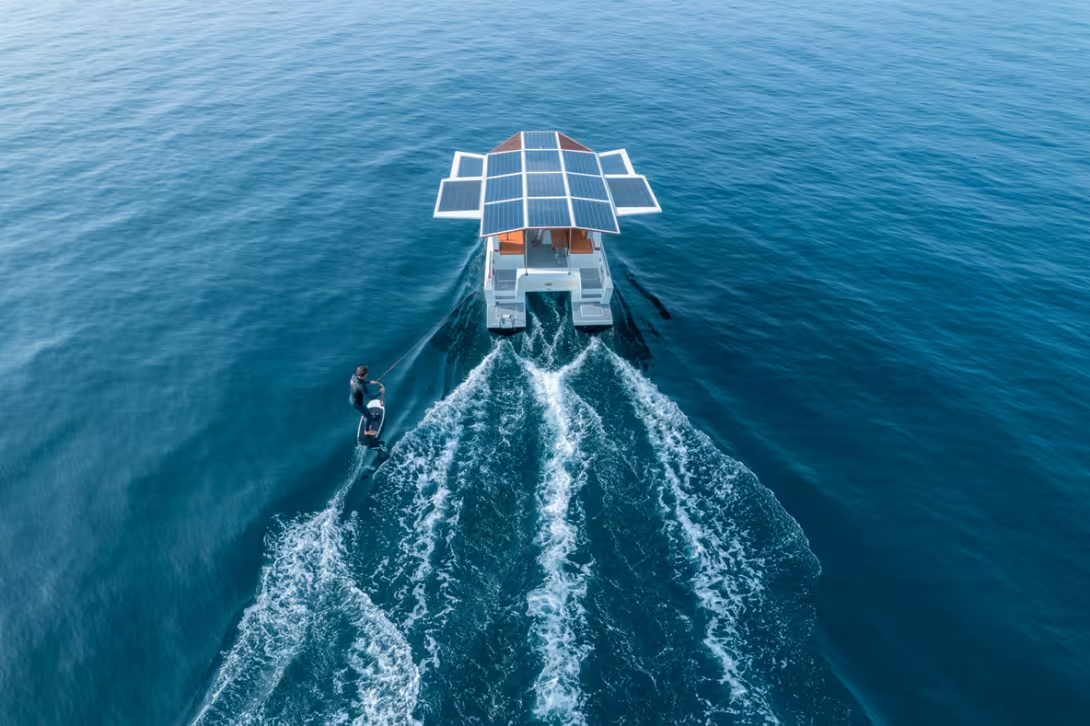
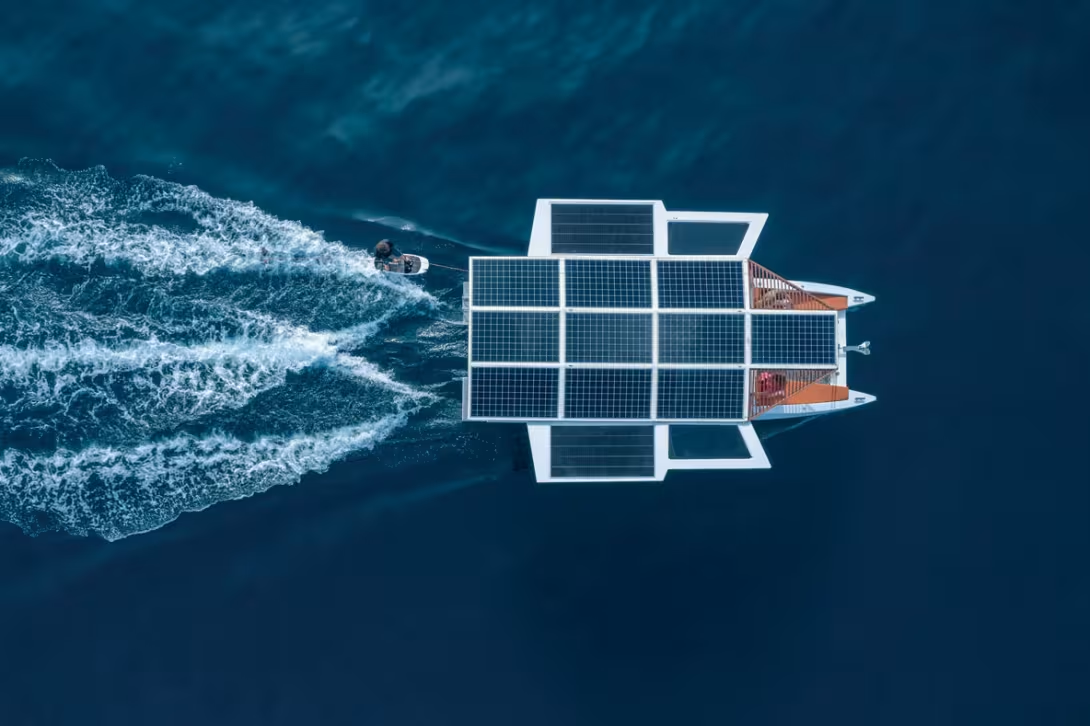
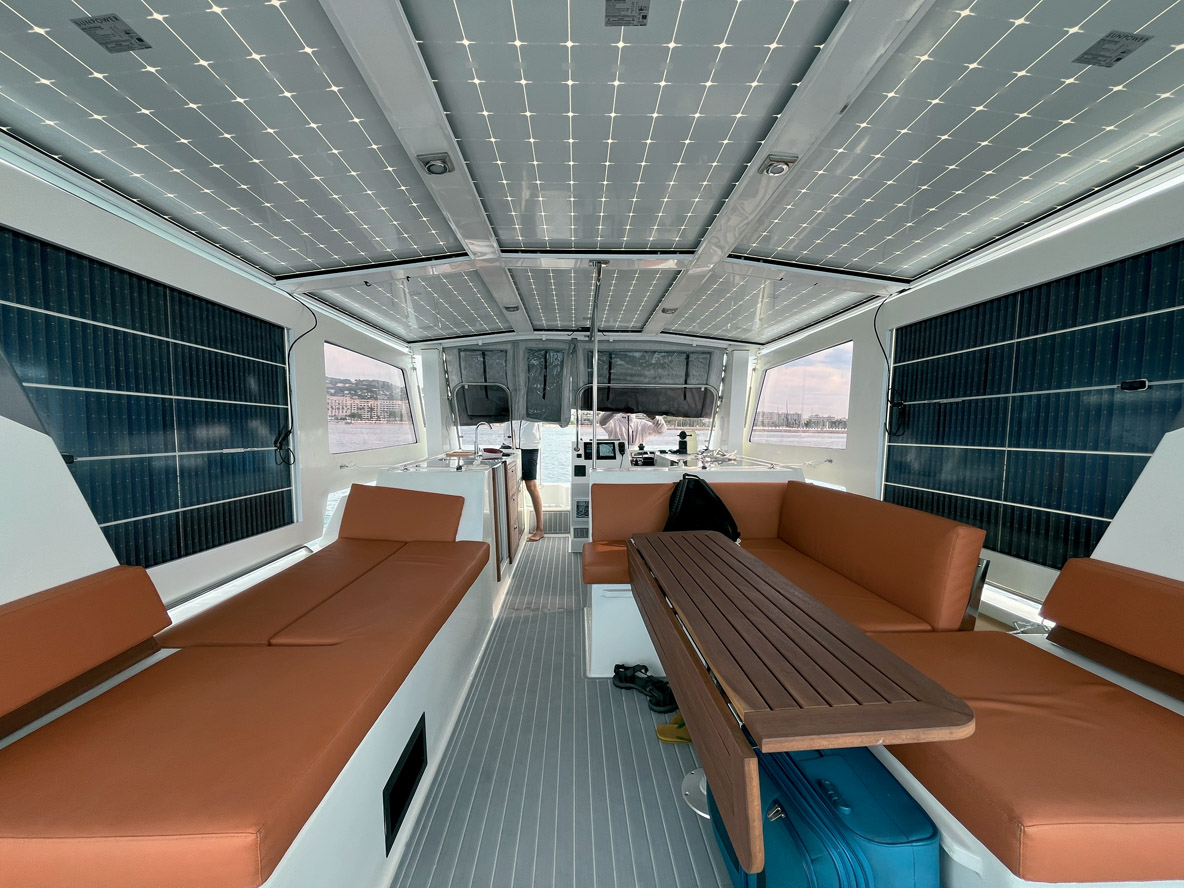
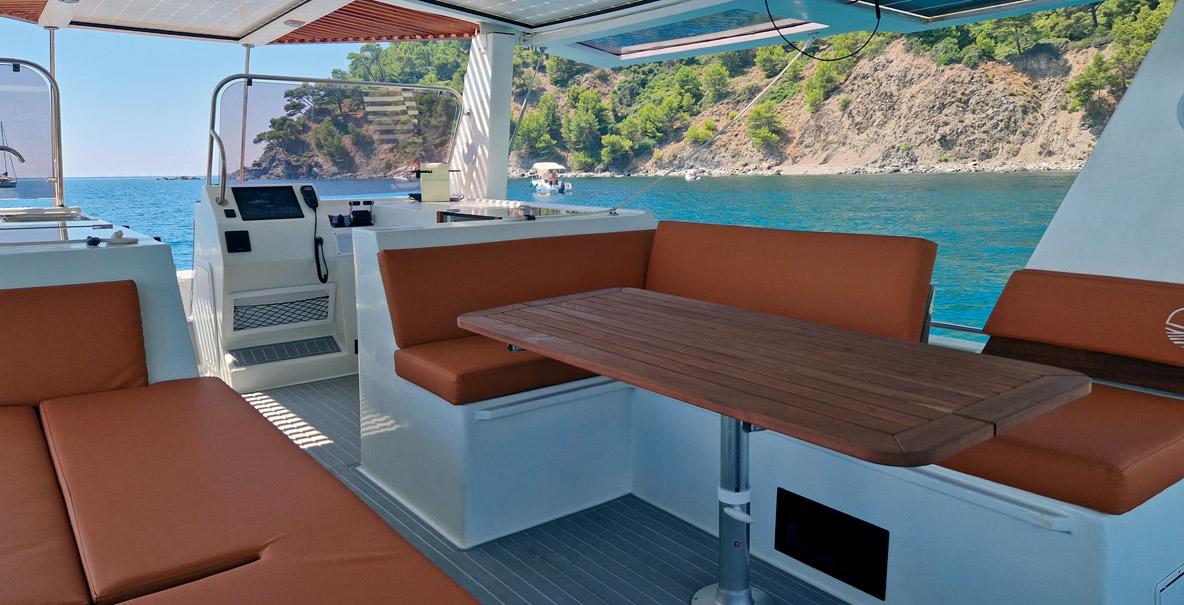
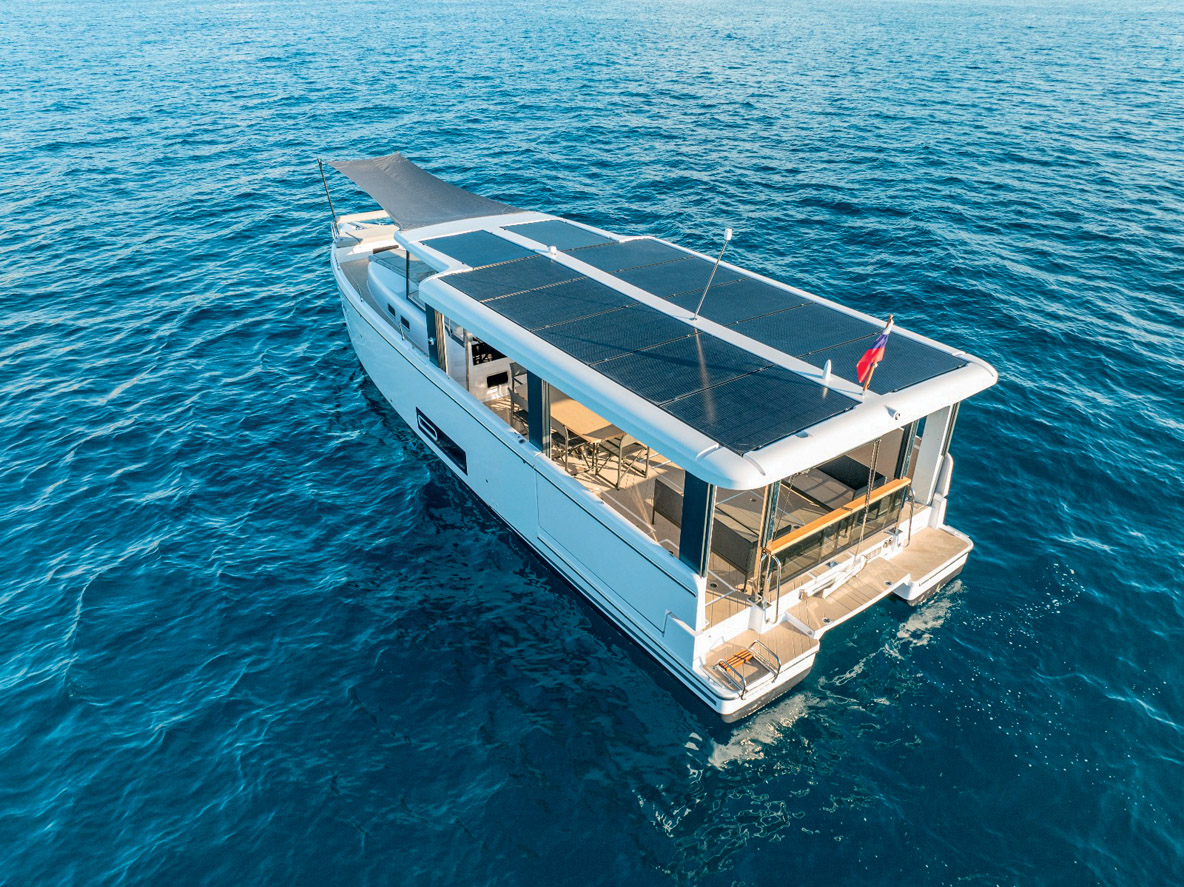
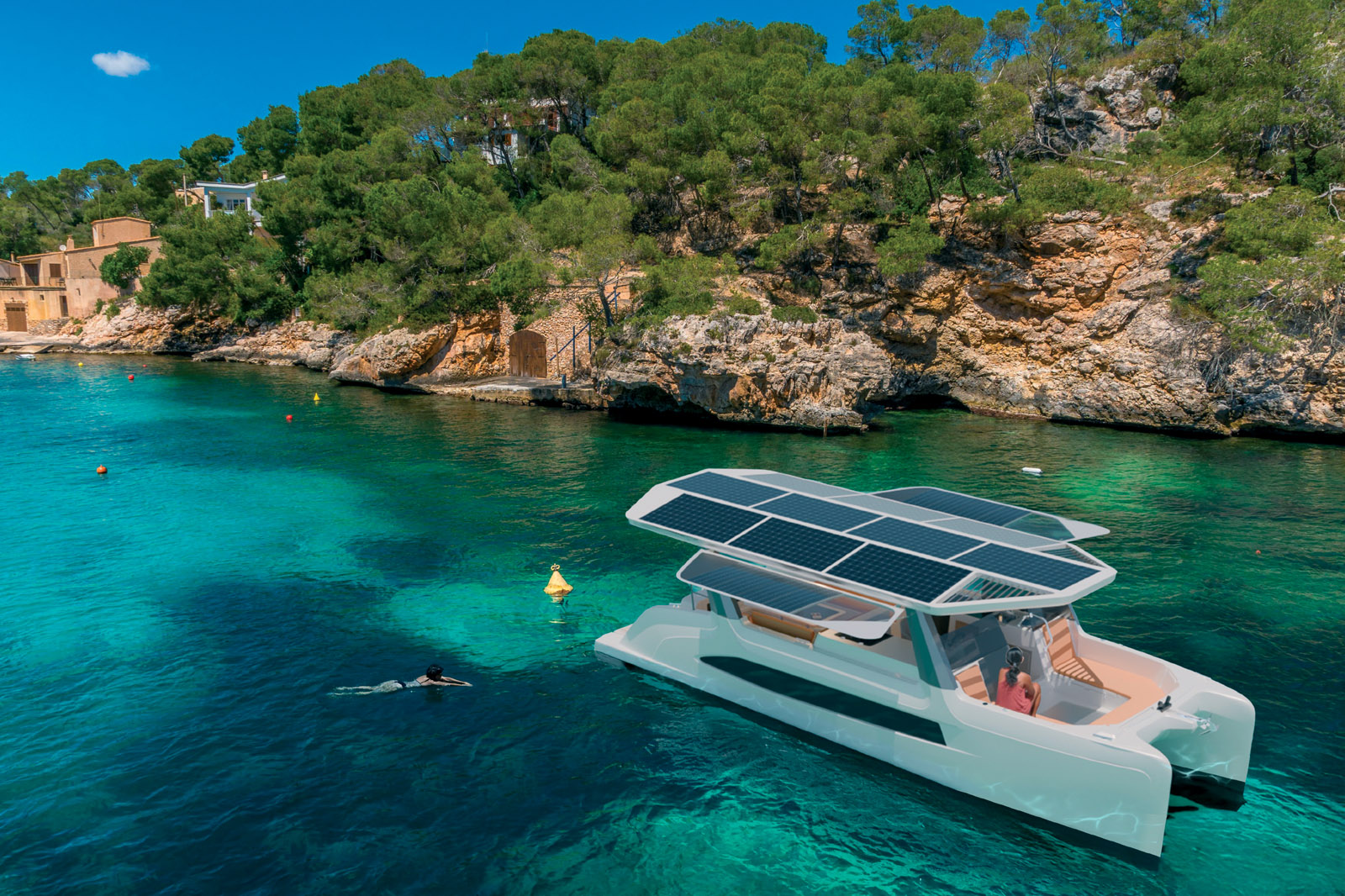
The M.9 we discovered in Port Canto is definitely not your average boat. It is an open bowrider catamaran with a central walkway and a hardtop that covers the entire deck—and beyond, since wings can be unfolded well past the midships beam to carry as many solar panels as possible (on both sides!). That’s what it takes for this small prototype multihull to manage without any internal combustion assistance.
The initial concept for the M.9 was devised in 2015 by Bruno Causse, who created a first 7-meter (23-foot), 100% electric beach catamaran. Unable to find investors to support commercial development, the inventor passed the baton to Philippe Raynaud. The project became a 9.70-meter (31’10”) weekender designed by Vincent Lebailly. The Millikan brand was launched - a Tesla- style tribute to Robert Andrew Millikan, who won the Nobel Prize in Physics in 1923 for his work on the elementary charge of electricity and the photoelectric effect. The M.9 we are interested in is built by Chantier Naval La Passagère in Saint-Malo, Brittany.
A Tribute to Simplicity... and the Pleasure of Being at Sea
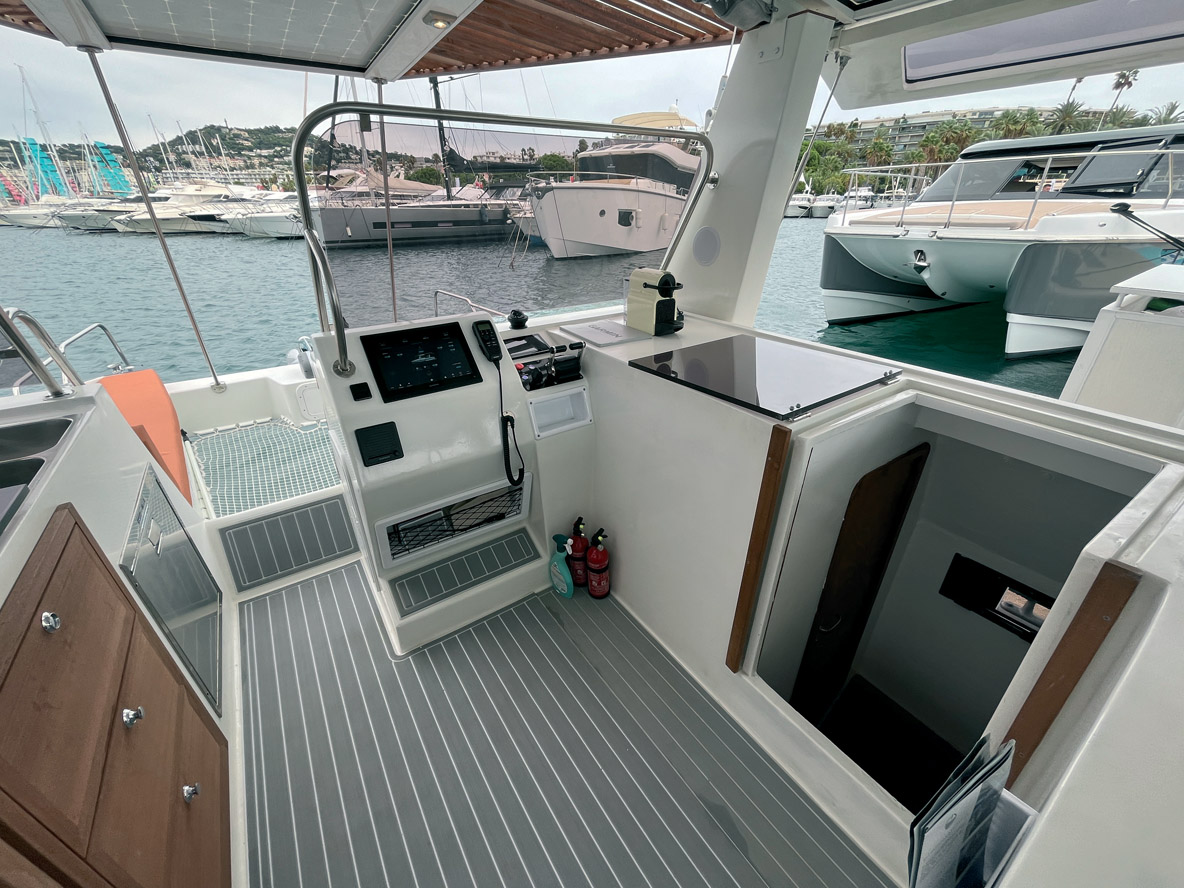
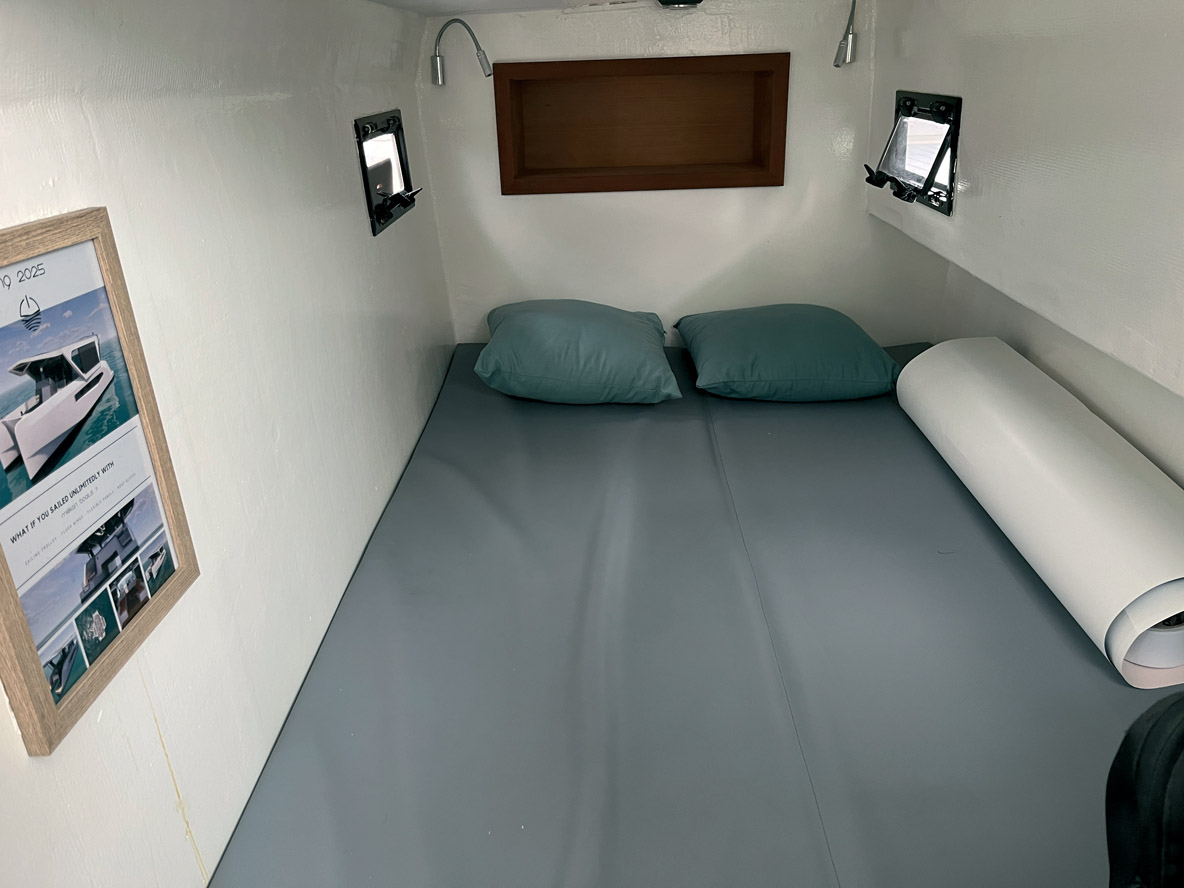
The M.9 is designed to be simple and basic. But without compromising on comfort. The platform is barely 32 feet (10 meters) long and 11 feet (3.4 meters wide). The hulls are very narrow, generating little drag so they remain energy efficient. Most noticeable is the fold-out T-top, covered with a dozen solar panels capable of producing 5 kWp. The battery bank is deliberately limited to 2 x 16 kW so as not to penalize the displacement. The electric drivetrain, consisting of two 15-kW BlueNav pods, has the advantage of being very easy to install. That’s it for the quick overview. In more detail, there’s plenty of fun to be had on the water with 345 square feet (32 m²) of deck space divided into a lounge with a dining area that can be converted into a double berth, a minimalist (but fully equipped) galley, and a forward cockpit flanked by sun loungers. The whole space is very airy as it is completely open, with a lodge-like feel. There is an unobstructed 360° view and the shoal draft makes it easy to take the ground. For a few nights on the water, two cabins are fitted in the hulls with a heads compartment and a closet.
Is this an Identikit Picture of the Ideal Boat — and the Boat of the Future?
Coincidence? Just as the M.9 was being unveiled to the public, Bénéteau, the world’s leading manufacturer of recreational craft, released the first statistics from its Seanapps boat management app. This is an in-depth analysis of data from 1,000 connected boats (mostly powerboats), covering the practices of 180,000 users in the Mediterranean. We learned that, although the majority of the boats concerned were between 40 and 60 feet (12 to 18 meters) long and 80% were equipped with powerful engines, the average daily trip rarely exceeded 20 nautical miles and four hours under way. We also discovered that the average speed between stops was around 8 to 10 knots, that trips lasting more than a week were rare, and finally that most of the time was spent at anchor, as close to the shore as possible. I forgot to mention that the generator was only fired up once the boat was offshore, whenever possible. “The main expectations of sailors are an enriching outdoor experience, simplified skills, and increased awareness of sustainable development,” summarizes Damien Jacob, the group’s product director.
This study enabled Bénéteau to come up with the Island Cruising Boat concept, a monomaran (monohull bow and catamaran stern) with a very open deck, covered with solar panels and powered by a hybrid drivetrain. Admittedly, the project did not go as far as the M.9, but the similarities are striking.
A Prototype to Get Started
During our test, the prototype nature of the M.9 was evident – as Philippe Raynaud pointed out, the aim is to validate certain technical and ergonomic choices. Our role as boat testers was therefore not to compile a list of imperfections – this has already been done in detail by the manufacturer – but rather to put our impressions and this 100% electric sailing concept into perspective.
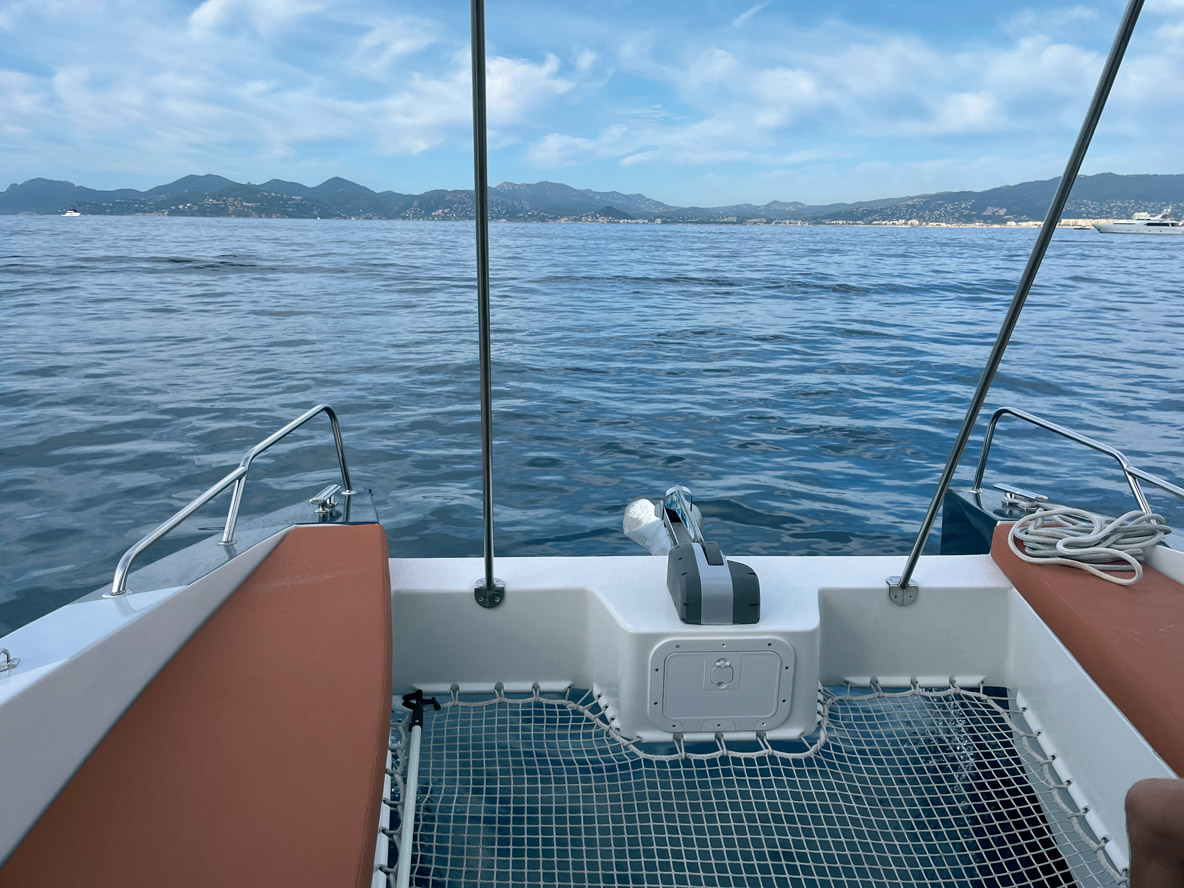
Access on board is easy thanks to the low sugarscoops - you always feel very close to the water and connected to the environment. The deck offers a generous surface area and, thanks to the central layout, there is plenty of room to move around. The “sole” of the forward cockpit is actually a net, which offers little protection and makes it impossible to install a table. However, it is very pleasant to relax on the sun loungers.
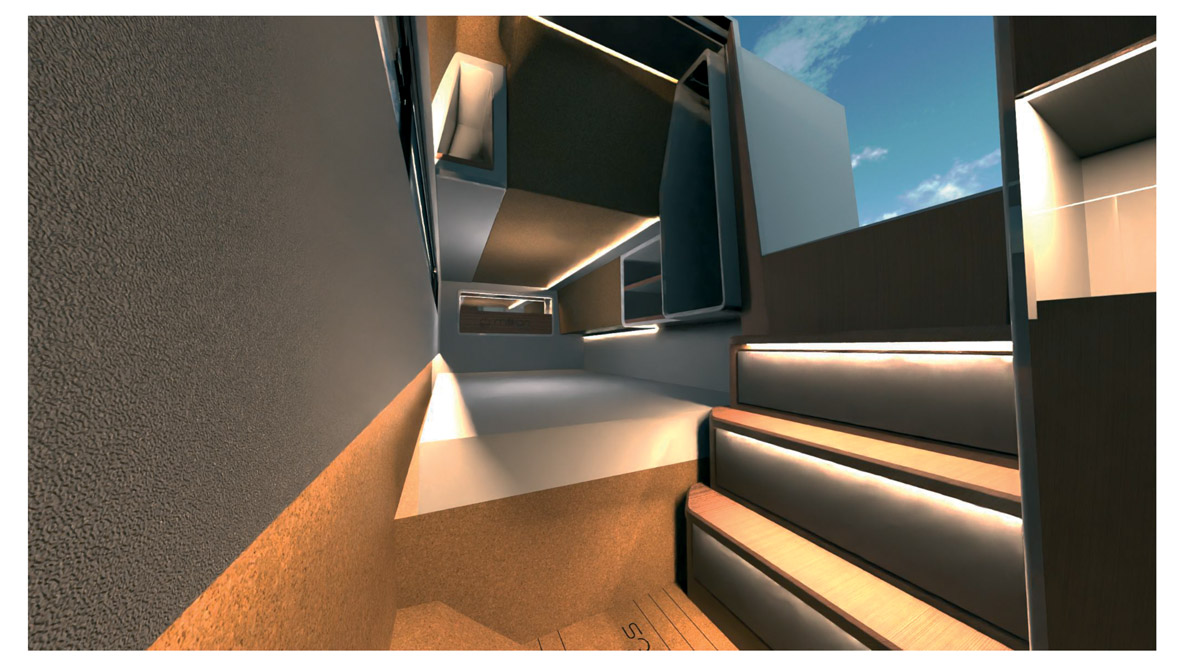
On either side, two mirror- image cabins are equipped with beds that are only 43 inches (1.1 meters) wide, but the deck’s dining area can be converted into a double berth that measures 55 in. (1.4 m) wide. Once the wings are lowered and the fabric side panels are rolled out, privacy is perfect.
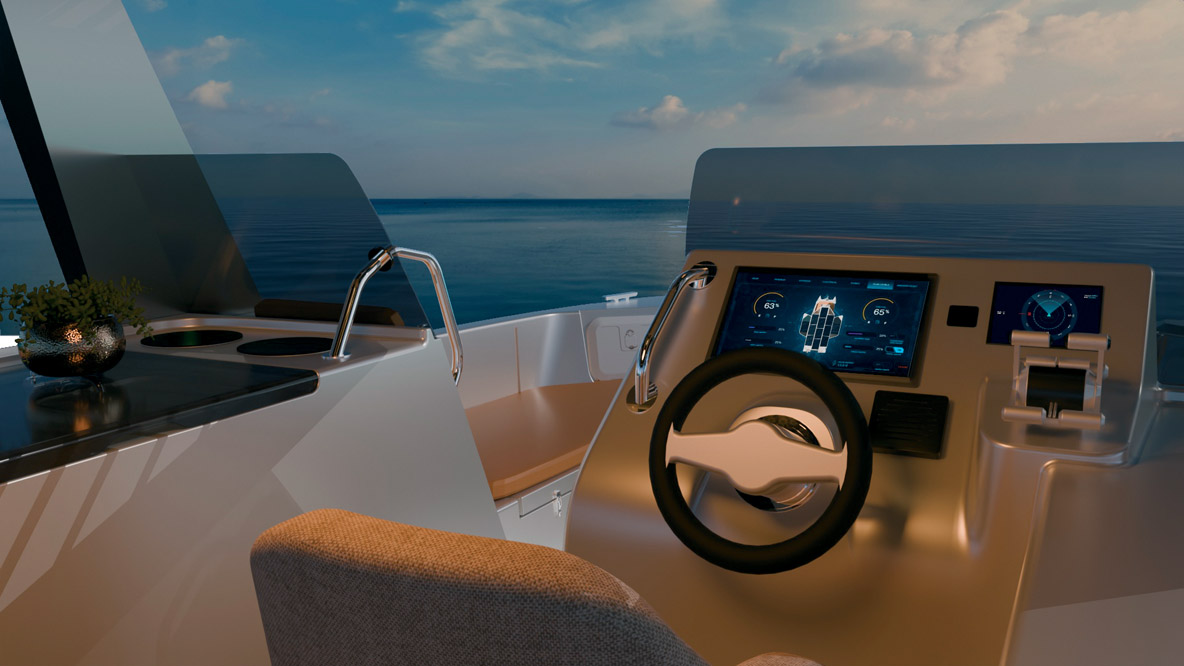
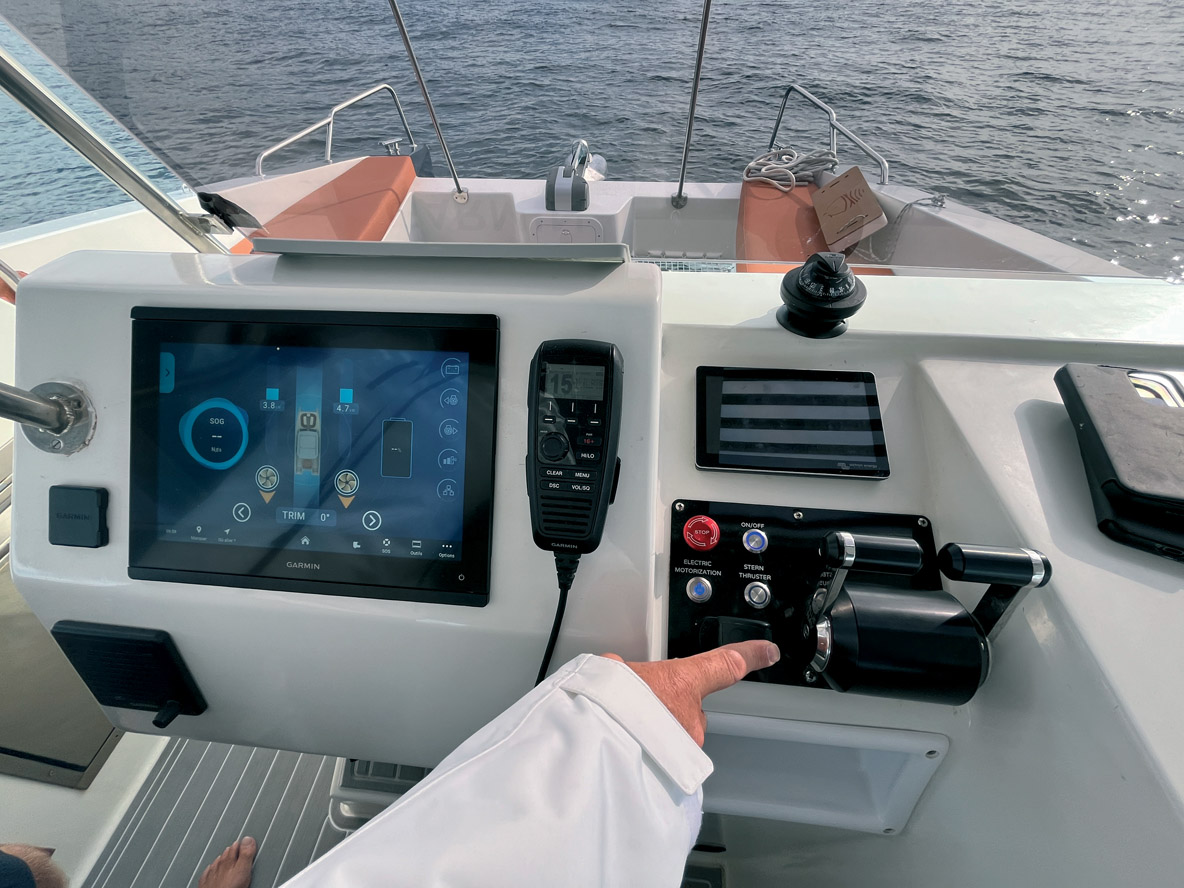
There is no wheel at the helm station, but instead, the system is controlled by a joystick similar to a bow thruster and a power lever. The narrow bows handled the choppy waters outside the port very well. We set off and the M.9 picked up speed, but not too much, as this was meant to be a leisurely outing. To change course, you just press the joystick. It’s a little frustrating because the feeling isn’t as direct as with a tiller. But it’s effective and allows you to stay on course. With all the chop, we reached 7.5 knots while consuming 24 kWh, which far exceeds the capacity of the solar panels, which can only collect 5 kWp. In these conditions, the range is less than 1½ hours. We slowed down to 1,000 rpm and 4.5 knots. At this speed, the batteries only lose 6 kWh, giving us more than ten hours of sailing time.
But if we go backto 4 hours of sailing per day and good summer sunshine, the M.9 is more than capable of “recharging its batteries” without having to plug into the shorepower once back in port.
100% electric propulsion with no recharging
Meets the most stringent environmental standards
Cabin space is a little cramped
Net foredeck
Technical Specifications
Architect: Vincent Lebailly Yacht Design
Overall length: 31’10” (9.7 m)
Beam: 11’8” (3.55 m)
Draft: 2’8” (0.82 m)
Displacement: 5,950 lbs (2.7 t)
Motors: 2 x 15 kW BlueNav
Batteries: 2 x 16 kWh
Solar panels: 5.6 kWp
Fresh water: 21 US gal (80 l)
Berths: 4
CE Category: C6
We met up with the CEO at his premises in Caen, Normandy, where the first hulls built in Estonia will be received and completed: “With naval architect Vincent Le Bailly and 3D modeler Fred Gasson, we wanted to offer a seaworthy and reassuring multihull whose design immediately evokes these qualities while gaining in elegance. For the interior, we consulted specialists in order to meet the expectations of a wider boating clientele.
The M.10 is 18” (45 cm) longer than the M.9, its wings and arches are more attractive, and the roof, now made of aluminum, is more robust. Tests with a shaft-driven prop have demonstrated a significant gain in performance, while technological advances in lithium batteries have made it possible to increase the power from 32 to 40 kWh with virtually no increase in weight.”
The builders have announced that their new model is capable of sailing self-sufficiently at 7 knots on a beautiful summer day between 10 a.m. and 5 p.m.
To make the M.10 as easy to use as possible, the manufacturer has developed an intelligent energy management system that takes into account production, consumption, and, of course, storage.
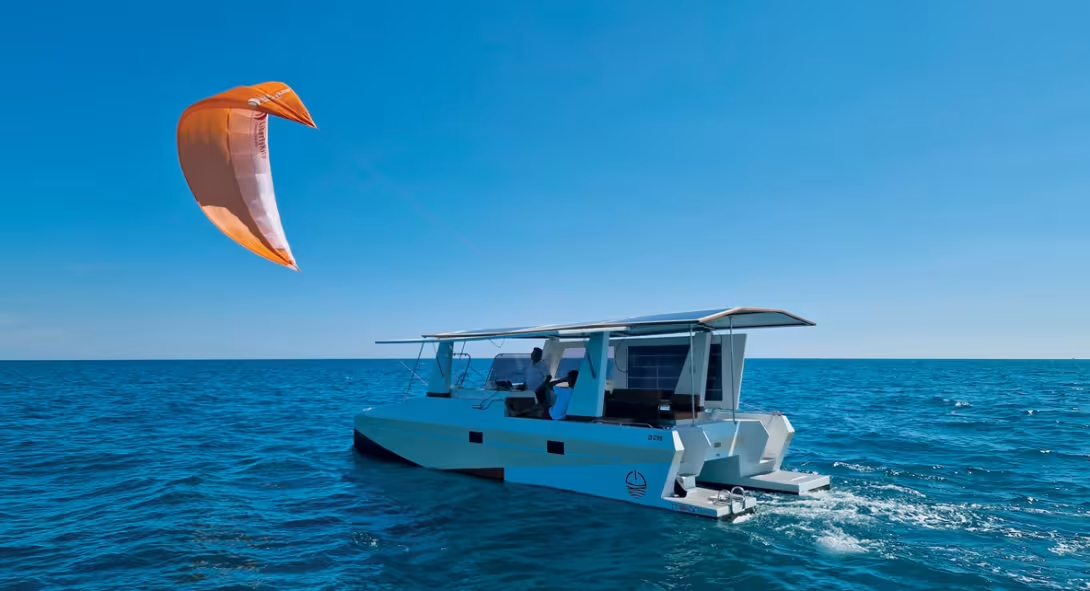
A kite wing can be ordered as an option to make the most of downwind conditions, and it will likely to be possible to produce electricity by via hydro-generation. But Millikan isn’t stopping there, as foils are also being developed.
The M.10 is set to be unveiled to the public for the first time at this year’s Cannes Yachting Festival.
Technical Specifications
Length: 32’10” (10 m)
Beam: 11’2” (3.4 m)
Motors: 2 x 20 kW
Batteries: 40 kWh
Solar panels: 5 kWp
Max speed: 12 knots
Range: 90 nm at 8 knots
www.millikan-boats.com