This new powercat was launched following a long and meticulous development process: the aim was to offer a product as innovative as it was attractive, in a market that is still immature but undoubtedly has great potential. With a length of just 37 feet (for this first model), a highly accomplished design and inboard drivetrain, here’s a snapshot of the M37, which made its world premiere back in April at the Palma International Boat Show. We were able to try out the first Makai at home, between Trogir and Split, Croatia.
Infos pratiques
- Le chantier : Makai M37
- La fiche technique
-
 Découvrez notre vidéo exclusive
- Financez votre Makai M37
- Assuez votre Makai M37
- Articles autour du Makai M37
Conditions: calm sea with slight chop, 10 to 20 knots of wind
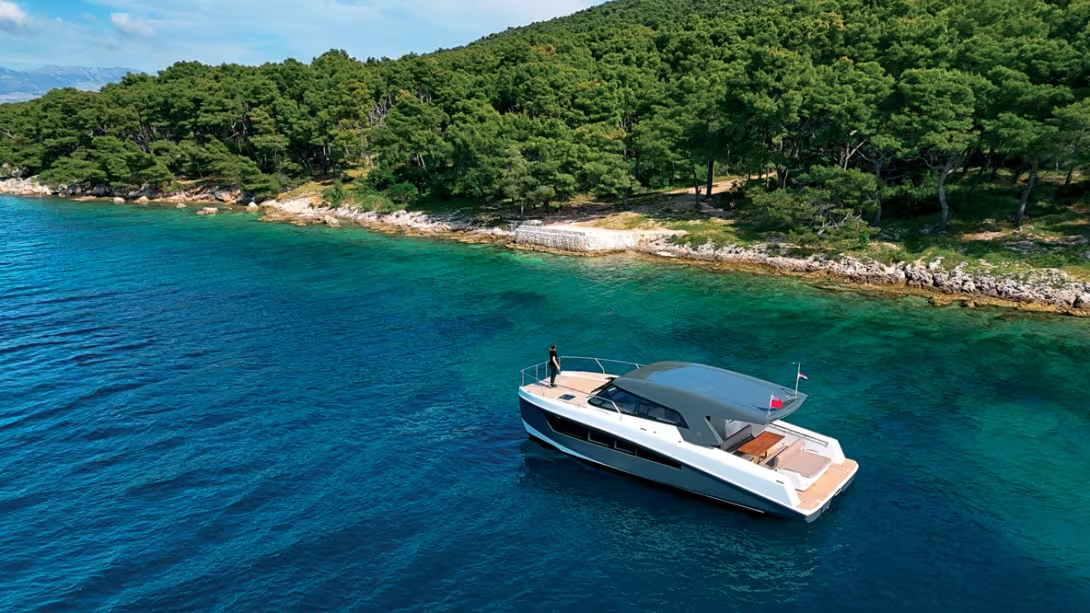
Makai Yachts is a new brand launched in 2020 by multihull specialists. The challenge was to develop and launch a first powercat that was compact, attractive, efficient and... universal. These specifications deserve a closer look. The choice was to position this first model at 37 feet, as this was a blind spot in terms of what was available. Generally speaking, comfortable cabin-cruisers start at 40 feet, while the day-cruiser sector dries up above 35... But that was before! Since then, Yot has launched a 36-footer, then a 41... and Aventura Catamarans is fine-tuning its 38 MY. The Italian design by Emanuele Rossi (ERYD Design) gives this powercat sedan lines that are as sporty as they are attractive: one of you even commented on our video by describing the Makai as like a “Porsche 911 on the water”. The designers were keen to take advantage of an inboard drivetrain, better suited to cruising longer distances. Combined with a highly accomplished hull, thanks to an air cushion effect fed by the tunnel between the hulls, the two motors guarantee power, reliability and comfort. Particular care has been taken in the construction, which uses vacuum resin infusion with a Divinycell foam core.
Last but not least, the M37 has been designed to appeal to boaters the world over. As a result, this powercat will delight yachtsmen in the Mediterranean, the Baltic or the Bahamas. The M37 is available in an Open version, i.e. without the hardtop. This version is more suited to day-cruising in regions where the typical climate is warm and sunny.
A forthcoming 42-foot model is planned for next year.
An Intelligent Deck Layout
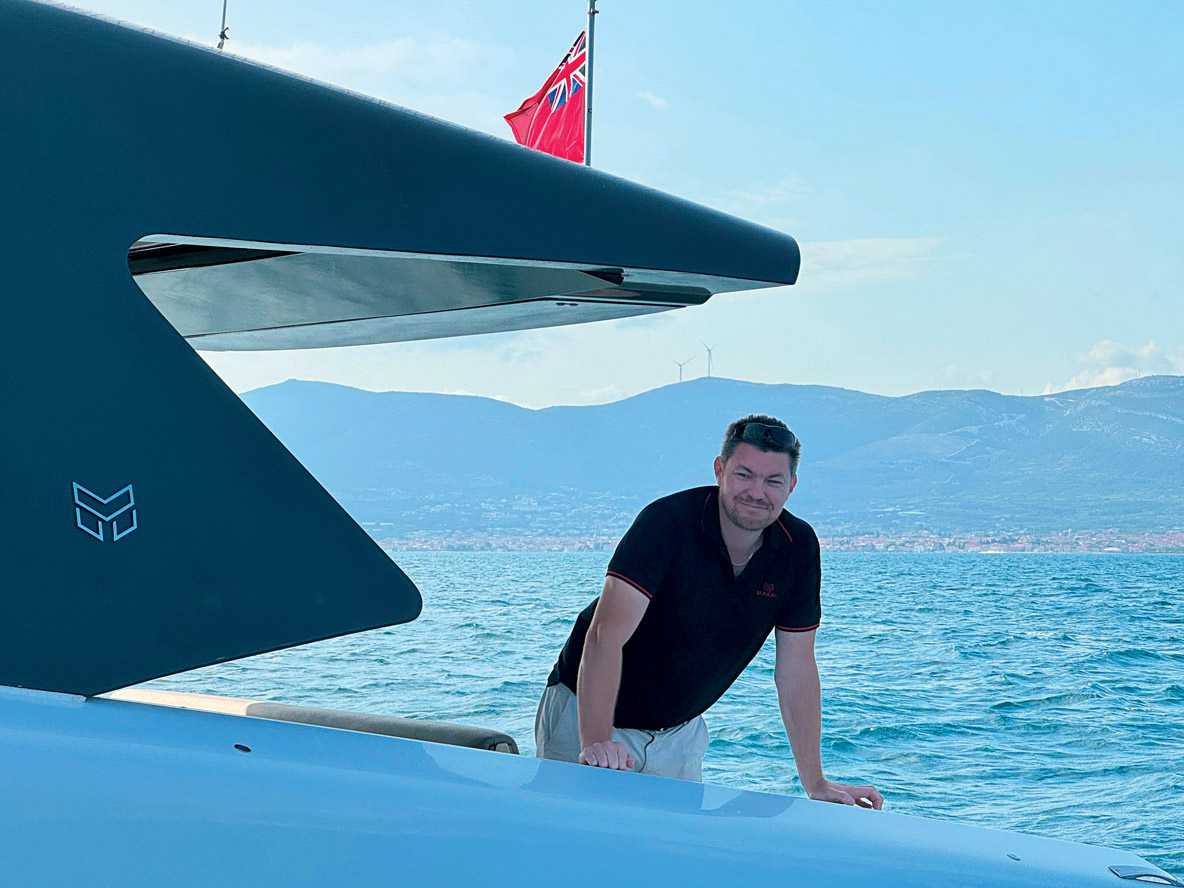
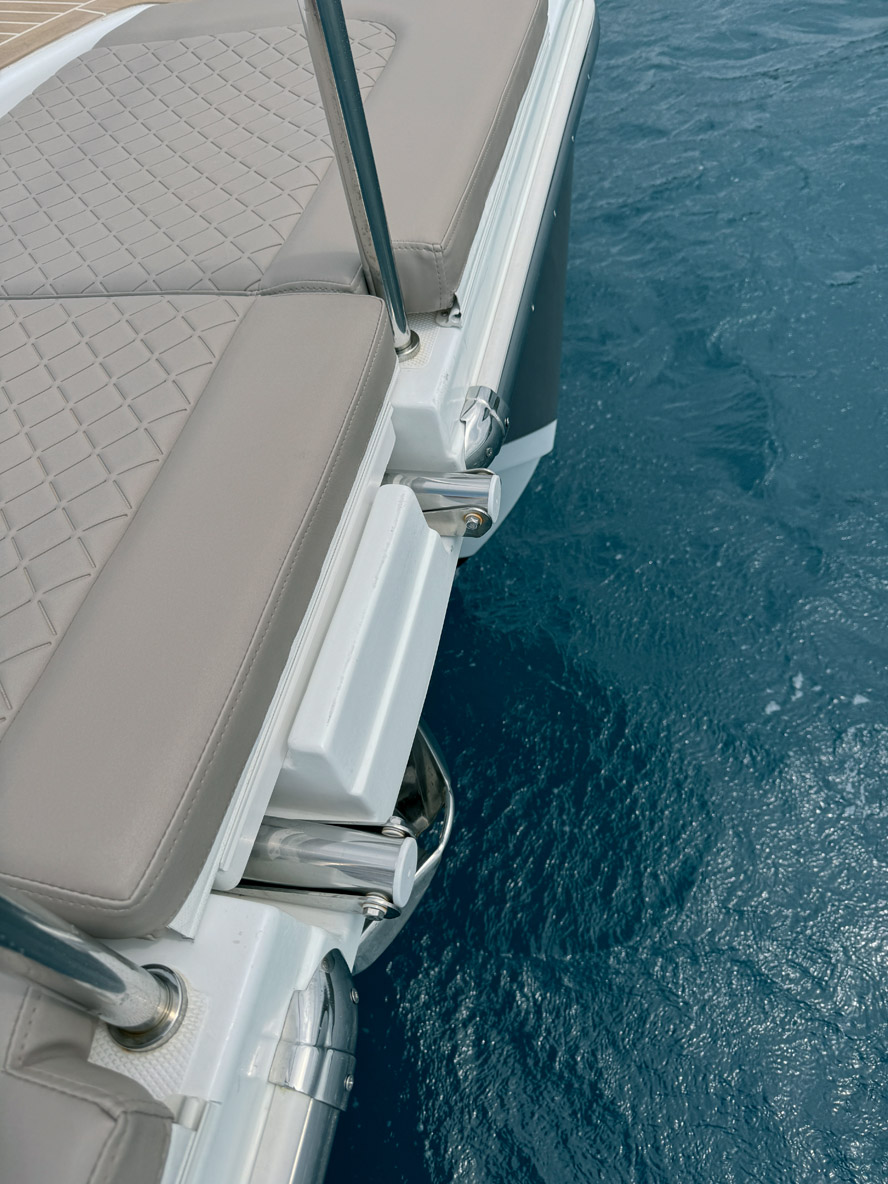
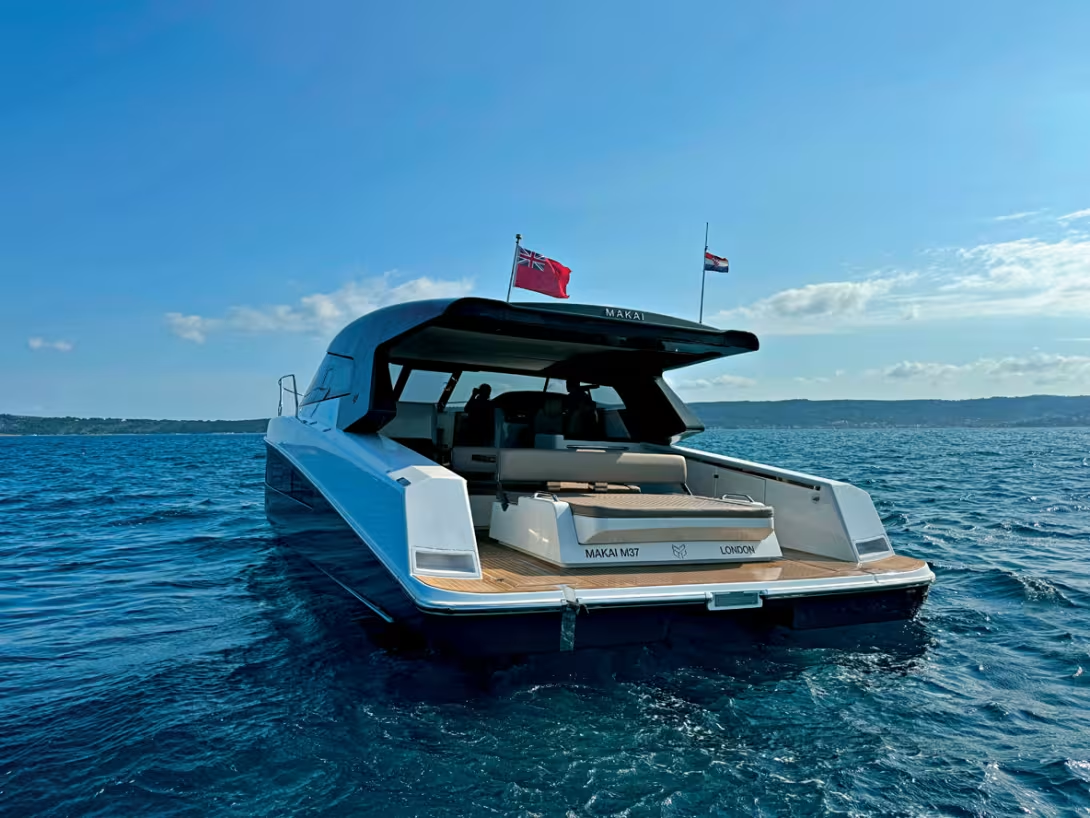
The M37 project is based near Split, Croatia. And so it was at Trogir, a few miles to the northwest, that our appointment was made. The weather, at midday, was a little cloudy and windy, though was expected to improve in the afternoon. I hurriedly boarded the boat from an old fishing boat pontoon, discovering a vast stern platform that was handy for exercise - and, of course, for swimming. Shane Grover, co-founder and brand manager, is accompanied by Nina Secak, marketing and administration manager. Both welcomed me warmly, as it doesn’t seem all that often that a boating journalist travels all the way to Croatia for a test sail.
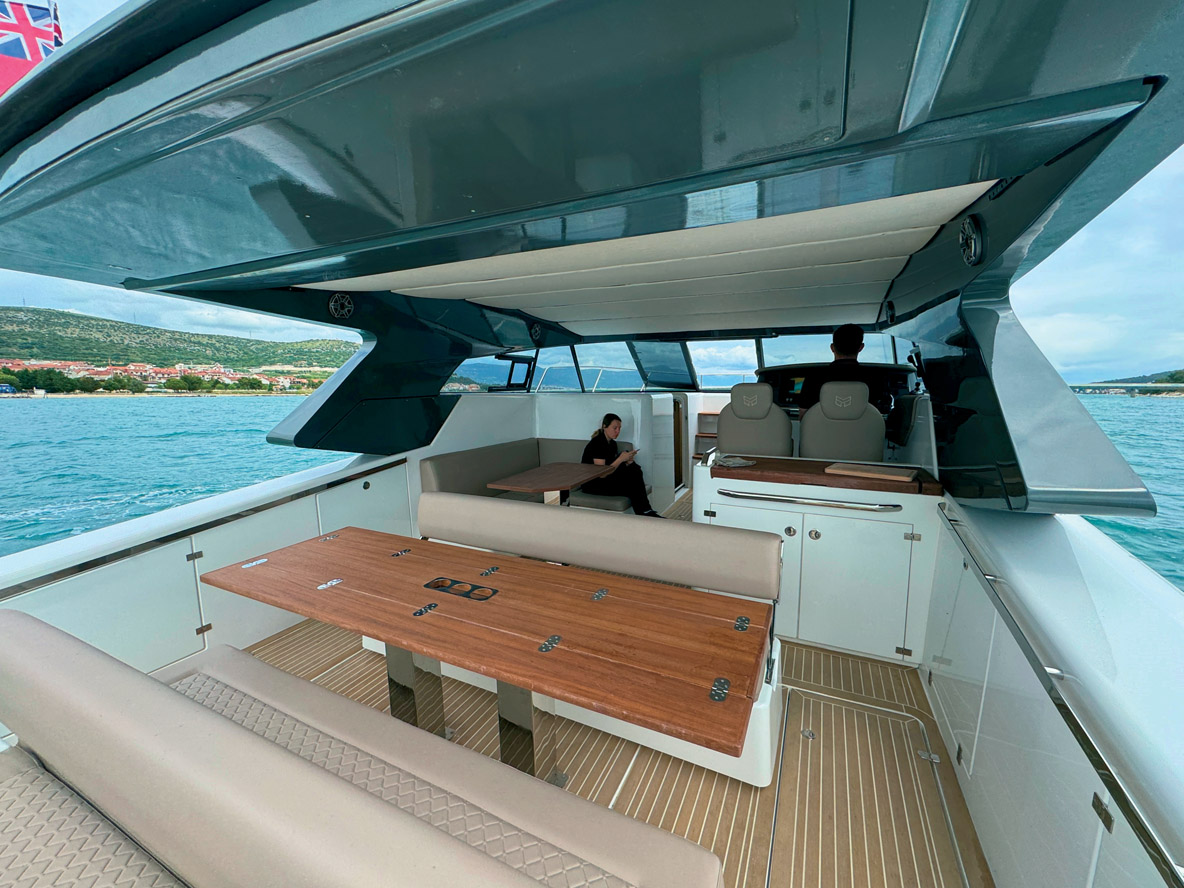
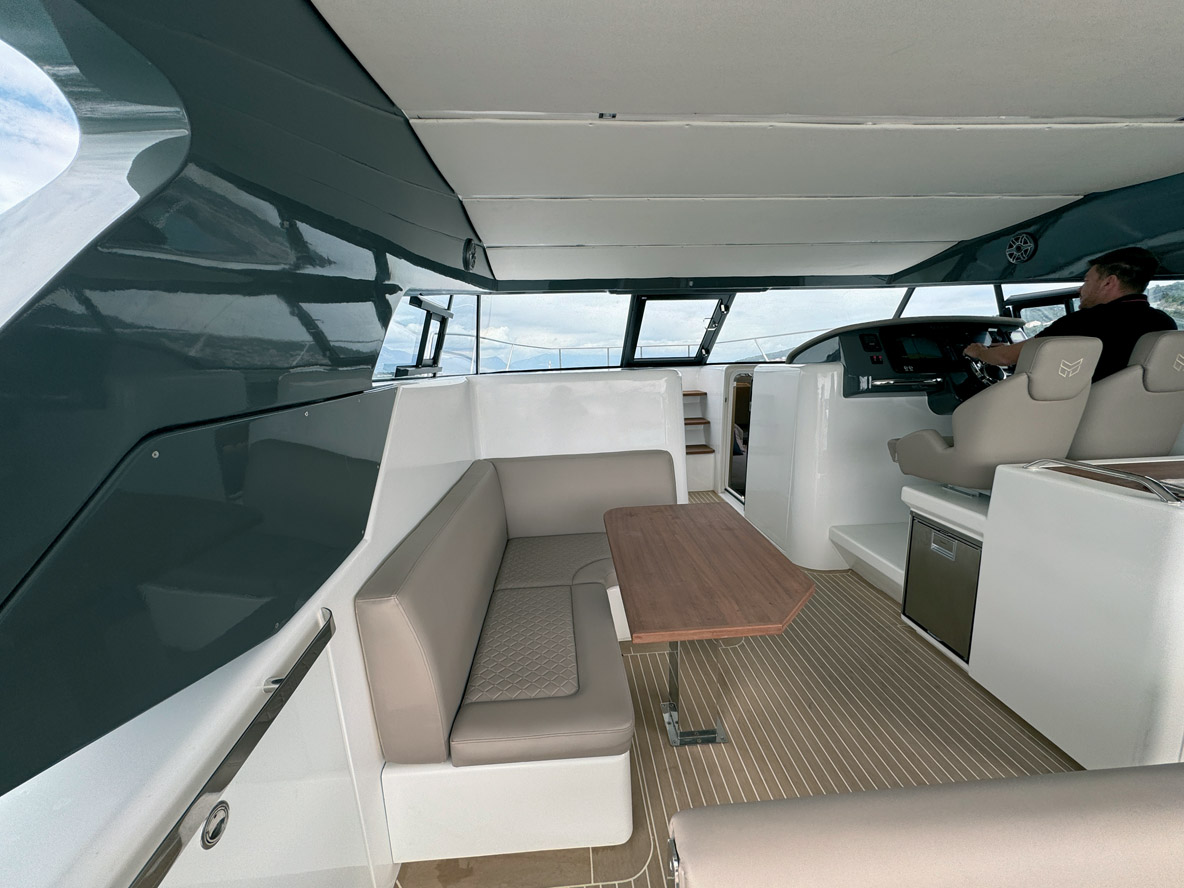
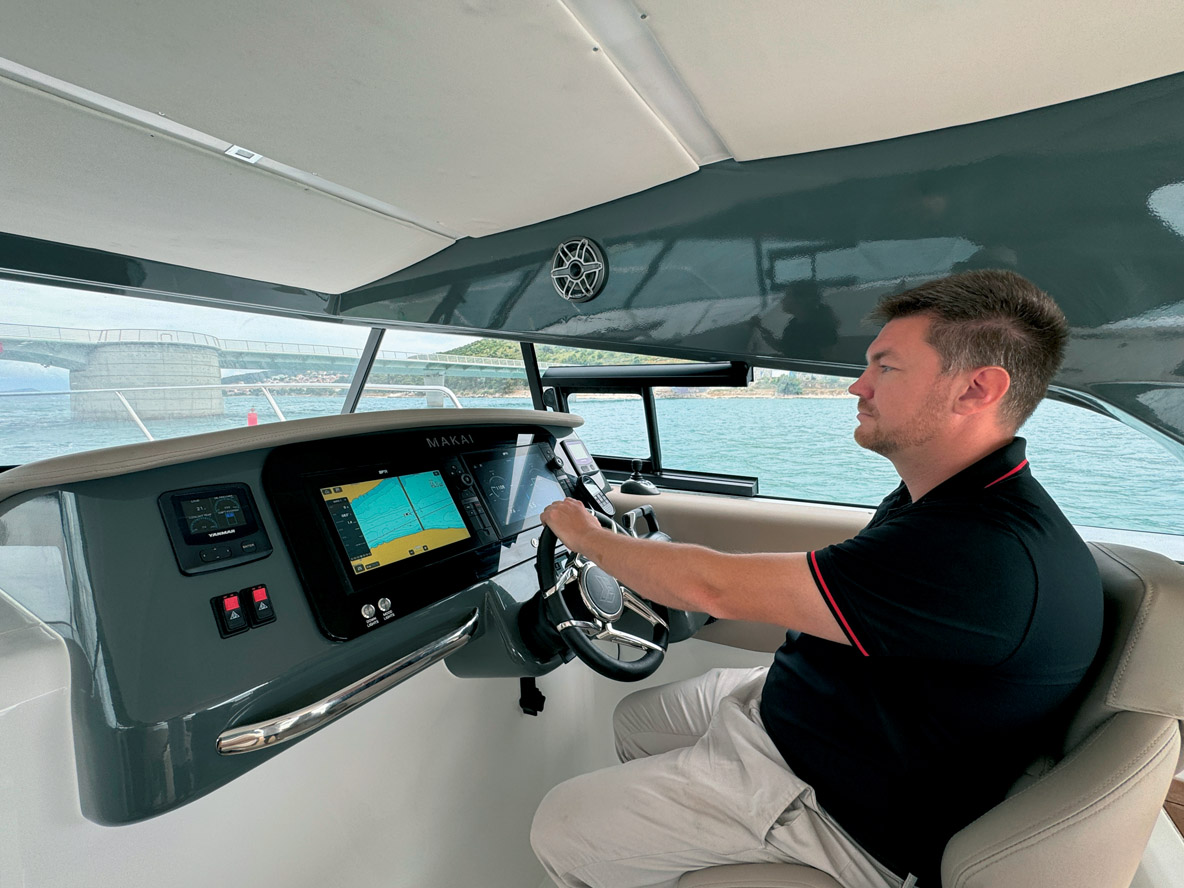
The cockpit, measuring some 205 square feet (19 m²) in area, is very wide, with a huge sunlounger in the open area. The movable backrest provides a classic bench seat on the inside, facing a folding table. A second bench seat is logically oriented aft. There’s plenty of storage space in the floor, under the seats and on the bulwarks. Stainless-steel handrails everywhere are an excellent safety feature. The black Z-shaped hard-top supports are almost more impressive in terms of design when viewed from the inside. The black leather upholstery creates a cozy look. The semi-sheltered living area makes full use of the available width, thanks to the central passageway to the foredeck, which eliminates the need for side decks. A small L-shaped saloon is located to port, while the helm station is offset to starboard. Another seat adjoins that of the helmsman. The ergonomics of the controls are excellent: the builder has made a point of equipping the Makai with modern, intuitive technology, similar to that found on today’s car dashboards. The two large multifunction displays interface with all the technical and electronic elements on board.
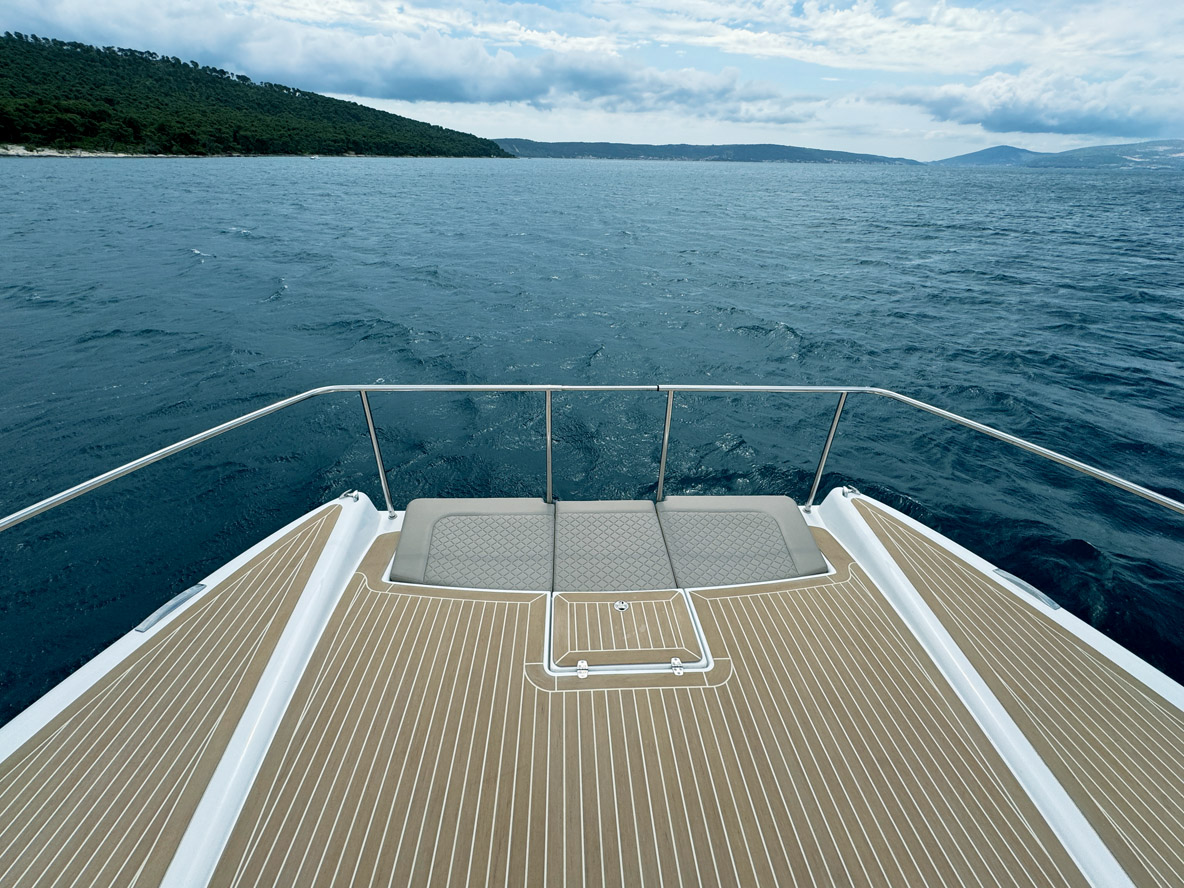
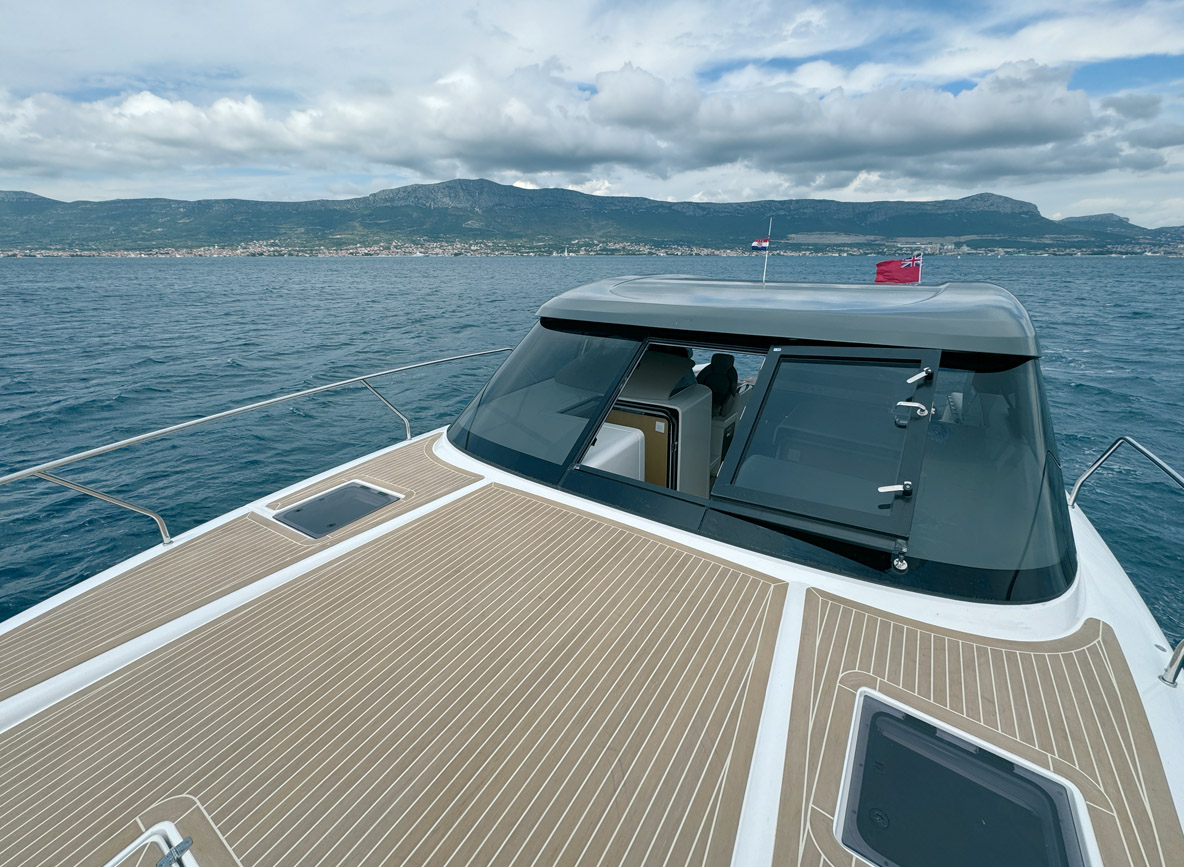
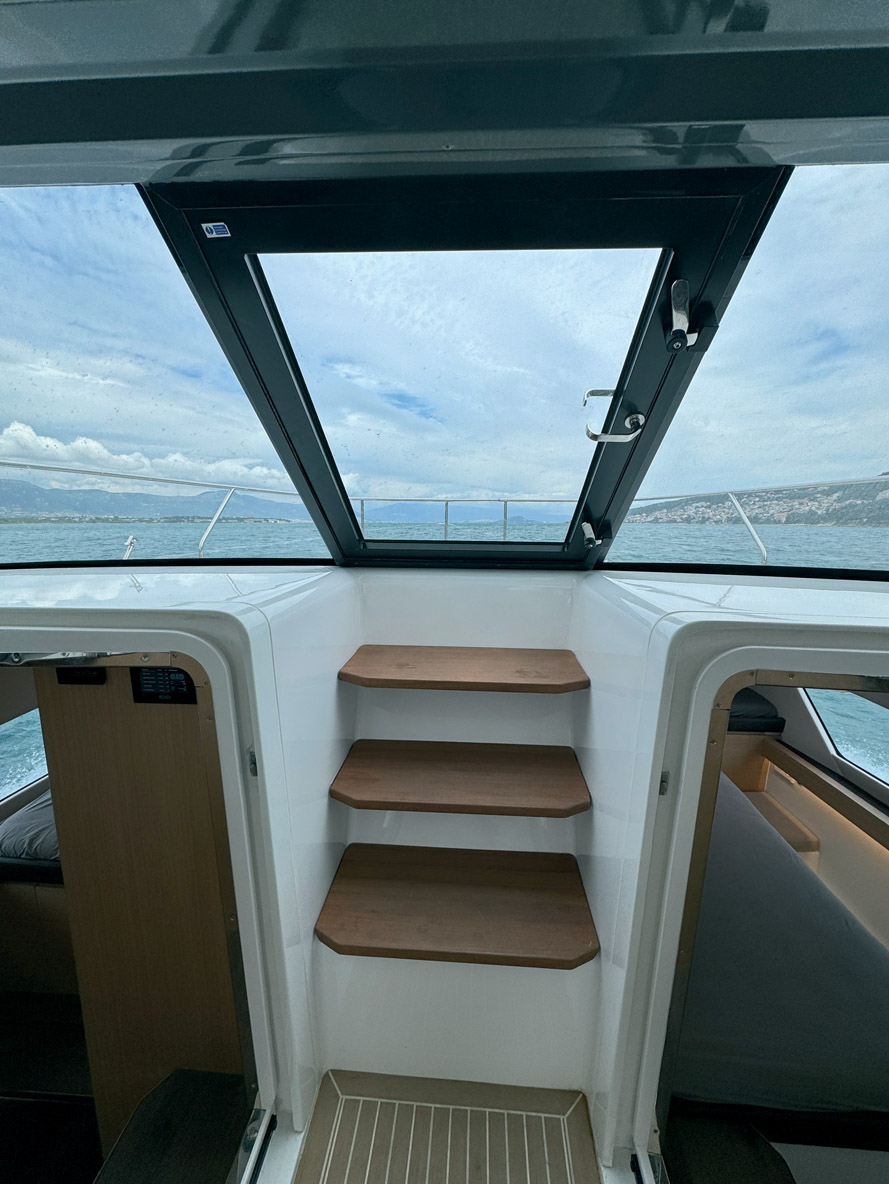
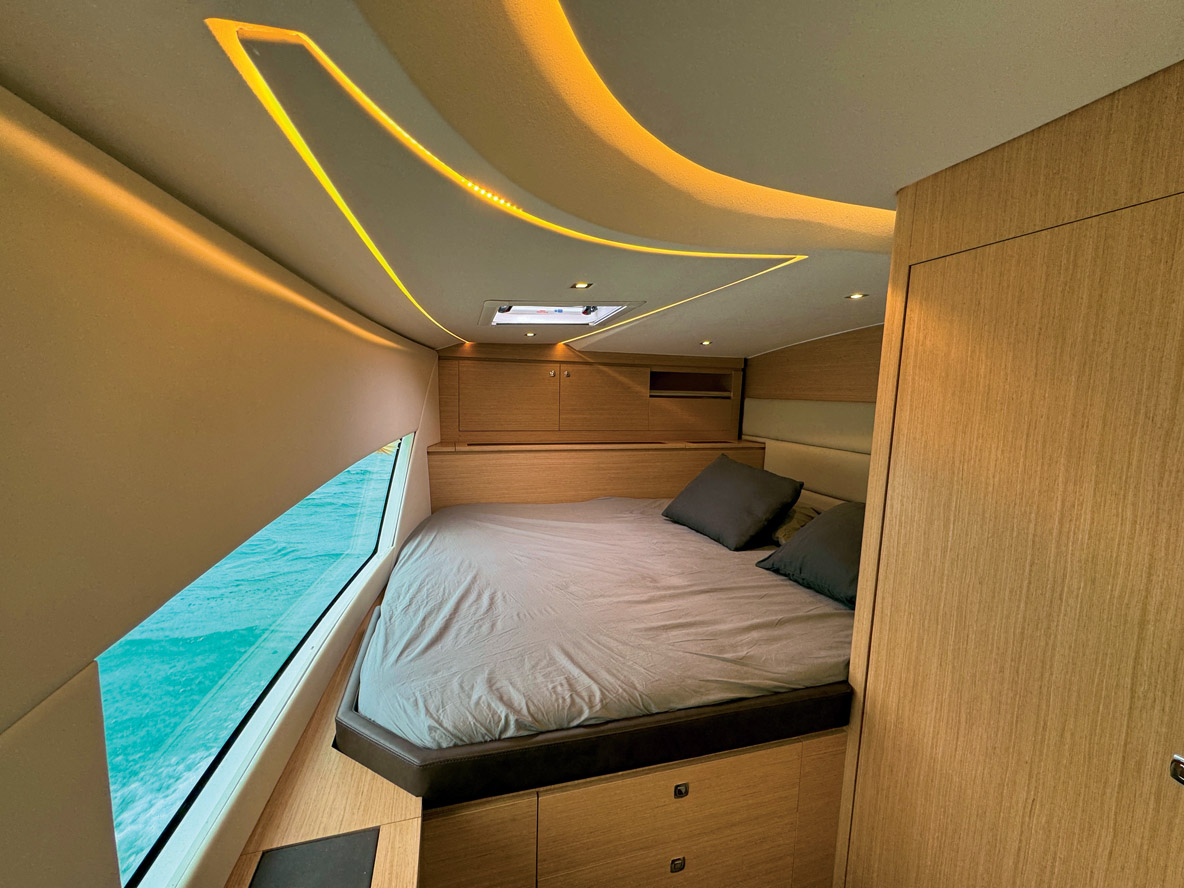
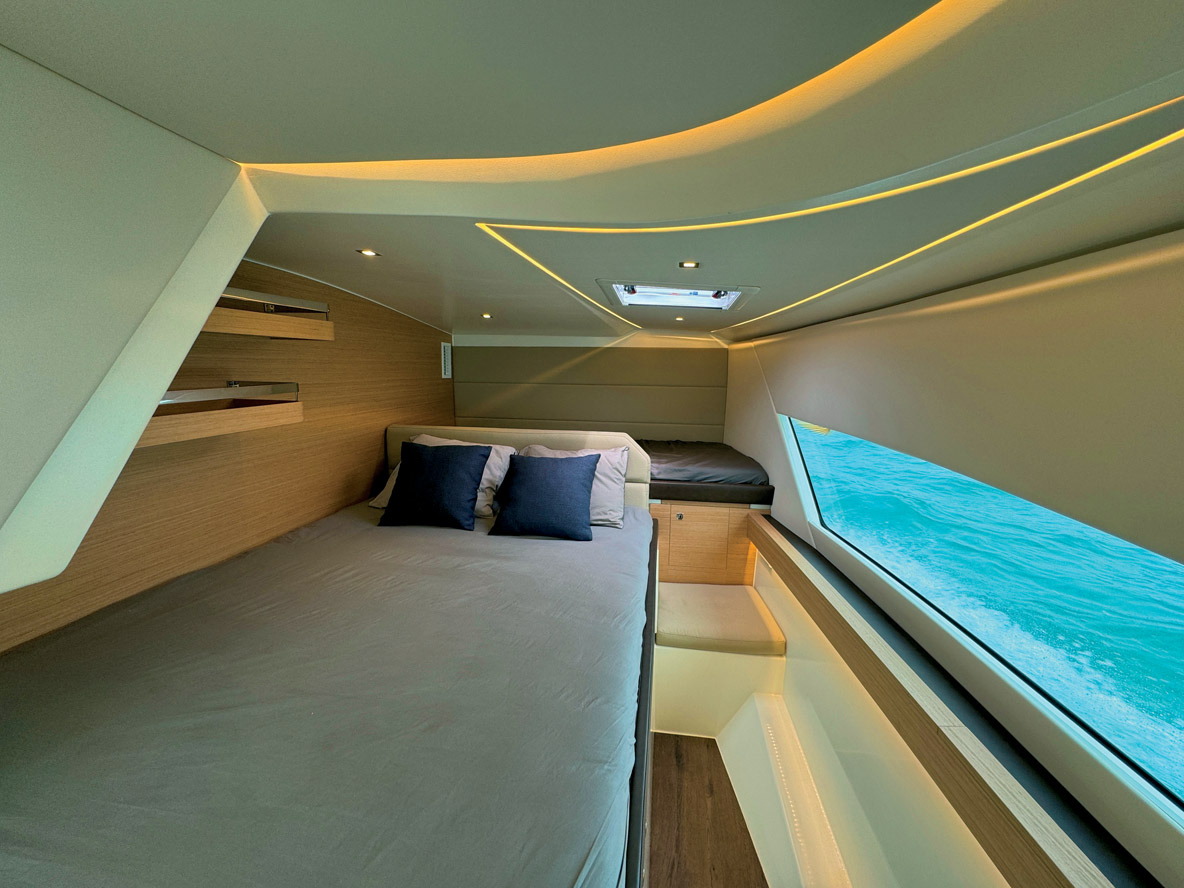
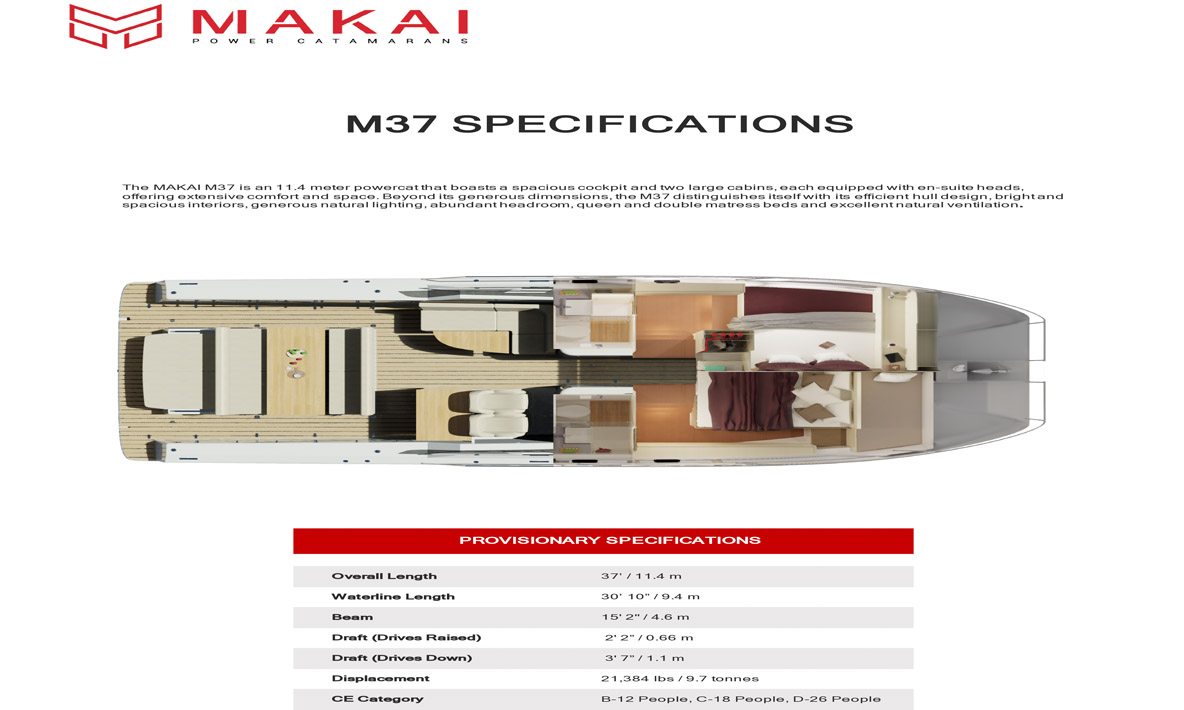
A little further forward, there is a companionway on each side, each leading to a cabin (6’8” headroom/2.04 m) with generous light via a large hull porthole. The port cabin, with its bed set athwartships, is a little larger than the more traditional starboard cabin with its bed fore-and-aft. The berths are of generous size, at 80 x 60” (2 x 1.5 m). At the stern, on either side, there are compact but well-designed heads compartments. Three steps lead up to the central opening of the wrap-around windshield - a system on jacks is required to secure and simplify handling of this inclined panel. You then find yourself on a vast foredeck area which is made safe by a sturdy stainless-steel pulpit. A locker houses the 700 W windlass and the 165 feet (50 meters) of chain supplied as standard. Elegant fairleads - though undoubtedly finger- aggressive with tensioned mooring lines - lead to retractable cleats. A bench seat is fitted forward. The deck layout also provides access to the water (or beach) from the bow via a retractable ladder.
30 Knots Top Speed
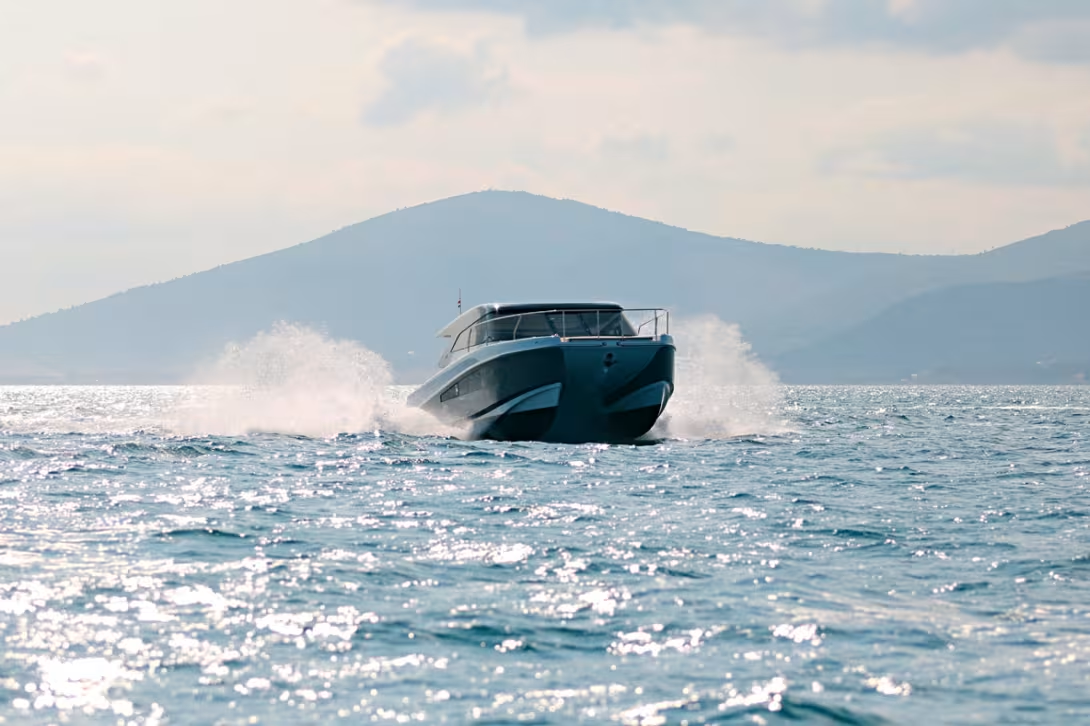
Comfortably installed in the bucket seat, I take the helm - and the throttles. The Yanmar purrs at 1,000 rpm. At this speed, we’re approaching 6 knots and fuel consumption is just one liter (0.26 US gal) per mile, which would allow you to cover more than 800 miles without refueling. This frugality of inboard diesel engines - especially at low revs - is to be commended. Note that the drive legs can be lifted so that the M37 can beached or even take the ground if moored in tidal waters. 6 knots is certainly the economical cruising speed. If you’re looking for a little more adrenalin, just ease the throttles forward... Acceleration is straightforward, with 0 to 20 knots taking just 13 seconds, but the 6 seconds before getting up on the plane mean that the helmsman has to stand up because of the bow riding up. A little lift-up with the dashboard, combined with higher seats, would be most welcome. Once up on its lines, the Makai M37 shows off its seakindly behavior. It turns almost flat and, above all, dampens chop considerably. I can immediately feel the effectiveness of the Air Glide that Shane has just described to me. The specific design of the tunnel between the hulls is able to capture the air - provided the powercat is properly up on the plane - and generate a real shock-absorbing cushion. I had already seen the effectiveness of this design on board the Four Winns TH36 and the Yot 36: it’s amazing, and it works perfectly on board the M37. In a really confused sea, the underside of the nacelle can sometimes slam a little, but this is rare. Optimum fast cruising speed is around 20 knots, with fuel consumption remaining reasonable (4 liters/1 US gallon per mile). On the other hand, with 2 x 450 l (2 x 118 US gal) of fuel, range is limited to just over 200 nautical miles. Top speed with our twin 370 HP engines (the standard powertrain is 2 x 320 HP) is 30 knots. In absolute terms, this is a very respectable figure, but it’s a long way from the 38 knots promised on paper before the first tests... This significant difference in speed is undoubtedly due to the displacement, which is ultimately 2 tons more than anticipated when the M37 was designed. In terms of robustness and durability, this is not necessarily bad news.
Conclusion
Barely splashed for the first time, and the Makai M37 was scouring the Mediterranean to make a name for itself at boat shows - in this case Palma, Cannes and Venice. This was quite a test run, demonstrating that this new powercat, even though it’s less than 40 feet long, is not averse to taking to the open sea... The comfort provided by the M37, combined with undeniable seaworthiness, make this powercat an excellent choice for coastal cruising and, why not, forays on the inland waterways, thanks to its contained beam and air draft. The option of beaching and disembarking via the bow complete this catamaran’s particularly attractive versatility.
Extensive boating program
Attractive design
Reduced range at cruising speed
TECHNICAL SPECIFICATIONS
Architect: ERYD Design
Length: 36’5” (11.1 m)
Waterline length: 30’10” (9.4 m)
Beam: 15’1” (4.6 m)
Draft: 26”/3’7” (0.66/1.1 m)
Displacement: 21,385 lbs (9.7 t)
Engine: 2 x 320/370 HP Yanmar Sterndrive
Fuel: 237 US gal (900 l)
Max speed: 38 knots
Range: up to 700 nm at 6 knots
Water: 118 US gal (450 l)
CE Category: B12/C18/D26
Price: € 559,000 ex-tax (€ 529,000 ex-tax for the Open version)