After a remarkable breakthrough in the late nineties, the concept of a “Power Cat” seems to be running out of steam and somewhat losing its identity. Some builders have carried on, even to the point of developing an active range, but sales remain relatively small. Today we are seeing a real revival: the major players are coming back with completely redesigned models, new players are appearing, charterers and owners are taking an active interest in this developing sector.
Infos pratiques
- Le chantier : Leopard 51 PC
- La fiche technique
-
 Découvrez notre vidéo exclusive
- Financez votre Moorings 514 PC
- Assuez votre Moorings 514 PC
- Articles autour du Moorings 514 PC
The paradox of the economic crisis
Their own qualities notwithstanding, power multihulls represent an opportune niche in a market which is yet to be fully explored. This potential market is generating specific interest in the way it is evolving (albeit slowly) within the sector. The Power Cat is offering a pertinent response to several types of potential buyers: ageing yachtsmen, newcomers or defectors from monohull powerboats and enthusiasts from countries which might not have a strong yachting tradition such as parts of Asia or South America. The downside of this is that these countries are often out of the running when the demand from the wealthy (sure, a small minority) keeps on growing, and the price of oil is attractive.
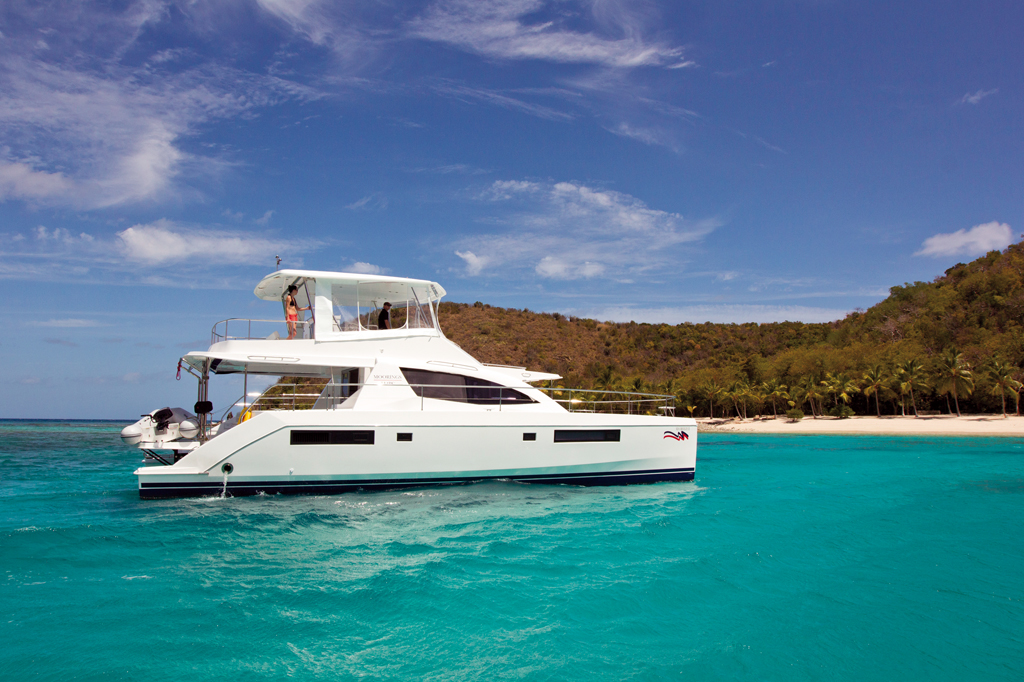
The long arches conceal the propeller tunnels and provide a real dynamic push by lengthening the waterline
Leopard Catamarans and power multihulls
This South African industry leader, for several years now one of the three biggest multihull builders, produces a range of power catamarans designed by Morelli and Melvin: the 39 and the 47PC (see tests in Multihulls World No. 117 and 122). A builder acutely aware of the evolution of charterers’ expectations, via their close links with Moorings, Sunsail and Footloose and their 27 worldwide destinations served by hundreds of charter bases. To overhaul their range of power cats, Leopard called on Alexander Simonis to design a 51 footer!
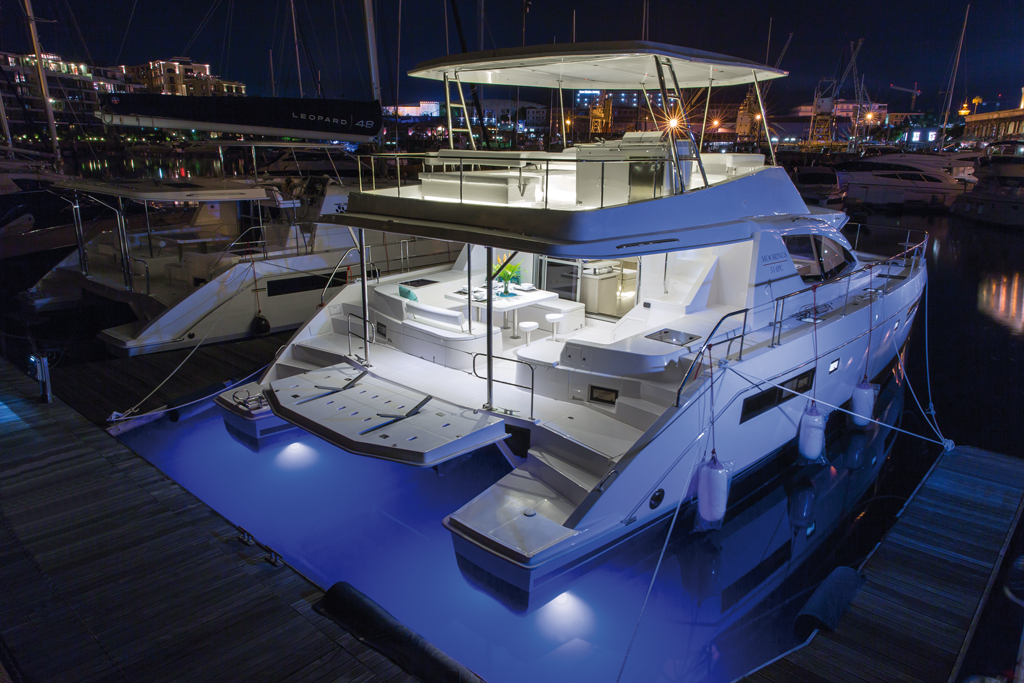
The lounge areas of the two cockpits and the flybridge are the Moorings/Leopard 51’s sociable areas
More technically challenging
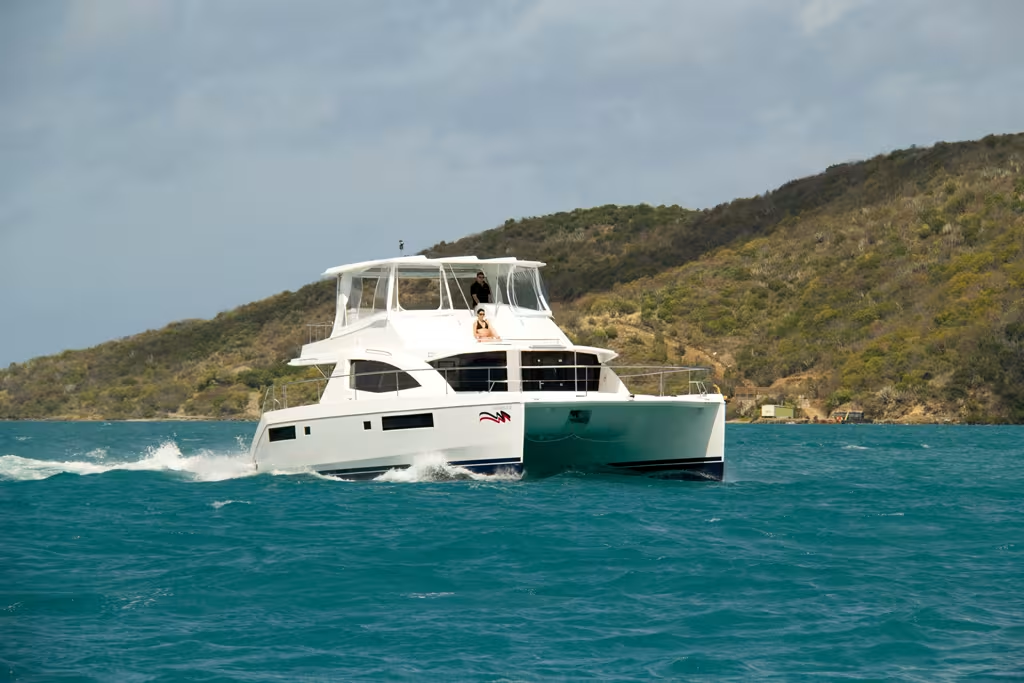
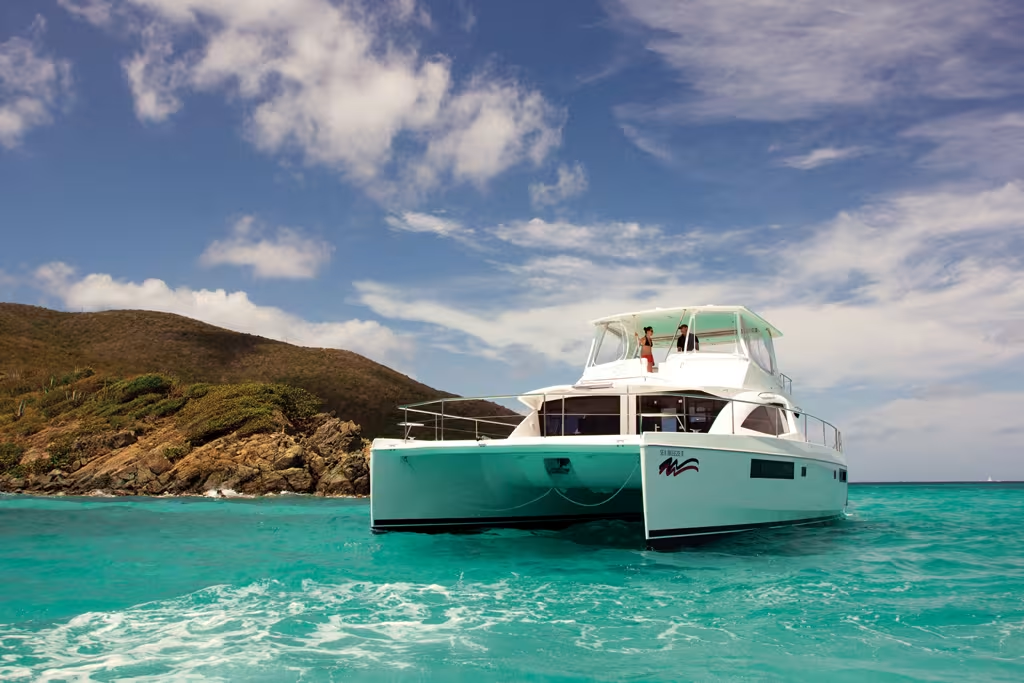
Before going aboard the all new Leopard 51PC (a Moorings 514PC version) for a little 2-day test cruise around the enchanting BVIs, let’s try and understand some of the technical aspects. The general design of the Power 51 takes much of its basis from the Leopard 48 sailboat, with the exception of the hull, which has been substantially modified to correspond with the specific requirements of a power-driven vessel. The layout, the lines, the bridgedeck clearance, the freeboard and the distance between the hulls of the Leopard 48 corresponded with the specifications required for the 51, but the hydrodynamics were going to have to be revisited if the boat was going to meet expectations. The goal: to build a modern motor catamaran, with accommodation for 8 guests plus skipper, small enough to go in marinas, capable of making offshore passages at an economical 10 knots, but being able to maintain a 15 knot cruising speed, with a top speed of over 20! Now there’s a challenge…
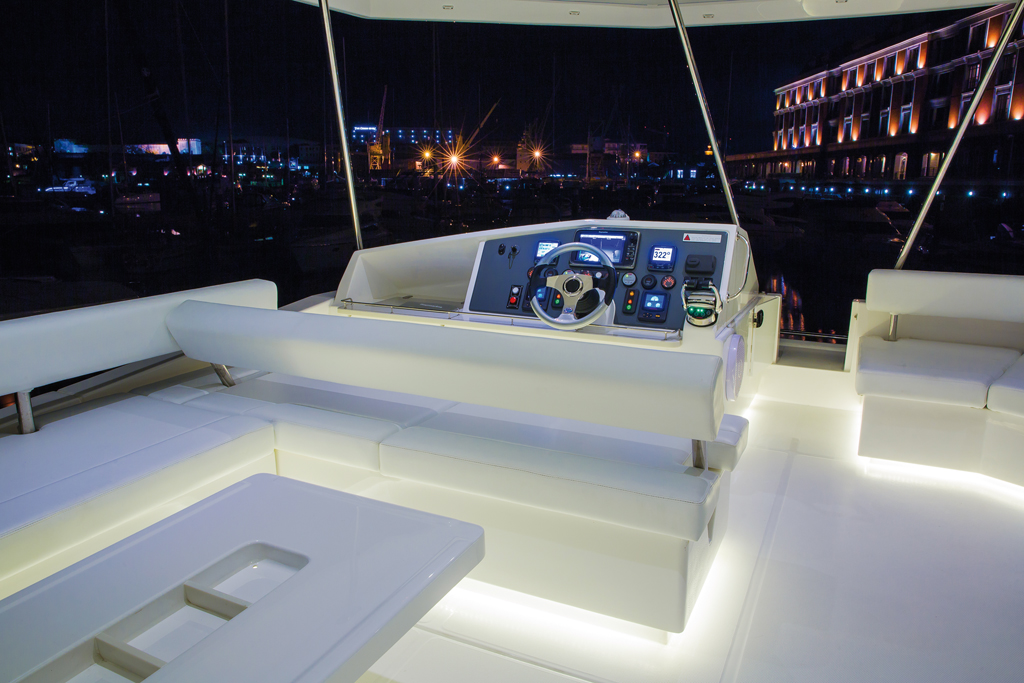
The helm station is really comfortable and safe. All that’s missing is a deflecting windshield
The Alexander Simonis equation
For the 51PC, the equation which the architect had to solve centered globally around six factors: the trim, the wetted surface, engine power, interaction of the waves under the bridgedeck, optimization of the flow and the aerodynamics. The overall balance of the vessel is fundamental to the comfort and the performance, and it is unthinkable to artificially compensate using trim adjusters as on many monohulls. The design of the 48’ sailboat had the necessary characteristics (fine, elevated hulls and length), but it was designed to pushed along by the wind from high up and central, and not by something below the water and at the back! So the rocking had to be reduced, the hull extended by bringing the forefoot down and lengthening the arch. The reduction in wetted area is achieved by there being no keels (a pair of protective skegs for the propellers has been added though). The points on which Simonis-Voogd worked hardest were transmitting the power and the dynamic balance, achieved by adding a long arched tunnel to the original form. The design of this part of the hull is complex, as the goals of performance and handling behavior are imperative. The tunnel houses the propeller and allows a reduction in the angle of the shaft (around 8°), but also serves as a dynamic accelerator, by channeling the flow of water. Optimizing also meant a battle against turbulence in the tunnel. So we can see that we’re talking about a completely different hull than that of its 48’ sailing cousin… Reducing wave resistance, fighting drag, optimizing flow and trim is also (as it is with aviation) a question of fine tuning (rudders, departure angle of the tunnel). The design was done in partnership with the German division of the digital towing tank, Numeca, used by the Oracle and Emirates teams for their AC72s! Aerodynamics haven’t been left out either, also using this type of modeling.
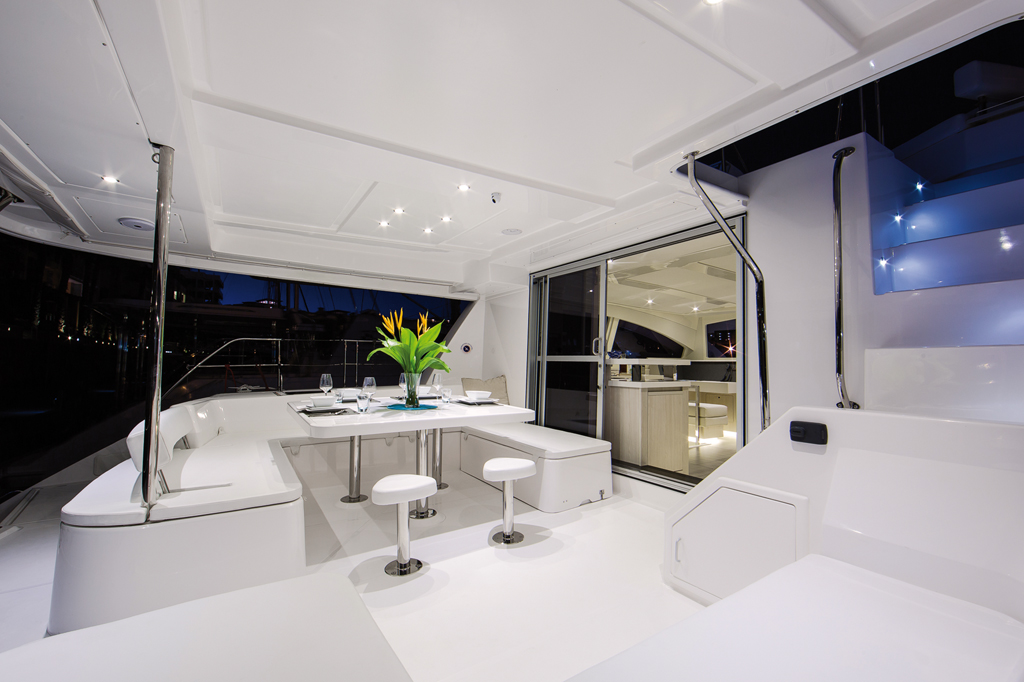
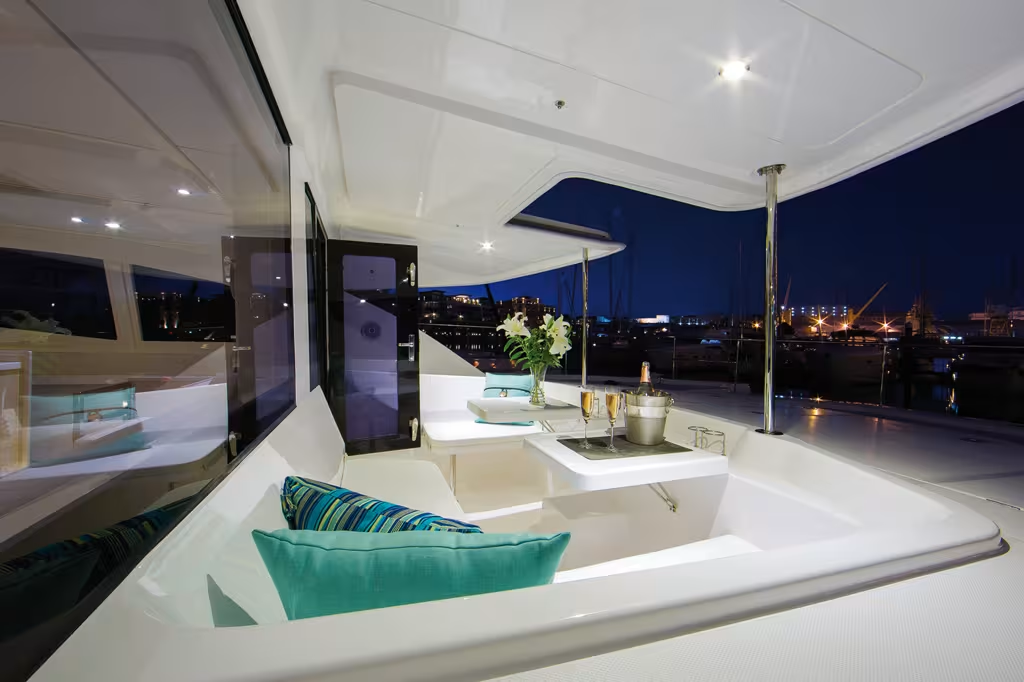
The aft cockpit, with flybridge above, is very open to the salon and the galley, making it a perfect outdoor dining area
Sophisticated engines
The Moorings 514PC which we tested was fitted with new 370 hp Yanmar 8LV motors. These latest generation V8 lumps are managed by an electronic system which includes a plug and play diagnostic tool. These are 4.46 liter twin turbo V8s at 90°, whose heads have 4 valves per cylinder, and common-rail injection systems. The high output alternators produce 180A at 12V. These recently released motors have generated great reports from our colleagues who specialize in motorboats, and the reviews of users seem to be equally positive. Yanmar’s innovative design has resulted in an engine which is compact and light (530kg), and produces little noise and low emissions.
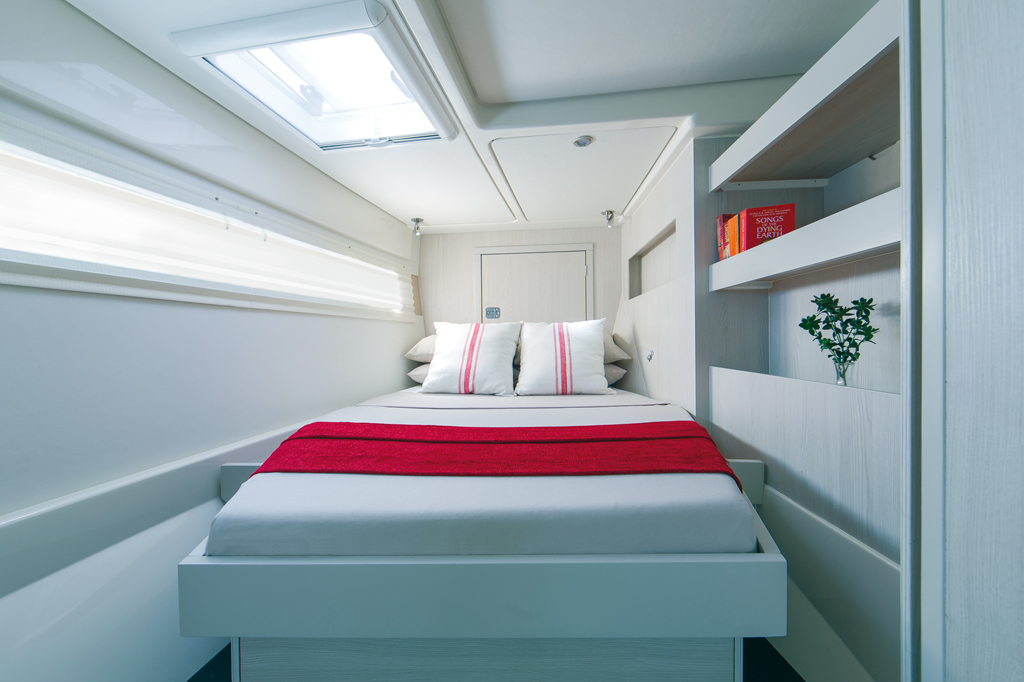
Light, space, natural (or air-conditioned) ventilation, direct access to the bathroom: luxury in 50 foot motorboat.
A remarkable use of space
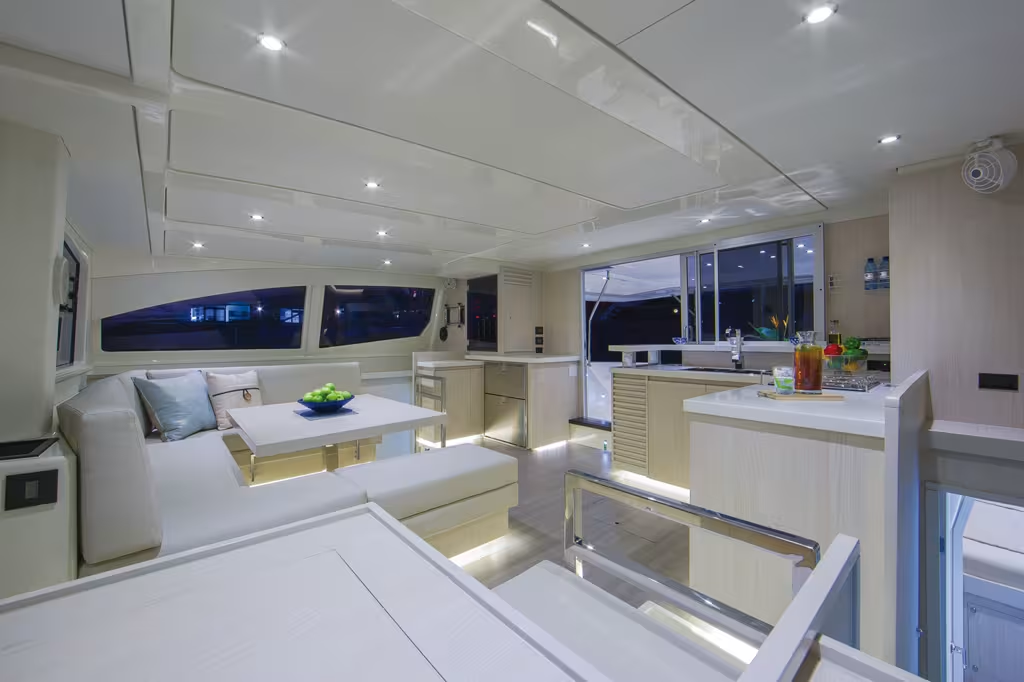
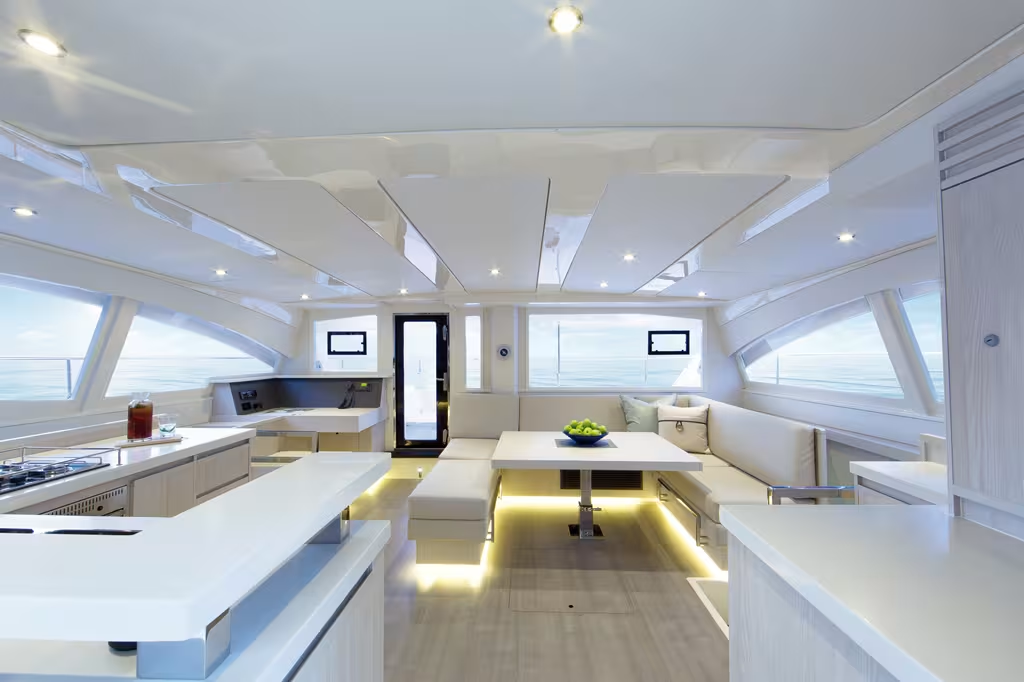
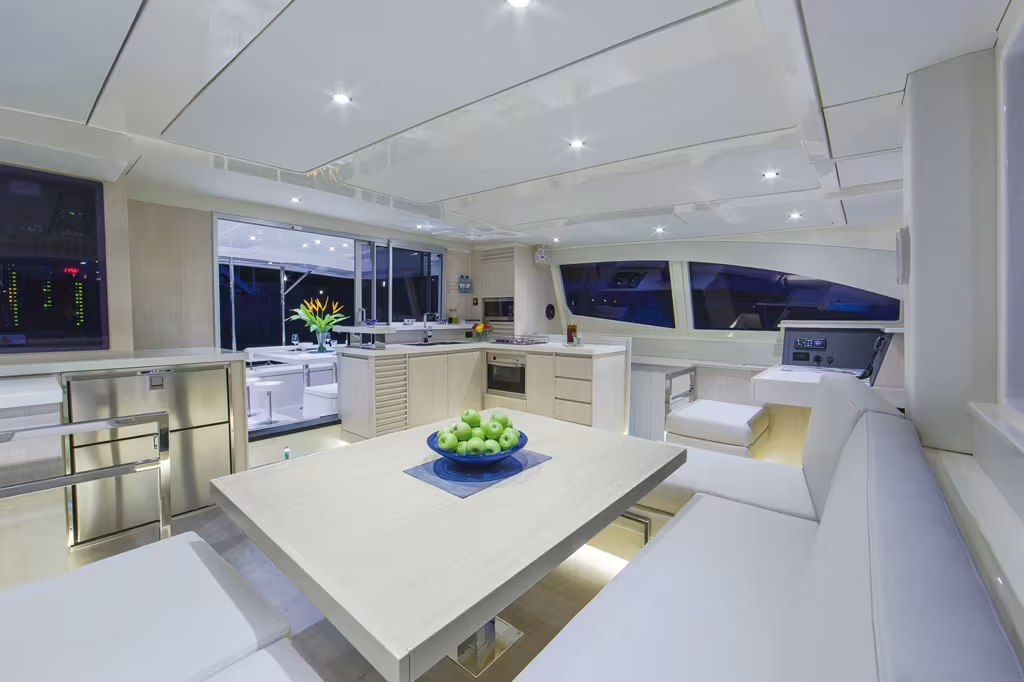
Everything is big aboard the Leopard/Moorings 51. Accessing the cockpit by the aft is made easier by extensions to the sugar scoops, and it opens up into a particularly welcoming outdoor double lounge space. The traditional cockpit with table, totally reworked flybridge (compared to the 47PC) leads to a real deck salon with lounger, relaxing sofa and large table next to the helm station. A galley area with barbecue, fridge and sink is cleverly integrated, and safety is ensured by a stainless steel tubular guardrail and numerous handholds. This marine terrace has a great convivial advantage. The solid structure can be entirely enclosed by fabric screens - a perfect solution for an anchorage, though I would be a bit concerned about the windage when under way. A rigid wind deflector at the front might be useful. Inside, Leopard Catamarans have radically evolved the style, abandoning the cherry cabinetry in favor of a more fashionable, contemporary design. Very light white oak paneling has replaced the traditional woodwork, creating a tasteful light urban chic appearance, which suits the boat well. The L-shaped galley is functional, practical and easy to clean. A traditional oven, three-burner hob and a microwave should enable the cook to satisfy a hungry crew. Stowage is effective and plentiful, though on the model we tested didn’t seem to have any provision for being closed up in rough conditions. The forward cockpit, which is accessible from inside, picks up on the design of the 48, with all the same advantages we saw on that model. The standard of the cabins (4 on our test boat, aimed at the charter market) is indisputable, and the ergonomics of the hulls on this version, which has four bathrooms, is a real accomplishment.
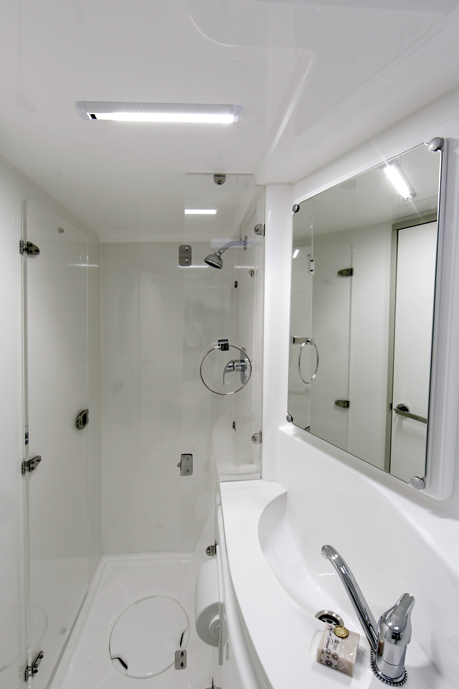
A great layout, with 4 cabins and 4 generous bathrooms
Sea trial: 80 miles around the Sir Francis Drake Channel (BVI)
Landing at Tortola, coming from Miami via Puerto Rico, immediately put us in the right mood. After overflying the Bahamas (magical!) the runway at the little airport at Beef Island seemed to be floating in the lagoon. I’m going to discover the Leopard in its Moorings 514 PC version in the perfect surroundings! The boat, chilled by air conditioning, gets us gently acclimatized, and we soon head off for Cooper Island, our first Caribbean pirate anchorage (abandoned by the Spanish who first discovered them, the BVI became the choice of English, Dutch and French pirates). Twenty-five knots of tradewind blowing across a rough sea, with scattered squalls and going into a good chop would be a good testing ground. Before letting me take the helm, our skipper pushed the throttles hard down, and we picked up to sixteen knots in an all-out assault on the Sir Francis Drake Channel. This first run gave a good impression of the boat’s agility. Despite its reasonable size (for a power multihull), the 514PC rode the wave train without ever slamming. The absence of pitching and rolling in these choppy conditions was a real revelation. The ease with which we reached the quiet (in April) spot of Salt Island meant that we had earned a swim, before stopping at the beautiful Cooper Island to check out the conch fritters, and then heading off to go round Virgin Gorda. The 20 miles we had to make straight into the force 5-6 tradewind would without doubt have raised a few issues on a sailboat of the same size! We tackled the strongest conditions of this trip with generous amount of throttle. At 18 knots, under the lee of the northern end of Cooper Island, the 51 performed like a magic carpet. Off Spanish Town we turned and headed northeast, straight into the wind in the narrowest part of the channel, which kicked up a short, one and a half meter sea. Looking for the best compromise between speed and comfort, I found the perfect equilibrium at about 11 knots. Our “fast” cat had (already!) got us to the entrance of the big lagoon of Gorda Sound (at the northern end of Virgin Gorda), where we had a coffee off the Bitter End Yacht Club (there are very few areas where anchoring is permitted in the BVI). Riding into these tradewinds really showed off the 51’s dynamic qualities, its balanced trim and passage-making ability. Those coming across from sailboats will appreciate the power which they have in reserve, and the high speeds they can achieve, and will set the revs to suit their needs, while the feeling of stability on this cat will convince anyone who has bad memories of similar-sized, single-hulled powerboats. After sampling the traditional painkiller (local worry-killer more like!), we enjoyed a very comfortable night (the boat being kept at a perfect temperature thanks to the air conditioning, powered by the almost inaudible generator!) The photo shoot the following morning had us heading over to the reef off Mosquito Island, where our shallow one meter draft and the cat’s excellent maneuverability worked wonders. Offshore, the trades were kicking up a sea, right on our track. The trip down to the legendary anchorage at The Baths, at the southern end of Virgin Gorda, gave us the opportunity to test the speed to the governed limits (500 rpm under the maximum possible for this boat destined for the charter market). The 514PC showed off another of its talents by skimming along at 19 to 20 knots with surprising ease. This highlighted the work which has gone into the design, the importance of the right choice of motors, and the careful consideration given to their installation: no annoying vibration, a perfectly acceptable level of engine noise inside, almost inaudible from the flybridge, as well as the ability to slip through the waves leaving a smooth wake. After a final crossing of the Drake Channel, we tied the 51 up at the charming marina at Village Cay for lunch, before making the most of a final and exciting surfing trip where, carried along by longer waves, we hit 21 knots on several occasions (the unrestricted version is capable of 25 knots).
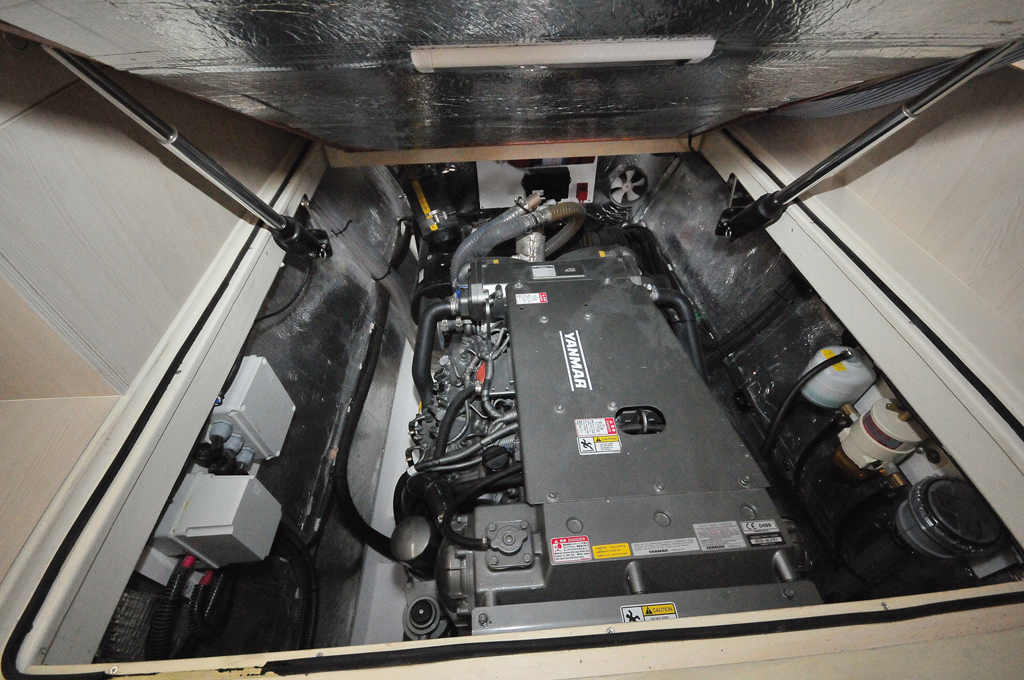
The superb Yanmar V8 motors are easily accessible (hatches on hydraulic rams), and their location further forward contributes to the boat’s trim under way
Conclusion
Simonis-Voogd and Leopard Catamarans have come up with a winning design with the 51PC, and its production constitutes a real success. Perfectly suited to coastal cruising, or discovering an island chain at whatever latitude, it is also capable of more serious passagemaking at a moderate speed. While this powercat might not be aimed at the serious expedition market, it is very seaworthy and is great for company.
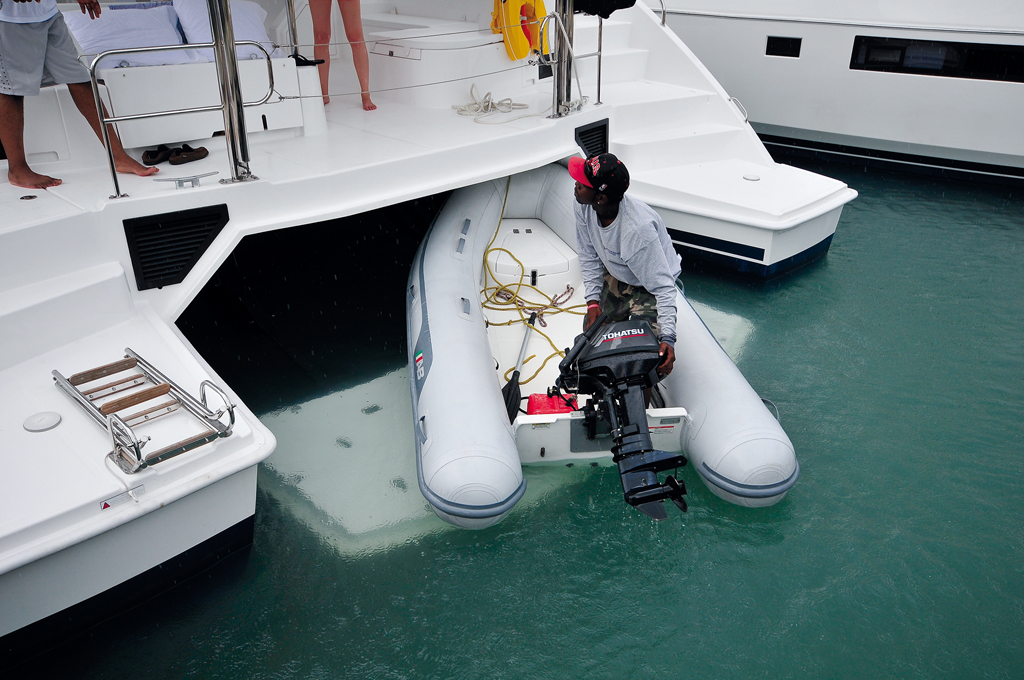
The hydraulic platform enables a large dinghy to be dropped in the water, and then transforms into a bathing platform. But its weight, cost and complicated mechanism warrant a bit of thought
Pluses:
- Dynamic qualities
- Successful design
- Great for living aboard
Minuses:
- Fabric flybridge enclosures not so great
- Optional hydraulic bathing platform is cumbersome and complicated
- Door and drawer catches inadequate
With a displacement of around 19.5 tonnes, the following results were GPS-checked (using a Garmin Quatix watch)
1,500 rpm at 8,5 knots, 6 l/h per motor making 12,5 l/h 2,000 rpm at 10 knots, 11,5l/h per motor making 23 l/h 2,400 rpm at 15 knots, 22 l/h per motor making 44 l/h 3,300 rpm at 18 knots, 40 l/h per motor making 80 l/h 3,500 rpm at 20 knots, 45 l/h per motor making 90l/h Max speed 21 knots in a following sea, 18.5 knots in flat water. Fuel consumption during our two day test: 80 US gallons or 302 liters
The competition:
| Model | Builder | Motors | Designer | Basic price (in € excluding tax) |
| Cumberland 47’ | Fountaine Pajot | 2x225 or 500 hp | Joubert/Nivelt | 616,000 |
| Flashcat 47’ | Flash Catamarans | 2x220 or 480 hp | Flashcats | 448,000 |
| Jaguar 48’ | Jaguar Catamarans | 2x260 hp | Dixon Yacht | 853,000 |
| Aquila 48’ | Aquila | 2x225 hp | J&J | 540,500 |
Technical info:
- Architect: Simonis-Voogd
- Builder: Leopard catamarans
- Length: 15.54 meters
- Waterline length: 14.96 meters
- Beam: 7.64 meters
- Draft: 0.98 meters
- Displacement: 19.4t/23.6t
- Diesel: 1,500 liters
- Water: 1,000 liters
- Motors on the version tested: 2X370 hp Yanmar V8LV
- Transmission: prop shafts
- Basic price: US$ 698,000 / €552,700 excluding taxes
- Main options (excluding tax) - Full Raymarine electronics pack: €7,582 - “Comfort” electrical pack: €5,604 - Fusion sound system throughout the boat: €2,857 - Northern Lights 9kw generator: €21,846 - 40,000BTU aircon: €13,558 - 2X70w solar panels: €2,655 - Electric bbq and fridge on the flybridge: €3,682 - Fabric enclosure for helm station: €7,582 - Exterior upholstery : €3,309 - Synthetic teak covering for exterior deck: €17,308 - Hydraulic bathing platform / dinghy support: €28,956 - 2 sets of ground tackle and fenders: €3,436 - Commissioning and shipping to Europe or Florida + safety equipment: € 55,589
- Price of the boat we tested: €700,435 ex-tax
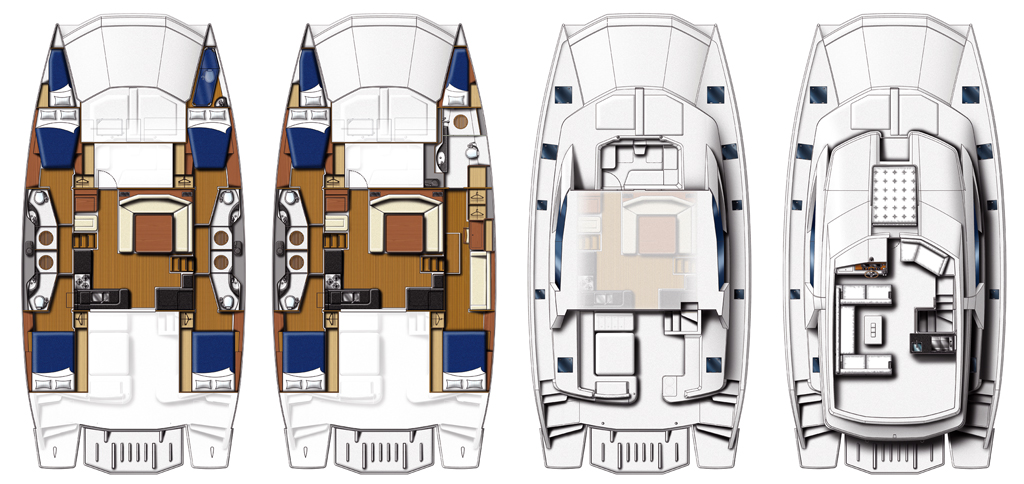
A word from the architect
To truly create an efficient power catamaran we embarked on a 6 month CFD (computational Fluid Dynamics) program with the German firm Numeca which uses the software by the same name which was also key to the success of Team Oracle in the last America's Cup. Simonis Voogd Design has been actively developing power catamarans for the last 10 years and the data accumulated out of those designs was used to refine the numerical models for the new Leopard. The goal was to find a solution to the sensitive trim problem associated with power driven multihulls. By finding a solution to keep a minimal trim angle through the speed range of the yacht, the driving efficiency can be greatly enhanced. By doing a large number of computer runs with small variations we managed to find a highly efficient solution and the result is a set of hulls with good sea keeping characteristics and excellent tracking with very little slamming as result of reduced pitching motion. The new Leopard 51 PC is large step forward in the development of power catamarans and truly represents current cutting edge research and technology. Alexander Simonis

Caption
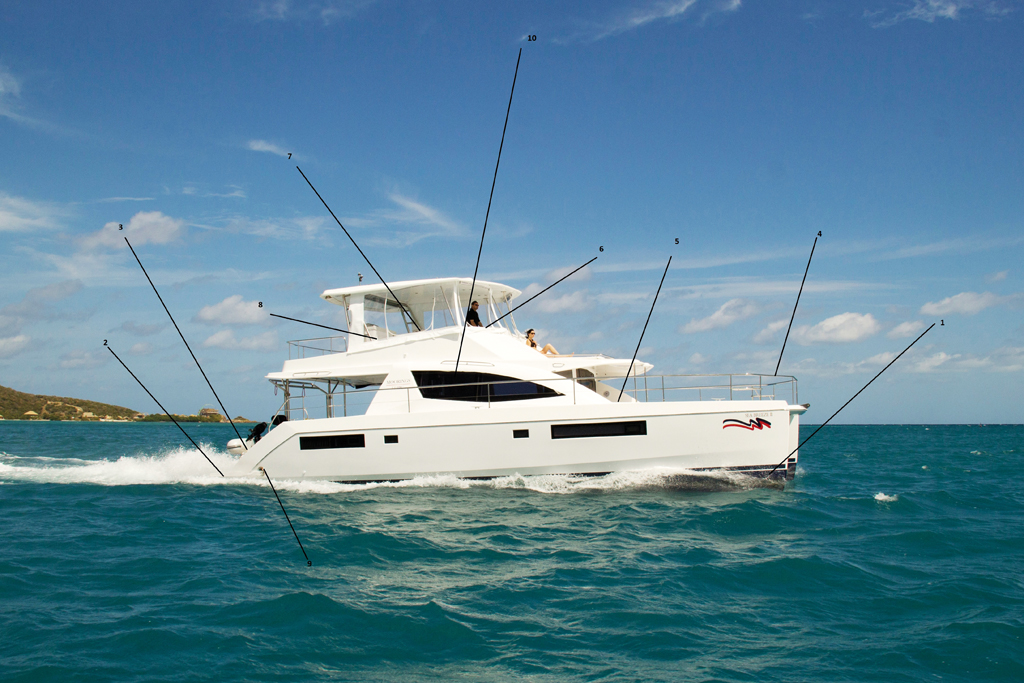
- : The finesse of the bows and the balance of the hulls produces a very steady wave-piercing effect
- : The long arches integrate into the propeller tunnels and give the 51 a lot of its dynamic qualities
- : The hydraulic platform (which supports the dinghy) seems heavy and complicated
- : The handrails provide great security
- : The forward cockpit inherited from the 48 integrates perfectly into the design
- : The flybridge makes an extremely nice marine terrace, but a deflecting wind-shield for the helm station would be useful
- : The fabric screens allow you to completely enclose the flybridge: perfect at anchor!
- : The outdoor galley fitted with an electric barbecue is brilliant
- : The elegant hulls of the 48 have seen their underwater area significantly modified, giving a totally different hull form
- : The overall lines are pleasant, and the volume inside the coachroof is surprising.