Fountaine Pajot is one of the few major builders, along with Robertson & Caine, to have maintained a long and unwavering commitment to the powercat. Today, sales of power catamarans represent 20% of the multihull market, which is more than enough motivation to launch a new model! The MY4.S, the smallest model in the range, is replacing the MY37. A new model to be discovered at the Cannes Yachting Festival.
Infos pratiques
- Le chantier : MY4.S
- La fiche technique
-
 Découvrez notre vidéo exclusive
- Financez votre MY4.S
- Assuez votre MY4.S
- Articles autour du MY4.S
Test location: La Rochelle, France Atlantic Coast
Conditions: Sea state, slight - Wind, northeast 10 knots
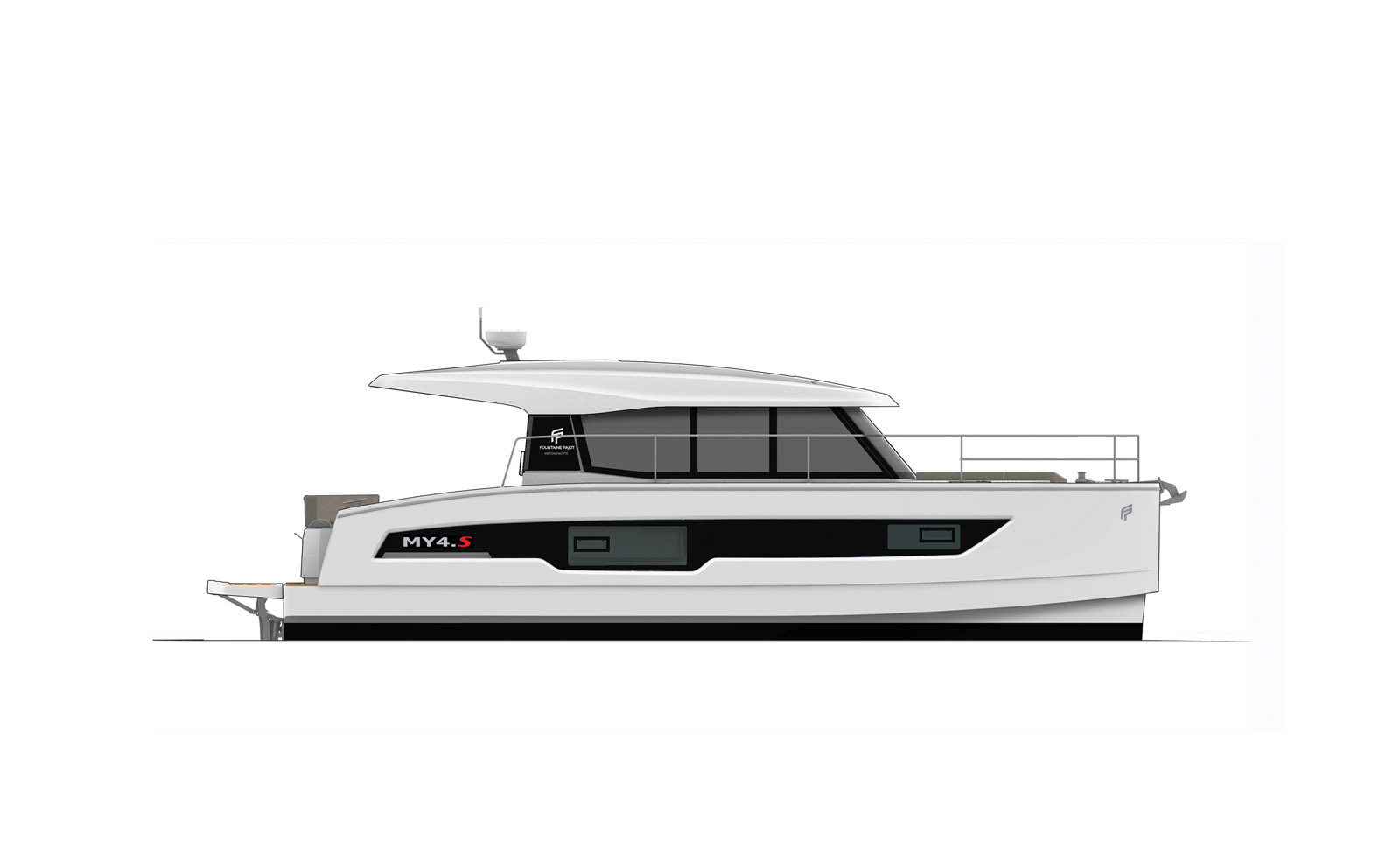
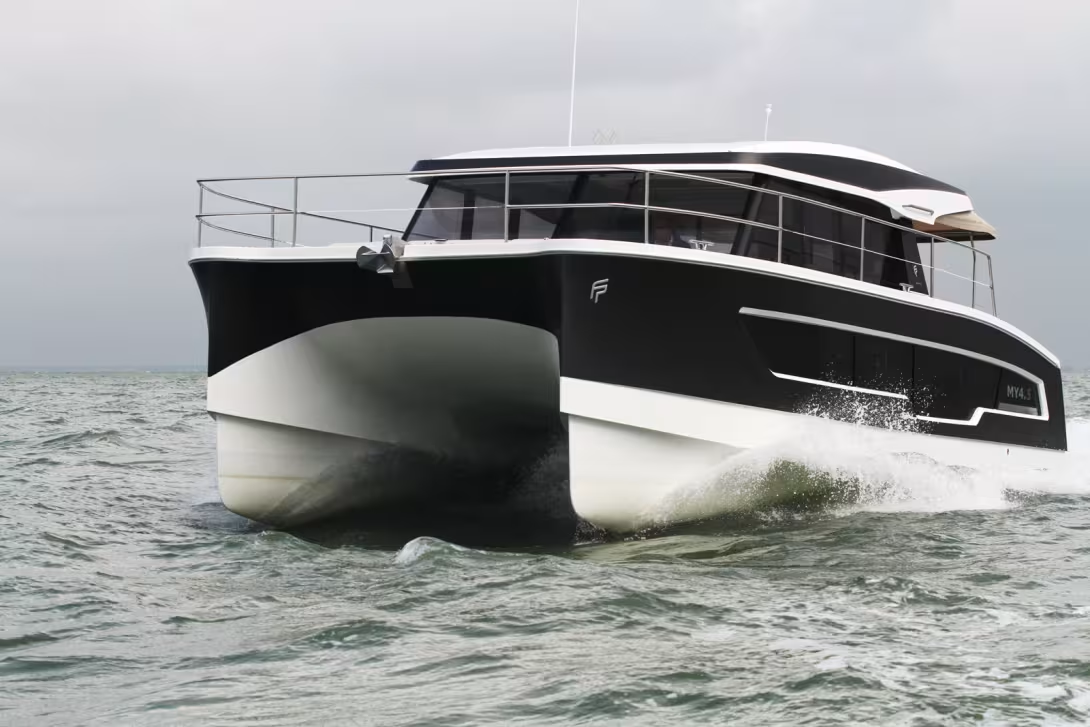
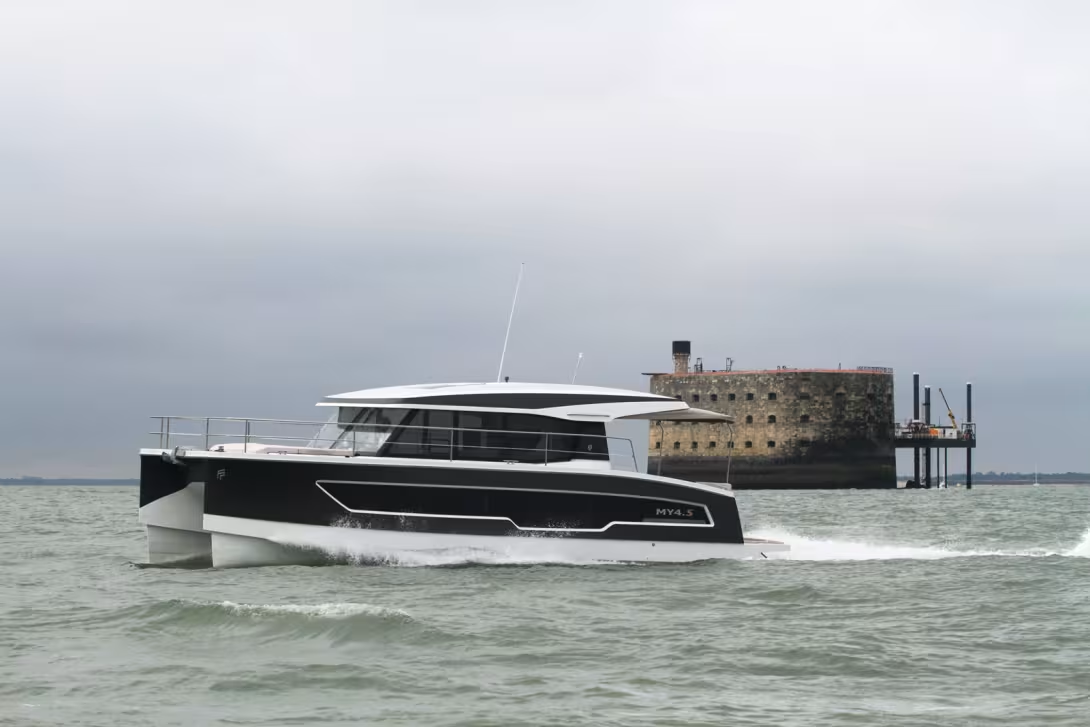
The builder has taken the opportunity of the launch of this new model to rename its entire Motor Yachts range: the MY40 now becomes the MY5, and the MY44 becomes the MY6. The idea is to give a “monohull equivalent” reference in terms of surface area and volume: the 5 corresponds to a 50-foot motorboat, the 6 to a small 60-foot motoryacht... Remember that the entire MY range is produced from 100% motor-specific designs and molds - we are not talking about using a sailing catamaran hull as a base. As for the 4S that we’re looking at here, it is therefore taking on 40-foot monohulls. And the S stands for Sport Top or Sedan, as you wish. Fountaine Pajot has opted for a racy design by sacrificing the flybridge, an option offered on the previous model. It is difficult to overshadow the MY37 since the 4.S borrows its hulls. The manufacturer has done well: Daniel Andrieu’s design already offered excellent marine qualities on the 37. The hulls are characterized by a chine so marked that it forms a deep recess on the bows. However, above the chine, everything is new! And what stands out is the fineness of the coachroof. Without the flybridge, the 4.S becomes a very elegant sedan, capable of holding its own among the gleaming singlehulled weekenders.
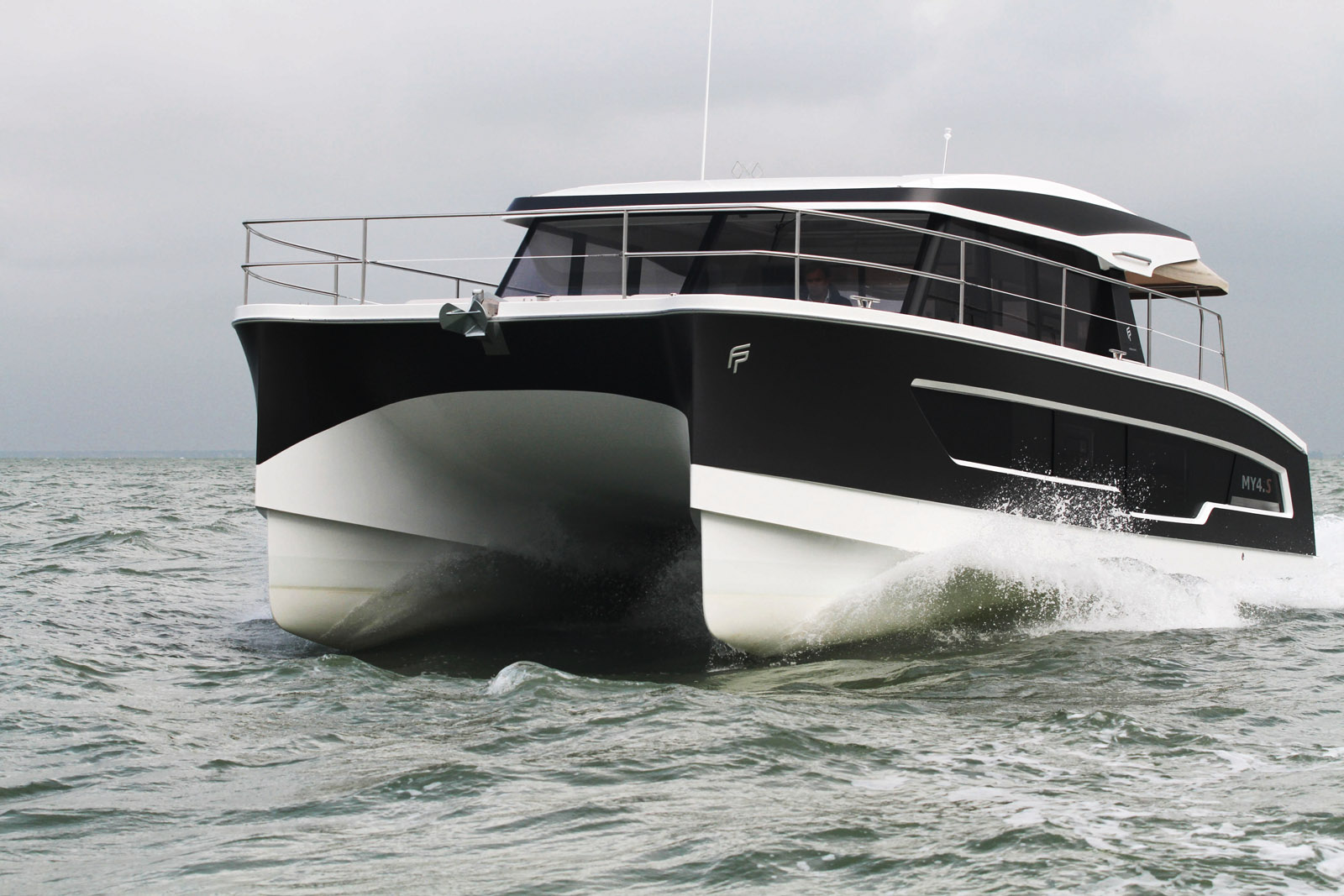
The design of the superstructure deserves praise: beautiful, understated, efficient…
A bit more powerful than the MY37
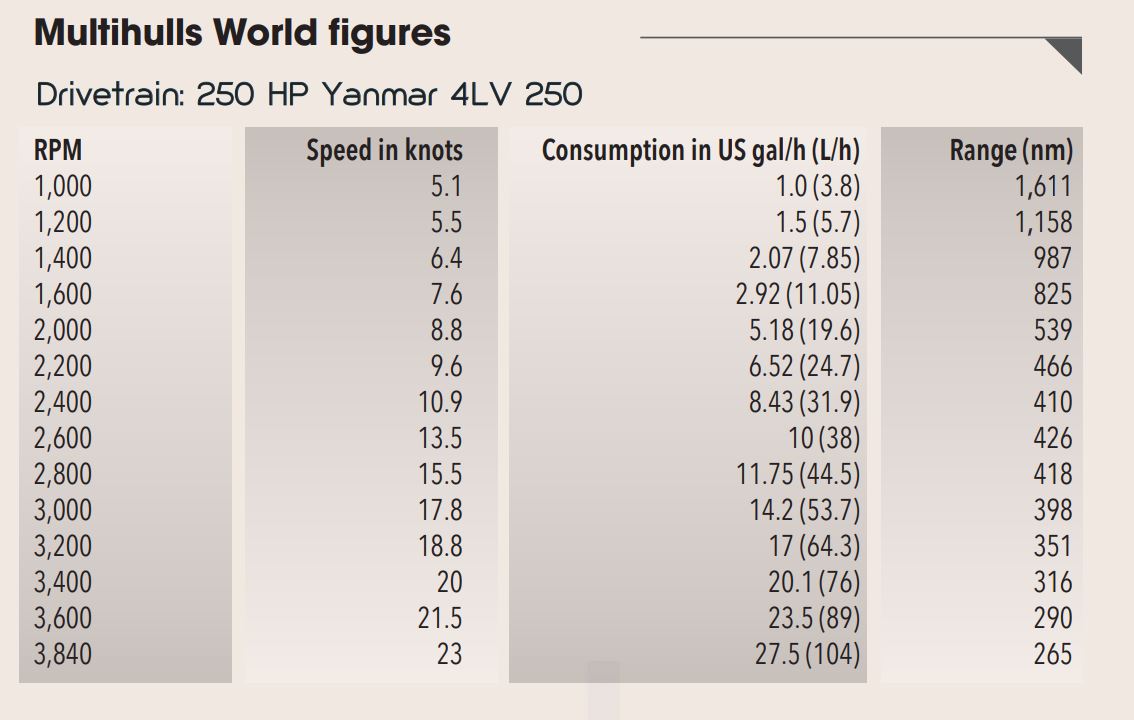
Fountaine Pajot proposes two powertrain options, both from Test location: La Rochelle, France Atlantic Coast Conditions: Sea state, slight; Wind, northeast 10 knots TEST Text and photos: Emmanuel van Deth Discover our exclusive MY4.S video Yanmar – either 150 or 250 HP, the latter being the one chosen on our test model. The MY37 was also equipped with two 150 HP engines, though by Volvo, as standard and 2 x 220 HP as an option. The extra 60 HP total gain on the larger engine option translates into a maximum speed that increases from 20 to 23 knots - despite an increase in displacement of 1,300 lbs (600 kg). The helm, without being hard, responds perfectly and the trajectory is always precise. The hulls are characterized, as we have mentioned, by a very marked chine and particularly fine-entry bows. Not surprisingly, we find the same excellent behavior as on board the 37: perfectly flat turns, smooth passage in short chop, absence of spray - it is literally broken by the chine - and above all, hulls that are really optimized for a cruising speed in open water, i.e. 9 to 15 knots. The best illustration of the efficiency of these hulls at these relatively high speeds is that the range is greater when motoring at 13 knots than at 11! Thanks to the low fuel consumption engines, these efficient hulls and fuel tanks totaling 317 US gal (1,200 liters), the range is 1,600 nautical miles at 5 knots and even more than 1,000 nm at 6 knots.
This compares to a range of 265 nm at full speed... Speed, ease of use, low fuel consumption by not pushing the throttles too hard: the MY4.S comfortably lends itself to a program of weekend boating as well as semi-high-speed cruising. Strangely enough, it is during low-speed sailing that the underside of the nacelle or the flat face of the chines are likely to slam a little. When maneuvering in port, you can of course play with the twin engines to pivot at will, though the manufacturer does offer a bow thruster as an option. The engines, housed in large compartments at the stern, are easy to access. Camera surveillance of the engine rooms is also an option.
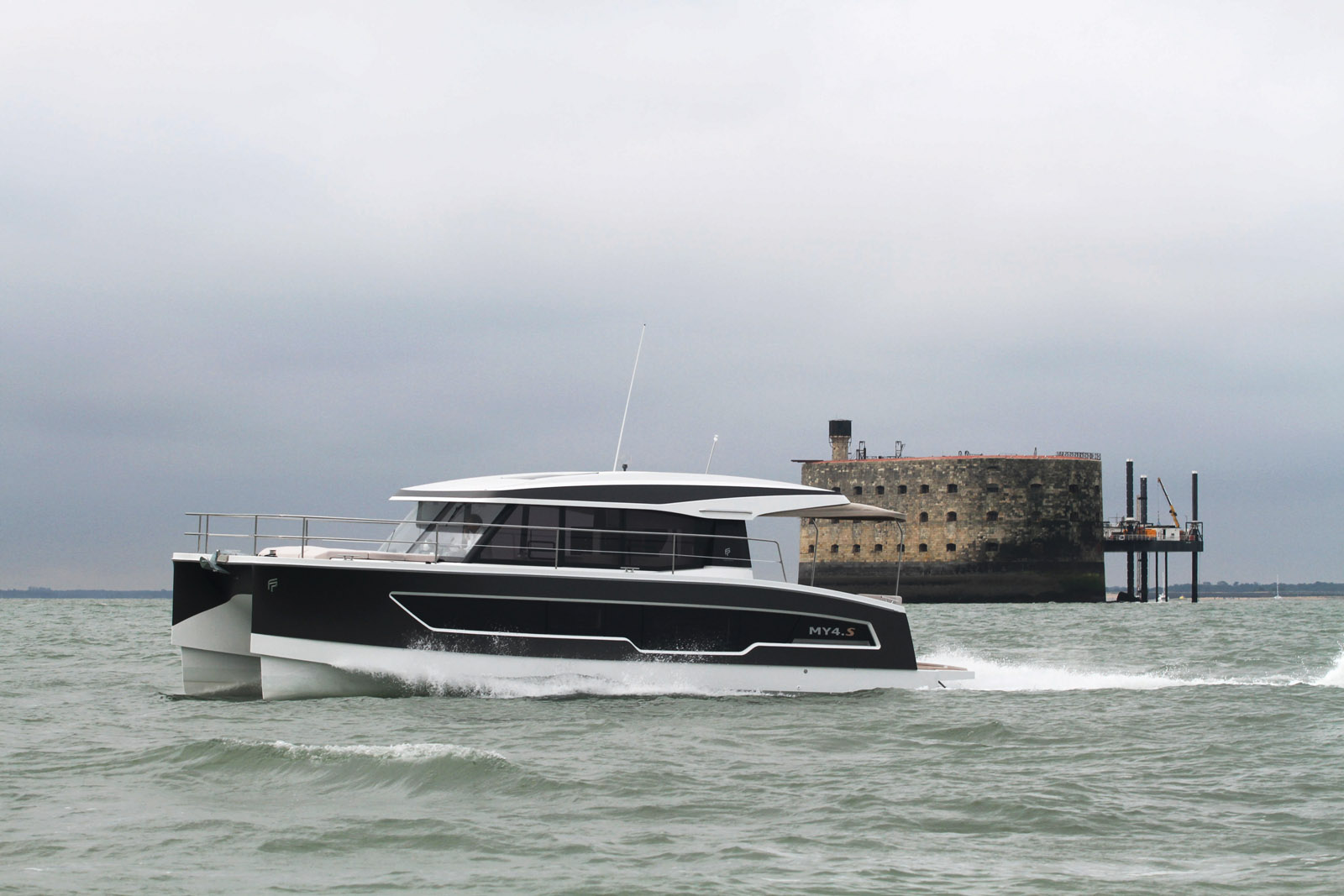
En baissant les gaz sous les 1 400 tours/minute, l’autonomie est supérieure à 1 000 milles, autorisant un large programme de croisières…
A very simple deck plan
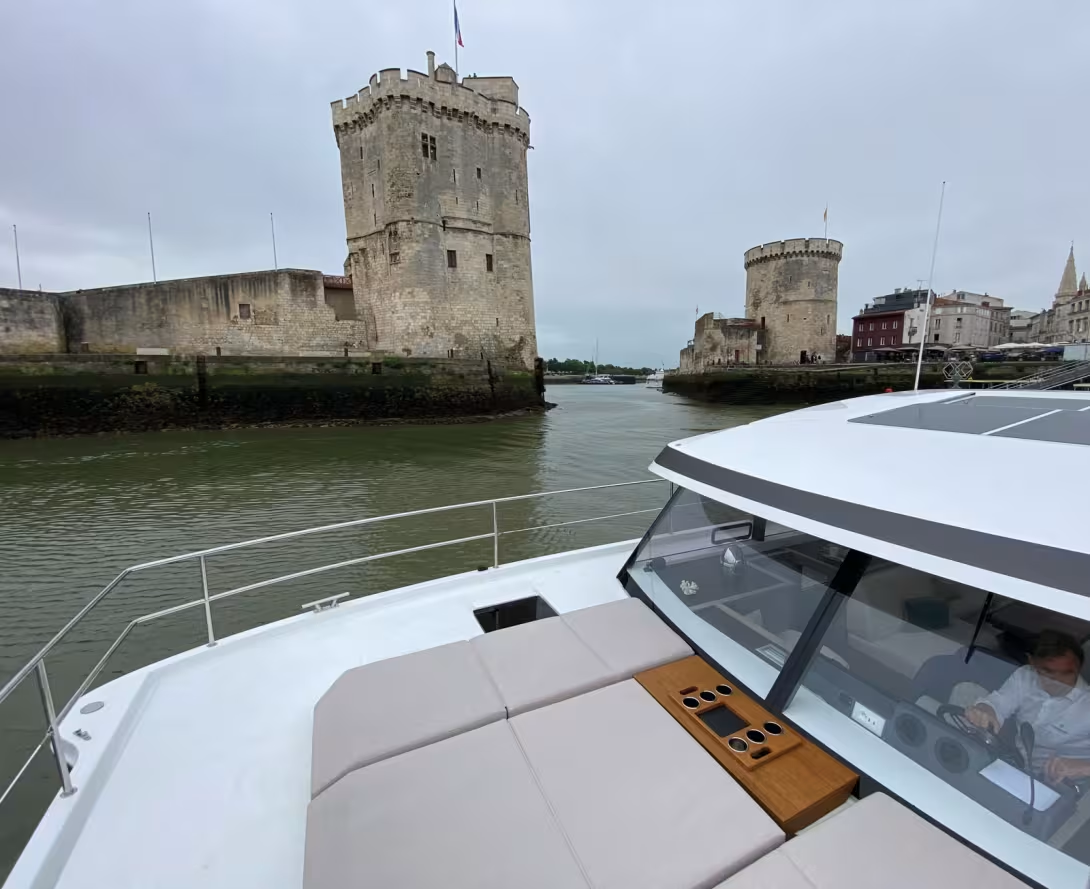
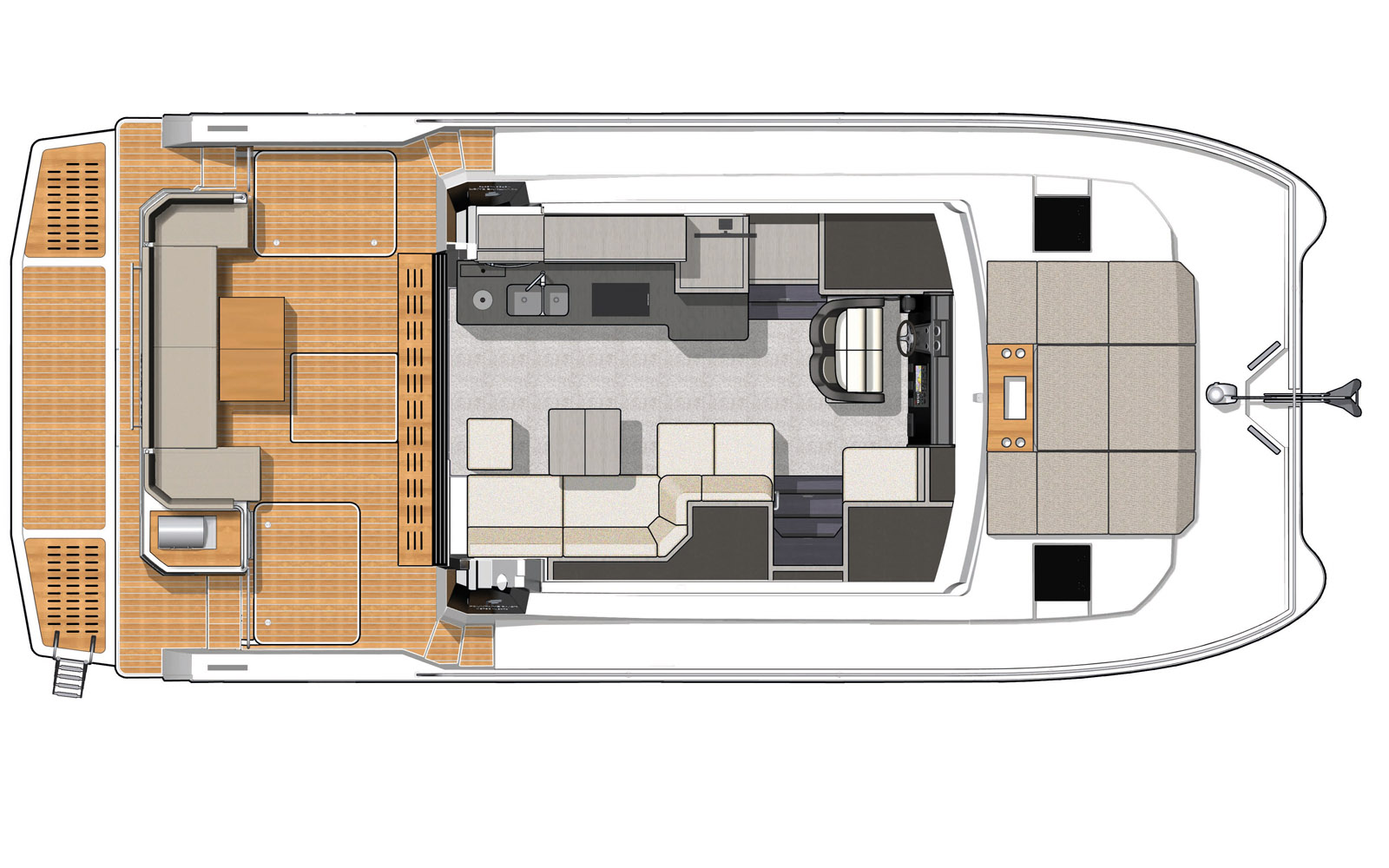
The increasing willingness of boat builders to install flybridges on all their boats has almost made us forget the charm and features of a sedan. In addition to a much more elegant silhouette, this configuration benefits from better weight distribution and frees up the cockpit or the side-decks from one or two access stairways. Of course, in return, there is no upstairs terrace! Note, though, that the Fountaine Pajot Design team could ultimately consider a flybridge version if they felt the demand was there. The cockpit is equipped with a large bench seat of 8’6” (2.60 m) that can be converted into a sunbathing area. Optional extras include a fixed or hydraulic platform, a galley and, of course, an outdoor table. The side-decks, at 17” (43 cm) at the cockpit end, are relatively narrow compared to those of sailing multihulls, but this is not surprising when you consider the beam of the MY4.S is 16’9” (5.1 m) when an Excess 11 for example is 21’7” (6.59 m)! Moving around on board is made safe by a complete stainless-steel rail, but the small handrail near the cockpit deserves to be completed by other handholds on the coachroof - this is planned, but as an option. The (solid) foredeck offers large sunbathing areas. Ground tackle and other lockers are ready to use.
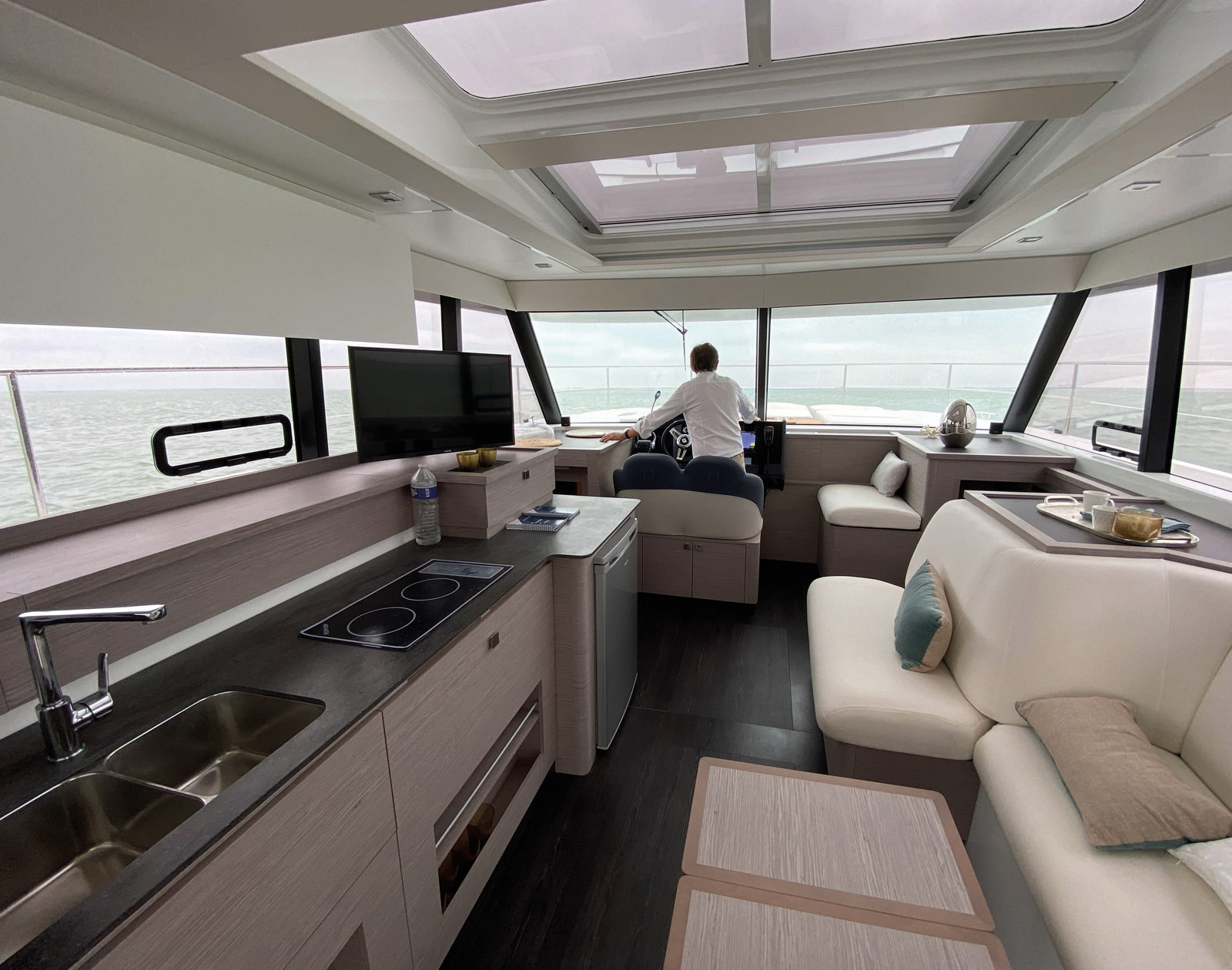
Finition flatteuse, éclairage généreux : on se sent bien dans cette nacelle !
Flattering finish and opening sunroof
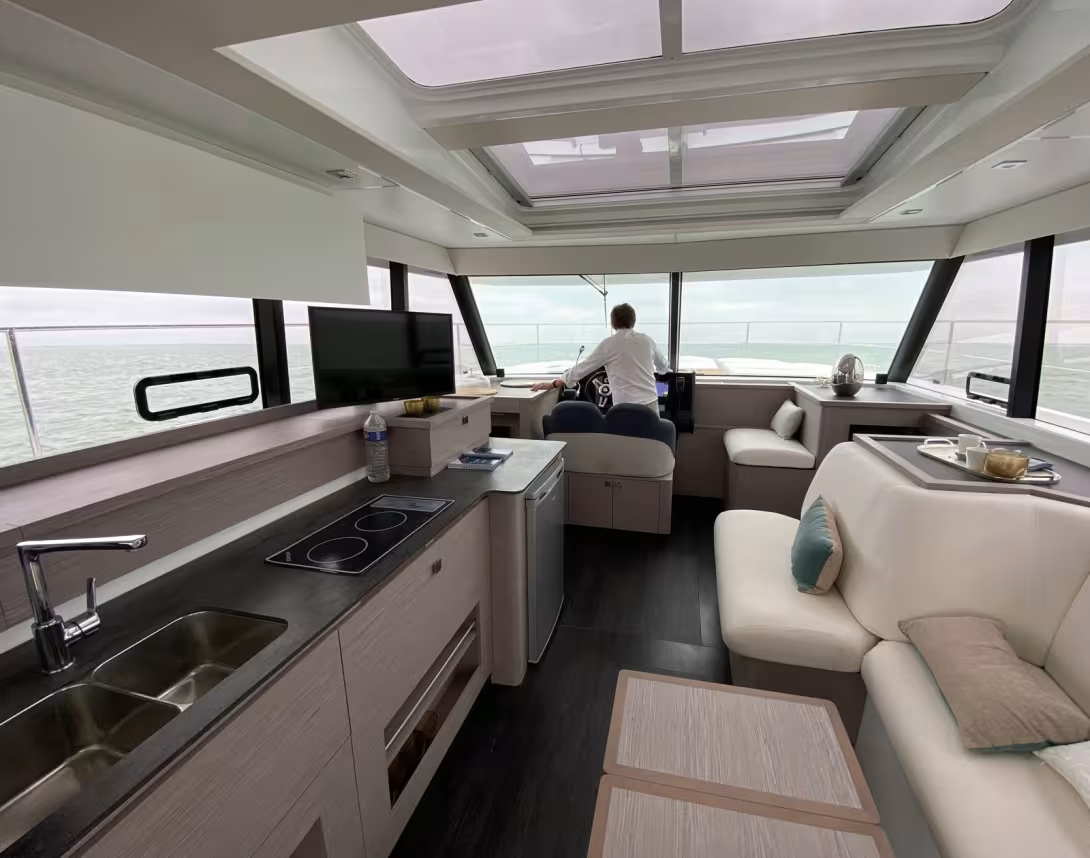
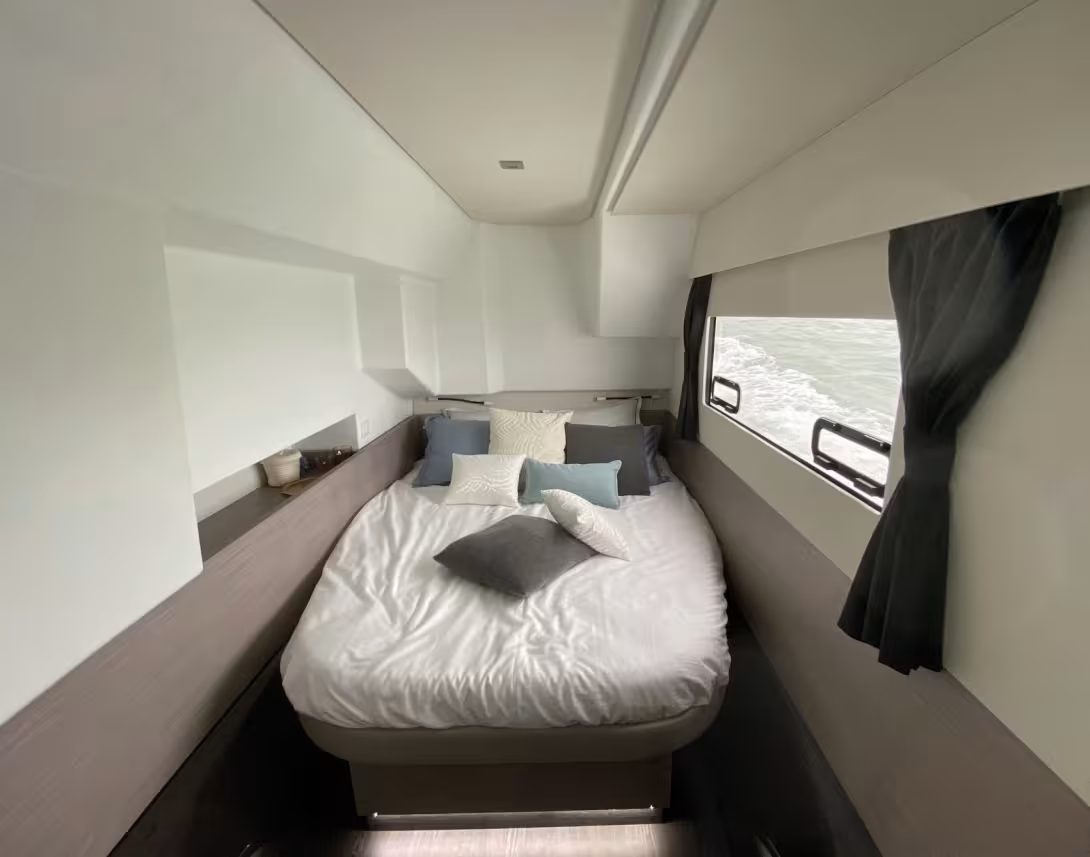
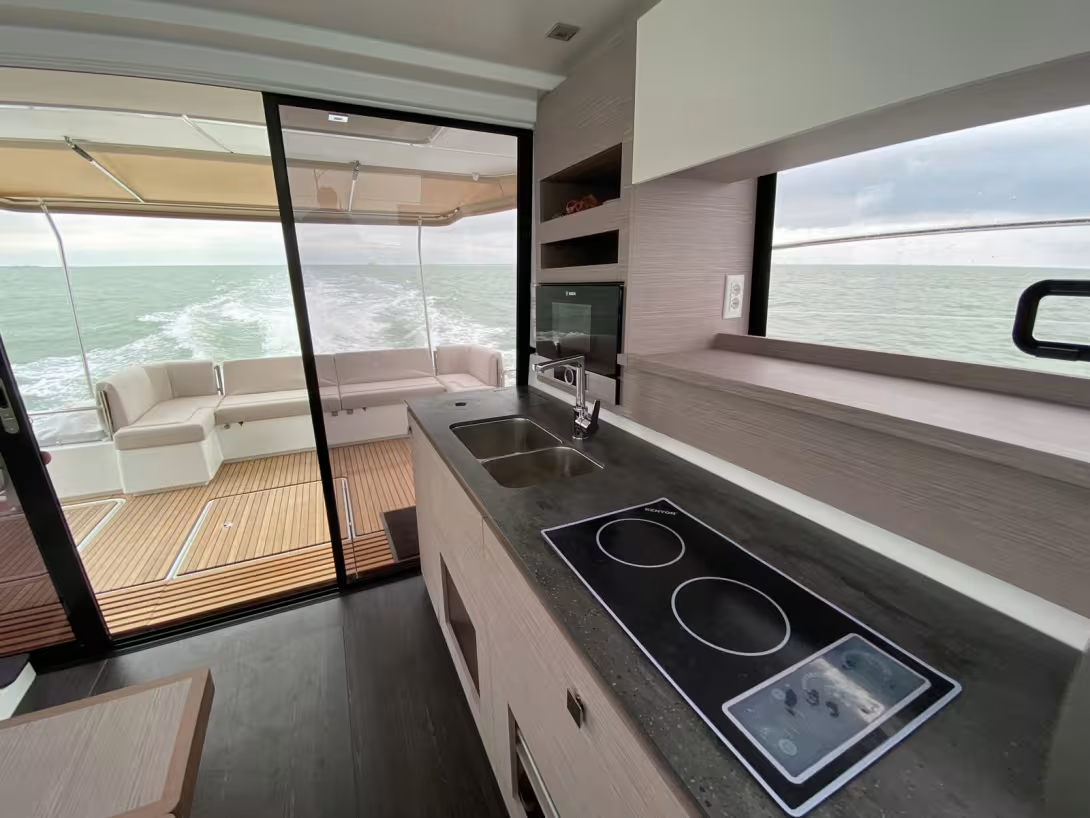
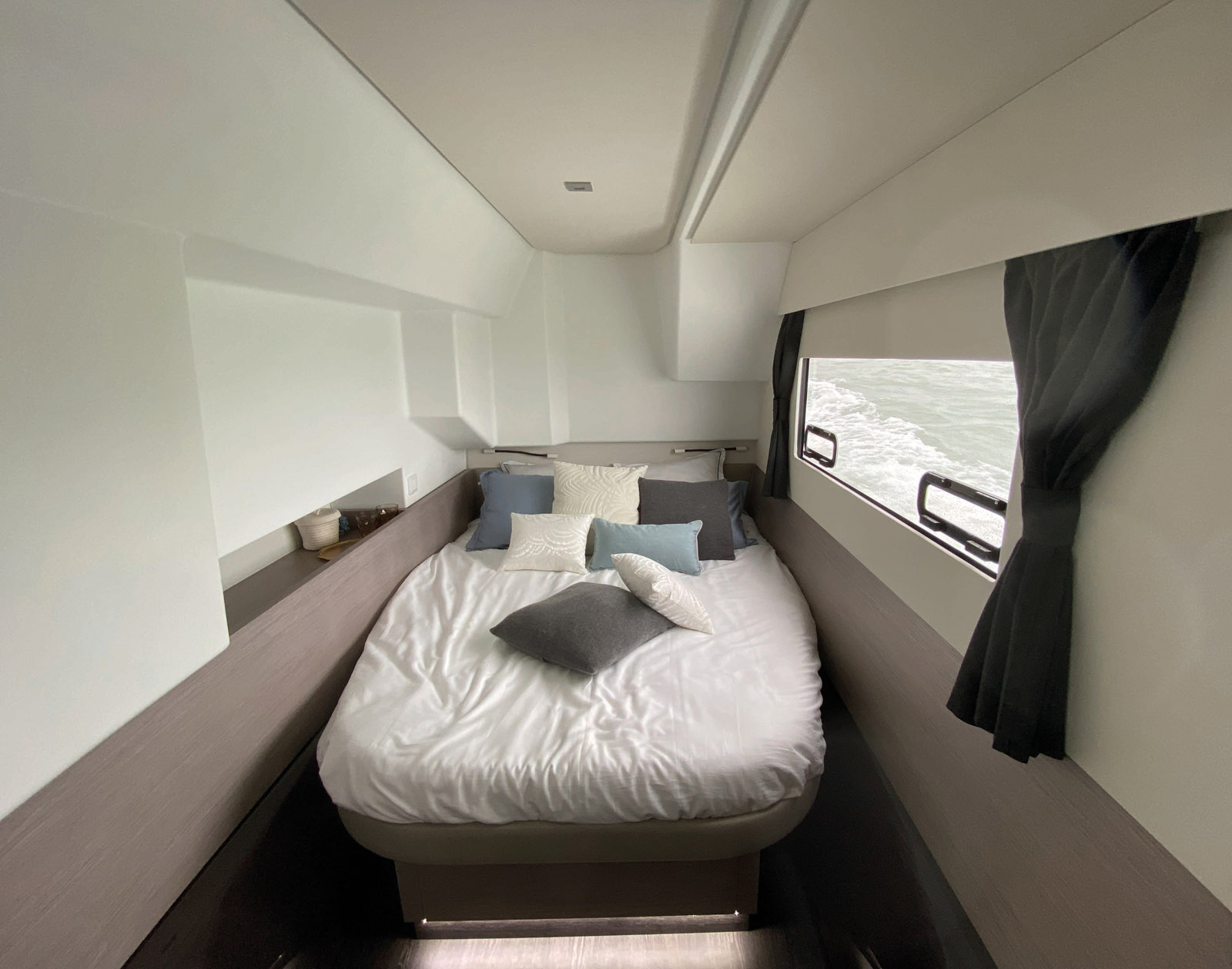
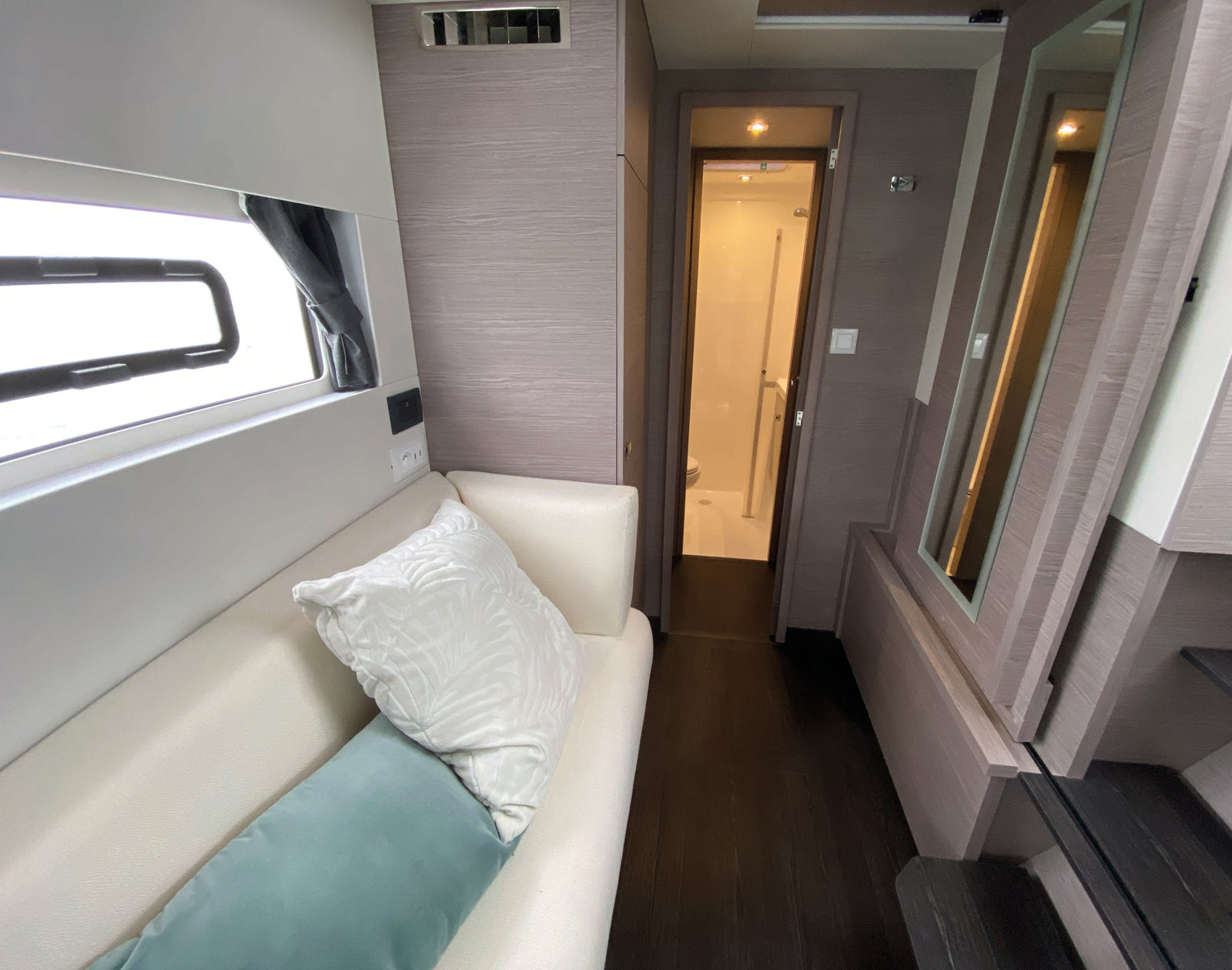
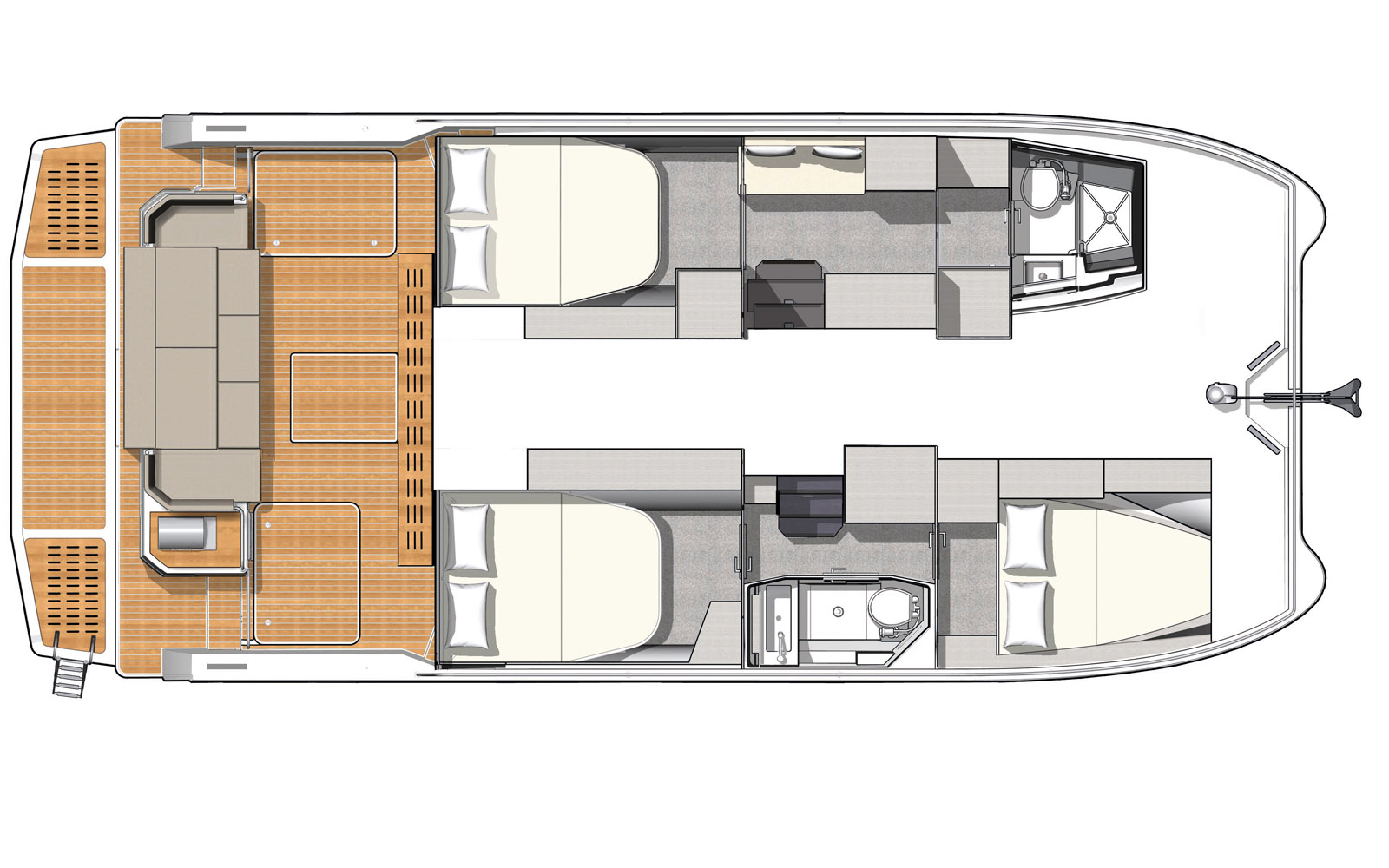
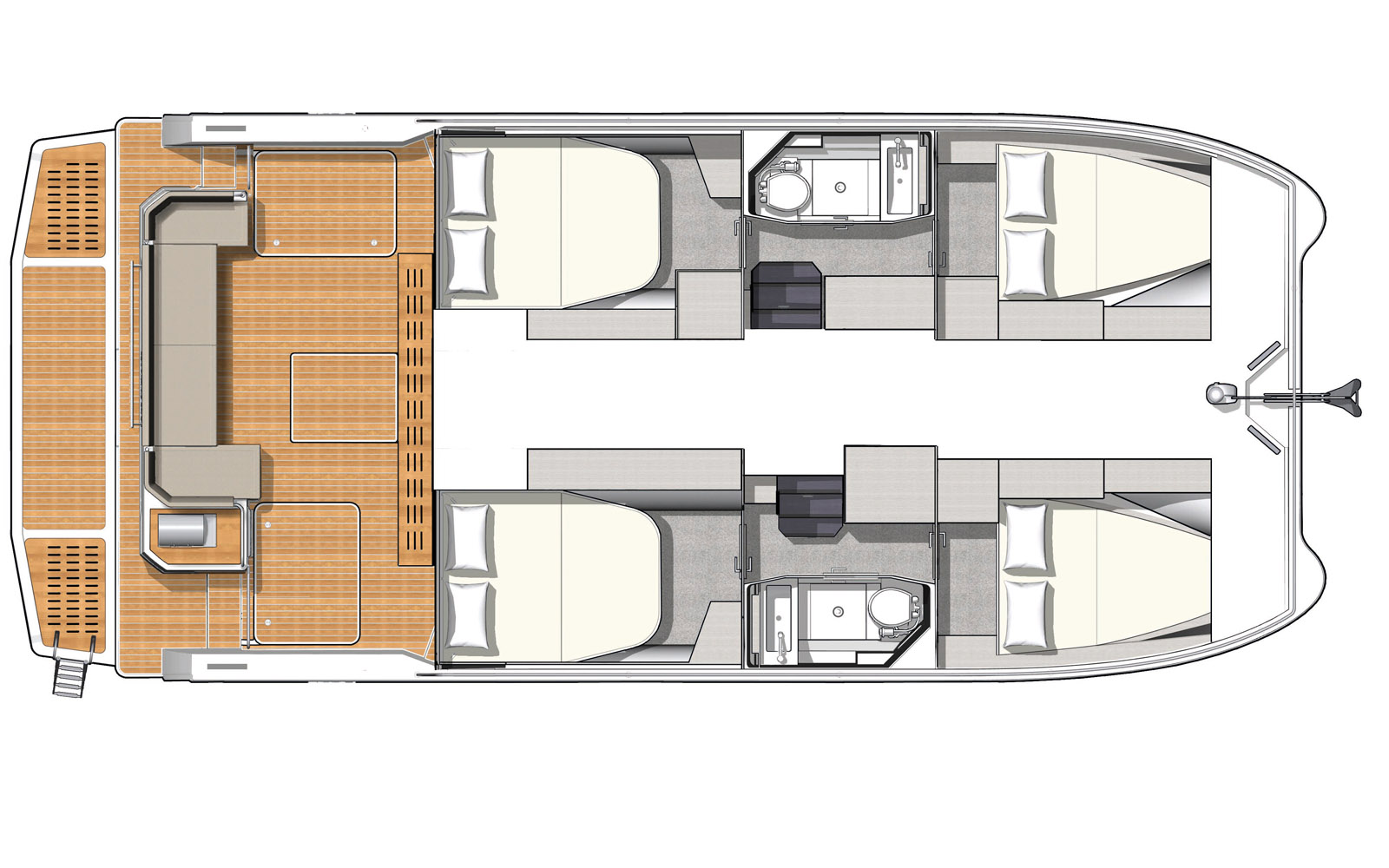
The aft bay window forms a nice wide opening. Inside, a saloon organized similar to the MY37’s - galley on the port side, dining area to starboard, helm station forward - but the finish seems much more flattering. The builder has set the bar very high, always with the aim of being a credible competitor to the single-hulled weekenders, which are generally quite luxuriously finished. The headroom in the nacelle is very comfortable, at 6’9” (2.07 m). The galley countertop is a useful size, at 8’10” (2.71 m), and there’s a double sink, a tworing burner, a refrigerator and numerous storage spaces. The dining area is a bit more modest with its L-shaped bench seat and 24 x 28” (70 x 60 cm) table. Fortunately, this tabletop can be folded out - but that’s an option. You can share a meal with five people, but not really anymore, without using stools that would inevitably interfere with circulation. Up front, there is the helm station. You can stand or sit here thanks to the swivel seat. The seat can be raised a few inches for the shorter to mediumsized helmsperson. As for the windshield wiper, it is too short to sweep the bottom of the window. From the controls, you have an excellent view of the water, except for two small blind spots aft. And natural light simply floods in: first of all, because the windows are an imposing size – 31½ to 35½” (80 to 90) cm high - and not very tinted. As for the coachroof uprights, they are slender. Above your head, a car-like sunroof, but an XXL version. The control for this is a bit lazy, but you can sail as if with the top down, or almost. This option adds more than € 24,000 (before tax), and you’ll have to pay almost € 200,000 in packs and equipment to get a fully-loaded and attractive powercat. On our test model, a Maestro version, the port hull is dedicated to the Owner. There is a large semi-island-bed 5’3” (1.60 m) wide, plenty of storage space, an incredible sea view, two ventilation openings and a beautiful bathroom in the bow. Headroom is 6’3” (1.91 m), this being 3’5” (1.03 m) below the level of the nacelle, i.e. four steps down. The starboard hull houses two cabins and a central bathroom. The aft berth is as generous as that in the other hull, but the forward berth is a little less so: 4’11” (1.50 m) wide at the head and 2’4” (0.70 cm) at the feet. Aft, the sound volume remains contained, even with the motors at higher rpm, though a few squeaks can sometimes be heard. Each cabin has two opening windows to ensure effective ventilation.
 |
 |
A bord de la version Maestro, c’est toute la coque bâbord qui est dédiée au Propriétaire.
Conclusion
Even more convincing to former sailors, Fountaine Pajot’s challenge with its MY range is to shake up the supremacy of monohulls; by opting for a range - and numbers - that highlights the surface area and volume provided by a catamaran, and by offering a very elegant Sedan version, the manufacturer is pulling out the big guns. And we can’t blame them for using the hulls of the former MY37. Firstly, because the design is highly successful, and secondly, because the previous model was built in 72 units... This bodes well for the 4.S!
The Pluses
+ Excellent seakeeping behavior
+ Reasonable fuel consumption at cruising speed
+ Elegant silhouette
The Minuses
- Dining area a bit too cozy for a large crew
- Helm seat slightly too low and wiper blade too short
- High price of some of the (very numerous) options
 |
 |
 |
TECHNICAL SPECIFICATIONS
Builder: Fountaine Pajot
Architect: Daniel Andrieu
Interior design: Pierangelo Andreani
Material: GRP
Overall length: 36’1” (11 m)
Beam: 16’9” (5.1 m)
Draft: 31½” (0.80 m)
Air draft: 12’5” (3.78 m)
Light displacement: 20,950 lbs (9.5 t)
Engine: 2 x 150 HP or 2 x 250 HP
Fuel tank: 2 x 158 US gal (2 x 600 l)
Water tank: 92 US gal (350 l)
Number of cabins: 3 or 4
Price ex-tax MY4.S Maestro: € 395,000
Price ex-tax MY4.S Quatuor: € 397,000
Exclusive Pack: € 16,500
Gold Pack: € 26,000
Platinum Pack: € 49,000
2 Yanmar 4LV 250 engines: € 13,600
Bow thruster 175 lbs (80 kg): € 11,076
Cockpit cover: € 2,663
Saloon window cover: € 1,095
Sunroof and electric awning: € 24,200
Shade for the foredeck: € 2,200
Cockpit table: € 785
Handrails on side-decks: € 246
Synthetic teak sugarscoops and cockpit: € 11,400
Electric saloon table convertible into a dining table: € 4,973
Garmin 1 Pack: € 13,000
Aft camera: € 889
Radar: € 2,592
Air conditioning: € 13,702 or € 14,402 depending on the number of cabins
Full heating (hulls and saloon): € 11,220
Foghorn: € 269
3 x 90/100 W Solar panels: € 2,798 15 gal (60 l) / h
Watermaker: € 10,311
Beaching skegs: € 6,265
Hydraulic platform with synthetic teak: € 25,646 8’ (2.4m)
Dinghy with 6 HP outboard: € 3,648
Complete safety equipment incl. liferaft: € 3,966 195’ (60 m)
Chain + 35 lb (16 kg) anchor: € 707