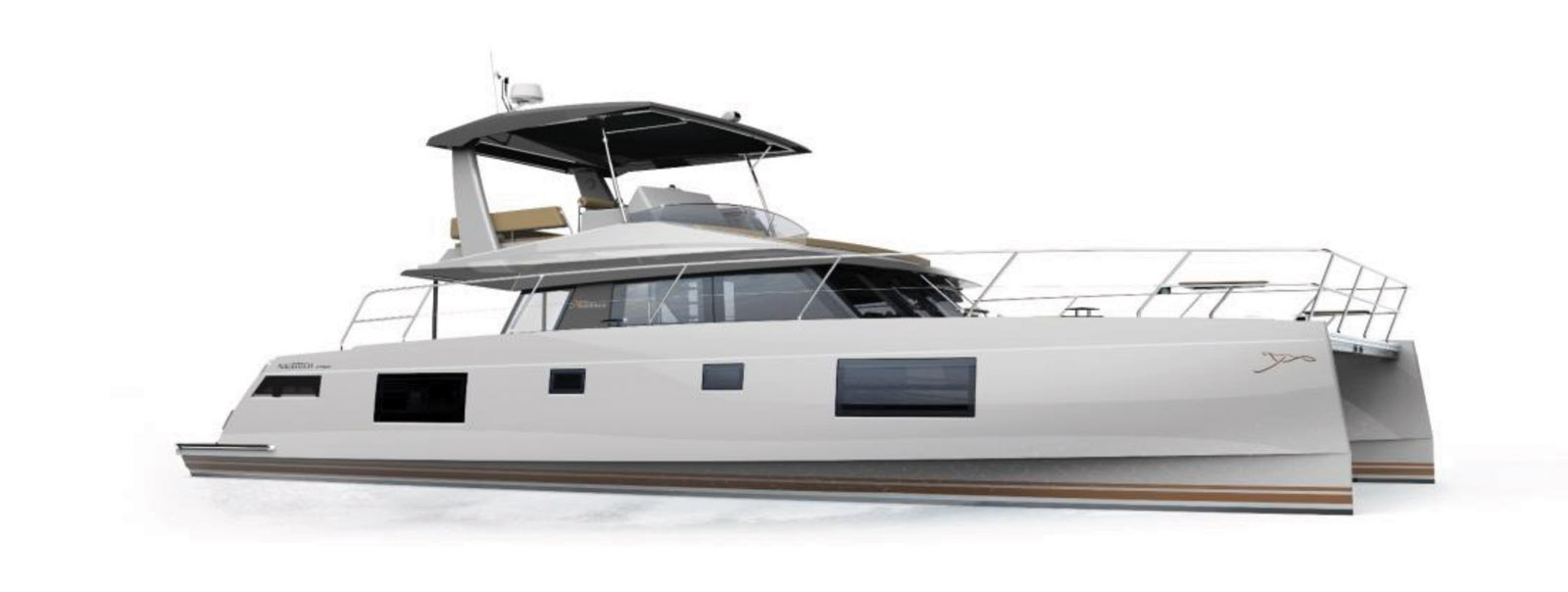
Though the first release of the Nautitech 47 Power dates back to January 2018, this powercat was given a deep restyling of the interior and the cockpit a few months ago. Basically, this was pretty much a new model that we were testing in the Florida sunshine.
Infos pratiques
- Le chantier : Nautitech 47 Power
- La fiche technique
- Découvrez notre vidéo exclusive
- Financez votre Nautitech 47 Power
- Assuez votre Nautitech 47 Power
- Articles autour du Nautitech 47 Power
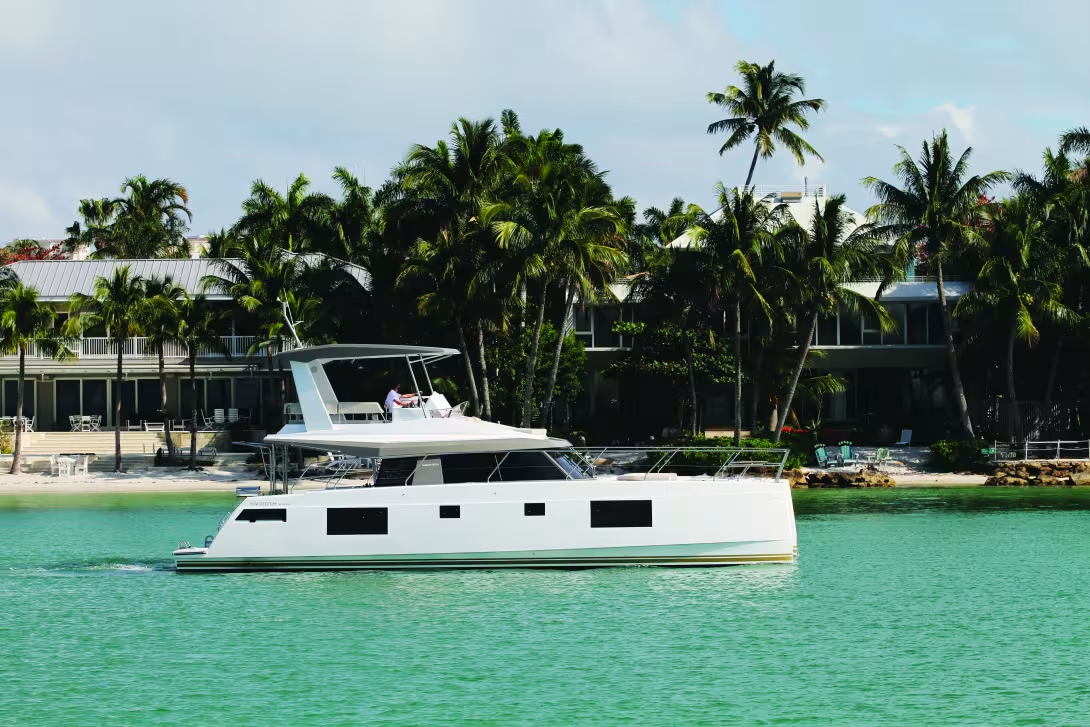
This model is a first for Nautitech - based at Rochefort, just south of La Rochelle, on France’s west coast - as it is the first power catamaran from this brand that has been around since 1994. The builder and its in-house architect, Marc Lombard, decided to build using the basis of a sailboat model, the very successful 46 Open. A rather clever decision in terms of investment, since a large part of the studies, designs, molds, tools, etc. can be (re)used. The silhouette of the 47 is logically reminiscent of that of the 46 Open - in the Flybridge version - with rather narrow hulls, a fairly short coachroof forward, and a large beam - respectively one meter (3’3”) and 0.5 m (20”) wider compared to the Aquila 44 and the 48. A design that is less “motorboat-like”, yet is still elegant in the Flybridge version with its (optional) arch/bimini. The fact remains that transforming a sailing catamaran into a powercat is not as simple as that. The design team and the architect had to considerably reinforce the structure in order to fit the 300 hp engines where previously the much more modest 40 hp motors sat, and finally to redesign the aft third of the hulls – taking into account engine block dimensions, different weight distribution and finally adaptation to higher speeds. In terms of design, the 47 Power benefits from the same restyling of the coachroof as the 46: the side pillars and the cap of the roof/bimini have become dark gray, refining the overall silhouette.
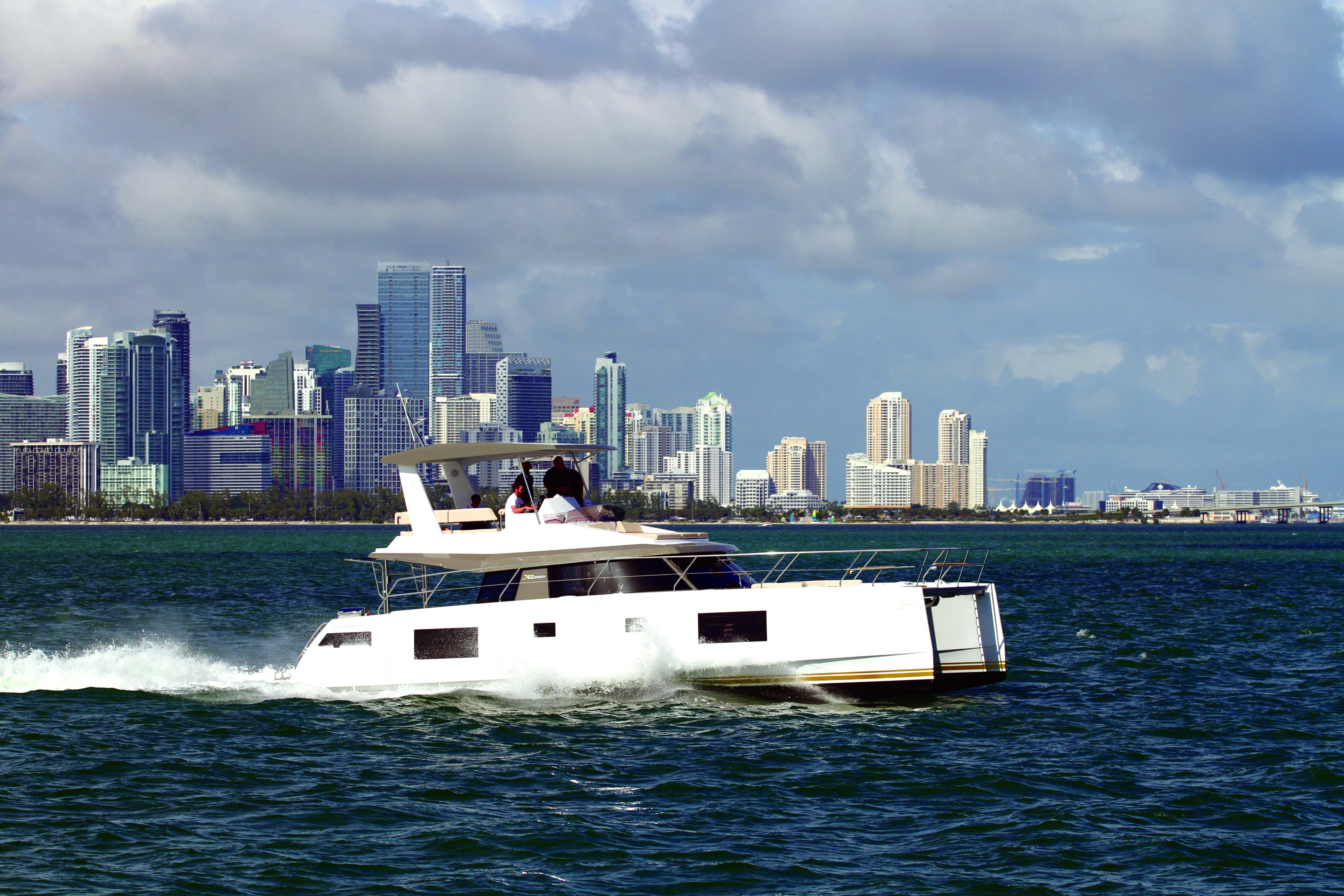
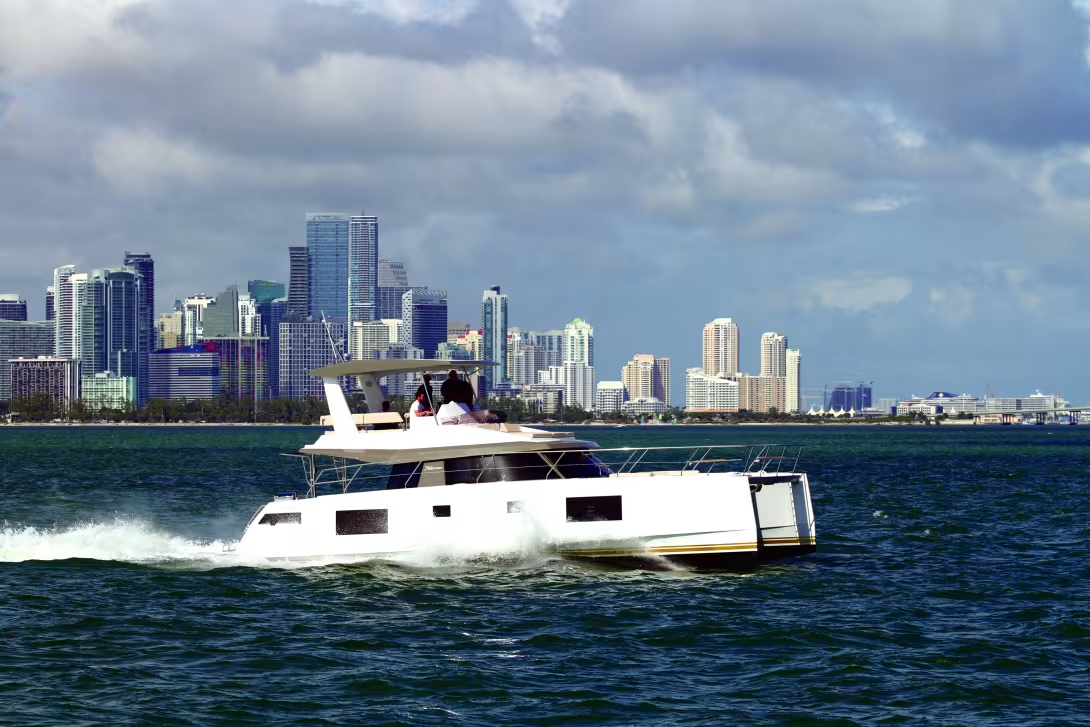
Just south of downtown Miami, the sheltered waters of Biscayne Bay proved to be perfect for our tests.
Test location: Coconut Grove, FL, USA
Conditions: wind southeast 10 knots, calm sea
Biscayne Bay as a playground
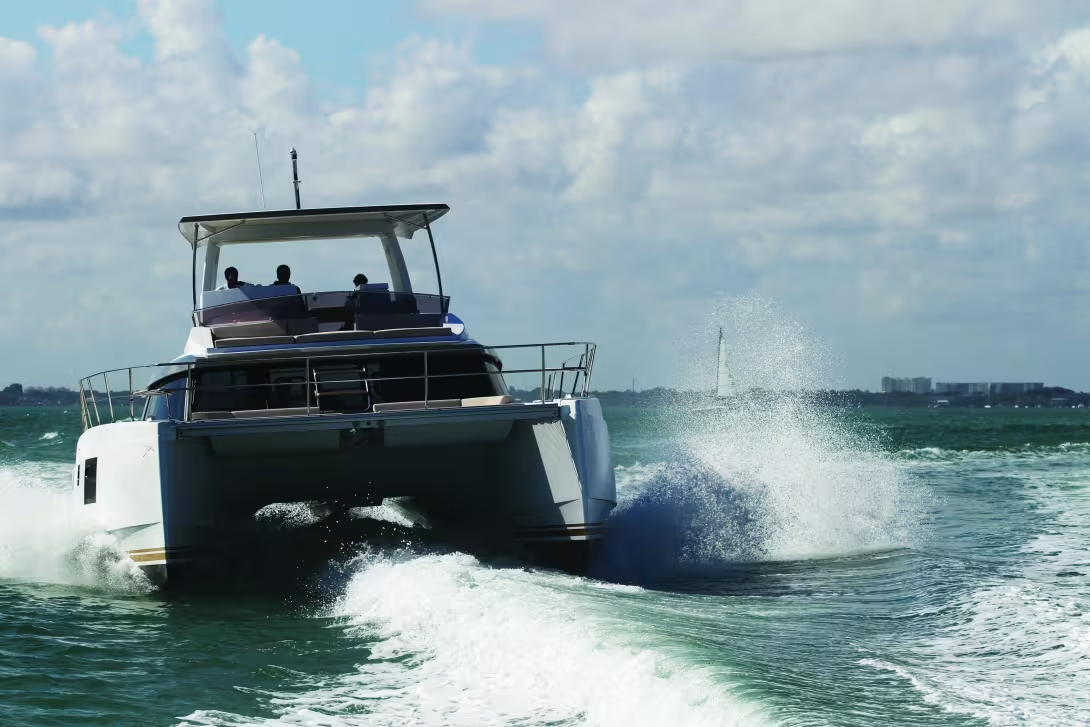
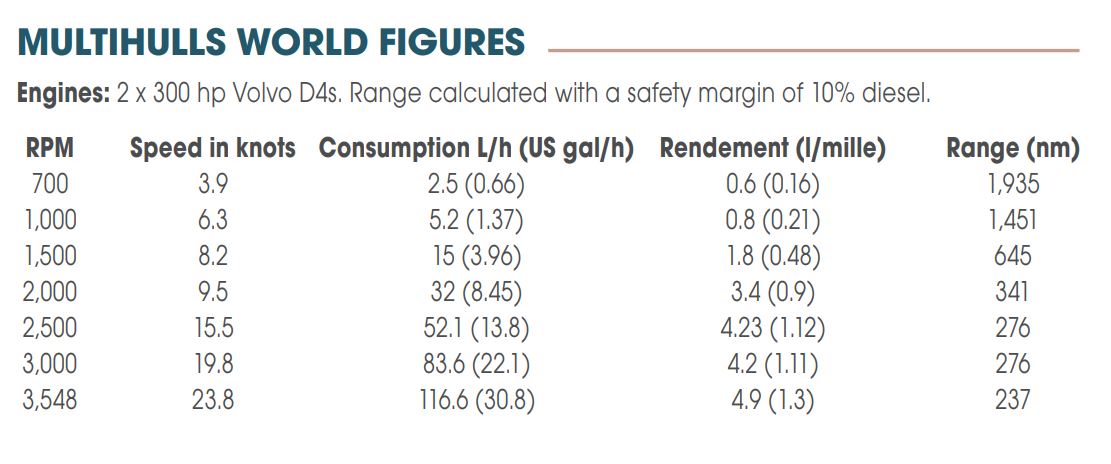
We met up at a marina in Coconut Grove, a few miles south-west of the Miami Boat Show. This stretch of water - Biscayne Bay - is vast and is protected by a string of islands. On the other hand, exiting from the port requires maximum attention as the channels are narrow, tortuous and... numerous. No question of cutting any corners here: there is practically no water outside the markers. So, it was at a moderate speed that we made our way towards the open sea. Sat on the flybridge, we benefitted from excellent visibility on the water. The bench seat is large enough for two or even three people, the two throttle handles fall perfectly under your right hand, and the instruments are simple and clearly visible. Once past the last few markers, we could finally push the two Volvo engines – this version had the 300 hp D4s instead of the standard 225s. Acceleration was brisk, and we quickly exceed 20 knots. At the helm, control is easy during normal use. On the other hand, the steering can become harder when you’re making tight turns - not so tight as all that actually, as the radius of the turning circle is about 70 meters (230 feet). Our first impressions on this test? The engines are surprisingly quiet - even down below. Then let’s take a look at the remarkable stability of the platform: whatever the trajectory, the 47 stays perfectly flat, firmly planted on her two hulls. Further out to sea, we set out looking for the biggest wakes generated by motor boats (there’s no shortage of them here!) that we could find. We launched at nearly 24 knots and at different angles into the steepest waves: the Nautitech was pitching but barely slowing down. The hulls (re)designed by Marc Lombard do wonderfully, and literally play with such a sea state. A convincing performance that promises great comfort, even in the open sea. The chines that line the hulls - both inside and outside - act as effective spray deflectors. The pleasure is even greater when you set the recommended cruising speed of 15 knots. The only disappointment in this beautiful picture is that the range is less than 300 nautical miles. You’ll have to cruise at a speed of less than 7.5 knots to cover 1,000 nautical miles without refueling. Passing very close to the luxurious villas of Key Biscayne doesn’t generate any issues for the crew: Our Nautitech is certainly not as long as a yacht, but she is perfectly adapted to this luxurious universe... and just to make the most of it all, the draft of her small keels is limited to 1.20 m (4’), allowing access to the remotest of anchorages.
Vive le flybridge!
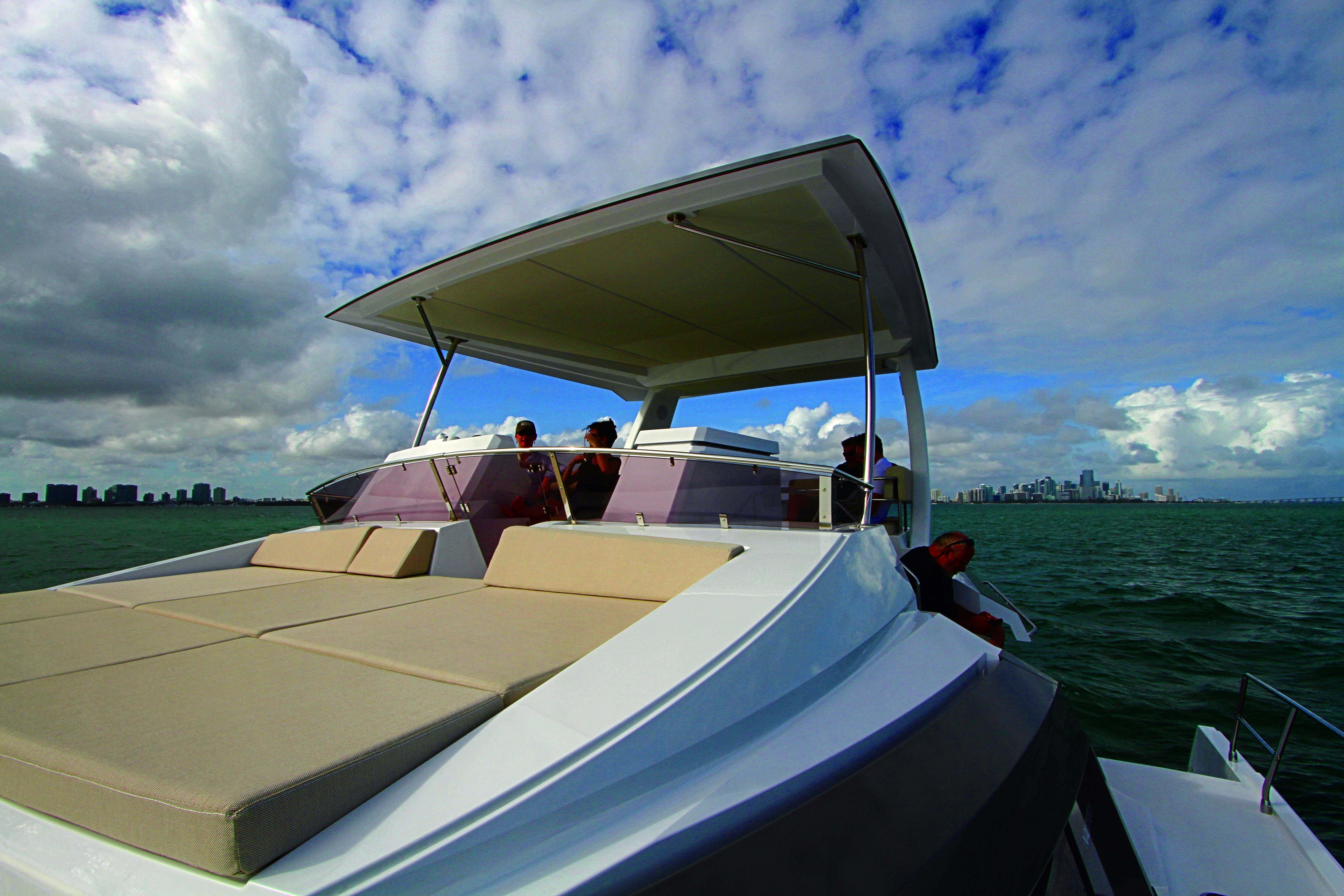
The flybridge offers a full helm station with a large bench seat. At the front, a small gate leads to a large sunbathing area.
You can understand the debate for or against a flybridge on a sailing catamaran, but it’s no longer relevant aboard a powercat. No amputated rig, sail shadows or boom hazards. Here, the flybridge is 100% fun! At high speed, a discreet windshield breaks most of the wind felt. The (optional) rigid bimini protects you from the sun and bad weather. The manufacturer offers a U-shaped saloon aft of the helm station, a galley module to port and a sunbathing area forward - this is accessible through a small gate (whose fit could be improved). So here we are on the front of the coachroof, where a ladder leads to the foredeck. Of course, the deck layout is not limited to this famous flybridge, which is so userfriendly - the main access is via five steps on the port side. Forward of the coachroof, two large lockers and an anchor locker are available. Compared to the sailing version, the rigid deck extends further forward to provide two cockpits. These cockpits can be fitted out with a dedicated upholstery and even two removable tables. There are still trampolines to be reached before the getting to the beam connecting the bows. The side decks are very wide, and the whole deck is bordered by a very safe stainless-steel rail. A handrail is also integrated into the molding of the coachroof. Four steps down, and you’re in the main cockpit, at the stern. This area is of course protected by the flybridge. The layout here is understated and efficient: an L-shaped bench seat with a table on the starboard side, a straight bench seat on the port side and one more at the stern, fitted athwartships. Moving around is easy and fluid, and the accesses to the sugarscoops are wide. As an option, a hydraulic platform capable of supporting 250 kg (600 lbs) can be ordered.
The importance of the interior helm station
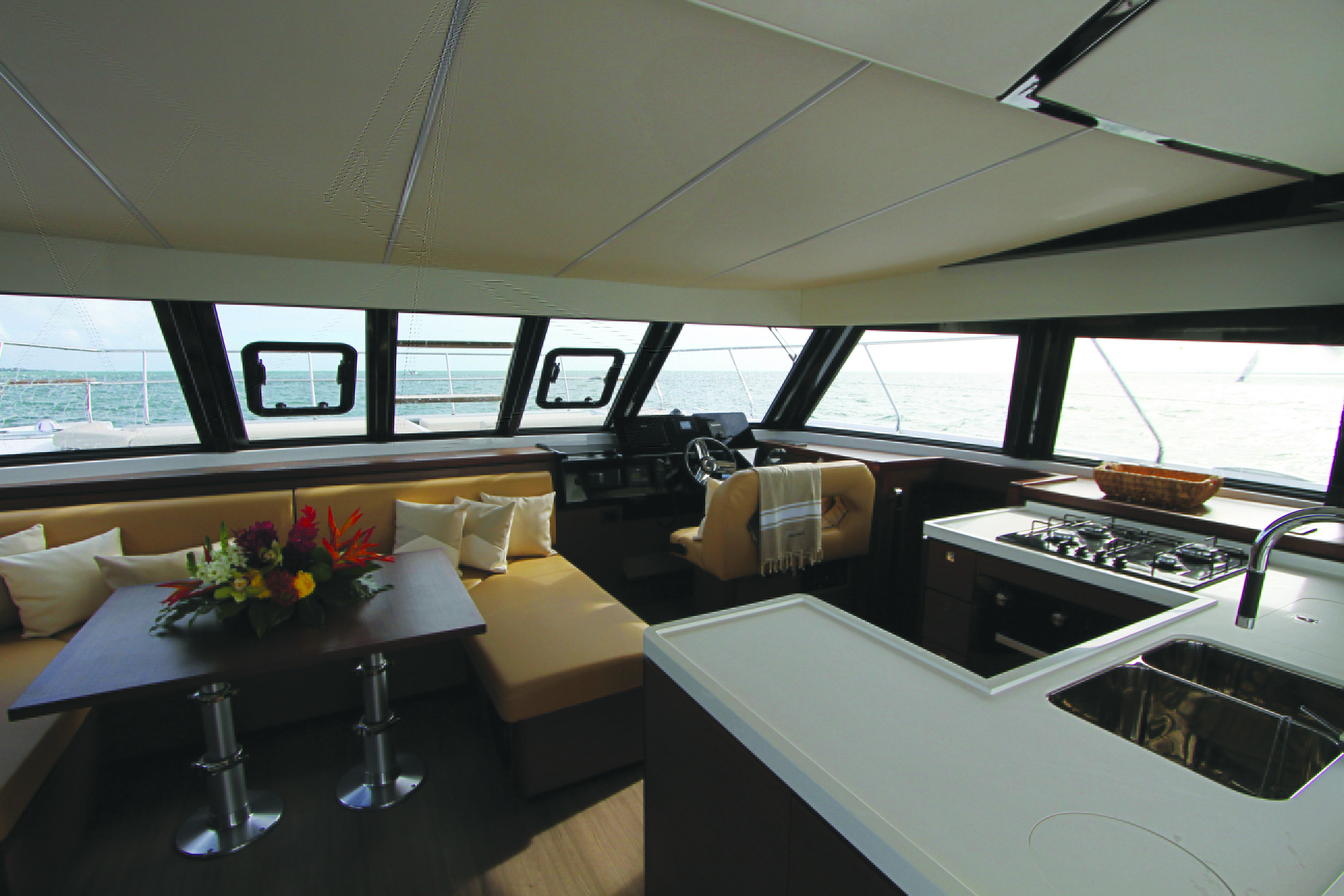
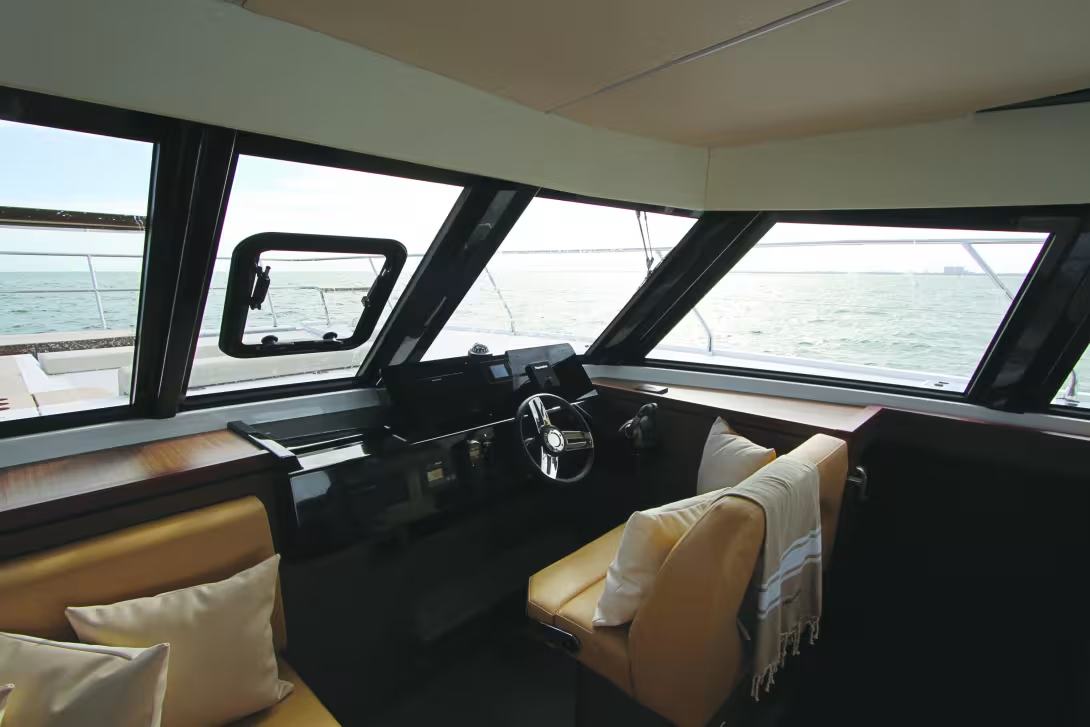
This new version of the Nautitech 47 Power offers an interior helm station, a welcome addition for overnight passages or sailing in bad weather.
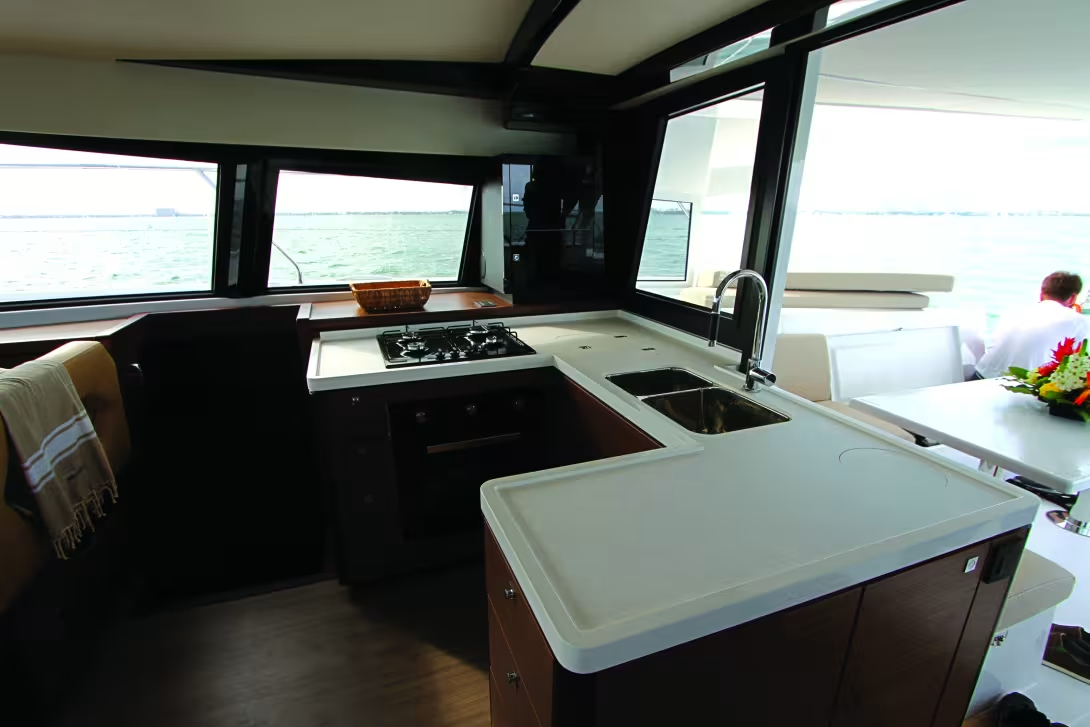
The nacelle, aboard all Nautitech boats, has a very large opening towards the cockpit, with no difference in level. Overall, the fittings are identical to those of the first version discovered at boot Düsseldorf back in January 2018 - with a few details of color and finish, that are more highend. As for the finish, a little more work could go into the adjustments of the panels – the cut-out for the trash can, the worktops - and then it’ll be perfect. The big difference is the optional interior helm station. We can only recommend that you get this! Driving in the shelter is a rare pleasure when it rains, at night or simply when temperatures are cooler. This cockpit is located in the starboard forward corner of the saloon, with a good general view over the water. Further to port, the U-shaped saloon can happily seat six. Two options are available for the table: it can be folded down as a coffee table or transformed into a double berth. The U-shaped galley adjoins the cockpit on the starboard side. A very wide range of options allows you to equip this 47 to suit your desires - generator, electrical appliances, watermaker, air conditioning, etc. For the hulls, you’ve got a choice of 3 or 4 cabins. Here, the plans are identical to the layout of the 46. The Owner’s cabin is located to port - bed at the stern, storage and desks in the passageway and XXL-sized bathroom at the bow. The “guest” hull comprises two cabins, but now also two bathrooms. All berths are 2 meters long by 1.60 meters wide (6’7” x 5’3”). As an option, either or both of the forepeaks can be fitted out with a single berth.
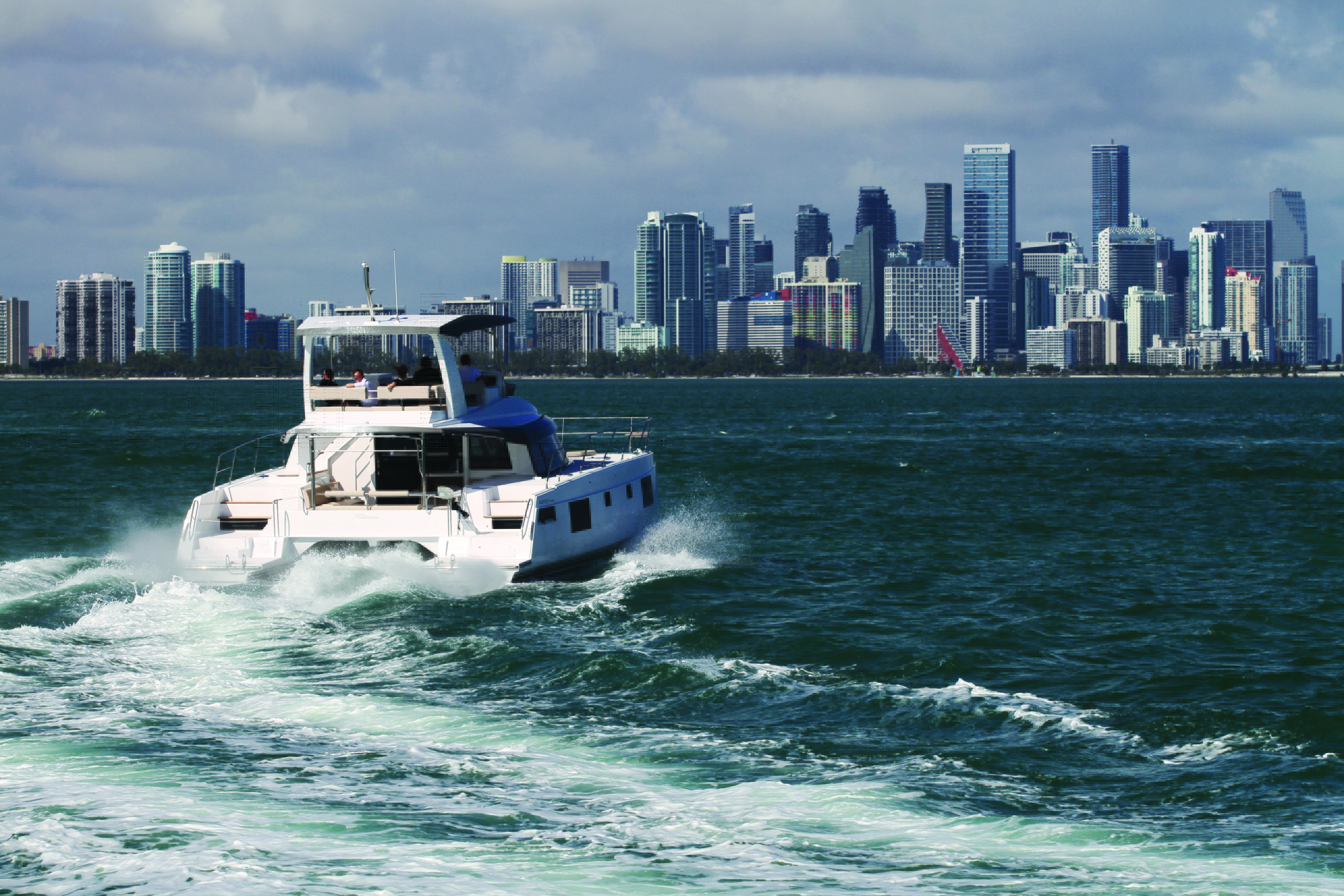
When turning, the Nautitech 47 Power stays flat, and course control is incomparable. The chines help keep sea spray off the deck.
Conclusion
Among the family of sailing catamarans transformed into pzowercats, this one is a success. It seems that Marc Lombard has become an expert in the exercise – the Privilège Série 5 which became the Euphoria had already won us over! But pleasant to sail, and incredibly seaworthy, this 47 Power is a very attractive platform for living and traveling on the water. All she lacks is larger tanks to allow her to go further and for longer...
The Pluses
Exceptional seakeeping qualities
Very thorough soundproofing of the engines
Optional interior helm station
The Minuses
Limited range for longer passages
A few finishing details could be improved
TECHNICAL SPECIFICATIONS
Builder: Nautitech Catamarans
Naval architect: Marc Lombard
Construction: Polyester sandwich (infusion)
Length: 14.23 m (46’8”)
Waterline length: 14.16 m (46’6”)
Beam: 7.54 m (24’9”)
Draft: 1.20 m (3’11”)
Light displacement: 14.31 t (31,550 lbs)
Engines: 2 x 225 or 300 hp
Range: 1,000 nautical miles
Cruising speed: 8.5 knots
Top speed: 22 knots
Diesel capacity: 2 x 654 l (2 x 172 US gal)
Water capacity: 2 x 300 l (2 x 79 US gal)
Number of cabins: 3 or 4
Price: € 641,898 ex-tax
Price of the catamaran we tested: € 838,190 ex-tax
Main options ex-tax: 4-cabin version: € 5,562
Charter version: € 21,900
Elegance Version: € 37,900
Premium Version: € 54,900
Premium Nav-Pack: € 27,900
Supplement for 2 x D4 Volvo 300 hp: € 20,890
. Interior cockpit: € 8,290
Bow thruster with 2 joysticks: € 13,600
Synthetic teak decking for cockpit and sugarscoops: € 10,490
Tenderlift platform: € 42,900
Forward cockpit upholstery: € 3,990
Cockpit table convertible into a lounge: € 1,900
Synthetic teak decking on flybridge: €4,950
Fixed coffee table: € 1,190
Rigid bimini: € 29,800
Bar cabinet with sink and refrigerator: € 5,630
Flybridge upholstery: € 5,630
Saloon table convertible into a double bed: € 1,580
100 l/h (26 US gal/h) watermaker: € 14,900
Fans: € 990
Reversible air conditioning in saloon and cabins: € 24,900
Underwater lighting: € 6,230
7 kW Generator: € 21,600
2,000 W inverter: € 2,380
Fusion Hi-Fi System: € 3,100
3.1 m (10’) RIB and 15hp outboard: € 8,980
Cat. A safety equipment for 12 persons: € 4,450
Platinum Antifouling (for warm/tropical waters): € 4,900
Launch and delivery at La Rochelle: € 8,650