First seen back in September at the Cannes Yachting Festival, this electric trimaran intended for day cruising appeared in stark contrast to all the other boats on display. The concept of the Orphie 29 goes back to the fundamentals of sailing, which promise fun and relaxation on the water with optimal respect for the environment. Obviously, we wanted to know more…
Test location: Cannes, France
Conditions: 4 to 8 knots of wind, light chop

Infos pratiques
- Le chantier : Orphie 29
- La fiche technique
-
 Découvrez notre vidéo exclusive
- Financez votre Orphie 29
- Assuez votre Orphie 29
- Articles autour du Orphie 29
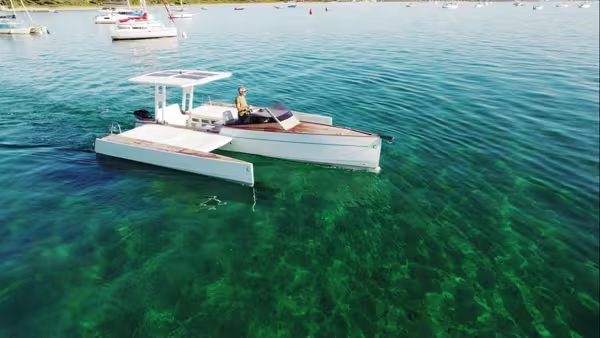
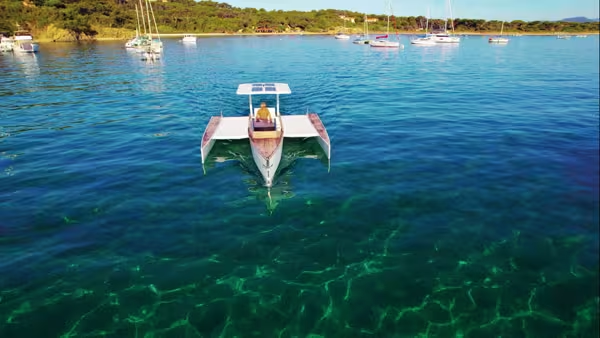
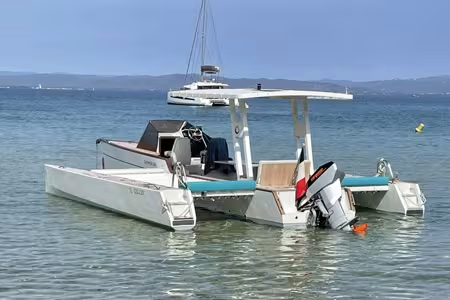
One section of the Cannes Yachting Festival was dedicated to hybrid or 100% electric boats under ten meters (33 feet) in length. A good twenty models were on display at the end of the central dock, and this was where we discovered the Orphie 29. This small multihull of a new kind is very beamy and sits low on the water. It looks like a racing boat with very tapered hulls, but without a mast. The center hull looks like a motor cruiser dayboat with a beautiful hardtop-covered cockpit and a very narrow bow extending with a streamlined windshield. All decks are teak-coated and surrounded by a rub-rail in varnished mahogany, giving the air of a vintage motorboat. The sterns of the floats are equipped with sugarscoops, and the transom of the central hull supports a Torqeedo outboard motor. In short, the Orphie 29 looks like nothing you’ve ever seen before!
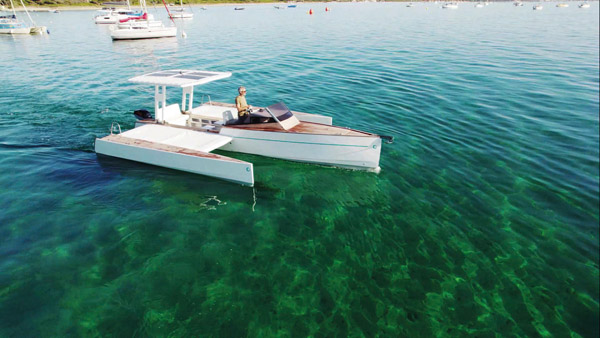
The Orphie 29 moves silently across the water with no CO2 emissions thanks to its electric drivetrain.
A different approach to our behavior on the water
The two partners in the project, Cyril Ambrozy and Yann Herriot, are passionate about the sea, sailing and gliding across the water. Their objective is to let people to discover the coastline in a different way by focusing on the basic pleasure of being on the water. So, while not actually trying to change people’s behavior, it’s a modern and eco-responsible way of boating. For Cyril and Yann, the future of propulsion at sea is electric and wind, nothing more.
A trimaran platform was chosen for its great stability, its qualities of passage through the water and its capacity to carry six to ten people by distributing the weight across the three hulls, minimizing drag, and therefore energy consumption. Displacement is the thing that has been precisely identified as the enemy of propulsion, whether by propeller or wind. The hunt for weight was a crucial concern during the design phase by Jean-Marc Piaton and Clément Bercault - who have just set up their naval architecture and design agency. The very narrow hulls (21”/53 cm for the side floats and 4’1”/1.56 m for the central hull) are made in plywood epoxy and joined by carbon infused beams. It’s simple, strong, efficient and lightweight.
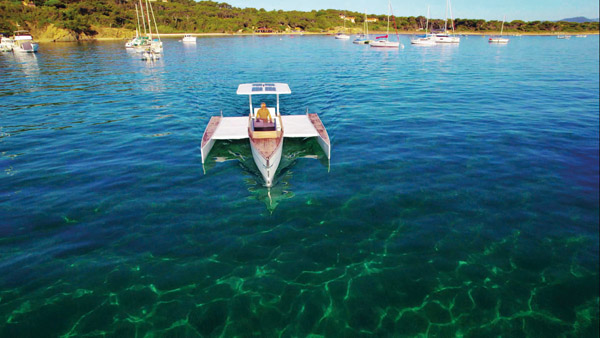
The narrowness of the hulls ensures very low drag, and therefore less need for propulsion energy.
A high-tech drivetrain
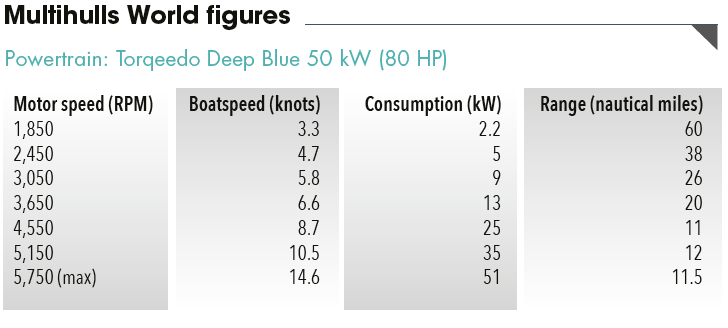
While the modern and fluid lines associated with the beautiful deck plan is reminiscent of neo-retro production, the drivetrain is highly technical. “In fact, a, it all started when I saw the trimarans (Diam 24s – ed.) in the Tour Voile, maneuvering under power.” The Orphie 29 is therefore powered by a 50kW outboard motor, though an inboard version has not been excluded. This power allows us to make 8-10 knots for about 15 miles and, depending on the sea state, to push up to a peak at 14-15 knots with the right propeller. With the hull speed being a little less than eight knots, we could be satisfied with a power of 25 kW or two x 12 kW on each external float. The shipyard does offer this as an option, available in two x 24 kW with batteries of 30 kWh, all functioning at 48 volts. The BMW i3 battery in 400 volts on our test model is housed beneath the cockpit sole, so doesn’t impede the boat’s habitability.
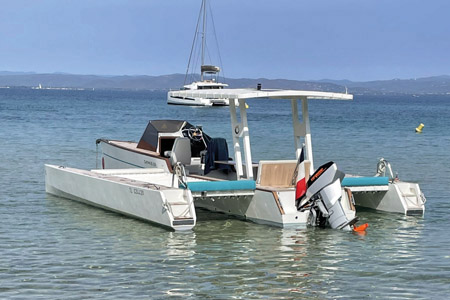
With just 14 inches of draft, the Orphie can get very close to the beach.
Familiar sensations... or to be newly discovered
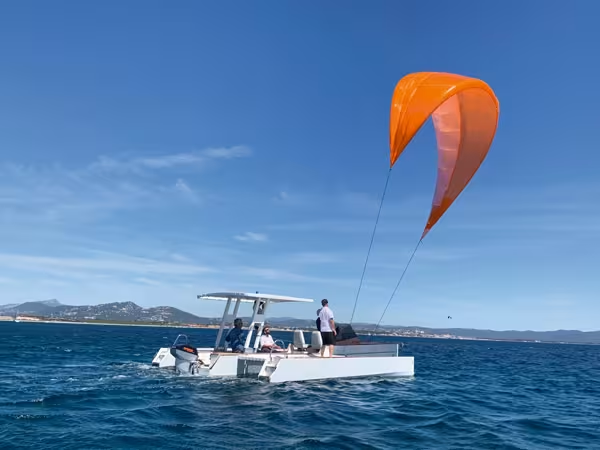
A little trip round the bay of Cannes was proposed to convince us of the accuracy of the concept. The Orphie 29 is equipped with a bowthruster and sternthruster, making it easy to maneuver, but I wonder whether the version with motors on each side would be a more interesting and less expensive alternative. As we left the harbor, it was amusing to see the astonishment that we arouse: all eyes seem to be riveted on our strange machine. A light chop picked us up as we cleared the port, and the fine wave-piercing bows (true to the elongated head – “orphie” is French for Garfish) coped very well with it at up to eight knots. The trimaran certainly wasn’t reluctant to accelerate again, but the electrical consumption rises quickly doing this. Pierre, the skipper, explained to me that it isn’t speed that his clients are looking for. The multihull was operated all last summer by the company Riding Watt, offering day cruises out of nearby Hyères. “We cruise at 6-8 knots and use the kite to pull the boat as soon as there’s a bit of air”, Pierre explained. We weren’t able to try out this famous kite on our trip, as the bay was crowded with boats from the show out on seatrials, but the enthusiasm of the customers is inexhaustible, it seems. “At this speed, just with the motor, the BMW battery allows you to cover fifteen to twenty miles, and more than thirty if you are happy to go along at five knots. This is more than enough: the clients are there to enjoy the swimming and the sunshine. When we return to port in the evening, it only takes five hours of recharging on an ordinary 32A shorepower outlet to recharge the battery”. The point is that the pleasure is elsewhere than in energy debaucher - you only have to lean your hand overboard to feel the water temperature to be convinced. It was 77°F (25°C) in late summer. Your ears aren’t assaulted by any engine noise, not to mention exhaust fumes, that are obviously absent.
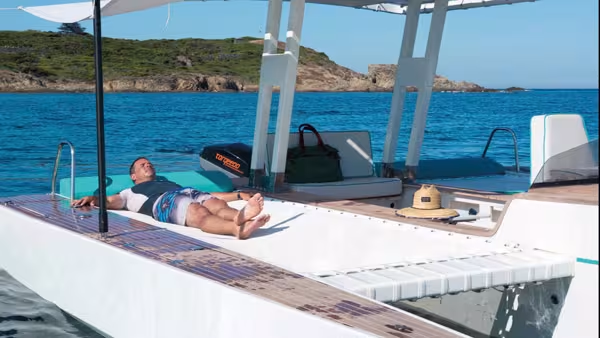
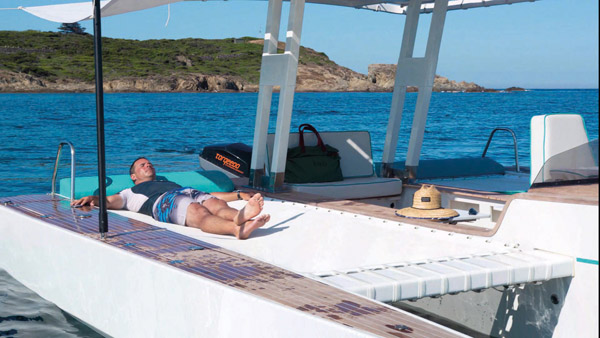
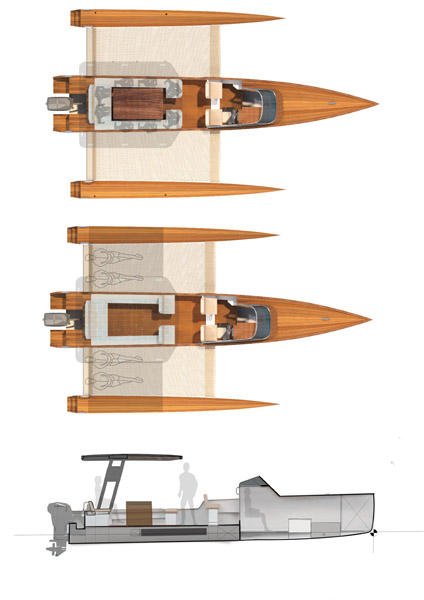
The on-board accommodation is simple but fun. A large table under the hard-top allows the whole crew to enjoy a meal. Then, while some swim, the others laze in the sun or under the shade awnings. The small interior cabin in the forepeak provides the essentials: a mini galley, a heads compartment and a single berth.
 |
 |
The Orphie 29 aims to give maximum satisfaction in minimum space. The solar panels on the hard-top are used to power domestic consumption, especially lighting.
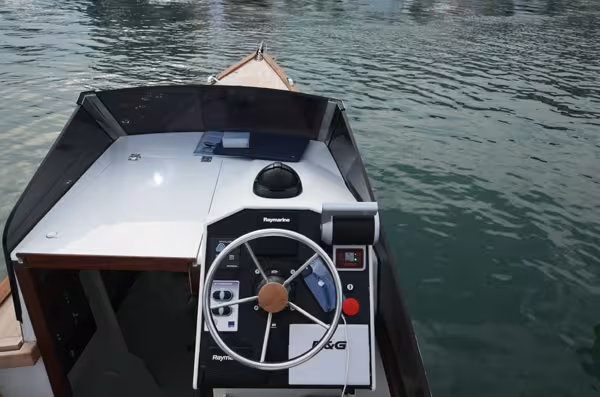
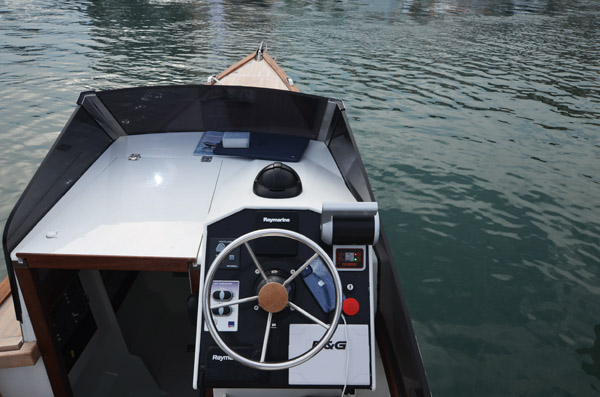
The helm station is basic, but it’s got all the essentials - engine controls, Raymarine log and VHF, B&G plotter, windlass, and even bow and sternthrusters.
Conclusion
The finish was not yet at top level on this first model, but the shipyard will be improving this with a second unit currently in build. Yann tells us that this next boat will be revised following lessons learnt from the first season’s operation. The central form of the hull will be moved forward and the stern raised, further optimizing seakeeping behavior at eight knots, the speed favored by the users. Of course, the trimaran will lose a couple of knots in top speed, but the increased comfort and the lower fuel consumption when below ten knots happily justifies these slight modifications.
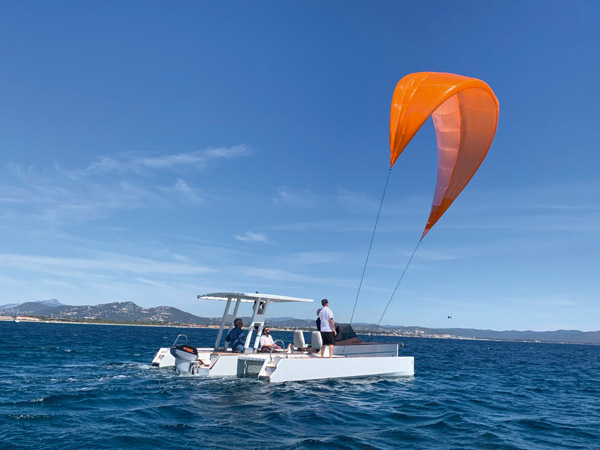
A 215-square foot kite can be easily deployed downwind. This adds even more range.
THE PLUSES:
+ Innovative and convincing concept
+ Elegant and simple design 100 % CO2 emission-free
+ Numerous powertrain/battery options
THE MINUSES:
- Finish needs improving
- A bit cramped in the cabin
- Very beamy for a marina slip
- Not cheap
TECHNICAL SPECIFICATIONS
Builder: Orphie Boats
Architects: Piaton-Bercault Yacht Design
Material: Plywood/Epoxy/Carbon
Length: 29’6” (8.98 m)
Beam: 17’5” (5.30 m)
Draft: 14”/30” (0.35/0.75 m)
Displacement: 4,080 lbs (1.85 t)
Motors: Torqeedo from 12 to 48 kW in 48V or Deep Blue 25 to 50 kW in 400 V
Batteries: 50 kWh in 400 V (i3) or 30 kWh in 48 V
Water: 15.8 US gal (60 l)
Prices:
Basic version with 1 Torqeedo at 12 kW:€ 180,000 ex-tax
2 x 12 kW Torqeedo version with 30 + 15 kWh batteries at 48V: € 200,000 ex-tax
Version we tested with 50 kW Torqeedo and BMW battery: € 248,000 ex-tax
Main options:
400 Wp Solar Panels 2 or 4 waterjets
215 sq ft (20 m²) kite wing
Additional LEDs on deck and underwater
Shade screens with carbon support posts