
Start-up company Neocean has developed a small catamaran with an electric motor capable of flying above the waves. With a simple throttle control, and cleanly - with no C02 emissions. We had the chance to try the first version of the Overboat on the Étang de Thau lagoon in the South of France. Ready for take-off!
Infos pratiques
- Le chantier : Overboat
- La fiche technique
-
 Découvrez notre vidéo exclusive
- Financez votre OverBoat
- Assuez votre OverBoat
- Articles autour du OverBoat
« Today, you’re going to be flying on the water!” says Vincent Dufour, the founder of the young company Neocean. I admit that when he tells me that it will be without C02 emissions, a flutter sets in, a brief moment of perplexity... Of course, I had already had the opportunity to fly without polluting, but it was with the help of wind power and on board a craft that involved a very steep learning curve. Without sails, the power/weight ratio available with what exists on the electric motor market seemed to me – in theory - insufficient to enable a boat of this size to take off. Our appointment was made for that same morning, so I would quickly be sure. Before leaving on the water, Vincent introduced me to his colleagues - a dozen engineers, mechanical and robotics experts in electric motorization and hydrodynamics. Some of them come from the University of Montpelier, with which Vincent has previously founded a research project.
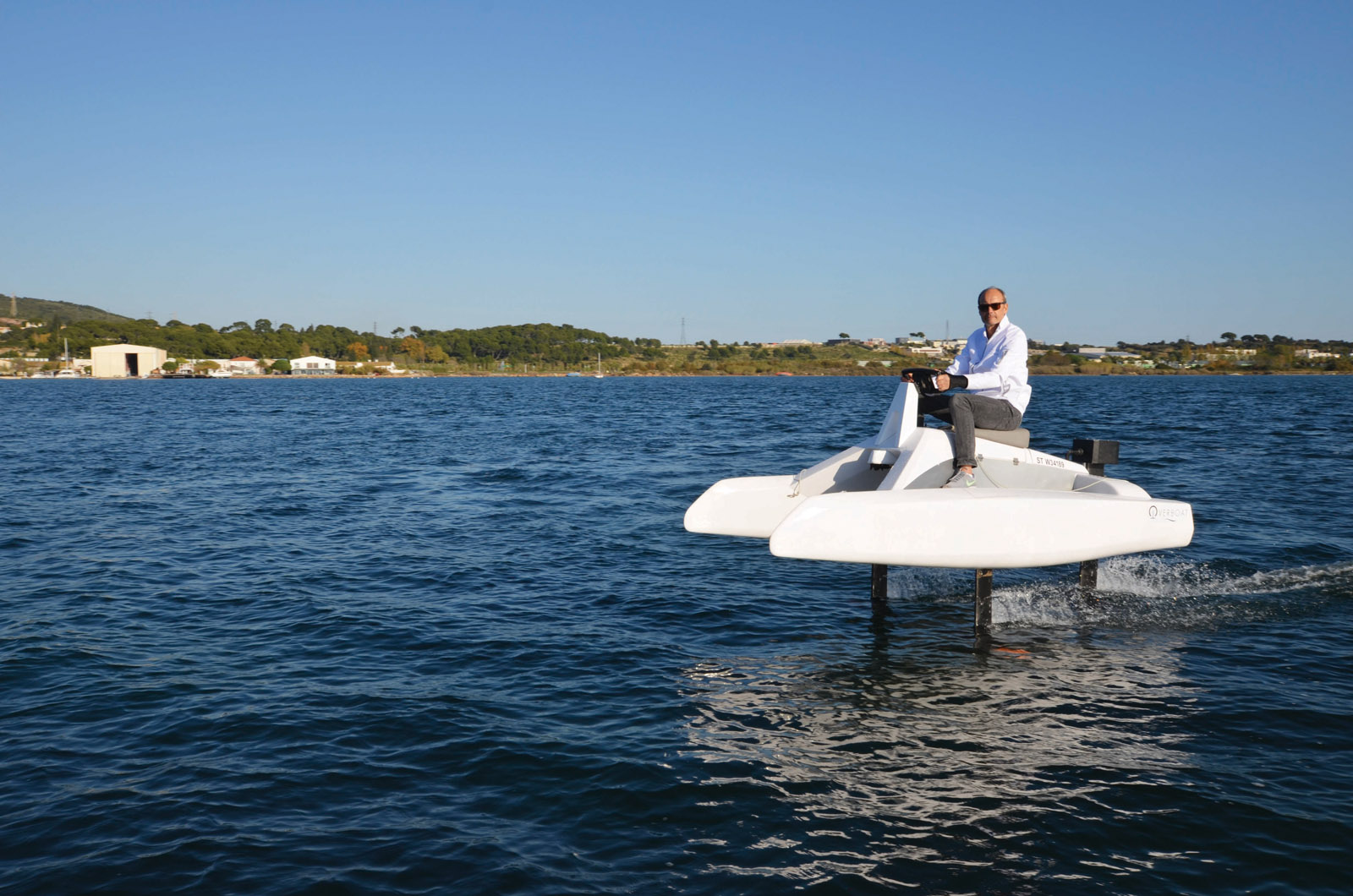
Naviguer en silence, sans émission de C02 et au-dessus de l’eau : une vraie révolution !
This young and friendly team is based in the same hangar is home to Switch catamarans, at Balaruc-lesBains. The dynamic and bustling atmosphere smells like a start-up. Vincent, an oceanographer and biologist by trade, has solid experience with the projects he set up and piloted in different parts of the Planet before becoming the “innovation” director of the LanguedocRoussillon Region of France. “When I saw the America’s Cup AC 72s sailing on San Francisco Bay, it clicked instantly,” he admits. In the workshop, my eye is immediately drawn to a model of the Overboat that sits in the middle of various workstations dedicated to the manufacture of engines, foils and electronic systems - the hull being subcontracted to a specialized composite workshop.
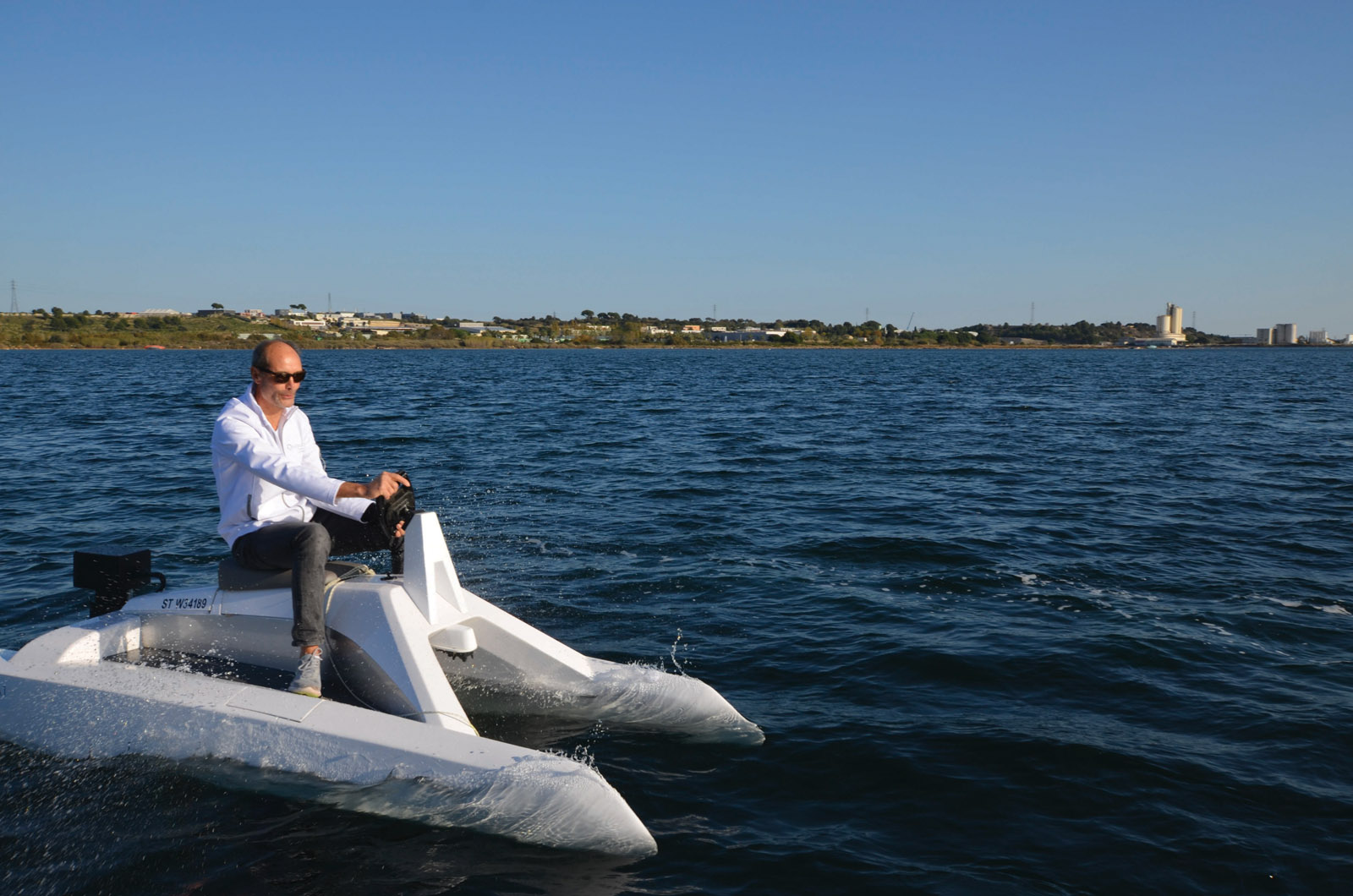
Sailing in silence, with no C02 emissions and above the water: a real revolution!
Immediate sensation
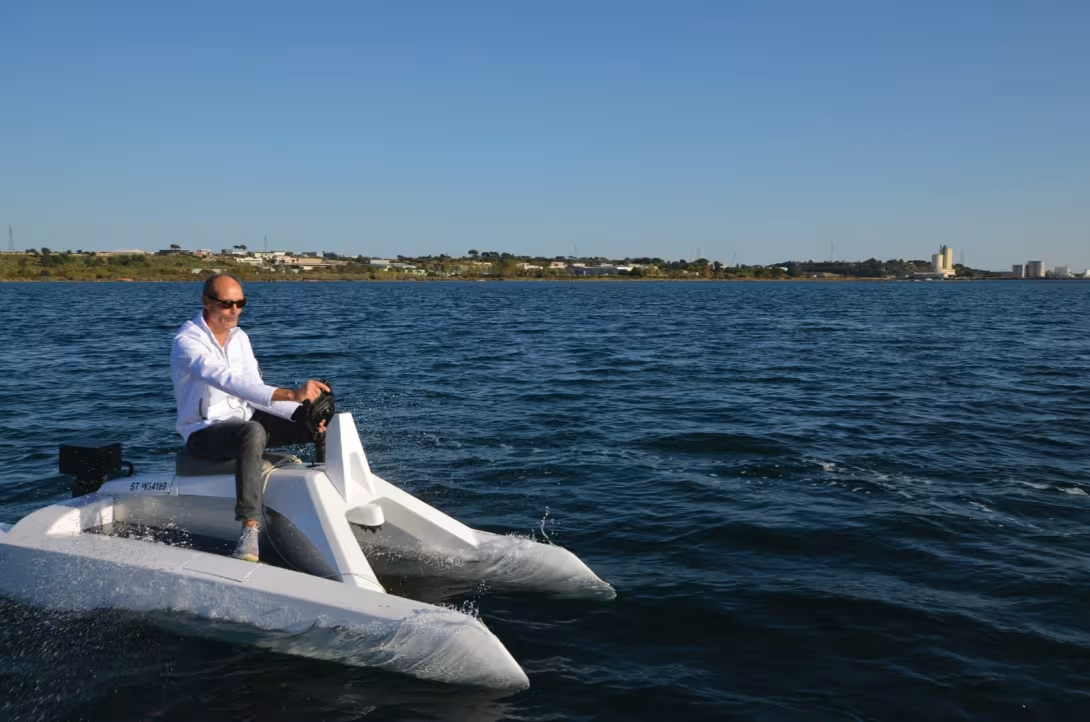
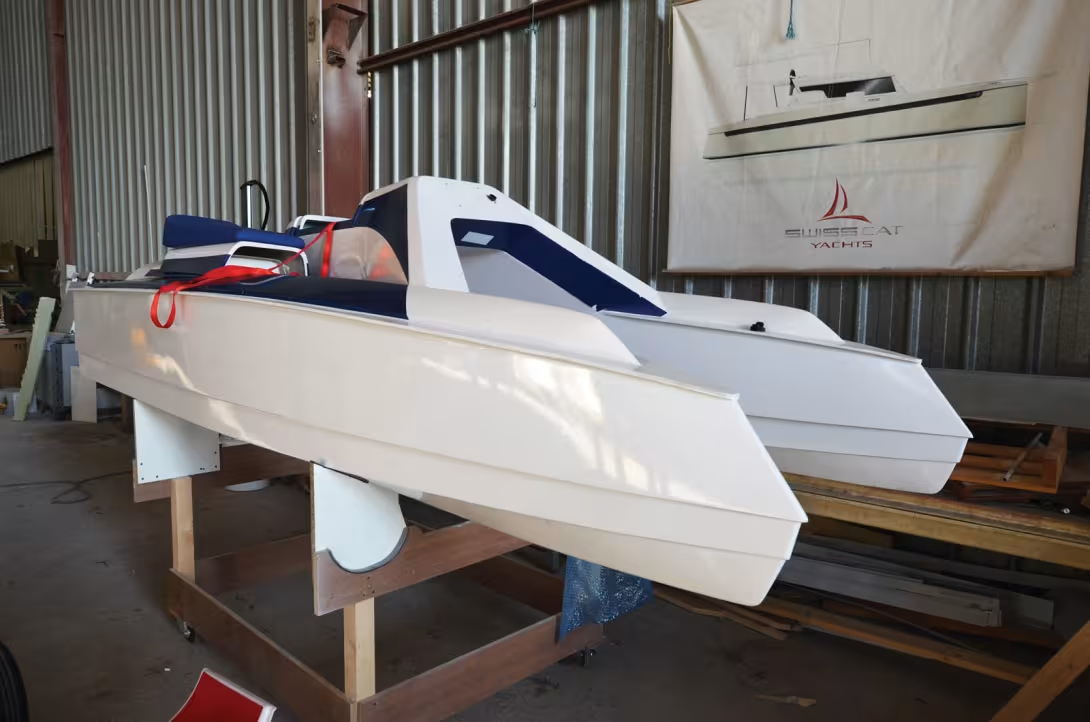
I discovered the craft moored alongside the pontoon; it looks a bit like a spider with its two floats on which legs support a central saddle and a small futuristic and evocative rectangular steering wheel. The catamaran configuration was chosen for two reasons: firstly, its low hydrodynamic drag, and secondly, its stability - despite its length of barely ten feet (3 m) and its featherweight of 220 lbs (100 kg), the Overboat doesn’t threaten to capsize at all when you climb aboard. An initial demonstration was performed by one of the developers. He took his place on the saddle as you would on a jet-ski. A little gas (or rather a few electrons) pushed him away from the pontoon. Then a frank acceleration ensues before he tore himself free from the water after only 30 feet (ten meters)!
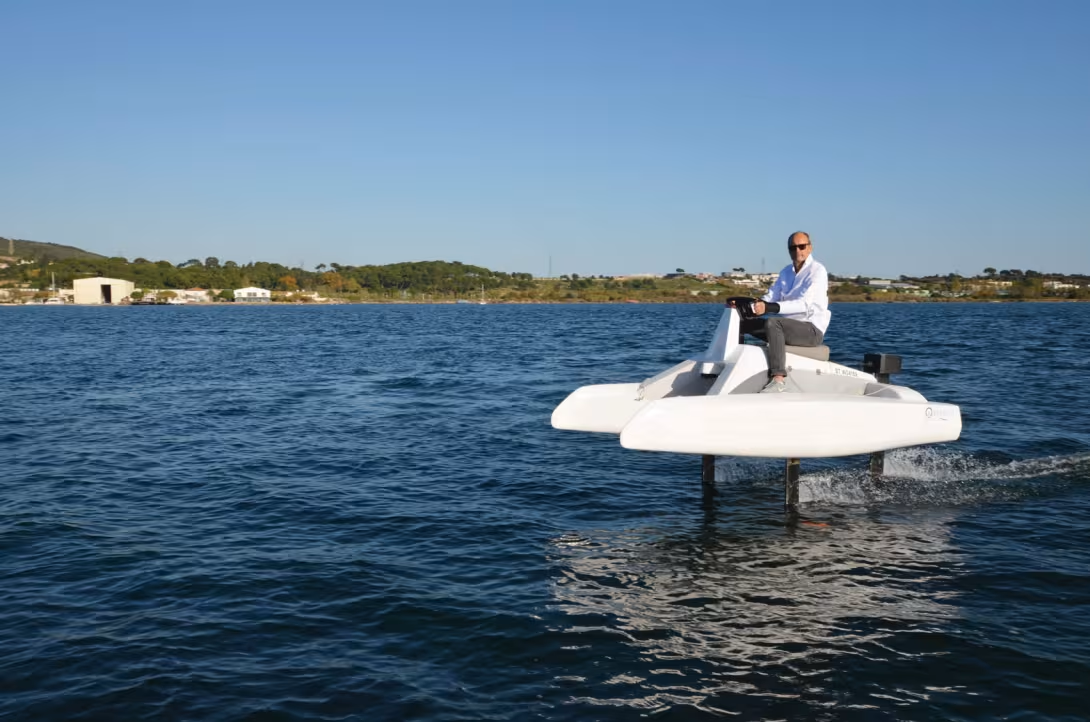
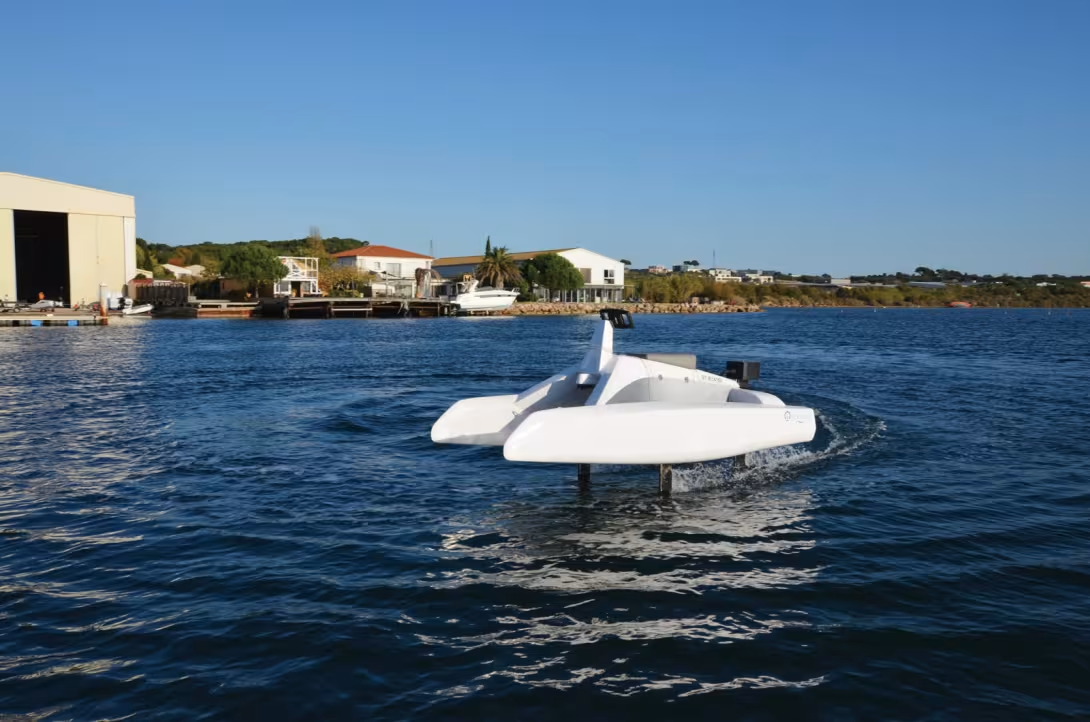
The Overboat moved away in flight then returned towards us, making a few turns in a limited radius and stopped in one or two boat-lengths. The maneuverability is impressive. To take off and fly in a restricted perimeter is seemingly very easy. And then it was my turn. I got on the Overboat like a bike, received a few explanations and rode off, um, no actually, flew off! With a little apprehension, I accelerated using the joystick on the rectangular steering wheel that displays the information. The catamaran launched itself then suddenly, at about 4 or 5 knots, started to lift then continued to climb up onto its foils until it was more or less 18 inches (50 cm) above the water. A speed of 15 knots was reached very quickly. The first few hundred meters were very surprising: no jolts or noises were perceptible. So that’s what flying on water is all about? No need to describe the exhilaration that gripped me, especially since no adjustments are required: the machine takes care of everything, my only action is to press the throttle. When I release it, the Overboat comes down instantly and slows down very quickly once back on the water - a few feet are enough to come to a stop. But once you’ve started, you don’t want to stop! To give the exercise a little bit of a challenge, I passed through the wake of the Zodiac that we use as a photo boat. Perpendicular to, or equally, almost parallel to the wake, crossing the waves happens without decelerating and especially without any jolting. It’s frankly breathtaking. Moving silently around a bay with a good chop and being totally receptive to the environment is therefore not a dream - and yet, I feel like I’ve boarded a magic carpet. What’s more, it represents hope for the future of our motorized, yet virtuous, travel on water. By escaping the constraints set by Archimedes, the Overboat is much less energy consuming: electric propulsion with no C02 emissions is becoming an affordable reality for the average boater.
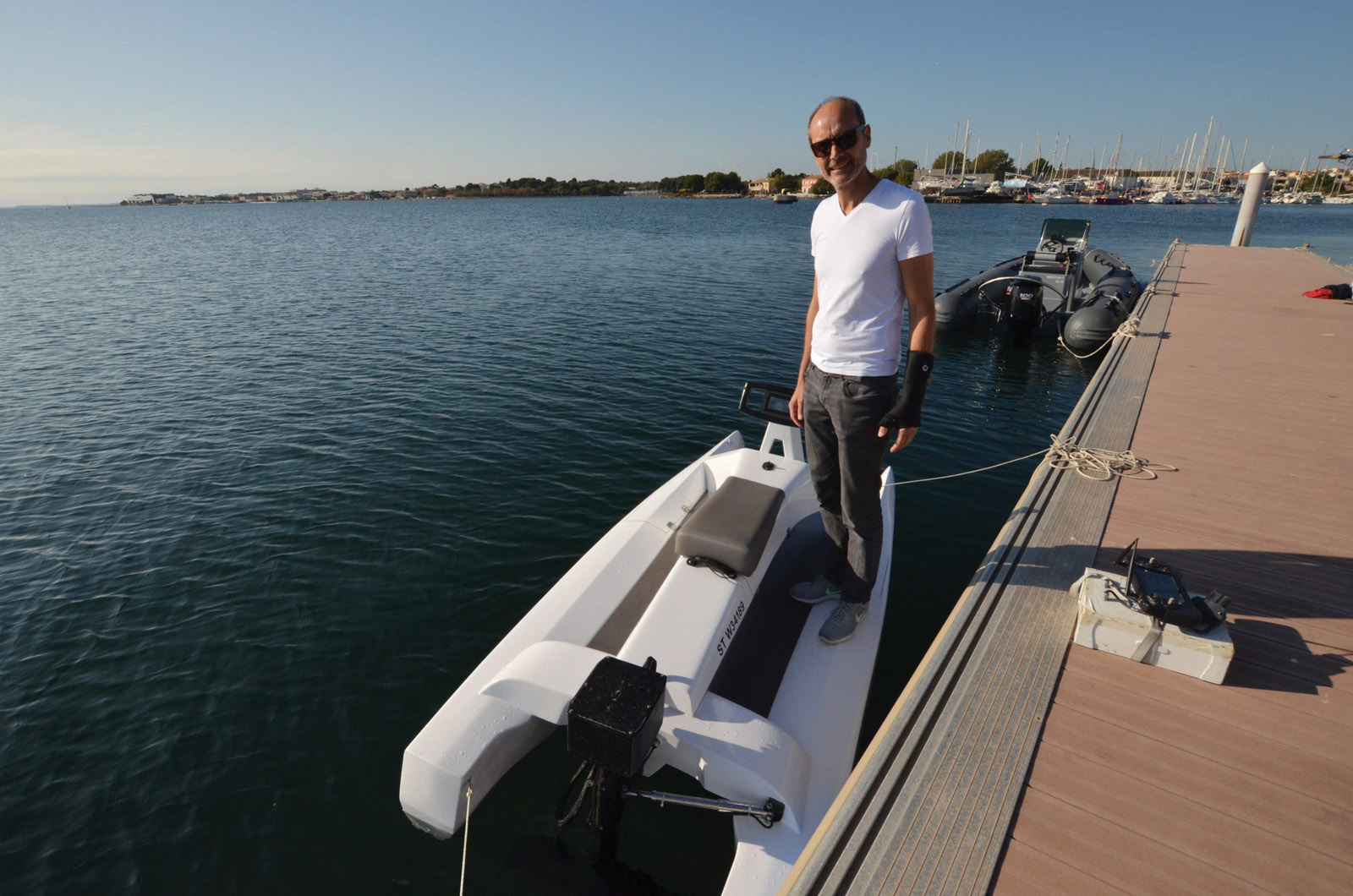
Thanks to its great stability, a catamaran is the ideal platform to support this flying machine - light enough to get out of the water without requiring a lot of power.
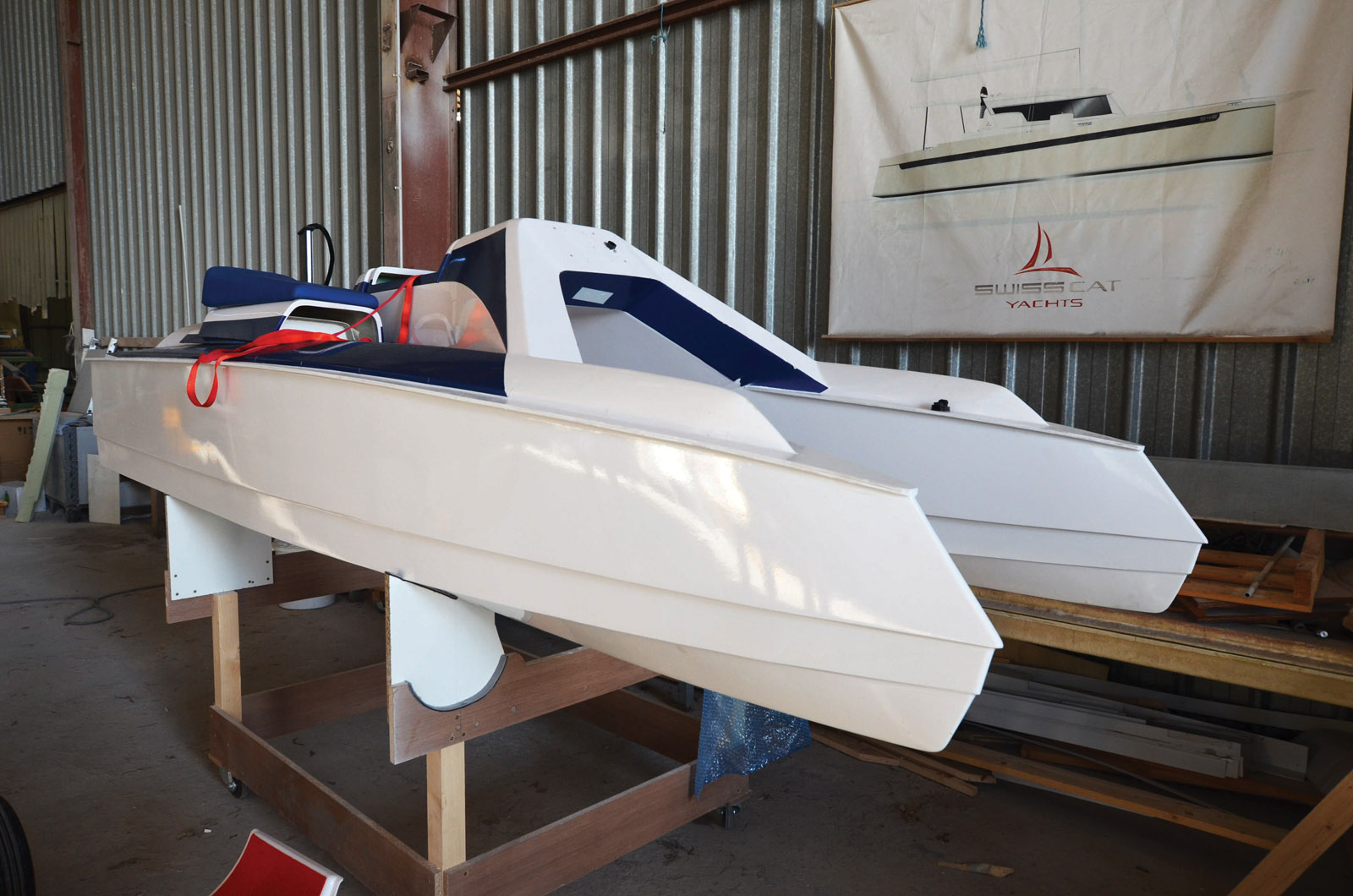
A traditional “Archimedes” version is available. Chines help give good deflection of the bow wave for more comfort.
Flight managed by cuttingedge technology
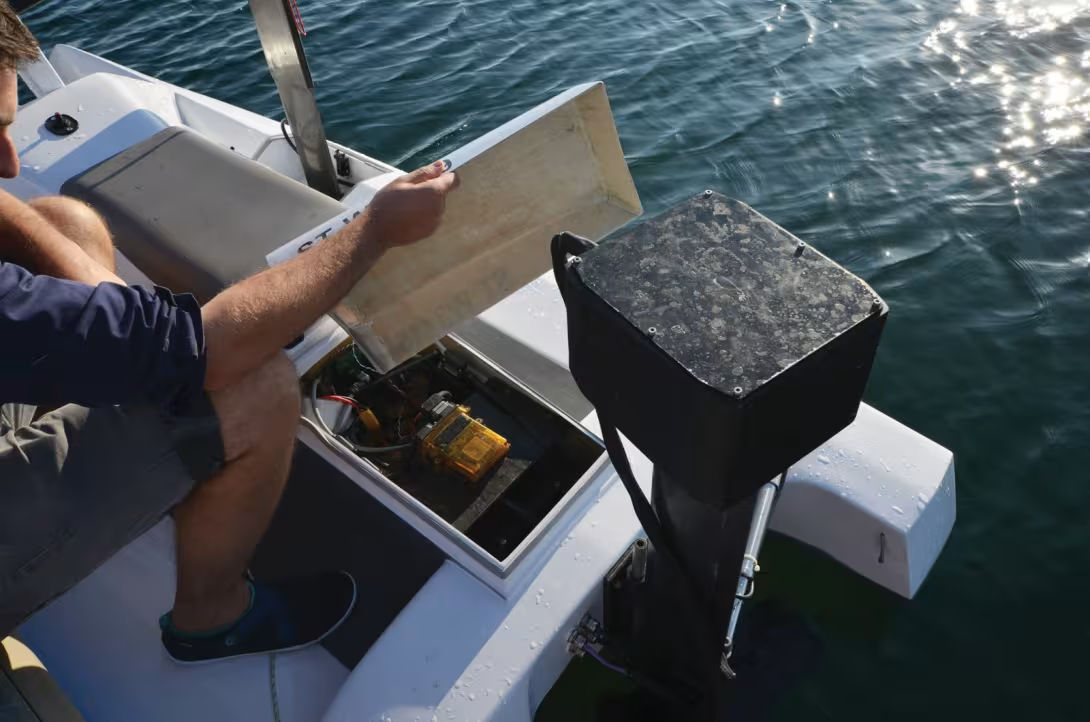
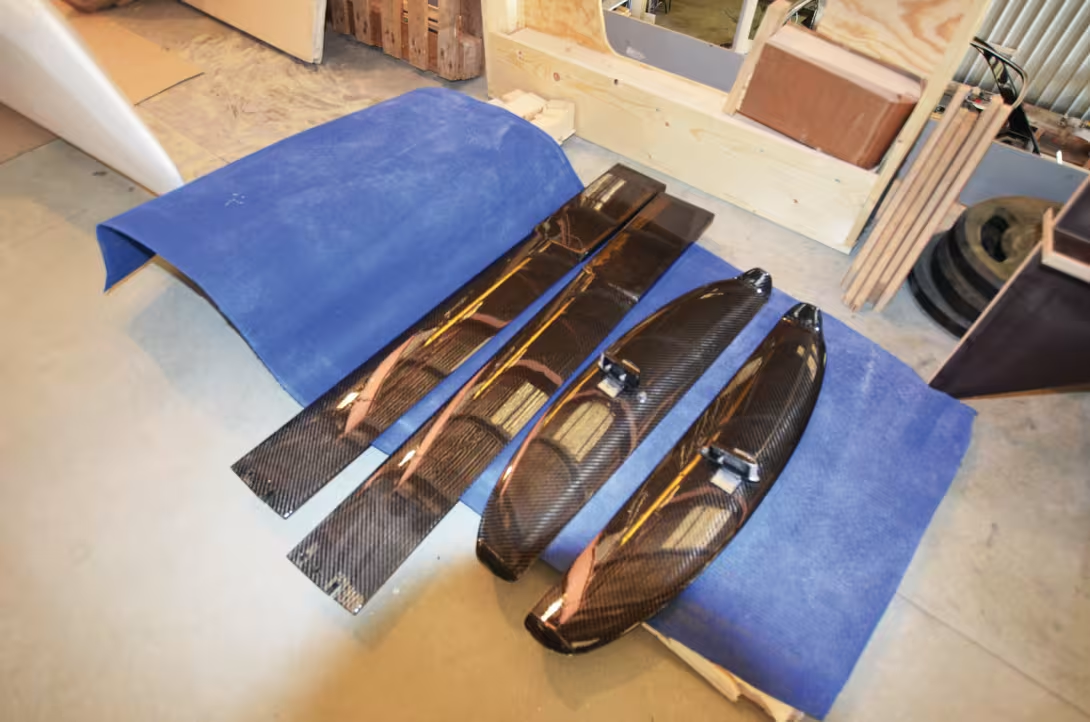
Though, in use, it is both child’s play and great fun, there has indeed been relentless development over several years that has finally led to this result. First of all, the dynamic qualities: very little wetted surface, therefore little resistance and less need for power on these hulls designed by Jean-Baptiste Epron - assisted by the Yacht Design Collective. The 4.5 kW underwater bulb electric motor is optimized with a tunnel propeller. The whole unit was specially developed by the team and its power-weight ratio is without equivalent. In addition, its power does not require a license in Europe, and three small electric bicycle-sized batteries, totaling 3.2 kW at 44 lbs (20 kg), are enough to give it two hours of range. The inverted T-shaped foils and the rear foil that also supports the motor are small pieces of carbon alchemy. They are fully articulated with winglets that provide superior performance, and flaps - they are used to adjust the stability of the machine in real time. The on-board electronics that enable these “automatic” flights are at the cutting edge of technology. An inertia control unit uses 60 sensors to collect information 100 times a second, then relays it to a computer, which interprets it and gives its incidence instructions to the articulated foil motors at almost the same rate. The entire system contains 400,000 lines of code, which corresponds to very powerful software, probably equivalent to the power of a computer as big as a car back in the 80s. Neocean’s team have successfully used 40 years of racing, industry, technology, hydrodynamics and aerodynamics experience to develop this device. But, like progress, it doesn’t stop there, and one of the developers gave us a demonstration of the drone mode. With a handheld remote control, he took control of the Overboat and guided it on the water with even more dynamism. Going shopping and then getting the shopping aboard by a crew member remaining on board becomes a reality. Yes, you’re getting the picture, the Overboat can revolutionize the idea of the tender…
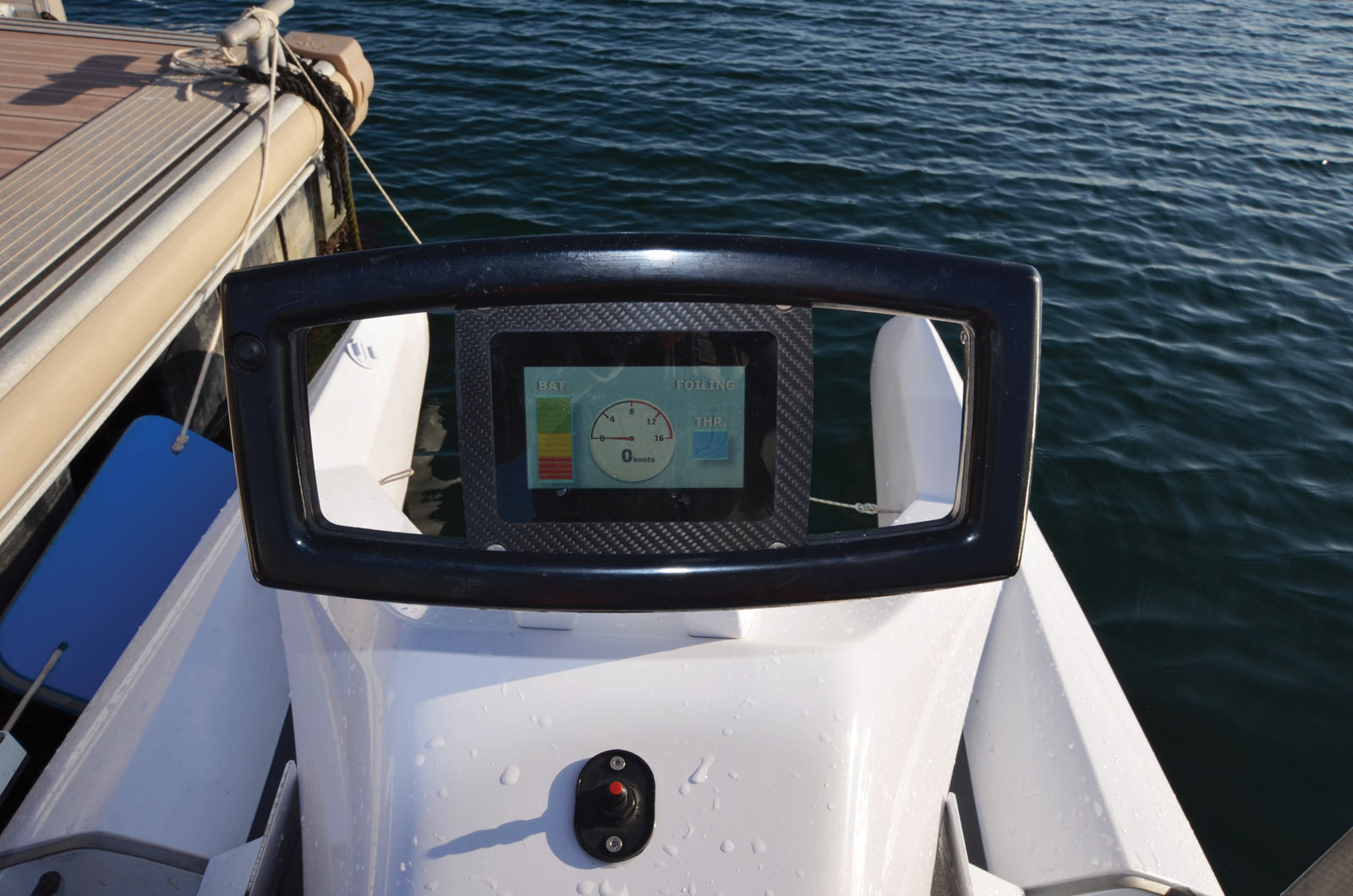
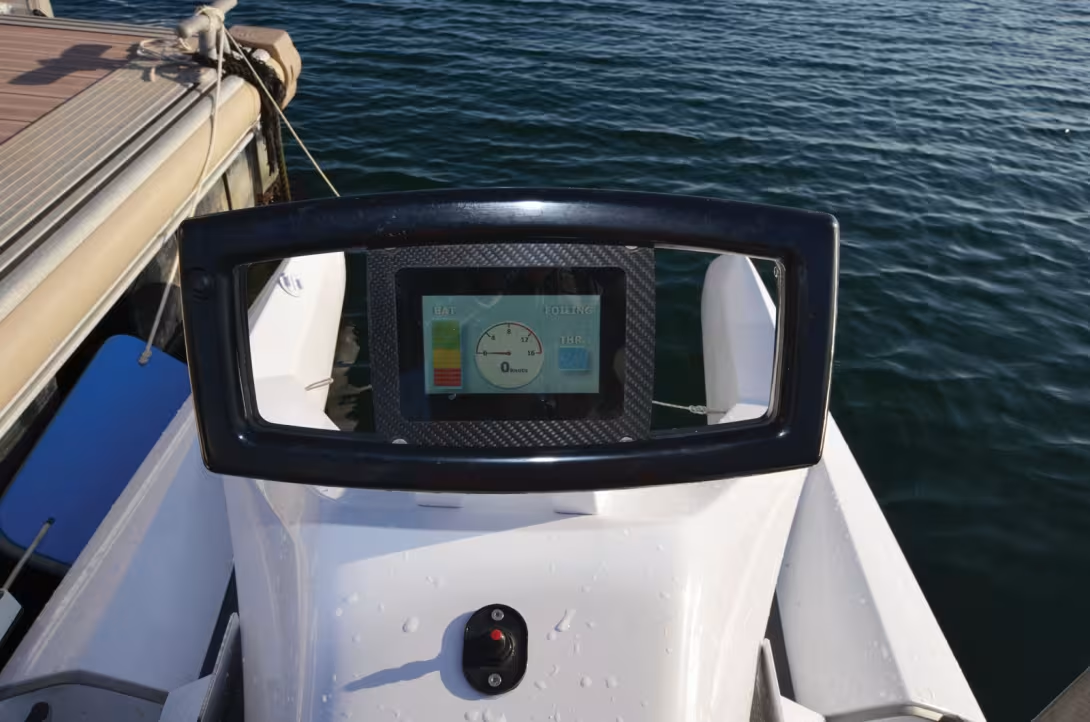
The rectangular steering wheel is worthy of a spacecraft... a legitimate futuristic touch for a craft capable of flying on water without a sound.
Conclusion
Overboat is a very effective anticrisis remedy. Except for a few adjustments, that are coming, of the sensitivity of the gas pedal or the steering, its remarkable tuning makes it possible to generate the sensation of sliding across the water for everyone, including children. The ease of use is disconcerting: get on and fly, and that’s it. A version without foils is also available and corresponds to a quieter use. The price tag of € 26,900 ex-tax for the foiling version and € 12,500 ex-tax for the traditional version is very consistent and in line with a conventional and polluting jet-ski. A new toy that makes ecology fun.
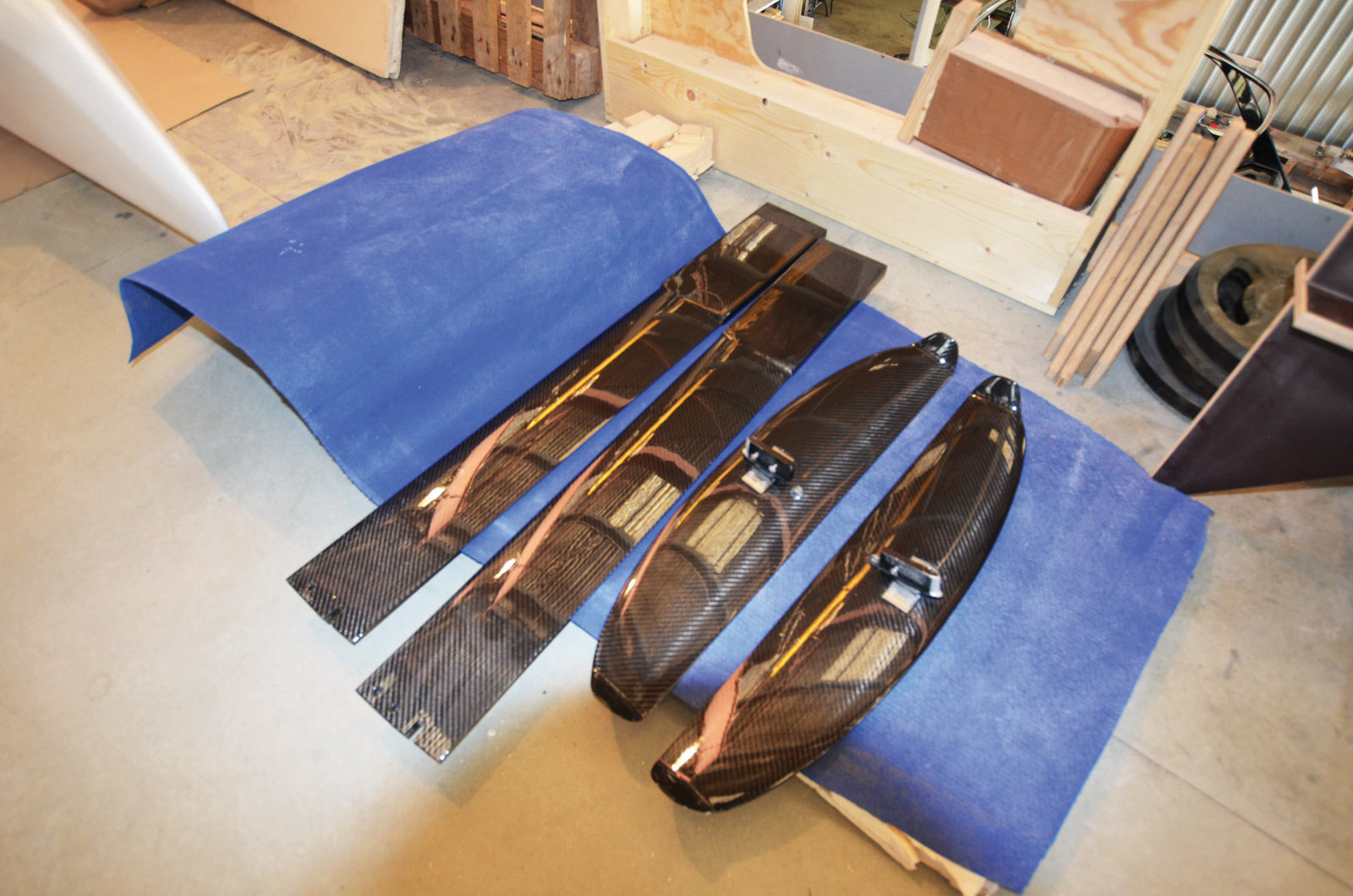
Foils are marvels of technology. The winglets shown here at the wingtips provide 15-20% energy savings.
The Pluses
+ Feeling of freedom and exhilaration of flight
+ Futuristic design
+ Environmentally friendly and quiet operation
The Minuses
- Sensitivity of the controls being adjusted
- A storage system needs to be organized
TECHNICAL SPECIFICATIONS
Manufacturer: Neocean
Design: Jean-Baptiste Epron and Yacht Design Collective
Hull length: 10’2” (3.10 m)
Beam: 4’5” (1.35 m)
Max. draft: 2’7” (0.80 m)
Draft with appendages raised: 8” (0.20 m)
Lightweight displacement: 220 lbs (100 kg)
Price for the hydrofoil version: € 26,900 ex-tax
Classic version: € 12,500 ex-tax
