Made in France, on the west coast, the Pinball is the result of an original and ambitious project. Dedicated mainly for day trips and rental market, it also offers some new solutions for cruising and is full of technology. Enough to offer you some great fun for crews that might not yet be that experienced.
Test location: La Rochelle, France
Conditions: calm sea, 3 to 4 knots of wind
Infos pratiques
- Le chantier : Pinball
- La fiche technique
-
 Découvrez notre vidéo exclusive
- Financez votre Pinball
- Assuez votre Pinball
- Articles autour du Pinball
At the origin of the Pinball project, there is one man, Pascal Duclos, an accomplished industrialist who is always on the lookout for new ideas and solutions to protect our good old planet. An electronics engineer by trade, Pascal was previously in the electric car business. After leaving the automotive world, he started looking for a boat that would meet his needs. Not finding the rare pearl, he decided to manufacture his own boat. This challenge led him to meet Stéphane Chaurial, naval architect, and designer for 15 years for the Ocqueteau shipyard in Charente- Maritime (France). By the way, the shipyard having ceased its activity, Pascal acquired it, which allowed him to have a factory to build the boat. The project was to design a versatile boat, with good performance on rough waters, easy to use during the summer as well as in mid-season and well adapted to rental without a skipper. A pretty specific mission statement that allowed them to move on to the next step. Having both a sense of innovation and an ecological streak, our man wanted from the beginning an environmentally friendly boat and the choice was therefore made for a hybrid electric/diesel propulsion system. A solution which offers the advantage of a non-polluting energy, a silent operating mode, but also a great range for longer cruises. When it came to the hull, it is almost naturally towards the catamaran that the two men went. Indeed, this kind of hull offers both a low resistance to the water in electric mode thanks to the reduced wet surface and, in fast navigation, the comfort and the stability are outstanding compared to a monohull. What remained was to define the size. Here again, to offer an ideal compromise between a correct living area, good seaworthiness and a size that remains easy to maneuver without a skipper, 29 feet (9 m) w as a good call.
 |
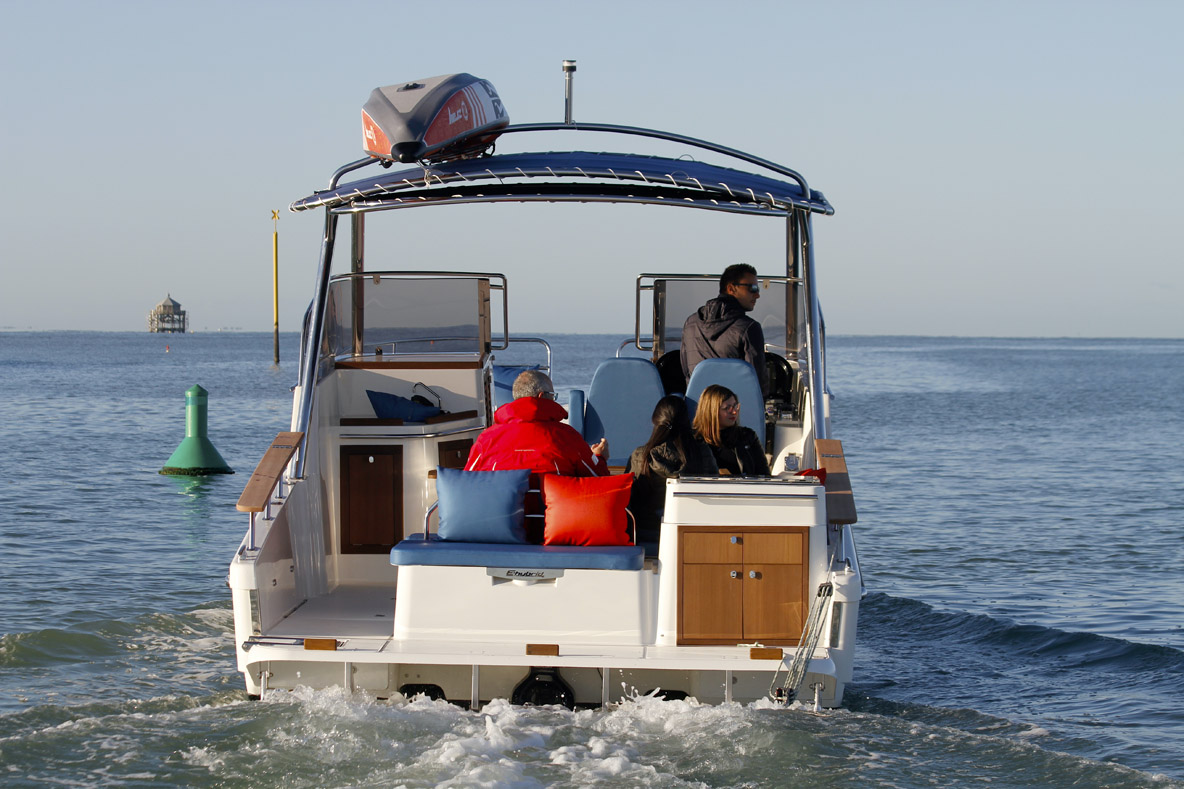 |
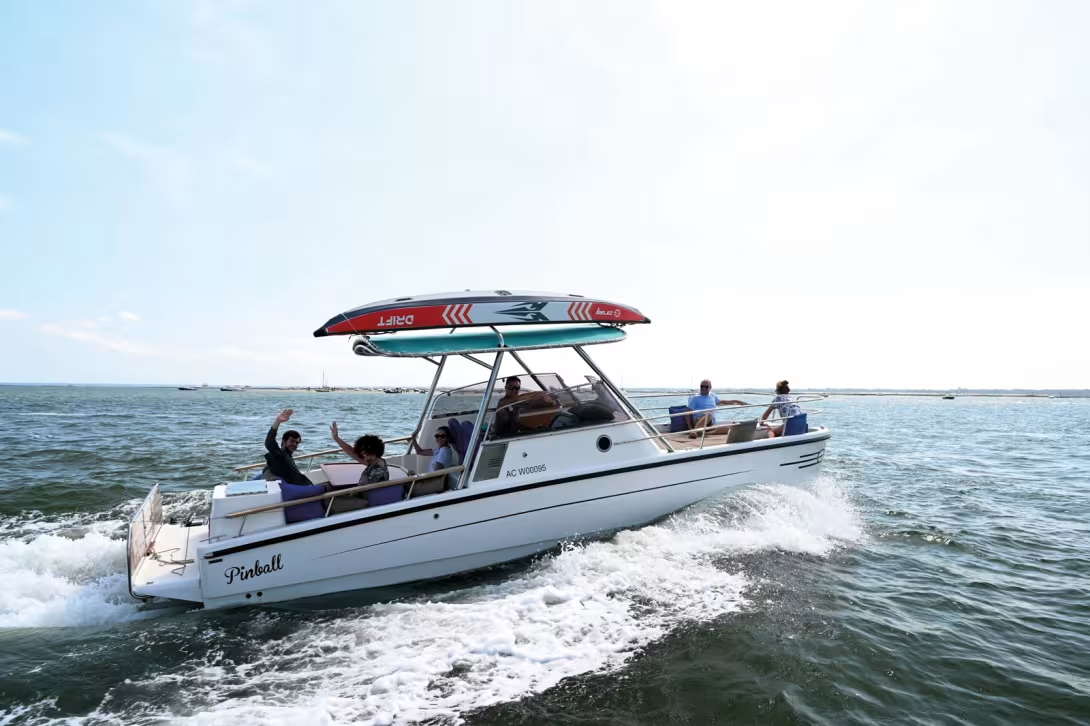
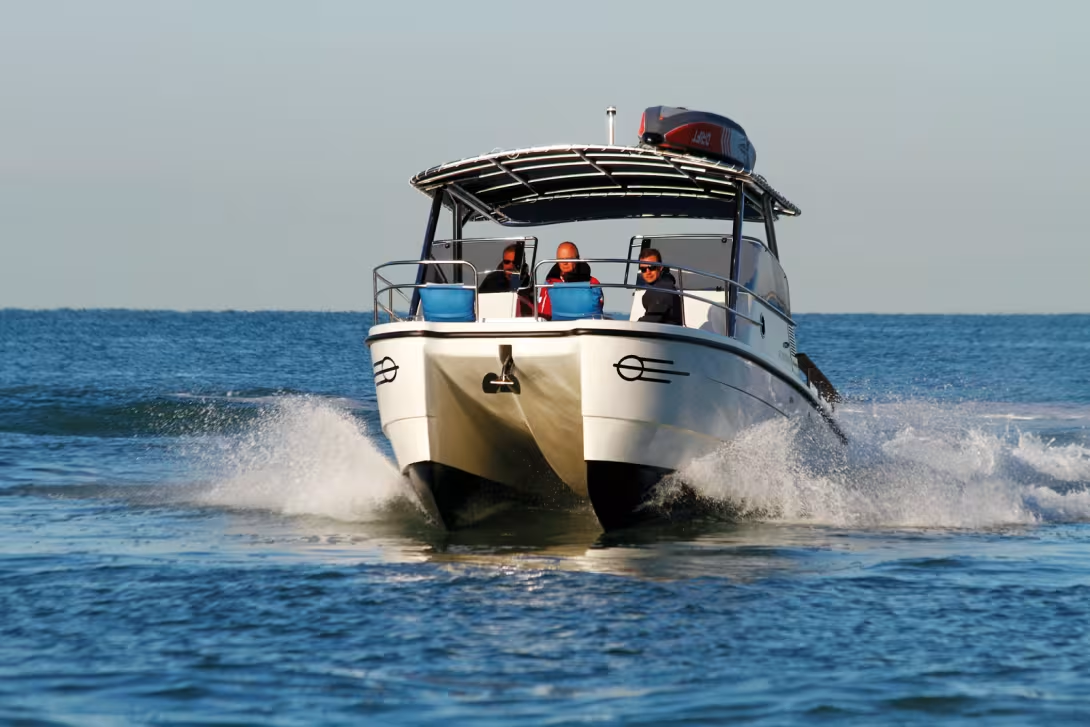
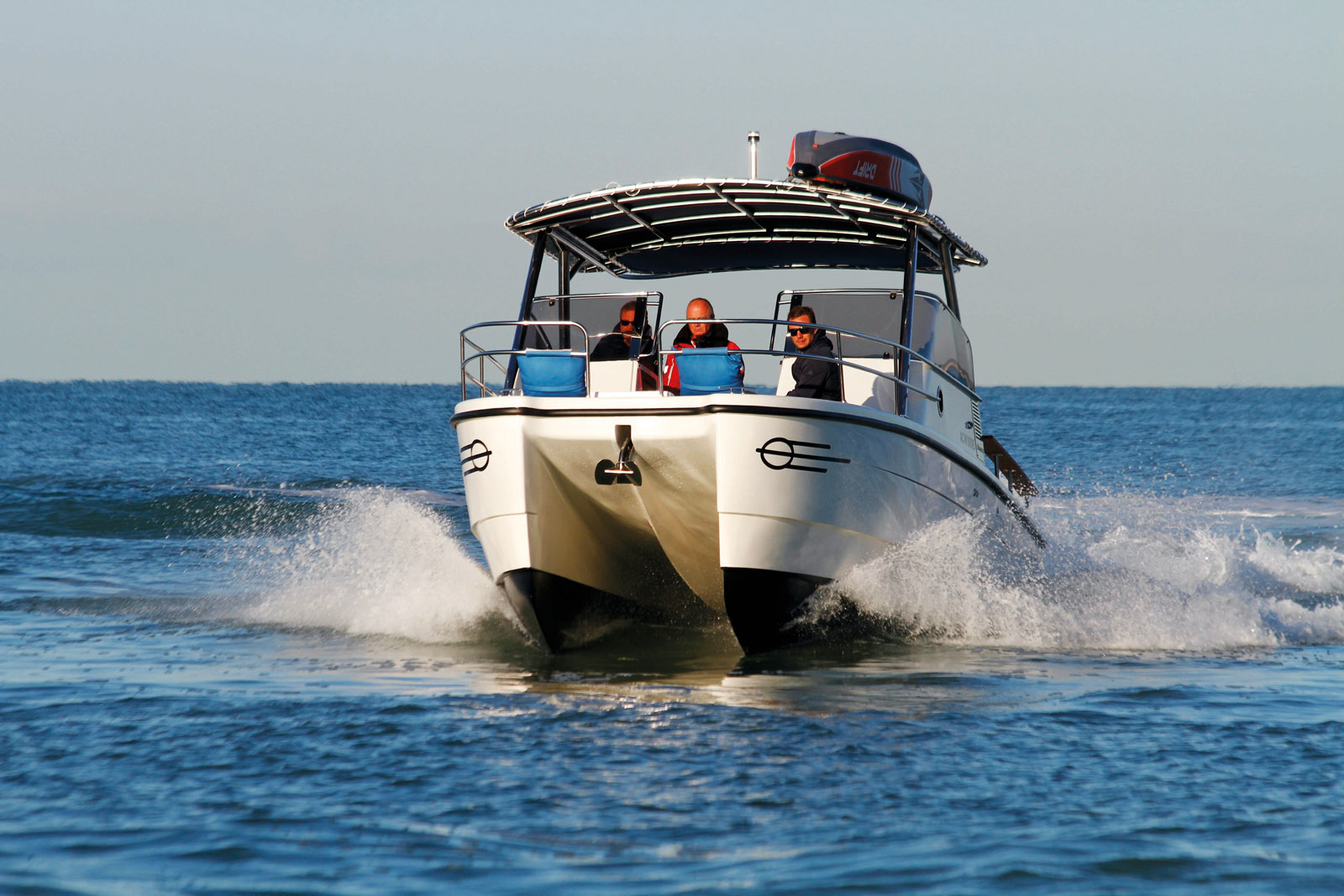
From ahead, the Pinball reveals two sharp bows, while it’s impossible to suspect it’s a multihull if you look at the powercat from astern.
A deck layout full of surprises
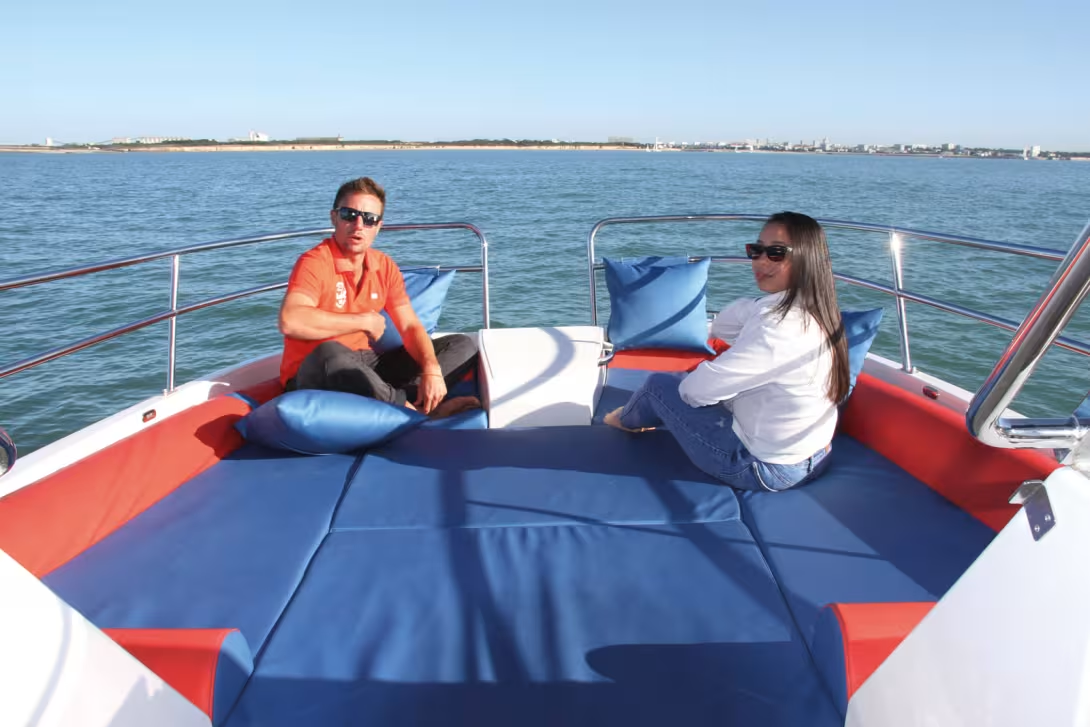
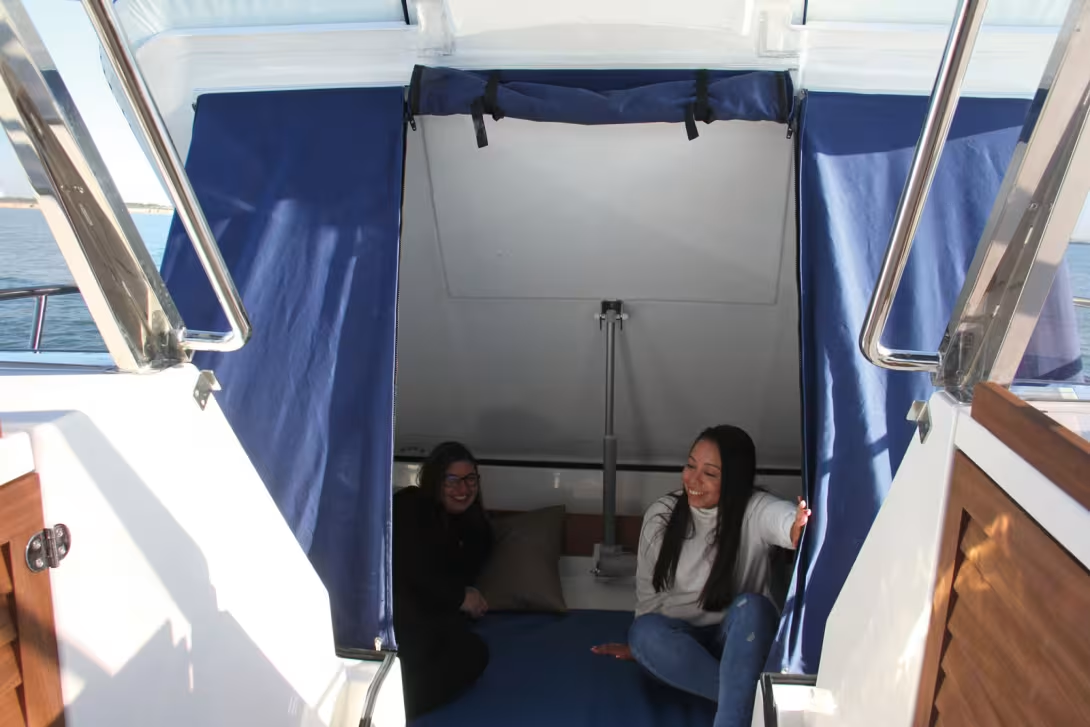
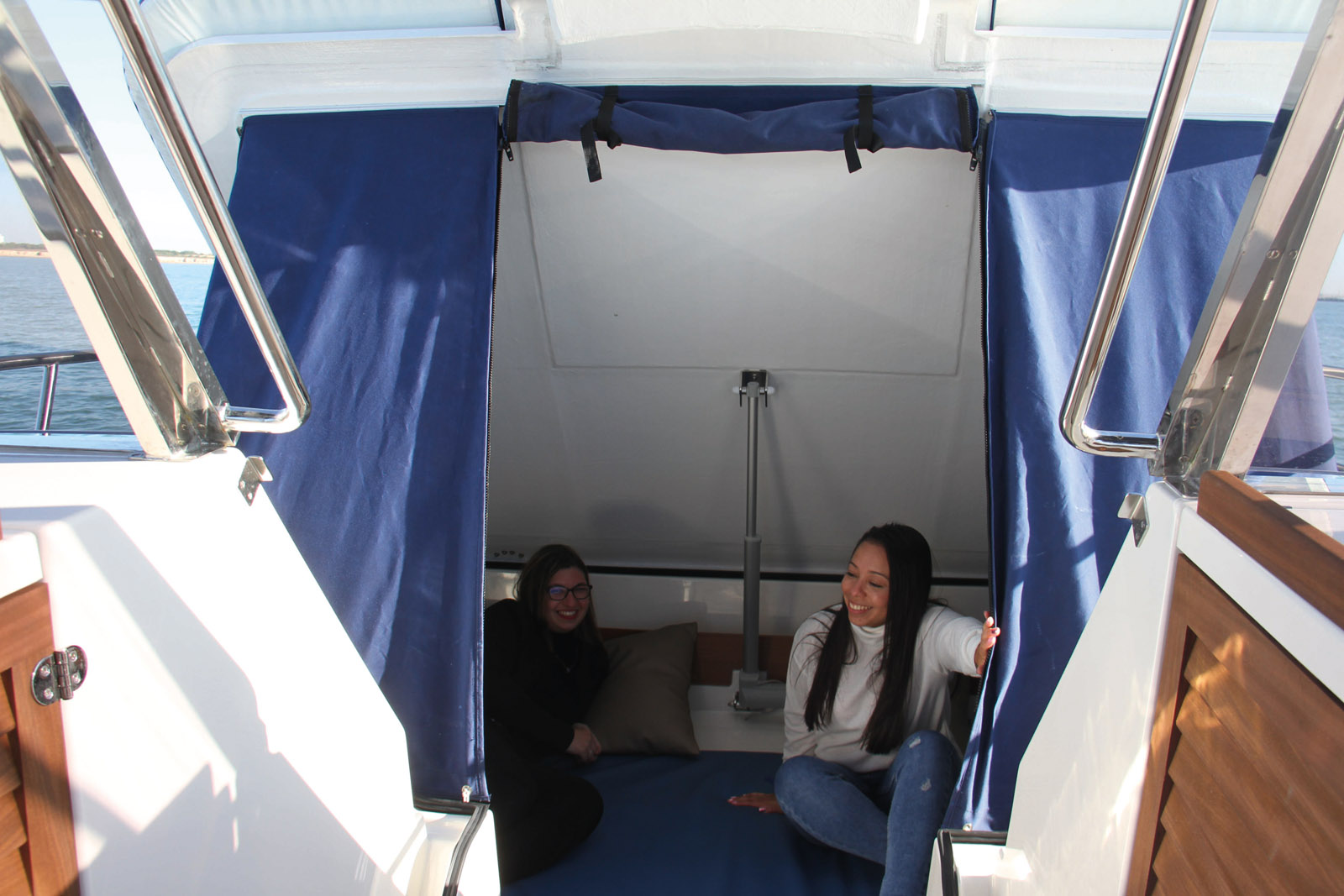
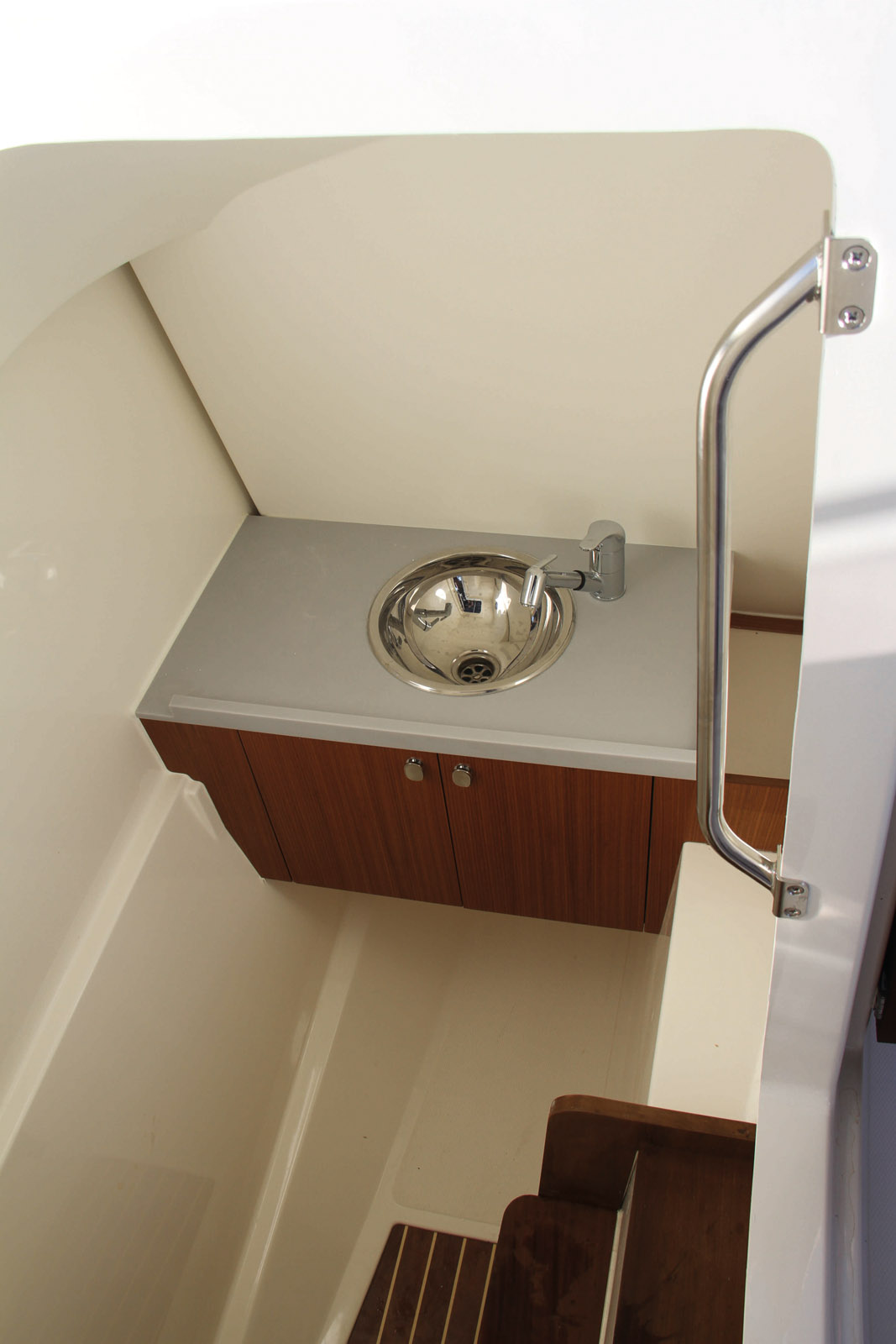
Once on board, it is difficult to imagine that we are on a catamaran. The boat benefits from a generous surface, even if the designers wanted to keep a reasonable beam (9’6’’ - 2.95 m) to be able to use an almost normal slip at the marina. Moreover, the freeboard is quite deep, especially in the cockpit. You step aboard via the rear platform, which has a plancha grill with a folding work surface and a small receptacle underneath to collect the grease. A simple detail, but one that makes life easier. There is also a swim ladder well integrated in the platform. Finally, a second platform can be lowered to access the water at anchor and raised up when under way. The handling of this is, for the moment, manual and a little artisanal, let’s hope that it can be done electrically in the future. The deck layout is relatively original since it is organized like a dual console boat with a large cockpit area, two consoles, a central path and a sunbathing area on the bow. The cockpit benefits from a large saloon area to starboard where 8 people can sit around a large table. The aft bench seat can be used in a «sea-facing» version and the entire rear part can be transformed into a very large sunbathing area of 32 sq ft (3 m²). All seats have hidden storage spaces underneath and there are also several large storage compartments in the floor. The circulation remains easy thanks to the wide passage on the port side which goes directly to the port console where there is a galley unit including a sink and two cabinets. The starboard console is dedicated to the helm with an ergonomic dashboard and two comfortable leaning-post seats. In addition to housing the helm station, the starboard console takes advantage of the hull cavity to offer a vast “storage room“ that can be set up according to the customer’s wishes. On our test model, this area featured a series of sliding boxes, a bit like the storage lockers an aircraft. On the other side, the port hull features a large restroom with a sink , a shower and even a por thole. The forward part is seemingly dedicated only to tanning thanks to a 67 sq ft (6.2 m²) sunbathing area, probably a record for a 29 ft (9 m) boat. Comfortable and well protected by the guardrails, this space also allows access to the anchor locker just in case. However, this sunbathing area hides a much bigger surprise. Indeed, by just touching a button, this entire surface rises to create a large tent offering a very nice size bed (2.5 x 4.6 ft - 2 x 1.40 m) for two or three people. An idea inspired by the famous Volkswagen Combi and again, it’s really clever. The tour ends with the bimini-top which shelters the cockpit and part of the saloon. If needed, it can be extended to completely cover the saloon, a good initiativ e for sunny areas. In the end, the Pinball offers interesting habitability since you can decently consider doing coastal cruising on board while benefiting from a rather generous space and you’ve got all the amenities required on board. For the moment, the finish is still perfectible, and the catamaran could offer a little bit more equipment, but this is the first model, and the shipyard is already planning to make changes.
 |
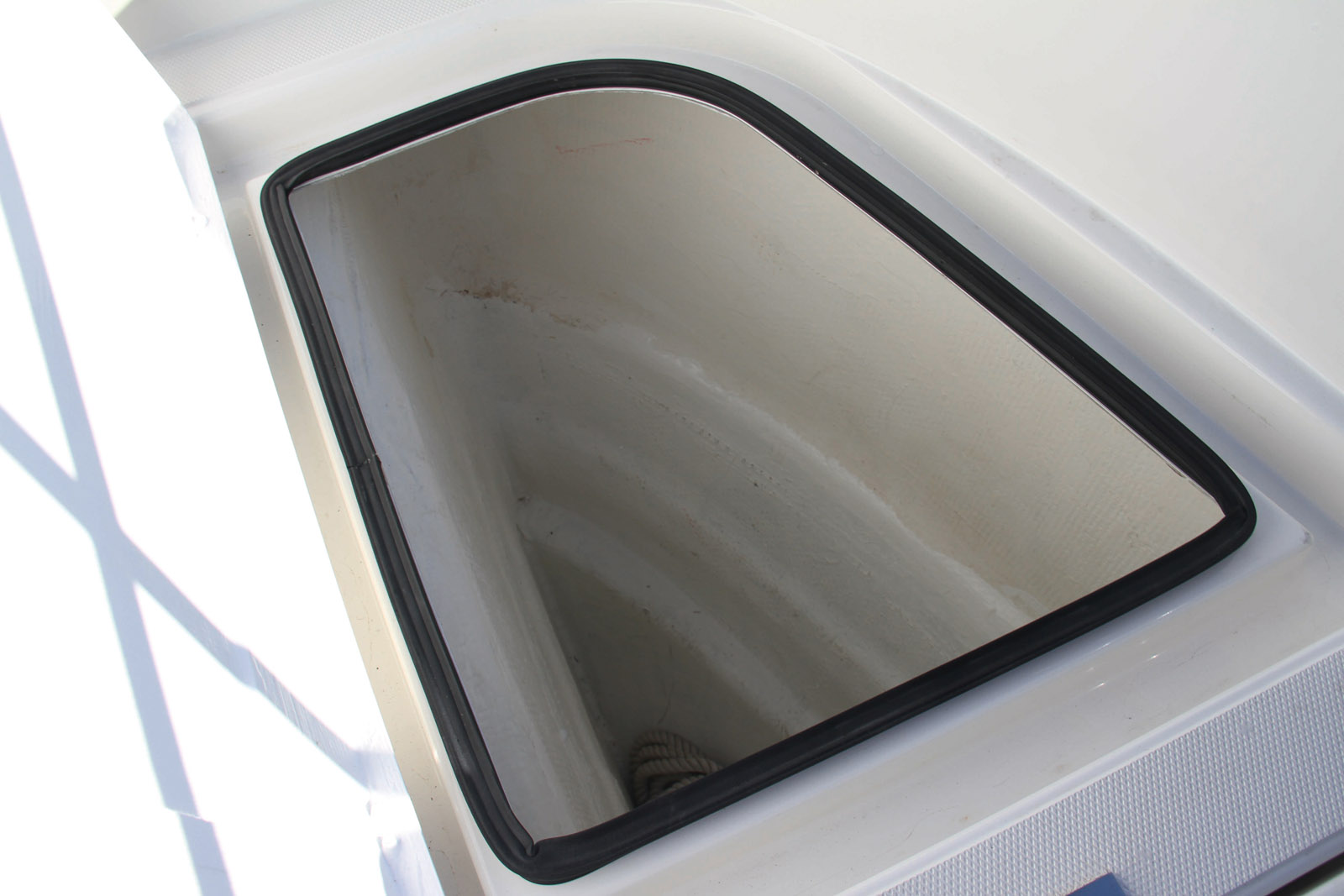 |
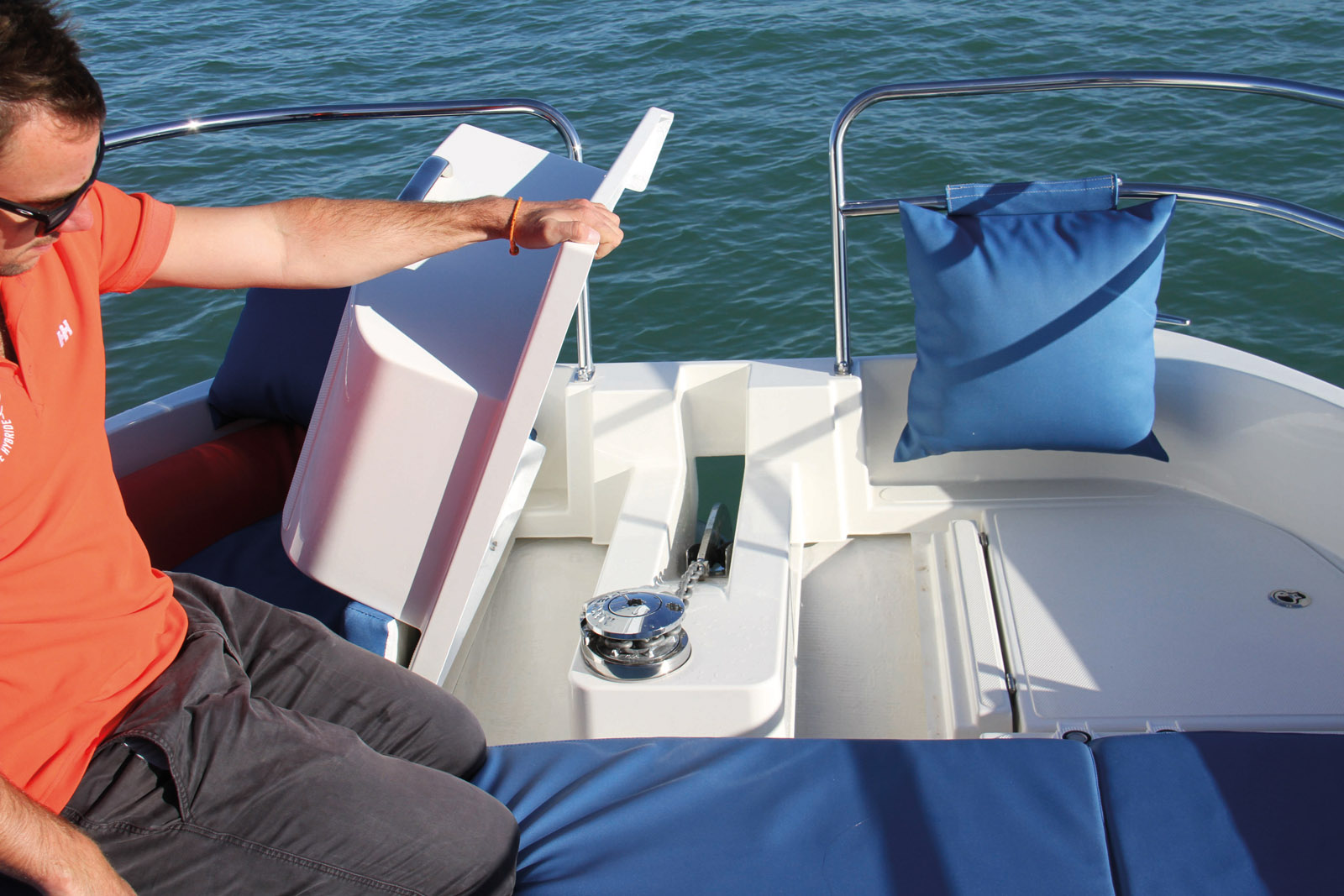
An anchor locker is cut into the bow.
The builder has provided plenty of lockers and storage space.
Very original propulsion
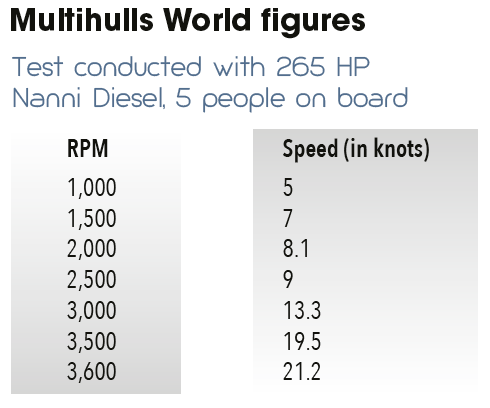
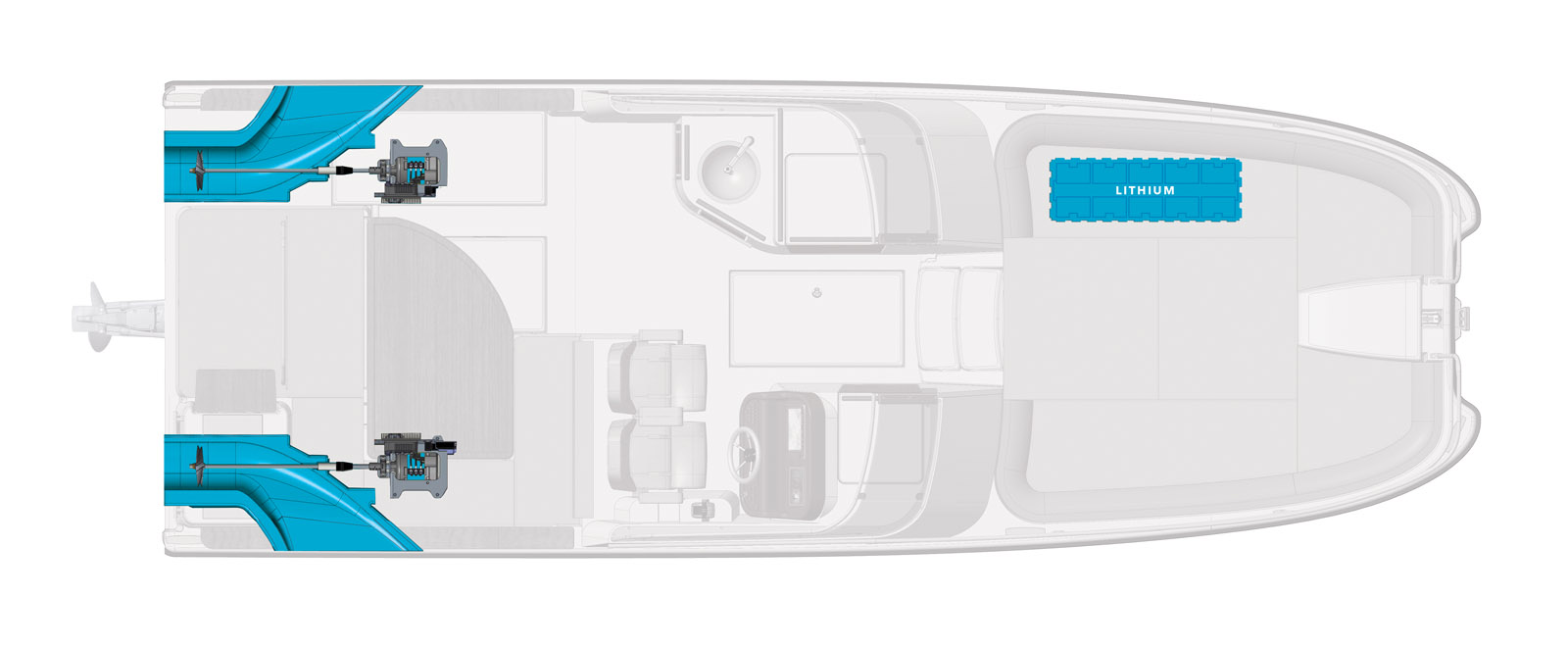
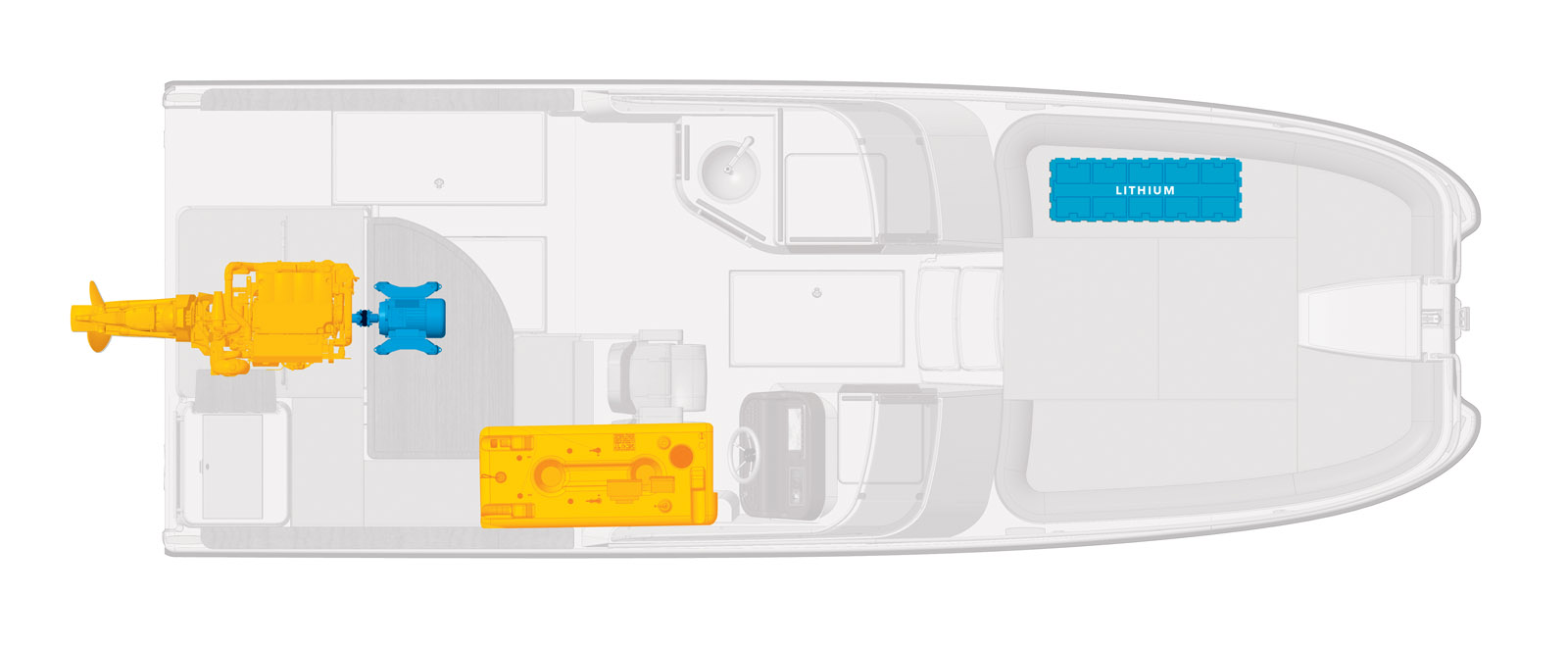
Original in its deck plan, the Pinball is even more so when it comes to its drivetrain. For ecological reasons, the boat features hybrid propulsion, that is to say a central diesel engine and two electric motors. In electric mode, the boat uses two 8 kW motors (one in each hull). In addition, to increase safety and efficiency, each motor is connected to a propeller housed in an elbow nozzle that starts at the side of the hull and ends at the rear of the sugarscoop. To propel the boat and to maneuver it, you have to play with the flow, in forward or reverse, which will allow the boat to turn. The maximum speed in “Emode“ is 6 knots and the range at 4 knots is 2 hours thanks to lithium batteries of 20 kWh at 48 V. To help the piloting, the Pinball has a 10-inch screen displaying the main indicators such as the available power, the used energy and the remaining range. You can also use this electric mode with the steering wheel and the throttle or only with the two handles by playing on the flow of each motor for a very precise maneuver. Another interesting point is that the batteries benefit from a multiple charging system. They can be recharged by connecting to the shore power dock outlet, knowing that a complete recharge takes 6 hours. It is also possible to extend the charge of the batteries when under way by using the diesel engine. A generator (Regen electric motor) connected to the engine will recharge the batteries from 2,000 rpm. Finally, this “Emode Regen“ mode even allows, by using the engine in neutral, to function as a generator to recharge the batteries. In the end, this «Emode» is rather well thought out and allows you to ease into a marina or in a natural area without disturbing the environment. To cover greater distances, you switch to “Hmode“ - traditional propulsion with a diesel engine. The changeover is done in neutral with a simple switch. For the traditional drivetrain, the shipyard chose a 350 hp diesel engine coupled with a Z drive. A power which despite the fact that it’s not massive, allows the boat to reach 25 knots according to the manufacturer. During our test, we unfortunately did not have the final engine, but a Nanni Diesel developing 265 hp and our maximum speed was limited to 21 knots. To be honest, given the size of the boat and the purpose of this catamaran, a little more power would allow it to exceed 30 knots and to cruise at a speed of about 20 knots, a performance that opens up slightly greater perspectives. Regarding the hull itself, the Pinball is based on two floats with a very tapered profile and a very sharp bow. The two hulls also benefit from a sharp bilge that starts from the bow and ensures stability while preventing the spray effect. This design allows the boat to literally cut through the wave. The volume of air under the nacelle is also very important, providing an air cushion effect that makes sailing comfortable. Finally, to house the diesel propulsion system, a central part, almost like a mini hull, is placed under the nacelle. It is this protuberance that supports the Z drive. When you take the wheel, I might as well say that the handling requires some explanations at the beginning, in particular in the electric mode with the use of one or two throttles. Also, you need to familiarize yourself with the operation of the nozzles. For example, starting and acceleration are faster when the nozzles are empty... good to know. Once these notions are learned, the Pinball is quite interesting to helm. Switching from electric to diesel mode is also quite easy, since you just have to press a button. It’s a pity, however, that you have to go back to neutral to do this, whereas on other hybrid boats of this kind, the switch from electric to internal combustion is done smoothly without having to go back to neutral. In diesel mode, there is also a lot of information on the dashboard screen. The turtle that appears indicates that the engine is not hot enough. At 3,200 rpm, a «boost» symbol indicates that the Regen electric motor (which also acts as a generator to recharge the batteries) adds its 30 hp to the power of the diesel engine to help planing. Finally, another indicator warns the helmsman that the system is entering in battery recharge mode (normally after 2,000 rpm). An interface that may seem complex but is nevertheless quite easy. Once in planing mode, the Pinball becomes a classic powercat with the advantage of the stability induced by the two hulls. Very comfortable thanks to its tapered bows, the boat also provides a great feeling of safety, especially as it is quite high up on the water. The day of our test, we had mild conditions, but the crossing of some wakes reassured us about the dynamic qualities of this catamaran. So, there is not much to reproach it except for a certain lack of pep which could easily be fixed by adding more power.
 |
 |
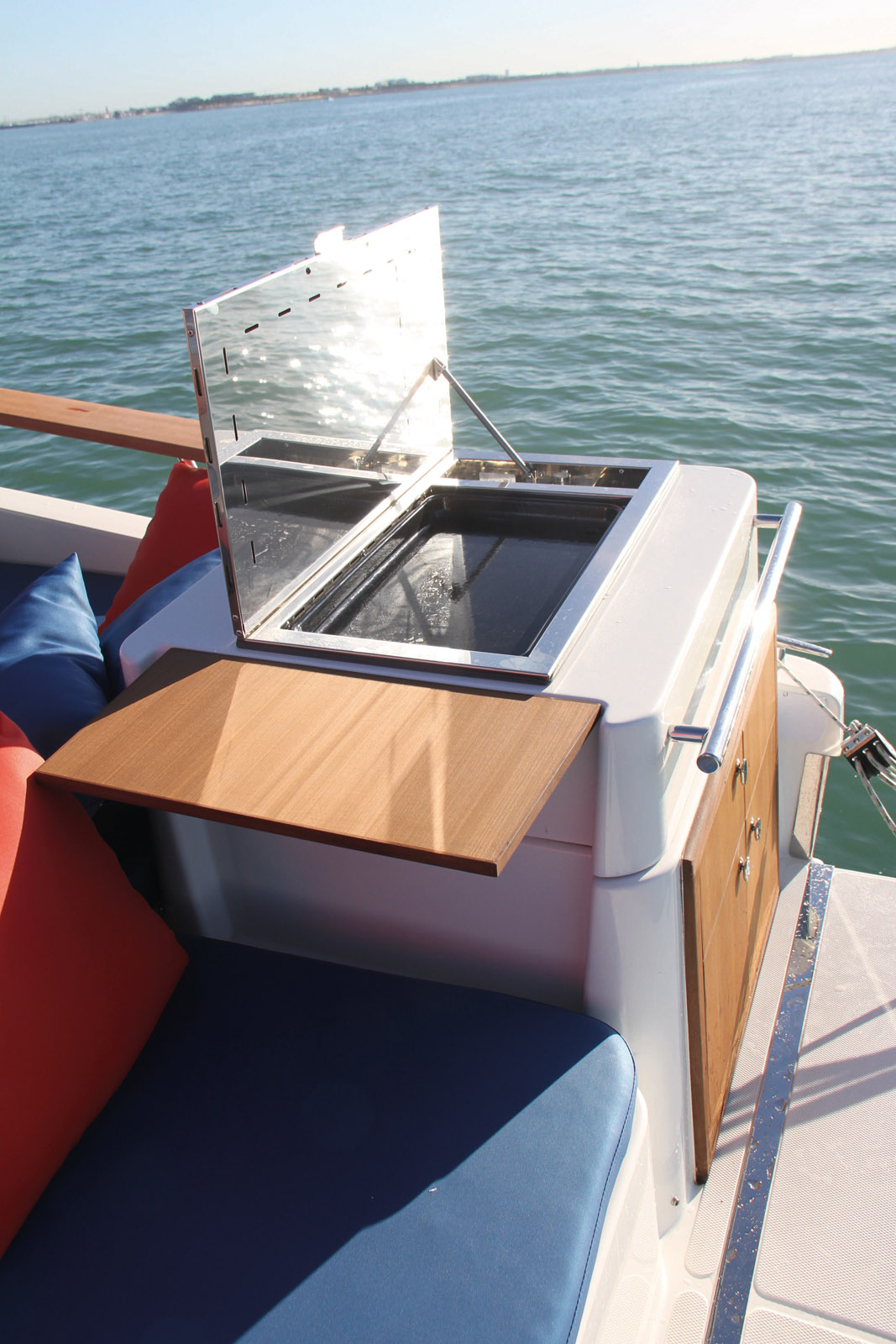 |
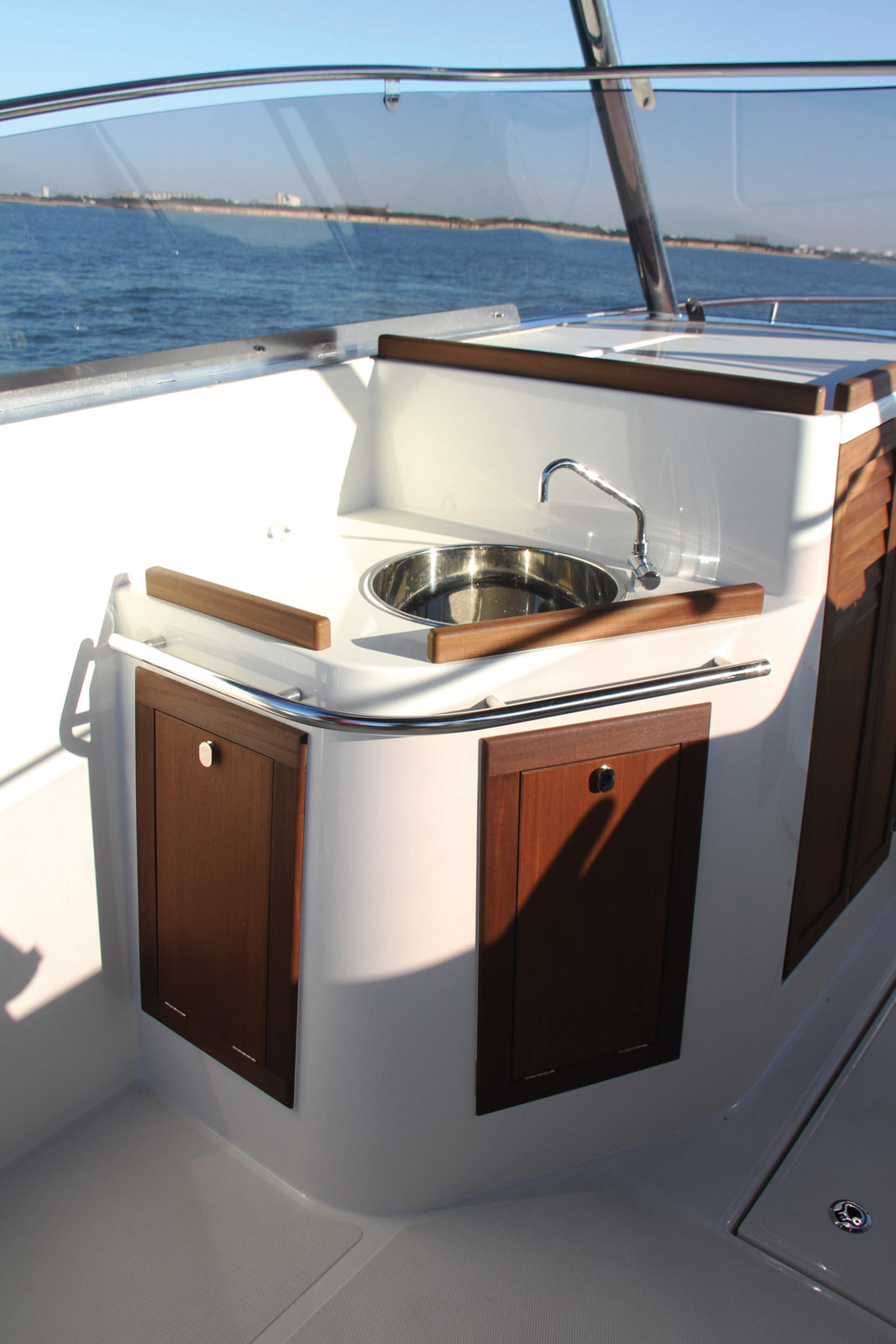
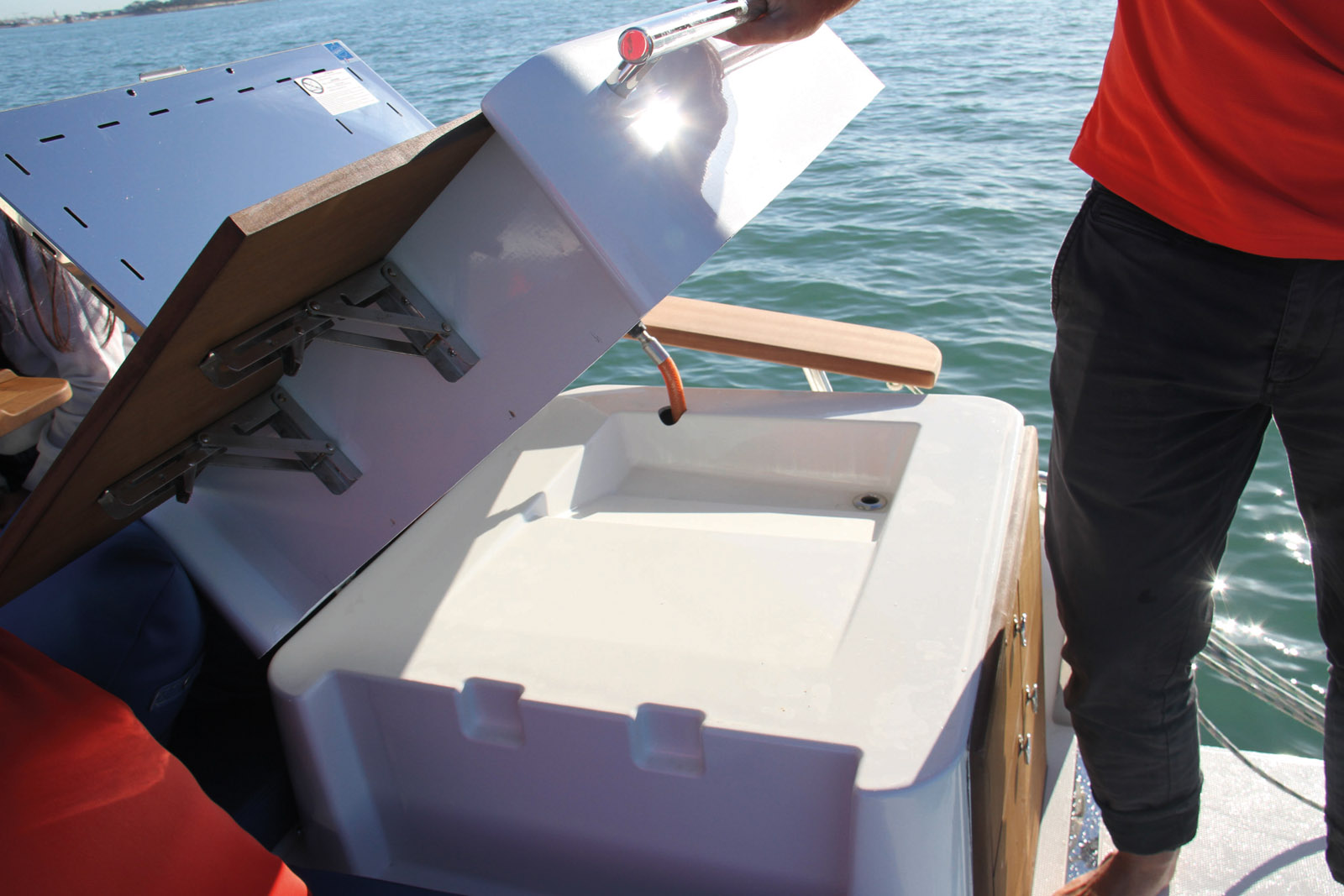
An outdoor galley is fitted; many elements are modular and/or retractable.
Conclusion
The Pinball definitely brings something new to the market, whether in terms of its layout, rather original for a catamaran, or its propulsion, which is very innovative and above all very ecological. Capable of venturing into protected areas in electric mode, it is also ready to welcome a couple or a small family for coastal cruising or for a multi-activity day on the water. So, even if this powercat still suffers from a few defects and still needs some fine-tuning, we already appreciate its versatility and its possibilities. In short, a boat that checks all the boxes!
 |
 |
The sunlounger can be folded upward in VW Combi-style to create a small cabin with a toilet.
THE PLUSES :
+ Innovative propulsion
+ Habitability
+ Original deckplan
THE MINUSES :
- Rear platform is not electric
- Finishing touches
- Time to adapt to helming
 |
 |
TECHNICAL SPECIFICATIONS
Builder: Pinball Boat (France)
Designer: Stéphane Chaurial
Overall length: 29’6” (9.00 m)
Hull length: 27’4” (8.33 m)
Beam: 9’8” (2.95 m)
Draft: 27” (0.69 m)
Height (above waterline): 9’10” (3.00 m)
Unladen displacement: 7,715 lbs (3.5 t)
Capacity: 15 people
Cabins: 1
Berths: 2 Fuel: 75 US gal (285 l)
Water: 35 US gal (135 l)
Maximum diesel power: 350 HP
Maximum electric power: 2 x 8 kW
Battery capacity: 20 kWh - 48 V CE
Category: C
Price: from € 207,500 ex-tax with 350 HP diesel + 2 x 8kW electric
 |
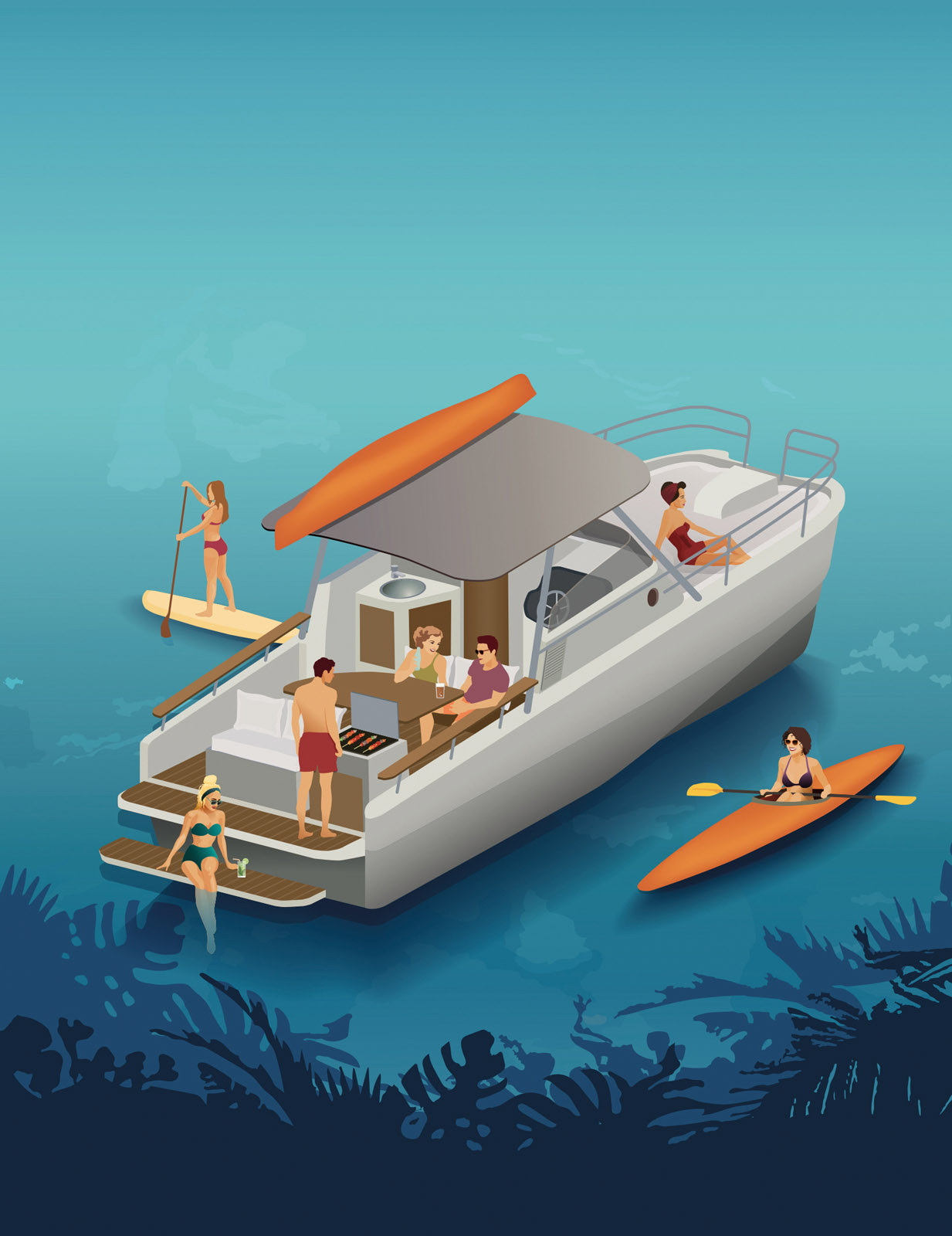 |
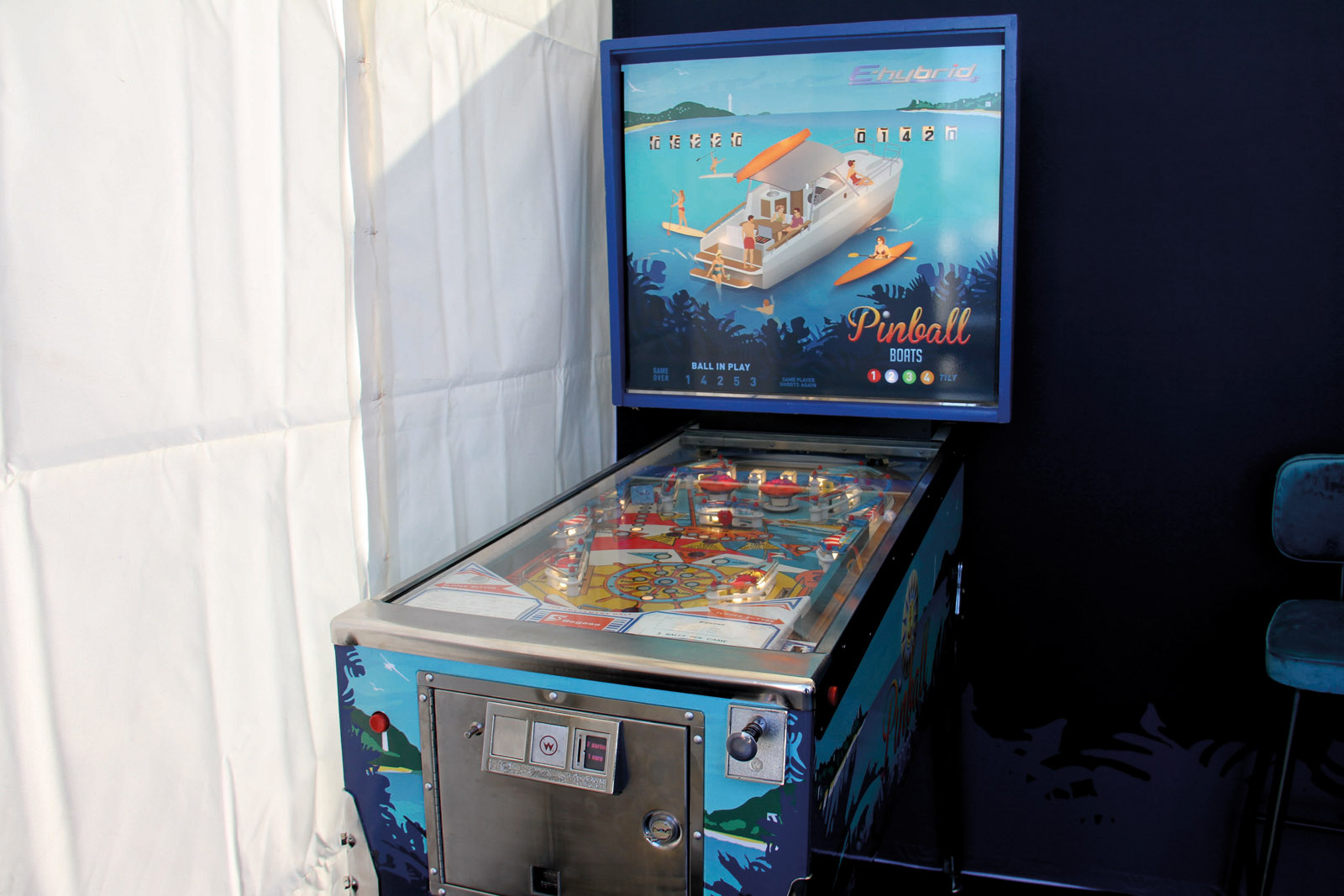
The Pinball’s manufacturer didn’t hesitate to take advantage of the name (this pinball machine was at their booth at La Rochelle boat show, at the end of September, and was much enjoyed with a slight vintage flavor).