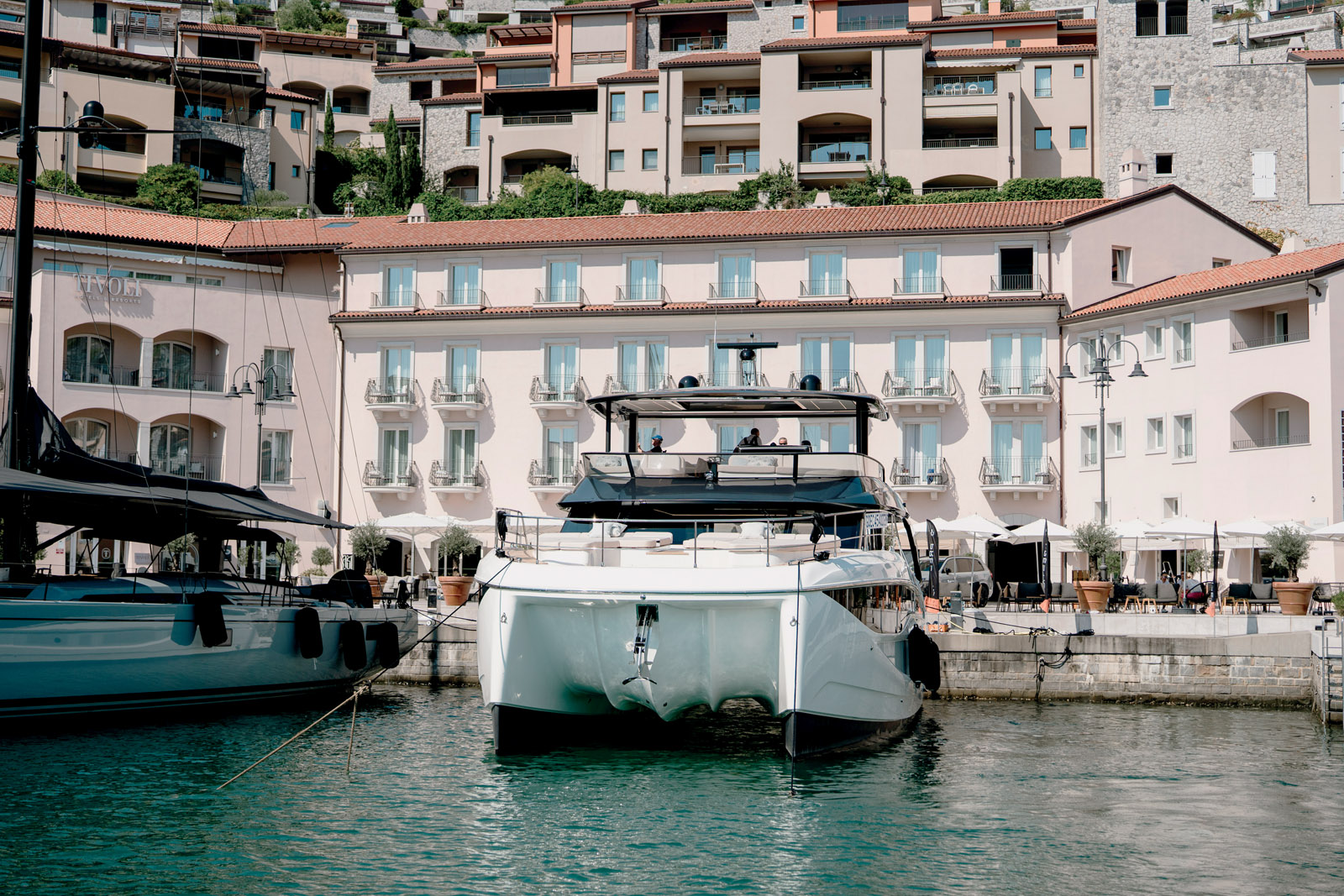
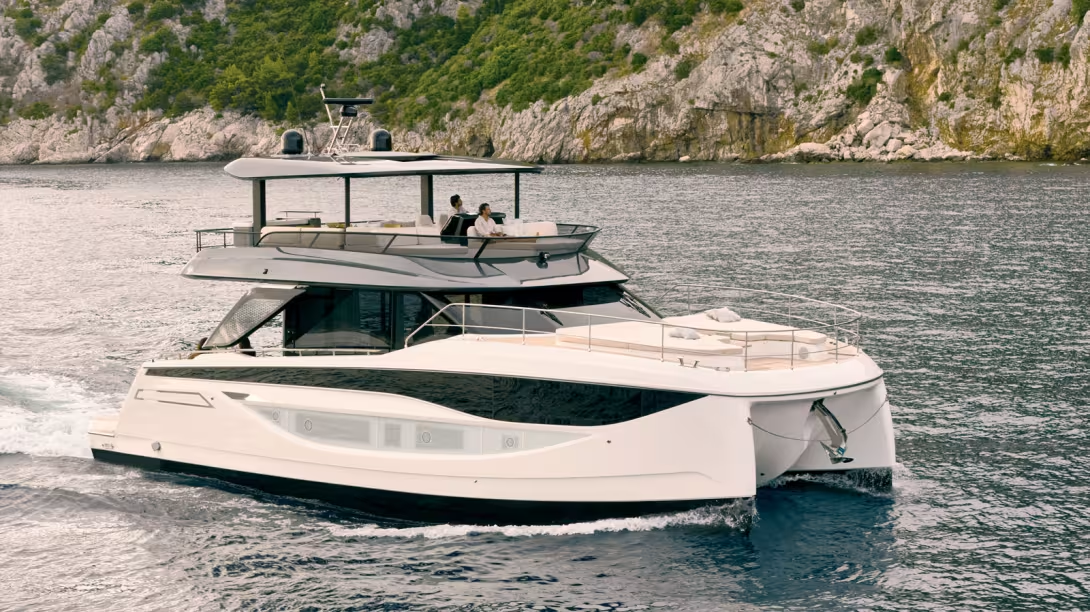
Prestige Yachts is completing its M-Line range of luxury powercats with the timely launch of a model that sits between the M48, the first in the series, and the M8, currently the flagship. This eagerly awaited M7 was presented to us in the charming and very popular marina of Porto Piccolo, near the Bénéteau Group luxury yard in Monfalcone, on Italy’s Adriatic coast.
Infos pratiques
- Le chantier : Prestige M7
- La fiche technique
-
 Découvrez notre vidéo exclusive
- Financez votre Prestige M7
- Assuez votre Prestige M7
- Articles autour du Prestige M7
Conditions: Calm sea, 2 to 3 knots of wind
As soon as we arrived, we were greeted by an impressive sight with the Prestige M7 afloat in the very select atmosphere of the small marina of Porto Piccolo. The view from the top of this amphitheater of villas and sumptuous apartments presented a scene below of an elegant and modest port, creating a veritable showcase for the beautiful boats moored there. The backdrop was perfectly suited to the new M7, a powercat that aims to consolidate the growth of the Prestige Yachts brand in the luxury motor yachting world within the M-Line catamaran range. The objective of the M-Line is not just limited to competing with other players in the large powercat and multiyacht sector - it also aims to compete with the manufacturers in the entire segment. Which, it must be said, is almost exclusively monohulls.
In fact, it was originally only monohulls that rolled off the Jeanneau production lines, marking the rise of the Prestige range since its inception in 1989. And when Prestige Yachts became a brand in its own right in 1998 (we should take this opportunity to salute the foresight of the instigator of this brilliant idea, Jean-François de Prémorel), it was still all monohulls, albeit increasingly luxurious ones, that were being manufactured. Prestige’s positioning was to compete with market leaders such as Princess, Sunseeker, and Fairline (Monte Carlo Yachts, at that time, being more geared towards treading on the toes of Italian brands) by offering relatively standard features, but with a slight edge in terms of ergonomic layout and attractive pricing. In perfect harmony with the Garroni design studio, models such as the Prestige 500 appealed to customers by meeting new expectations in terms of layout and comfort, while reducing the costs associated with engines, maintenance, and fuel consumption. And the 5,000 examples sold (all models combined) are testament to this... but at Prestige, they wanted to evolve and therefore took an interest in the multipower market by launching the M-Line range, meeting the latest customer requirements in terms of volume, luxury, living space on board, and fuel economy. The challenge, in terms of design, was to retain the Prestige hulls - the M7 fits perfectly into this logic... and successfully so, since at the time of going to press, four M7s are on order and nine M8s have already been sold.
Exemplary Exterior Layout
The Garroni design firm has a reputation for magically creating extra inches, even extra square feet, aboard each new model without increasing the length of the hulls, as well as for surprising customers with living space layouts that are, at times, radically innovative. All this while maintaining a level of classicism in terms of exterior design. A remarkable feat! Among other things, we remember the private staircase leading down to the owner’s cabin on the 500 and the various decks on the X models. But getting back to the M-Line range: more recently, it was the superyacht-style staircase on the M8 that caused a sensation.
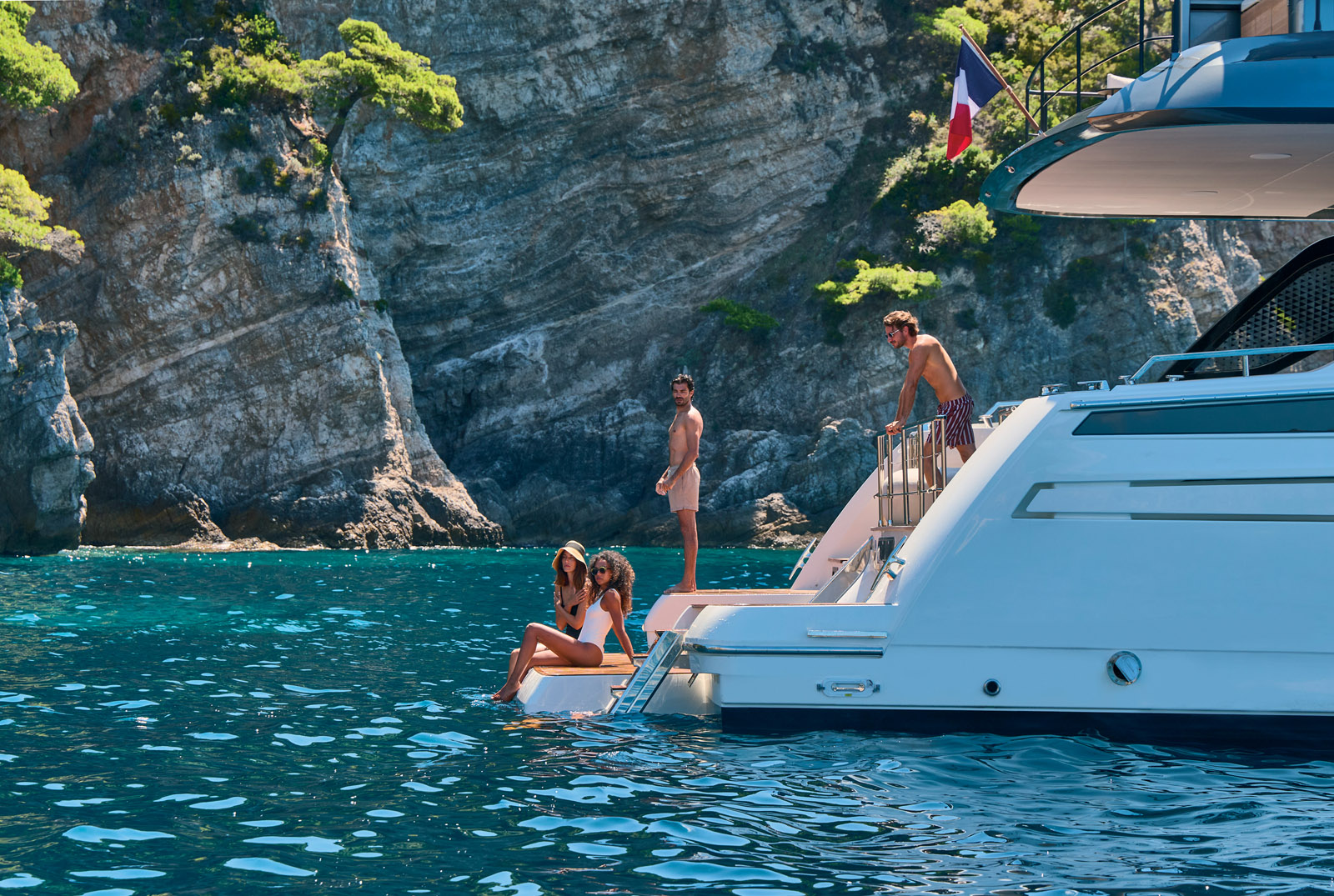
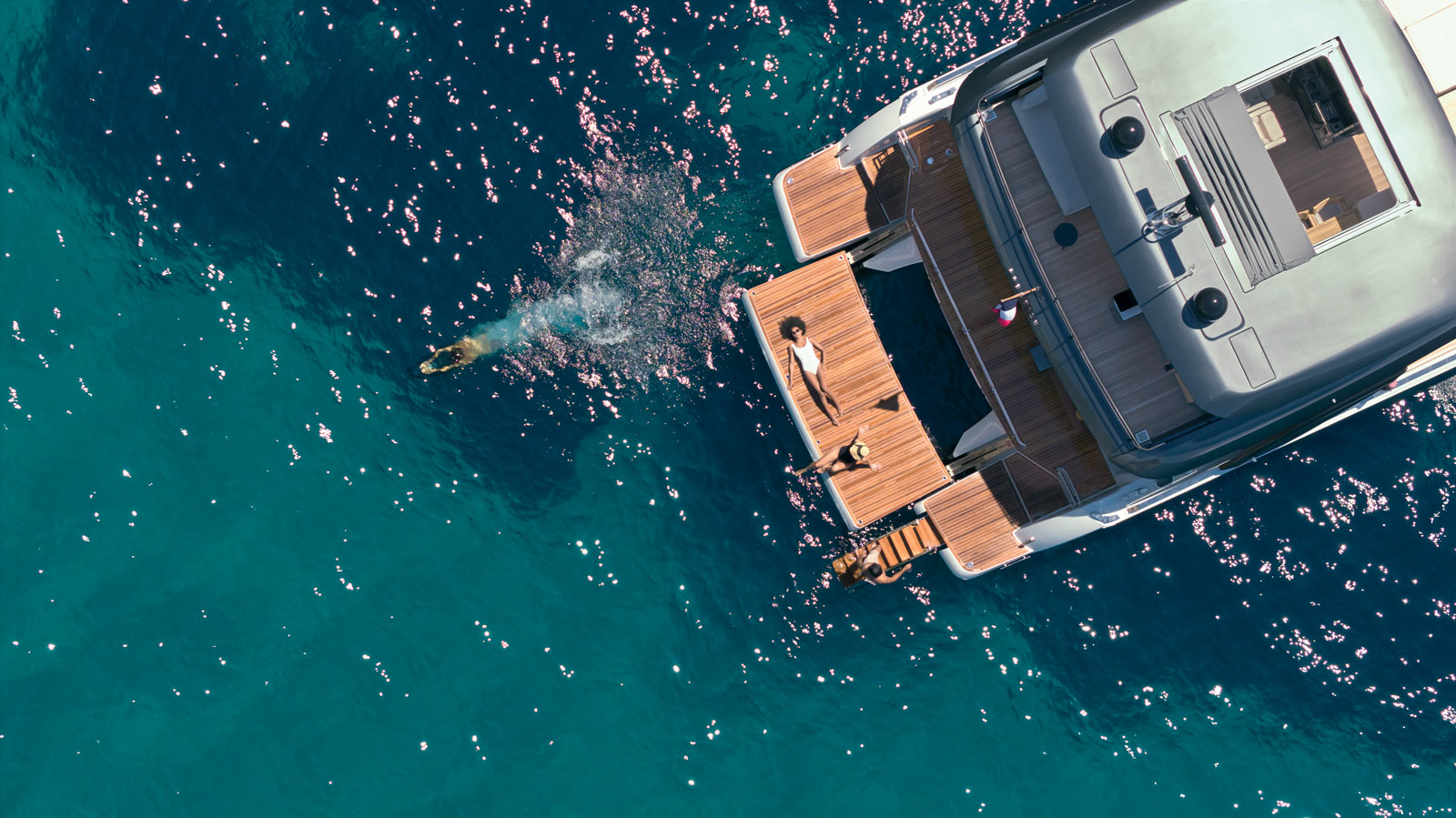
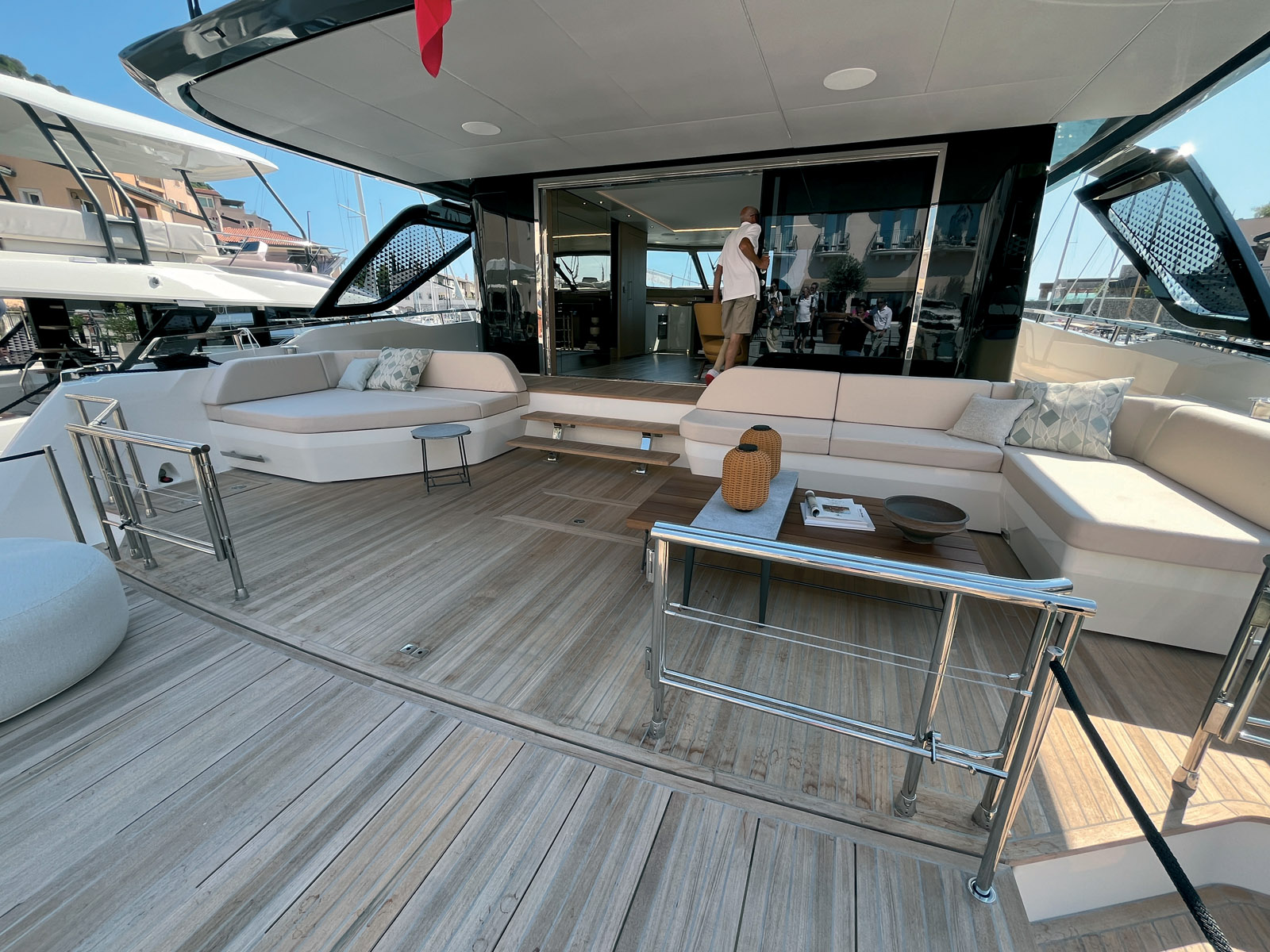
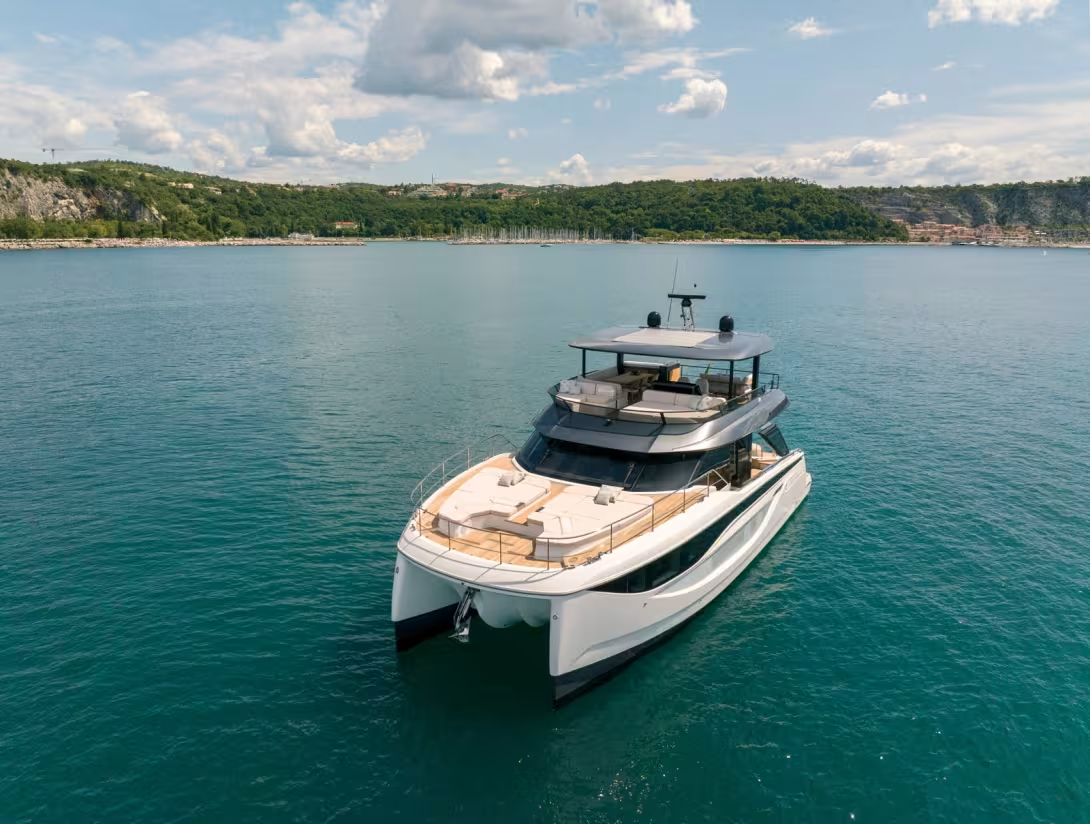
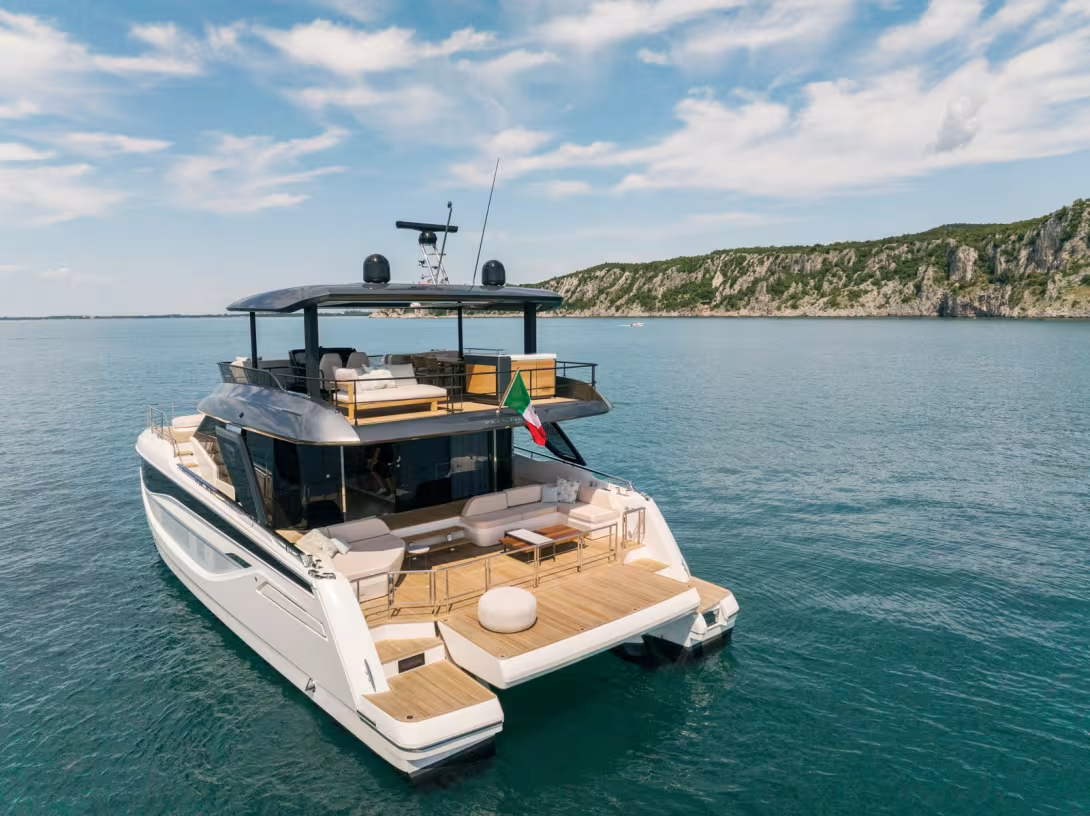
On the M7, the surprise begins with the aft cockpit, or rather terrace or beach club, we should call it. A difference in level places this area three steps below the main deck, creating a lounge space closer to the water. Two different sofa arrangements are possible - one with a central sofa keeping a clear passage near the bulwarks, and the other with a sofa and couch on each side, favoring a central passageway towards the interior. This space is very large, and the juxtaposition of the wide hydraulic platform allows, by moving the stanchions, to enjoy a huge terrace. It’s even possible to install a removable table for dining with your toes in the water. The side-decks are wide and lined with high bulwarks before climbing a few steps to the foredeck, which is high enough to provide a sense of security as well as impressive below-deck volume for the interior. The sun loungers, which can be converted into a small lounge area or chaise longue, with shade covers if required and central and side access, are on a par with those found on some very large boats.
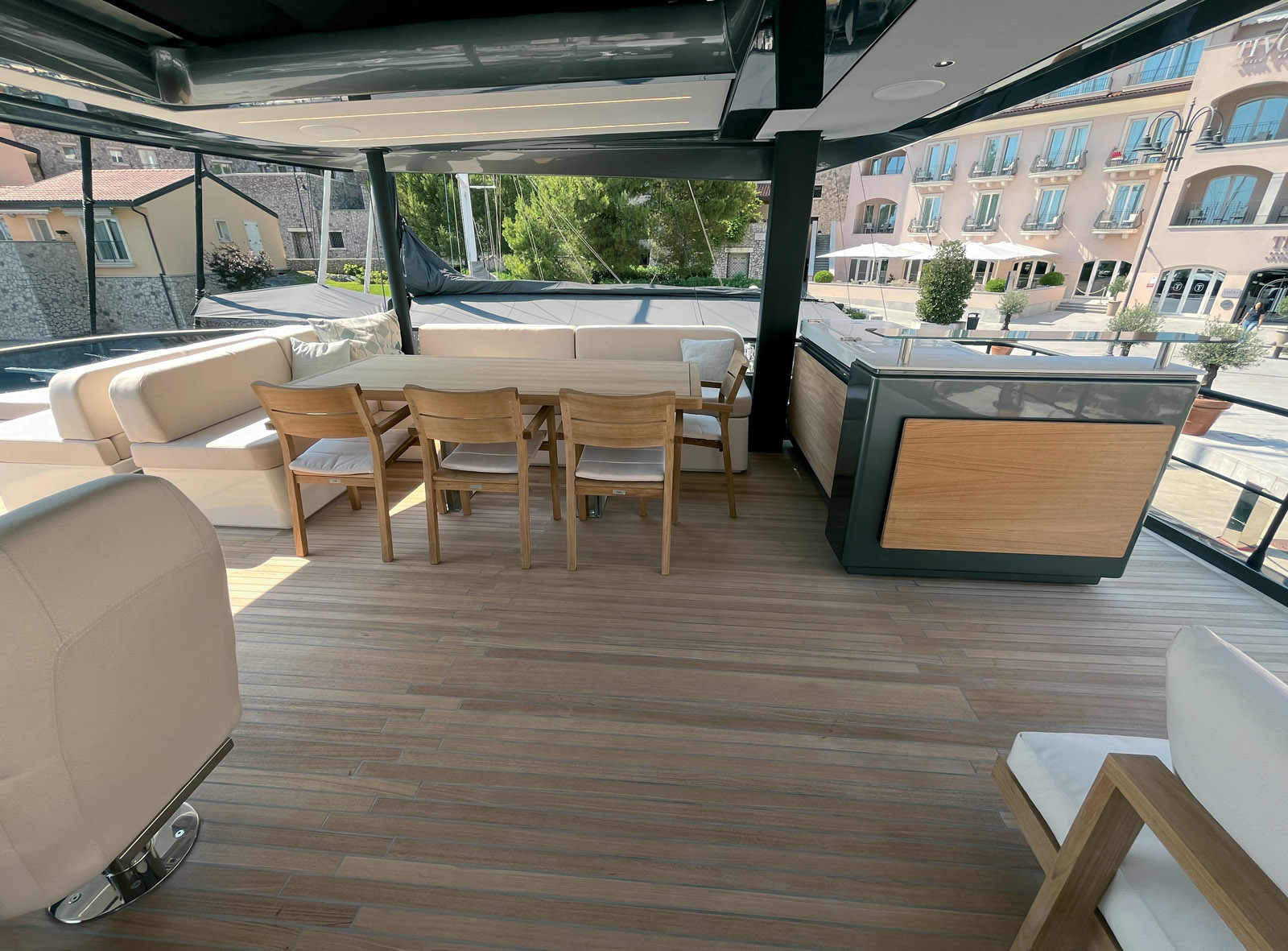
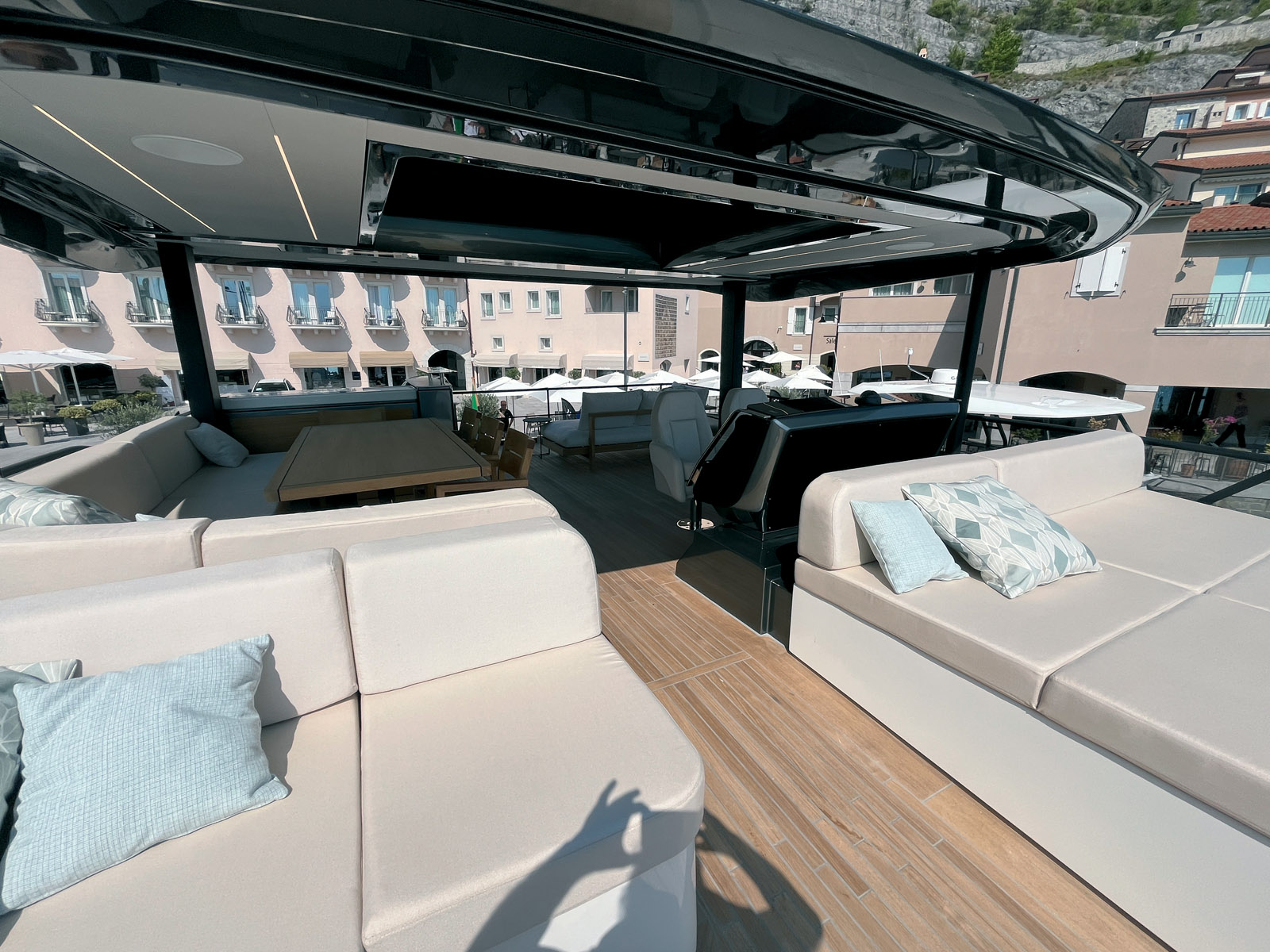
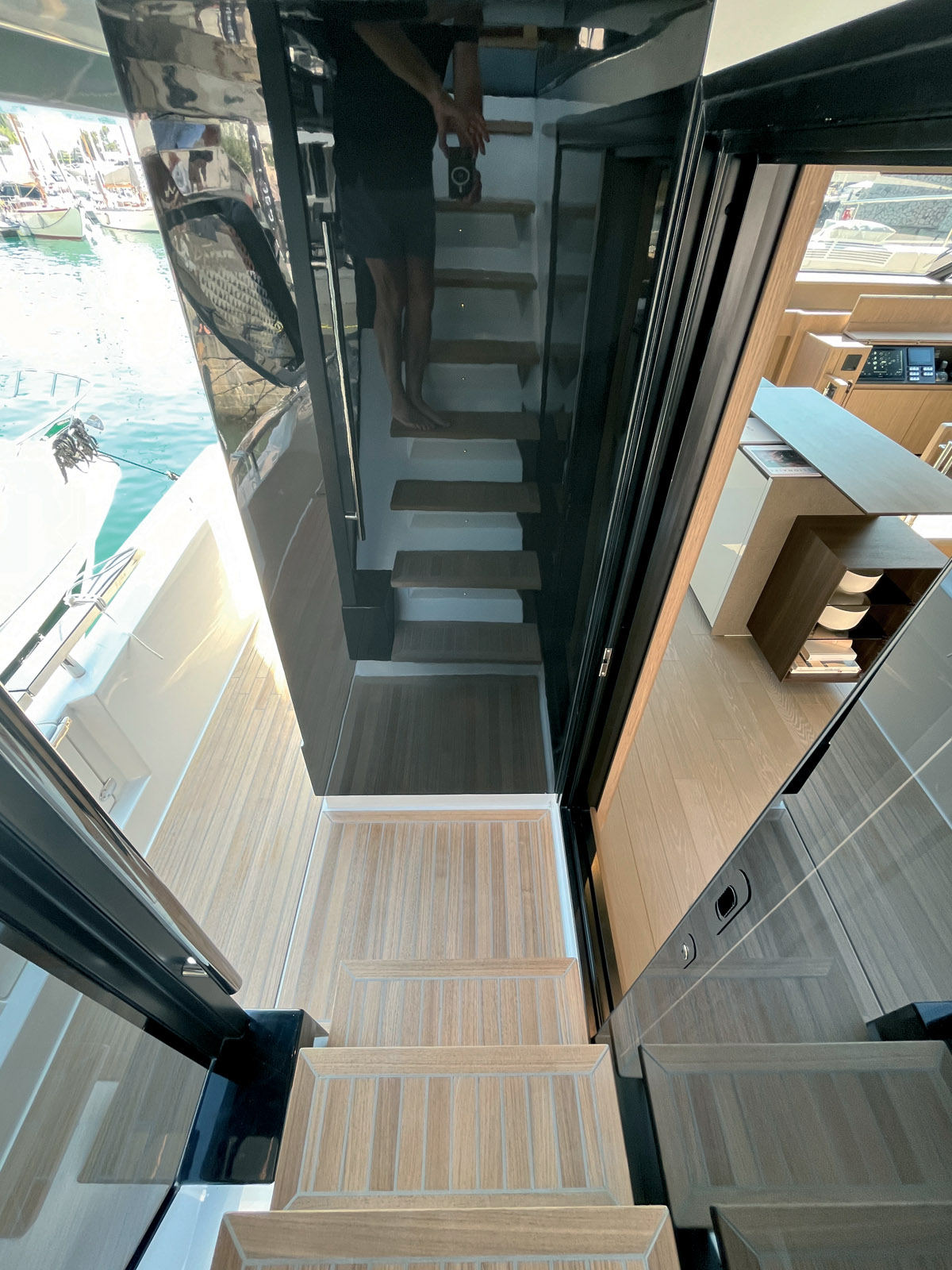
But it is aft that Garroni’s major innovation is revealed, with a staircase leading up to the flybridge in the opposite direction to the direction of travel. This staircase is enclosed between the roof porthole and the interior bulkhead. It is accessed via a passageway from the port side-deck, which also leads to the saloon, through a sliding glass door. The steps are easy to climb, framed by handrails and protected by this “cage.” The icing on the cake is that the space below the stairs serves as a companionway to the double crew cabin from a door that deceives the eye at the back of the coachroof, a win-win situation. The flybridge is divided into three areas and is a model of ergonomics. There is a large sunbathing area forward of the steering console, a large dining table in the middle, a galley/bar aft, with a convertible area opposite. Our only reservation concerns the absence of a day head, which this arrangement could not accommodate.
A Luxurious and Modular Interior
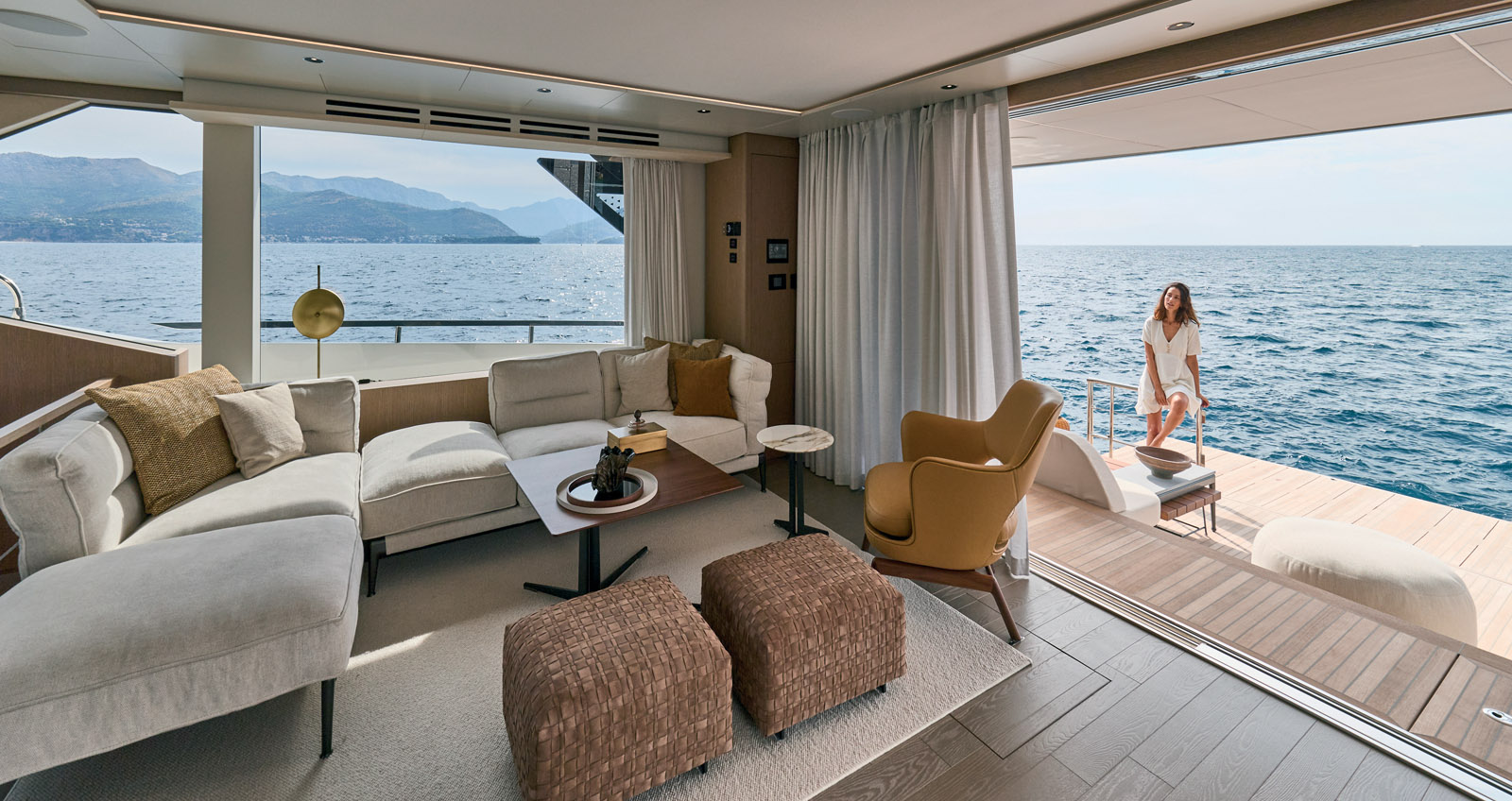
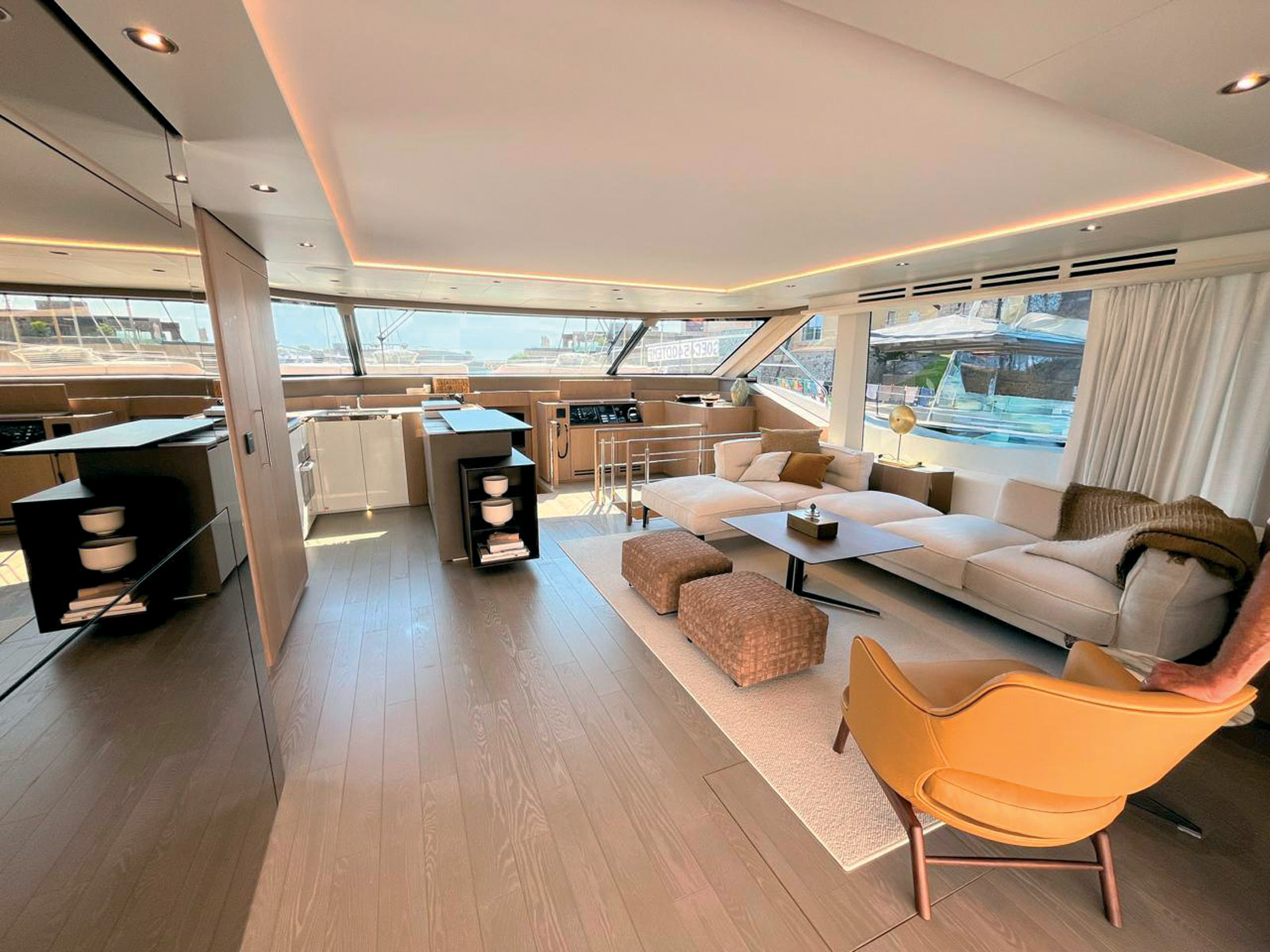
Upon entering the nacelle, you immediately feel a gentle Zen atmosphere. On this first version, the saloon is a proper living room with a very large and comfortable lounger and armchairs. Alessandro Tolino and Clémence Cessou, the product managers, point out that this living room can be replaced by a large dining table. But as we have seen, the possibilities for dining outside are so convincing that we don’t think this would be justified - better to simply devote this space to relaxation.
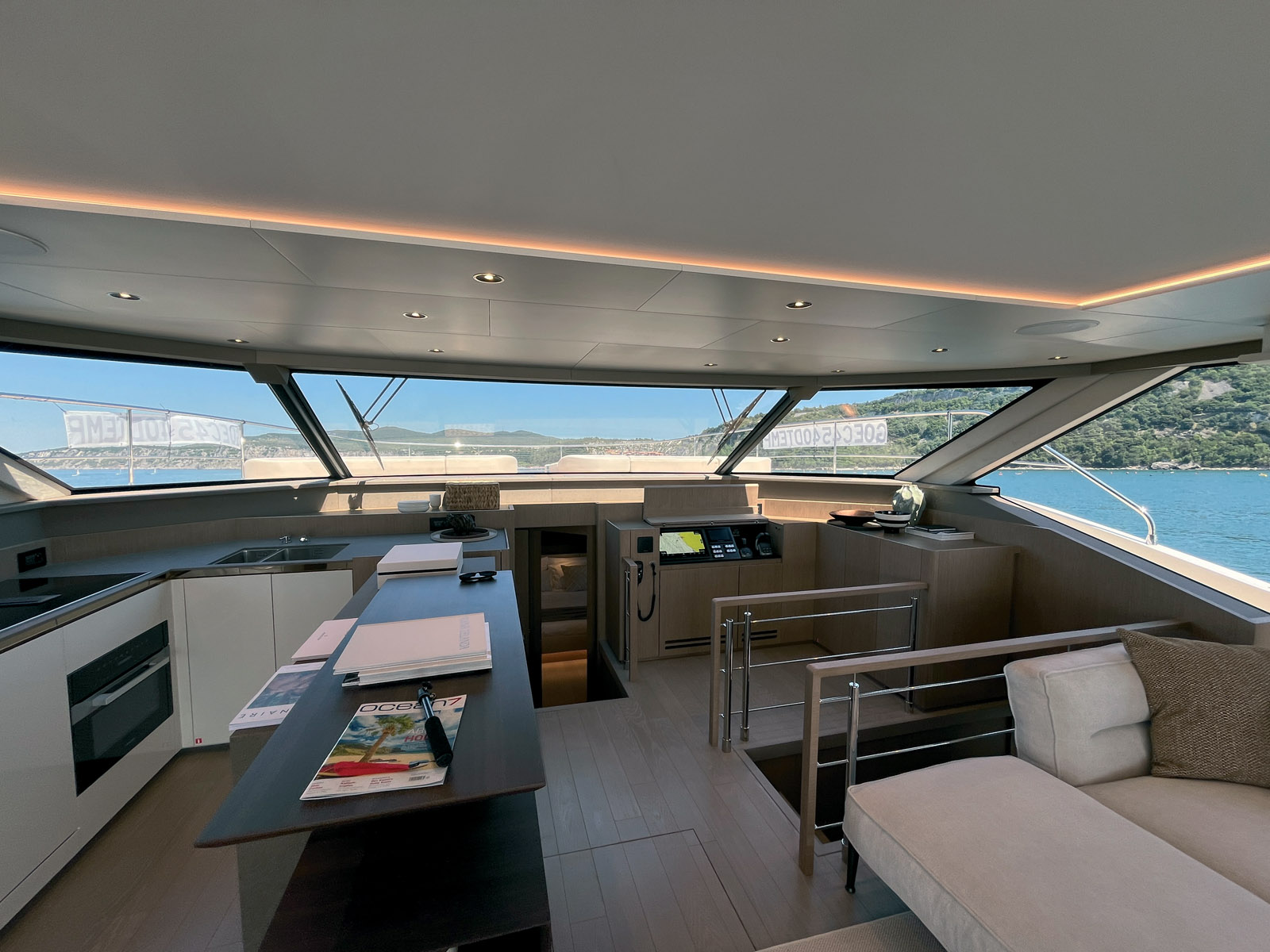
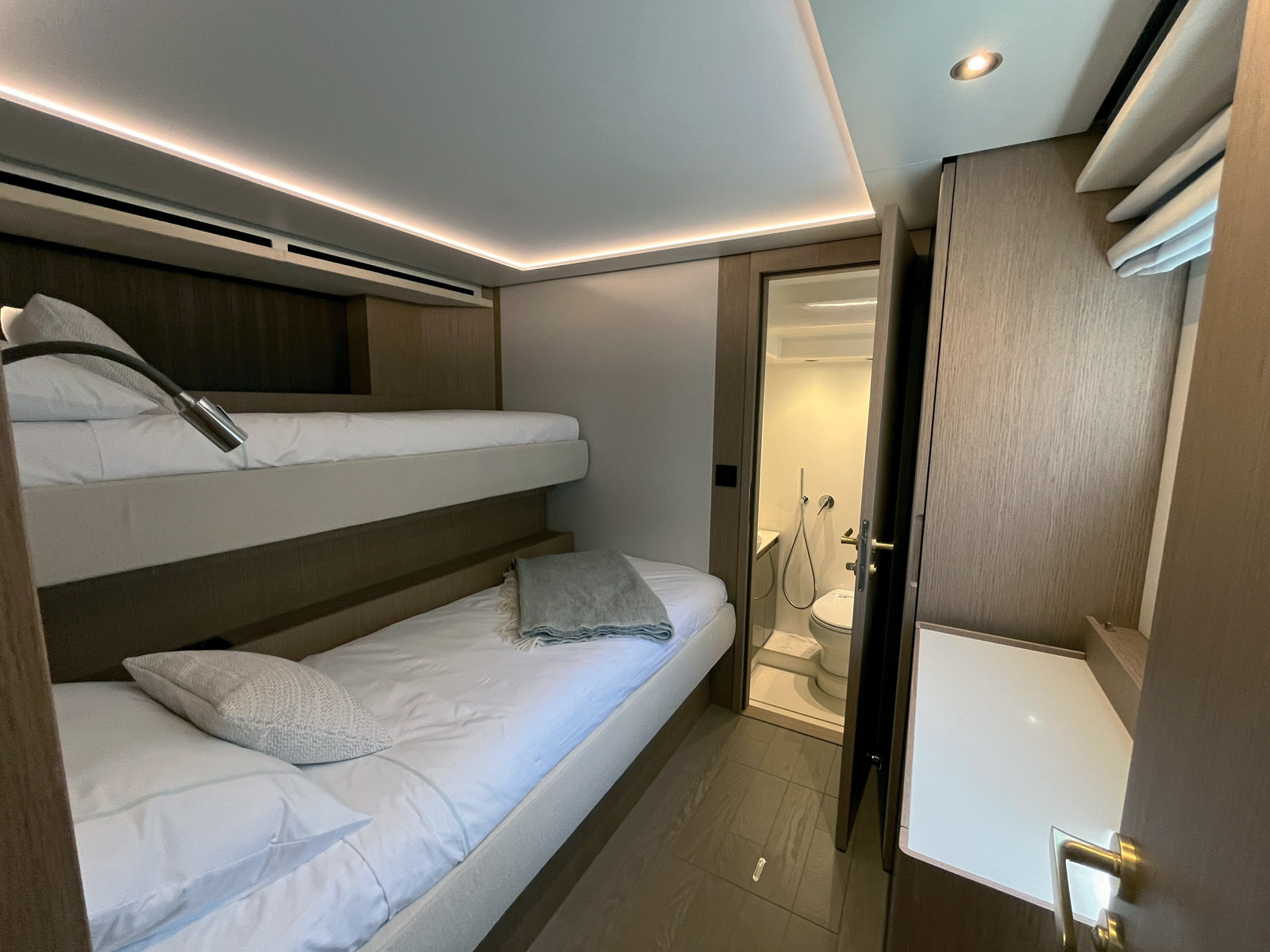
Further on, near the flybridge staircase and without obstructing traffic, a superb U-shaped open-plan galley is equipped with the latest appliances that will delight food lovers and chefs on board. Opposite, there is a staircase leading down to the VIP cabin and a pullman cabin. Forward of this staircase, the helm station is sufficiently understated that it can be used as an office area. However, it is also possible to opt for watchkeeping chairs, with the navigation instruments and equipment reduced to control screens, autopilot, and joystick. From this open space, the view is not quite 360° due to the bulkhead supporting the staircase, but the glass surface enlarges the space, and the two-way mirror hides a giant screen facing the sofa.
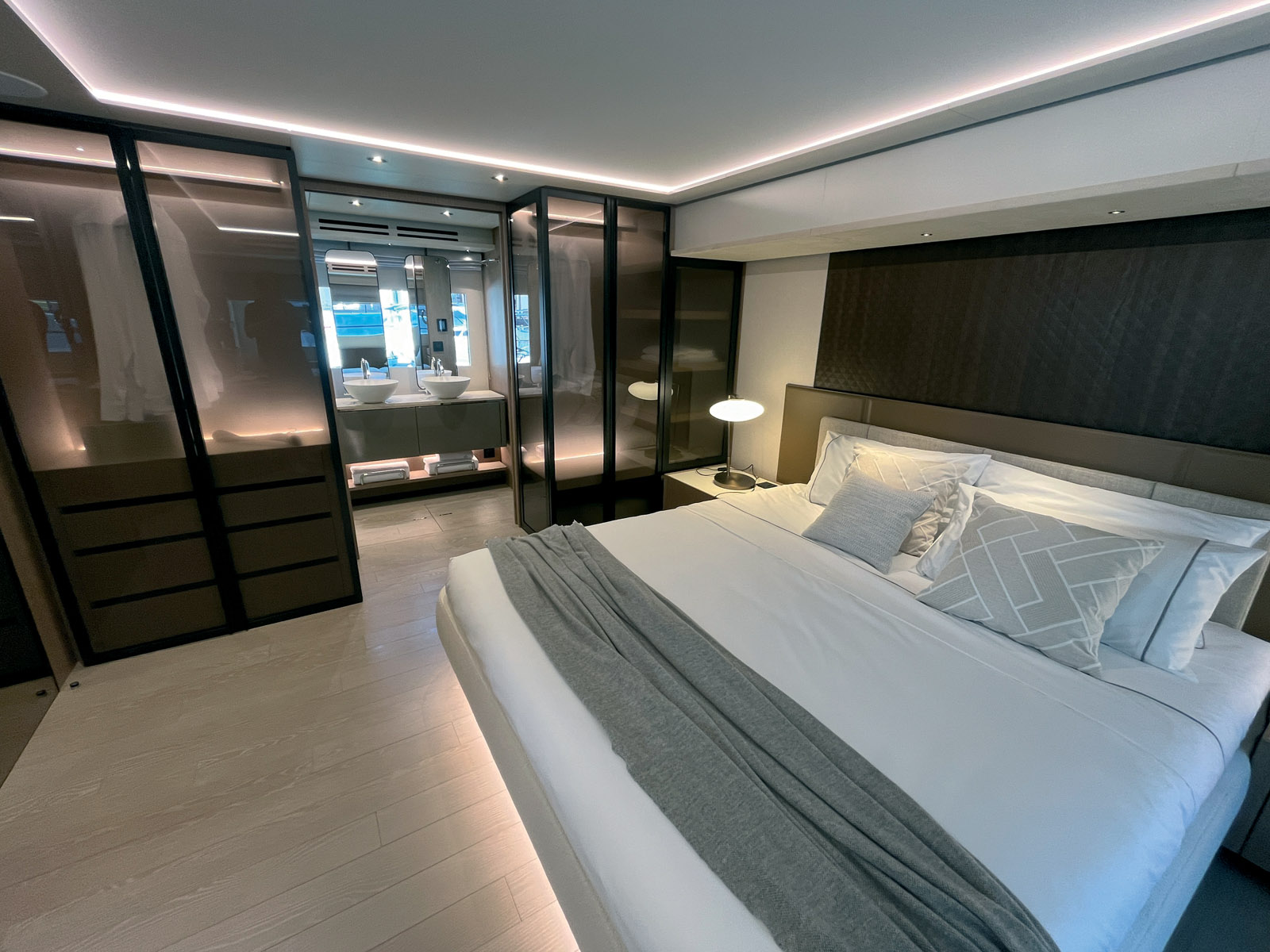
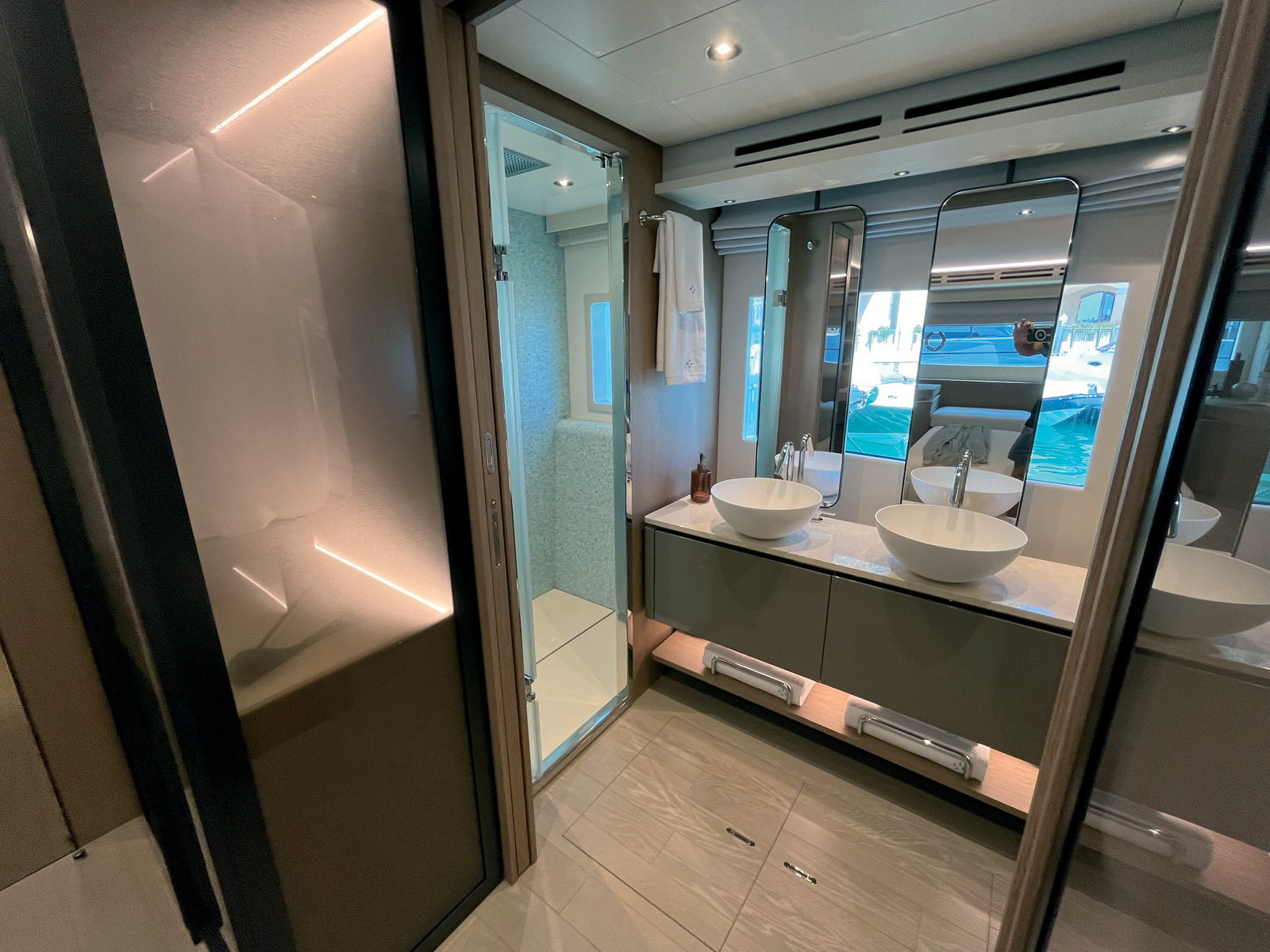
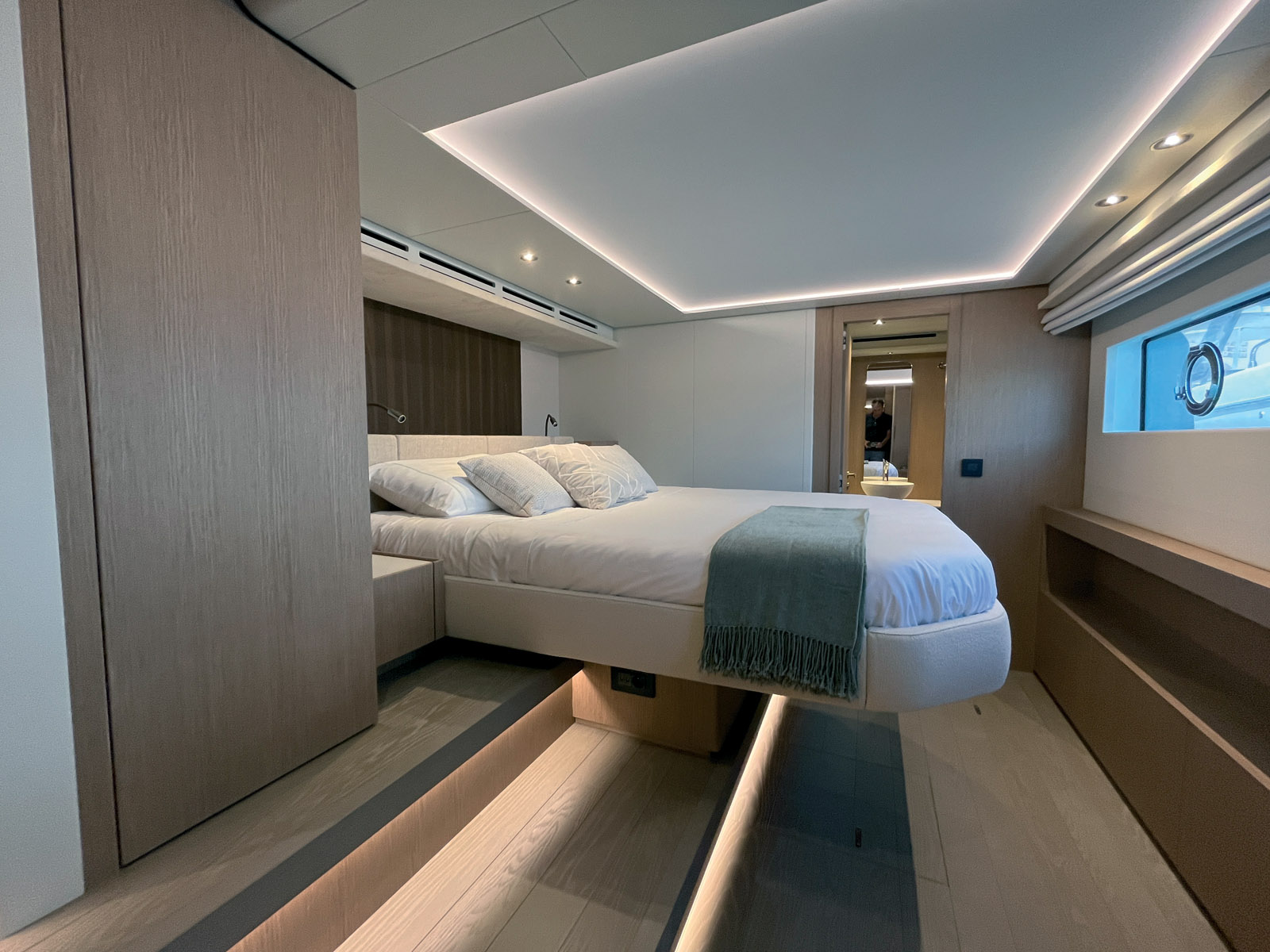
Between the galley bar and the nav station, there is access to another VIP cabin on the port side and the pièce de résistance at the bow, the famous Owner’s cabin. With the high foredeck, it is level across the entire width and bathed in light thanks to the huge side portholes, which are nevertheless cleverly concealed and do not detract from the fluidity of the exterior design. This suite is a haven of peace, thanks in large part to its décor. The owner can choose from a range of beautiful pre-selected materials, as with the rest of the interior. Double sink, shower, cabin, closet, sofa, and beautiful desk – this cabin has it all.
The crew accommodation is located aft, with a double cabin under the stairs and another, for a captain, is optional under the aft deck, behind the engines.
Ease of Handling and (Relative) Fuel Efficiency
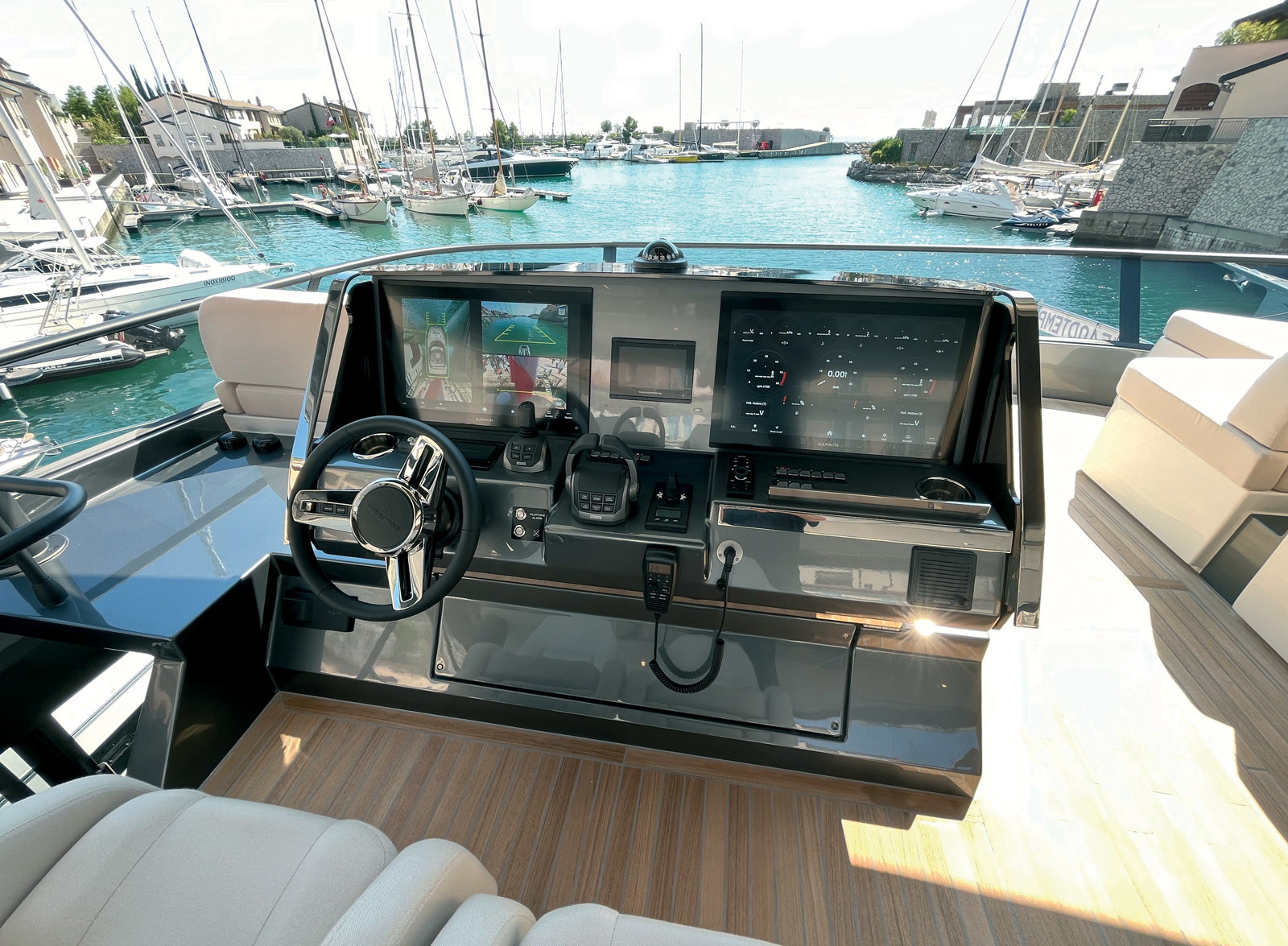
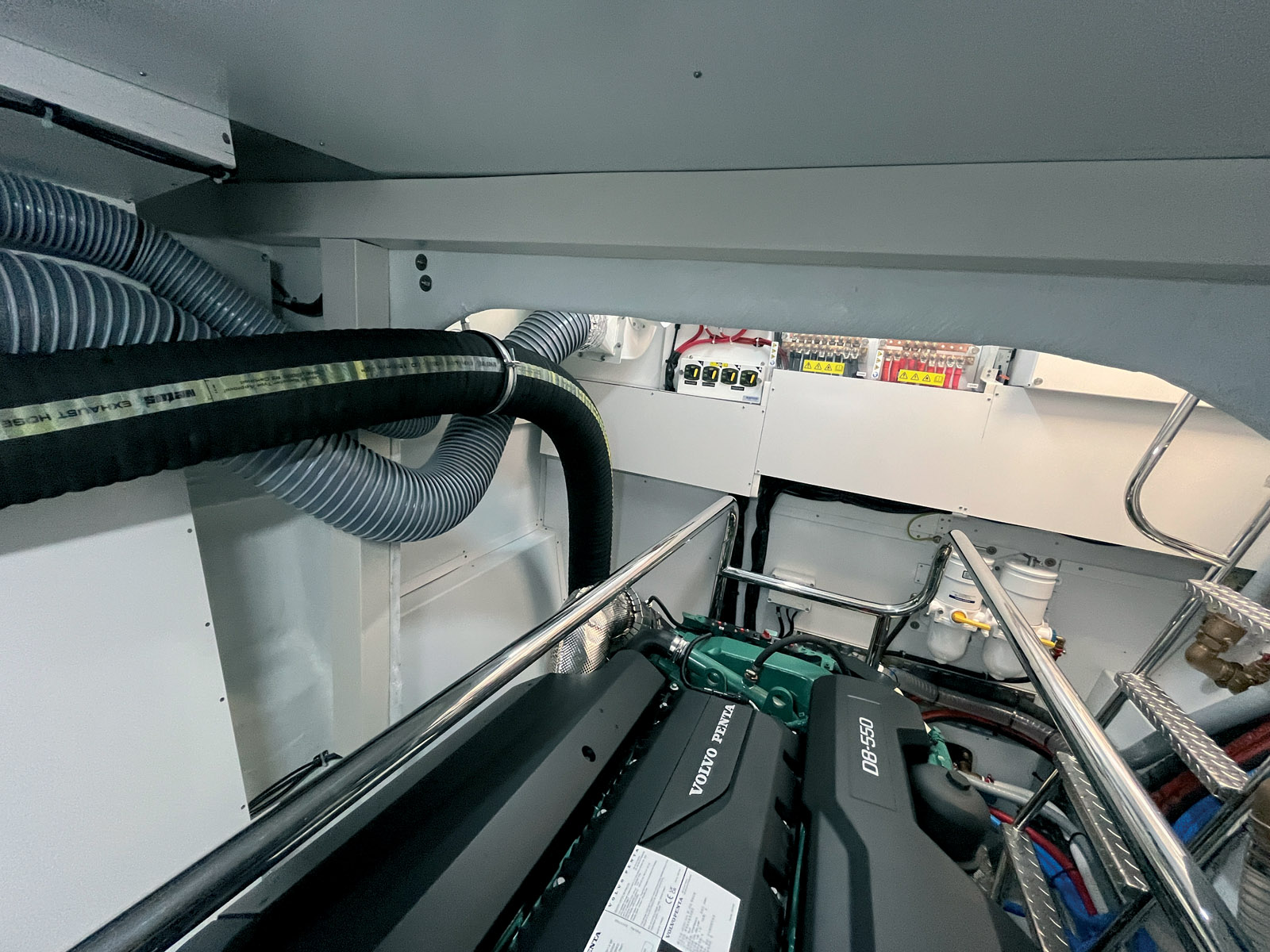
As with the other models, the emphasis is not on speed (none of the powercats in the M-Line range claim a top speed exceeding 20 knots) - a choice that is relatively unprecedented in this market sector. Nevertheless, you can count on good average speeds and reasonable fuel consumption. The only powertrain option available is twin 550 HP Volvo D8s. The V-drive mounting allows the engines to be positioned further forward, optimizing the trim of the hulls and preserving significant volume for storage and the optional aft crew cabin. The flybridge helm station is very pleasant. Its location near the staircase makes for easy communication with the lower deck. Our readings showed a maximum speed of 20 knots, though this figure could be slightly higher in optimal conditions - there were quite a number of us on board. A fast cruising speed of 17 knots requires 45 US gallons (170 liters) per hour from the tanks, giving a range of almost 300 nautical miles and even 350 if you opt for the additional 130-gallon/500-litertank - more than enough for some great summer coastal cruising.
We were a little surprised to find that at these speeds, noise is quite omnipresent on board, partly due to the external exhausts, but it seems that increased soundproofing could improve this. At trawler speeds (8 to 10 knots), peace and quiet reigns on board with a fuel consumption of around 8 US gal/30 l, giving a range of 1,000 nautical miles. The hulls perform very well in calm water, but in bigger seas, care must be taken as the nacelle is quite low in favor of the forward cabin. However, the Lombard team have designed a rise towards the middle of the nacelle to allow bow waves to pass without hindrance. At anchor, with any sea coming on the beam, the question of a stabilizer may arise, as these fairly narrow catamarans are a little sensitive to roll, though nothing like a monohull hull, rest assured!
Conclusion
The Prestige M7 is above all 2,150 sq ft (200 m²) of luxury and refined amenities. This new powercat distills, as the brand boasts, a genuine art of living at sea. The M7 pushes the boundaries of comfort in this size class even further. When under way, getting to and from the flybridge is not only easy, but also very safe, a real advance in terms of ergonomics.
Successful layout
Very safe access to the flybridge
Lack of a day head
No optional stabilizer system
Technical Specifications
Architect: Marc Lombard Yacht Design
Design: Garroni Design
Length overall: 58’10” (17.94 m)
Beam: 24’9” (7.54 m)
Draft: 5’1” (1.55 m)
Light displacement: 39.5 t
Laden displacement: 45.9 t
Powertrain: 2 x 550 HP Volvo D8
Max speed: 20 knots
Cruising speed: 17 knots
Cabins: 4 + 1 or 2 crew
Fuel: 766/898 US gal (2,900/3,400 l)
Water: 200 US gal (760 l)
Solar panels: 2.6 kWp
CE Category: A12/B14/C16/D20
Base price: € 3,800,000 ex-tax
www.prestige-yachts.com