Following on from the successful launch of its M48 last year, Prestige Yachts is building on the powercat concept with its new M8. In this larger size (we’re talking 65 feet here) the French brand is offering high-end features with the undisguised aim of taking on the superyacht world. We were invited to Monfalcone, Italy, where the manufacturing headquarters are based: an opportunity to discover an ultra-modern shipyard and, above all, the new flagship powercat of the M range.
Infos pratiques
- Le chantier : Prestige M8
- La fiche technique
-
 Découvrez notre vidéo exclusive
- Financez votre Prestige M8
- Assuez votre Prestige M8
- Articles autour du Prestige M8
Conditions: Flat sea, 1 to 2 knots of wind
The surprise that the M range caused by the sudden appearance of a major monohull motorboat specialist onto the powercat market is now old news. The manufacturer is moving forward and intends to get down to “serious” business with the launch of a new flagship yacht in its new range. M is for multihull, and 8 is for “80-foot monohull equivalent”. A terminology already found in some of the other Bénéteau Group products and, above all, now used in Fountaine Pajot’s MY range.
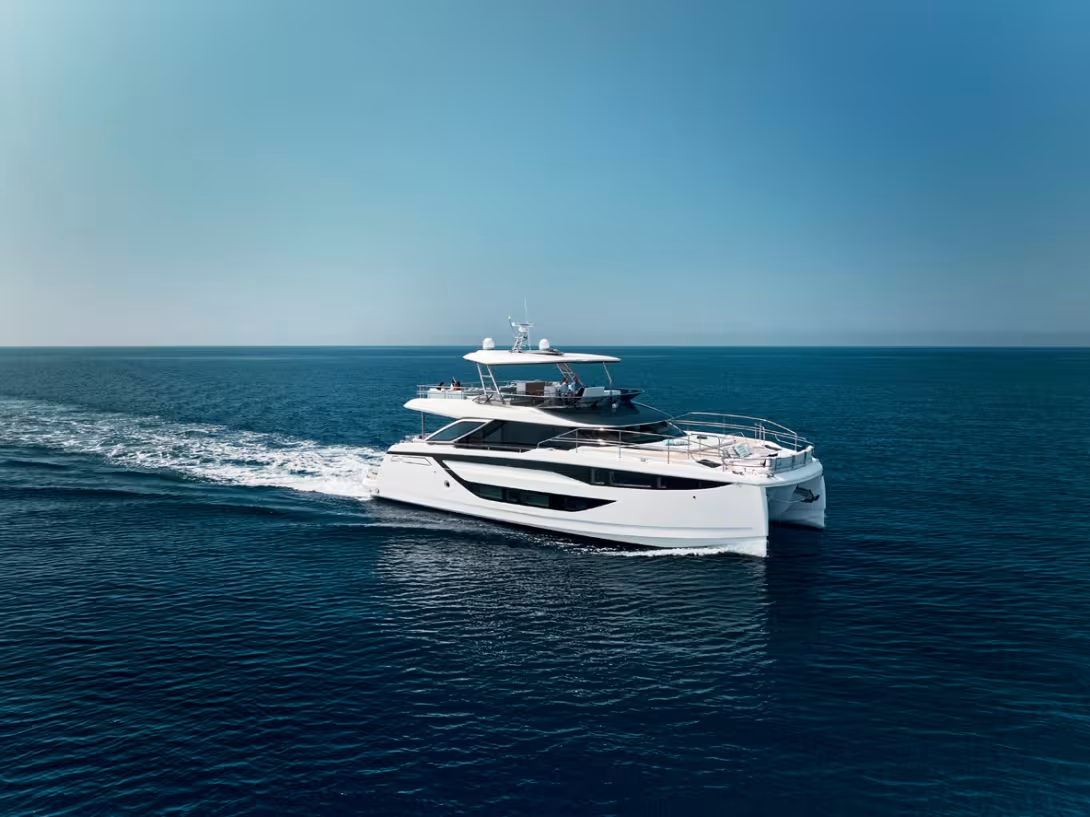
As soon as I saw this multiyacht tied alongside on the dock, there was no doubt: we were talking very top-of-the-range positioning. The high freeboard of the hulls and the streamlined coachroof combine to create a powerful, imposing yet elegant look, typical of exceptional boats. We were welcomed aboard by Erwin Bamps, the brand’s vice-president. For once, he remains quiet - I’ve known him to be really very talkative... But here, he’s content to observe our expressions, which are struggling not to express a childlike wonder. In short, Erwin was savoring our bemused looks and Wow-type expressions as we discovered his prestigious powercat. Having learnt the ropes as a director at Gulf Craft (a superyacht brand), he and his team have done their utmost to equip this Prestige M-Line with the all-essential features needed to seduce a clientele accustomed to rarely seen features. How did he achieve this? “By offering ever more original features for this size, sixty-five feet (just shy of 20 meters,” he concedes. In fact, the M8 immediately establishes itself as an exclusive, luxury yacht.
Extreme design optimization
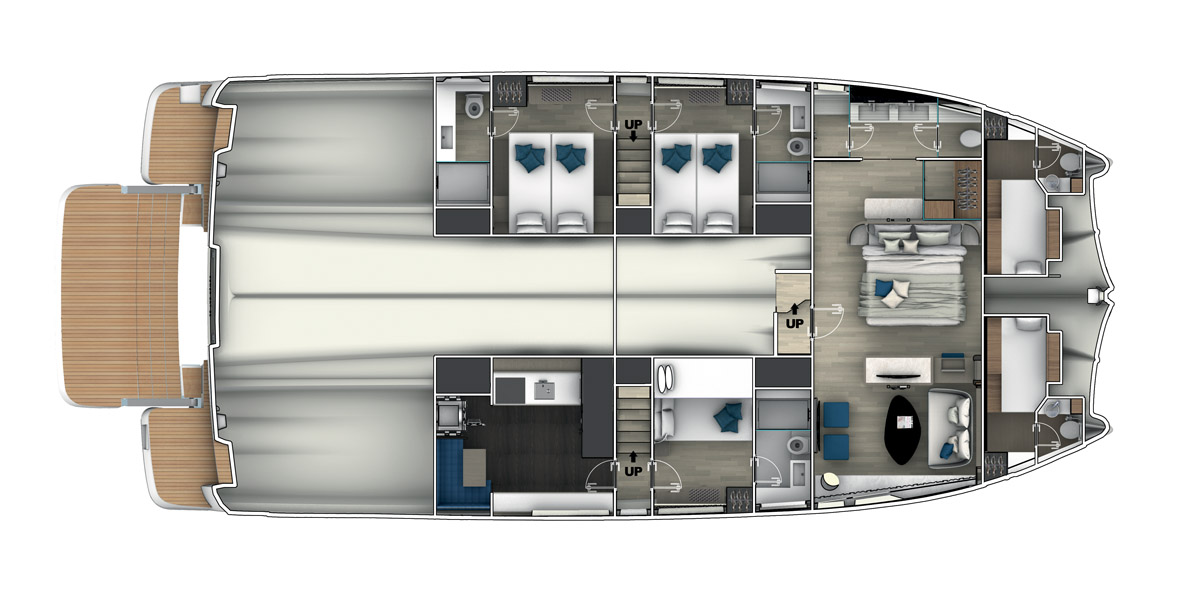
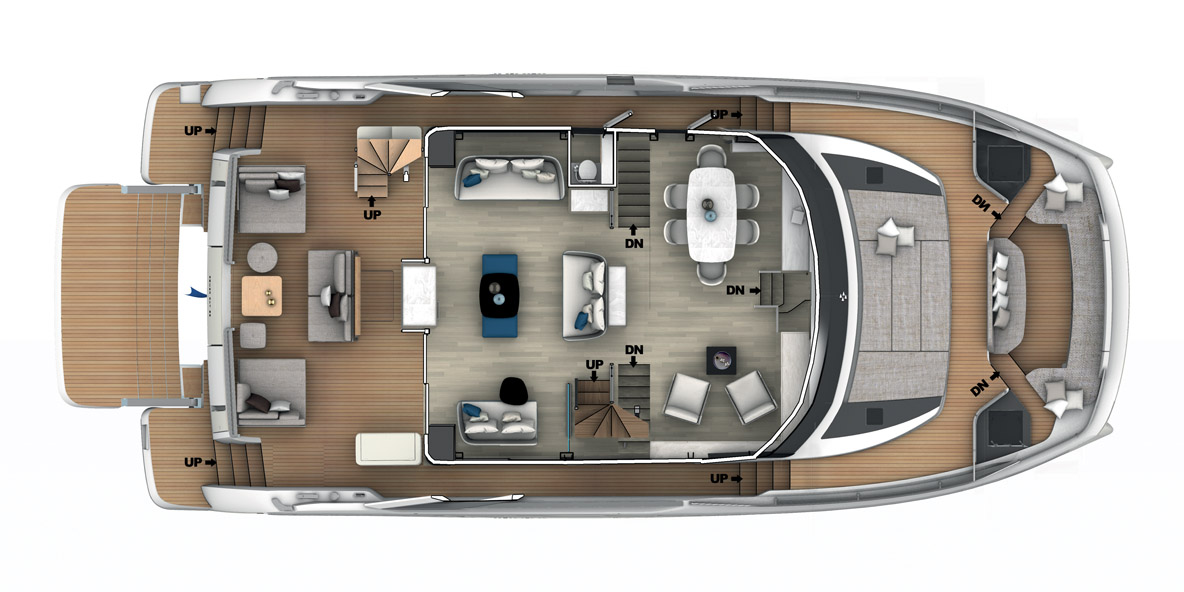
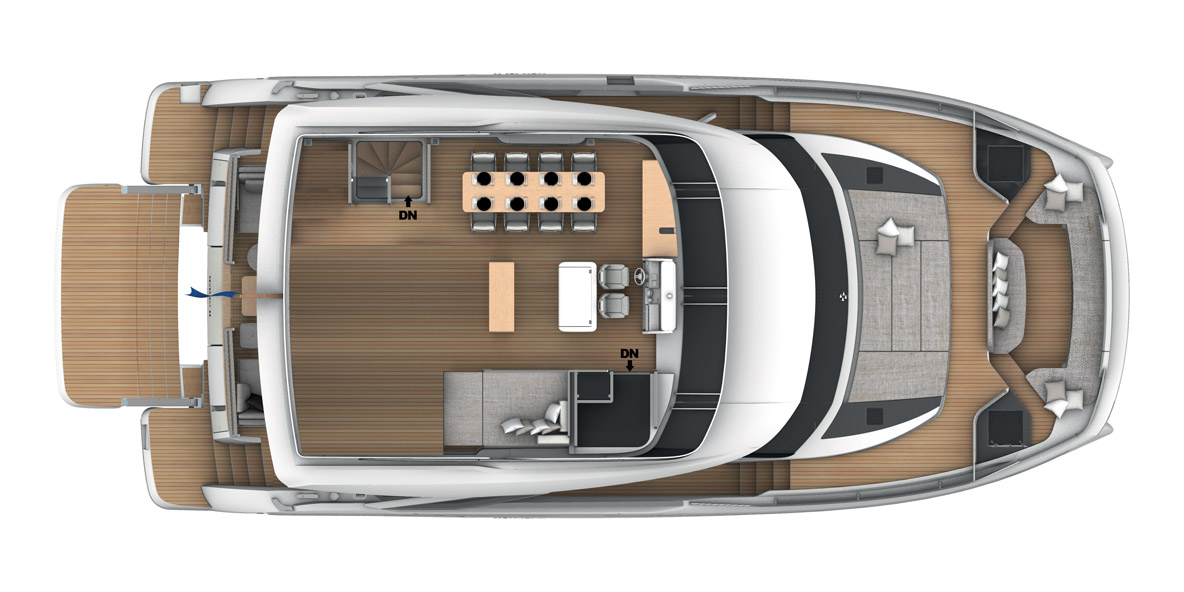
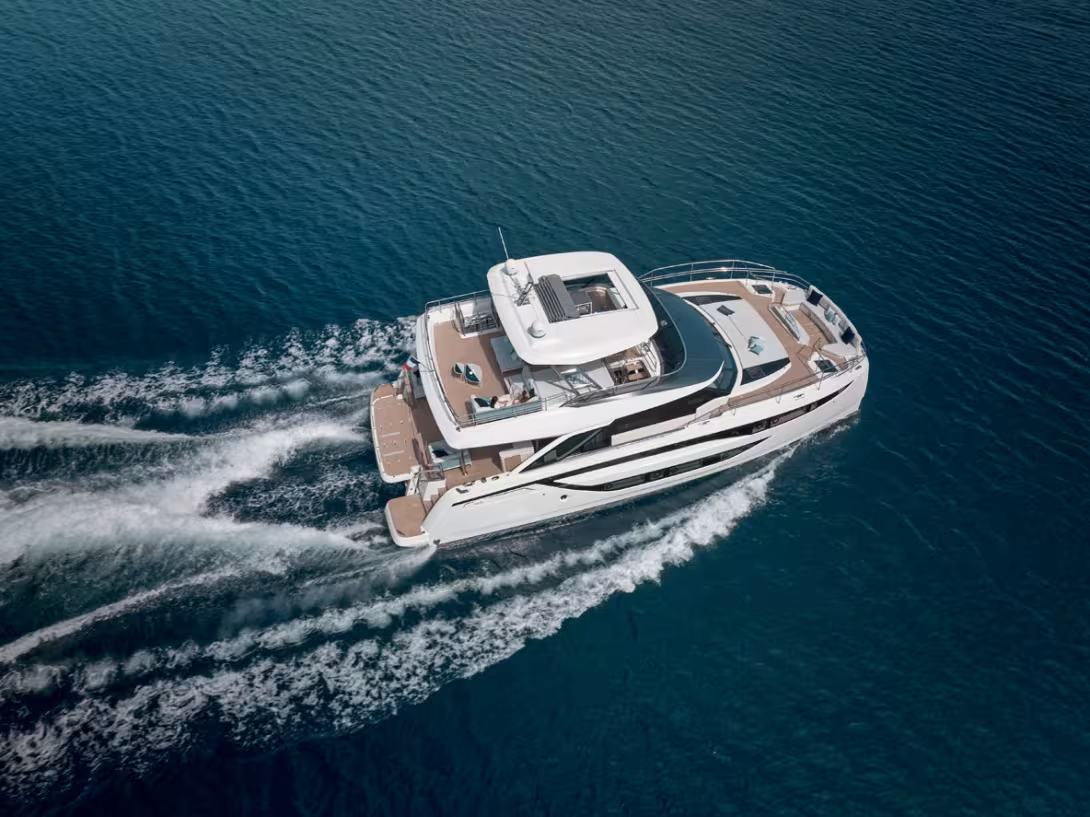
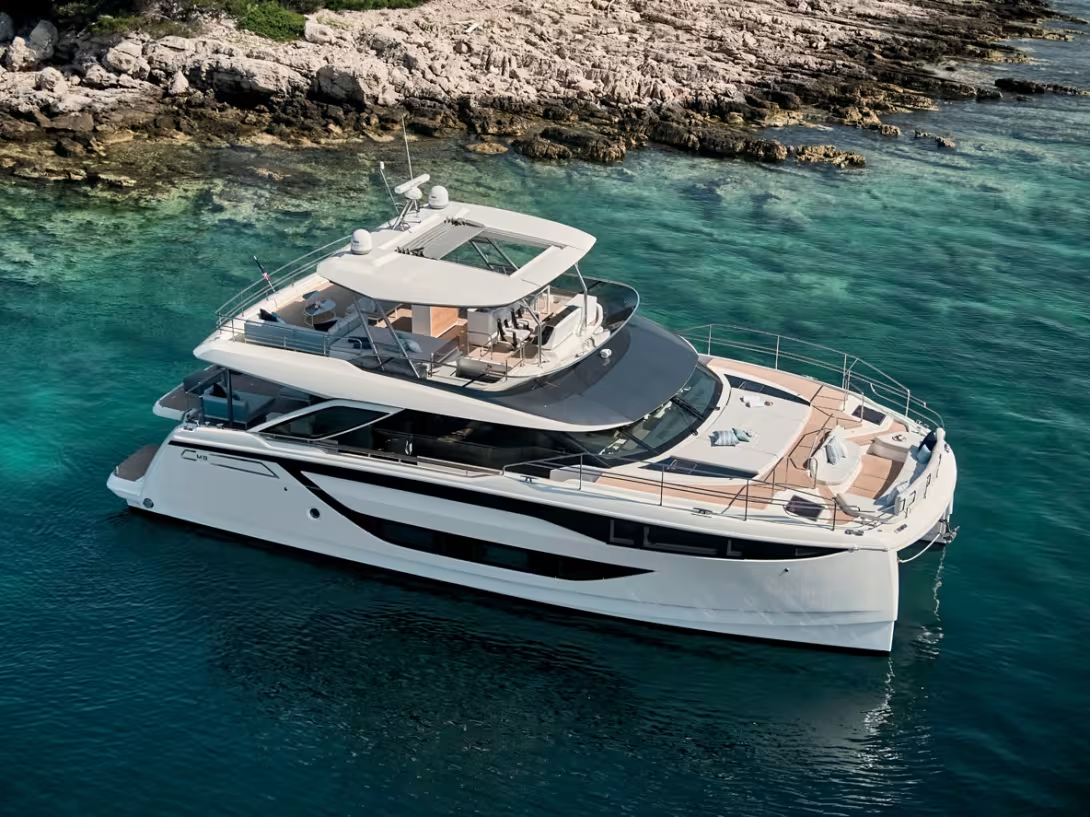
Over the years, Prestige Yachts has gradually got us used to pushing back bulkheads to gain precious square feet or install a shower room, adding a companionway to make cabins more private, raising ceilings so you never have to stoop, constantly opening up interiors to the outside for a better view of the sea/anchorage, and so on. What was thought possible only on a 50-footer has become the norm on a 40, creating the brand’s justified success. Their approach to design is not one of austerity, but of ease, and is the result of the work of Camillo Garroni, the Italian interior designer who has brilliantly specialized in increasing habitability. So, just think, when Prestige Yachts moves on to catamarans, the small step we’ve already seen with the M48, now turns into a giant leap with this new M8. The figures are impressive - and virtually unprecedented: for a platform measuring 65 feet by 29 (19.8 m x 8.8 m), no less than 2,900 square feet (270 m²) of living space are provided, including a 320 sq ft (30 m²) owner’s suite, a 540 sq ft (50 m²) deck saloon and an equally vast flybridge. Beyond these record-breaking surface areas, the way these spaces are arranged and distributed is equally innovative and convincing. Here, design is of course at work, with the high freeboard reminiscent of current trends in monohull yachting. Aboard the M8, the raised foredeck is unique in that it can accommodate the owner’s suite forward of the saloon, all flush decked. The streamlined silhouette remains faithful to Prestige Yachts’ DNA: the flybridge cap remains discreet, while the slightly diminishing hull line to the stern and the integration of the superstructure behind the bulwark add a touch of sportiness. At no point do these almost aerodynamic lines betray the incredible interior dimensions.
The little extras on big yachts
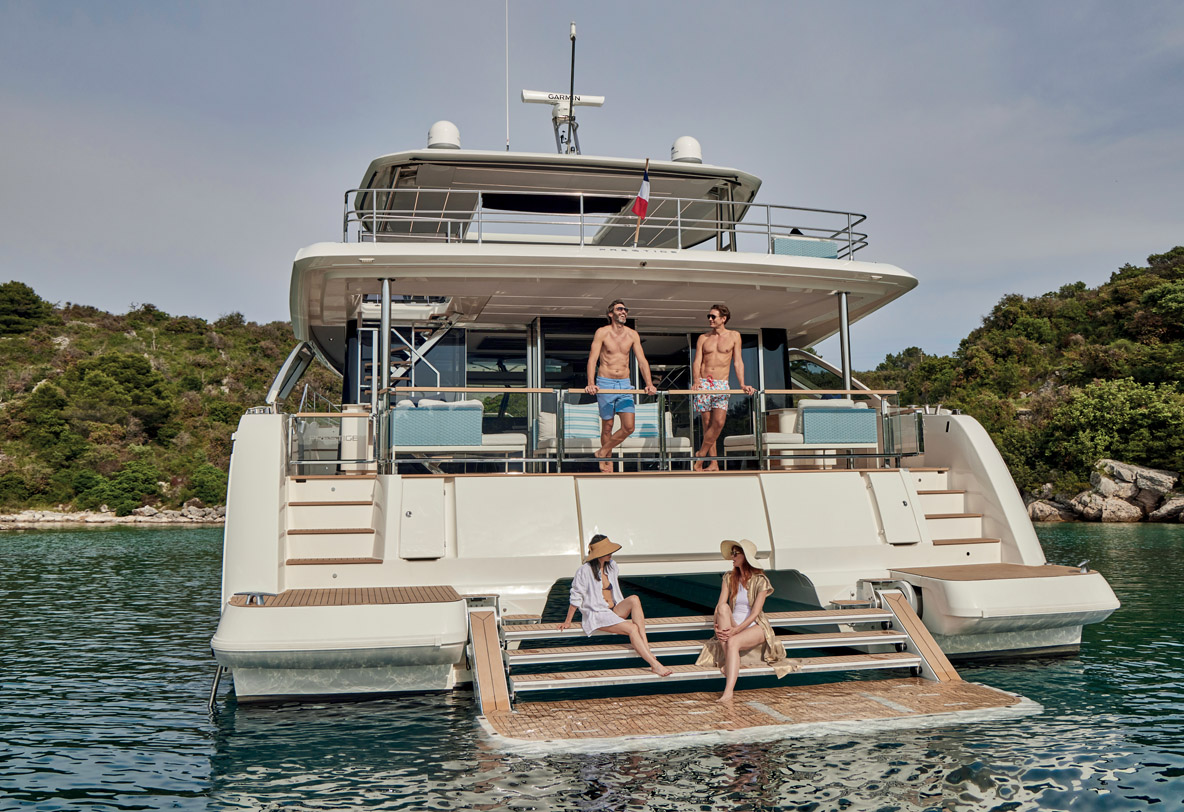
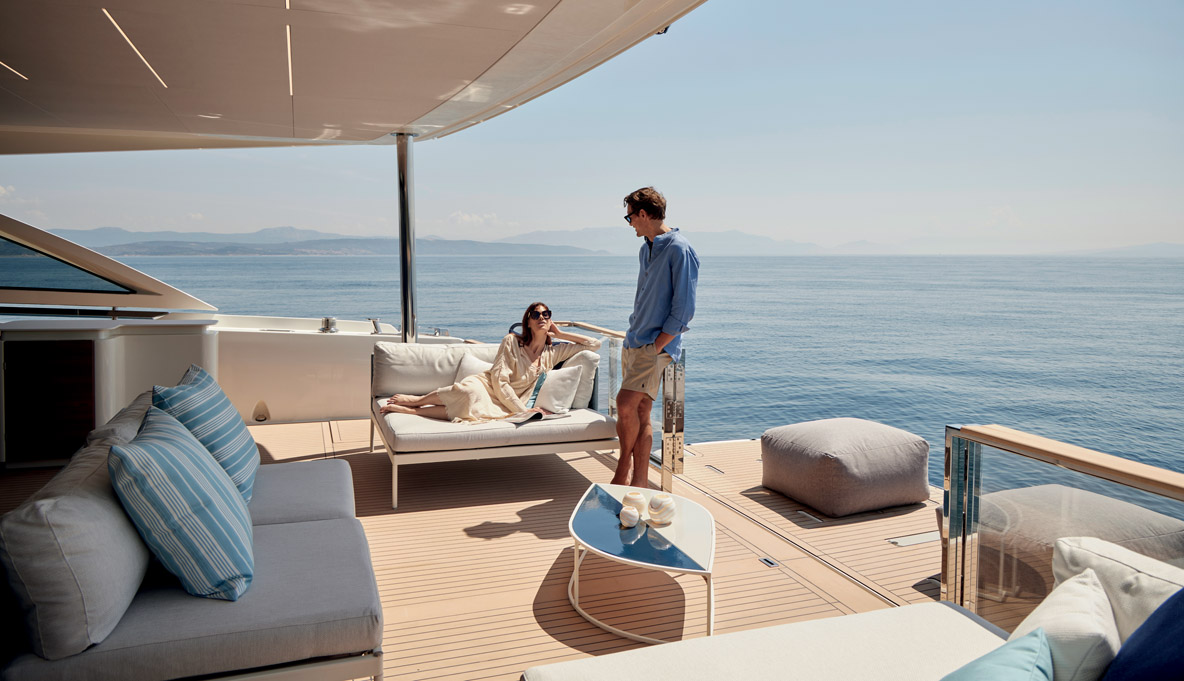
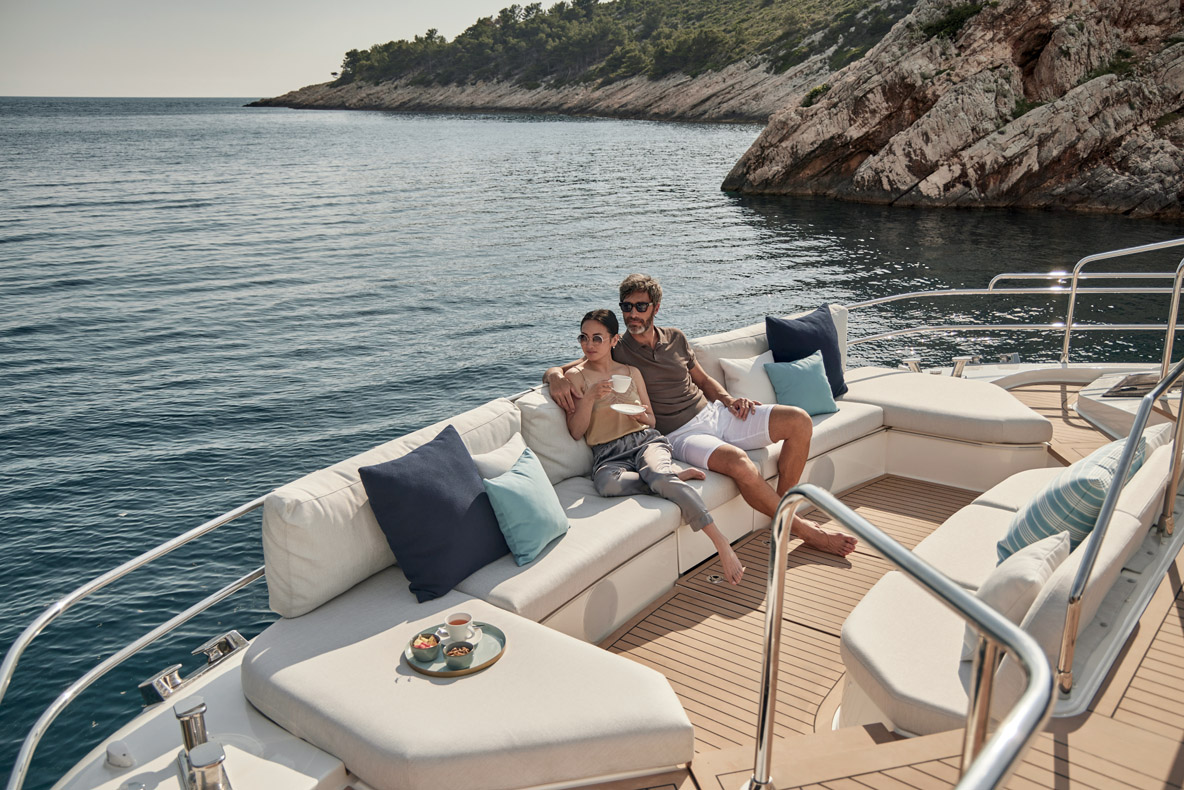
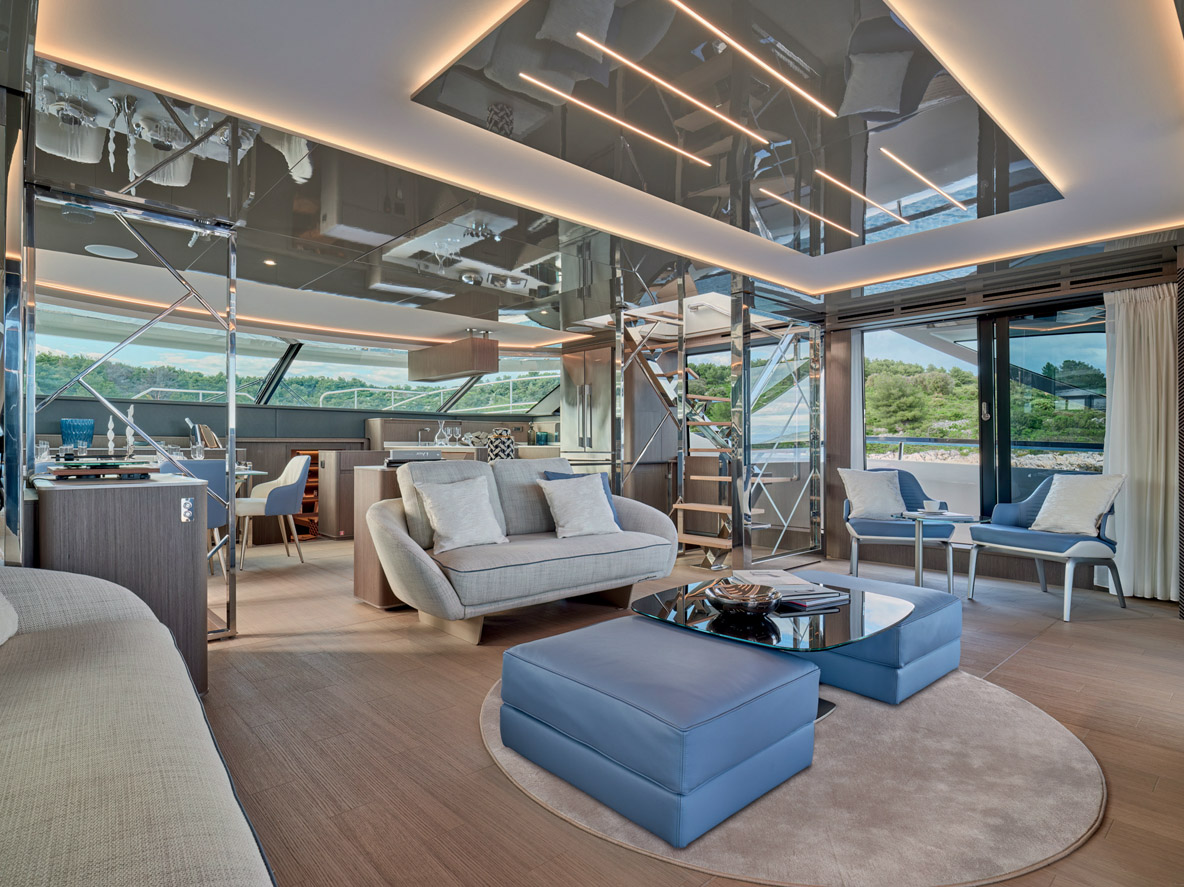
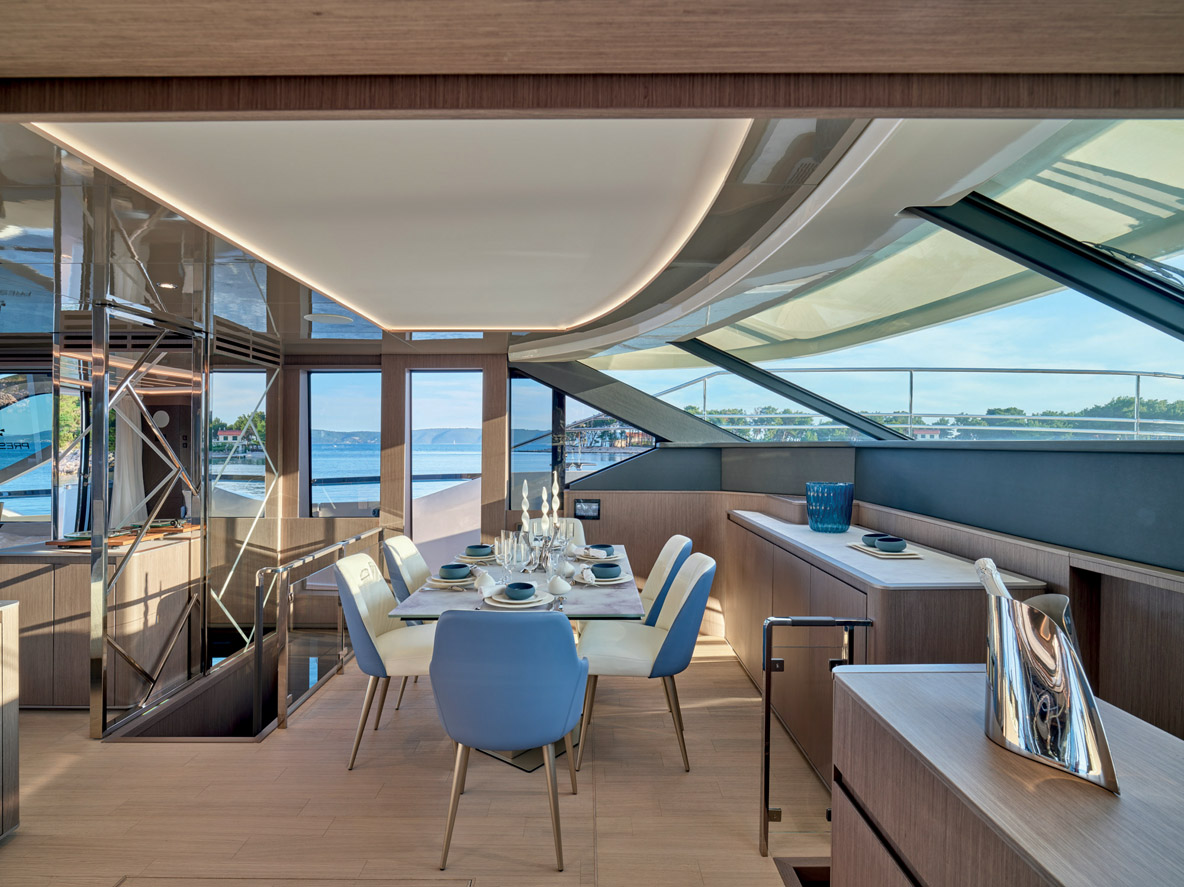
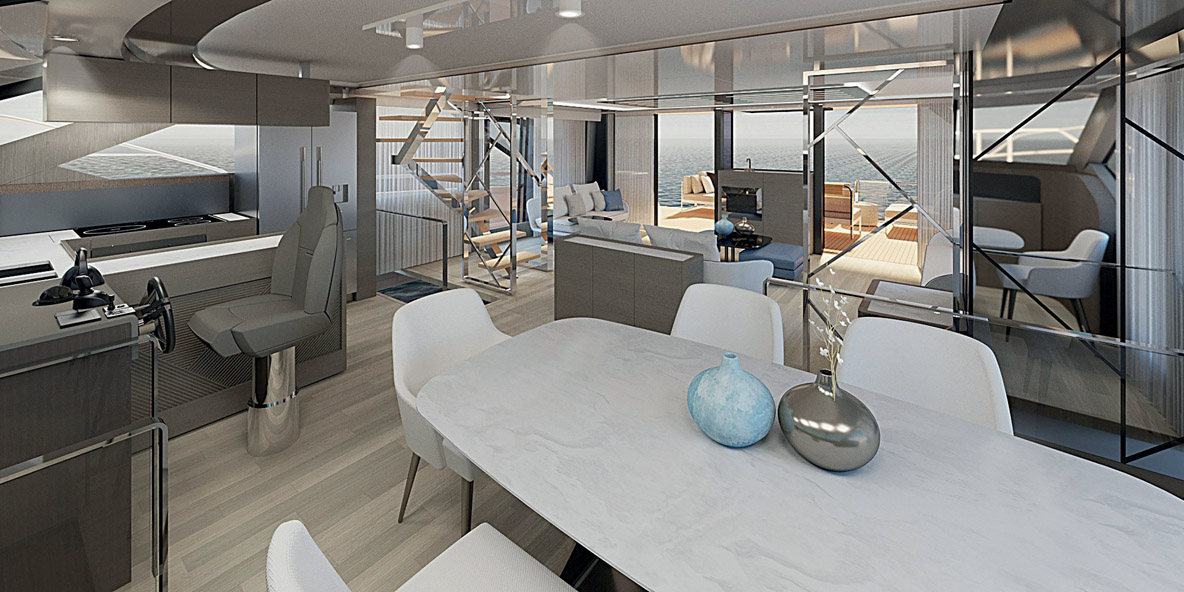
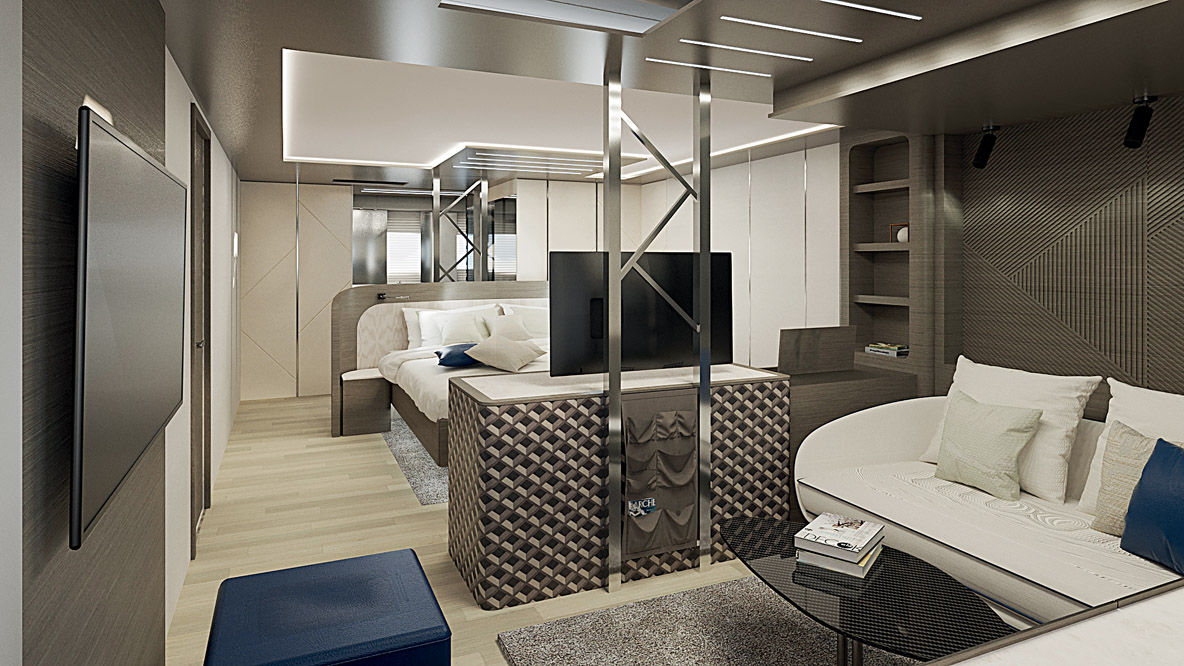
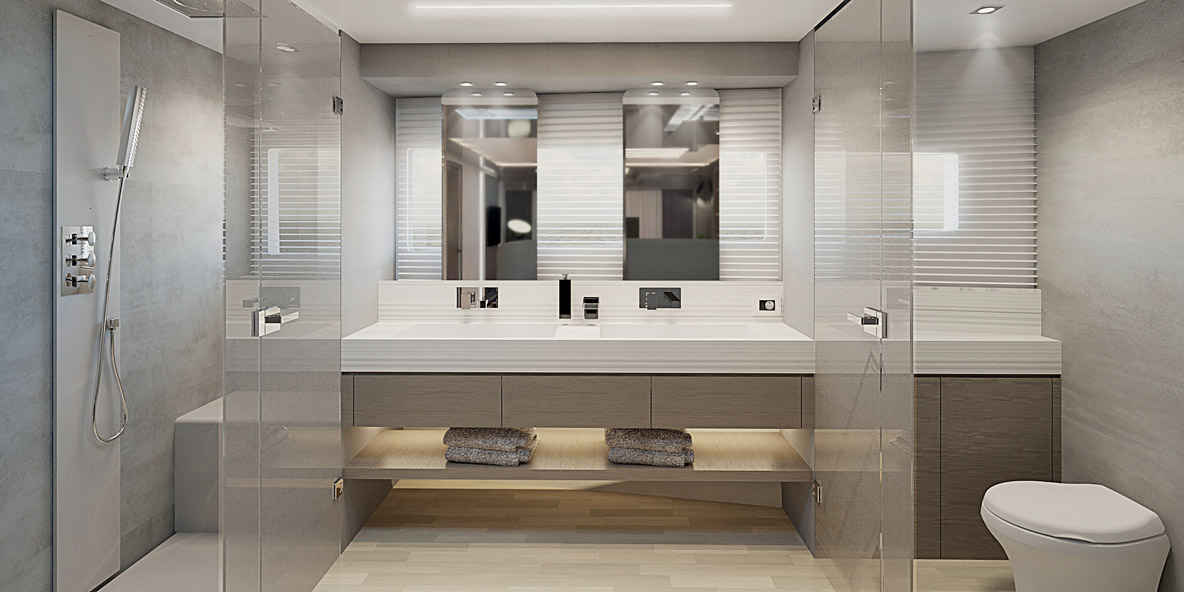
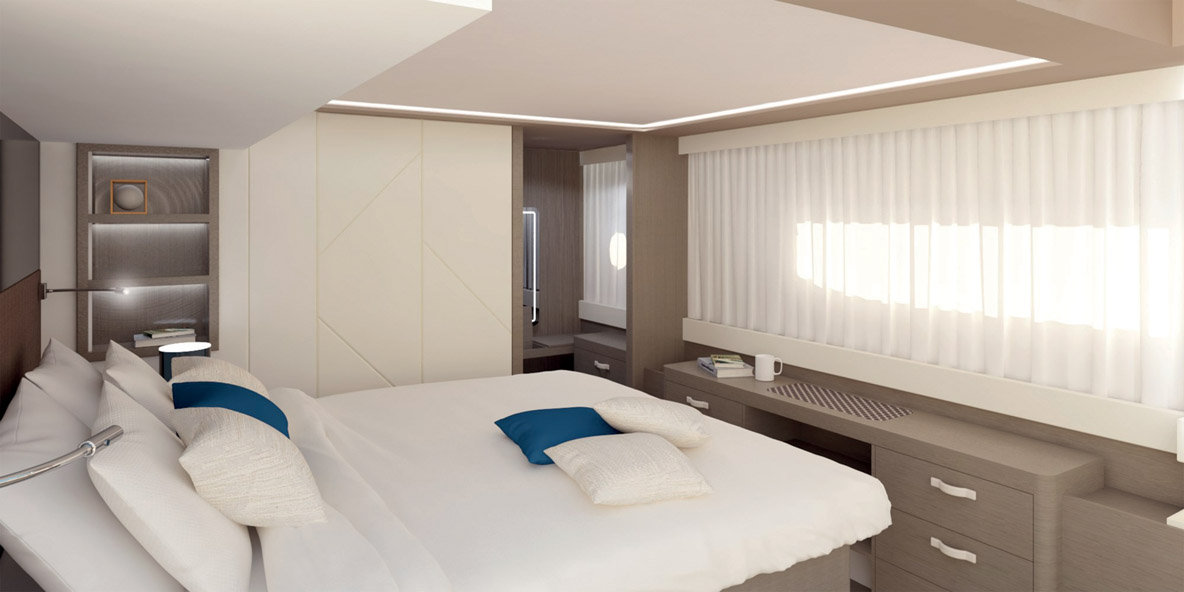
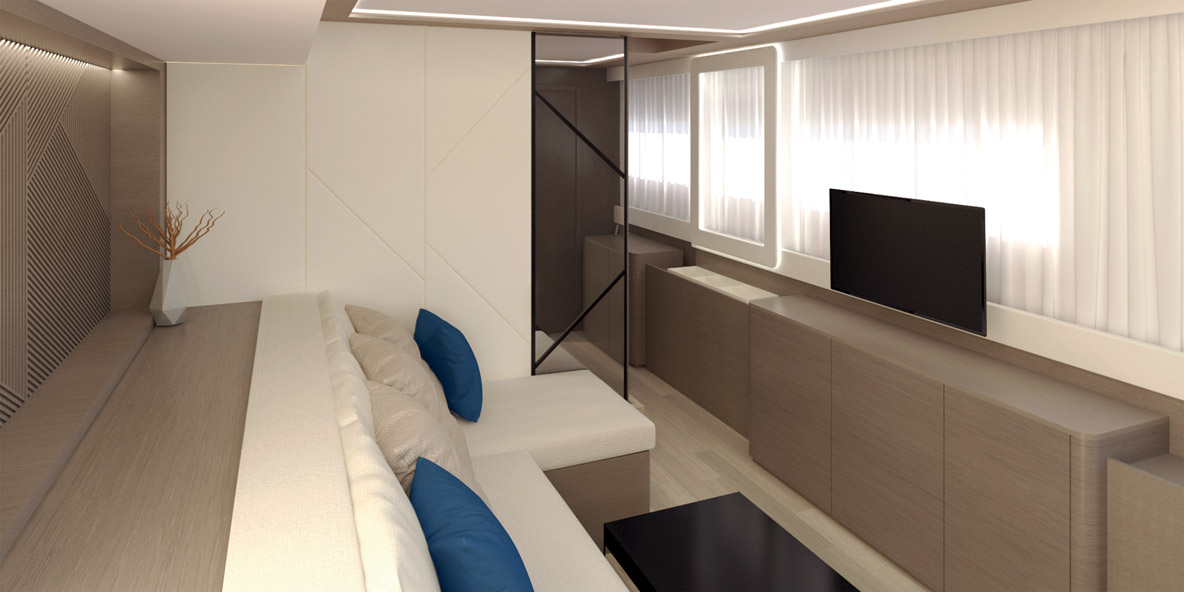
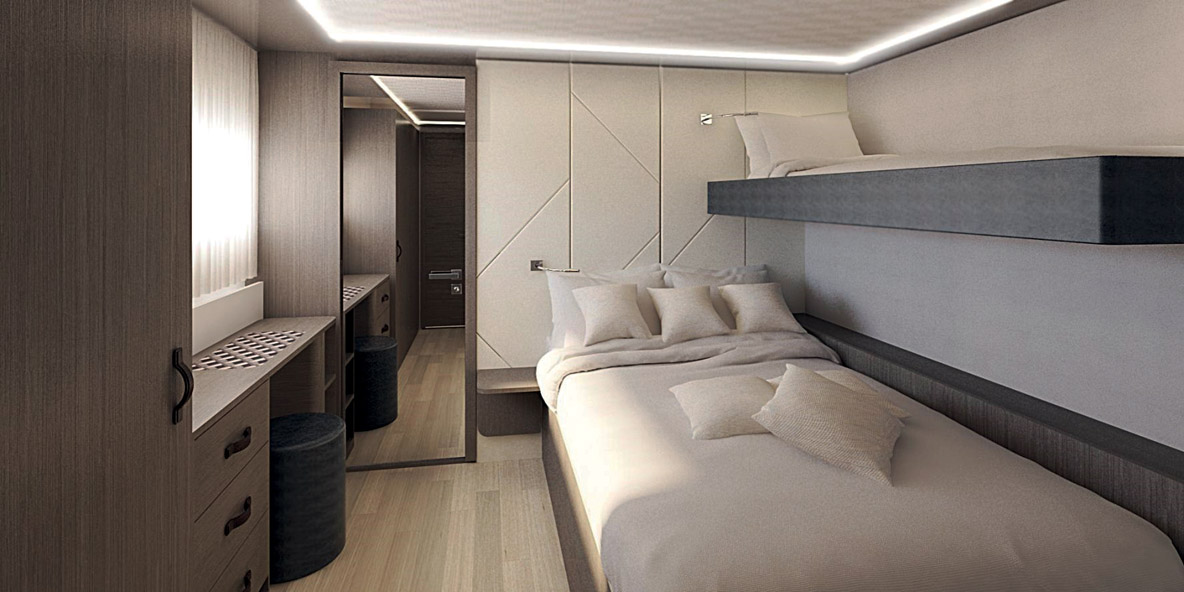
As much as volume and equipment are essential, the layout, furnishings and decor are key elements for luxury on the water, and numerous features found on large yachts confirm the ship- yard’s success. The immense deck saloon is divided into several zones: lounge, dining area, open galley or salon are distributed around a staircase that leads down to the lower cabins (or the crew quarters with its galley if the boat is a galley-down version). Upwards, the steps lead to the flybridge. This makes it easier to move around, but also to live harmoniously with any crew, not forgetting of course all the services you’d expect aboard a 65-foot powercat. In addition to the essential king-size bed, the full-width owner’s cabin features a desk, lounge, huge closets and bathroom - all bathed in light, with no steps to climb. The 320-square foot (30 m²) cockpit, like the flybridge, is equipped with top-of-the-range sofas and tables - the furniture can be arranged according to function, whether you want to dine with ten guests or laze around in the sunshine. Another point that demonstrates the care taken in the initial design: day heads are located on deck, centrally along the side-decks. This arrangement proves practical not only after a swim, but also if hosting a reception, when guests are not obliged to venture into a cabin. A choice of three to five guest cabins allows you to plan your sailing program and your level of comfort. A convivial open-plan galley for a large family can give way to a boudoir with crew quarters including galley, crew mess and pullman cabin. With the bow cabins, the number of crew members can be increased to four, which is more in keeping with small-scale superyacht cruising with service worthy of a five-star establishment. Last but not least, there can be no luxury without beautiful decor, and in this area, Prestige has renewed its collaboration with Valentina Militerno de Romedis. This Italian interior design specialist had already enhanced the styling of the X70. Blue hues were chosen as a tribute to the city of Miami - and for the freshness they evoke. Stainless steel has also been subtly worked to bring modernity and dynamism.
The sobriety of a trawler yacht
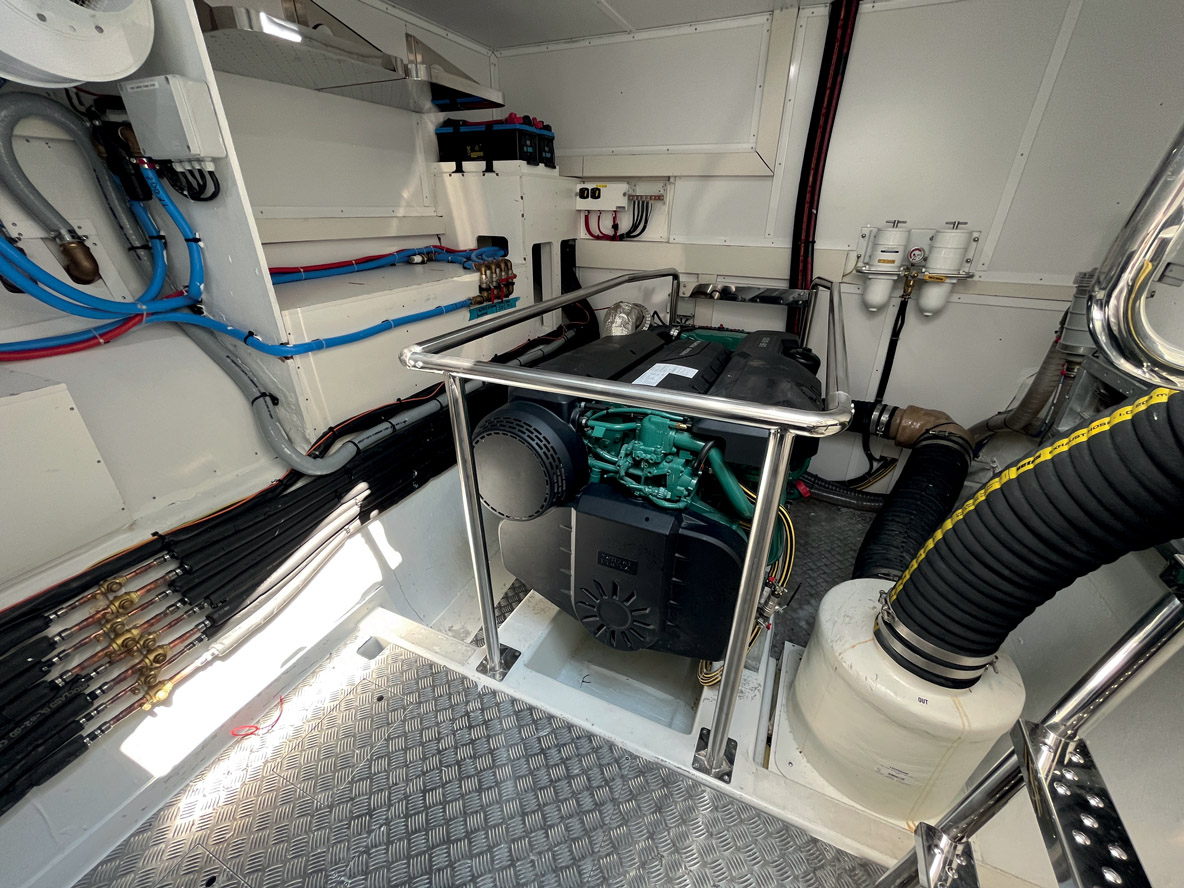
Doesn’t this quest for luxury risk translating into gargantuan fuel consumption once under way? As we prepare to cast off, I was obviously wondering... Let’s start with the departure maneuvers: well assisted by efficient controls, they posed no problems. We could finally enter the channel that leads out into the Gulf of Trieste. The absolutely calm sea and very light wind was going to enable us to take accurate readings, although we wouldn’t be able to see how the M8 behaved in big seas. Given the bridgedeck clearance, the inertia offered by the 50-ton displacement and the length of the hulls, there’s really nothing to worry about. Wishing to take a closer look at the instrumentation, we asked the captain to gradually increase the throttles, and take advantage of the opportunity to gauge the decidedly modest drag in the wake of the two hulls, which are set reasonably wide apart. Marc Lombard Design’s specially developed half-tunnel propeller hulls are designed to take full advantage of the 600hp Volvo D8 V-Drives. Once again, Erwin is all smiles - as if he’s scripted our boat test better than a director could...
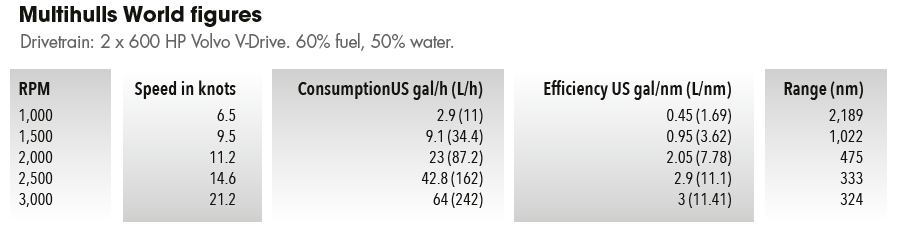
We eventually reached over 21 knots without difficulty, but what really stands out is the fuel consumption at both fast and slow cruising speeds. Excluding any needless consideration of trim, an average speed of fifteen knots requires 40 US gallons (150 liters) per hour. By easing back to ten knots, consumption is already divided by three - to 13.2 gal (50 l) per hour. At 8 knots, consumption is limited to just 5¼ gallons (20 l).
These values are only slightly lower than those of an already well-optimized Prestige X70, but the comparison can only be made objectively with a monohull motoryacht of over 80 feet, which will have twice the thirst. From the helm on the flybridge, visibility is excellent, and the staircase adjacent to the cockpit leads directly down to the saloon, or further down to the cabins. Noise levels at these lower levels are very low indeed, allowing you to live undisturbed.
Conclusion
Prestige Yachts has spared no expense with its new flagship: the M8 benefits first and foremost from a multihull platform, but also from the know-how of the best specialists in the various areas of design and production at the Monfalcone shipyard - all serious assets when it comes to tackling the superyachtmarket. From the bathing platform with its adjustable staircases, to the exceptional living spaces both inside and out, and the omnipresent luxury, the M8 easily rivals the best in this market, and even manages to impose a form of sobriety - quite relative, of course - by managing to limit its fuel consumption to that of a monohull yacht some ten feet shorter. Luxury and signs of frugality: a challenge brilliantly met.
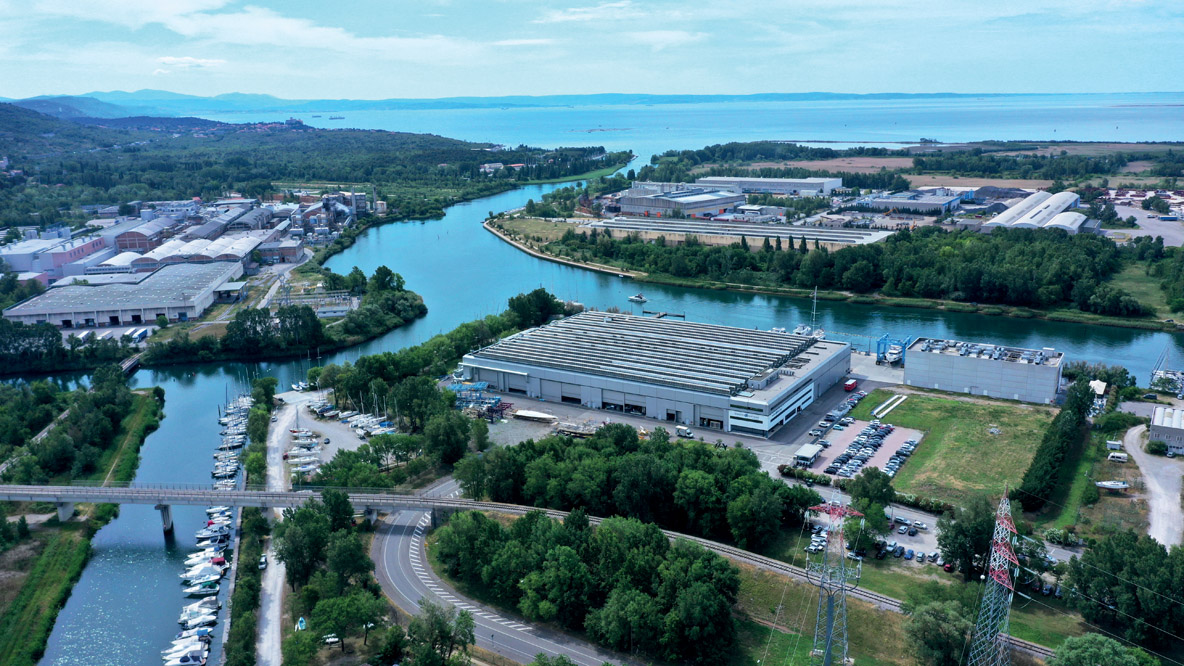
A “prestige” shipyard!
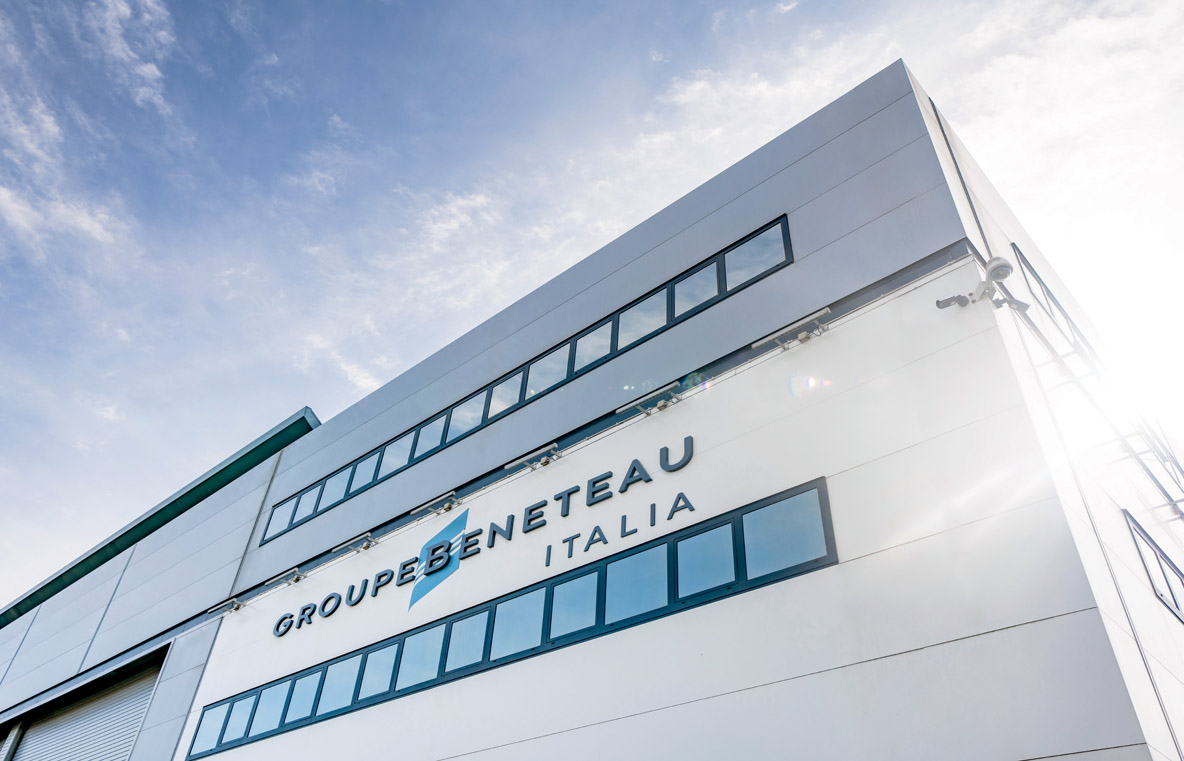
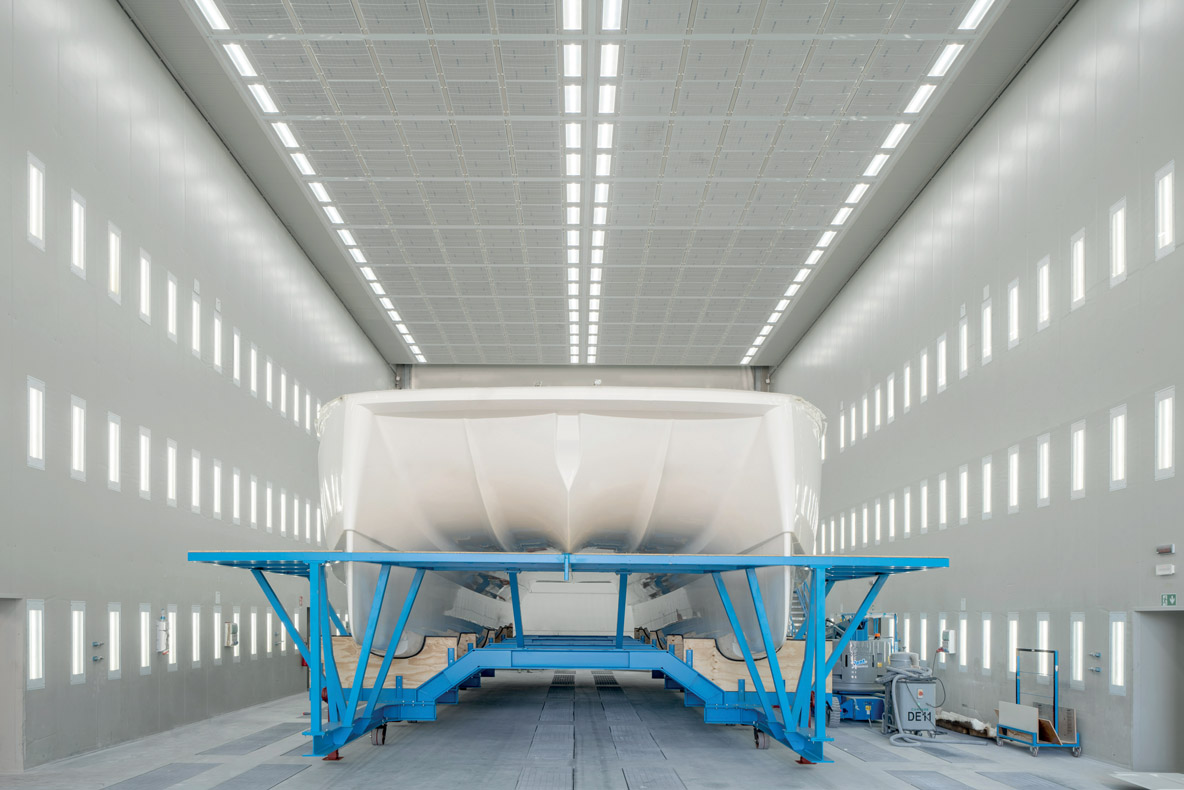
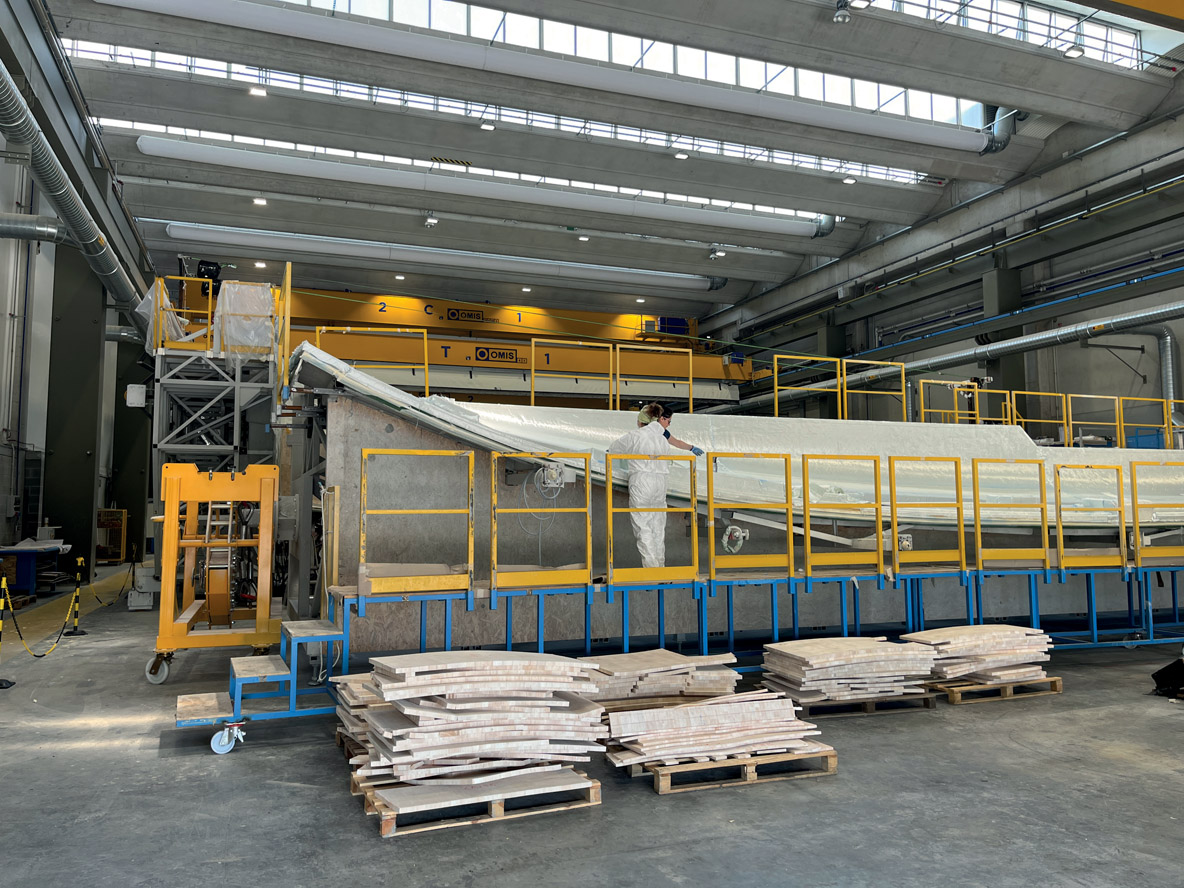
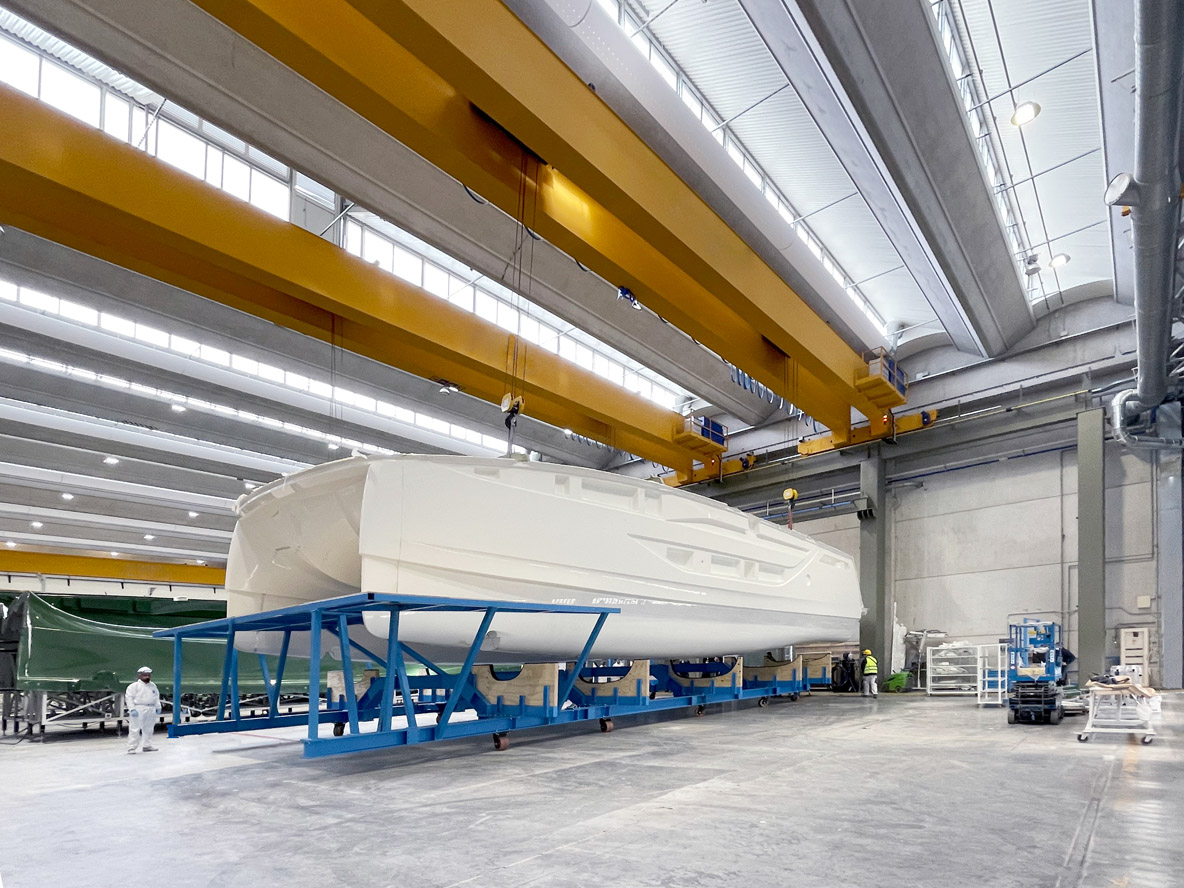
Back in 2010, with the launch of the Monte Carlo Yachts, the Bénéteau Group set up a division in Monfalcone, on the northern Adriatic coast of Italy. This waterfront location is ideal for easily launching large craft, and the climate is mild enough to organize customer seatrials even in winter. The ultra-modern 4½-acre (18,000 m²) facility - out of a total area of 11 acres (45,000 m²) - include molding and assembly sheds, where the temperature is controlled between 64 and 77°F (18 and 25°C) all year round. These sheds, whose floors are heated or cooled by water, are also ventilated by a network of extractors to control humidity. In 2015, the installation of a 200-foot (60-meter)-long paint hall heated to 175°F (80°C) marks a further step for quality. In addition to painting, it also allows hulls and structures to undergo post-infusion curing for eight to ten hours to achieve greater overall stiffness. The shipyard is understandably monopolized for the construction of the group’s largest models. After the Monte Carlo Yachts, the CNB 66 and 76 were built here before leaving for Forli. Today, the annual production schedule includes eleven Bénéteau Grand Trawlers, eight Jeanneau Yacht 66s and eight Prestige M8s. Of the 250 people who work at Monfalcone, 170 are in production, while 80 work in the offices - including more than 30 technicians. But if the Bénéteau Group chose Monfalcone to build its top-of-the-range yachts, where customization and fine finishing are paramount, it was also largely because of the excellence of the Italian workforce. The culture of “beauty” is a raison d’être for many craftsmen accustomed to satisfying the desires of wealthy boat owners. Alpi joinery is delivered by reputable local companies before being assembled in the workshops - the same goes for upholstery and some of the decorative features. This high-quality workmanship, still done by hand, is perfectly suited to the demands of semi-custom finishes.
Fuel consumption equivalent to that of a much smaller monohull cruising yacht
Ownert’s cabin worthy of a superyacht
No choice of decor for the moment
Limited crew accommodation on the 5-cabin version
Technical specifications
Architect: Marc Lombard Yacht Design
Interior design: Garroni Design
Interior decor: Valentina Militerno de Romedis
Overall length: 65’ (19.82 m)
Beam: 29’ (8.85 m)
Draft: 5’5” (1.65 m)
Light displacement: 90,600 lbs (41.1 t)
Laden displacement: 116,000 lbs (52.7 t)
Engines: 2 x 600 HP Volvo D8
Max speed: 21 knots
Cruising speed: 17 knots
Cabins: 5 + 1 crew
Cruising range: 350 nm
Fuel: 2 x 488 US gal (2 x 1,850 l)
Fresh water: 2 x 112 US gal (2 x 425 l)
Black water: 63 US gal (240 l)
Hot water: 31.7 US gal (120 l)
CE Certification: A
10 / D
20
Base price: approx. € 3,300,000 ex-tax
Price of the version we tested: approx. $ 5,300,000 ex-tax
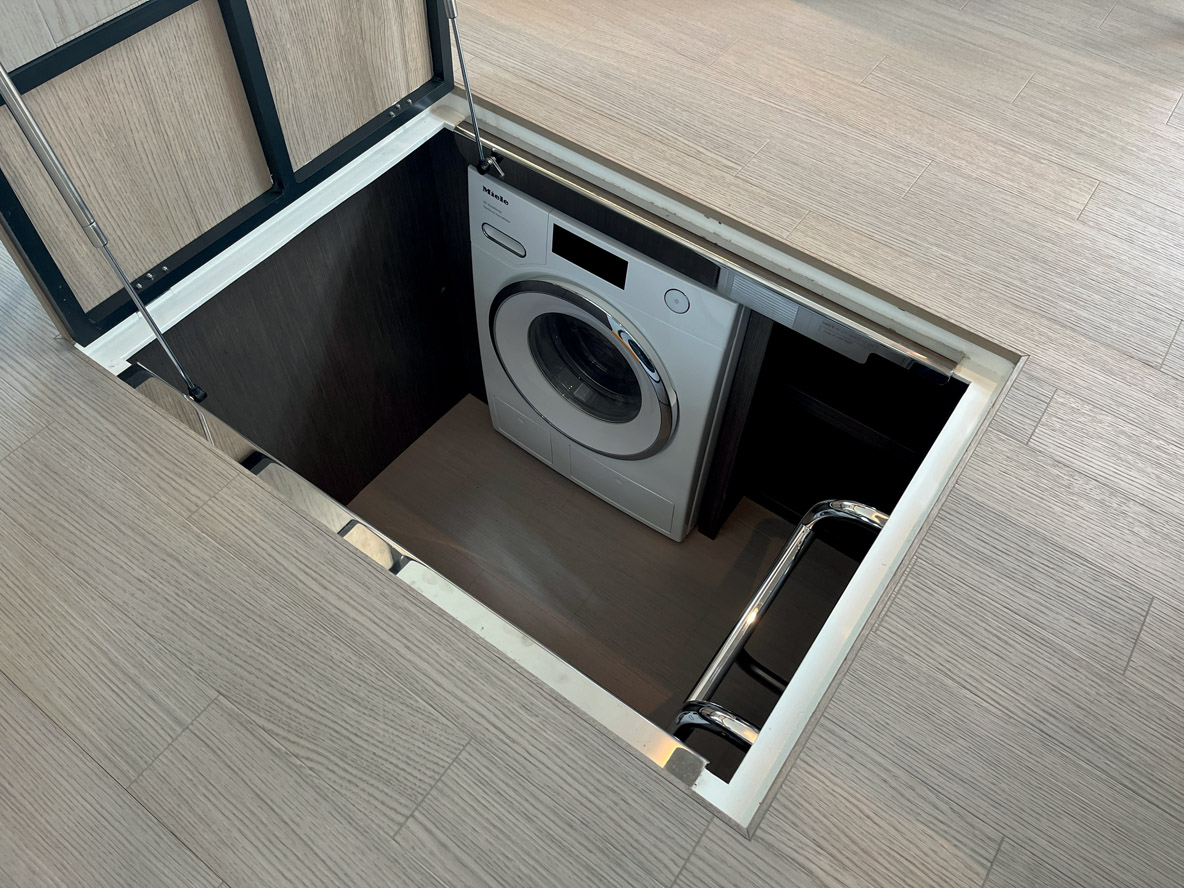
as well as a laundry room.