The appearance of a 55’ model at the top of the Fountaine Pajot range of motor catamarans allows the company to advertise a full offer, unique on the world market. At the moment when the traditional motor segment is plunging into an unprecedented depression, it was too good an opportunity to rediscover the multihull’s advantage in this field, and get to know the Queensland 55’.
Infos pratiques
- Le chantier : Queensland 55
- La fiche technique
- Découvrez notre vidéo exclusive
- Financez votre Queensland 55
- Assuez votre Queensland 55
- Articles autour du Queensland 55
Difficult positioning
It may seem paradoxical that the platform which logically is the most efficient is having trouble asserting itself in the nautical world! There is strong inertia and apart from a few (nevertheless significant) exceptions, fishing, transport and pleasure boats remain supported by fixed concepts.
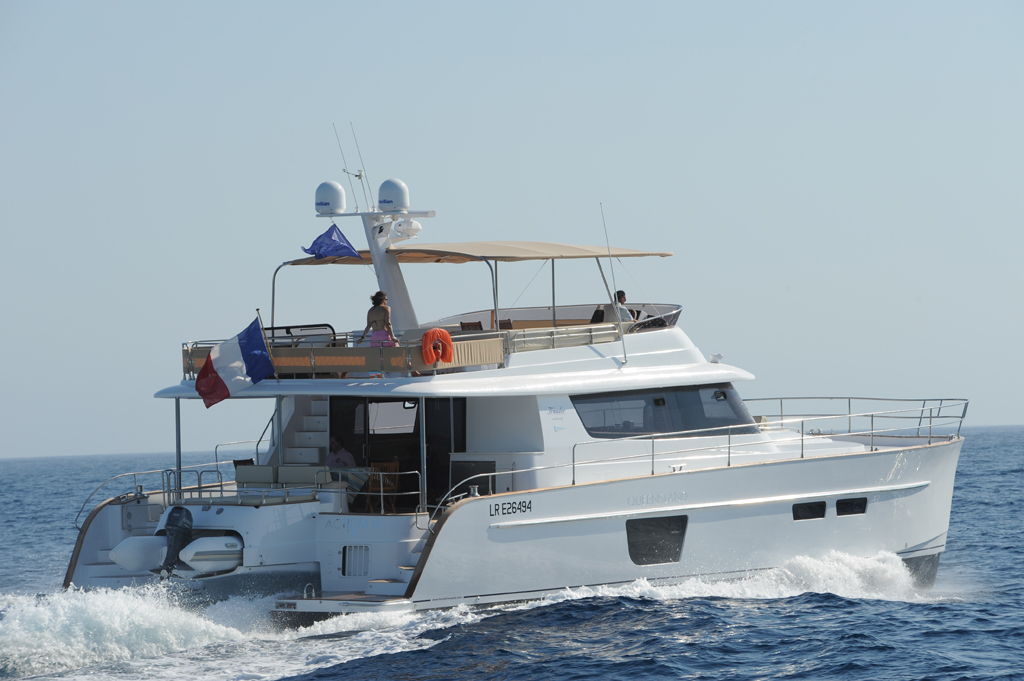
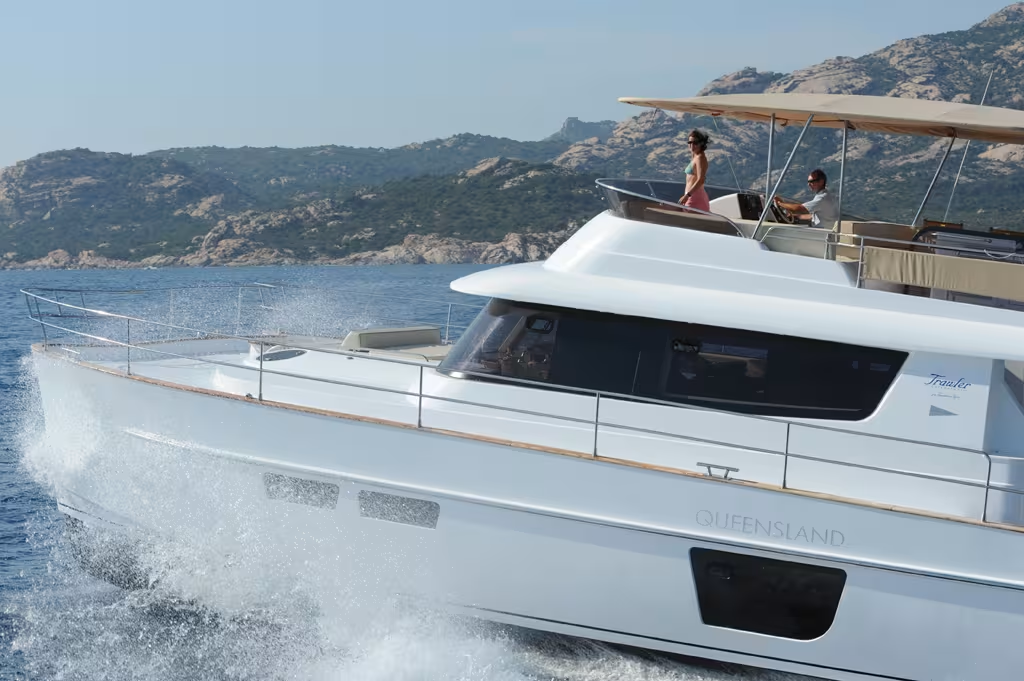
An elegant, mature silhouette which respects the trawler spirit.
Conservative pleasure sailing?
Let’s note together that no brand in the motorboating industry has used its reputation and sales strength to offer a ‘multihull’ version, and that it is the builders of sailing boats which have taken the initiative! The world leaders probably consider that they have their reasons, and the announced, then confirmed, collapse of certain forms of motorboating have changed nothing! Let’s hope that the clientele asks itself the right questions; the first defectors are testing the multihull’s advantages.
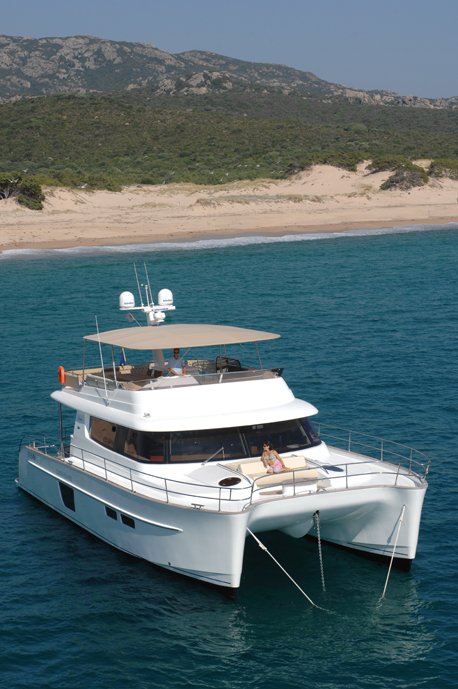
Both at sea and at anchor, the trawler is a really enjoyable way of living.
Pioneers with mixed results
Nigel Irens’s masterstroke opened a door to the future, with his ocean-going cruising trimarans; the Santorini 65' from Joubert / Nivelt / Jarillon invented an almost ideal vision of the exploration catamaran, and recorded a golden number in 1998: 1 litre per mile at 11 knots! Jeantôt Marine understood the stakes, with Marc Lombard’s Euphories, but the ‘modern style’ silhouette and the high engine powers didn’t find their clientele, despite their objective qualities. The correction in style which occurred with the Transcats was a critical (though not a popular) success. Only Lagoon succeeded in recording a score in production, with the Power 43 from Subrero/Faÿ, but the failure of the 2 x 200hp version with its 22 l/h at 10 knots shows the resistance to be overcome! In the absence of other interested partners, Laurent Bourgnon was obliged to put pressure on Sunreef to develop his ocean-going 70-footer; the builder is today congratulating itself on the enhanced product image generated by the super voyage half way round the world (via Patagonia) by Laurent and his family. Alas, the prototype’s aim of sobriety has not been taken up by the model’s customers! Fountaine Pajot is one of the rare operators to maintain a firm course in this segment, and appears to be receiving the dividends of the strategy launched with the Maryland 37/Highland 35', which is continuing today with the Summerland 40, the Cumberland 46' and the Queensland 55'!
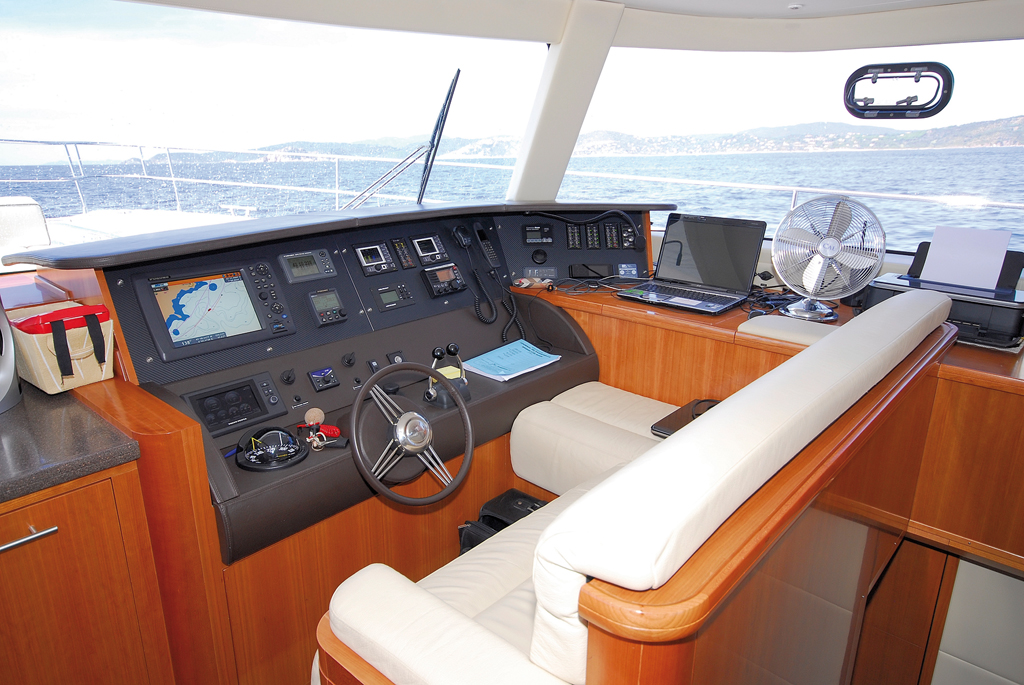
The inside steering position: ergonomic and comfortable. The best!
Daniel Andrieu, the Queensland 55’s architect
For the design of its flagship (interior design by Jean-Jacques Coste), Fountaine Pajot turned to the ‘Cabinet Andrieu’, project manager for the Iris working catamarans, whose various versions (passengers, transport) allow 300 people or their equivalent weight in cargo to be embarked at speeds of 20 to 30 knots! Daniel Andrieu is the designer of the famous Sun Magic 44 from Jeanneau, the Sun Fast 40 and 43, the Jod 35'. He collaborated with the Yaka Design Team for the America Class boats CHN 69 and FRA 69 in 2005 and 2003 and the study for Challenge France, Yves Pajot’s 12m JI.
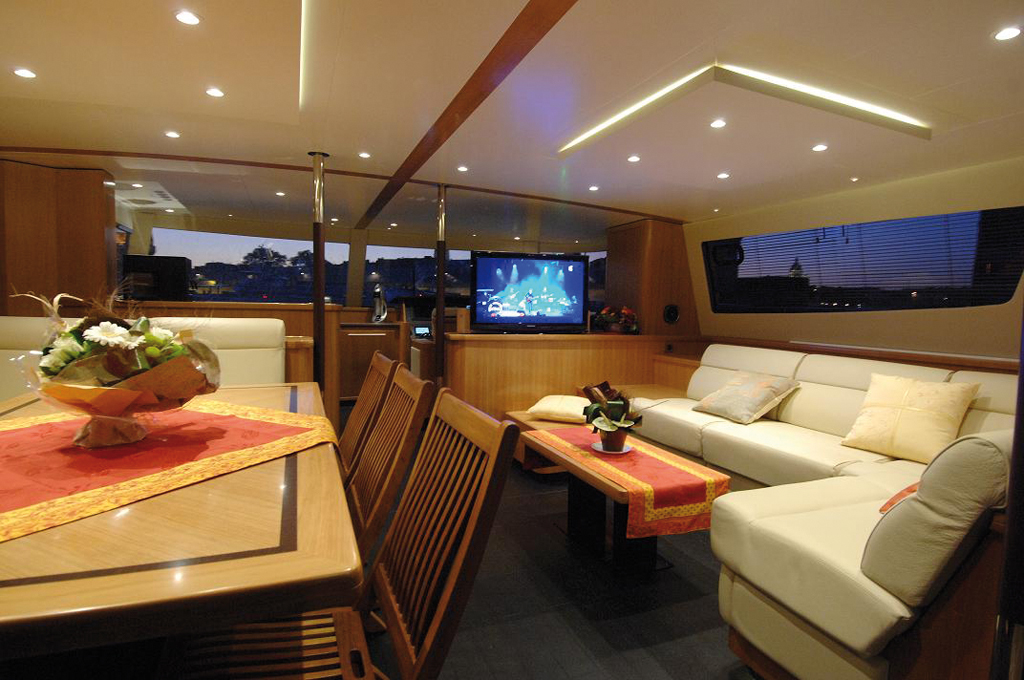
An atmosphere balanced between luxury and nautical comfort, the complementarity of the private spaces and conviviality.
A trawler cat with an assertive personality
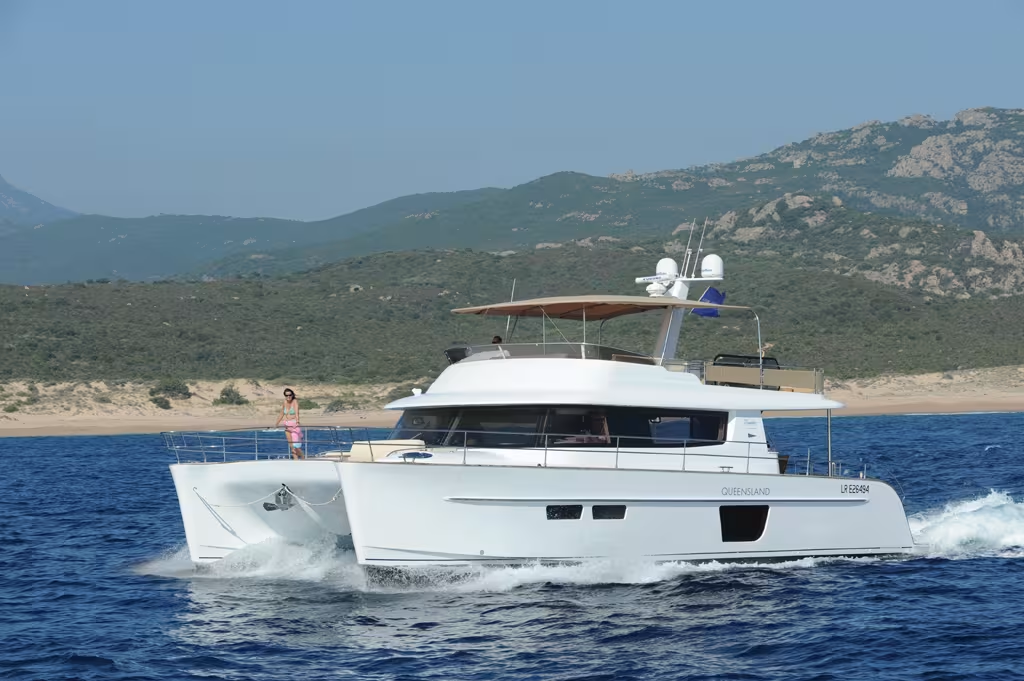
The Queensland is beautiful! The overall silhouette retains the ‘voyager’ look which suits the concept, and the care taken with the proportions and the secondary style elements enhances the elegance of the lines. Head on, the boat seems equipped for ocean conditions; a ‘gull’s wing’ is present, to reduce the inertia of the green water on the front of the platform, the two heavily flared bows are supported by a deflector ‘step’, below which the hulls become finer. The tunnel is very clean and does not restrict the acceleration of the water (which enters at 20 knots and comes out from this ‘turbine’ at 40!), guaranteeing low resistance, and participating in the quality of the flow and the silence in use. The impression of slenderness continues aft and the integration of the dinghy garage deserves praise for its functional relevance. The coamings are heightened by a solid wood gunwhale and a nice-looking stainless steel tubular guard rail. The style of the coachroof is superb, and the flybridge is well integrated into the overall lines.
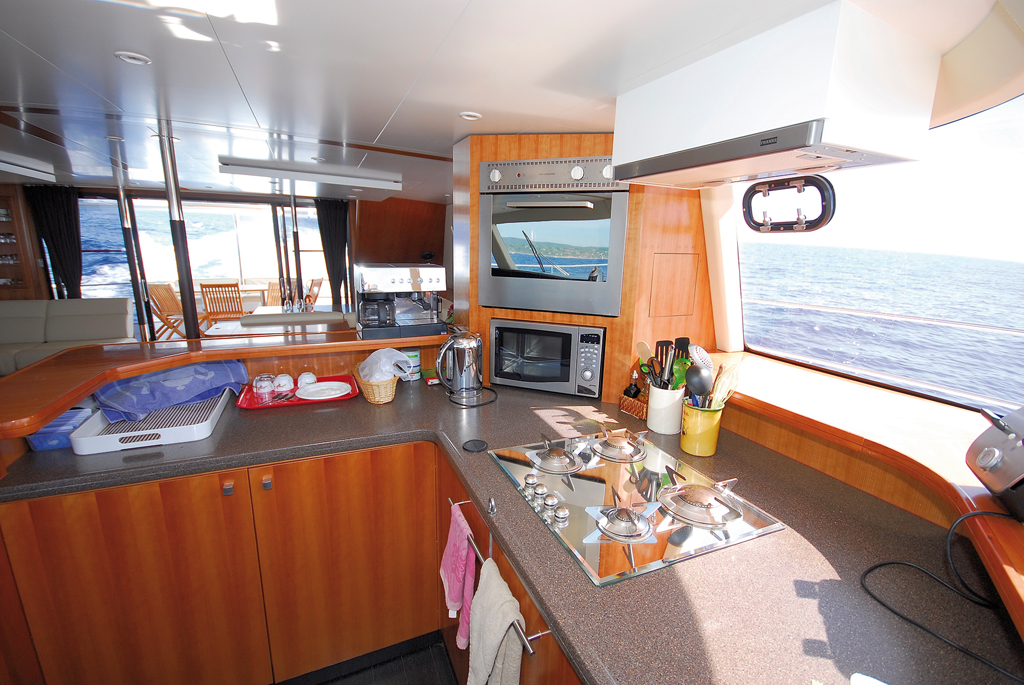
The galley is very functional, as well as being beautiful and having a sea view…
Accommodation which rivals the best references
Our test version was an owner’s version dedicated to charter! I’ll explain: the captain likes voyaging and discovering distant destinations, but his heart and his head encouraged him to open his boat to a clientele which shared his dreams. A skipper and a hostess (accommodated separately in the port forward ‘studio flat’) are at their disposal during the season (they have a fully-equipped laundry). ACTIUM offers 4 cabins, 2 superb ‘suites’ and two double-singles with equivalent services. Each of them of course has a separate shower and toilet, as well as TV-video. I spent a pleasant and restful night in the port aft ‘studio’, and appreciated the quality of the bedding, the ergonomics, as well as the visual effect of the transverse volume; the portlight in the hull side opens an innovative perspective on the nautical scenery. I appreciated the refinement created by the cosy comfort, perfect soundproofing and sophisticated lighting. The upper level brings together the galley and navigation area forward, as well as a superb and voluminous saloon, divided into a lounge and dining area. The panoramic view and the design are attractive, but the table will only accommodate around 6 people when the temperature means the exterior saloon can’t be used. The galley is pleasant to use, functional and practical, despite the sliding doors and the catches which are not worthy of the boat.
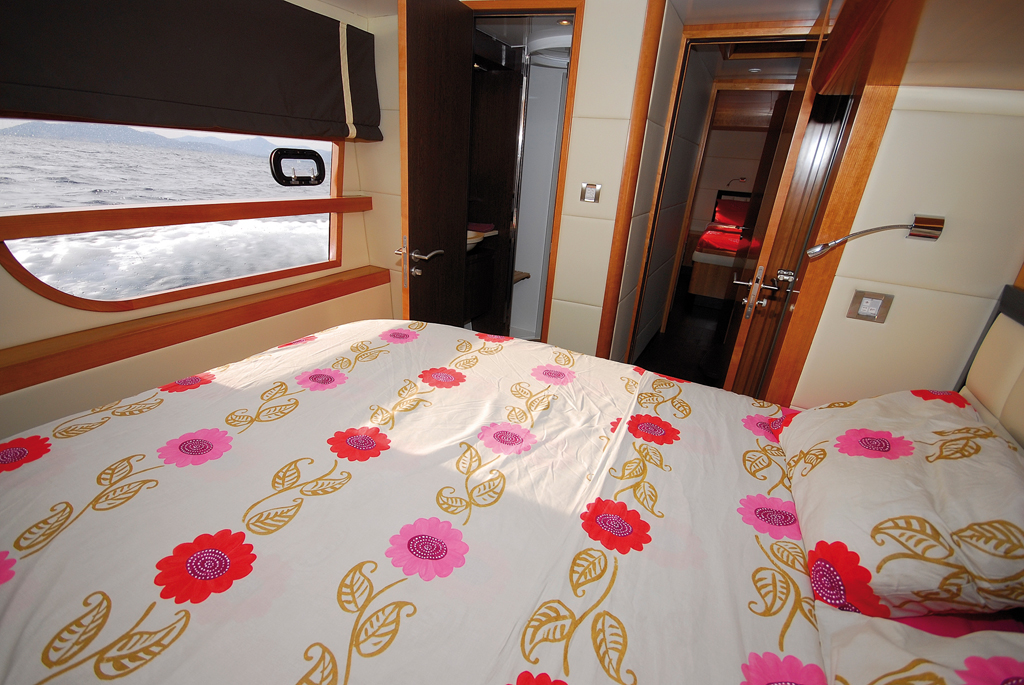
The aft cabins: a unique viewpoint for the nautical scenery.
Exemplary handling at sea
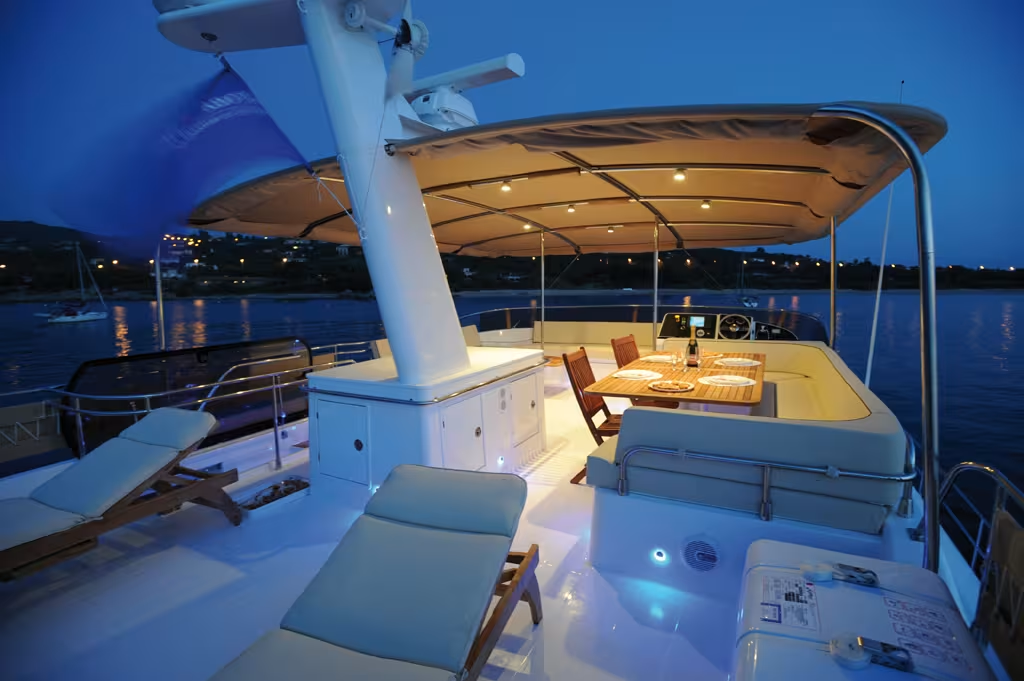
The navigation station is equipped for long watches: Pullman pilot berth, excellent visibility, good instrument positioning. The D11s’ digital dashboard is ideal: intuitive, clear and precise. Water, engine and gearbox oil temperatures, exhausts, pressures, synchronised rev. counters, everything is there! The electronics automatically match the engine revs; a child could keep an eye on the operating parameters! We head for the flybridge, whose superb accommodation area (wet galley, sun terrace, lounge and piloting areas) is...wonderful! The captain was manoeuvring to extract our 16.5m from the old harbour at Cannes, which was congested with boats from the recent Boat Show. Everything was going well without thrusters. Returning to the flybridge, I became aware of the size of the machine! Once out of the harbour, the sea was flat, with 10 knots of south-westerly breeze, and we settled down for a real moment of pleasure aboard our flying saucer. At 11 knots, then 14 – 15, the trim was perfect, no impacts, no vibrations, no noise! The coastline sped by before our eyes, a discreet wake closed up in a few boat lengths, without generating secondary waves (which sailing boats hate so much!). I took advantage of this opportunity to open the engine rooms and climb inside to get used to these 11-litre blocks. The companionway is safe, with no risk of falling on the engine or burning yourself. Visual checks are facilitated by the powerful lighting, a double lateral gangway and the headroom. The sound level is quite bearable at 15 knots, with no clatter or aggressive frequencies; these D11s are really civilised! The technical fit-out is well though-out, logical and readable; the temperature of the location is compatible with the demands of the turbo compression. General accessibility and the quality of the transmission (very short propshafts) are remarkable. I left the place with a feeling of confidence in this propulsion, which had just motored round Spain in four and a half days! We had planned to meet another crew in the Baie de Cavalaire, and took advantage of the empty stretch of water to accelerate. At 24 knots (laden), the Queensland reached its maximum speed and slipped along like a nautical high speed train. The noise and the wind were now discernable, and in my opinion, the boat was not as pleasant as at 15 knots, but this power reserve could be useful. It shows the boat’s dynamic qualities. Later, I weighed anchor from the flybridge, satisfied with the overhanging position and the size of the equipment (windlass compartment, chain, anchor, ease of fitting the spreader). The westerly wind was blowing at 15 knots as we motored past the Iles d’Hyères into a chop which was now more organised. No parasitic reaction in the structure, the stability remained surprising; we were at 18 knots... I wasn’t aware of the speed! The first spray from the bows attracted my attention, a higher windshield is needed for this kind of situation, or...reducing speed, as we did, to remain in our ‘economical’ range! Returning the Queensland to its mousehole at the back of Gapeau harbour, I was won over by this big boat’s agility, the precise flexibility of the controls and the silence of the exhausts.
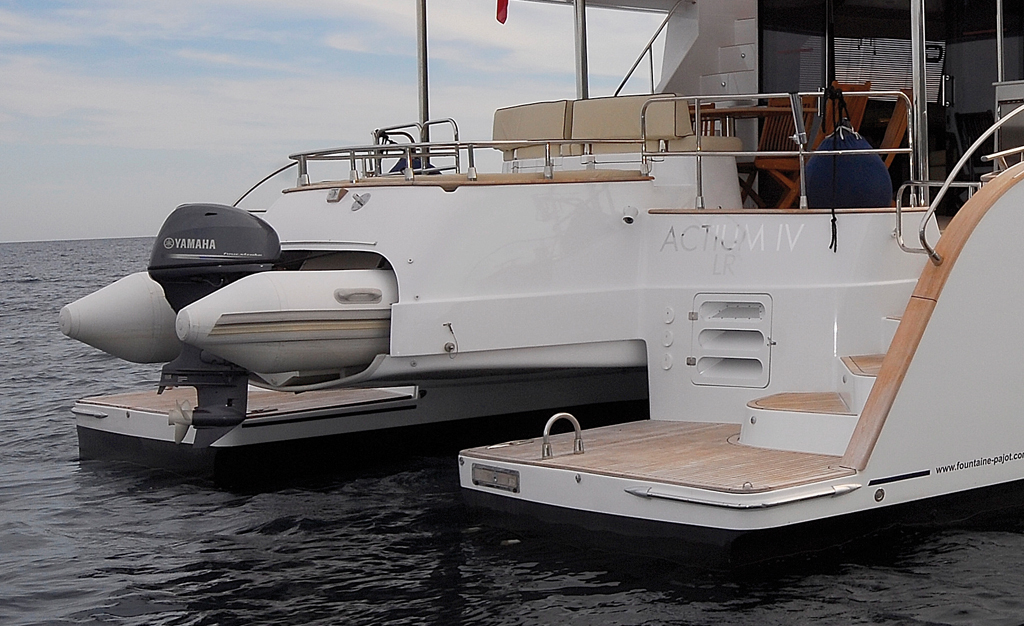
The builder has developed a clever system for stowing the dinghy. Practical and easy!
CONCLUSION
I liked the Queensland 55', its personality and its obvious ability to realise a programme. It is of course an exceptional catamaran, but I appreciated the reliability, the coherence and its seakeeping qualities. My judgement is also based on the panache which it showed during the 1800-mile delivery trip from La Rochelle to Ajaccio. The discretion of its wake, the total absence of smoke or smell (!), its ‘voyager’ silhouette, its civilised temperament and its superlative comfort offer an attractive alternative to the so-much-greedier monohull competitors. The added value in terms of pleasure and quality of life aboard is real! The 55’ will show its potential in cruising-discovery use and voyaging at an economical speed; I am already envious of the crews joining the boat in Croatia and the Cyclades next spring.
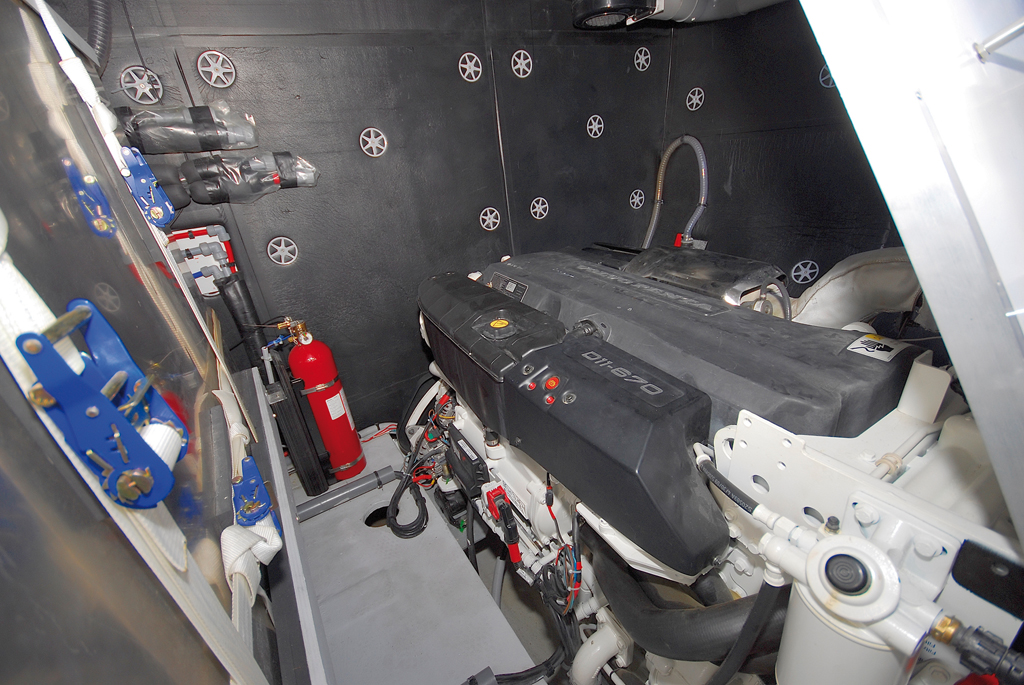
The Queensland’s technical heart: a clear, readable and reliable installation.
TECHNICAL SPECIFICATIONS
Architect: Daniel Andrieu Builder: Fountaine Pajot Interior designer: Jean-Jacques Coste Length: 16.75m Beam: 7.80m Draft: 1.10m Engine powers: 2 x 435hp or 2 x 670hp. Volvo IPS system available (adjustable legs, 30% economy, high additional cost) Transmissions and power of test model: 2 x 670hp / propshafts Range: 1,200m at 9.2 knots Diesel: 2 x 1,600 L Water: 1,000 L Max. speed: 24 knots (2 x 670 hp version), 20 knots (2 x 435 hp version) Price exc. VAT: 1,689,000 euros in Maestro version and 1,623,000 euros in 4 cabin Quatuor Main options, exc. VAT: - Volvo D11 engine: 108,000 euros - full air-conditioning: 45,000 euros - equipped dinghy garage: 19,600 euros - 180 L/h watermaker: 17,600 euros - saloon video + aerial pack: 7,200 euros - cabin video pack: 8,000 euros
The plusses
- overall lines - behaviour at sea - comfort
The minusses
- high price - cheap galley cupboards - consumption at over 15 knots
THE COMPETITORS
Model Builder Length in m Power hp Weight in t Price in euros, exc. VAT 60' Power Sunreef 18.29 2X300 30 1,200,000 Alaskan 54 Serenity Shipyard 16.30 2X260 15 N/A Jag 550 Dean Catamarans 16.50 2X286 22 700,000
Performance-consumption D6
Speed Consumption Range Eco mode 9.5 kts 2X14 L/h 1,200 miles Fast cruising 15 kts 2X50 L/h 450 miles Max. speed 20 kts 2X83 L/h 360 miles
Performance-consumption D11
Speed Consumption Range Eco mode 9.5 kts 2X15 L/h 1,000 miles Fast cruising 18 kts 2X60 L/h 430 miles Max. speed 24 kts 2X120 L/h 290 miles
Actium
The catamaran we tested is available for charter in the Mediterranean, with skipper and hostess. It has just finished its first season in Corsica, and should be cruising in Croatia, then Greece during the summers of 2011 and 2012. If you would like to discover the joys of the motor catamaran, in a luxurious, comfortable atmosphere, don’t hesitate to join Actium... Information: www.actium-catamaran.com