
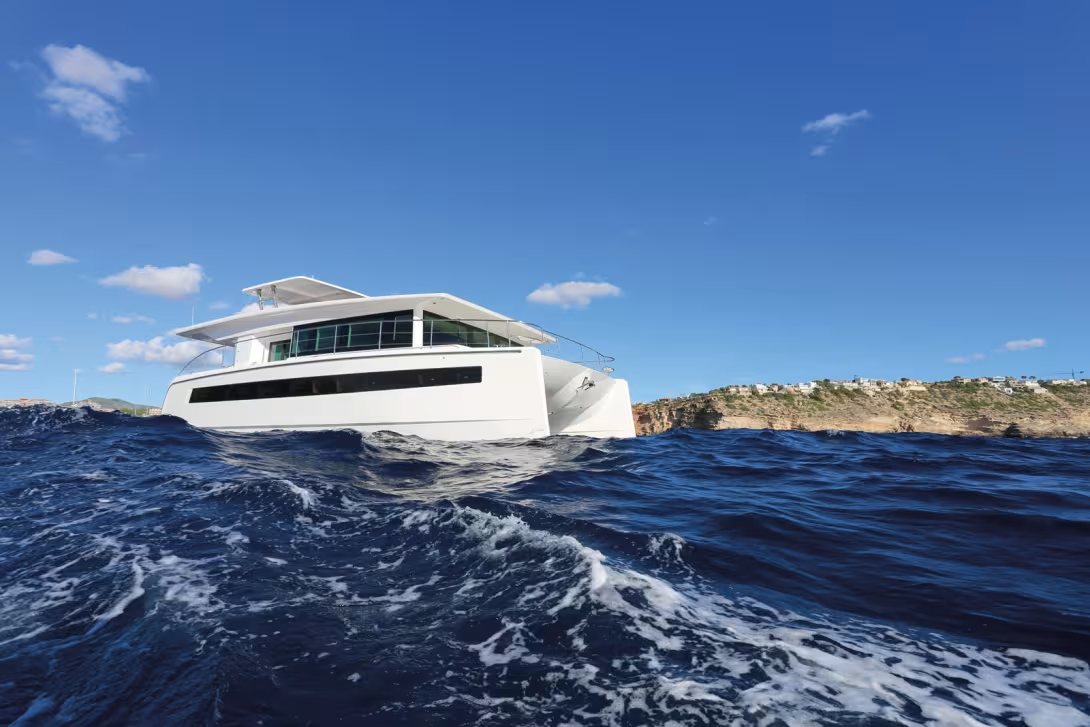
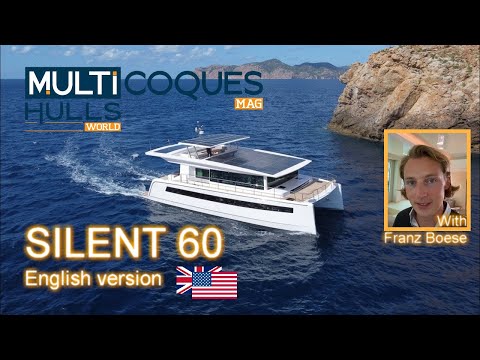
This new model, belatedly presented for the first time at September’s Cannes Yachting Festival, is taking up the torch of the brand’s first model, the Silent 64. That was the catamaran that became the first electric propulsion multihull to have crossed the Atlantic. A few years ago, it was quite a feat... One that the Silent 60, which is much more technologically and technically advanced, could repeat without difficulty.
Test location: Porto Adriano, Mallorca, Spain
Conditions: Wind 5 to 10 knots, calm sea
Infos pratiques
- Le chantier : SY 60
- La fiche technique
-
 Découvrez notre vidéo exclusive
- Financez votre Silent 60
- Assuez votre Silent 60
- Articles autour du Silent 60
Three years ago, the members of the Silent Yachts team in Austria could be counted on the fingers of one hand. CEO Michael Köhler came up with the concept of the electric catamaran as early as 2014, starting from scratch... It was he who presented us the Silent 55, not far from Palma de Mallorca. This model is considered to be the first electric catamaran actually offered in series production. The catamaran behaved well, the design was neat, but the finish a little less so. Today, Silent Yachts has a staff of 40 people. The brand has its catamarans built in Italy and Thailand: 13 examples have been launched so far, 12 are currently in build, and a further 27 are on order! These figures sum up the accuracy of the initial vision: yes, the electric powercat has a future - as bright as the sun, you might say. Building on this success, Michael has opened an office in Port Adriano and has a slip right out front - which is of course where the brand new Silent 60 is docked. It should be noted that while the site has been radically urbanized, the adjoining marina offers very high-quality services - as far as we are concerned: the pickup line from the starboard groundline that was fouled in the propeller was cleared by a diver a few minutes after a call to the Harbor Master by our Captain. Because our luxurious electric powercat is indeed under the responsibility of a genuine skipper with stripes…
 |
 |
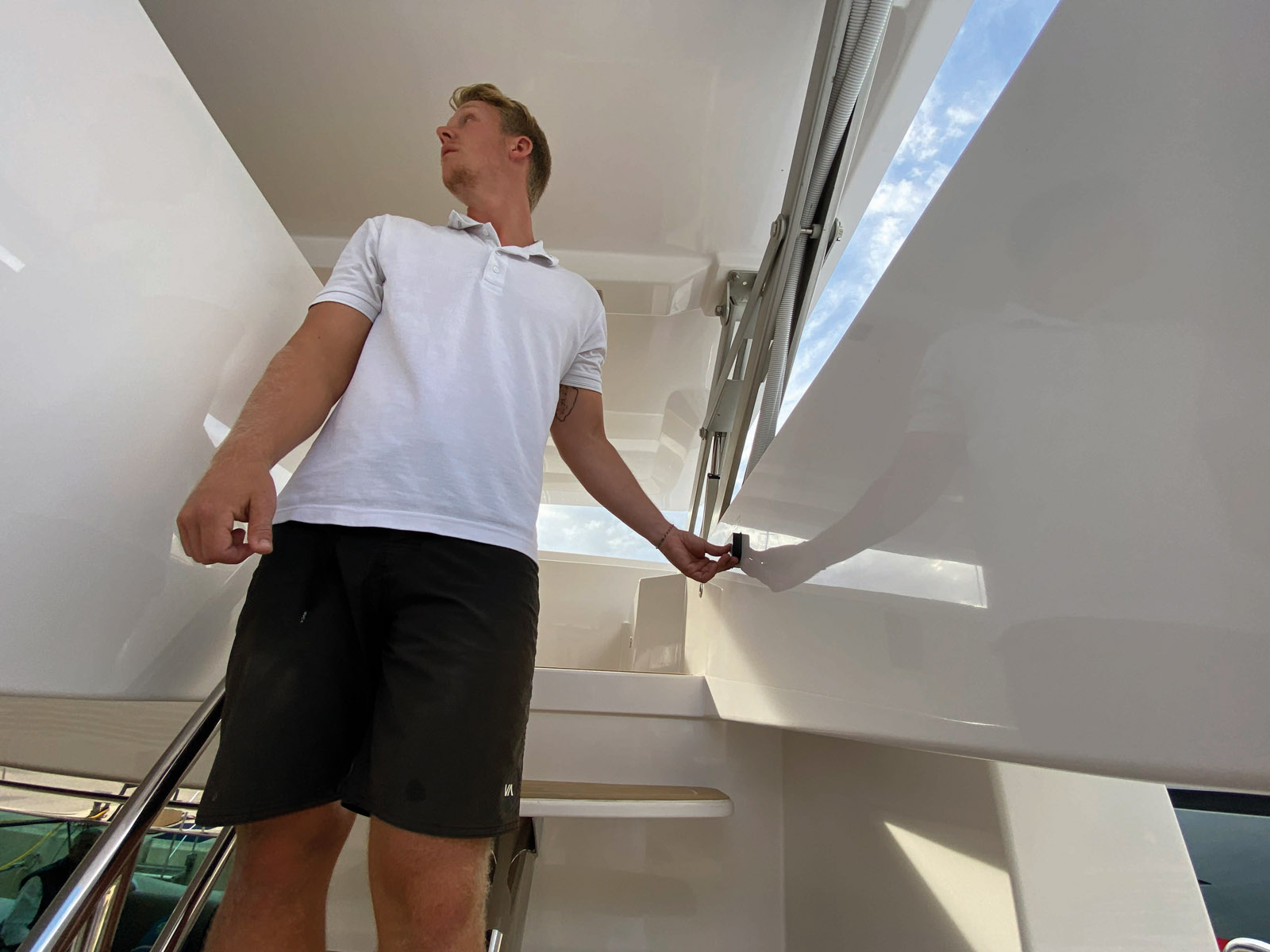 |
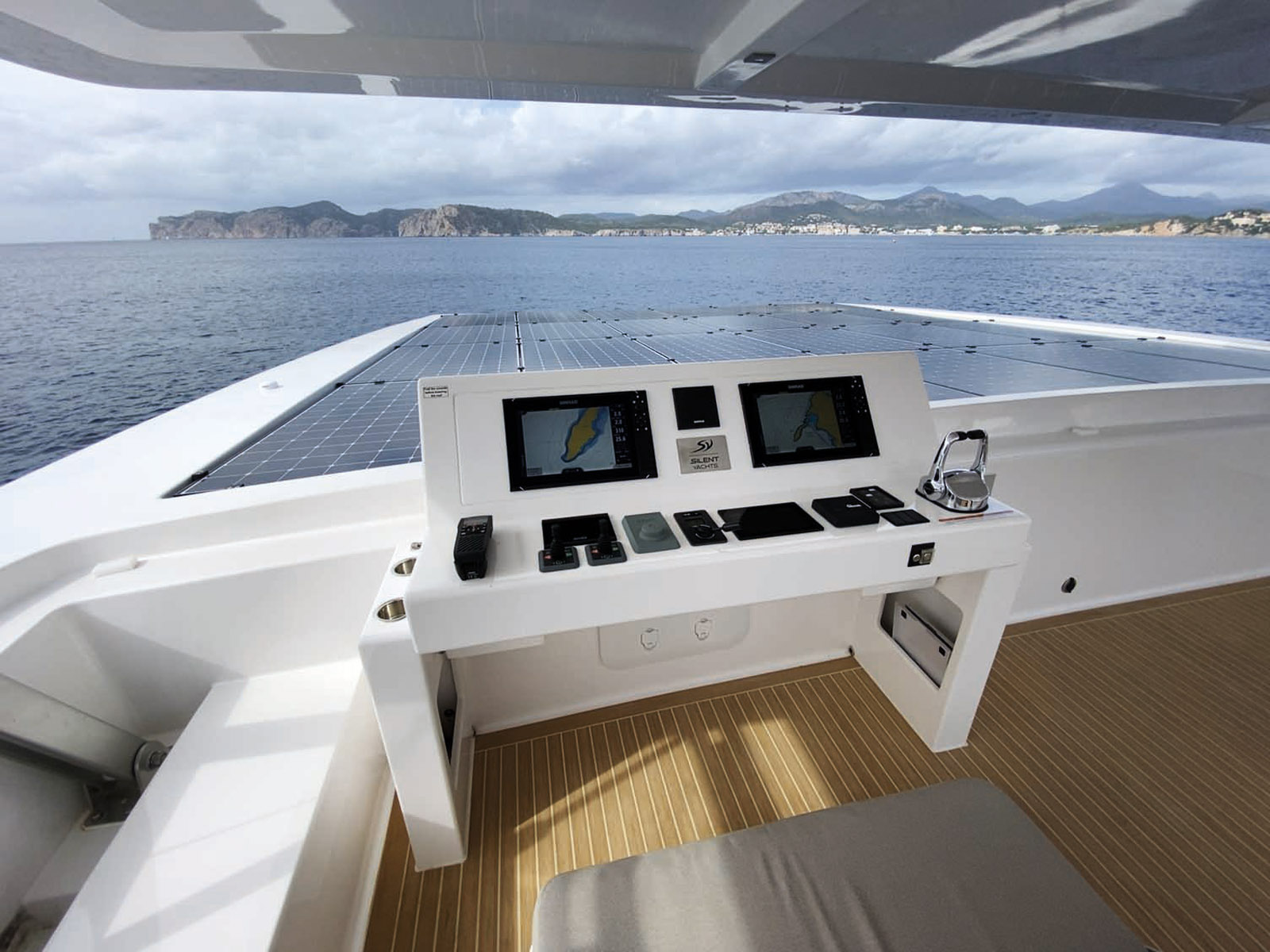
The flybridge features an exterior helm station. The T-top is foldable.
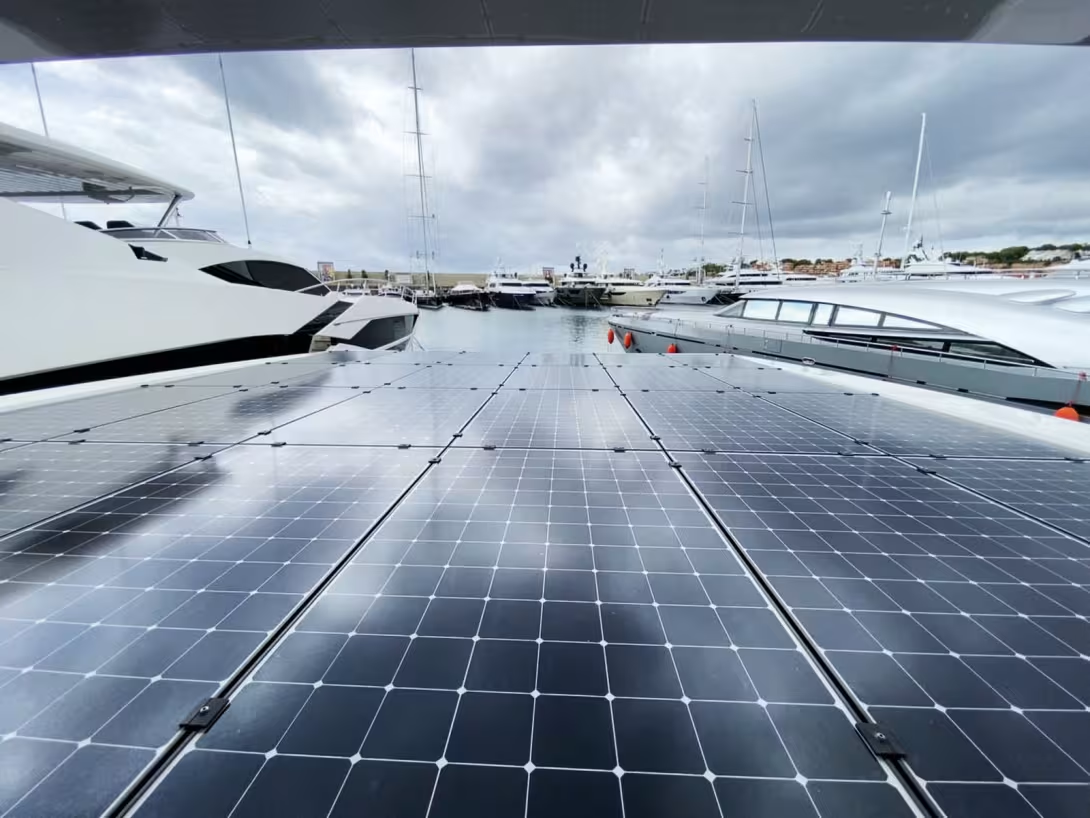
The sun is first and foremost for the solar panels!
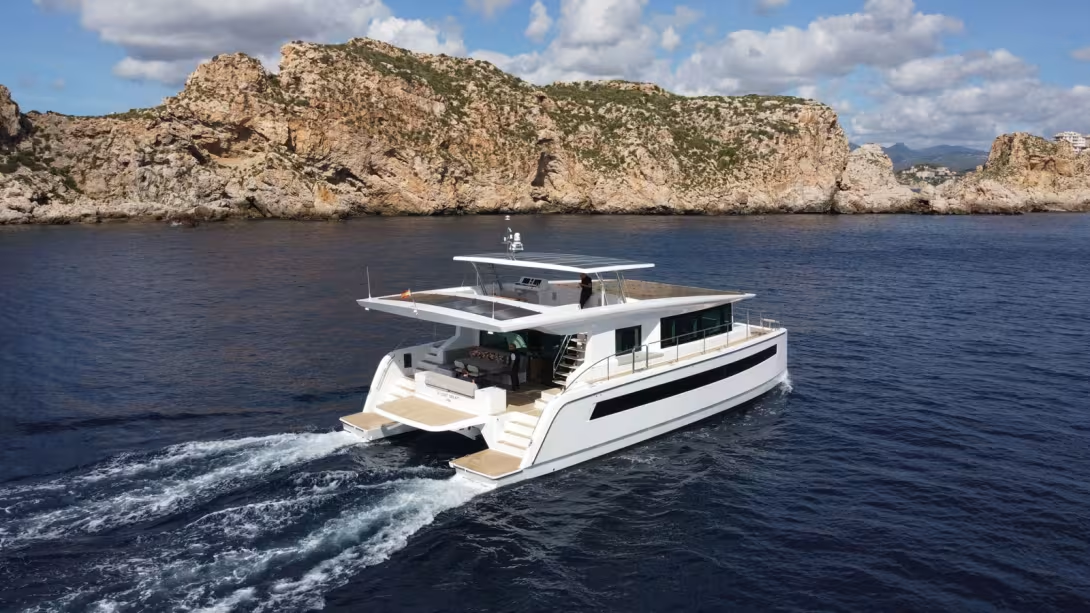
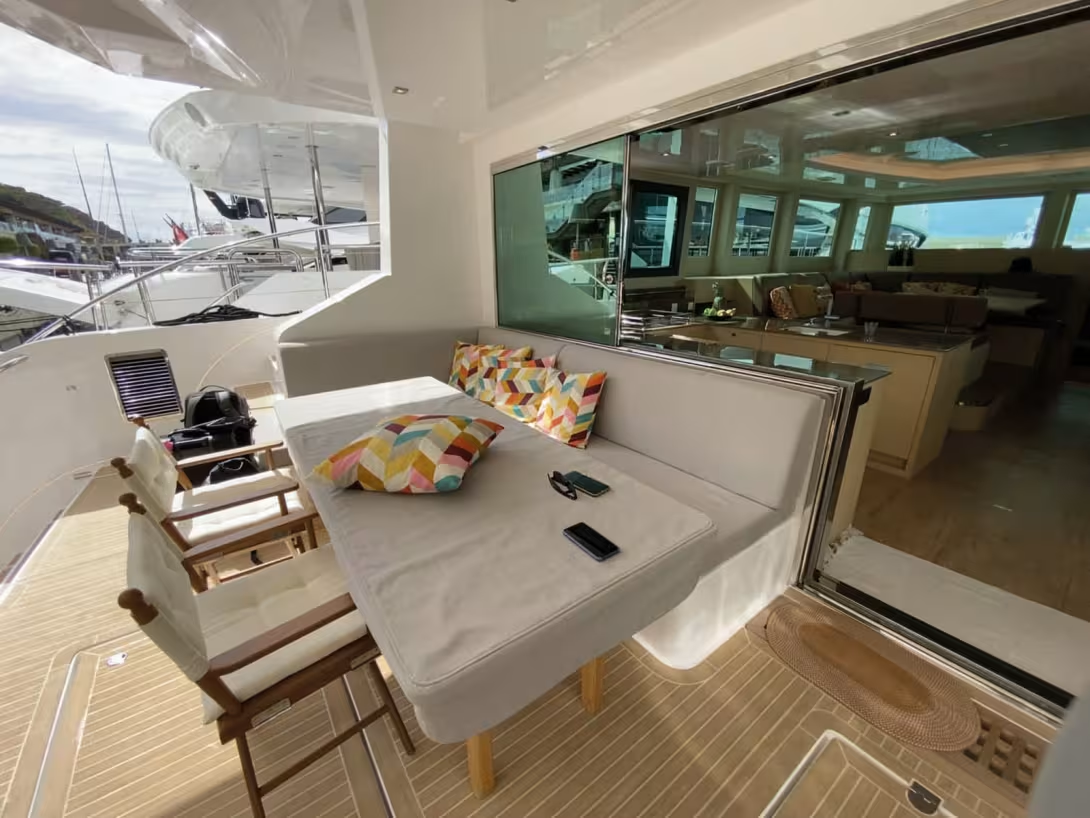
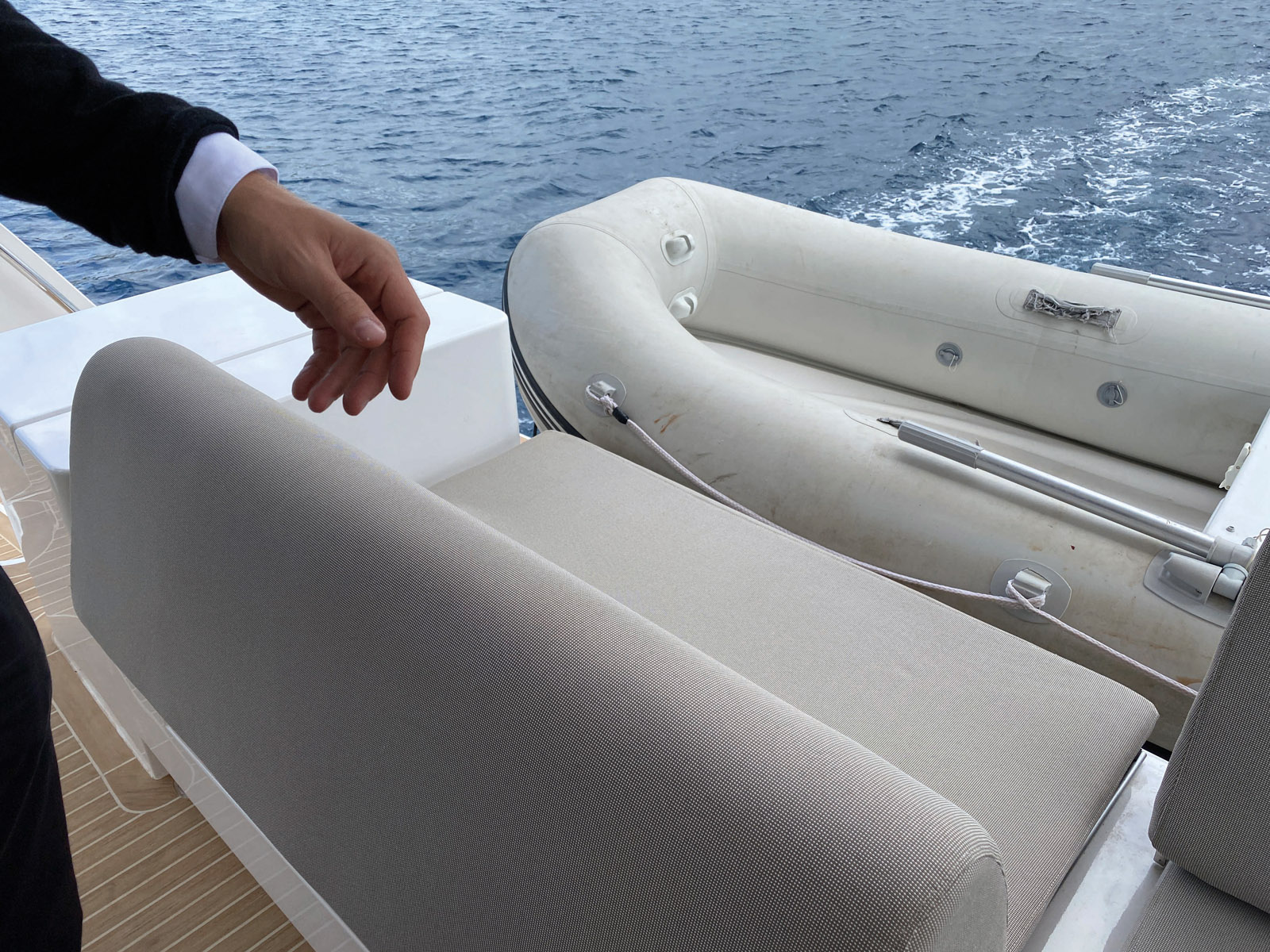
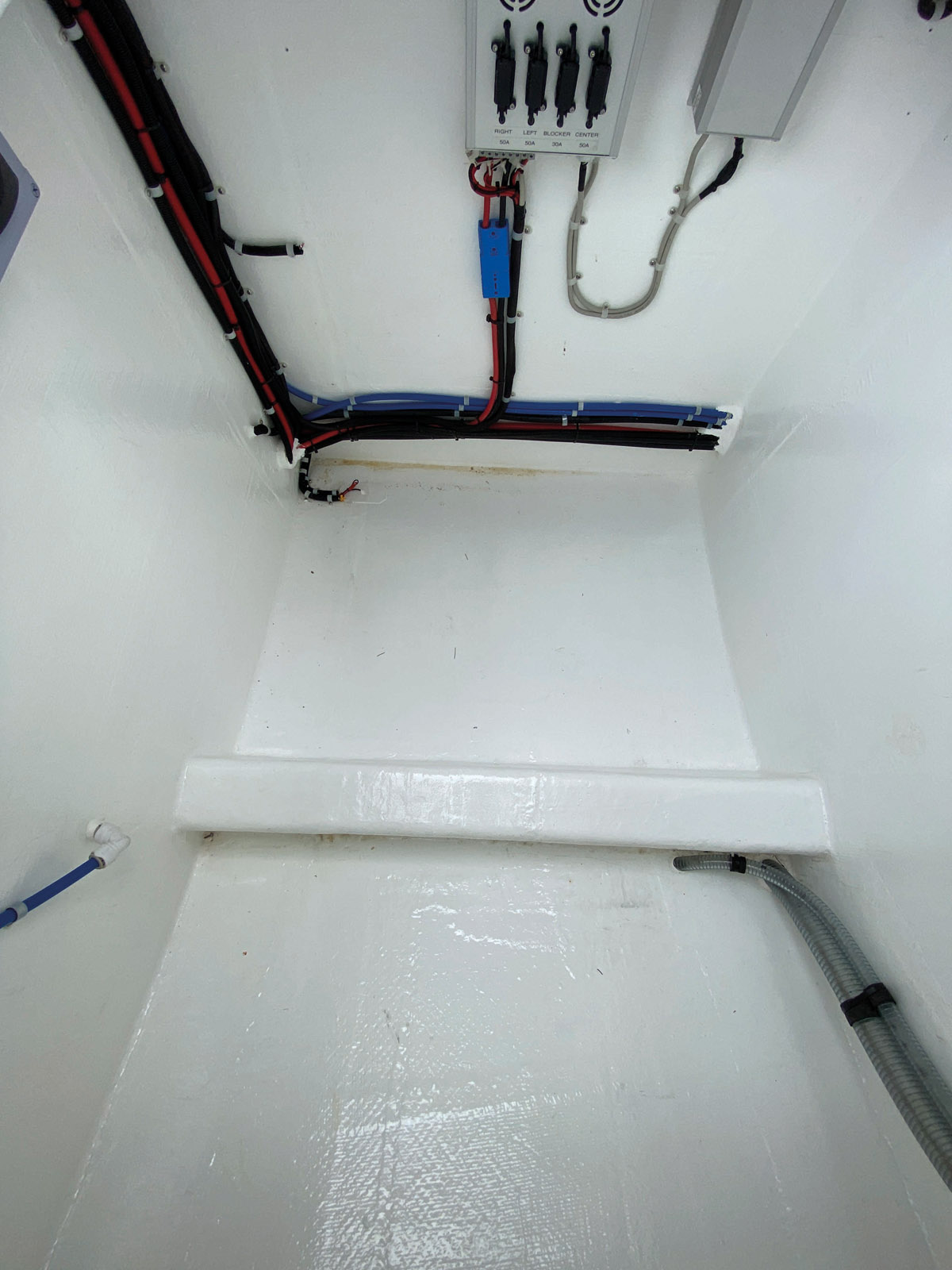
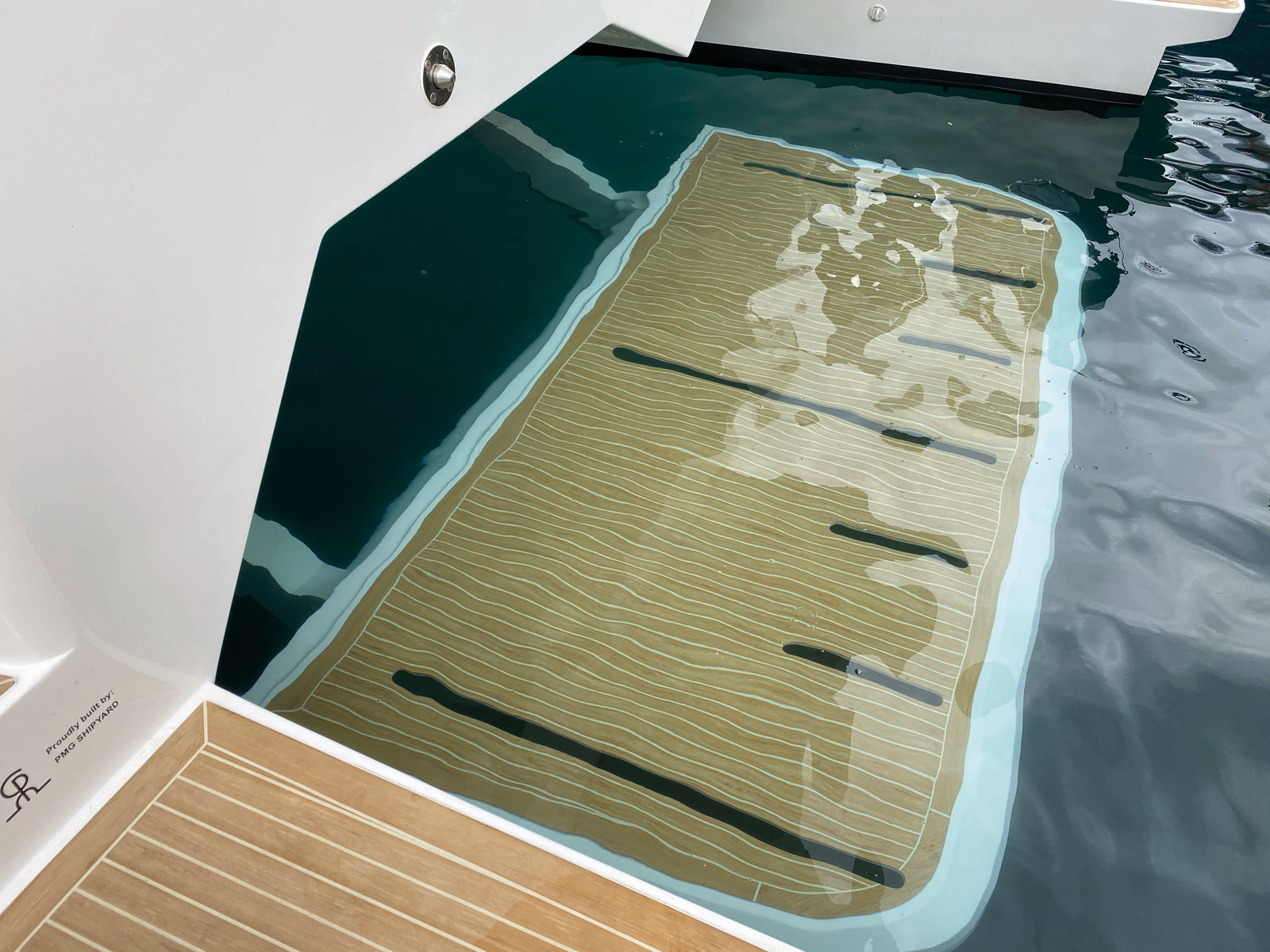
It’s clear that the designers of the Silent 60 have set about getting the most out of the upper horizontal surfaces to install the solar panels. No question of overhead windows here, but rather of a folding T-top in order to avoid being completely in the shade (in the event of the sun pointing toward the stern, for example) and of an XXL-sized coachroof. In practice, the side decks are sometimes reduced to 21” (55 cm) wide and are topped, especially towards the front, with a lip that gets in the way a bit. In general, there’s almost no useful surface for the crew, except for the lateral seats – these are neat, having already been validated on the Silent 55 - and the extreme front of the deck, though this is really exposed to the sun. LEDs are integrated into the bulwark. The cockpit is also generously shaded. There is a 6’10” x 2’10” (207 x 85 cm) table with L-shaped seats on the port side. Further aft, a reversible bench seat overhangs the huge hydraulic aft platform. This not only supports the dinghy but also acts as a “beach-club” – in fact, you can connect the two sugarscoops (four steps down from the cockpit) to create a long flat area of more than 26 feet (8 meters). Numerous storage spaces are provided to neatly stow equipment as diverse as scuba gear or bicycles. The flybridge is reached by a ladder to starboard - eight rungs plus two steps at the bottom. Up there, a breathtaking view over the water (and the solar panels), a complete helm station, a folding table (59”x25”/50” - 150 x 63/126 cm), large L-shaped seats and an imposing articulated T-top, leading to the relative simplicity of the area.
 |
 |
 |
The cockpit has a large outside table and a reversible aft bench seat.
The builder has provided a lot of stowage space, such as this locker.
The huge aft platform supports the dinghy – and will be much appreciated at anchor.
Powercat or palace?
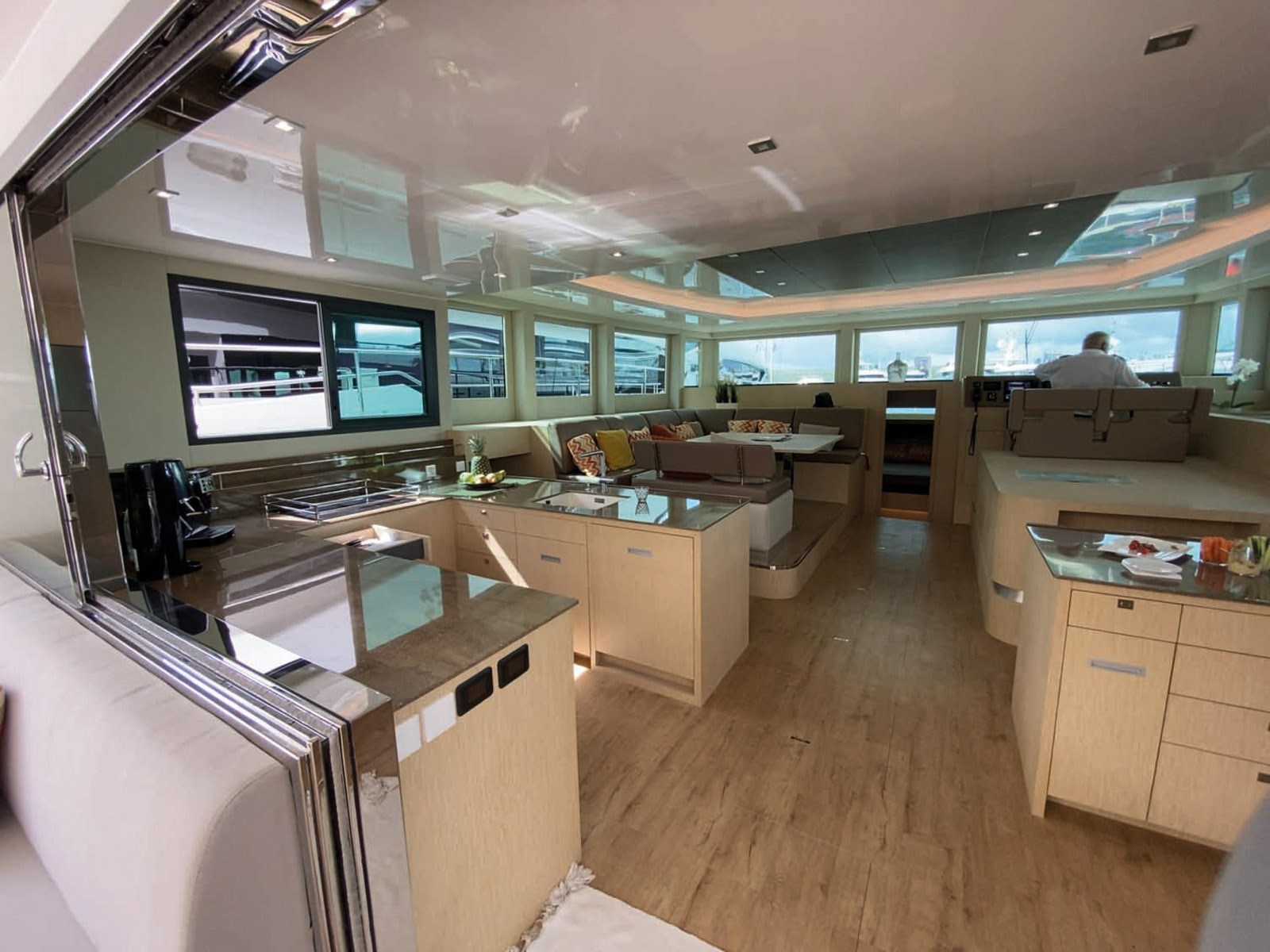
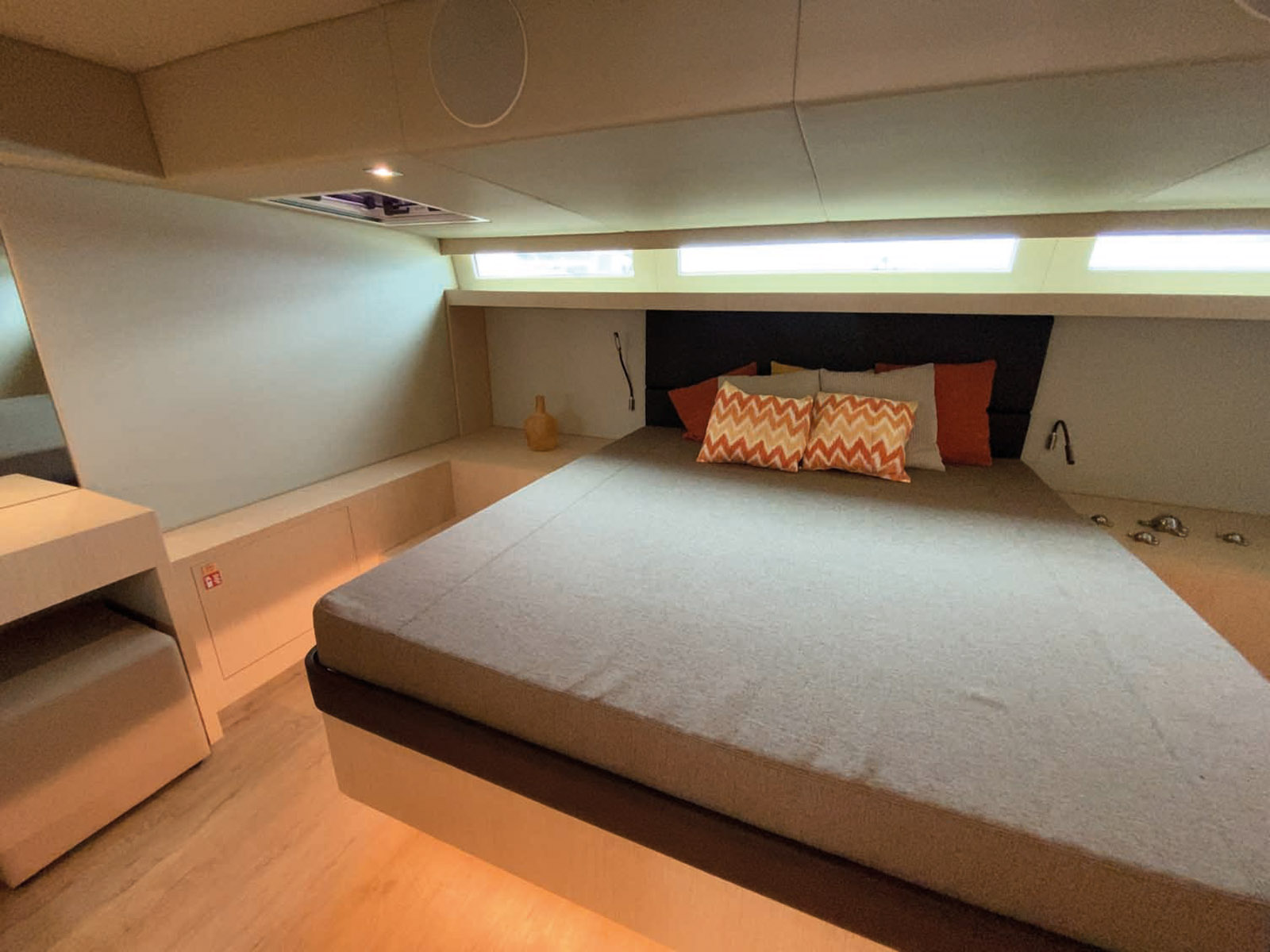
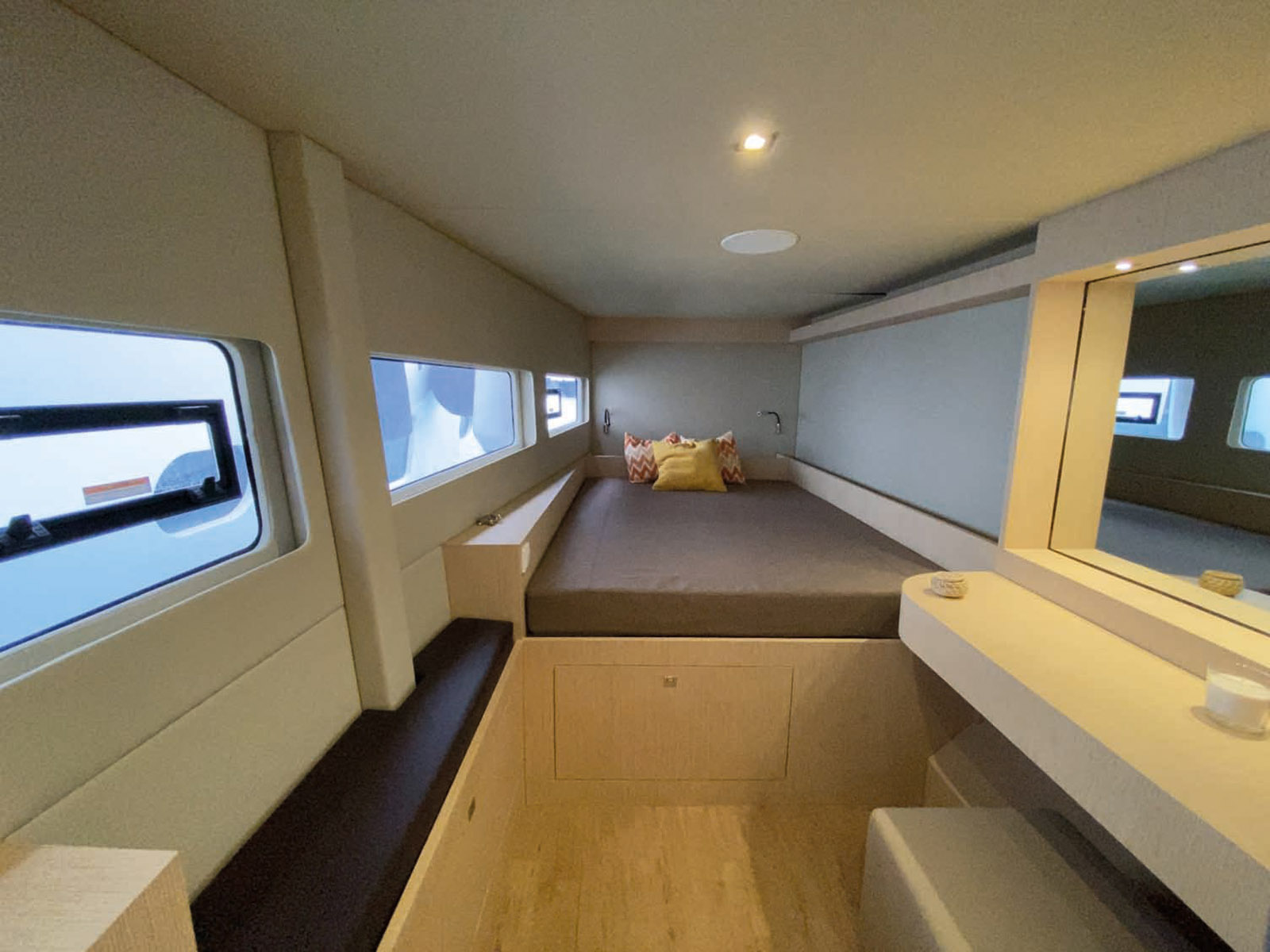
The entrance into the nacelle is particularly uncluttered: 6’7” (2 m) high and 4’9” (1.46 m) wide, with another opening panel above the countertop 4’1” (1.24 m) high and 3’ (0.91 m) wide. The nacelle offers 515 sq ft (48 m²) and an incredible volume - the headroom is over 7’ (2.20 m). Close to the cockpit, the galley is composed of two modules - a U-shaped one to port and an L-shaped one to starboard. The refrigerator is huge. The raised U-shaped saloon is offset to port and is centered around a 60” x 55” (154 x 140 cm) table. Franz Boese, Marketing and Product Manager, points out a notable change starting with hull #4: the entire bottom of the nacelle will be raised significantly, so as to gain volume in the storage beneath the cockpit, but also to remove the step from the saloon. Opposite, a large flat area can be exploited – it served as a chart table during our test. The interior helm station features a full instrumentation system, which provides all the standard navigational information to the Captain, as well as data concerning energy management. On the screens, you’re able to see the approaches to the dock and also anchoring operations (there’s a 1,500 W windlass) thanks to a set of cameras. Forward, a companionway and two steps lead to a first cabin of 215 sq ft (20 m²) whose floor seems surprisingly soft, like a carpet. The headroom here is 6’6” (1.97 m) and the central bed is 6’7” (2 m) long by 5’11” (1.80 m) wide. On the starboard side, four steps down, you have access to a large bathroom. In the port hull, five steps and 4’1” (125 cm) lower than the floor in the nacelle, there are two cabins and their private bathroom. The topsides house seven portholes, no less! The bunks are wide (6’7” x 4’11” - 2 x 1.5 m - at the bow, and 6’7” x 6’3” - 2 x 1.91 m - at the stern), and the volumes well ventilated (3 opening panels at the bow, four at the stern). In the starboard hull, there is an aft cabin. Here again, the dimensions are generous with 6’3” (1.91 m) of headroom and a bed measuring 6’7” x 5’8” (2 x 1.72 m). It’s a pity that the door sills stick up from the floors. A skipper’s cabin and shower room are also provided. The builder offers several layout versions from four to six cabins. A forward door can also be incorporated.
 |
 |
 |
The nacelle totals 151 square feet (48 m²). Its opening onto the cockpit is very wide.
The owner’s cabin is located at the front of the saloon, and totals 215 sq ft (20 m²).
The many large hull windows bring a lot of light into the cabins.
Comfort and silence... the joy of electric
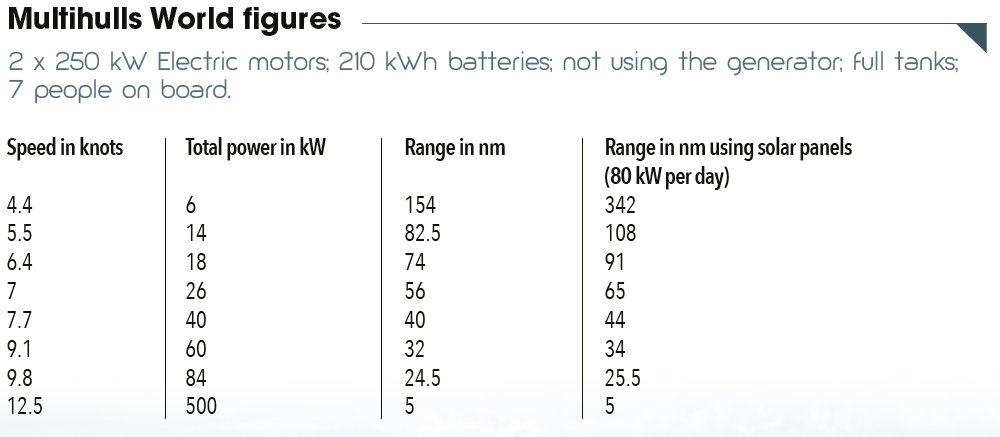
The manufacturer was well-advised to name its brand Silent; it is indeed the silence that one notices at first. No vibrations, imperceptible powering of the engines, barely noticeable shift into gear, only the few seconds of action of the bow thruster to disturb the atmosphere. Once underway, there is still no noise, including in the aft cabins. The Silent 60 we tested was equipped with two much more powerful motors than those offered as standard - 2 x 250 kW compared to 2 x 30. Energy management on board is primarily related to the speed of the powercat. Without taking into account possible electric recharging, the 210-kWh battery doesn’t allow for more than 30 minutes at maximum speed - 12.5 knots - that is to say, barely 5 nm. On the other hand, below 10 knots, one consumes “only” 42 kW per motor. There, you can keep going for two and a half hours, or 24.5 nm. That’s still not very far, of course, especially as you wouldn’t go as far as to completely flatten the batteries, but the figures improve very quickly if you have a light hand on the throttles: 32 nm at 9.1 knots; 40 at 7.7; 56 at 7; 74 at 6.4; 82.5 at 5 and even 154 nm at 4.4 knots. OK, we’re not going very fast anymore... but that gives the solar panels time to charge! Counting 12 hours of sunshine (it does sometimes get dark!), the manufacturers are assuming an output of 5 hours per day - you can expect to accumulate 80 kW per day, or 3.3 kW per hour for the batteries. As a result, in good weather, the Silent can cruise “indefinitely” by keeping its speed below 4 knots. Not surprisingly, the gain from the solar panels decreases rapidly as the speed increases - see table below. Warning: these figures do not take into account the rest of the consumption on board nor the inevitable losses in efficiency. Of course, the manufacturer has provided a powerful 100 kW generator, capable of guaranteeing a speed of 10 knots. This generator is located aft in the port hull - and even though it is carefully soundproofed, we can still hear it! The idea is therefore to cruise quietly between 5 and 10 knots and to take advantage of periods at anchor to recharge the batteries. The builder has plans for an automatic kite to provide drive on downwind passages. The system has not yet been perfected, and we were unable to test it. In principle however, the idea fits perfectly with the overall philosophy of this multihull. It is also possible to recharge relatively quickly in port - provided that a suitable shore power outlet is available. A glance at the “engine room” reveals the care taken with the installation and the ease of intervention on all the components and equipment aboard this electric powercat.
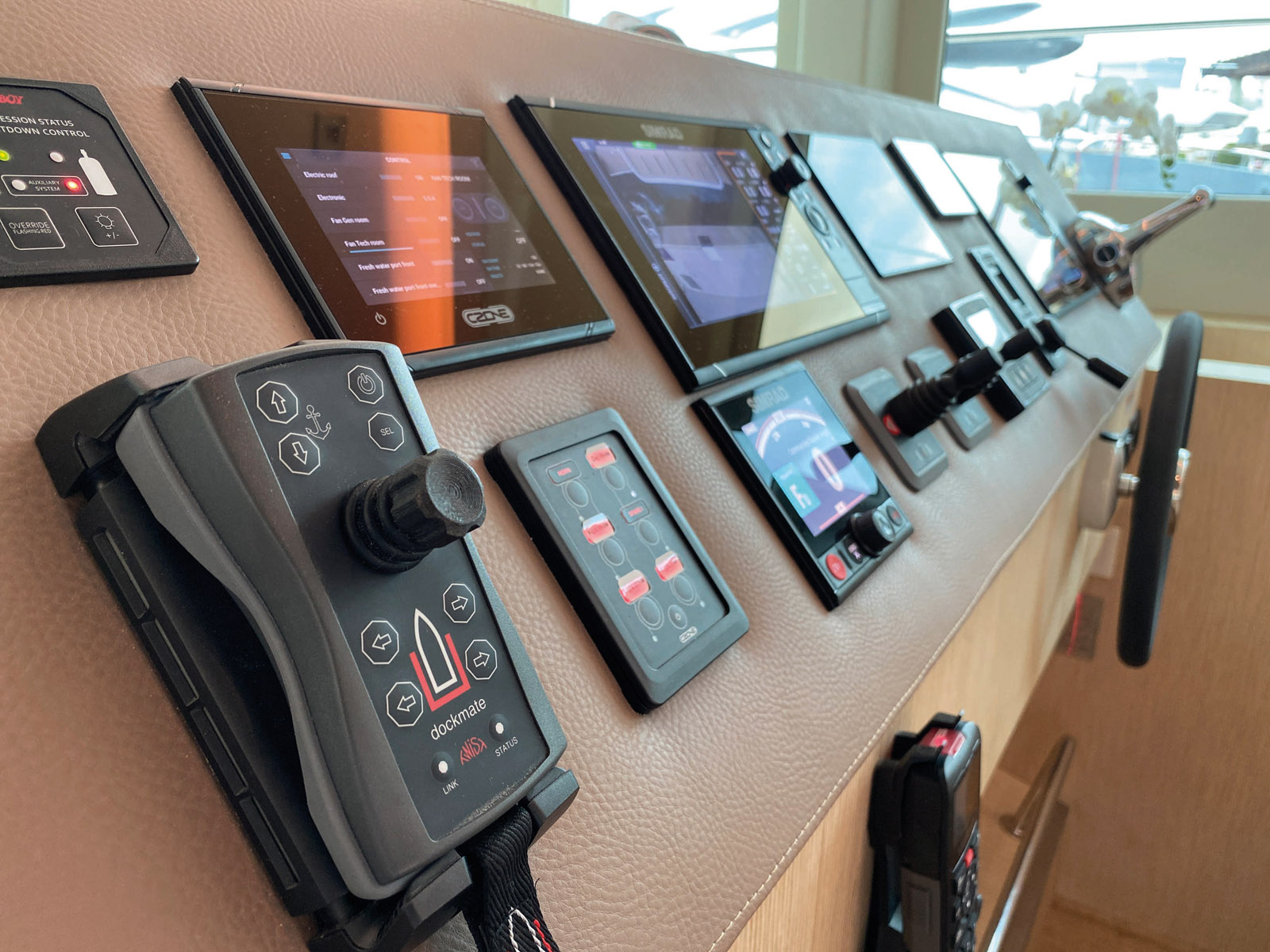
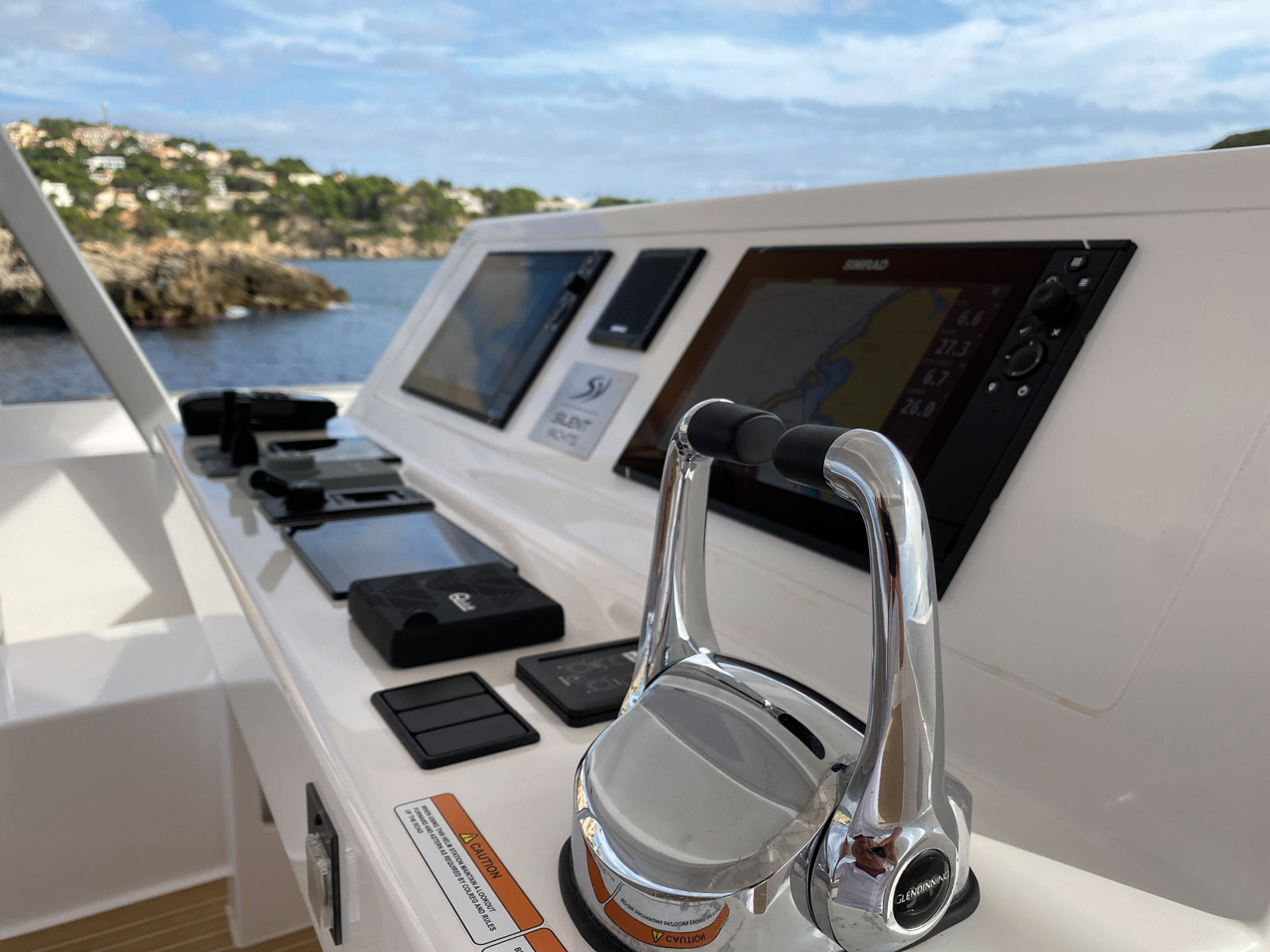
The interior helm station is home to the controls and displays all the technical information.
Conclusion
As in the automobile industry, boats that use electric propulsion have evolved considerably. A successful concept and accepted technological choices: we have come a long way since the utopian projects of (only) 10 or 15 years ago. A notable difference between electric cars and electric boats is that the former do not use solar energy - one might wonder why - whereas on the sea they do! Of course, it is the multihull configuration that is the most important factor, combining large deck areas and low drag. Today, the Silent 60 demonstrates that it is possible to enjoy comfortable cruising without using fossil fuels. But the “official” speeds are still quite modest... mostly because of the displacement. The Silent 60, built in glass/vinylester composite, is close to 29 tons lightship displacement. This is very heavy compared to the 11.5 tons of the all-carbon Class 6 Power. The next step will undoubtedly be to reduce the weight!
The Pluses:
+ Comfort and silence under way
+ Possibility to live on board without running the generator
+ Technical mastery and a clear improvement in level of finish
The Minuses:
- Speed and range still limited in “self-sufficient” mode
- Little sunlight for the crew
- Narrow side-decks, forward
TECHNICAL SPECIFICATIONS
Builder: Silent Yachts
Architect: Dr. Albert Nazarov
Concept: Michael Köhler
Length: 59’ (17.99 m)
Waterline length: 58’ (17.80 m)
Beam: 29’6” (8.99 m)
Draft: 3’ (0.93 m)
Displacement: 63,900 lbs (29 t)
Standard motors: 2 x 30 kW
Motors on our test model: 2 x 250 kW
Max speed of our test model: 12.5 knots
Max motors: 2 x 340 kW
Generator on our test model: 100 kW
Fuel: 2x 132 US gal (2 x 500 l)
Lithium batteries: 70 kWh
Batteries on our test model: 210 kWh
Solar panels: 16 kWp
Water: 2x 132 US gal (2 x 500 l)
CE Certification: A12; B12; C16; D20