The multipower market is reaching a level so effervescent that it’s not easy for us to test all the new models launched all over the world. In fact, you might think it would be tempting to simply share with you tests of boats from the big yards... but that’s not knowing us at all! When the first images of the Sunmare were circulated, we were immediately seduced by the design of this powercat. Is it a one-off? Are we the only journalists to have tried it out? All the better for you! We want more like this!
Infos pratiques
- Le chantier : Sunmare 50
- La fiche technique
-
 Découvrez notre vidéo exclusive
- Financez votre Sunmare 50
- Assuez votre Sunmare 50
- Articles autour du Sunmare 50
Conditions: Sea state slight, 10 to 15 knots northeasterly wind
Although the venerable F. Hervé shipyard was established in La Rochelle back in 1946, just after the war, it has evolved over the generations (currently the fourth) who have successively taken the helm. As proof, we went along to discover brand-new premises in Périgny, on the outskirts of La Rochelle, along with a mysterious multihull - it’s a sub-contract job currently in build. They know about quality work here: in 78 years, only 37 boats have been produced. All are one-offs, and most are wood construction, often of traditional inspiration. However, Hervé soon turned their attention to composites and electric powertrains, and even produced three powercats - Nomad, a small cruiser based in La Rochelle, Glaz Mor, a powerful cruiser based in Canada, on the St. Lawrence, and the astonishing A2V prototype, a boat with aerodynamic lift. The fact remains that the Sunmare 50, with its sharp design and modern, neo-retro look, is a somewhat of a UFO in Hervé’s catalog... and I’m delighted to see it “in real life”. Just enough time to grab a quick snack from the unmissable eatery, before stepping aboard with Alain Balzeau and his son Bérenger at the port of Les Minimes. We were lucky that despite it being bitterly cold, the sun was out and the light was sublime.
Extremely Sleek Sedan Design
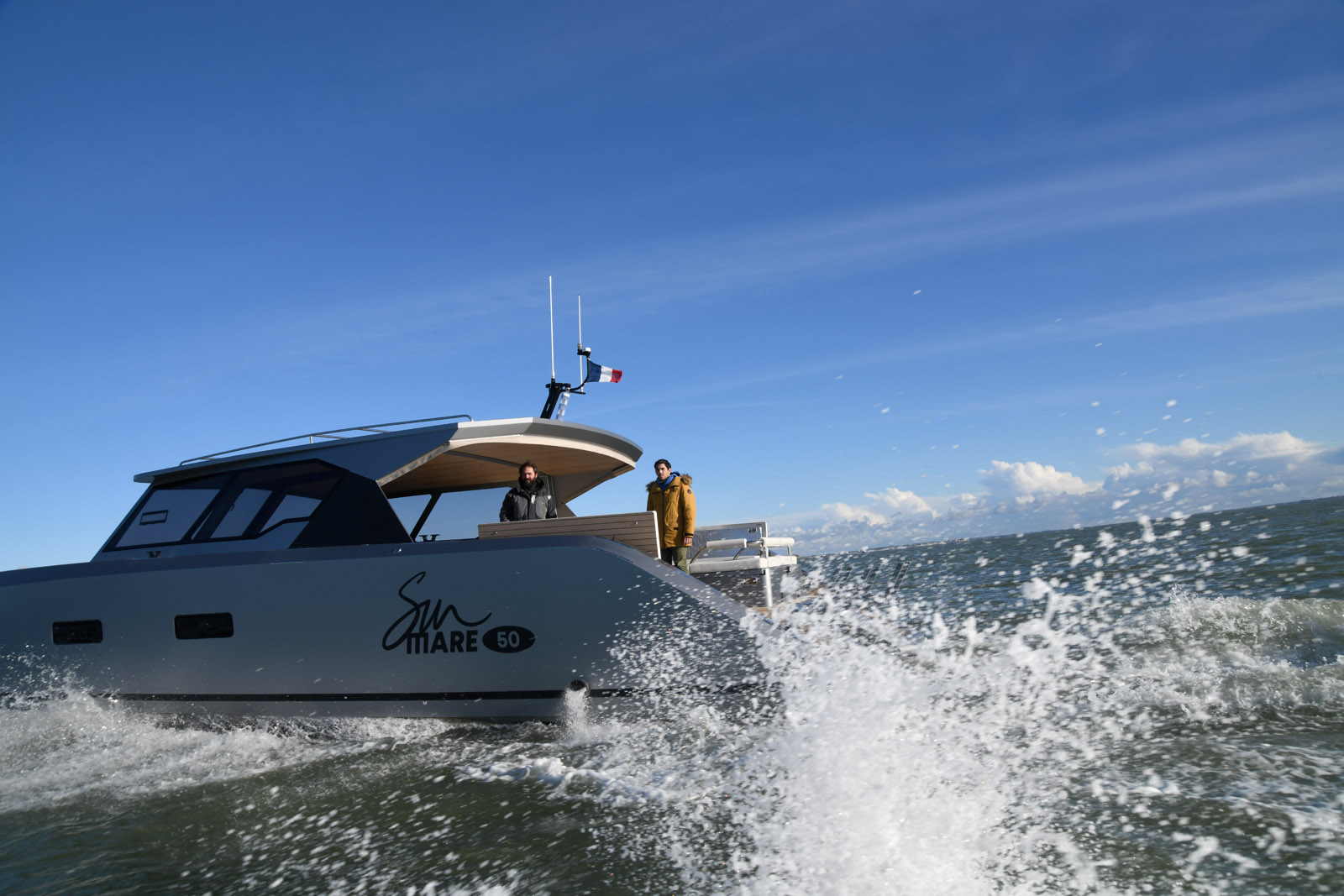
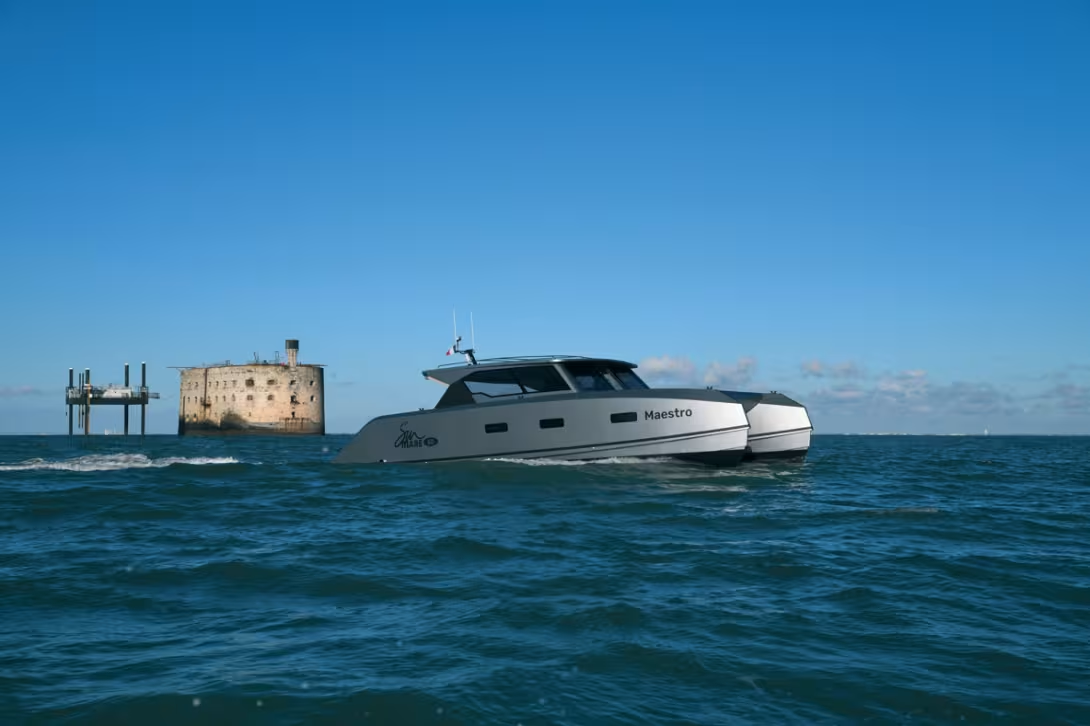
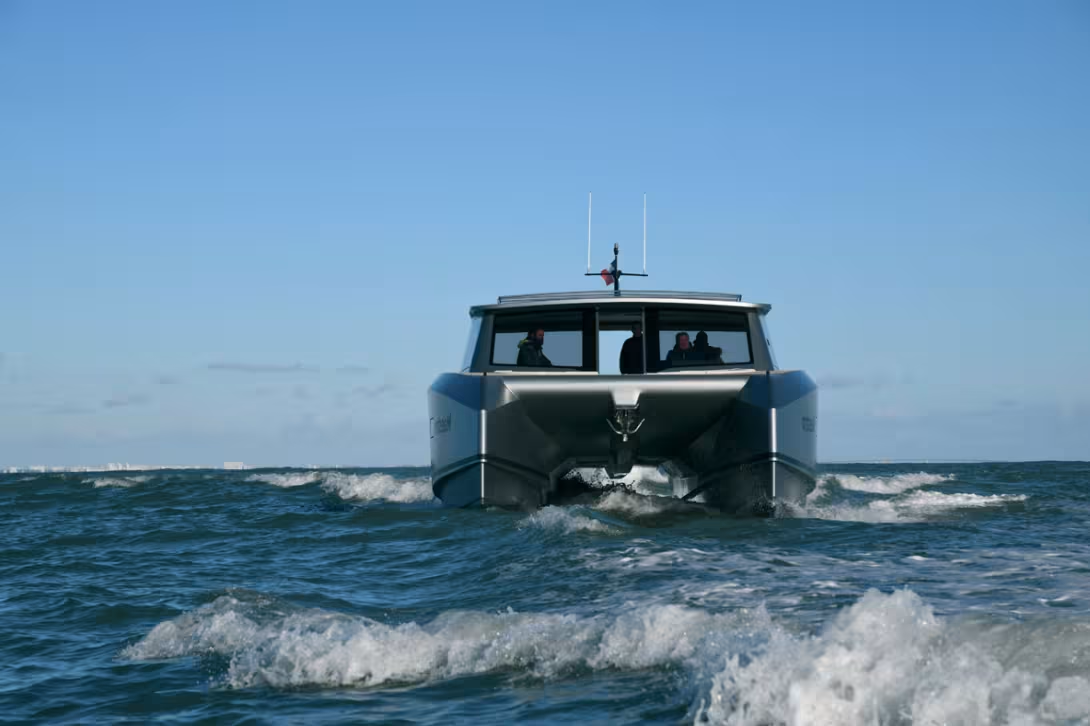
At last, I was face to face with the machine! At first glance, I was surprised by the purity of the design. This impression stems from the deck’s inverted sheer, accentuated at the bow to join the upper break in the bows, from the rising rib, which also joins a break in the bow, from the very gentle slope of the transoms and, above all, from the extreme simplicity of the superstructures: no flybridge (and therefore certainly no T-top) or covering bimini for this 50-foot powercat sedan. The metallic grey livery is soberly highlighted by the black triangular upright at the rear of the coachroof. The latter being somewhat reminiscent of the designs of powerful American sedans from the 1970s - there’s a touch of retro in the design of this multipower, yes, there sure is! Looking a little lower down, contrary to the trend for large openings in hulls, the Sunmare makes do with three modest rectangular portholes.
Except for the 6 mooring cleats, the mini-mast and antennas, and the handrails/bars on the coachroof, nothing protrudes...
These highly successful lines are the result of a collaboration between two architecture and design firms, Yacht Design Collective and Damien Bovie Design.
I realize that while the somewhat cheeky elegance of the Sunmare 50 would fit in perfectly with the selection of machines that make up the very essence of James Bond, the program for this powercat is necessarily restrictive. In the case of the Sunmare 50, this is not at all a problem, as this powercat is a pure one-off, the result of a specific order for a high-end day charter vessel operating out of southern Corsica, between Porto-Vecchio and the Lavezzi islands.
The builder opted for a hybrid construction method, using just three molds. Most of the large sections (called flat panels in the yard’s own jargon) adopt developable shapes and are in fact assembled on flat marble.
The individual pieces are then assembled and glued together. Limiting the use of molds reduces investment - and therefore the final cost of a powercat ordered individually. However, the tooling and know-how are already in place, so a second build (or more) isn’t out of the question!
Flush deck layout
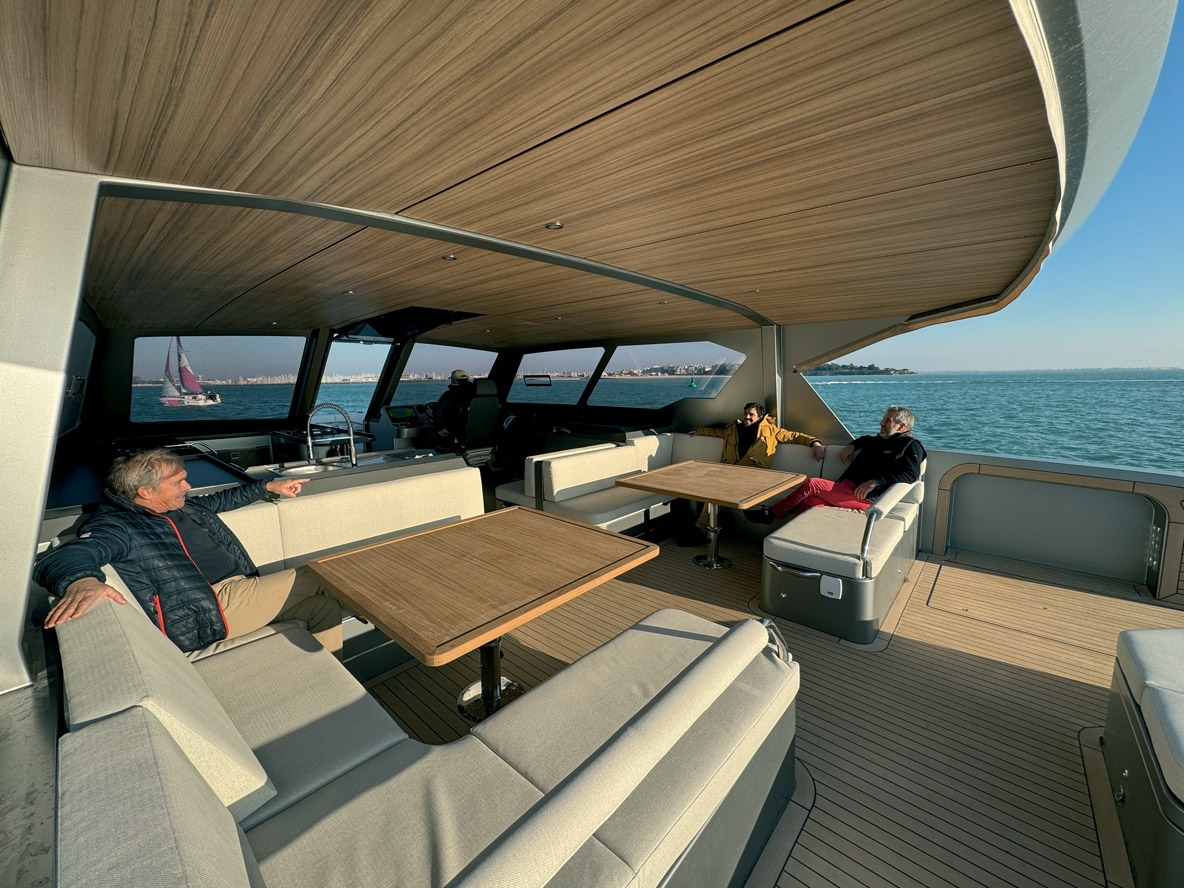
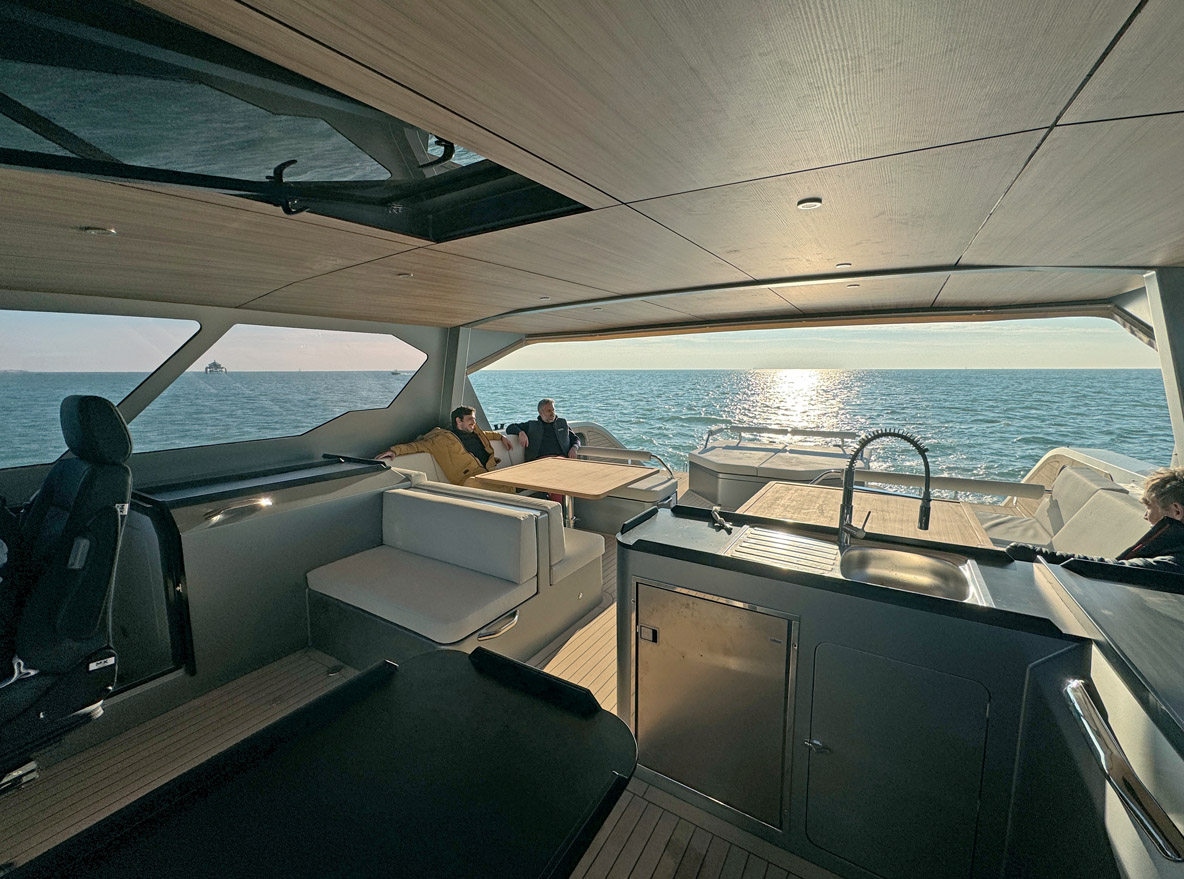
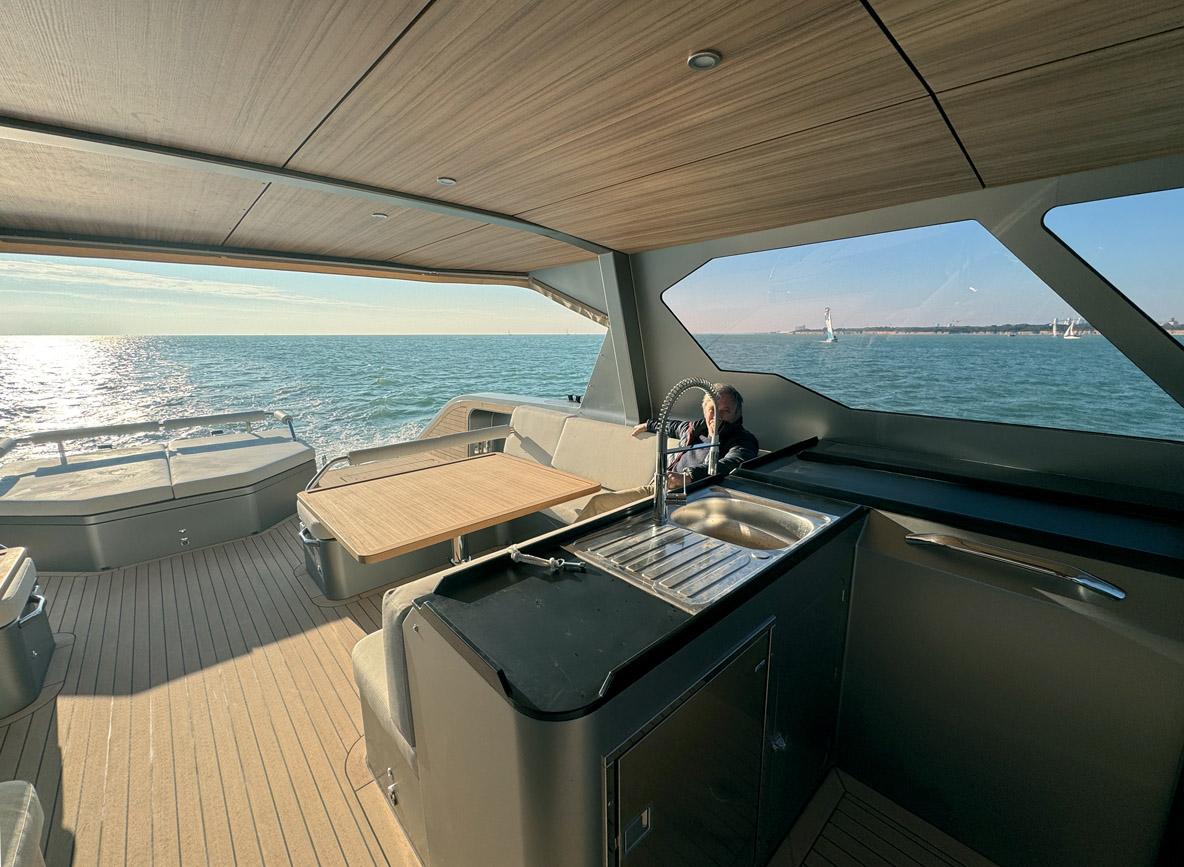
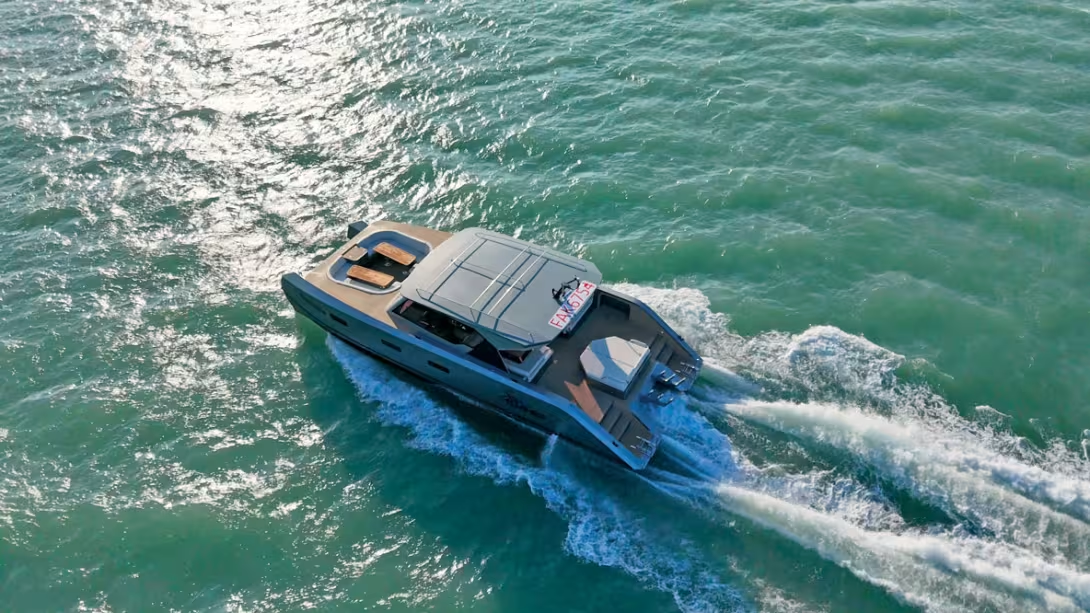
The main feature of “Maestro” - as this boat has been named - is that it adopts the deck layout of a 35- to 40-foot powercat... on a hull that is 50 feet long! As mentioned above, the Sunmare has no flybridge, and no side decks either. Traffic flows from the aft cockpit through the nacelle to the bow-rider-style forward saloon. In keeping with the day cruiser theme, the nacelle is completely open at the back (although a system of zippered canvas allows it to be enclosed). The cockpit, in addition to its two wide sugarscoops, features a vast central sun lounger and, a little further forward and partly protected by the coachroof, a convertible saloon on each side. The omnipresent teak runs from the deck to the sugarscoops, including of course the nacelle. The bulwarks are fitted with a recess on each side, while the entire ceiling features magnificent wood lining. The whole boat exudes craftsmanship, notable as you relax in seats that are thick and comfortable.
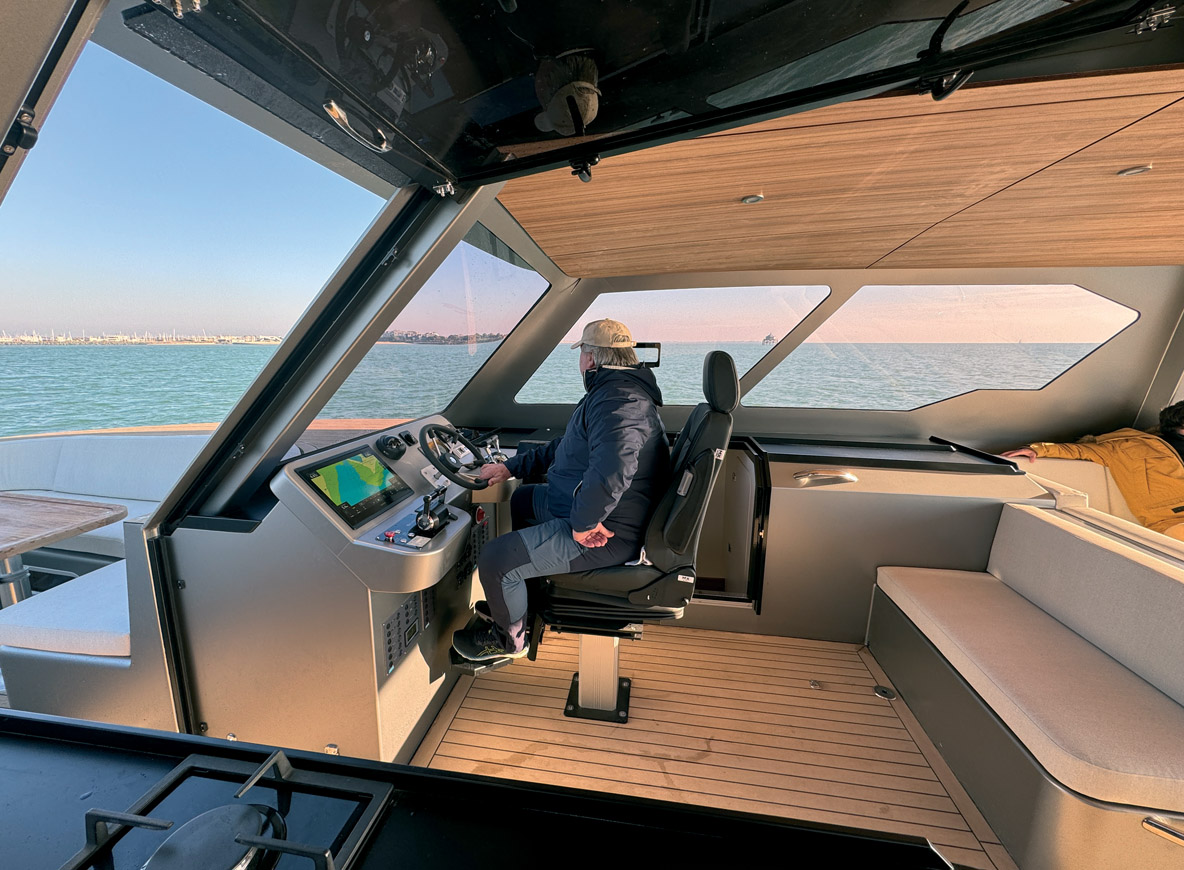
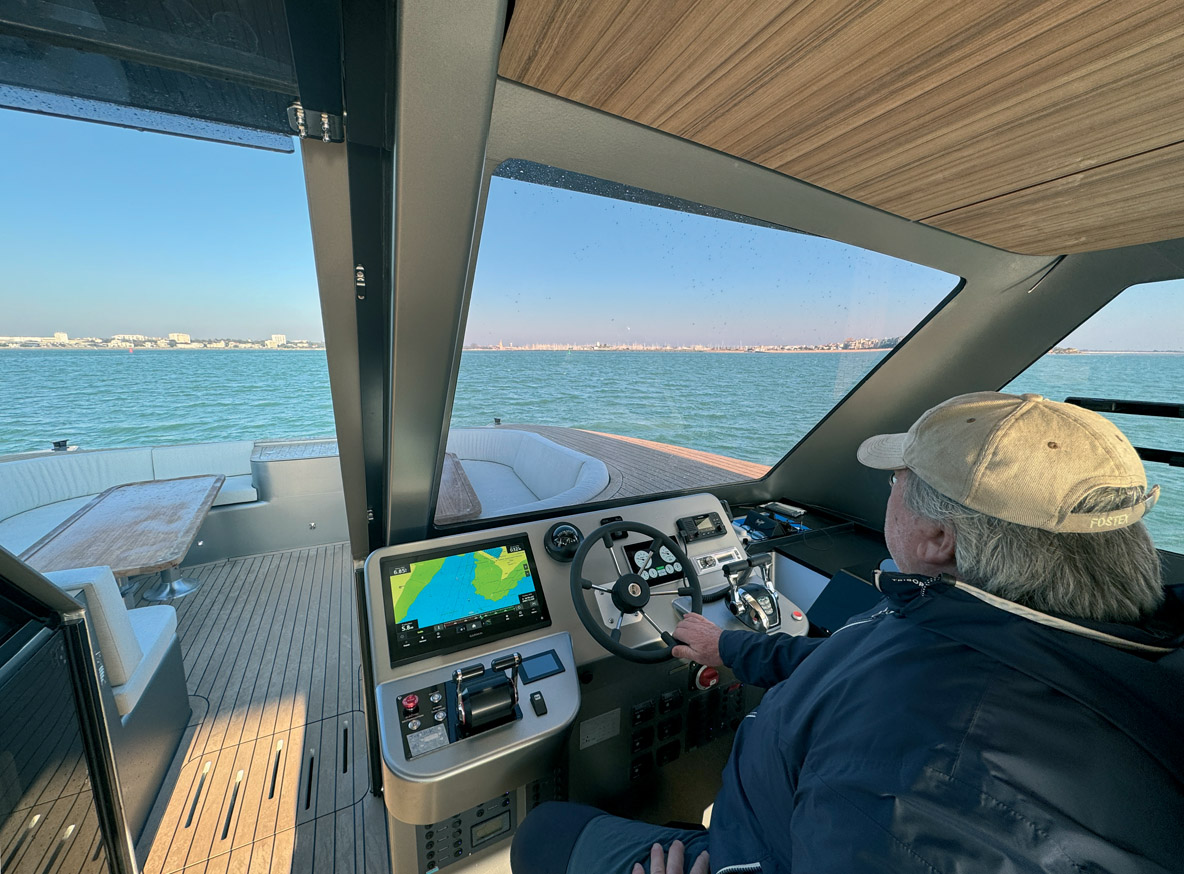
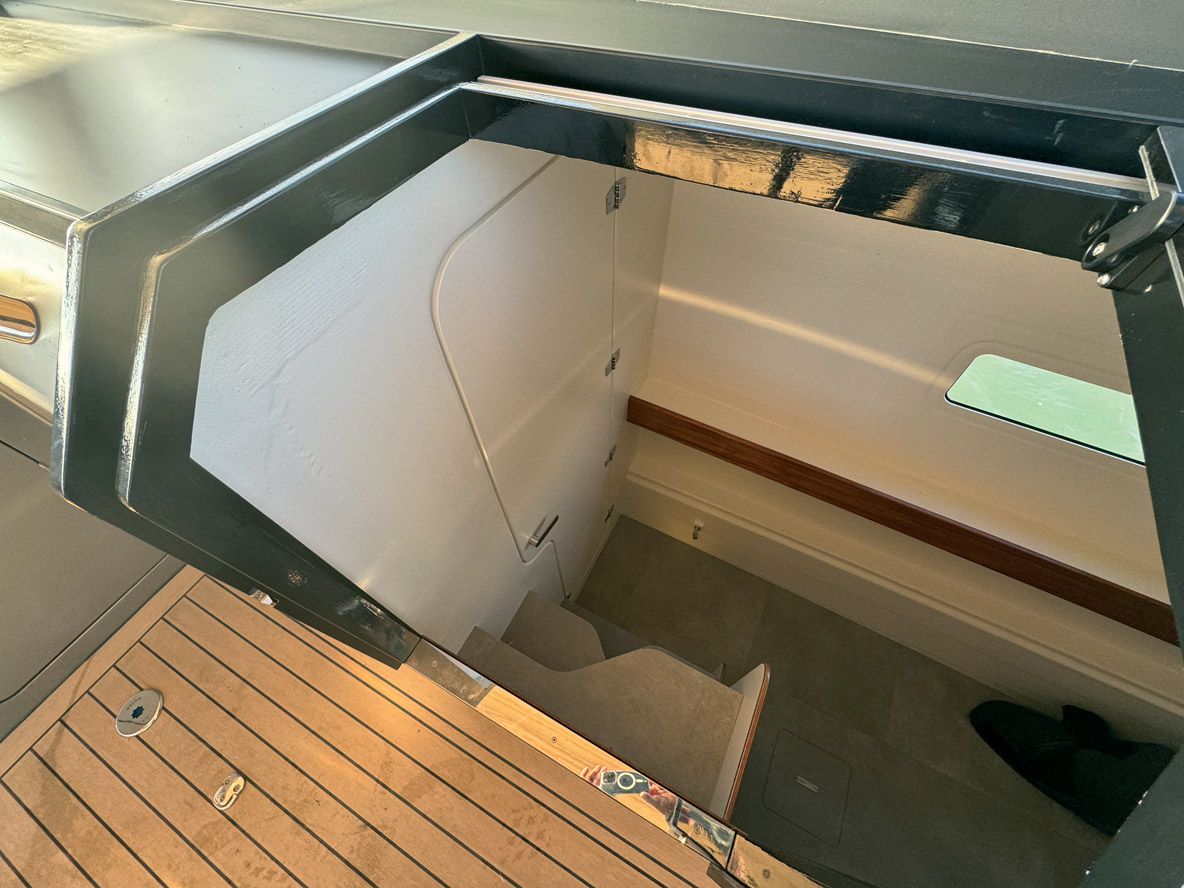
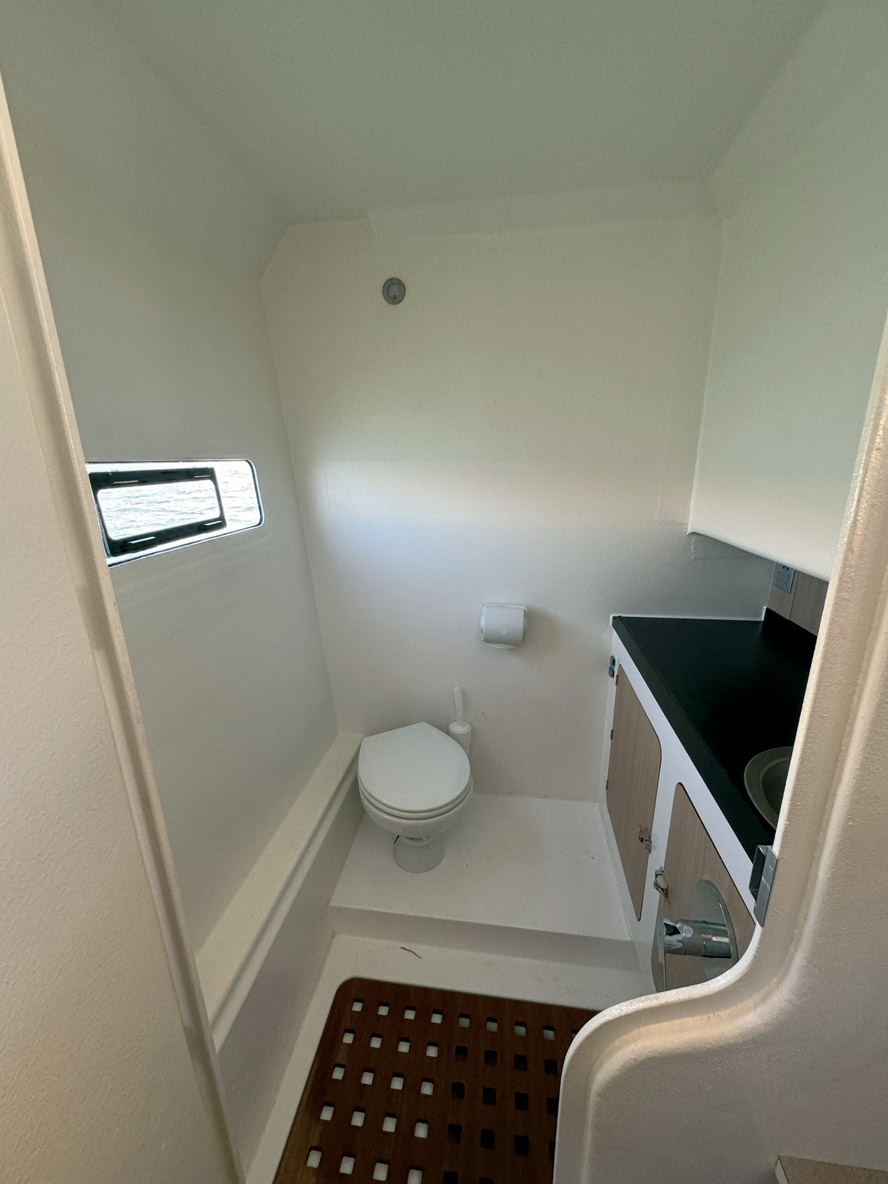
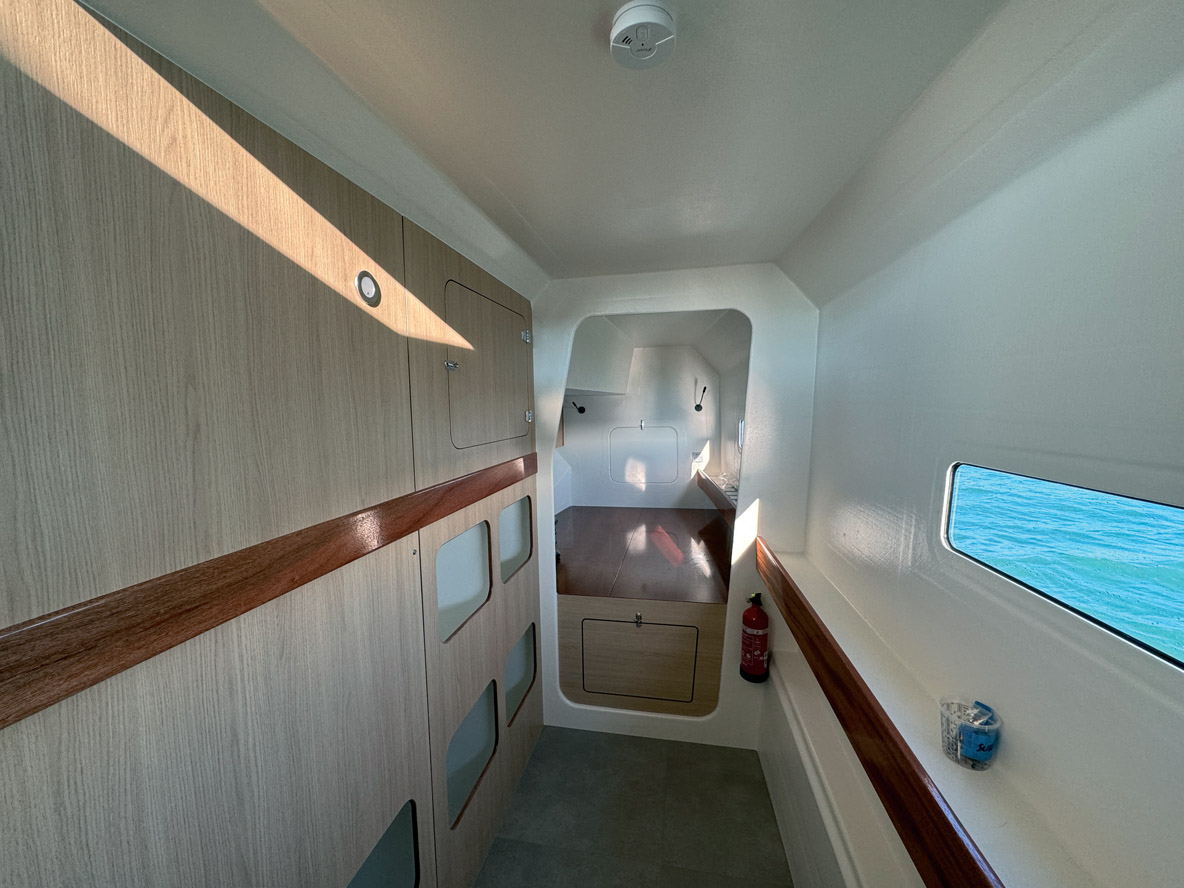
In the nacelle, there’s a bench seat on the starboard side. Opposite, you’ll find an attractive galley and another saloon area at the very front. To starboard, under the windshield, the helmsman is perfectly seated in his adjustable chair with footrest, with an ultra-modern instrument panel in front of him. Two staggered companionways each lead to a double cabin with walkway, storage and en-suite bathroom. The drop down is quite steep, so the builder has opted for staggered steps typically found on units 15 feet shorter. This small detail - like the limited number of cabins - is a reminder that the Sunmare 50 has no ambition to compete in the traditional market of 50-foot powercats designed for coastal or semi-offshore cruising. Maestro is designed for day cruising - hence the somewhat secondary treatment of the cabins.
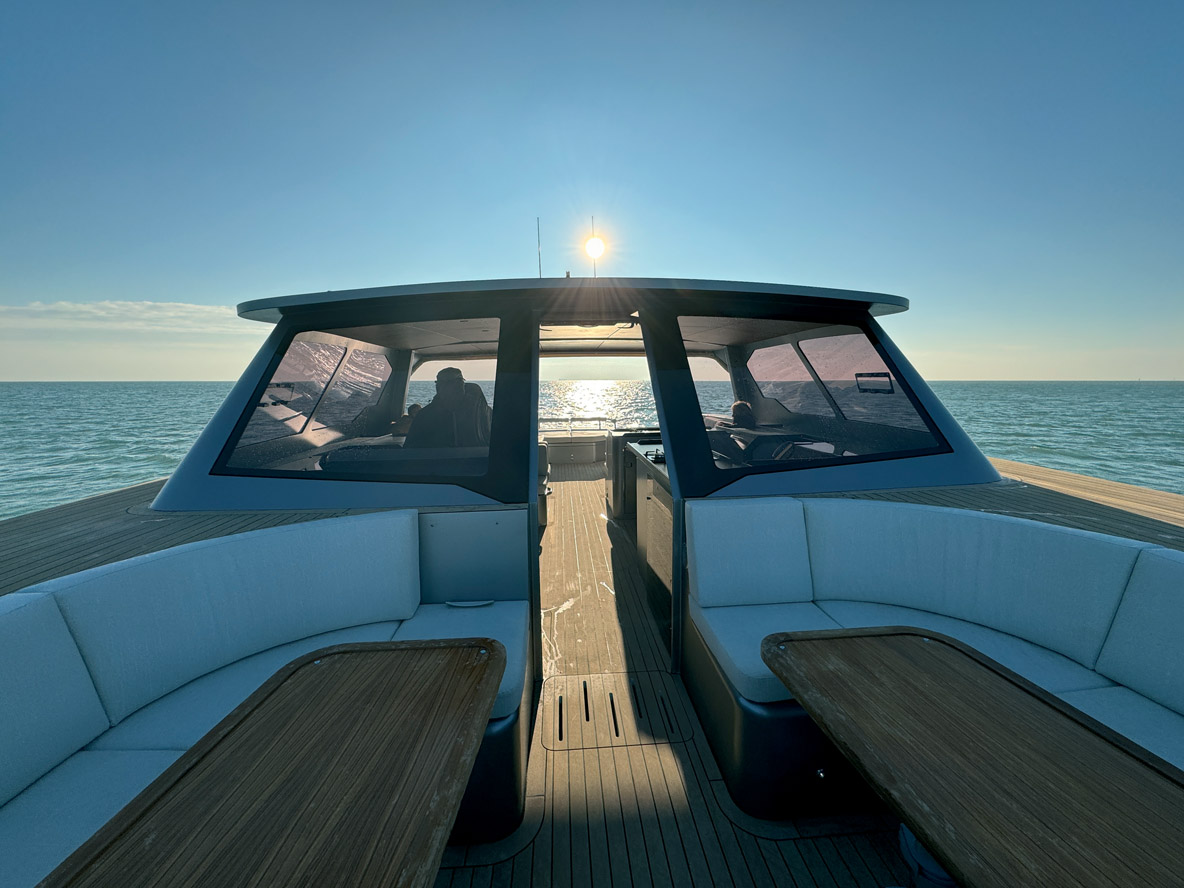
The central passageway, perfectly straight and totally clear, leads to a forward door that can be left open in fine weather at anchor or under way at lower speeds. The foredeck is cut away, offering a C-shaped saloon area on either side. When the powercat is stopped, this space can be shaded by an awning.
The single-level deck layout used on the Sunmare 50, with passage through the interior, dispenses with the traditional wide side-decks and secure forward decking, making pulpits, railings and guardwires superfluous. However, it is still possible to down the sides of the deckhouse, as the wide bulwark, which becomes the deck’s forward overhang, remains relatively thick.
Tranquil Power
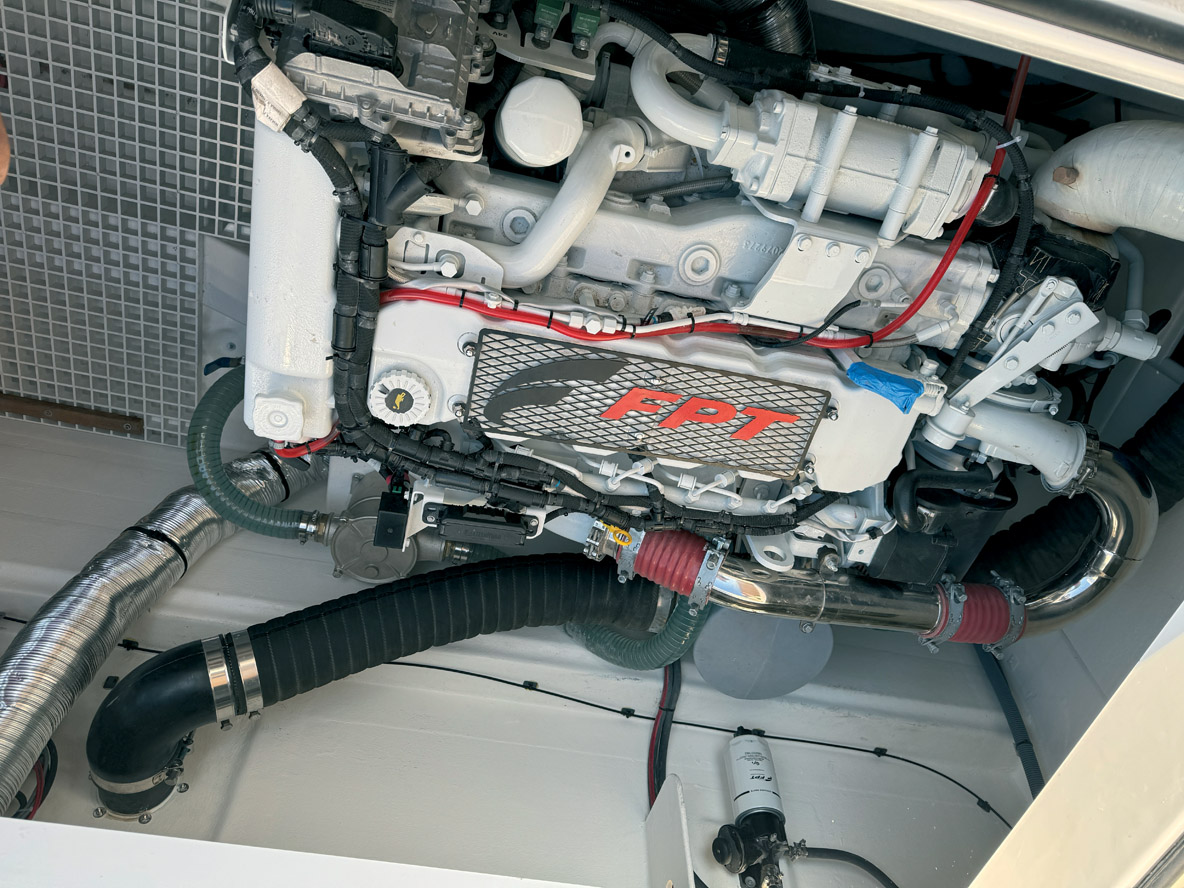
The two 6.7-liter FTP N67 motors each deliver 480 HP, a powerful performance that can be heard as soon as the 1,590-pound (721 kg) engines fire up. This is not all about the fervor of an offshore boat’s powertrain whose throttles are just waiting to crank up the revs and make a roar, but rather the expression of two big American-style pick-up diesels. They push hard, with torque from low revs and a pleasant, almost reassuring sound. The target cruising speed is 17/ 18 knots, reached just after the hull starts to lift on the water. At full throttle, 3,200 rpm, we reached 22 knots, no more. The ambiance is definitely one of tranquil power.
Fuel consumption is 5.3 US gallons (20 liters)/hour at 8 knots, 13.2 gal (50 l) at 15 kts and nearly 53 gal (200 l) at full throttle.
Helming the Sunmare 50 is simple, with an excellent feeling of ease, lightness and gliding across the water. The helmsman always enjoys good visibility - thanks to the relatively low deck, the nose-up trim during acceleration doesn’t translate into a situation like driving a car with the hood open.
On the chilly green waters of the approaches to La Rochelle, our turns were smooth, with a slight counter-heel. As for any chop, it is literally cut through by the sharp bows. The tunnel between the hulls, being both relatively high and perfectly shaped, will delay the moment when the Sunmare could slam.
Our test model was not yet equipped with its two 15-Kw electric motors. This green propulsion system doesn’t claim to replace the two powerful diesels, but it does allow you to cruise emissions-free at 5 knots for an hour or two. The idea is to be authorized to sail at low speed in marine sanctuaries where carbon emissions are prohibited.
Conclusion
It’s hard to remain unmoved by the personality of this Sunmare 50. Attractive, original and well thought-out, this multipower is definitely like no other - and that’s what we like about it. Its day-cruiser program, unusual for a unit of this size, features a nacelle that’s completely open to the cockpit and a single cabin per hull - where competing cruisers have two or even three... The “concept boat” approach, relatively common in sailing multihulls, is much less so in the world of multipowers - the relevance of this project demonstrates that power and custom can also go hand in hand. The fact remains that the Sunmare 50 richly deserves to be developed into a small series production run - the builder is on board with this idea, so watch this space...
Attractive, functional deck layout
Possibility of installing electric motors
Not suited to cold and/or rainy climates
Technical Specifications
Architect: Yacht Design Collective
Design: Damien Bovie Design
Length overall: 50’6” (15.4 m)
Hull length: 48’11” (14.9 m)
Waterline length: 48’8” (14.6 m)
Beam: 19’8” (6 m)
Draft: 3’11” 1.2 m)
Displacement: 24,250lbs (11 t)
Drivetrain: 2 x 480 HP FPT with shaft-driven props and 2 x 15 kW motors
Fuel: 396 US gal (1,500 l)
Price: on request