
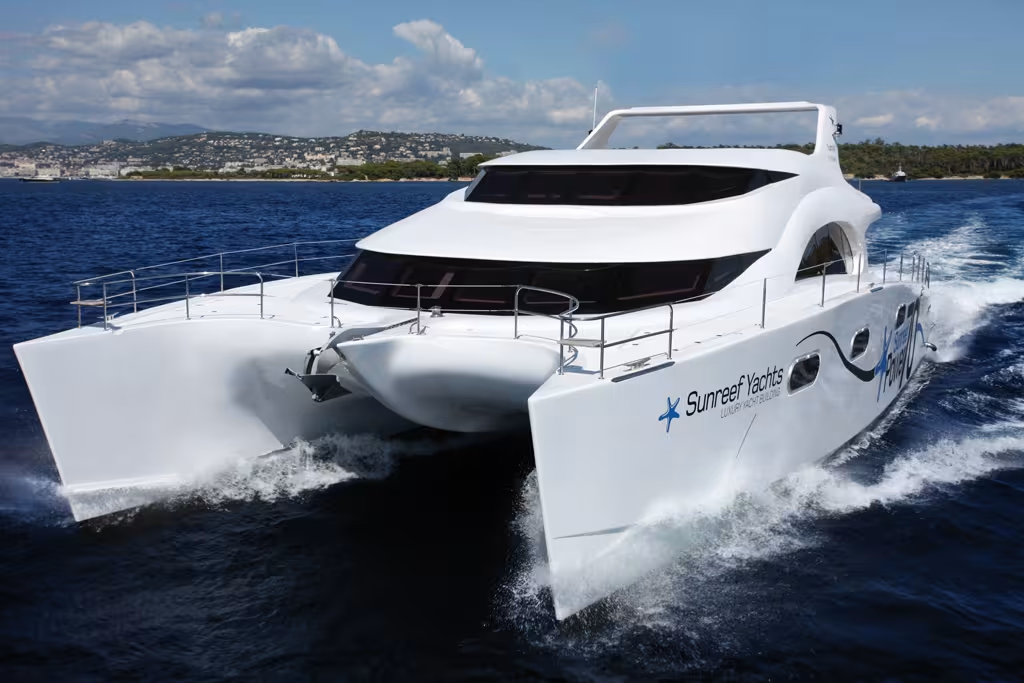
When a double winner of the Route du Rhum, the holder for 10 years of the all-category record for speed in a sailing boat over 24 hours, decides to move over to motor boats, the move deserves attention. If this defector is known as one of the best ‘perfecters’ of sailing platforms in the world, the interest is confirmed. The champion is Laurent Bourgnon. His motor catamaran: the Sunreef 70. Here is the test of ‘the beast’!
Infos pratiques
- Le chantier : Sunreef 70 Power
- La fiche technique
- Découvrez notre vidéo exclusive
- Financez votre Sunreef 70 Power Expedition
- Assuez votre Sunreef 70 Power Expedition
- Articles autour du Sunreef 70 Power Expedition
The etymology of the word crisis means decision-judgement! Are the arbitrations carried out during these questioning phases more realistic than the arrogant fashions of the expansion periods? No one nowadays can any longer approve of the huge appetites of certain motor ‘yachts’; the designer-users must question themselves about their elephantine output and their sometimes absurd programmes. Carrying out a crossing at 40 knots from Antibes to Girolata on the pretext that one is in a hurry...to drop anchor, poses questions as to one’s common sense. Consuming 2 x 300l/h to do this provokes the collective responsibility. For several years, the architectural logic of multihulls has led certain developers to offer credible alternatives, where the key-words become: efficiency, range, economy. I invite you to discover one of these new motor boats.
A boat which will allow you to leave for an expedition in Patagonia as well as spending the summer on the Riviera...
Bernard de Santorin
In 1998, Bernard Jarillon dreamed of a motor boat which would have the qualities of the sailing boat aboard which he had just crossed the Atlantic (silence, cleanliness)...but not its shortcomings! Submission to the meteorological changeability, impossibility of establishing an average speed and respecting a precise programme bothered our architect; his creative spirit was already on the boil. The association with Michel Joubert and Bernard Nivelt opened the doors to the high seas to a motor catamaran which was revolutionary...in its sobriety. Long floats (65’), compact nacelle, low wetted surface area, minimum aero- and hydrodynamic drag: the Santorini was born. This ‘go anywhere’ boat, equipped with 2 ‘agricultural clockwork’ engines of 6l capacity, giving 135hp at 1,500 rpm, was capable of an average and economical (1l/mile) speed of 11 knots, in a comfort and safety which is still today a reference. During the inaugural voyage to Santorin, it arrived 1h later than planned (leaving from Saint Raphaël)
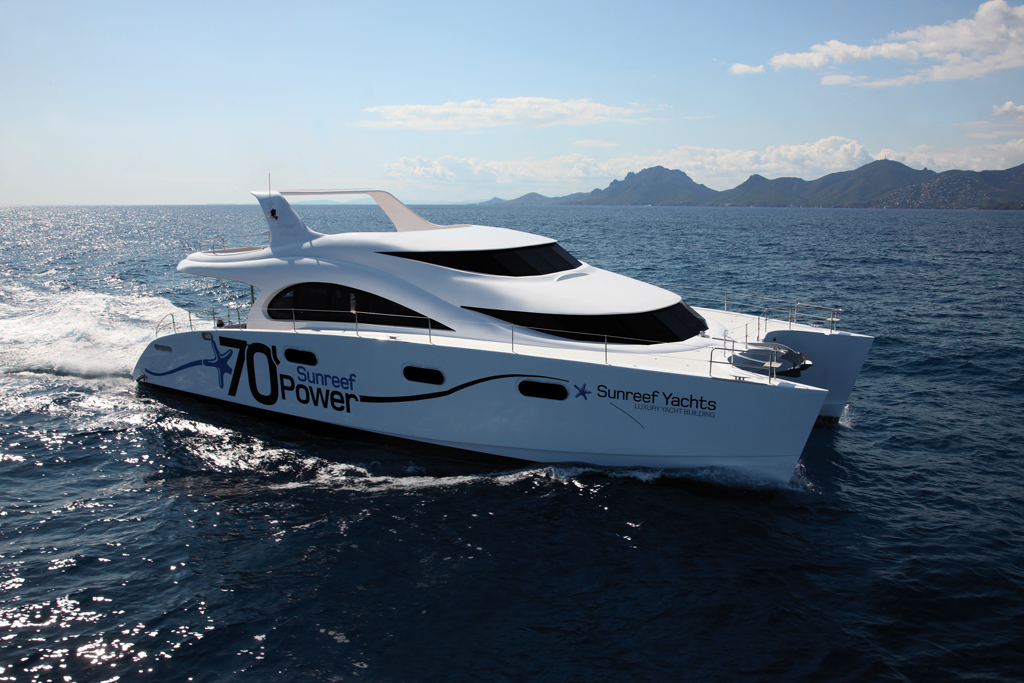
Elegant lines, a modern design and reasonable consumption: this is the Sunreef Power 70.
Witnessing
Laurent Bourgnon visited Santorini with Bernard and understood that this boat concretised his dreams, with one exception: the liveability! The Bourgnon family includes 4 children aged from 2 to 15, and wants to be able to welcome visitors at anchor, so they needed a bigger boat. But the meeting between the two men confirmed the relevance of the programme and justified the 3 years necessary for the creation of the future 70’.
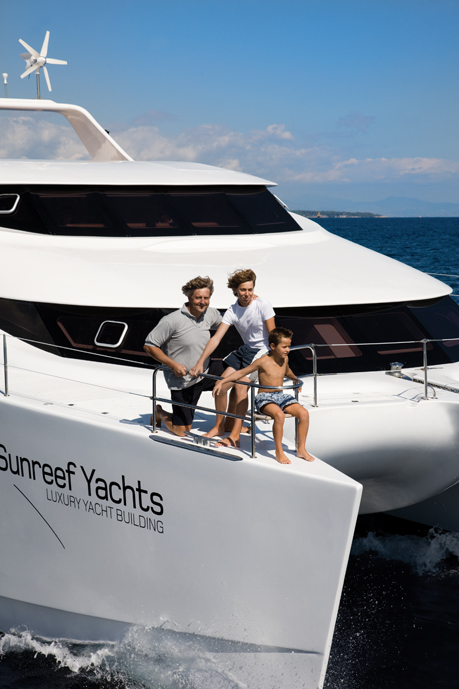
A 70-foot motor catamaran: this is Laurent Bourgnon’s new boat in which he is going to leave and discover the world with his family...
Objective: a 70’ catamaran with ‘economical’ engines!
Laurent’s idea was to start again with a blank page and design, in collaboration with a builder, an expedition prototype which would be offered as a production model. He offered this process to certain French builders, but their timid reaction led him to Poland, to Francis Lapp, who he had met on the Paris-Dakar and who had since founded Sunreef Yacht, with his son. There followed 3 years of studies and construction. The osmosis with the research department was immediate, but the builder’s marketing was often disoriented by the conducting of this project. There was no question of building two boats, the same platform therefore had to be versatile: to meet the specifications of a solid and economical tribal expedition boat, and attract a new yacht clientele: a challenge!
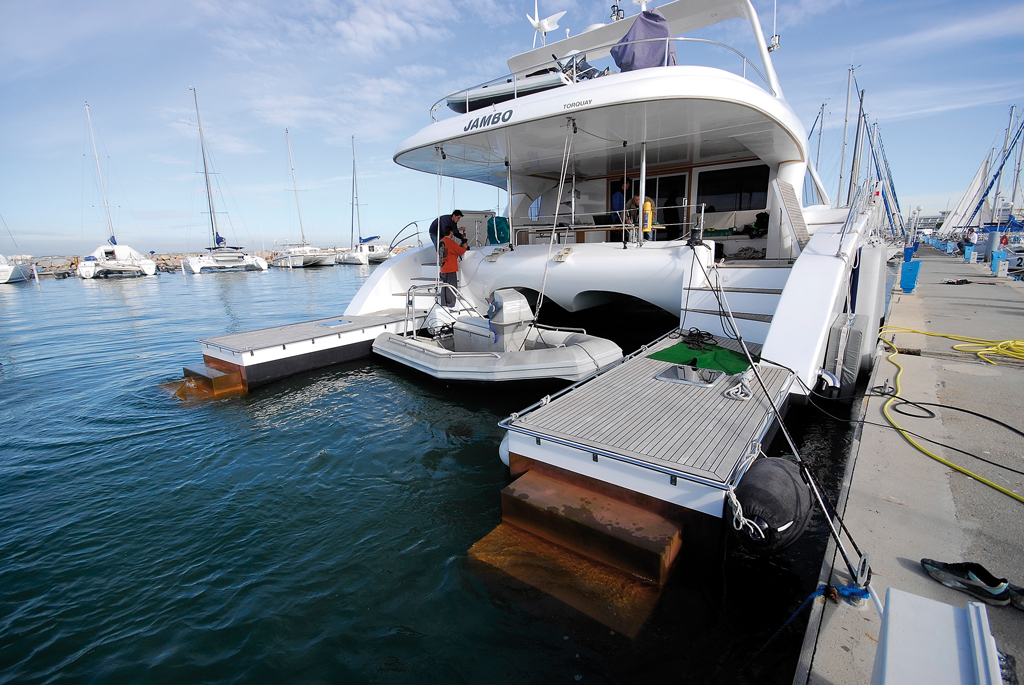
The sugar scoop extensions have the same functions as the bulbs, they are in fact the rear part of the ‘powder skis’ on the ‘off-piste’ version of the Sunreef Power Expedition. In addition, they serve to carry the tenders!
It is called JAMBO !
The project therefore settled on the basis of a big 70-footer, with contemporary lines, whose volume would allow the luxurious versions the builder wanted, whilst remaining compatible with harbour constraints. The ‘knock about’ version envisaged by Laurent had its floats lengthened to 25m!
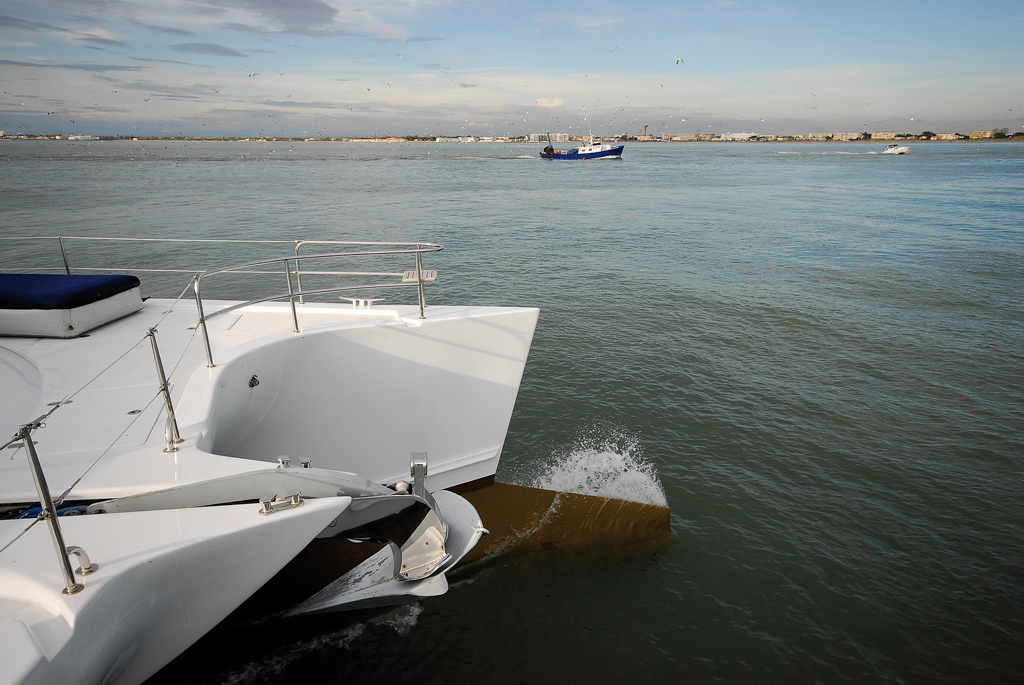
The bulbs in action; their positive action in rough seas can easily be imagined.
Classic underwater lines; an avant-garde silhouette
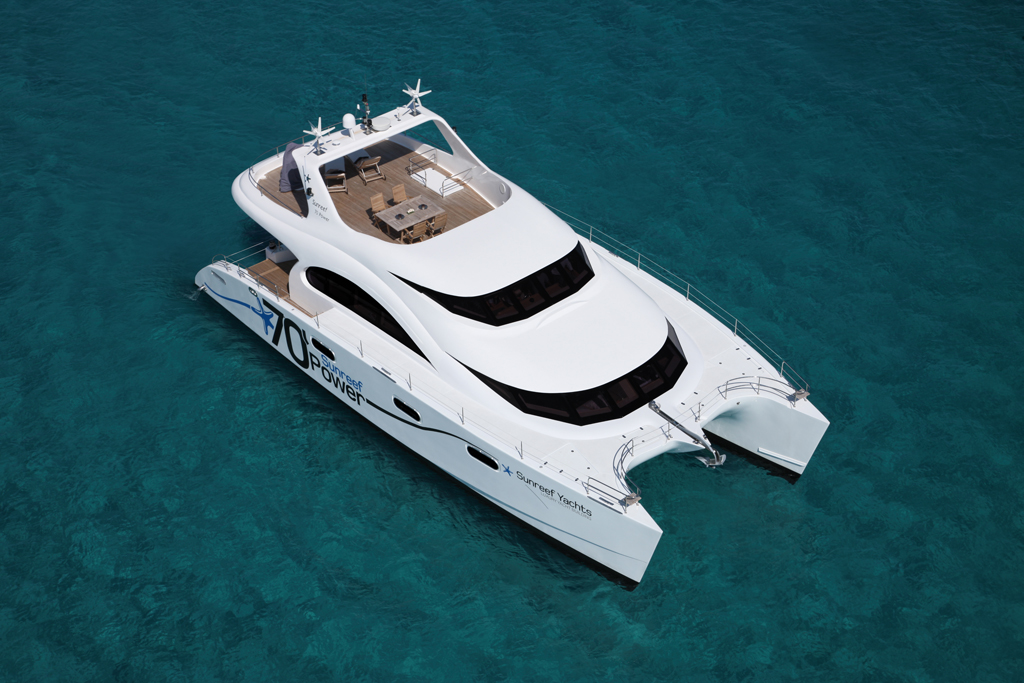
The Power 70’ is genetically marked by its ocean-going vocation, the taut cylindrical hulls were chosen for their load-carrying capacity, their suitable prismatic coefficient and their high efficiency at the target speeds (10-20 knots). Unlike most motor boats which cruise nose up at 10° and will only accept normal trim at the expense of gargantuan power and consumption, the Power 70' Expedition was to cruise flat. A small strake runs along the outside of the floats and joins the spray deflectors at the bow. Two keels allow beaching. The vertical hull sides give a good elevation to the whole. The wedge-shaped cabin roof and the navigation position are elegant; the lateral glazed surfaces are in keeping with an undulating movement which heralds the flybridge...whose surface area is not lacking in audacity! This terrace structure covers the cockpit and serves as davits for the tender. The ‘Ital design’ treatment of the whole is quite attractive and should reach its target, even if it is far from the ‘utilitarian’ vocation of the prototype.
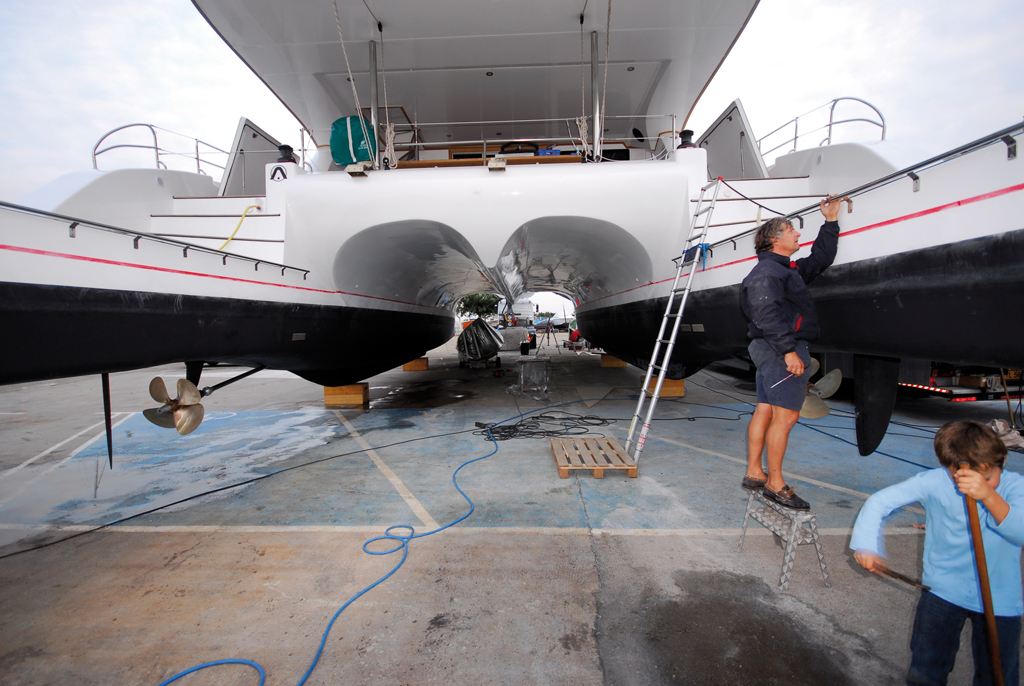
The Power Expedition can be beached easily on its keels; the nacelle’s double tunnel, the sugar scoop extensions and the rudders (from Primagaz!) can be made out.
A jumbo version for the water world
Laurent’s aim is to share with his children and his wife (who is not a sailor) the essence of his first voyage accomplished with his own parents (aboard a Joshua, then a Diam 40). I suspect it is also to have fun, intellectually, by cultivating an architectural and technical route which seems to be hidebound, by choosing the world and its destinations as an experimentation ground. The concept of an economical motor vessel only works with a multihull, with a long waterline proportional to its displacement. JAMBO therefore had its sugar scoops lengthened to the limits of what was reasonable, and its bows are capped by two added bulbs. These composite appendages are light both in weight and price, and provide the boat with the additional ‘glide’ which optimises its performance over the desired parameters: economy, extra long range (possibility of more than 10,000 miles), safety and comfort at sea.
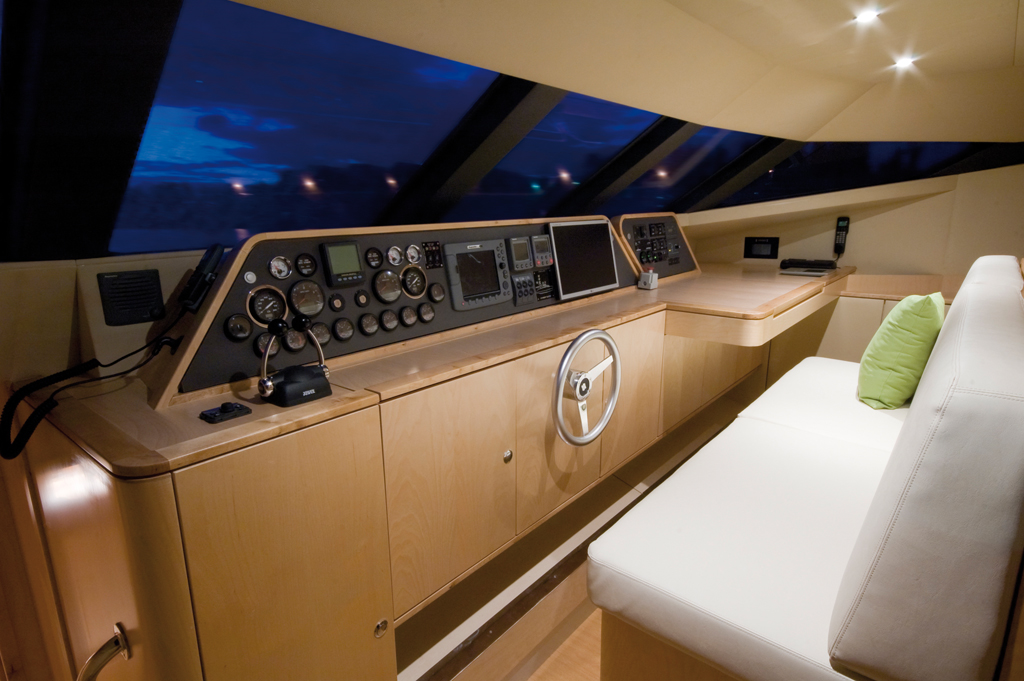
Jambo’s navigation position: even the children should be able to be at the controls...
He who wants to travel far optimises his consumption and moderates his speed.
Making a boat advance in a fluid which is 700 times denser than air is not exactly a rest cure! Although at the hull speed of 10-11 knots, a good motor catamaran could achieve an objective of between 1 and 2 litres per mile, it would multiply its consumption by 8 or 10 to double this speed! In addition, aboard a small boat, this speed is not compatible with normal life (noise, vibrations, odours, impacts in the sea). That is why JAMBO aims for the famous golden number which is the key to a successful long-term voyaging programme: 240 to 260 miles per day, whilst consuming as little fuel as possible.
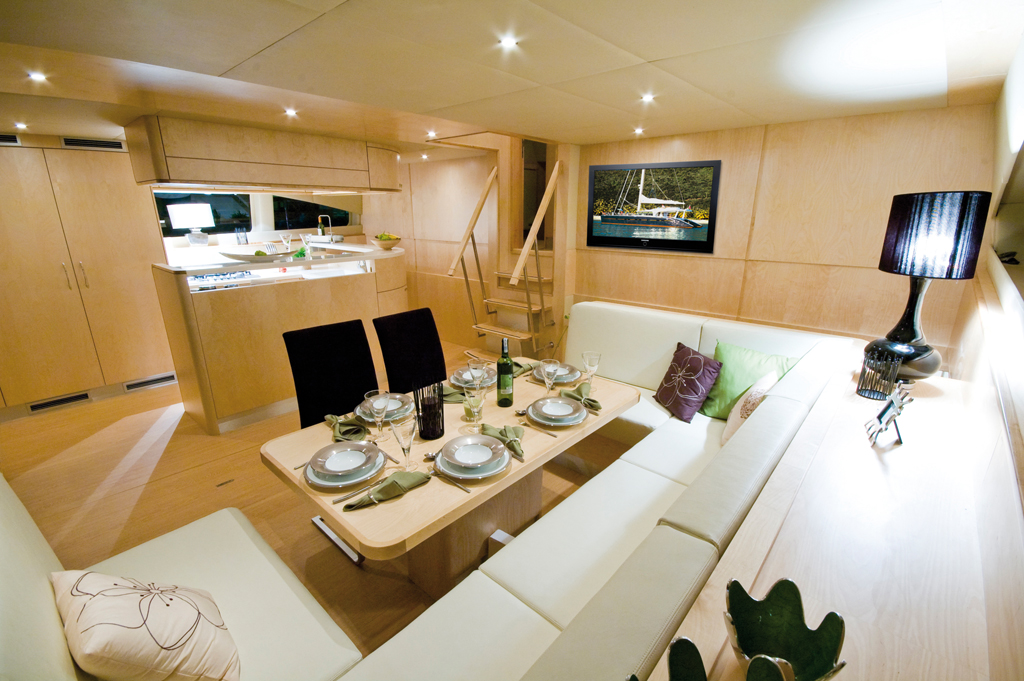
Although we are aboard an expedition boat, a Sunreef must be comfortable and the ‘Italian style’ design makes the best impression!
Latest generation engines
JAMBO is equipped with Volvo D6 Turbos (2 x 370 hp); these modern engines use all the technological resources made reliable in leisure boating: common rail injection, computer programming of operating parameters... They have been the subject of a meticulous installation in an engine room planned to accommodate up to 800hp! There is therefore space for maintenance. The architecture of the installations has been carefully thought out, the battery banks and the abundant electrical connections have been fitted rationally, as have the exhausts. Access to the engine room is via very large hatches, whose opening is assisted by rams. The accessibility of all of the elements is real; supplies of fresh air and ventilation are reinforced. The engines no longer break down! But the peripherals are their Achilles’ heel: alternators, reduction gear, transmissions must be the subject of monitoring and prevention. Supply of clean diesel and cooling intakes are at the heart of the system. Aboard JAMBO, the diesel is pre-filtered, centrifuged, filtered; these arrangements, added to a necessary vigilance when choosing supplies, condition the correct operation of these engines, which are more demanding in terms of fuel quality than certain rustic, older-generation machines.
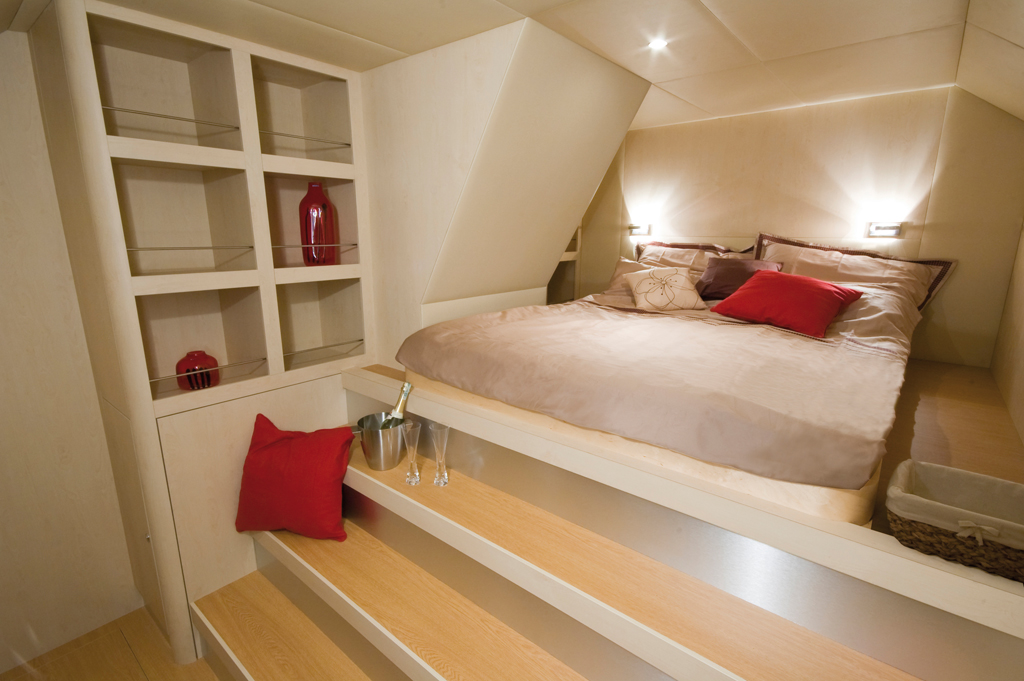
The cabins are treated in the same way: with taste, but without being ostentatious.
Constant optimisation
Bulbs (designed by an office concerned with the America’s Cup and manufactured by J.F Lilti from Grand Large Composites) on the propellers, whose pitch has already been adjusted, via the optimisation of the mapping by Sport Système (a reference in this field): Laurent has tried to increase the efficiency and has gained nearly 15% in consumption). The next stage: variable pitch propellers and ad hoc engine management.
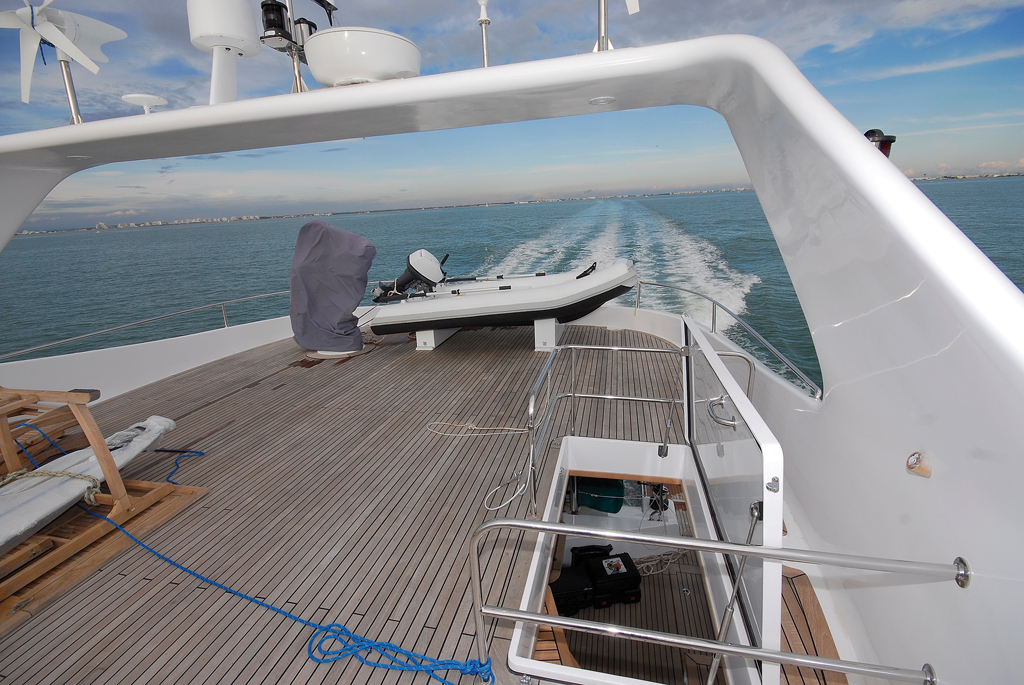
At 20 knots, the Power 70’ leaves a delicate wake; 5m above the water, the large flybridge is a real promenade deck. The two wind generators are the distinctive sign of a boat which is comfortable at anchor.
The behaviour of a gentleman
JAMBO had already covered nearly 3,000 miles from the Baltic to Cannes when I discovered it. As always with Sunreef, I was struck by the quality of the interior accommodation, the soft furnishings, the woodwork and the lighting, but the internal space in the 70’ Power offers perspectives unknown in this size. The viewpoints from the piloting cabin, just like those of the two frontal ‘studios’ are eloquent on that subject. I won’t mention the ‘tennis court’ on the flybridge! The cockpit, dining room and terrace-cockpit have got to be seen, their like has not been seen before! Harbour manoeuvres will dictate a bow thruster and control stations on the flybridge and in the cockpit, (which JAMBO doesn’t have), bearing in mind its programme. Our tests took place in parallel with the perfecting of the engine mapping and measurements of consumption and behaviour after the bulbs had been fitted. Cruising aboard JAMBO filters the perceptions almost completely; the operating silence at 10 knots is remarkable. In this version, the Sunreef 70’ can exceed 20 knots, but this is just a reserve of speed, which is useful, but whose use will remain exceptional. After having carried out a tour of Southern Europe to run it in, JAMBO confronted a delivery trip from Corsica to Cannes in a strong mistral without blinking. After our tests, it set off for its trip around the globe, stopped at Cape Verde, at Fernando de Noronha and in Brazil. The Patagonian Canals, its first major objective, will be in its wake as you read this article!
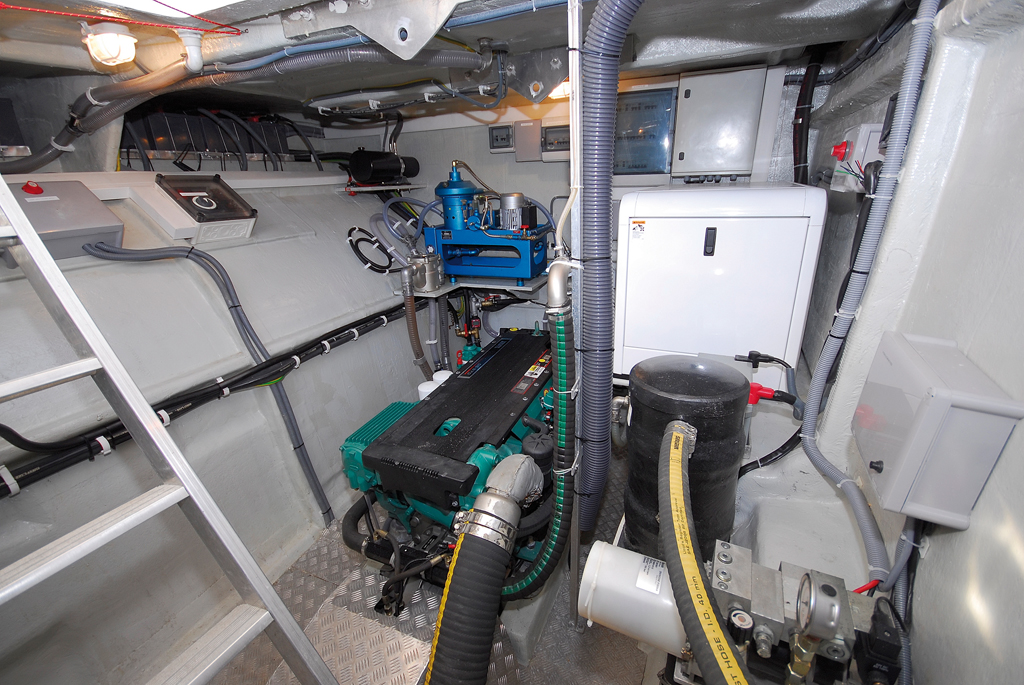
The organisation of the technical area: note the care taken with the installations and the chainplate fixed to the deck beam for heavier operations.
CONCLUSION
The thermal engine has not had its last say in the leisure boating world, and provided additional research is carried out, it can still be adapted and accompany a progressive transition towards clean energies (solar, wind, compressed air) aboard our boats. JAMBO shows by its example that a different engine culture is appearing, which is more virtuous and responsible. The attitudes of buyers and designers will tell if it is being followed or not! Will the public authorities, of whose return of intervention we are singing the praises at the moment, support the movement with encouraging measures in the field?
THE PLUSSES
- exciting voyage programme - relevance of the concept - living space
THE MINUSES
- Budget - logistics (harbour – maintenance) - exuberance of the engine options
The Competitors
Model Builder Architect Price Trawlivarius 80' Prometa Boat System Christophe Lesueur NC Ocean Voyager 82' CIM Joubert/Nivelt NC Santorini 65' Prometa Boat System Joubert/Nivelt
TECHNICAL SPECIFICATION SUNREEF POWER EXPEDITION
Architect: Sunreef research department/L. Bourgnon Builder: Sunreef Yacht, Gdansk, Poland Length: 25m (production boat 21.40m) Beam: 9.30m Weight: 40t Displacement: 50t Material: foam/glass/epoxy sandwich. Production boat: foam/glass/vinylester Engines: Expedition: Volvo D6 2 x 370hp; Standard: Cummins 2 x 455cv Diesel: Expedition 2 x 8,000 l; Standard 2 x 2,500 l Batteries: 12, 24V-1,200Ah Generator: 19 or 27 kVA Anchoring: windlass 24V-3,000w + Fob 60kg anchor + 80m of 13mm diameter chain Price of basic version: 1.8M euros exc. VAT