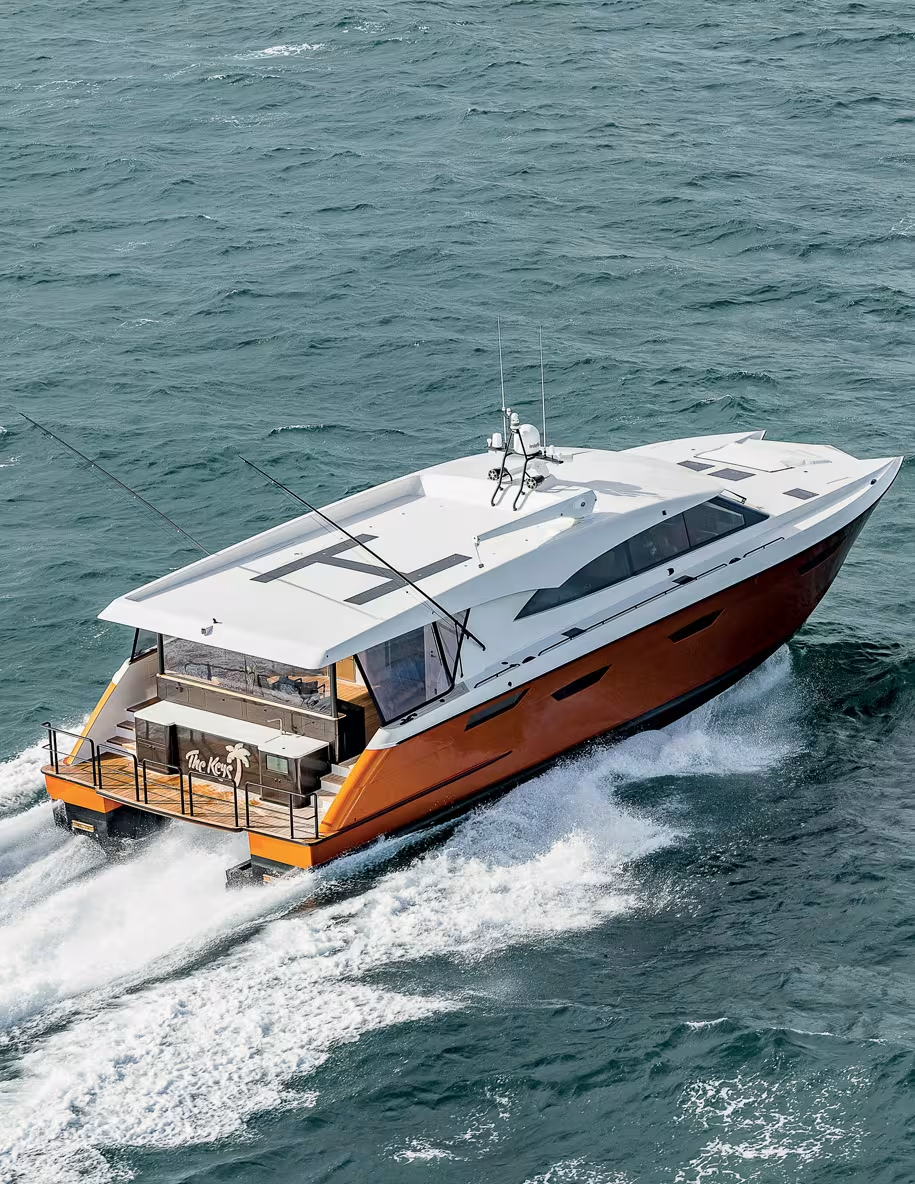
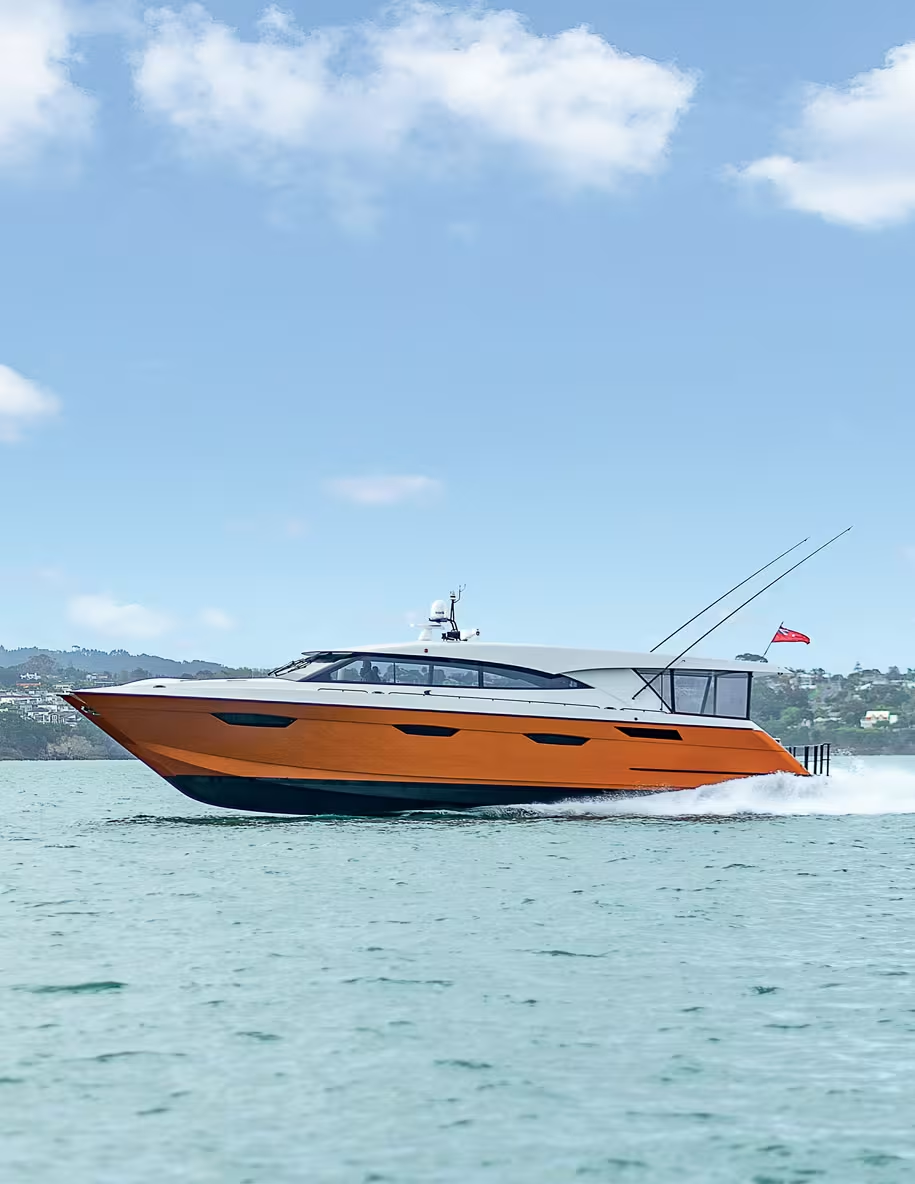
When New Zealander Wayne Valder, multi-time winner in the Offshore World Powerboat Championships, decided to design a large motor cruising catamaran for his own personal use, the result was always going to be a very, very fast machine. Add a flashy orange Bentley livery and a small chopper at the rear of the flybridge - the machine is worthy of being on the set of the next James Bond movie, don’t you think?

Infos pratiques
- Le chantier : Valder Sprint 20s
- La fiche technique
-
 Découvrez notre vidéo exclusive
- Financez votre Valder Sprint 20s
- Assuez votre Valder Sprint 20s
- Articles autour du Valder Sprint 20s
Conditions: 0 to 25 knots, sea calm to moderate
“I am coming to the end of my racing career, so I was looking for something else challenging and a bit more futuristic than a conventional flybridge cruiser or sportfisher.” Explains Wayne Valder, “I am used to running upwards of 140mph in my MTI powercat on the US offshore circuit, so while I didn’t plan anything that fast in pleasure boat form, I still wanted something reasonably quick.”
His quest took him to one of the leading lights in ultra performance pleasure cats, Roger Hill, who drew up a 20m foiling asymmetrical cat with enough horsepower to reach around 45 knots.
The boat’s name, The Keys, derives from Wayne’s and Kathy’s affiliation and love of Key West, Florida, competing in the World Power Boat Championships several times. It is considered one of the iconic offshore powerboat racing venues in the world, and while it hasn’t always been good to Wayne and his Pro Floors team, it keeps drawing him back.
Wayne is currently competing on the US P1 offshore circuit and also plans to have The Keys on display at the 2023 Fort Lauderdale International Boat Show.
Foam/carbon sandwich
Compared to a similar length monohull, the Valder 20 offers 20% more accommodation volume. Not only are the internal spaces larger, so to the cockpit and deck areas. The entertainment areas are vast. The Valder 20 has a similar area to that found in a 75-foot (23m) monohull.
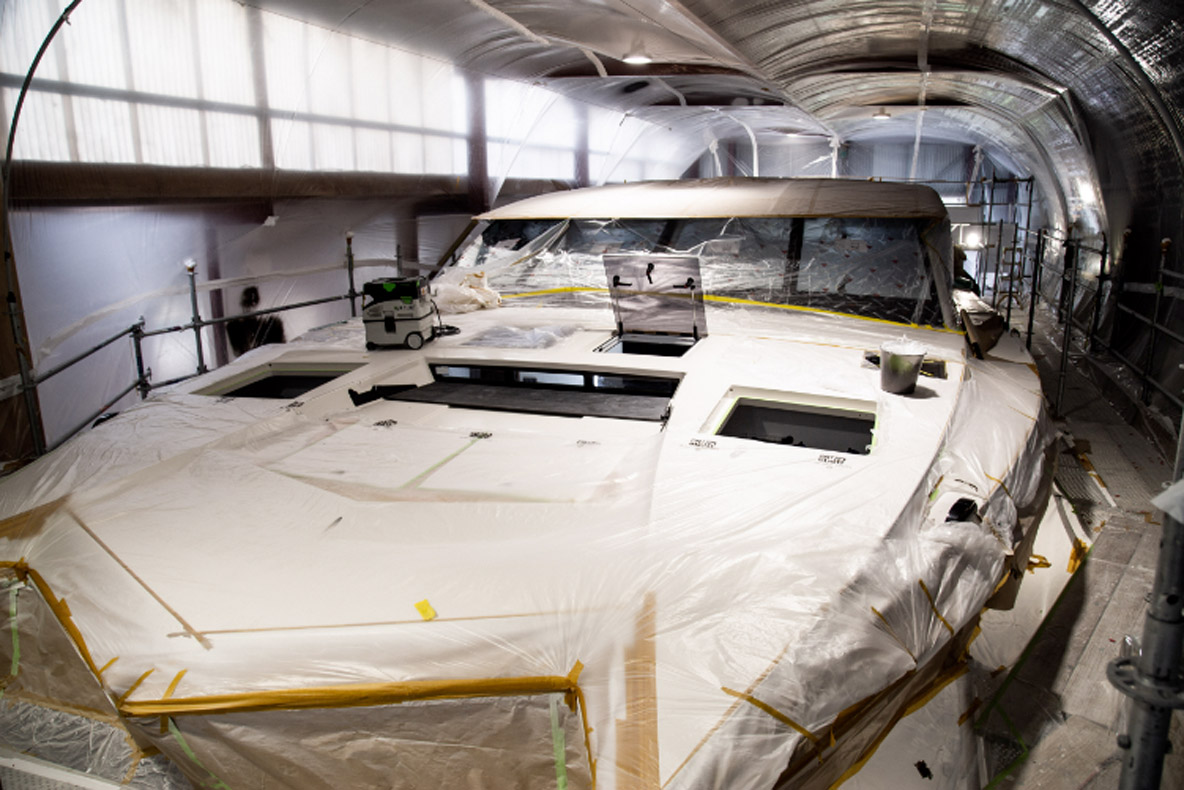
Once the plans were completed, Clevedon based Scott Lane Boatbuilders were given the task of putting The Keys together. Weight is critical with any high-performance hull. All Valder Yachts are built using foam-core, carbon fiber skinned panels to achieve the minimum weight possible and allow for a luxury fit-out and specification.
While Scott Lane has an enviable reputation for building Elite monohulls, this 66-foot (20m) Roger Hill design is his first power cat, plus his first all carbon fiber vessel (hence the branding, Valder Yachts). It is also the largest boat he has built from his Clevedon factory. Scott Lane Boatbuilders made female molds and then sent them to Nic De Mey Yachts in Tauranga to produce all the epoxy-infused carbon components. The composite parts were then sent back to the boatyard for assembly. Nina Heatley of Clever Fox Projects was responsible for the composite engineering and details.
“Essentially, the hull is four main components, so we were able to leave the sides off as long as possible during construction, so the builders had easy access to the interior and were able to do most of the joinery and fit-out before we closed it all in”, says Scott.
There is 40mm (1.6”) of foam core in the running surfaces, 20mm (0.8”) topsides, with all bulkheads, flooring and structural areas infused carbon. Overall displacement fully loaded is 88,600 lbs (40.2 tonnes). The current mold can be stretched out to 72 feet (22m) with an additional 2 feet (600mm) wider beam. LOA of the Carbon Cat 20 is 66’6” (20.27m), with a LWL of 56’1” (17.1m), a maximum beam of 22’ (6.7m) – each hull being 6’6” in the beam - and a draft of 33” (0.83m).
Wayne was never going to build just one boat. Hence the set of molds and already hull #2 is under development. He intends to take Valder Yachts onto the world market and has already had some keen interest from local and overseas potential buyers.
“This is the future for boating, and I can see this boat being able to get to Fiji in around 40 hours and Sydney in 34 hours, which is unheard of in a conventional monohull motor yacht”.
Wayne’s plans include having a crack at established long-distance speed records such as the Sydney to Auckland and Around NZ records, both of which are held by the late Ginger Gibbs. He is even aiming at the NZ Diesel Speed record, which currently stands at 45.6 knots. During initial trials, the GPS touched 45.2 knots, so it isn’t going to take much to break the record…
V-shaped foil capable of generating 20 t of lift
“Speed and efficiency in bigger boats have always interested me, and after speaking to Roger and learning more about his reasoning for his asymmetrical foiling powercats, I could see we were both on the same page”, says Wayne.
A lifting foil between the hulls was required to optimize the top speed and the economy at lower cruising speeds. Thanks to his background in the foil assisted field the Naval architect and CFD analyst Giuseppe Musca has been chosen as hull consultant and for being responsible for the performance analyses and powering requirements, hydrodynamic appendages design and for developing a custom hydrofoil system for the project.
After a multi design exploration study focusing on the comparison of the lift, efficiency and pressure distribution of several foil design shapes the final choice was a delta-shaped V carbon foil able to generate approx. 20 tons of lift at the optimum cruising speed.
The foil system is able to self-stabilize the boat at all range of speeds but, in order to reach the maximum control of the lift generated and improve the navigation comfort even in rough sea conditions, an additional Humphree interceptor ride control system has been integrated and installed on each transom.
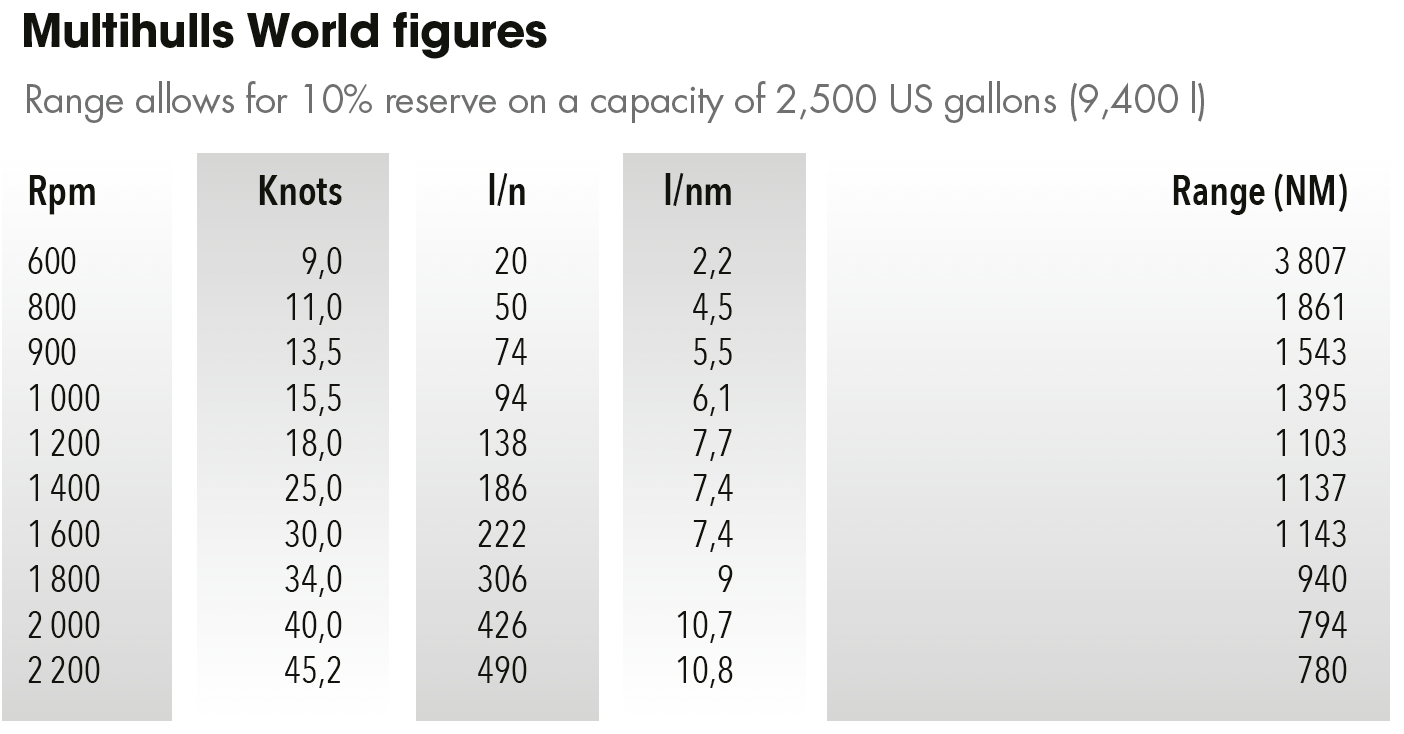
The foil starts working at around 18 knots, which is undoubtedly reflected in the performance and fuel data. Based on the figures, the boat has an extensive optimal cruising speed of between 18-30 knots, maintaining a relatively constant range in nautical miles per unit of fuel. The best cruise is at a high 30 knots, with 7.4 liters (1.95 US gallons) / nm and a range of 1143 nm (allowing for 10% reserve fuel).
If you are happy to cruise at a more sedate 13.5 knots, then you’ll have enough fuel to go non-stop to Cairns, and that’s almost 2,000 miles. At 30 knots, it’s a quick trip to Fiji (1,160 nm), and at a high 34 knots, you have enough fuel to go all the way to Nouméa, New Caledonia (975 nm).
After initial trials a few hydrodynamic tweaks have been called in order to squeeze out the last few tenths of a knot. This should also help The Keys break the 46-knot barrier and take the title as the fastest diesel cruiser in the country.
45 knots…You bet!
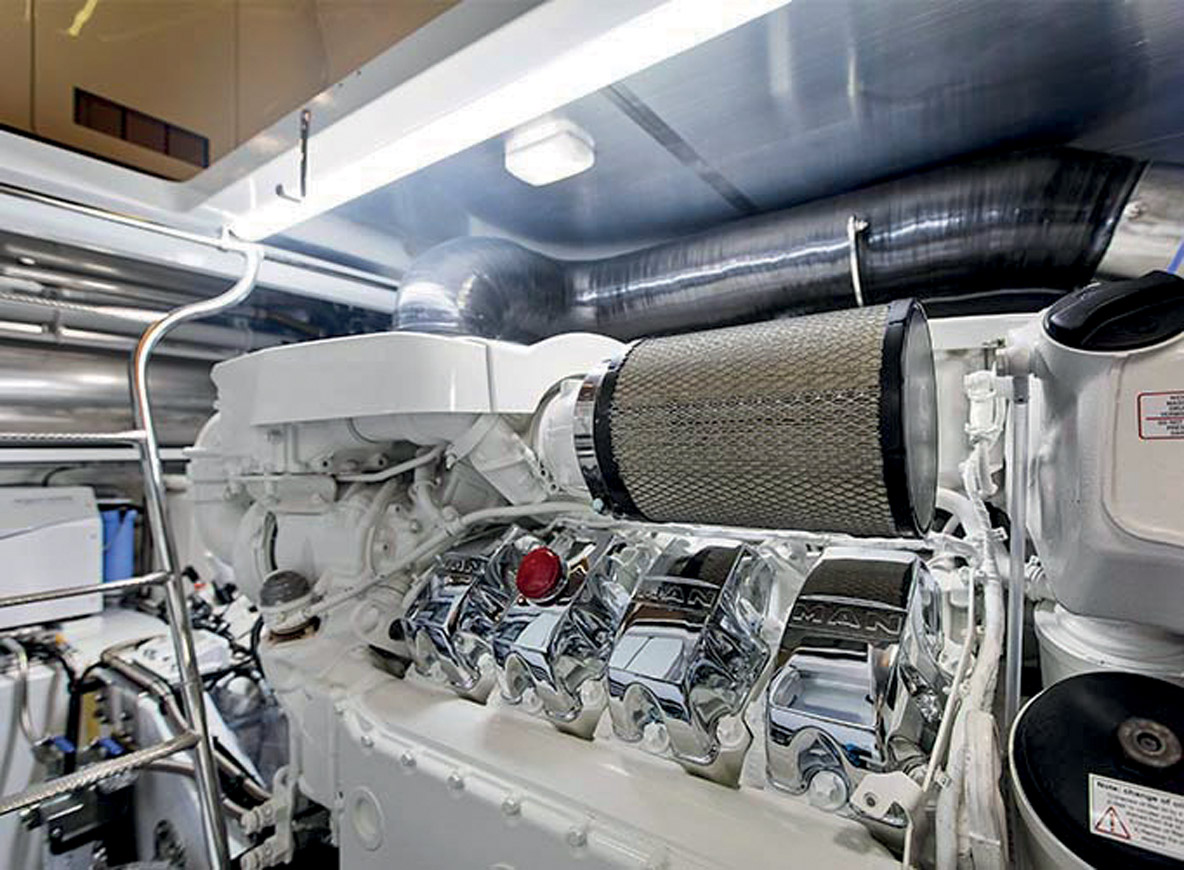
Quand il s’agit de rendre un bateau plus rapide, Wayne est irremplaçable. When it comes to making a boat go fast, there is no one more experienced than Wayne. So when it came to powering his new Carbon Cat, there was no question about packing in a load of horsepower. To do 45 knots, designer Roger Hill specified a minimum of 2600 hp.
“We went for the MANs due to their excellent power to weight ratio and particularly the torque curve. They develop maximum torque early on and hold it right through the range, something that is important as we need the power early to activate the foil”, says designer Roger Hill.
Initial trials with a pair of 1300hp M.A.N V8s saw the boat nudge around 45 knots in mid load. Since launching, some work has been done on the aft sections of the hulls running surfaces to provide a little less stern lift and improve boat handling at high speed.
The 1300hp M.A.N V8s are coupled to jackshafts and linked to ZF665V gearboxes with a 1.97:1 ratio. The Keys is fitted with conventional driveshafts, with a pair of CJR Propulsion 31” x 52.5” 5-blade underwater MRKSuperprops, with minimal drag P brackets. The MRKSuperprop is an advanced bespoke design for high-speed boats and is 100% CNC machined to Class S. Boat #2 is having CJR Propulsion surface-piercing propellers that should take the cat over the 50-knot barrier. Leigh Michau of Q-Marine, the New Zealand agent for CJR Propulsion, says that even the current underwater propellers on The Keys are designed to work to 47-48 knots.
“50 knots is my target, and while I know it is not achievable with the current driveline set up, I am sure we can achieve it and more with surface propellers while still running the same engines”, says Wayne.
While the 1300hp M.A.N V8s is rated to 2300 rpm, we could only achieve 2200 rpm @ 45.2 knots while on the boat on Auckland harbor. Wayne says he is confident in achieving maximum rpm with a few tweaks, such as moving the foil, which still was due to be carried out in the weeks after our review.
The Keys is fitted with Acoustic Vybar, a rigid marine noise barrier and vibration damping sheet specifically engineered to combat the challenging combined effects of vibrations, sound transmission and reverberation from marine engines and boat hulls. Vybar is also not affected by hydrolysis and will not degrade.
A king size bed for the owner’s cabin
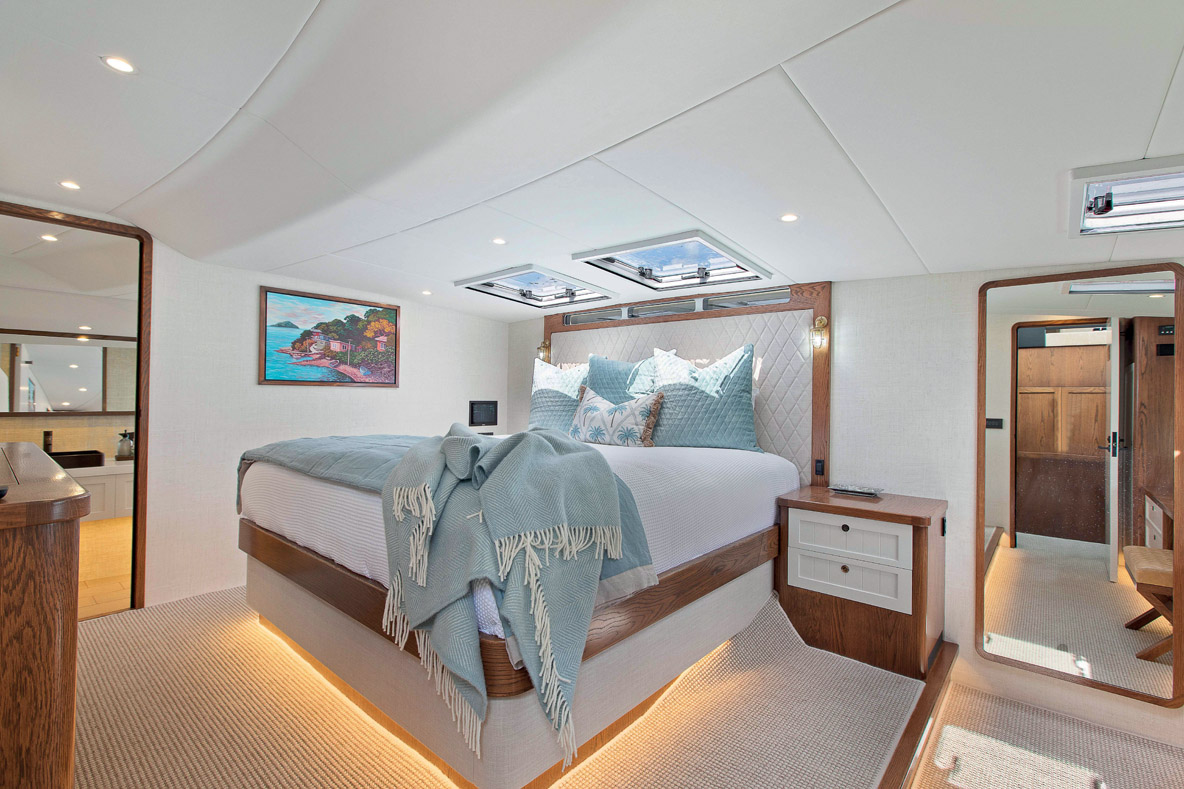
The Valder 20 is essentially a custom boat with bespoke layouts available to suit every owner’s tastes. The Keys is what Wayne and partner Kathy wanted, but already there are changes planned on boat #2. These include changing to a single level sole through the saloon and galley area and raising the foredeck to generate more headroom in the master cabin. There is also talk about much larger hull windows.
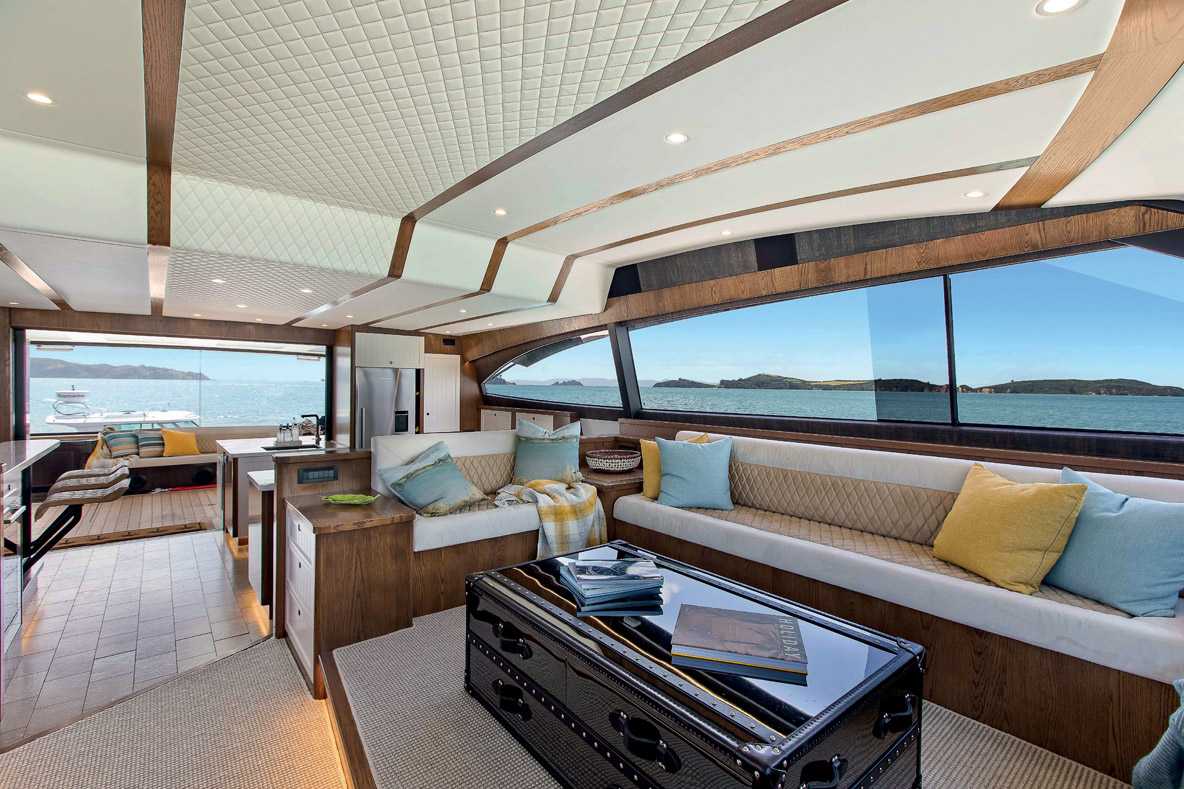
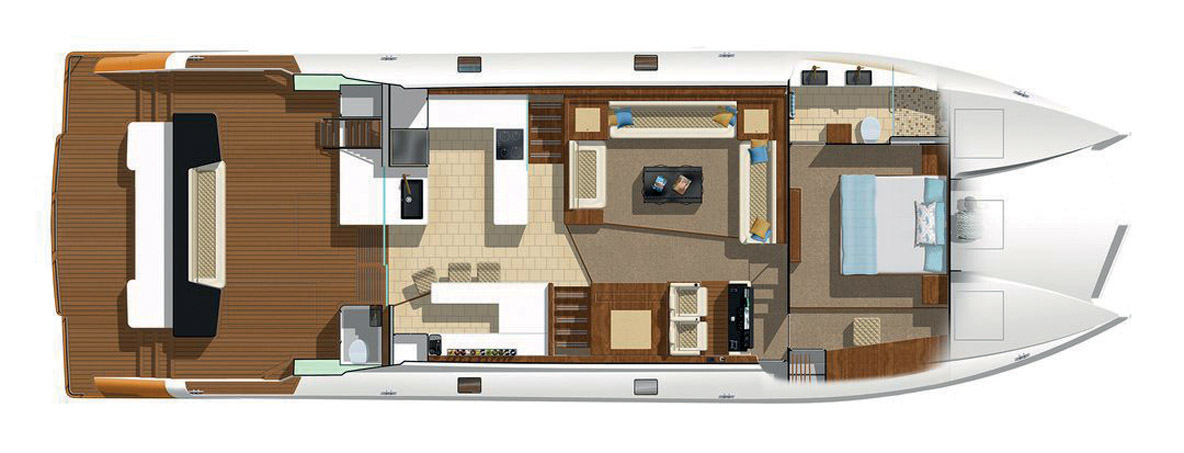
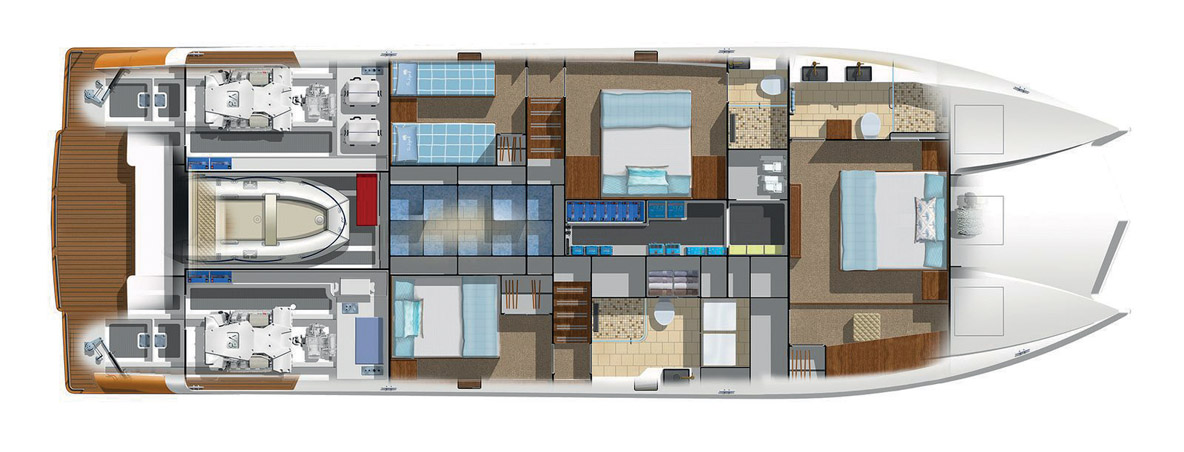
The Keys is a four-cabin design, with a full-beam master forward with a king-size berth over the tunnel and a large en-suite bathroom with cork floors, massive shower cubicle, twin sinks and Corian surfaces in the port hull. The master cabin is accessed forward of the helm, with the atrium radiating natural light into the entranceway. Like the rest of the boat, the timber is all oak, with the owners wanting a particular stain. Light fabrics and wall coverings, and white cabinet doors enhance the feeling of space and room to move.
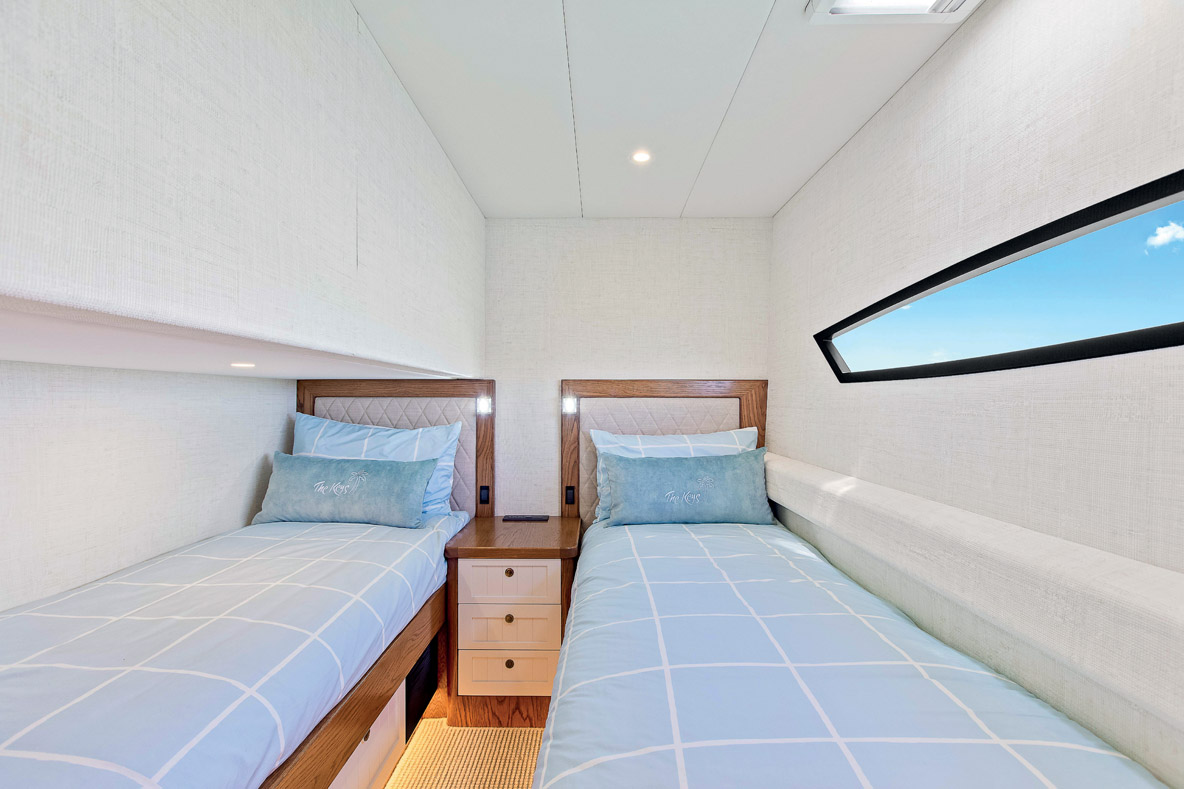
The rest of the accommodation is in the hulls, with both areas accessed from companionways on either side of the saloon. To port, two cabins share the same en-suite. Forward is a large cabin with a queen berth, and aft is a rear cabin with two singles. There is a VIP cabin in the starboard hull, complete with an exceptionally large en-suite.
Electronic control by joystick
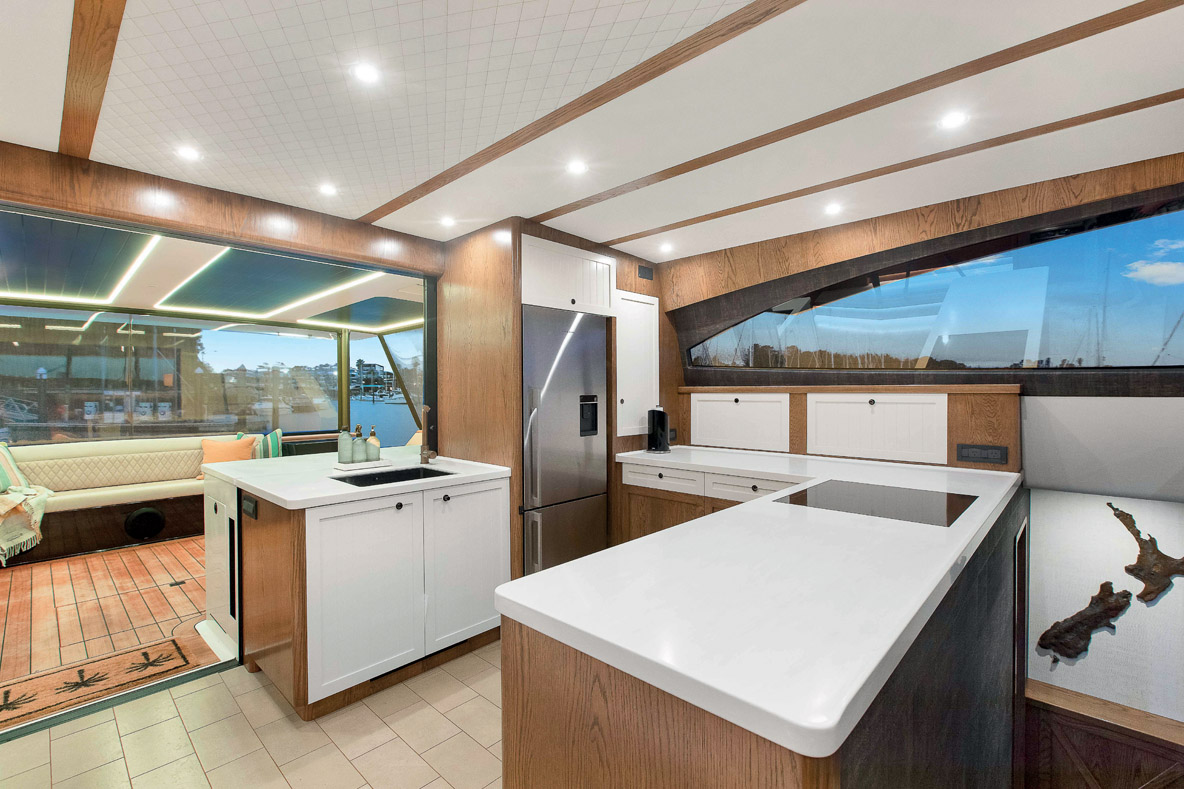
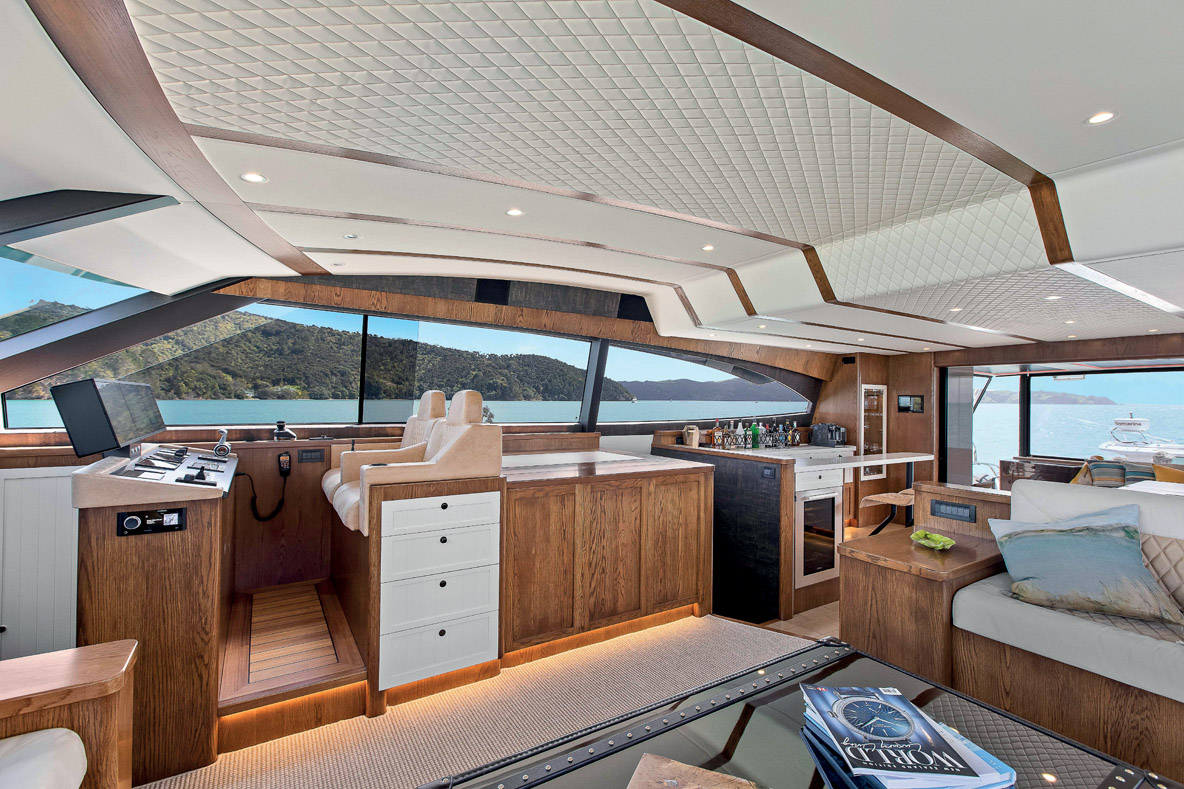
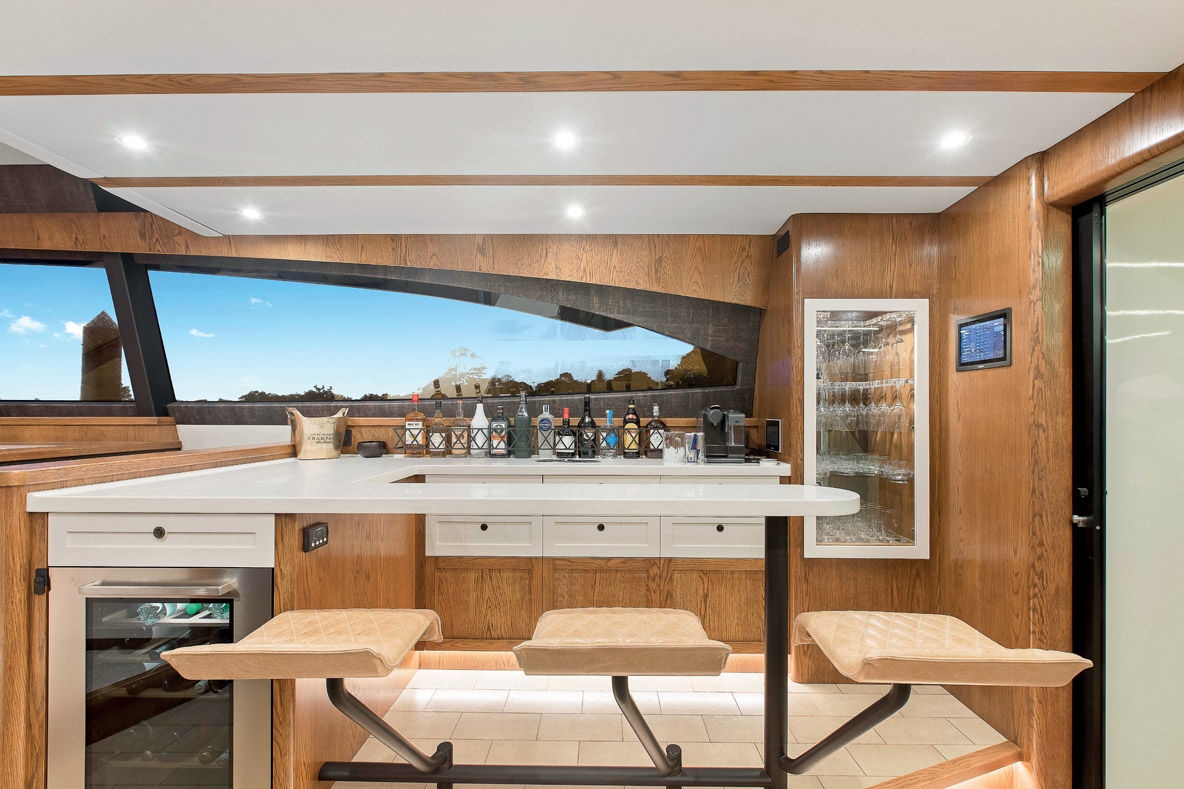
Being a custom build, the saloon layout is again a decision of the owner. The Keys is relatively conventional in many ways, with a port side forward lounger, aft galley, bar opposite with an entertainment center and helm forward. All spaces are conceived to provide maximum use of the available space, with a meticulous finish as you might expect from Scott Lane Boatbuilders. However, while the prime directive from the owner was to portray an accent of quality with a Bentley inspired interior, it also had to be practical. Something that has certainly been achieved.
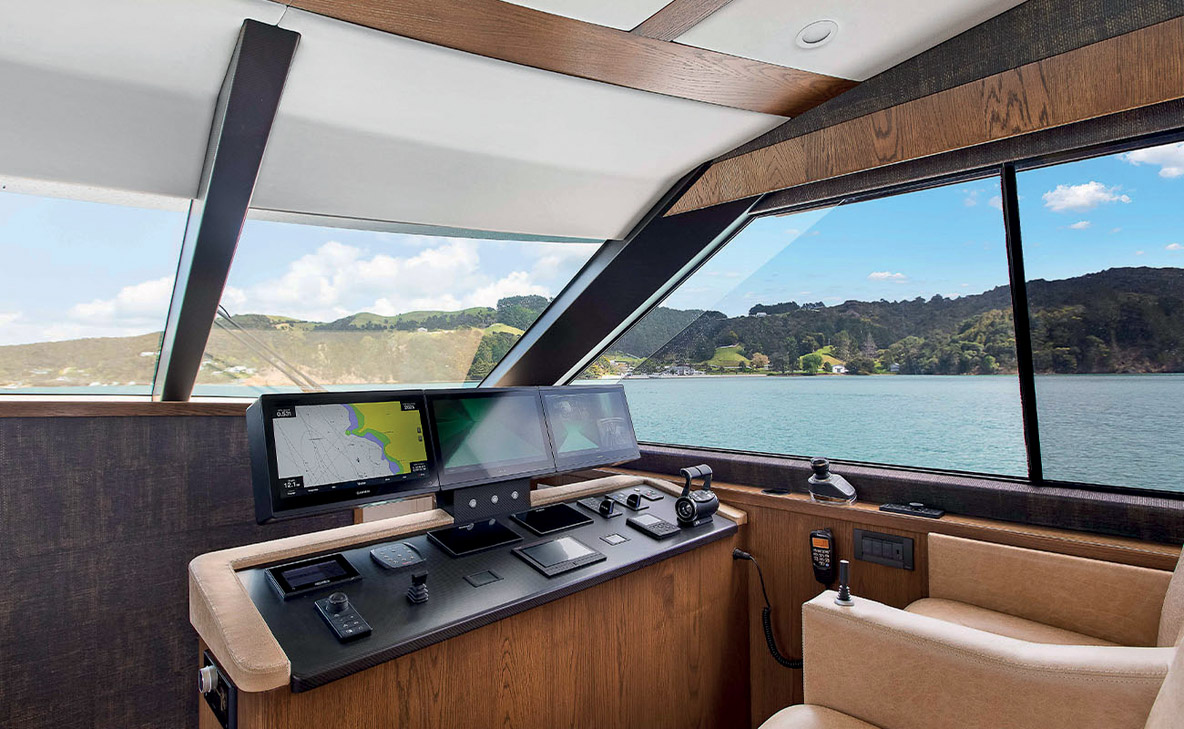
The spacious dash gives you the ability to fit as much or as little in the way of electronics as you want. The helm on The Keys features a trio of Garmin 16” screens surrounded by all the necessary navigation and system controls. A CMC electronic steering system is used, which is controlled by a joystick on the helm armrest. It proved to be extremely positive at high speed and provided effortless control of the boat during all maneuvers.
While visibility from the helm is fine, in boat #2, one of the forward window mullions will be removed, providing even better uninterrupted viewing. Sliding side windows on either side of the saloon provide extra natural ventilation.
Designed for extended cruising
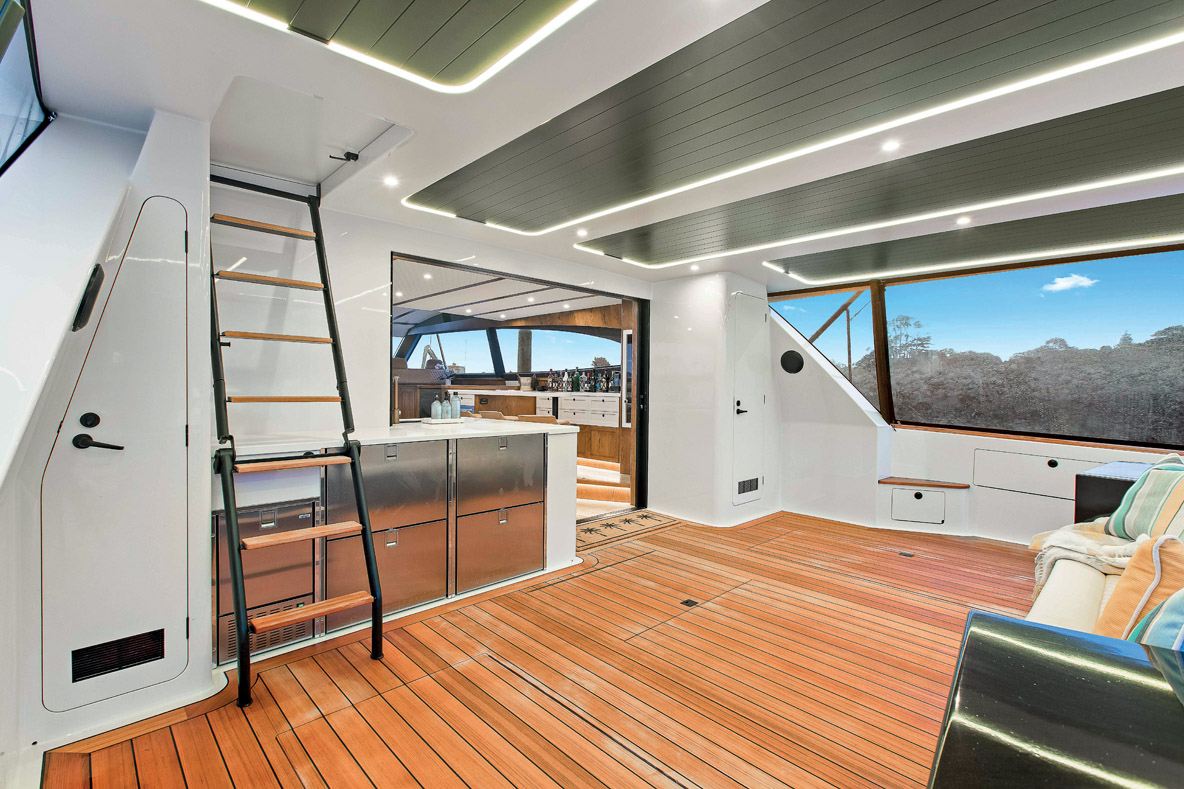
The flow from the interior to the cockpit is clean, with a sliding door and a lift-up rear window. This brings the galley area seamlessly into the cockpit, so the entertaining spaces all blend into one. There’s no question that this is a multihull that has been designed around having fun with friends as well as extended cruising. The generous cockpit features loose chairs, but again you can build in whatever seating layout you want. Forward there is a large fridge/freezer area and rod locker to port, with the day head on the starboard side.
Under the center of the cockpit is a tender garage with a rise/fall hydraulic platform.
The ‘boat deck’ and helicopter landing space is above the cockpit and accessed by a set of steps. One of the earliest design requests was for the boat to have a ‘touch and go’ landing pad for Wayne’s helicopter. Plus, there’s also an ADC davit crane and space for a large RIB tender.
The foredeck space of The Keys has been well utilized with a recessed sun lounger with fold up back rest and detachable bimini top. There are deep storage lockers either side of the enclosed anchor compartment. I was interested to see a Lonestar Elite 7 drum winch with a Sarca Excel anchor, rather than a conventional capstan, not something you see often on larger vessels. According to Wayne, it works extremely well, and he is very pleased with it.
Conclusion
Offered in a range of sizes from 59 to 72 feet (18 to 22m), Valder Yachts are available in either a sports sedan or flybridge style. Valder Yachts are the start of a new dimension in power cat design and are destined to become a world leader in high-speed foil assisted power catamarans. If you aspire to be admired on the water, like speed and luxury, then a Carbon Cat can help fulfil those dreams – provided you have the means, of course…
Transatlantic range at 10 knots
Foil-assisted navigation
Lack of headroom in the owner’s cabin
Hatches in the hulls could be larger
Technical specifications
Designer: Roger Hill Yacht Design
Material: Carbon fiber
Length overall: 66’6” (20.27 m)
Waterline length: 56’1” (17.1 m)
Beam: 22’ (6.7 m)
Max hull beam: 6’6” (1.98 m)
Draft: 33” (0.83 m)
Light displacement: 66,000 lbs (30 t)
Max laden displacement: 88,600 lbs (40.2 t)
Drivetrain: 2 X M.A.N 1 300 HP V8
Cruising speed: 18 to 30 knots
Max speed: 45 knots
Fuel: 2,500 US gal (9,460 l)
Water: 440 US gal (1,675 l)
Year launched: 2021
Price: on request