We’ve heard of sport catamarans, cruising catamarans, catamaran yachts, fishing catamarans, etc... and now we’ll have to reckon with adventure catamarans, such as the robust Vandal 46 Explorer built in aluminum.

Infos pratiques
- Le chantier : Vandal 46 Explorer
- La fiche technique
-
 Découvrez notre vidéo exclusive
- Financez votre Vandal 46 Explorer
- Assuez votre Vandal 46 Explorer
- Articles autour du Vandal 46 Explorer
Conditions: Calm to rather rough seas, 4 to 5 knots of wind
So-called “adventure” boats that you might describe as the 4x4s of the seas have been a big trend in recent years. The multihull sector is no exception, with powercats such as Cheetah Marine and 2 Oceans... Vandal Marine, meanwhile, is introducing the concept to the 40 to 50-foot market with a catamaran designed and built in the Netherlands. Behind its aluminum construction and adventurous looks, the Vandal 46 Explorer has plenty of surprises in store...
At the origin of the project is Tender Works, a Dutch company based a stone’s throw from Amsterdam, has been building yacht tenders for over 25 years. When Ben Mennen, co-founder of the company, went looking for the boat of his dreams and found nothing, he decided to build it. The idea behind the project was to design a powercat that would be as solid as a workboat, but as welcoming as a modern pleasure boat. They also wanted the boat to offer exceptional marine capabilities even in heavy weather, and to have minimal fuel consumption.
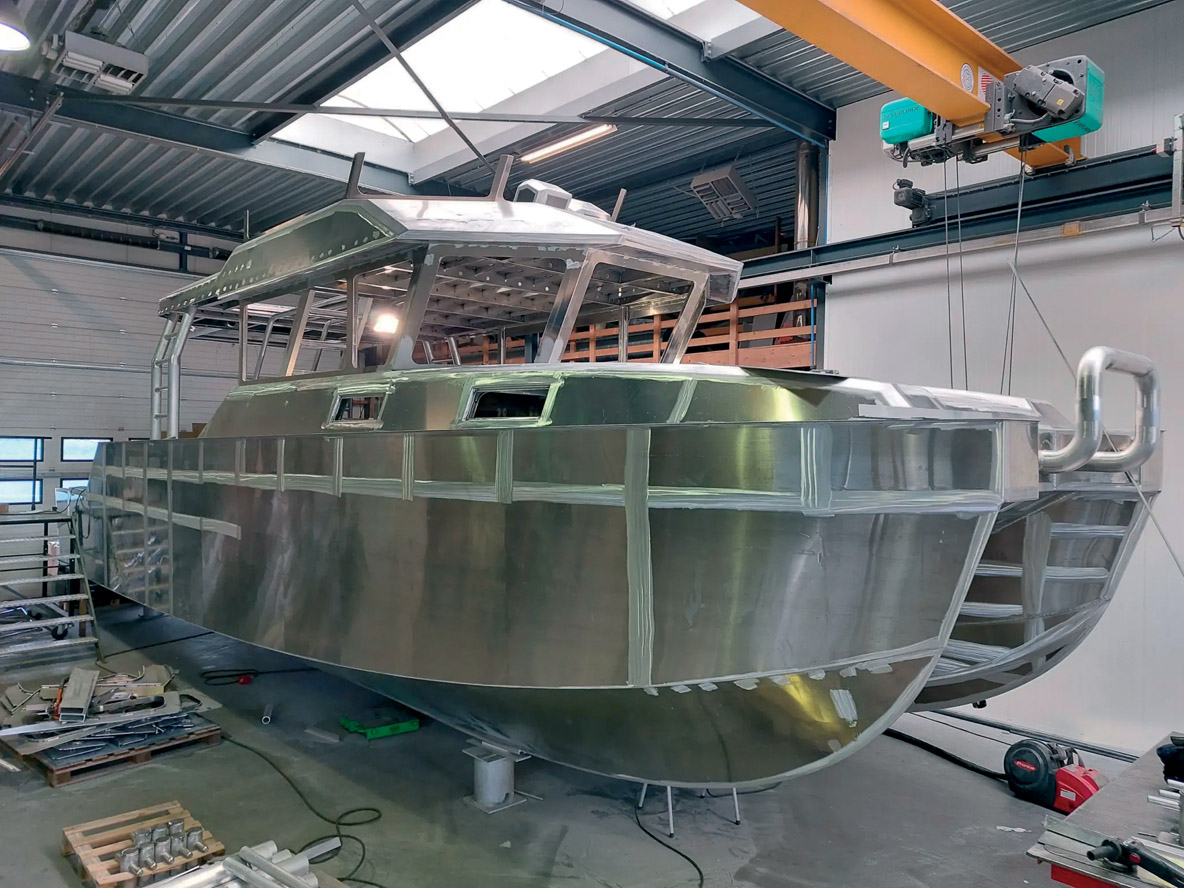
A shipyard specializing in aluminum construction
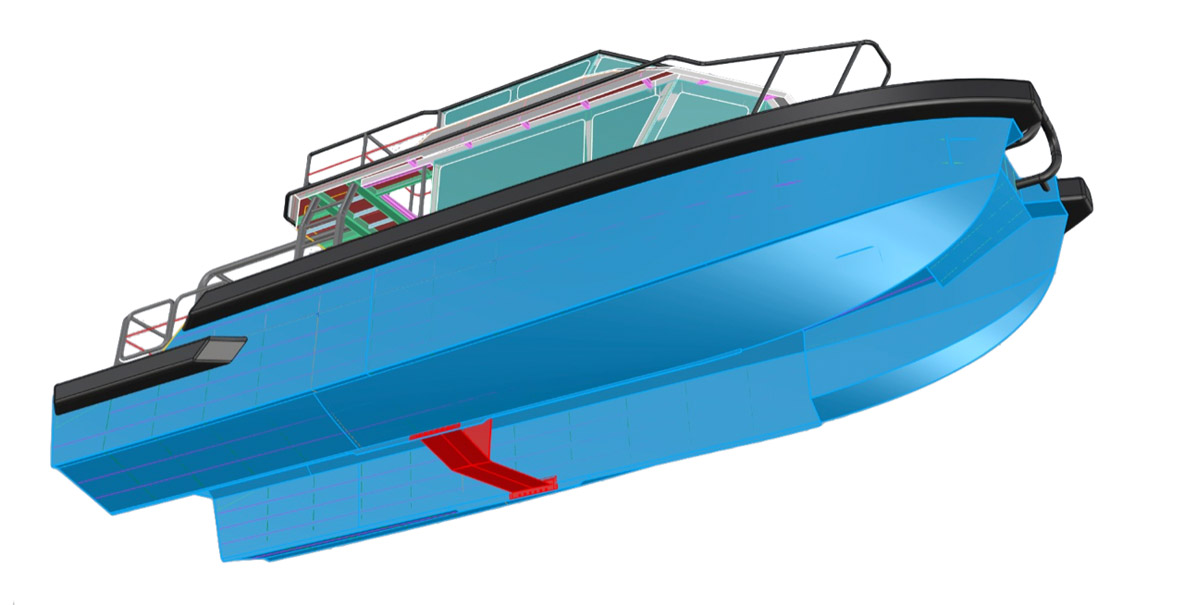
To meet this challenge, they teamed up with designer Espen Øino and naval architect Scott Jutson. To meet all these criteria, the choice of a catamaran with asymmetrical hulls was quickly made. In addition, to ensure smooth passage through the waves and reduce fuel consumption, they decided to install a foil between the two hulls. As aluminum specialists with Tender Works, this material was the natural choice for the hull and the structure, especially as it enables the construction of strong, lightweight hulls that are almost totally customizable. Indeed, the other requirement was to design a boat that could be adapted to the needs of different owners. All that remained was to define the name, and for an adventure catamaran that’s rugged and a fighter in the waves, Vandal was the obvious choice, as a tribute to the ancient peoples of Europe.
The aesthetic aspect was not forgotten, as the 46 Explorer boasts an industrial chic look that blends perfectly with a Jeep Wrangler for example.
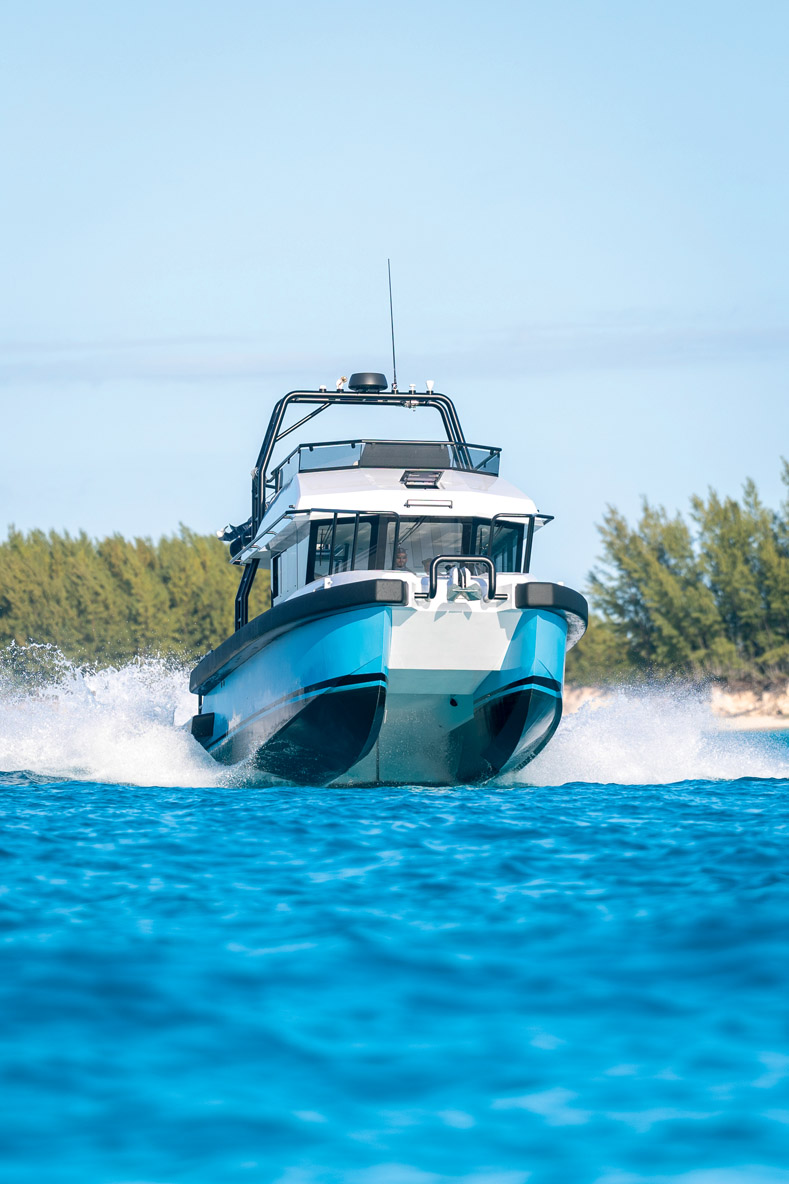
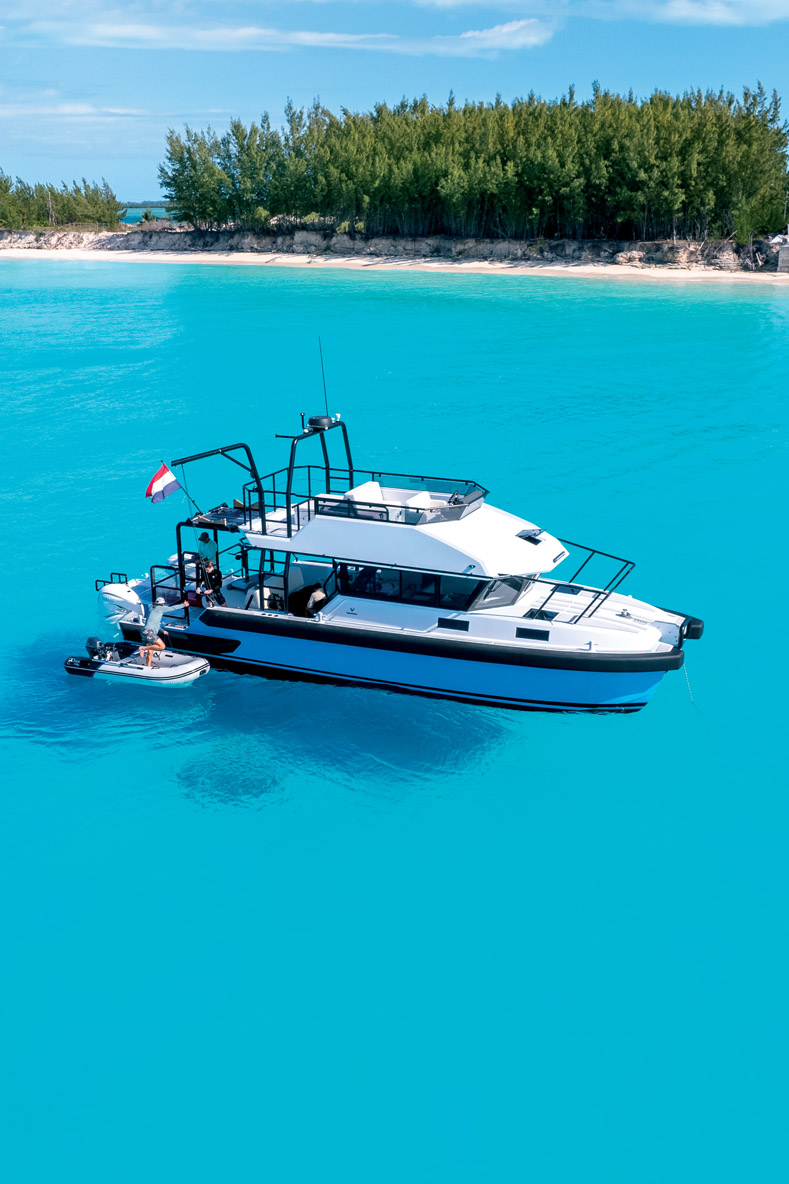
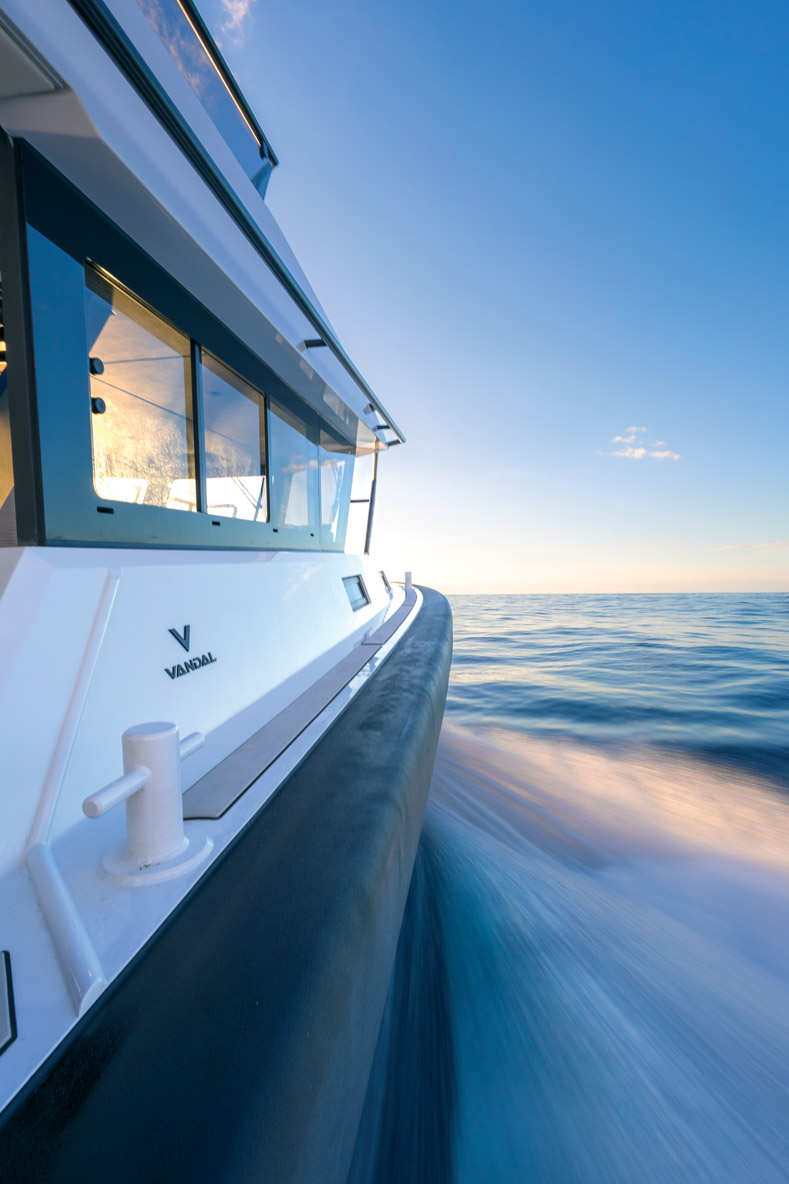
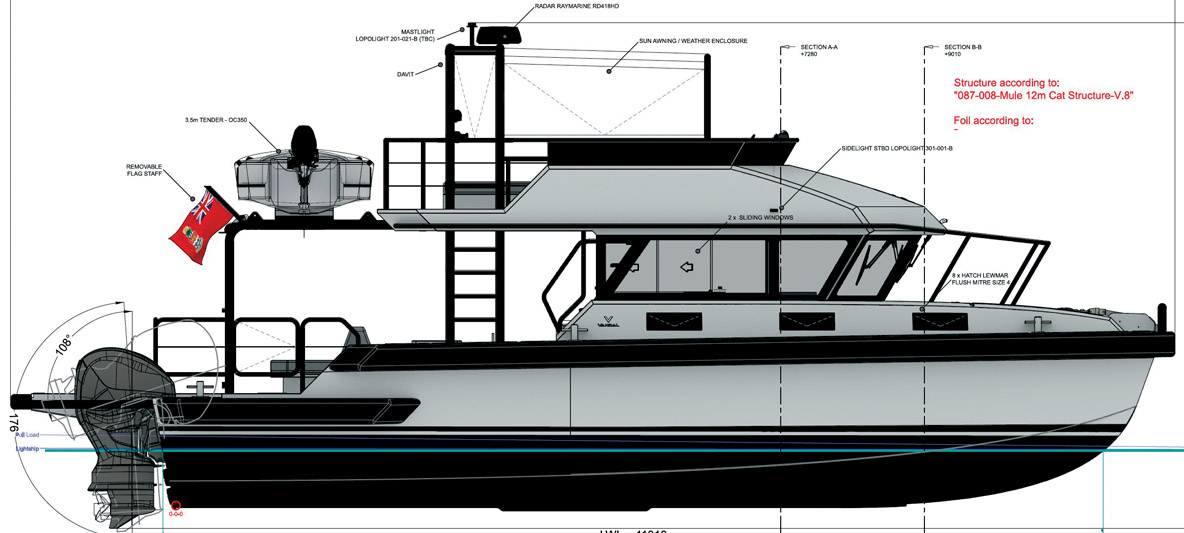
The result is unique, to say the least. At first glance, this catamaran leaves no one indifferent. The catamaran has a long flybridge, and the whole boat is supported by a structure of large-diameter tubes. To reinforce the workboat look, the Vandal is surrounded by a large rub rail, a real plus for hull protection. In fact, the hulls are made from very strong industrial aluminum, and this robustness is evident throughout the catamaran, starting with the oversized cleats.
Another surprise is that the catamaran is only 13’6’’ (4.15m) wide, which is rather unusual for a 46-foot unit. However, this allows it to sneak into a monohull slip, a real advantage.
In keeping with the idea of industrial chic, the Vandal is quite simple, at least in appearance. It is also almost entirely open, both on the main deck and on the flybridge, which has no T-Top.
A well-designed deck layout
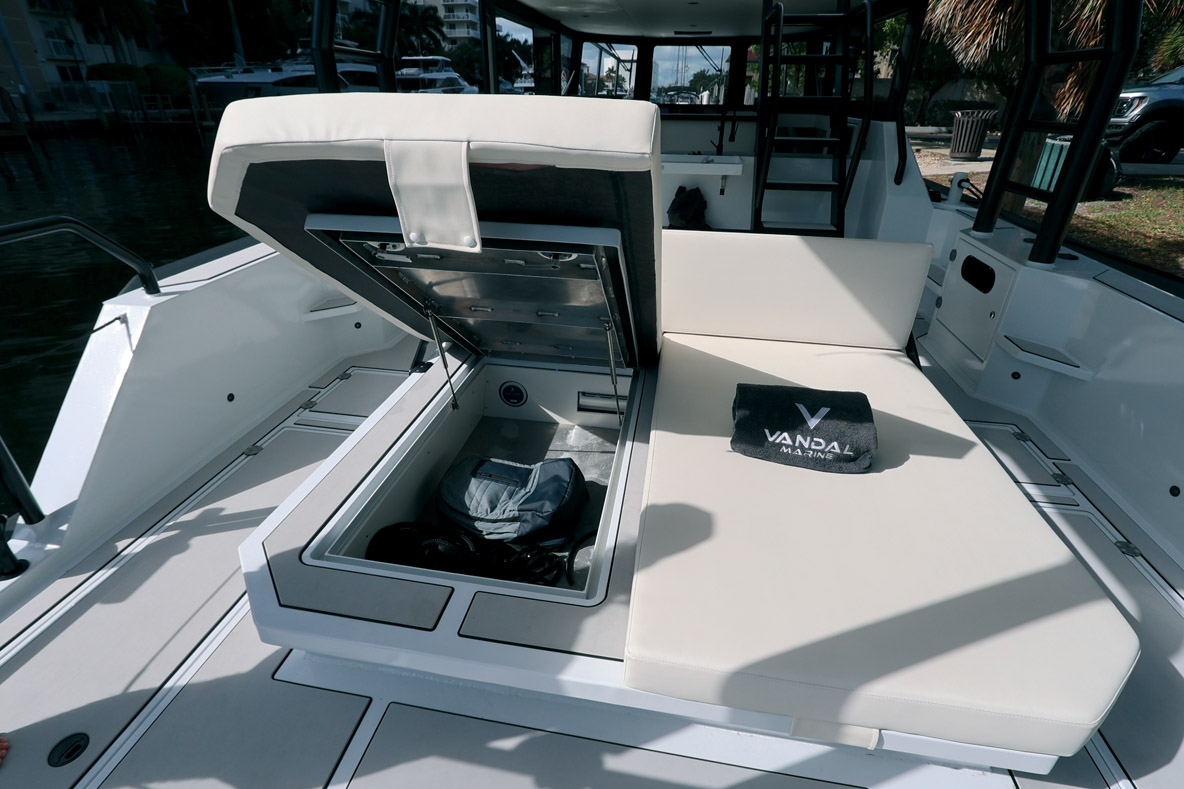
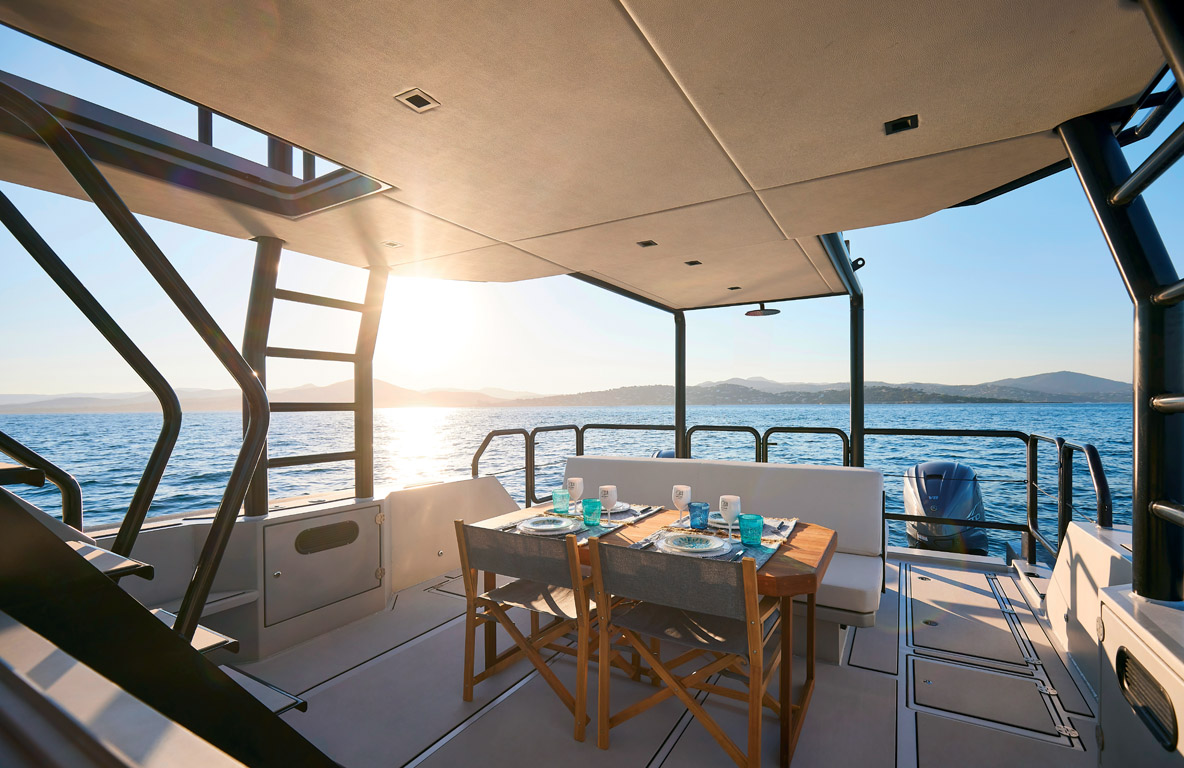
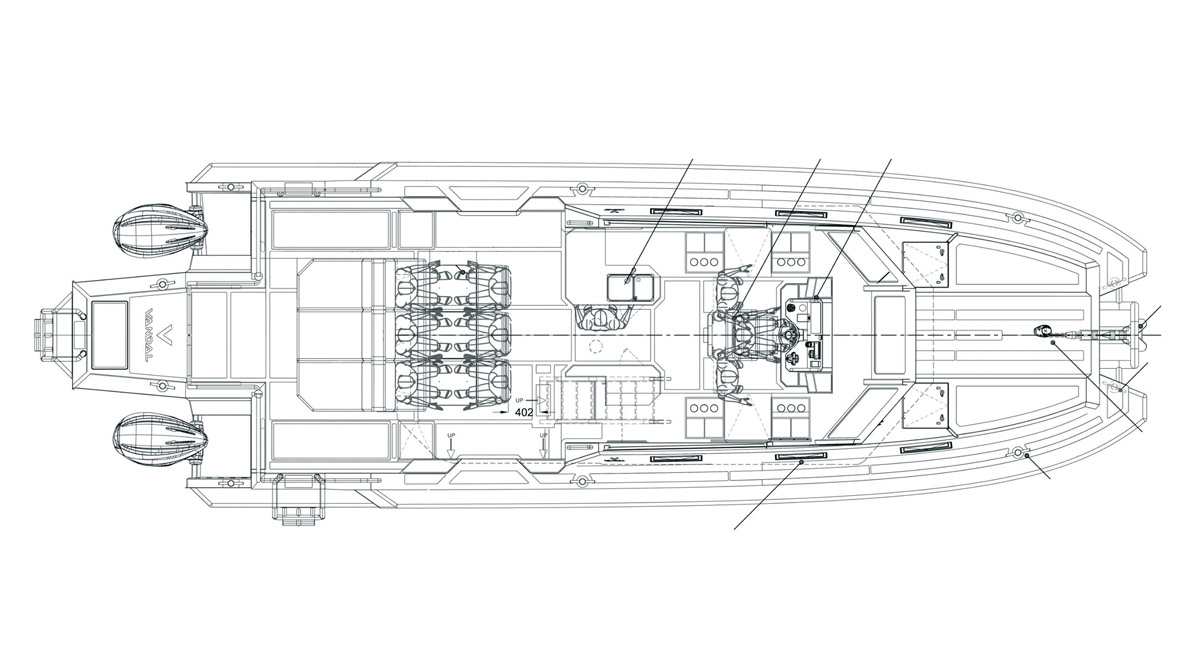
Once on board, we discover another facet of this catamaran. In fact, every detail has been thought through. The floor, for example, is covered with a non-slip coating that’s very comfortable underfoot. The pretty deep clearance guarantees safety, while the stern is enclosed by balconies, again made from large-diameter tubes. To access the bathing area or to pull up your catch, a wide gate is fitted on each side. If that’s not enough, you can use the long rear platform between the two outboard motors. The bathing ladder, also oversized, can be installed either sideways or aft. Another surprise: this central platform is topped by a «home-style» shower head for rinsing off after a swim. The rear of the cockpit features a modular bench seat that can be transformed into a sunlounger, with ample storage spaces under the cushions.
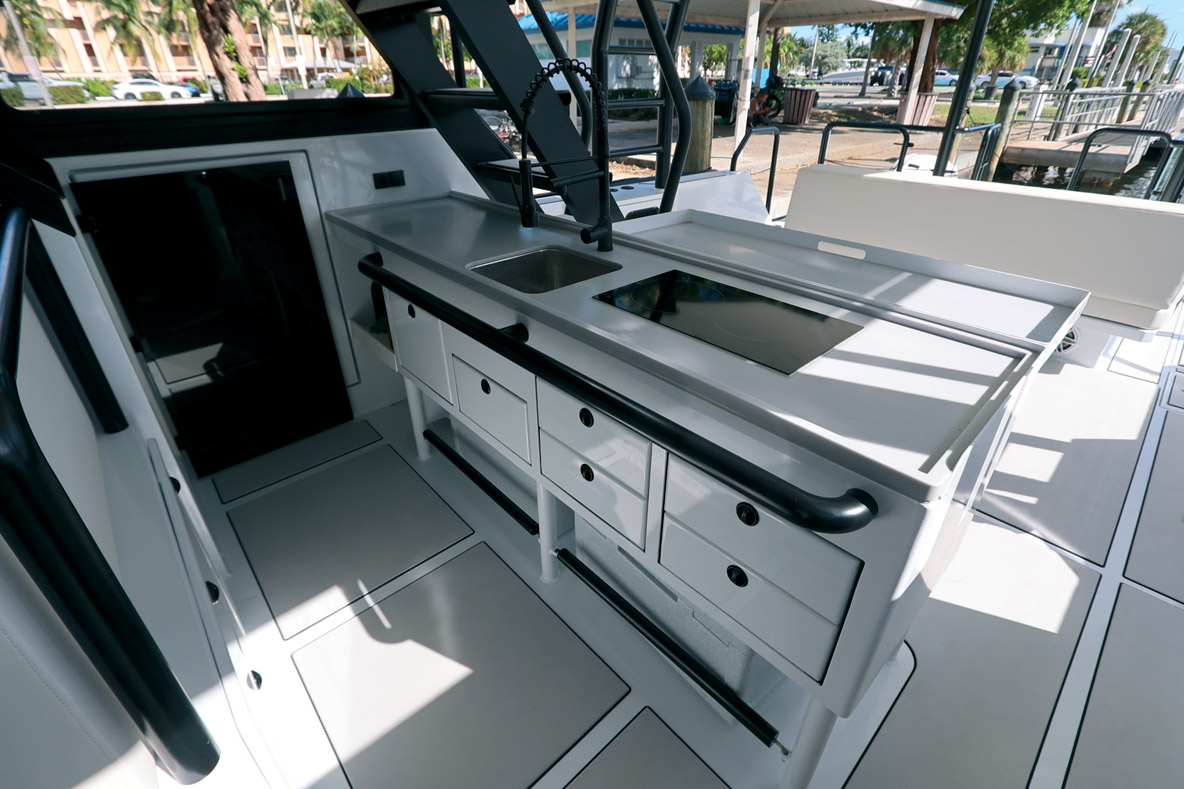
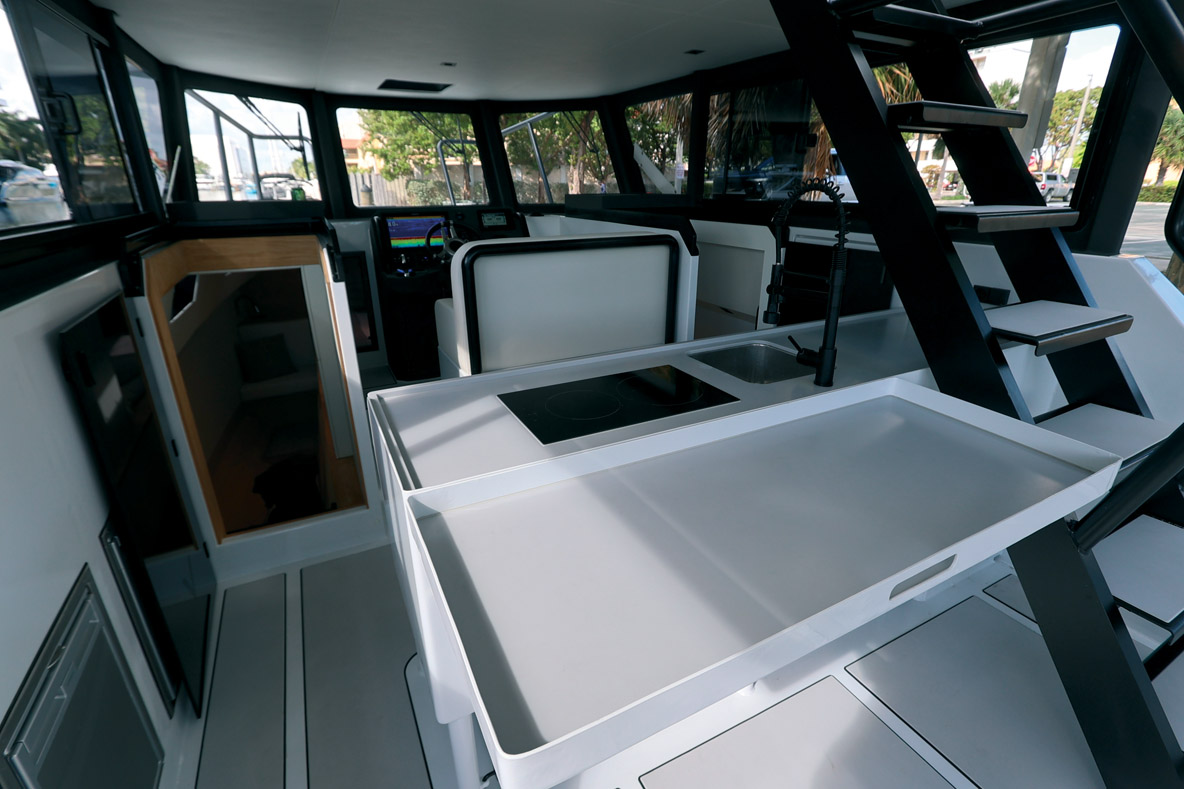
Continuing forward, the cockpit offers plenty of space, although it’s a shame there’s no table. On starboard, an aluminum ladder evokes the ambience of a New York loft, and it proves quite comfortable, but we’ll come back to that later. Next to the ladder, the main galley features a sink and hob. A fold-out table can also be used for extra space, while a cooler is located underneath. The rest of the galley is full of storage space in the form of drawers and cupboards. It’s also worth noting that the entire boat has plenty of storage, taking advantage of the thickness of the bulwarks.
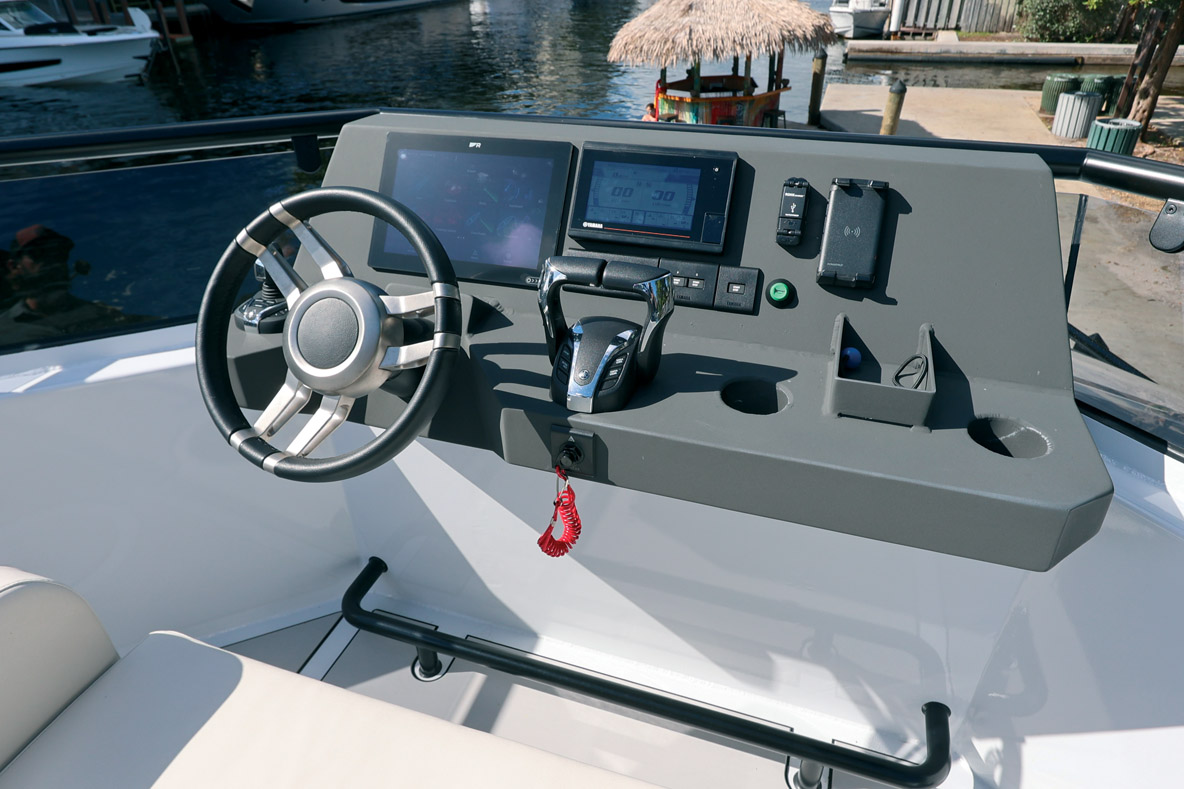
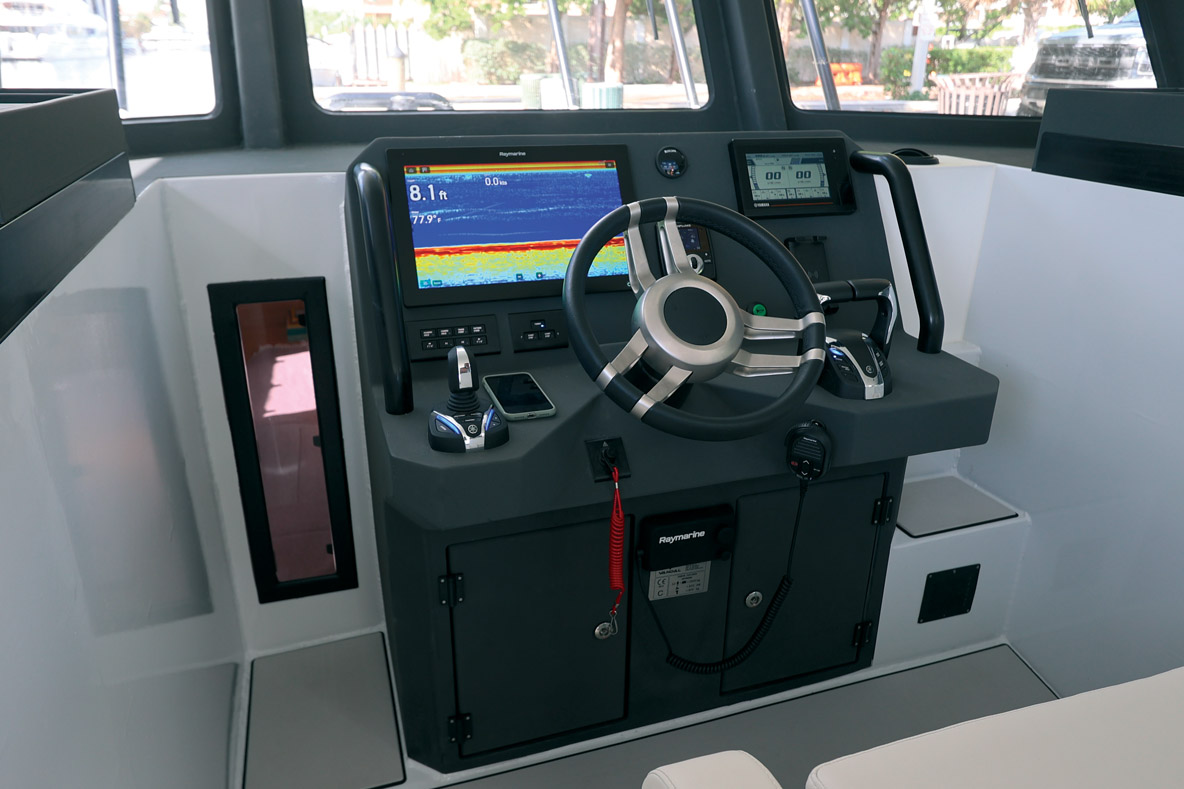
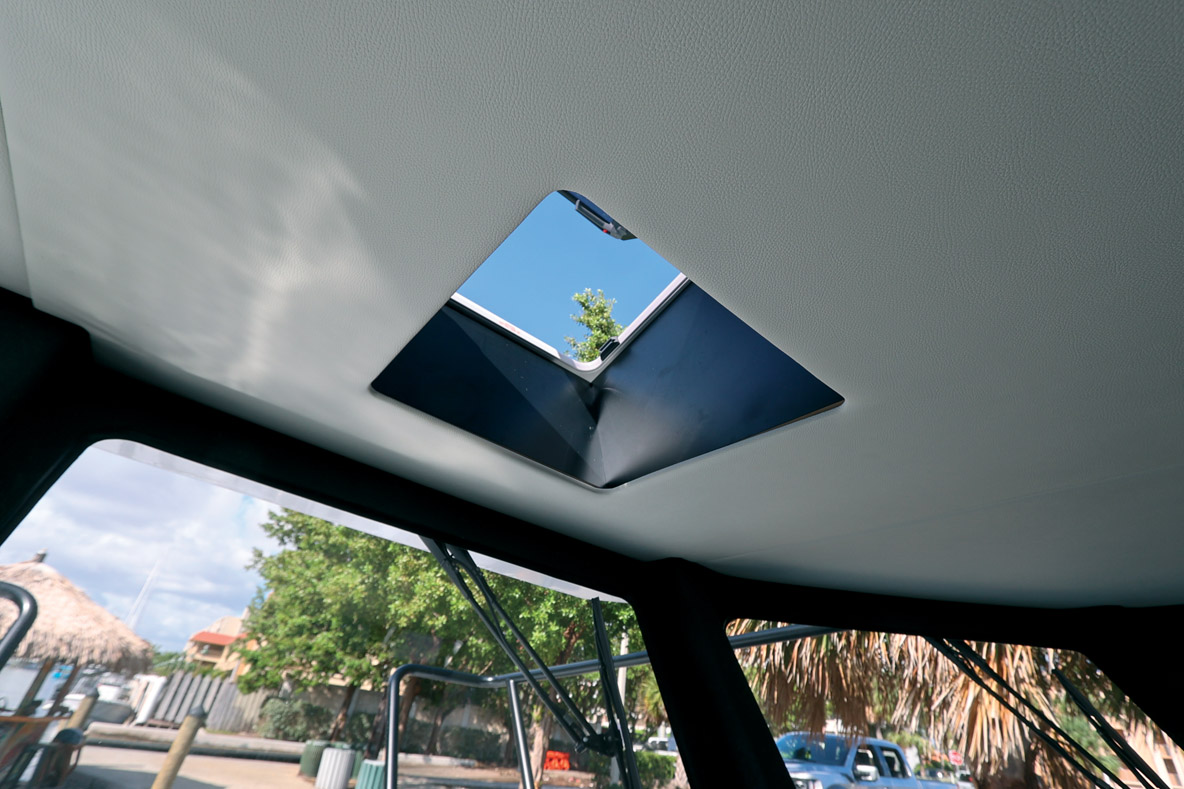
Just beyond the galley, the helm station is centrally located. Very well protected by a large windshield that completely closes the front and by sliding side windows, the helm position is quite ergonomic. Once at the controls, visibility is excellent and there’s plenty of room for electronics, throttle and joystick. There’s no storage compartment, but a compartmentalized box on each side, which is much better. Another interesting detail is the deck hatch just above it, which provides light and ventilation. While a good idea, it’s a shame that you have to do a bit of climbing to open and close it...
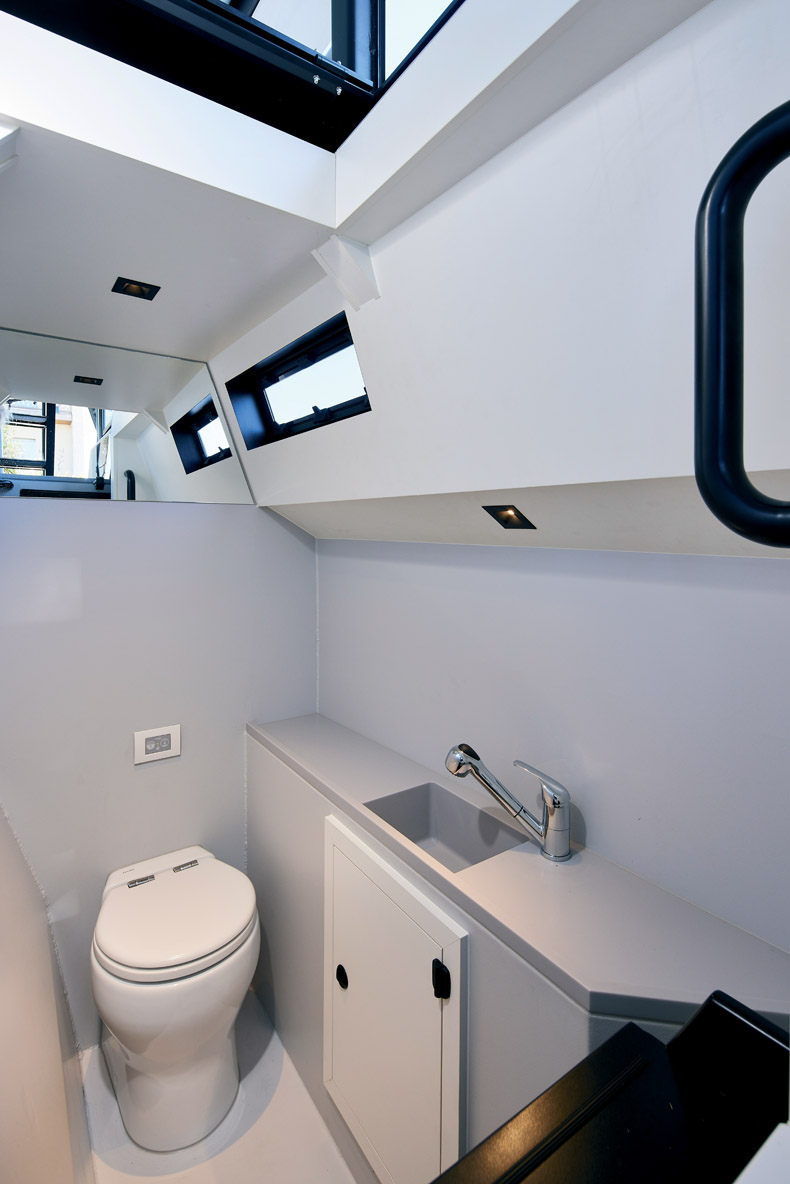
On the starboard side, just off the helm station, a door opens into a spacious head. Featuring a toilet, sink and some storage space, this area is particularly impressive for its headroom of over 6’6” (2 m).
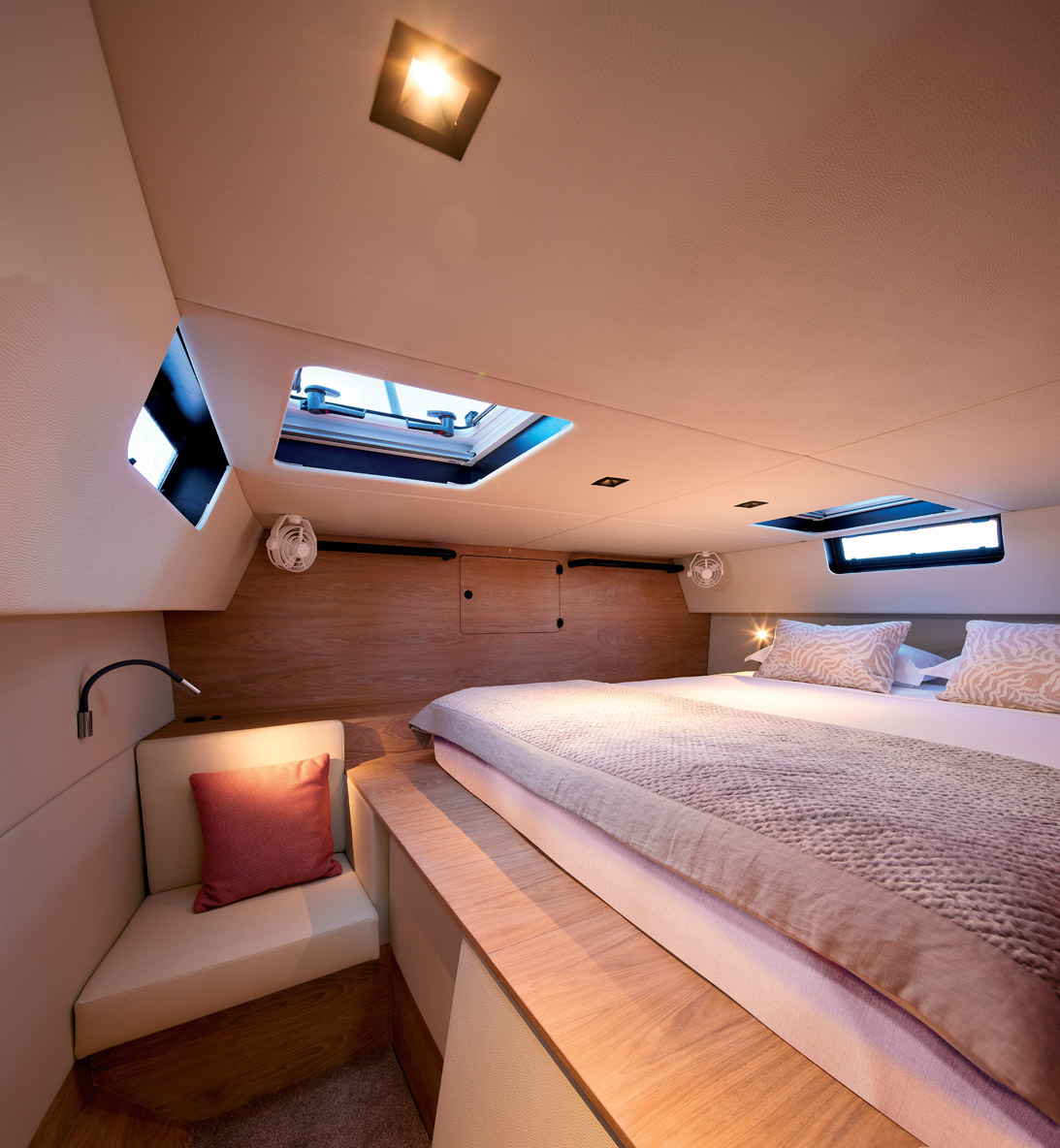
To port, the other door leads to the cabin. Bathed in light, this space offers a queen-size bed set athwartships, i.e. positioned above the tunnel. There’s also a small seat and some storage space. However, this deck layout can be extensively modified, as this is a semi-custom unit. In fact, a two-cabin version of the 46 Explorer is conceivable.
Extremely well built, the Vandal also benefits from a very high level of finish, even though this is only hull number 3. The linings are carefully applied, the woodwork is of high quality, and even the aluminum is treated in such a way that it almost feels like a fiberglass boat.
Exterior helm station
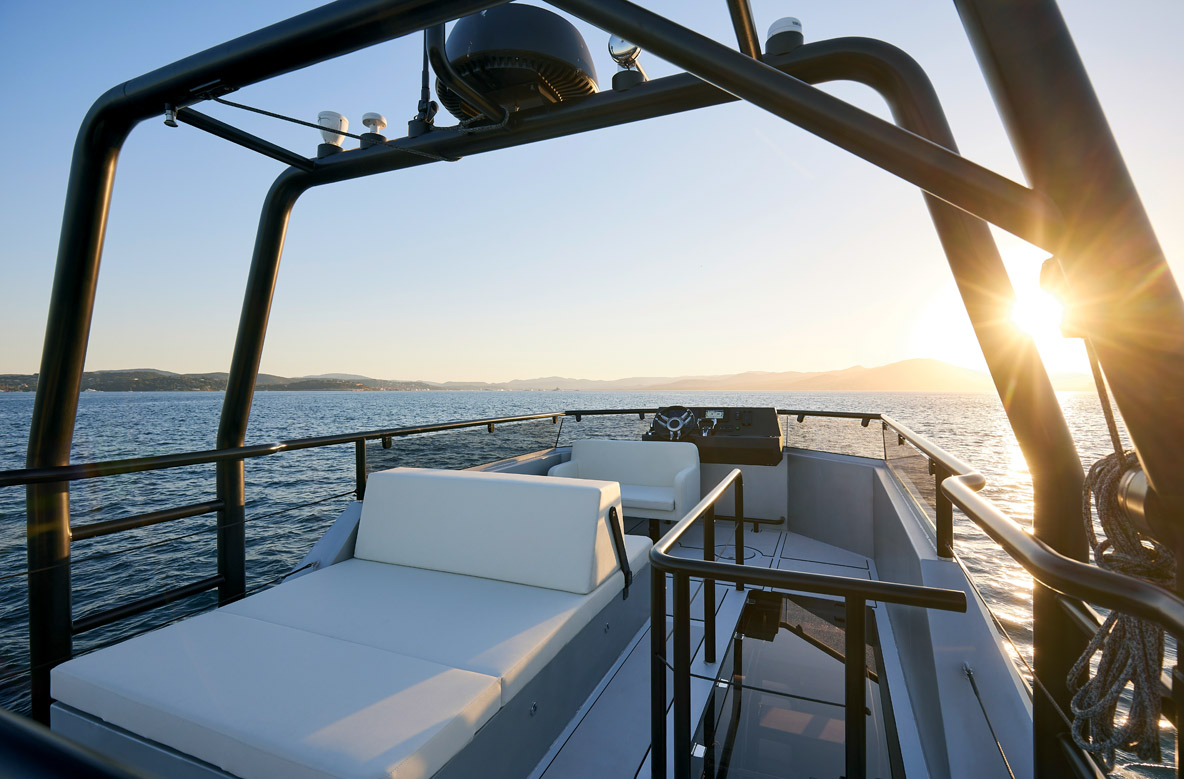
From the cockpit, simply climb the stairs to the flybridge. Equipped with wide steps and handrails on both sides, this staircase is very comfortable. This good-sized flybridge naturally includes the exterior helm station, which is complete and even has a footrest. The aft section can be left free or fitted with whatever you like. On our test boat, there was a bench seat convertible into a sunlounger. From here, you can also access the crane integrated into the roll bar, which is pretty clever. The crane can be used to launch the dinghy into the water or to raise it onto the platform provided. A simple, reliable solution. The platform supporting the dinghy is also covered with solar panels providing a total output of 360 Wp.
Last but not least, the foredeck, which is only accessible via the narrow side-decks. Fortunately, a solid handrail runs along the cabin roof. Once forward, a curious balcony provides a place to stand, but also blocks the space a little. A sunlounger could be installed here, but there’s not enough room. On the other hand, the windlass is well clear, and the anchor is protected by a sort of 4x4-style bull bar, which completes the adventurous look.
2 x 425 HP and a top speed of nearly 40 knots
A bit of a head-turner, the Vandal 46 is just as effective on the water. For the occasion, our catamaran was equipped with two 425 HP Yamaha XTO engines. The outboards are slightly inclined, with the bases facing outwards for greater efficiency. To date, this is the maximum power, but we may see a version with a little more horsepower in the future.
However, with a weight of 11 tons and a catamaran hull, this configuration is more than sufficient. What’s more, the Vandal benefits from a large foil installed between the hulls. The advantages of this foil are manifold. It allows you to sail about 2 ft higher than a conventional catamaran, so you’re almost flying over wave crests for a smooth passage. It also reduces the wetted surface and thus friction, which cuts fuel consumption by around 30%. The manufacturer claims a range of 200 miles at 20 knots, which is quite impressive.
Once out of the channel, it’s time to push the throttle. It soon becomes clear that the theory lives up to its promise. She lifts off in just 6 seconds, not bad for a 46-foot catamaran. The GPS continues to climb until we reach cruising speed of around 28 knots. At this point, the 46 Explorer easily rides the waves in maximum comfort. The chop is swallowed up before you know it. Curves follow one another at a sustained pace, without the boat heeling over - a truly surprising feat. What’s more, this powercat doesn’t require any particular skill, it’s easy to trim and steer without ever touching the limits. With a little more throttle, we quickly reach 36 knots, just short of the speed advertised by the manufacturer, but we’re still 400 rpm short of the 16-inch saltwater propeller.
At this level, performance is of secondary importance. What’s really appealing is the boat’s ease of handling in swells, a real pleasure for the pilot, but also for the crew, not forgetting the benefits for the gas budget. Regarding of the catamaran’s capabilities, it’s almost tempting to go out and take on heavy weather, as there’s no doubt that this “all-terrain powercat” won’t disappoint.
Conclusion
The Vandal 46 Explorer is truly one of a kind. In addition to its rugged good looks, this catamaran boasts excellent build quality. We were also impressed by the attention to finish and detail, and by the many clever features on board. Finally, it’s hard to forget its exemplary seaworthiness. In short, a powercat built for adventure, but also capable of adapting to almost any sailing program, since it is almost entirely customizable. It’s hard to beat that!
Finishes
Seaworthiness
Foredeck access
Technical specifications
Architecture & design: Espen Øino & Scott Jutson
Overall length: 45’11” (14 m)
Waterline length: 39’4” (12 m)
Beam: 14’5” (4.4 m)
Draft: 2’7” (0.8 m)
Light displacement: 26,015 lbs (11 t)
Fuel: 348 US gal (1,260 l)
Water: 158 US gal (300 l)
Max power: 2 x 425 HP
CE Category: B
Starting price SC version: e 950,000