
The great popularity of multiyachts over recent years is showing no sign of waning. However, a new trend is emerging among many builders: to offer units that are as environmentally friendly as possible. And it’s in this innovative area of the market that the young Turkish brand Vision F Yachts have positioned themselves with their F 80.
Infos pratiques
- Le chantier : Vision F80
- La fiche technique
-
 Découvrez notre vidéo exclusive
- Financez votre VisionF 80
- Assuez votre VisionF 80
- Articles autour du VisionF 80
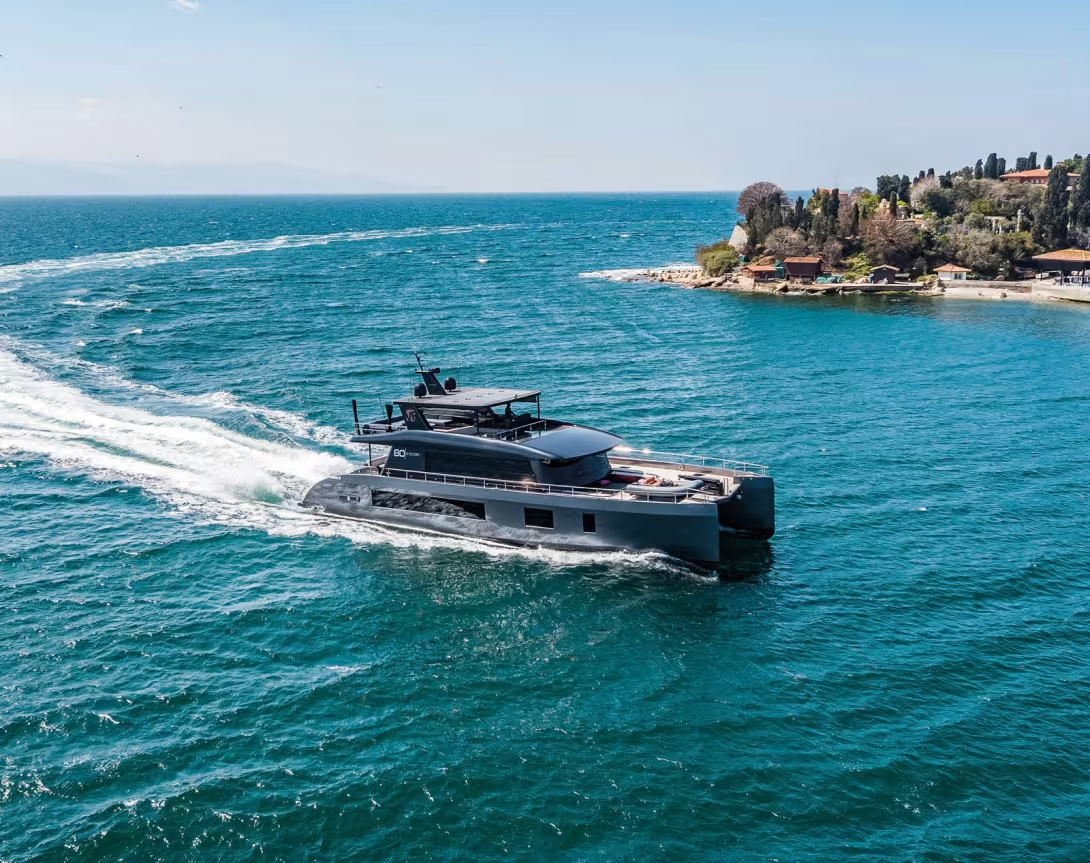
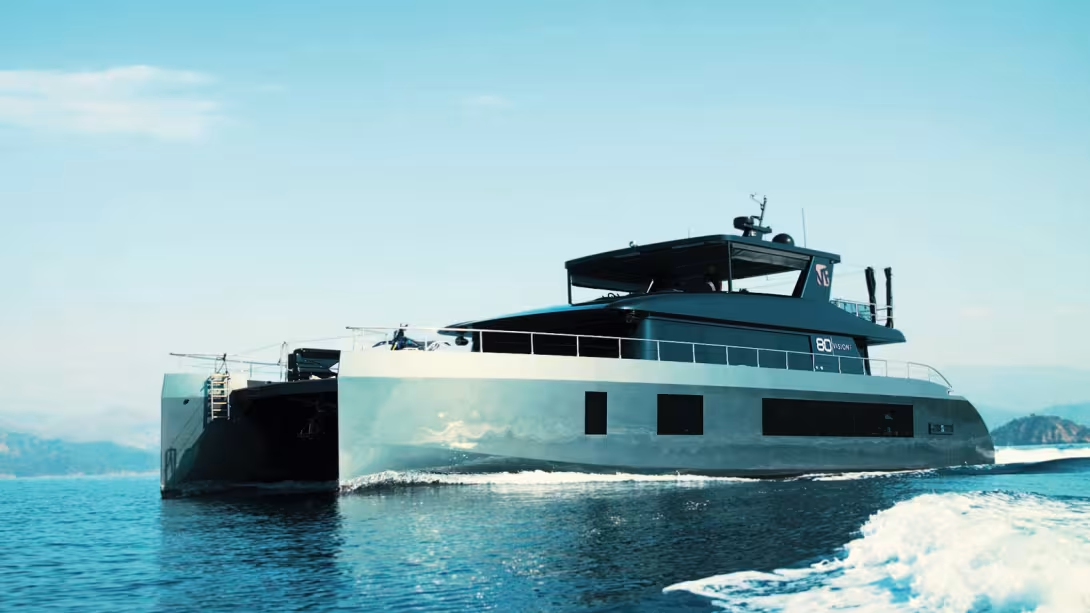
This was another nice surprise at the 2021 Cannes Yachting Festival! Moored right up alongside its competitors, the Vision F 80 blended in perfectly with current trends. Anthracite lacquered hulls, black superstructures, teakcovered deck, rectangular though slightly softened forms, huge flybridge and large opaque windows: the design codes are obviously reminiscent of those of the undisputed leader of luxury multiyachts. This new 80-foot catamaran from Turkey, on display with the large units at the show, demonstrates the irresistible rise of large multipowers, that are now competing unchallenged with the biggest players in the monohull superyacht industry!
The Vision F Brand, headquartered in the Tuzla marina in Istanbul, was created in 2018 at the heart of this facility dedicated to yachting. However, it relies on the experience of the Yalova shipyard in the south of the megalopolis, just a stone’s throw from the Bosphorus. This yard has been repairing large yachts for many years. Like Coskun Bayraktar, its General Manager, the young brand is not lacking in enthusiasm and ambition. Having invested locally in the maritime landscape, they have already announced two new models due in the near future – Future, that’s where the letter F comes from in the name.
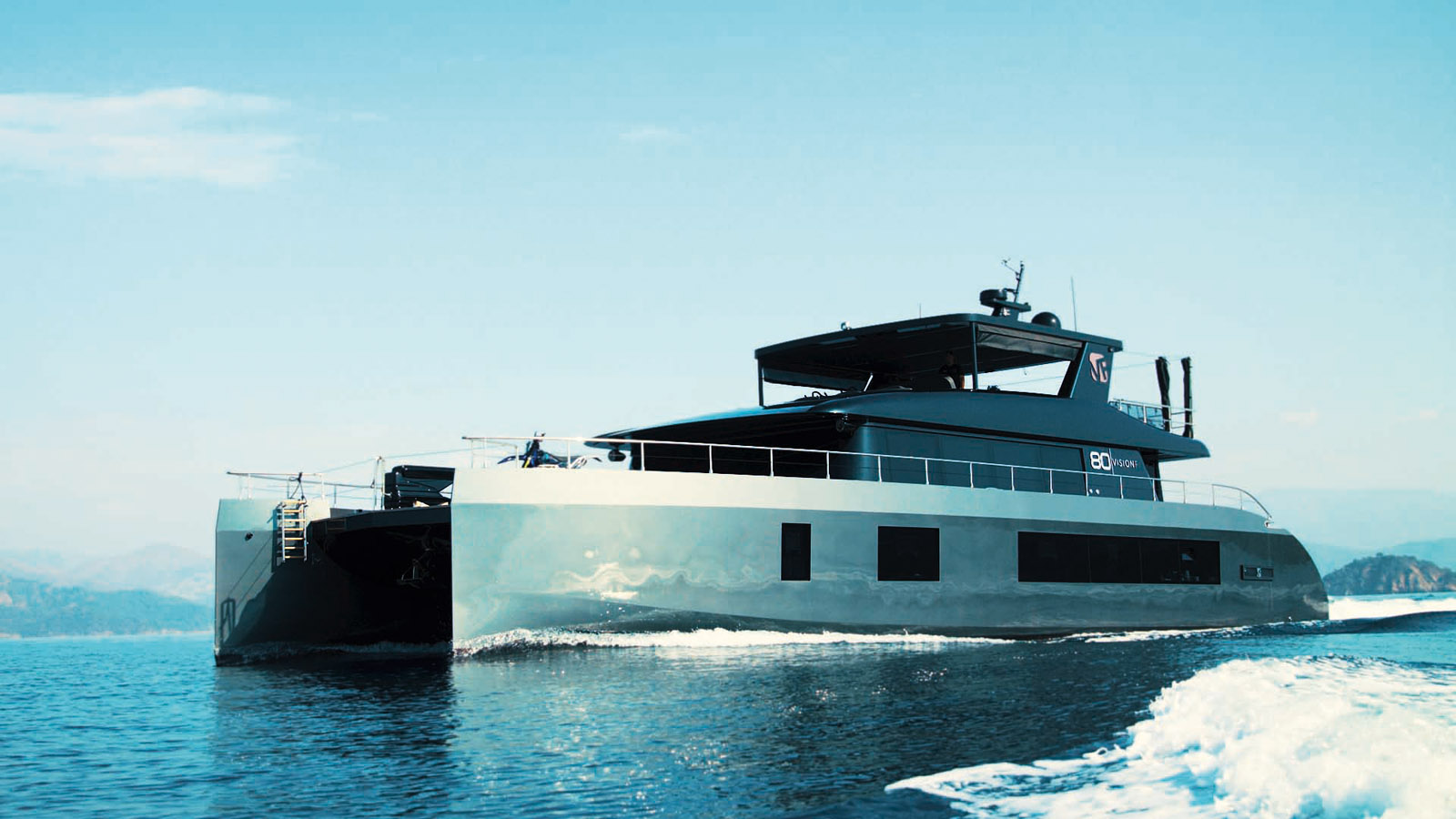
Note the slender bows and the minimal wake, a sign of low drag.
A very high-end range
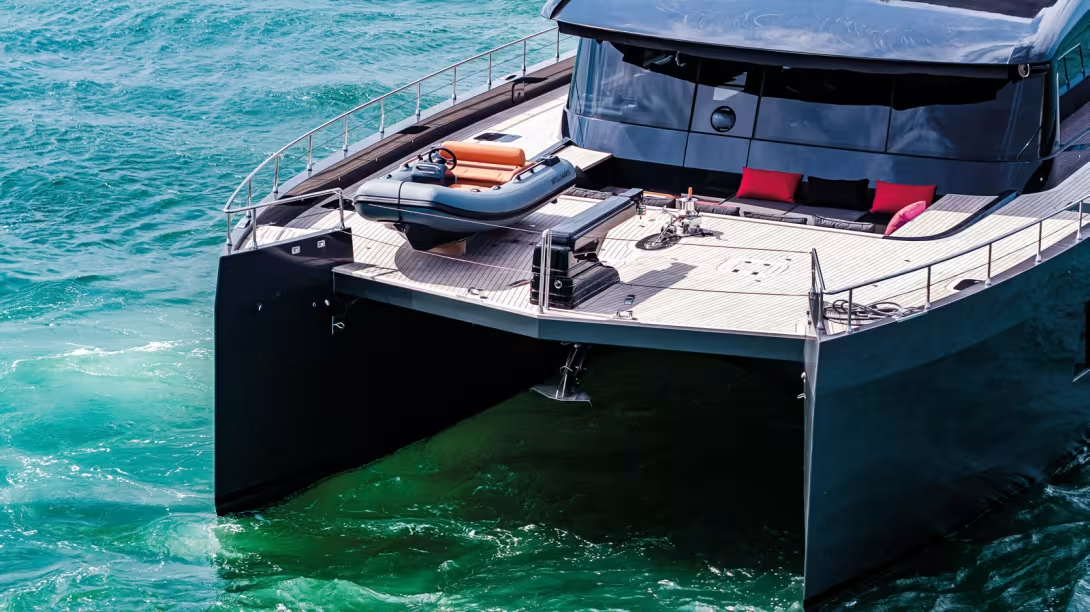
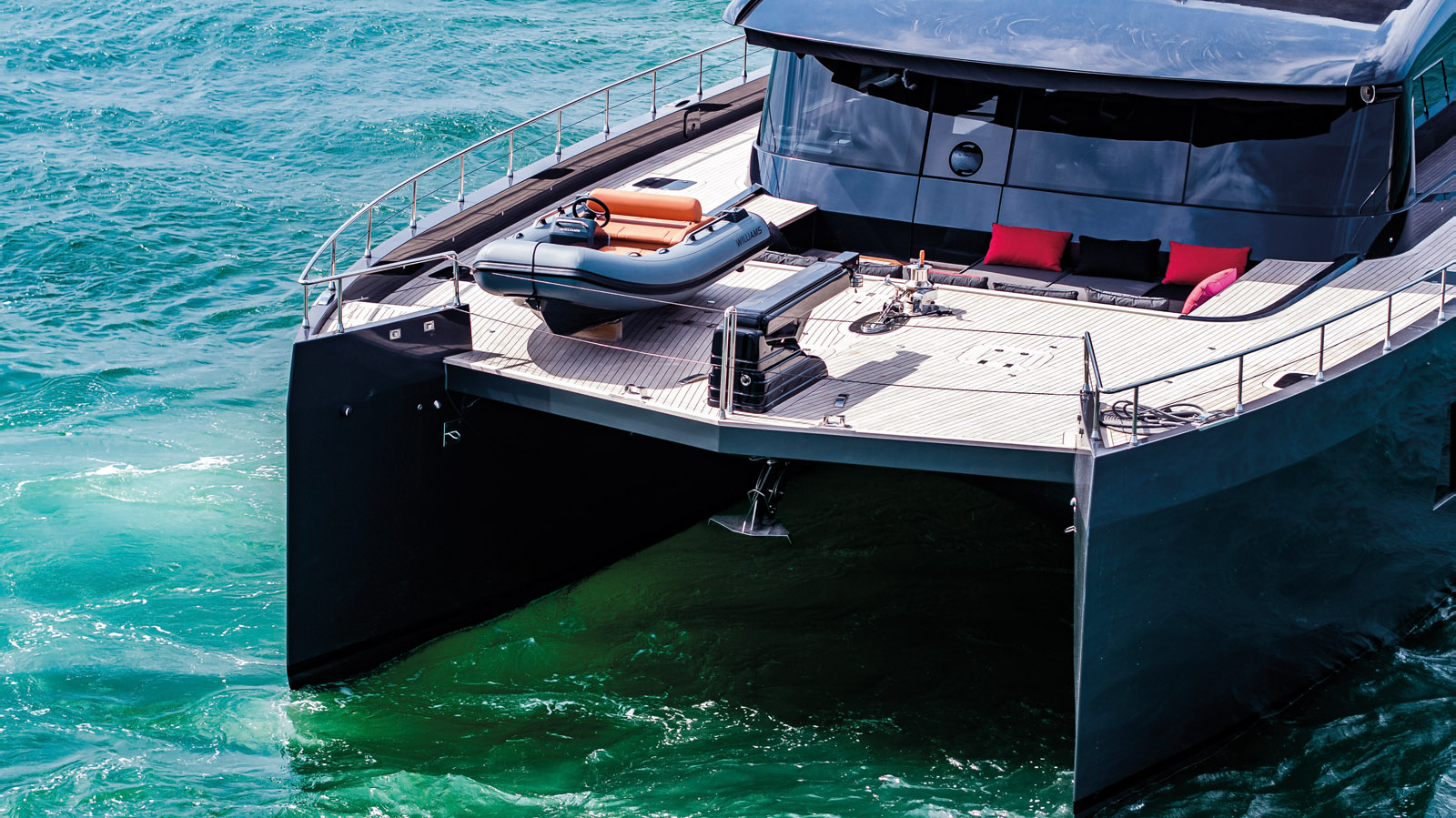
As soon as you step aboard, facing the flight of steps up the sugarscoop, you notice the absence of a hydraulic platform between the hulls. In fact, the dinghy is housed on the foredeck with a crane for launching. There’s a good reason for this choice, but we’ll come back to that. With a very high freeboard, this catamaran differs from its competitors by having a much narrower beam – 31’4” (9.56 meters), while its counterparts are well over 35 or 40 feet. Even with significantly less width, the space on board remains impressive. Apart from the sugarscoops, the nacelle occupies the entire length of the main deck. The hulls and the flybridge offer a usable surface area of about 3,200 sq ft (300 m²). Now that would make a nice pad ashore… yet here we are, on the water! The analogy is not misplaced, however: what the clientele for this type of vessel is looking for are the facilities of a very high-end, luxuriously decor apartment. Interior designer Seda Ünay used only the finest materials. Beautiful walnut woodwork, leather, alcantara, velvet, thick wool carpets and fine marble are used in the saloon, cabins and bathrooms. The atmosphere of this first model in the series is resolutely oriented towards dark shades, using browns, grays and blues, enhanced here and there by the addition of lighter colors such as the marble of the table - or brighter like the gilding of the basins or the red leather of the bunkside tables. The whole gives a sumptuous atmosphere that can be adapted to the owner’s taste, as is the norm on this type of craft.
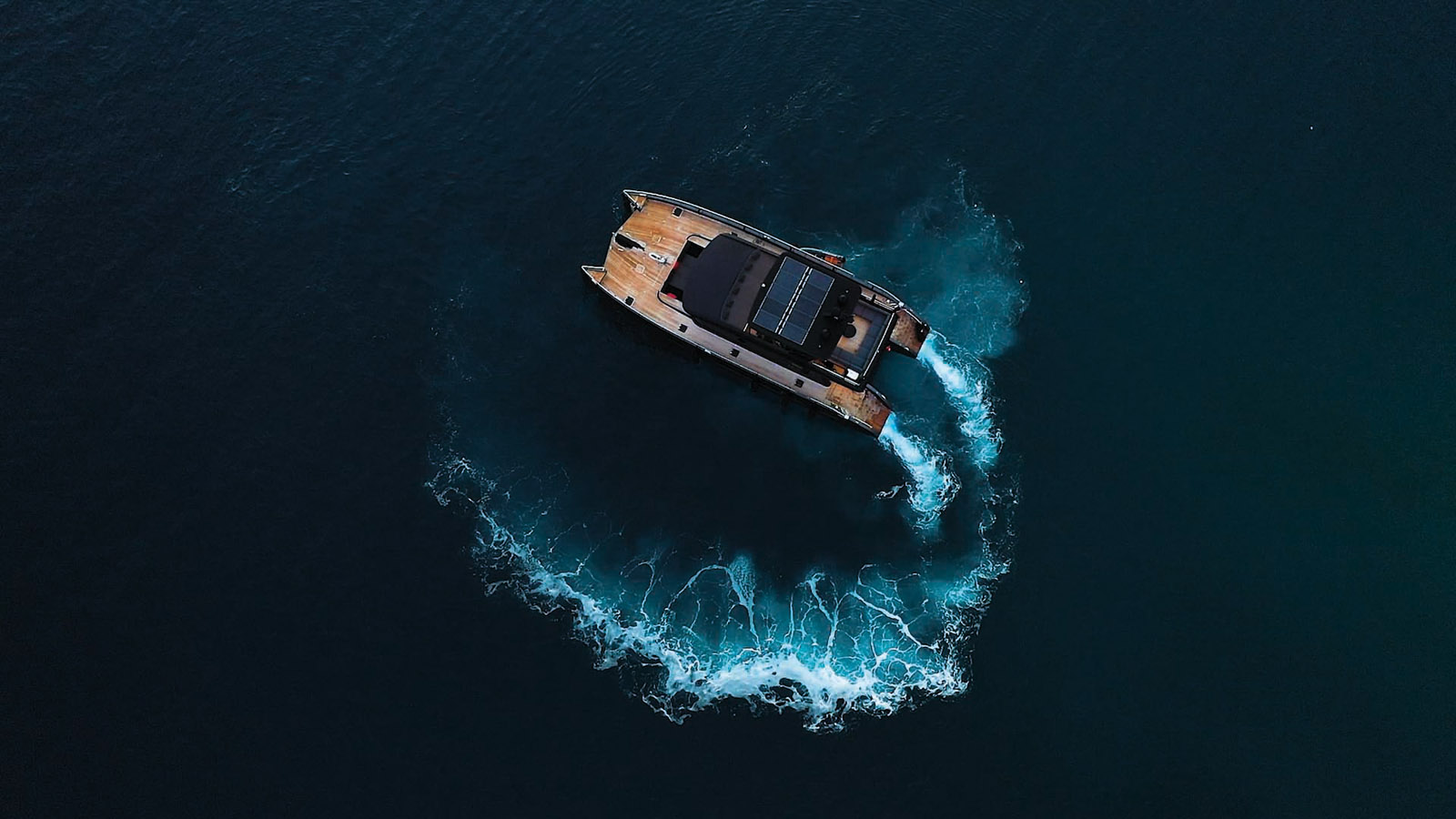
The narrower beam for this size of boat is a remarkable feature of the Vision F 80. The space on board hardly suffers, but the fuel consumption is halved.
Convivial layout
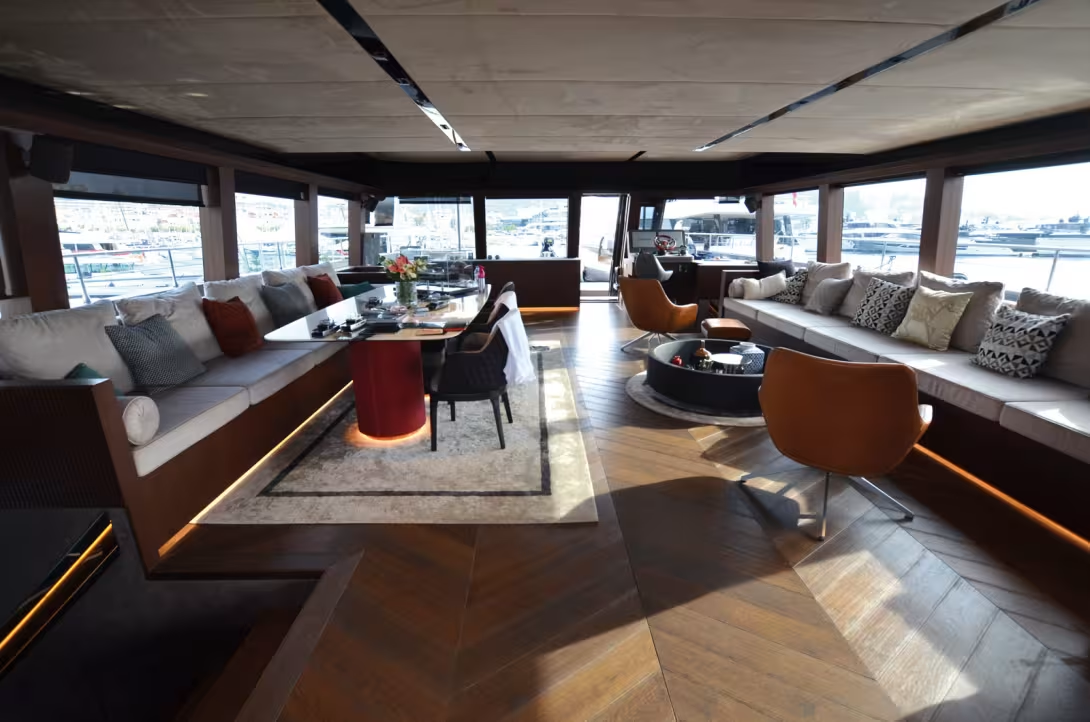
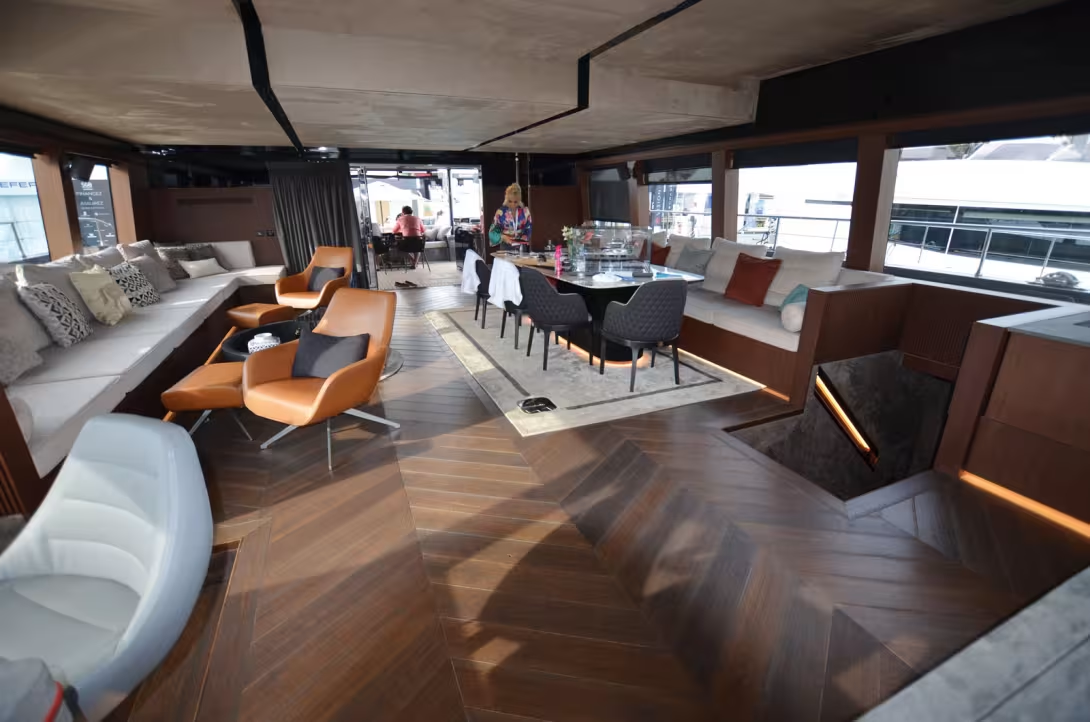
So as not to be penalized by the (relatively) narrower beam, the galley has been installed aft in the port hull. This configuration frees up the saloon and guarantees a certain level of privacy. In the nacelle, there’s the dining table on one side and a huge bench seat, to which are added poufs and armchairs on the other. The central space offers a passage towards the companionways down to the cabins. The forward door leads out to the front deck, equipped with bench seating and sunloungers. This model has four cabins, including a 250-square foot (23 m²) suite for the Owner. All the bathrooms with walk-in shower are at least 30 sq ft (3 m²). These generous dimensions make it comfortable at any time of the day, which is important at this level. The flybridge provides sunbathing space over the entire width in front of the helm station. A large bench seat is protected from the sun by the hard top and sun loungers are installed aft. Such a layout is quite traditional - and effective in making guests feel at ease. Late afternoon, we took a short trip out to sea, giving us an excellent opportunity to judge in situ how life on board unfolds, with no less than 40 guests are expected on board.
 |
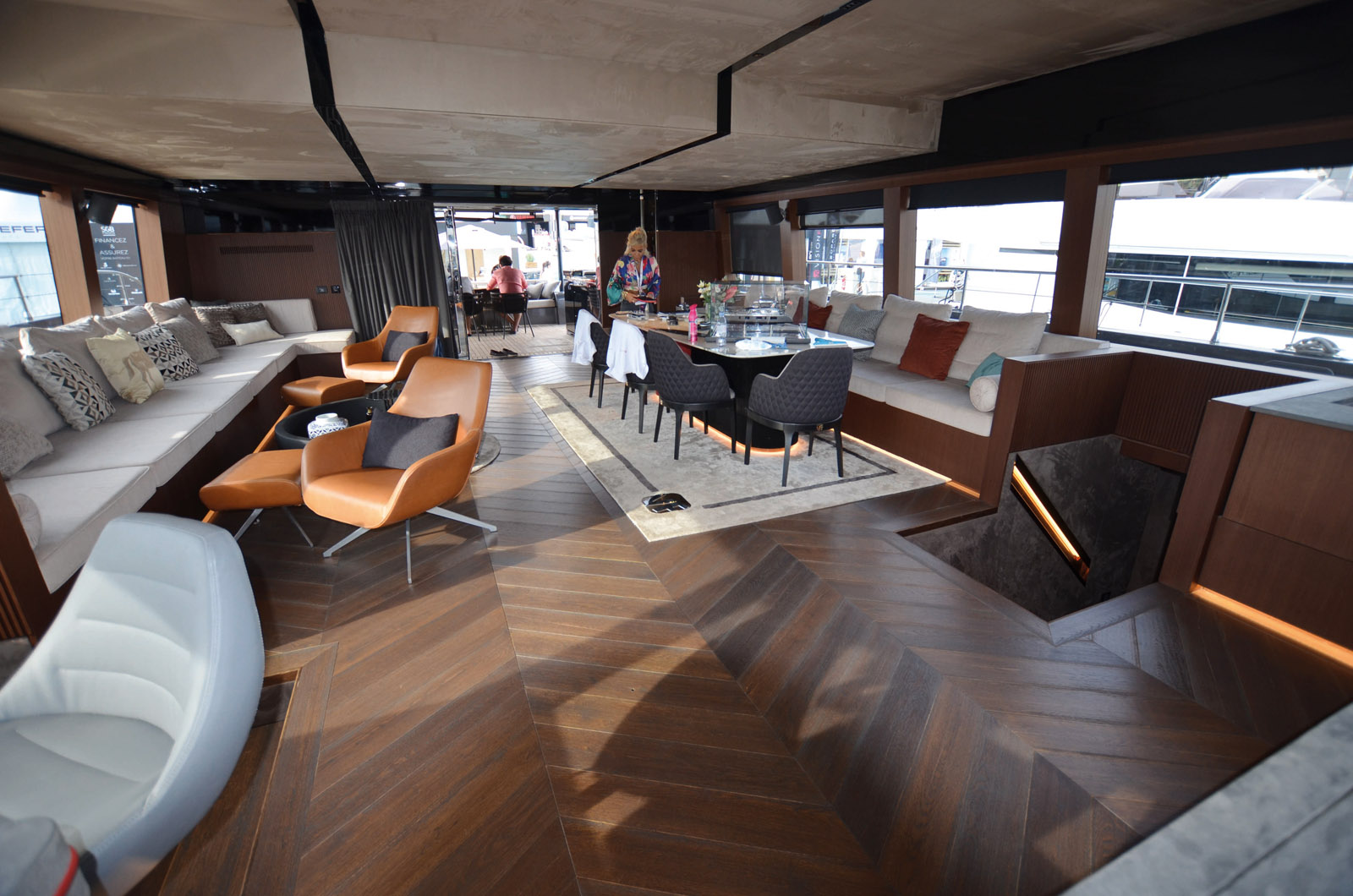 |
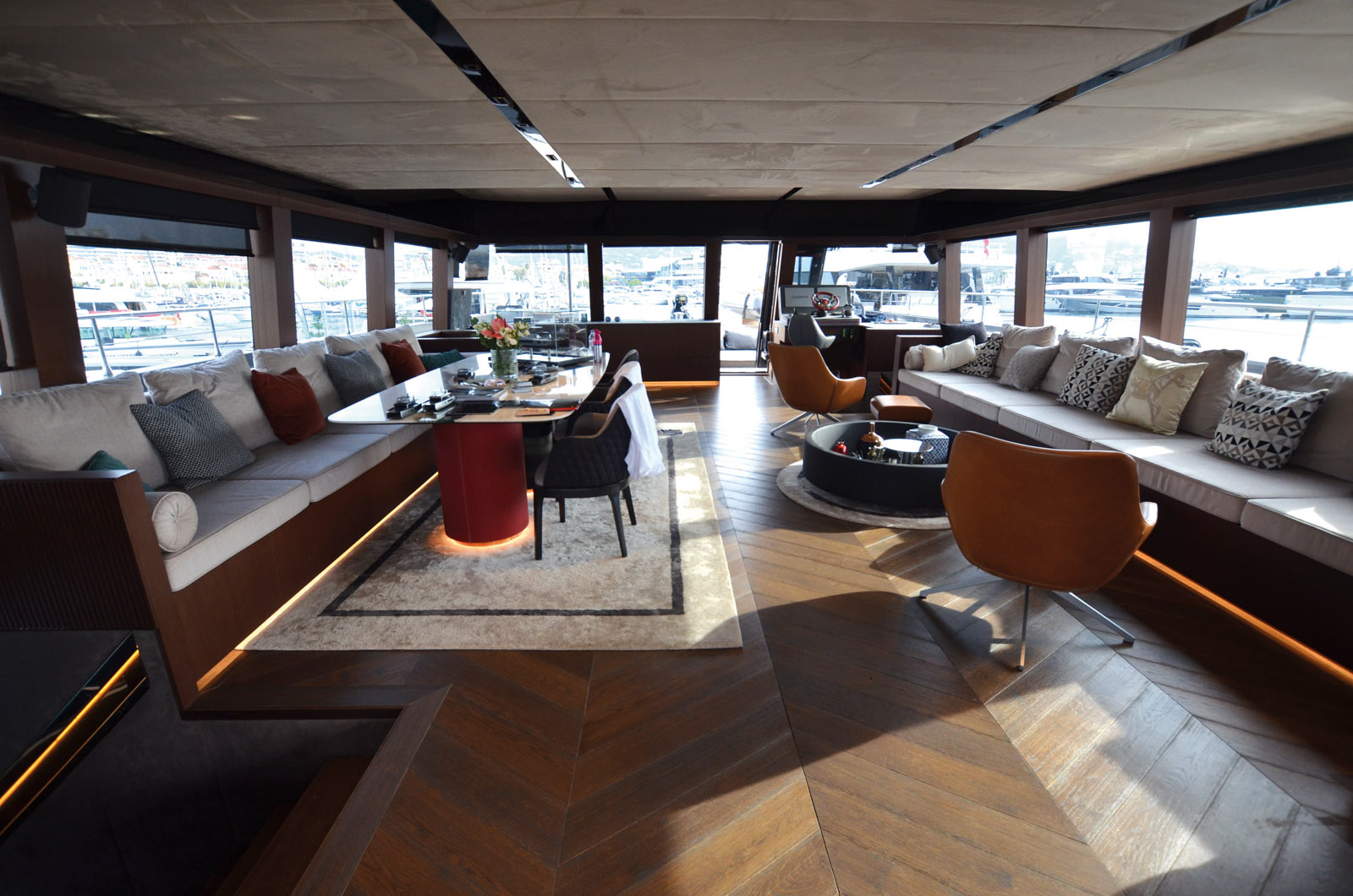
The custom-built saloon of the Vision F 80 is very spacious. The large sofas are welcoming, and many guests can be accommodated on board. The view outside makes it great for relaxing with friends or family, even in large numbers.
Performance and sobriety
Though the demand for luxury features is ever increasing, environmental awareness is also generating higher expectations every year. The Vision F meets these two seemingly contradictory requirements with an aluminum construction, a recyclable material par excellence, and reasonably low fuel consumption for an 80-foot yacht. The shipyard reports a consumption of 13 US gallons (50 liters) an hour at 12 knots – this average recorded during the Turkey to Côte d’Azur delivery trip - which must be a record of sobriety in this size where most of the F 80’s competitors would be gulping down twice that much fuel. Despite the party atmosphere on board, I was keen to check some of the performance data of this multiyacht. Getting back to the absence of a hydraulic platform and its tender at the stern, the idea is to transfer weight forward, which is beneficial to the waterline trim. As for the narrow beam, it manages to disrupt progress less thanks to a lower windage and, not least, a light displacement of 48 tons - a completely unheard-of value for an 80-foot powercat. The straight bows are narrow wave-piercers. The hull has been designed by Nazmi Bayard, an architect who is used to designing cargo ships. The design rises at the stern to accommodate Volvo’s IPS without increasing the draft. This multiyacht equipped with 600 HP IPS 800s should have no need for a bow thruster. The moment of truth is when it comes to getting out of the narrow slip: the twin IPS controlled by the joystick make maneuvering easy. But the weather conditions on the day were particularly favorable – maybe a bow thruster would be a help in strong crosswinds. While most of the tests off Cannes were carried out progressing southwestwards towards the mountainous Esterel coast, the skipper headed east towards Golfe-Juan. The helmsman didn’t need to go around the islands of Sainte-Marguerite and Saint-Honorat by the south: he took us via the shallow channel - no more than 10 feet (3 meters) of water. With a draft of 32 inches (80 centimeters), even an 80-foot yacht can afford this kind of fantasy close to the shoreline... The hulls split the water and you can feel the hull slipping along with no resistance - drag is reduced to its simplest level. There’s no doubt that the 23 knots claimed are very achievable. But given the number of people on board and the “fun cruising” atmosphere, we’re not pushing things too much. That said, the powercat was easily making eleven knots. A quick glance at the instruments showed us a fuel consumption of 12.7 US gallons (48 liters)/hour, which corresponds to the figures from the delivery crew. The soundproofing of the engine compartments is effective - the noise level is low throughout the boat.
 |
 |
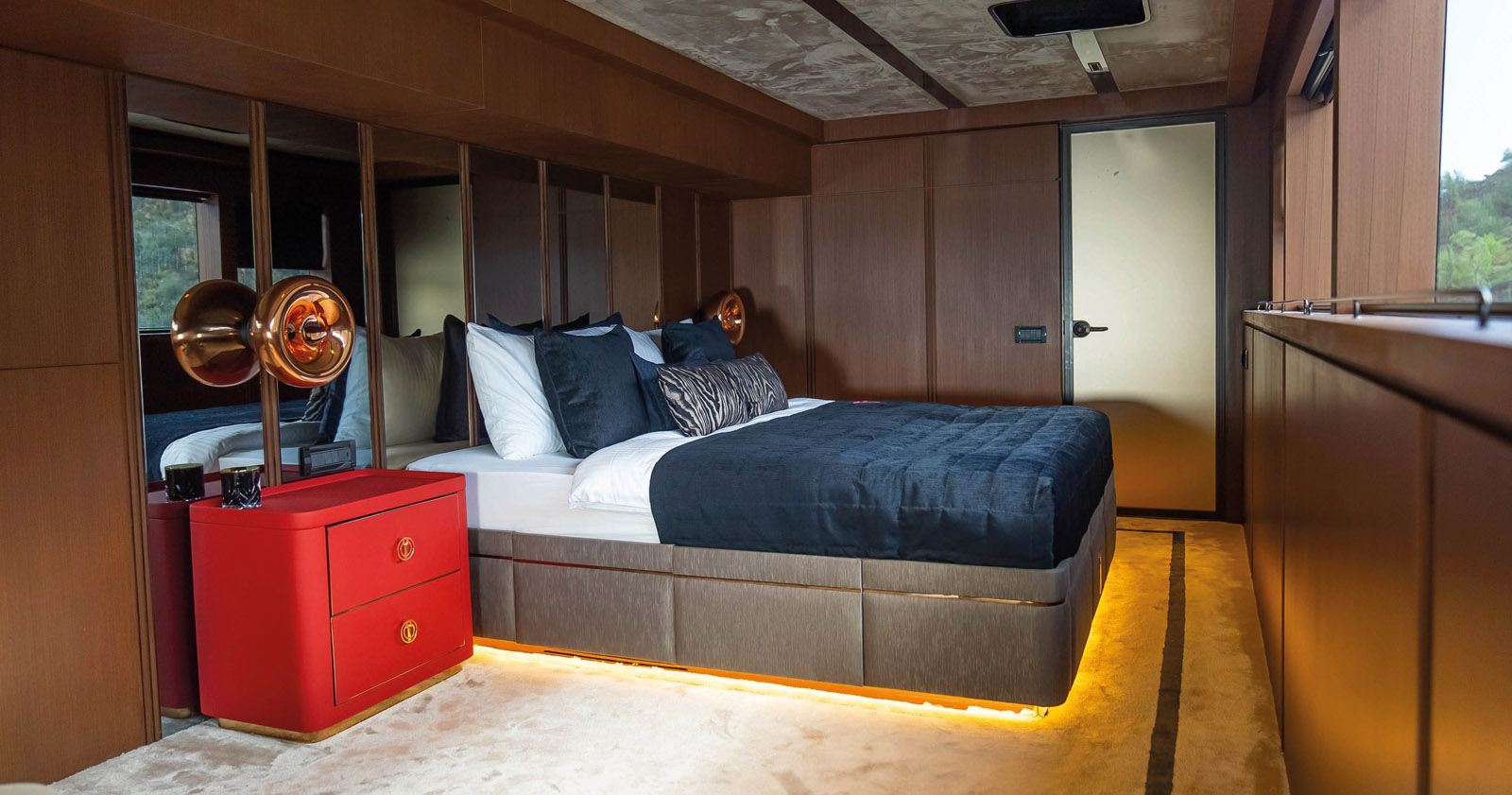 |
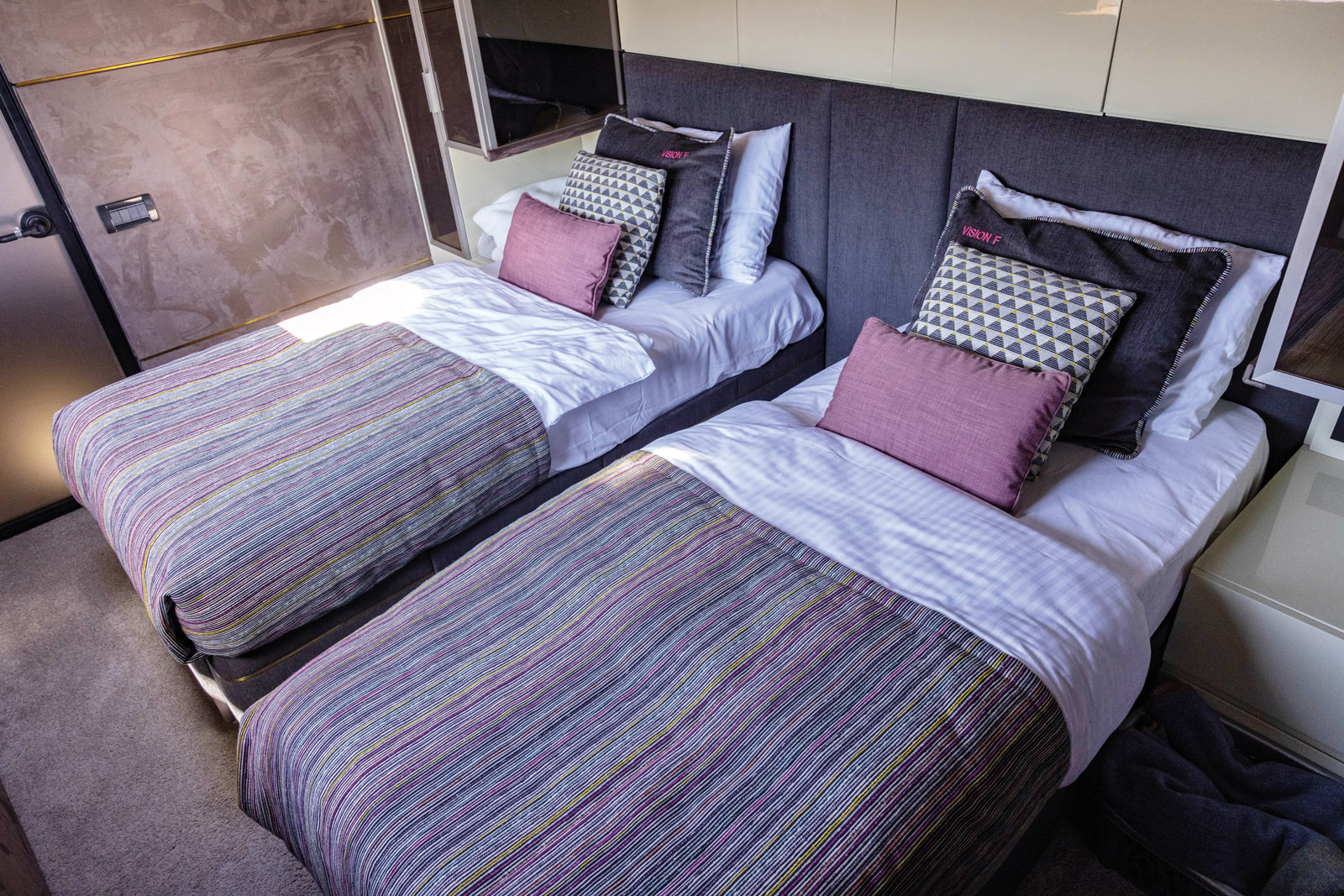
The children’s cabins, or for friends or family, are individually decorated and follow no single color scheme. Everyone on board can have their own personalized atmosphere.
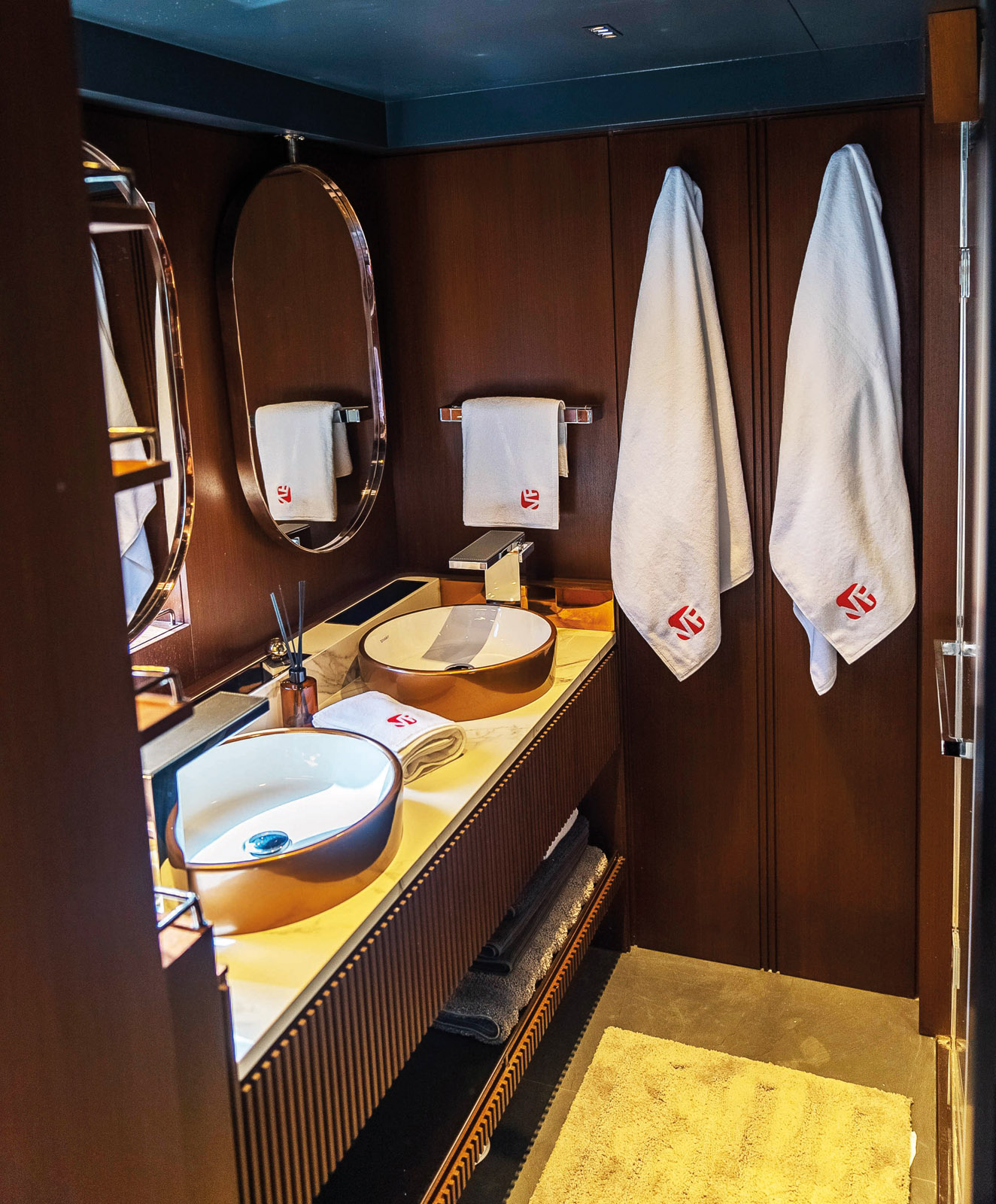
The cabin - or rather the owner’s suite – occupies 250 sq ft (23 m²) in the starboard hull. The bathrooms are just as spacious as you would have at home.
Conclusion
This new brand is obviously dynamic and ambitious, and their plan is based on a concept that has been very successful. While their product seems at first glance to be very close to those of the market’s frontrunners, it is nevertheless distinguished by certain technical aspects that favor the speed/fuel consumption ratio - a measure of the legitimacy of the new standards of luxury, which are now becoming more acceptable and in phase with environmental issues. As for the next challenge? Building bigger models, of course...
The Pluses:
+ Versatile seakeeping/comfort qualities
+ Fully customizable
+ Reasonable fuel consumption
The Minuses:
- Paint coatings could be improved
- Very marked by today’s trends
- Requires shipyard monitoring
TECHNICAL SPECIFICATIONS
Builder: Vision F Yachts
Architect: Nazmi Bayard
Interior design: E. Seda Ünay
Construction: aluminum
Overall length: 78’1” (23.80 m)
Max beam: 31’4” (9.56 m)
Draft: 32” (0.80 m)
Light displacement: 48 t
Laden displacement: about 60 t
Motors: 2 x 600 HP Volvo Penta IPS 800 or 2 X 900 HP Volvo Penta IPS 1200 (option)
Max speed: 23 knots with IPS 800
Fuel: 2,020 US gal (7,650 l)
Water: 1,004 US gal (3,800 l)
Cabins: 3 to 5 + 4 crew
Guests: up to 12 people
Crew: up to 5 people
Price: on quotation
 |
 |
The tender is stowed on the foredeck and handled with a crane. In port, it is easy to launch and operate the dinghy because it is not jammed up against the dock.
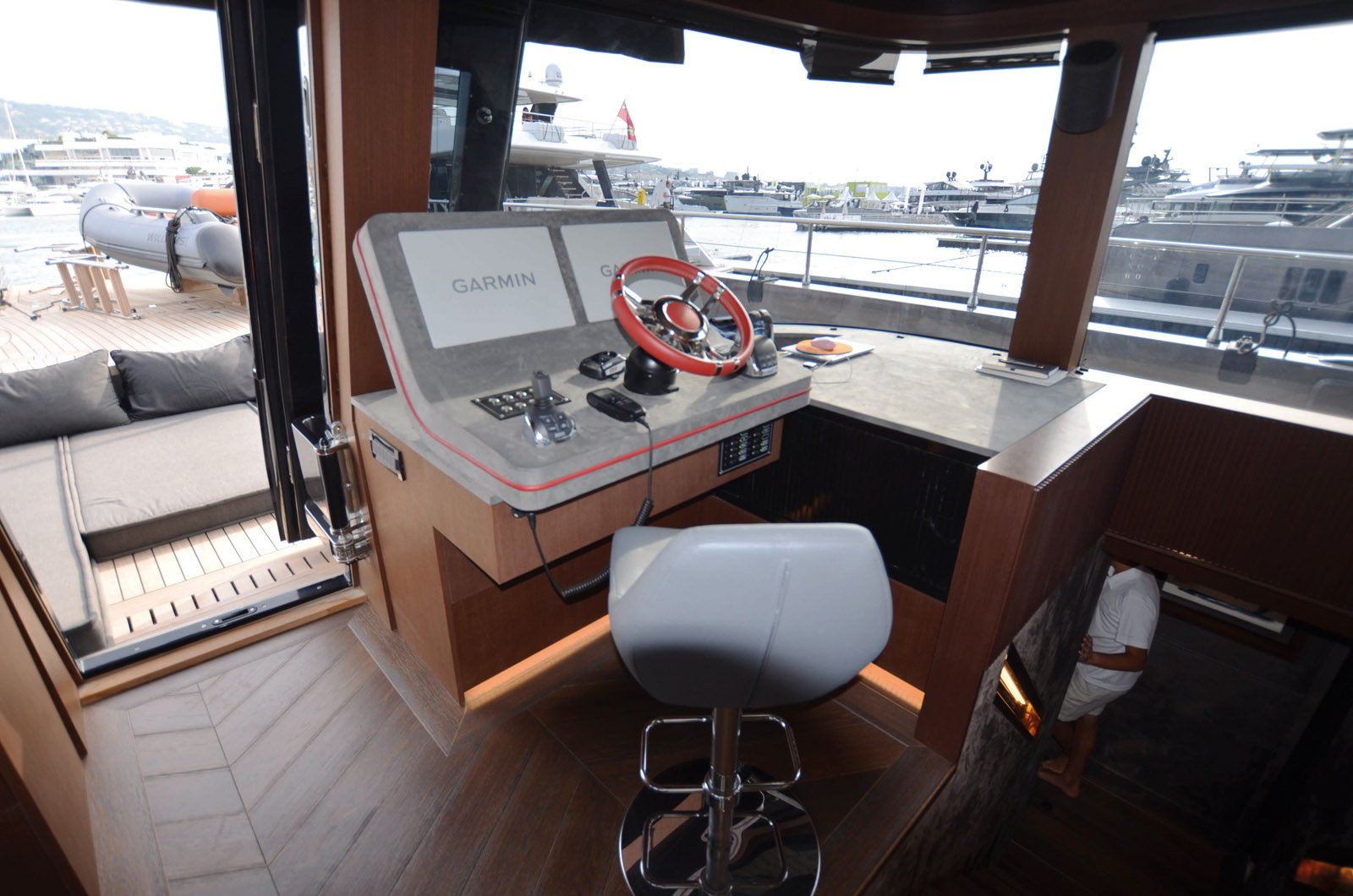
The interior helm console is pleasingly upholstered in alcantara. Notice the absence of a bow thruster among the controls - Volvo’s IPS are responsible for ensuring easy docking maneuvers.
