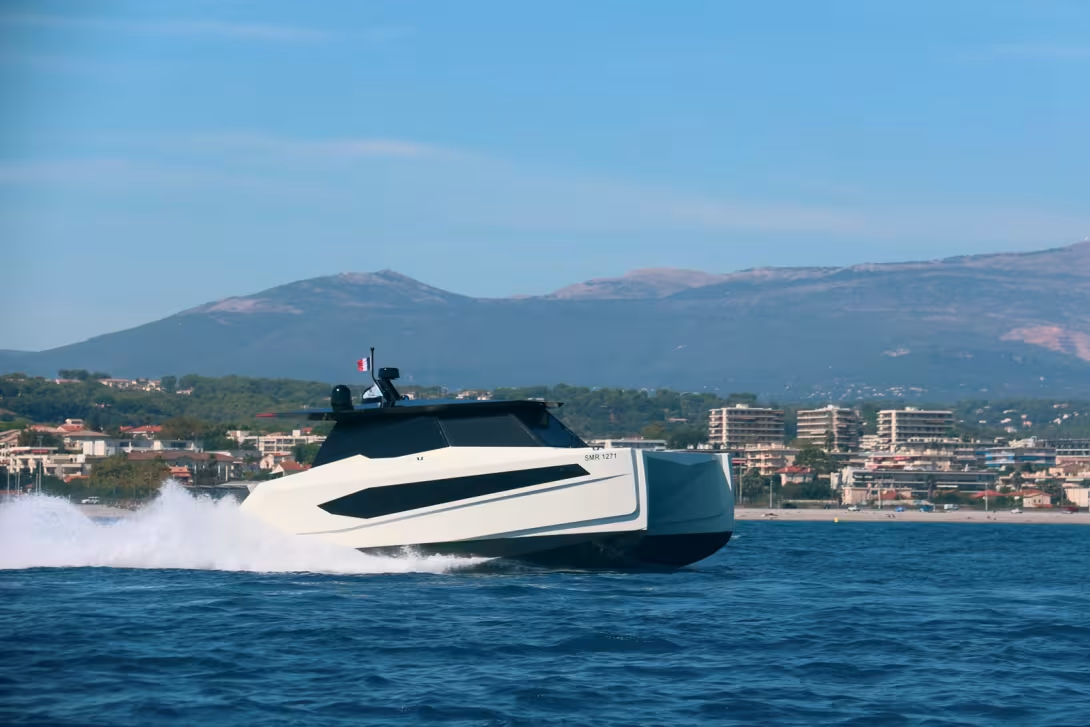
The Wama undoubtedly created a sensation at the last Cannes Yachting Festival. This 42-foot powercat, designed and built in Tunisia, has a unique design and features innovative and interesting solutions. That was all it took to convince the Multihulls World team to get aboard, and as you’ll see, it really flies!


Infos pratiques
- Le chantier : Wama 42
- La fiche technique
-
 Découvrez notre vidéo exclusive
- Financez votre Wama 42 XL
- Assuez votre Wama 42 XL
- Articles autour du Wama 42 XL
Test conditions: 2-4 knot easterly wind, short chop (0.5 m/1½-ft waves)
Wama Yachts is a new shipyard established in Tunisia, whose name is inspired by the first names of its founder, Walid, and his wife, Mariam, both of whom are passionate about sailing. A few years ago, the couple bought a boat and were quickly disappointed. Unable to find what they were looking for, they decided to build their dream boat. To do so, they went all out and recruited the best specialists in the field. Over the months, the construction of a single boat became a much more comprehensive project; the Wama brand was created with real ambitions (see our Who’s Who section in MW204). After a first small 26-foot monohull, the main project finally came to fruition. This time, it was a 42-foot catamaran made of aluminum and carbon fiber with a high-tech look and sporty performance.
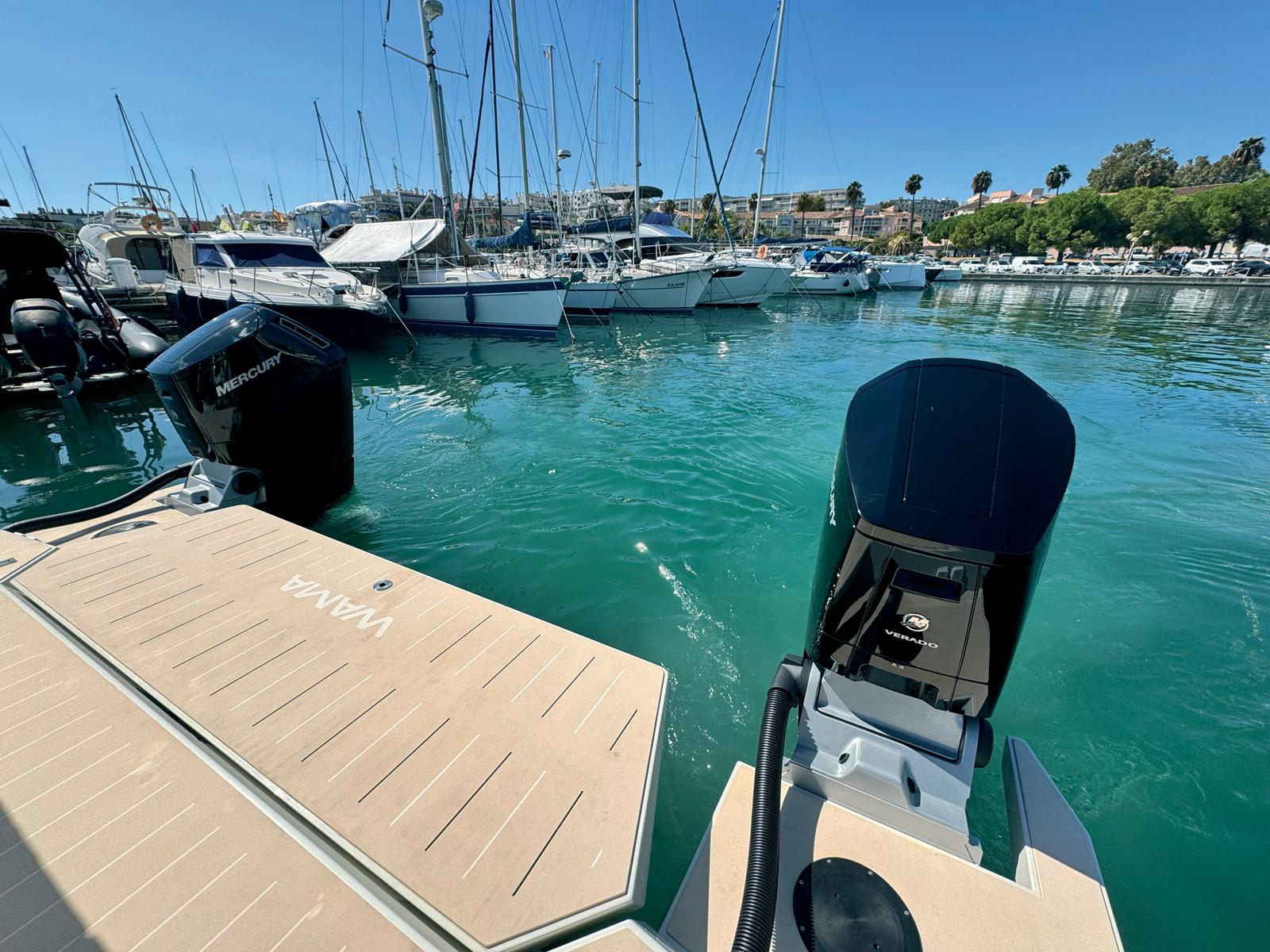
On the docks at the Cannes Yachting Festival, where it was showcased, this powercat did not go unnoticed, far from it: stretched lines and structured sides, high and slender bows with a relief on the inside of the hulls, a thick nacelle and respectable width (5.40 m/ 18’), the Wama 42 XL is a real eyecatcher, especially as its black superstructures are made entirely of carbon. Its sleek modern look and sporty appearance are confirmed by the presence of two 600 HP Mercury V12 engines mounted on the aft brackets. The long side portholes add to the modern look while promising a fairly spacious interior. As for the roof extension, it shelters the cockpit while adding a dynamic touch (if needed) to the overall design. In short, it’s a very nice design by Ali Kastally, the shipyard’s naval architect.
The yard is skilled in working with fiberglass, aluminum, and carbon fiber. For this model, aluminum was chosen for the hull and carbon fiber for the superstructures. These materials are both strong and lightweight. As an aside, the aluminum here is so well treated that it is difficult to recognize this material.
Sleek, Ultra-modern Lines
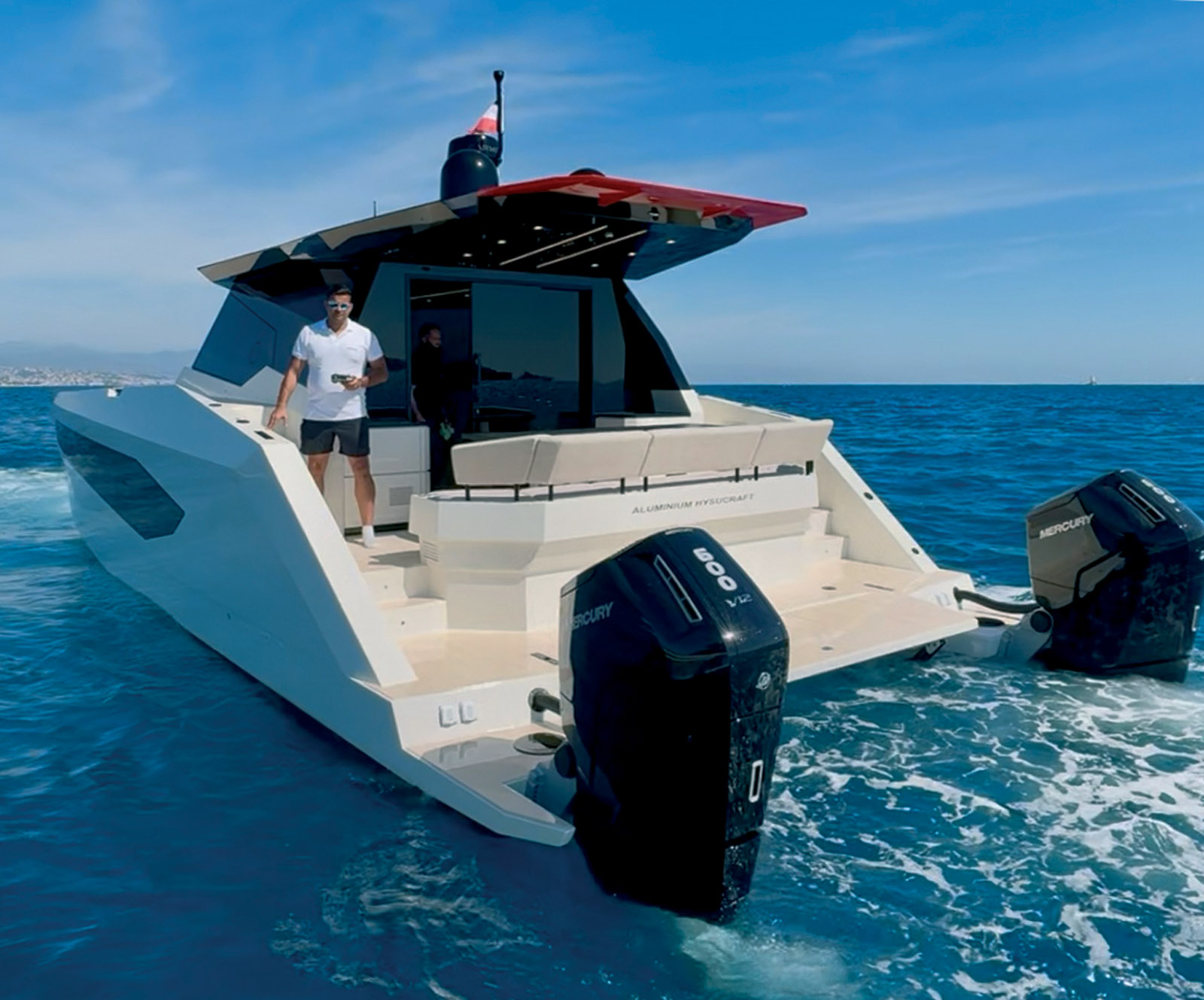
Thanks to the brackets supporting the engines and the large rear platform, boarding is easy from the dock. The hydraulic platform is a little small to support a dinghy, but on a 42-foot boat, this isn’t really necessary. On the other hand, it’s perfect for swimming, accessing a jet ski, or all kinds of water activities.
From there, two steps on each side lead to the cockpit, but a gate will need to be added for child safety. The cockpit itself is a decent size for the length of the powercat, without being impressive. There is a long rear bench seat that can accommodate five people and two separate folding tables that can be joined together to form a larger one if necessary. It should be noted that these tables, like many elements on the Wama, are made of carbon!
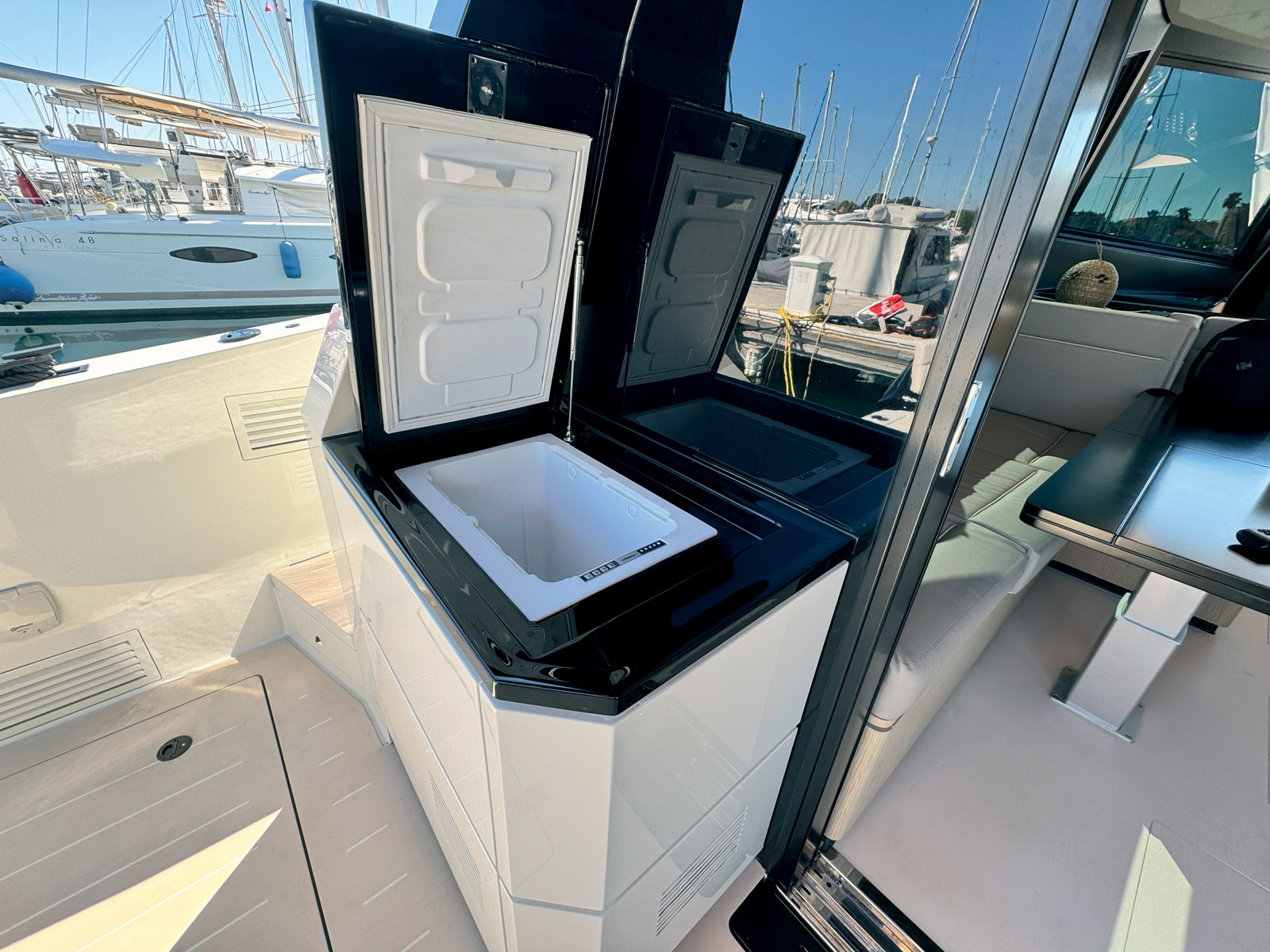
Opposite this bench seat, there is a refrigerator on the port side and a grill on the starboard side.
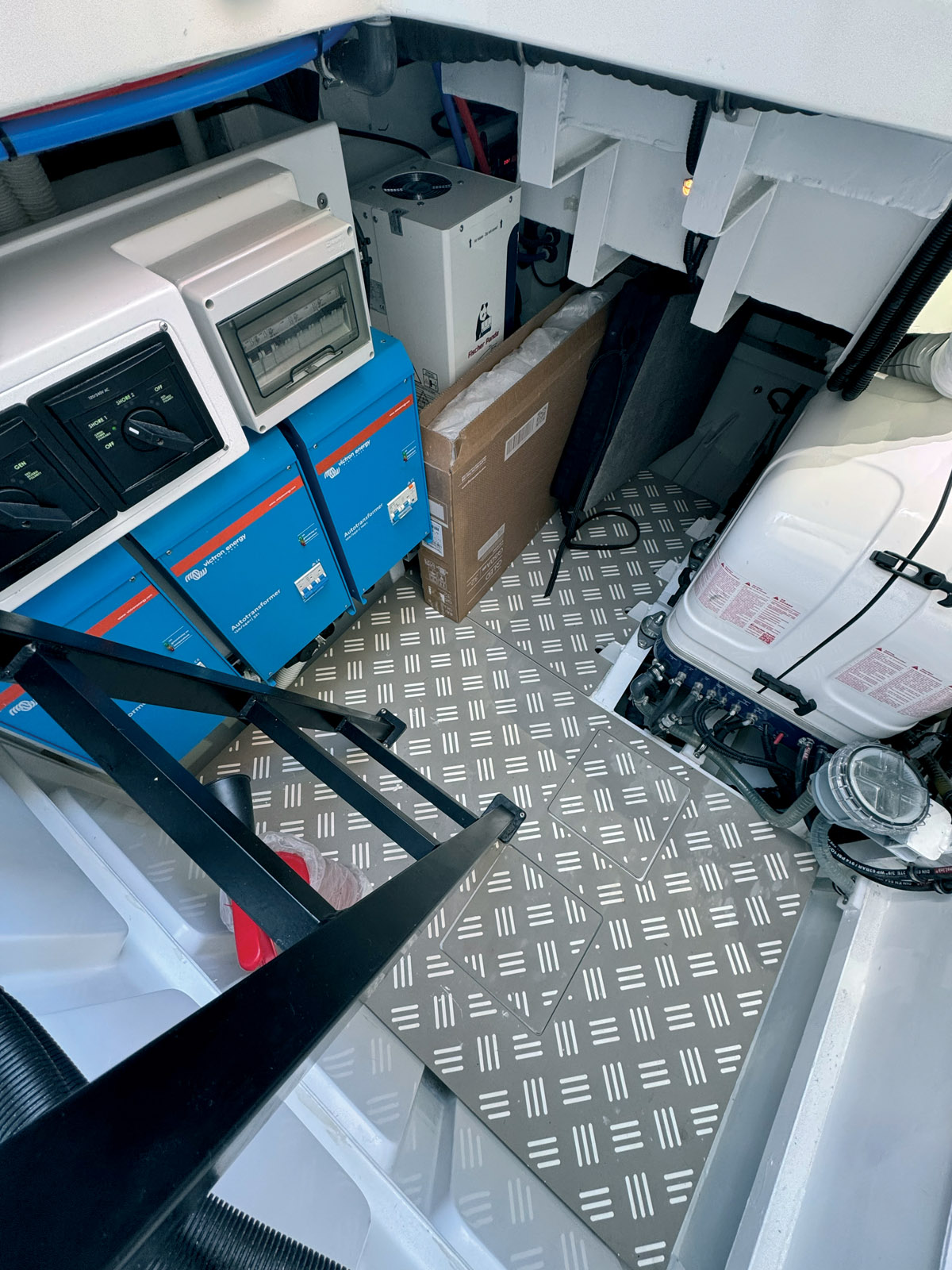
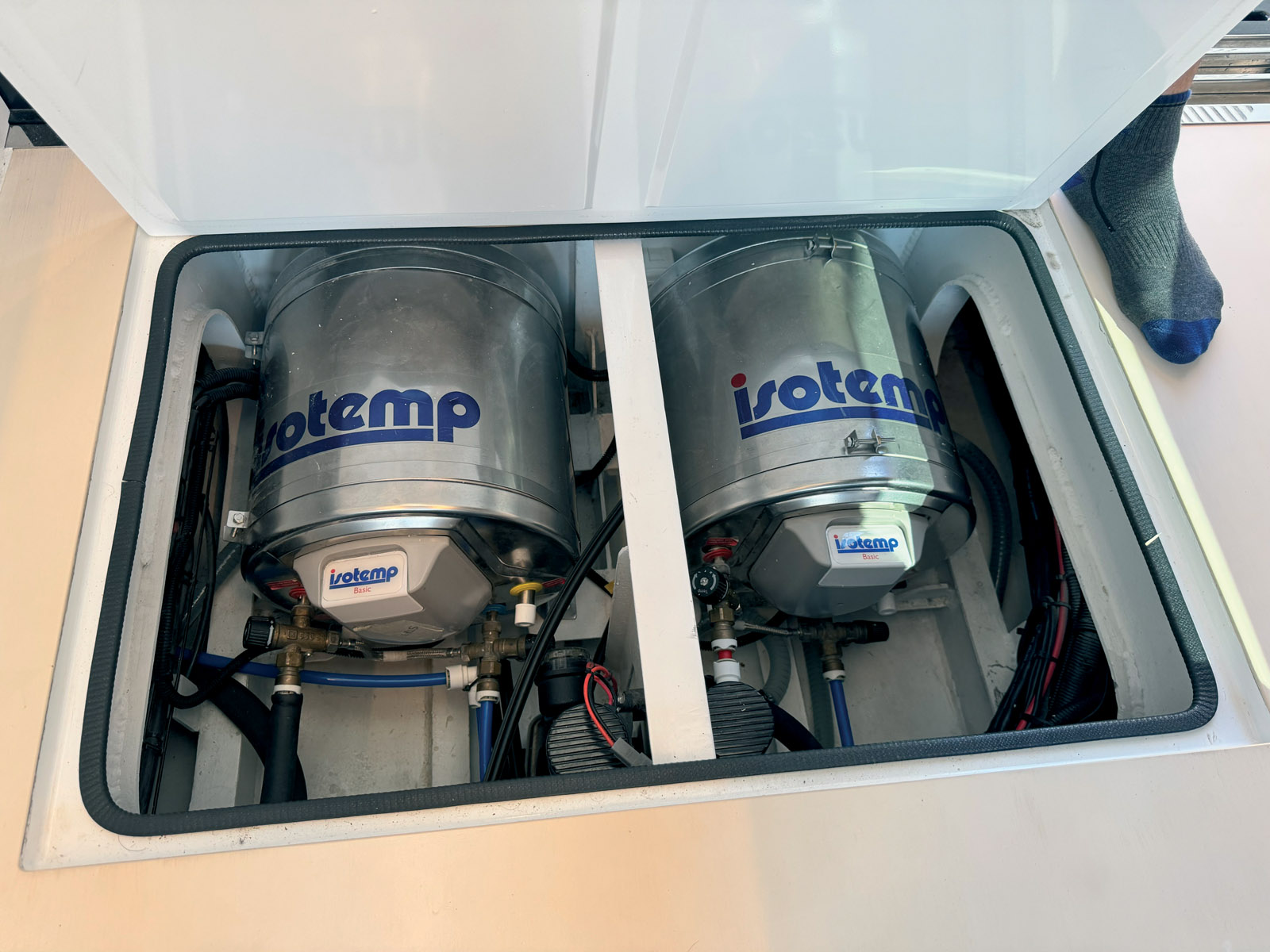
Finally, a large technical locker is installed in the floor, providing access to all systems such as the lithium batteries and the generator.
On either side, very wide side-decks lead to the foredeck. However, these access routes require more handrails, something that the shipyard will modify immediately.
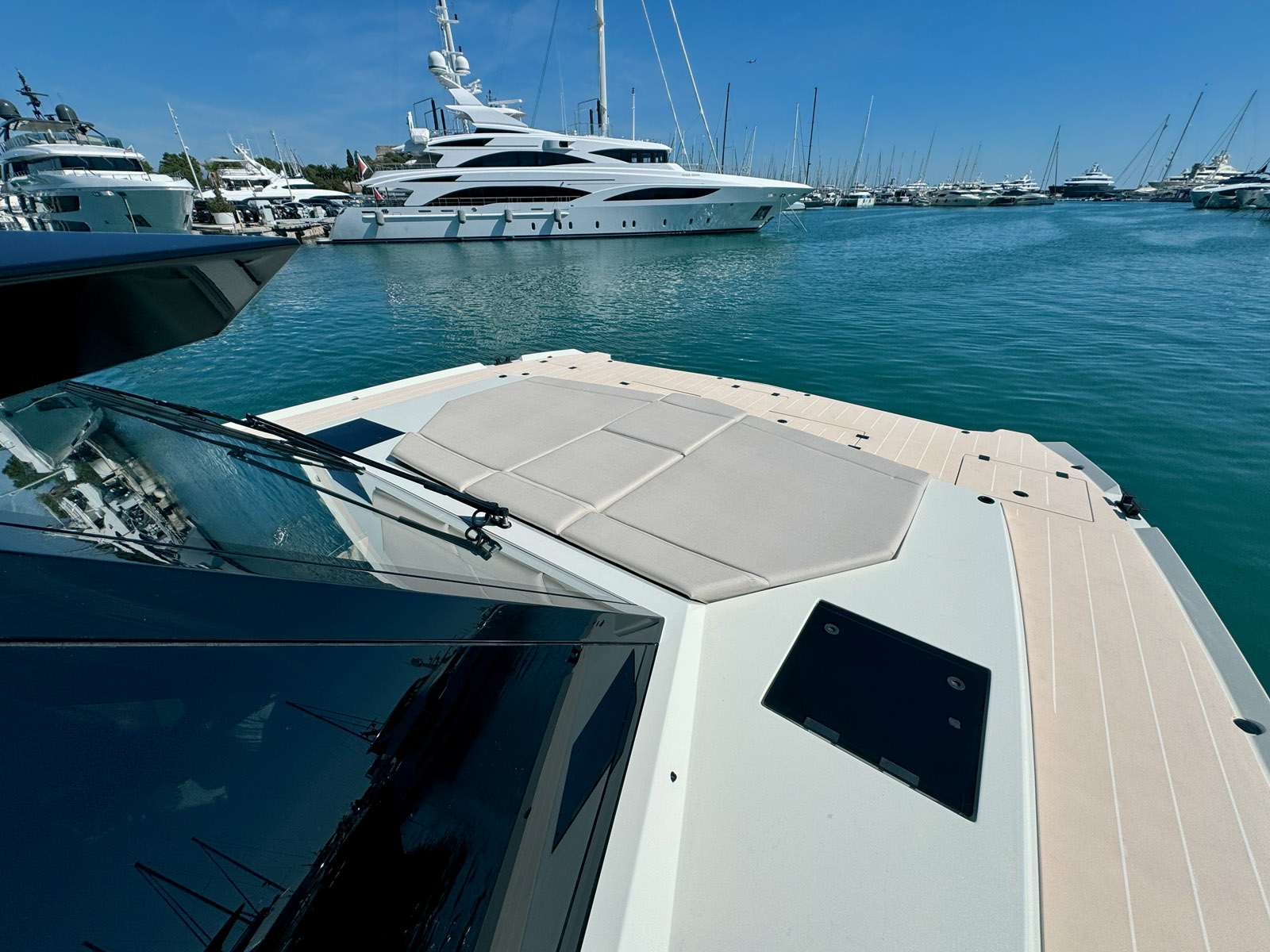
Supported by a thick nacelle, the foredeck features several well-integrated storage lockers and, above all, a lovely sun-lounger for two people. This is also where the anchor is stowed, cleverly concealed behind a fiberglass housing and with easy access to the chain and windlass. Shown here without protection, the Wama has removable stanchions and lifelines to improve safety.
A Functional Main Deck
From the cockpit, two sliding doors open onto the main deck. At first glance, you might think that this catamaran is not that wide. This is a false impression because in fact it is 55 cm (22”) wider than an Aquila 42 Coupe or a Dracan 42. The Wama 42 is therefore positioned as a comfortable day cruiser or weekender but remains much more compact than a powercat dedicated to coastal cruising – the Leopard 40PC has a beam of 6.61 m (21’8”). In fact, the Wama’s hulls are reserved for cabins, and the superstructures are limited to the living area of the main deck.
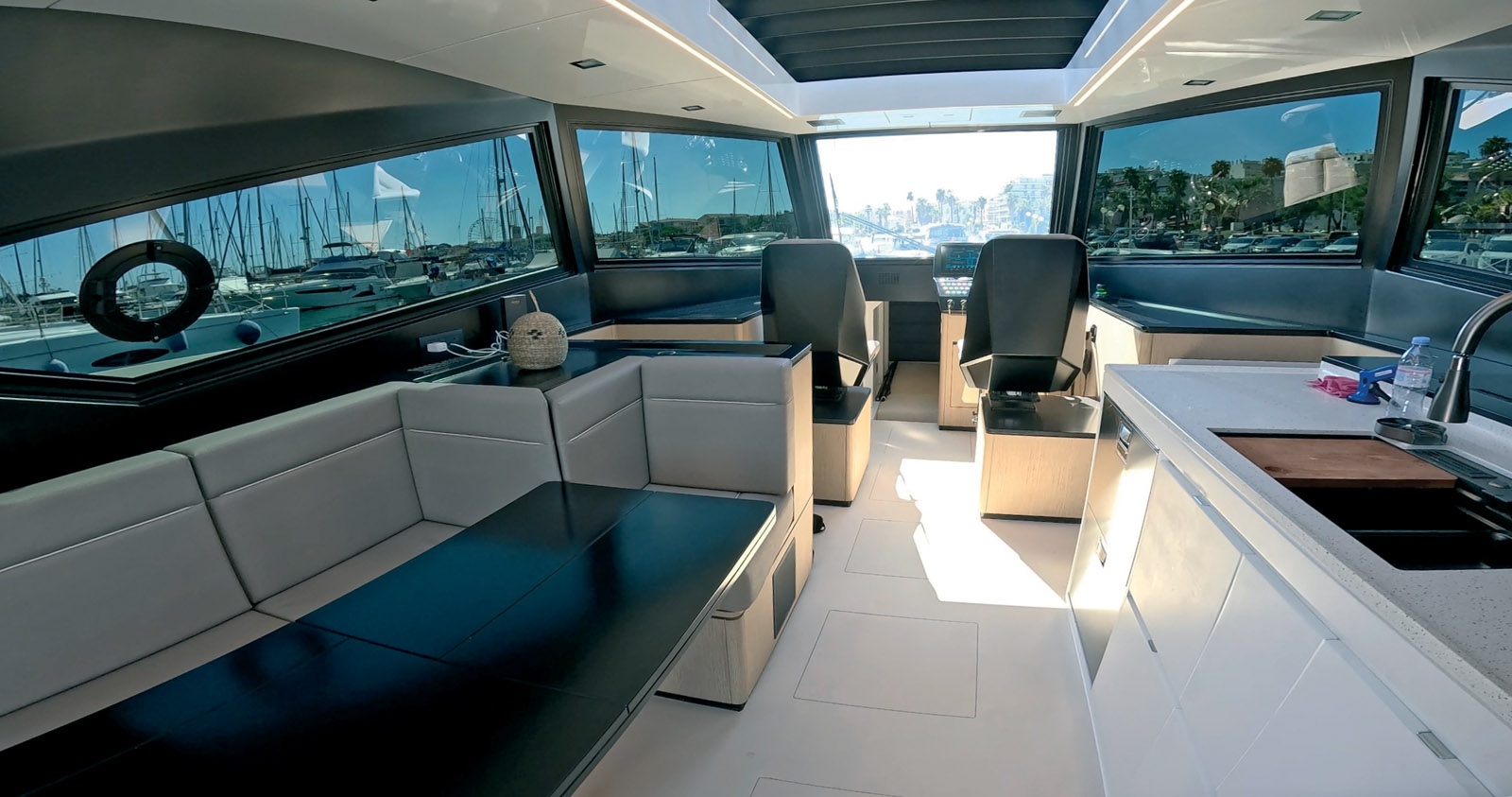
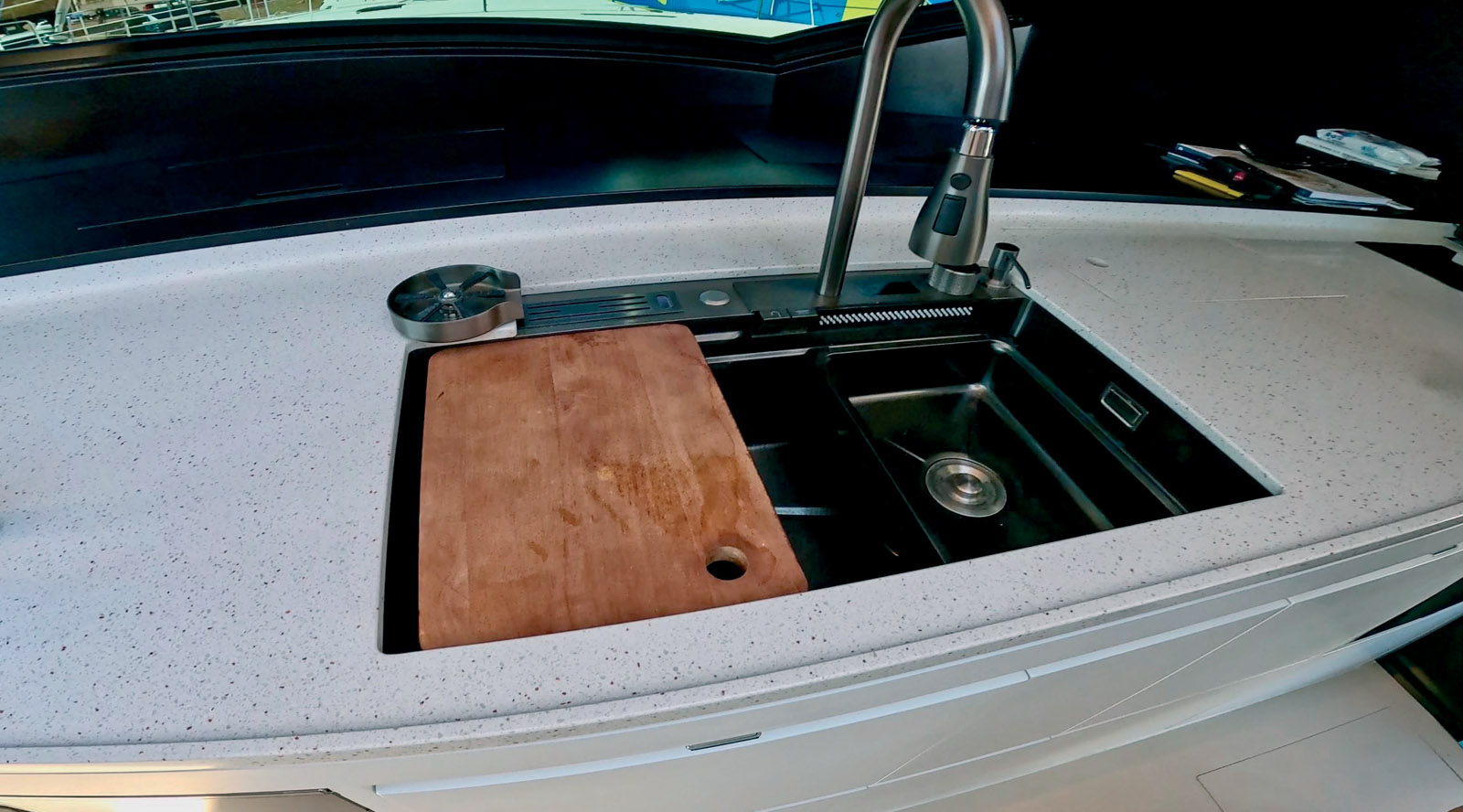
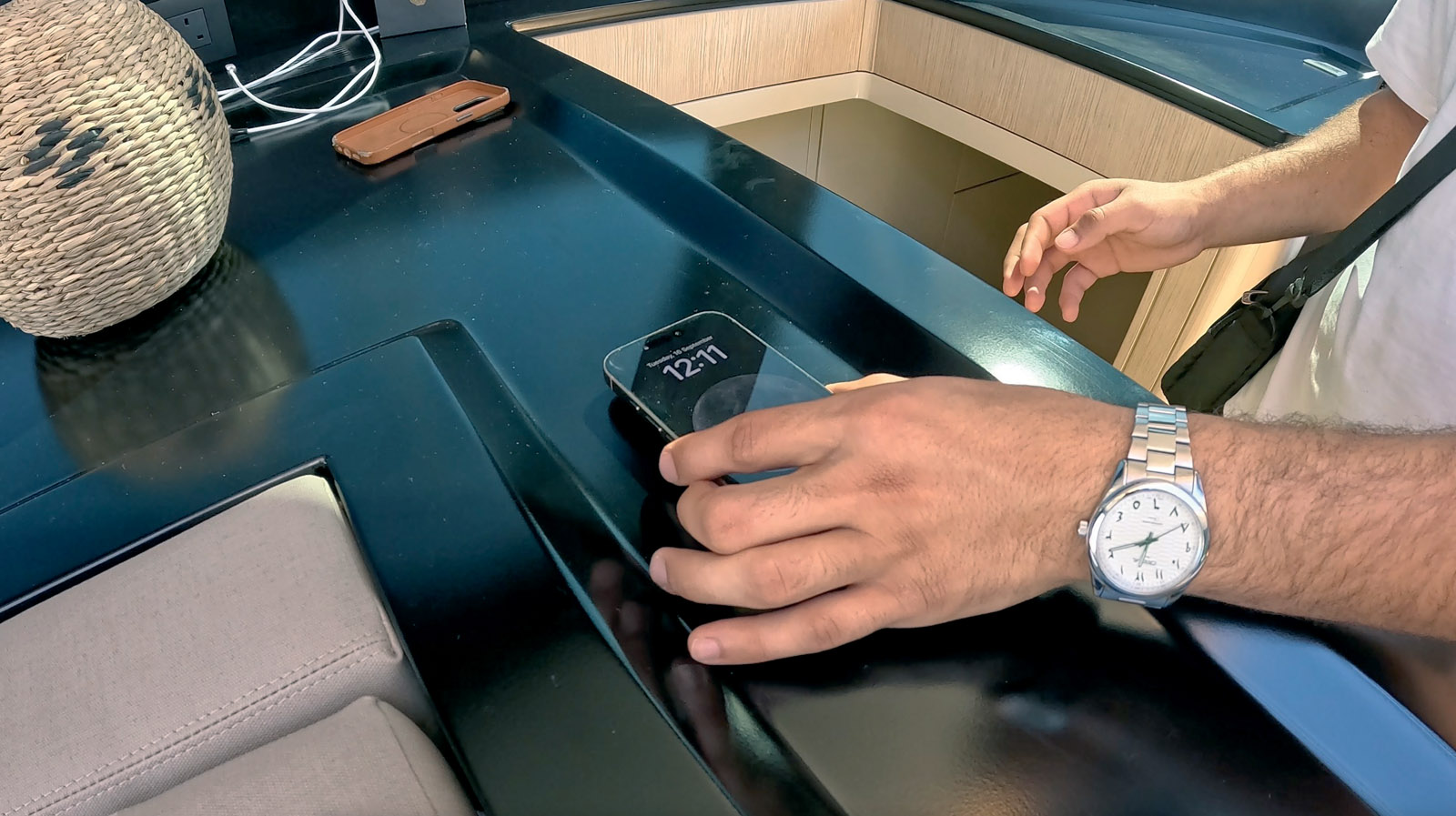
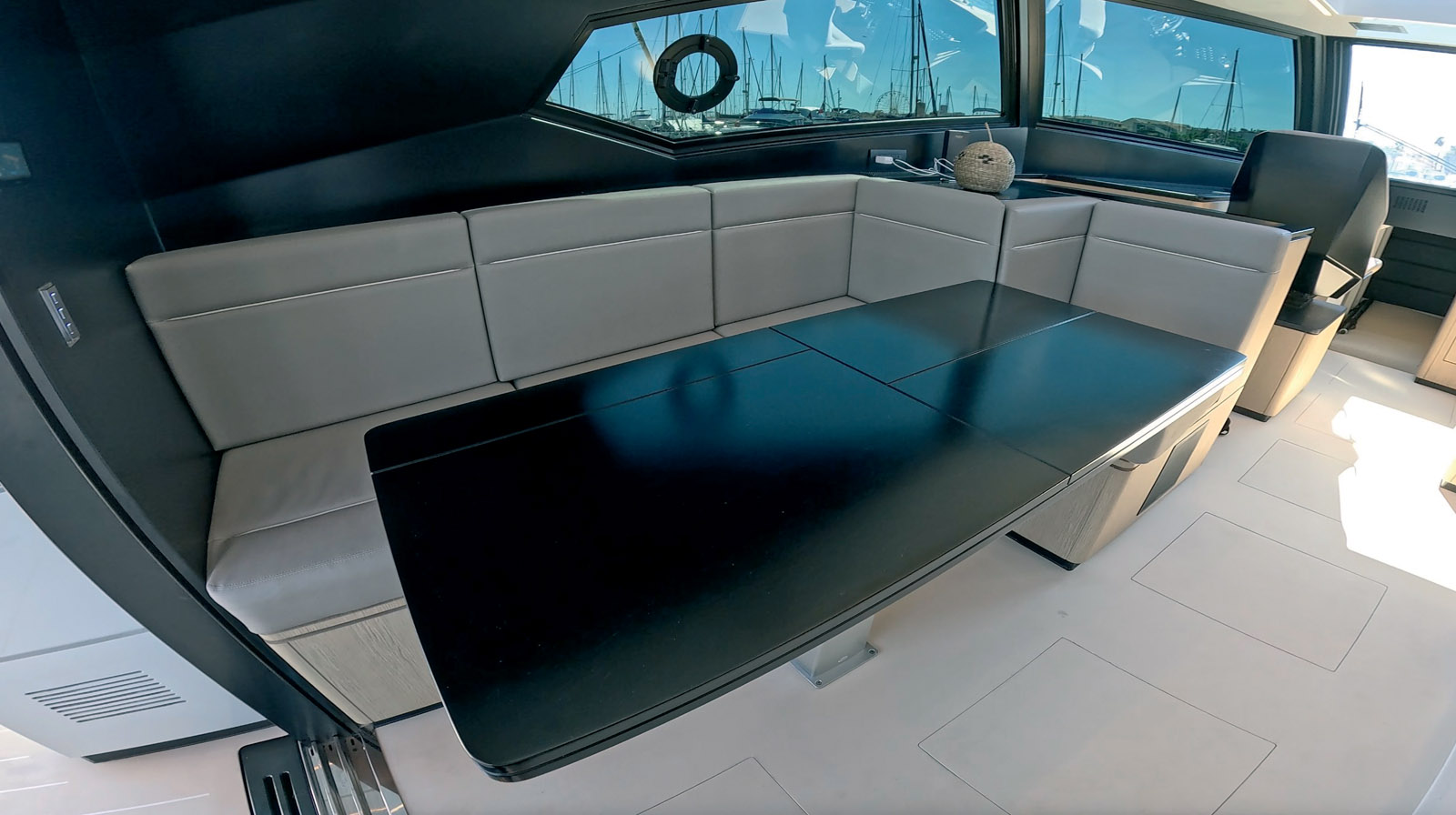
As a result, the main deck features a L-shaped bench seat on the port side with a table for sheltered dining and a long, well-equipped galley on the starboard side with an induction cook top, refrigerator, and ultra-modern sink. There is also storage space throughout.
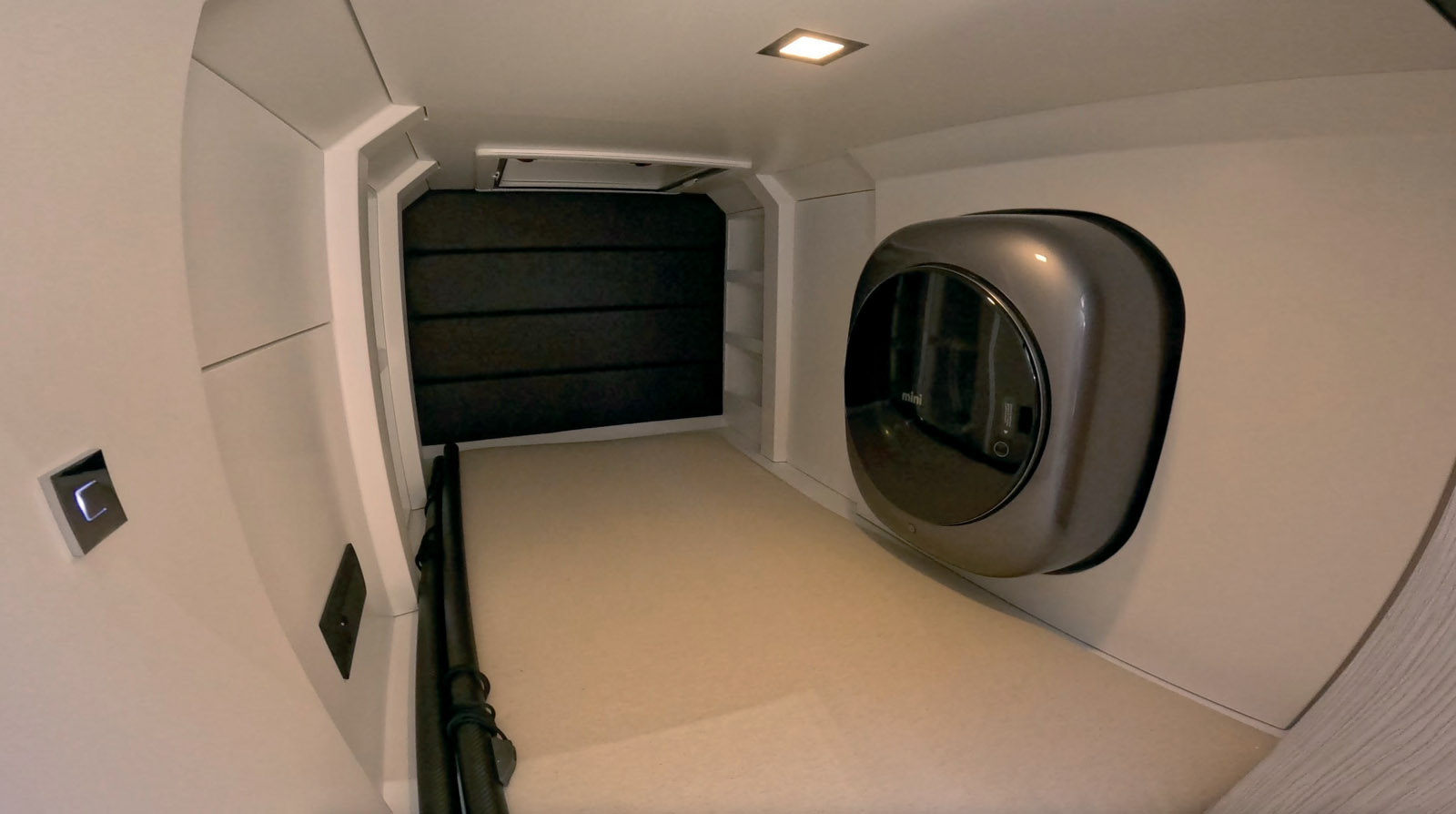
On each side, a staircase leads to the cabins, while at the bow, right next to the steering console, there is a small multipurpose room that can be used for storage or as an extra bed for the captain or a child. This is also where you will find a small washing machine (optional), which is always handy.
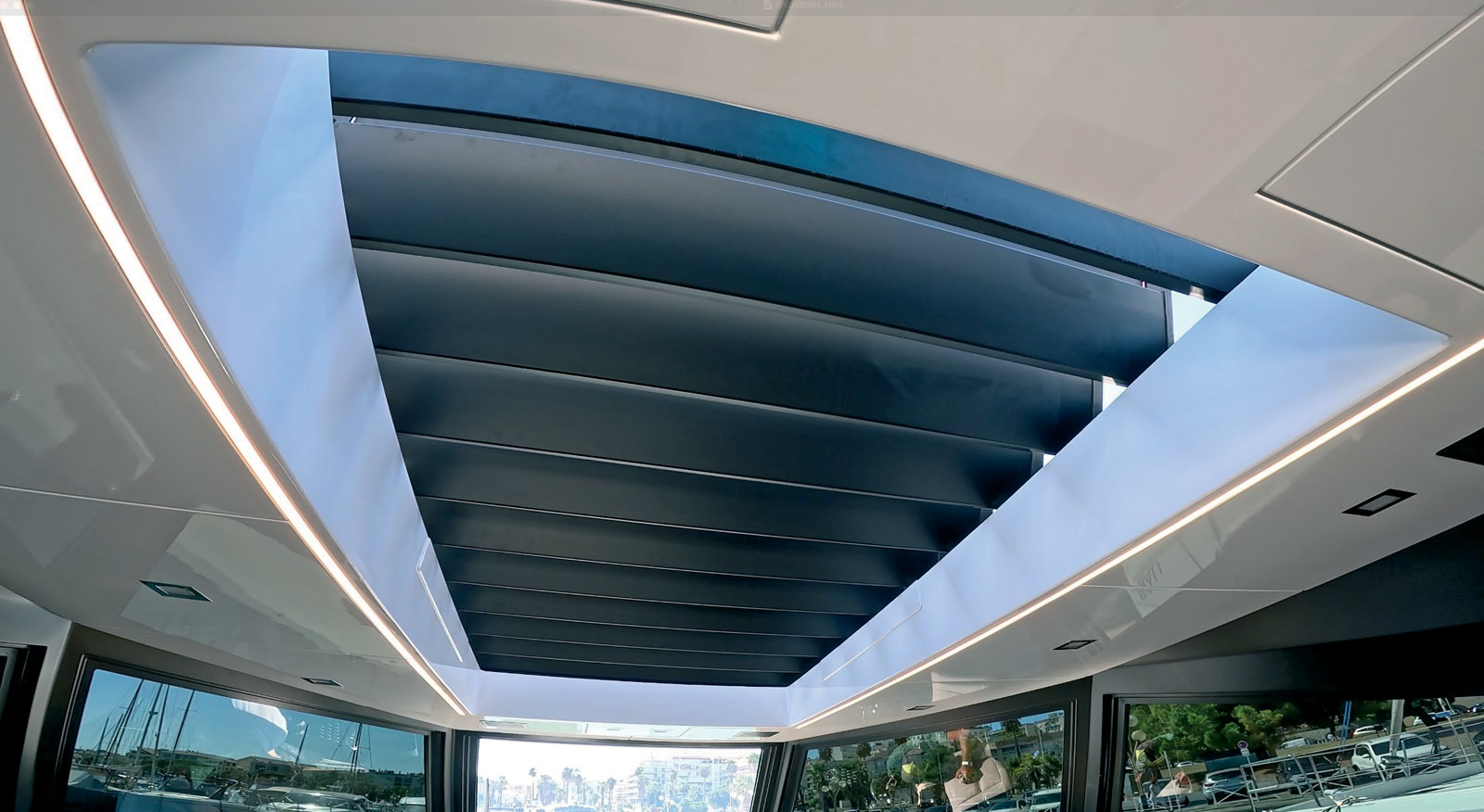
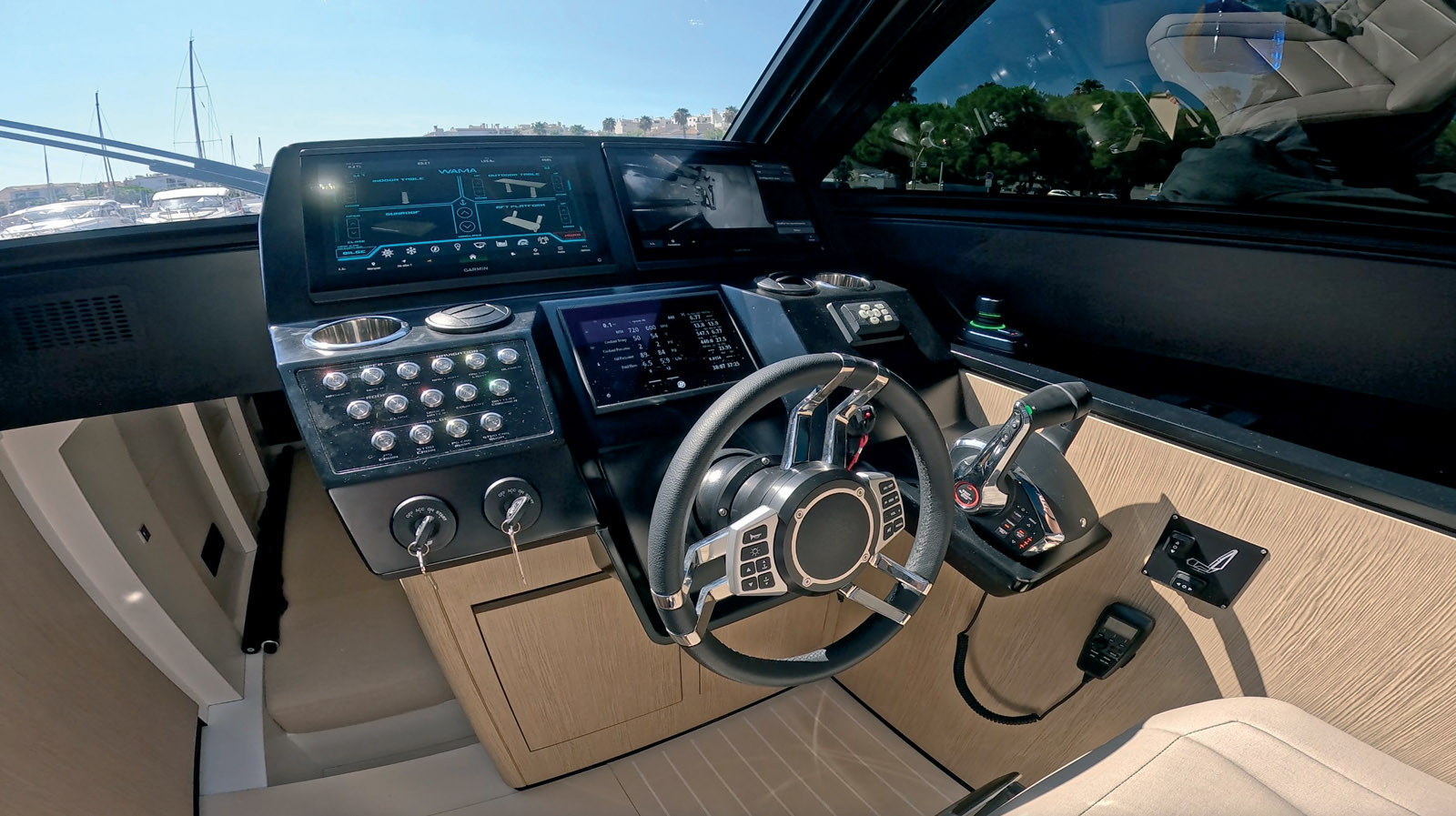
Located forward on starboard, the helm is extremely well equipped with two large screens, an adjustable steering wheel, all the switches, and a joystick. The Wama 42 XL is also equipped with several cameras in the engine compartment and at the anchor, so you can check that everything is running smoothly from the screens. In addition, the pilot seat is fully adjustable thanks to a system reminiscent of that found in a high-end car. Designed in a country accustomed to sunshine and very hot summers, the 42 XL benefits from tinted windows, which are not just for aesthetic purposes. Finally, the highlight of this boat is the cabin roof, which is equipped with a system of adjustable shutters that can be closed completely or opened to the desired angle to control the amount of sunlight and air, all at the touch of a button on the dashboard. It’s a really clever feature.
Three Cabins in a Zen Atmosphere
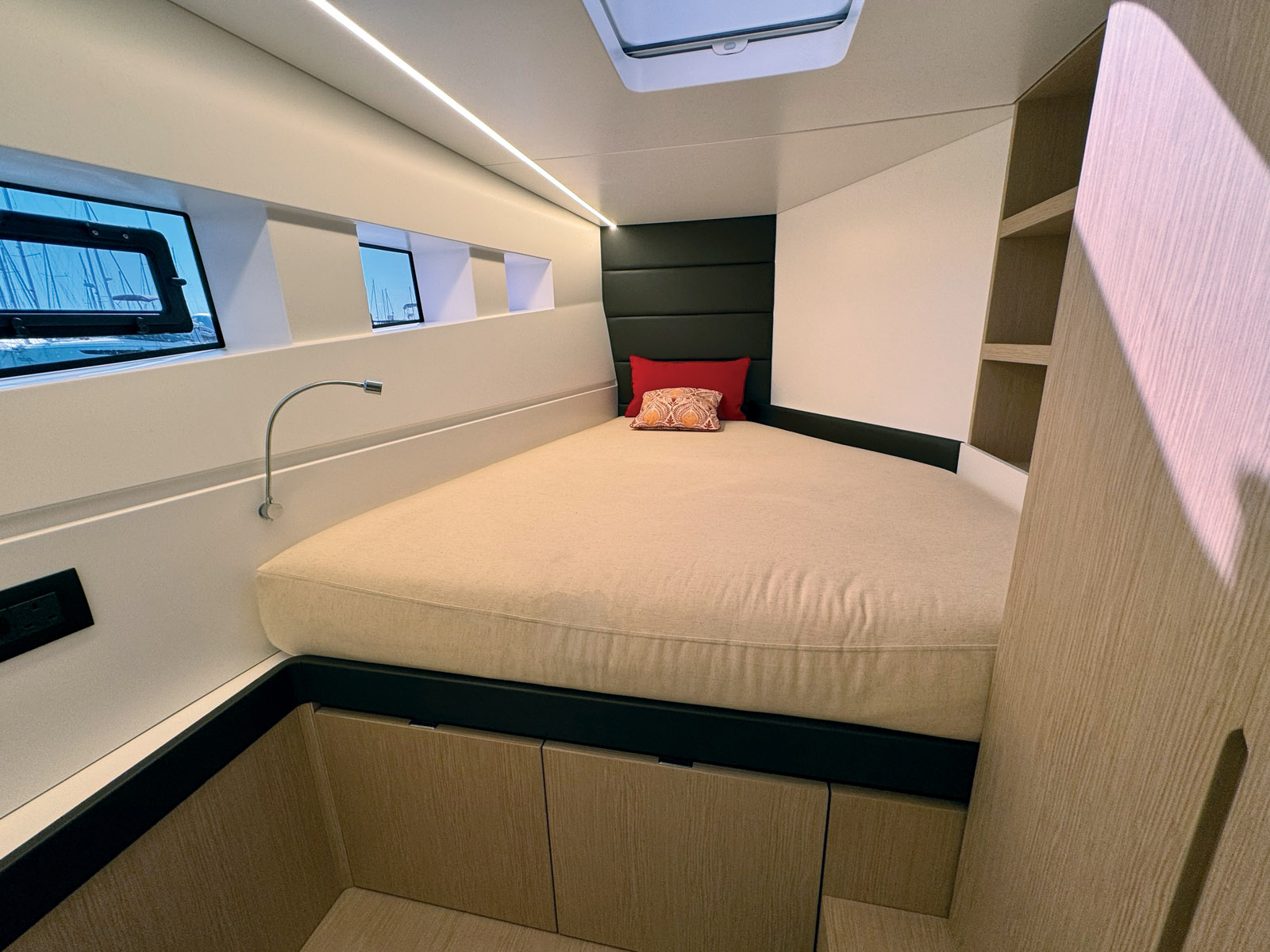
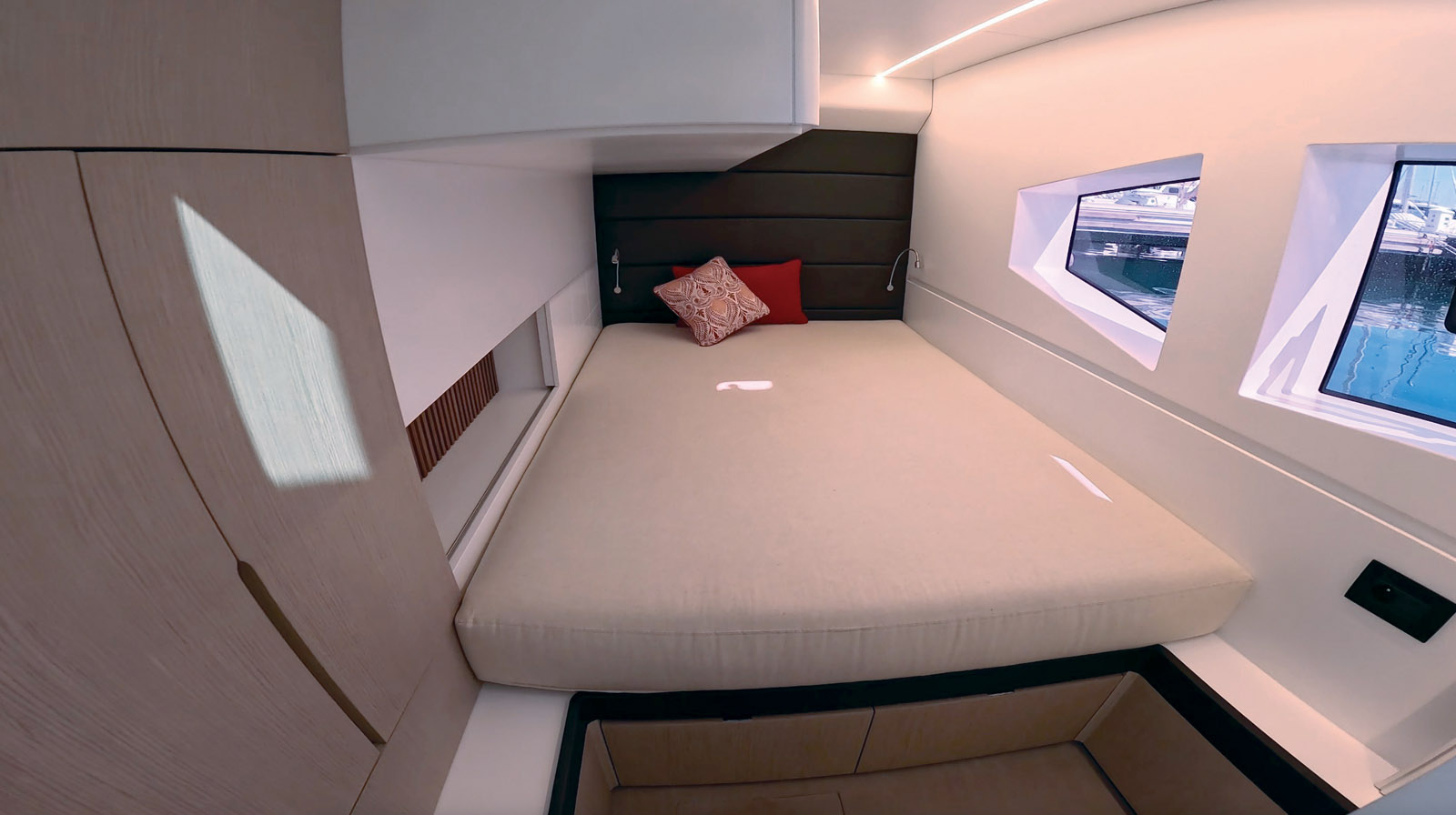
In terms of accommodation, the Wama 42 XL has three cabins - an owner’s cabin on the starboard side and two guest cabins on the port side.
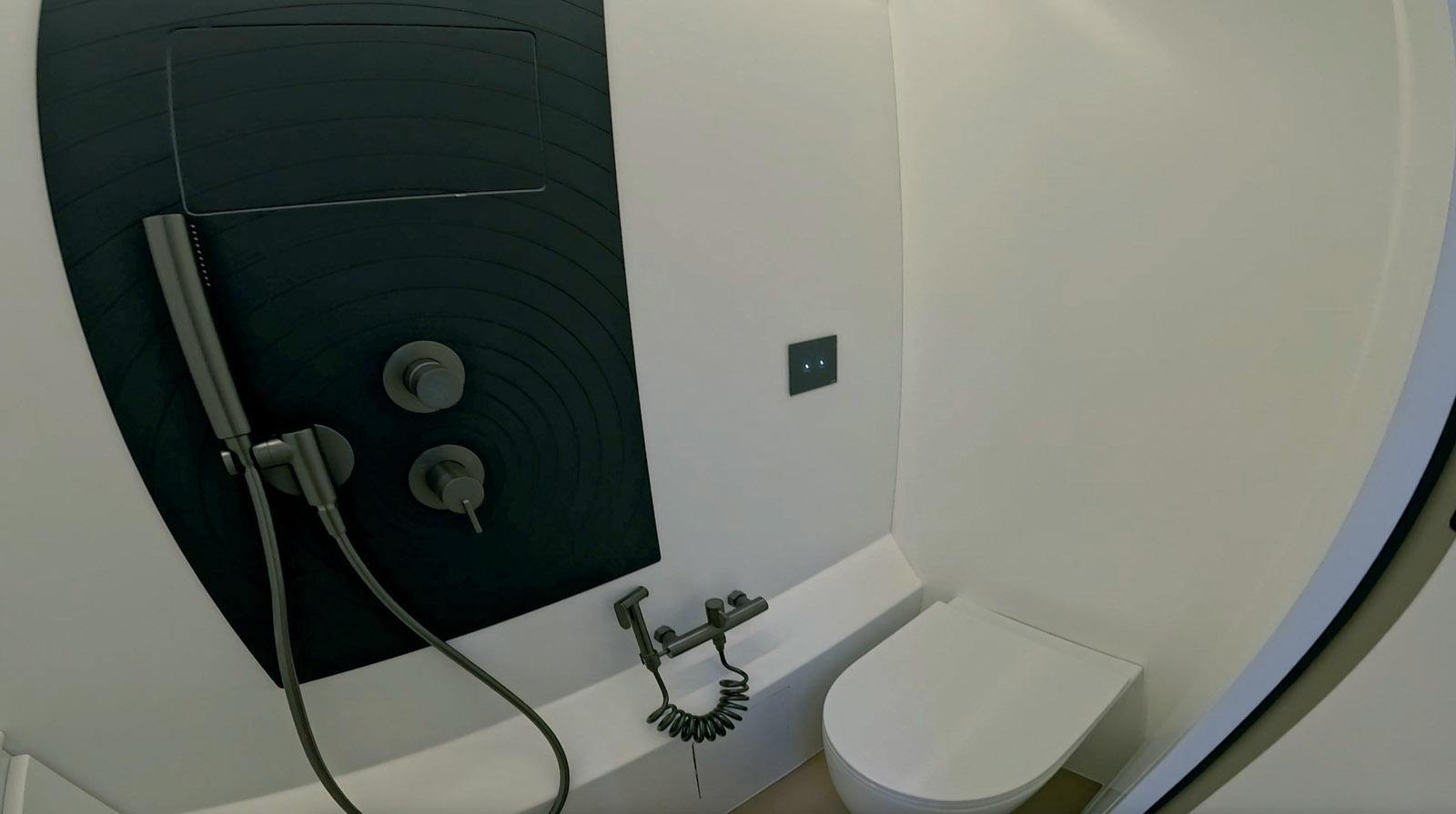
Accessible via a few steps, the owner’s cabin features a double bed at the rear, a small sofa in the center, and a large head at the front with an extra-large shower. The cabin is well lit thanks to the long hull portholes, and the very modern finish is quite flattering. By closing the sliding door at the staircase, you can really enjoy a peaceful and relaxing space.
On the starboard side, the space is divided between two guest cabins, each with a double bed. The one at the front is a little narrower, but the one at the rear has slightly less headroom and a fairly prominent angle that you will need to be careful of. The head, located between the two cabins, is much smaller than on the port side and will have to be shared. Here again, the finish and decoration are meticulous - the very soothing atmosphere contrasts somewhat with the sporty look of the rest of the catamaran.
Another pleasant surprise with this catamaran is the level of equipment, even in the standard version. Although Wama does offer options, the basic package is already quite impressive, including electronics, a fully equipped galley, air conditioning, an anti-fog system, a Fusion audio system, two surveillance cameras, deck covering, an electric windlass, and a television.
It should be noted, however, that in the standard version, the hard top is made of composite rather than carbon. Similarly, the foil system (see below) is also optional, as is the electric table.
Two 600-HP Mercury V12 Engines and a Top Speed of Nearly 40 knots
As we have seen, the Wama 52 XL is eye-catching and its aluminum/carbon composite construction is of interest to connoisseurs...
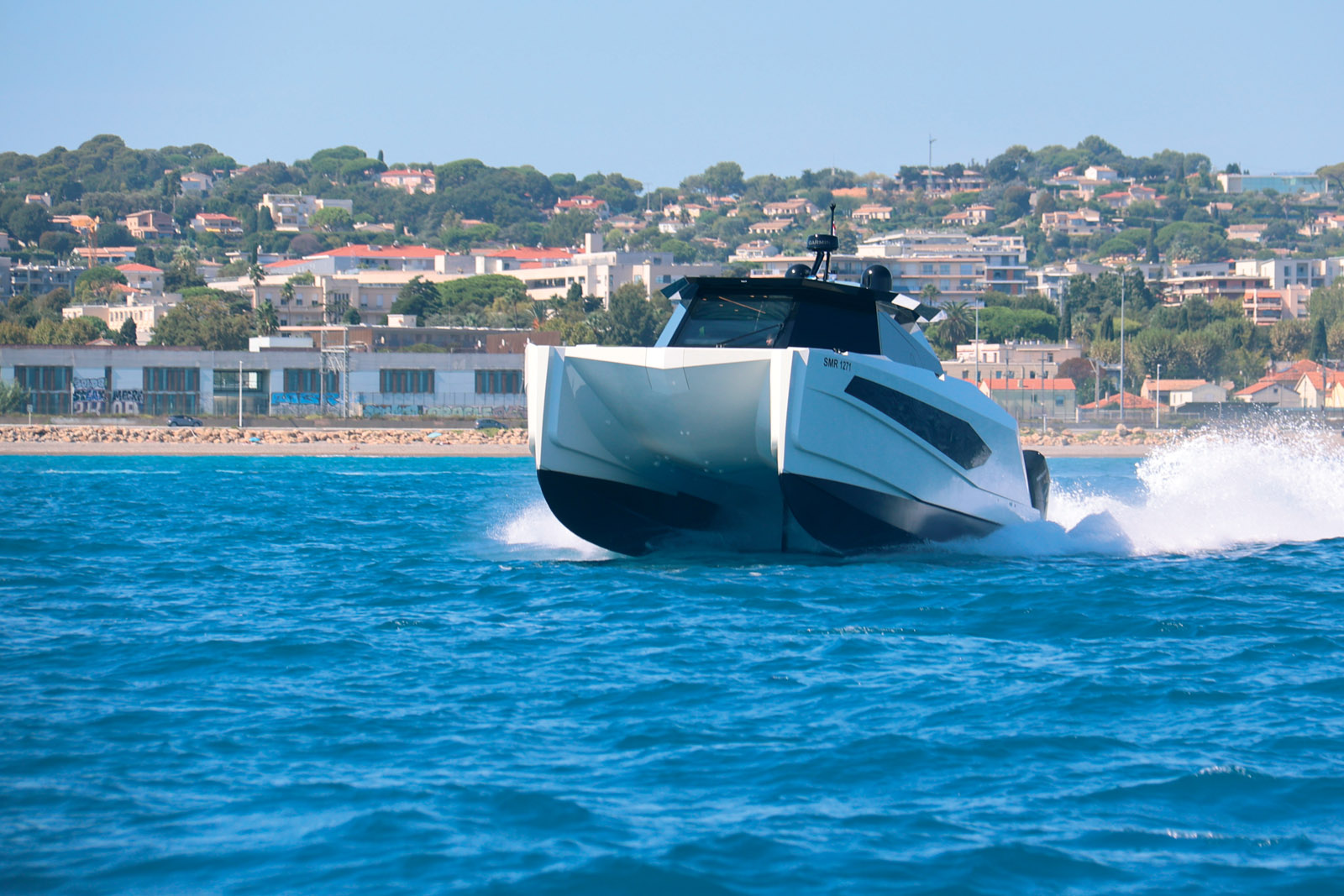
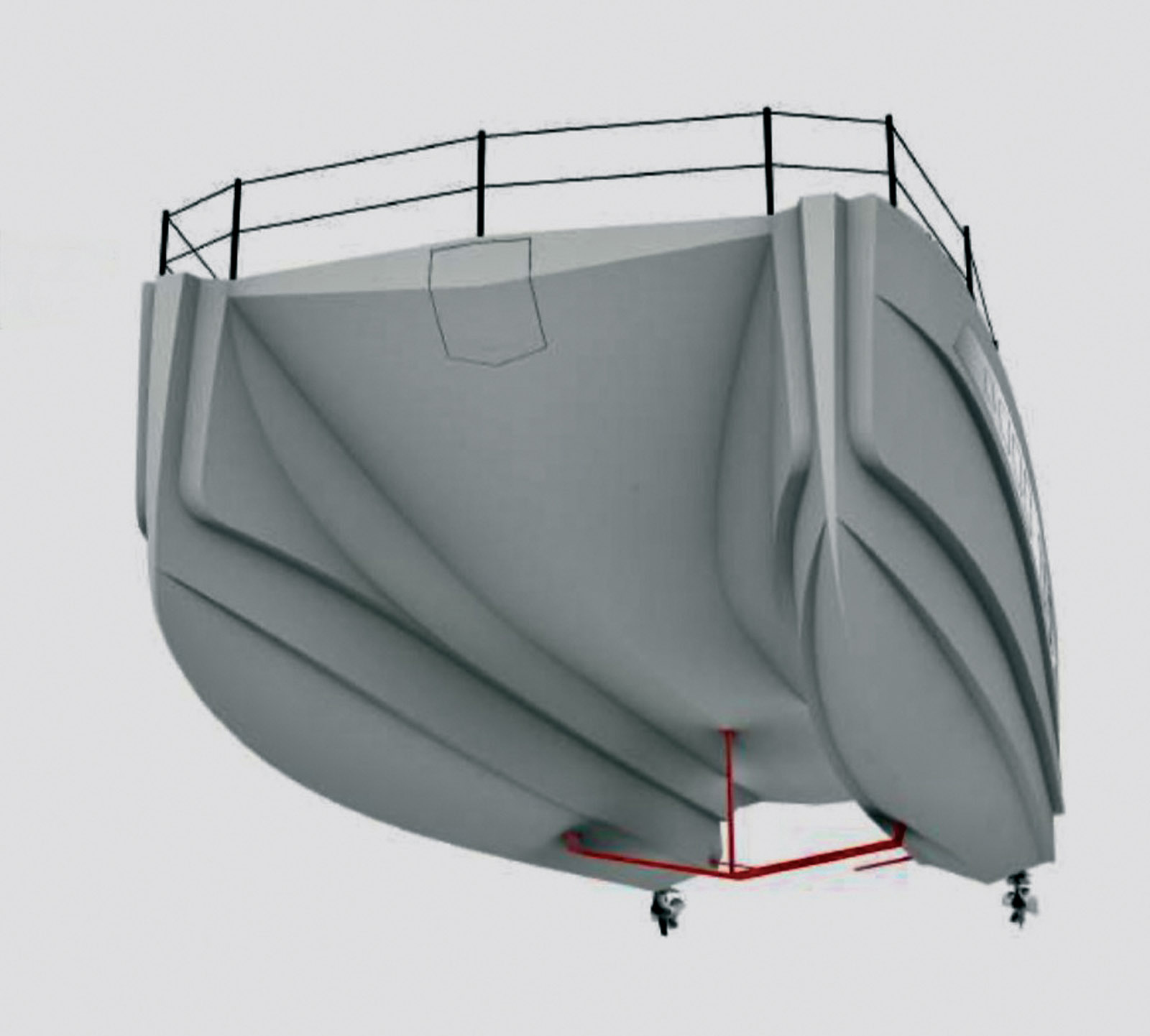
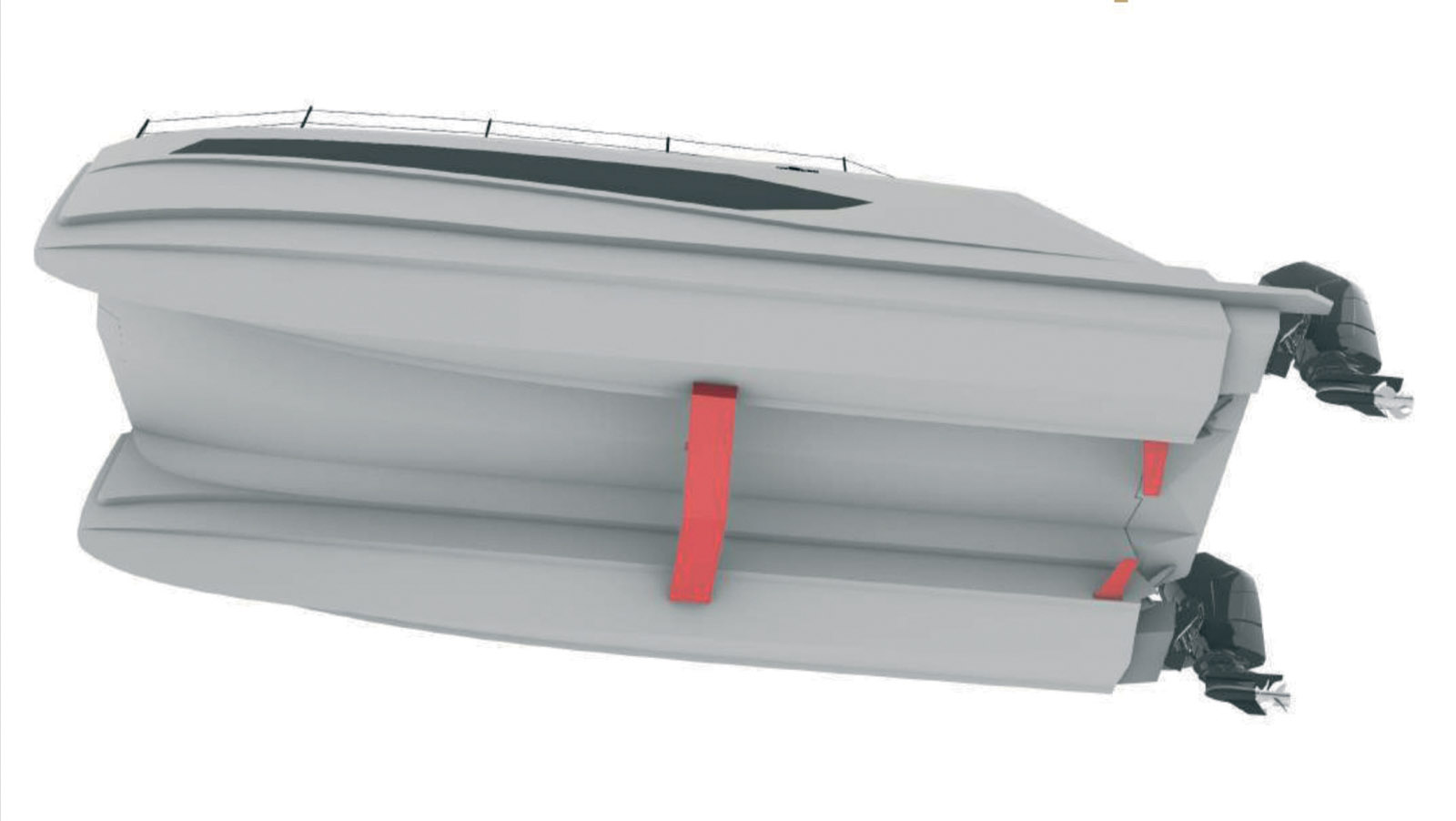
but that’s not all: the powercat also features a unique two-part foil system. The front foil, located just behind the midpoint of the hull, consists of a lateral blade between the two hulls and a vertical blade in the center to provide an additional anchor point. The second part consists of two small, almost horizontal foils attached to the inside of the hulls, almost at the level of the transom. Their carefully-calculated angle supports the effect induced by the first foil and keeps the rear of the hulls raised when under way.
Foils are now very popular, and we have already tried a number of powercats that have them; the results are more or less convincing, but it must be said that on the Wama, the seakeeping is simply impressive.
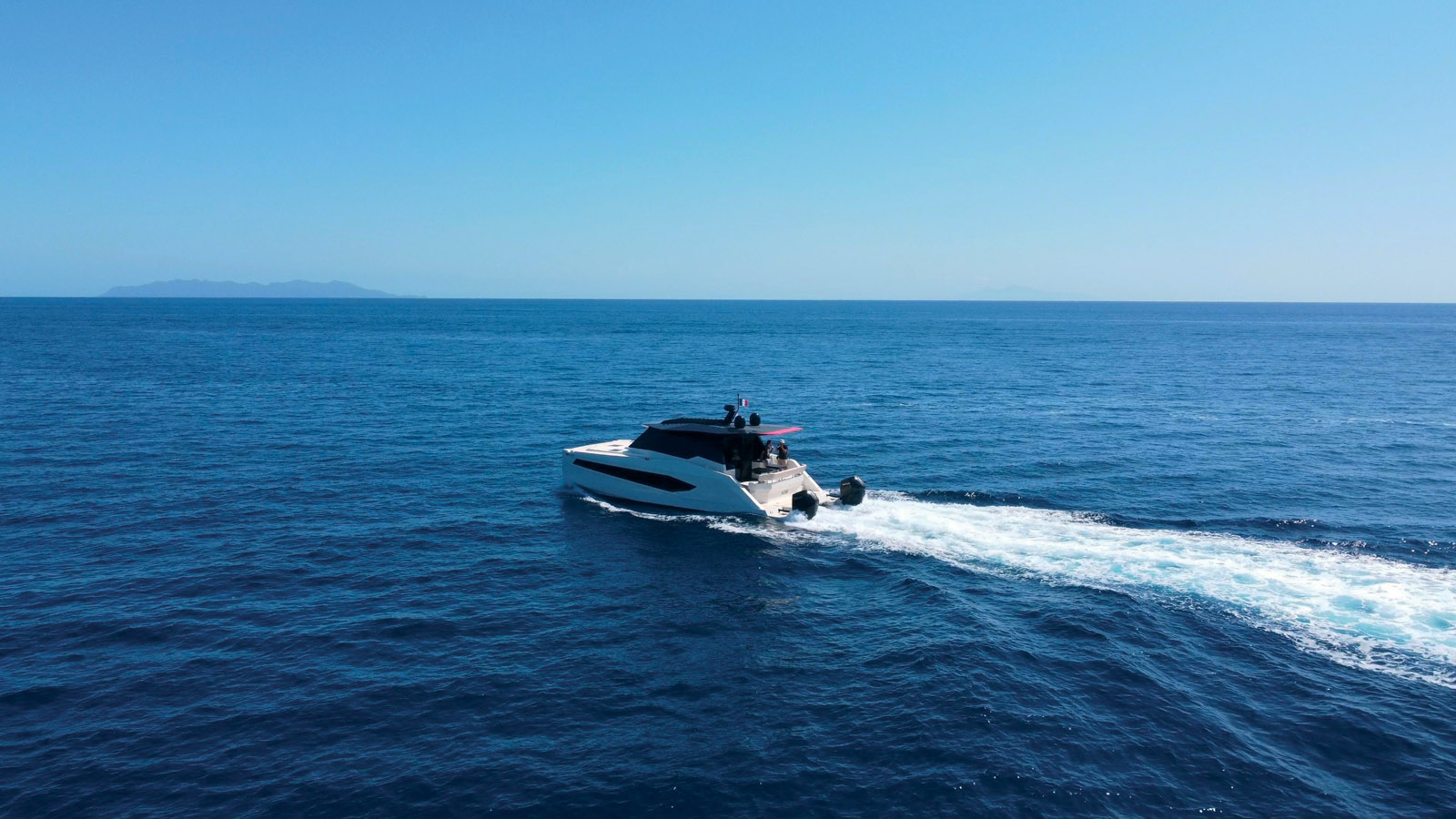
Once at the helm, the first thing you appreciate is the seat adjustment, which allows you to find the right position. Another pleasant surprise is the low noise level, thanks to the discretion of the Mercury V12 engines, but also to the good insulation work done on this powercat. As you would expect with 600 HP, you gently push the throttle lever until the second gear. Then everything flows naturally. The boat planes at around 3,000 rpm and “climbs” onto the foils shortly after. From there, the Wama is very light and smooth to steer. Despite the 50-centimeter waves (20”) in the Bay of Antibes, nothing seemed to disturb the Tunisian powercat. I made a few turns and, once again, to my pleasant surprise, the foils didn’t stall and in the curves, the catamaran stayed flat, much to the delight of the crew, who can go about their business without being in survival mode. Taking advantage of the comfortable power available, I pushed the throttle for a few quick maneuvers. The GPS reached 25 knots, then 30, 35, and we reach a maximum of 38 knots, a little below the 40 knots announced by the shipyard, but with 50 cm/20” waves and with seven people on board, I was quite respectable. What’s more, our propeller was a little too big, as we didn’t exceed 5,700 rpm, but above all, this performance is not achieved through suffering, but with remarkable comfort. In this configuration, the cruising speed is between 25 and 27 knots, which is perfect for a family program. Similarly, the version we tested, with two 600 HP Mercury V12 engines, is likely to appeal more to North American or Middle Eastern customers, while in Europe, the version with two 440-HP Yanmar diesel engines will certainly be more popular.
It should also be noted that the 42 is available in a non-XL version, which is slightly narrower and built in fiberglass, and should represent a first step into the world of Wama powercats.
Conclusion
This first attempt is undoubtedly a masterstroke. Not only is the Wama 42 XL beautiful to look at, but it also offers high-tech solutions and some of the best seakeeping in its class. The use of aluminum and carbon makes it lightweight and partially recyclable, which is a bonus, and, as a final pleasant surprise, it comes with a generous range of equipment.
High-tech equipment
Seakindliness
No aft cockpit gates
Hefty price tag and optional foils
Technical Specifications
Architect: Ali Kastally
Length overall: 42’9” (13.03 m)
Beam: 17’9” (5.4 m)
Draft: 2’10” (0.85 m)
Light displacement: 28,660 lbs (13 t)
Outboard powertrain: 2 x 600 HP Mercury V12
Inboard powertrain: 2 x 440 HP Yanmar diesel
Fuel: 396 US gal (1,500 l)
Water: 211 US gal (800 l)
Cabins: 3/4
Heads: 2
CE Certification: B
Base price: € 1,200,000 ex-tax
www.wamayachts.com