
The WorldCat 280CC-X brings American quality standards for anglers seeking performance and dedicated accessories. By adopting two hulls, it manages to preserve comfort for passengers who are more familiar with relaxation and conviviality. A future assured in the USA – and undoubtedly a promising one in Europe.
Test : Arcachon (France)
Conditions : 15 knots, slight sea

Infos pratiques
- Le chantier : WorldCat 280CC-X
- La fiche technique
-
 Découvrez notre vidéo exclusive
- Financez votre WorldCat 280CC-X
- Assuez votre WorldCat 280CC-X
- Articles autour du WorldCat 280CC-X
Though the principle of the catamaran has long since conquered the world of sailing, its appearance in the world of powerboats is more recent, and mostly focused on large cruising boats - 40 feet and above. For smaller boats, the multihull concept has exploded in the United States with pontoon boats and is gaining market share among fast offshore fishing craft. In Europe, it’s taken longer to get going... If we’re presenting the 280CC-X here, it is because this boat, which is part of a range of a dozen models, is destined for a more international career. As the first WorldCat to be officially approved in Europe, the 280CC-X is being distributed on the Old Continent – but it is soon to be followed by a 40-foot model, then a smaller 23-footer. The WorldCat 280CCX (CC for center console and X for latest generation) is at the heart of the WorldCat family and combines everything that makes powercats so interesting.
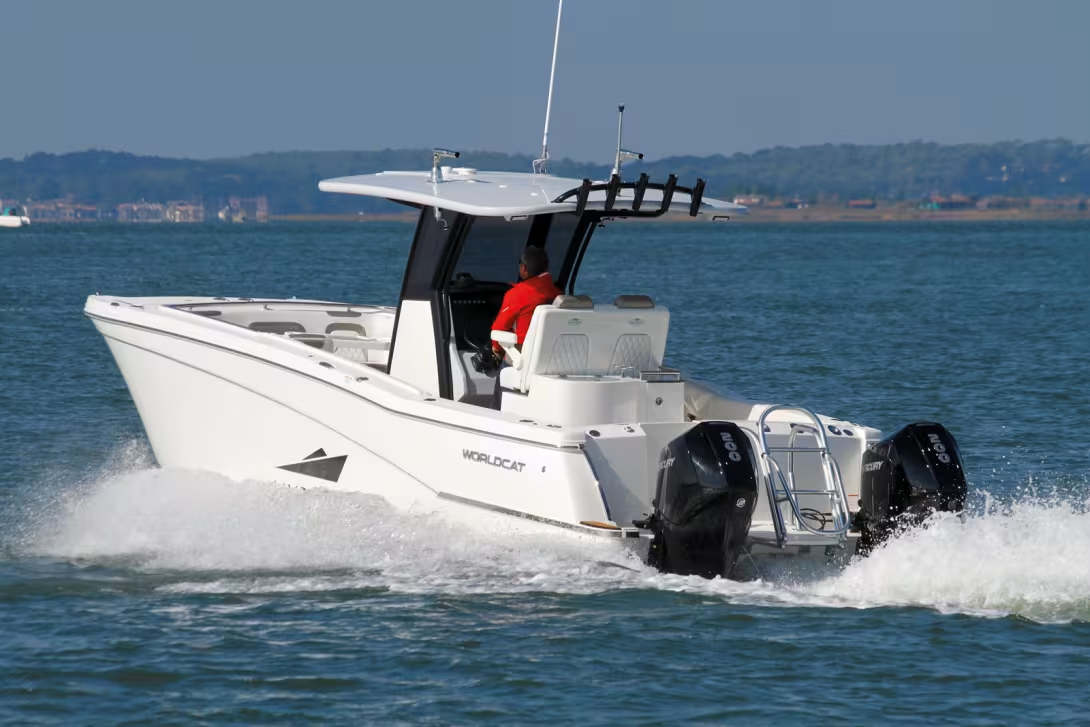
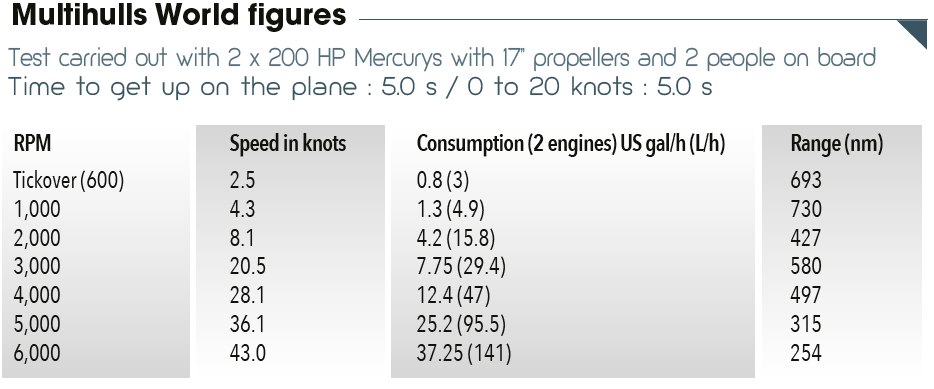
When viewed at sea from the deck of another boat sailing parallel,there’s nothing immediately apparent to distinguish the WorldCat 280CC-X from any standard American fishing boat: There’s fairly significant freeboard with a bow well projected forward, a central helm station protected under a rigid T-top and finally a classic twin engine setup, with a pair of 200 HP Mercurys. But, as soon as we change our angle of view a little bit by overtaking it, the bow splits in two and the hulls appear, narrow and marked with beautiful strakes, framing a tunnel that’s neither very wide nor very high. Yes, this is a catamaran, and our test will give indications on the specific behavior of such a hull design versus the classic monohull. Among the advantages, stability is at the top of the list, and it is felt as much when stopped as under way, with a comfortable passage through the waves. A significant plus is the possibility to take the ground on the level. The behavior is pleasant and dynamic, with a time of 5 seconds to get up on the plane and reach 20 knots. With a top speed of 43 knots, the World Cat 280CC-X proves to be a good performer... and not as thirsty as all that (at this pace), with a cumulative consumption of 37.25 US gallons (141 liters) per hour. At 4,000 rpm, the engines propel the catamaran at 28 knots with a consumption of 12.4 gal (47 l)/h. It is perfectly possible to envisage economical consumption by setting the engines at 2,000 rpm. At this speed, we still reach a speed of 8 knots at 4.25 gal (16 l)/h, giving a respectable range of 400 miles. The distance even increases to 580 miles if you push the throttles to 3,000 rpm: there, at 20 knots, the 280CC-X gives the best fuel performance, and all smoothness... Let’s specify that this powercat, in spite of its length, is capable of venturing out on the open sea: Jérôme Pourtalet, of French importer MyBoat, did not hesitate to make the trip to the La Rochelle Boat Show by sea from Arcachon - more than 100 miles further south down the Bay of Biscay, with the dreaded passes of the Arcachon Basin as an appetizer...
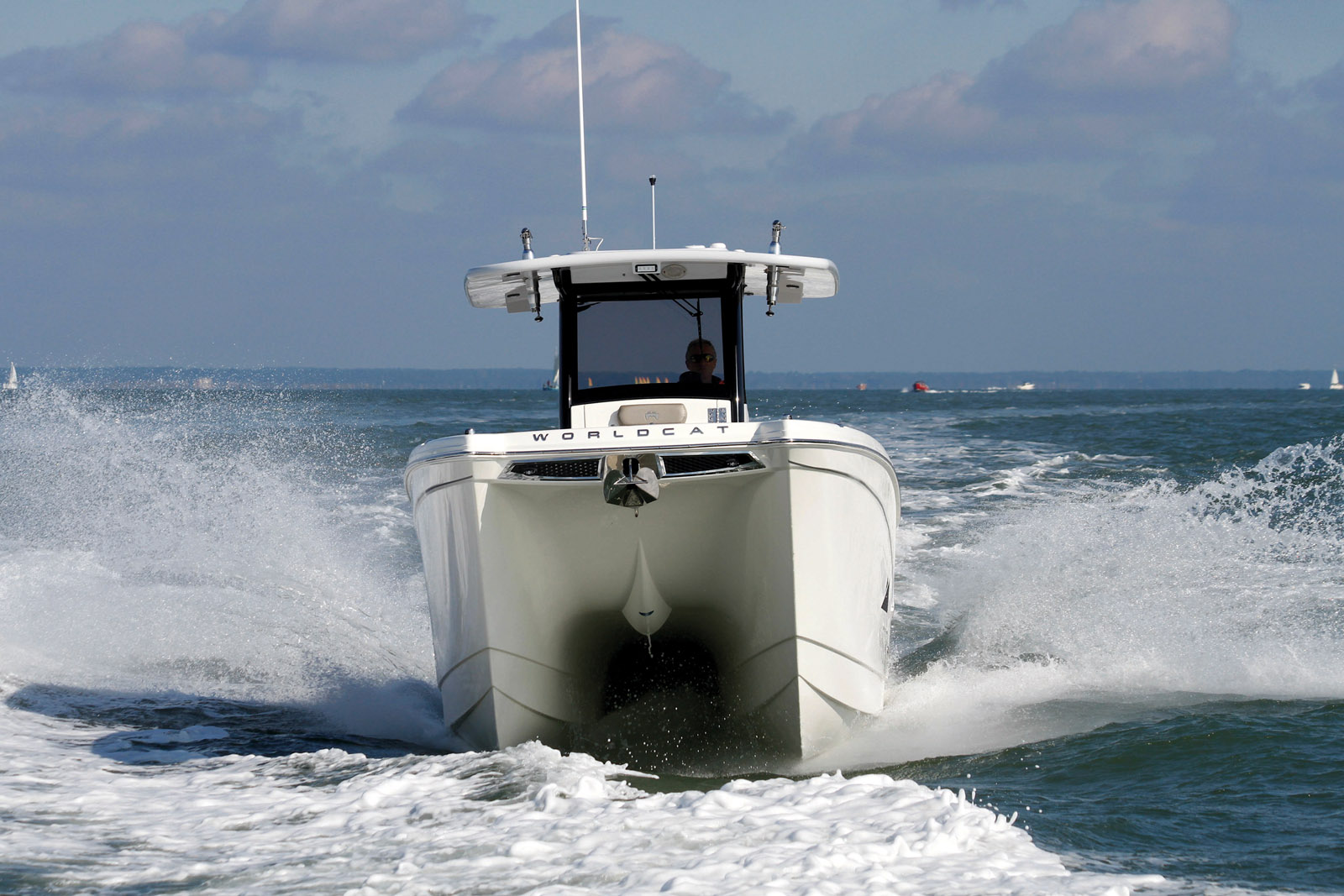
This shot highlights the contained width of the platform and the bridgedeck clearance.
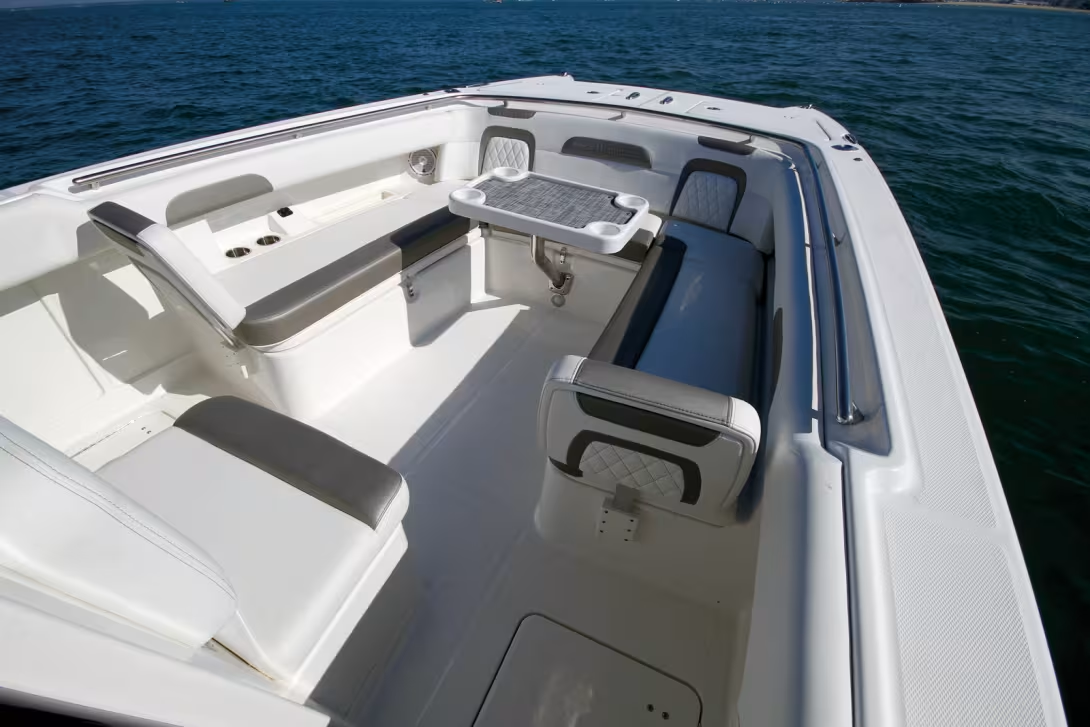
A wide, convivial foredeck
The WorldCat 280CC-X cannot hide its origins in terms of construction and fittings, as it has all those “Made in the USA” attributes, starting with a high level of quality. The helm station is quite emblematic of this impression: the console, which leaves two wide side decks (22”/0.55 m), has a large dashboard where two large screens, a SeaStar joystick (with GPS anchor system), cup holders and several storage spaces can be easily installed. Under the hardtop is a glove box, the VHF and the rod holders. Both helm seats are deep, with adjustable seats and comfortable headrests and armrests. The upholstery allows to appreciate the care given to the finish with diamond-pattern stitching. Many of the features and accessories are geared towards sport fishing. Thus, the deep (30”/0.76 m) cockpit is very clear and practical, with its padding at the top of the bulwark, its recess for feet (with rod holders) and its wide gunwale. On the side decks, two lockers open to reveal fish boxes with rod holders. The rear of the leaning post has a livewell and storage for boxes of lures. A further five rod holders are mounted on the back of the T-top. The fishermen are well catered for, but other passengers are not forgotten. The cockpit has some nice surprises in store for them, such as the folding bench seat at the rear, the wide (17”/0.43 m) access door to the platform between the two outboards, incorporating an impressive swim ladder.
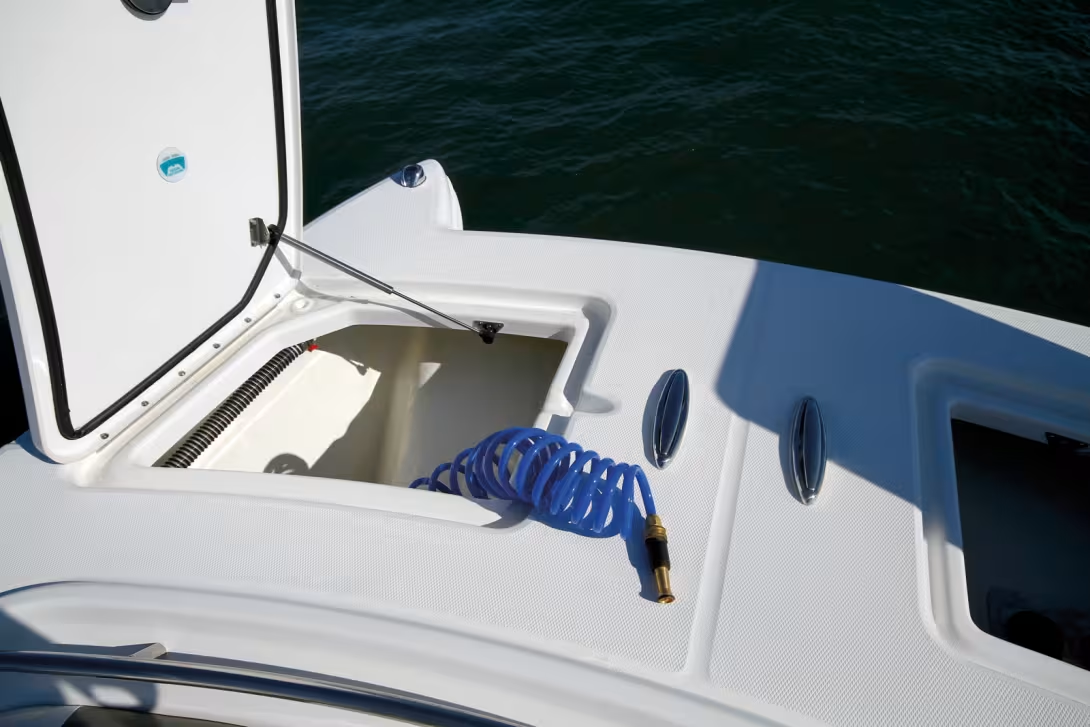
The forward section of the boat is dedicated to these passengers, with a saloon that takes advantage of the catamaran’s great width, featuring three beautiful U-shaped bench seats, around a (small!) table and facing the seat forward of the console. The backrests are high and comfortable, and the niches in the side bulwarks have drinks holders, speakers, storage bins and cigarette lighter sockets. The seats lift up on gas struts above lockers with watertight seals. This area is secured by a handrail that runs around the bulwark. At the wide bow, two lockers house the deckwash and storage space, and the windlass and chain locker. Finally, in the console, the forward door gives access to a bathroom.
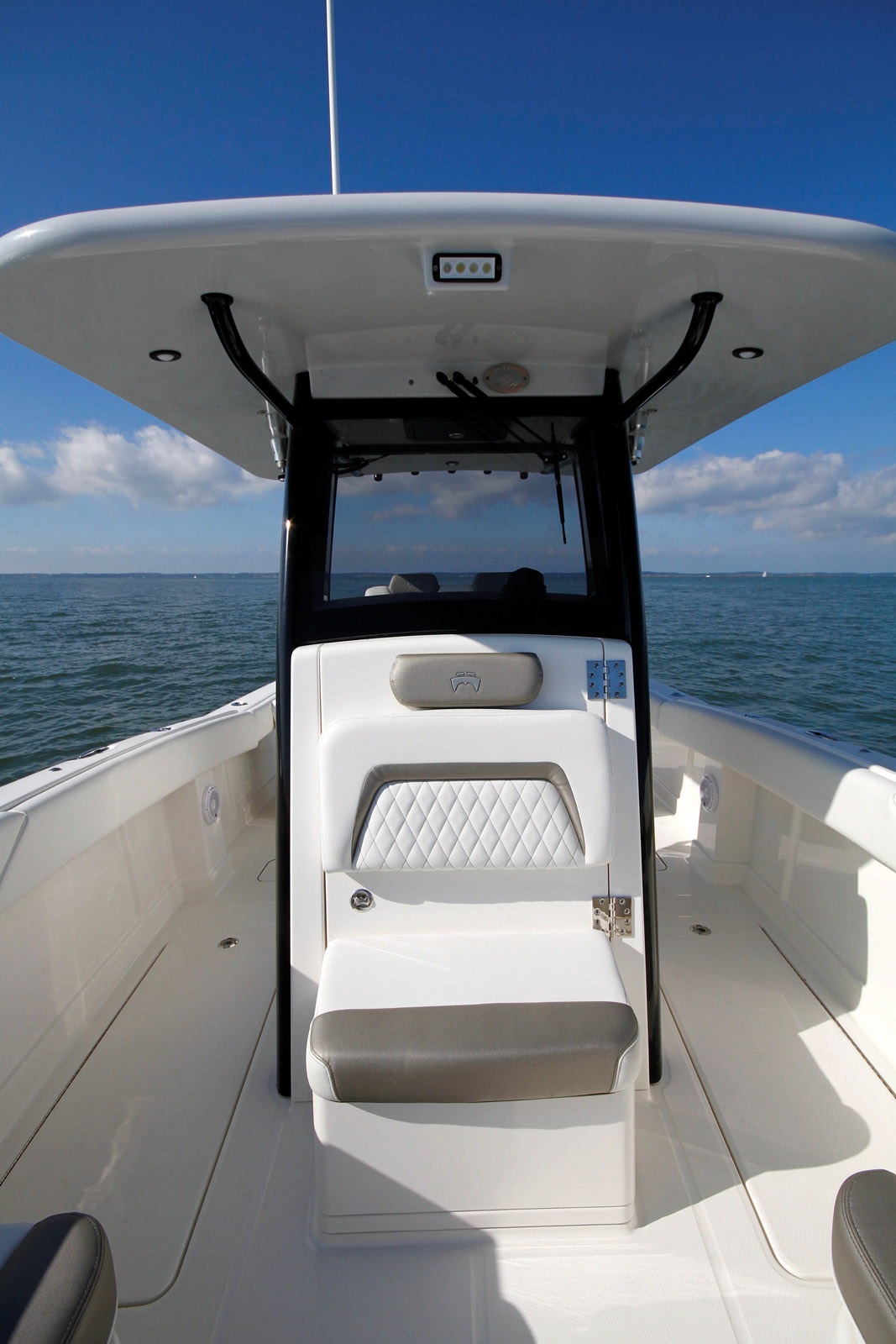
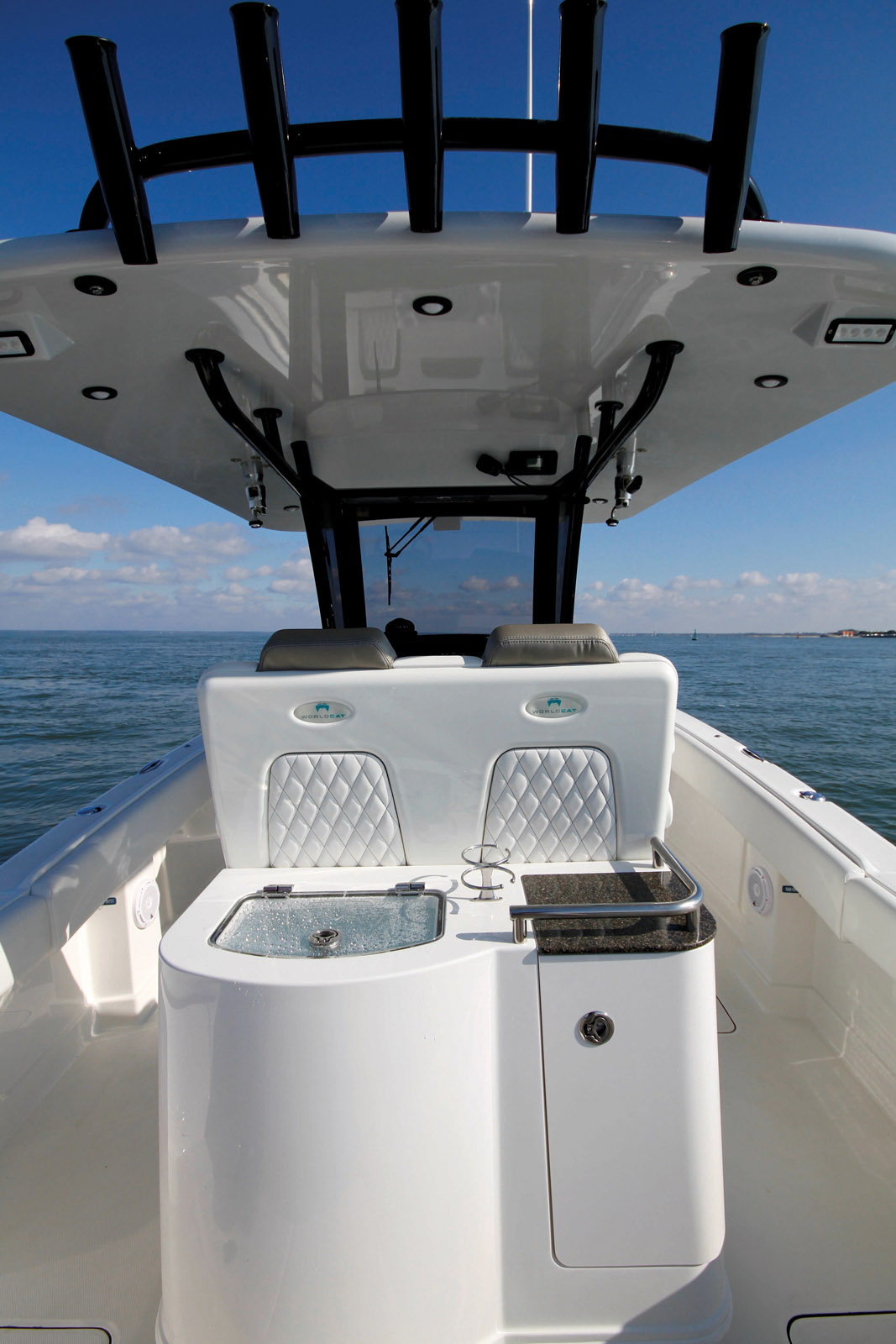
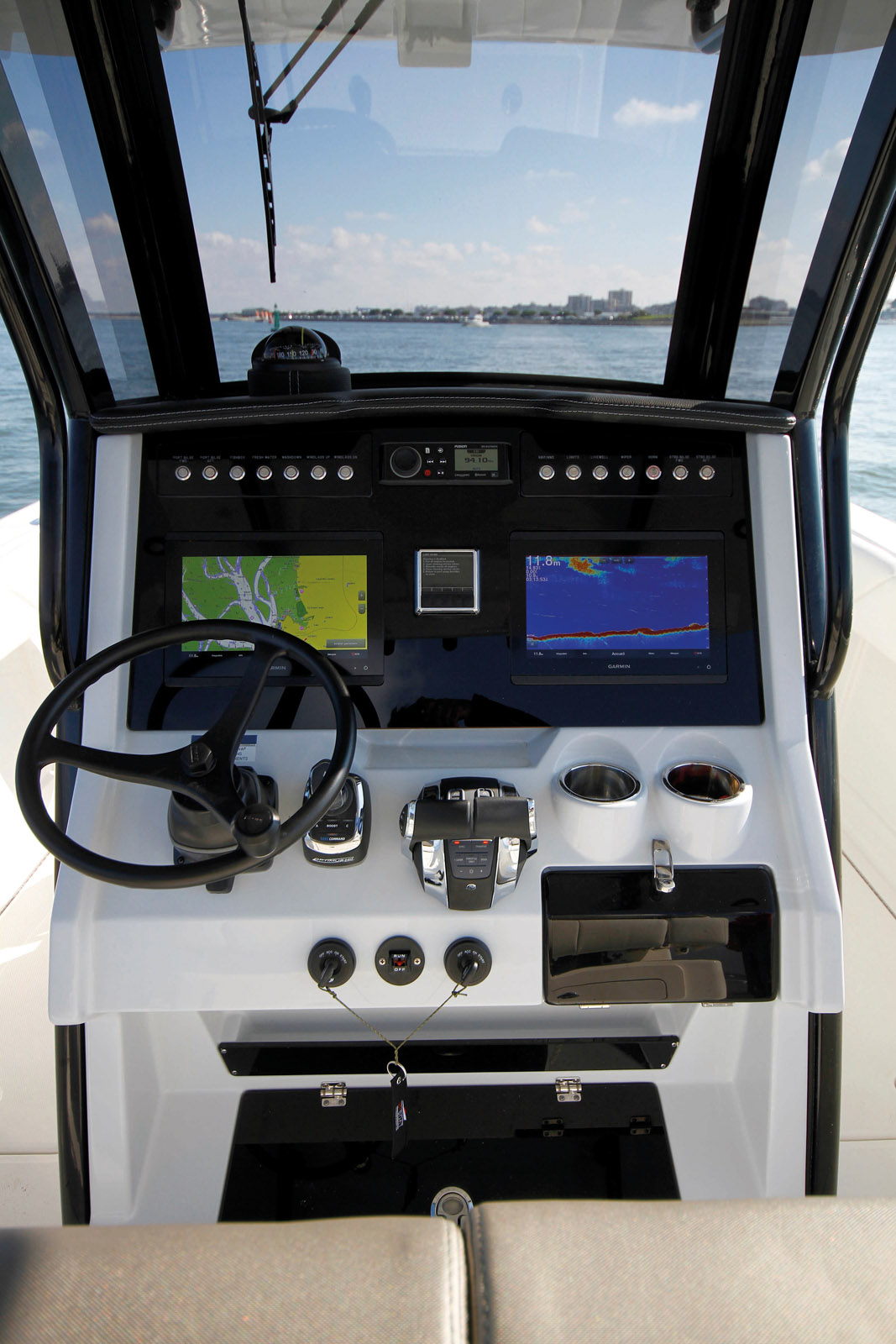
The helm station is protected by a large T-top. At the back, there is a livewell and a locker for storing lure boxes.
Conclusion
The WorldCat 280CC-X perfectly represents the American offer in terms of fishing boats. The concept of the catamaran, which offers stability and a large forward volume, should also seduce a European clientele in search of something new. The well-designed and constructed fittings, combined with impeccable seaworthiness, are some of this boat’s greatest assets.
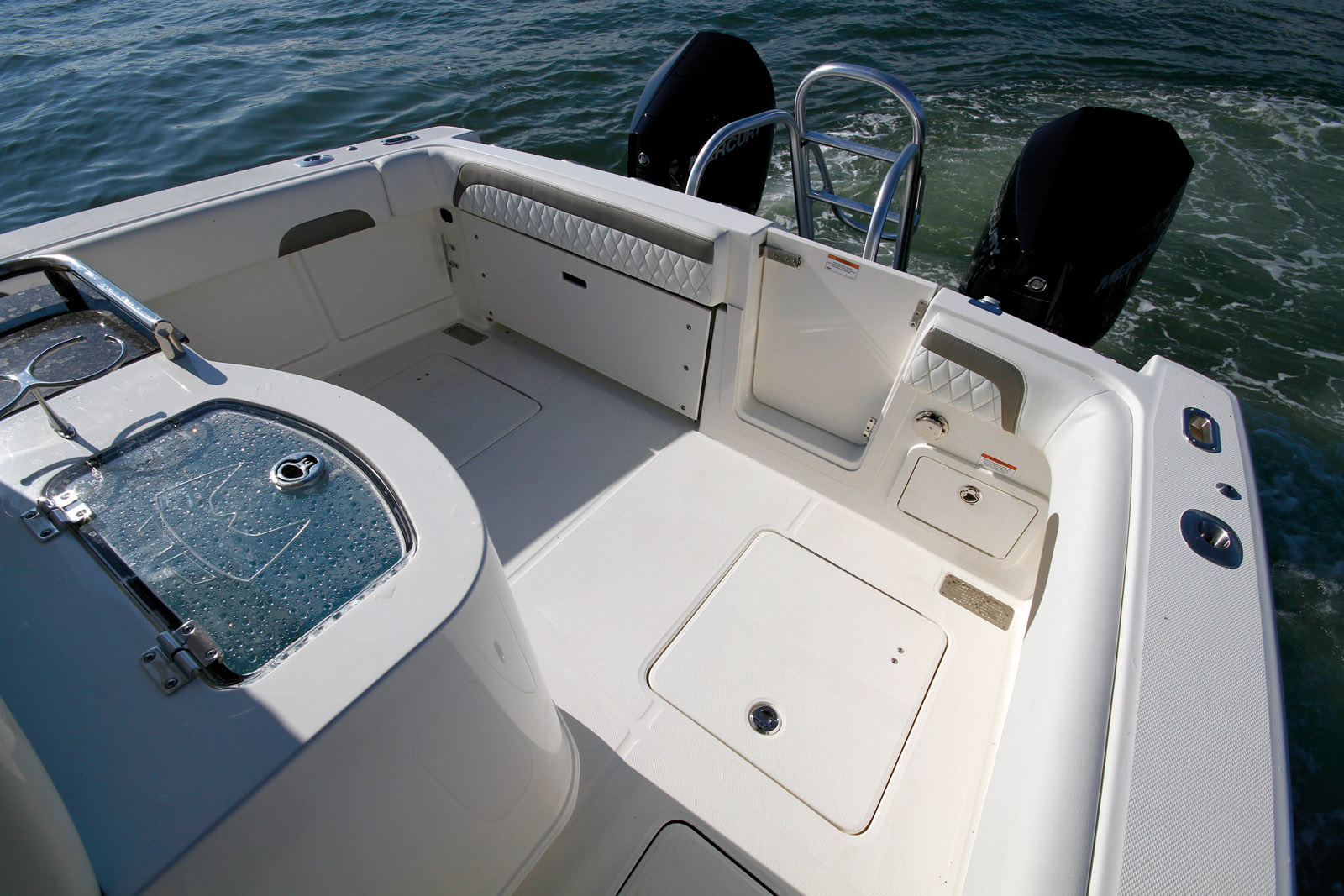
When under way, the cockpit is secured by closing the small door. Just aft of this, the swimming platform is a bit wedged-in between the outboards.
The Pluses
+ Stability at sea
+ The layout for fishing
+ The forward lounge for relaxation
The Minuses
- The bathing platform wedged between the engines
- The small foredeck table
TECHNICAL SPECIFICATIONS
Builder: WorldCat (USA)
Length: 27’5” (8.36 m)
Beam: 8’11” (2.73 m)
Displacement - not including engines: 7,275 lbs (3.3 t)
Material: GRP
Capacity: 8 people
Berths: 0
Fuel: 110 US gal (2 x 416 l)
Water: 20 US gal (77 l)
Max power: 2 x 225 HP
Recommended power: 2 x 200 HP
CE Category: C
Price: from € 284,400 ex-tax with twin 200 HP
Mercury outboards
Principal options (excluding tax):
Seastar Optimus 360 electric steering: € 10,900
Forward table: € 1,287
Shadow finish (T-Top, black lacquered rod holders and steering wheel): € 6,064
Taco Marine rod holders and handles: € 4,089
CE certification: € 1,869
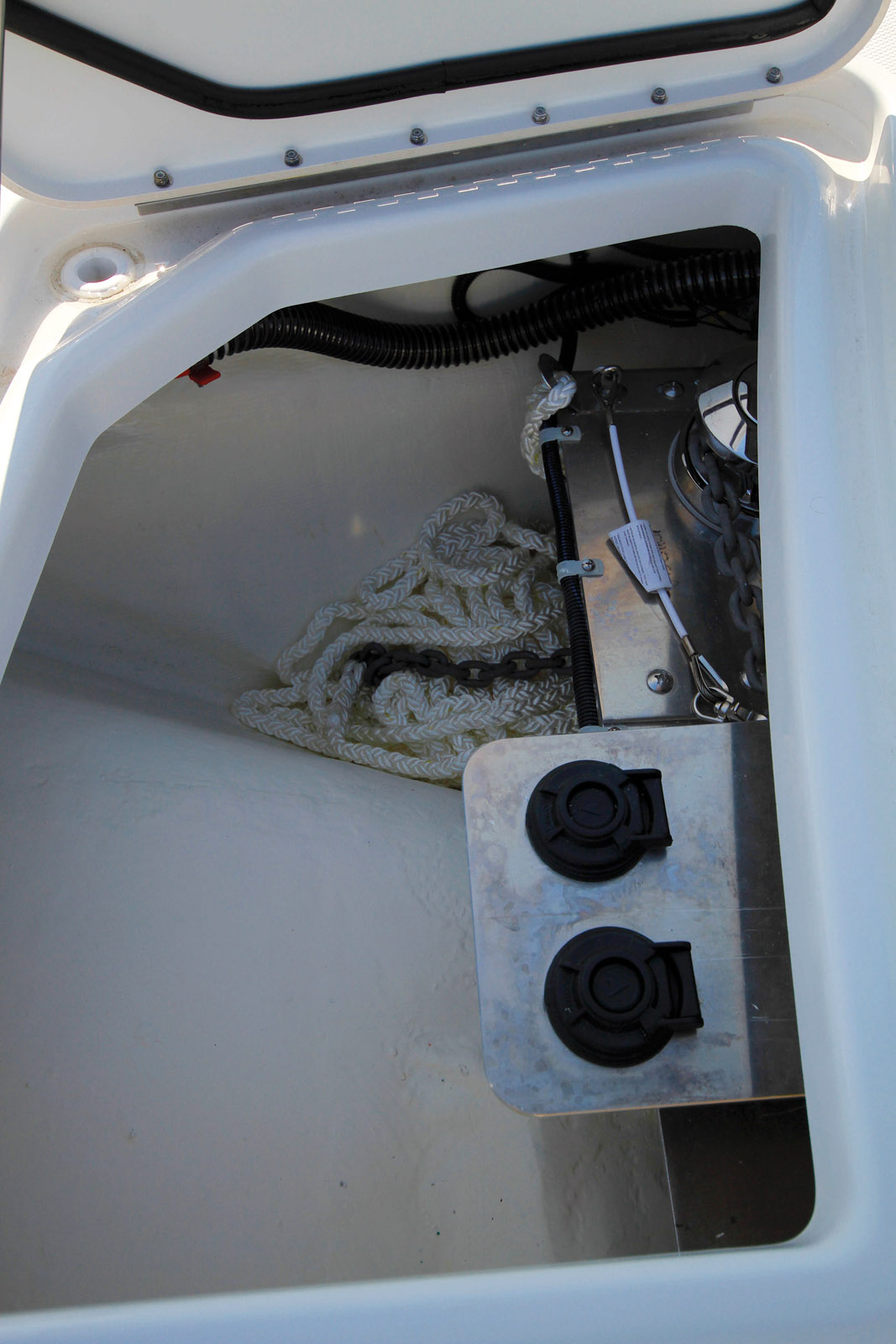
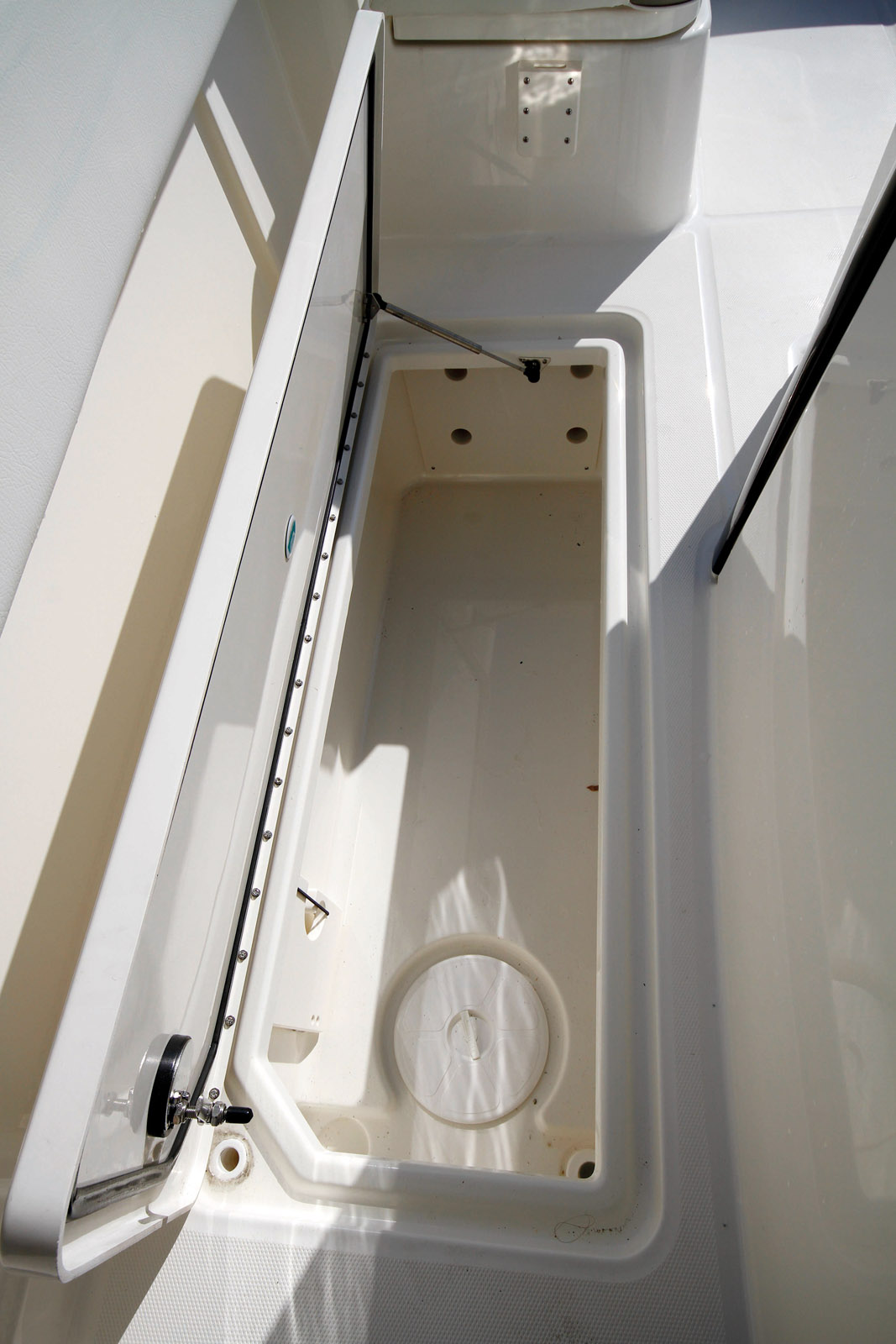
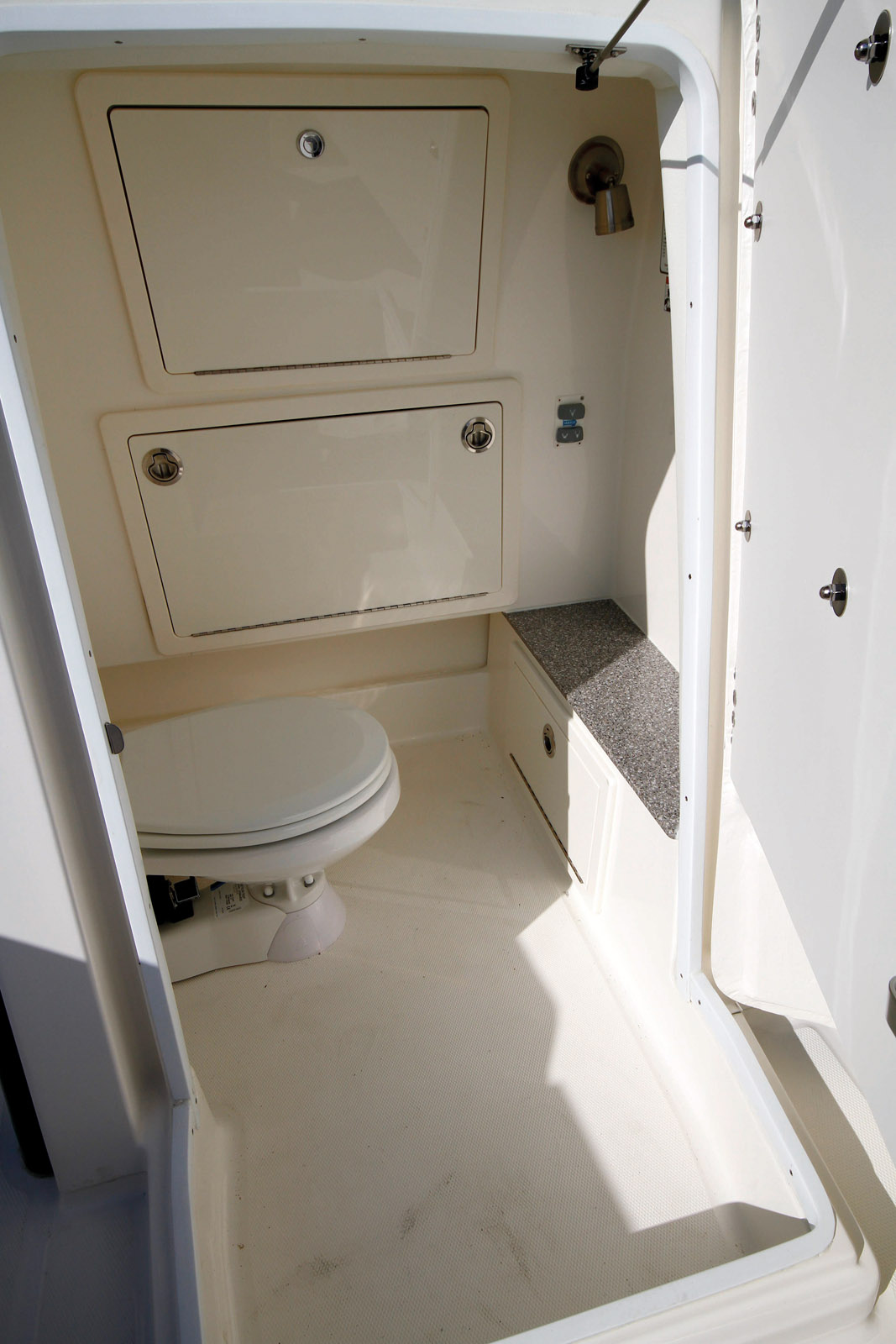
Aboard the 280CC-X, there are numerous lockers, storage spaces and even a bathroom.