
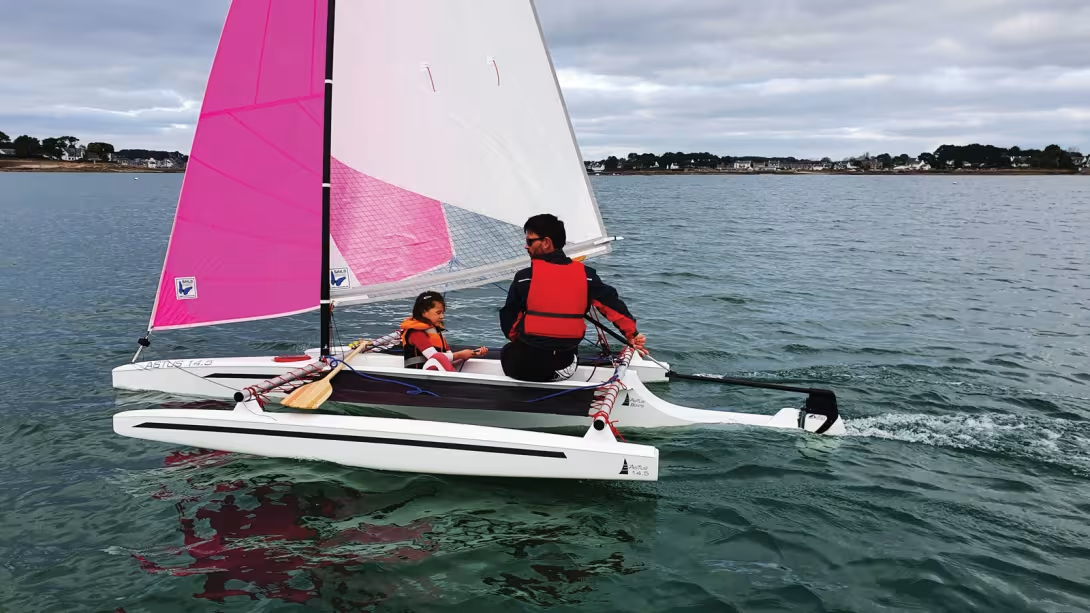
This pocket multihull is no simple beach toy... Designed by VPLP, it is modern, light and transportable. Moreover, it can sail in trimaran or proa mode! We’d been looking forward to testing this little rocket ship as soon as we could. And we weren’t disappointed - judge for yourself.


Infos pratiques
- Le chantier : Astus 14.5
- La fiche technique
-
 Découvrez notre vidéo exclusive
- Financez votre Astus 14.5
- Assuez votre Astus 14.5
- Articles autour du Astus 14.5
Our editor is sometimes criticized for favoring too many “big” multihulls. That’s not the case, I can assure you. We’re just telling the story of the evolution of an offer that for years has been in “always more” mode: longer, taller, more comfortable… more expensive too. Believe it or not, our enthusiasm peaked when Astus announced the release of its new 14.5, a small multihull available in proa or trimaran versions - we’ve been asking the yard’s team for months to finally carry out this test!
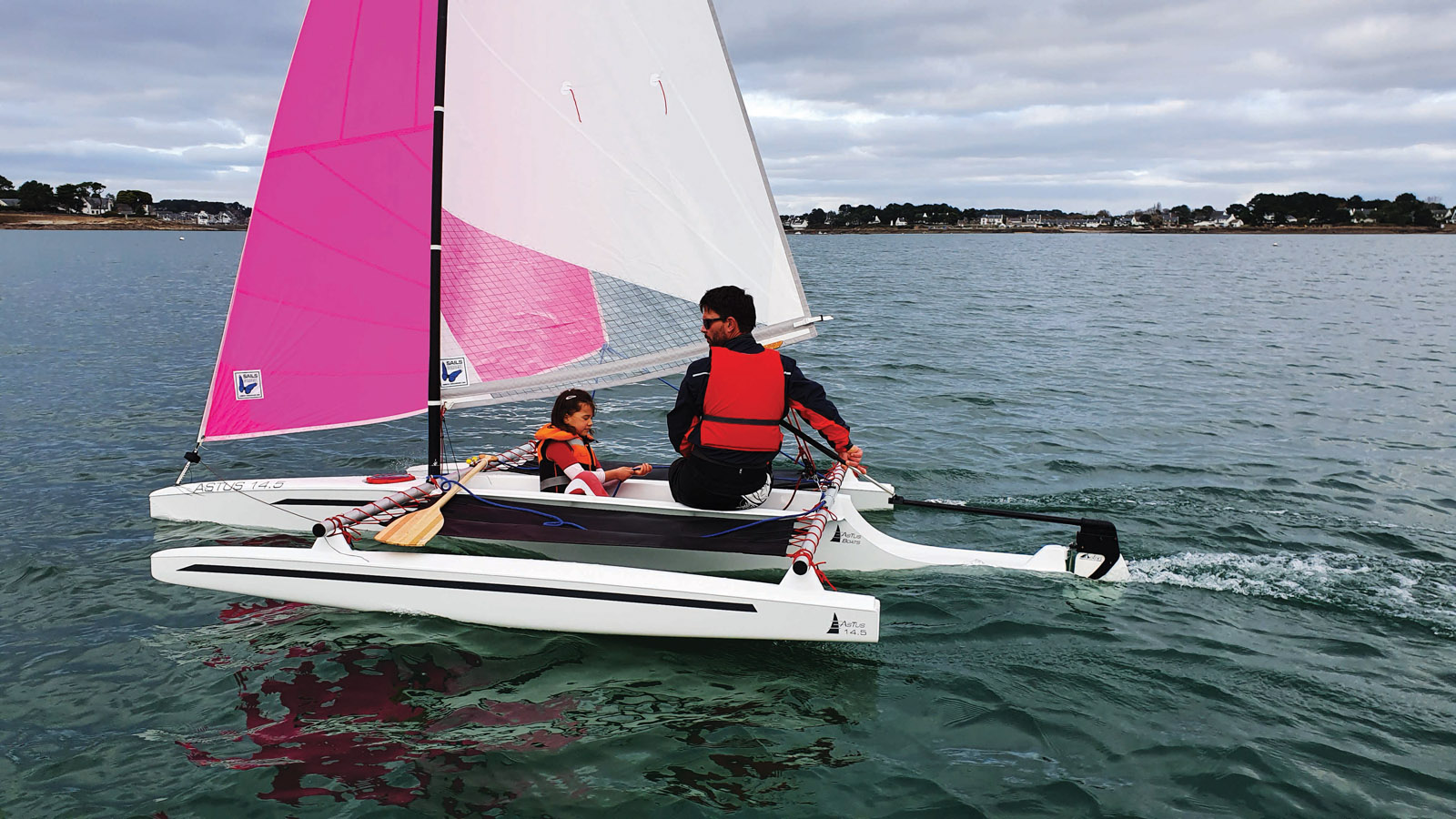
The Astus 14.5 is available as a trimaran or as a proa - and lends itself to multiple uses!
350 multihulls built
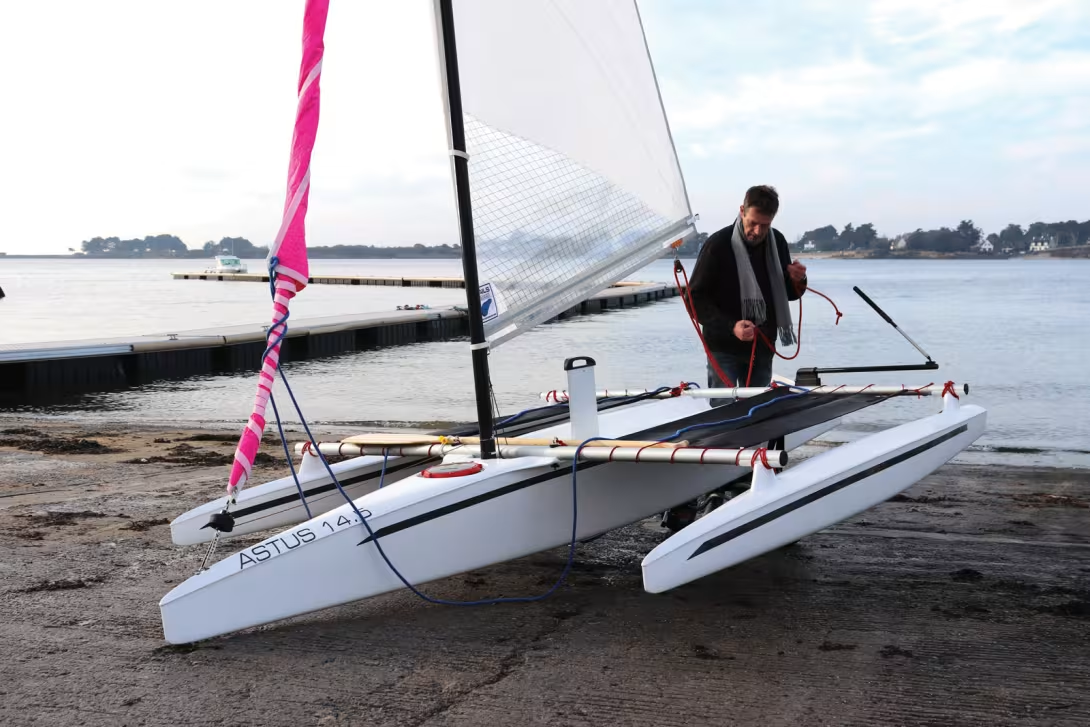
Sixteen years ago now, Jean-Hubert Pommois transformed the large sheds of the family farm into a shipyard. Quite a challenge. Today, Astus Boats has become a team of seven people capable of producing 25 multihulls per year - 350 have been built in total. So, we were given an appointment in South Brittany, a few kilometers from the shipyard to try out their latest example. Thinking I was doing the right thing, I bought croissants for four, but Jean-Hubert came alone for this test. Indeed, no need for a full basketball team to put together a multihull whose central hull weighs only 50 lbs (23 kg) ... While I am taking pictures, Jean-Hubert takes it down from the roof of his van, the linking arms already in place. At 7’10” (2.40 m) wide, the trimaran version is compatible with the European road gauge. But with the floats in place, handling it would be more complex. In the absence of the floats, on the other hand, one person on their own can get by very easily. It’s a simple, doit-yourself system, the result of an idea implemented over the previous weekend, but the single tube, placed longitudinally at the corner of the roof, allows the whole thing to slide down to the ground without effort. I put my gear down for a few moments to bring out the floats stored in the trunk (9’2” / 2.80 m long). Their surprisingly light weight (15 lbs / 7 kg each) takes me back to the 1980s and to a very nice Jet Services model! But the solidity is quite different, the quality of the finish is incomparable, and the gelcoat rendering is irreproachable.
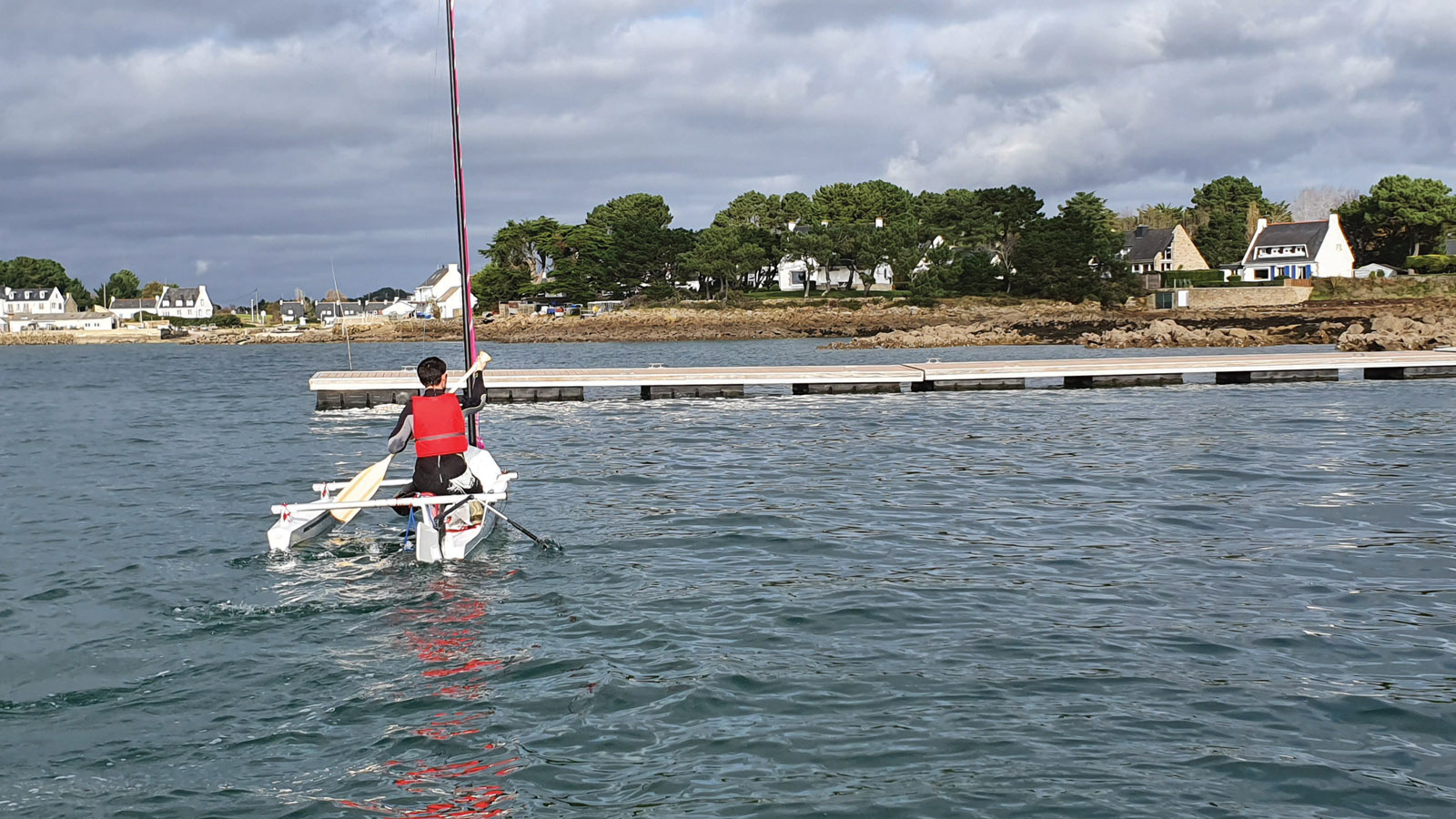
A paddle advantageously replaces a motor.
Still in fresh out of the box condition!
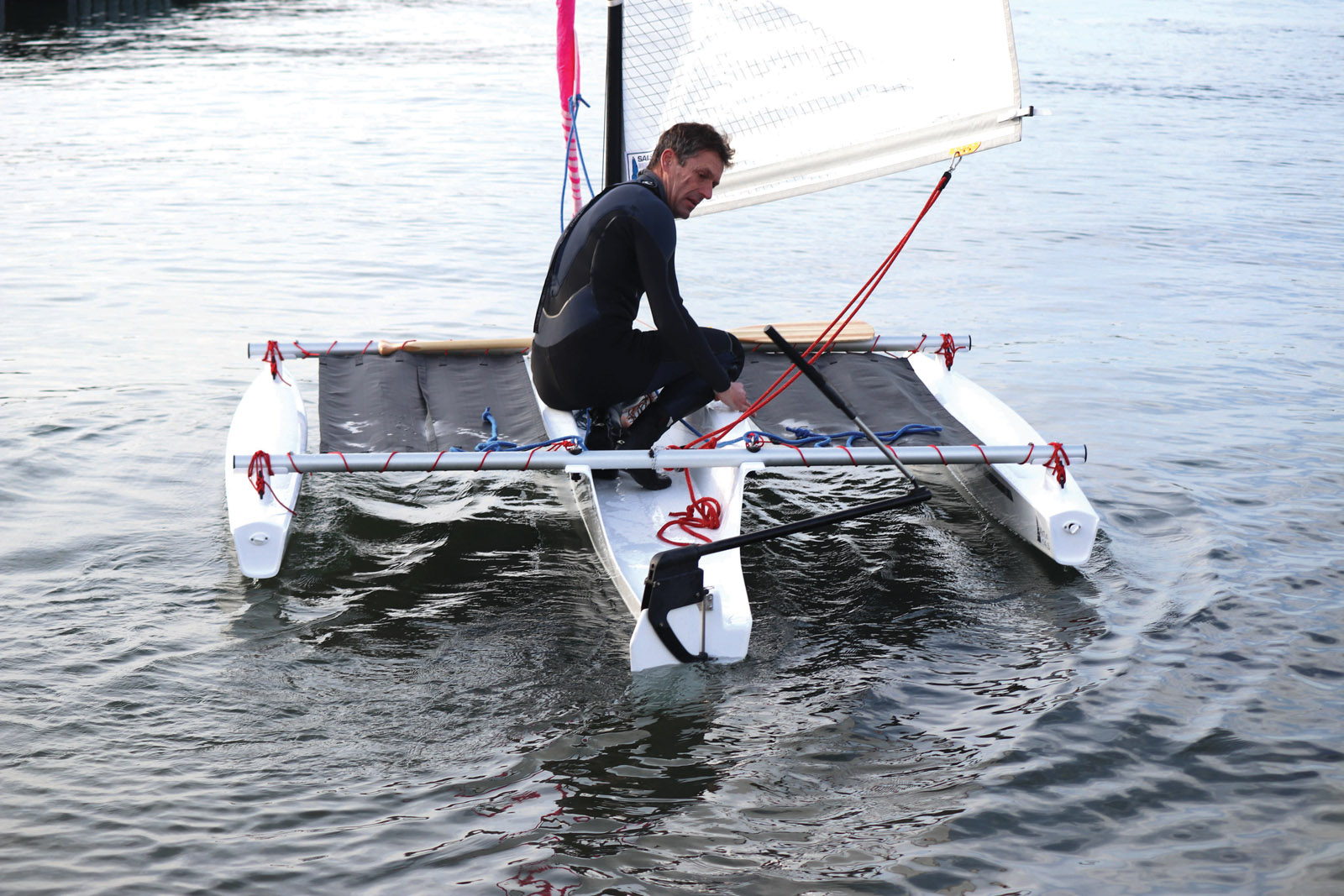
This is only the third outing for the Astus 14.5: all the testers have flown a hull during their first runs in proa mode... As a result, for my go with this new trimaran, we’re fixing the two floats of the trimaran version. With four eye nuts done up, the two aluminum tubes become integral with the central hull. The two aft nuts act as gennaker sheet blocks. One item of equipment, two functions, it reads like one of the famous lessons from “Professor” Desjoyeaux! As for the floats, once the arms are in their housings, a single strap ensures solid attachment: simple and effective. Same philosophy for the fixing of the two trampolines, whose lashings that connect them to the linking arms pass through solid straps. The mainsail is then also laced to the mast - itself sleeved in two parts - using straps. This system has been preferred to a sheathing system: it allows the sail to be lowered more easily at sea if necessary. For example, when it is necessary to paddle back to shore due to lack of wind. Jean-Hubert was to demonstrate this on his first outing! The gennaker, on its small Furlex furler is laid out, like the mainsail, at the foot of the mast, which again allows you to intervene on the sails when you wish. Barely fifteen minutes after we pulled up in the van, the whole unit is rigged and ready to sail. With the rudder blade fixed in the upright position, daggerboard (with its reassuring aluminum profile) secured but not yet lowered into its well, our little racing boat reaches the Crac’h River on its launching wheels. The featherweight also means that you can get out on your own, so you can go sailing whenever you want without having to motivate anyone else. After a few warmup runs, Jean-Hubert comes ashore and hands me the tiller: “Your turn!”. He couldn’t believe he was saying it so easily. With its minimalist draught of 6” (15 cm) with all appendages raised, access on board is easy and almost dry, which suits me well considering the water temperature round here in late fall. Trim in a little bit of mainsail to clear the pontoons bordering the boat ramp, lower the rudder with the tiller, lower the daggerboard and off we go. In light airs and still under mainsail alone, I’m sitting on the edge of the polyester topsides. The central hull is hollow enough so that I don’t have the feeling of having my ears between my knees.
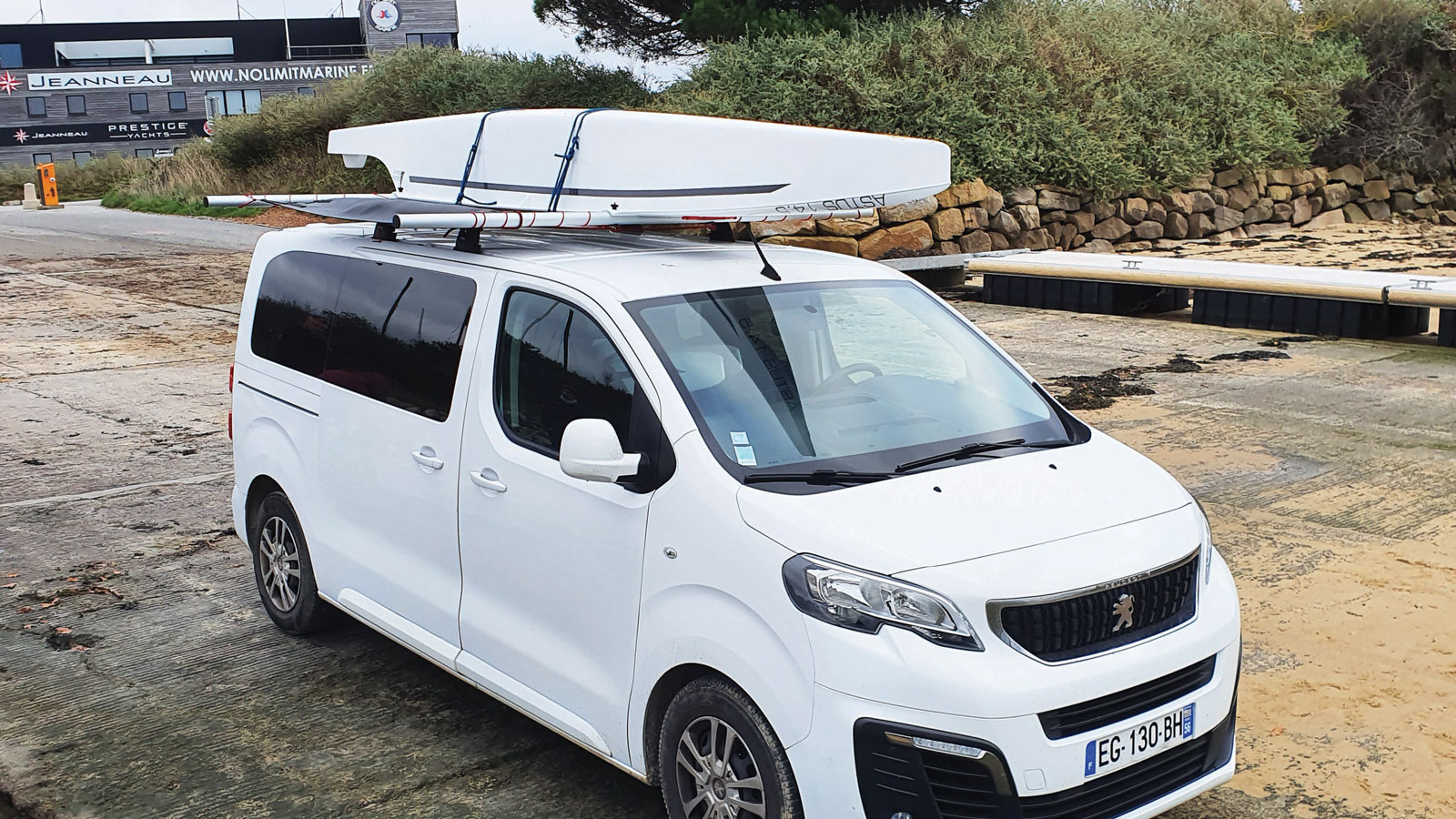
One float can fit into the central hull for transport - but not both!
Is there a turbo? That’ll be the gennaker…
As soon as the breeze picks up, we hike out so our butts are on the trampoline, which becomes like a hammock as we heel. A really comfortable position and well enough clear of the water so as not to get too wet. With the mainsheet jammed off, we release the gennaker furler and in less time than it takes to write it down, the boat’s turbo is engaged. If there is no jammer, you keep the sheet in your hand. That’s no problem because to maintain a high speed, you have to constantly keep trimming. Acceleration and surfing of course lead to large variations in apparent wind. The mast of this prototype also seems quite flexible (see the video on our website). It is therefore difficult to reduce the wind angle with a luff lacking tension or/and an open mainsail. A very small teething problem that the yard will quickly overcome after this test. A steeper carbon mast profile or fiber shrouds - or both - are possible. In the meantime, I’m enjoying a beam reach, exhilarated by the feeling of speed, close to the water. With my eyelids half closed, my eyes riveted to the bow of the leeward float, I feel like I’m at the helm of an Ultim. The sharp bows, the design of the floats, the spray flying past, everything is there... just on a scale of 1:7! In the absence of any other indicator (a windex would be really great) the leeward float is a good gauge Though not the best indicator of performance, it’s pretty close. Too submerged means that the boat is too loaded, we ease the sheet or come up a little. The bow tends to dive: you have to pay attention to the pitch, move aft and maybe even reluctantly ease a little gennaker. Tacking - even if it means backing the gennaker a little - and gybing follow one another without difficulty, the multihull always responded to this helmsman slaloming between the oyster beds and channel markers while pretending to be Dean Barker! By the end of our session, the breeze had reached 15 knots and we were a towards the top end of the range for the gennaker. But it doesn’t matter, with a few rolls the furler, the boat becomes a safe multihull for cruising, under just the mainsail. This is reassuring for everyone on board because the Astus 14.5 is not just a solo boat. On the contrary, its long and deep cockpit encourages children to enjoy the joys of sailing in complete serenity. Forward of the mast, a compartment accessible through a watertight hatch will allow you to shelter a small picnic and to envisage day trips if the weather is favorable. CE approved in category D, the maximum wind encountered must not exceed 16 knots, and the waves must be less than 20” (0.5m).
In proa mode!
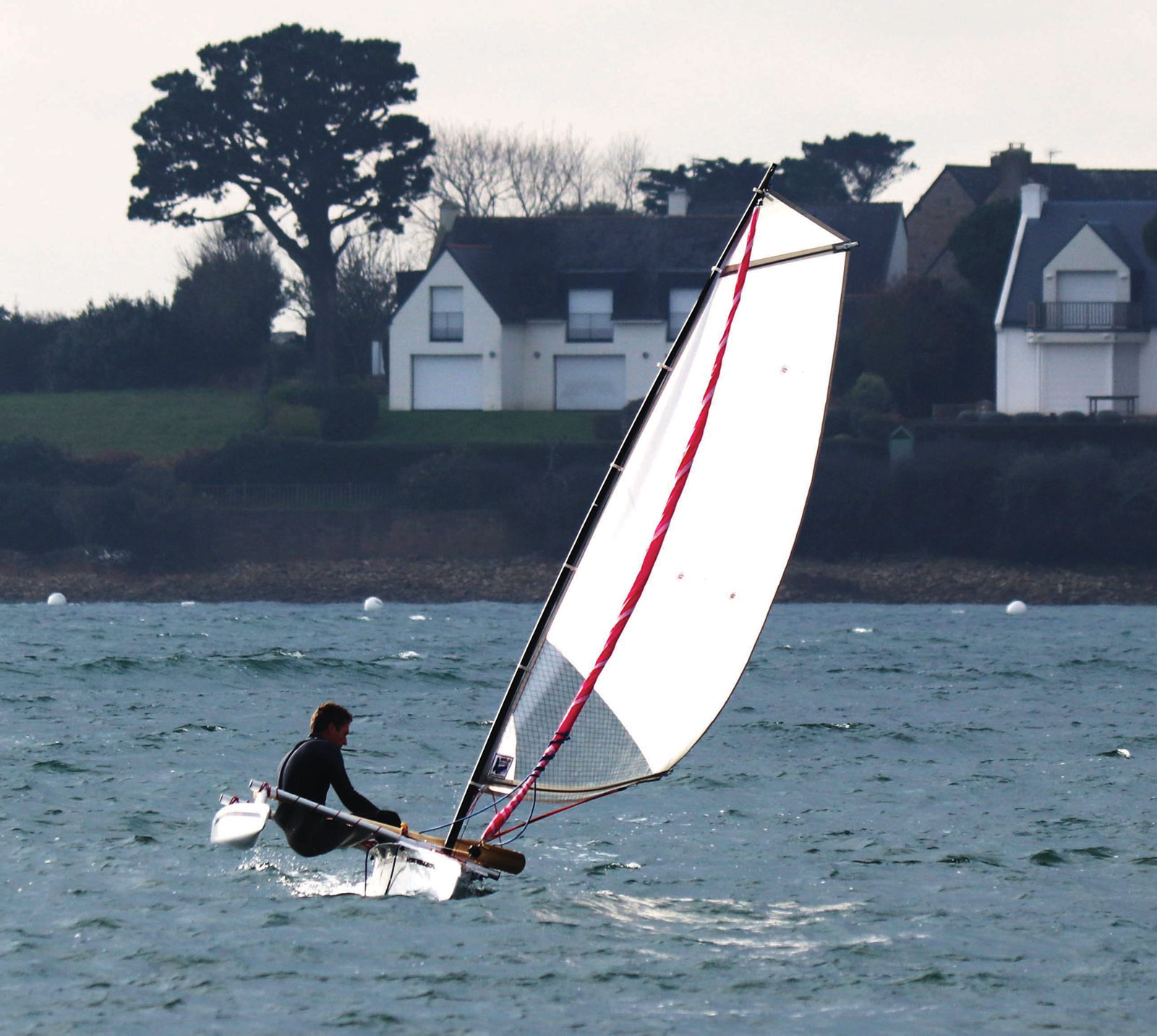
A monodrome proa alternately uses its float as a support (to leeward) then as a pendulum (to windward).
On the other hand, if you’re looking for sport at all costs, a quick return to the pits is always possible and this is just what we did. In barely a few minutes, you remove a float, you switch the arms to the short version (5’/1.5m instead of 8’/2.4m) and here you are at the helm of a monodrome proa. Never heard of one of those? That is to say that this proa will navigate alternatively with its float to windward (like a Pacific proa) or leeward (Atlantic proa). The bows remain the bows and the rudder does not move from its pintle and gudgeon. So obviously, on the leeward float, unless you let yourself be caught against it, you feel rather serene, almost like in trimaran mode. Except that there is no more trampoline behind to support you... you need to remember that. On the other tack, it’s the other way around: you can relax and hike out, and it’s a good thing, because there is no float downwind. Given the alarmist comments of my mentor of the day, I can tell you that my first runs, and especially tack changes, were very cautious. The photos confirm JeanHubert’s comments, seeing the plunging of the float when upwind, and I was more than conservative in my management of the boat. But with a bit of practice, there’s a lot of fun to be had. The Astus 14.5 in proa version is transformed into a super light skiff, with a minimalist wetted surface, and is generously canvassed.
Conclusion
While tinkering with a prototype with recycled floats, Jean-Hubert Pommois had a gut feeling that in its standard version, the Astus 14.5 was going to be a great success. Economical: the plan is to keep it below the 5,000-euro mark, at 4,900 euros including tax in its basic proa version. Versatile: this pocket multihull is available as a proa or a trimaran, can be propelled by mainsail or gennaker and can be used single-handed or with crew. In short, sporty or relaxed, the Astus 14.5 can do it all. Fun, light, wellcanvassed, and of course well-designed by the prestigious VPLP design office, you will be drunk on the speed at the helm, without spending any time underwater. In fact, the architects ordered hull number 1 of the series. This will liven up their lunch breaks on the waters of the Golfe du Morbihan, in front of their offices in the town of Vannes. But more importantly, that’s proof if it were needed, of confidence in the shipyard. The pair will soon be announcing the release of an Astus 22.5 - with foils (!), a third collaboration that we’re definitely going to be trying out for you, and as always, as an exclusive.
Assembly in 15 MINUTES FLAT
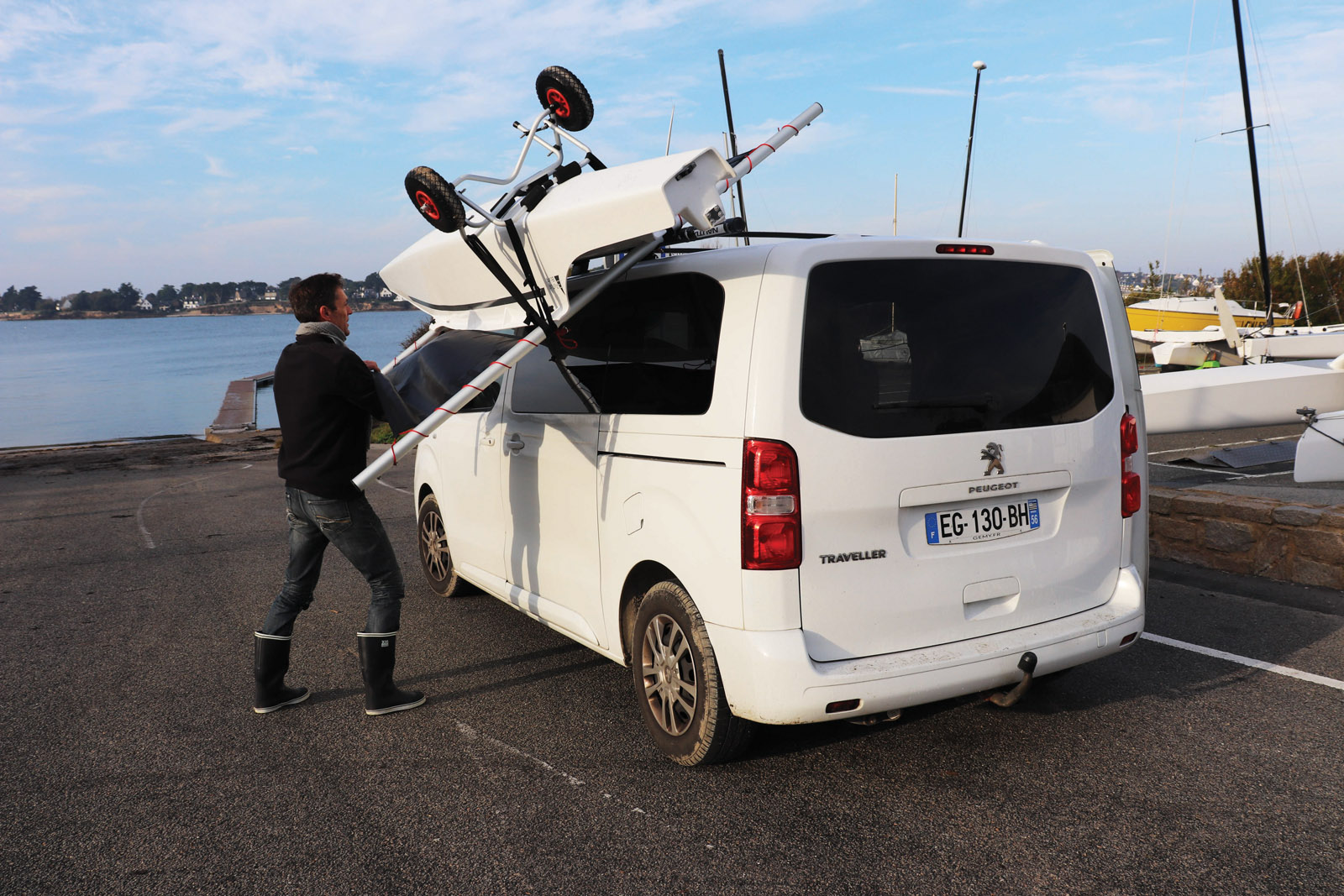 1/ A bar parallel to the lateral angle of the roof, fixed to the roofbars, allows the central hull to be tilted - here already equipped with its arms and trampolines.
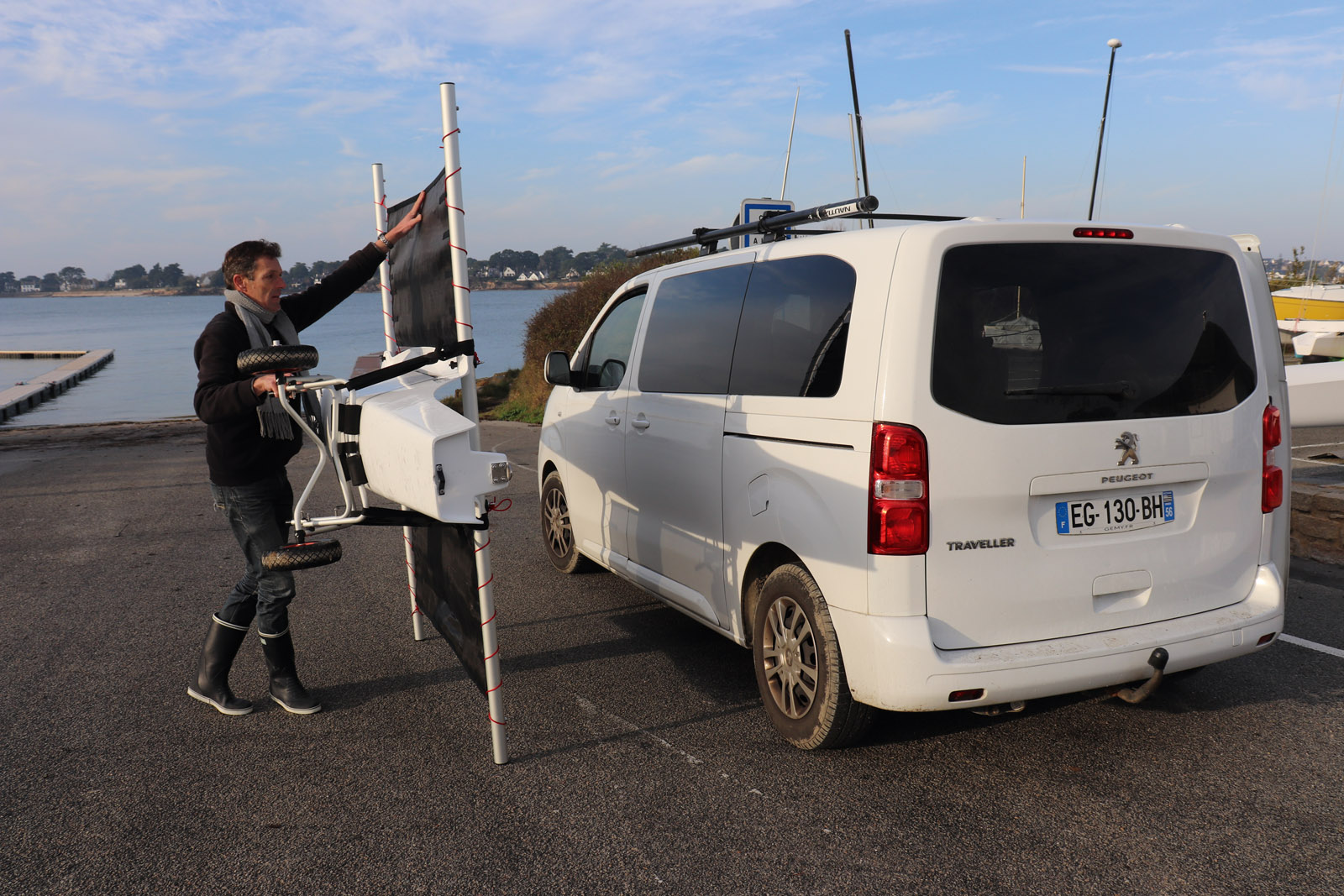 2/ With the wheels already in place, turning it over and moving is easy.
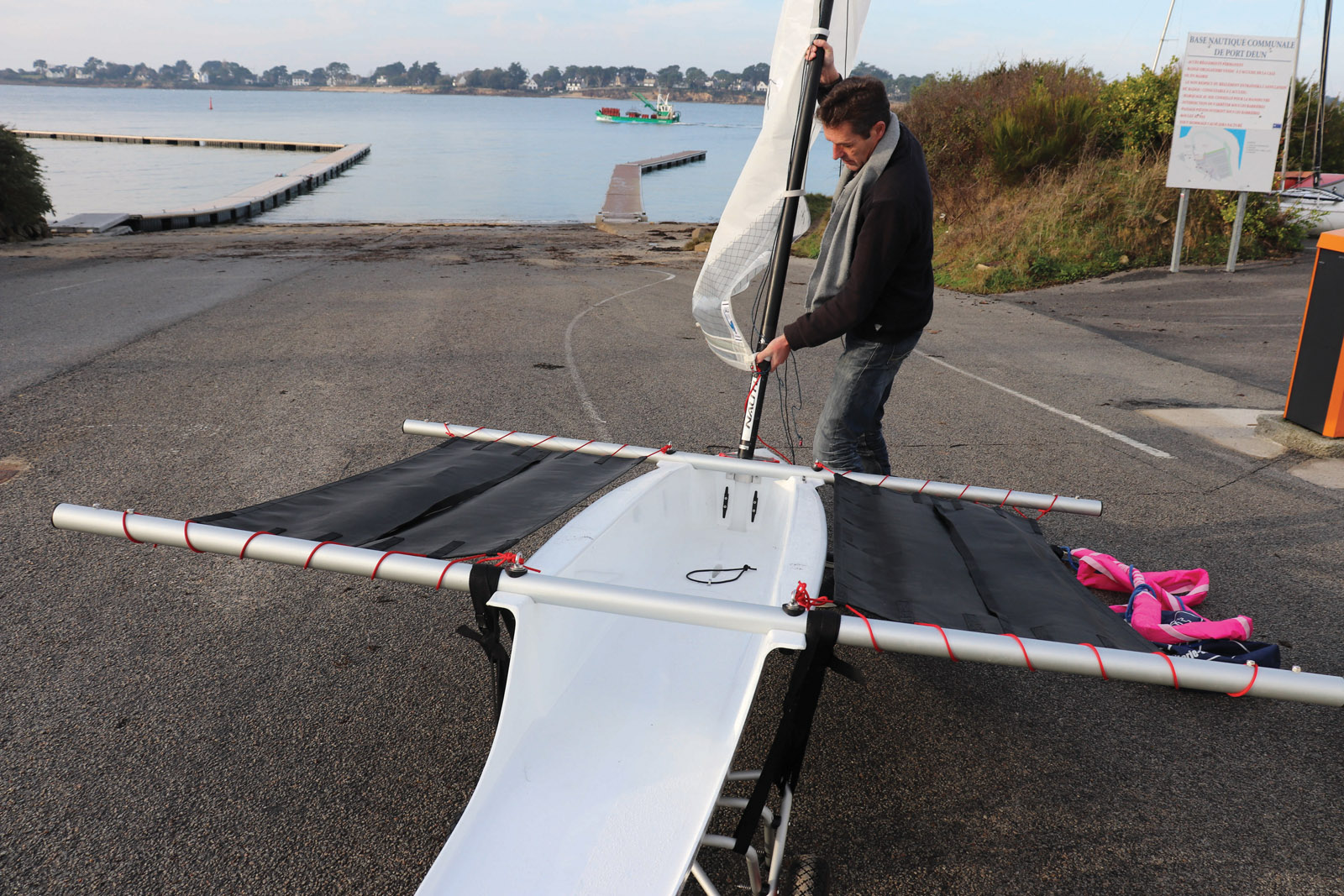 3/ The mainsail is already laced to the mast; this is then stepped at the front of the central hull.
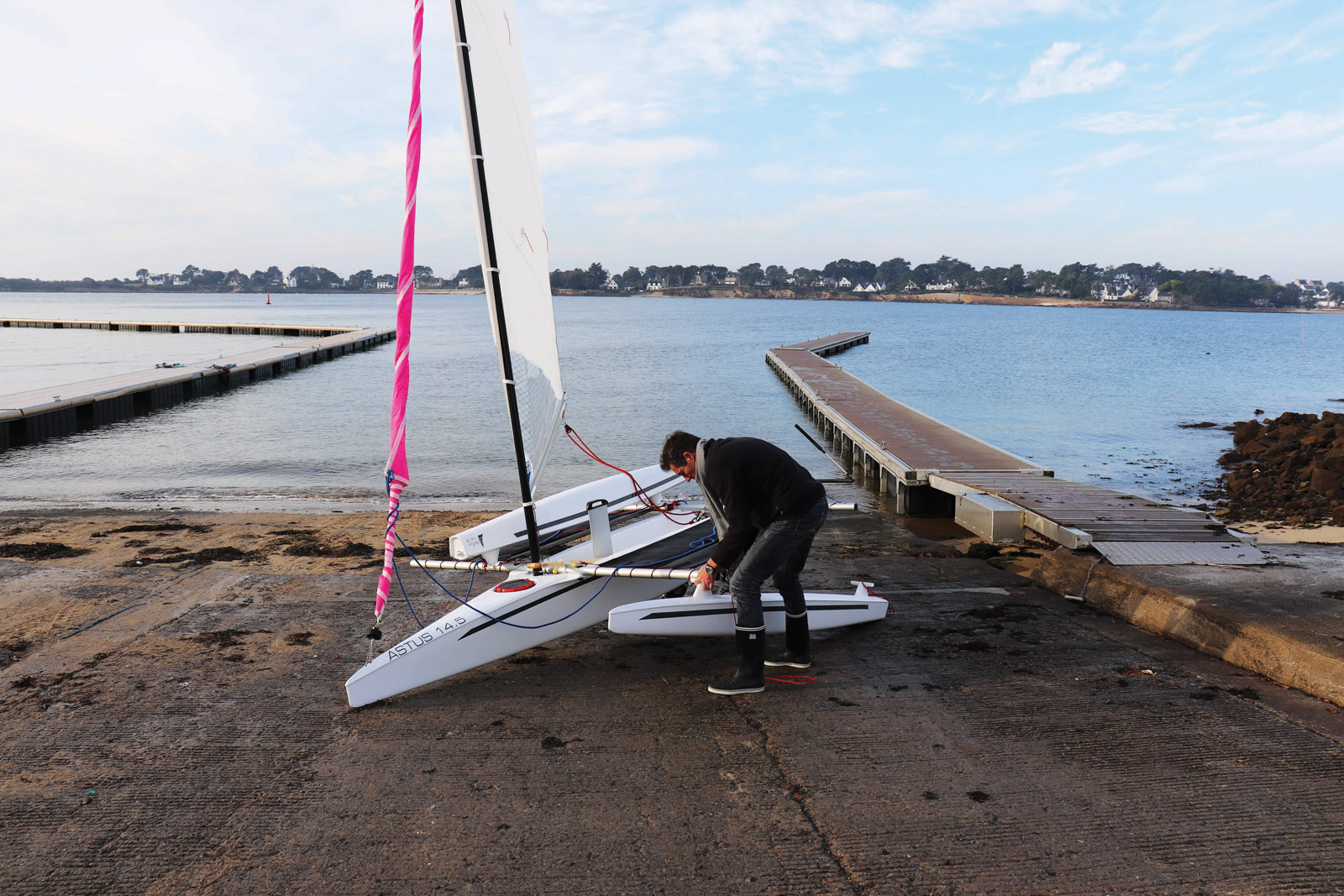 4/ Installation of the floats.
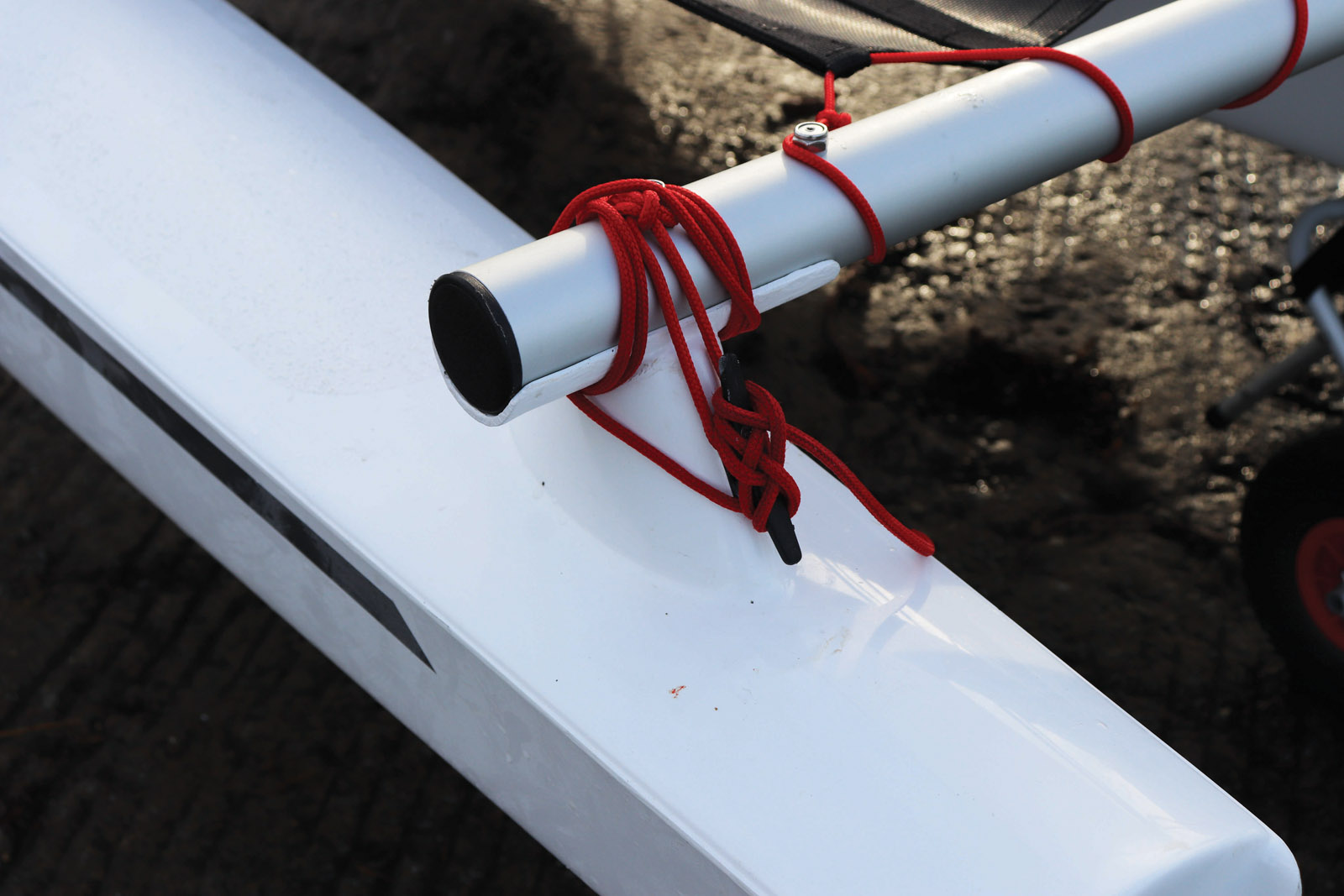 5/ They are secured in their housings using a lashing
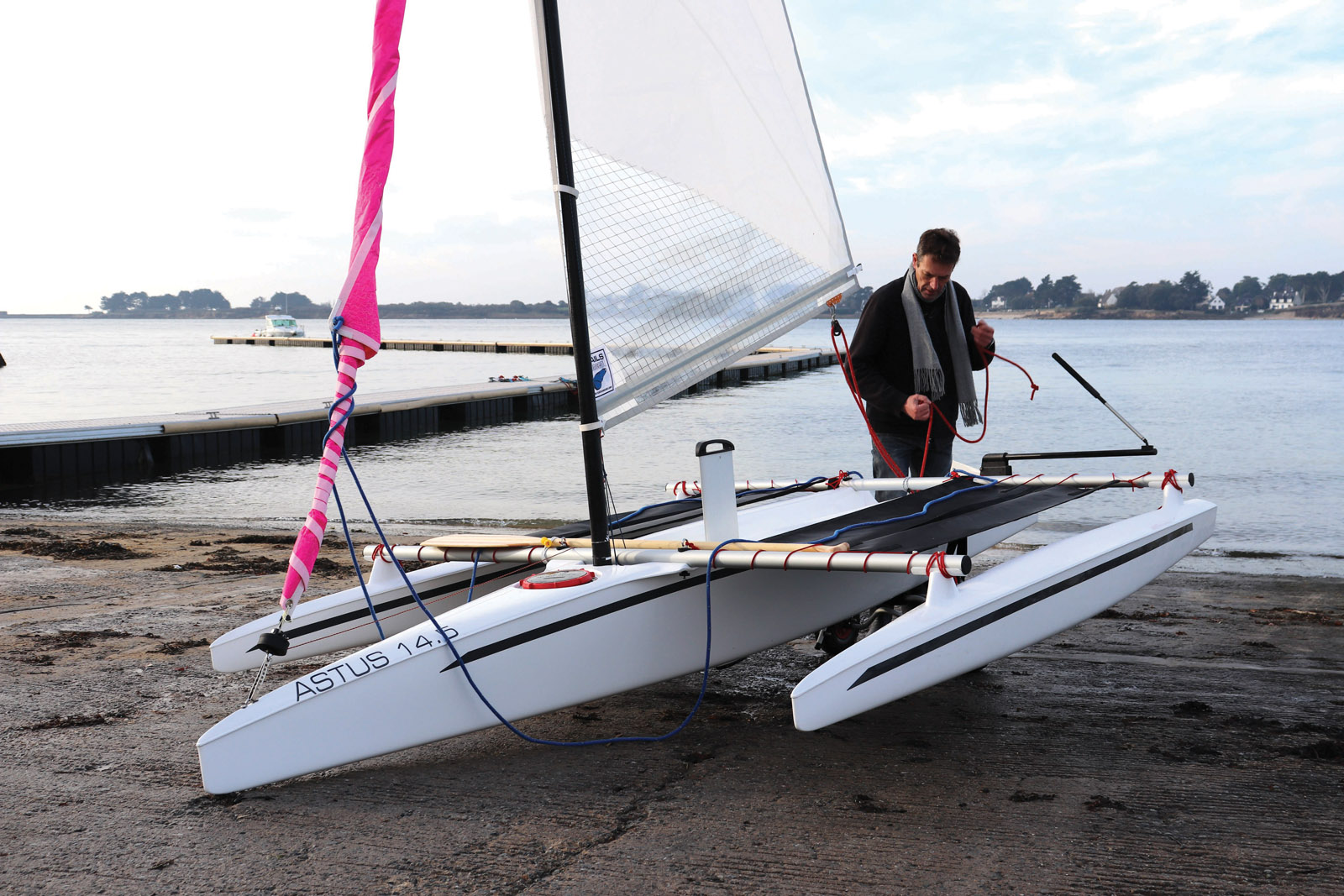 6- Fitting the daggerboard, rudder and mainsheet.
 7- And we’re off!
SPECIFICATIONS
Architect: VPLP Design
Design: Jean-Hubert Pommois
Central hull length: 14’3” (4.35 m)
Float length: 9’2” (2.80 m)
Beam - Proa version (one float): 5’1” (1.55 m)
Beam - trimaran version: 7’10” (2.40 m)
Central hull width: 23” (0.58 m) Central hull weight: 50 lbs (23 kg)
Weight of each float: 15 lbs (7 kg) / Volume: 2.8 cu ft (80 liters)
Mast height: 15’5” (4.70 m) - in 2 sections
Mainsail: 54 sq ft (5 m²)
Genoa: 54 sq ft (5 m²)
Draft: 6” / 28” (0.15 m / 0.70 m)
Pivoting rudder / daggerboard
Max. load: 500 lbs (230 kg)
CE Category: D
Price: from € 4,900 inc. tax for the basic PROA version (price ex-works)
Options:
Trimaran version: second float, additional trampoline, extended tubes: € 940 inc. tax
Genoa on furler: € 850 inc. tax
Paddle
Launching wheels
Rowing seat
The Pluses
+ Simplicity
+ Fun et versatile
+ Very reasonable budget
The Minuses
- Stiffness of the mast to be reviewed
- The tiller is a little short
- The proa mode requires a little learning time