
A lightweight and well-canvassed trimaran might strike fear into someone new to sailing and / or multihulls… but there’s no such worry on board the Astus 18.2, a model which is both fun and safe. Welcome newcomers!
Infos pratiques
- Le chantier : Astus 18.2 Sport
- La fiche technique
- Découvrez notre vidéo exclusive
- Financez votre Astus 18.2
- Assuez votre Astus 18.2
- Articles autour du Astus 18.2
The specifications for this model are to satisfy a crew looking to enjoy their daysailing at the helm of a simple, fast machine which is easy to transport by trailer. An XXL-sized beach cat, so to speak. The builder makes the hulls in contact monolithic polyester, and in contrast, the deck is in PVC/polyester sandwich. At the heart of the Astus Boats range (the yard was founded in 2004), this boat replaces the 16 and reinforces the new range, strengthened by the 20.2. The 18.2 picks up on a good part of the ingredients of its big brother, starting with modern hulls with a central hull sporting a step, low to the waterline. In short, it’s a 20.2, just shorter, and without cabin which Jean-Hubert Pommois, the yard’s founder, has launched. In this sector there’s not much competition: the Magnum 21 is now out of production, and the Aventura 20 has never really taken off… leaving the Astus 20.2! Ultimately the 18.2 is a bit heavy for handling on the beach - a special trailer is available, but requires a 4x4 or tractor - and having similar performance to the 20.2, though this does have a cabin. But according to everyone who’s sailed one, the 18.2 is a real success.
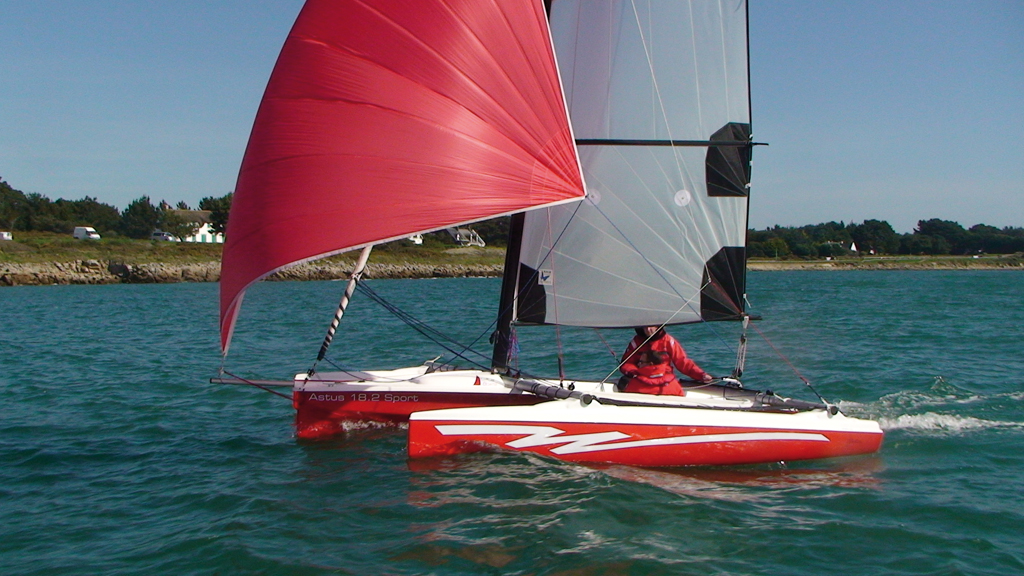
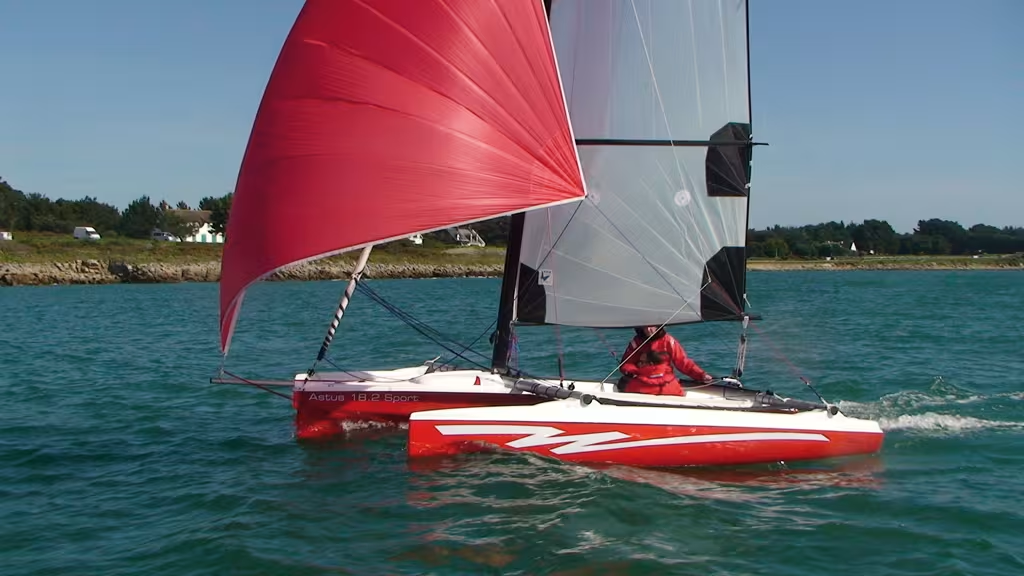
The Sport version, with larger Mylar sails, takes off in the slightest breeze.
Modern hulls!
This is the second generation! The 18.2 has voluminous hulls which are wider than those of the 16. The yard’s clientele, generally moving up from lightweight catamarans, is usually more demanding in terms of performance. This isn’t because they want to have one or two children aboard to drag along in the water! An observation confirmed by the success of the Sport version, with more sail area and better equipped. It was Philippe Roulin, formerly with the VPLP team of naval architects (he spent 15 years with the famous organization), who was in charge of the 18.2’s design. Thanks to the long stepped form of the central hull, there is a bit of extra volume above the waterline. Another, not insignificant, advantage on a small boat: the spray is deflected. The daggerboard and rudder blade are pivoting, with quick-release cleats in case of hitting something in the water. As for the rig, the yard opted for a simple 7 meter mast from a sports cat, which rotates and has no spreaders. The shrouds are secured by bridles on the hulls. The lowers are there to improve the lateral hold of the spar… and also to support the mast when the outer hulls are retracted toward the central one - the arms are telescopic. All these operations are simple - 15 minutes more or less, and all able to be handled by one person.
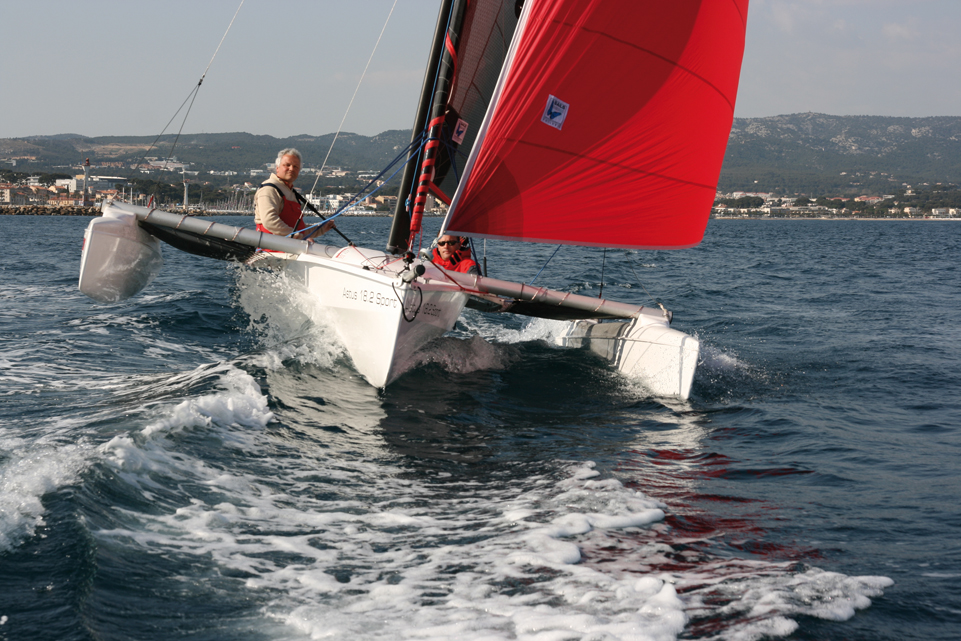
The tulip shape of the Astus 16 is replaced here with a marked step just above the waterline.
Capable of hitting 20 knots!
You don’t need to be out in a Force 5 to see what the 18.2 can do. In 12 knots of wind and a flat sea, with the sheets well in, the Astus sets off strongly. Upwind, this three-legged machine bowls along at 7 knots, sometimes 8. The course isn’t that high - around 50° - but thanks to the higher speed, the VMG is much better than that of a monohull, small or large. And in a chop? As with light multihulls, pitching movements are quite dry. The structure seems to absorb all the forces, with little deformation visible: the three hulls don’t greet the waves individually! Coming off the wind and easing the sheets, the Astus gains at least another knots. If the wind is light, there’s the option to hoist the gennaker as you free off. Downwind, this 15m² nylon sail will pull you along at over 10 knots with ease. By playing with the apparent wind, the boat can be set into a long acceleration. Exhilarating and easy! Now it’s up to you to set the records - 17 knots has been achieved by one of the yard’s salesmen. There’s no worries in strong winds: the hulls cope effectively, showing no signs of being overloaded. For days when there’s no wind, or for maneuvering in port, Astus Boats offers an outboard bracket, and recommends a motor of 2 or 3 hp. One customer in two chooses to fit a motor to their Astus 18.2 - which can be a very good idea.
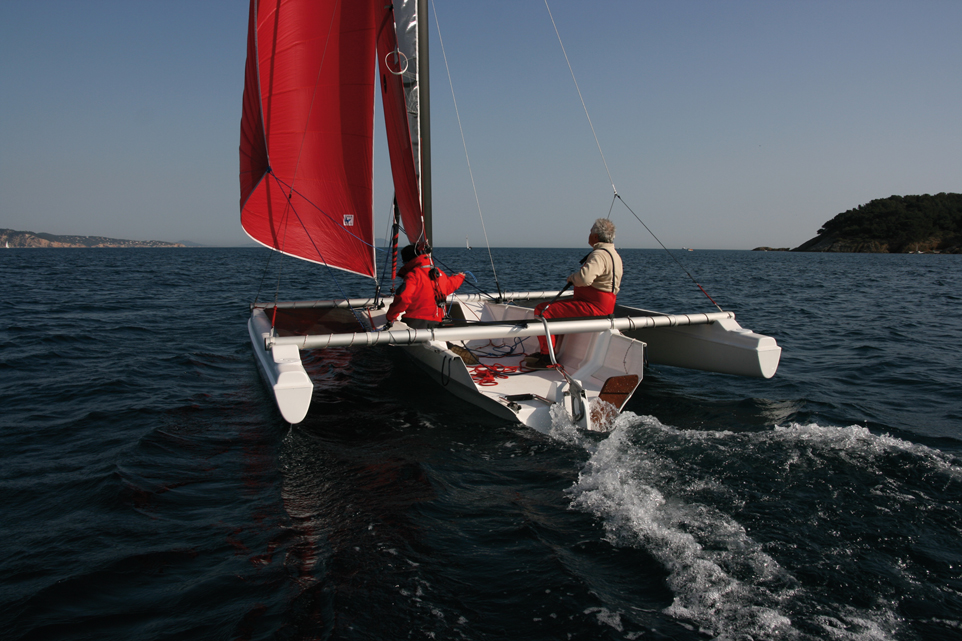
In the beginning, the cockpit was supposed to have been equipped with lockers, which would serve as bench seats. Ultimately, the yard went for a clear space… whose finish remains somewhat crude.
A very clear deck layout
A welded metal tube serves as the tiller. This crosses the aft beam, but remains aft of the traveler and the sheet for the main. This leads to a bit of gymnastics with the tiller extension when tacking and gybing. The feel, which doesn’t reach that of a real sports cat, is enjoyable: the helm is light, and gives excellent control of the course. Many owners however, suggest there is a bit of play. The cockpit, at 2.50 meters long, is nice and simple. The hull is basic, with no deck inside. Initially, the yard fitted benches, set back, but early trials showed that moving around onboard was easier without, and that the crew tended to sit outboard anyway. So the yard set about designing seats aft. So this is where you sit, and/or on the trampolines. It’s very comfortable, but you can get a bit wet around the edges in a breeze. Access to the water is easy with the (optional bathing ladder) thanks to the, completely open, cockpit. There’s no cabin on board, though there is a cuddy, forward, which might have been better as a proper watertight compartment. There’s also the option to stow gear and equipment in the bilge, beneath the cockpit.
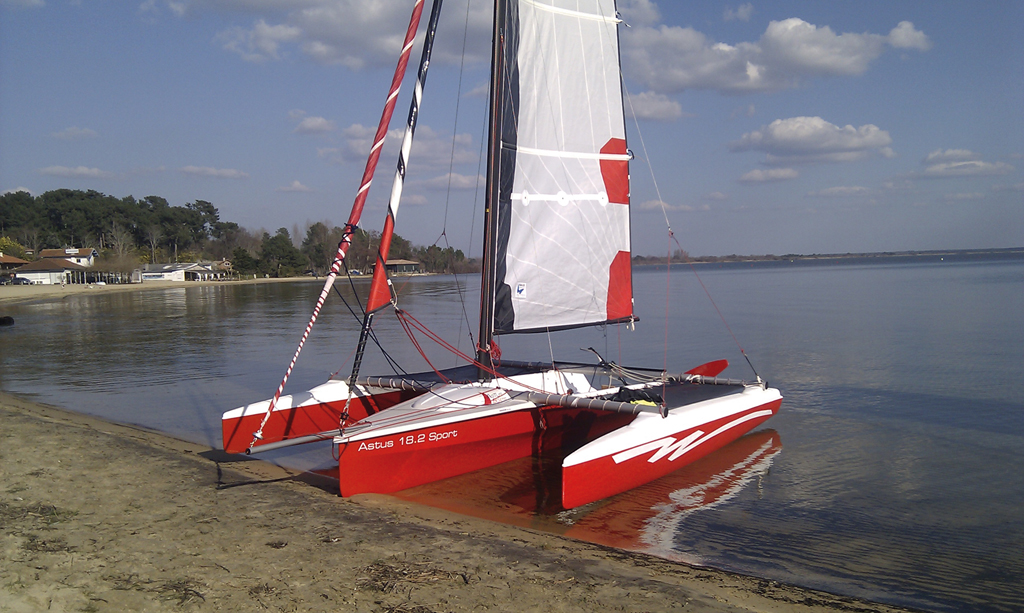
The Astus is trailable thanks to the telescopic arms: folding the floats up takes only a few minutes! A perfect boat for coastal camping.
Conclusion
With a sail area to weight ratio of 65m²/tonne, and 77 for the Sport version, on paper, the Astus 18.2 is supercharged little machine. And on the water it shows itself to be fast and exhilarating. For all this, it is easy to handle and is forgiving of mistakes. Classified with a “C” rating, it can allow for some good days out, thanks to a decent range. This little trimaran would seem to be an excellent craft for wandering along the coast. If the weather is warm and dry, you can easily manage without a cabin: a tent or two will do!
Points to check
The hull and the floats, being built in polyester, are strong and easy to repair. As for the folding system, it is reliable and above all, very simple. In short, there are very few problems to be worry about with this little boat. All the same, check that the appendages are in good condition - the daggerboard and rudder blade and their lifting systems. Think also about taking a look at the mast foot and masthead, which can get knocked during road transport.
We like:
- Fast and safe sailboat
- Capable of a wider program than might first be apparent
- Ease of handling and of setting up
We didn’t like:
- Quite a challenge to use from the beach
- Standard of finish in the cockpit not great
- Play in the rudder
Technical specifications Astus 18.2
- Overall length 6.6 m
- Hull length 5.49 m
- Waterline length 5.35 m
- Beam 2.5/3.85 m
- Draft 0.25/1.2 m
- Weight 260 kg
- Upwind sail area 17 or 20 m2
- Mainsail 12 or 13.5 m2
- Genoa 5 or 6.5 m2
- Gennaker/Asymmetric 15/20 m2
- Motor 2 to 3 hp outboard
- Construction polyester Naval Architects Perspective Yacht Design
- Builder Astus Boats
- Production 34 examples built from 2011 to 2016
- Secondhand price starting from € 8,000 ex-tax with gennaker and trailer
