
The Astus 18.2, whose prototype was presented at Le Nautic, the Paris Boat Show, at the end of 2010, has taken over from the Astus 16.1, the dayboat of the range. A real innovation, or a simple marketing revamp? We went to discover it on the occasion of a test raid around the island of Porquerolles, in the Mediterranean.
Infos pratiques
- Le chantier : Astus 18.2
- La fiche technique
- Découvrez notre vidéo exclusive
- Financez votre Astus 18.2
- Assuez votre Astus 18.2
- Articles autour du Astus 18.2
Whether for day outings as a family, or more athletic coastal raids, small transportable trimarans have been very popular for the last few years. This has not escaped Jean-Hubert Pommois, who created Astusboats in 2004. Surfing on the public’s infatuation with accessible leisure trimarans, the company has rapidly imposed its presence on this niche market, by bringing out a new model each year. Now that its range has been set up, from the 14-foot beach machine to the 22-foot coastal cruiser, over the last two years, Astusboats has started to renew its oldest models. With the added suffix .2, this second generation of trimarans is more performance oriented, according to the builder. From the first glance, the suspense was over. The design of the Astus 18.2, by the architect Philippe Roulin, a former associate of the famous VPLP office, is almost nothing like that of its predecessor. Exit the flared hull of the Astus 16 and welcome to the chine at mid-height of the freeboard. This has allowed the step in the central hull to be judiciously lowered, so as to widen the cockpit floor without spoiling the slimness of the hull in the water.
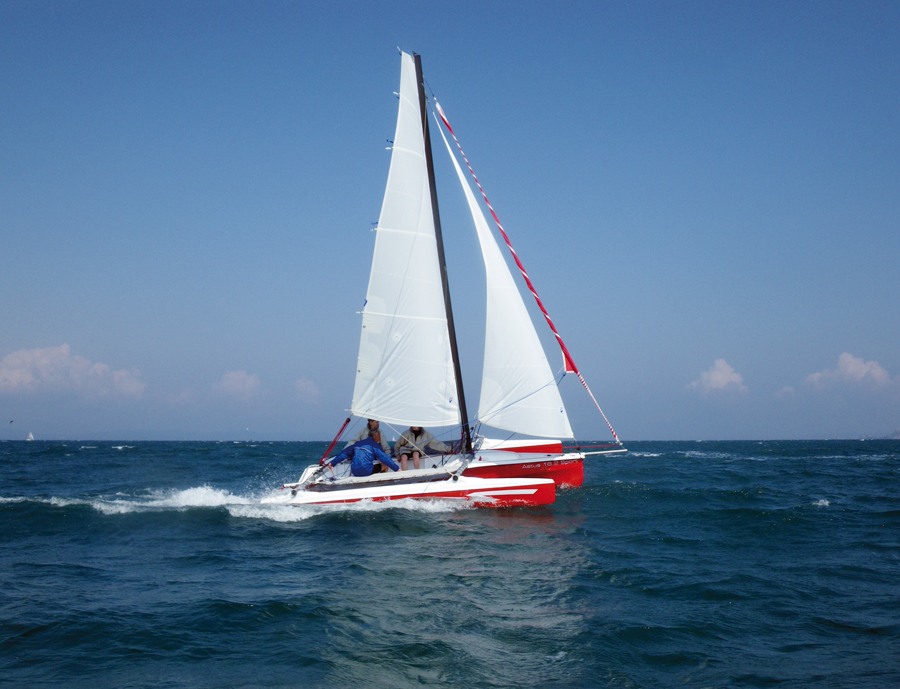
Aggressive lines, which turn heads. The Astus 18.2 is a beautiful trimaran…
Welcome aboard
Aboard, the result is convincing, with an exceptionally spacious cockpit for a boat of this size, planned for five adults. With 2.5m long benches, a 140cm wide space separating the benches and a completely uncluttered flat floor, this cockpit has the appearance of a terrace sitting on the water, pleasantly lengthened by an 80cm sugar scoop, but above all by the trampolines, which form perfect sunbathing areas. But the comparison with a floating pontoon stops there. Slim, almost vertical bows, floats which are almost as long as the central hull, white decking on the bright red hulls and graffiti furiously streaking the sides of the floats, display elegant aesthetics which will not fail to turn heads as it passes. The resemblance to the Astus 20.2, brought out last year, is not a coincidence. The preform of the latter’s central hull was modified to obtain the mould for the Astus 18.2. Incidentally, the forefoot has been rounded so as to ease its passage onto the central rollers of the trailer, when it is being taken out of the water. We find again the folding system dear to the builder, based on simple telescopic aluminium beams. It allows the beam to be reduced easily from 3.85m on the water to 2.5m on the trailer, with no tools and leaving the trampolines in place. The boat can also be folded afloat so it can thread its way under engine into a marina berth. In this case, beware of the sudden heel when moving on the floats, which are positioned slightly above the water. In return for a few ‘bits of string’ to hold the foot of the pivoting wing mast on its ball joint, and keep it central when raising the mast, one person can carry out this operation, deploy the floats and launch the boat, weighing just 260 kg, in 20 minutes, without any particular risks or effort.
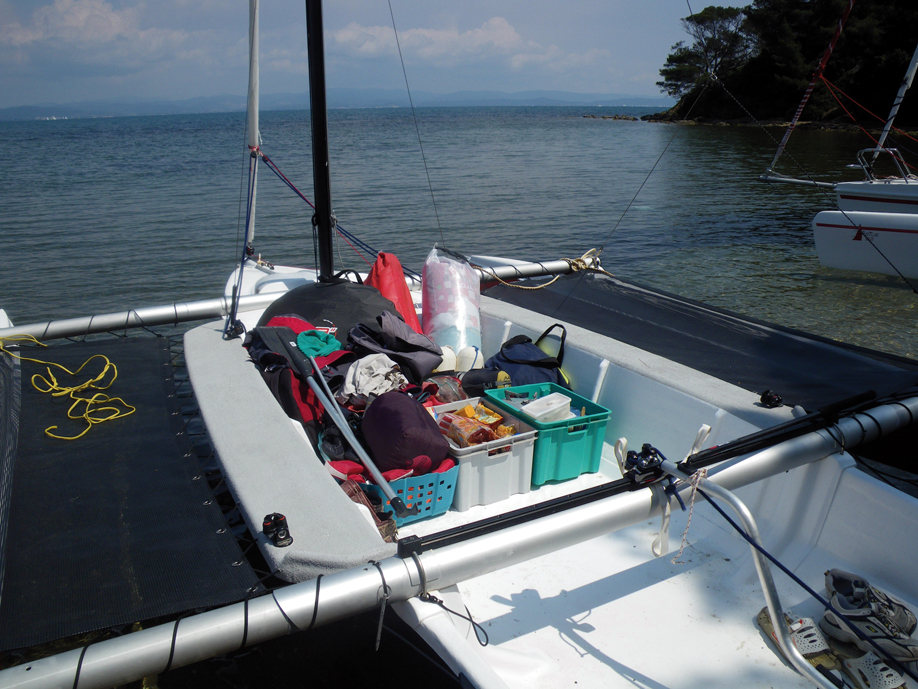
The cockpit is huge. You can embark enough to be completely independent for two days...
It is time to go sailing...
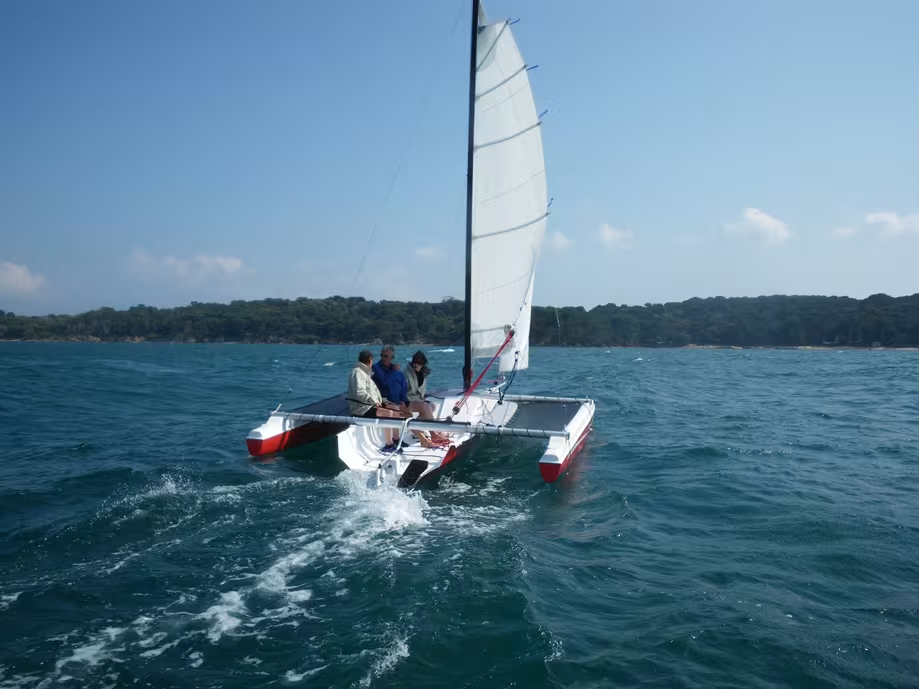
We didn’t even have to go to this trouble when we arrived at the Etoile Marine Mediterranée base, situated on the Giens peninsula at Hyères, where our Astus 18.2 was waiting, peacefully attached to its mooring buoy, a few metres from the sandy beach. With the pivoting centreboard raised, the machine only draws 20cm, and can easily be beached on the sand so it can be loaded directly from the shore. Copiously loaded, moreover, given the quantity of equipment embarked for three people and two days, completely independently. The numerous boxes and bags piled up over a large part of the vast cockpit...before being swallowed up by the single but spacious locker, easily accessible from above via a big removable hatch. The watertightness of this latter, which amounts to a raised edge of a few centimetres, proved to be satisfactory when faced with the rare bucketfuls of seawater which passed over the deck during our test. It could be replaced to advantage by a real watertight deck hatch, for those who envisage sailing flat out in rough seas. In the absence of an anchor locker and a ‘wet’ cockpit locker, we kept two plastic boxes on the big sugar scoop, to stow the anchors and fenders. Equipped with an outboard bracket, but not the motor that goes with it, leaving under sail between the anchored boats was the opportunity to note the good manoeuvrability of this lightweight multihull, which tacks easily. We sailed close-hauled towards the island of Porquerolles in a calm sea, accompanied by a light breeze varying between force 2 and 3. The boat is well-balanced and the helm can be released without the boat deviating from its trajectory. Despite the weight of our load, the speed was reasonable: between 5 and 7 knots. It must be pointed out that although we had certain options from the ‘sport’ version, such as the mainsheet traveller and its 6-part Harken tackle, we carried the Dacron sails from the ‘leisure’ version, which have 3m² less area. Despite this reduced sail area, we succeeded in equalling the Astus 22.1 trimaran which was accompanying us, as long as we didn’t try to point too high. With 105 to 110 degrees between each tack, we gained amply in speed what we conceded in course. A course which could be improved by tightening the forestay. To do this, it would have to be possible to tighten the shrouds, by equipping the spreaders to which they are attached at the ends of the beams with a small block and tackle.
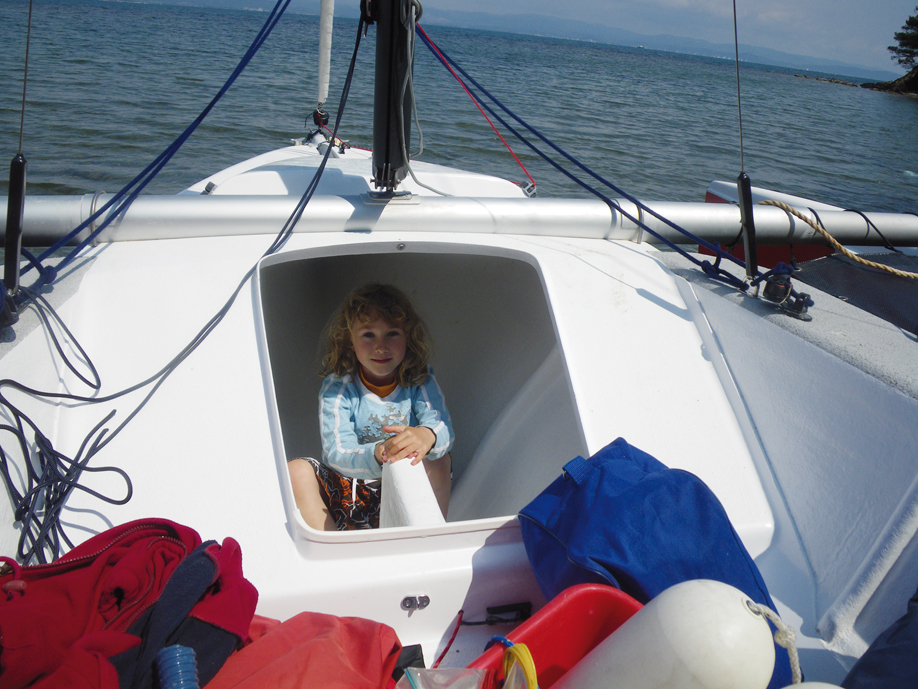
For stowage, there is the very voluminous forward locker...
Compared to the trampoline of an equivalent-sized sport catamaran, the Astus 18.2’s benches offer appreciable seated comfort. But for longer sails, we adopted the sitting position in the bottom of the cockpit, with our bums on a lifejacket and our backs wedged against the ideally inclined hull sides. Sitting like this, at water level, the feeling of speed is accentuated, whilst the embryonic coachroof remains low enough not to obstruct the view. This position, protected from the wind, will suit young children perfectly, as they will feel safe. The only snag: several times the central hull’s slim, low-volume bow crossed the wake of a big motor boat. The water which then came over the foredeck ran onto the cockpit floor. After having unloaded part of the equipment from the boat onto the big Notre Dame beach, in the north-east of the island of Porquerolles, we tackled some reaching legs under gennaker. This latter, which remains in position at the end of the telescopic bowsprit, can be handled with disconcerting ease, thanks to its continuous line furler. The 60% additional area is welcome, to liven up the boat when sailing off the wind. Without feeling a really powerful acceleration, the speed climbed noticeably, to reach between 7 and 11 knots, depending on the gusts, which reached force 3. The spinnaker sheets are equipped with Ronstan jamming cleats mounted on turrets to save the crew’s hands, but the fact that these turrets are not inclined makes freeing the sheet difficult when the crew is perched out on the windward float. When we returned to the beach, despite the gently sloping seabed, we didn’t have to worry about the centreboard or the rudder, both of which are equipped with releasable cleats in case of impact. The centreboard is well-balanced and can be manipulated with no effort, with the help of 2 dedicated lines. The profile of the long rudder blade is carefully designed, but the slimness of its end will demand a minimum amount of care, so as not to damage it when moving the boat ashore. The upper part of the rudder blade has a curious flat front, which the water hits when sailing. As a result, there are two sprays of water either side of the rudder, with debatable hydrodynamic qualities. As for the moulded aluminium rudder stock, this is the same one as used on the rest of the range, with the same regrettable, but tolerable play.
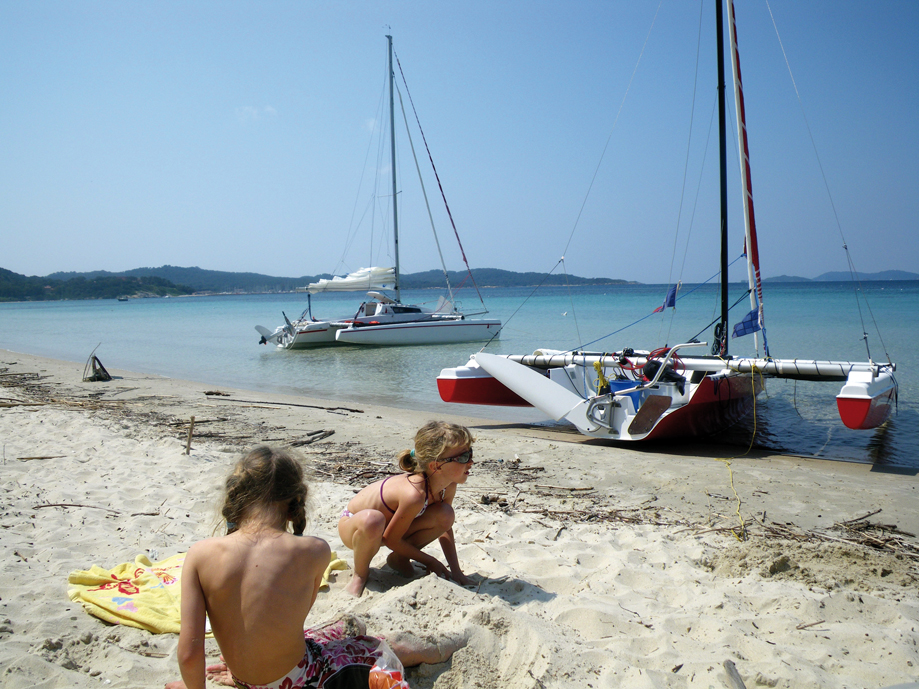
The advantage of the coastal cruising trimaran: 20cm draft. Beaching becomes as easy as making a sand castle…
And life aboard?
The island of Porquerolles is one of the four sites making up the Port Cros National Park. The rules formally prohibit bivouacs ashore. Even without a cabin, sleeping aboard can easily be envisaged. You can either sleep on the trampolines or on inflatable mattresses on the cockpit floor. This choice may be dictated by the configuration chosen when the boat is built, as the builder offers no less than three different possibilities. The prototype presented at Le Nautic had no benches. The wider trampolines filled this role and allowed two people to lie side by side for the night. As an option, one or two rigid benches can be added to the interior of the cockpit, reducing the width of the central passage, but adding numerous lockers, for storing belongings which can stand getting wet. Our test version had two rigid benches added to the exterior of the central hull, to prioritise space in the cockpit. Overhanging the sea, they reduce the useful width of the trampolines, which can only comfortably accommodate one person. Although the boat’s overall aesthetics were accepted unanimously, the cockpit finishing was more debatable. The grey non-slip surface covering the benches is too aggressive for the skin, whilst the interior of the central hull shows the granular relief of the lamination, simply painted with gel coat. This pretty trimaran deserves a better solution, equal to the care given to its design.
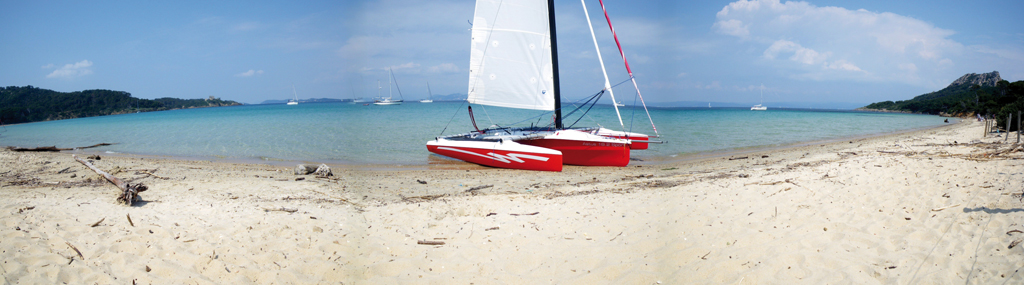
In the distance, the cruising cats... Only the Astus was able to approach the coast to allow its crew to enjoy this beautiful beach... Magic!
The coastal camping trimaran is great fun!
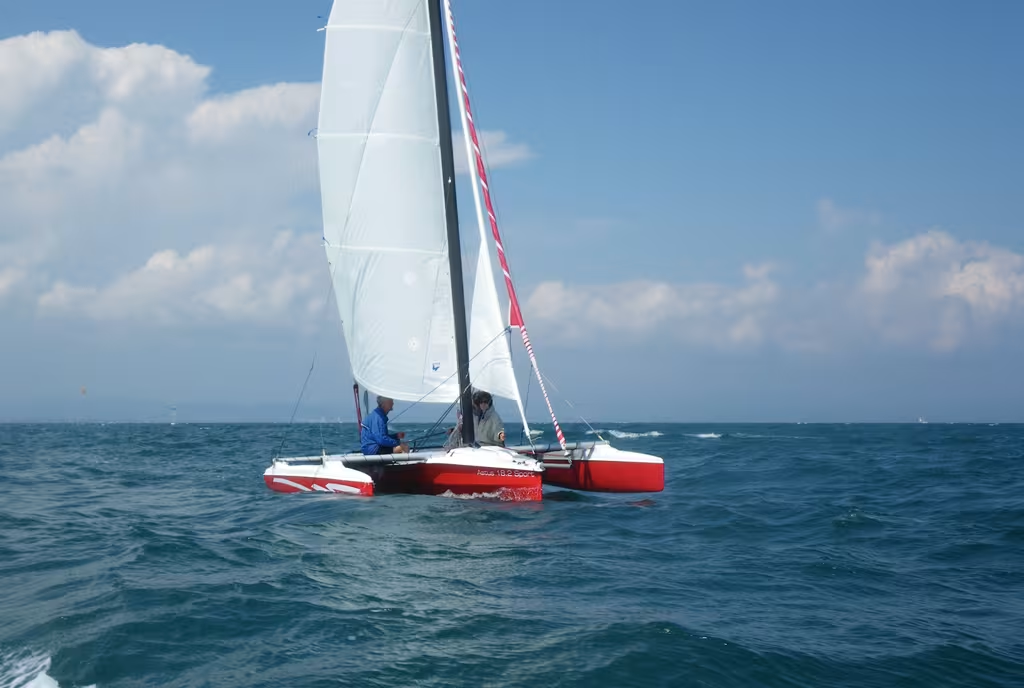
The next day, the wind had freshened a bit. Under jib and full main, we sailed a long reaching leg to the Giens peninsula, in a good force 4, with one-metre waves. With the leeward float half under the water, the leisure rig proved sufficient for these stronger conditions. The Astus 18.2 got into its stride, and settled at around 10 to 12 knots. Although we were far from the exhilarating acceleration of Formula 18s, or other sport catamarans, this serene sailing is perfectly suited to family use. Contrary to what we had feared the previous day, the bow was never caught out by a wave which was steeper than the others. As it went faster, the boat reared up slightly and flew over the chop. Without reaching the boat’s limits, and from time to time seeing the 400-litre float plunge completely under the water, we kept a cautious hand on the mainsheet despite everything, but there appears to be a large margin of safety before the boat comes close to capsizing. With the centreboard raised, the helm proved to be much firmer than on the previous day. Alternating luffing to accelerate in the apparent wind, and surfing on a broad reach, I had great fun piloting this little trimaran, by playing with the elements. Sitting on the windward float, with my feet braced against the edge of the bench, my back wedged against the shroud’s spreader, and the telescopic tiller extension in my hand, the helming position was comfortable, and perfect for taking advantage of the unobstructed view of the bow and the sails, suspended above the water and out of reach of the spray.
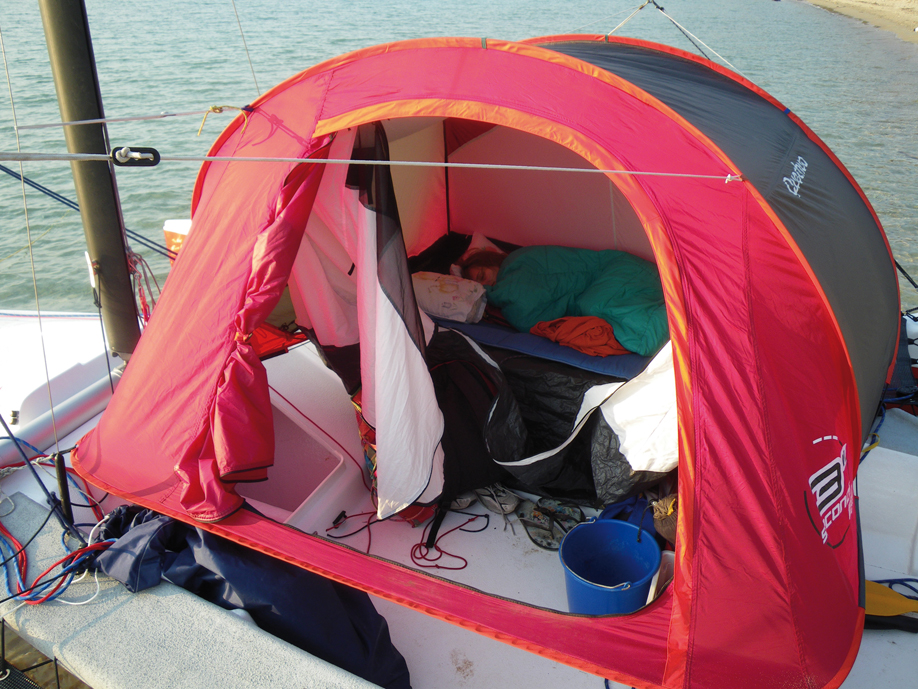
It’s time to go to bed. Fortunately, the builder has provided various systems to allow you to sleep under shelter. But what about bigger people?
Well?
The time to take the Astus 18.2 back to its base came too quickly, but these two days had allowed us to confirm this attractive trimaran’s aptitude to meet its ambivalent programme. A real leisure platform, when it comes to accommodating the whole family, including the youngest children, with all the associated equipment for serenely enjoying the sea and the coastline. It is also capable of offering excitement once it is lightened, as long as you opt for the sport rig. Because although the leisure sail plan lacks a little tonicity and energy for the most experienced sailors, they will be delighted by the specifications of the sport rig (tri-radial cut, Mylar cloth, ad-hoc boom and rigging) so they can take advantage of this lightweight day boat’s potential.
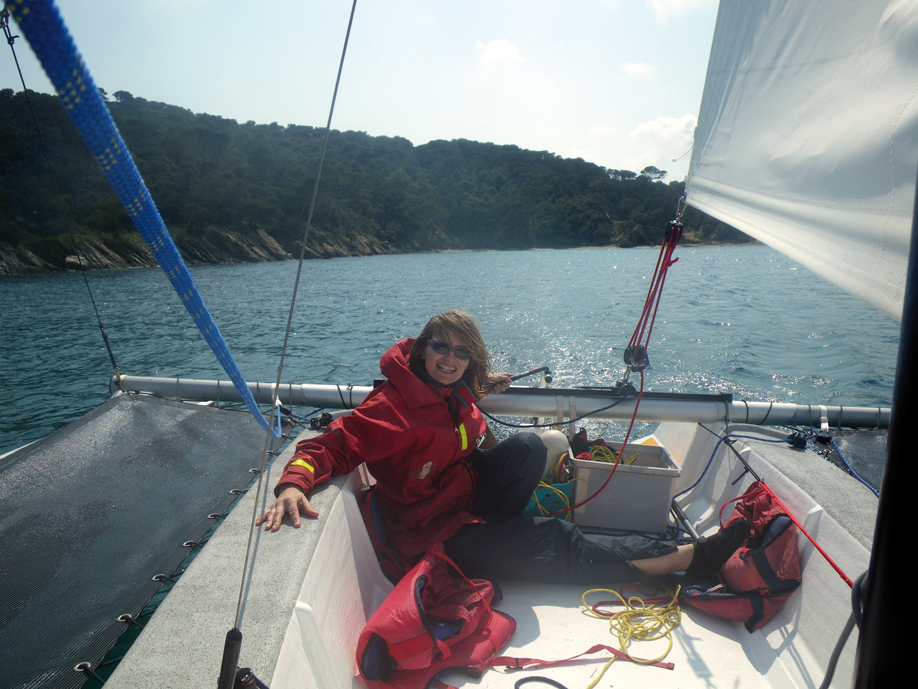
Looking at the helmsman’s smile, you can imagine the pleasure of being at the helm of this Astus 18.2...
Specifications
Builder: Astusboats Model: Astus 18.2 Length: 5.49 m Beam: 3.85 m unfolded / 2.50 m folded Draft: 1.25 m / 0.20 m Displacement: 260 kg Sail area: 20 m² (sport version) / 17 m² (leisure version) Engine: 4 hp max EC homologation: 4 people in category C, 5 people in category D Architect: Philippe Roulin, Perspective Yacht Design
