Even though it is called the Astus 20.2, this Astus is nothing like the previous one, the 20.1. A guided tour of one of the nicest little day-boats.
Infos pratiques
- Le chantier : Astus 20.2
- La fiche technique
- Découvrez notre vidéo exclusive
- Financez votre Astus 20.2
- Assuez votre Astus 20.2
- Articles autour du Astus 20.2
The trend is serious: small day-sailing trimarans are superseding yesterday’s monohull centreboarders. And so much the better. To ensure its place within this segment, the Astus 20.2 has a number of advantages. Of course, it is more stable than the centreboarders. The telescopic folding system makes it easy to launch, store and transport. The small cabin allows two people to sleep aboard, and will shelter four people at meal times. In addition, it is easy to sail, it can sail fast if there is a little bit of breeze, and still performs well in light weather. What more could you ask for? Make no mistake: the Astus 20.2 is a completely new boat. Unlike many builders, who, by adding an XX.2 or an XX.3 are satisfied with adding a transfer and two handles, the Astus 20.2 is built on new moulds, the hull and the floats are different, the coachroof too, and even the crossbeams have been modified. The 20.2 is also wider unfolded, yet much narrower folded!
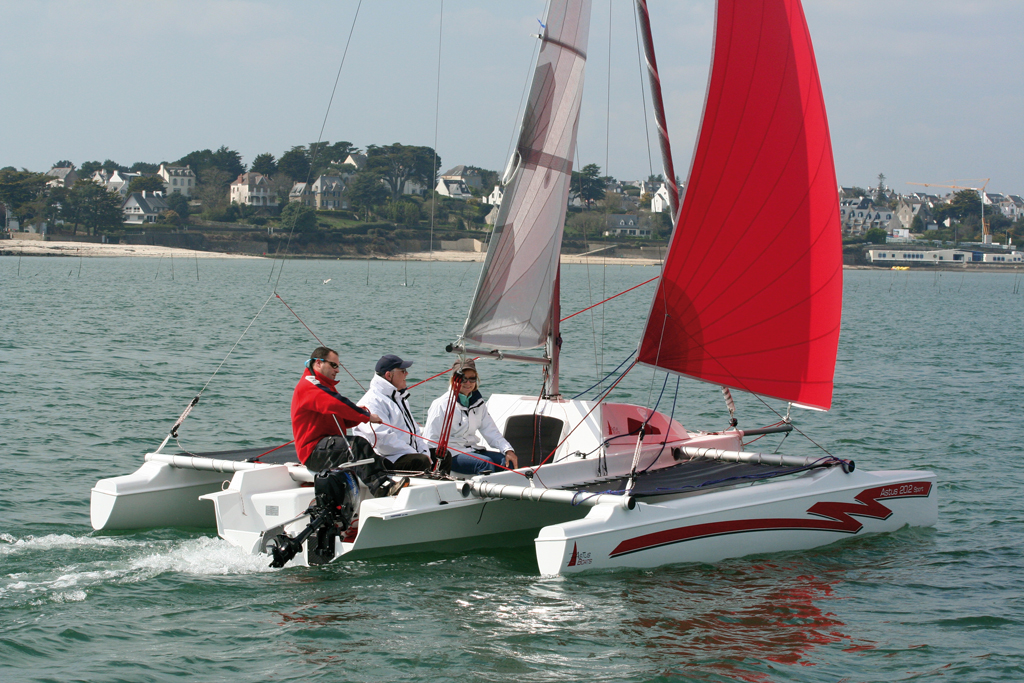
Our test trimaran (the ‘sport’ version) took off in the slightest gust!
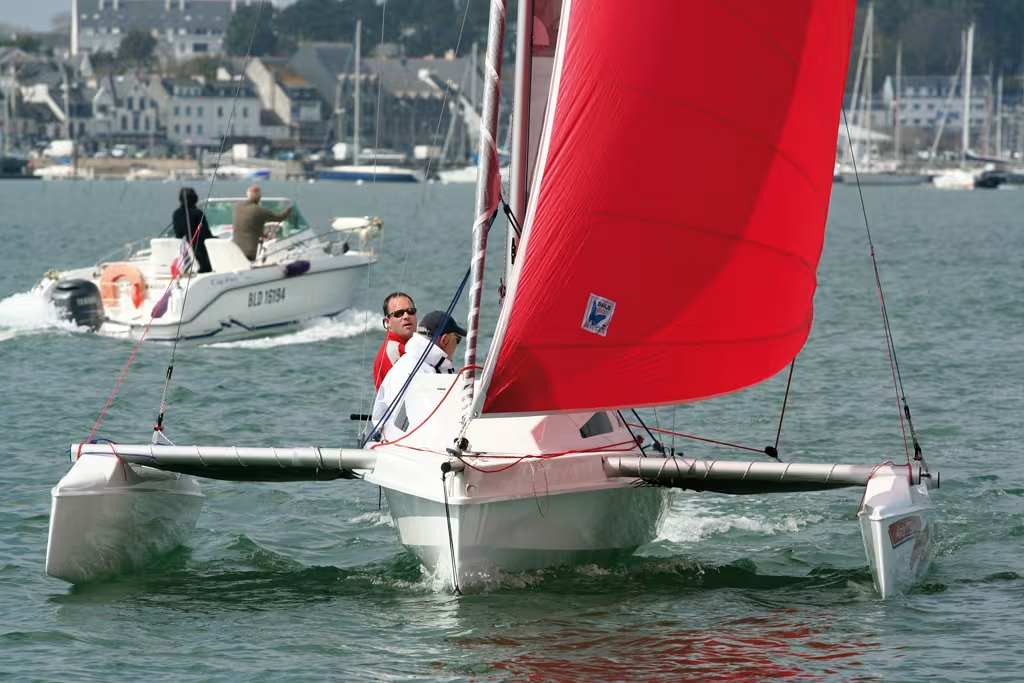
So we are justified in asking the managers of a winning company why? With 75 examples of the 20.1 sold, we are talking of a real success. “Many customers made remarks,” Vincent Gibet, responsible for customer tests and the press at Astus Boats pointed out. “Certain people complained that the trampoline was too small, or that access to the cabin was difficult, as the crossbeam passed just behind it.” Hence the idea that came from Jean-Hubert Pommois (the company’s boss) of creating a completely new boat, without changing the name, as is current practice in the car industry. Traditionally, the Astus belongs to the small day-boat family, resolutely oriented towards cruising, not performance. But here again, Vincent pointed out “the owners’ experience showed that from a peaceful cruising boat, they were starting to try and get an extra tenth of a knot out of the boat, to beat their mates, and that the rather basic fittings of the family version were no longer sufficient.” Hence the builder’s decision to meet their expectations. The customer is king (and when, in addition, the company manager comes from a business school...). The 20.2 is therefore available in two versions, the basic one, dedicated to day cruising, and a sport version, boosted with several extra square metres of sail area: compared to the cruiser version’s 21m² of sail, our test boat offered 24m², a gain of more than 10%. Otherwise, the 20.2’s mast is no taller than that on the 20.1, but the previous rounded coachroof has been replaced by a more angular design (flatter, like the Astus 22), which has allowed an extra 15cm on the mainsail luff, giving a larger total area. Our test boat even had a nice suit of sails in Pentex, one of the most high performance composites, which is stiff and light. These sails are in a very nice-looking grey (in any case, very photogenic). The test boat’s suit of sails was completed by a downwind gennaker, with more belly and flown from the hounds, and a bigger spinnaker, also flown from the hounds.
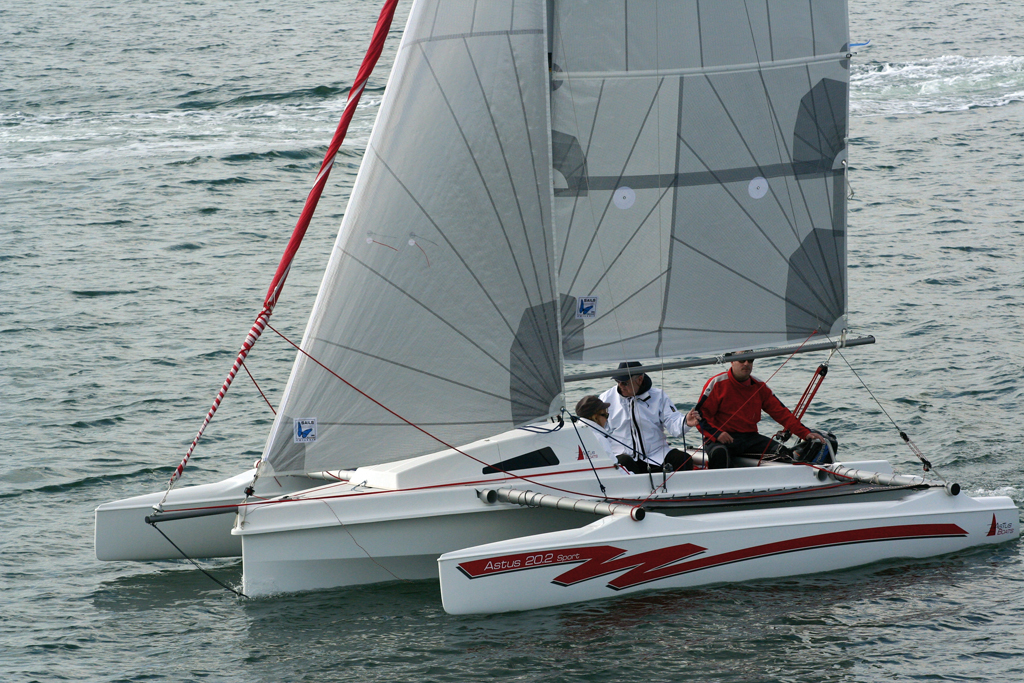
The 20.2: a completely new boat in the Astus range.
An easy boat to sail.
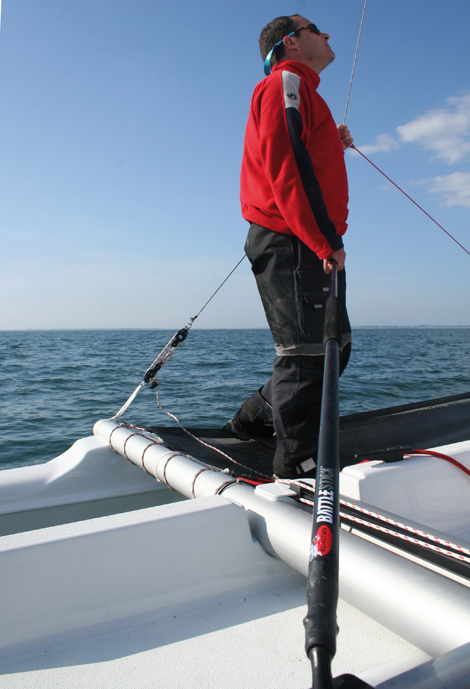
When I arrived at Saint-Philibert, the boat was already rigged, the mast was stepped and we quickly launched it. Phew, the almost non-existent morning breeze had given way to a bit of wind – so much the better. This boat is like a little bike, in the sense that you can do what you want with it, without having to use the engine. Thus, whilst I remained ashore to take some photos of the boat under sail, Vincent left the quay and returned under mainsail alone – the joys of a manoeuvrable little boat. This square-headed mainsail is hoisted in the mast groove; it is hauled taut with the help of a Cunningham, which does away with the need for a winch. Moreover, there are none on the boat. I climbed back aboard and finally took the helm. Strangely, it was a little heavy, whilst we were only doing 5 or 6 knots. A glance at the rudder lifting system showed that the rudder blade had moved back slightly. I bore away and took in the line, and the problem was solved. On this kind of small boat, even more so than on any other, the trim is of paramount importance. The rudder is of course right aft, and although the stick is telescopic, it is perhaps a little bit short to allow the helmsman, depending on the point of sailing, to position his body where it will best trim the boat. Thus when sailing to windward, I moved right forward, comfortably on the float; Vincent did the same and the leeward float hardly touched the water. The increase in speed was immediate, and the GPS screen went almost instantaneously from 5 to 7 knots.
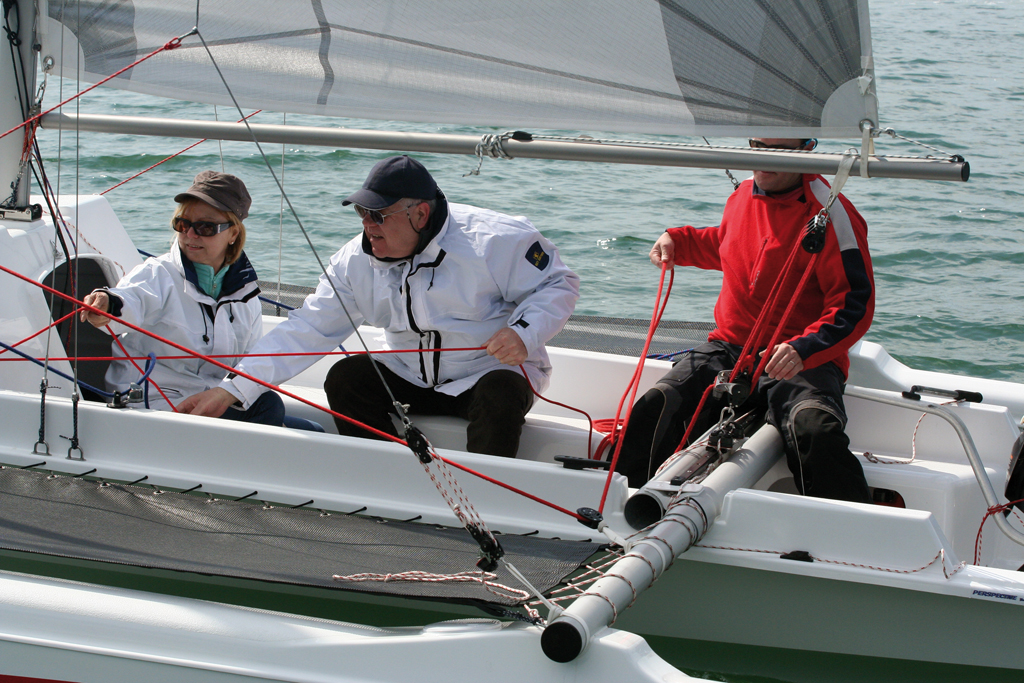
The cockpit is king-sized, and allows you to live in it comfortably.
The wind was very light, so we unrolled the gennaker. This is a flat sail, and thus quite versatile; it allowed us to sail with the wind abeam and even closer with no problems. Finally, this sail has a lot in common with a Code 0, and in these light conditions, we were sailing respectably close to the wind; with less than 10 knots of breeze, we were at 6 knots, with 120° between tacks. The gennaker sheet is led back to a winch block fixed on the aft crossbeam with a tape, and is made fast on a small cleat. Later, when there was a bit more wind, under jib and mainsail, we had difficulty making more than 100° between tacks, on a flat sea. Gybes followed tacks; we explored the Baie de Quiberon and enjoyed this boat, (which proved to be very manoeuvrable whatever the point of sailing) to the full. And in a gust which came from nowhere, we reached a top speed of over 10 knots, under gennaker. This was to be the day’s maximum (some people have surfed at a lot more than that), but we were exceeding the ‘normal’ range of use.
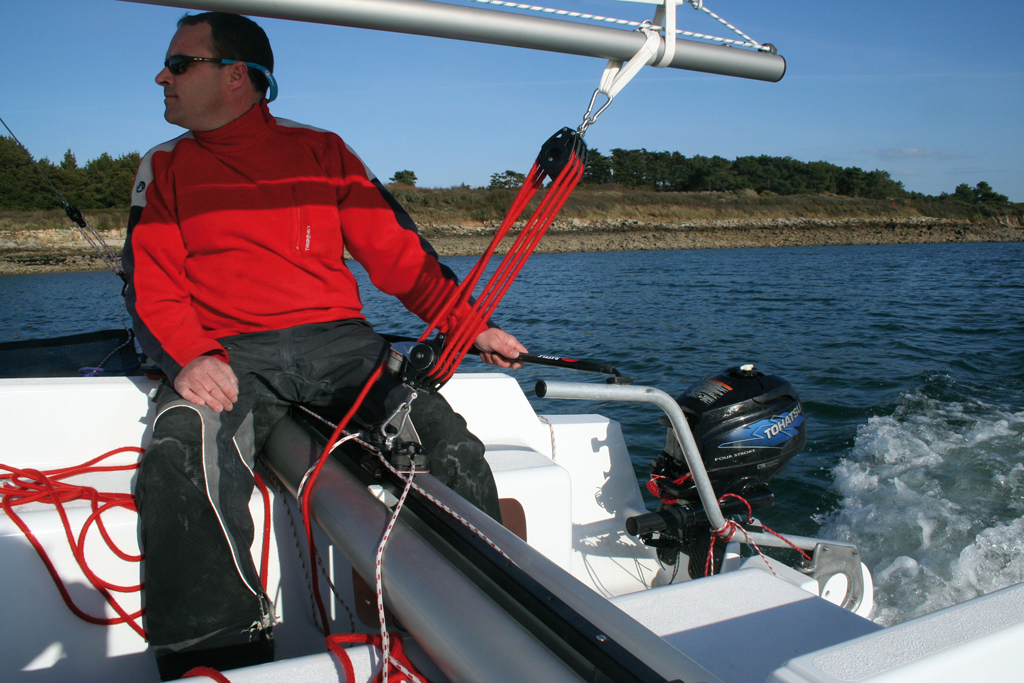
A manoeuvrable boat which is great fun to helm.
A very simple rig.
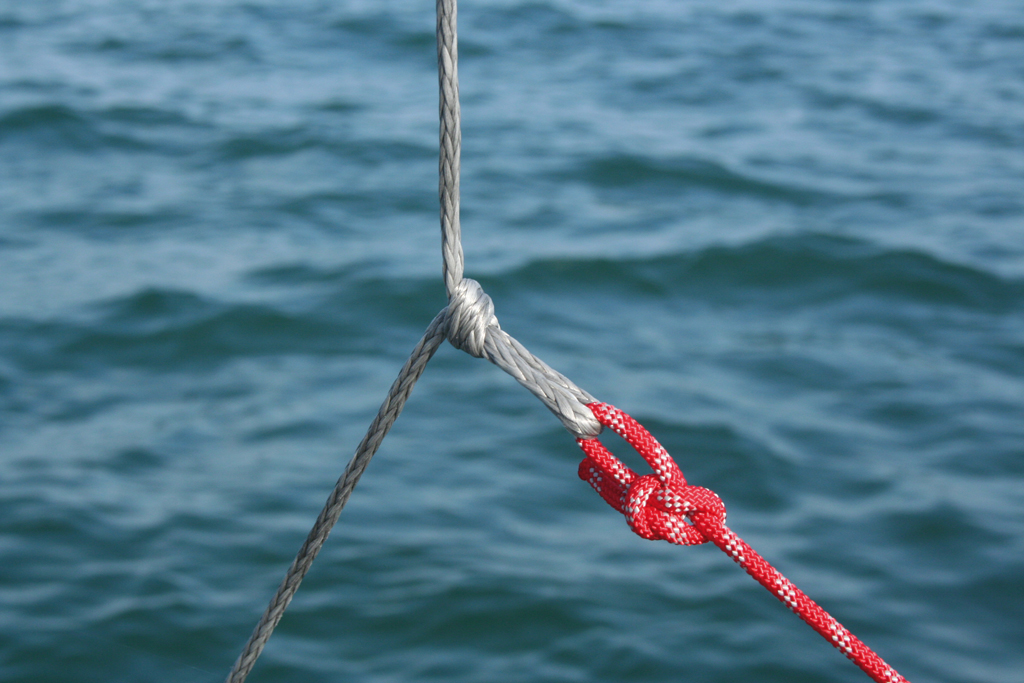
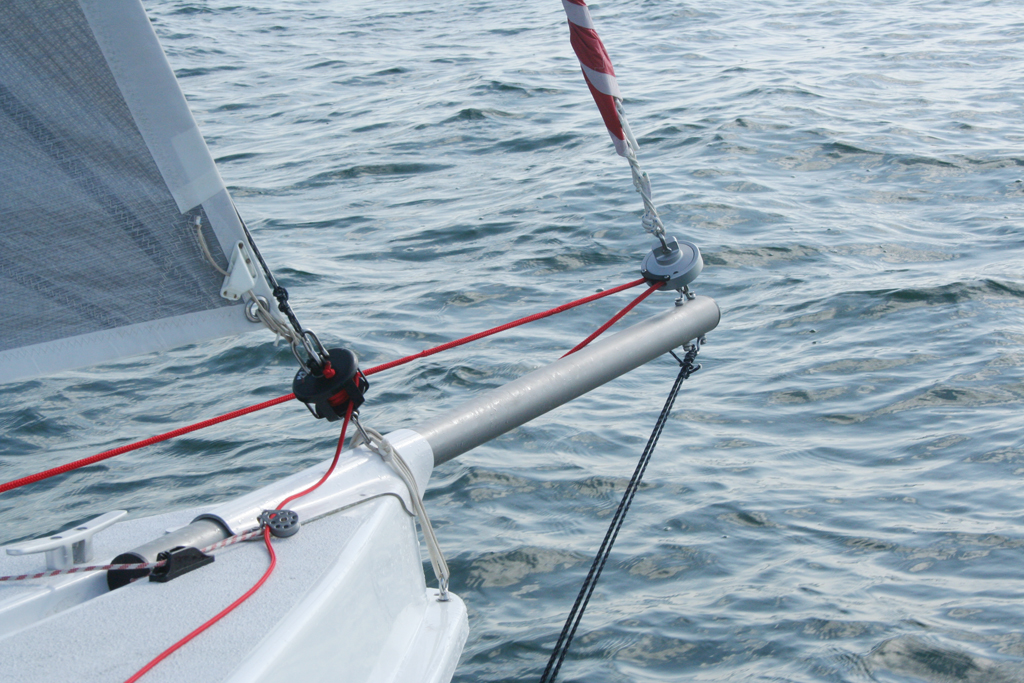
A quick glance at the sails showed that although the jib roller was attached classically at the bow, its sheeting system deserved a bit more attention. In a quest for simplicity, and to make up for the absence of a winch, this jib sheet passes via a block on the clew of the jib, thus forming a 2:1 purchase; it ends with a snap-link which attaches to the trampoline lashing. This system allows precise adjustment of the clew according to the point of sailing, by simply moving this snap-link. The other end is led back to a turret-jammer. The system is ingenious and practical. As for the standing rigging, on our test boat, the textile lashings on the shrouds and cap shrouds will soon be replaced by stay adjusters. Thus after each time the mast is unstepped (even though the shrouds do not have to be removed to transport the boat and its mast on its trailer), the adjusters just have to be refitted between the chainplates and shroud terminals. The standing rigging is completed by runners, in a Y-shape, one end of which is fixed to a purchase, and otherwise fixed to the forward crossbeam – float connection. They are in Dyneema, and stabilise the platform. Their ends deserve better than the knots which fray at their extremities. However, this is not complicated to do, all you need are the needles, and suitable thimbles (see MW 110).
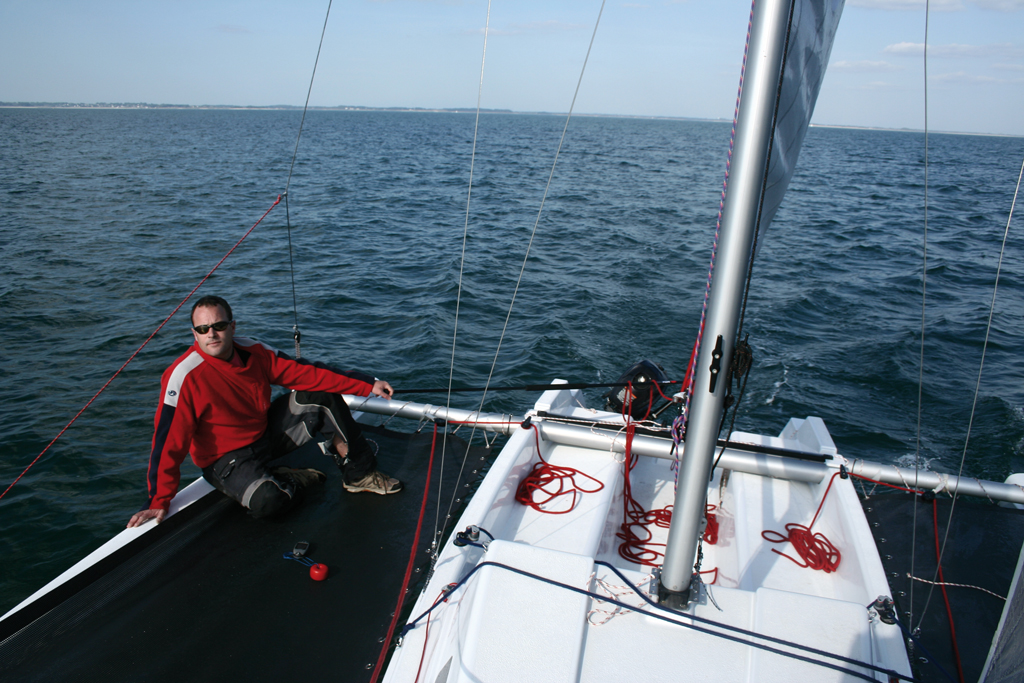
On a 20-foot trimaran, adjusting the trim is of paramount importance. Don’t hesitate to move around the trampoline.
As for comfort aboard, the exterior area is more than respectable (with regard to the size of the boat). The cockpit is king-sized, open and spacious; you can lie down in it with no problems for a siesta, at anchor, or when the rest of the crew is doing its best to improve the boat’s trim to get the best out of it... The total length of the seats is 245cm (with, it is true, the aft crossbeam which limits the ‘lying’ length to 165cm); the cockpit’s maximum width is 140cm, and that of the seating is 40cm. The companionway giving access to the small cabin is very practical (max. height 62cm, max. width 52cm), a clear improvement compared to the 20.1, and two people can sleep inside. Four people can sit here, but would be a bit cramped. Maximum height is 125cm, the double berth offers 190cm x 110cm as its largest dimensions.
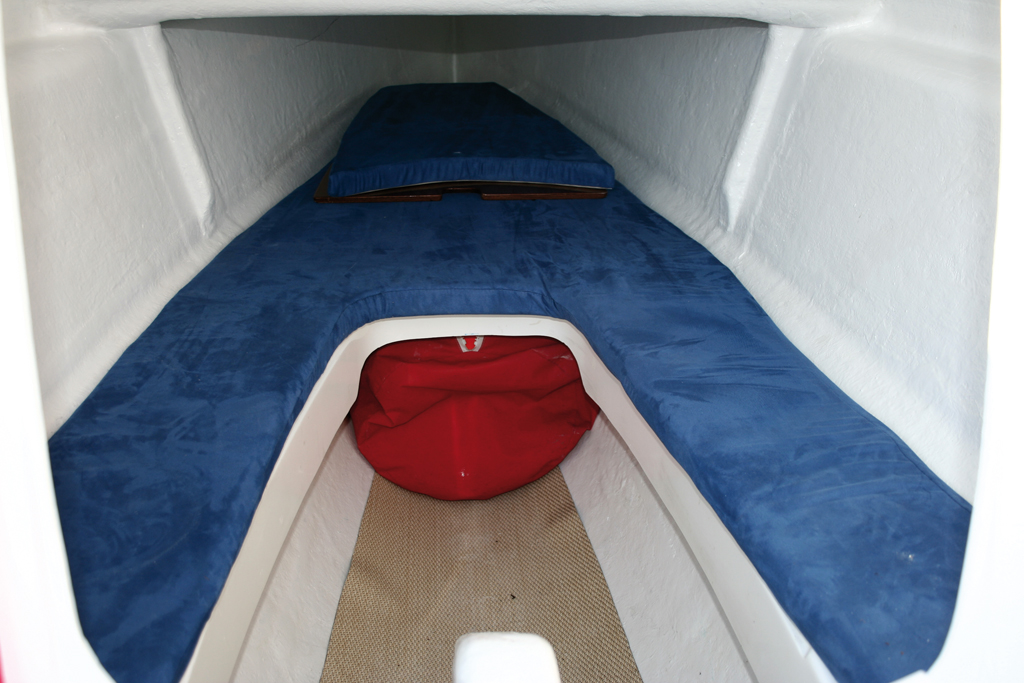
The interior allows two people to sleep aboard. Ideal for coastal camping...
Coming ashore: a look at the hulls below the waterline.
It was already late in the day and it was time to return to the river at La Trinité. We came alongside the quay. Before putting the boat back on its trailer, the floats have to be retracted. The operation is very simple, the runners have to be freed first, before releasing the trampoline lashing tensioning line, undoing the two pins which hold the crossbeams (mechanical, in aluminium tube) in the open position. All that remains then is to walk on the trampoline to retract the arms; they are then folded towards the central hull, talking care to keep the arms parallel. Once out of the water, a look at the hulls below the waterline was essential. They are just as they should be on a trimaran, that is: minimum wetted surface area, whilst offering a maximum deck area. To this can be added the fact that they have to fold, and thus come within the trailing limits once the arms are retracted; thanks to the use of double tubes, the 20.2 folds further and better, as its total beam is reduced to 2.4m. More than necessary! The rudder and centreboards pivot. It is not as easy as it seems to meet a specification which is finally complex. And this is the beauty of the exercise. As for the construction, it appears to us to be carefully carried out; the same care has been taken with the mould. Here, the preform was realised using a three-dimensional numerically-controlled cutting process, on blocks of foam. This offers a perfect design. Simply looking at the perspective of the ridge of the ‘step’ in the hull is enough to convince you. As is often the case with small builders, the composite part (frankly, the most unpleasant part, the lamination), is sub-contracted. The construction prioritises monolithic, except for the flat parts, which are made in sandwich.
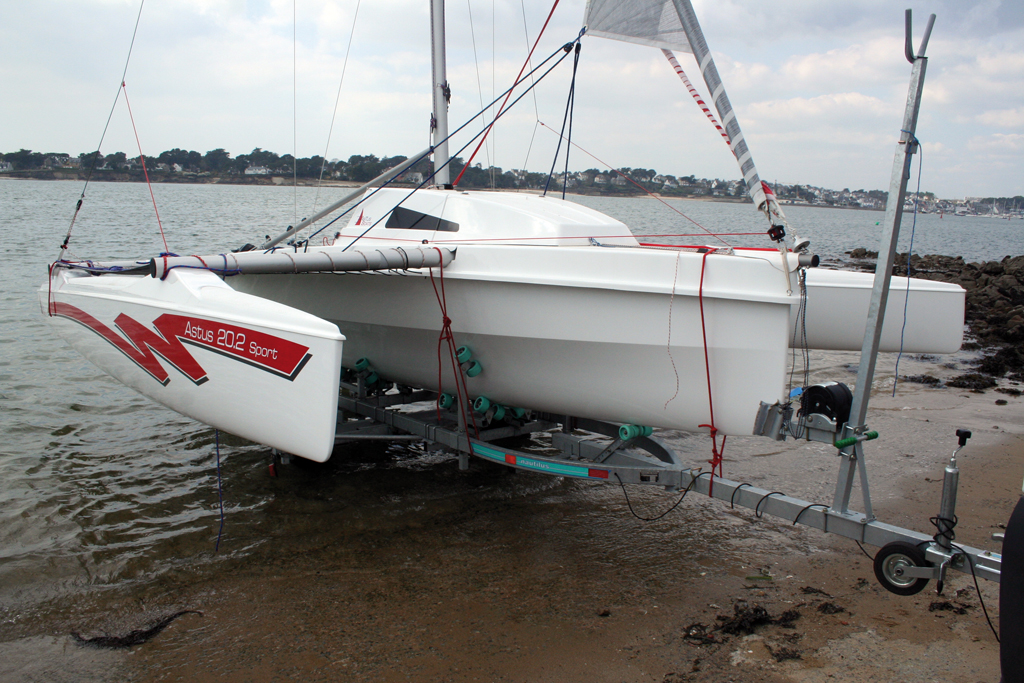
Thanks to its trailer, the Astus 20.2 allows you to go easily from one cruising area to another. Three cheers for transportable boats!
In conclusion,
It’s certain, here we have a very pleasant boat; a little, three-legged day-boat, which is easy to launch, prepare and sail. Obviously, in strong winds, you must show a little restraint.
The plusses
- A little boat which is easy to transport and store. - Not too expensive.
The minuses
- Not ideal for big families.
Technical specifications: Astus 20.2
Overall length (central hull): 5.95 m. Float length: 5.40 m Max beam, floats extended: 4.5 m Mast height: 7.65 m Displacement: 380kg. Draft: 0.25 m / 1.25 m Windward sail area (cruising): 20 m² (Mainsail: 14.5 m²; jib: 5.5 m²) Windward sail area (sport): 24 m² (Mainsail: 17m²; jib: 7 m²) Downwind sail area: 35m² (42m² in the sport version). Max engine power: 6 hp. Design: Jean-Hubert Pommois Architect: Perspective Yacht Design Price: Astus 20.2: 19,800 euros Price of the ‘sport’ version tested: 21,960 euros
Caption
The Astus 20.2 under sail.
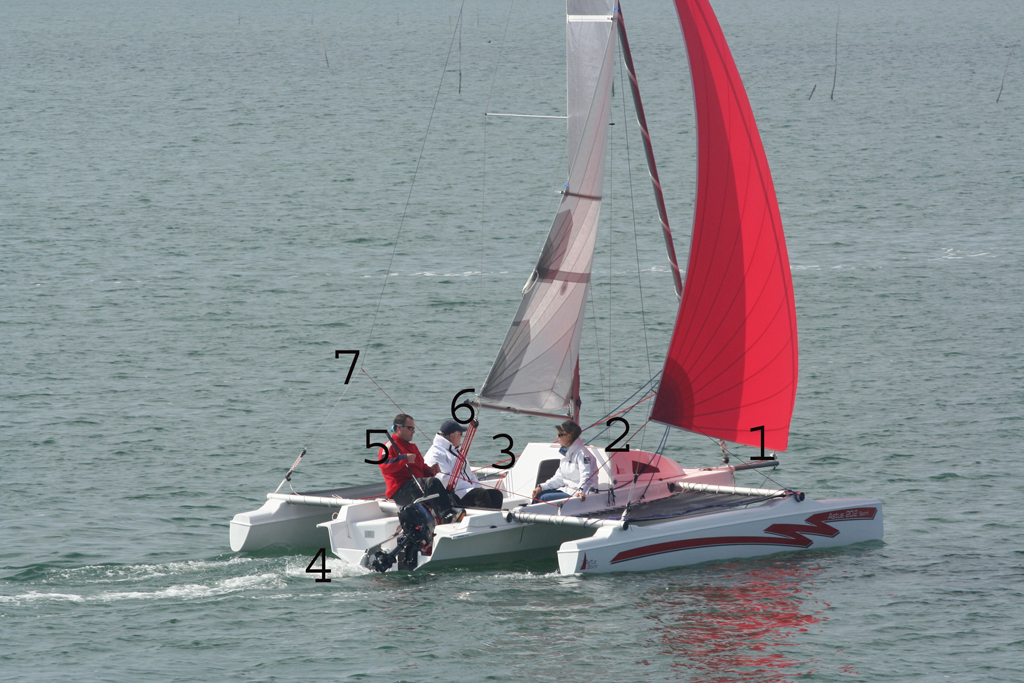
1: the bowsprit. Telescopic; it takes the gennaker.
2: the anchor locker. Its position, at the mast foot, helps with weight distribution; of course we would have preferred to see the weight of the chain and the anchor stowed lower.
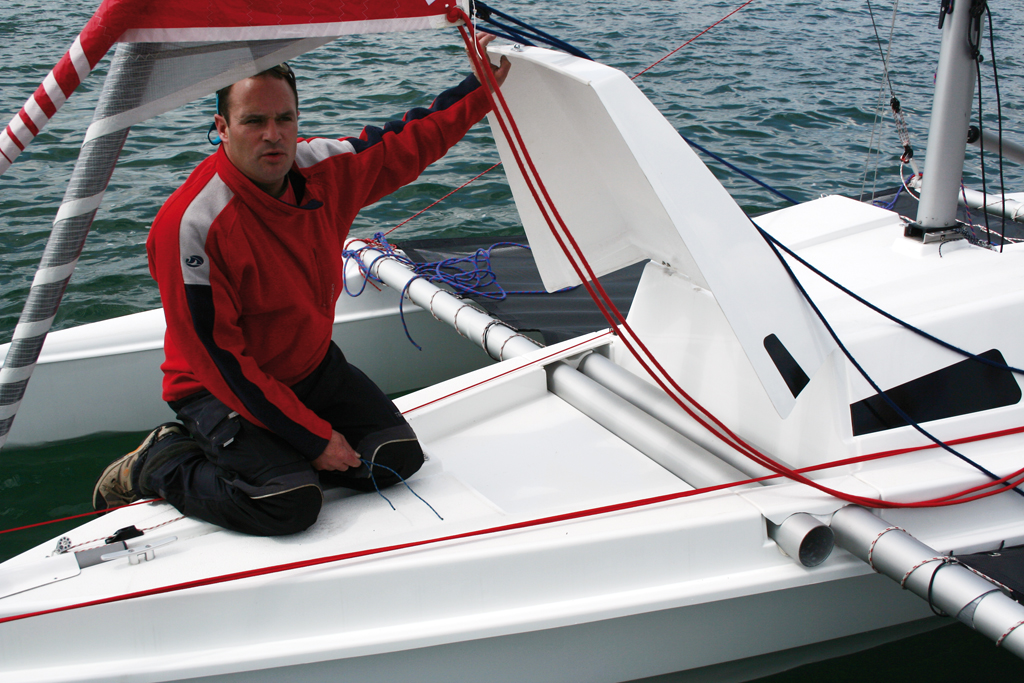
3: the jib sheet. One end is fixed to a snap-link which is attached, according to the point of sailing, more or less towards the forward end of the trampoline; it passes through a block on the jib clew before returning to a turret – jammer.
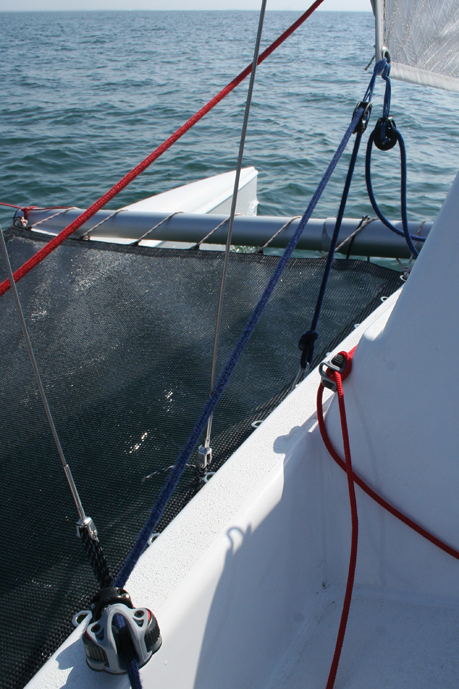
4: the lifting rudder. Just like the centreboard, the lifting rudder allows the boat to be beached. A pin would hold it in the lowered position, a complication the builder does not want to fit, so that the boat can be beached and refloated easily.
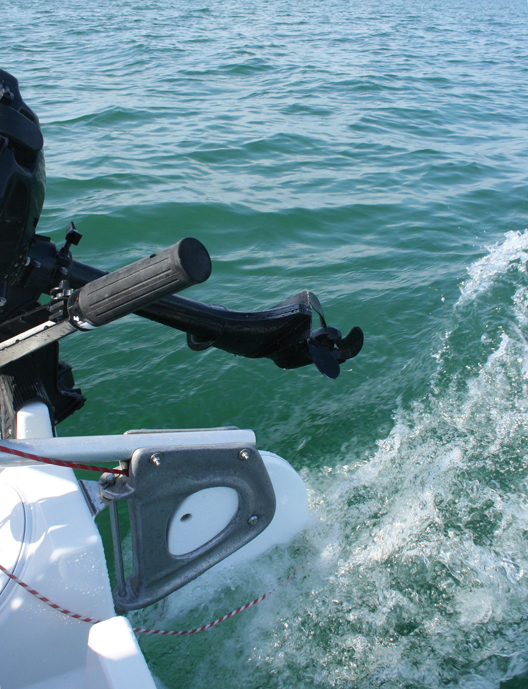
5: the telescopic tiller extension. It is long, but not long enough to allow the helmsman to position himself where he would optimise the boat’s trim..
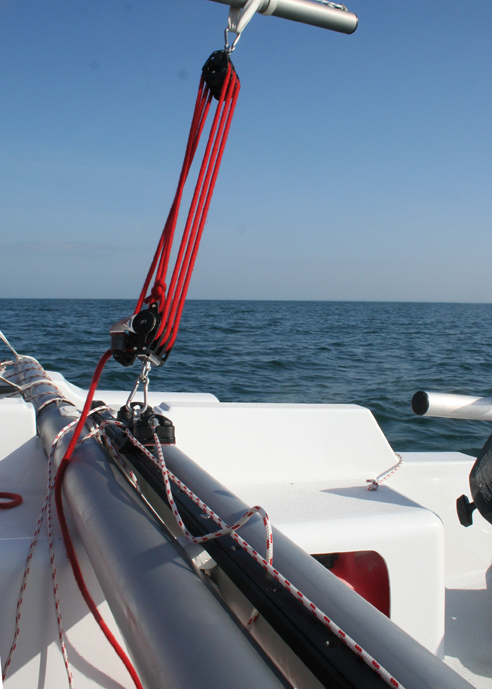
6: the 6:1 purchase. Only on the sport version; allows good control of the mainsail.
7: The Dyneema running backstays. The ends of the braid deserve better than this simple knot...