
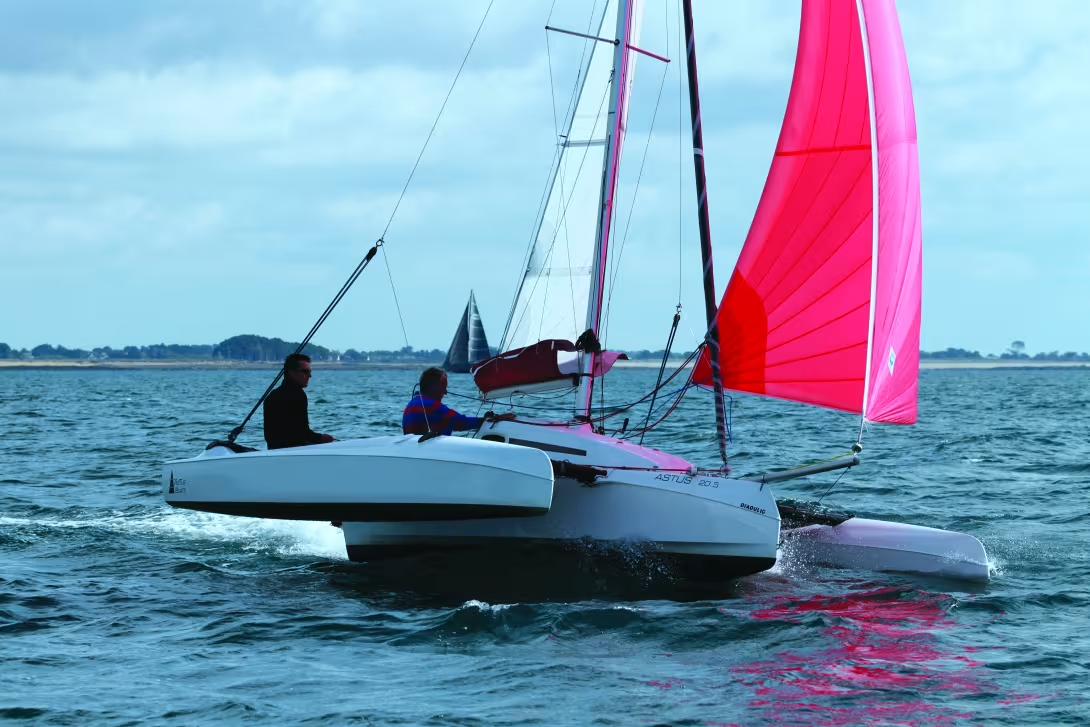
Catamarans under 30 feet in length have become rare on the market, while trimarans, most often with variable beams, are flourishing. Among them, the Astus 20.5 presents many particularly convincing arguments – starting with a reasonable budget.
Infos pratiques
- Le chantier : Astus 20.5
- La fiche technique
- Découvrez notre vidéo exclusive
- Financez votre Astus 20.5
- Assuez votre Astus 20.5
- Articles autour du Astus 20.5
It's a fact: in the latest edition of our Buyer’s Guide, there are barely any catamarans – other than the occasional prototype - below 10 meters (33’). The coastal multihull niche is now being invested by trimarans. Three hulls, with a folding structure or telescopic linkage arms, allow the boat to fit into a standard marina slip and also be transported by road. This is an undeniable advantage compared to a catamaran which can almost never be dismantled. These small units offer a pretty wide sailing program: day sailing, coastal rallies or cruises, racing... it’s only serious offshore work and the live-aboard life that are reserved for real adventurers, who have little regard for comfort.
Astus Boats, the small trimaran specialists
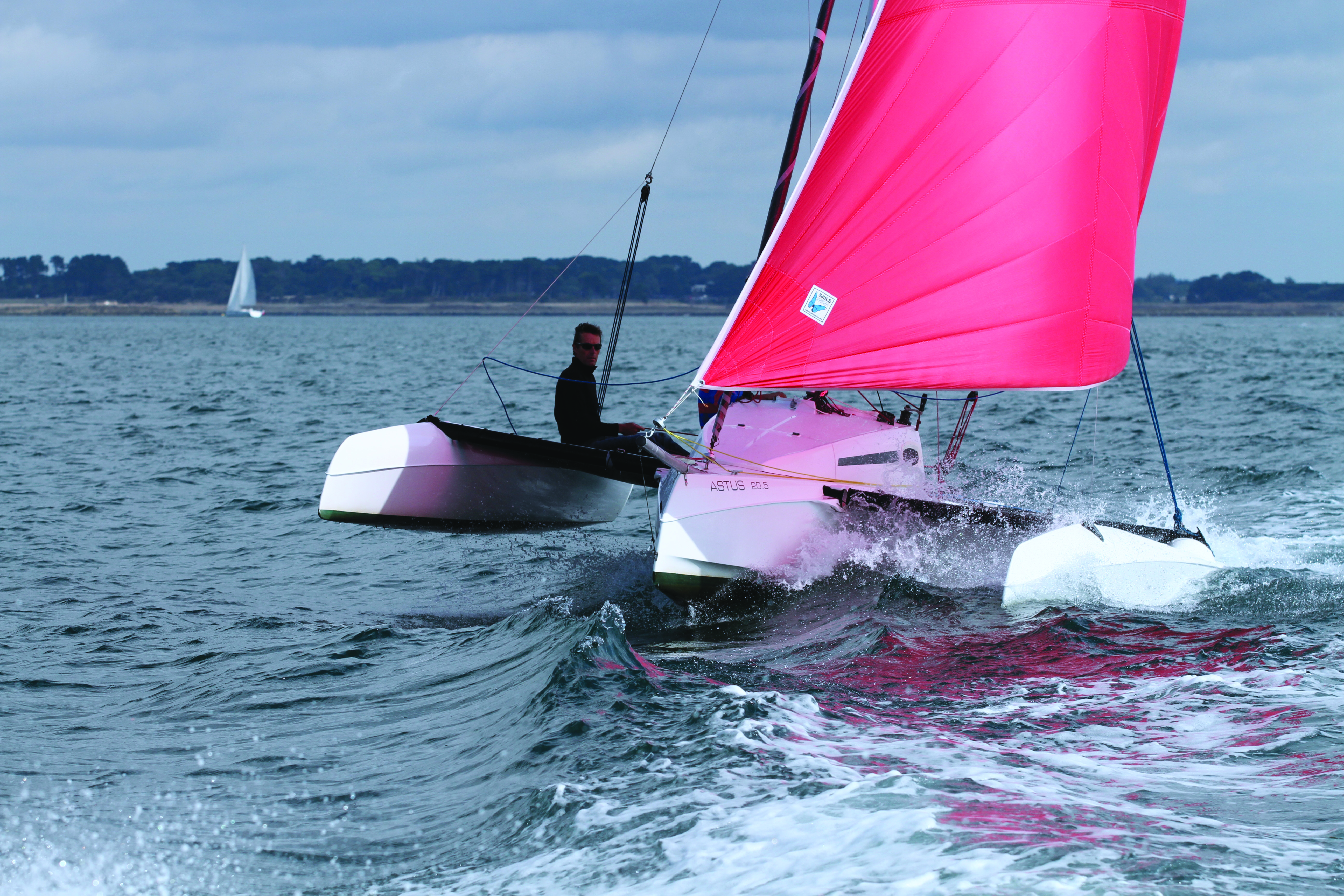
Based in southern Brittany, Astus Boats was born in 2004 under the impetus of Jean-Hubert Pommois. Specializing from their first model – the Astus 20.1 - in compact trimarans whose floats were on telescopic tubes, the builder stands out from Dragonfly, Corsair and even Tricat with more stripped-down multihulls at attractive prices. A positioning that is proving to be profitable since no less than 400 Astus are crisscrossing the waters of the world. The key size for the yard is certainly 20 feet: after the first 20.1 with 73 units, and her replacement, the 20.2 (Astus' best-seller with 120 units), the 20.5 was launched in 2018. This is the model, already with 30 units built, that we went along to test.
Plans signed by VPLP
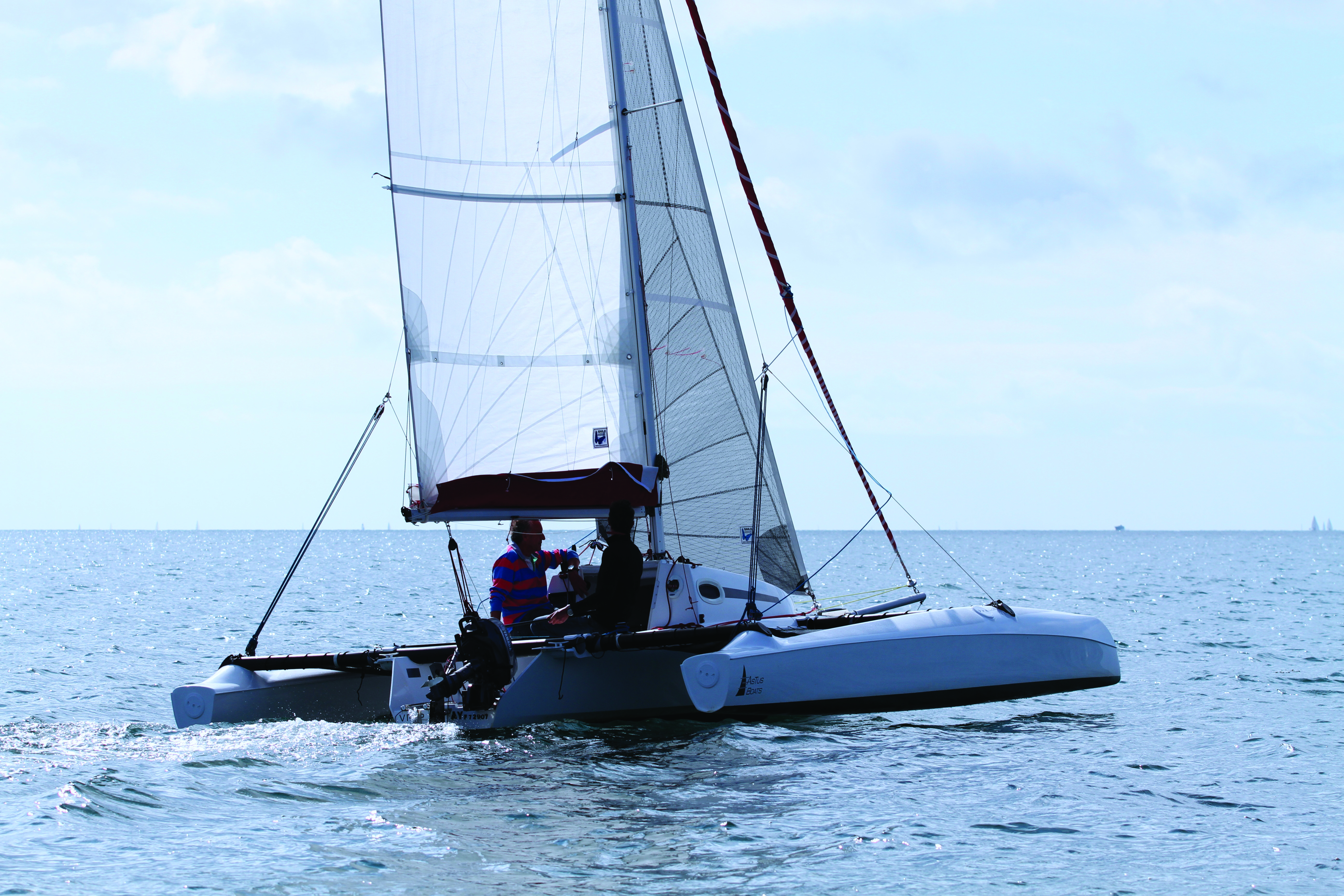
Back in 2004, Jean-Hubert would never have dreamed of soliciting naval architects VPLP: it wasn't until 2016, with the Astus 16.5, that this step was taken. The result is a much more flattering design and more marked chines compared to the previous models. The bow of the central hull is particularly successful: it gives our trimaran an undeniable sporty feel. Another advantage of this prestigious signature: a remarkable overall balance, especially in terms of longitudinal trim. The 20.5 is the second Astus design signed by VPLP – the next one being the 22.5, expected later this year.
Looks small from a distance, bigger once you’re on board
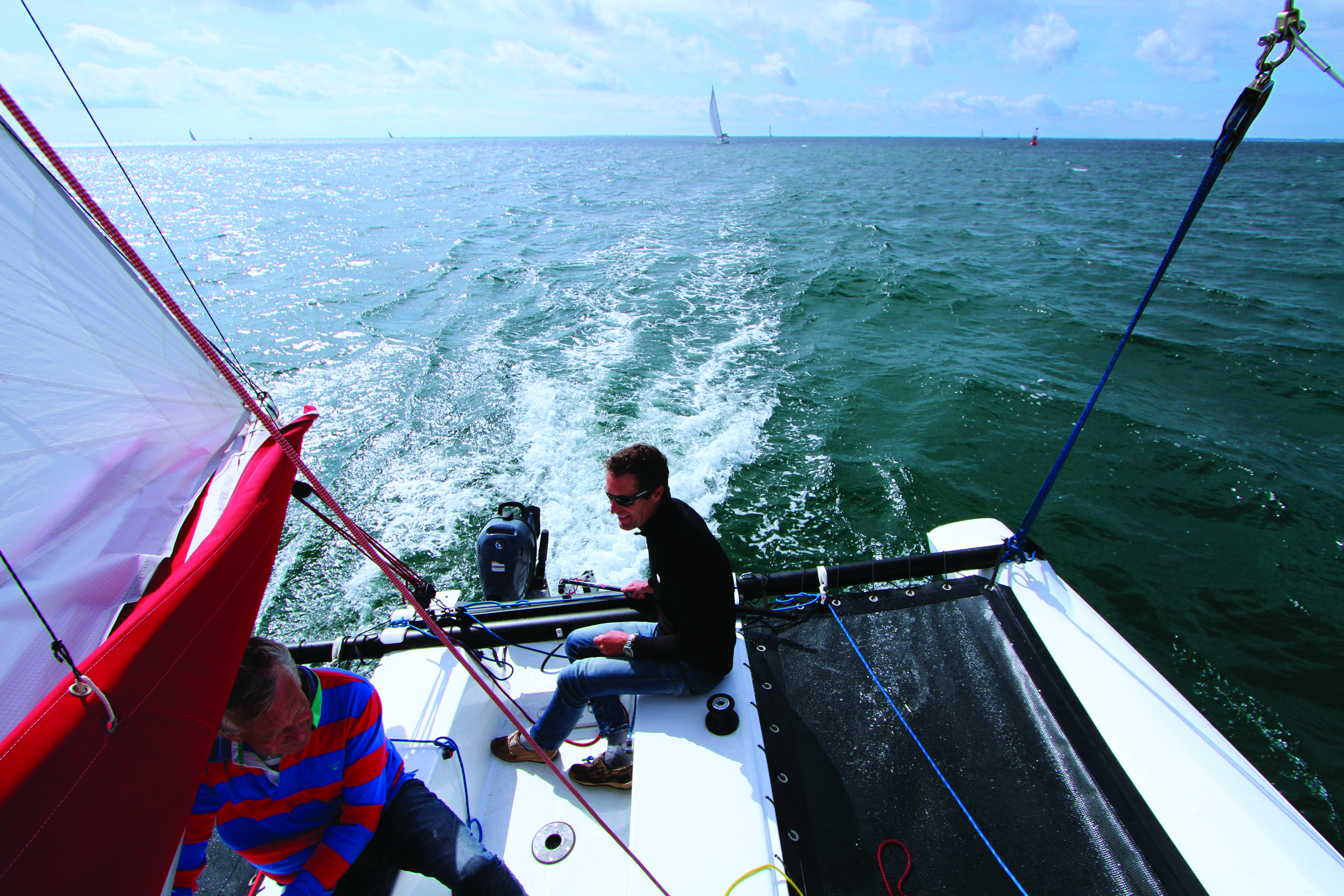
Looking at our Astus out on her mooring, she looks very small compared to the other multihulls we can see on the water. And yet, as soon as we get on board, we don't feel cramped at all. Not so surprising: with her two 3.25 m (10’8”) by 1.15 m (3’9”) trampolines and her fairly large cockpit (1.58 m/5’2” long), the total usable surface area is 16 m² (172 sq ft). The coachroof, whose hatches are due to be enlarged, exploits all the available deck width: the trampolines are used to access the small foredeck. Moving about while under way doesn’t pose any real issues. The anchor well is cleverly integrated into a locker on the front of the coachroof. The basic fittings are rather minimalist, but the options offered and the Sport version allow things to be elaborated somewhat - additional winches, mainsheet traveler. Note that a kit for stepping the mast is available as an option.
A sheltered cabin
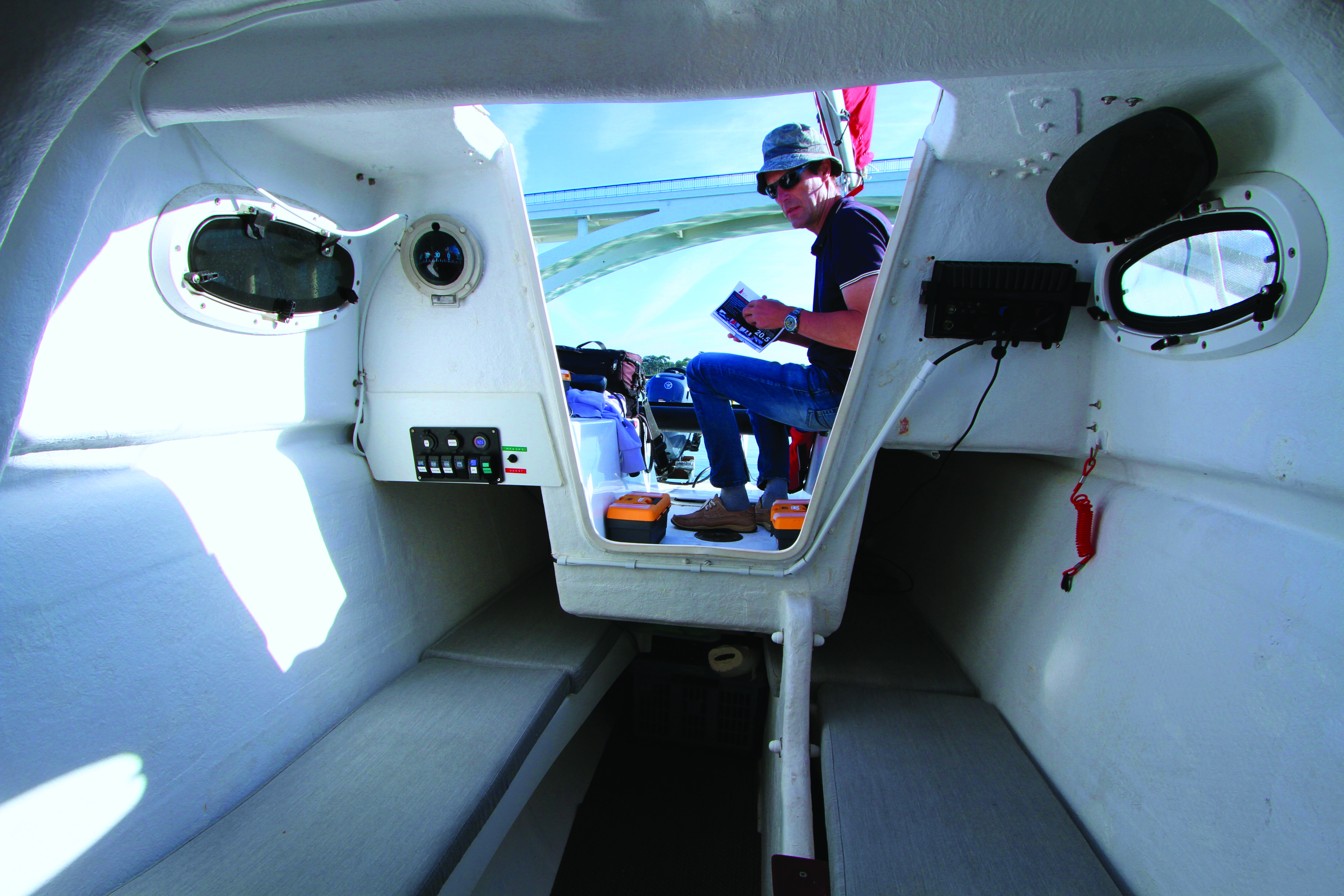
The first version promised four berths... but in the end, the manufacturer made do with a double berth at the front, 2 meters (6’7”) long and only 1.10 meters (3’7”) wide at the head and 55 cm (22”) at the feet. The minimum height is 39 cm (15½”) above the mattress. The cabin still offers a small saloon for four people (76 x 23 cm / 30 x 9” bench seats) and some storage space. The headroom at the entrance of the companionway is 1.40m (4’7”). The whole thing is simple, robust and well thought out - considering the length of this multihull, it'd be hard to do better…
Sensations guaranteed!
The engine, positioned quite far from the helmsman, is not very easy to access for starting or for adjusting the throttle or turning for maneuvering. But once underway, you quickly realize that a very low power of 3hp is more than enough to propel this featherweight craft. The sails are obviously easy to set up, given their small surface area. A few knots of wind are enough to get the 20.5 going: she’s particularly fast, and accelerates at the slightest puff of wind and will tack on the spot without flinching. Upwind, the angle is excellent. It would be impossible to realize, from the helm, that the daggerboard is off-center in the central hull - another trick to avoid cluttering up the interior. Note: both the centerboard and rudder are pivoting and both have a releasable cleat. However, to achieve optimum performance, correct trim of the jib sheeting is essential: the system of sheets set on fixed points has room for improvement. The gennaker allows the hulls to show off their full potential - all the more so as the wind in Quiberon Bay was now approaching 15 knots: the Astus was making headway at 10 knots, peaking at 12. The windward float was no longer touching the water, the central hull was lifting slightly, but the structure didn’t budge... the safety margin (and speed!) is still huge. In the cockpit, we stayed generally dry. Spray whips up only a little to leeward.
Conclusion
Quick in all conditions, always fun and easy to sail, the Astus 20.5 is a perfect platform for enjoying yourself on just about any body of water. The Sport version, a little lighter and with more canvas than the Leisure version, guarantees a little more adrenaline. The pivoting appendages of the 20.5 allow her to take the ground, and approach the shoreline without fear. Her basic accommodation allows you to spend a night on board. This is a small multihull, but you get a lot for your money!
We love the telescopic arms!
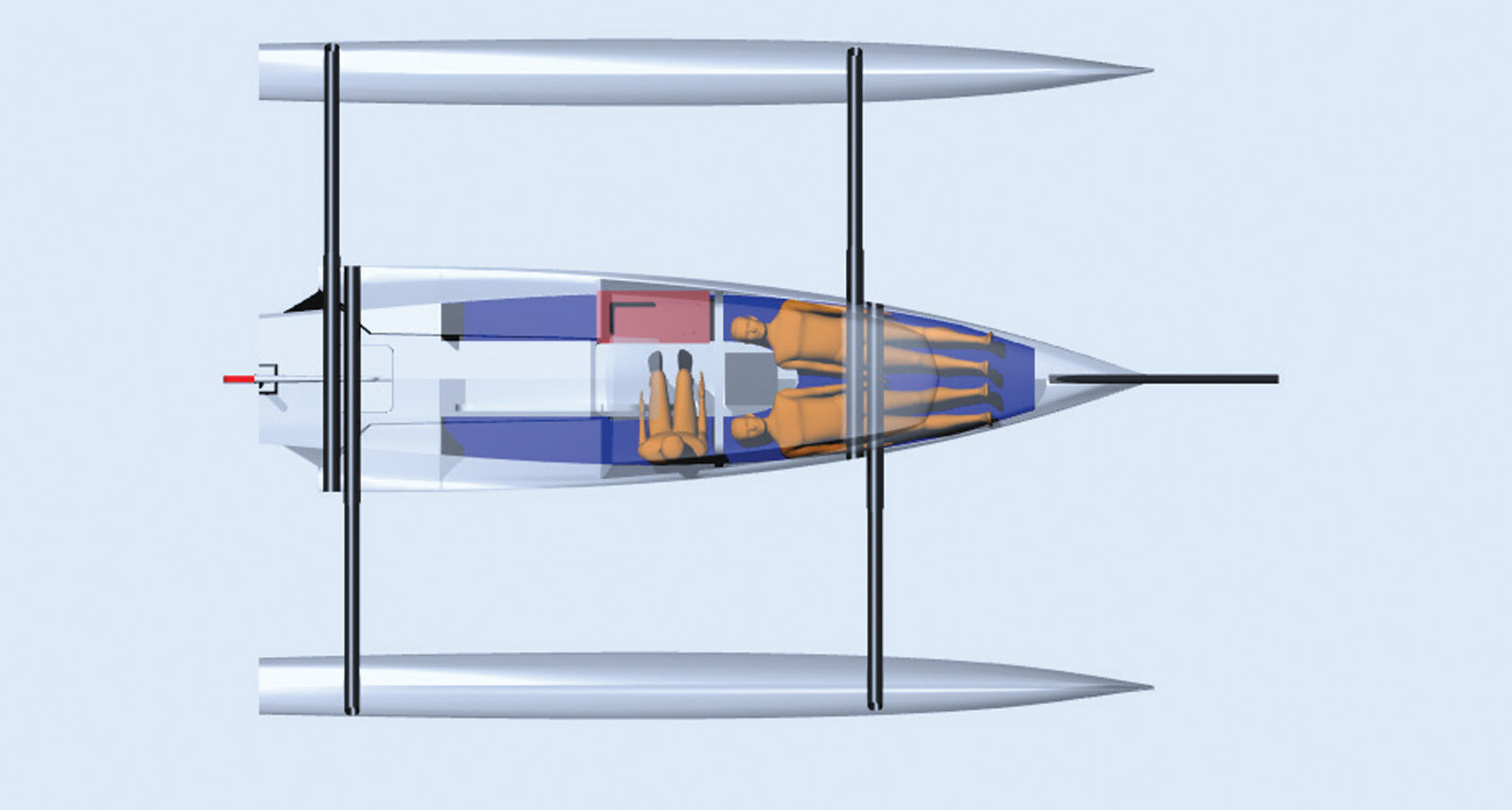
The 20.5, like all the Astus models, uses the telescopic arm technique. Slightly offset by 15 cm (6”) - starboard forward, port aft -, they fit into their brackets. To preserve watertightness, they are located on the deck and are invisible thanks to the anchor locker. The advantage of this system is that it’s mechanically very simple: the folded-up assembly is still the same overall length, and... it is not expensive. On the other hand, the arms are simple straight tubes, obviously lower than “real”, streamlined arms. As a result, in the breeze and the chop, it can get a little wet. Not too much though, as the 930-liter (33 cubic feet) volume of each float corresponds to almost 50% of the light displacement. To retract the arms, you slacken off the trampolines, remove the pins, and all that's left to do is to grab the outer shrouds and pull inwards: the float comes to rest against the central hull. A job easily done in less under five minutes.
TECHNICAL SPECIFICATIONS
Builder: Astus Boats
Overall length: 5.95 m (19’6”)
Waterline length: 5.90 m (19’4”)
Beam: 2.48/4.50 m (8’1”/14’9”)
Draft: 0.3/1.25 m (12”/4’1”)
Mast height: 8 m (26’3”)
Upwind sail area: 21/24 m² (226/258 sq ft)
Gennaker: 19/23 m² (205/247 sq ft)
Asymmetric spi: 30 m² (323 sq ft)
Unladen weight: 470 (central hull in infusion) or 490 kg (1,036 or 1,080 lbs)
CE Category: C/5 D/7
Number of berths: 2
Hull construction: polyester
Motor: 3 to 5 hp outboard or electric
Price: from € 22,417 ex-tax
Main options in € ex-tax
Gennaker (19 m²) and furler: 1,658
Asymmetric spi 30 m²: 1,992
Aramid sport sails: 1,500
Mainsheet traveler: 575
Removable table: 242
Hull in infusion: 1,658
Carbon mast and boom: 3,250
Braked trailer (900 kg/1,985 lbs): 3,317
The plusses:
Performance
Ease of use
Price
Minuses:
Motor operation hindered by the aft beam
No adjustment of the jib sheeting points
