With this model, Astus Boats has completed the update of its range. All the models - the 14.5, the 16.5, the 20.5 and now the 22.5 - carry the prestigious VPLP signature. The Astus 22, which has been around for 12 years, has unsurprisingly slipped from the catalog. As for the 24, it is still in there for now, but is soon to bow out. The positioning of the shipyard is therefore more than ever the small, transportable, simple and accessible multihull.
Infos pratiques
- Le chantier : Astus 22.5
- La fiche technique
-
 Découvrez notre vidéo exclusive
- Financez votre Astus 22.5
- Assuez votre Astus 22.5
- Articles autour du Astus 22.5
Test location: La Trinité-sur-Mer, France
Conditions: Wind - west 12 to 16 knots, Sea state - slight
The timing was very tight for us to publish this test in this issue: in fact, Jean-Hubert Pommois, founder and manager of Astus Boats, welcomed us aboard his brand new Astus after only one day of testing... A risky gamble, but one that paid off, since this 22.5 turns out to be particularly welldesigned. To begin with, we were lucky with the weather; this July in Brittany has been cool, wet and very windy... but for one day, we were able to enjoy clear sunshine and an ideal breeze of force 3 to 4.
Modern design
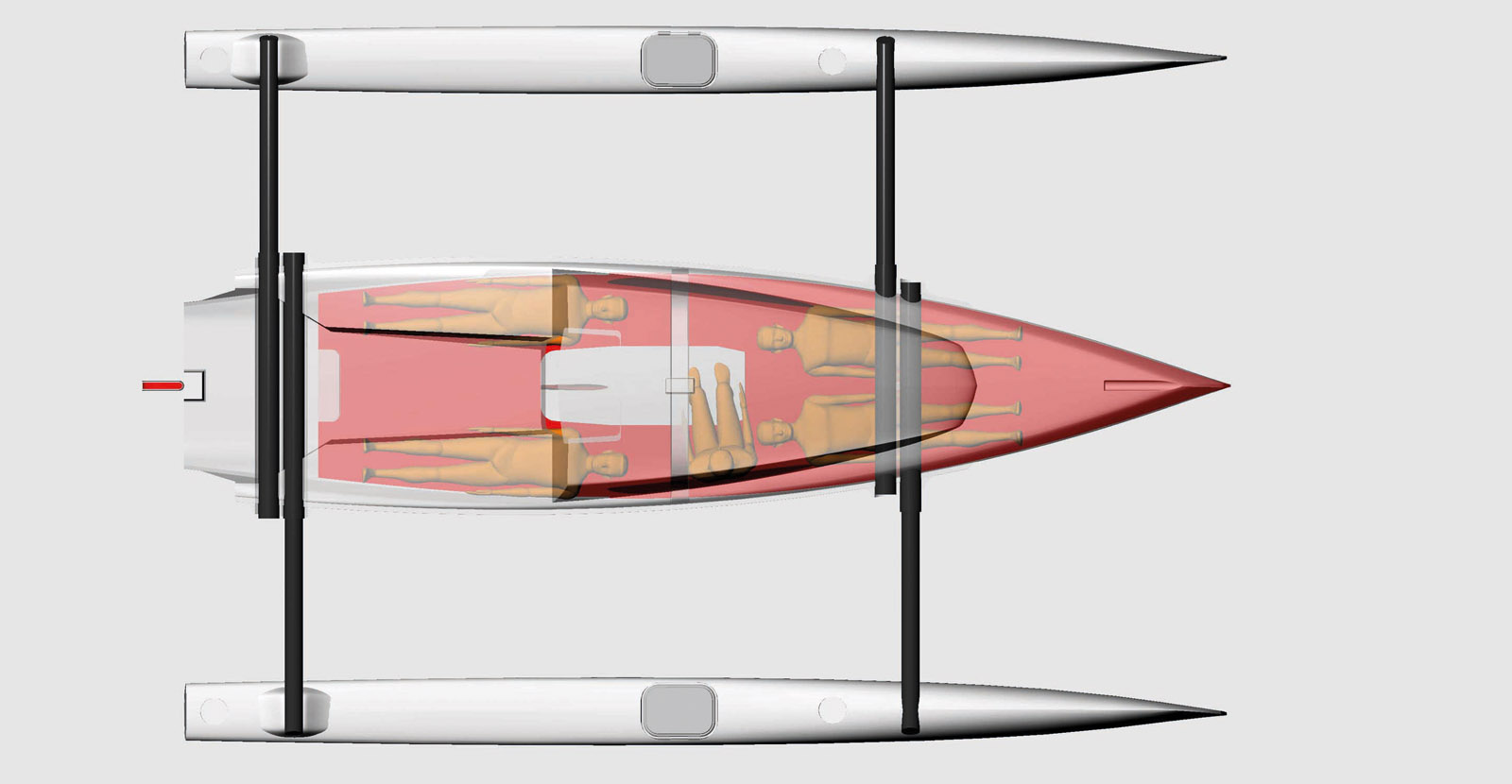
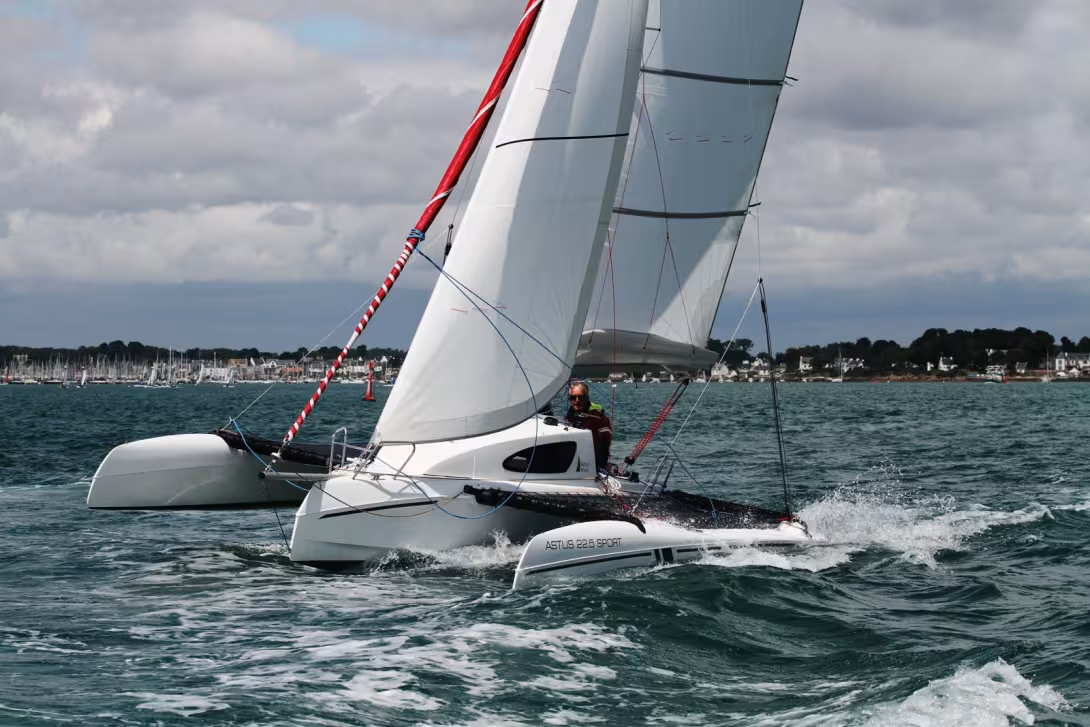
We discovered the Astus 22.5 on its mooring, almost under the famous white Kérisper Bridge. The steeply inverted bows, the marked chines and the plunging topsides at the front immediately evoke performance - the VPLP touch is at work here. The mast is slender (the profile is 30 feet / 9 meters in length) and the platform remains stable thanks to a slight dihedral form. The central hull manages to reconcile a narrow waterline with decent beam at deck level. The floats, with over 40 cubic feet (1,150 liters), have a remarkable volume of 160% compared to the light displacement. These are attached to the central hull by strong telescopic aluminum tubes.
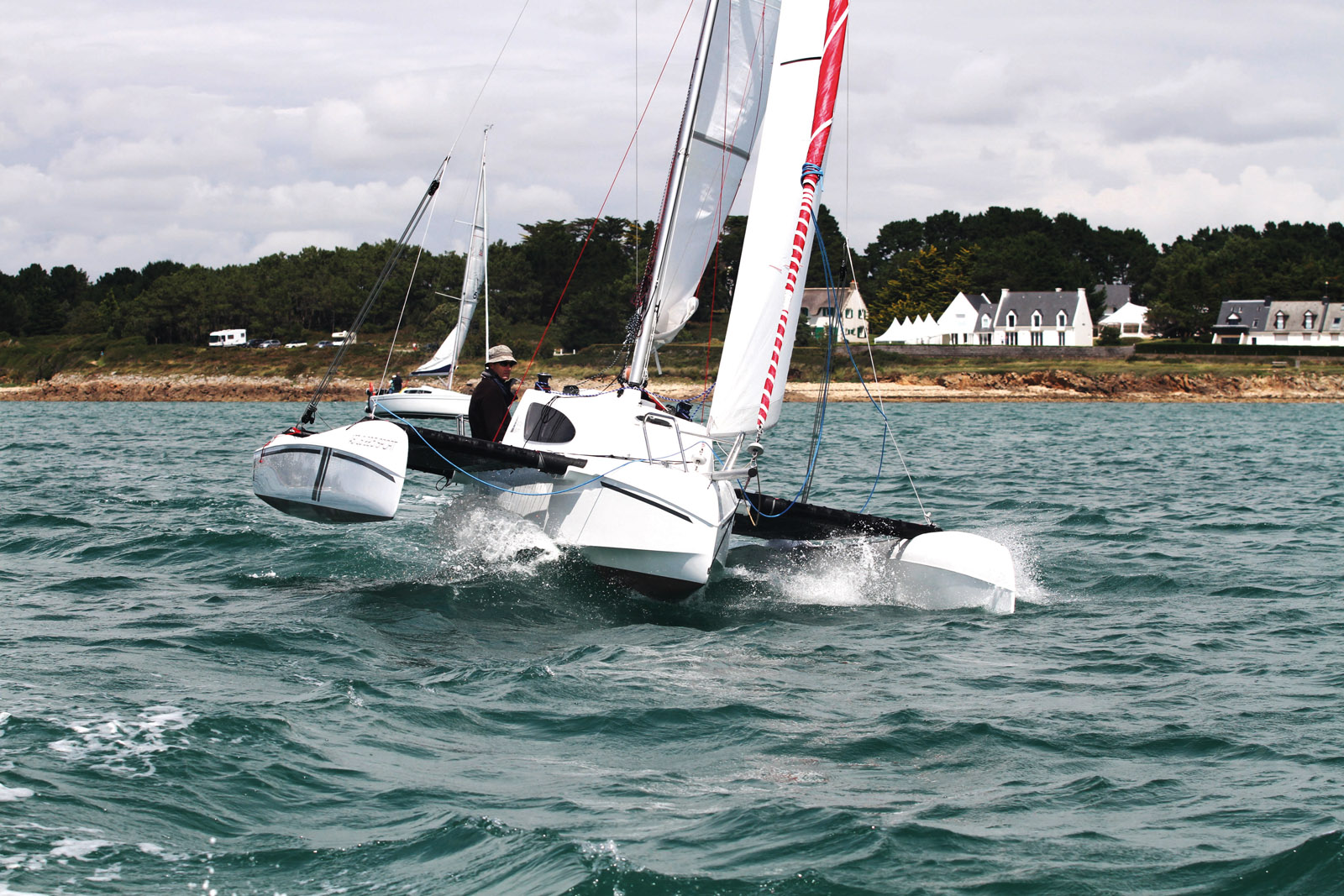
In addition to narrowing the beam at the waterline while preserving the volume above, the chines are very effective in deflecting spray.
Easy to rig
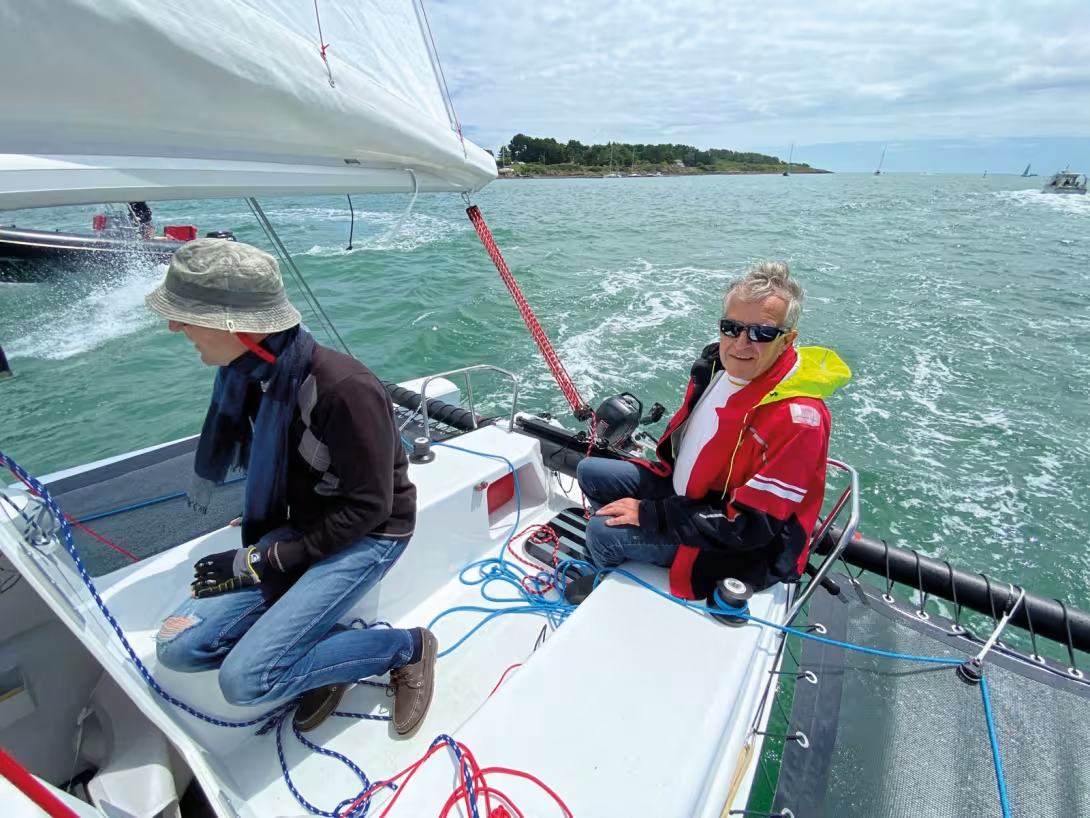
The advantage of small multihulls is their ease of getting ready: in less than five minutes, the engine is started, the mooring slipped, the mainsail hoisted and the solent unfurled. The deck layout offers a large cockpit with 5’3” (1.60 m) bench seats and vast 12’ (3.75 m) long trampolines. At the bow, the large open pulpit makes it easy to set up the bowsprit and gennaker - but also to anchor: the anchor locker is hidden at the front of the coachroof to optimize centering the weight. Moving around on deck is easy. On the other hand, the tube supports at the after end of the cockpit somewhat separate the helmsman from the controls for the outboard motor - the same goes for setting up and lifting operations. However, access to the small aft platform and the bathing ladder is not a problem. At the back of the boat, the manufacturer has provided a large locker, measuring 3’7” (1.10 m) long, 22” (0.55 m) wide and 18” (0.45 m) deep. The deck hardware is simple, almost too much so - a pair of jibsheet track would not be a luxury. The advantage is that this small trimaran can be tamed immediately, even by a not very experienced crew. Single-handed sailing, as long as you have a little autopilot, presents no problems. In each float, a large storage volume is provided, accessible through a deck hatch. A small area in the aft third of the boat could do to be reinforced - the deck of the float is not so solid under the weight of a crew member.
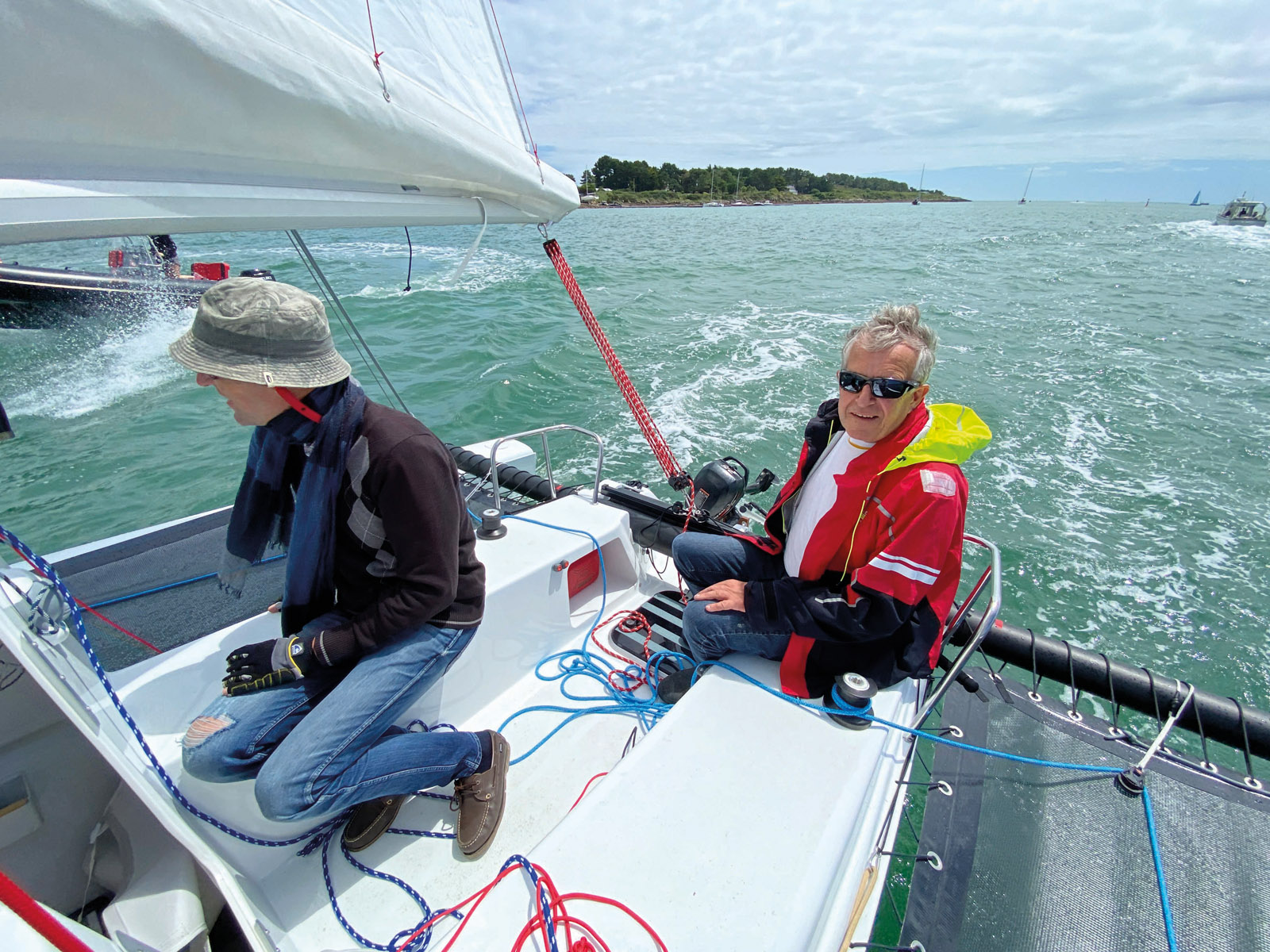
The cockpit is well laid out, but the double aft beam hinders access to the outboard.
Average speeds generally in excess of 10 knots
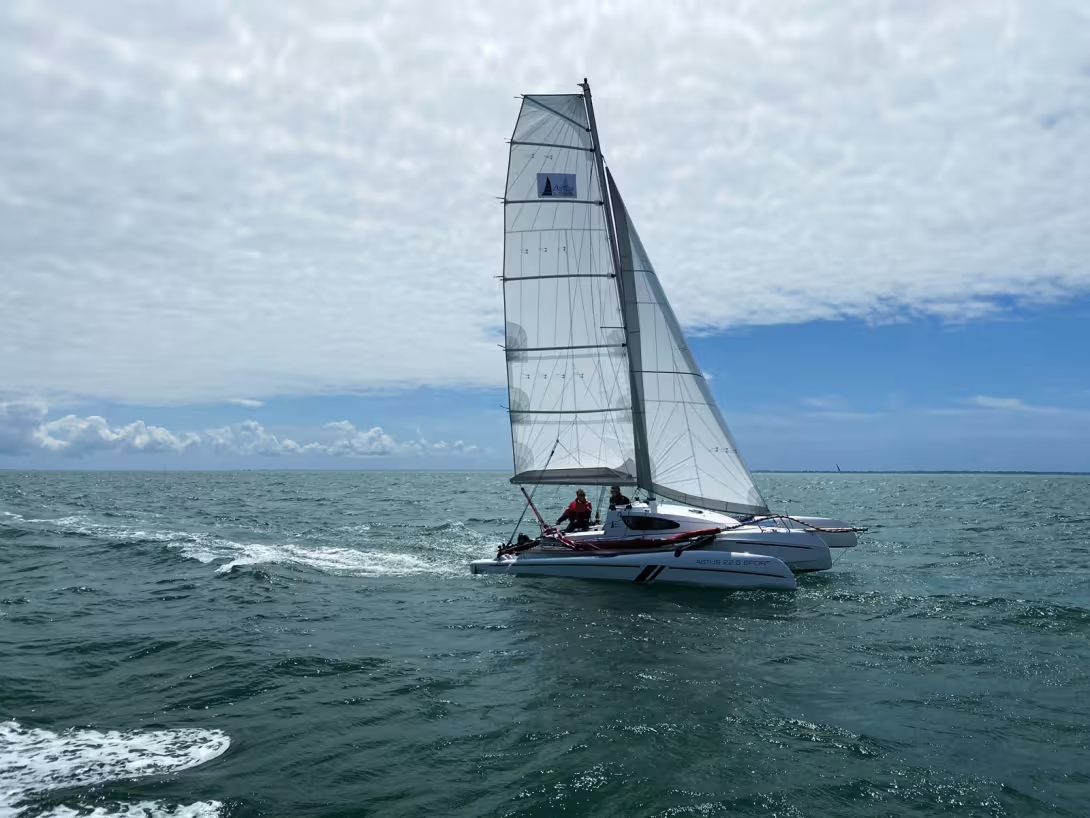
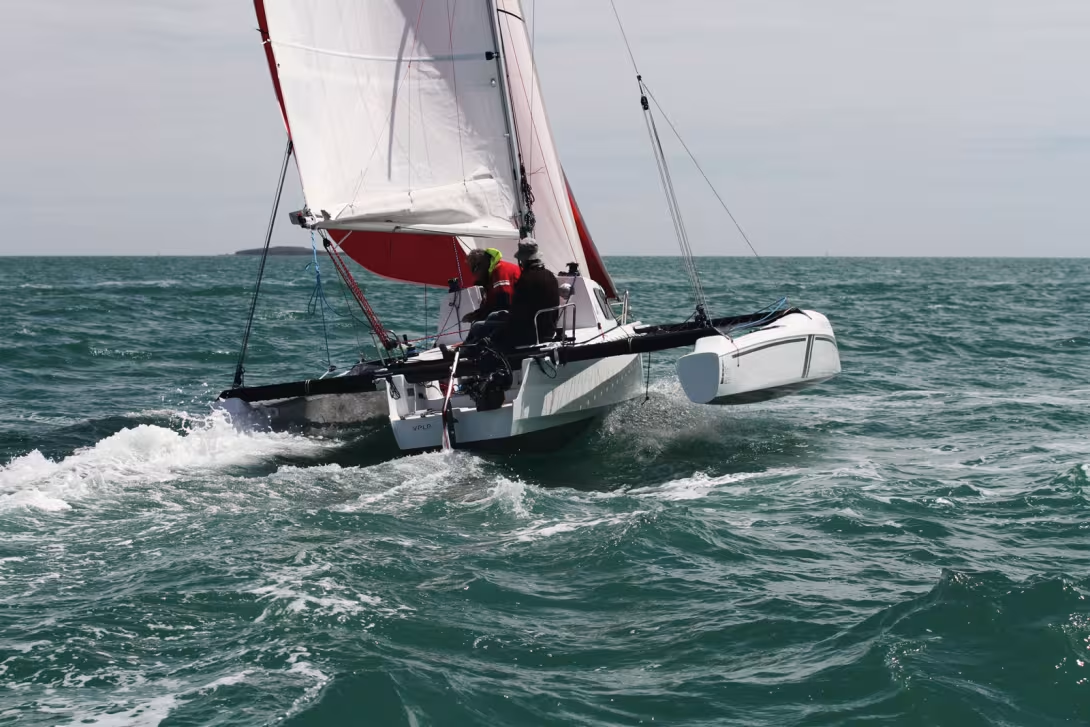
We began our test with some short upwind work and then freed off in the channel of the port of La Trinité. The wind established itself at 14 knots. We noted 7 knots upwind at 45° to the true wind and already 9 knots with the wind on the beam. Tacks and gybes followed one another with ease, never getting stuck in irons. The pivoting daggerboard is off-center to port, but this dissymmetry is imperceptible at the helm. The helmsman is well supported thanks to the pushpits that can be leant against - the foam was missing on this Astus 22.5 #1 but we’re sure that the whole thing will be comfortable! We set off again a little further south-southwest in the bay of Quiberon to make a bit to windward. With a little more chop, the Astus 22.5 confirms its ease under sail: the hulls go through the sea smoothly and the chines deflect almost all the spray. As for the tubes (which do not necessarily have any of the features of a streamlined linkage arm), they are sufficiently raised to free themselves from the any seas that run flush with the leeward trampoline. Now it’s time to unfurl the gennaker - our test trimaran’s sail is scheduled to be reworked; it suffers from too much volume in the upper third, which makes furling tricky. Not surprisingly, we’re instantly in turbo mode, making an average speed of 13.5 knots and a few peaks at 16 knots when the wind is right. The helm is hardly heavy, though it was more so the day before in much stronger wind. But with the big, unreefed square-topped mainsail and XXL gennaker in 18 knots of true wind, you start to feel it... The memory of these long runs remains an excellent feeling of gliding across the water, and the pleasure of sailing twice as fast as you would on a monohull 10 feet longer…
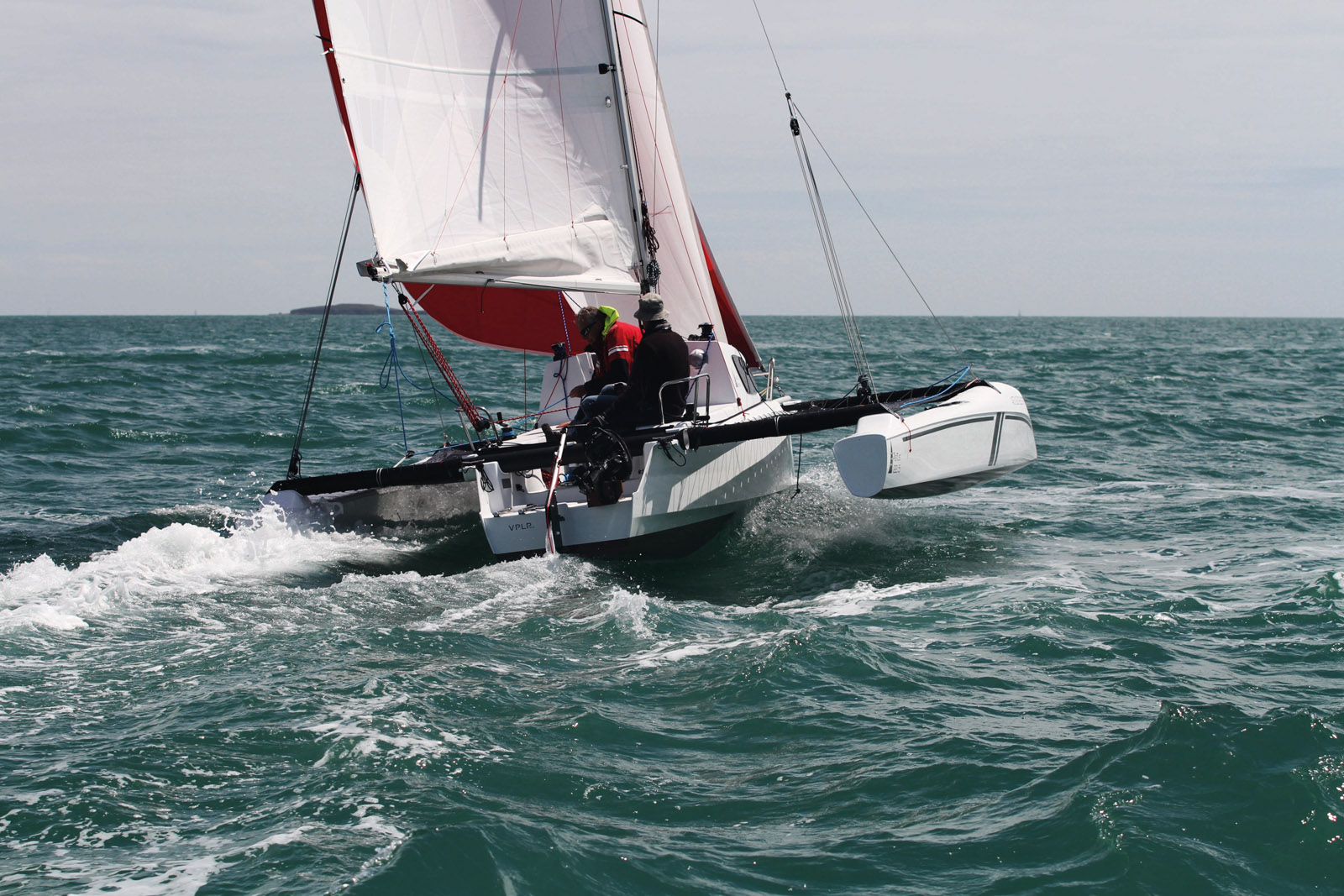
The gennaker is unfurled, trim the sheet, and the pure sensation of gliding across the water begins!
Surprising volume
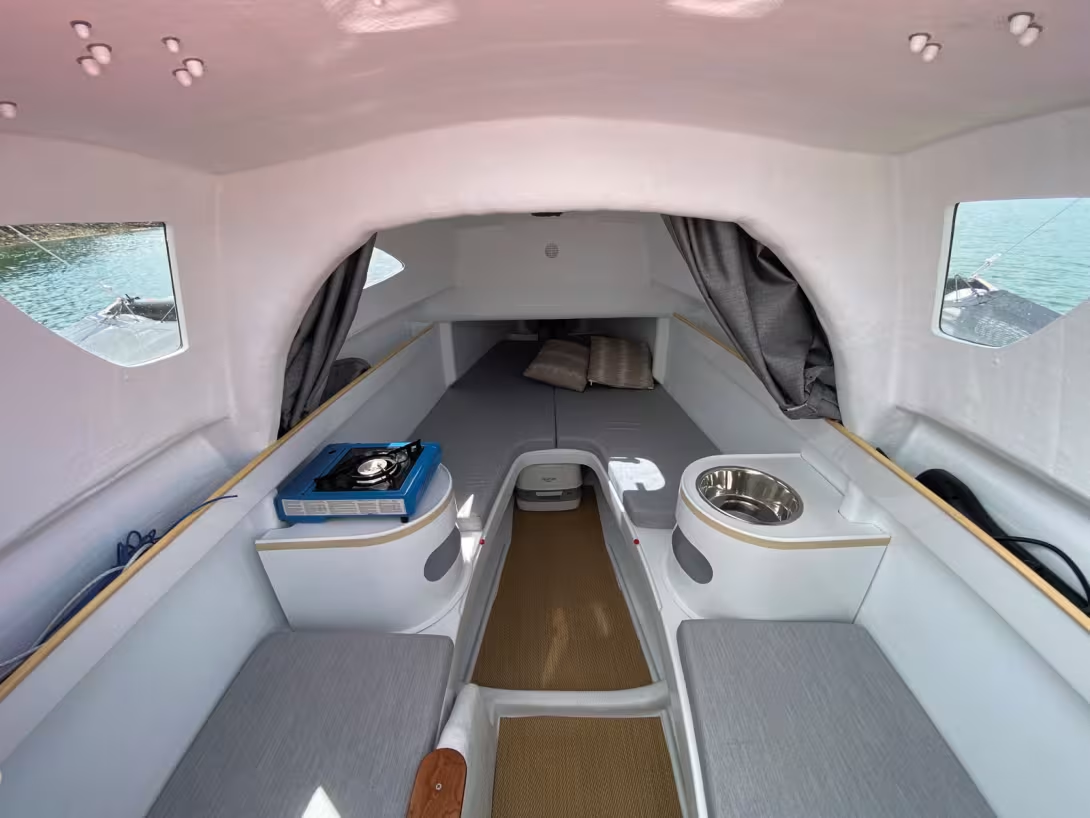
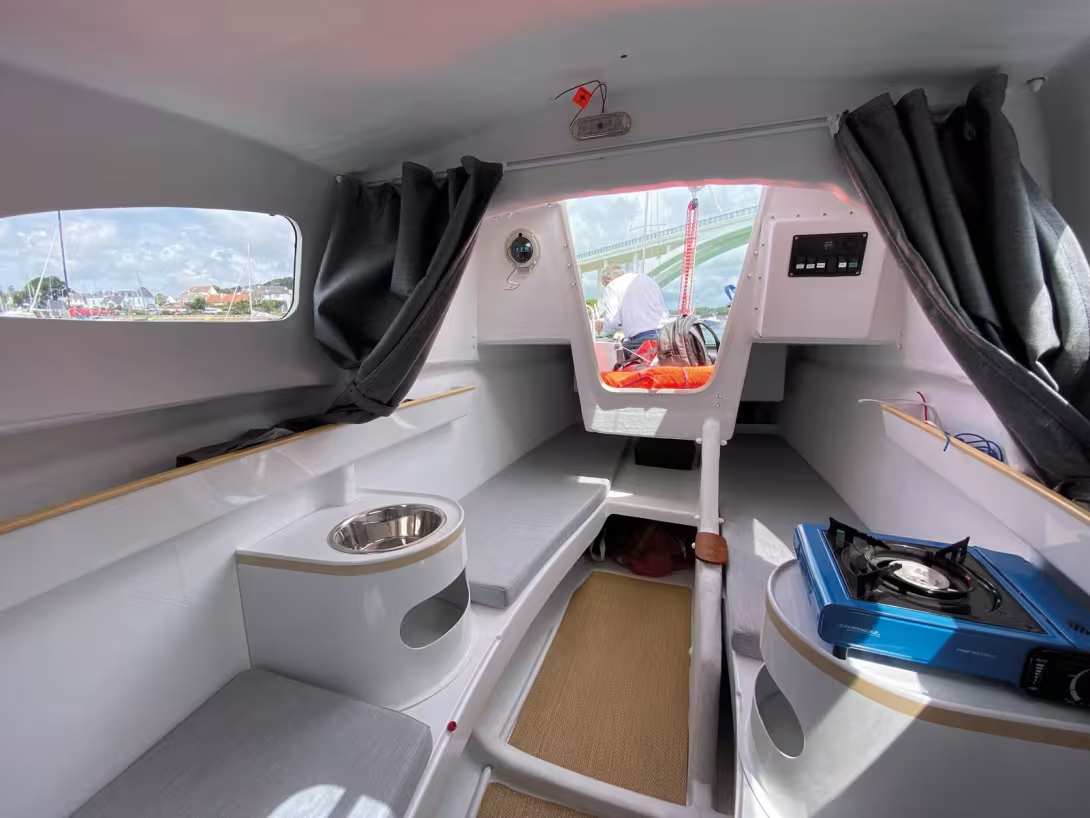
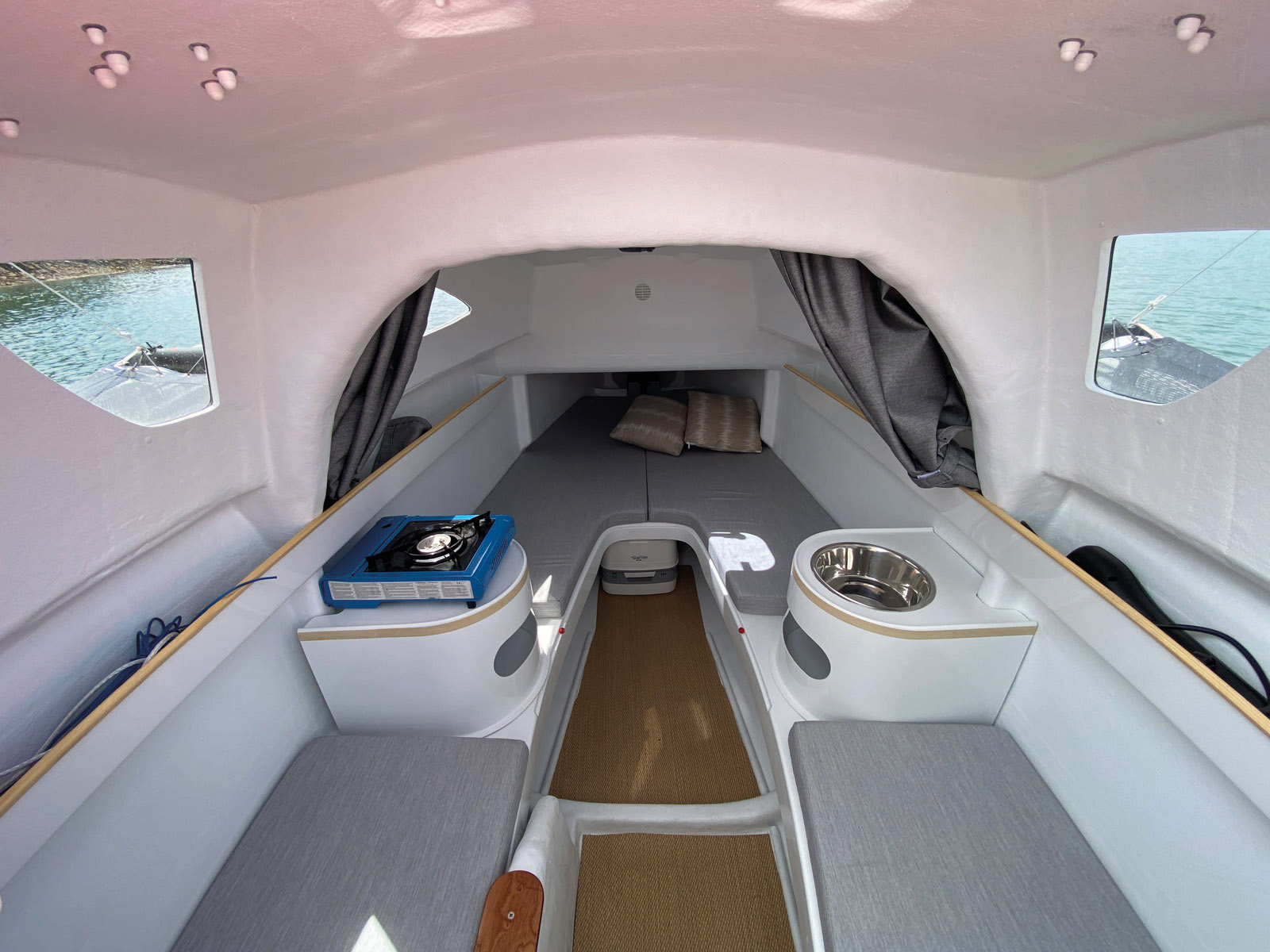
The companionway hatch can be completely removed to allow free access in fine weather. We were surprised by the volume down below; the headroom reaches 5’3” (1.59 m) and there are four berths. Of course, the side benches are narrow – 18”/ 46 cm - but the forward double berth manages to spread out over 6’6” (2 m) in length, 4’7” (1.4 m) at the head in width and still 28” (0.7 m) at the feet, right at the front. Note: the tube footprints are relatively high, at just over 16” (0.41 m) above the mattress. You access the interior by using a mini - but really that mini - wood step fixed on the daggerboard well offset to port. By juggling with the galley furniture, five people can sit in the saloon. The gas stove will have to find a safer place - just to avoid setting fire to the curtains... The table is foldable so that it can be used in the cabin or in the cockpit. Numerous lockers and storage compartments are accessible - beneath the cockpit sole, and under the bench seats. The manufacturer also offers additional storage units.
 |
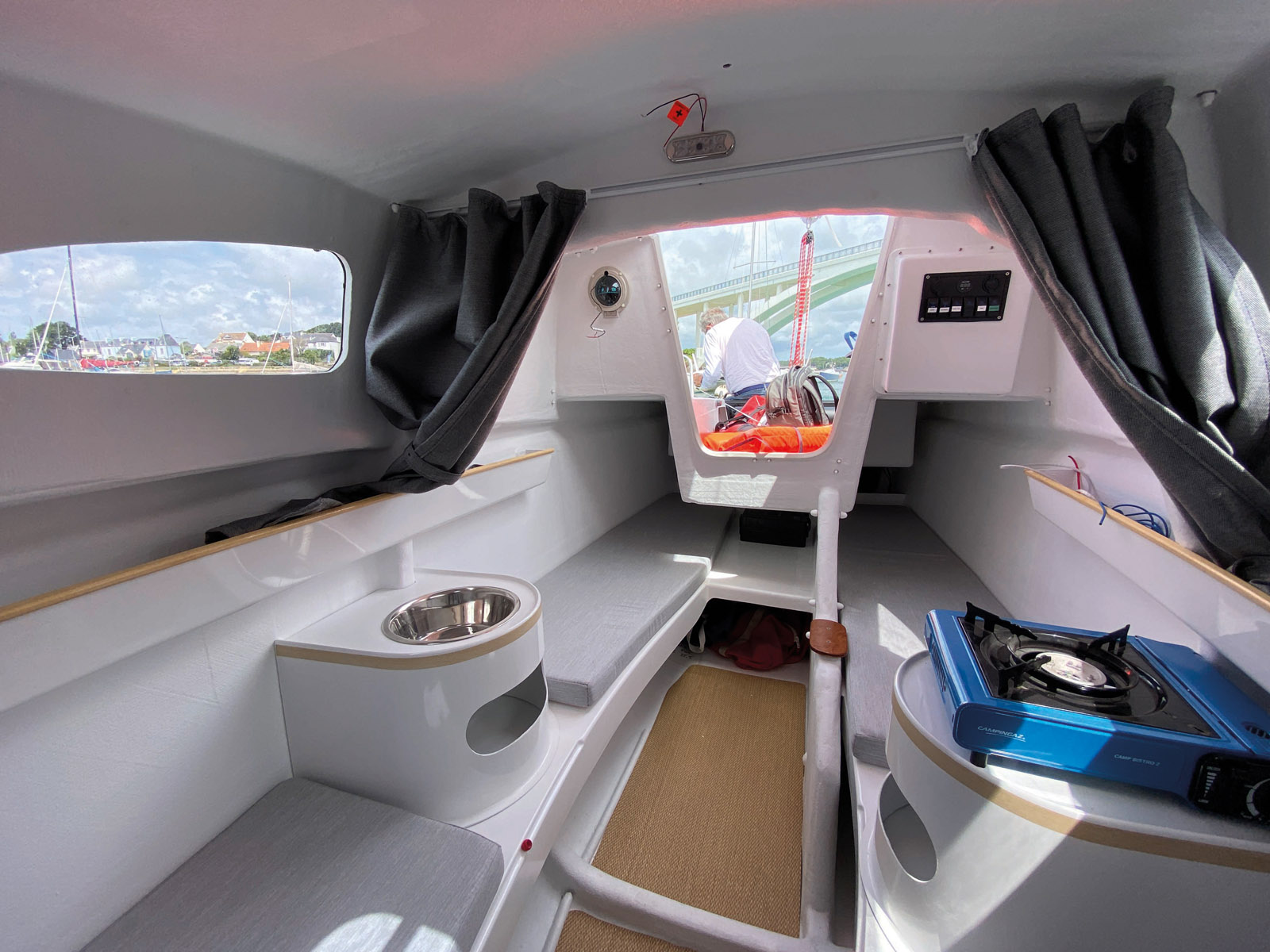 |
In the cabin, the layout is much more comfortable and cozier than you might expect.
Telescopic arms
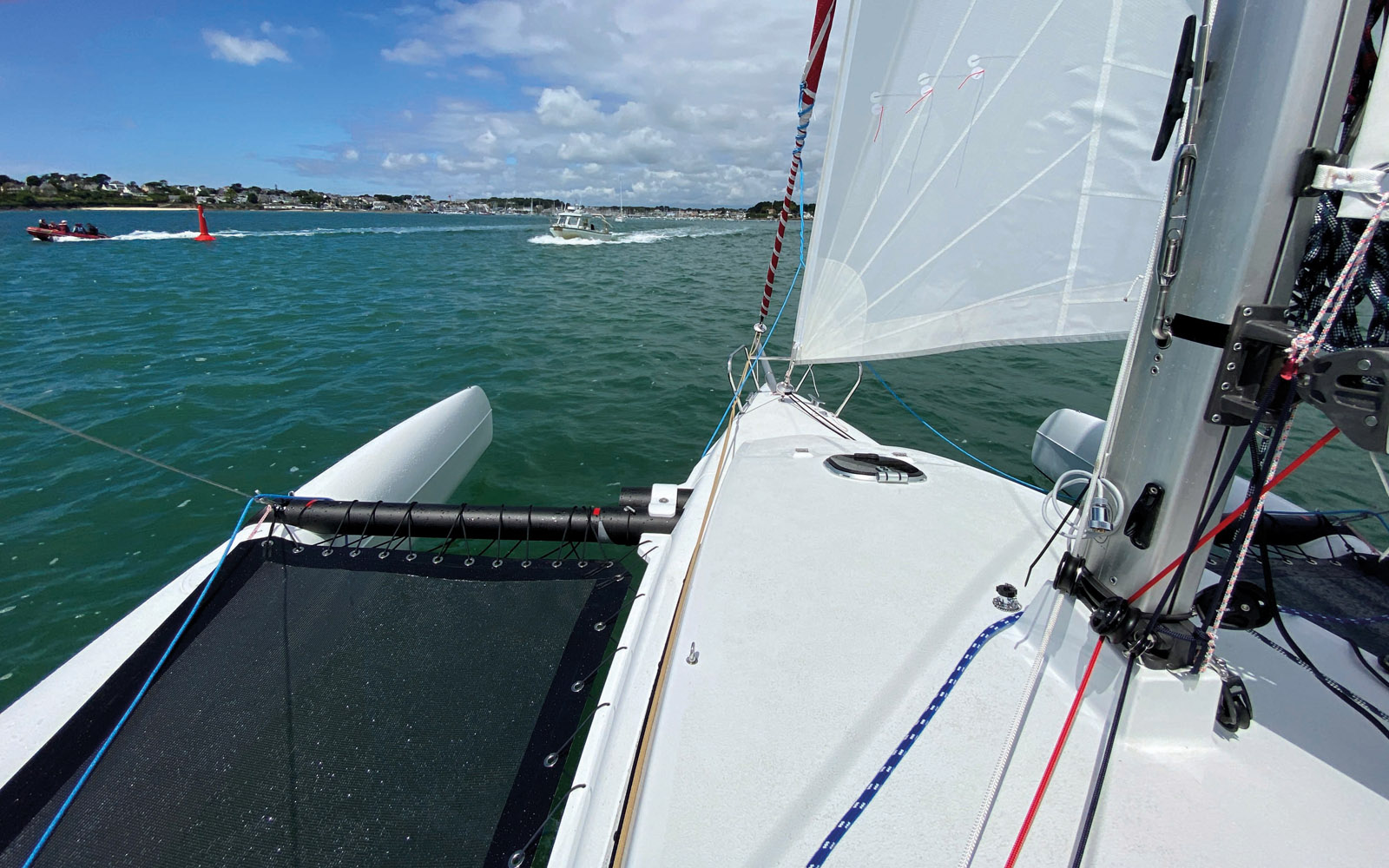
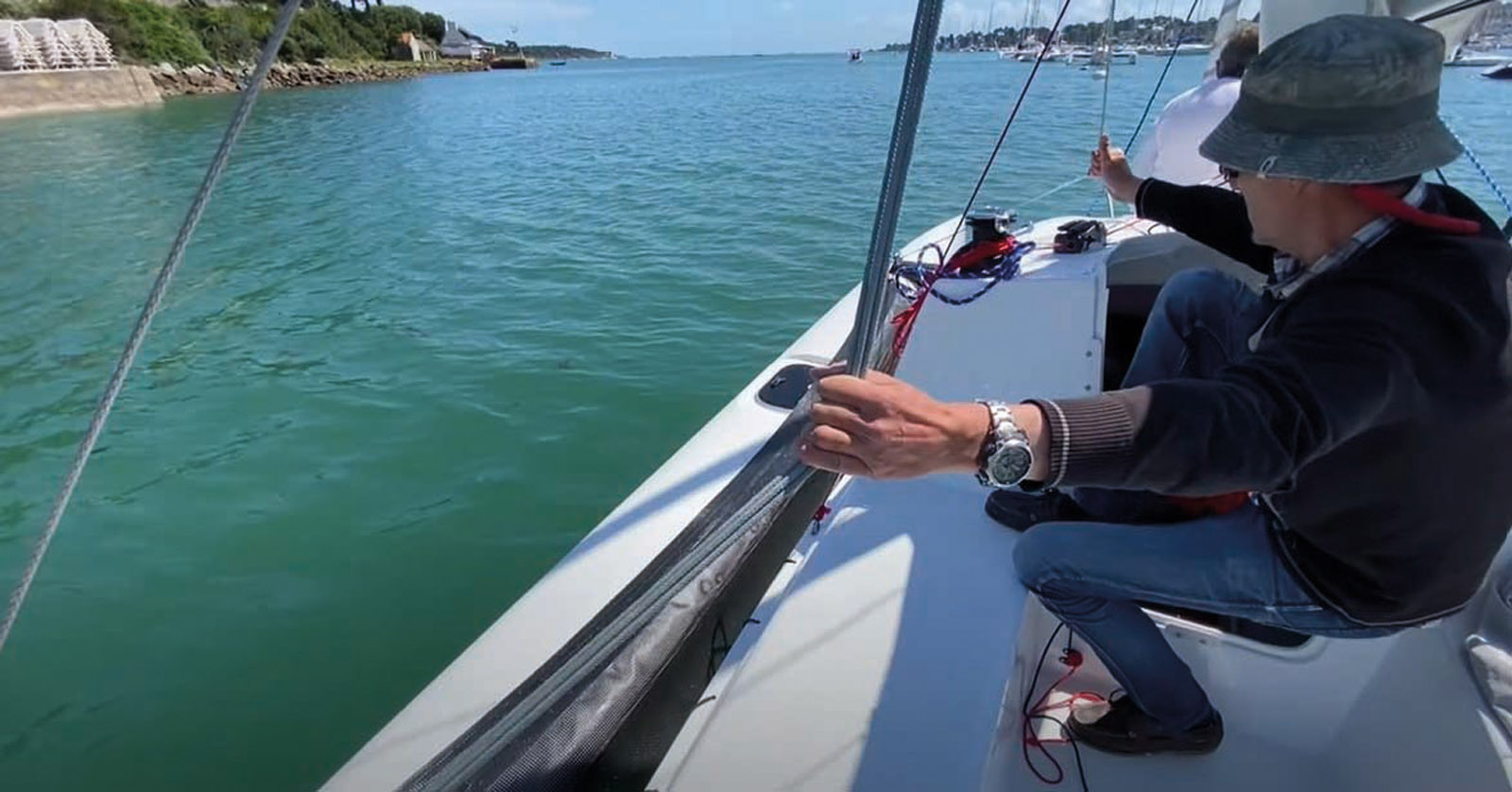
It’s clear to see that the 22.5 follows the same formula as all the previous Astus in terms of structure/folding: the linkage arms are made of strong stainless-steel tubes that each slide into a cavity - a tube of just slightly greater diameter. As a result, the arms are slightly offset; the starboard one is slightly forward of the port one. Once moored back on our buoy, Jean-Hubert folded the port float; the lateral rigging needs to be loosened off and the trampoline (aft side) must be slackened to achieve this. Then he removed the pins from the tubes to bring the float closer to the central hull. The operation is very easy... as long as the trimaran’s trim isn’t putting any load on the tubes. An extra pair of hands might help.
 |
 |
1- This image shows how the two telescopic linking arms are offset.
2- Folding the floats afloat is possible as long as the trim of the boat can be controlled so that the tubes and brackets are not put under strain.
Conclusion
This new Astus 22.5 is a very convincing small trimaran. Without being high tech, nor having pretentions of astounding performance, it offers the crew a real ease of use, sufficient comfort for coastal cruising and the option to be transported by a medium-powered car to reach new cruising grounds. An attractive program, don’t you think?
The Pluses
+ Great performance
+ Layout and volume of the central hull compatible with coastal cruising
+ A truly transportable trimaran
The Minuses
- Engine access far from the cockpit seats
- Reinforcement required on the after end of the deck of the floats
- Folding process not so easy afloat
TECHNICAL SPECIFICATIONS
Builder: Astus Boats
Architects: VPLP DESIGN
Material: GRP infused polyester
Overall length: 27’3” (8.30 m)
Hull length: 22’8” (6.90 m)
Length of floats: 22’6” (6.85 m)
Beam unfolded/folded: 15’5”/8’3¼” (4.70/2.52 m)
Draft: 13”/4’7” (0.34/1.40 m)
Mast height: 30’ (9 m)
Light displacement: 1,590 lbs (720 kg)
Fully battened mainsail area: 226 sq ft (21 m²)
Solent: 97 sq ft (9 m²)
Gennaker: 345 sq ft (32 m²)
Outboard: 3.5 to 9 HP
Berths: 4
CE certification: C5/D7
Price of the Astus 22.5: € 41,500 ex-tax
Principal options ex-tax:
Electrics pack: € 1,125
Mattress and berth board: € 1,292
Removable cockpit table: € 217
Chemical WC: € 162
2 galley cabinets and stove: € 479
Carbon rig and fiber shrouds: € 5,333
Sport gennaker on furler plus bowsprit: € 2,333
Sport sails in Aramid Black Technora: € 1,833
2 x ST15 Harken winches: € 817
Pushpits and helmsman backrests: € 742
Bathing ladder: € 242
Outboard bracket: € 292
Navlights: € 650
Ground tackle: € 150
Braked road and launching trailer: € 4,000
Mast stepping strut: € 292