
Despite its old design, the Corsair 24 remains up to date: exciting on the water and easy to use, it can be forgotten on its trailer and meets the trailing limits. In short, the pleasure boat par excellence!
Infos pratiques
- Le chantier : Corsair 24
- La fiche technique
- Découvrez notre vidéo exclusive
- Financez votre Corsair 24
- Assuez votre Corsair 24
- Articles autour du Corsair 24
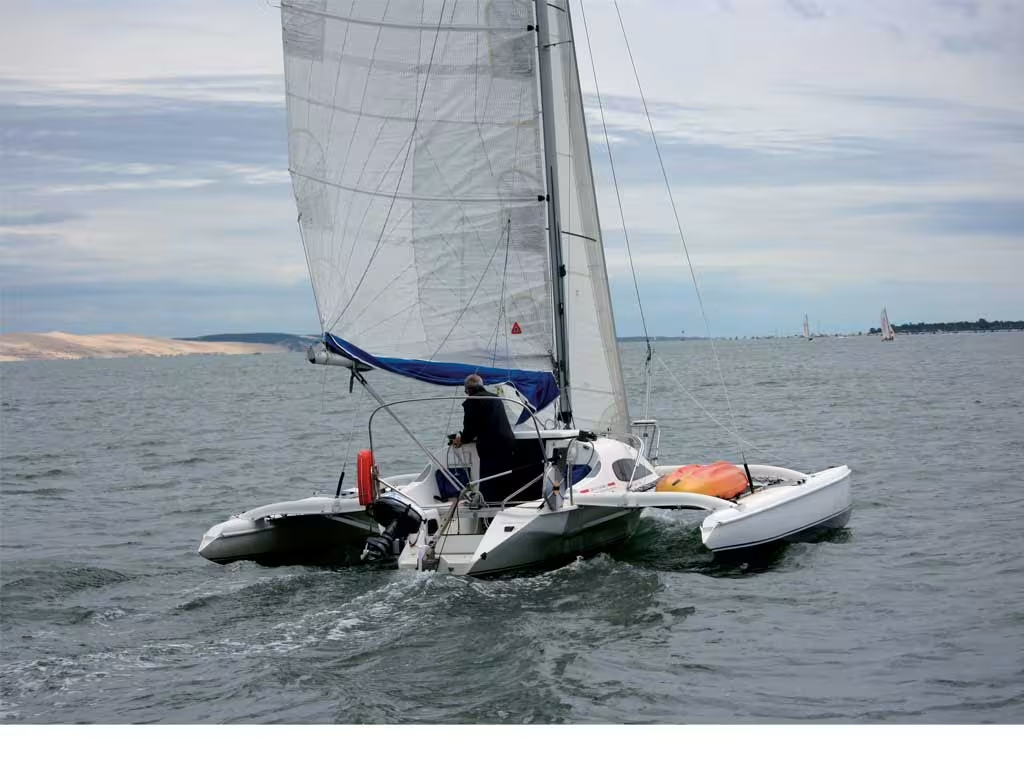
The Corsair 24 Mk2's three bows crunched on the sand. I hauled myself onto the port trampoline and off we went. "When you have 15 knots of wind, you sail at 12! My record is 17 knots, with full main and gennaker. There was 21 knots of wind. The boat is so easy, we reach these speeds without noticing." Alain Lemardeley, owner of Entre deux mers for two years, made my mouth water even before we hoisted the sails. A formality aboard a little trimaran measuring barely more than 7 metres: the fully-battened mainsail was hoisted by hand, the jib unrolled and the speedo cheerfully exceeded 10 knots. As simple as that. And all this whilst remaining level and almost dry! Flashback: designed by an incredibly avant-garde architect/sailor, the Corsairs remain today a reference in small, fast trimarans. The Australian, Ian Farrier, developed the folding arm system on his multihulls in...1975, with the Trailertri and the Tramp. Well before the problems with marina berths! The prototype of the first Corsair, the F-27, was launched in 1985. The smallest, the F-24, was unveiled in 1991. Three years later, a Mk2 version appeared, whose rotating mast advantageously replaced the classic rig of its predecessor, whilst the centreboard became a daggerboard. It is this model, built in Australia in 1996, that Alain bought two years ago for 35,000 euros, with the trailer. The trimaran lost its 'F' in 2000 to become the 'C24' (linked to a rights problem between the builder and the architect), with no notable changes, and was produced until 2008, with a total of more than 300 boats. It was then replaced by the Dash 750, which presents a new float design – more voluminous – a textile rig and a more innovative bowsprit.
Convinced by the trimaran in one outing
Our skipper wasn't a multihull enthusiast: he had sailed for a long time in an Edel 6, a First 24 then a 300 Spirit, a 9- metre cruiser, aboard which he embarked for the Transquadra – two-up –in 2002 and 2005. On his return from the West Indies, Alain became interested in transportable sailing boats which could be stored in his garden. He tried the Multi 23, and was convinced by the trimaran! "I found the boat brilliant, but not very liveable." Alain then took an interest in the Corsair and Dragonfly, and finally fell for this particularly attractive F- 24, with its folding arms (in just five minutes) and its kit for stepping the mast. His only regret? Not having done it sooner! The boat proved to be great fun on tidal waters, and the whole family was delighted with the trimaran. "The women loved it; it didn't heel!" Alain recalled. Thanks to the marked longitudinal step in the hull, the accommodation presents an attractive volume, a functional galley and four real berths. It lacks a 'real' heads, certain people would say... The chemical WC is nevertheless fitted under the forward berth. On the other hand, there is no limitation on headroom, thanks to the lifting roof. Here Alain finds again one of the charms of his Edel 6, which was also equipped with a similar hatch... The deck plan is very convincing in use: the cockpit is relatively wide – for a trimaran. The slimness of the central hull is quickly forgotten, thanks to the two trampolines, which allow safer movement forward. Top marks for the control lines grouped together on a battery of jammers on either side of the coachroof, and the continuous jib sheet. The daggerboard is operated by two lines, and the gennaker can remain in place on its bowsprit, as long as it has an UV protection strip. It's a pleasure at the helm: not only is the feel excellent, worthy of the best monohulls, but in addition, you can let go of the tiller and the Corsair F- 24 will go in a straight line for long enough for you to trim a sail. The boat is therefore easy to manage single or short-handed. As for the speed, we understood straight away, it is very fast: "Close-hauled, we can hold our own with a monohull, but once we bear away, our boat is more powerful." The builder announced top speeds of more than 20 knots for the first version, with the fixed mast. A speed potential which is intact today!
Built for the high seas ?
Of course, at over 10 knots, it's a bit wet. But most of the spray doesn't reach the cockpit. As a regular ocean racer, Alain couldn't resist heading for the horizon. For the moment, it's been just a few trips in the Bassin d'Arcachon passes, sometimes with a heavy chop... Convinced by his F-24's seakeeping qualities, the skipper intends to go further, without neglecting safety. Alain is well aware that 24 feet is a bit small for the open sea: "This summer, I quite fancy sailing round Spain, with the return trip by road from Port Leucate. Singlehanded or with the family, we'll see." The trimaran is unsinkable as standard, but Alain wants more, in case of a big leak: "I filled the floats with bottles of mineral water, around 1500 bottles. It took me 6 months; all my friends and colleagues helped out. At the bow, Corsair has fitted a crash box, and a watertight locker. Each float is partitioned into three compartments. "I added a watertight panel under the cockpit, with another one under the companionway to benefit from an additional buoyancy volume." He will have to think about energy production, which is insufficient at the moment. "I'm looking at fuel cells." Before crossing to the West Indies? "After my trip round Spain, why not?"
The Pluses:
+ Exceptional performance
+ Overall robustness
- Huge programme
The Minuses:
- Not easy to protect the floats from getting dirty and from impacts when they are folded
- High price
TECHNICAL SPECIFICATIONS
Builder: Corsair Marine
Architect: Ian Farrier
Hull length: 7.3 m
Waterline length: 7.2 m
Beam: 2.50/5.50 m
Draft: 0.3/1.4m
Unladen weight: 768 kg
Mainsail area: 22 m2
Genoa area: 14 m2
Gennaker area: 30 m2
Asymmetric spinnaker area: 60 m2
Engine: 6hp outboard
Production: 300 examples from 1991 to 2008
Second-hand price: 30,000 to 40,000 euros