Corsair was created by a New Zealand architect in California, and has built more than 1,200 folding trimarans between 1984 and 2008, which makes it the leader in this segment, along with the Danish Dragonfly. We have just tested the biggest of these trimarans, the Corsair 36...
Infos pratiques
- Le chantier : Corsair 36/37
- La fiche technique
- Découvrez notre vidéo exclusive
- Financez votre Corsair 36
- Assuez votre Corsair 36
- Articles autour du Corsair 36
The 36’ has now been replaced by the Corsair 37, a re-styled version of the same boat. Taking into account the small number of examples present in Europe, we leapt at the chance to test one, whilst waiting to present the 37’ carbon (RS) development.
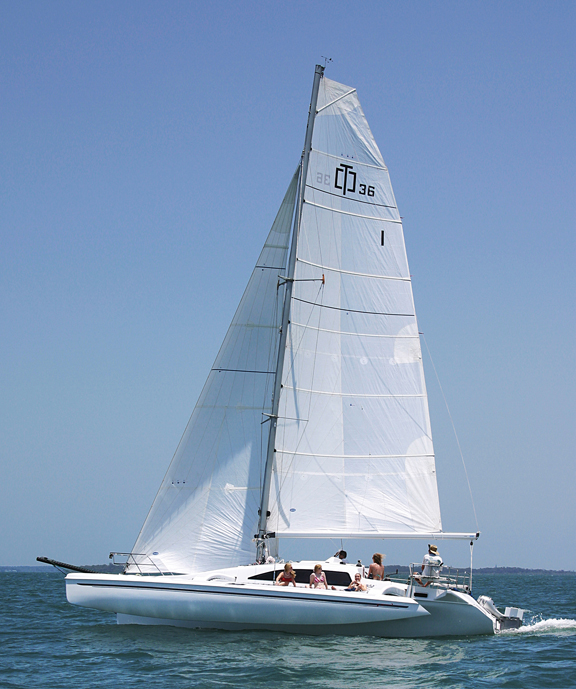
Aluminium rotating mast, carbon bowsprit and nice Pentex sails by Calvert Sails: the Corsair 36 offers simple but high-performance choices!
The split with the founding architect
In 2000, Ian Farrier left the Chula Vista company that he had created and of which he was the vice-president and the emblematic architect. The disagreement with Paul Koch, the new strong man at Corsair (an Australian who built the Farrier Ostac), led the designer to return to his New Zealand offices, from where he re-launched his own range (F82, 32’, 36’ and 39’), intended for individual (up-market) construction, and Australian and Phillipine (Melvest Yard) production.
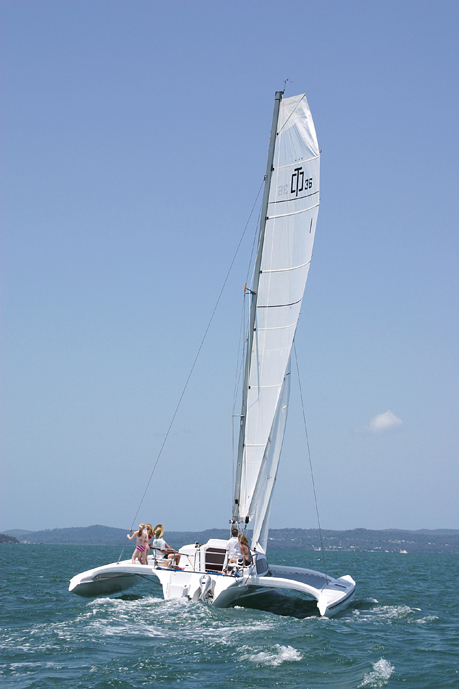
A really liveable trimaran which allows you to envisage offshore cruising...
The 36’- 37’: the flagship of a turbulent range
The 36’s characteristics show clearly that it belongs to the Farrier line, and it is obvious that despite the difficulties, the Corsair research and development department has here designed a trimaran (strongly) inspired by Farrier! Whilst awaiting the arrival of a 50’ catamaran, the 36’ – 37’ is top of the leading group of ‘big’ folding trimarans, alongside the Dragonfly 12m and 35’. The other models in the range are the Sprint and Dash 750, the 28’ and the 31’. This speedy family’s racing results are well-known and people all over the world have followed the example of the American aficionados. The achievements of Mike Horn (28’, 3 oceans singlehanded) and Yann Vincent and his partner with SALE GOSSE (31’, Antibes-Tahiti) on the high seas are at the limit of the useable specifications, but illustrate a remarkable potential.
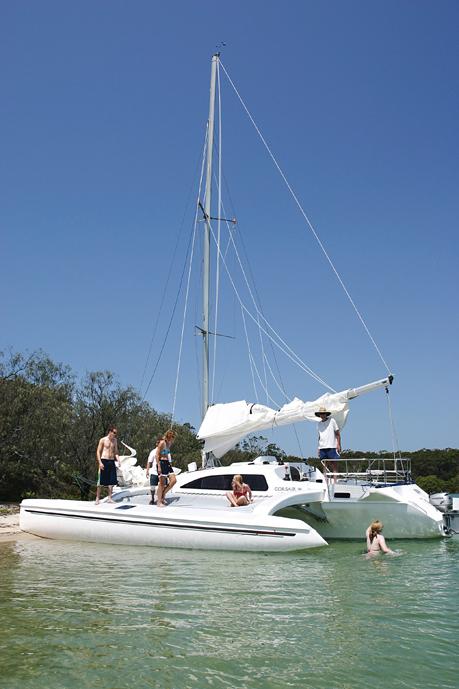
One of the Corsair 36’s advantages is that it can be beached easily. Another plus when cruising...
The ‘Made in USA’ relocates
Paradox of the 2000s, commercial competition is imposing its law on the very theoreticians of economic openness. The Chula Vista site has now been completely transposed to one of the new areas of the ‘global factory’: Vietnam! After an attempt at partial sub-contracting in Mexico, manufacture of the Corsairs has therefore left United States territory completely.
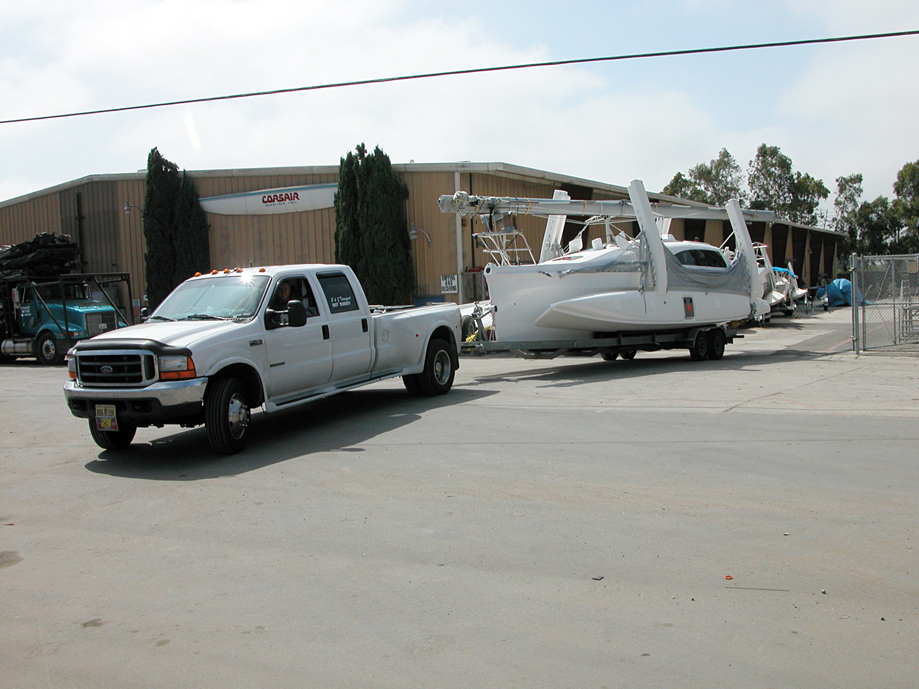
Even if we don’t do it every day, the 36 is really transportable on its trailer. Ideal for changing cruising areas.
Variable geometry multihull
Should a trimaran fold its wings in the vertical plane, or the horizontal? Depending on who you speak to, the answers will be different, or even conflicting; a comparative test would be very interesting! The vertical alternative (Farrier) appears simpler, but has the disadvantage of leaving the sides of the floats in the water, thus exposing them to fouling by marine micro-organisms! The system is now in the public domain, but it was the subject of a patent developed and made popular on the visionary Trailer Tri. The mechanical principle has remained the same on the 36’: the four ‘half-arms’ are linked to the hull by well-built mechanically welded braces, articulated around two axes; the heads of the arms are locked by two big bolts in the housings in the central hull. The assembly inspires confidence, and has no operating play at sea. The absence of shroud adjustment by spreaders means that the bottlescrews have to be loosened by a few turns to start the pivoting movement; the company says it has improved this point and the manoeuvre can be carried out in 2 minutes on the 37’. The 36’ owners consulted confided quite unanimously that they rarely folded their boat, and transported it even more rarely. However, this possibility remains an advantage which allows laying up for winter at low cost (this is the case for the 36’ we tested), delivery to another cruising area, or shipping in a container.
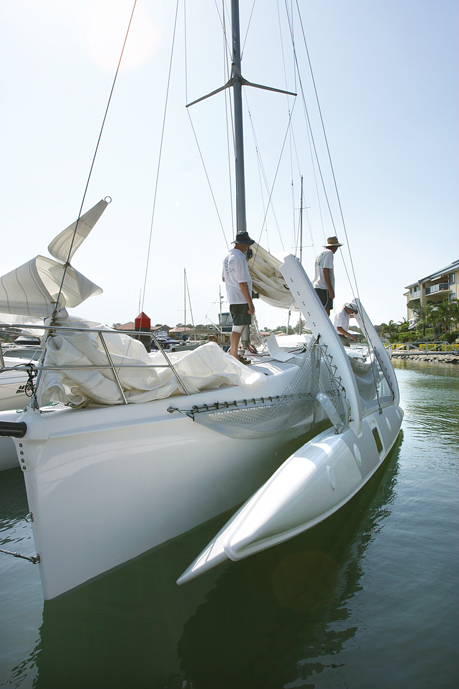
The Corsair folding system: simple and reliable.
Classic architecture for a clever multihull
A fast cruising trimaran must nevertheless find enough internal volume to make the product acceptable; the design of the central hull is therefore a headache. That of the 36’ is a success; it offers the essential slim bow sections and retains moderate beam at the waterline, the flared hull sides create volume without an abrupt step; the underwater lines flatten deliberately towards the stern to favour planing speed. The U-shaped hull with a hard chine will tolerate the load variations inherent in the programme of this kind of design (shared with its competitors), but could become a handicap close-hauled in a rough sea! The boat has practically no dihedral, but the arms’ camber allows them to be brought clear of the waves. Two stainless steel cables contribute to stiffening the assembly and stopping the longitudinal forces between the floats and the central hull.
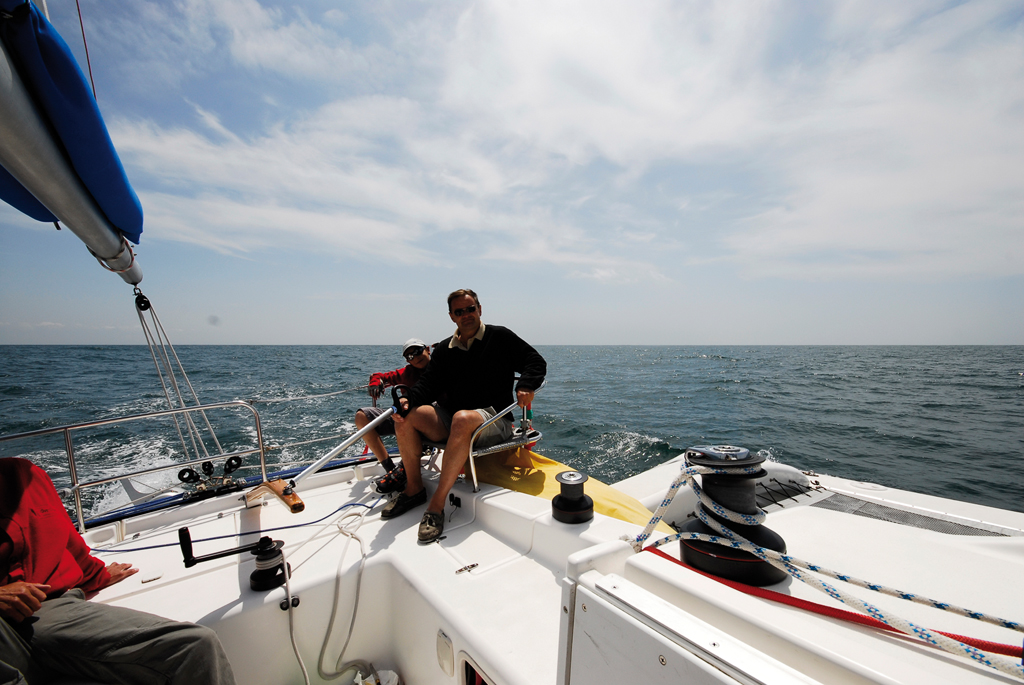
During the test, we really appreciated this mesh watchkeeper’s seat. It offers an excellent steering position.
Serious construction, but finishing which could be perfected
The builder’s experience is established, yet each model holds new challenges and the technical constraints of this type of multihull always remain subtle. The manufacturing process is classic for this kind of boat: the high carbon content arms are realised in 2 half-shells, assembled and filled with foam; the central hull and the floats are made in foam/glass/vinylester sandwich under vacuum, with Kevlar carbon reinforcements. The deck assembly sheer line is made up of a quite prominent lip and the trampoline attachment would gain from abandoning the stainless steel eyes for a laminated batten. The gelcoat is not particularly shiny, but the external condition of our 4-year-old test boat was good. The internal volumes are pleasant, there is lots of light and the 36’ – 37’s family cruising vocation is completely coherent. The aft cabin is spacious, the forward triangle houses a nice double berth; the moveable saloon table and a berth opposite complete the night arrangements. The Corsair offers real comfort for 4/5 people. The soft furnishings are attractive, but the imitation leather headlining and the ceiling panels give the impression of cheap decorative elements. The cupboard push buttons and the bathroom mirror (tarnished) are not fit for this boat. The galley is practical.
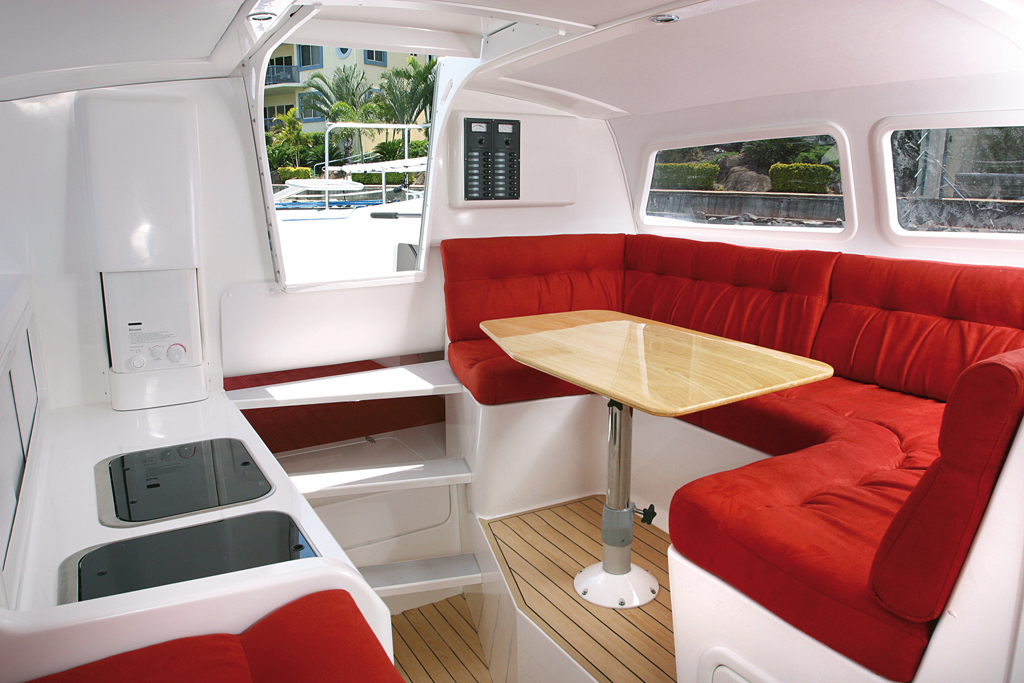
Inside, the Corsair 36 offers good volumes (for a trimaran).
A jubilant multihull
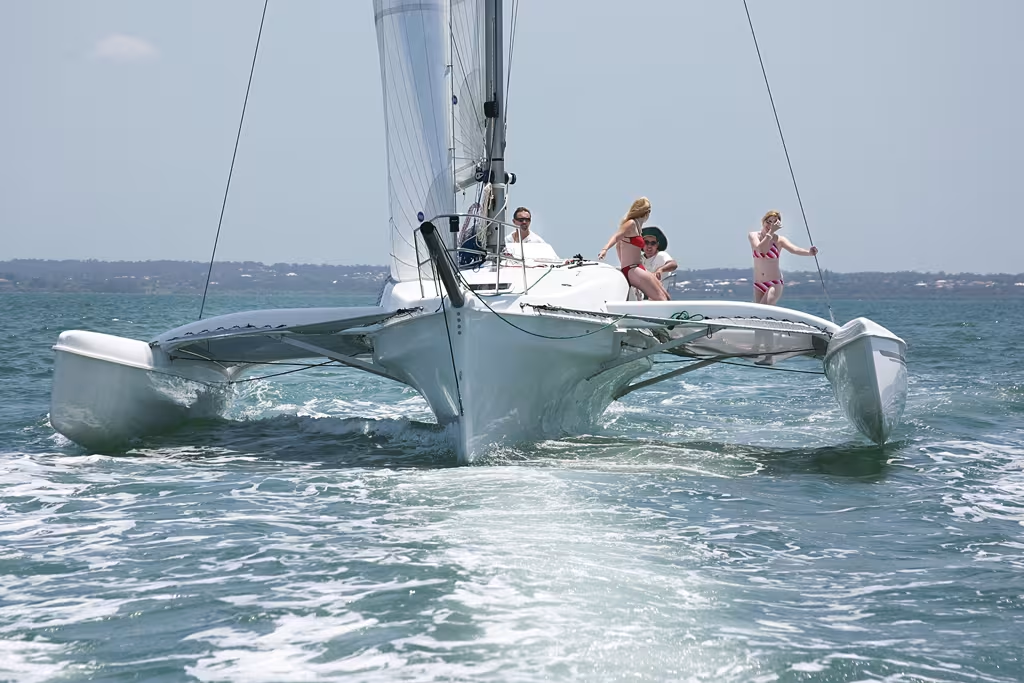
Around sixty miles separate La Rochelle from the Ile d’Yeu, but from les Minimes to Port Joinville there can be many a slip twixt cup and lip...depending on the force and direction of the wind! As Antoine loves to repeat, “when cruising, if you find yourself beating to windward, you have taken the wrong route”, but not everyone has this singing Shaman’s powerful lucky charms. Dare I say it, I actually like sailing to windward... It all depends on the boat (and the sea conditions!). CHALLENGER, our Corsair 36’ was heading at the double for the Tripate (festive regatta in the Baie de Quiberon); we had to make do with the westerly wind forecast for the area! Right from the start, the contact with the Corsair went well, the overall ergonomics are cunning, there is plenty of room and the boat remains simple. The Honda 4-stroke motor, intelligently linked to the rudder by a rod, pivots according to the needs of the manoeuvres. The power and torque appear to be more than sufficient in normal conditions and avoid the space occupied, the weight and the maintenance of a fixed diesel. The fact that it could be lifted, and the electric starter, combined with the silence when running completed its appeal. Hoisting the mainsail was a formality, carried out by hand, one of the numerous positive points to the credit of the rotating mast. The anodised aluminium profile (carbon on the 37’) is rustic and reliable; it saves the usual peripherals in the rig (multiple spreaders, jumpers...) and considerably improves the aerodynamics. A nice suit of Pentex sails, from Calvert Sails, and a retractable carbon bowsprit complete this successful section. With the daggerboard lowered, we tried to gain laterally, so as not to sag below the Ile de Ré, but at 11 knots, the 36’s ease quickly reassured us as to its performance. The Pertuis Breton, first ‘col’ of the stage, was swallowed up in 1h 15 in a 10 – 12 knot breeze. As we got out to the open sea, we found a nice north-westerly swell (2m), which increased throughout the afternoon. On the aft deck, Corsair has fitted mesh watchkeeping seats on a tubular structure; this robust arrangement is remarkable. This comfortable and reassuring ‘terrace’ is perfect at anchor and provides a steering position (wing style) which is very suitable; I didn’t stop singing its praises.
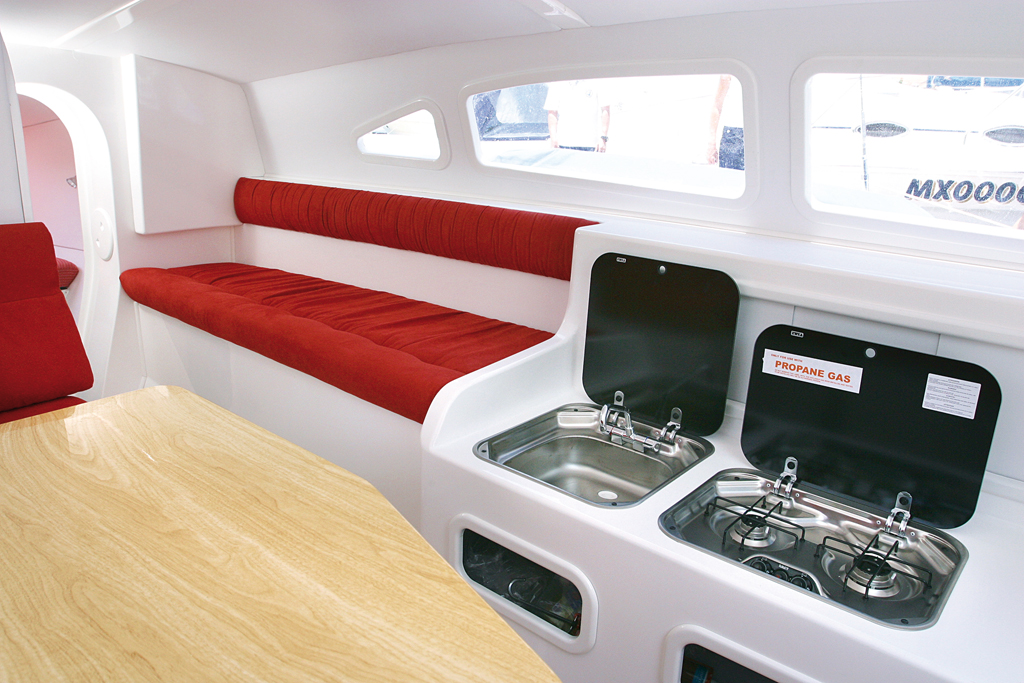
The galley is rudimentary, but provides the essentials. What more could you ask for?
Like most modern trimarans, there is real feel to the helm, and the rudder’s directional effect reinforces the pleasure of the exercise. The wind headed us and freshened; by hardening in everywhere, the 36’ kept to its course, battling at between 8 and 11 knots against the chop and the swell. The boat remained comfortable and efficient on this point of sailing, and we beat all the monohulls around us in pointing ability and speed. The first squalls hit the Corsair, confirming the tolerance of its sail plan. The strongest of them obliged us to bear away onto a reach in a deluge of spray and rain: with its float giving the maximum support, the 36’ flew at 18 – 20 knots for 1 mile, then resumed its course. During this episode, the boat displayed perfect agility and rudder control; the leeward float is comfortably supported by a very reassuring amount of volume. I left the crew at Port Joinville, where we arrived at 6pm, satisfied with the performance of our trimaran. The sailing imperative did not allow us to really sail the machine hard under asymmetric, the Corsair 36’s favourite point of sailing – I promise to come back again! Xavier, CHALLENGER’s owner has completed his programme, performed well in the Tripate regattas and brought the boat to its Port Medoc berth in one go: a nice week in a trimaran!
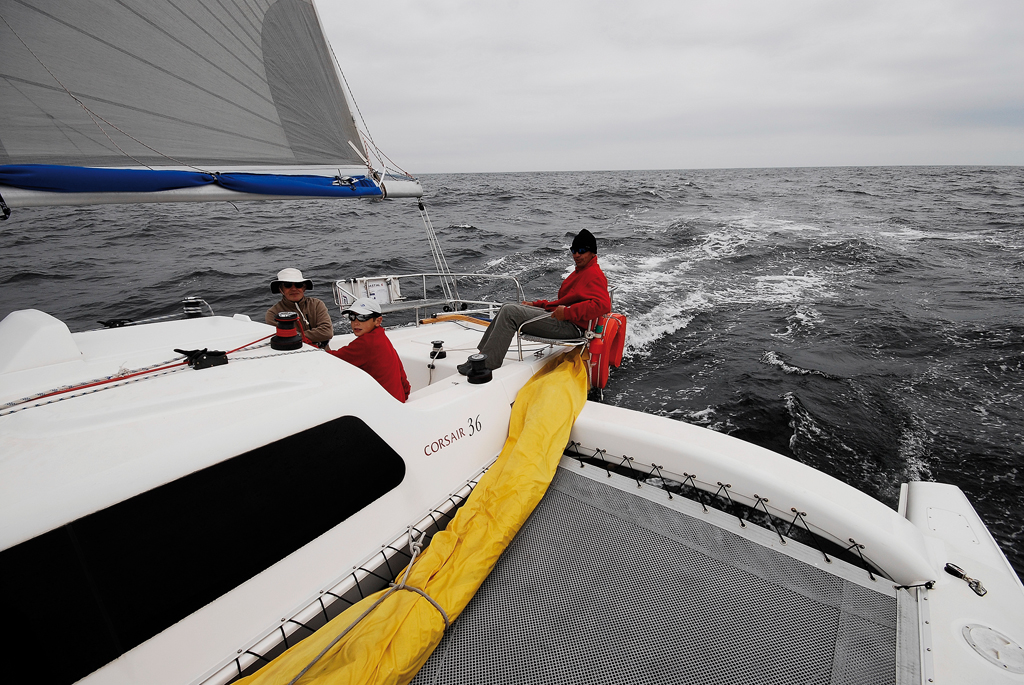
A test in rough, wet conditions, but one which showed us the great potential of this folding cruising trimaran.
CONCLUSION
Despite the shortcomings in the finishing, and a few equipment errors, (fragile tiller, winches and mainsheet track which could be perfected), which the builder has noted and which seem to have been corrected on the 37’, the Corsair 36’ is an attractive trimaran. Fast, safe, equipped with a simple and relevant rotating mast, it remains easy to sail. It will have low maintenance and benefits from the advantages of its geometry. Its strong point: it is a sporty cruising boat... Great fun!
The plusses:
Attractive personality Performance Simple and comfortable
The minuses:
Finishing High price (like all folding trimarans) Limited distribution
The competitors
Model Builder Windward sail area Displacement in t. Price in euro exc. VAT Seon 96 Seon AB 60m2 1.4 NC Triforsix 34 Tournier Marine 69m2 3.25 234,000 Trimax 10.50 Trimax 70m2 2.5 219,000 Dragonfly 35 Quorning Boats 76m2 3.7 260,000
Technical specification
Architect: Corsair research and development department Builder: Corsair Length: 10.97m Beam: 7.8m Draft: 0.51/1.83m Appendages: daggerboard Mainsail area: 49.42m2 Genoa area: 26.45m2 Jib area: 12.75m2 Mast height: 14.48m Unladen weight: 2.495t Number of berths: 4/6 Engine: Honda 4-stroke, 15 to 20hp Water: 132 l Price: 206,000 euros
Differences 36’/37’
The Corsair 37, available in 2 versions , one all Carbon Fibre , and one in Vacume bagged Foam Sanwich E glass , are major updates to the Corsair 36 trailerable trimaran . There have been many changes and improvements to the original Corsair 36 design including 1: All Carbon Fibre Mast and Boom and bowsprit and folding beams on both versions of the boat 2: The Carbon 37 is completely Carbon construction throughout making for a light stiff and very fast cruising boat 3: The aft transom area is larger and completly redesigned for better access to the water when swiming . Steering linkages are completly accessable . 4: A Carbon Fibre dagger rudder is standard on both versions giving a greatly improved feel to the helm and better steering response as well as the ability to raise the rudder and daggerboard for access in to shallow water 5. The interior has a cleaner more modern feel and changes have been made to major bulkheads to enhance strength and functionality . 6. Access to the aft cabin has been improved and simplified 7 . Seating in the cockpit has been slightly changed to improve comfort while sailing.