
This modern and ambitious trimaran has a reputation to uphold: it is the new variation of the mythical Corsair F27, one of the most popular cruising trimarans in the world. Highly anticipated in 2020, the 880’s original launch schedule was hampered by Covid. However, connoisseurs quickly understood that this little steed would not disappoint…
Infos pratiques
- Le chantier : Corsair 880
- La fiche technique
-
 Découvrez notre vidéo exclusive
- Financez votre Corsair 880
- Assuez votre Corsair 880
- Articles autour du Corsair 880
Test location: Follonica, Italy
Conditions: Westerly 10 to 15 knots, slight sea
The Corsair 880 is without doubt the multihull that we’ve had the hardest time testing. Back in the spring of 2020, an appointment was made on Lake Garda to discover the first model delivered in Europe. Our plan seemed very attractive until Covid got involved. Discussions with the Seawind/Corsair team included options in Switzerland, Germany, and Italy again. And then nothing more. A long period of watching began in Australia and the United States thanks to our correspondents. The first 880 delivered in France at the beginning of the summer of 2021 just escaped us... but finally, the first Italian model – hull #16 in the series – welcomed us with open arms – the linking arms of course! The appointment was made with the Trimarani Italia team, in the marina at Scarlino, just south of Follonica. We were here on a superb stretch of water protected by the island of Elba. To top it all off, the weather was great, and the forecast heralded a good thermal breeze - what more could we have asked for?
Folding floats
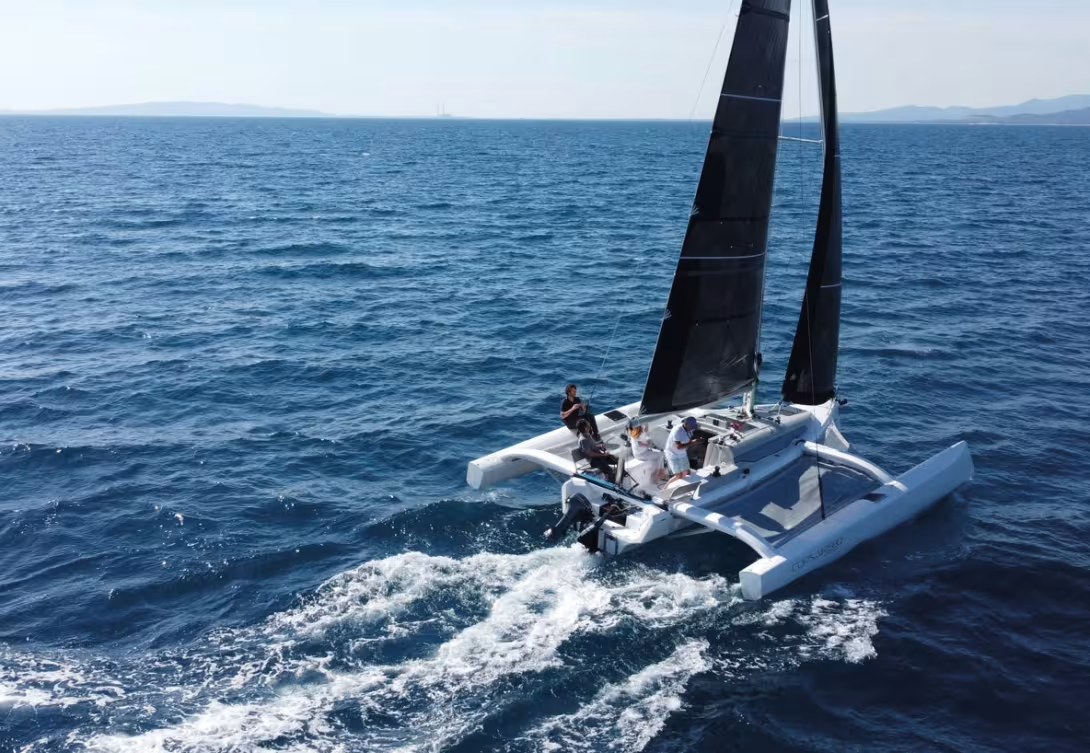
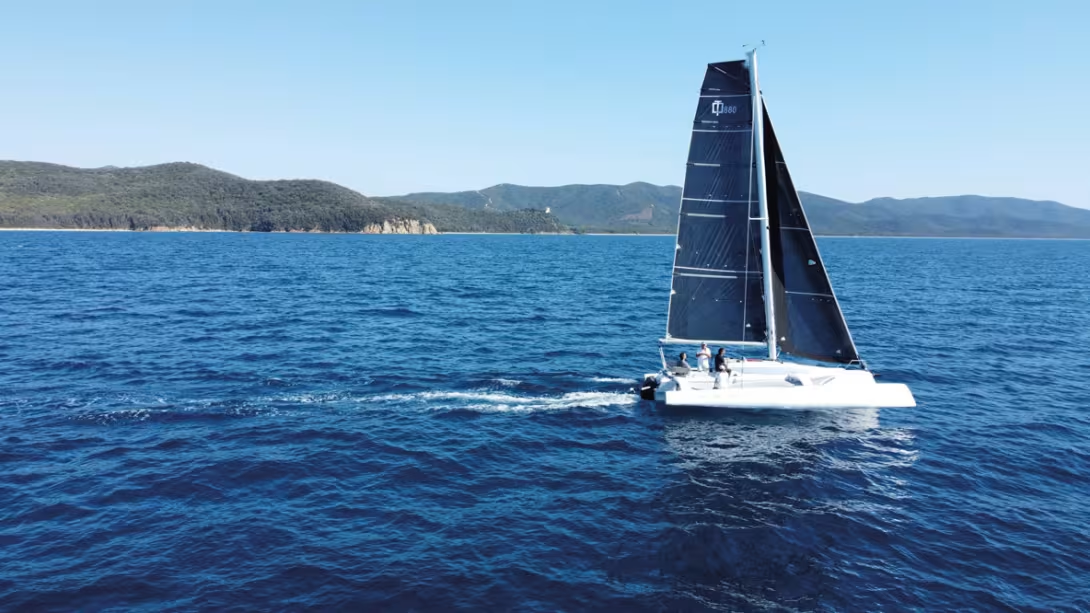
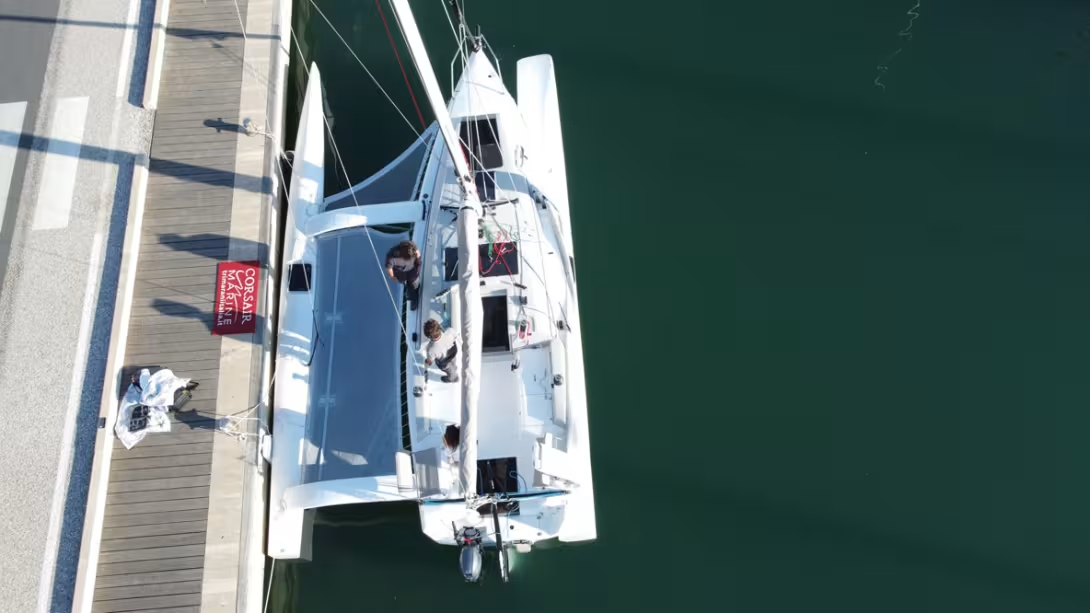
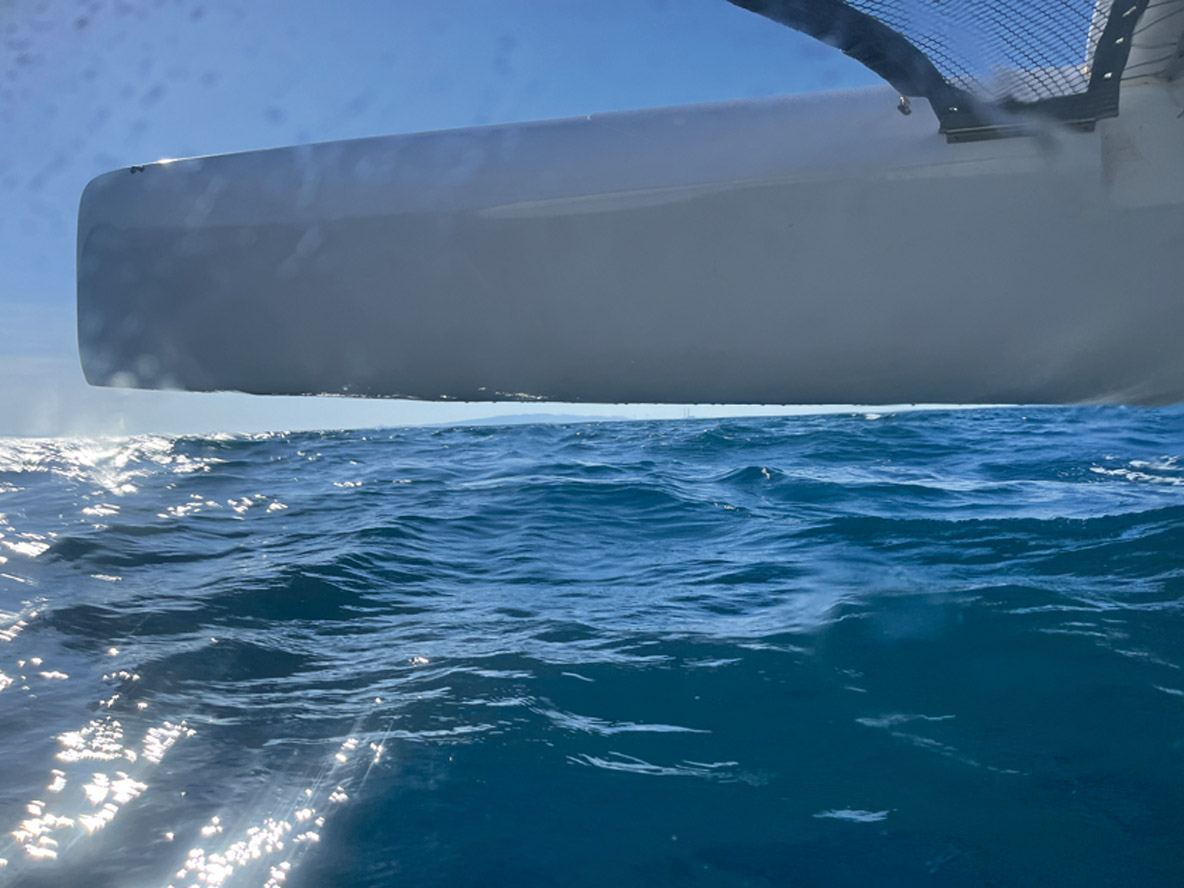
This beast features three inverted bows, a respectable freeboard height and a rather discreet coachroof - from a distance, you could be forgiven for thinking that this Corsair is much larger than it actually is. Seen from ahead, the central hull reveals a particularly marked chine - the beam at the waterline bears no relation to the width of the deck. The recipe is well known to win on all fronts, i.e. performance and habitable volume, but here, François Pérus and Romain Scolari haven’t hesitated to force the curves and angles - with the greatest of mastery. The Vietnam-based builder uses a glass/PVC foam sandwich and numerous carbon reinforcements placed in all high-stress areas. In the end, the Corsair 880 weighs in at 3,660 lbs (1,660 kg), a somewhat “standard” displacement compared to its closest competitors – 3,085 lbs (1,400 kg) for the Libertist 853 and 4,630 lbs (2,100 kg) for the Dragonfly 28. But here, it should be noted that the 880, like the Dragonfly, is in the folding trimarans camp. A folding mechanism and its articulations are necessarily going to be heavier than fixed arms. On board the 880, the floats pivot with their arms vertically and come to rest against the central hull - this is where the very marked chines become even more clever! The operation takes barely a minute per float. The only concern is that fenders need to be placed differently and that the outboard side of the hulls may be exposed to fouling under the water... this is the price to pay for a trimaran capable of reducing its beam from 22’4” (6.8 m) to just 8’2½” (2.5 m) without any increase in length - this is not the case for the mechanisms with horizontal pivoting arms that shift the floats aft. When folded, the Corsair 880 has the ideal dimensions to take advantage of an affordable marina slip and to envisage road transport on a trailer.
Rotating mast and roller-furling boom
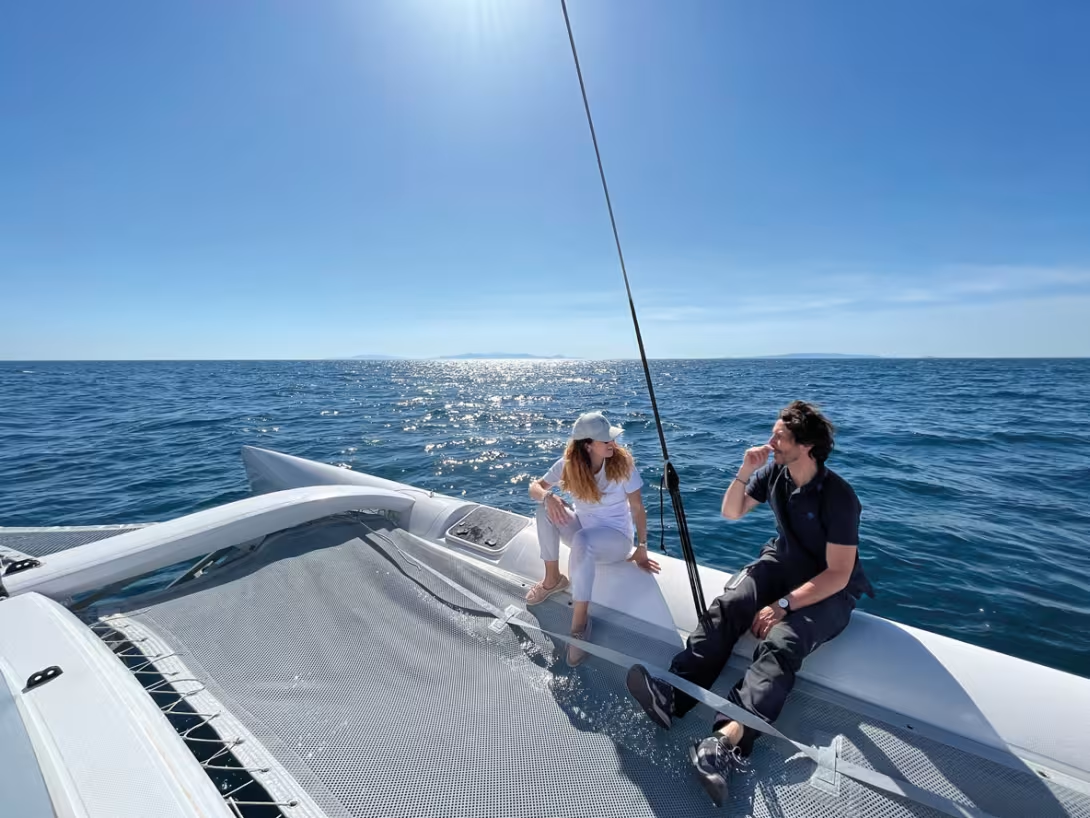
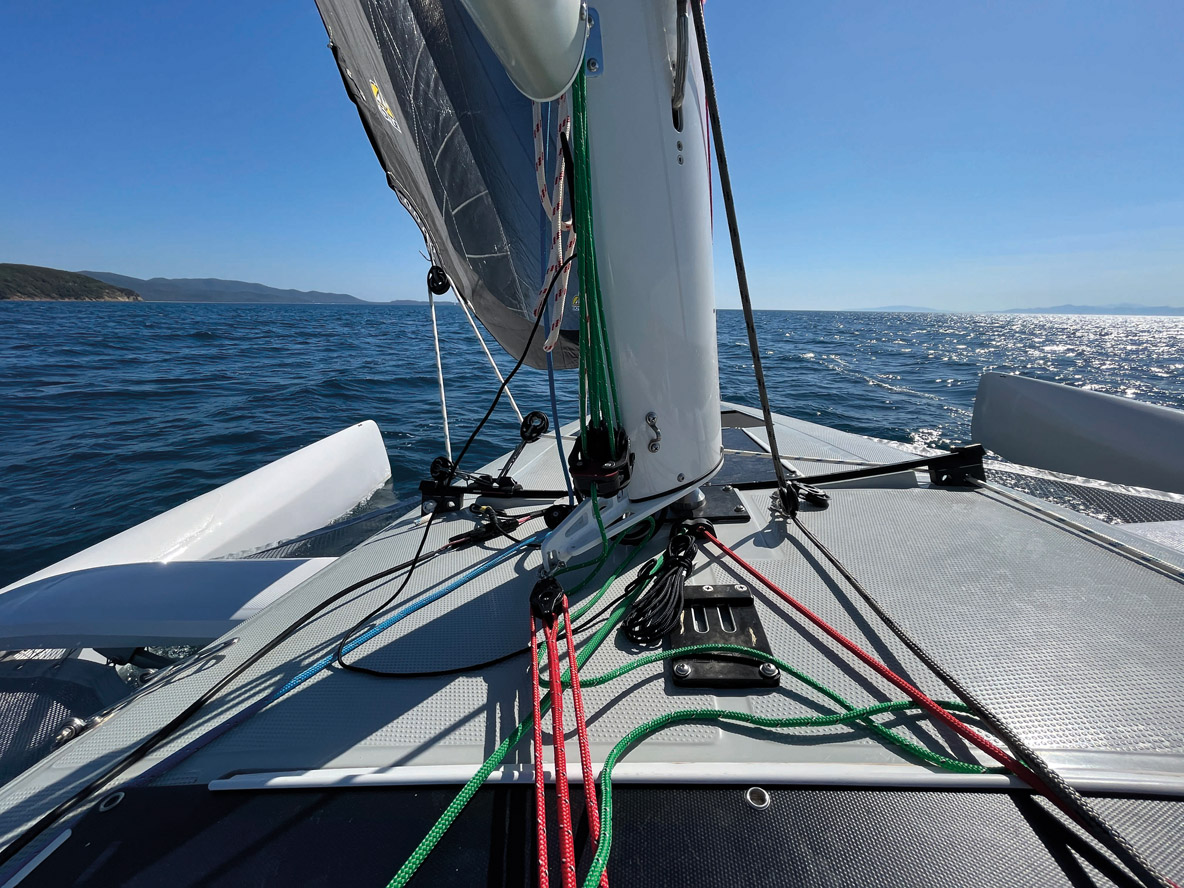
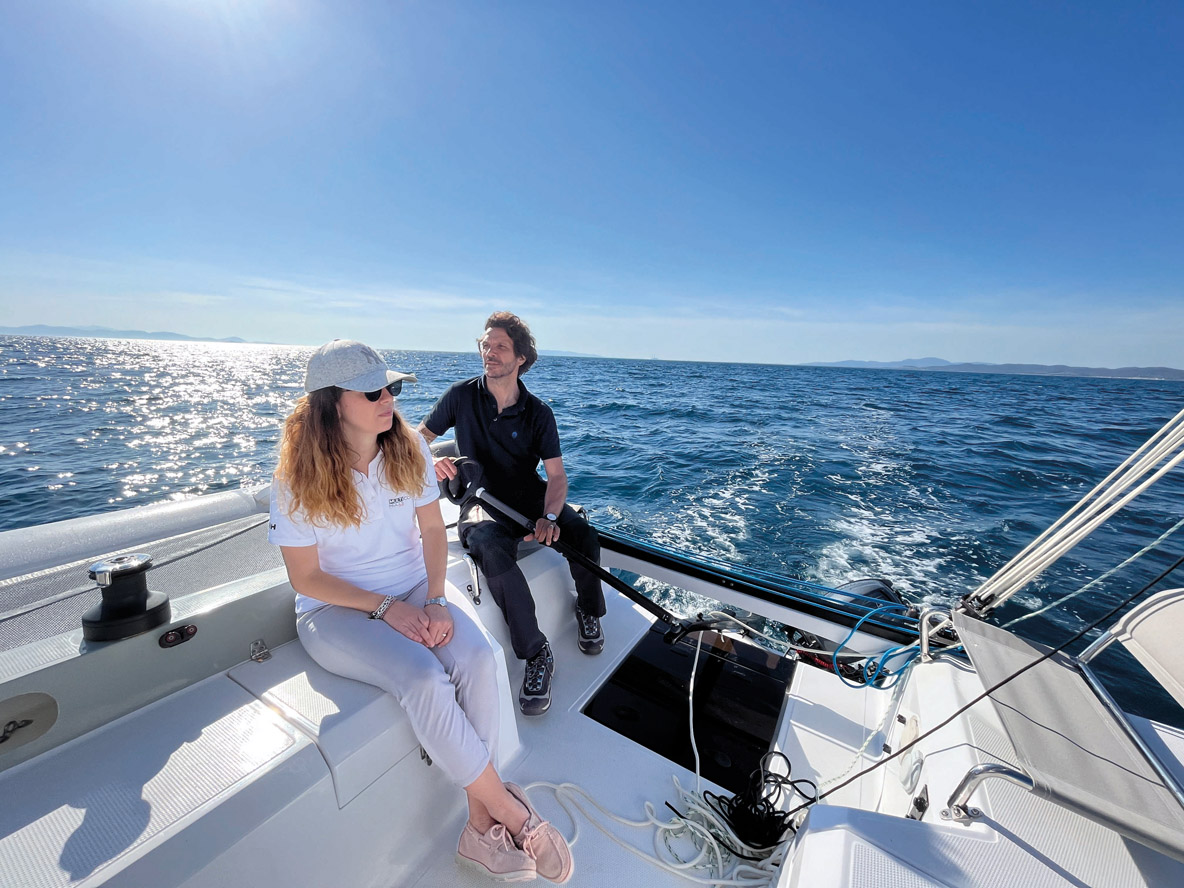
Maneuvering off the dock is relatively simple because the outboard motor, while there is just the one, is directly connected to the rudder by a linkage. This makes it possible to turn the boat on the spot. Our version here was fitted with a 9.9 HP engine, and at cruising speed, it allowed us to reach almost 7 knots. Once aboard, I discovered a roller- furling boom and a rotating mast: slotting the boltrope of the mainsail into place requires a minimum of attention. Generally speaking, the set-up of this trimaran is quite sophisticated: it speaks to sail and performance enthusiasts without concessions. The style here is nothing like that aboard an Astus where everything is, on the contrary, simplified to the extreme. The 880’s deck hardware is very complete, with an imposing mainsheet traveler set all the way at the very back of the cockpit. The cockpit, comparable to that of a monohull of the same size, is relatively wide and uncluttered, but access to the sugarscoop and its bathing ladder offset to starboard is a bit laborious. But then you can’t have everything. The helmsman benefits from a seat with a backrest on each side. The deck layout manages to accommodate a voluminous coachroof with narrow side-decks that are still manageable. In any case, the large trampolines that occupy the entire area between the connecting arms and the hulls offer an XXL-sized passage forward and of course the possibility of practicing very effective hiking out. Two triangular nets mean the foredeck area is very safe, and in this very racing-oriented world, the jib furler and its self-tacking track almost come as a surprise…
Thrills at the helm
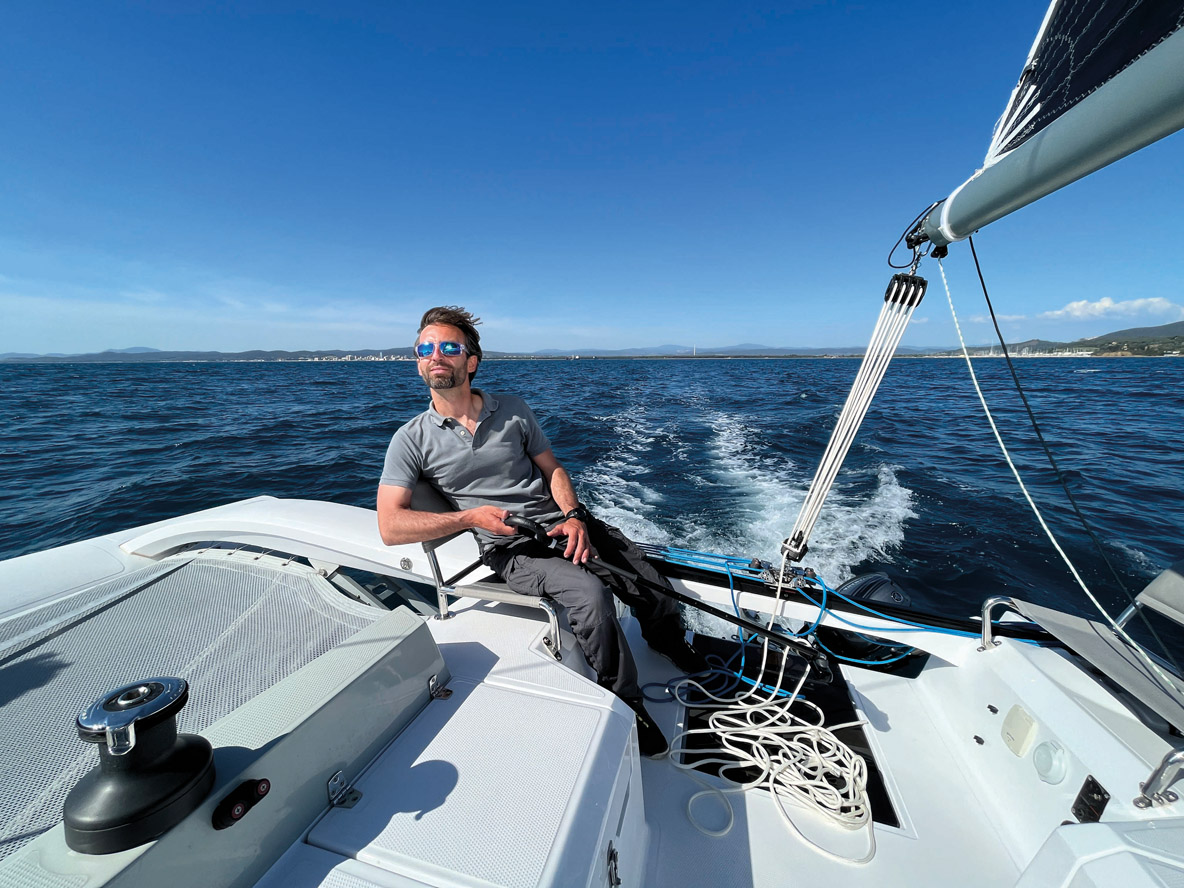
Steering this Corsair 880 is certainly a rare pleasure: you just feel a little pressure to luff up when the 880 is really bearing on its leeward float, not much more. This trimaran runs like it’s on rails but manages to communicate all the information expected by the helmsman - a total symbiosis is established, and you’ll be reluctant to give up the helm! Upwind, with the daggerboard fully lowered (two lines on the deck control the lowering and raising of the appendage), the trimaran holds a brazen course at 40° off the true wind: With a 15-knot wind, our boatspeed was constantly in excess of 8 knots and the hulls seem to just play with the chop - the central hull and the leeward float at least, as the windward float remains practically airborne all the time... As soon as you pull on the helm to bear away, the GPS goes into overdrive: we reached 10.4 knots with disconcerting ease on a long run where our boatspeed never dropped below 9 knots. It should be noted that we were on board a standard model and that we only had the mainsail up and the self-tacking jib. The gennaker or the asymmetric spinnaker would certainly have offered us 4 or even 5 knots extra. The testimonies from crews who have pushed the 880 much further seem to be unanimous and confirm our impressions: this trimaran is always safe and, if over-pressed, it lets the helmsman know.
A lot of neat features on the inside
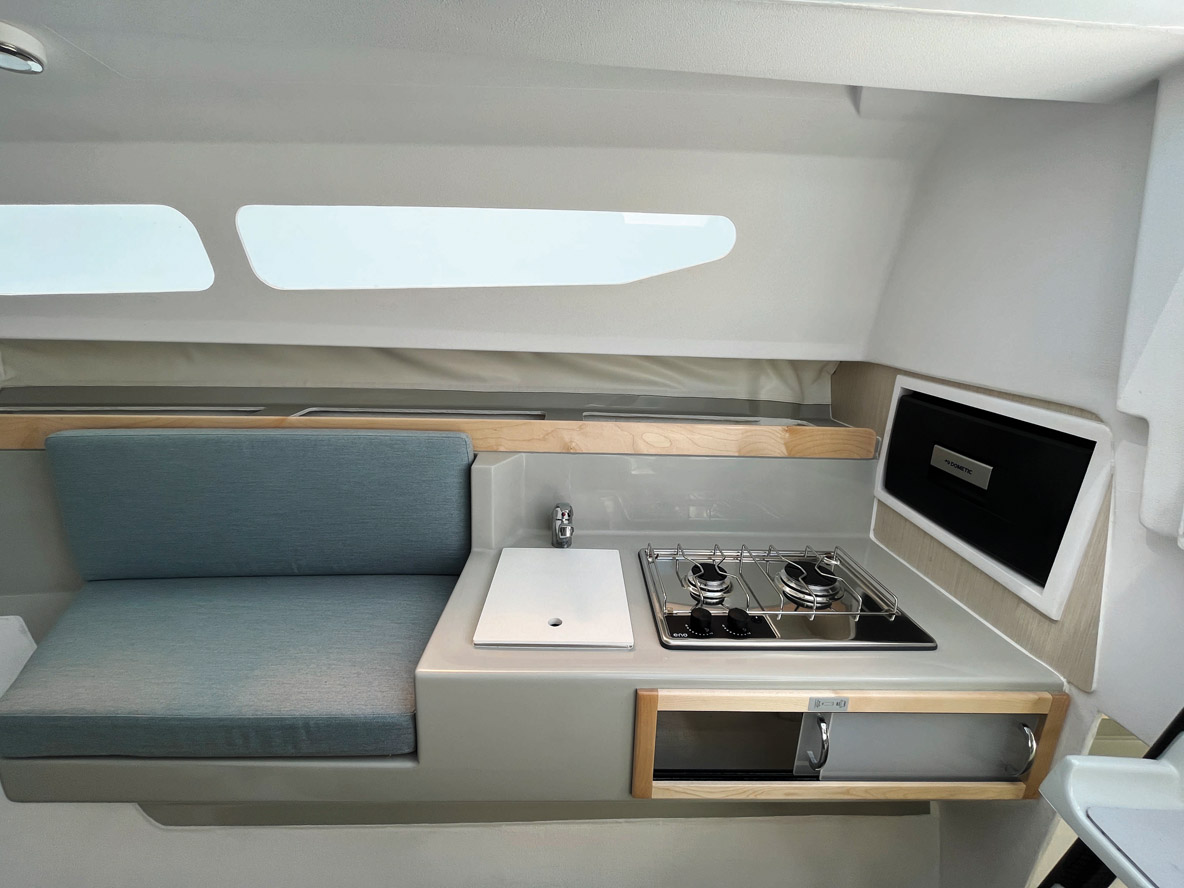
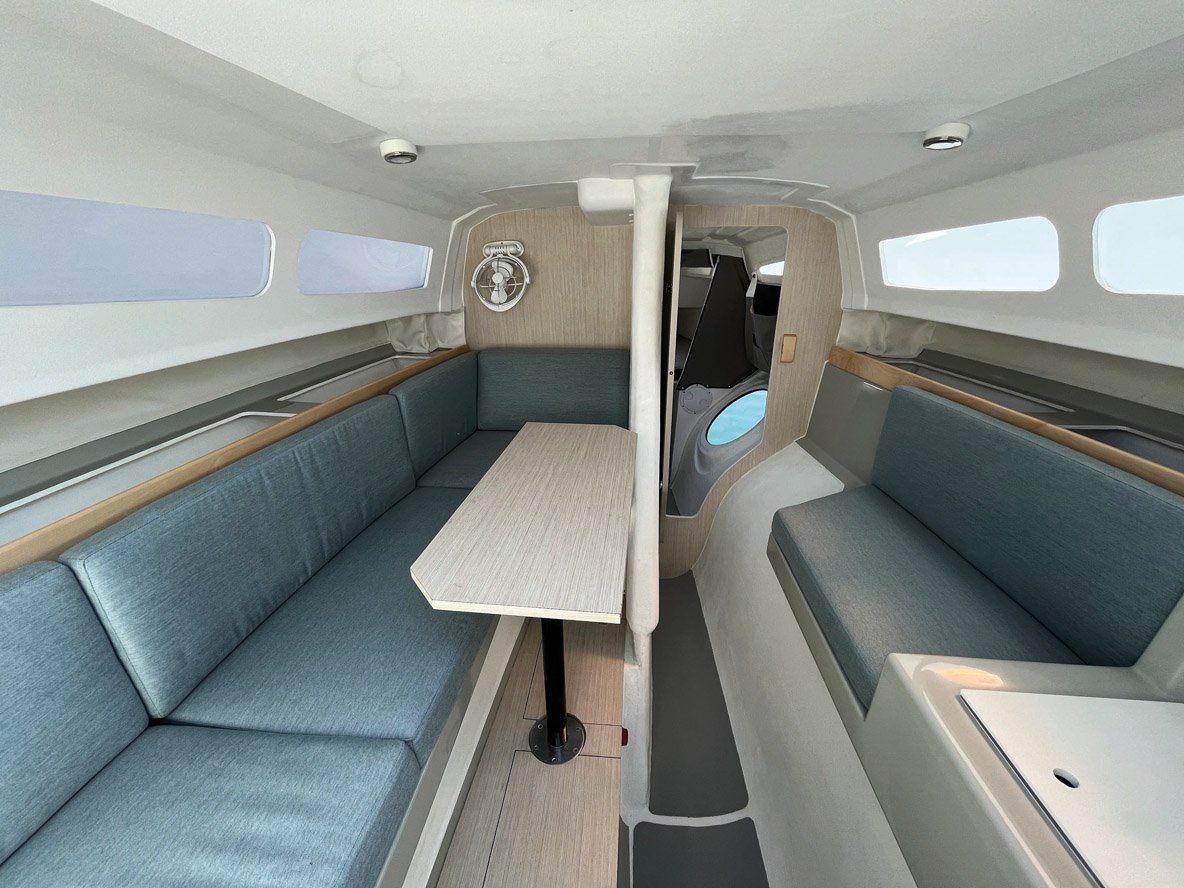
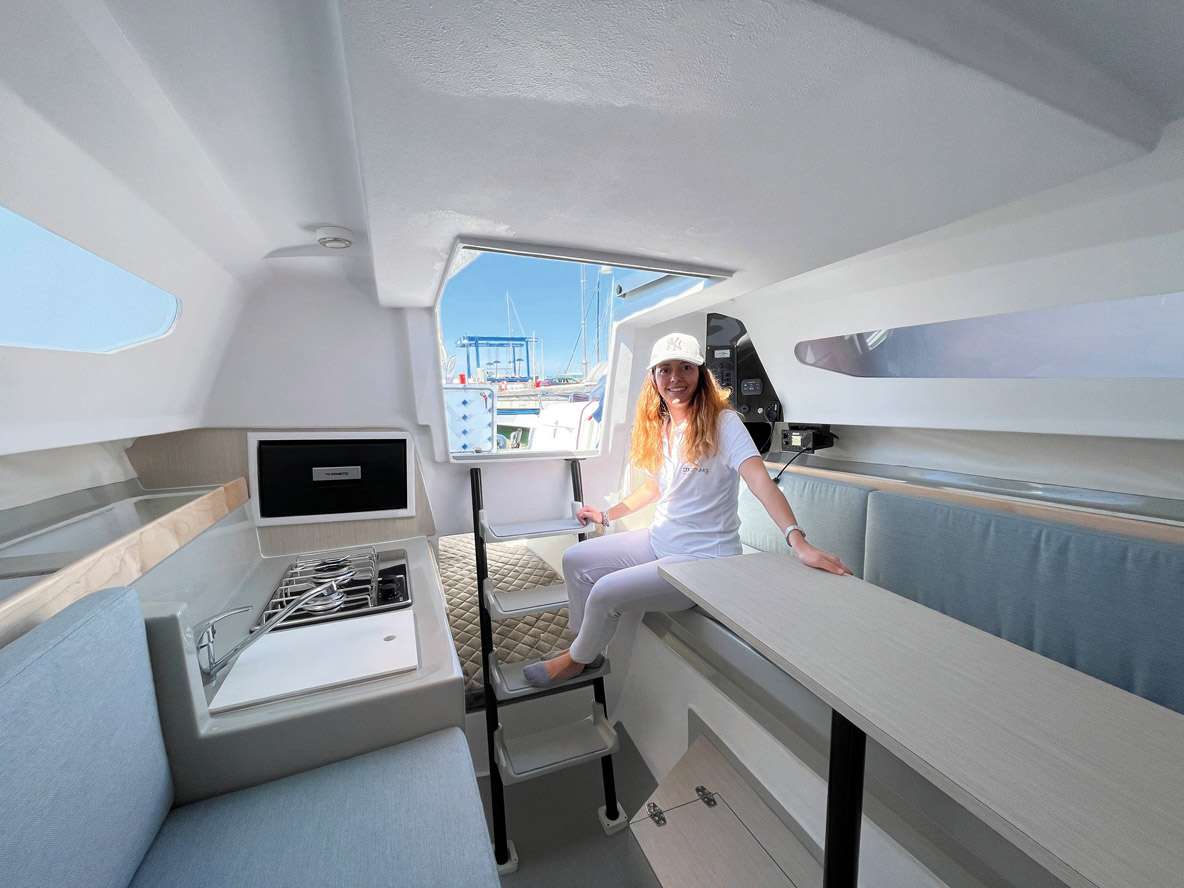
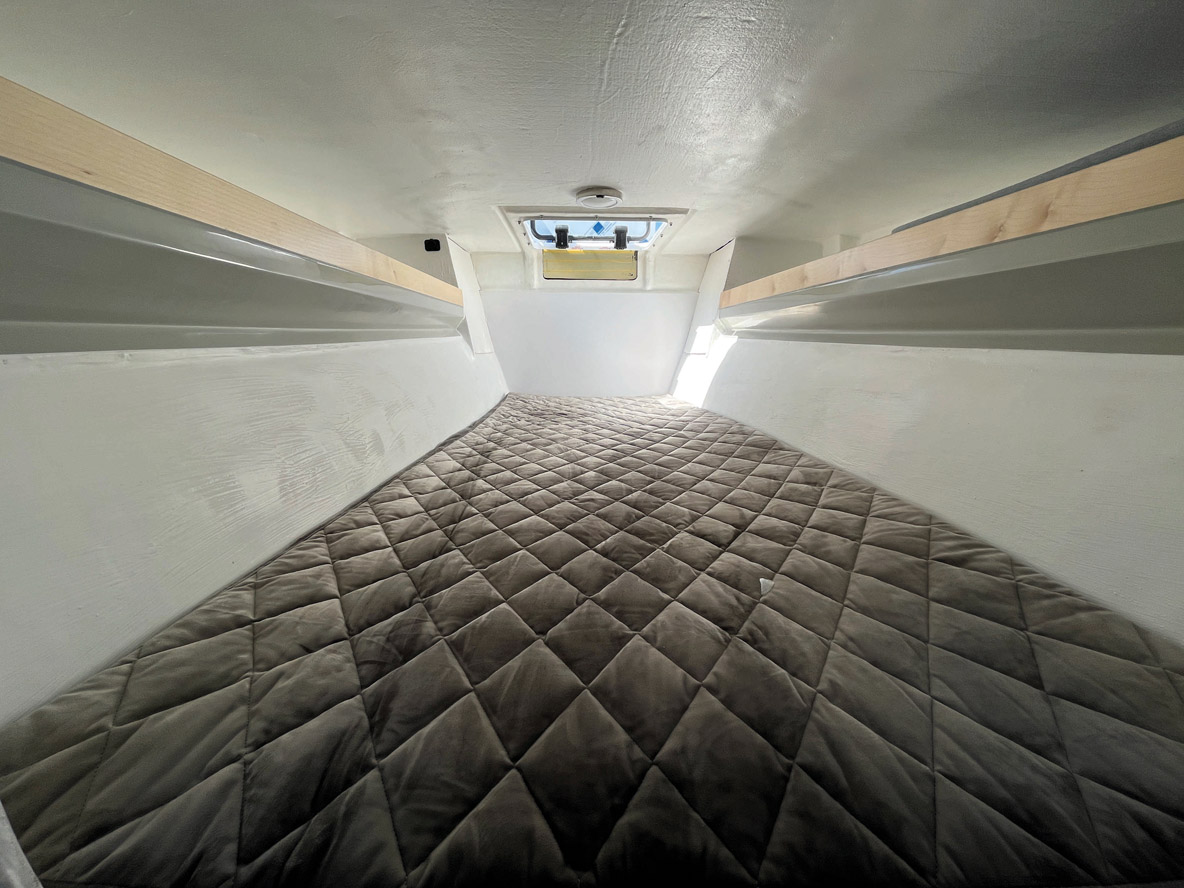
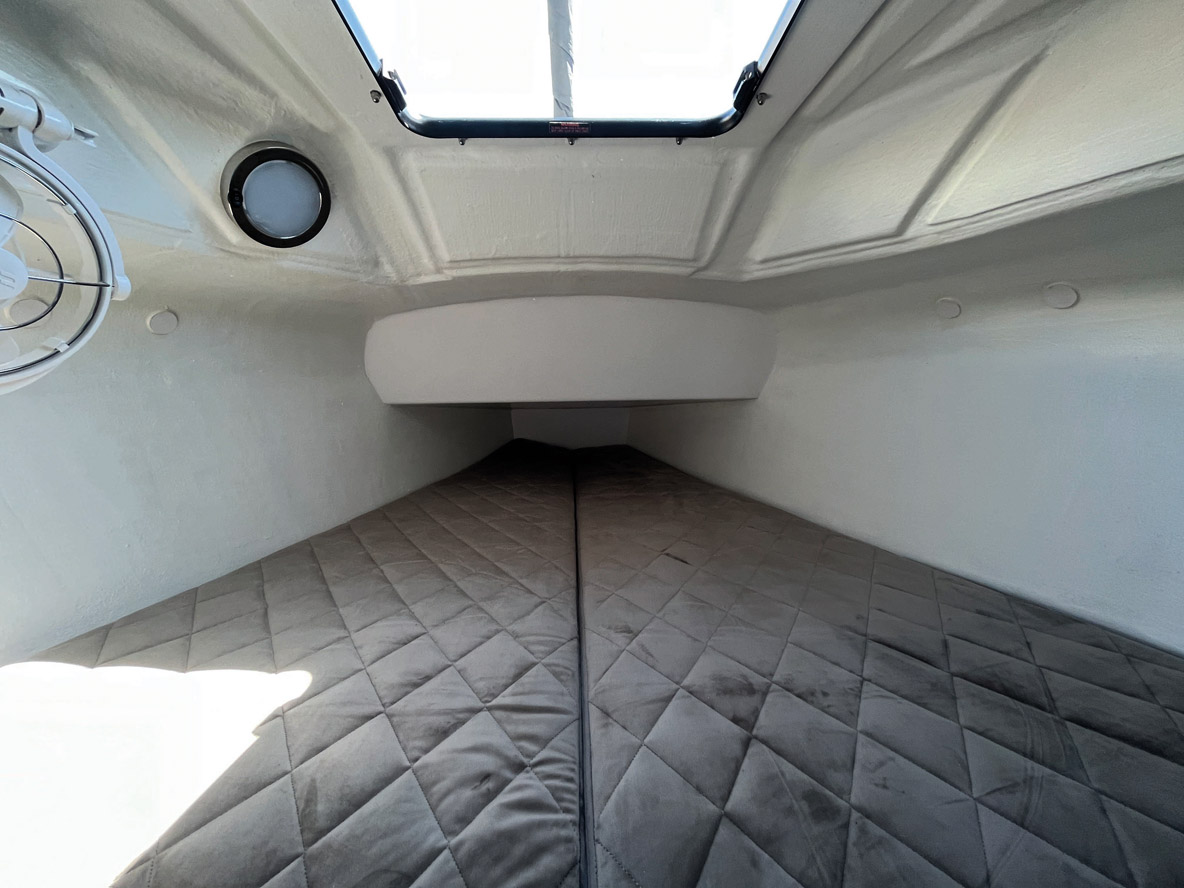
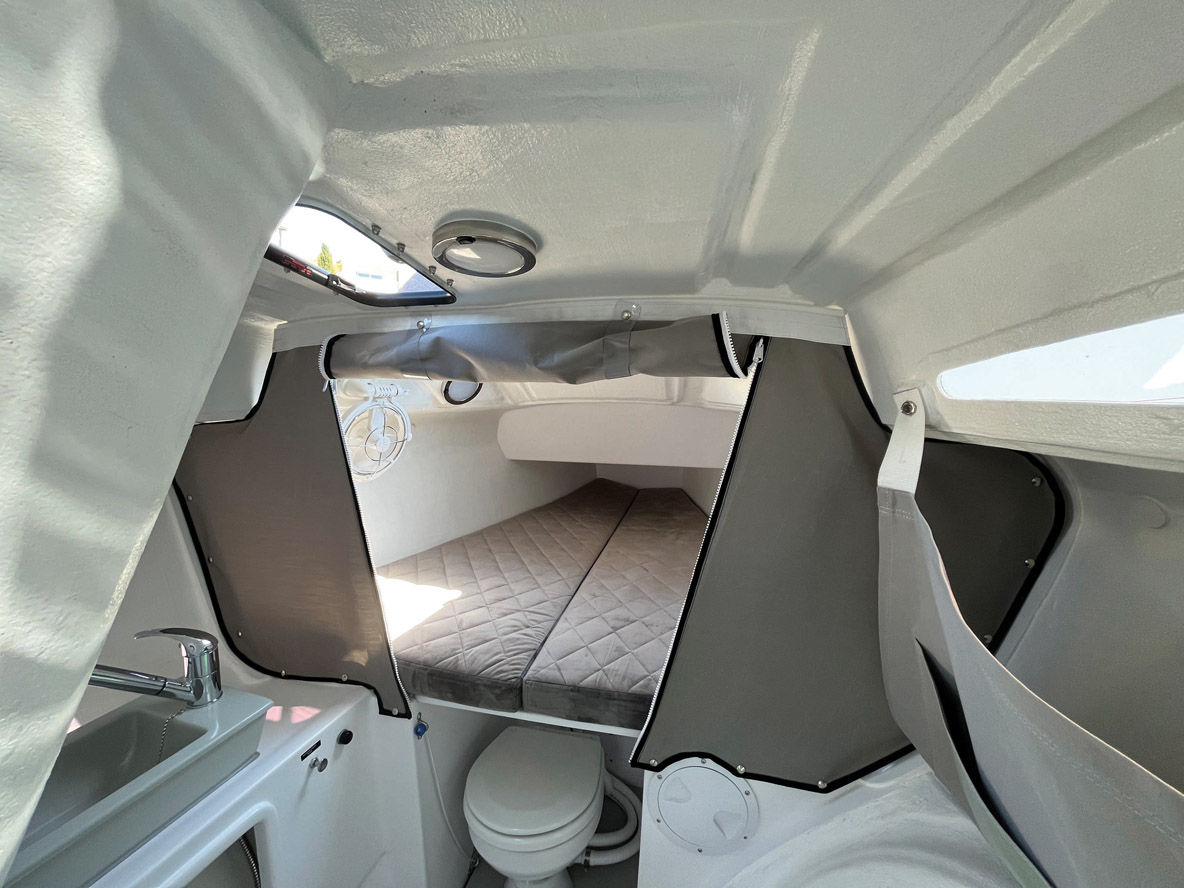
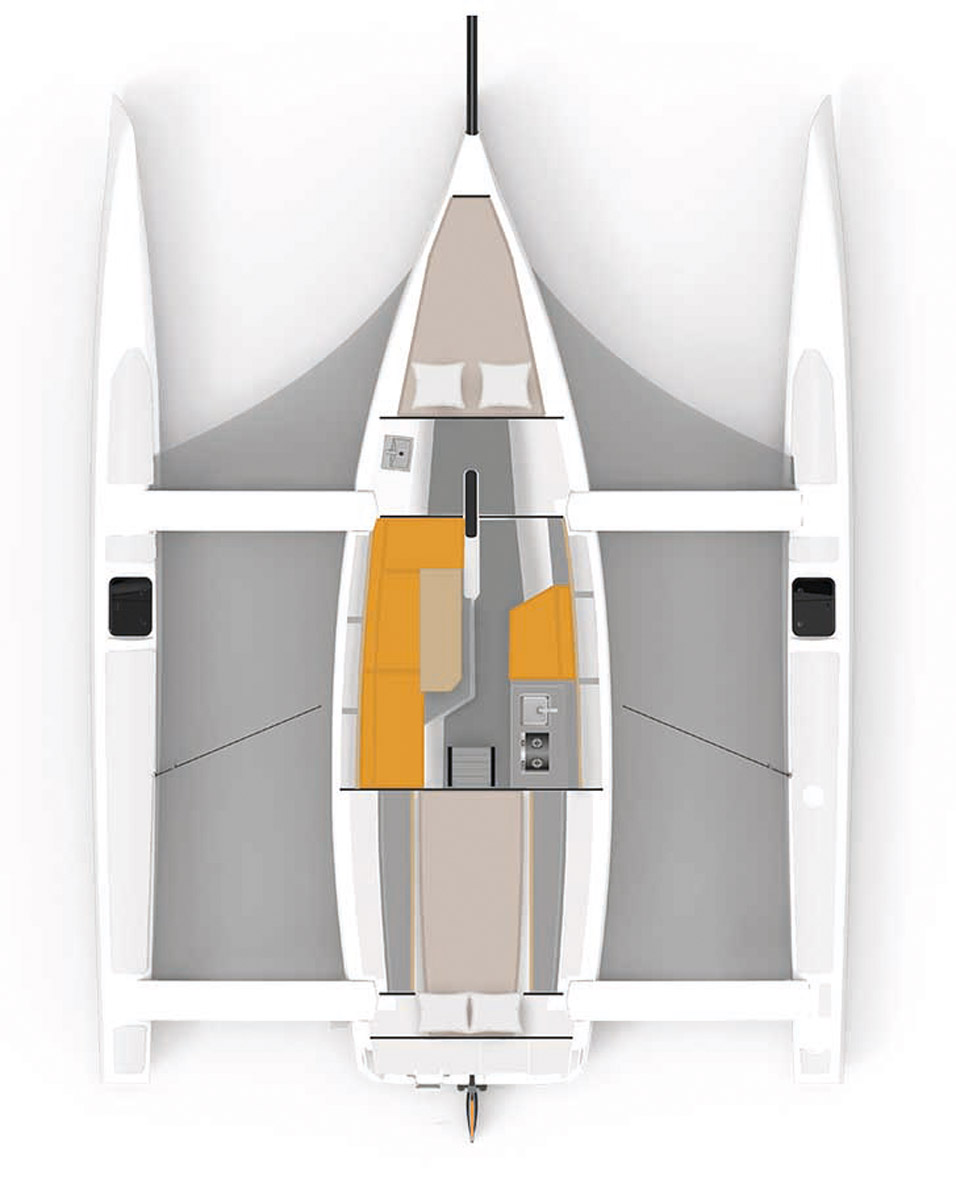
Generally speaking, for the same size, a small trimaran has a hard time keeping up with the cockpit space and especially with the layout. Looking at the floor area, the 880 doesn’t really contradict this observation: it’s barely a foot wide! On the other hand, thanks to its particularly flared form, it manages to provide a surprisingly large volume from the height of the benches, with a very comfortable headroom of 6’2” (1.87 m). To starboard, the raised saloon offers a table of 36” by 15” (93 x 37 cm). The seats can be transformed into quite a large comfortable area, but not really into a double berth. On the starboard side, there is a short bench seat and a “kitchenette” galley close to the cockpit. The companionway ladder can be unclipped and rotated to provide access to an aft berth under the cockpit. Here too, although the mattress measures 6’7” (2 m), the width is just 38” (0.96 cm). As for the forward compartment, this can be separated off with a curtain. Its berth is the most generous on board – also 6’7” (2 m) long, but 2’ (0.6 m) wide at the feet and 4’8” (1.43 m) at the head. Under the mattresses, a toilet can be swung out to be operational without needing to remove the mattresses – very smart! There’s an opening hatch and the escape hatch that offers an incredible view of the starboard float when going along under sail.
Conclusion
Reserved for a demanding and knowledgeable clientele, the Corsair 880 is a particularly well optimized and exciting boat to sail. This trimaran will satisfy a family willing to discover new waters thanks to the option of road transport, but also a crew of racing sailors - who will logically opt for the Sport version.

Technical specifications
- Builder: Corsair Marine
- Architects: Yacht Design Collective
- Length: 28’8” (8.8 m)
- Beam: 8’2”/22’3” (2.5/6.8 m)
- Draft: 17”/5’3” (0.45/1.6 m)
- Standard mast length: 39’4” (12 m)
- Displacement: 3,659 lbs (1.66 t)
- Sail area: 554/677 sq ft (51.5/62.9 m²)
- Number of people: 8
- Motor: 10/15 HP outboard
- Standard price: $ 138,250 ex-tax
- Sport version price: $ 154,450 ex-tax
- Main options in $ ex-tax
- Anchor package: 866
- Cockpit bimini: 2,370
- Refrigerator: 1,525
- Cockpit cushions: 720
- Water heater: 1,975
- Advanced navigation pack: 6,989
- Sails Cruising PE Line and furling genoa: 7,220
- Gennaker: 8,520
- Asymmetric spinnaker: 4,269
- Bowsprit & gennaker/spi hardware: 4,560
- Engine pre-installation & wiring: 1,470
- Solar package 150 W: 1,732
- Toilet + black water tank: 2,299
- Wrapping: 4,000
- Epoxy protection + antifouling: 3,100
- Twin axle aluminum road trailer: 9,800
- Exceptional helming pleasure
- Perfectly laid out interior
- Simple and efficient folding system for the floats
- Demanding to set up
- When folded, the floats expose their outboard side to fouling
- Elevated budget
The competition
| Model | Libertist 853 | Dragonfly 28 | Tricat 30 | ||||
| Length | 28’ (8.53 m) | 28’8” (8.75 m) | 29’ (9.14 m) | ||||
| Displacement | 3,086 lbs (1.4 t) | 4,630 lbs (2.1 t) | 4,960 lbs (2.25 t) | ||||
| Sail area | 635 sq ft (59 m²) | 861 sq ft (80 m²) | 645/737 sq ft (60/68.5 m²) | ||||
| Price in € ex-tax | 129,000 | 152,280 | 170,833 | ||||
| Test in MW | #167 | #110 | #152 |