
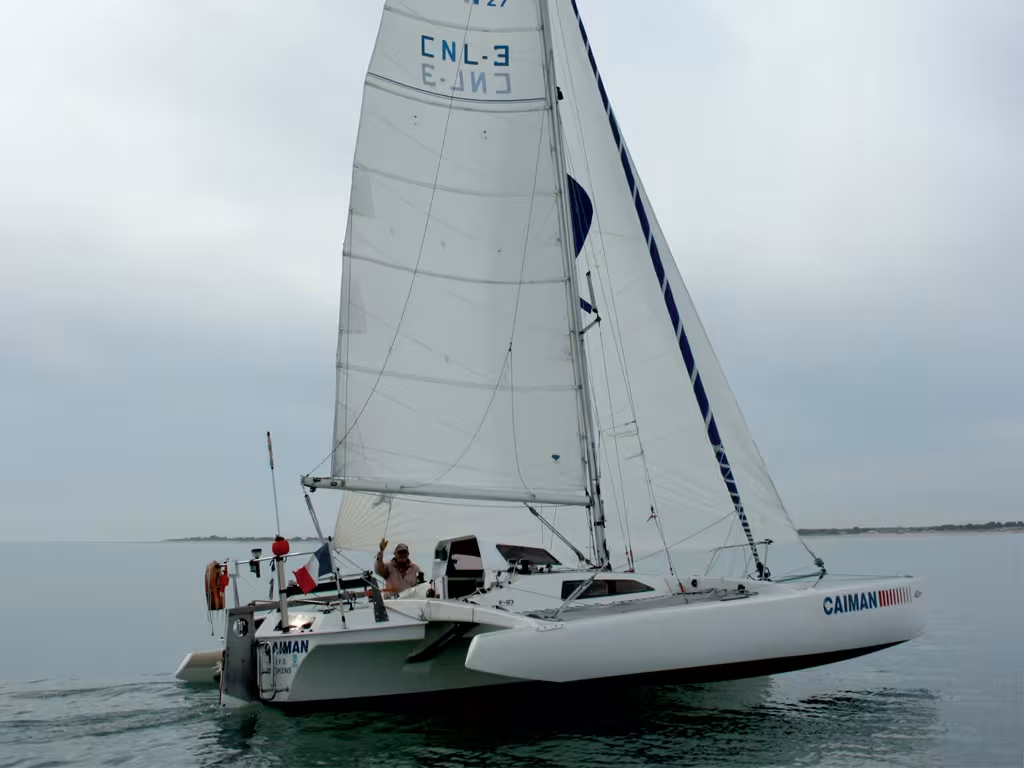
30 years after its launch, this folding trimaran is still just as appealing, comfortable and fast...a rare boat on the secondhand market, to be snatched up without hesitation!
Infos pratiques
- Le chantier : Corsair F 27
- La fiche technique
- Découvrez notre vidéo exclusive
- Financez votre Corsair F 27
- Assuez votre Corsair F 27
- Articles autour du Corsair F 27
So, the Corsair is American? Yes, but the story of these folding trimarans started on the other side of the planet, in Australia. It was here that in 1975, the architect Ian Farrier started to think about one of his obsessions – folding trimarans. The principle is quite simple: to take advantage of a maximum beam when sailing, to favor power and thus speed...but also to have an hourglass figure, to be able to slip into a marina berth ordinarily reserved for a little monohull. Another feature: the ability to be loaded rapidly onto a road trailer, to head for a new stretch of water. The operation consists of removing two bolts and slackening the lateral rigging; in five minutes, it’s done. Sometimes, folding just one hull is sufficient... That year, the Trailertri 18 was launched: several hundred examples of this multihull were sold. Five years later, the Trany appeared, and finally the model we are interested in, the Corsair F 27. And this was something of a revolution, compared to the other multihulls on the water at that time – it was nothing like the already outdated designs of the English catamarans of that period. A glance at the hulls to begin with: the floats are particularly voluminous so they don’t sink into the water when loaded, and on the contrary favor performance, especially as the unfolded structure has a beam of nearly 6 meters. As for the central hull, it is very narrow at the waterline and is then flared: the longitudinal ‘steps’ are quite large. Another distinctive feature is the material used for its construction: carbon is already present, to lighten the boat as much as possible. These characteristics are still current: look at the latest Multi50s – they are not so different, proportionally of course! This trimaran quickly became a genuine best seller, and 450 examples were sold up until 1997. It is therefore one of the most widely sold multihulls in the world. The 27 was then replaced by the Corsair 28, with a very similar design. In Europe, on the other hand, importing was made difficult by the dollar exchange rate, which was very unfavorable at the beginning of the 90s. This is why this nice machine is quite rare in Europe and so common in the USA!
Fast, fun, and why not ocean-going?
The deck plan adopts a center cockpit, relatively wide side decks, with good non-slip - extended by the trampolines. All the control lines are returned to two pairs of winches, either side of the main companionway. Although the standard rig sports a moderately-roached mainsail and a genoa with a small overlap, the sail plan can obviously be boosted, to make the boat even livelier in light weather. In its original state, the machine picks up speed immediately: it easily sails faster than the wind in under a force 2. So with a big roach and a gennaker on a bowsprit, you can imagine what it would be like... To be clear, no sailing boat can rival it for speed! And when the breeze picks up, the Corsair comes into its own. It is quite dry, settles onto its leeward float and goes faster and faster. 20 knots is within the reach of all crews, without trying hard or getting scared! Exhilarating for a cruiser... And you will particularly appreciate the Corsair F 27’s qualities in rough seas. It is stiff and particularly safe, and has impressed more than one sailor in difficult conditions. It’s not for nothing that several skippers embarked aboard this boat to cross the Pacific. The builder has moreover understood this, and has fitted a locker in the cockpit, equipped with a double set of hatches – this volume, where the emergency equipment can be stowed, is accessible even if the boat has the misfortune to capsize. For harbor maneuvers and in a flat calm, if you are in a hurry, the services of a 6 or 8 hp outboard are used. An engine which costs around 4,000 euros – easy to maintain and so much cheaper than a diesel.
Three cheers for the aft cabin!
The companionway is capped with a lifting hatch, an option which considerably improves comfort aboard. The saloon appears to be narrow compared to that of a monohull of the same size...but it nevertheless includes a galley and sufficient stowage space. And isn’t a trimaran better than a monohull? In the bow, there is a berth with access which is a little difficult, and the chemical WC. Aft of the cockpit, the builder has provided an aft cabin. Don’t get too excited: in reality, there really isn’t enough space for two. But this berth, well isolated from the rest of the accommodation, remains very pleasant. And in the floats? Nothing, they are completely empty! The accommodation is therefore limited to this central hull, which does what it can with its ‘steps’ to offer decent comfort. But the trimaran provides a speed/comfort compromise which is awfully appealing!
The points to check
This US-built boat is very strong: no delaminated glass cloth, a very rigid deck, a folding system which is still operational – no play or sticking. We are a priori starting from a very healthy base. However, do check: the daggerboard and its casing, inevitably exposed to sudden arrivals on the beach, or worse, on the rocks. The rig on boats that have done a lot of cruising should also be closely inspected... An ocean crossing doesn’t spare the cables, spreaders or gooseneck, not to mention the rest.
The Pluses:
+ Fast, very seaworthy trimaran
+ Practical and reliable folding system
+ Independent aft cabin
The Minuses:
- Berths too narrow
- The daggerboard requires a few precautions when approaching land
- Folded, the floats quickly become fouled
TECHNICAL SPECIFICATION
Material: foam/polyester sandwich, Kevlar and carbon reinforcements
Builder: Corsair Marine, USA
Construction years: from 1984 to 1997
Architect: Ian Farrier
Hull length: 8.25 m
Waterline length: 8.00 m
Beam: 5.82/2.50 m
Unladen displacement: 1,180 kg
Draft: 0.35/1.50 m
Sail area: 46.55 m2
Engines: 8 hp outboard
Second-hand price: 40,000 euros