Infos pratiques
- Le chantier : Corsair 28
- La fiche technique
- Découvrez notre vidéo exclusive
- Financez votre Corsair F-28
- Assuez votre Corsair F-28
- Articles autour du Corsair F-28
A Real Trailerable Multihull
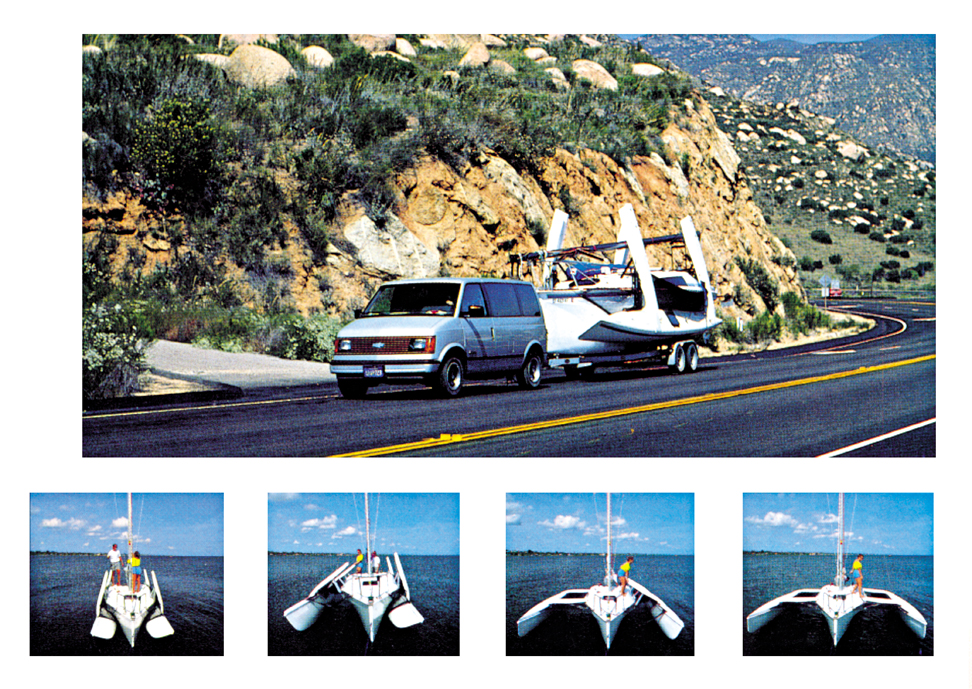
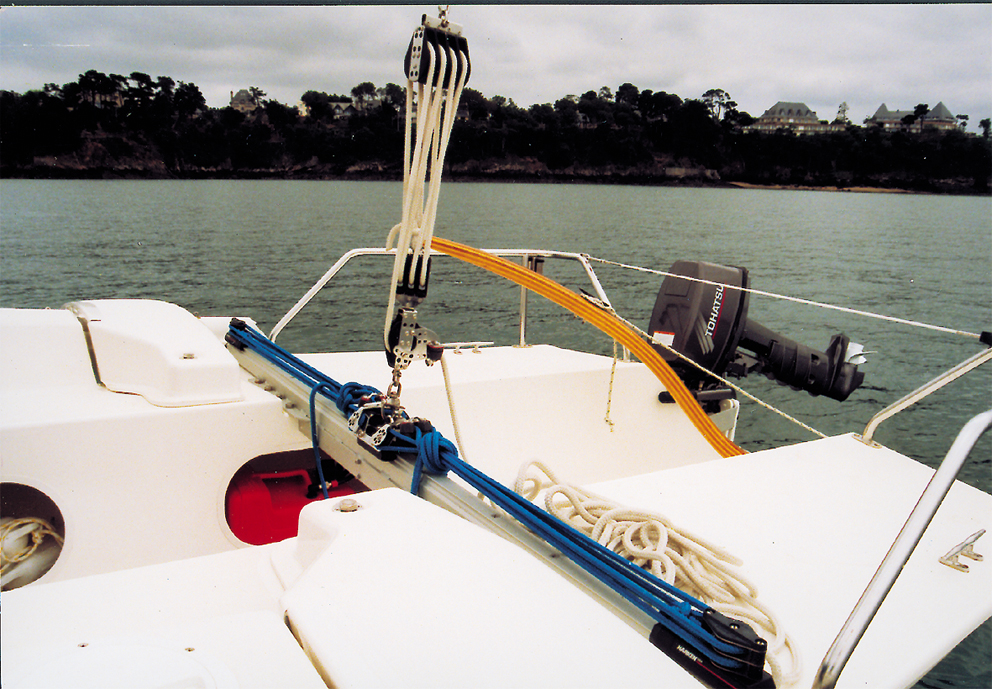
In fact, the F-28's true role is to succeed the F-27, 450 of which were built. At first glance, you might not necessarily spot the difference with respect to any other sports cruising trimaran. There is nothing in the boat’s general appearance to suggest it is a trailerable folding trimaran. A closer look and a demonstration shows that it takes one person alone little more than 2 minutes to fold both cross arms holding the amas, almost effortlessly, so that the F-28 can be trailered easily. Three steps prepare an F-28 for trailering: 1. Releasing the shrouds through a lever system at the base of each shroud 2. Disconnecting the four lock bolts on the cross arms 3. Raising the cross-beams to fold the amas against the hulls very easily thanks to a patented system The side trampolines move with the amas to come alongside the central hull. This is a really surprising operation, except for those already familiar with Corsair trimarans. The F-24, F-27 and F-31 have been using this mechanism for ten years now. This goes to show the reliability, robustness and functionality of the folding system. Consequently, this is a 6 meters wide trimaran that can occupy a slip for a monohull in the harbor. No more problems with mooring at the end of pontoons or in outer harbors. Moreover, being able to fold it for trailering will make winter storage easier. The rigging offers more interesting surprises. First, the F-28 is equipped with a mast raising/lowering system than can be operated by one person alone. To begin, the mast foot is placed in a pivot. Then two small triangle braces are set on either side of the center hull, on the deck . Using the trailer winch connected to a halyard from the mast, one person can then raise the mast. There is no need for a crane, or a large crew. The mast rotates, a minor detail that is important because it shows that the F-28 is designed for performance.
Proven functional fittings…
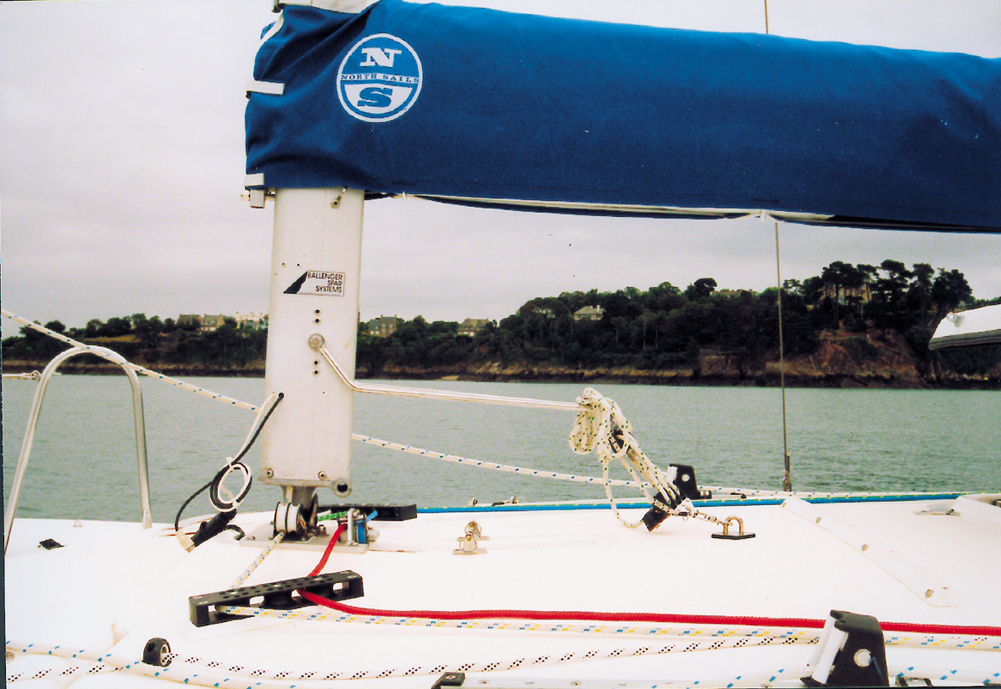
Then comes time to hoist the mainsail. The F-28 has simple and very efficient full-batten mainsail. Guy Albaret positioned a crank handle on the front side of the mast to the ultimate: a roller reefing boom. This is a boom whose gooseneck goes through the mast. To hoist the main sail, just release a lock and haul in the halyard as usual with the crank handle. When lowering the main sail, turn the crank handle in the opposite direction to release the halyard. This procedure can be used to reduce the sail area, but there is also a conventional reefing system with a cunningham roll-back. By this point in our test, we had been through all the big surprises, and were ready to get down to some serious sailing.
Under Sail
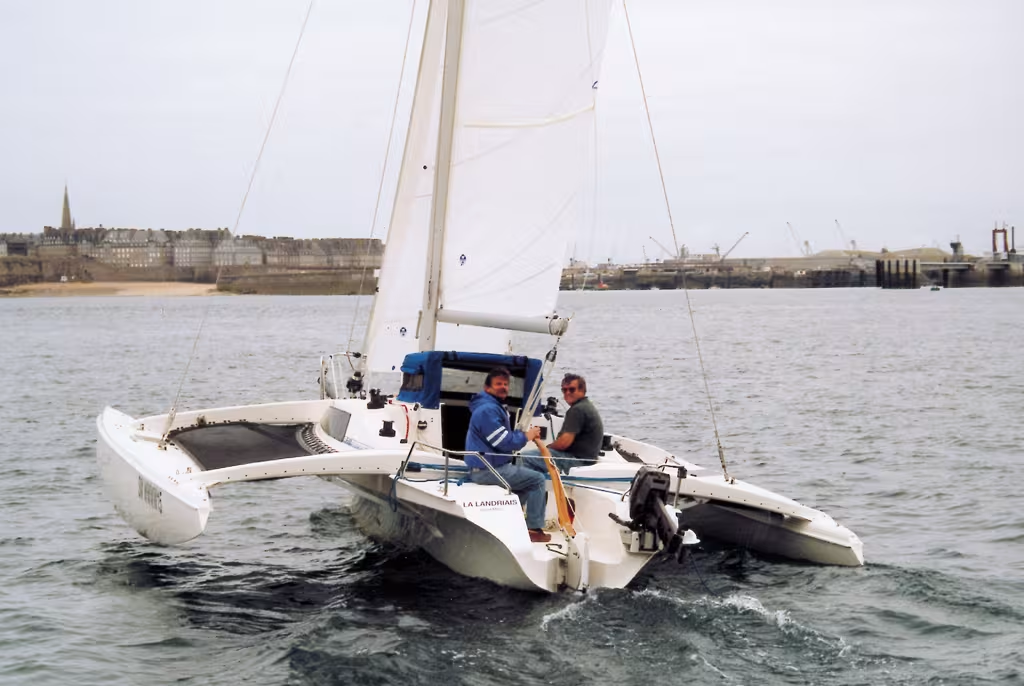
Unfortunately, the wind failed us. We had no problem, however. The light F-28 with its generous sail area was able to cut across the bay in all directions, using the other boats as markers. This is one of the Corsair’s advantages: it is a sports cruiser that combines comfort with performance and handling. We had on board the owner of an F-24, who was there just for fun. He told us he easily exceeded 20 knots on his trimaran. As we were moving at more than 6 knots with only 3 to 4 knots of wind, we listened to him describe how he maneuvered, alone, with a small crew or with the family, even in tough conditions. It is more than the sheer speed, it is the fast cruising that appeals to him. Such easy sailing enabled him to sail confidently to any destination, knowing he could come back to port fast.
Proven functional fittings…
For us, although the lack of wind would keep us from pushing the trimaran to see how it behaved (passage in the sea, spray, stiffness of the platform, etc.), we enjoyed playing with the adjustments, few but effective. We noticed that mast rotation is important for the power and proper running of the boat. It is possible to block it on the pedestal like a conventional mast, but once it is preadjusted using its rotation control, there is no need to worry. Combined with a properly cut set of sails, our fine-tuning (traveler slightly windward) helped the trimaran glide effortlessly. For the rest of the test, reaching and running before the wind showed how easy it is to go fast. The helm is always very light and gentle. It responds to boat acceleration even in light wind. This trimaran, is very lively at the helm, ideal for all those who enjoy “feeling” their boat; It is nothing like this with conventional cruising multihulls in terms of thrills at the helm. This is probably due to the fact that the Corsair F-28 is quite light: 1,200 kg. Consequently, there is no problem maneuvering, tacking or jibing.
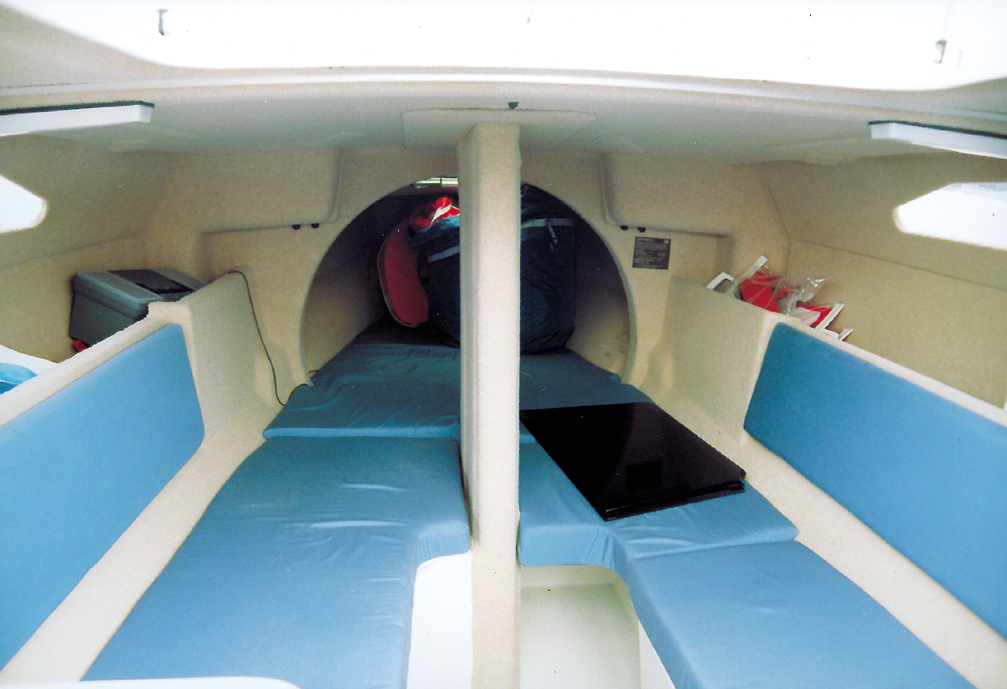
The “Europeanized” interior is succinct and shows the boat’s agenda is not really for very long cruises…
Accastillage
There are five self-tailing Harken winches around the cockpit. The traveler and the 8:1 main sheet block system are also by Harken. The traveler is equipped with a very nice little gadget: a small car that slides under the big one and has a double cleat system to release stress on the windward block. The result is that you can use the car on another leg without worrying about its leeward adjustment. In case of unexpected jibing the car cannot remain stuck windward. To steer this F-28, there is a fine laminated wooden tiller handle. To maneuver, you sit behind the mainsheet traveler in a cockpit open toward the back and spacious enough to hold several people. It should be noted that all the controlling lines run to the cockpit, even those for the daggerboard, which has one line to raise it and another to lower it. There is no need to use the winches to position the daggerboard: it slides perfectly well in its shaft. Similarly, the rudder can be entirely raised, which facilitates beaching.
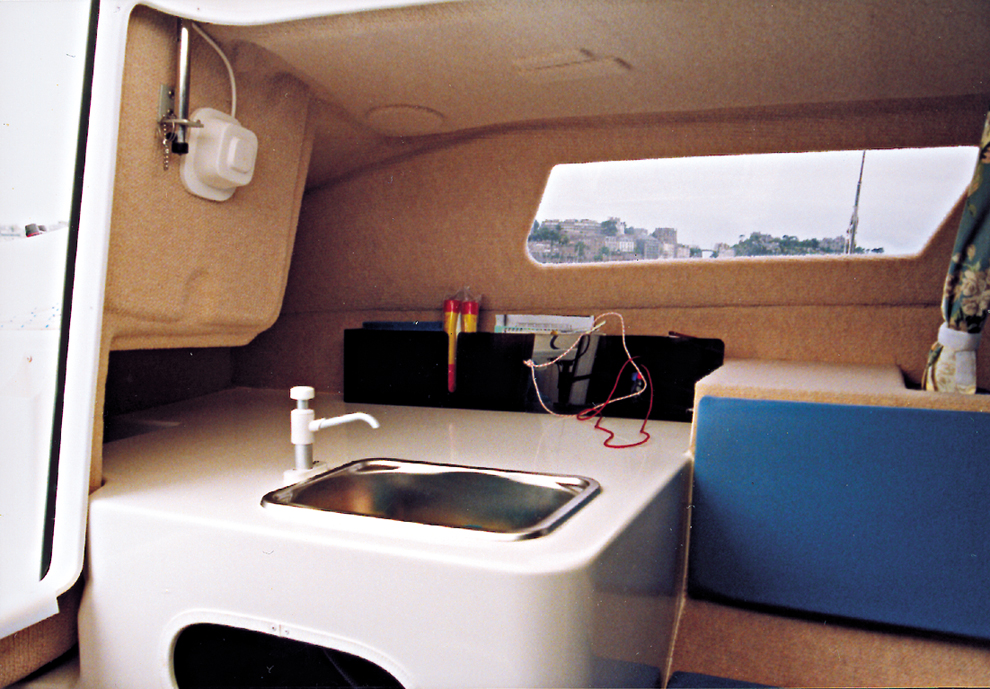
The “Europeanized” interior is succinct and shows the boat’s agenda is not really for very long cruises…
Rigging
Beside the 27m2 full-batten mainsail mentioned above, there is a 16 m2 jib mounted on a furler. The boat tested had an aluminum mast. All sails were made by North Sails. In front, the F-28 carries a splendid carbon spinnaker pole on which to hoist, either, a 33 m2 reacher or a 72 m2 asymmetric spinnaker. The boat looks fine, with a the central hull trimmed properly and the floats inclined slightly outward. The spacious deck is nicely finished with rounded corners, which are safe for children. The trampoline between central hull and the two amas offers an ideal place for windward sailing without getting wet. At any rate, the boat does not get too wet, thanks to deflectors on the amas to prevent spray. You must, however, beware of the waves striking the rear leeward cross arm. Inside, the amenities are plain because of the narrow shape of the central hull. There is a double berth in front, two bunks facing each other in the salon and the possibility of setting up another small berth under the cockpit, or leaving this space for storage. There is limited headroom except for the companionway, whose cover is raised on four supports. It can be equipped with a canvas enclosure. There is storage, but you can feel the boat is intended primarily for short cruises. To the left on the way down, there is a small simple galley and on the right, a corner for electronics. For decoration, the shipyard wanted to “Europeanize” the colors and let owners do what they wanted to customize their boat.
Well-Finished Construction
The construction of the F-28 is PVC foam sandwich. The resin used is polyester and the fiber is glass except for the cross arms, which are monolithic with unidirectional carbon fiber reinforcements. The whole is impregnated under vacuum, for a combination of lightness and strength. It is perfectly finished and the exclusive Corsair patented folding system is guaranteed for seven years. For thrill-seekers, there is a high-performance version of the F-28, the F-28 R. This unit is equipped with an 11.70 m all-carbon rotating mast and a 29 m2 mainsail. The shipyard has had the boat certified in French category 5 for the time being, with the intention of modifying some of the safety features (guardrails, etc.) to be certified in category 4. It comes with a loc-speedo-sounder and a bulkhead compass. The importer will be able to give you additional information on additional equipment and accessories.
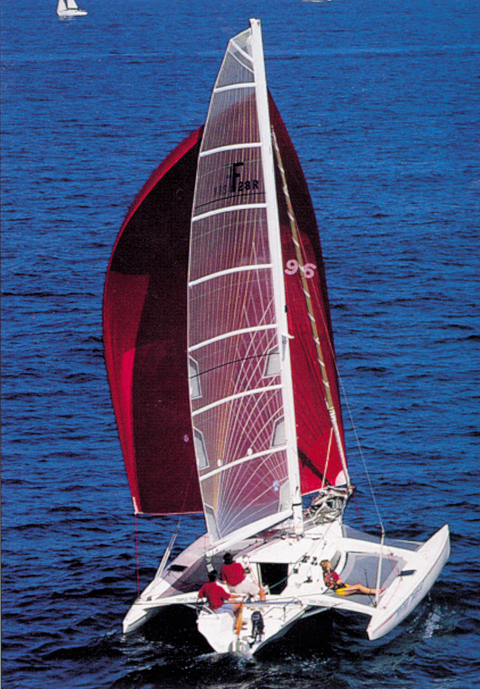
In the US, there are many regattas for aficionados of Corsair trimarans.
Conclusion
The F-28 is designed for sailors in search of performance and fun, but also wanting to be able to take the family for easy sailing. The way it has been thought out and built, this trimaran should suit a wide variety of people, with no limit on age, since everything has been simplified. Everything, from transport to set up, including the folding and unfolding of the cross arms, raising the mast and operation on the water, can be done by a single person. It belongs to the family of modern multihulls for people who want to move fast on the water with the family, go for a day outing or cast off for a short cruise. There is no question this is the type of boat we should be seeing more and more often in European waters, now that the success of the Corsair range in the US has proven the soundness of the concept. And many users will be attracted by no longer needing to carry pounds of cast iron under the hull. Price: FF 577,000 (VAT included)
Options
Carbon mast Jib furler Spinnaker and boom Solar panels Float stanchions Galley Head Electronics Appointments OB motor Trailer
Technical specifications:
Overall length: 8.66 m Waterline length: 8 m Beam: 6.10 m Beam when folded: 2.50 m Draft: 0.36 m Centerboard depth: 1.50 m Displacement: 1,200 kg Height of mast: 11.22 m Mainsail surface: 27.1 m2 Jib area: 16.3 m2 Spinnaker: 72.5 m2
Truly a trailer craft, the Corsair F-28 allows you to choose brand new cruising areas. Etape 1: The mast is mounted when the boat is still on the trailer. The boat is launched with its floats still folded (it is even possible to use the motors to move with the floats still folded). Etape 2:The floats are unfolded one after the other effortlessly. Etape 3: Solo, it takes less than three minutes to fold or unfold the floats and the trampolines automatically stretch themselves. Etape 4: OK, the F-28 is ready to cast off…