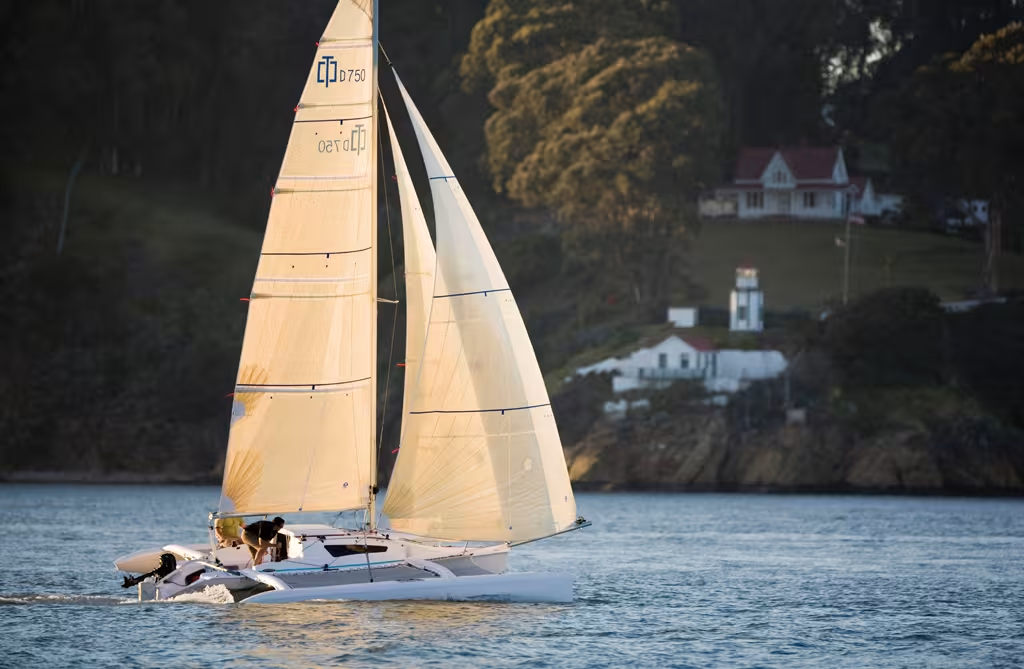
Did you like the Corsair 24? If so, you are going to love the Dash 750! More powerful and with a bigger sail area, on the water it proves to be even more exciting than its older sister. A thoroughbred which knows how to be discrete in the marina and on the road. Fasten your harnesses, and come with us!
Infos pratiques
- Le chantier : Corsair Dash 750
- La fiche technique
- Découvrez notre vidéo exclusive
- Financez votre Dash 750
- Assuez votre Dash 750
- Articles autour du Dash 750
Quite frankly, you could ask yourself if Corsair Marine’s directors really needed to replace their 24. The builder’s smallest model, 250 examples of which have been built, had everything it needed to appeal! But we admit that a slight rejuvenation, after 15 years’ good and loyal service could not do any harm... So, what’s new? The R & D department have essentially worked on the ‘engine’. The stepped central hull has been retained, but boosted by a mast which is 1 metre taller. And to take the extra m² - 5 to windward, more than 15 with the asymmetric spinnaker - the architects have designed new floats. Finally, 20% more volume, and a flatter bottom aft to encourage planing. The assembly method has also been developed: hull and deck are fitted into each other, and no longer just bonded. Slightly re-vamped inside and given a punchy patronymic – Dash – the new trimaran is also available in a day-boat version under the name Sprint 750. The machine retains the embryo of a coachroof, just enough to house a double berth, and has an XXL-sized cockpit. An excellent support for raids! But let’s return to our Dash, which we found in its sailing configuration, that is, unfolded. The system used by the company for the past 25 years is fiendishly effective. It is not for nothing that Corsair Marine, with 1,600 boats sold since 1985, is the world leader in folding trimarans! In concrete terms, the arms come away from the central hull. Whilst the floats incline and lie against the central hull, the arms stand up vertically. The builder has remained faithful to PVC foam/glass sandwich construction to keep the weight low, just what we like here at Multihulls World. To propel this lightweight boat, weighing less than one tonne, the 6hp recommended by the builder proved to be more than sufficient. The controls are easily accessible for the helmsman, as long as he moves aft a little from his usual position, just ahead of the mainsheet track. The only difficulty, during these very first manoeuvres, was to integrate the 5.6m beam. Single or short-handed, you have to go gently: you can’t fend off the front of the starboard float in two seconds when you are occupied on the other side of the platform. The roller boom system avoids having to leave (or return to) the pontoon with a big pile of canvas in front of your nose. The fully-battened mainsail slid cleanly up the aluminium mast.
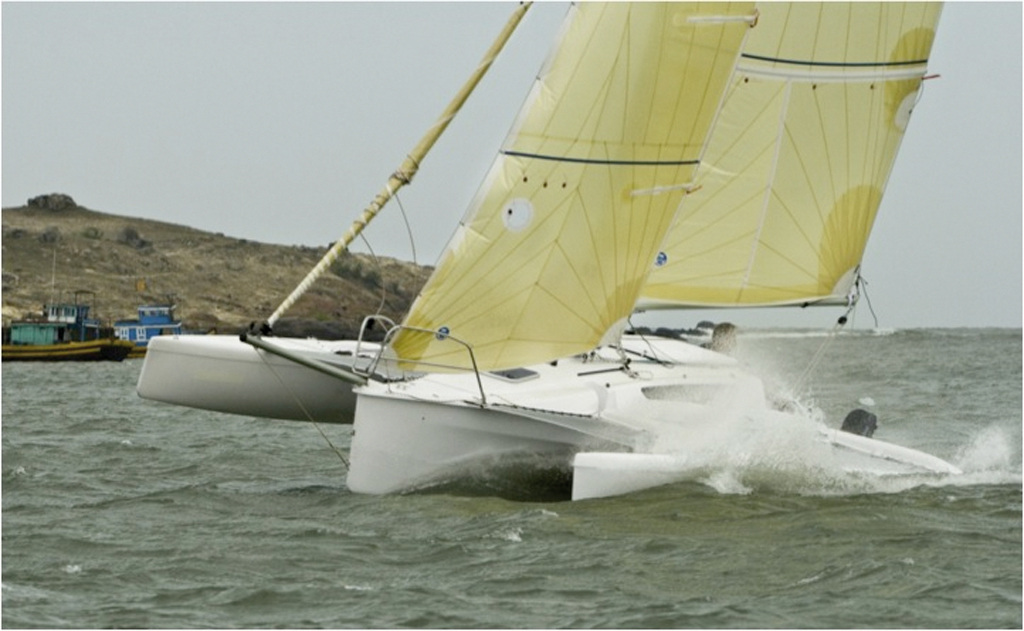
Top speeds of 20 knots? It’s possible, especially if the asymmetric spinnaker or gennaker are taken out of their bags.
A really lively trimaran…
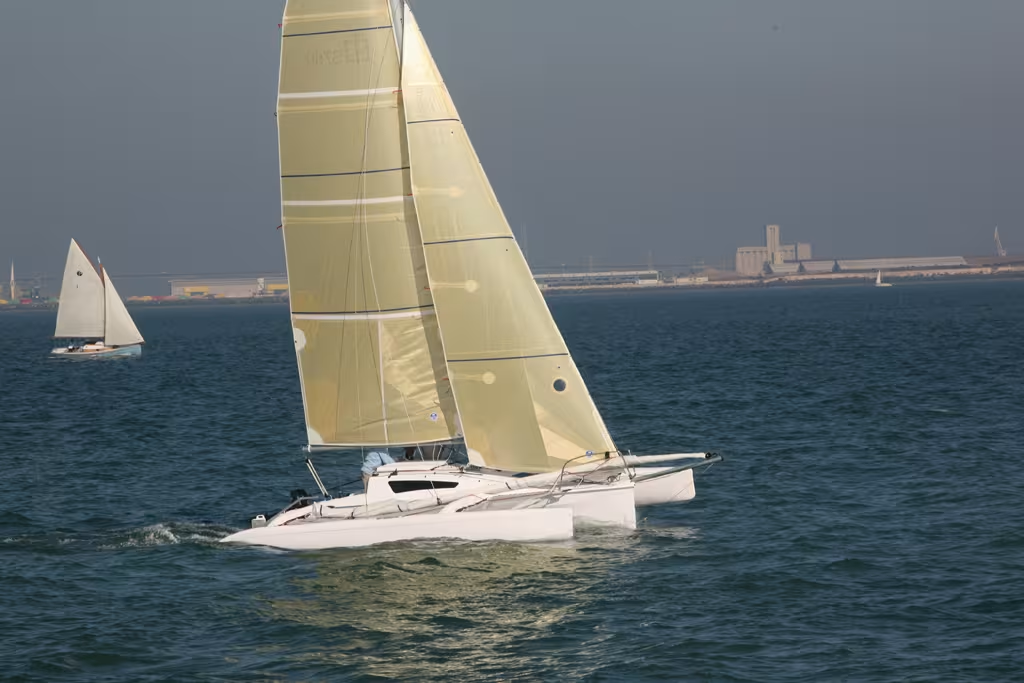
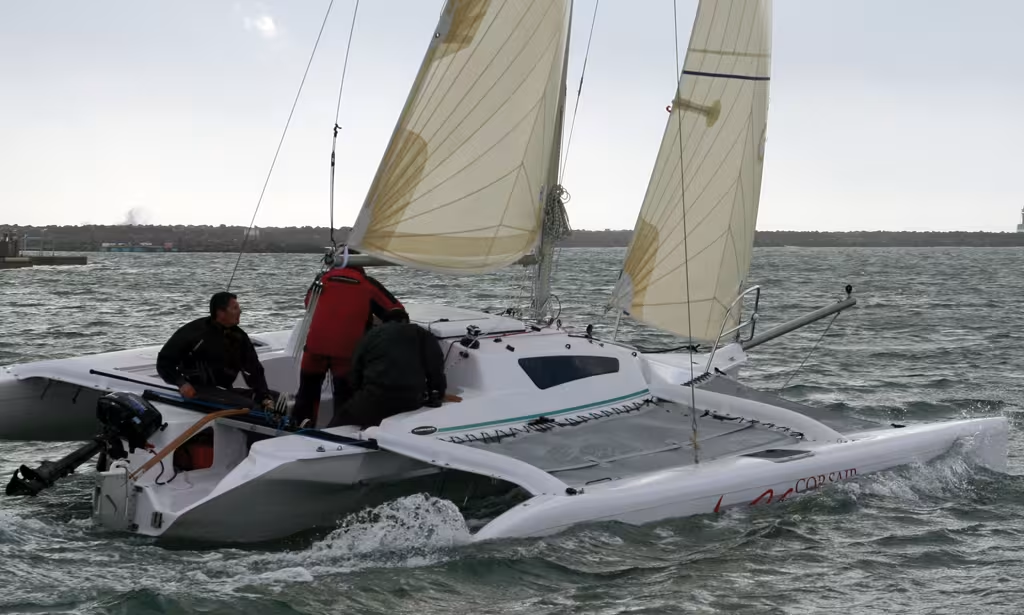
The boat was already accelerating, even before we sheeted in! We must point out that during our test, there was plenty of wind, with gusts of 30 knots... It was time to lift the motor and hoist the jib. The foresail is hanked on. Family crews can of course opt for roller reefing, but frankly, we did not feel it necessary. For two reasons: firstly because the foredeck, protected by a sturdy pulpit, is easily accessible from the cockpit. You can climb over the wide, flat coachroof, or go round via the trampolines. Then because this 15m² sail almost never needs to be reefed. Although the day’s rough conditions didn’t put us off going out, Christian Malardeau’s phlegmatic relaxed attitude persuaded us to fly full sail... With each gust, the boat immediately leapt forward, perfectly supported by the leeward float. The speed was flattering, more than 8 knots to windward from 10 knots of wind. The course? 45° from the true wind. Thanks to the daggerboard. And once the sheets were freed, we easily did more than 10 knots. The day’s top speed: 15 knots! In the hardest gusts, the leeward float sank a bit, then the Dash eased the strain by rearing up. Despite the large forces taken by the structure, the articulated arms don’t move. In short, no inclination to capsize or somersault; the 750 remains planted on its three legs. At the helm, it was great fun. Sitting comfortably in the cockpit with the sheet within reach, we overtook all the sailing boats on the water. We weren’t even wet: the big waves just made the leeward float ‘smoke’. A pleasure you can share as a family as the boat is very easy to handle. The control lines, which pass via top quality Harken fittings, are obvious and easy to use. There is none of the ‘snake pit’ atmosphere, despite the pivoting mast. The halyards remain on the profile, that’s all.
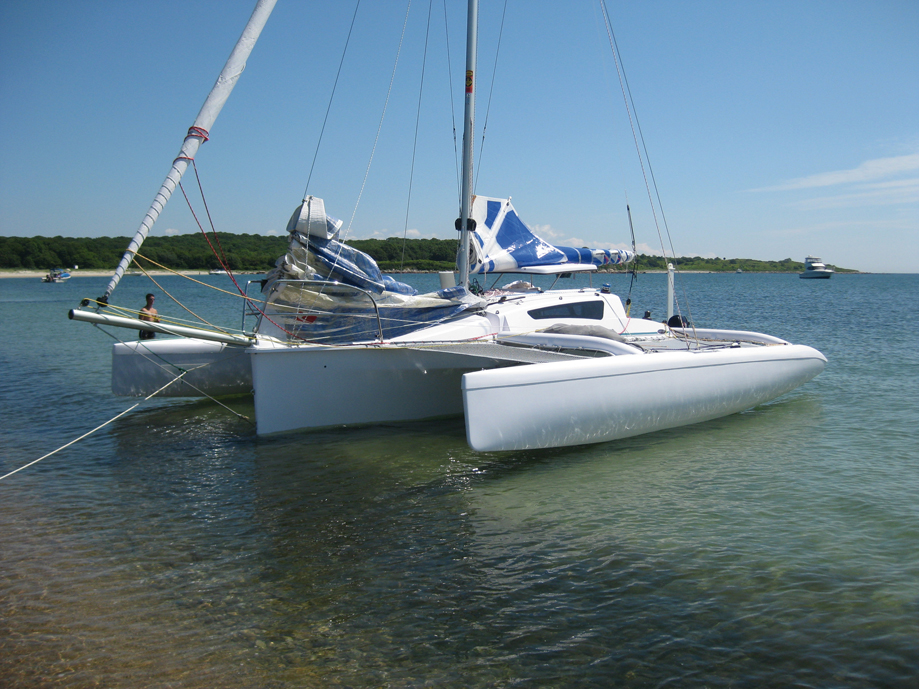
Combining brilliantly pure performance and peaceful family outings, or even a dream anchorage is the challenge the Dash 750 has successfully met.
The bows on the beach.
Enjoying flat-out runs is very nice, but at picnic time, settling in a peaceful anchorage is not bad, either. The Dash 750 is very adaptable: the daggerboard and lifting rudder allow you to arrive on the beach in the little creek you like so much. But be careful, not too quickly: the appendages in their cases, which therefore do not pivot, don’t appreciate touching the bottom, even on a not very aggressive seabed, not to mention on hard granite. You have to carefully manage the approach, possibly under engine, to control the course (it’s hard to fight against the windage once the appendages are raised) and the speed. The builder has provided an anchor locker with sufficient volume to stow the anchor and its warp. But there is no bow roller, which encourages use of a light, aluminium anchor and a weighted warp. For sure, holding will not be the equal of a classic anchoring system, especially on very hard or muddy seabeds, but it is the only way of preserving the gelcoat. And also to save a bit of badly-positioned weight. At stopovers, you can enjoy the long cockpit and of course the huge trampolines. It is hard to resist the call of the siesta. Access to the sea or the dinghy from the transom is quite satisfactory. The aforementioned transom is not very wide, yet the outboard motor, the rudder and the actual passage fit well together. The exterior stowage includes small shelves in the cockpit and the lockers fitted in the floats.
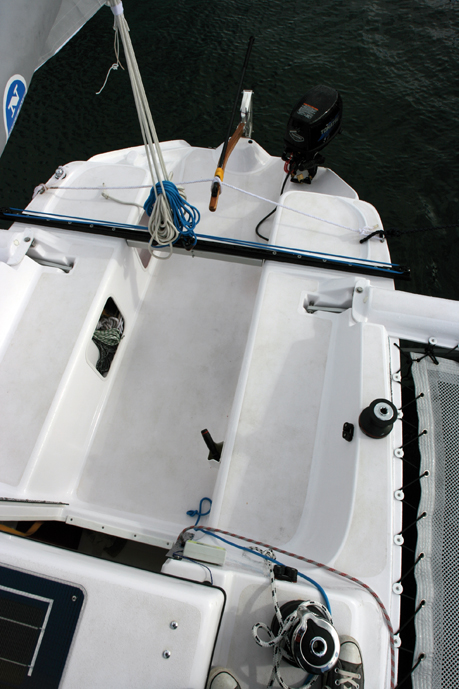
Aboard, you are partially protected by the wider coachroof, and it is possible to sit out... on the trampoline.
Accommodation: the width is limited.
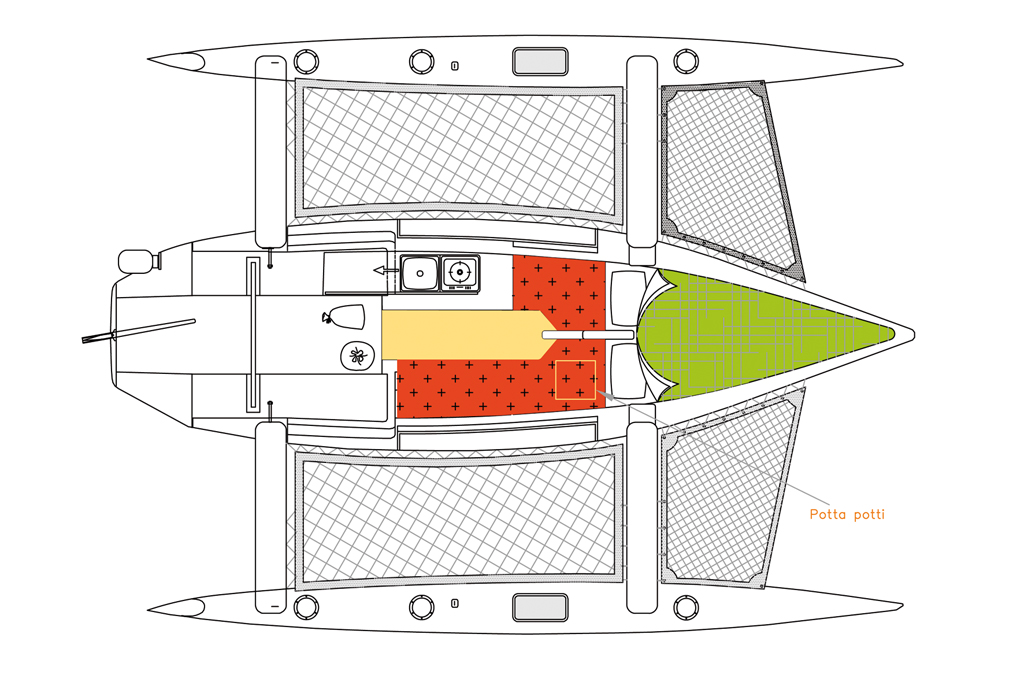
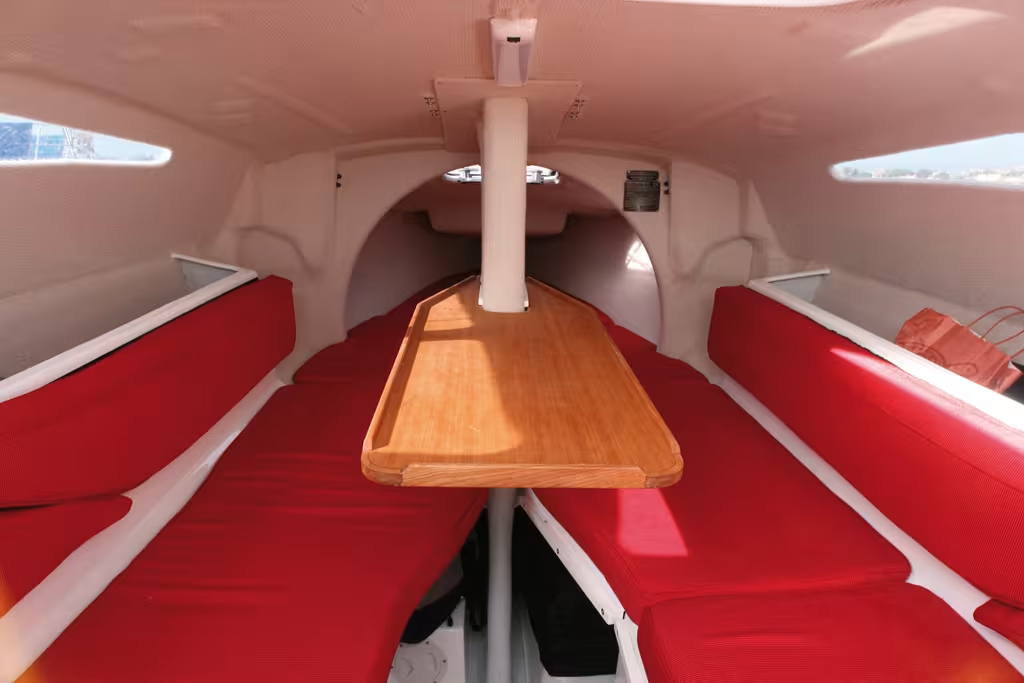
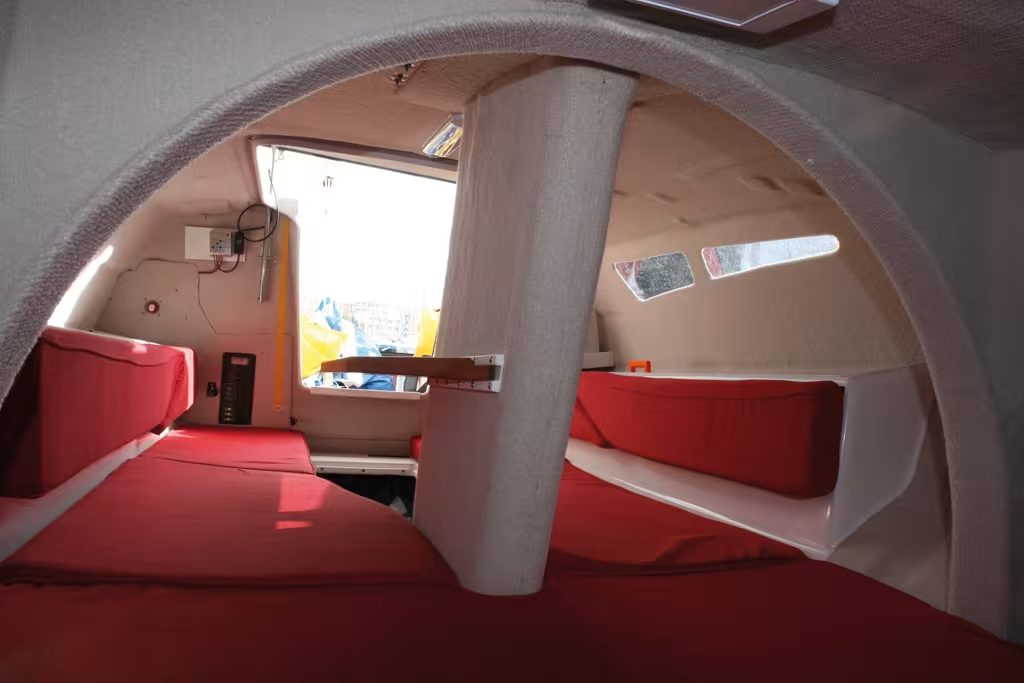
We might as well say it straight away. The coachroof may well be wide, and the steps marked, but the central hull’s interior volume is nothing like that of the central bridgedeck of a catamaran. Having said this, cats of this small size with a central shelter are rare. The advantage of the deep cockpit: there is just one step to go down. The area is strategic and convivial; it encourages the crew to come and go. Thanks to the width of the main hatch and above all the famous lifting roof panel, even big people will not make a fuss about going to get a fleece, a bottle of water or the sun cream from the interior. The hatch is mounted on rails and can be raised 40 cm above the coachroof. The finishing is flattering, bright and clean, with no approximate fitting. Our only reservation? The use of carpet – grey or beige - for the insides of the hull... We saw that 30 years ago, and since then have realised that this material retains moisture, goes mouldy and comes unstuck. The builder nevertheless assures us that he uses rot-proof carpet. The saloon is made up of two long settees. A table, 80cm by 42cm fits into the daggerboard case. Under the cockpit, to port, there is a galley which is just enough to make a coffee or boil the water for the pasta. In addition to the stove, there is a small sink and a 20-litre water container. Stowage is concentrated under the settees and the shelves along the hull sides. And the WC? No heads, but a simple chemical toilet hidden in a locker. The bow houses a double berth of a good length, but a bit tight at the head: just 1.2m wide – the standard is more like 1.4m. Beware: this berth is practically unusable if the bowsprit is retracted, and it may be tricky to hang two metres of carbon over the pontoon! To be anticipated, if necessary, by mooring stern-to. The end of our mind-blowing outing. The mooring lines were tied off to the cleats, on the bow of the central hull, and on stainless steel chainplates on the stern and the floats. The next day, the boat was folded, the mast was unstepped and it set off by road, ready for another test. Magic!
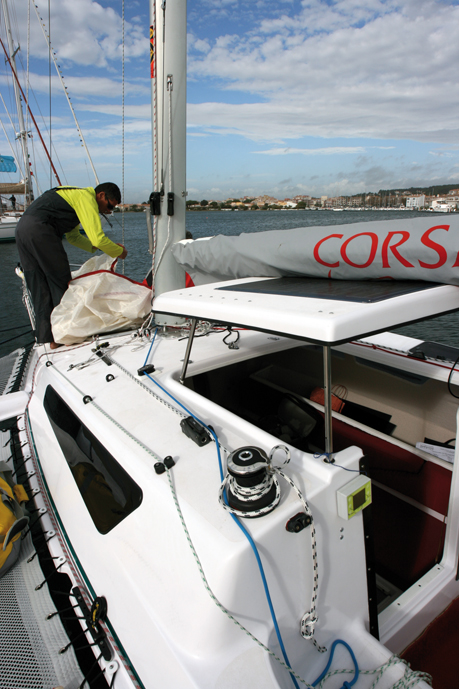
This articulated hatch is a great idea! Thanks to its two rails, the headroom increases from 1.52m to 1.92m. Will be appreciated by the tall.
In conclusion
More comprehensive than a Tricat 25, the Dash 750 is certainly a sailing boat which will not leave you indifferent: few boats, and especially no monohull, can pride themselves on sailing at 20 knots with no stress, embark a family crew for a few days’ cruising, and change cruising areas at will. Just one downside: its price. In dollars, ex-builder, the machine is still accessible. But the transport and customs charges are considerable. When you like something...
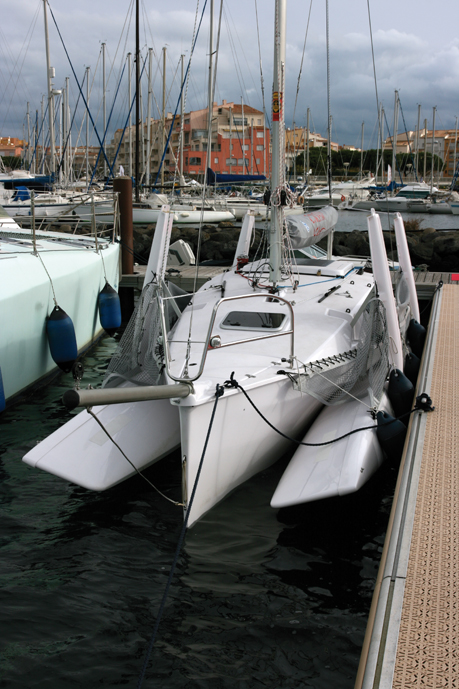
Undo a few bolts and the beam goes from 5.6 to 2.5m. Very practical for borrowing a monohull’s berth in the marina, and transporting by road.
THE PLUSSES
Strong, fast boat Simple, effective folding system
THE MINUSES
High price Carpet interior trim
Technical specifications
Dash 750 Hull length 7.40 m Waterline length 7.35 m Beam 2.5/5.6 m Draft 0.3/1.65 m Weight 850 kg Windward sail area 39.8 m² Mainsail 24.4 m² Genoa 15.4 m² Spinnaker 58.3 m² Engine 6 hp outboard CE category C Architect Corsair Marine Builder Corsair Marine Launch year 2009 Price 54,996 euros exc. VAT