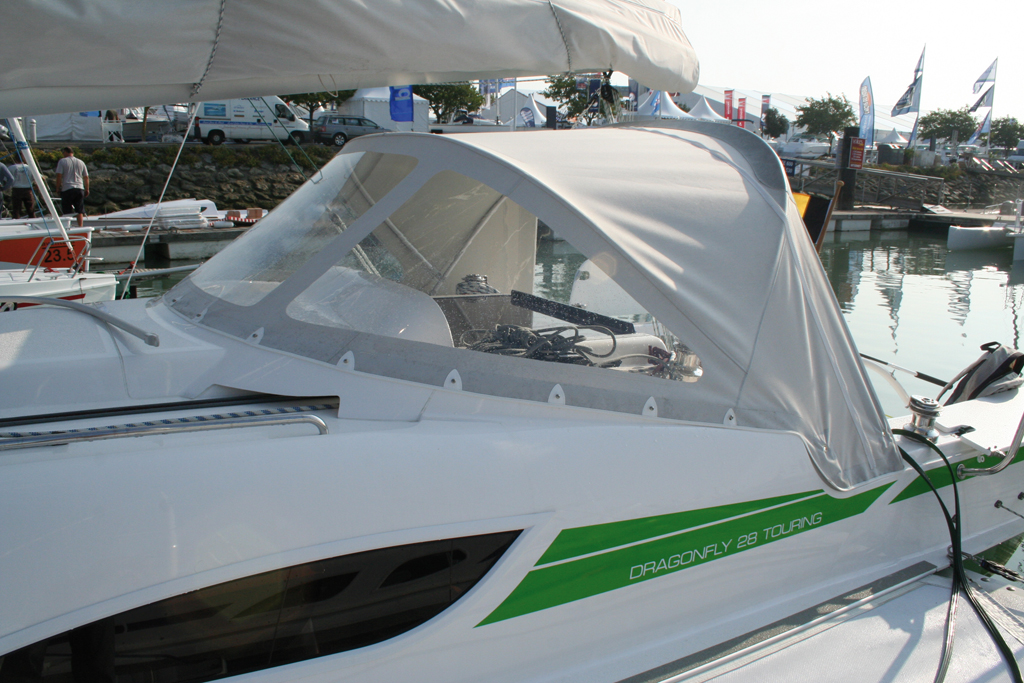
Advertised as the replacement for the 920, the new Dragonfly is just as attractive as its predecessors.
Infos pratiques
- Le chantier : Dragonfly 28 Touring
- La fiche technique
- Découvrez notre vidéo exclusive
- Financez votre Dragonfly 28
- Assuez votre Dragonfly 28
- Articles autour du Dragonfly 28
It was nearly one o’clock in the morning and I finally agreed to let go of the tiller extension I had been attached to for nearly 9 hours. Sitting comfortably on one of the small wings surrounding the huge cockpit, open to the stern, I took advantage of the moment just before going to rest to accelerate one last time in this pretty machine, on a wave, increase the apparent wind, bear away and accelerate again, until that limit beyond which the headsail no longer draws. The wind had spoiled us throughout the day, and it would have been a shame not to take advantage. Although the rain hadn’t stopped since we left from Port Haliguen, on the Quiberon peninsula, I was finally not very wet: the sprayhood is perhaps a little high, but it protects effectively from the rain. Its framework is in aluminium, and therefore the fittings are in plastic. Although the whole assembly is light, the fittings are more fragile, and will probably require replacement from time to time. As I left the helm, I heated a coffee on the little gas stove to port, it has two rings and is sufficient. On the other hand, the electric panel is perhaps a bit too close; this area will also serve as a chart table when under way. The saloon was cluttered with drying foul weather gear; I reached the forward double cabin, to find that, apart from the noise of the water on the hull, movement was almost non-existent, despite the speed. Zzzzzz…
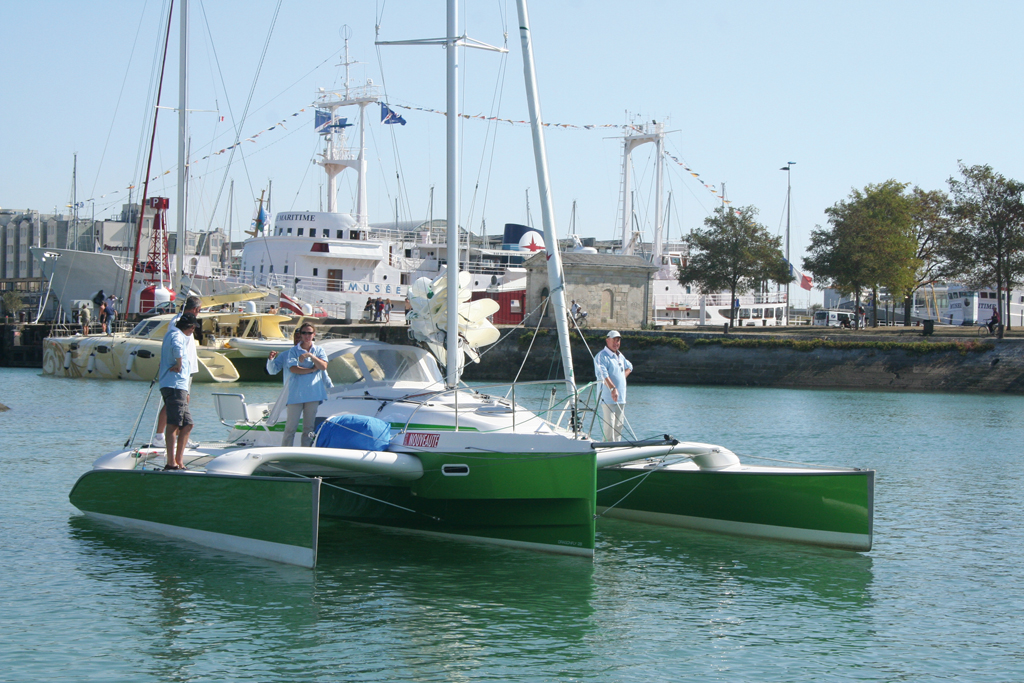
A fast, but civilised, boat.
Leaving from Quiberon.
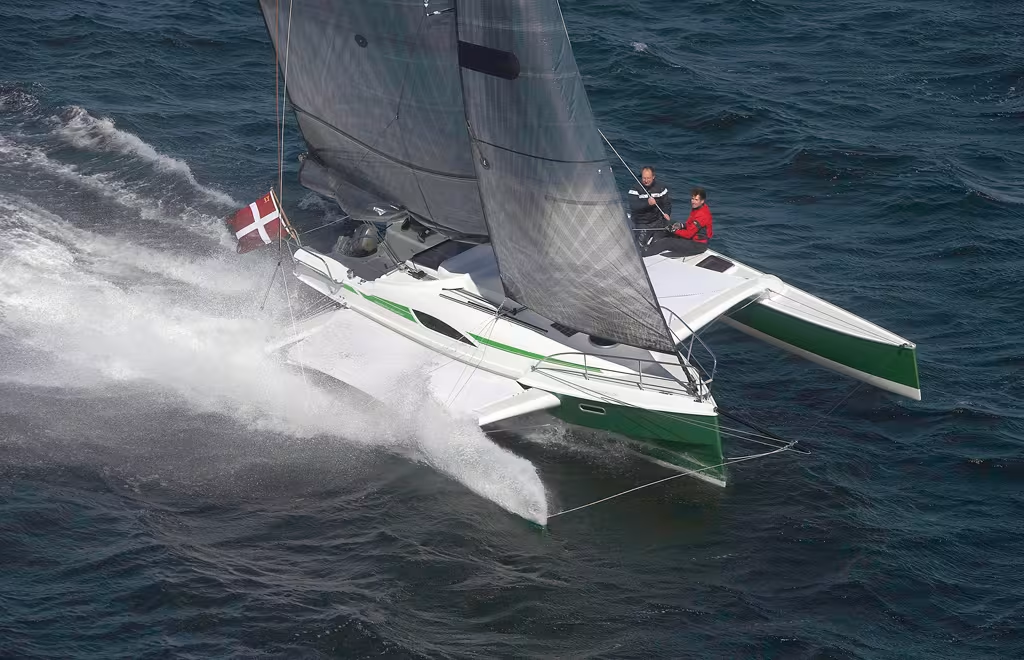
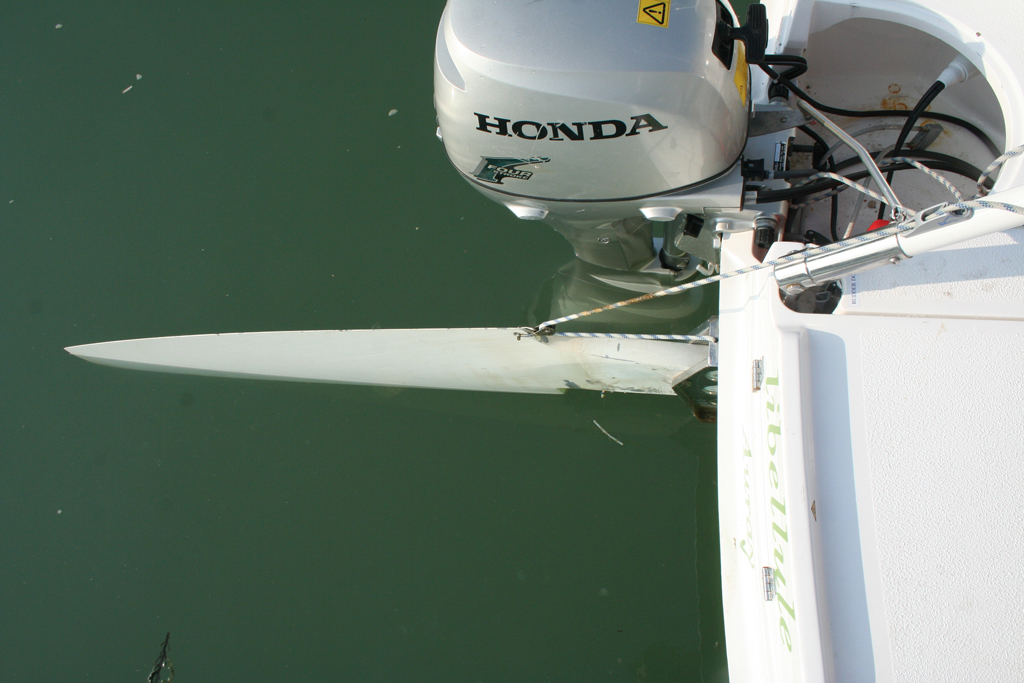
Let’s go back in time a little, in South Brittany. The weather forecast announced winds which were not very strong, worse still, they were forecast to become lighter. As we left Quiberon, we had almost 130 miles ahead of us, with the firm intention seeing what this beautiful boat in its metallic green livery (you either like it or you don’t; I loved it) is capable of. At around the Teignouse, the small chop created on the one hand by the light cross wind, and on the other by the tidal current, tended to slow us down: a light multihull (the Dragonfly weighs less than two tonnes) lacks inertia! However, in these waves, we felt that the boat was quite rigid, even though on the test day, the wind was blowing from the land and we were therefore sailing with no wind-induced waves. We took the Beniguet passage; once in the lee of Houat, the wind got up gradually, and like a horse bitten by a fly, the Dragon reared up, accelerated and showed the flat sea how it could really sail. The leeward float behaved perfectly; when reaching with about 20 knots of apparent wind, and probably the same amount of true, the Green Dragon exceeded 16 knots. The helm became a little heavy; we noticed later that the line holding the pivoting rudder in its lowered position had come slightly loose; the rudder had swung backwards, explaining this (when beaching, the rudder can be raised by a line). It can be locked in the lowered position using the same principle. We bore away, took in the rudder line, and set off again!
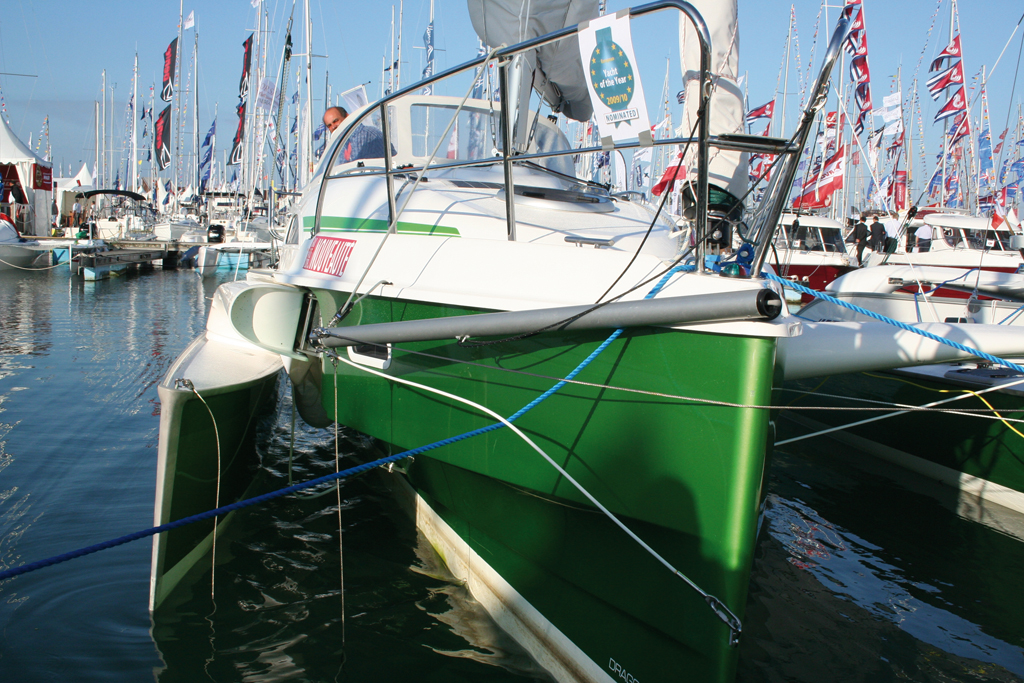
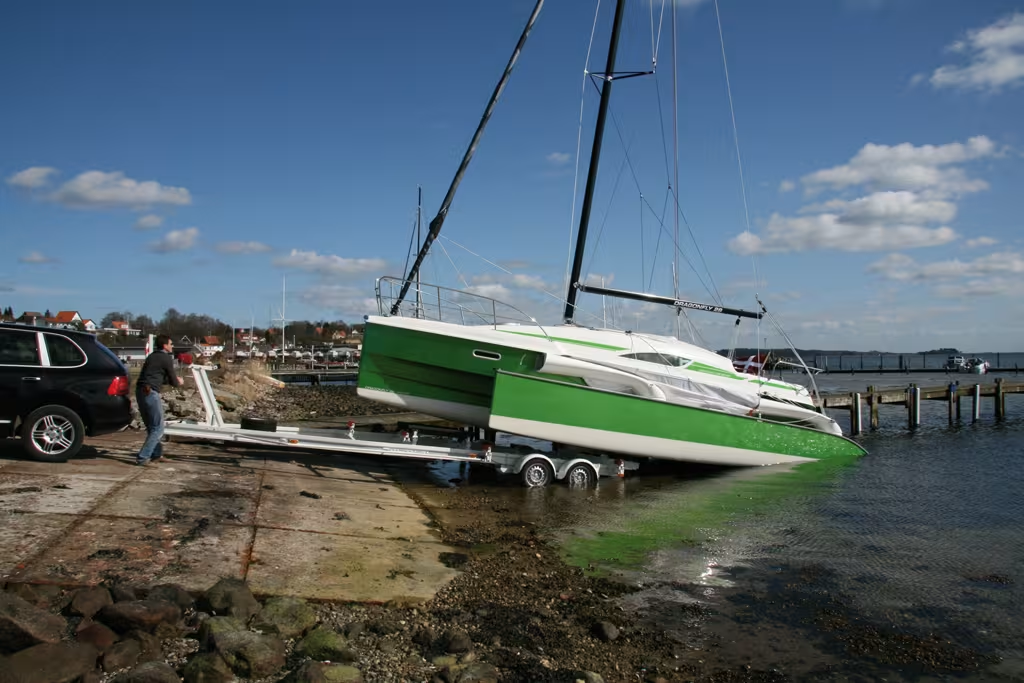
In harbour, the Dragonfly will take up no more space than a monohull of the same size. The magic of folding trimarans.
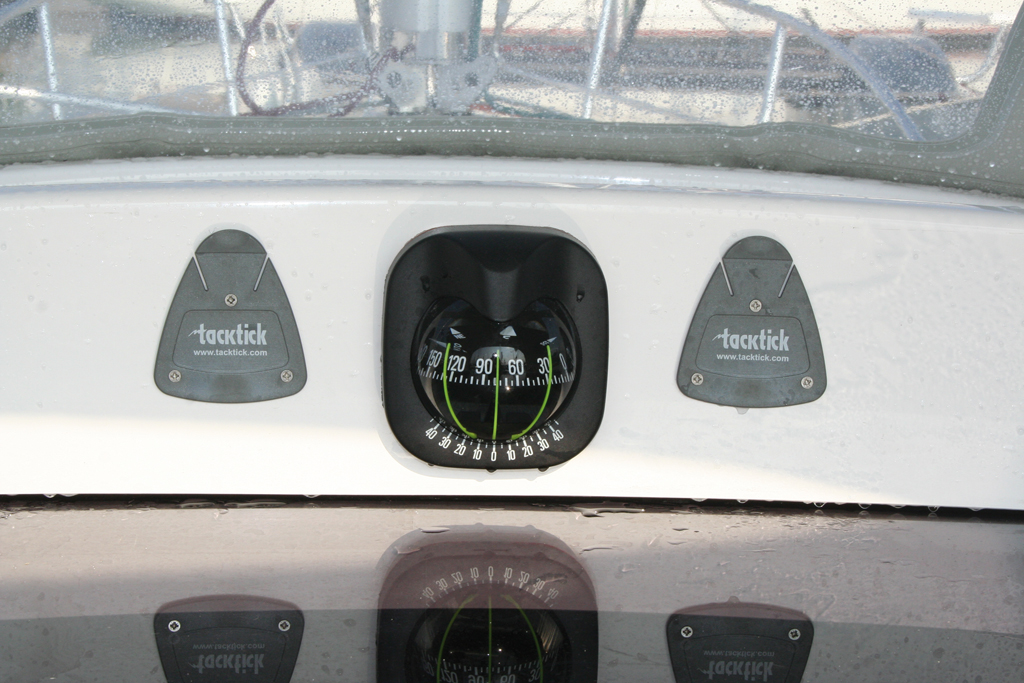
The miles stretched out in our wake, and in the middle of the night, the Ile de Yeu passed to starboard; since leaving, we had kept up an average of around ten knots. In use, the Suunto compass proved to be too small; you have to look at it very closely to guess the course. A brighter bulb, or a second one, would simplify life. When I was back on watch (the joys of sailing, having to put on clothes which are already wet – not an easy job!), the day finally broke, and it was still raining. A few hours later, we entered Les Minimes, at La Rochelle, where the Dragonfly was to be presented at the Grand Pavois. Harbour manoeuvres are made easier by the linking of the tiller and the engine, via a connecting rod. Of course, coming alongside will require a minimum amount of concentration as soon as there is any wind. The connecting rod clips on in an instant; however care must be taken to remove it before raising the engine, otherwise it will be very difficult to free it. Once raised, the engine sits in the space provided for it.
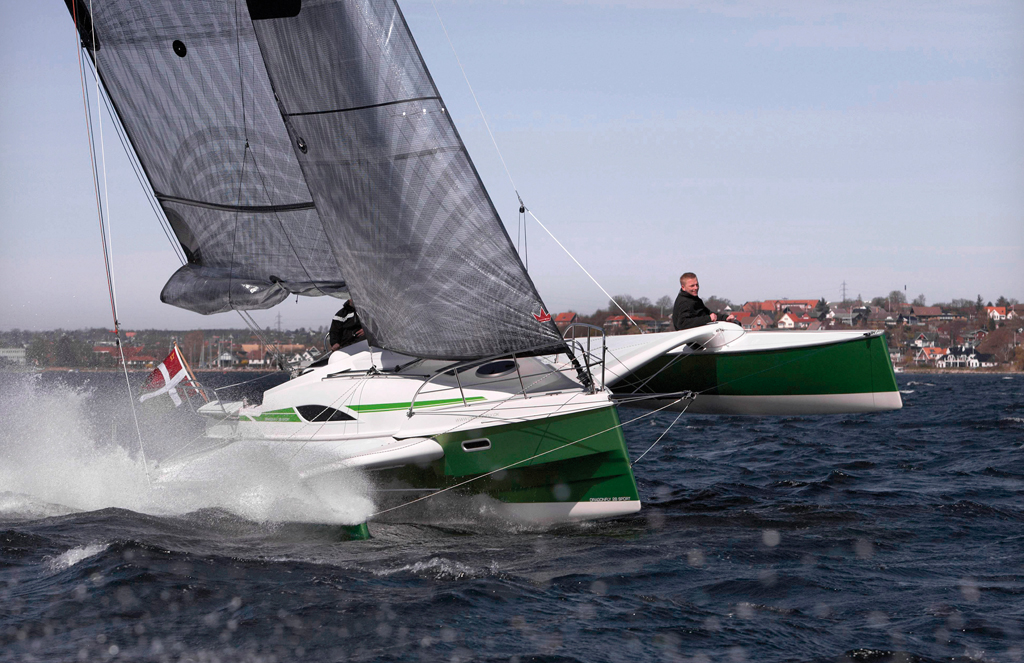
The replacement for the 920, whilst smaller, is more liveable, and just as fast…
A trimaran’s liveability.
The Dragonfly 28 is here to replace the 920 in the catalogue. Although it is slightly shorter, it nevertheless offers an additional berth. Going below, the boat is surprising; there is volume everywhere, thanks to the impressive ‘steps’ in the hull, on which the saloon seating is placed. In the middle, the table has folding leaves. The companionway ladder can be folded away; it can thus be positioned to port or starboard, depending on whether the galley, to port, or the chart table opposite is being used. The latter is reduced to its simplest expression. Removing it completely also gives access to the big double berth, right underneath the cockpit. Forward of the salon, there is access to the heads, which are very comfortable for a boat of this size, before arriving at the forward berth, perched above the hull ‘step’. That completes the interior accommodation. Stowage space is of course limited (ideal, to avoid overloading), on the other hand, light, bulky objects (fenders, empty jerrycans, etc) can be stowed in the floats, each of which has an access hatch.
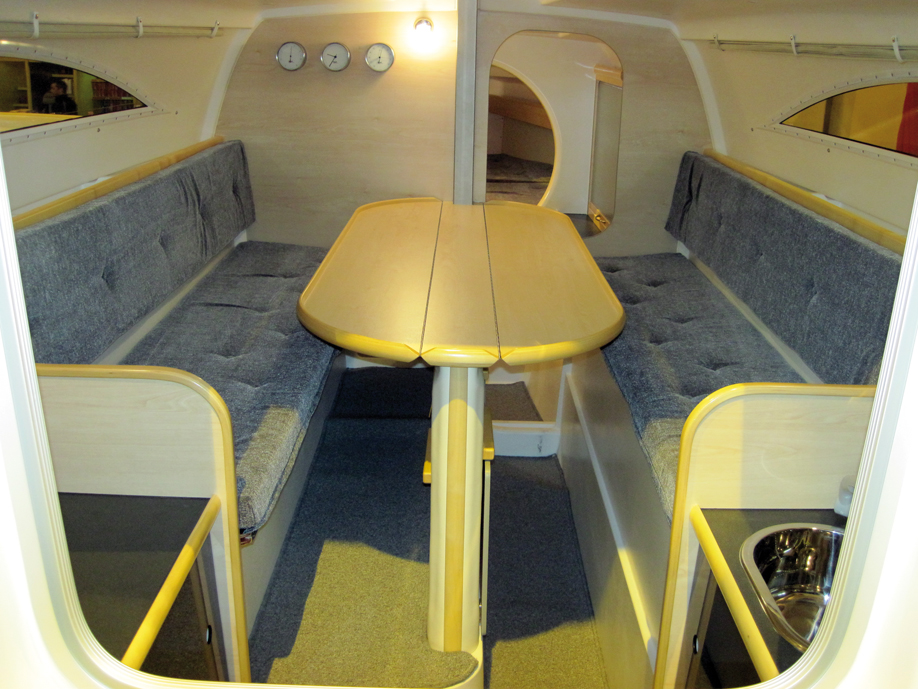
Inside, there is a surprising amount of space for a boat of this size.
Folding, and bits of string.
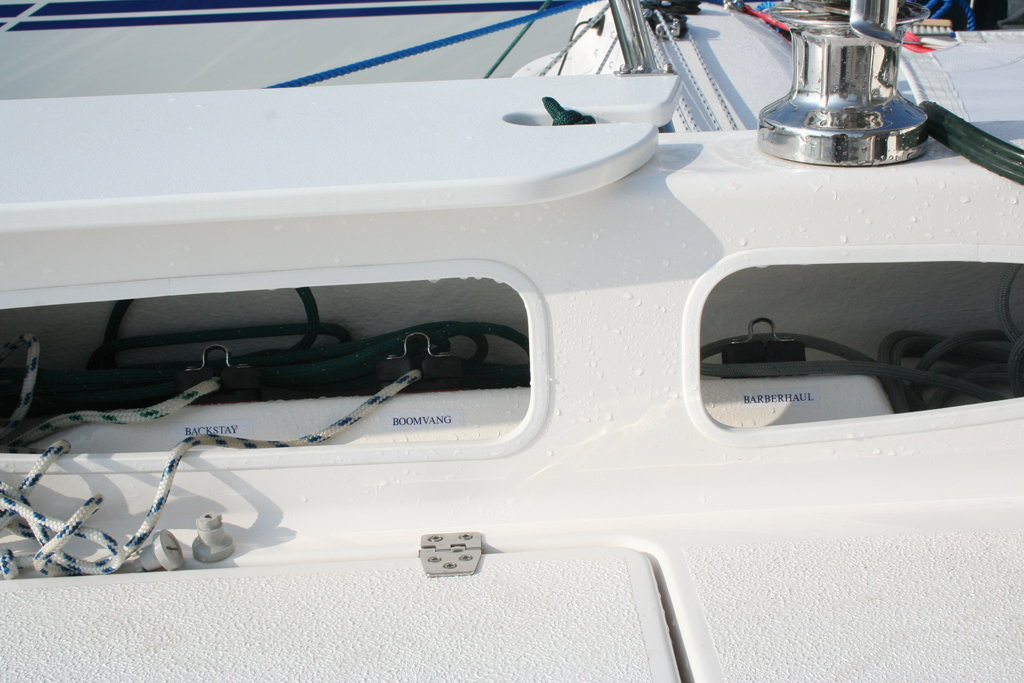
A first from Dragonfly, the folded boat conforms to the towing width limit, 2.5m, without having to be dismantled. For this, the Danish builder’s R&D department has had to innovate, by fitting the root of the arms into the hull. “The system also gives greater rigidity,” said Jean-Marc Le Goueff, from Multisailing, in Lorient, the Danish builder’s French importer. Remember that even the ‘old’ Dragonfly 800 had to be dismantled to be within towing limits. With aesthetics in mind, as well as practicality, the various lines are returned in the cockpit coamings. We thus find the runners, which in fact serve to tighten the cap shrouds; just forward is another jammer belonging to the mainsail purchases, port and starboard. The system must be outlined. The main purchase is a 4/5-part block and tackle, extended by a fine adjustment purchase (essential for fine trimming); it is fixed in the middle of the cockpit, on a turret. Depending on the point of sailing, a second purchase is used, starboard when sailing on port tack, and vice versa. Although the solution is ingenious and practical, care must however be taken, and in use it demands a bit of practice: at in the dark it is best not to make a mistake, as it is easy to free the runner instead of the second mainsheet purchase. Still at night, a gybe (close-hauled, the second mainsheet purchase is not needed) will require additional manoeuvres; taking off one, setting up the second... The remark is also true for the jib sheet spreaders, which also return to the cockpit coaming. Finally, this new Dragonfly is faithful to the philosophy of Quorning and the trimarans it builds: light, folding, obviously fast, and with a minimum of comfort. Even though certain innovations may be found surprising, we liked this boat very much. Its main fault: it is just a little expensive...
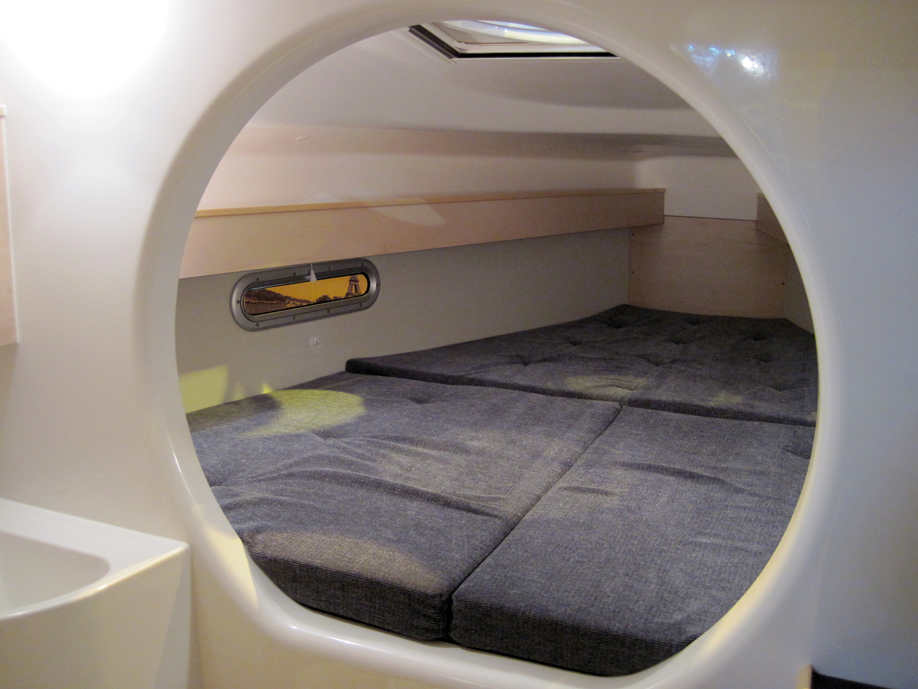
Enough to envisage some nice cruising over several days, with such accommodation.
The plusses.
- A fast boat. - Satisfactory liveability for its category. - A good helming position.
The minuses.
- Its price… - The over-complicated mainsheet - Lack of protection when getting on to the trampolines.
Technical specifications (Touring version).
Length of central hull: 8.75 m Waterline length of central hull: 8.60 m Folded length: 9.99 m Length when sailing: 9.05 m Beam when sailing: 6.50m Folded beam: 2.54 Draft: 0.40 m / 1.70 m Unladen displacement: 1,700 kg Max. displacement (without crew): 2,000 kg Air draft: 13.75m Mainsail: 35 m² Genoa: 19 m² Code 0: 35 m² Bowsprit: 1.60 m Construction: Monolithic below the waterline, sandwich above. Price of the ‘Touring’ version: 134,789 euros inc. VAT. Price of boat tested (‘Touring’, with options): 180,000 euros inc. VAT. Price of ‘Sport’ version: 151,533 euros inc. VAT.
Caption
Exploded view of the boat.
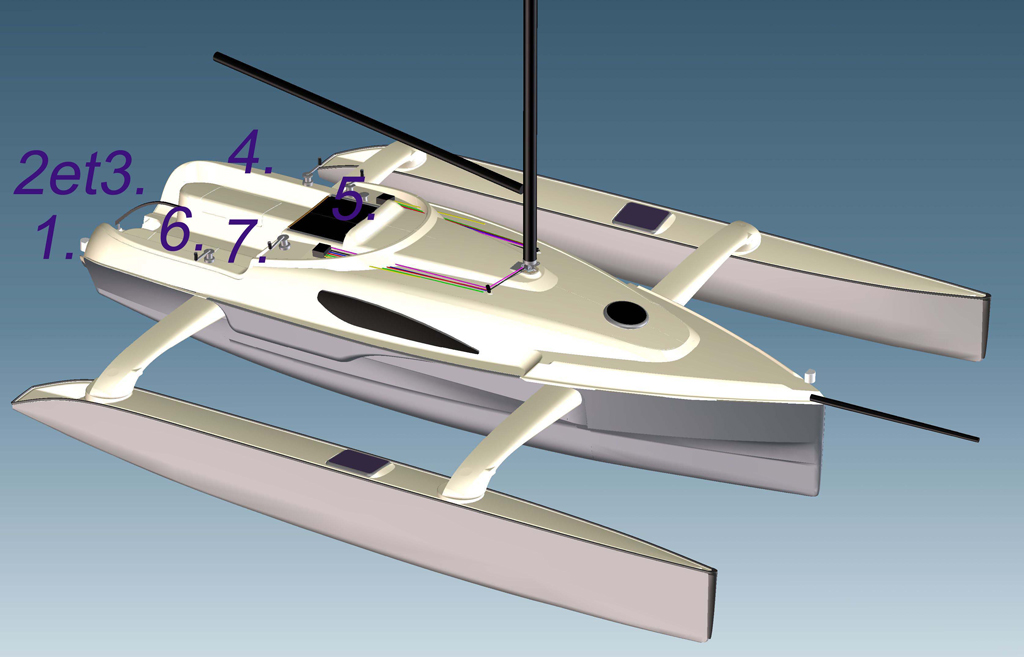
1. The connecting rod on the engine. For harbour manoeuvres, the engine clips to the tiller (and thus to the rudder) via a connecting rod, assisting manoeuvrability when coming alongside.
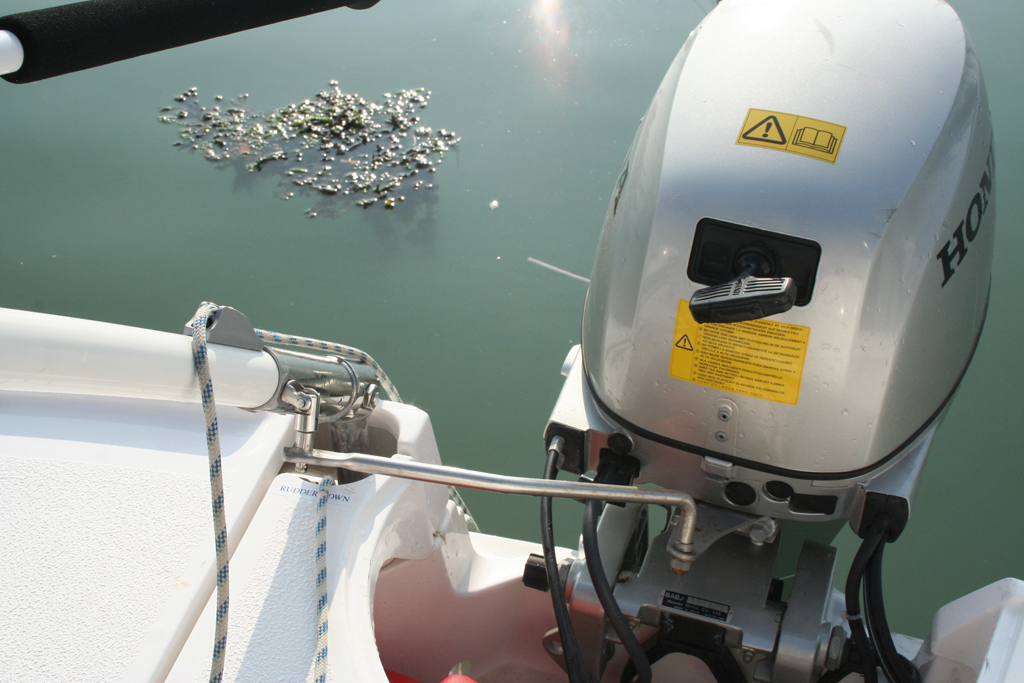
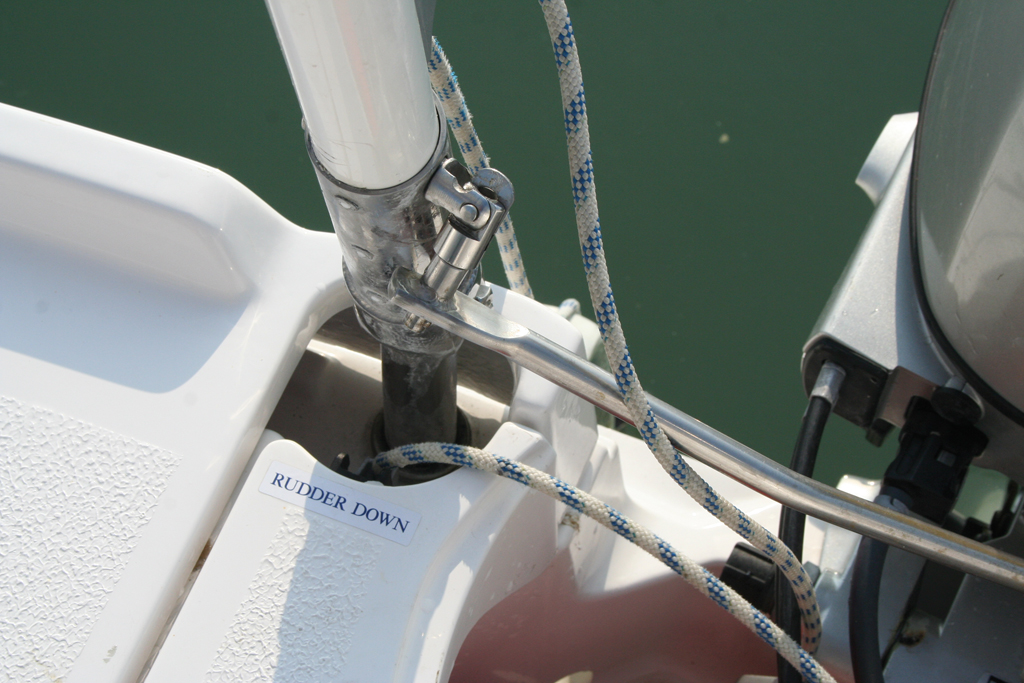
2 et 3. The lifting rudder. Just like the centreboards, the rudder can be raised, with the help of two lines, one to lower it, the other to raise it. Care must be taken to ensure the line keeping it in the lowered position is kept taut, otherwise the rudder will rise.
4. The lines and jammers under the coamings. Runners, trampoline tension and mainsheets return under the coaming, thus keeping the deck clear; the disadvantage of this formula: beware of getting hold of the wrong line!
5. The compass. Well-positioned under the sprayhood, it is unfortunately too small to be read effectively, especially at night!
6. The mainsheet purchase. The mainsheet purchase system is quite surprising; it is made up of a main purchase, fastened to a turret in the middle of the cockpit (with a fine adjuster), and two secondary purchases, which are used according to the point of sailing.
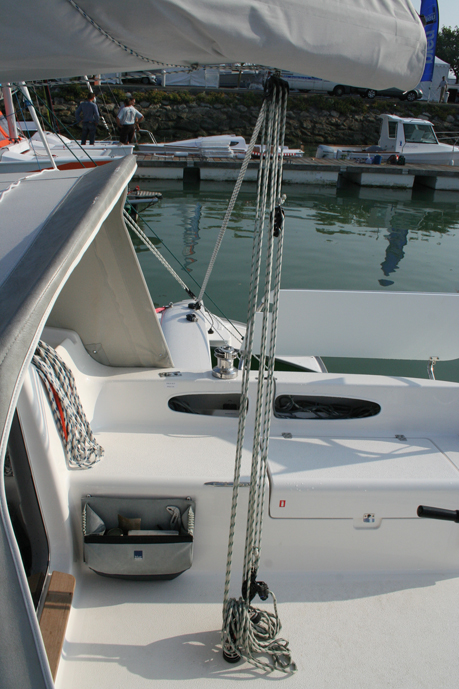
7. The spray hood. It is quite imposing, but protects rather well. It is extended by a tent, which closes the whole of the cockpit, to provide an additional area; classic aboard most Scandinavian boats.