
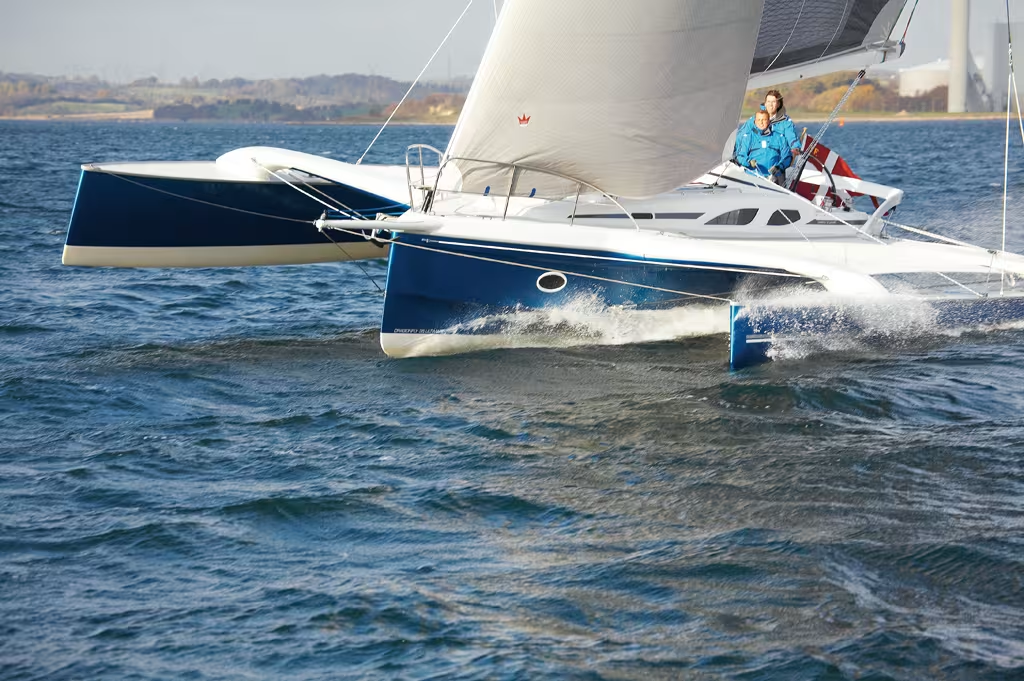
A new folding trimaran is always an event for fast, beautiful boat fanatics! That’s why just after the Dragonfly’s launch, we went to the Quorning yard to try out the beast…
Infos pratiques
- Le chantier : Dragonfly 35 Touring
- La fiche technique
- Découvrez notre vidéo exclusive
- Financez votre Dragonfly 35'
- Assuez votre Dragonfly 35'
- Articles autour du Dragonfly 35'
The legend of the multihulls from the North.
Borje Quorning has been building boats all his life. A Dane who emigrated to Vancouver, he founded his boatyard in 1967, next to the Baltic Sea, and built dozens of one-offs of all sizes, from 16’ to 52’. He turned exclusively to trimaran production in 1981, the year the 25 Mk1 was launched. In 1985, Erik and Jens, his sons, each entered a 25-footer in the round Britain race… and took 1st and 2rd place (on corrected time) in a race renowned for being tiring: what a family!
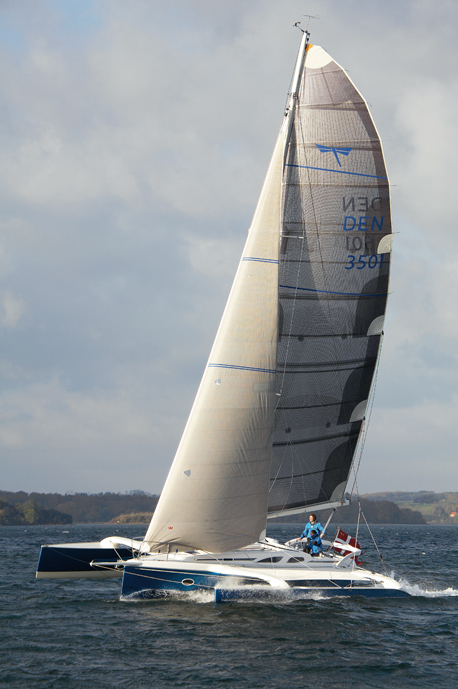
A sail plan, a silhouette and a wake which do not go unnoticed!
Innovation-creating manufacture
The Baltic Sea is a jewel offered to cruisers, but the charm of its marinas is only matched by the narrowness of their entries; so in ’89, our enthusiasts invented the ‘Swing Wing System’, which allowed the Dragonfly 800 to slip into a mouse hole! The 1000 followed, then the 1200 and the 920. The 800 boats produced have been rewarded with many prestigious honours: three times Boat of the Year, and several others in the design, quality and respect for the environment fields.
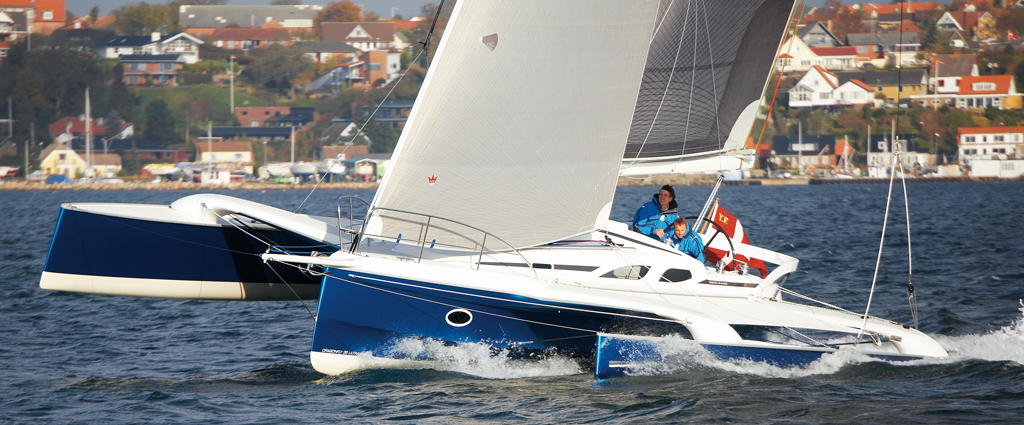
Cambered arms, marked dihedral; geometry for sailing fast and comfortably in rough seas.
Jens Quorning: inventor and trimaran builder
Like a certain number of his fellow countrymen, Jens has a marked taste for design and woodwork. He left to serve his apprenticeship in Maine, under the benevolent direction of…Dick Newick, who opened the doors of the best ‘woodshops’ to him, from the spot in Martha’s Vineyard. He was skilful, determined and imaginative, and came out of this concrete, generous open-air university enriched. An excess of regattas was prolonged by an Atlantic crossing aboard ROGUE WAVE, two-up with Tom Follet (the pilot of the proa CHEERS in the ’68 OSTAR). In 1991, he became involved in Quorning Boats and designed the 1200, the 920 then the Extreme development. As Borje retired in 2000, Jens is now the manager-creator of the Dragonflies.
The 35' : looking for an all-round trimaran
In 2000, Jens lifted the bonnet of the 920 and turned the Turbo control: the enlargement, cambering the arms and the increase in the volume of the floats allowed the power to be transmitted without unbalancing the boat. This trimaran was a success, but the length and the load-carrying capacity limited this sport coupé’s programme to semi-offshore cruising! The 35’ targets the same objectives, but in size XXL: enough volume for 4-6 persons cruising or crossing an ocean, comfort, ease of manoeuvre and high speed! Has Jens succeeded in putting together the magic combination? We spent three days in Denmark investigating the subject.
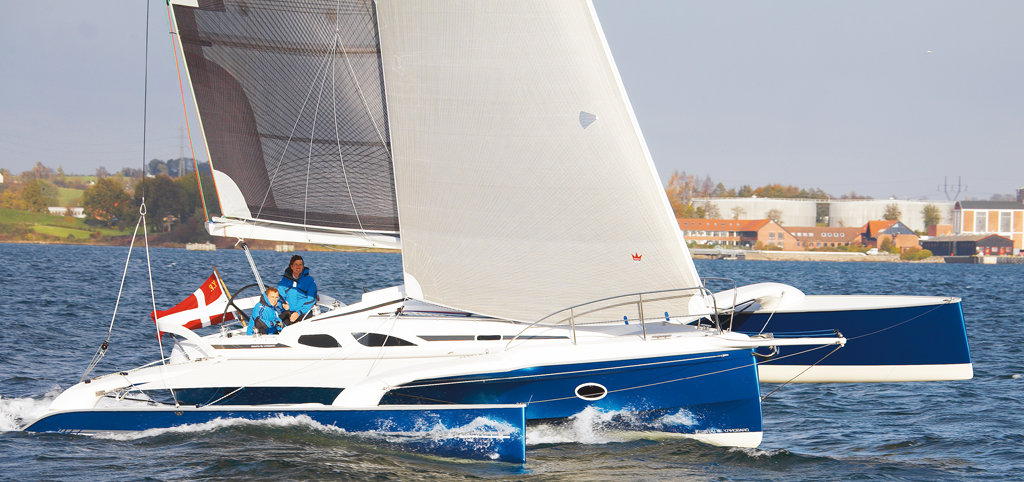
An exceptional trimaran which offers real pleasure at the helm.
Construction and build quality: a rigorous puzzle
At the risk of touching on a cliché, it must be recognised that the Danish business culture never ceases to surprise us: the boatyard which has sold more than 800 trimarans looks like a small village made up of low timber-framed buildings. A winter storage hangar for ‘subscribers’ (empty at this season, just a DF1200 which had just returned from the ARC and was spending the summer there), then a succession of workshops, linked and very well insulated. The lamination workshop meets the highest standards; it is adjacent to the paint-oven shop. The floats and central hulls are now built a few kilometres away, allowing the main site at Skaerbaek to focus on the assembly of the boats and realisation of the highly technical phases (construction of beams, masts, mechanical adjustments…). Out in the country, two kilometres from the sea, the peaceful atmosphere in this very specialised hive of activity is surprising. The technicians arrive at 8am, at 4pm everything is finished! The secret of their productivity rests on perfect scheduling of prepared gestures, which leave a place for the craftsman’s responsibility, but not for improvisation. Considerable investment in equipment (50 moulds), the design of the parts and the fluidity of the assembly stages explain the performance of this team of just 30 people. Agreed flexibility and high salaries also play a part.
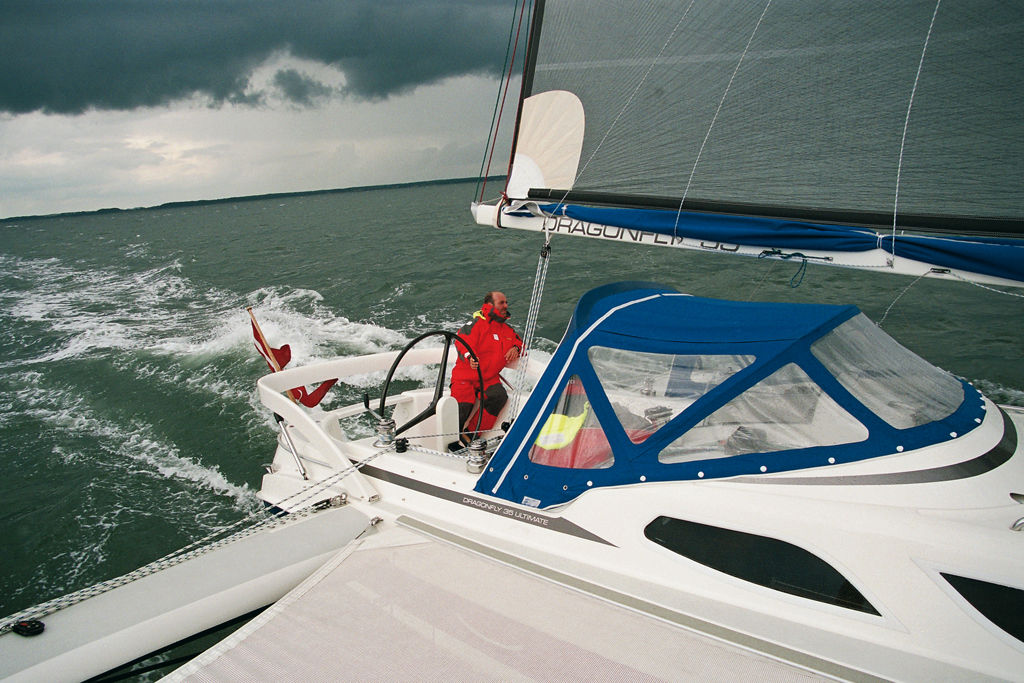
Low, heavy clouds, squall approaching, the DF35’ accelerates…with fingertip control.
Hand-picked suppliers
The Dragonflies are very technological boats, despite their ease of use, and no weak spots are tolerated: the mechanically welded elements of the folding system come from Andersen’s ‘custom’ department, as does all the mast equipment. The rigging, (textile and Dyform), the special portholes (fish-eye type: a passing nod to Newick) are made by BSI (internationally renowned for its conical terminals for Kevlar shrouds), directed by Eric, Jens’ brother!
Strong carbon tubes
The Dragonfly 35’ masts are in-house creations, coming from the rigging shop, run by Heinrich (ex-European Formula 28 champion!) The special profile, in rolled filaments, arrives in 4 parts, the sleeves are glued and the plates for the two sets of diamonds (there are no runners) are bolted through backing plates. White lacquer finishes off this expert work. The reliability? None of them has come down, despite the furious treatment inflicted on them by certain crews, especially Jens and Heinrich!
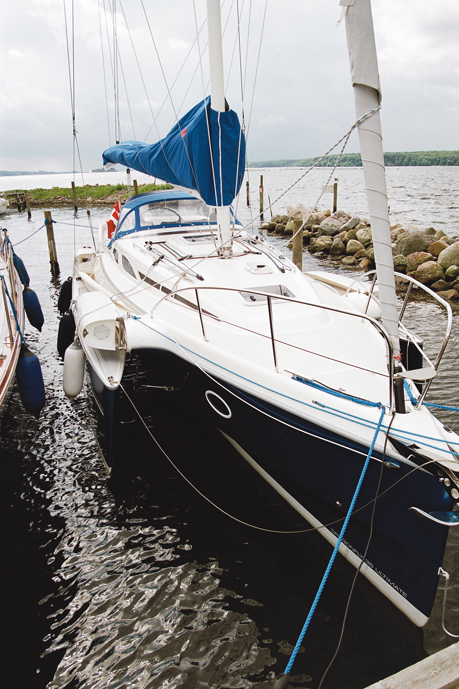
The ‘mouse hole’ type of marina the Dragonfly loves.
Beachable, transportable, folding?
The 35' benefits from the same agility as its smaller sisters; despite a 30 hp diesel saildrive, it can be beached quite safely in 50 cm of water! This 9m trimaran is transportable by road, and turns into a furtive animal which can shelter in a small space, limiting the constraints inherent in multihulls to a minimum.
The amazing accommodation
Inside, I found the cosy, light, warm atmosphere which has become the builder’s distinctive trade mark, but the volumes available led me to think for a moment that Quorning had given in to trends and watered down its Aquavit as far as performance was concerned! We will see later that this is not the case. Two spacious double cabins, a 6-place convertible saloon, a large galley with integrated fridge and oven, large heads, with shower and wc: the passionate work and Jens’ imagination regarding ergonomics are surprising. Through rationalising the fittings, he finds space where there isn’t any! The lighting and the aviation quality of the inner mouldings deserves praise.
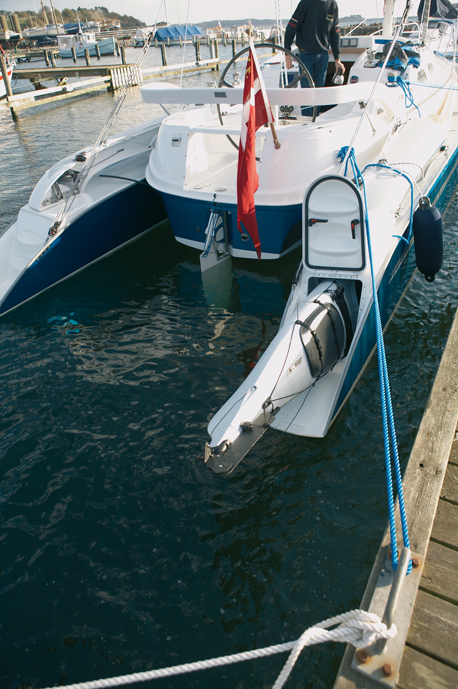
One or two kayaks, a small catamaran which can be dismantled… The volume in the floats acts as a spacious luggage carrier…
Quick, let’s get to the essentials!
I am impatient to share my impressions of the two day’s sailing in the Baltic Sea. They are representative of the DF35’s possibilities. This Dragonfly is polite and revealed its charms first, before showing a more fiery nature. To get out of the marina, ‘Doctor Swing Wing’ was at the controls; the 30hp Volvo coupled to a folding propeller has a comfortable amount of torque and our test example was equipped with a retractable bow thruster and an electric winch! Thirty seconds later we were out on the open water. At the helm, I watched Jens unfold the machine’s wings (1 minute per side), and admired the perfect geometry of this well-oiled mechanism. The 14mm Dyform cables which stop the arms flexing are adjusted in the factory and fit into place by themselves; only the forward stays require manual attachment (a few seconds). We sailed close-hauled under the squalls for about thirty miles, with a moderate 7 to 12 knots to accompany us, and I got to know the toys that I would be able to play with to my heart’s content over the two days. Firstly, the Kevlar rigging, which can be tightened up very quickly, then the ‘fine lingerie’ - this ‘Ultimate’ version is equipped with flamboyant ‘Genesis black Technora’ sails by Elvström. Vectran, Carbon and Mylar combine their qualities in this top-of-the-range laminate, the shape is splendid, the enormous stability requires no increased tension and puts off the moment when a reef must be taken.
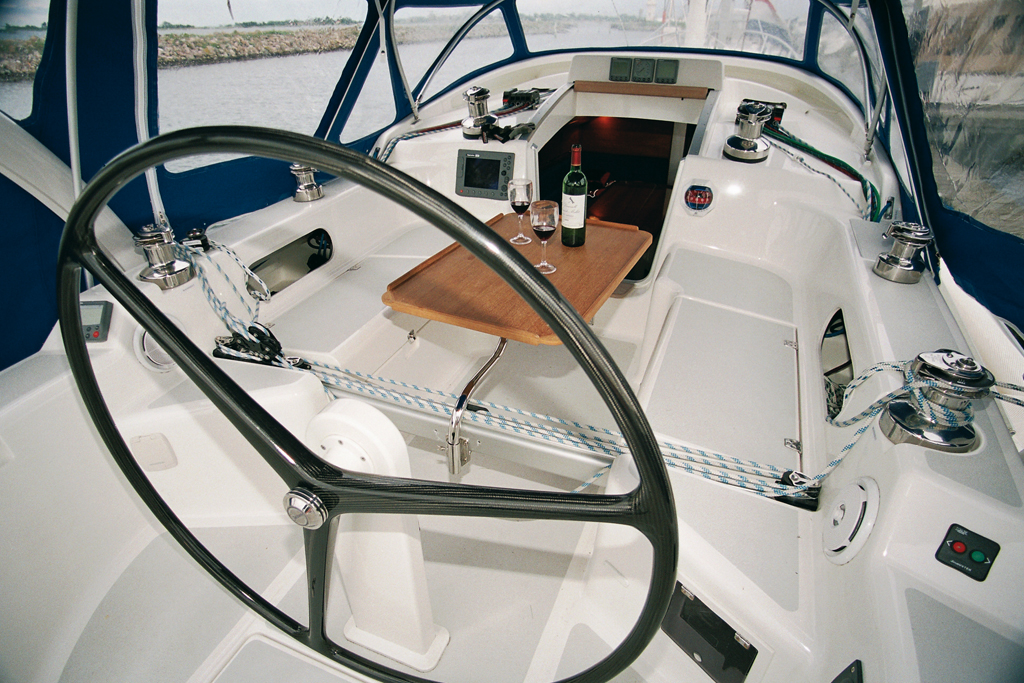
The Danish ‘loggia’, to be taken without moderation!
I love sailing close-hauled
Sailing to windward with the DF 35’ is an enjoyable exercise which will open the ‘doors of new perceptions’ to hardened racers and will allow the others to believe in their racing talents! Despite a comfortable and widened central hull, the machine does not seem to have any limits. We were sailing at between 8.5 and 9.5 knots at 40° to the wind, the optimum VMG (80° from one tack to the other) is very intuitive; if you need it you still have an extra 5° and by bearing away you can sail to windward at two-figure speeds!
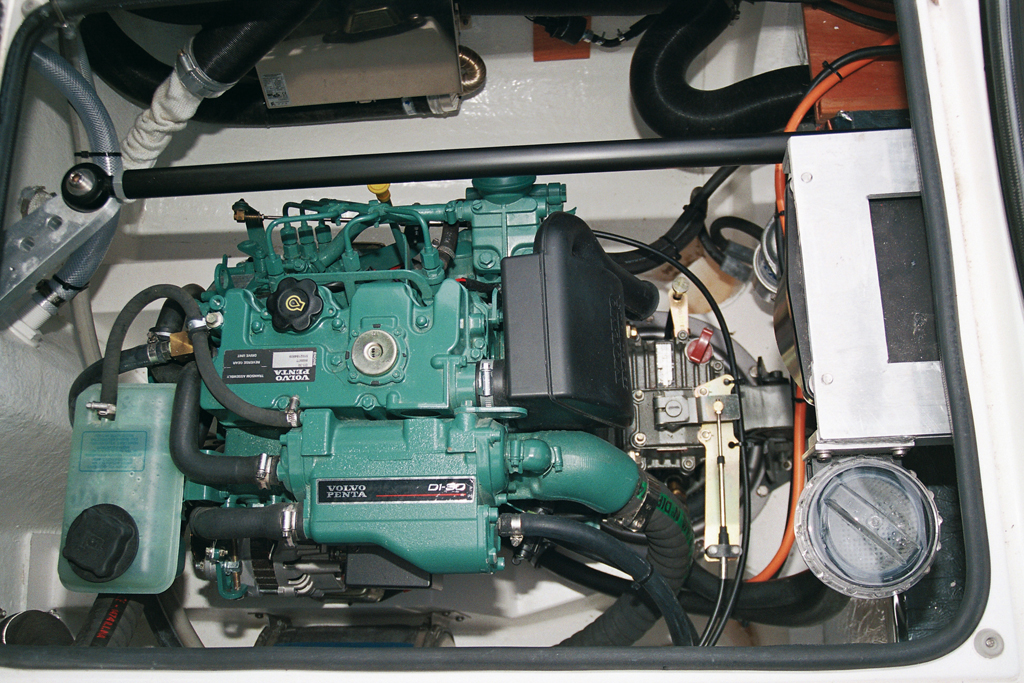
Under the cockpit floor: the 30hp engine, the automatic pilot and the rod transmission.
The geometry of a perfectly civilised thoroughbred
The cockpit offers three distinct areas: the control line area, protected by the sprayhood (sail reductions, daggerboards, jib sheet, etc…), in the centre the mainsheet trimming area and at the stern, the ‘terrace’ for the helm and 1 or 2 passengers comfortably leaning against the stern rail. The large diameter wheel is reminiscent of certain sports coupes, its directional effect is fiendish – the trimaran tacks like a match racing prototype! The arms are ‘cambered’ to keep them well clear of the wave to leeward. The length, the design and the camber (angulation towards the exterior) of the latest generation floats give them the volume necessary for safety and the slimness essential to pass sweetly through the waves. The horizontal axis of the arms is pinched a few degrees towards the bow (weight centring) and there is sufficient dihedral to keep the windward float well out of the water.
Squalls, light weather and the asymmetric
We carried out tack after tack and I felt enormous pleasure sailing this boat amongst the wind shifts typical of this stretch of water. We had been sailing to windward for more than 5 hours without getting even slightly bored; a 50’ monohull applauded as we crossed! Hoisting the asymmetric (on a 1.5m retractable carbon bowsprit) started another kind of movement, with the magic of the apparent wind: 8 – 11 knots of true wind, top speed of 13 knots and an average of between 9 and 12, pure pleasure…
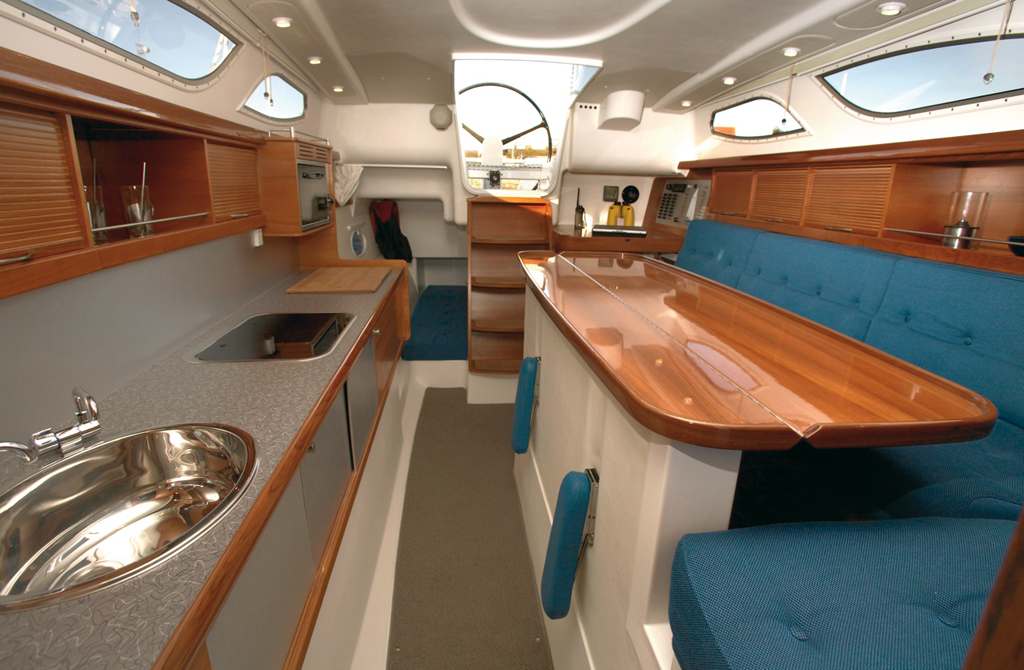
A surprising volume: 4 people for an Atlantic crossing, 6 for a weekend or 8 for an afternoon.
Doctor Quorning and Mr Speed
The passing of a quite deep depression gave us the opportunity to test the 35’ in a steady force 7, the next morning. With 2 reefs and a third of the genoa, the start-up was extraordinary; at 70-80° to the wind, the 35’ sped off at 14 – 18 knots with obvious ease and in a cloud of spray. This leg of about fifteen miles between the islands was quite extravagant, but revealed the boat’s sea-keeping qualities; the helm is a pure pleasure, sensitive, precise and needing no effort in this minefield! I bore away a few degrees to just beyond a beam wind and the beast took off at between 18 and 21 knots. The feeling of safety is permanent, the float’s vertical thrust can really be felt, and the chassis seems to have become stiffer, compared to the Extreme. The low, heavy sky, the squalls and the spray did not dull the excitement of this exceptional ride.
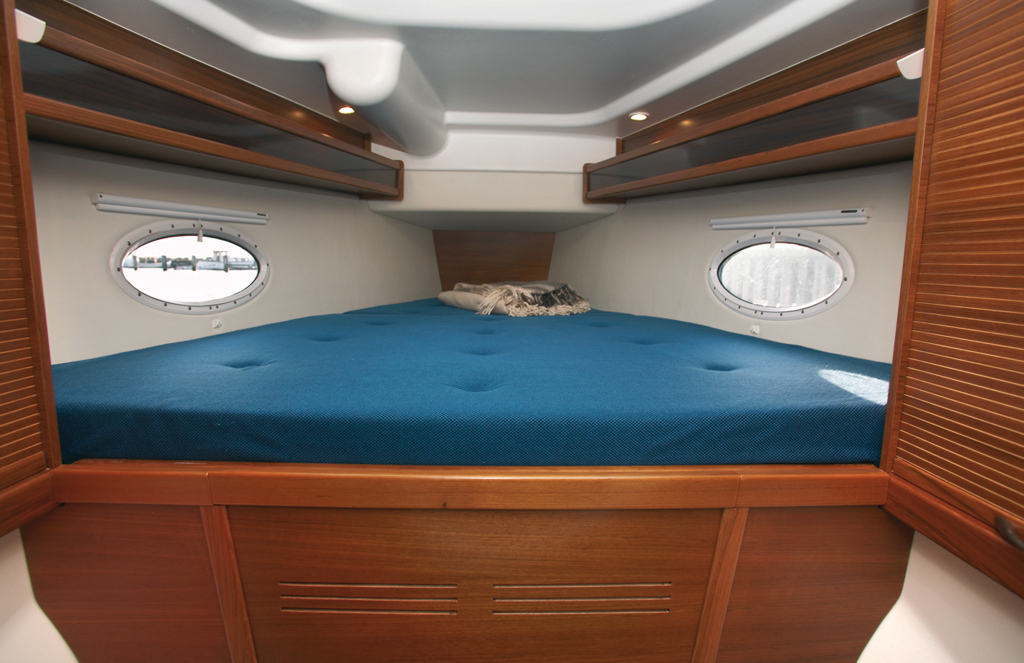
A warm atmosphere where the build quality shows through.
CONCLUSION
This trimaran is exciting; the maturity of the comfort-performance compromise it synthesises is remarkable, it is without a doubt one of the most successful cruising boats I have ever been given to test. The Touring version is a bit more sensible and cheaper, but the Ultimate opens the gates to Valhalla permanently!
The plusses
- fantastic comfort-safety-performance compromise - build and design quality - enjoyable and practical multihull
The minuses
- sugar scoop aesthetics - manufacturing lead time
THE COMPETITORS
Models Length in m Beam in m Weight in t Sail area m² Price euros inc. tax Corsair 36' 11.16 3.00/7.80 3 74 250,000 Challenge 37' 10.99 3.40/8.10 2.5 79 270,000 Lucas 38' 11.40 8 2.8 90 292,000 Triforsix 34' 10.30 4.20/7.80 3.3 87 250,000
TECHNICAL SPECIFICATION
Architects: Jens Quorning & Steen Olsen Builder: Quorning Boats (Denmark) Material: PVC foam/unidirectional and multidirectional cloths/vinylester. Manual application, post cured at 80°. Carbon rudder. Length: 10.68m Waterline: 10.35m Beam: 8.20m Folded beam: 3.80m Draught: 0.55/1.80m Weight: 3.7t Mainsail area: Touring 44m2 Ultimate 51m2 Genoa: 28m2 32m2 Spinnaker : 90m2 120m2 Reacher: 55m2 65m2 Height of carbon mast: 15m 16.50m Approval: unsinkable EC cat.A (6 pers), 8 in cat.B Engine: Volvo 30hp Sail drive Berths: 4/6 persons (2 doubles + 2 convertibles) Water: 140 litres Fuel: 80 litres Pivoting centreboard + retractable rudder – the boat can be beached. Price: Touring 286,000€ inc. tax, Ultimate 313,950€ inc. tax.
