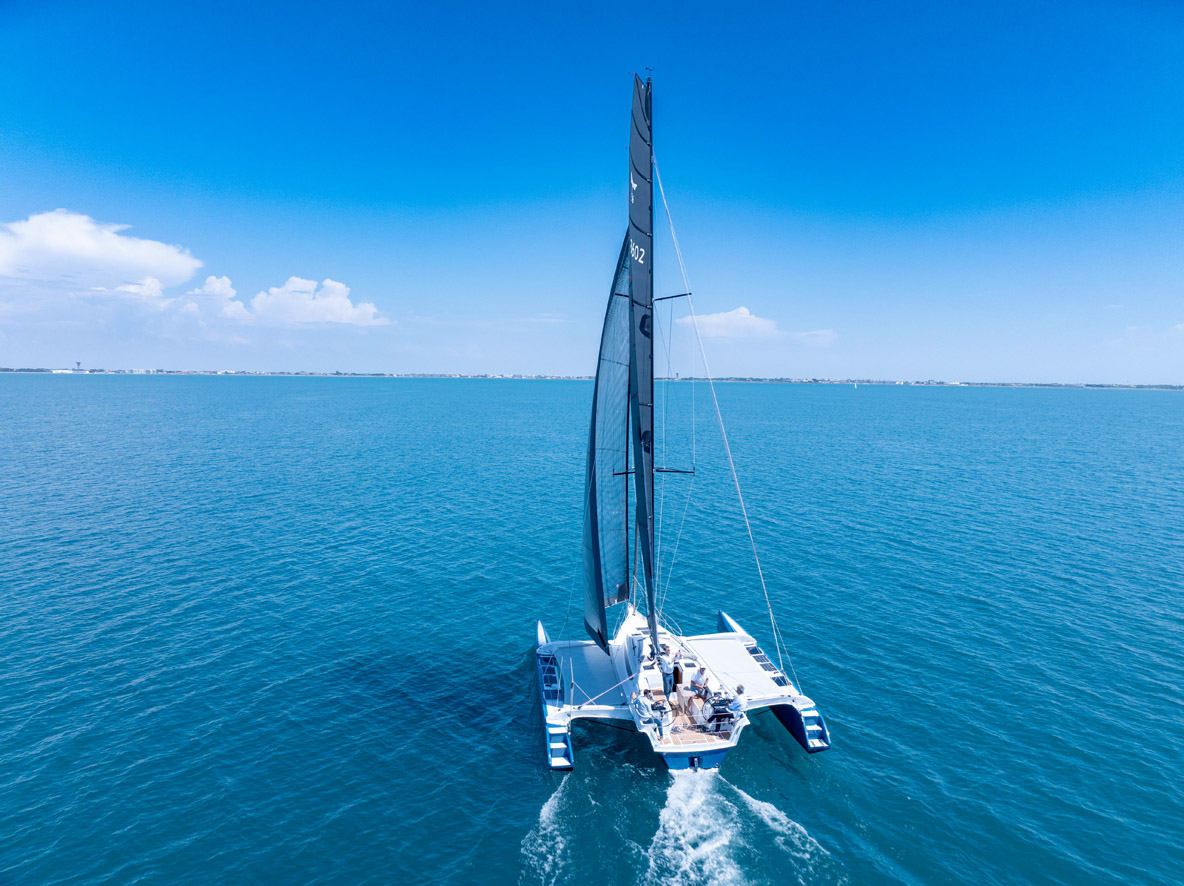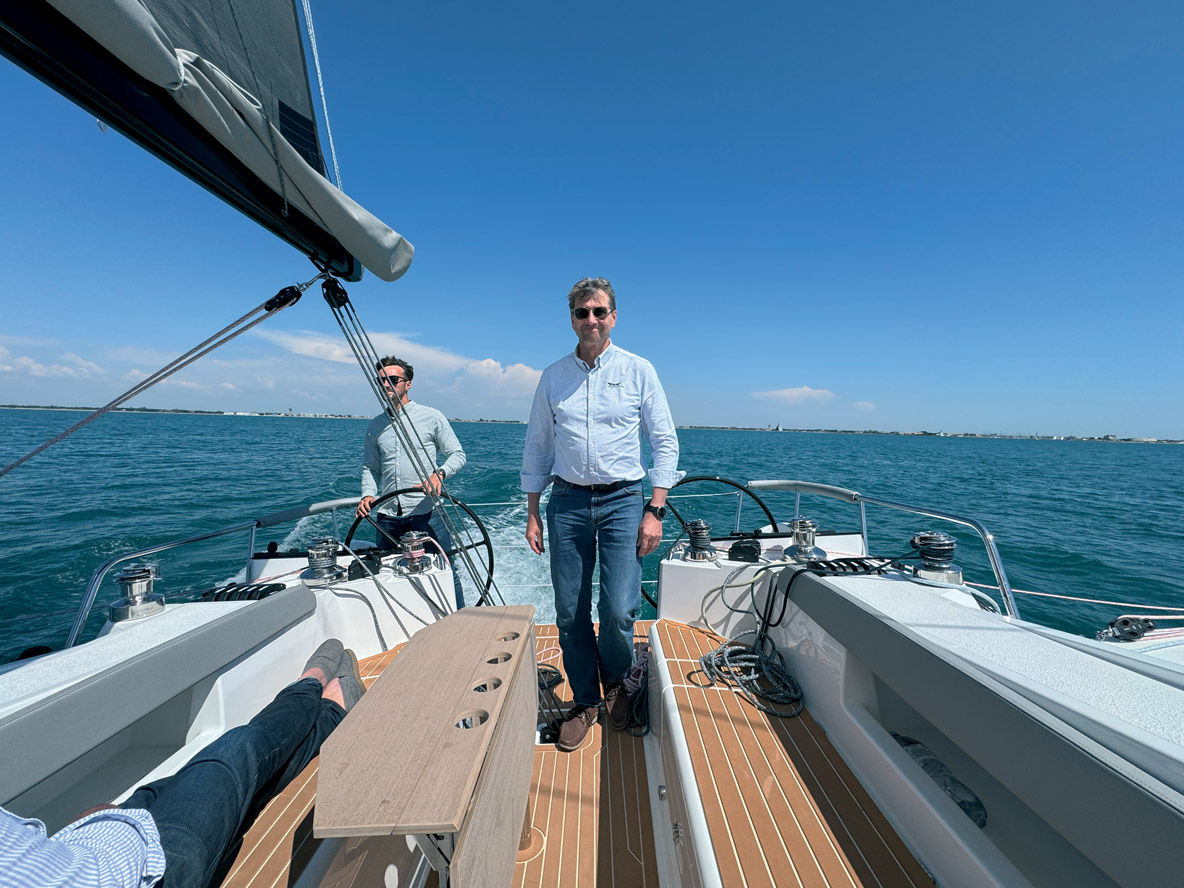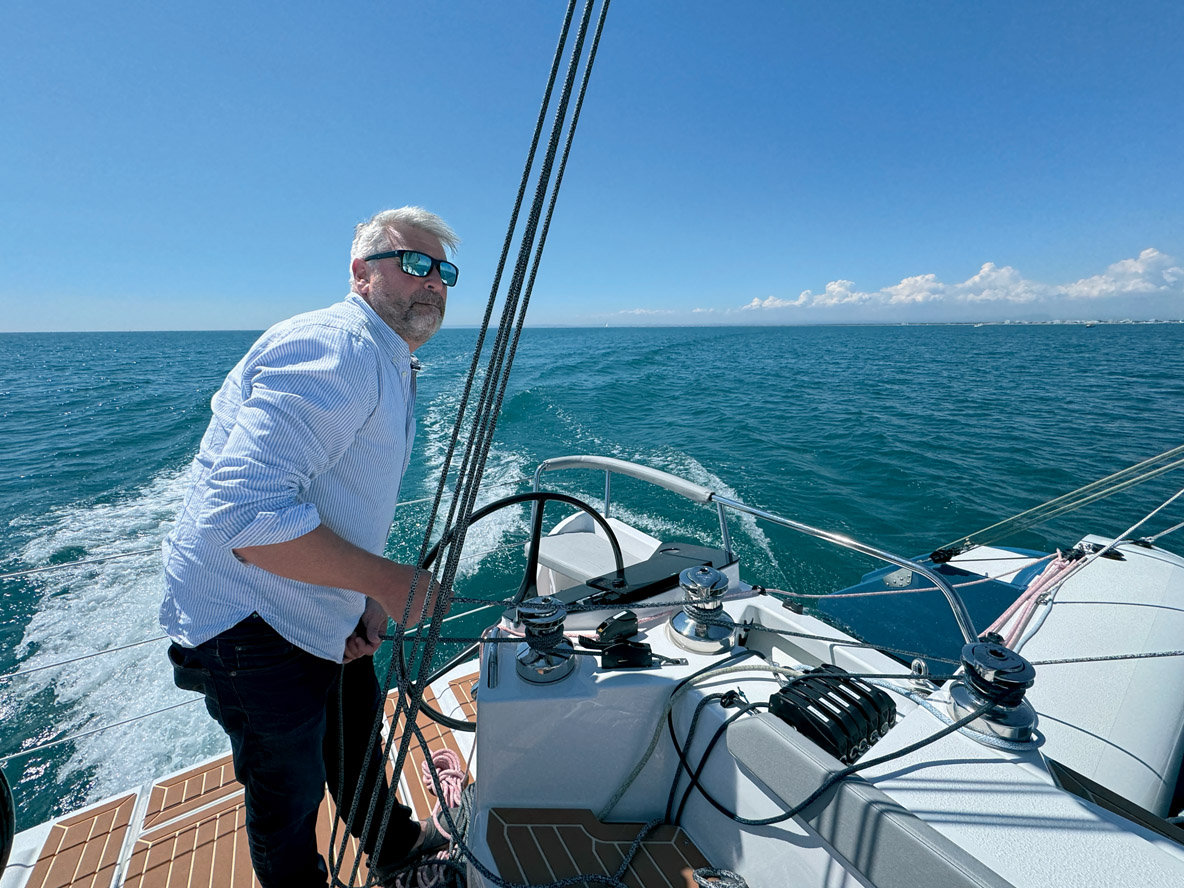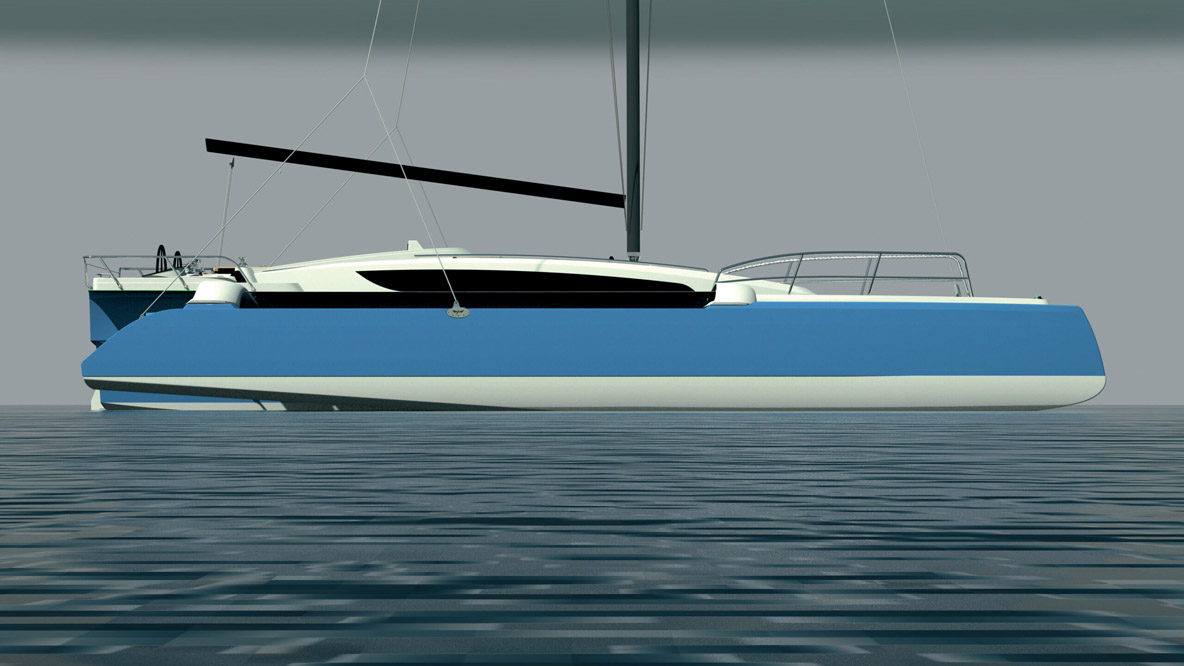
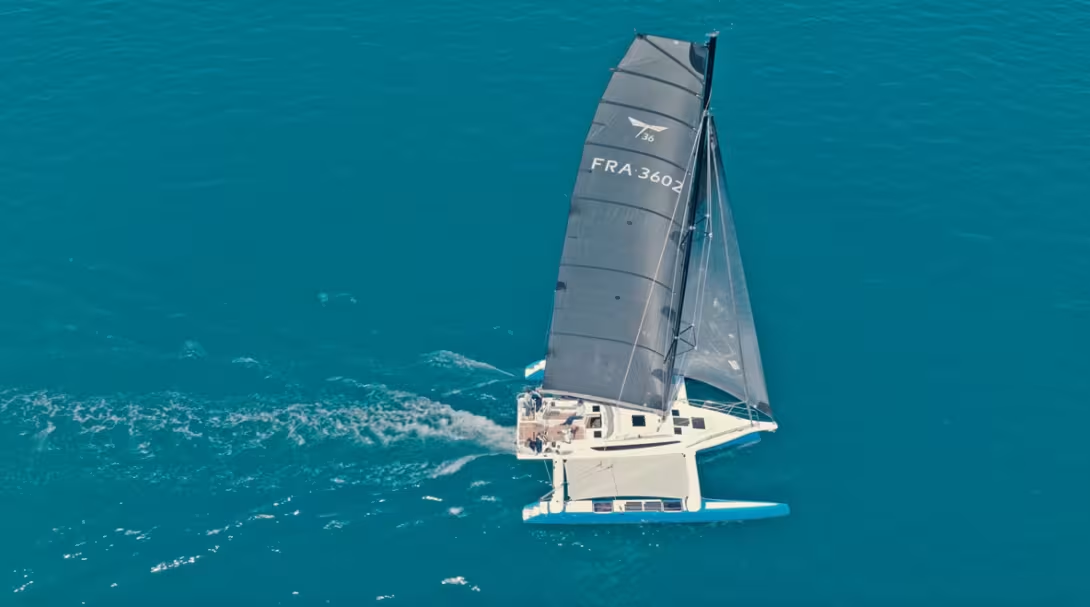
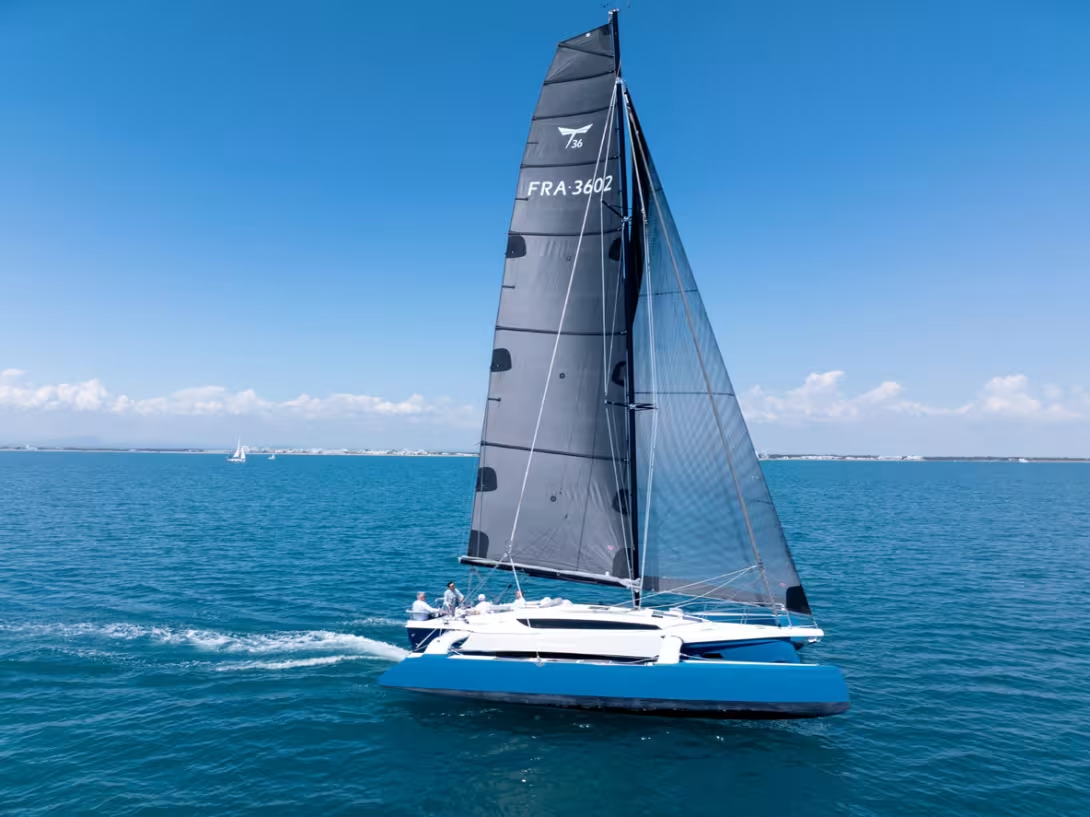
We had the opportunity to sail aboard the Dragonfly 36, recently elected Multihull of the Year in the Performance category, in the company of Jens Quorning, the head of the shipyard which bears his name. This particular trimaran was hull #2, a Performance version (featuring a rig that’s over 6 feet / 2 meters taller) and it’s undoubtedly a fast and enjoyable multihull to sail. But it is also a rugged vessel capable of crossing an ocean or taking the ground on a sandbank...
Infos pratiques
- Le chantier : Dragonfly 36 Performance
- La fiche technique
-
 Découvrez notre vidéo exclusive
- Financez votre Dragonfly 36 Performance
- Assuez votre Dragonfly 36 Performance
- Articles autour du Dragonfly 36 Performance
Conditions: Calm sea, 6 to 9 knots of southerly wind
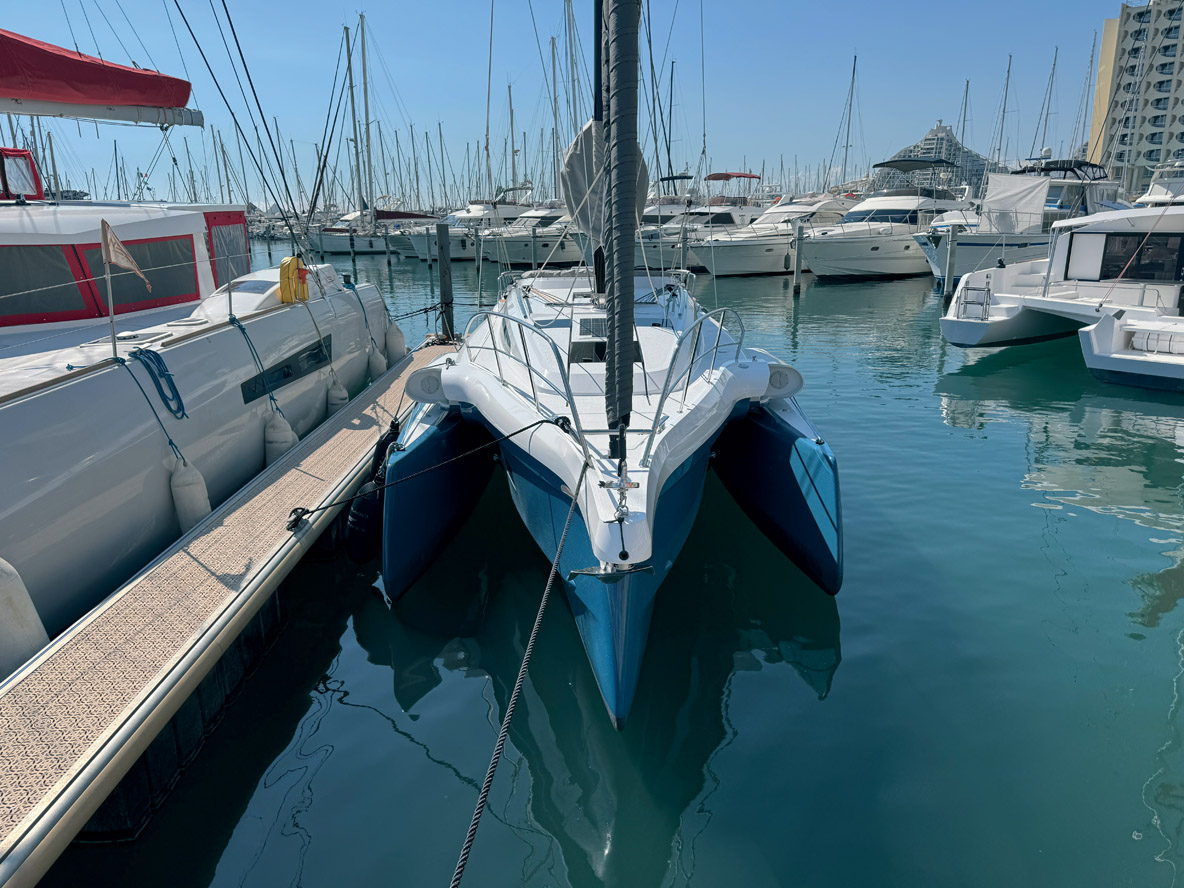
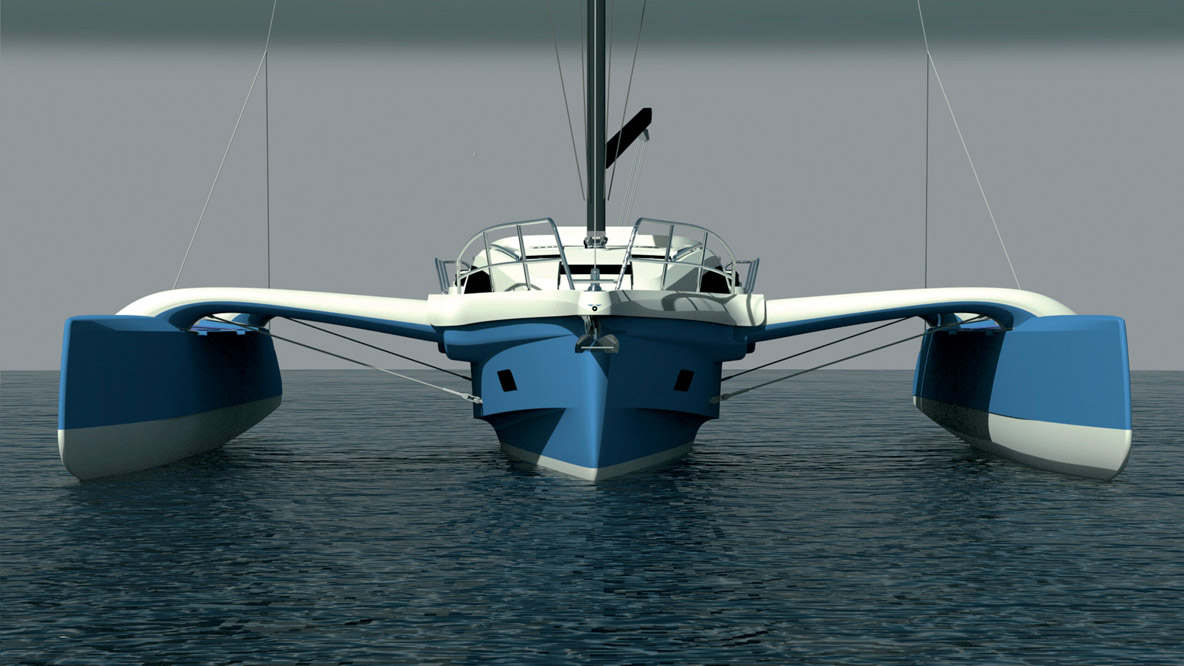
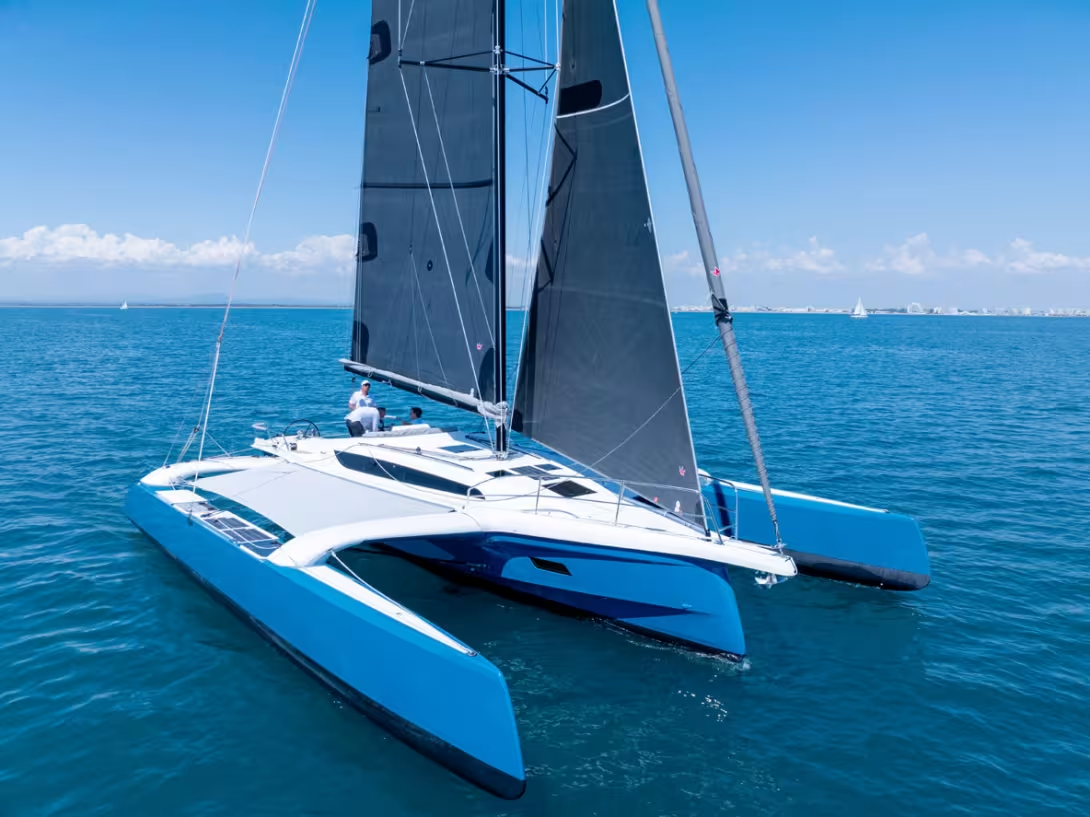
In terms of design, the 36 is the first Dragonfly to feature three inverted bows - until now, the central hull has always retained a traditional bow shape. With its particularly slender rig in the Performance version, this trimaran certainly looks impressive, both under sail and alongside the pontoon. Although it’s neither a dragonfly on a lake nor a pure ocean racer, the 36 immediately displays a tasteful sportiness.
The Quorning Boats shipyard, located in Fredericia, in the heart of Denmark, is renowned for the quality of its workmanship, and the new 36 is no exception, with its Vinylester/Divinycell foam sandwich construction, structural bulkheads and connecting arms in infused carbon with high- density foam, one central composite centerboard, and carbon rudders. In terms of safety, the 36 is unsinkable and equipped with watertight bulkheads at the forward end of the hulls.
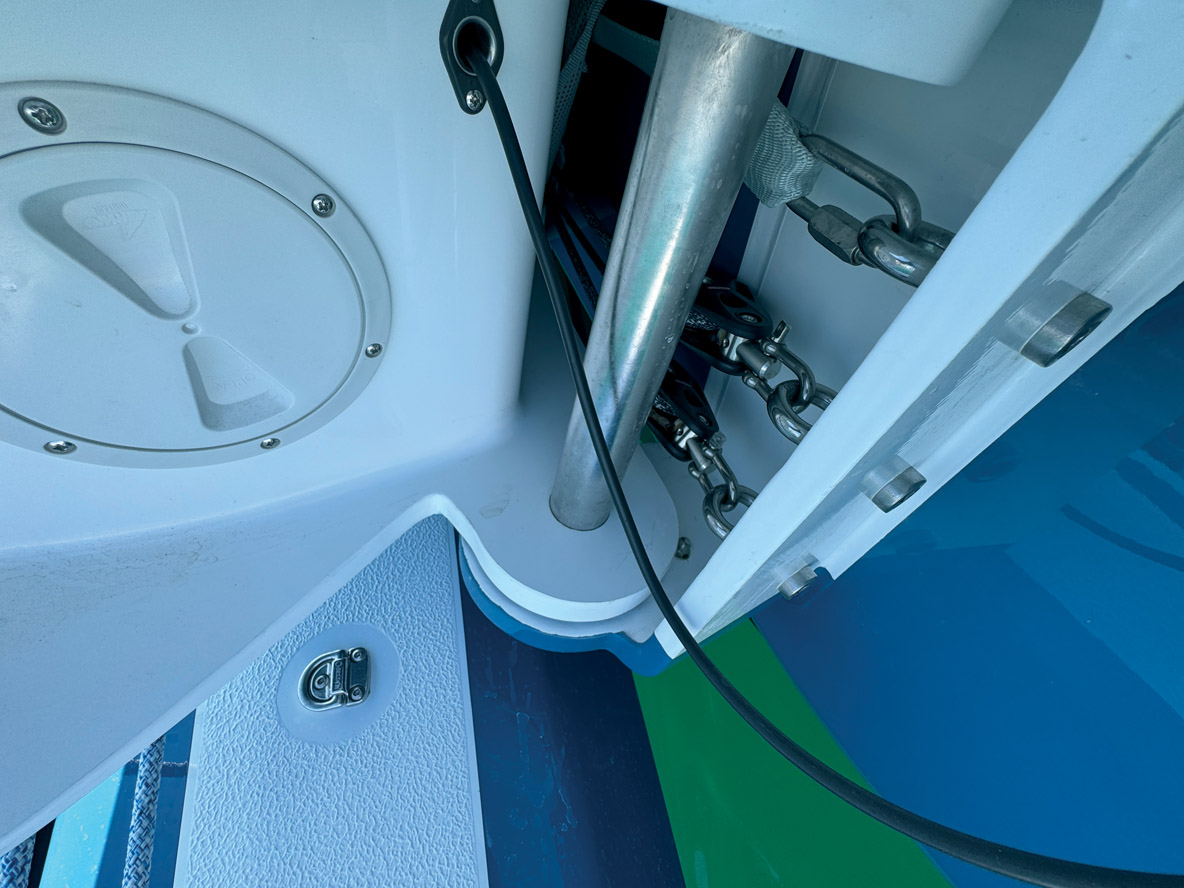
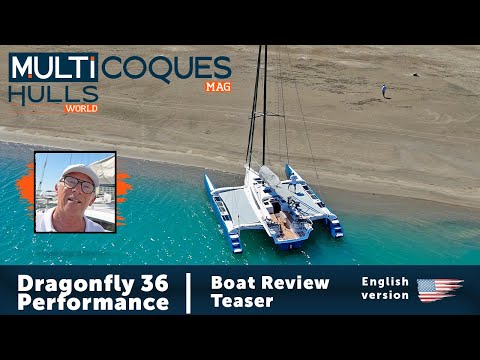
Like all Dragonfly boats, this trimaran can be folded thanks to its Swing Wing system, which has been further optimized as most of the large metal parts are now made of carbon. With a stopwatch in hand, it takes Jens just 1 minute and 30 seconds to reduce the beam of his trimaran from 26’8” down to 12’2” (8.12 m to 3.7 m). This size means that an ordinary monohull slip is sufficient – but bear in mind that the floats fold up aft, increasing overall length by 6’2” (1.88 m).
Immense Trampolines
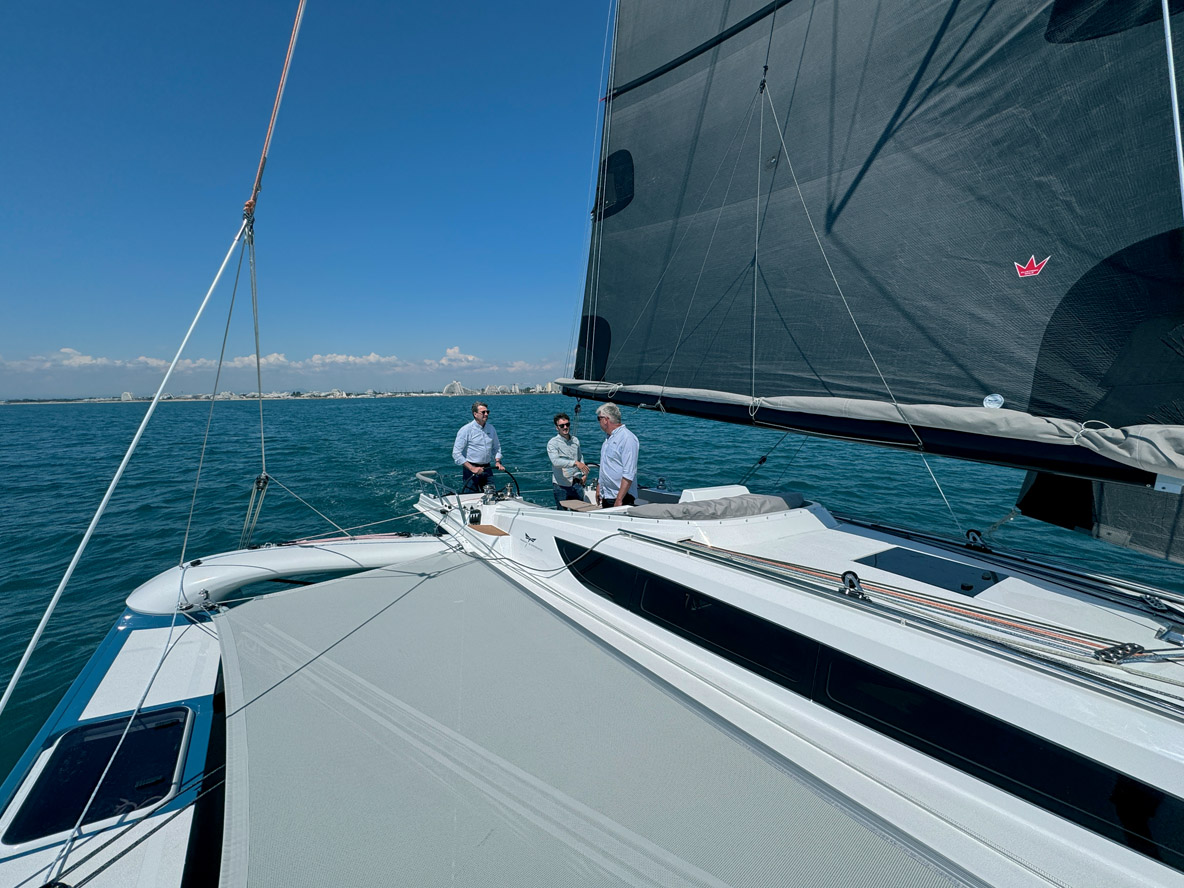
On each side, we were impressed by the size of the trampolines, which make it easy to move out towards the floats and get up to the bow in no time. When sailing, these trampolines can get wet, but when at anchor they become XXL sun decks.
The foredeck is a narrow triangle extended by a sturdy cathead bowsprit, which allows the bow roller and anchor to be shifted forward of the forefoot and for the downwind sails to be set.
Maximum Speed: 23 knots
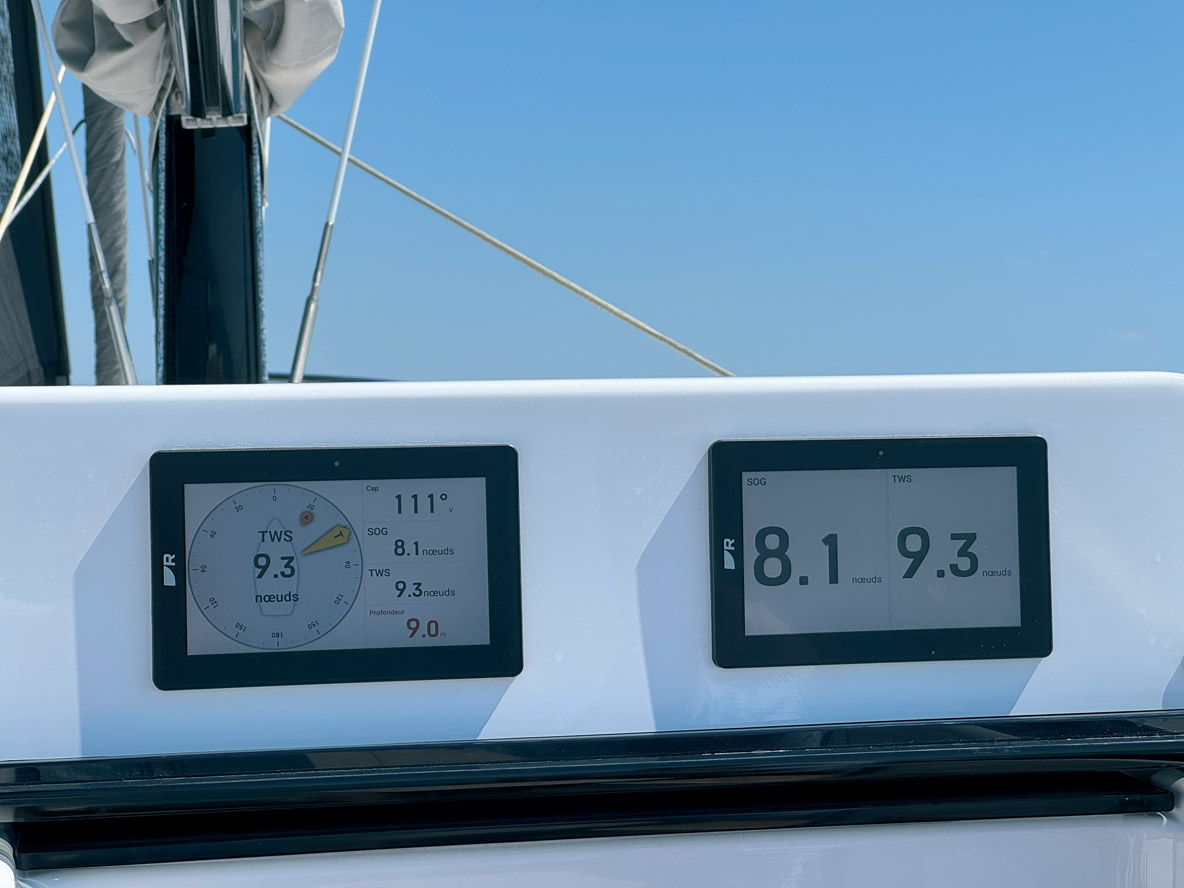
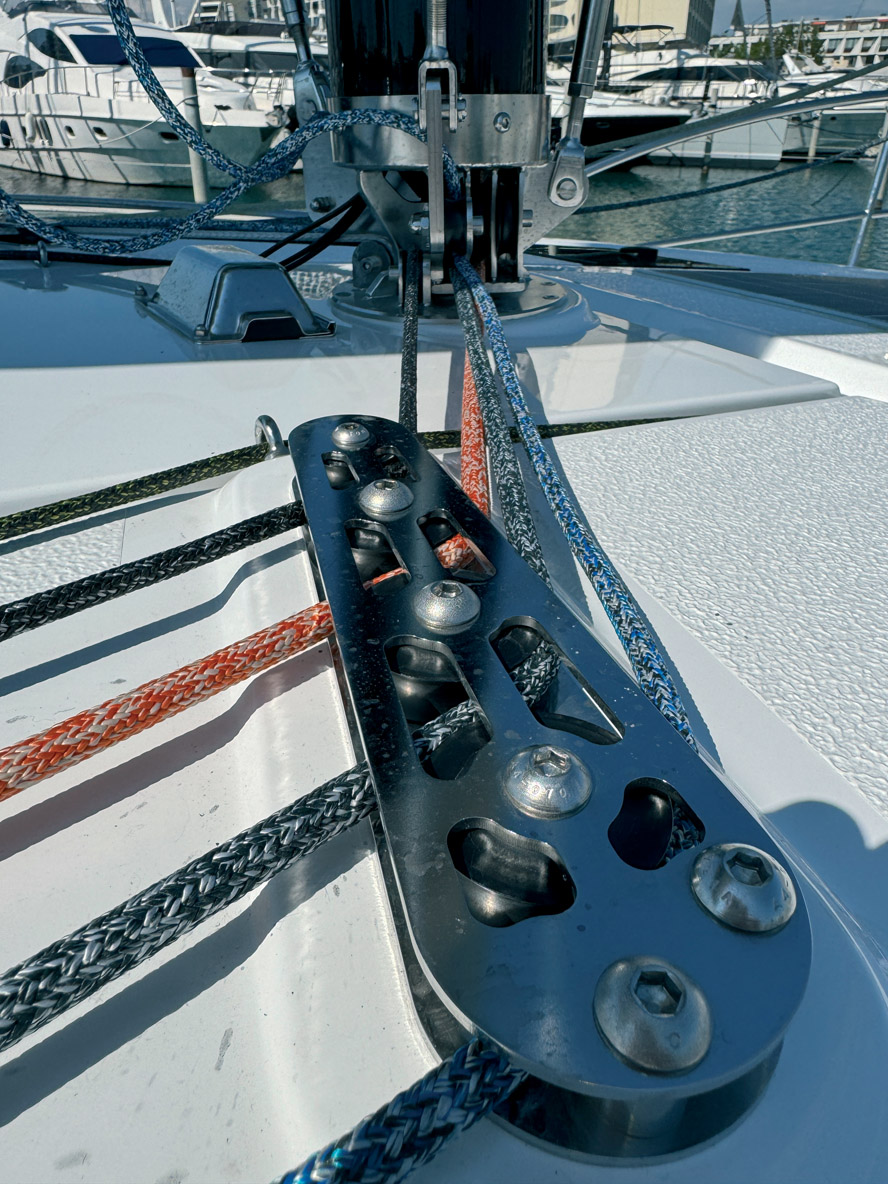
Unfortunately, we weren’t going to be able to test its full speed during our seatrial, as the weather forecast was for winds of less than 10 knots at their strongest on our test day. With large-roached mainsail and overlapping genoa hoisted, we set about our first close-hauled tacks. The course was impressive, as we remained at 30° to the apparent wind. With only 8 knots of wind, the instruments show us a speed of over 6 knots. Whether the helmsman is standing on the windward or leeward side, he has an excellent view of the sails and the water. As we saw, the maneuvers are divided up right in front of us, so we enjoyed trimming the sails very precisely thanks to the very complete and perfectly positioned deck hardware. Boaters coming from monohulls will appreciate the slight heel and the feeling of a somewhat lively and very responsive helm.
Aboard our Performance version, nothing has been left to chance, judging by the quality of the Elvstrøm Epex Technora black fiber sails and the folding propeller fitted as standard.
Once far enough from shore, it was time to switch to gliding mode by unfurling the gennaker. The speed increased immediately to match or even exceed the true wind speed. With 10 knots of wind, I manage to settle at 9 knots, but be careful, it’s easy to get caught up in the gliding game if you rely on the telltales – there is then a high risk of bearing away up to 30 or 40° from your initial course. That’s kind of how I managed to sail faster than the wind...
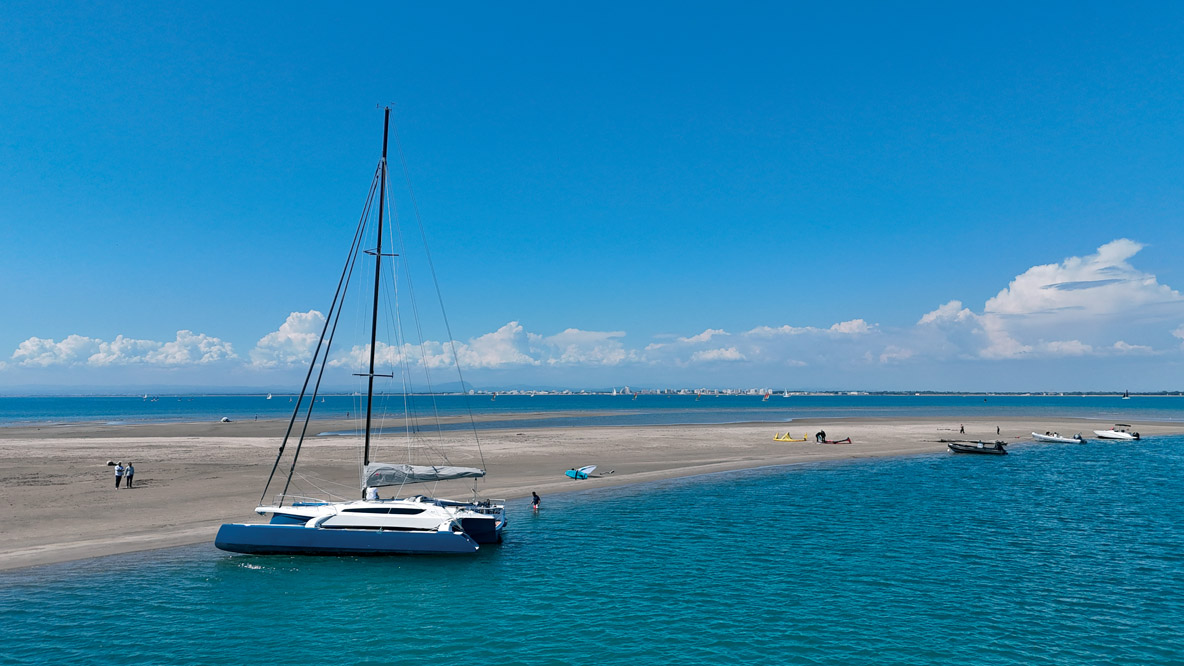
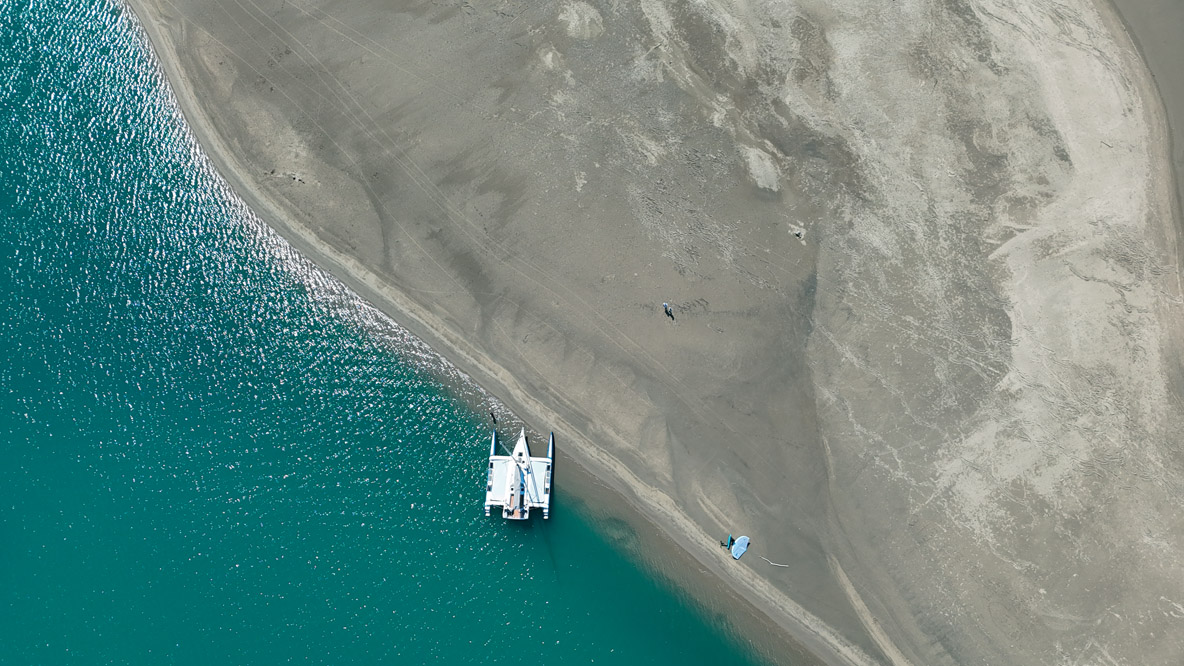
We quickly reached the Espiguette sandbank just off Port-Camargue, and Jens suggested we beach the boat. The pivoting appendages were raised, and with a bit of crunching sound, we heard the sand beneath the hulls.
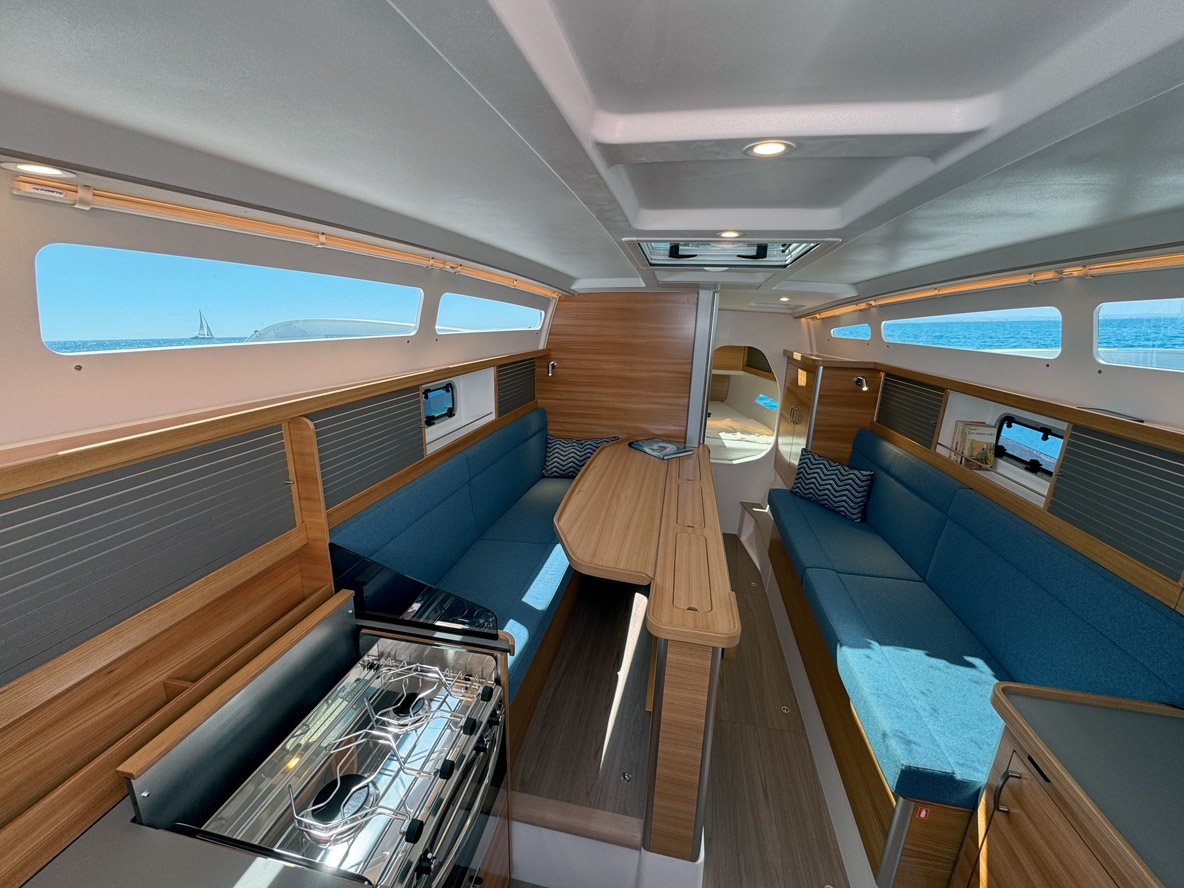
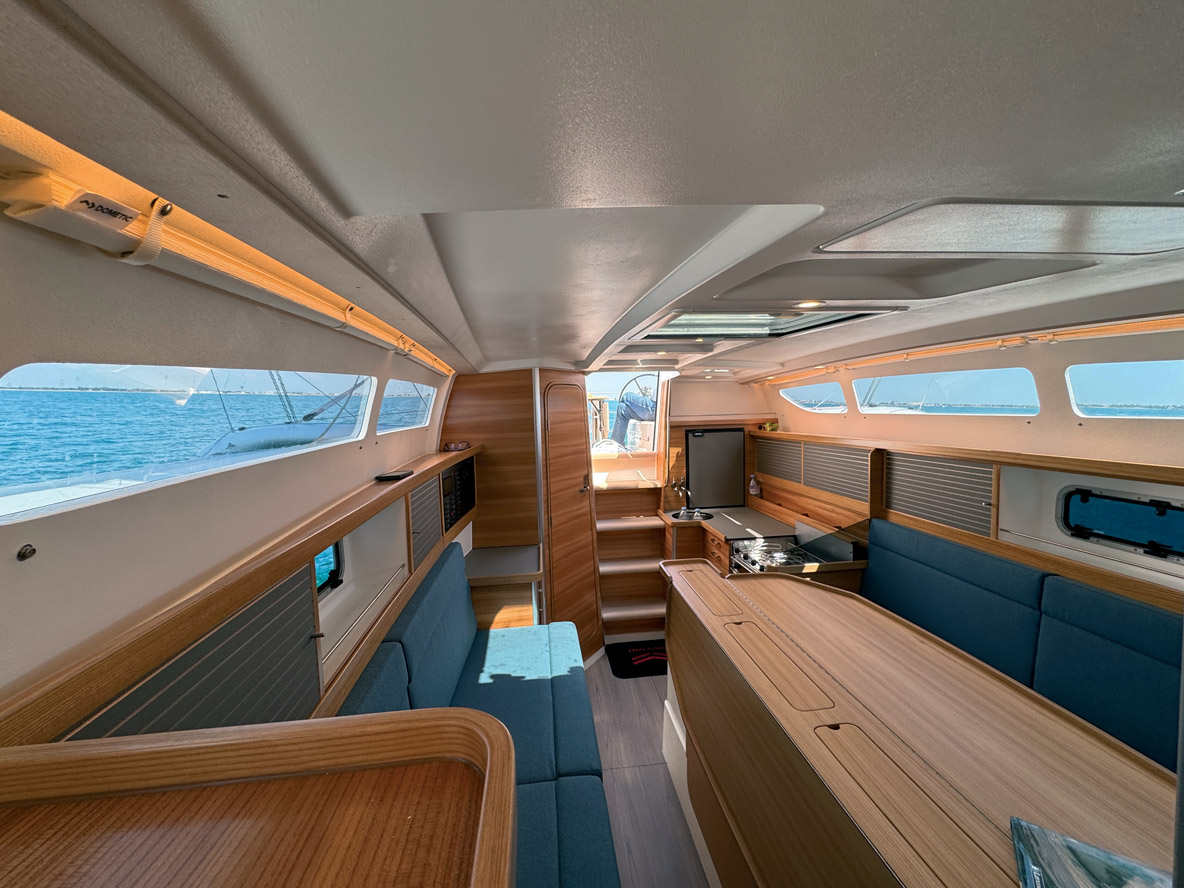
It was time to check out the interior – the central hull. Like the cockpit, the deep companionway (five steps take you 4’6”/1.38 m below the deck) and the relative narrowness of the saloon are reminiscent of a monohull layout. But don’t be fooled: there’s an incredible amount of storage space here thanks to the hatches in the floats.
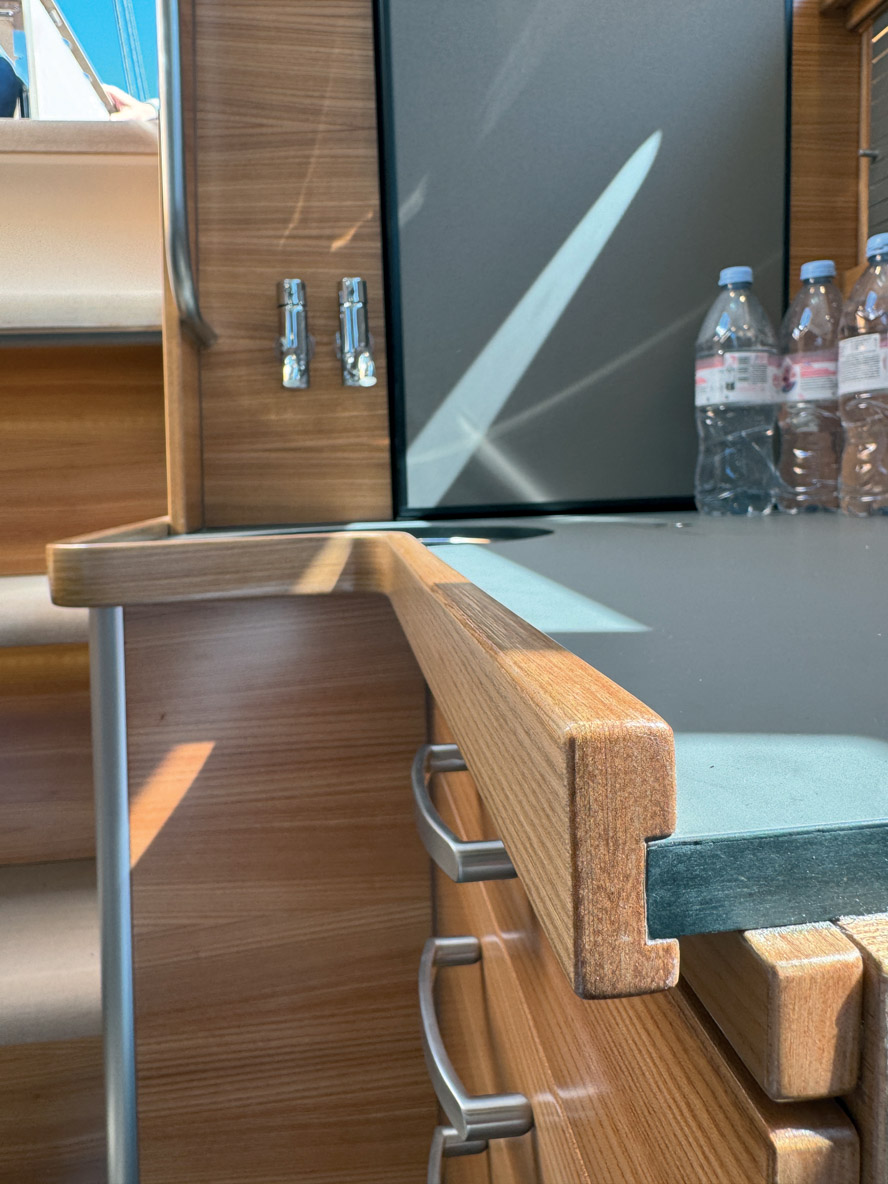
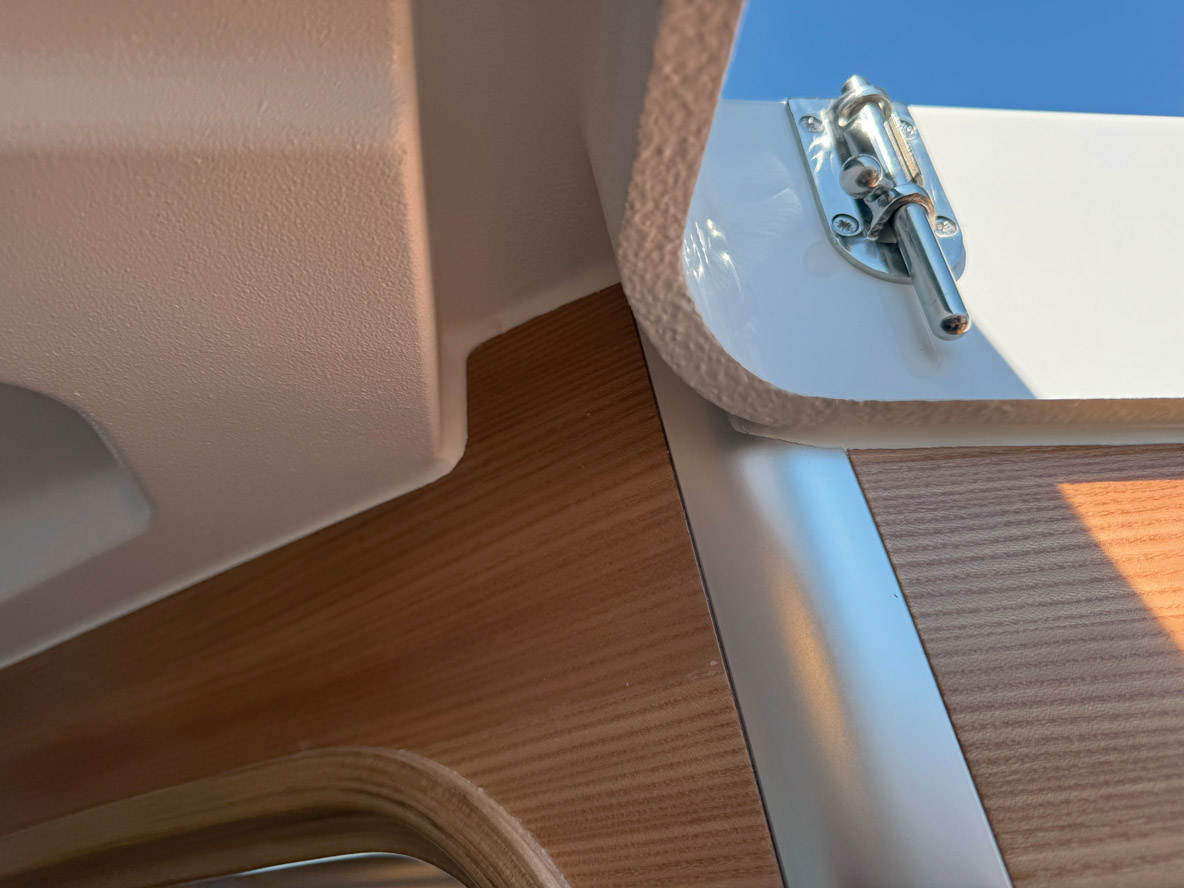
If the initial exterior inspection left no doubt as to the quality of construction and workmanship, the interior tour only confirms this certainty. Ash wood paneling (or optional varnished elm), fittings, upholstery: everything is flawless.
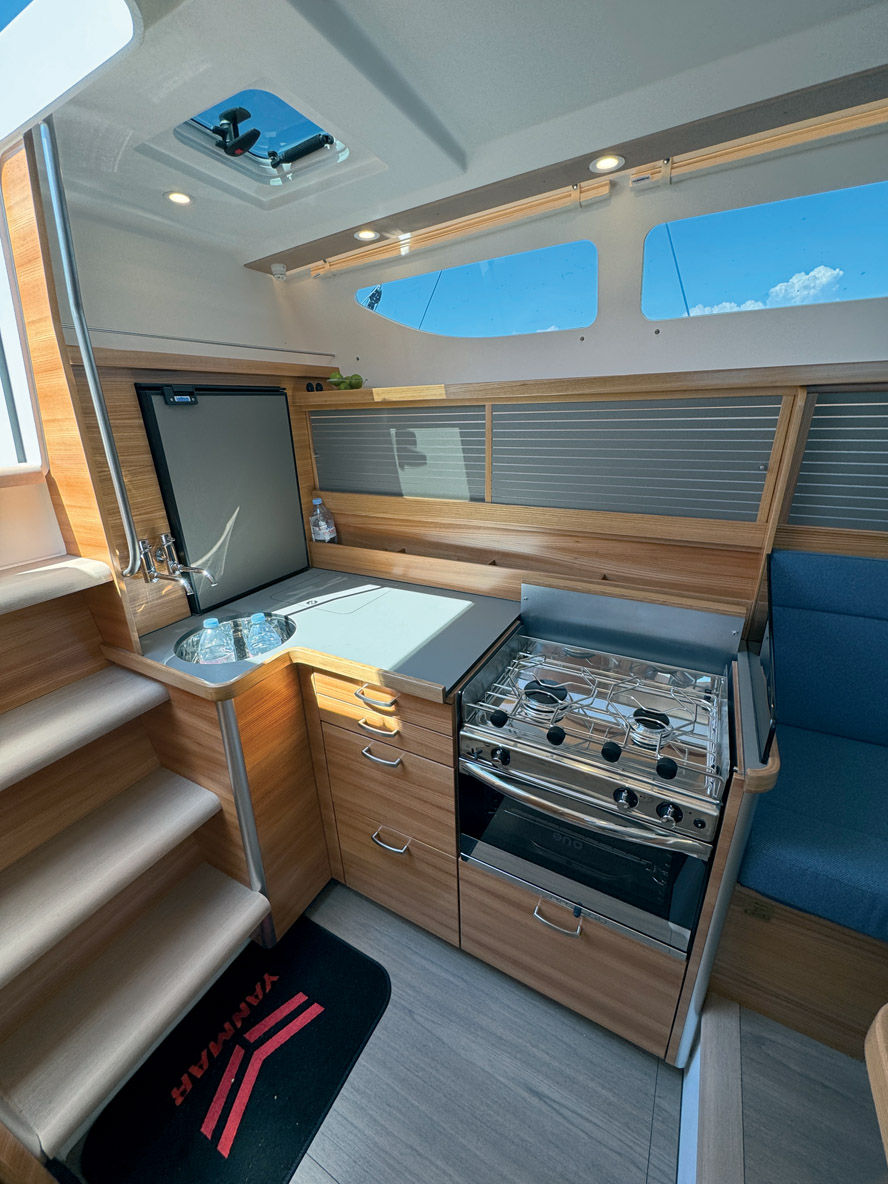
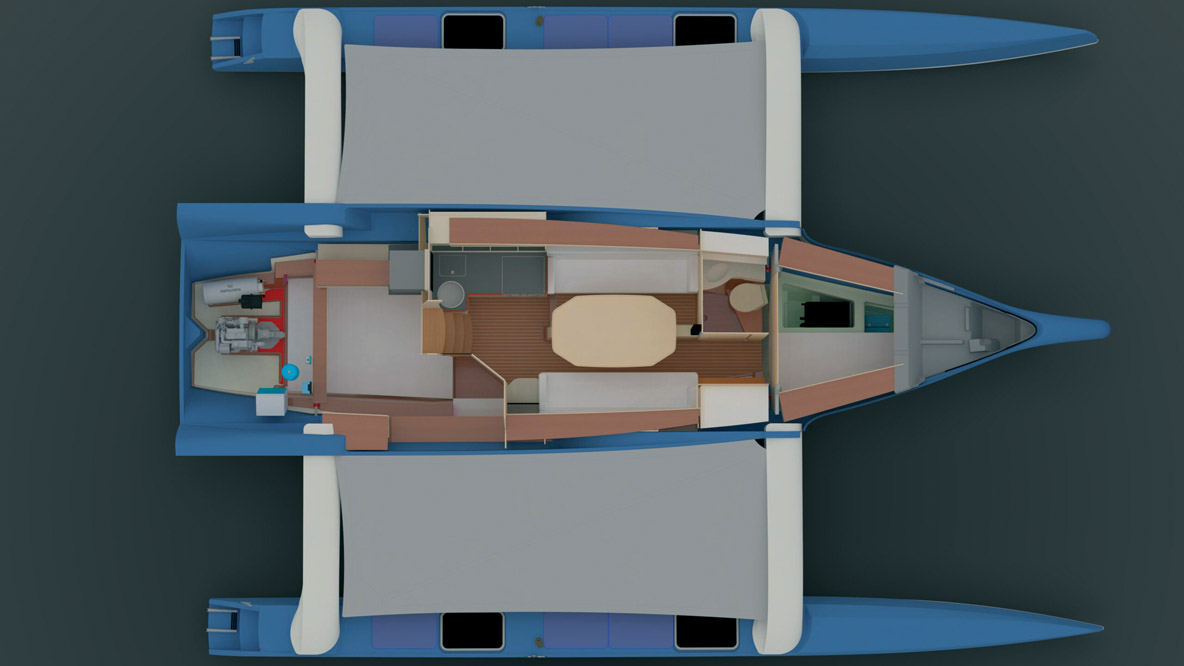
The builder has opted for a very classic layout with a side unit/navigation station to starboard, an L-shaped galley on the port side, and a saloon that spans the entire width with a 63” by 16” (1.6 m by 0.4 m) table equipped with two 9” (0.22 m) leaves. The central part of the tabletop covers the centerboard case. On the port side, there is space for an extra berth measuring 75” by 39” (1.90 by 0.98 m).
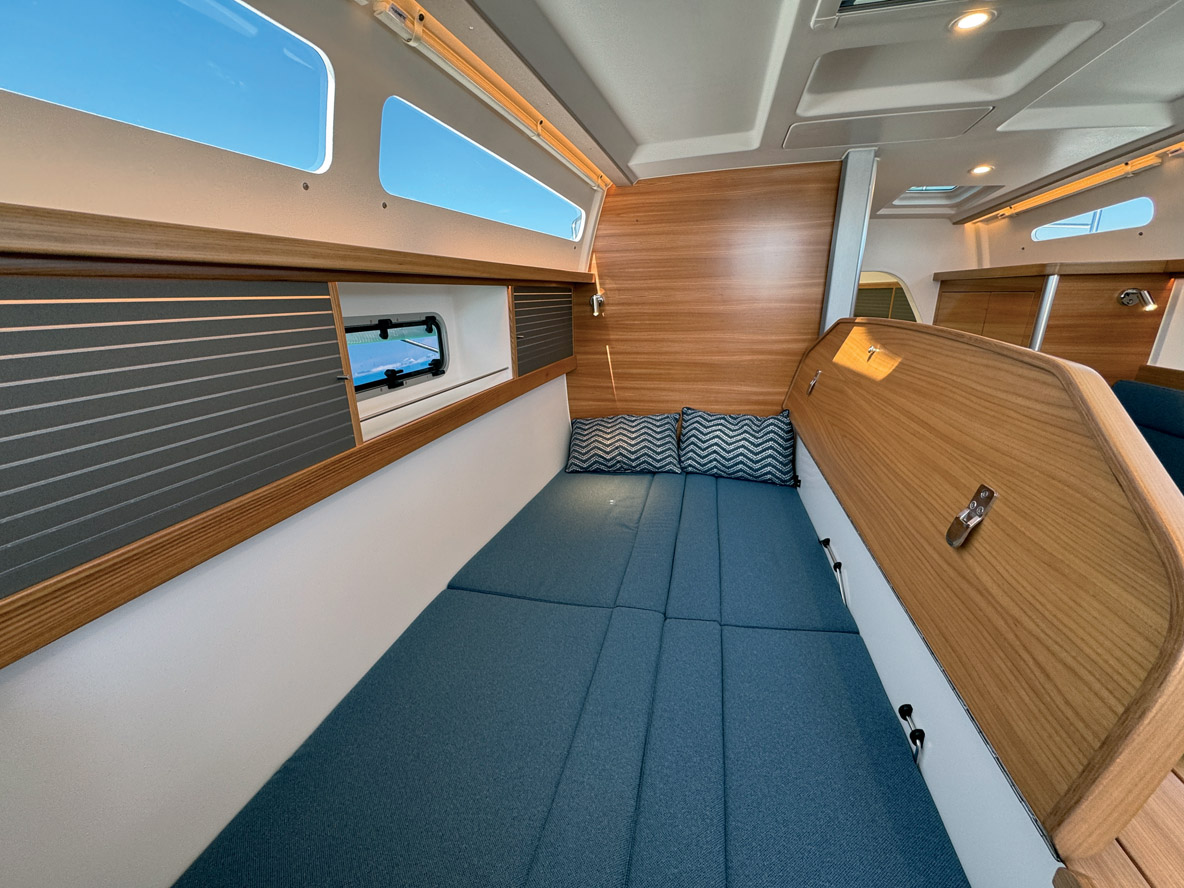
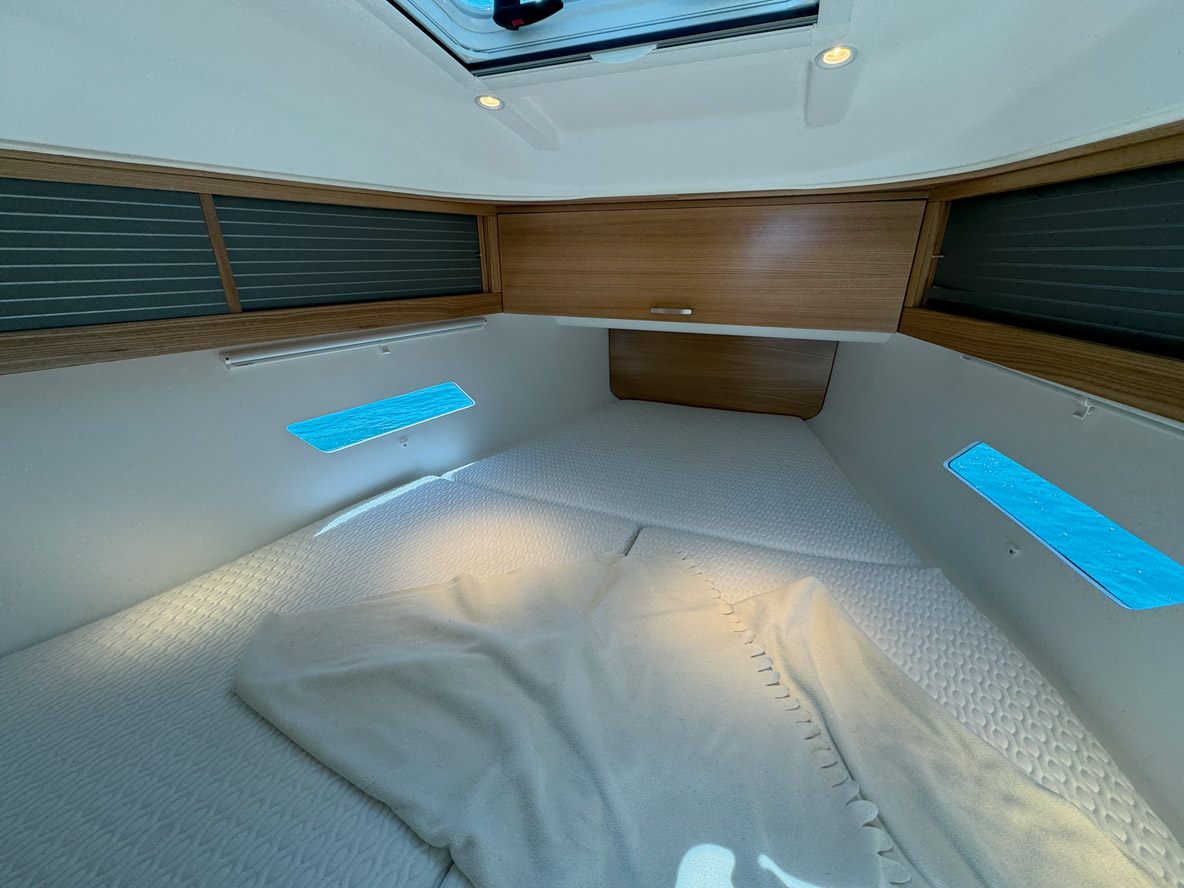
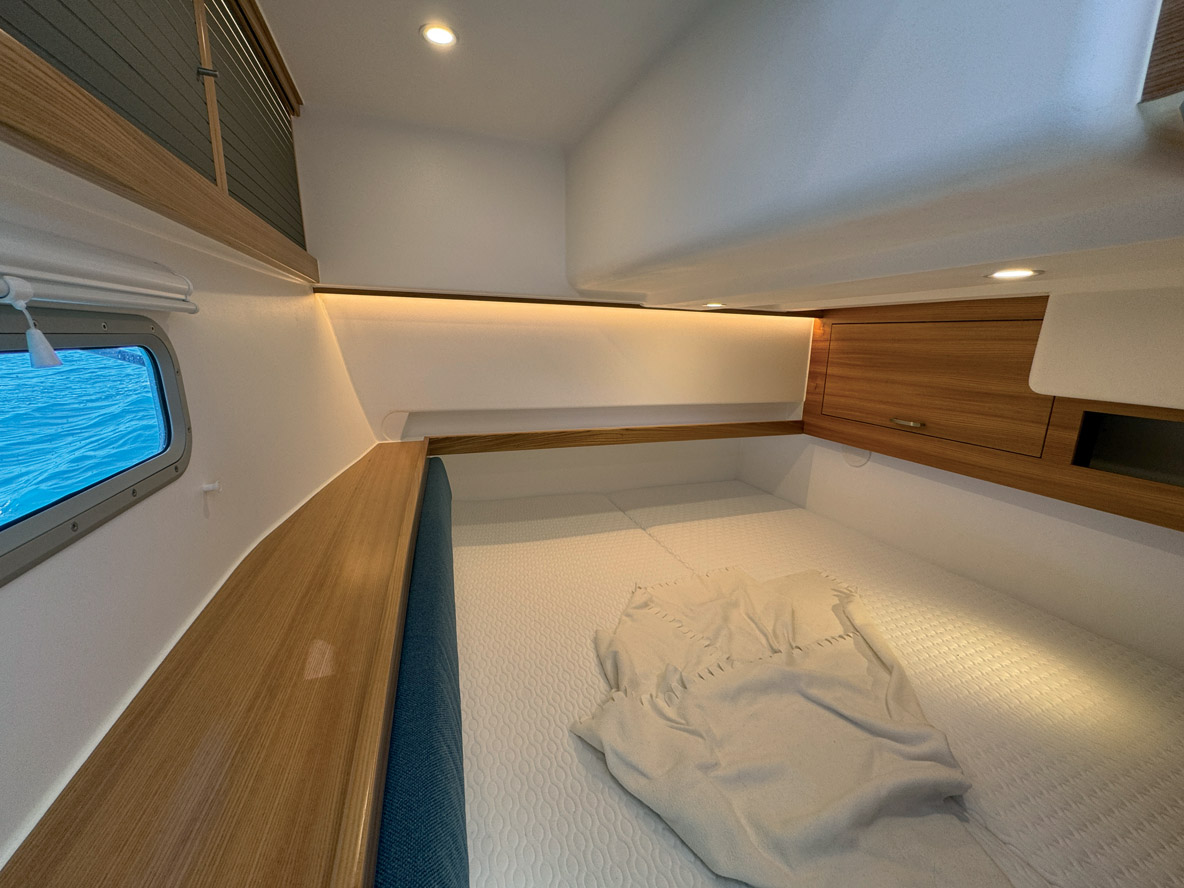
At the stern, a large berth measuring 81” by 63” (2.07 by 1.6 m) is installed flush with the floor. A passageway forward leads to the toilet and the bow, where the berth is 82” (2.08 m) long and 69” (1.75 m) wide at the head and 30” (0.77 m) at the feet. Two small windows in the hull allow you to enjoy the view while lying down.
Conclusion
This proves, if proof were needed, that a high-quality multihull that combines performance and handling pleasure is indeed what a demanding public is looking for and willing to pay for.
Jens Quorning A Life Dedicated to Multihulls...
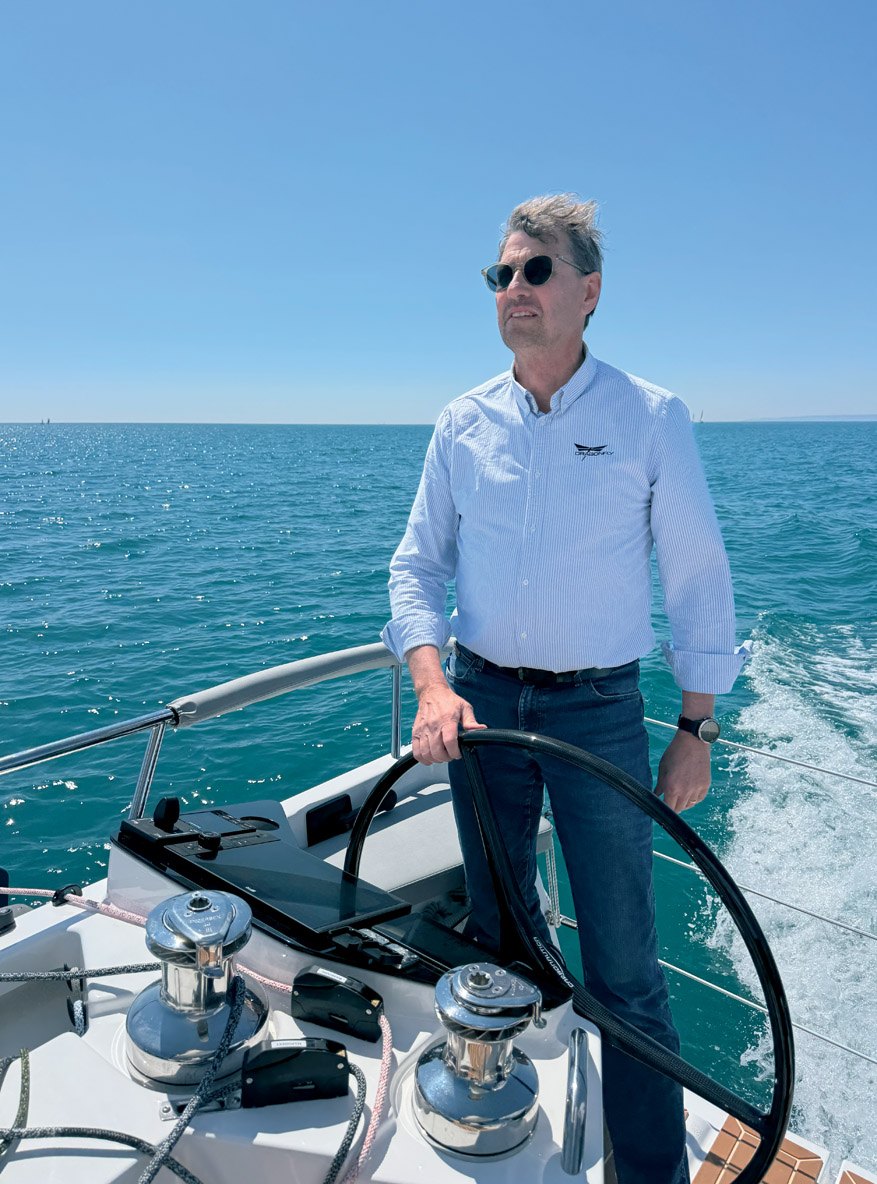
Jens Quorning hasn’t been CEO of Quorning Boats for almost 30 years by chance: he became involved very early on in the shipyard founded by his father Børge in 1968. After completing his apprenticeship in 1982, the young man spent a year working in Amercia alongside Dick Newick, which greatly inspired him and obviously had a lasting influence on the design of Quorning Boats’ multihulls. Jens has set numerous sailing records in Denmark and taken part in many international competitions. He has also sailed from Los Angeles to Hawaii on a 48-foot cruising catamaran and completed an Atlantic crossing.
Still as keen on sailing as ever, Jens has exceptional expertise in the design, construction, and manufacture of multihulls. He oversees sales, design, and development of his new trimarans and personally inspects each hull before delivery.
Very successful design
Helming pleasure
Reduced living space
High price
Technical Specifications
Architects: Olsen Design/Quorning Boats ApS
Length overall: 37’11”/44’1” (11.55/13.43 m)
Waterline length: 35’9” (10.9 m)
Beam: 26’8”/12’2” (8.12/3.7 m)
Draft: 2’2”/6’7” (0.67/2 m)
Light displacement: 9,925 lbs (4.5 t)
Mainsail: 645/753 sq ft (60/70 m²)
Genoa: 323/414 sq ft (30/38.5 m²)
Gennaker: 1,184/1,615 sq ft (110/150 m²)
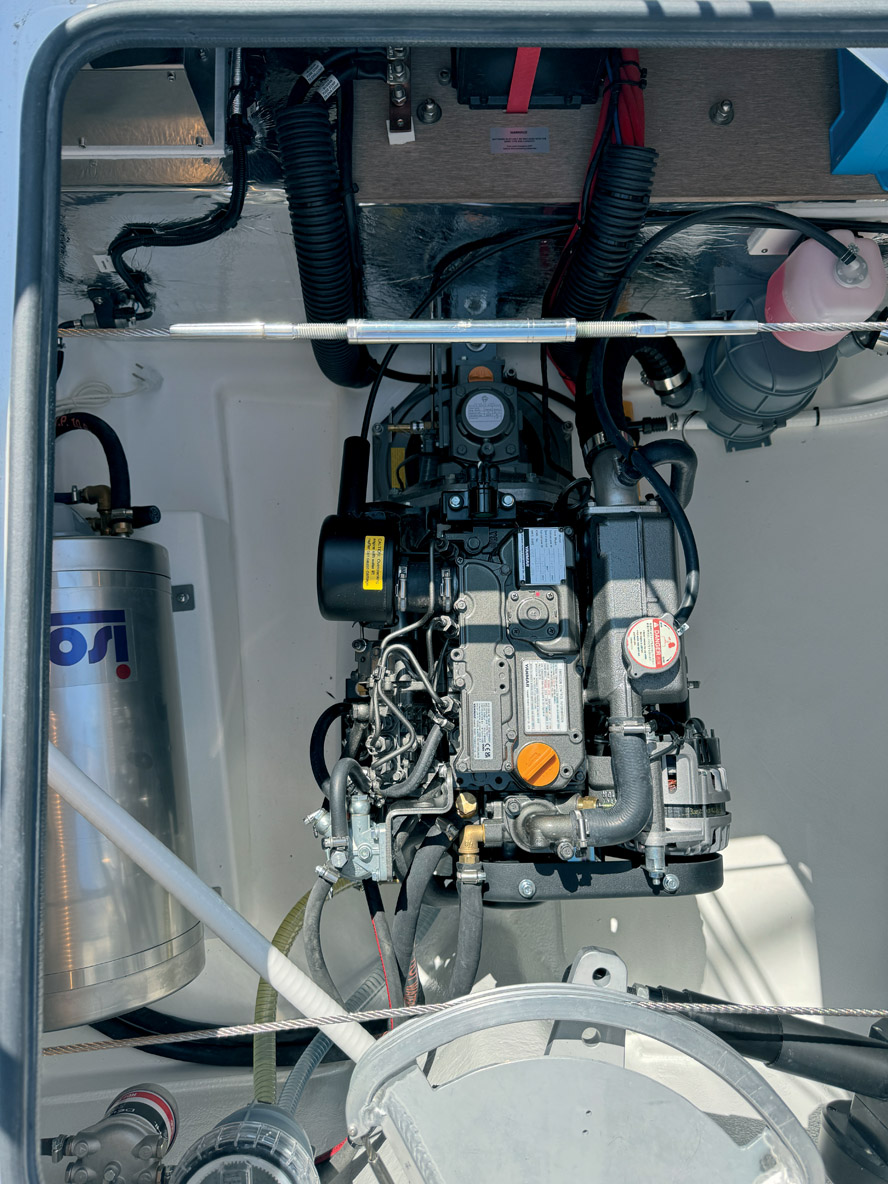
Engine: 30/40 HP
Fuel: 18.5 US gal (70 l)
Water: 52 US gal (200 l)
CE Category: A5/B7
Price for Touring Sail Away version: € 527,000 ex-tax
Price for Performance Sail Away version: € 554,000 ex-tax
Price of the version we tested: approx. € 640,000 ex-tax
Main options in € ex-tax:
Ground tackle and anchoring gear: 6,165
Yanmar 40 HP engine: 8,350
4-kW bow thruster: 11,655
Code 0 Touring 592 sq ft (55 m²)/Performance 721 sq ft (67 m²): 7,955 / 9,745
3 x 200 Ah lithium batteries with inverter/charger: 9,530
6 x 60 Wp solar panels: 6,370
2 Raymarine multifunction displays and peripherals: 4,890
Painting of three hulls and arms: 24,400
3-cubic foot (85-liter) refrigerator: 1,975
Watermaker: 11,315
Webasto diesel heater: 5,742
Water heater: 1,865
Shower in heads: 1,295
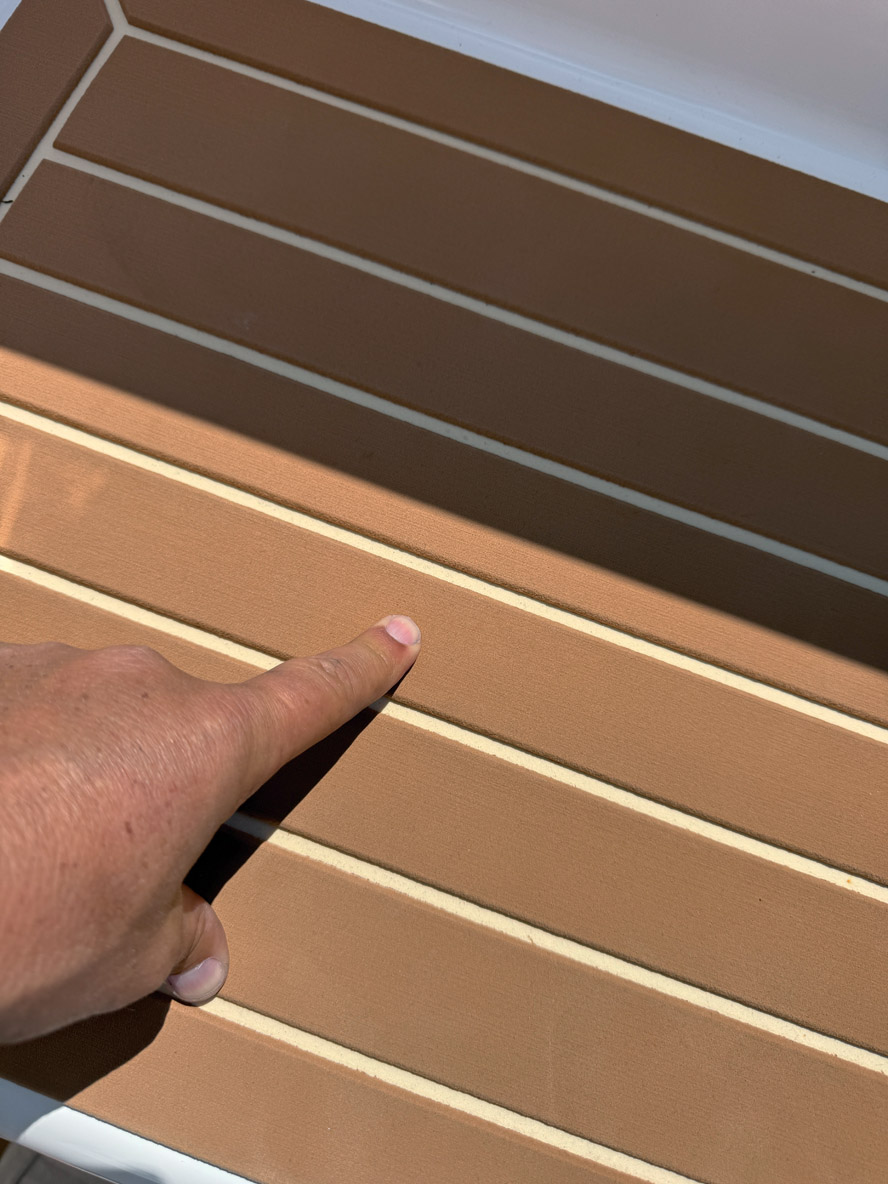
SmartDeck coating for seats and cockpit sole: 3,525
Sprayhood: 3,520
Folding cockpit table: 1,740