
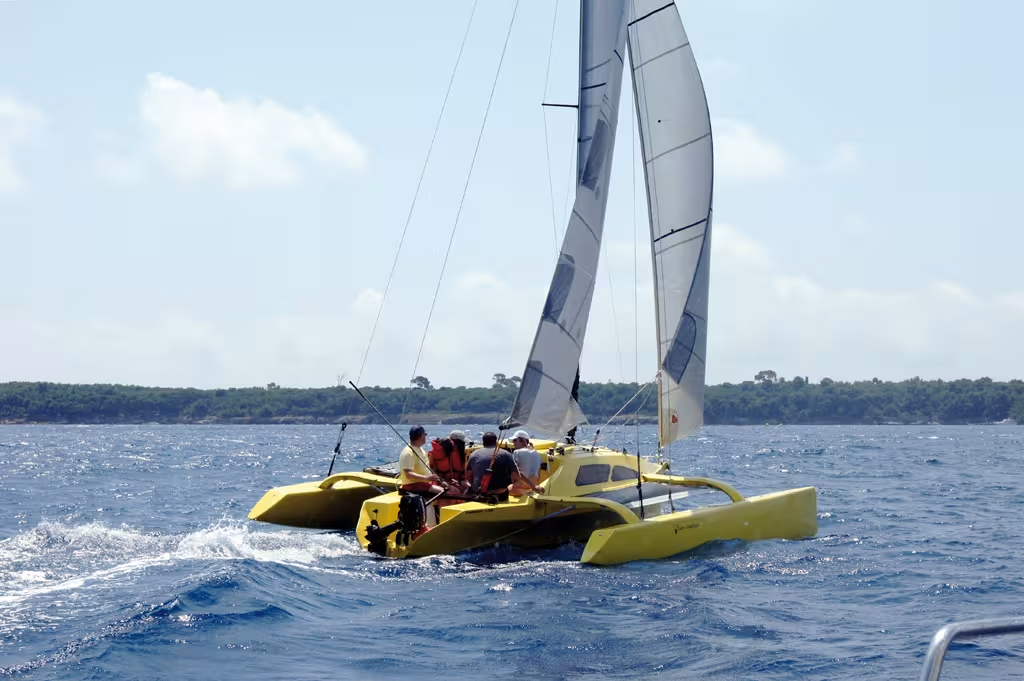
Between performance and comfort, which would you choose? To end the debate, Ian Farrier designed the F-22, a folding, transportable trimaran, built for a no-compromise programme combining above average speed and liveability. Until now, it has been built as a one-off by motivated amateurs, but mass production will be starting in 2012.
Infos pratiques
- Le chantier : F-22
- La fiche technique
- Découvrez notre vidéo exclusive
- Financez votre F-22 Trimaran
- Assuez votre F-22 Trimaran
- Articles autour du F-22 Trimaran
A few cables from the Croisette and its palaces, ‘Nid d'Abeille’ has just celebrated by parading through the roads of Cannes, clothed in bright yellow and carbon. The F-22 trimaran, built by Thierry Hémard, was impressive on its trailer, but didn’t really have a wasp-waist. The convoy nevertheless threaded its way without difficulty to the small slipway. But when the moment came to manipulate the trailer by hand on the slipway, the mask fell: behind the bulky appearance its ‘body-built’ shape gives it, hides a lightweight young lady, as light as you please, to play the star on the beach…and spoil the fun on the finish lines at regattas. It must be said that the damsel has undergone a strict diet during her construction: lightened foam sandwich at each meal, and liposuction under vacuum to eliminate any excess epoxy resin. Final verdict: less than 600 kg on the scales, when its competitors of an equivalent size show 100 to 200 kg of additional spare tyre. We could also quote the example of spectacular anorexia noted on an F-22 weighing just 480 kg, built completely in carbon by Melvest Marine, whilst other examples have opted for an aluminium mast and less high tech construction, and weigh more than 650 kg. A notable advantage of one-off construction is that each owner has been able to opt for the configuration of their choice: ‘short coachroof and long cockpit’ for racers and day boat lovers, ‘long coachroof’ for fans of coastal cruising looking for a spacious cabin, or again, ‘central cockpit and small additional aft cabin’ to centre the weight of the crew, whilst looking after the privacy of the berths at night. Thierry Hémard, who is divided between summer family cruising and the racing circuit with a few mates, chose the R (for Racing) version, with a long coachroof and a pivoting centreboard, which tolerates impacts better than the daggerboards also on offer. Independently of the choice of carbon as the mast material, the R version of the F-22 has a longer mast, supporting nearly 20% more sail. It is intended for experienced skippers, capable of managing the extra power, unlike the standard ‘detuned’ version, where there is no risk of capsizing in anything under 30 knots of wind.
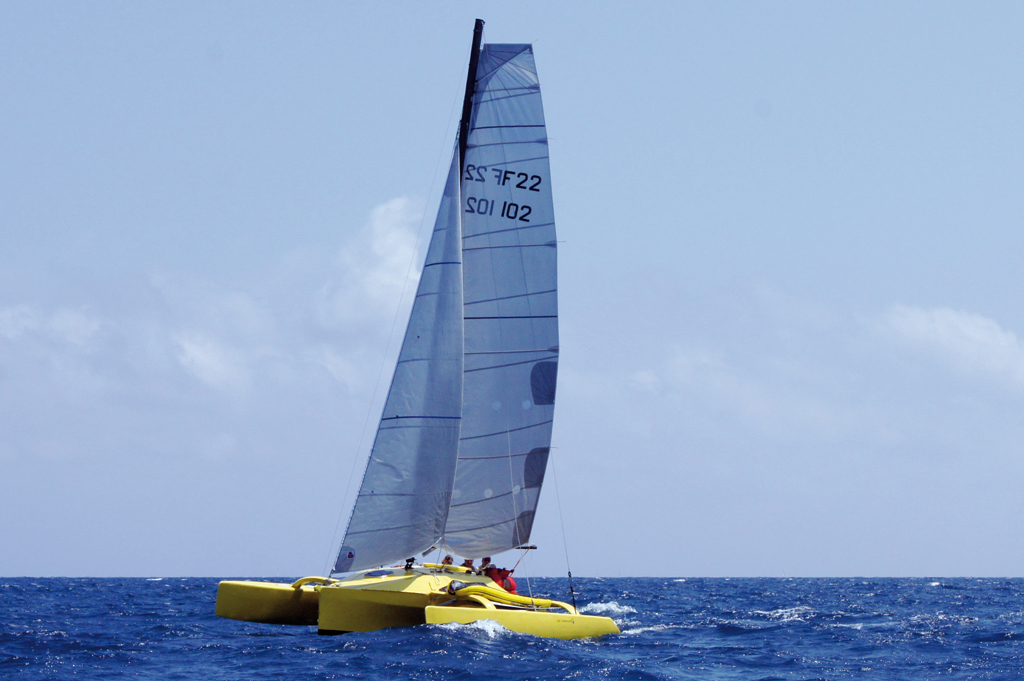
The trimaran literally takes off in the slightest puff of wind...
Stepping the mast and launching, under supervision
After having covered more than 1000 kilometres of motorway from its native Brittany, ‘Nid d'Abeille’ was fidgeting with impatience at the idea of finally tasting the waters of the Mediterranean. The first operation began, stepping the mast which, with a 10.7 metre long carbon spar with an area of 2m² was not a simple affair. Especially when you know just how vulnerable carbon is to impacts, and the price of the accessory. But Ian Farrier is not an architect who leaves things to chance, and everything has been provided for two people to be able to carry out the operation easily, without effort or danger, thanks to the use of a cleverly-designed mast-stepping trestle. The slipway configuration was not very favourable for launching. Its low gradient and the limited length submerged didn’t allow us to reverse sufficiently for the boat to start floating, despite the wheels being under the water (not the best treatment for the hubs and the braking system…). In the absence of rollers, (not really recommended, to avoid delamination of the bottom of the hull, which is in sandwich), we pushed the bows vigorously to finish launching ‘Nid d’Abeille’, appreciating, in passing, its moderate weight. Beware, however, when leaving under engine between the pontoons, as the lightness and the windage mean you have to anticipate the machine’s reactions if you don’t want to play at ‘dodgems’ with the other boats.
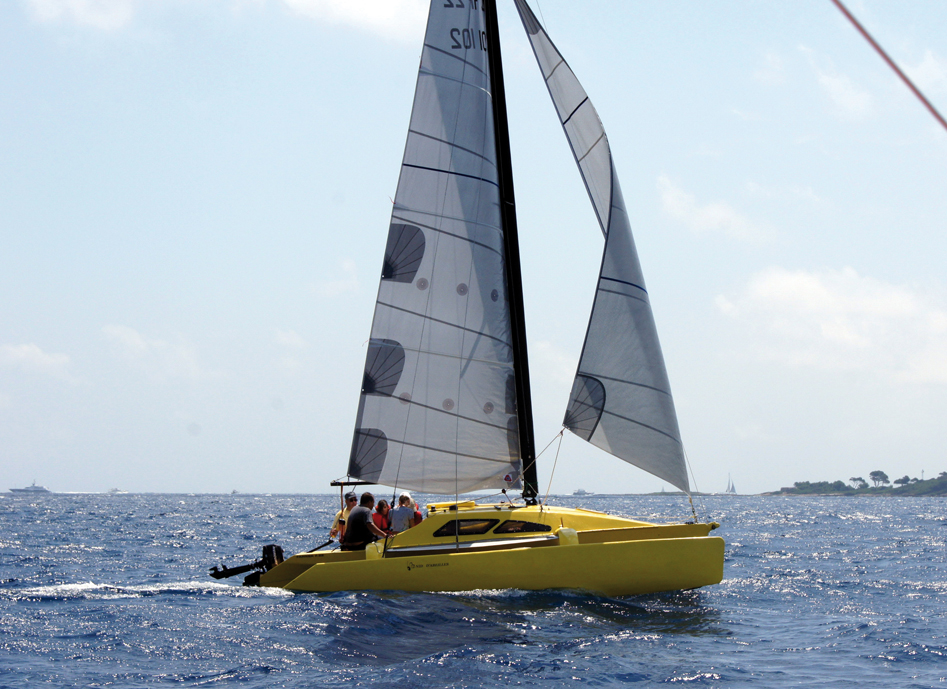
Very attractive lines and a really efficient hull!
Bend / stretch
The float folding system invented by Ian Farrier more than 30 years ago is still a pleasure to use and a delight to observe. A real ballet sees the float deploy effortlessly, whilst the shroud fixed to it moves out without ever ceasing to support the mast, and the trampolines are opened out and tensioned as if by magic. Two bolts to be tightened to make the assembly secure, and the job is done. To guarantee faultless adjustment and reliability, the crossbeams and their folding mechanism are exclusively manufactured by Farrier Marine in New Zealand. This third generation of the ‘Farrier system’ can be distinguished from its predecessors by its shorter arms, which no longer encroach on the cabin’s interior volume. It is also an advantage on the road, as the folded arms are hardly any higher than the mast stowed on top of the coachroof.
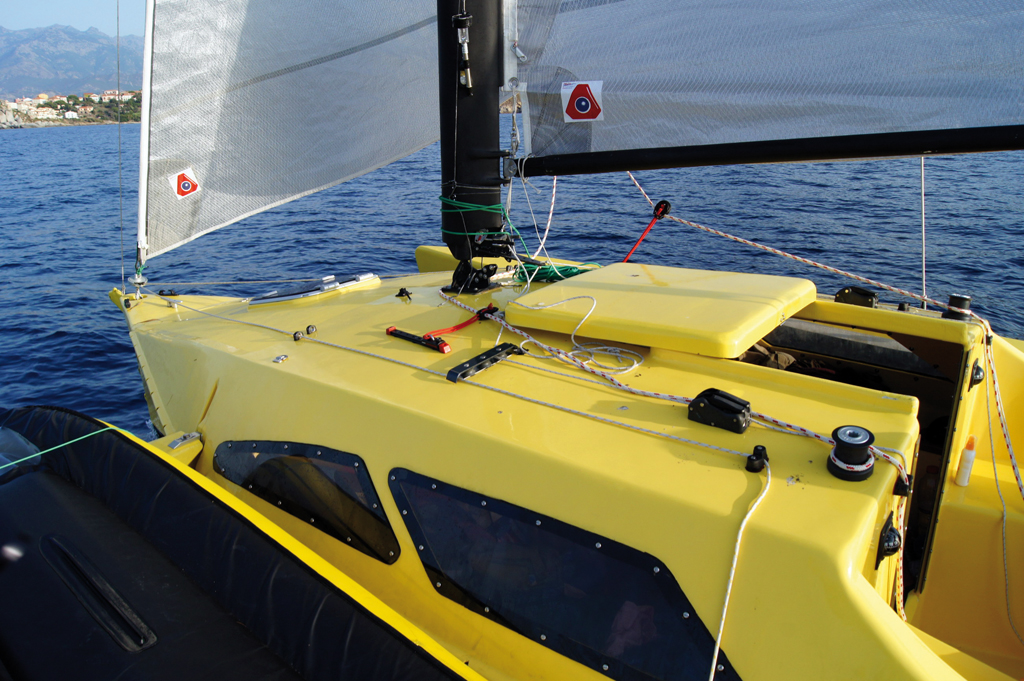
A simple but effective deck plan.
Incredibly seaworthy
It was time to cast off and hoist the sails...which takes a bit of elbow grease in strong winds, because of the long boltrope, whose friction does not make hoisting easier. Given this mainsail’s large area, sliders and lazy jacks would not be a luxury. A first 100-mile passage took us to Corsica, in a variable breeze, hesitating between ‘almost non-existent’ and ‘absolutely nothing’. The opportunity to note, flabbergasted, that a few miserable knots of barely perceptible breeze were enough for ‘Nid d’Abeille’ to take off at over 4 knots, as we could use the apparent wind created by its own movement. Otherwise, on this mirror-like sea, the little 4hp motor was enough to propel the boat at up to 7 knots, to the great delight of the dolphins, a great number of which had come to play under our bows. The return trip a few weeks later was the opportunity to see finally what this F-22 was capable of. We set off at dawn, and quickly found the wind. We were off, for a long 12-hour leg close-hauled/ broad reaching. In a force 3 true wind, we were sailing to windward at over 9 knots, without even realising. The perfectly balanced helm is exemplary. Well supported on its voluminous float, ‘Nid d’Abeille’ sailed easily, despite a sea which was becoming rougher. Perched high above the water, we remained dry, and if we had not had a GPS to reveal our true speed, we would have thought we were only doing between 5 and 7 knots. The wind then freshened to reach force 4. Taking advantage of the very long tiller extension fitted to the tiller, I moved up onto the windward float, with my back wedged against the runner. Suspended well above the water, I enjoyed watching the bow ploughing through the water. Thierry prudently kept one hand on the sheet…but never needed to use it. The platform’s rigidity is excellent, and each gust was the opportunity to accelerate even more, without the leeward float ever giving the impression that it couldn’t cope. The speed was now varying between 10 and 13 knots and we could clearly feel the boat coming to life, without the helm becoming heavy for all that. I was jubilant! When you think that there were four of us aboard, with all the cruising equipment, you can easily imagine the scope for improvement once the boat is lightened and sailing further off the wind. For the moment, at that speed and facing the waves, the spray started to come aboard and forced the crew into their foul-weather gear…apart from those who were in the dry, enjoying the comfortable cabin.
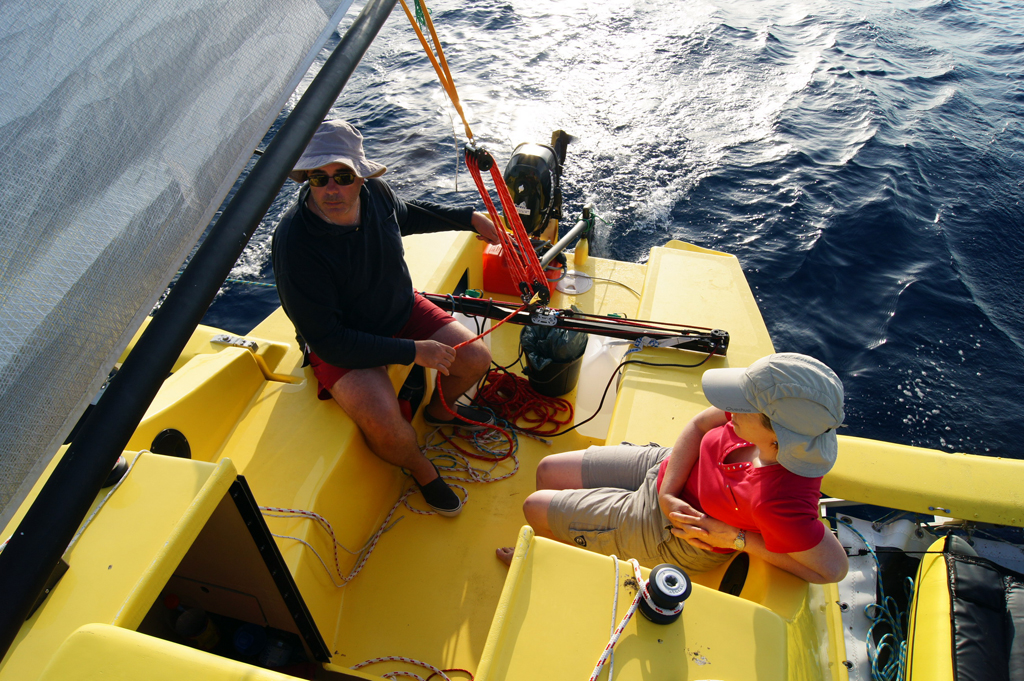
Although the cockpit is of a good size, it nevertheless remains perfectible.
Life aboard
If the F-22is capable of rivalling bigger racing multihulls on speed, it doesn’t fear comparison from a liveability point of view, either. With its high freeboard and imposing coachroof stretching over the whole width of the central hull and running as far as the pulpit, the machine’s profile is stocky, far from the delicate elegance of the Golden Oldies (former ocean racing multihulls). But once inside the cabin, the relevance of this architectural choice can be understood. The space available is quite simply amazing, with comfortable headroom of over 1.6m and an unusual width, which almost makes you forget you are aboard a transportable multihull. The traditional double berth in the bow is spacious and the lateral berths are long enough for adults. The space accessible under the cockpit seats allows a large sliding galley to be fitted, or some stowage boxes. Stowage for belongings is completed by the volume available under the forward berth and above all by the huge, deep lockers serving as backrests along the sides of the hull, which have the advantage of being easily accessible. On the other hand, there is very little space under the settees, as the hull is very narrow at this point. Finally, there remains a last volume, directly accessible aft, under the cockpit floor.
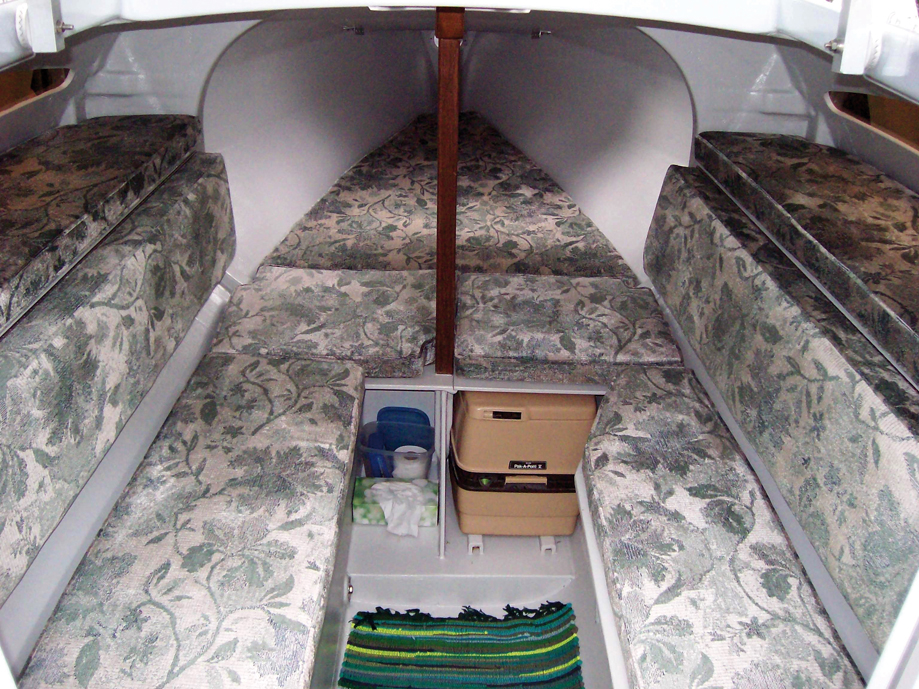
An incredible liveable volume for a transportable trimaran less than 7 metres long…
A perfectible cockpit
Four good-sized lockers under the cockpit seats, a chain locker and watertight lockers in the floats complete the stowage spaces outside. But although the F-22 attracts praise on many points, I was more critical of the cockpit, whose ergonomics deserve to be improved, at least in this version with the long coachroof. Although its size may seem satisfactory on first glance, it must be kept in mind that the part aft of the mainsheet track is not really useable when sailing. With no backrest, and open to the sea, the helmsman’s position is not one of the best. As for the inclined coamings, they form a perfect slide for the elbows when they are looking for support. Finally, the space between the seats is a touch too wide to be able to be able to brace yourself when heeled by stretching out a leg (a footrest fixed to the cockpit floor would easily remedy this problem).
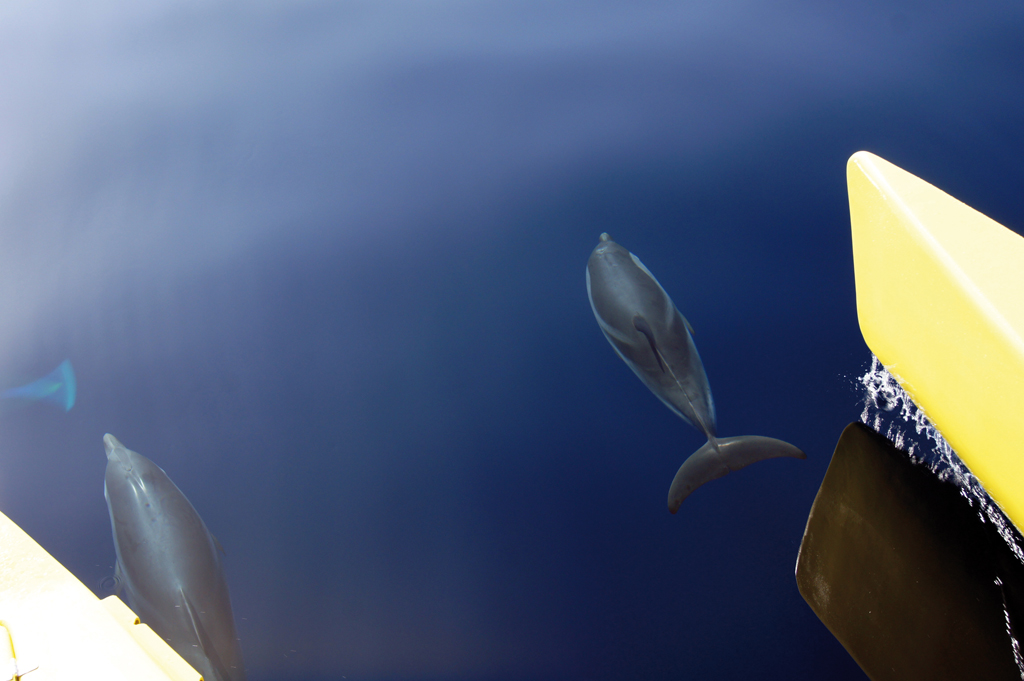
During the cruise to Corsica, the dolphins played for a long time with the trimaran’s bows… A good omen!
Soon on the shelves…
Don’t pay attention to the family likeness the F-22 displays to the other trimarans designed by Ian Farrier (including the famous Corsair F-24 and F-27, several hundred examples of which have been sold around the world), it really is a new boat which has required several years of detailed design work, to obtain the best possible result at the fairest price. Initially offered in the form of a plan, about thirty boats have been built by their owners (or by the boatyard of their choice) and as many again are being built at the moment. In parallel, Farrier Marine is building the moulds which will allow it to mass produce the boat and distribute it either ready to sail or in kit form including all the parts to finish assembling it. With this latter formula, Ian Farrier hopes to be able to offer a cheaper boat associated with more economical and ecological delivery to the purchaser. Although the date and the selling price still remain vague, the advertised aim is to offer a boat at a tariff well below that of its competitors with equivalent capacity. Faster, more liveable and cheaper than all the other 22 to 24-foot trimarans?... The ingredients seem to have been brought together for it to become the next best-seller in its category!
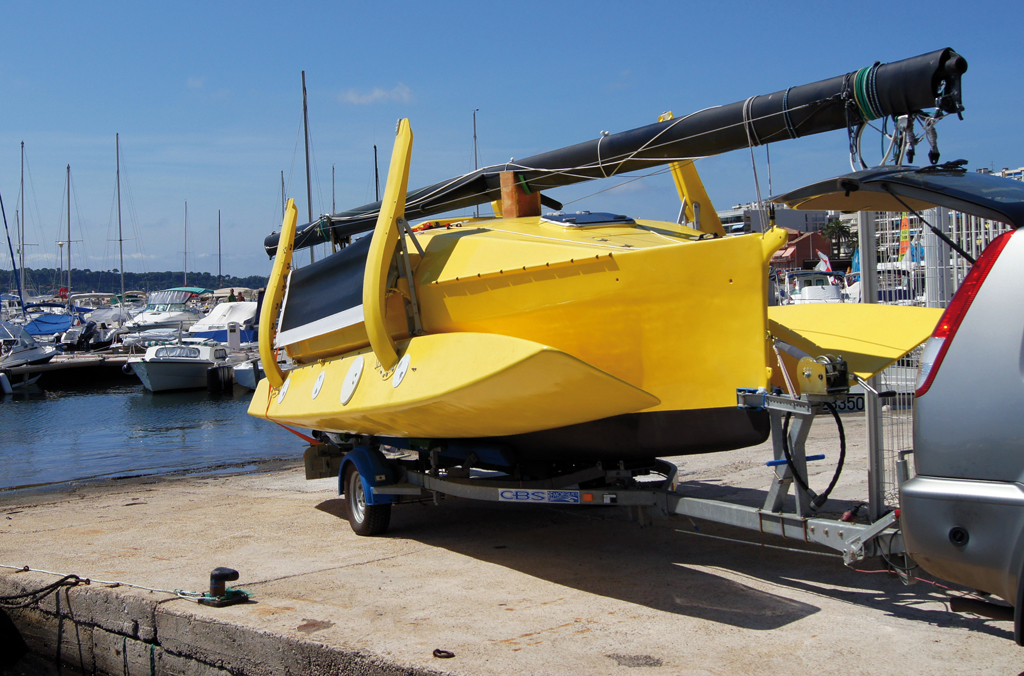
The F22, a real transportable boat on its trailer!
Over to Thierry Hémard, builder of the F-22 R ‘Nid d’Abeille’
I used to sail on an Astus 20.1, an easily transportable little trimaran which is simple to launch. No marina berth, no annual antifouling, the possibility of changing the cruising area according to my wishes...in short, the ideal boat! Except that I wanted 4 berths in the cabin. As I wanted to build my boat and also wanted it to be fast, for racing, I turned to Ian Farrier’s F-22 which met my requirements perfectly. The construction took 1000 hours, spread over a little less than 2 years. I could have finished it earlier if I had had heated premises, allowing lamination during the winter. I learned a lot of things and expected something more difficult technically, but with the very detailed plans and procedures supplied by Farrier, there is no need to invent, it is enough to follow. The longest and most laborious part: the finishing, along with the supply of the fittings. Between the dealers who no longer stock anything, and the delivery errors, you can’t move forward... It cost me 38,000 euros in materials, including 8,000 euros just for the rotating carbon wing mast. The finished boat was valued at 67,000 euros.
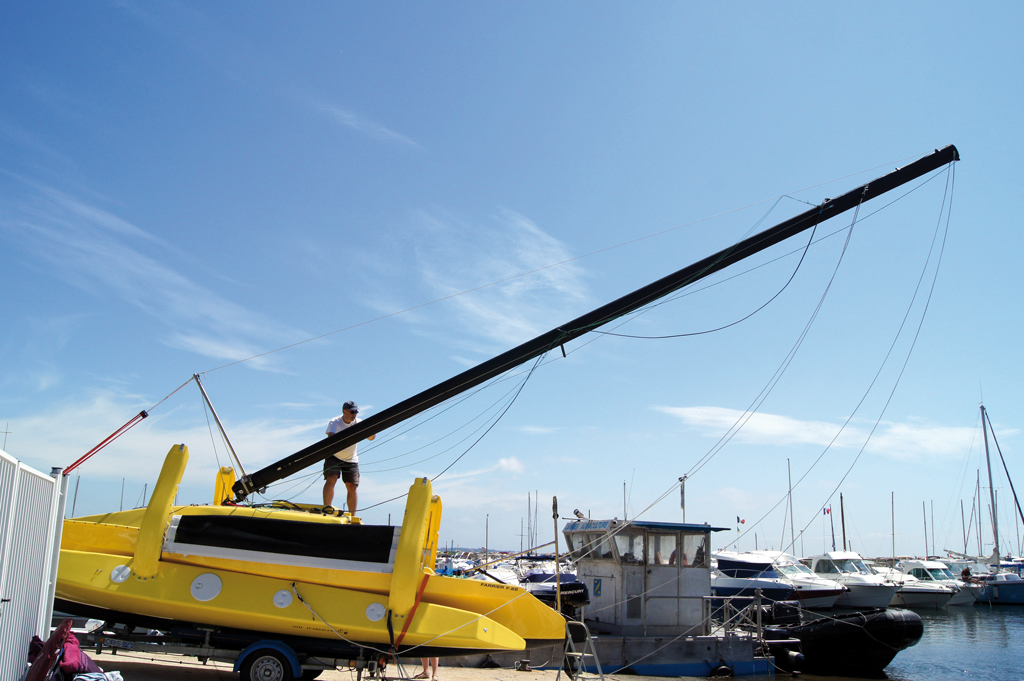
The mast can be stepped with no problems by two people, thanks to a cleverly designed trestle. (Photo: Morgane Hémard)
Specifications
Length: 6.96 m Beam: 5.51 m (2.5 m folded) Weight: from 480 to 680 kg depending on the model and type of construction Sail area: 30.2 m² (35.9 m² for the R version) Draft: 1.51 m / 0.31 m
