It’s a fact: Libertist trimarans are bright red and turn heads as they pass. The designs of brilliant naval architect Erik Lerouge associated with the iconic color of the most famous Italian car brand really hits the mark and suggests a beautiful sportiness. We got the opportunity to sail on the brand new 703, just after she was launched...
Test location: La Rochelle, France
Conditions: 4 to 5 knots of wind, flat calm sea
Infos pratiques
- Le chantier : Libertist 703
- La fiche technique
-
 Découvrez notre vidéo exclusive
- Financez votre Libertist 703
- Assuez votre Libertist 703
- Articles autour du Libertist 703
Following the remarkable arrival of the 853 at the International Multihull Show in La Grande Motte in 2019 (test in MW167), it was almost two and a half years before we were able to discover her little sistership, the long-awaited Libertist 703. At the La Rochelle boat show, this time it was the strong personality and the potent look of this small trimaran that caught our eye - the 703 is reminiscent of the great Ocean Fifties, all things considered. With her flush, aerodynamic deck, the central hull even looks somewhat like SVR-Lazartigue, François Gabart’s new Ultim. That’s all it takes for the Multihulls World editorial team to get excited: no, we really couldn’t miss the opportunity to be the first to try this boat... because there are sometimes situations where enthusiasm prevails over reason, passion over patience, the determination of the players over the caution of the boat testers.
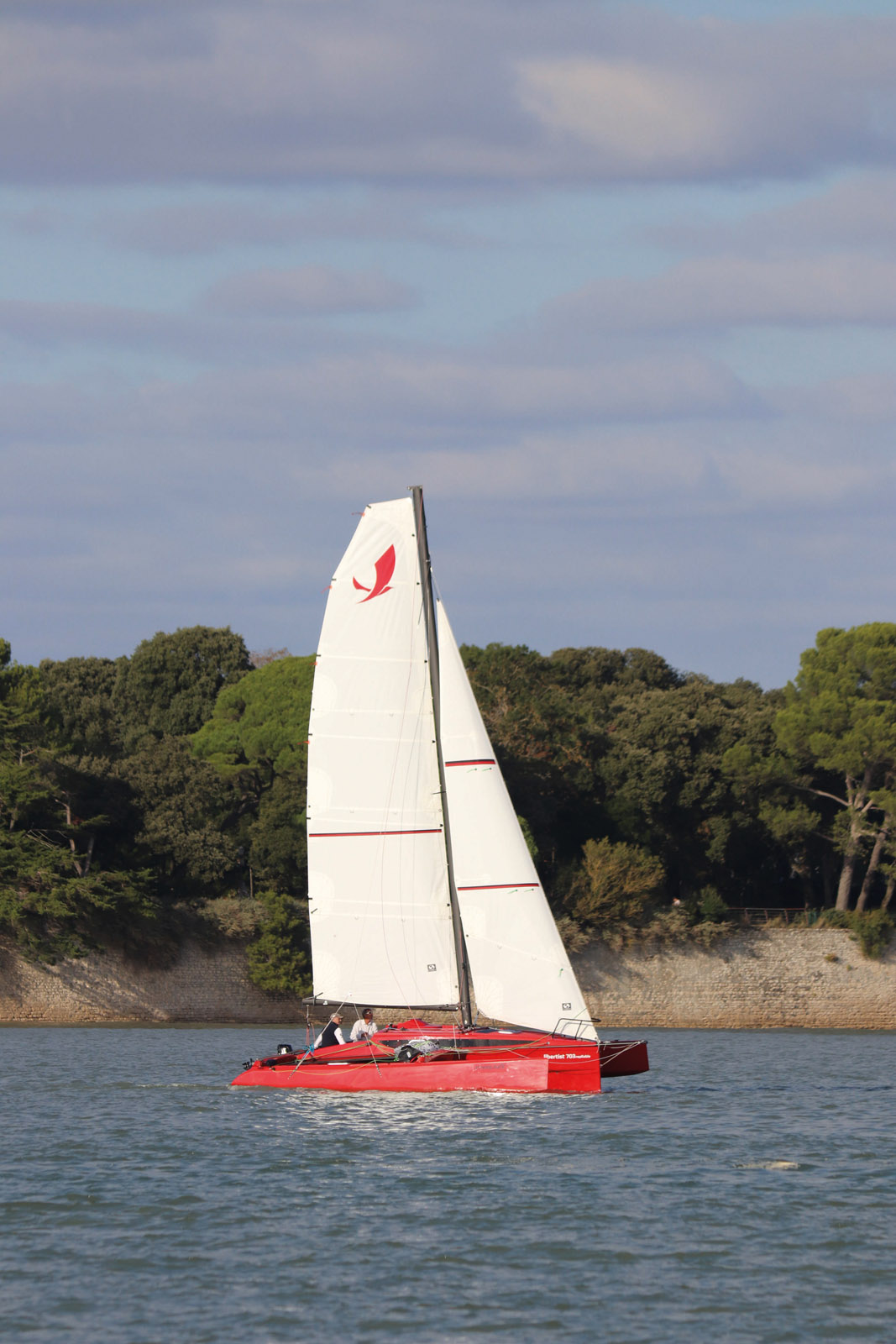
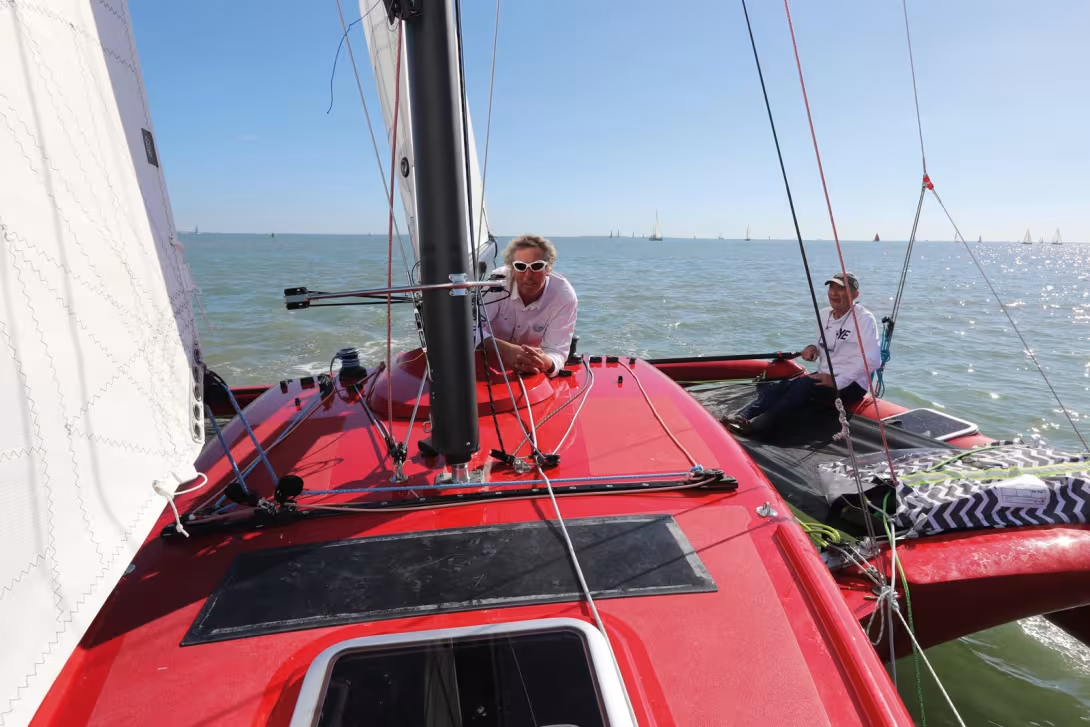
The self-tacking jib, with its two battens, offers a bit of roach.
A promising layout
Our haste has a price, however: we won’t be judging the interior of the Libertist 703 in this test. The interior is as it was when the hull came out of the mold and will be returning to Rega Yacht’s Polish production facilities, some 40 miles south of Warsaw. In line with the Libertist 853, the fittings should be both sober and modern, with varnished carbon giving the sporty touch and white lacquered surfaces for brightness. The interior volume is interesting for a hull of only 23 feet (7 m): in particular, there’s 5’7” of headroom (1.70 m). The two lateral bench seats at the foot of the companionway extend back under the cockpit, offering the length for two single berths. A small galley on the port side of the daggerboard and a double berth in the forepeak mean you could envisage more than just day trips: real mini-cruising is possible.
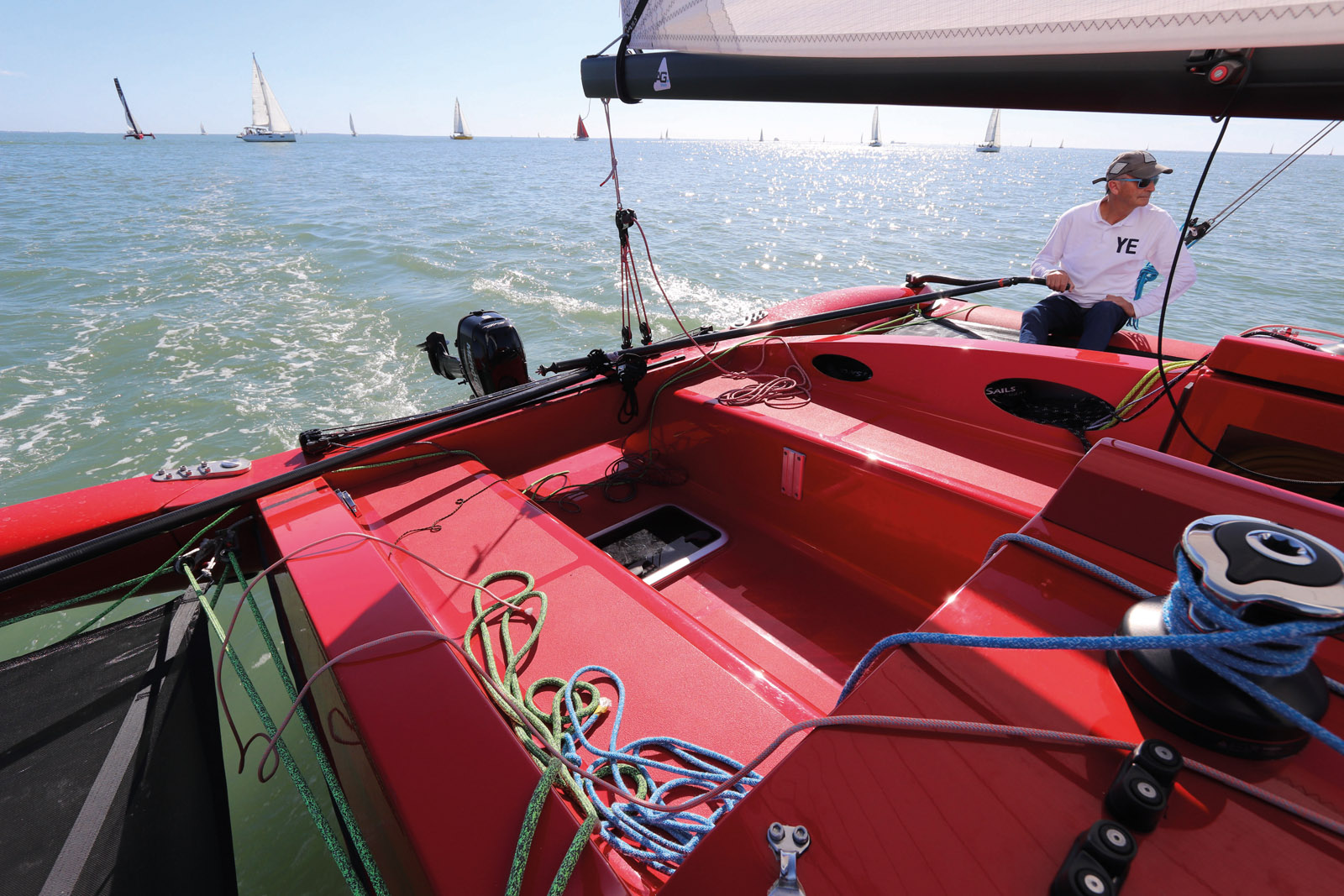
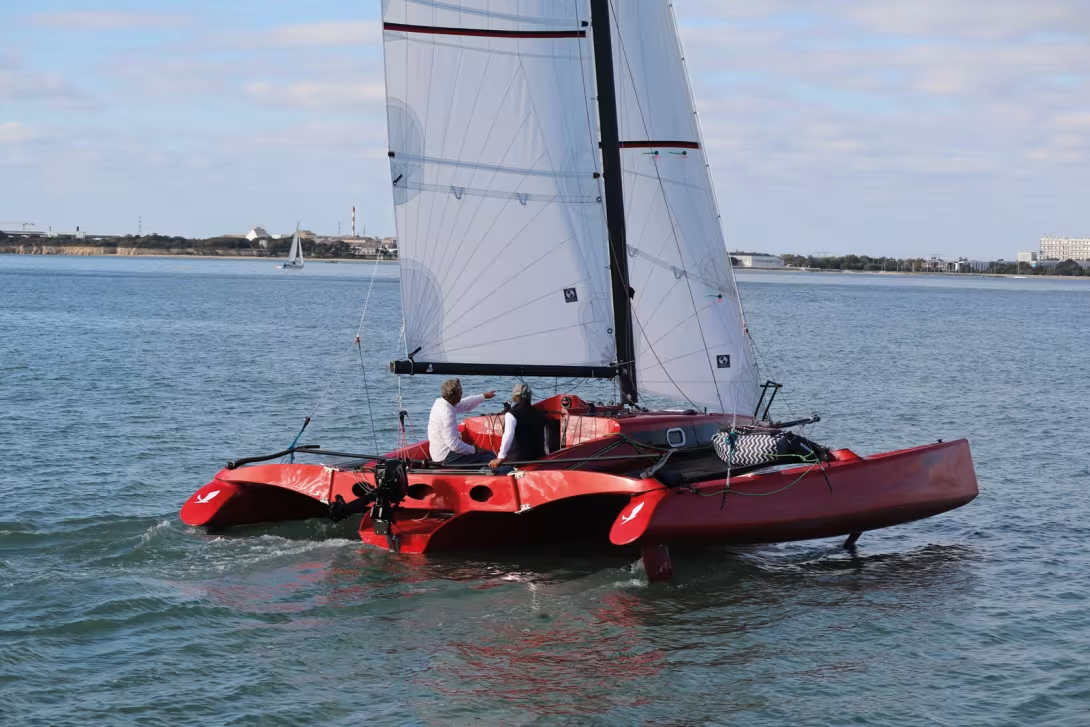
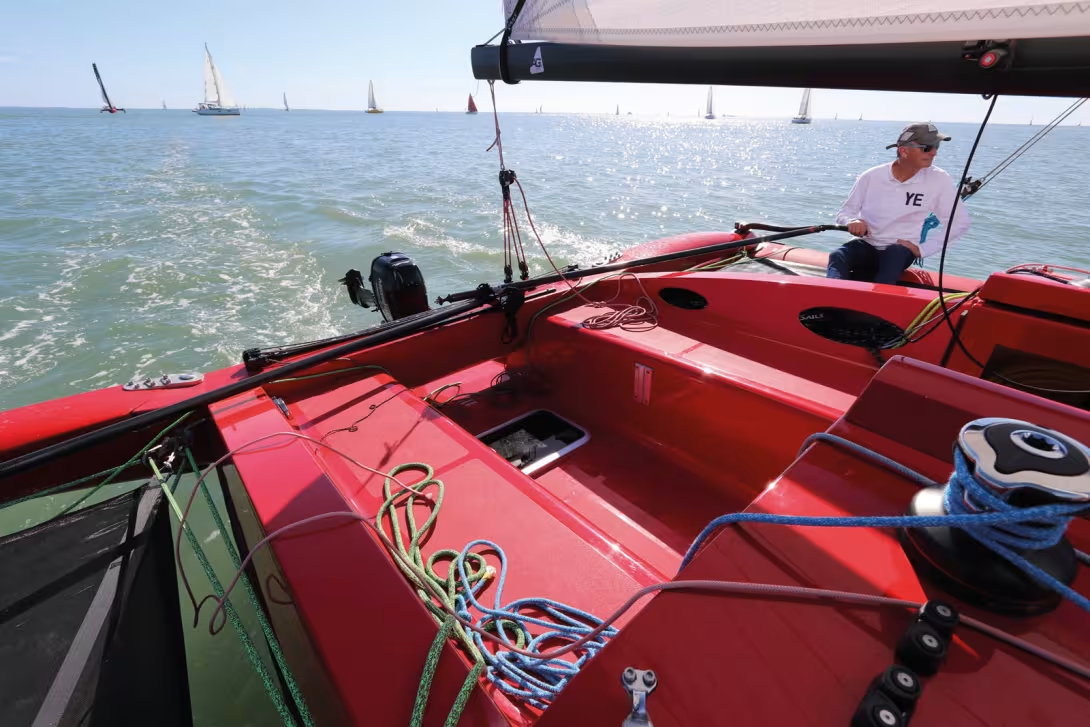
The cockpit offers neat seating - of course complemented by the trampolines.
A more than fresh finish …
Until the day before our test sail, two days after the 2021 La Rochelle show closed its doors, Patrice and Alain, the French importers of the Libertist, worked hard to ensure that we could sail the boat, even after the show was closed. Patrice had already spent a few weeks in Poland to ensure that the trimaran would be at the show: we cannot but salute such determination. There are still a few preparation issues - tiller tube a little too long, a missing centerboard, and a wrongly positioned cleat - but all the main necessities are there, so we can go out for a sail.
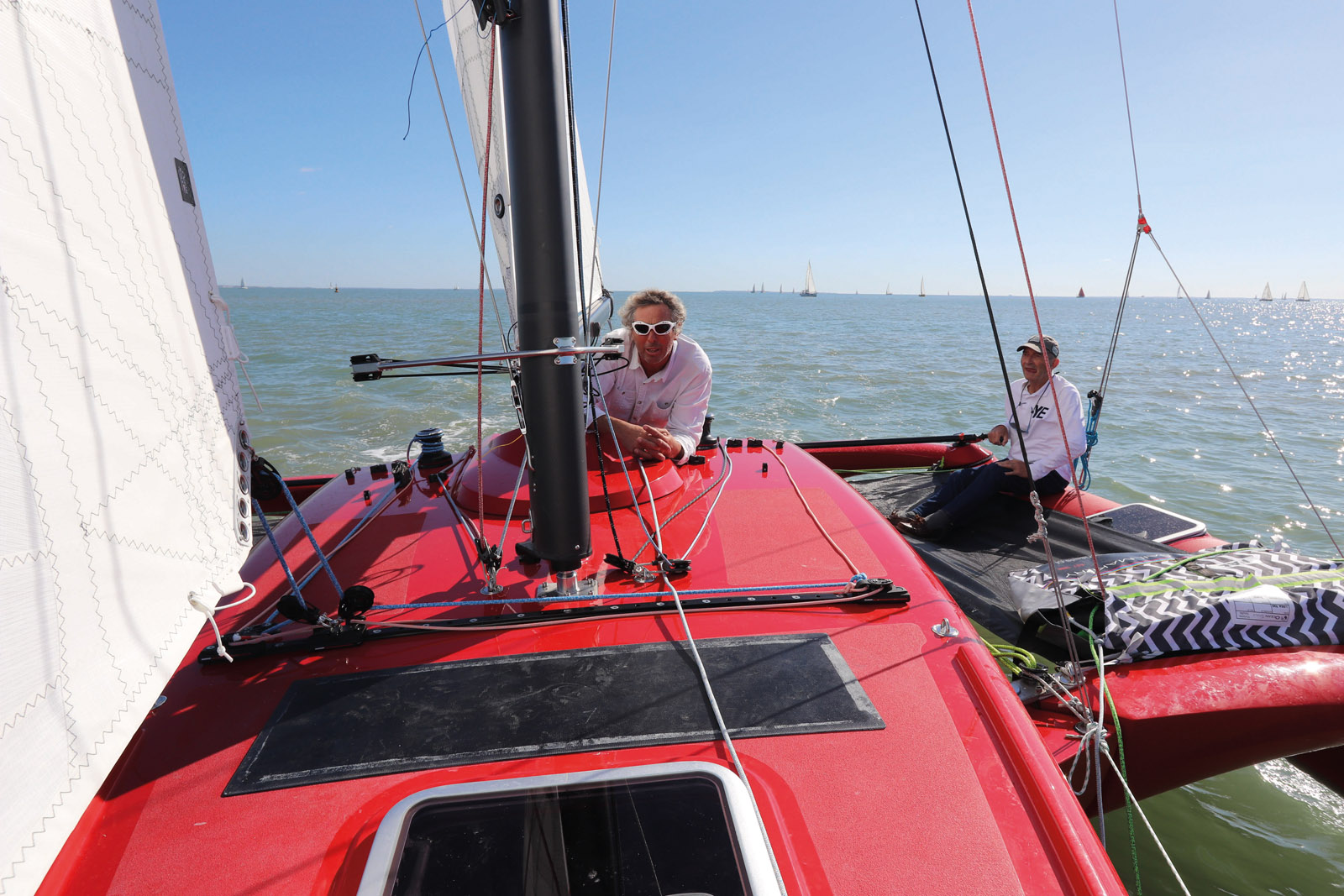
Rotating mast and great hardware mean you can get the most out of the Libertist 703.
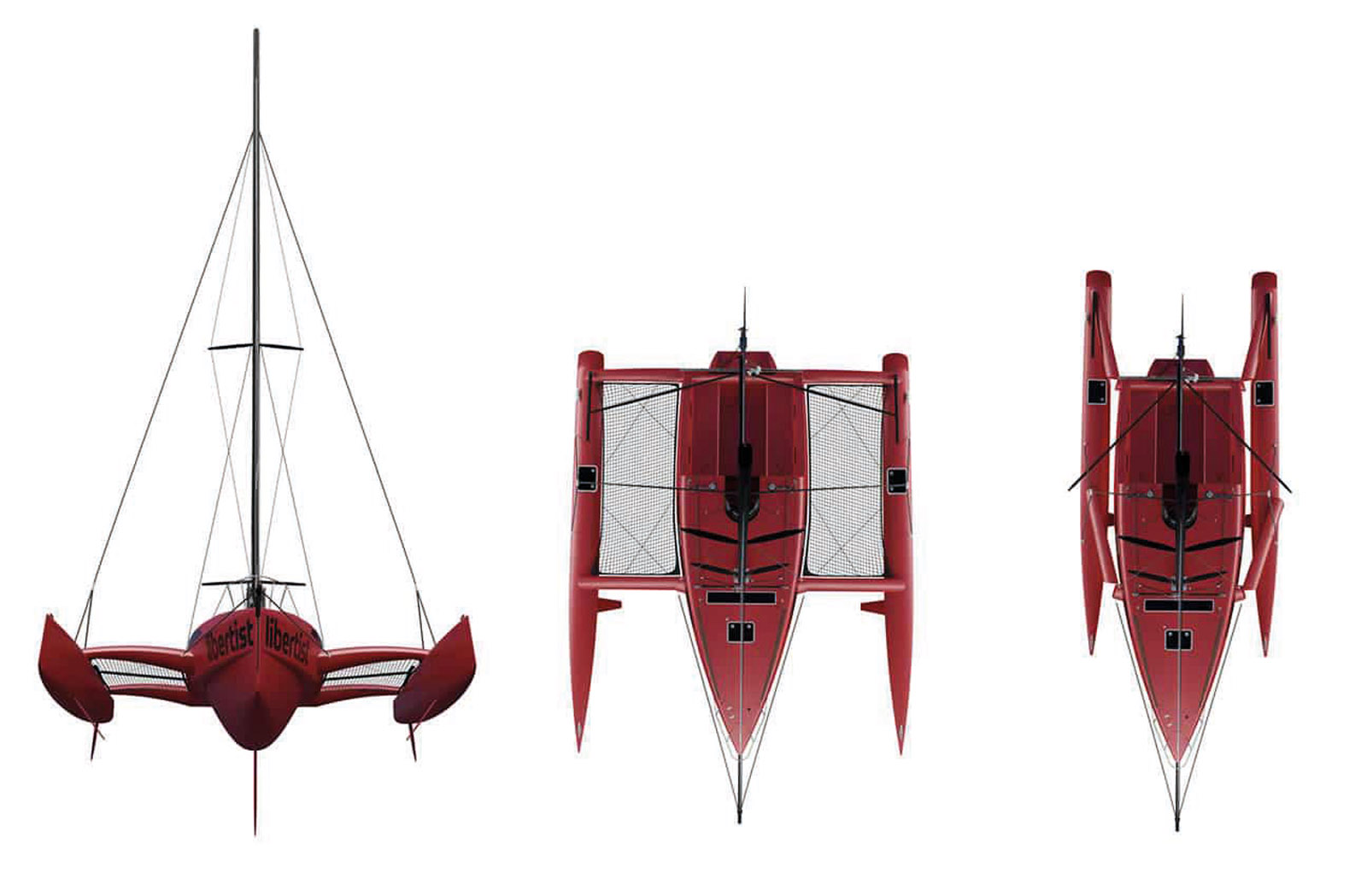
Folding arms
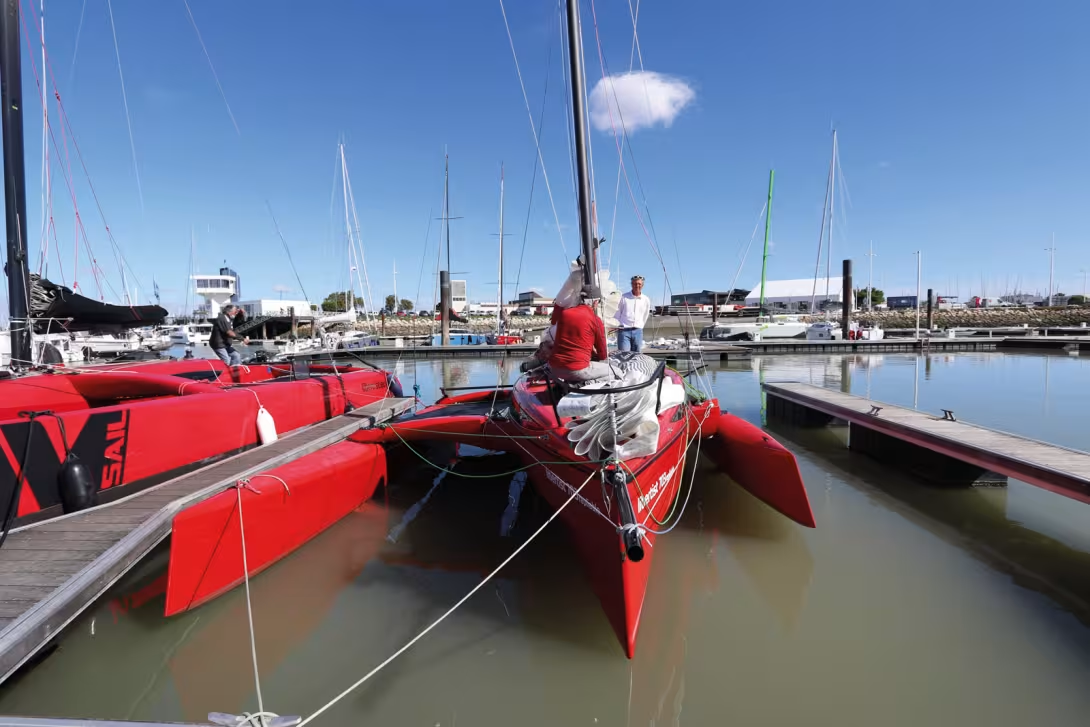
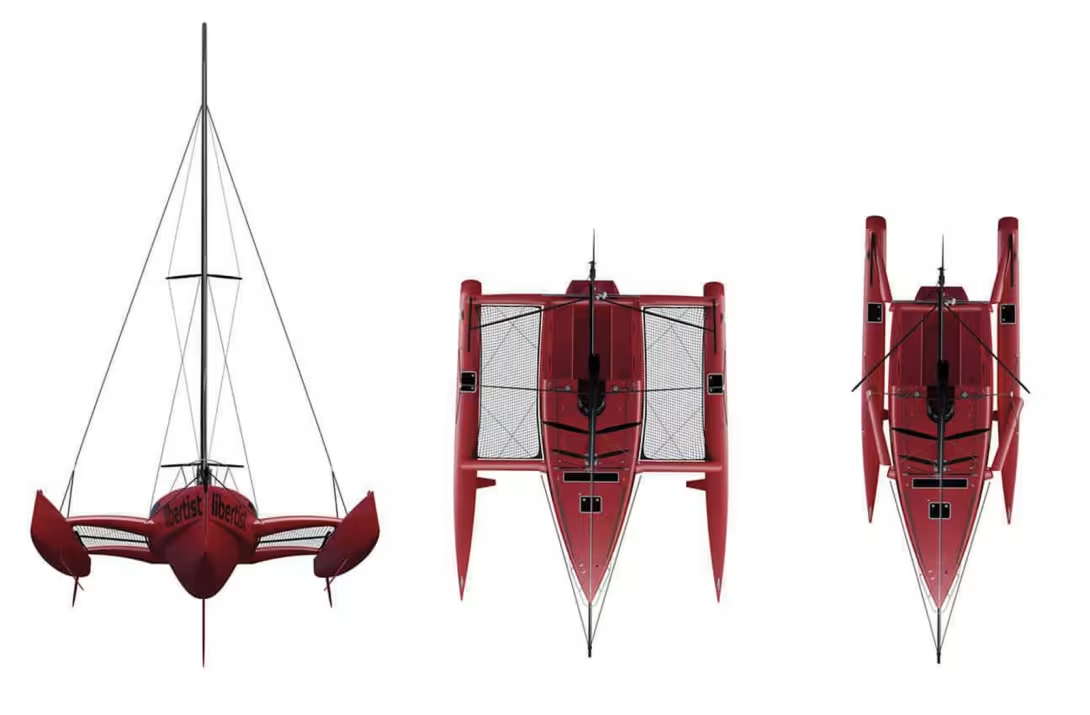
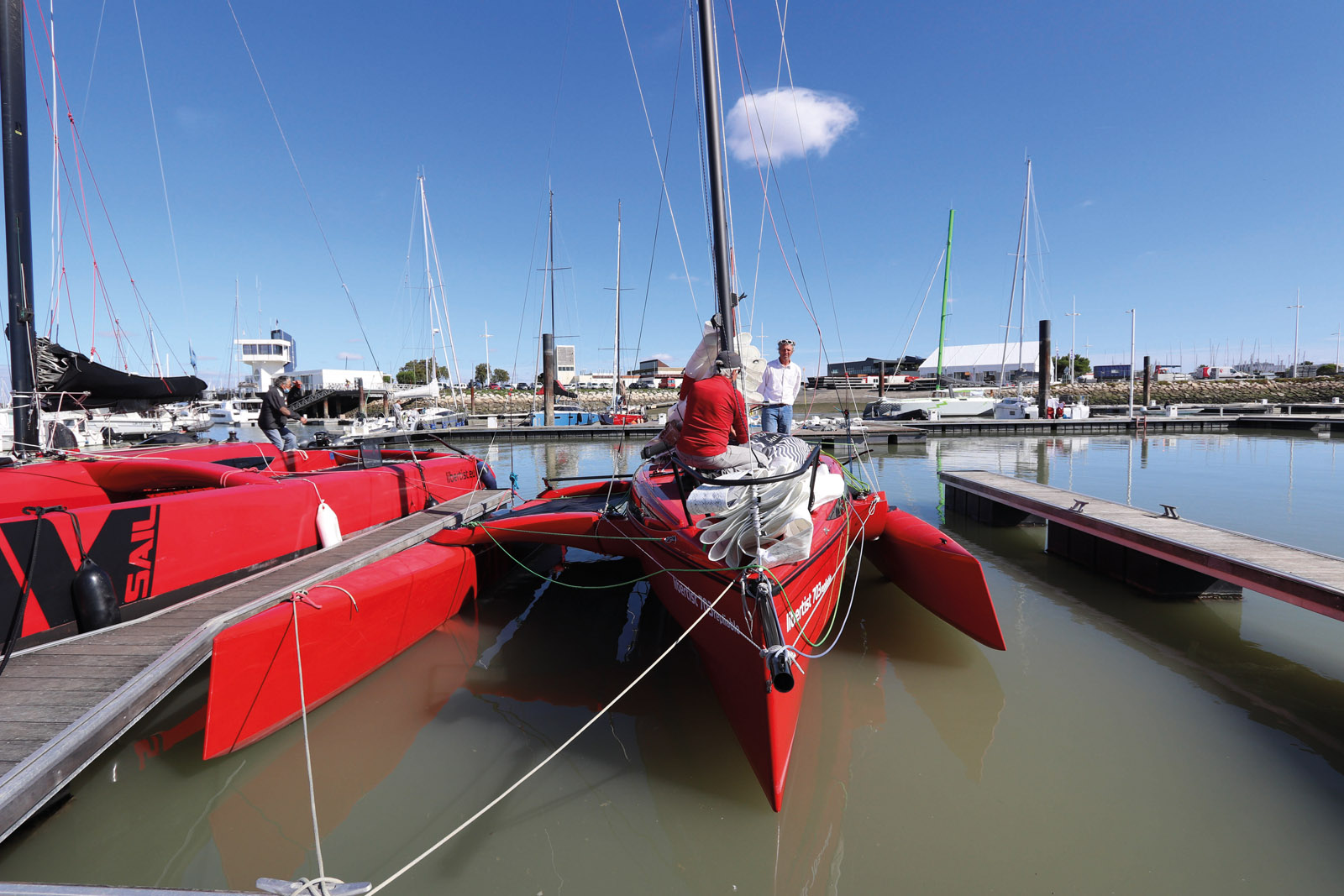
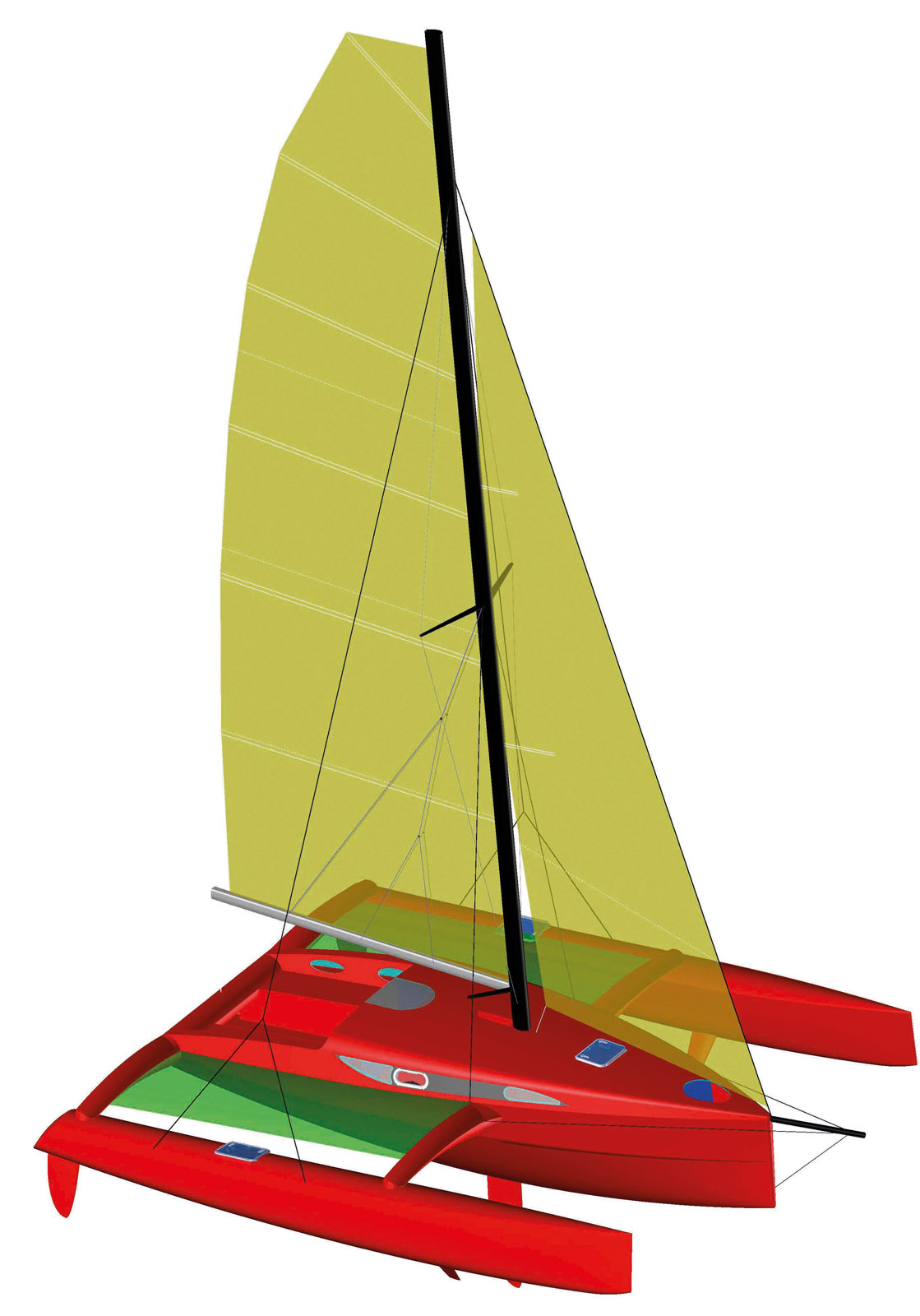
The first part of the process is unfolding the arms. Yes, we are looking at the first Libertist with variable width - from 19’6” down to 8’4” (5.95 m to 2.55 m). The 853 featured fixed arms, making this an exception in this size, and Erik Lerouge had to be talked into giving up on his principles here for the 703. Once convinced, the architect insisted on designing the entire engineering himself: a solution as original as it is appealing was born. Two conical axes allow the floats to rotate backwards in folded mode, and their geometry means there’s no cables to pull, which means one less hydrodynamic brake. This horizontal folding mode allows the antifouling to be effective even when the boat is folded, contrary to systems that involve folding by raising the arms and tilting the floats. The disadvantage though is that it greatly increases the overall length of the multihull when the floats are folded back against the central hull, protruding aft.
 |
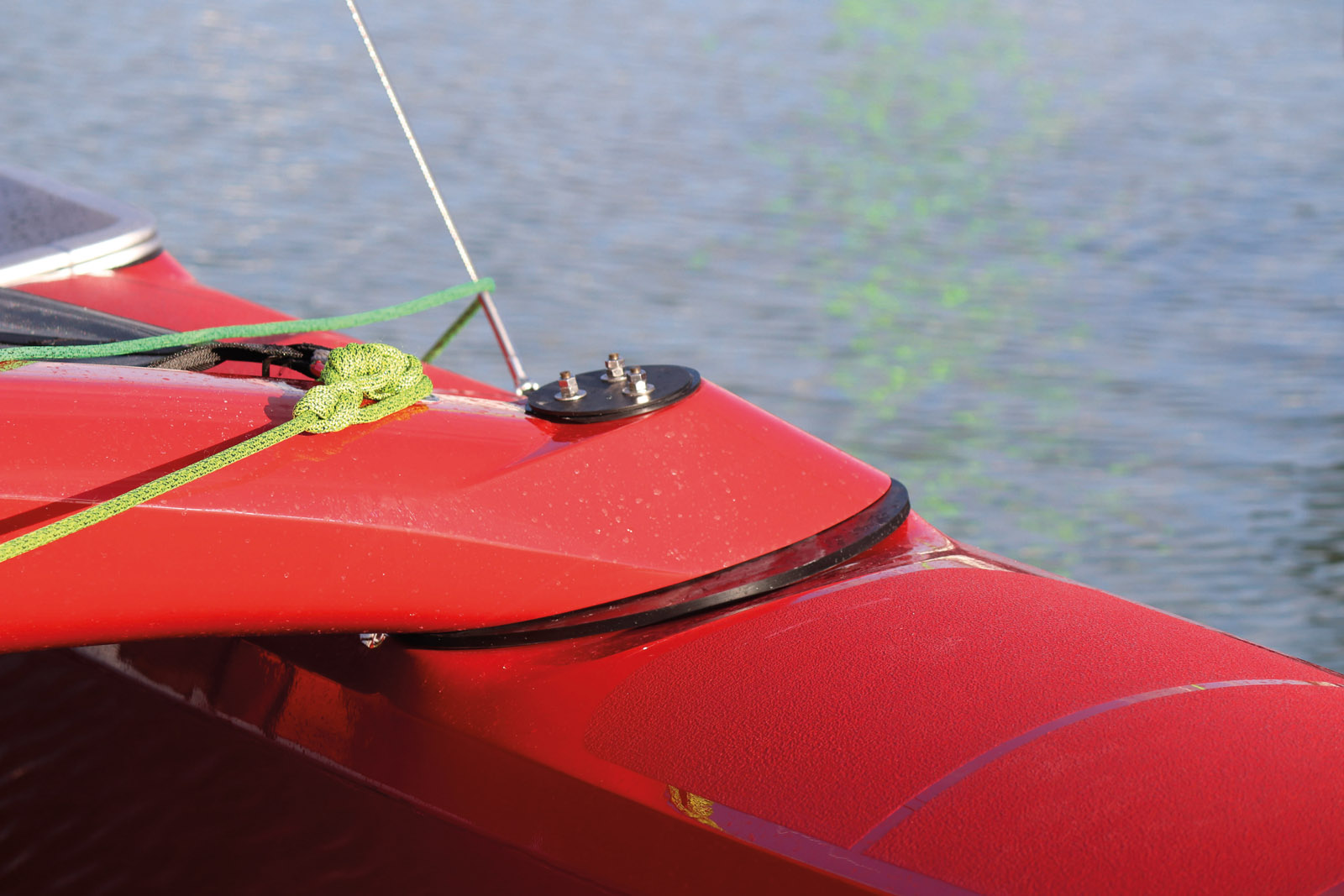 |
The folding system designed by Erik Lerouge proves to be efficient - the floats maintain the same trim, but the overall length of the folded trimaran is not far off 30 feet (9 meters).
Foils and carbon
For clearing the port, the 5 HP outboard has no difficulty in moving our test boat, which is not quite finished, and therefore probably below the 2,200 lbs (1,000 kg) lightship displacement the yard claims. In the absence of waves, there are no propulsion concerns. The adjustable height of the outboard allows you to adapt to the sea conditions. Here, it is high enough for throttle to be operated from the cockpit. This beautiful space is also home to all sail maneuvers, including the halyards. Only the halyard cleats remain on the mast, this owner of this first unit having checked the box for the “rotating carbon spar” option. In terms of construction, the hulls are made in foam-glass-vinylester sandwich infusion. Conversely, in order to offer maximum rigidity to the frame, the arms are made of carbon. And to make sure that helming this boat is top quality, the daggerboards, rudders and foils are made of the same high-tech material. Talking of foils, these appendages are inseparable from any Libertist: positioned forward of the hinges of the front arm, their structure rests on the reinforcements of the arms. The thrust of the foil therefore acts directly on the arm.
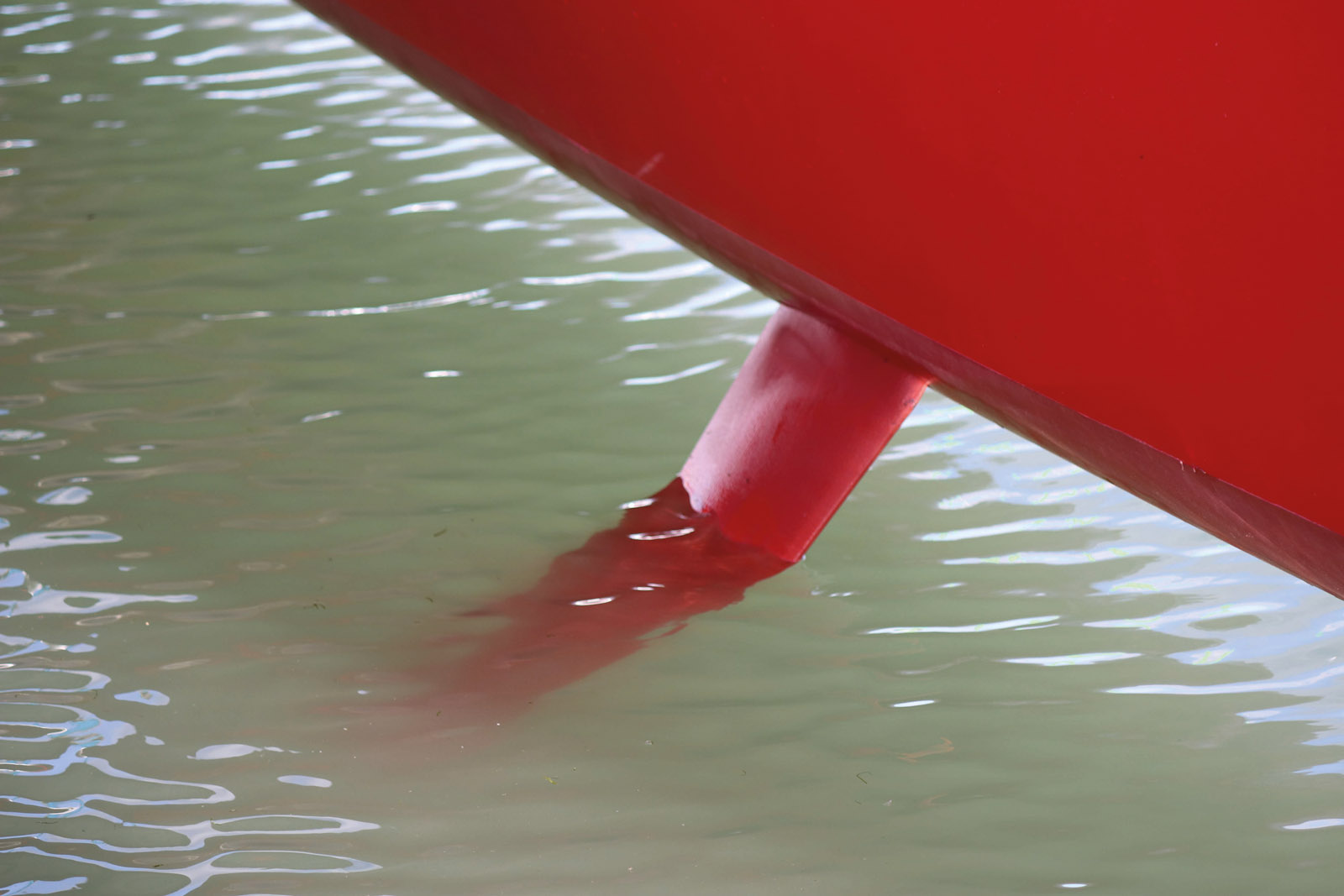
The fixed foils aren’t there to ensure flight but to bring more power and a good seakeeping behavior particularly in more muscular conditions.
0 to 22° angle between the two rudders
The steering system is made up of two carbon tubes and rests at its center on a car that runs on a track fixed to the rear of the central hull. With its two rudders, one on each float - something quite unique on the market - the trimaran proves to be slightly fiery, just enough to give a little pressure, without too much effort. When the helm is centered, the rudders are parallel. However, the angle between the two rudders can be as much as 22° if you push hard. This is called the Ackerman principle - this asymmetrical steering of the rudders compensates for the different trajectories of the floats. Separated by a distance of about 16 feet (5 meters), their rotation, especially for a significant course change, is not identical. This kinetics leads to a very pleasant fluidity when tacking, especially in the light airs we had on the day of our test. Each rudder has an angulation adapted to the rotation of its own float, as on the best ocean racing trimarans. At no time does the rudder on the inside of the turn slow down the movement.
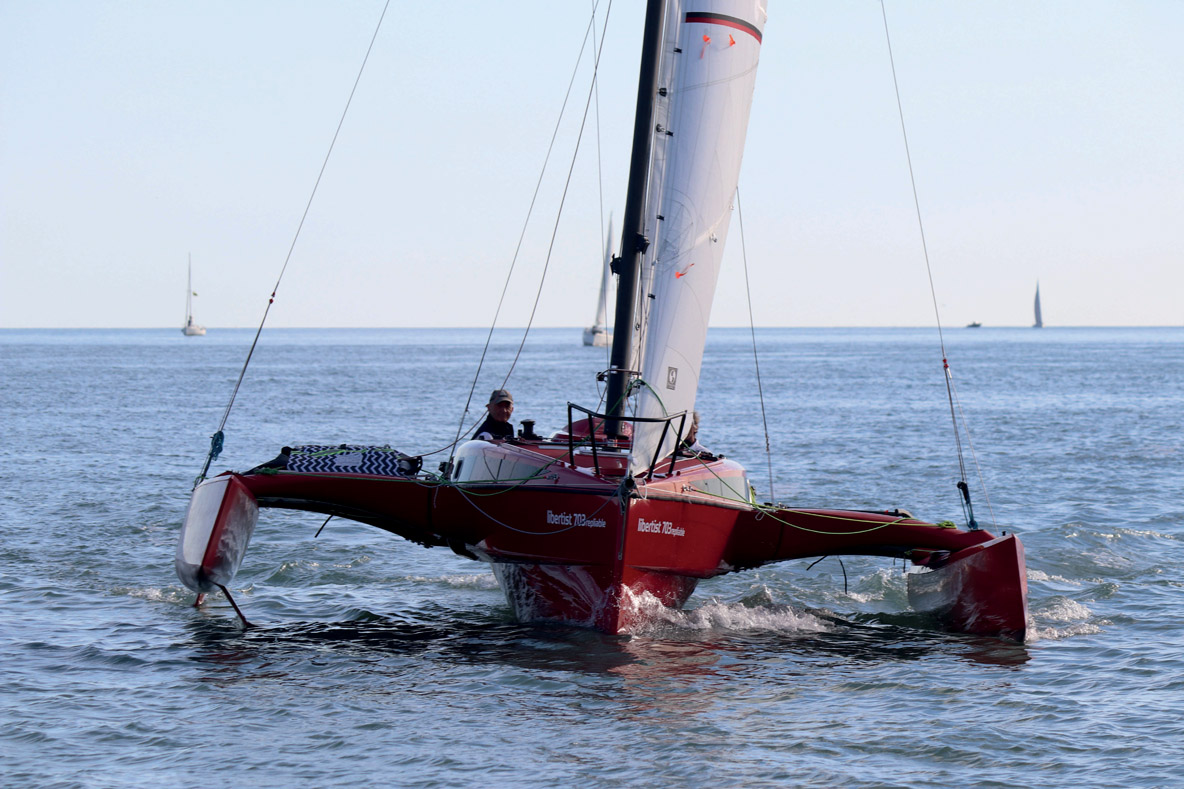
Each float is inclined 8° outboard. The central hull widens at mid-freeboard thanks to a pronounced chine.
Fine tuning
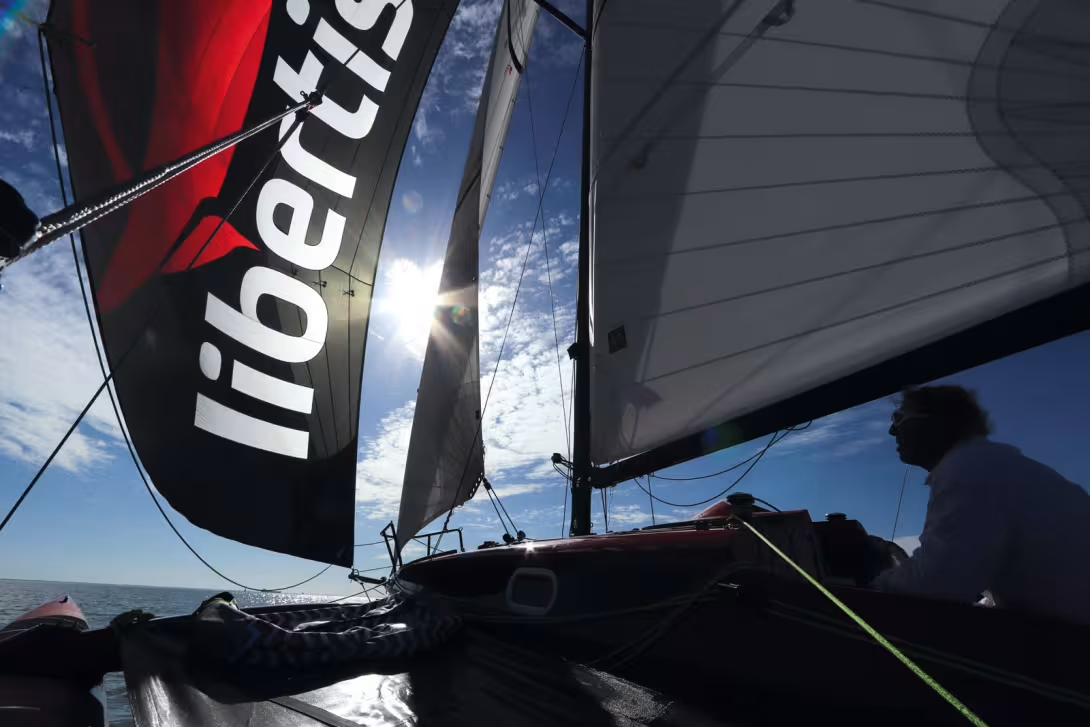
The fenders are stowed in the floats under a watertight deck hatch, the selftacking solent unfurled and the mainsail quickly hoisted. Both are triradial cut in DCX, produced by Ocean Sails, a company founded by Polish sailing champion Stanislaw Sawko. The black gennaker with the red and white Libertist logo is a true work of art, a testament to the sailmaker’s expertise. The lettering and design are not painted or glued on, but sewn into the sailcloth. The mainsail is trimmed first with a quadruple purchase, then with a fine-tuning system like on the most advanced one-design race boats. You feel comfortable and well protected in the cockpit. Downwind, you can quickly find the position to fine-tune the settings. Like the Harken winches, the Antal low-friction rings and other sail maneuvering gear are very high quality; it is a pleasure to be able to trim the sail to such a fine degree.
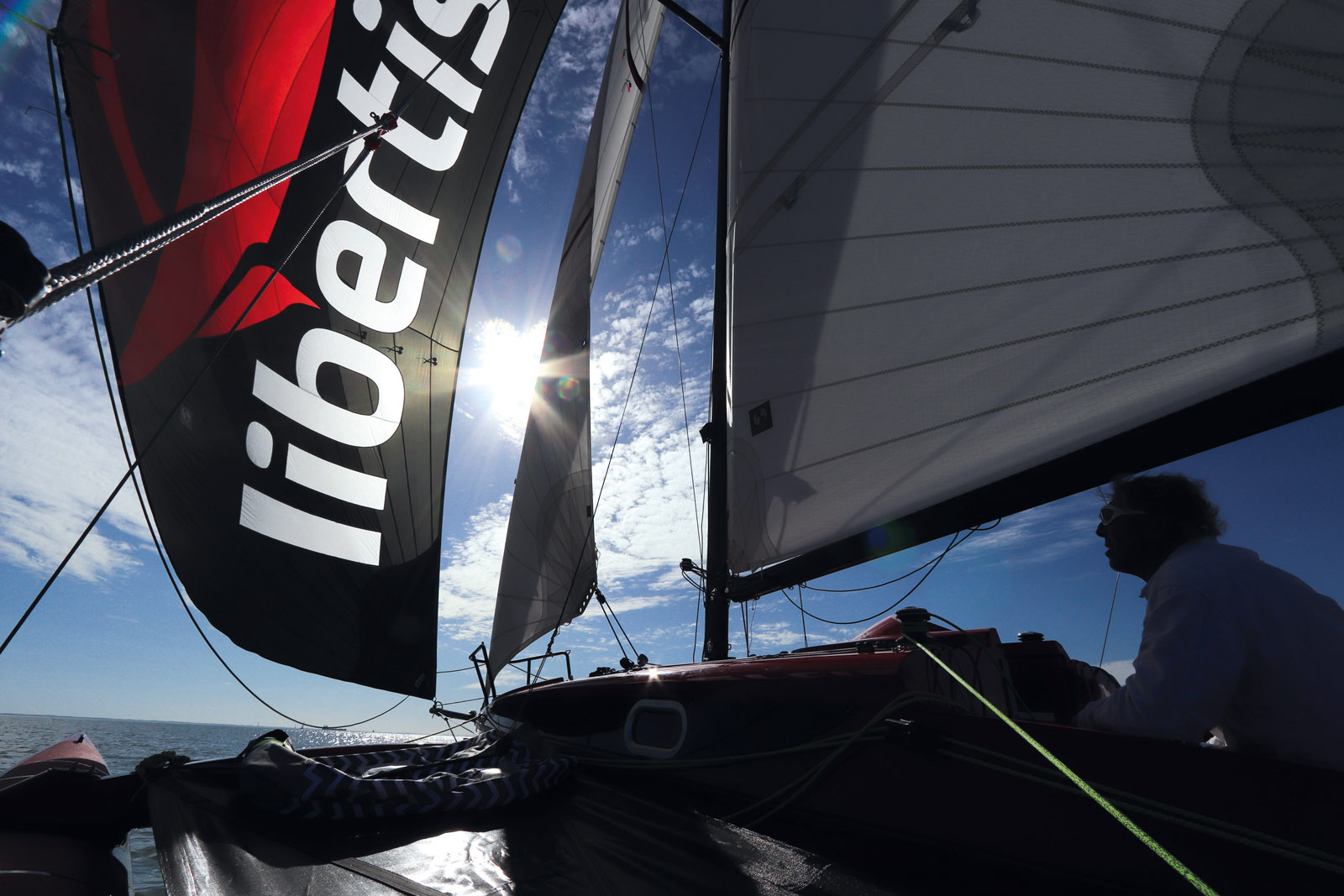
The lettering is sewn into the gennaker - a very different job than with adhesives!
When helming is a pleasure…
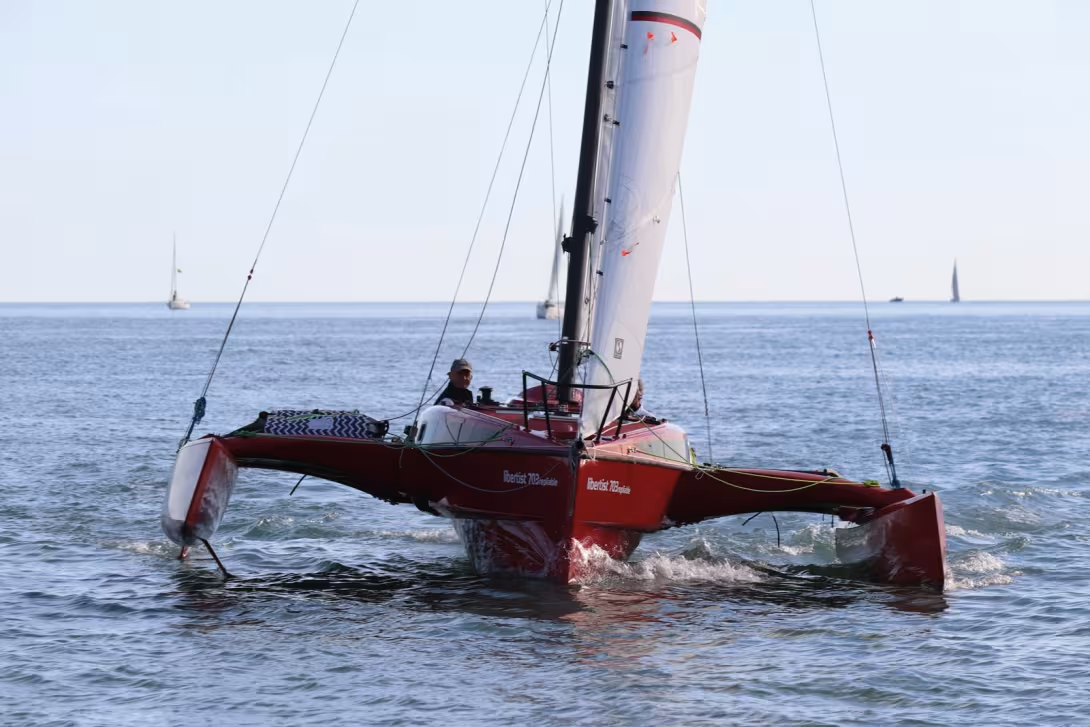
You steer sitting on the windward float, leaning against the cap shroud. With the pronounced dihedral of the arms, we quickly found ourselves quite high up, and so hardly exposed to the spray. In the conditions on the day, whether we were cross someone’s wake or encountered a little chop, the boat took no water at all. We’d need to try out some more muscular weather to confirm this first impression, however. With her slightly inclined hulls (8°), the Libertist 703 has the look, or rather the elegance, of a nice offshore racing trimaran. Of course, you could imagine a small, slightly raised seat as an option or a custom item, allowing you to lean back with the perfect angle to enjoy hours at the helm. But even if the tiller is a little long to position yourself well in relation to the shroud in the current configuration, it’s still pretty hard to give up the very beautiful carbon handle without a touch of regret. Helming this little rocket is a real pleasure, increased tenfold by the beautiful view you get of the sails. Sat well off-center at 10 feet (3 m) from the boom, your vision of the sail plan is just perfect.
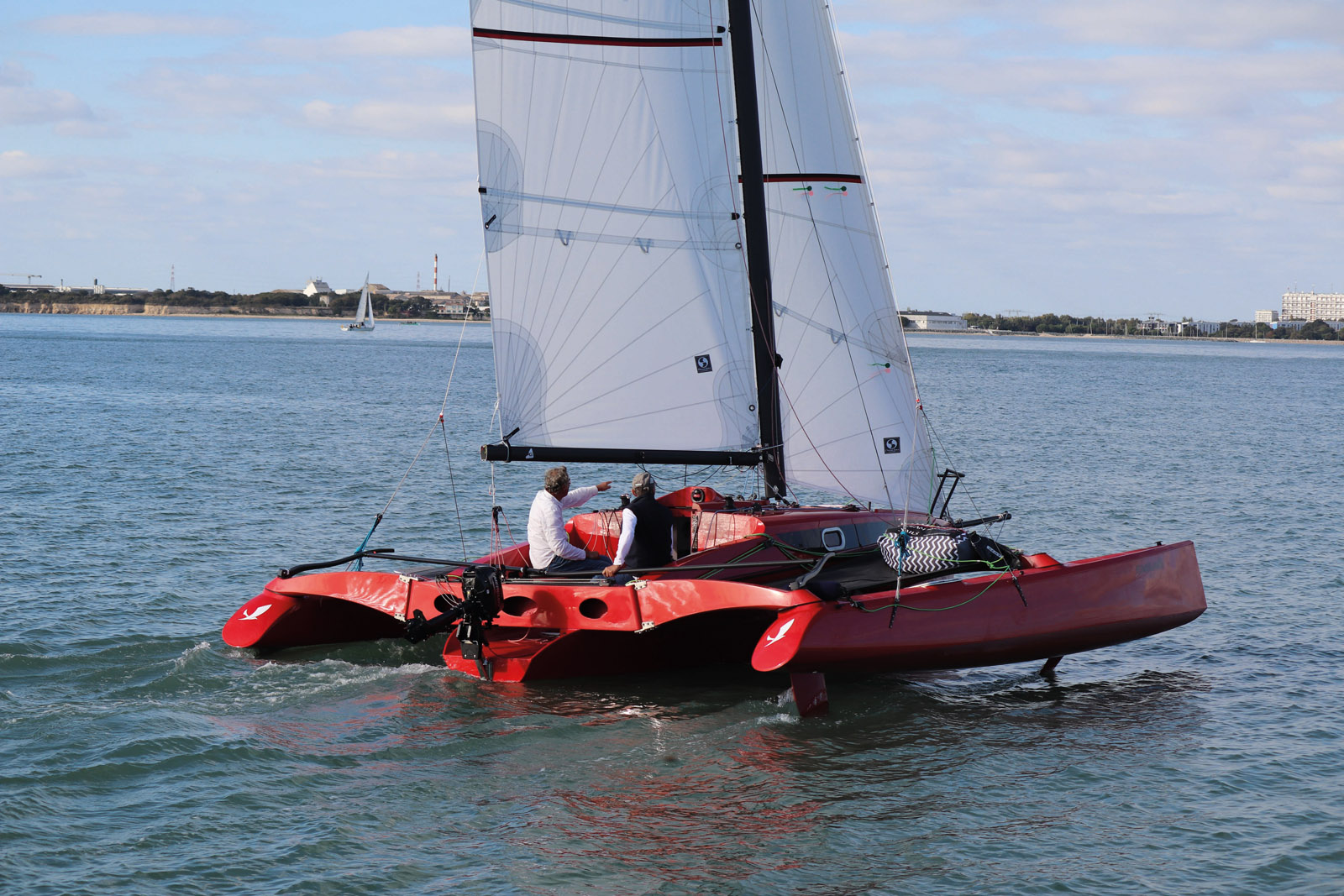
The aft beam makes the cockpit safe but complicates access to the sugarscoop and outboard motor.
Sailing at windspeed
With less than five knots true wind, the many monohulls out on the water on the day of our test seemed to have stopped. We passed them one after another, sailing as we were at 4.5 knots, as fast as the Libertist 853 in fact. In these conditions, sailing at wind speed is – I’ve got to say - quite exhilarating. The trimaran creates her own apparent wind very quickly and we could clearly appreciate the benefit of the foils, the leeward one playing its role perfectly. Not only does the voluminous float (130%) not dip down into the water, but the bow is even slightly clear of the surface. At first glance, the absence of the daggerboard doesn’t seem to have any impact on the speed, the foils seem to be sufficient in light airs. But once observed at a distance from our photo boat, the 703 was displaying flagrant leeway - upwind course-keeping is logically affected. However, we could tack without any problem. When the daggerboard is in place, it will be the same even when the appendage is fully raised as the passage for the boom will remain free. What we were testing on the day corresponded to tacking close to the beach, with the daggerboard up... To accelerate further, the magnificent asymmetric spinnaker was hoisted over the carbon bowsprit - we exceeded 6 knots in a last breath of air. Soon, guardwires will be fitted to make the foredeck safer and the trampolines fixed to the central hull for better tension - this will be the time to test the Libertist 703 in more muscular conditions. We’re waiting for the call...
Conclusion
This trimaran is a real success in terms of design and efficiency on the water - thanks to the talent of Erik Lerouge. The rotation system of the arms that he’s invented, while he was so reluctant at the beginning of the project, is very attractive. The mechanism should very soon be equipping the Libertist 853 as well. It remains for the shipyard to prove that production can keep up the pace and that the finish of its trimarans keeps up with market standards.
The Pluses:
+ Performance
+ Look
+ Folding system
The Minuses:
- You can feel the helm car bearings
- Quality of finish to be validated
- Helm position to be refined
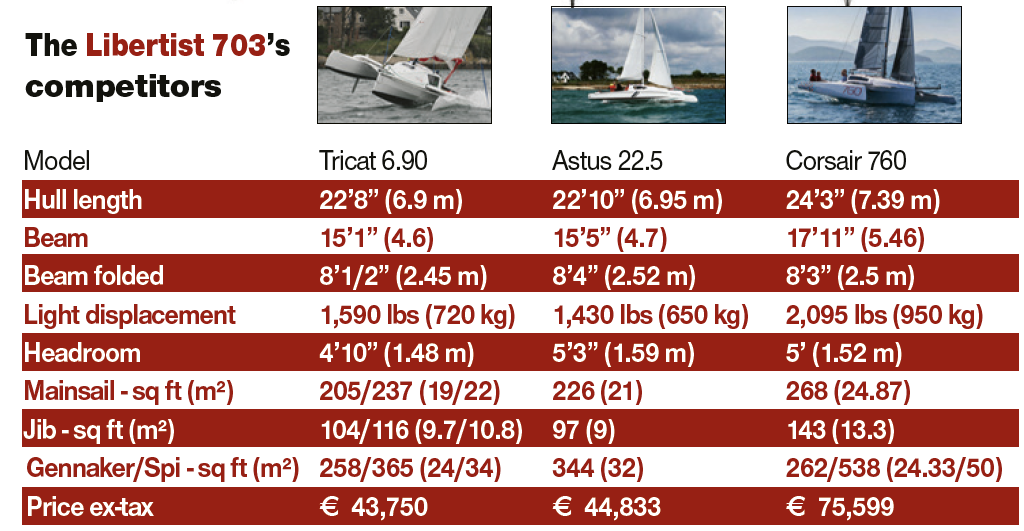
Technical Specifications:
Builder: Rega Yacht
Architect: Erik Lerouge
Material: Foam-glass-vinylester sandwich infusion, carbon arms
Hull length: 23’ (6.99 m)
Length of floats: 22’6” (6.85 m)
Beam: 19’6”/8’4” (5.95/2.55m)
Draft: 15”/5’3” (0.38/1.61m)
Light displacement: 2,200 lbs (1 t)
Laden displacement: 3,085 lbs (1.4 t)
Mast length: 36’9” (11.20 m)
Mainsail: 290 sq ft (27 m²)
Self-tacking jib: 130 sq ft (12 m²)
Code 0: 270 sq ft (25 m²)
Asymmetrical spi: 560 sq ft (52 m²)
Standard price: € 69,000 ex-tax
Price of boat we tested: € 99,000 ex-tax, including trailer, carbon mast, DCX sails...
Options: pricelist still to be calculated