
It might seem that there’s no longer a market for fixed-arm trimarans... but Neel has demonstrated the opposite with large cruising boats. In the 7-12m (23-40’) market, the Libertist's ambition is to confirm this success. Bearing the signature of Erik Lerouge, the Polish shipyard Rega Yachts still offers this series of trimarans in a folding version. A formula that allows it to enter a small but active market, mainly occupied by Dragonfly, Corsair and Tricat. We tried the fixed-arm version of the 853, following the International Multihull Boat Show.
Infos pratiques
- Le chantier : Libertist 853
- La fiche technique
-
 Découvrez notre vidéo exclusive
- Financez votre Libertist 853
- Assuez votre Libertist 853
- Articles autour du Libertist 853
Big potential for performance
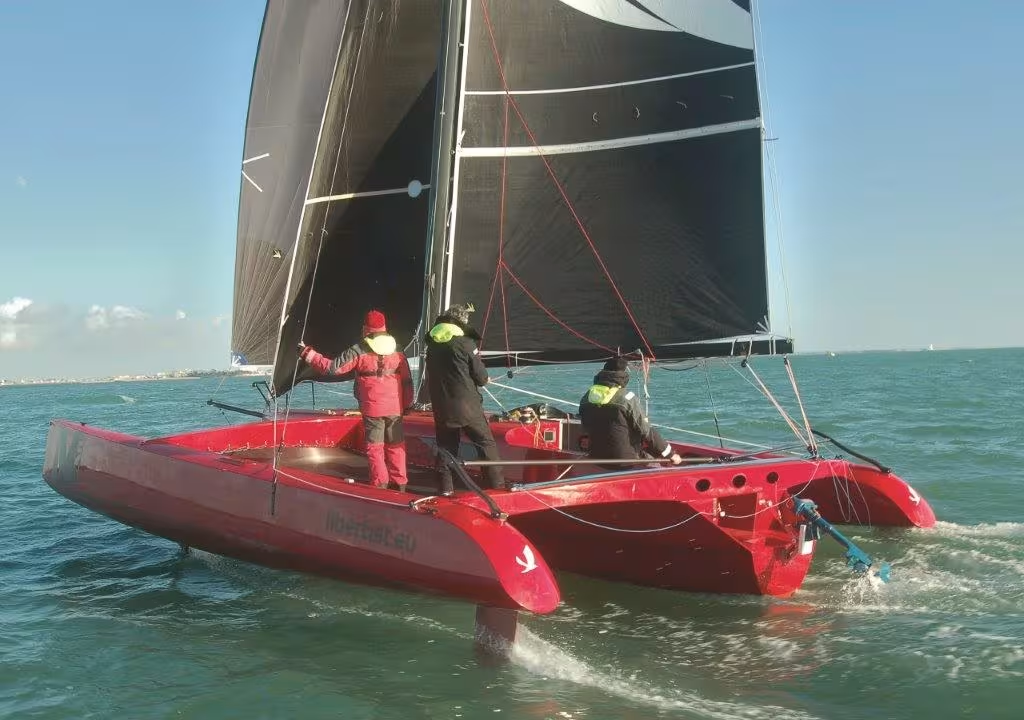
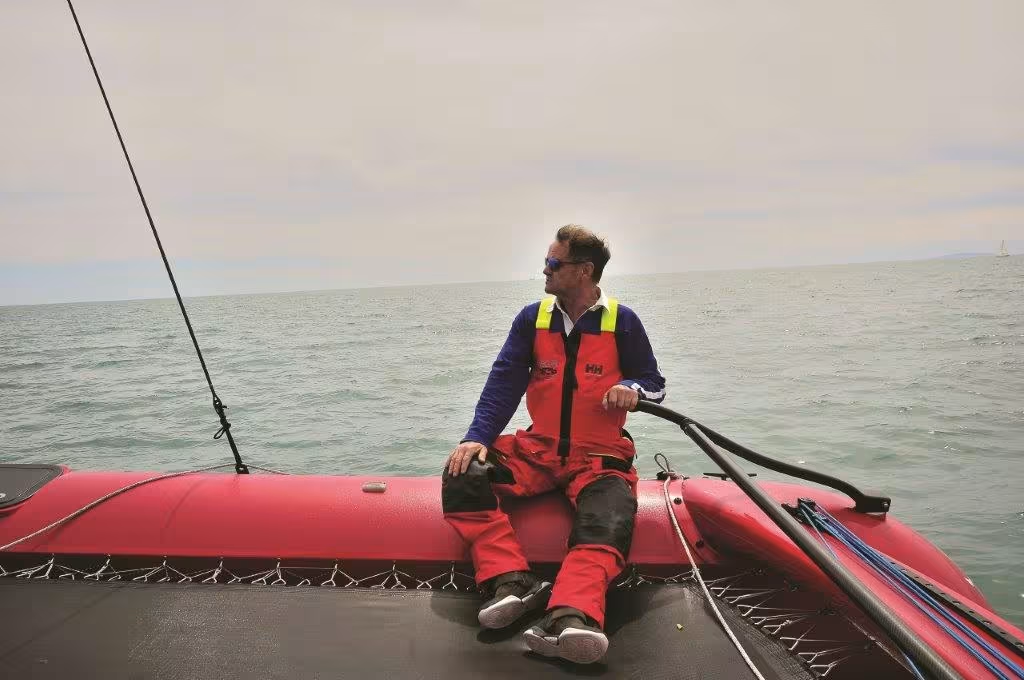
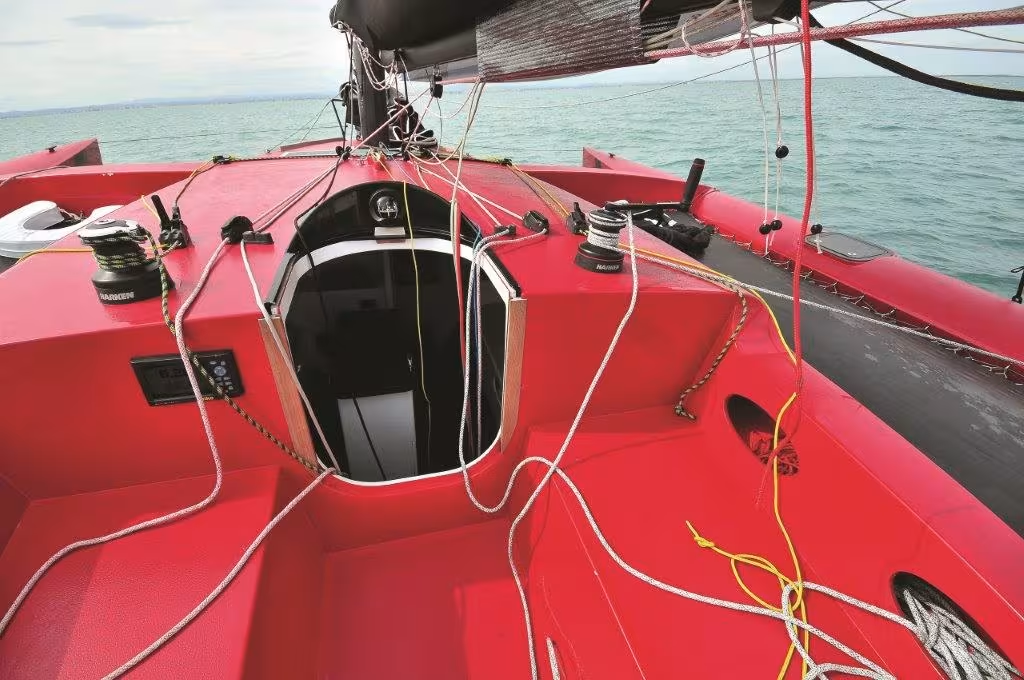
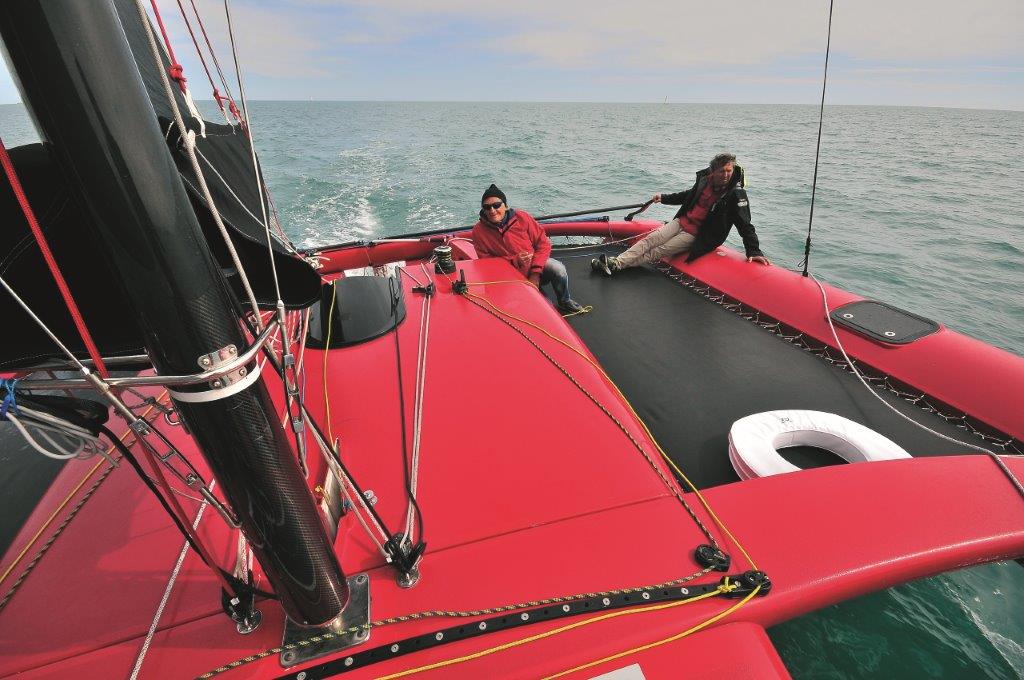
This muscled-up trimaran left no-one indifferent on the pontoons at La Grande Motte 2019: the Libertist is beautiful! The design of the arms is a success. Their harmonious shape, as well as the impeccable surface finish of the composite, contribute to the immediate seduction. The assembly principle is intelligent: the arms are embedded in a deck space and firmly bolted, as are their connections with the floats. The latter have a large volume associated with fine-entry bows. There are also two small fixed carbon foils. The central hull is a real exercise in style: the lines spin magnificently; the proportions are skillful and the bow (straight) doesn’t give in to any passing fads. The lively, tense works reflect the potential for performance, but the ergonomics of the deck, arms and trampolines are pleasant and compatible with family cruising. The cockpit is comfortable and safe.
Surprising interior volume
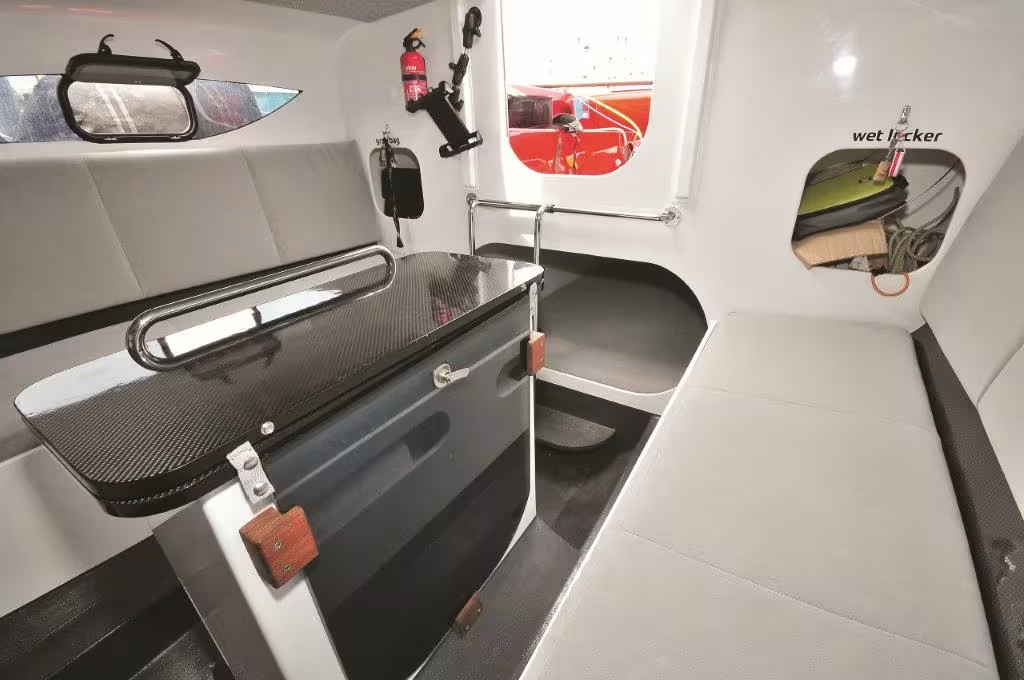
When newcomers go aboard this 28-foot-long sports trimaran, they are amazed by her remarkable interior volume. The headroom is surprising and the two long seats facing each other are really comfortable and friendly. Daylight is diffused through an elegant tinted polycarbonate panel, in which is also an opening window. The small galley is equipped with a sink, a worktop and a stove. The cut-out in the mast bulkhead preserves a maximum of material as appropriate in this area of structural stress (especially in the folding version, taking the compression of the half arms), but still provides an easy way forward. The double berth, aft, is huge. It will be suitable for a sporty couple or two children; the bed in the forecabin is a little narrower. Raised up, it will gain about ten centimeters (4”) on later models. The sliding companionway ladder is too vertical, but this is also due to be modified. The surface finish of the composite is superb everywhere, no need for headlinings, just a polyurethane lacquer.
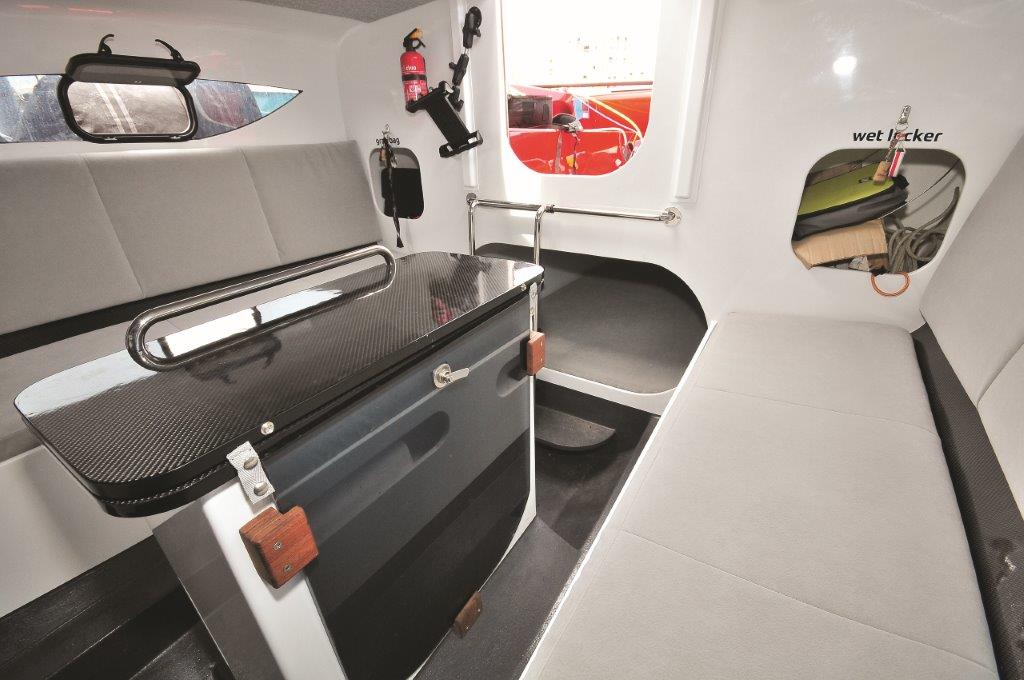
This sporty coupe hides a cozy interior with plenty of volume for 28 feet in length
Erik Lerouge has managed the feat of accommodating 1.80 m (6 feet) of headroom in this 8.50 m (28-foot) trimaran
On the water? Nothing but fun!
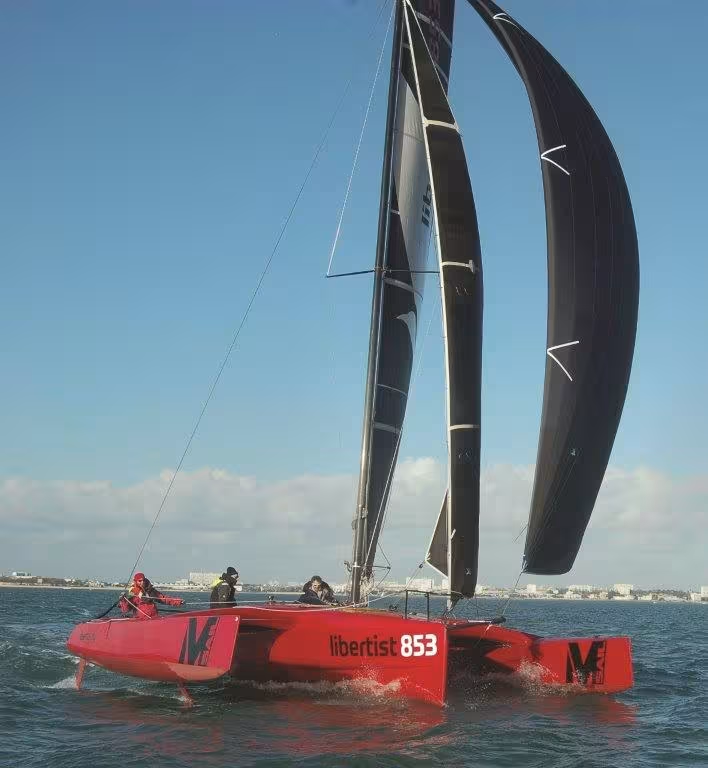
An afternoon of sailing with 8 to 9 knots of wind and rare peaks at 10 can be a curse more than a blessing... But aboard the Libertist, it's a pleasure to be enjoyed from the end of the tiller extension! From the very first strides, the small red machine moves with enthusiasm under main and self-tacking solent; the attentive helmsman will see his efforts rewarded by a speed equivalent to that of the true wind and by the pleasure of a sensitive, precise, always playful and stimulating helm feel. The contact with the chassis is direct, the directional effect of the rudders is very positive. Platform stiffness is essential to achieve this result and maintain deformation-free geometry. The All Purpose set of sails is superb (main and self-tacking solent in membrane), the asymmetrical spinnaker tacked down to a long carbon bowsprit is very versatile, well supported; it allows a good angle downwind (a slightly longer luff is possible). These sails are very propulsive but easy to trim. The next day, the breeze was awaiting us. To be complete, a test must include this experience, especially with an innovative trimaran of relatively small size. There were six of us on board, which is a little too many for an optimal result, but interesting for gaining knowledge of the boat. We came out very generously canvassed (mainsail and solent) with 20-25 knots of NW’ly wind increasing rapidly. Along the coast in full swing, the cavalcade began, 12, 14, 16 knots in an irregular wind interspersed with gusts and lighter airs. Helming is a lot of fun and the machine is very responsive. Reefing is essential with the arrival of gusts of more than 30 knots. The vertical thrust effect of the foils becomes noticeable and actually stabilizes the boat's trim. The positioning of the crew also contributes to the search for the right balance. After a tack change, I bear away to pick the pace up a bit, and the machine starts surfing between 18 and 20 knots, overtaking the waves, diving in them... but the combined effect of the floats/central hull volumes and the foil thrust ensures our rough off-piste descent is quite safe. The sea forms very quickly and becomes confused, we are a little too over-canvassed, but on a seatrial basis, this is allowed! As we close the coast, we find comfort and a calm glide between 15 and 16 knots. The wake looks superb and the helming pleasure is intense. The AG+ Spars carbon rotating mast with its original mast spanner system under the boom is perfect, the helm transmission by rigid carbon rods and intermediate car is remarkable for its precision, the wide traveler (adjustable from the helm station on the floats) is well sized and pleasant to use. Unfortunately, we have to put an end to this formidable cavalcade under gusts of over 40 knots. Congratulations Libertist!
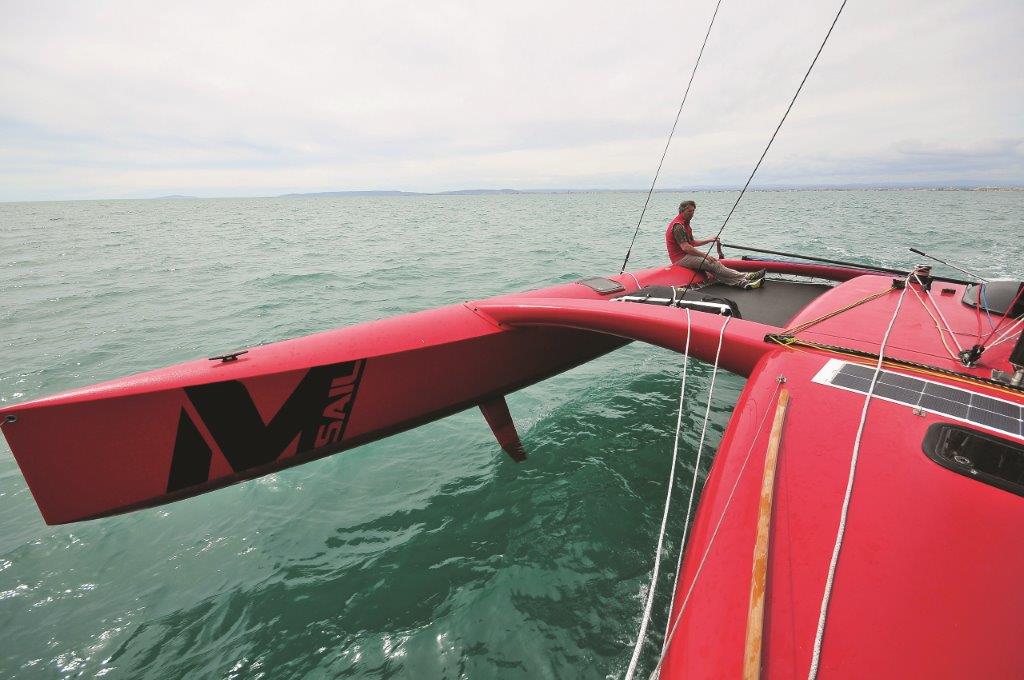
The ergonomics of the deck enhance the cruising aspect - note the fixed foil on the float.
They stabilize the trim: they provide a welcome boost in power and reinforce the safety of this exciting trimaran
Conclusion
This pretty little multihull is full of charm: she pushes the limits of habitability of a modern trimaran at only 8.50m (28’) while displaying rare performances. The quality of manufacture and design makes it very safe to use and it gives maximum pleasure per dollar spent. Intensive use is recommended, even for family cruising
LIBERTIST 853 in 9 key points

1- The rotating carbon mast is equipped with an intelligent mast-spanner triangulation system at the gooseneck
2- The generous bowsprit makes it possible to enjoy using lightweight and playful sails in light and medium airs
3- The deck layout has remained simple and efficient, the companionway will have to be revisited for better protection
4- Very large floats have ultra-fineentry bows
5- There is no central rudder, the appendages are located on the floats
6- The small supporting foils are fixed and self-adjusting. Their stabilizing effect is real
7- In this version, the carbon forward arm is removable and is housed in a central hull reservation, just like the after arm
8- The deck area of the 853 is remarkable and reinforces the fact that this is a cruising boat
9- The vertical thrust of the foil reduces the pitch and makes the float safe at high speed
A word from the architect - ERIK LEROUGE
I had carte blanche for the Libertist 853 to improve that eternal compromise between comfort and nautical qualities to which I am so attached. The 28-foot size was chosen to accommodate a nice saloon, a forward cabin, a double berth under the cockpit, a galley, a separate toilet and 1.80 m (6’) headroom, yet remaining transportable when dismantled. The idea of extra mini-foils had been in my head for a long time. The effectiveness of the foils is making progress, but they still had to be sorted out. A fixed solution was required: no risk of dangerous misalignment, manufacturing costs compatible with the selling price and total reliability. It is not about flying, but simply increasing power and safety at high speed by controlling the float's pitch. With a marked dihedral, we also needed to have a rudder under each float for optimum control. The fully infused construction has been well mastered by Rega Yacht, as has keeping the weight under control. Carbon is used where it is really beneficial: arms and appendages. The exploitation of power requires a quality rig and deck hardware, the rotating carbon mast gives a perfect leading edge to a top-of-the-range square-topped mainsail, the weight saving is completed by the use of fiber shrouds. The design is timeless. The tests validated our expectations for the downwind attitude control with the bonus of a reduction in pitch in choppy conditions.
The Pluses
+ Aesthetics
+ Build quality
+ Helming pleasure
+ Amazing living space
The Minuses
- No companionway shelter
- No ergonomic seats for the helmsman
- Trampolines secured using padeyes and not on laminated joins
- Random and undersized electric motor
Technical description
Naval Architect: Erik Lerouge
Builder: Rega Yacht (Poland)
Construction: Epoxy glass/foam sandwich (infusion), carbon arms
Length: 8.53m (28’)
Beam: 7.10m (23’4”)
Draught: 0.45/1.95m (18” / 6’5”)
Empty weight: 1,400kg (3,100lbs)
Height and surface of the rotating mast: 13.60m/4m² (44’8”/43sq ft)
Mainsail area: 40m²/131sq ft
Self-tacking jib: 19m²/62sq ft
Asymmetrical spinnaker: 78m²/255sq ft
Price of the basic version (isophthalic polyester resin, without fittings, aluminum mast): € 75,333 ex-tax
Price of the elegant design version / carbon performance finish / epoxy-carbon construction: € 150,000 ex-tax
