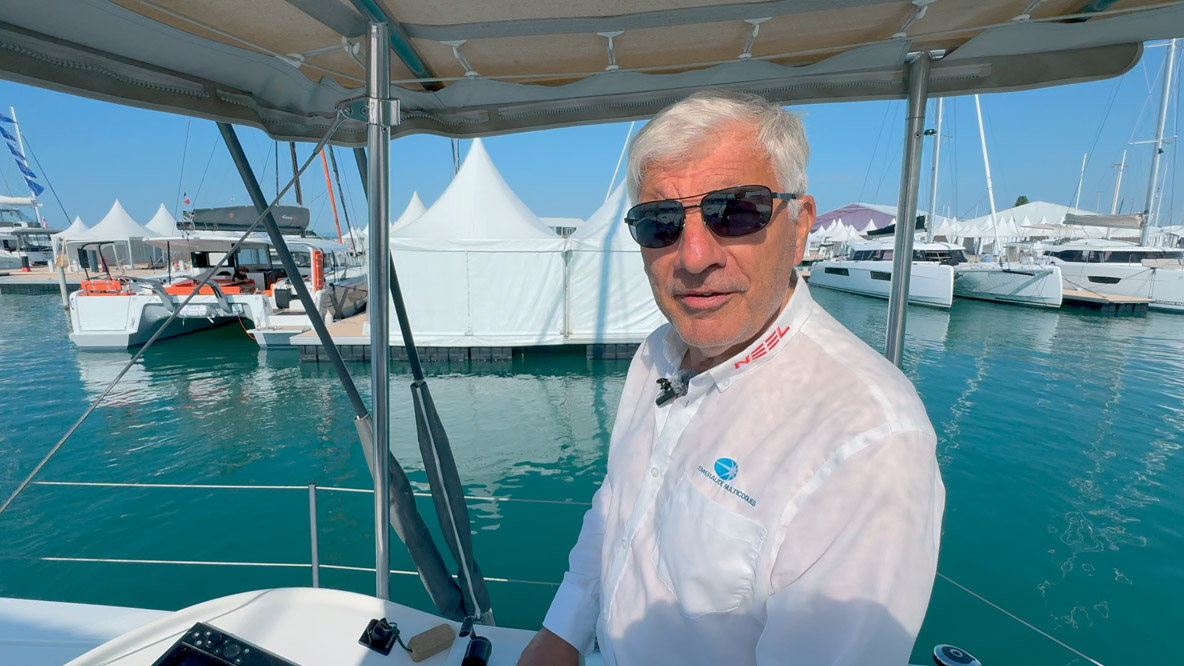
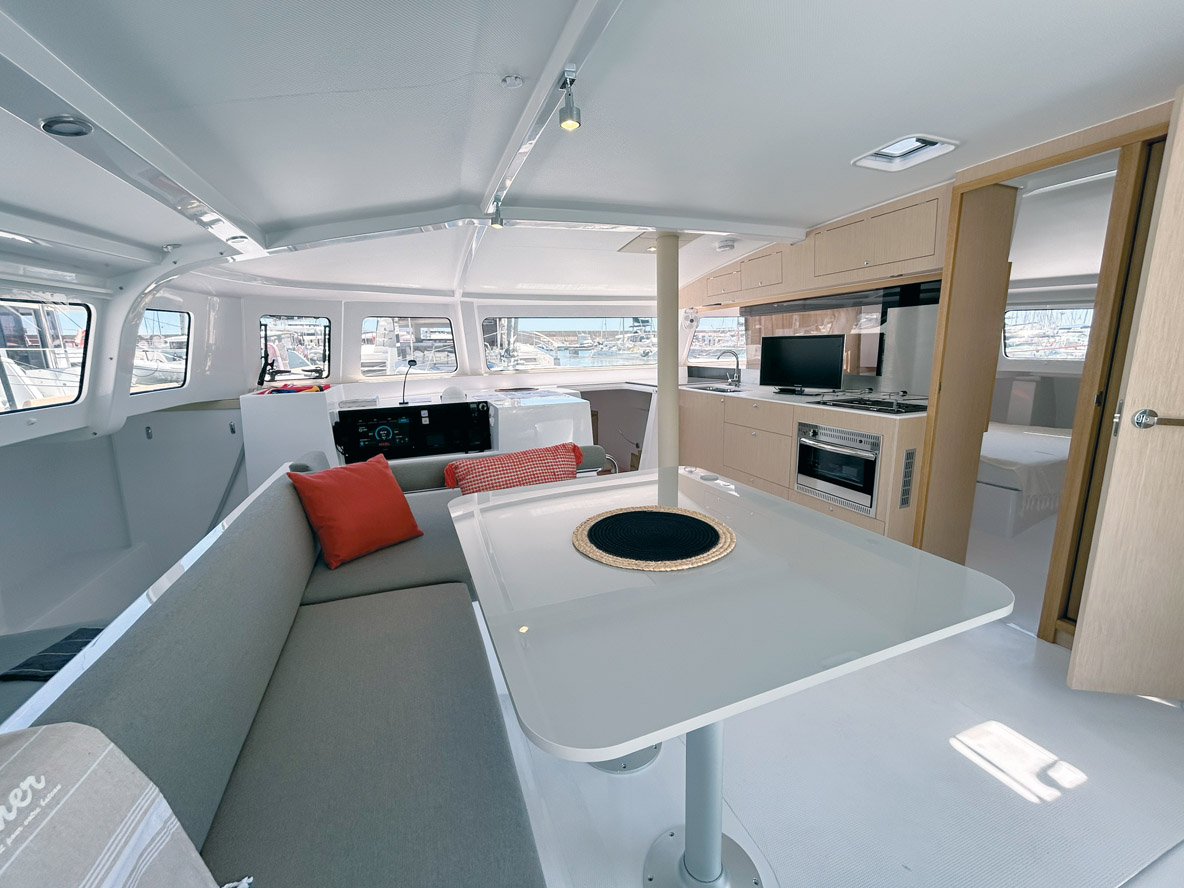
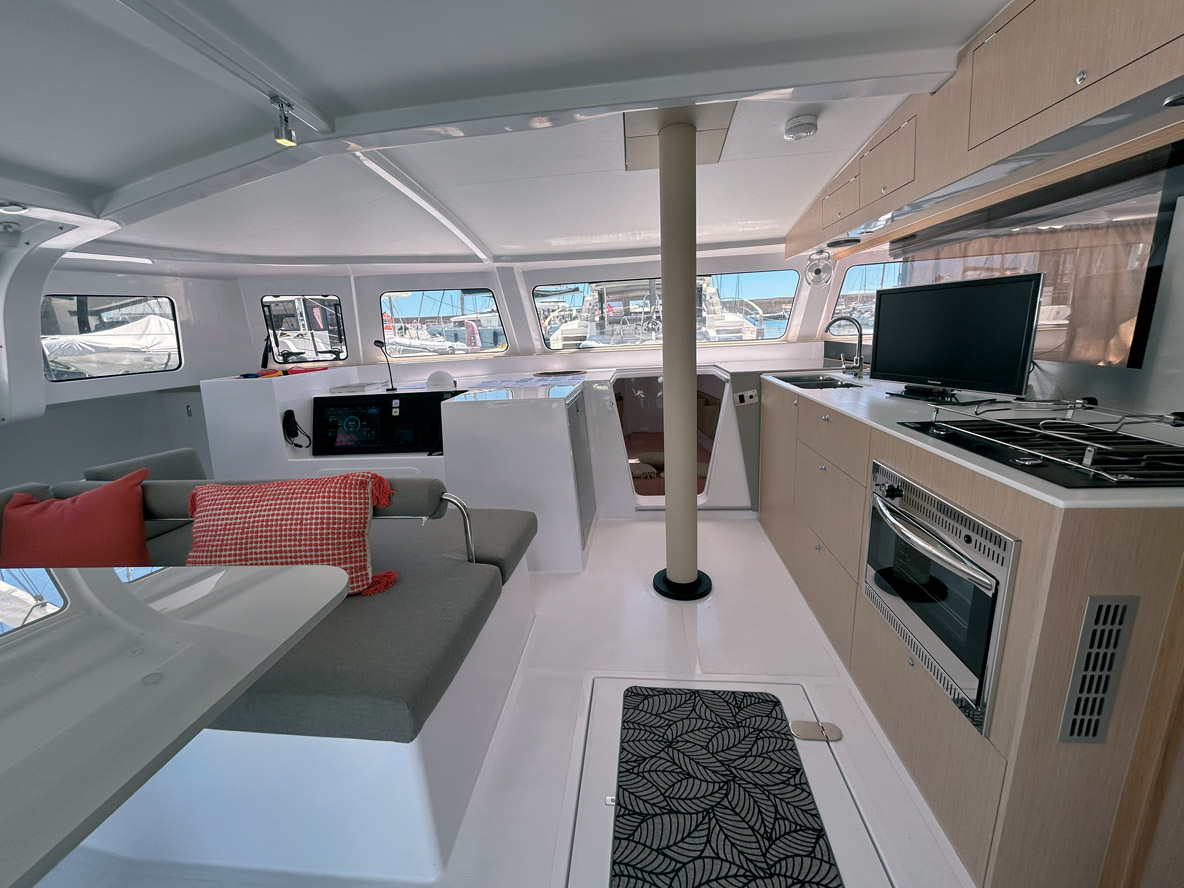
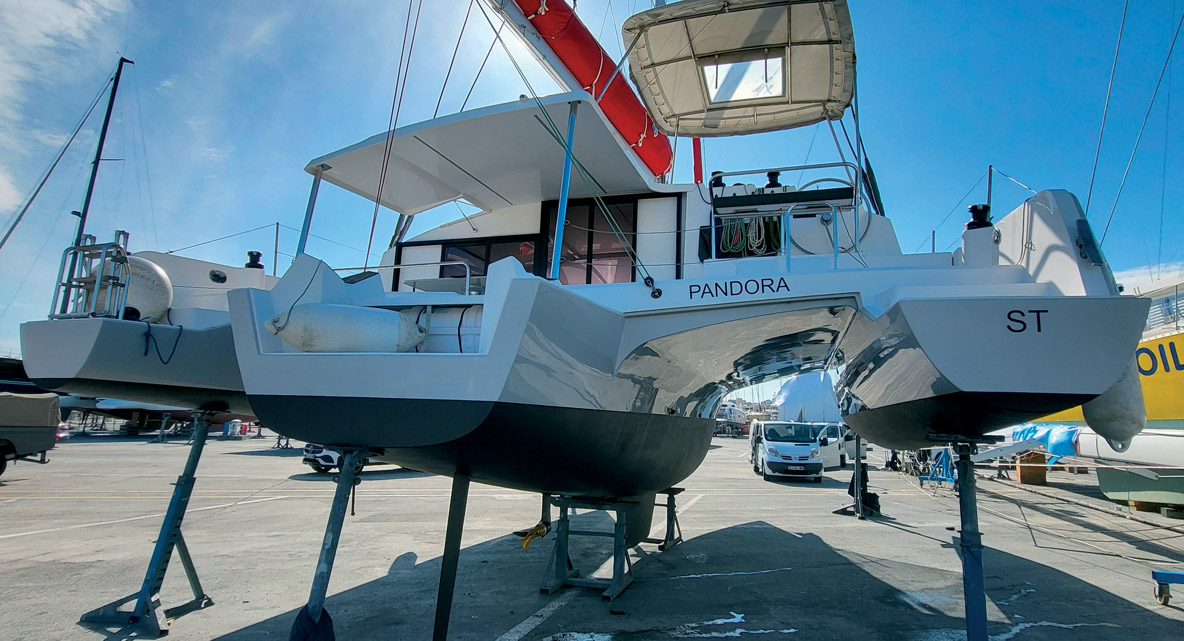
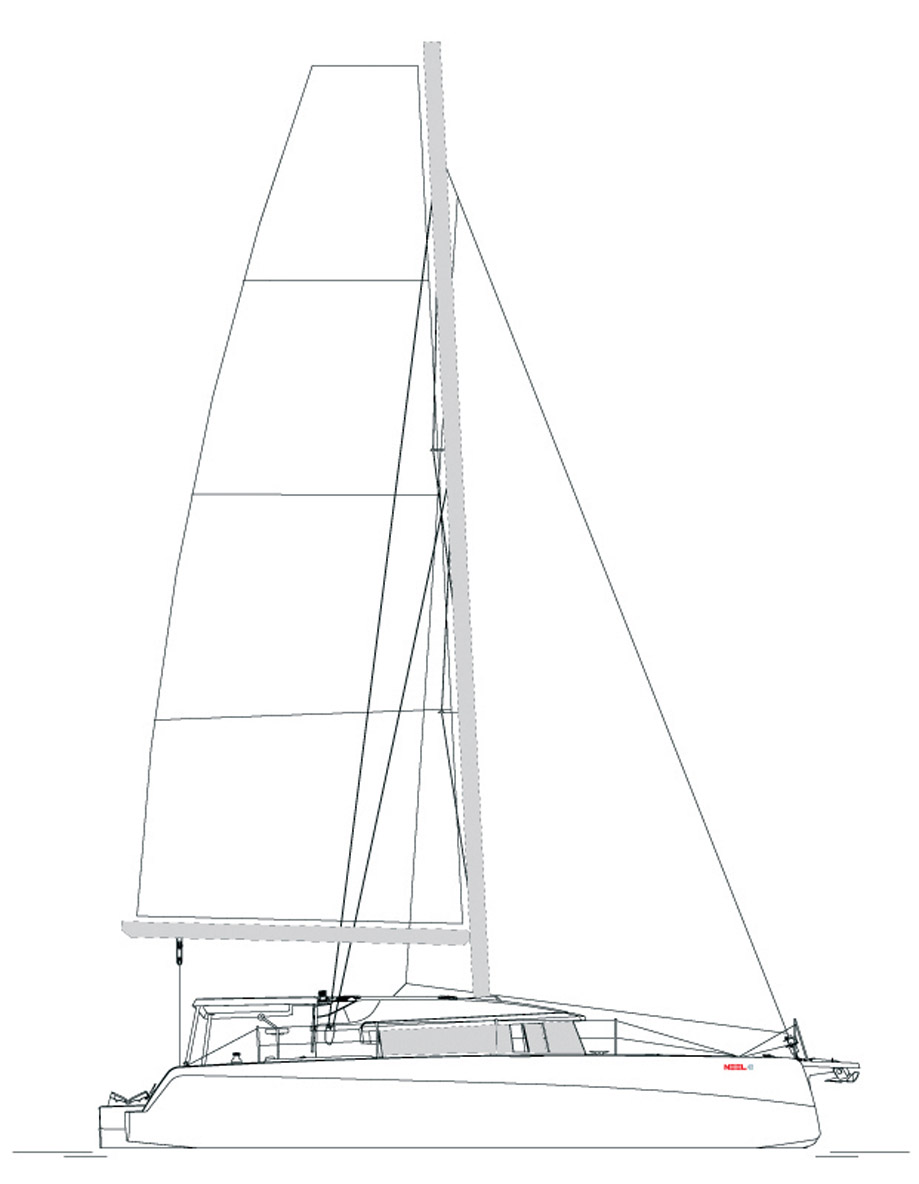
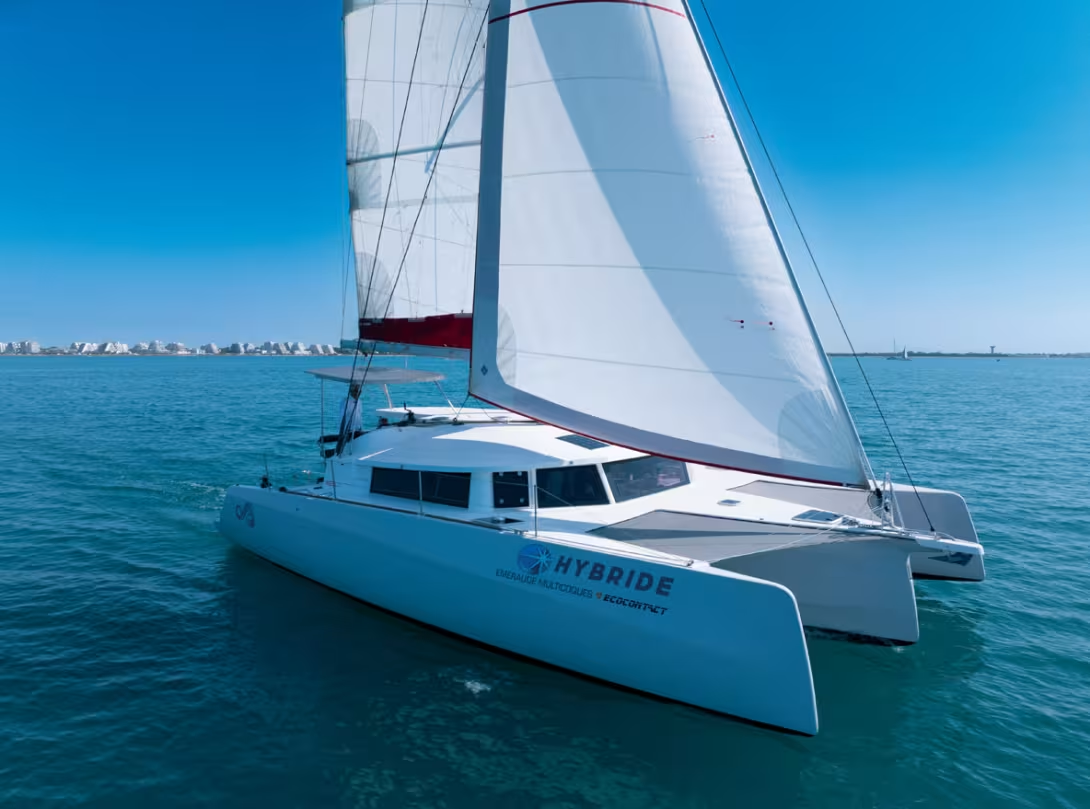
Presented at this year’s International Multihull Show in La Grande-Motte, this Neel 43 Hybrid is not an official version from the La Rochelle-based shipyard, but the result of an ambitious refit carried out by Emeraude Multicoques, a company specializing in the integration of technical solutions aboard multihulls of all brands. Based in Canet-en-Roussillon, Port Leucate, and at La Grande-Motte, Emeraude Multicoques offers tailor-made systems focused on energy efficiency, sailing comfort, and reducing the boat’s environmental footprint.
Infos pratiques
- Le chantier : Neel 43
- La fiche technique
- Découvrez notre vidéo exclusive
- Financez votre Neel 43 Hybrid
- Assuez votre Neel 43 Hybrid
- Articles autour du Neel 43 Hybrid
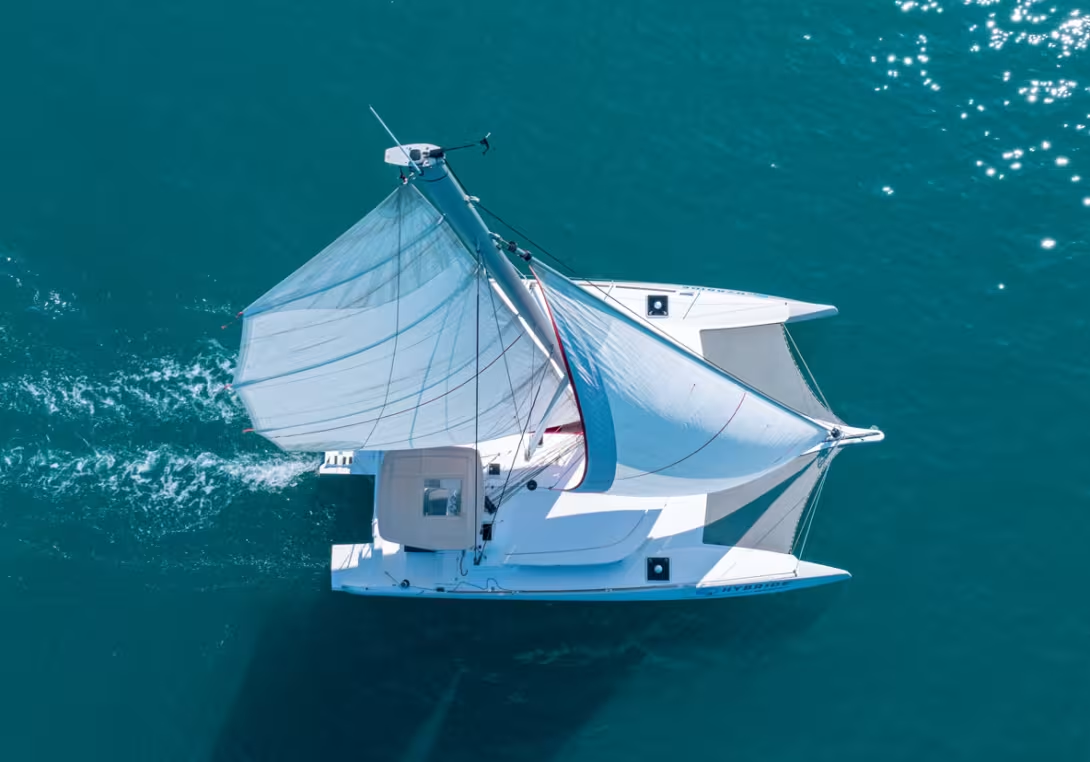
Conditions: Calm sea, slight easterly swell, 6 knots of wind
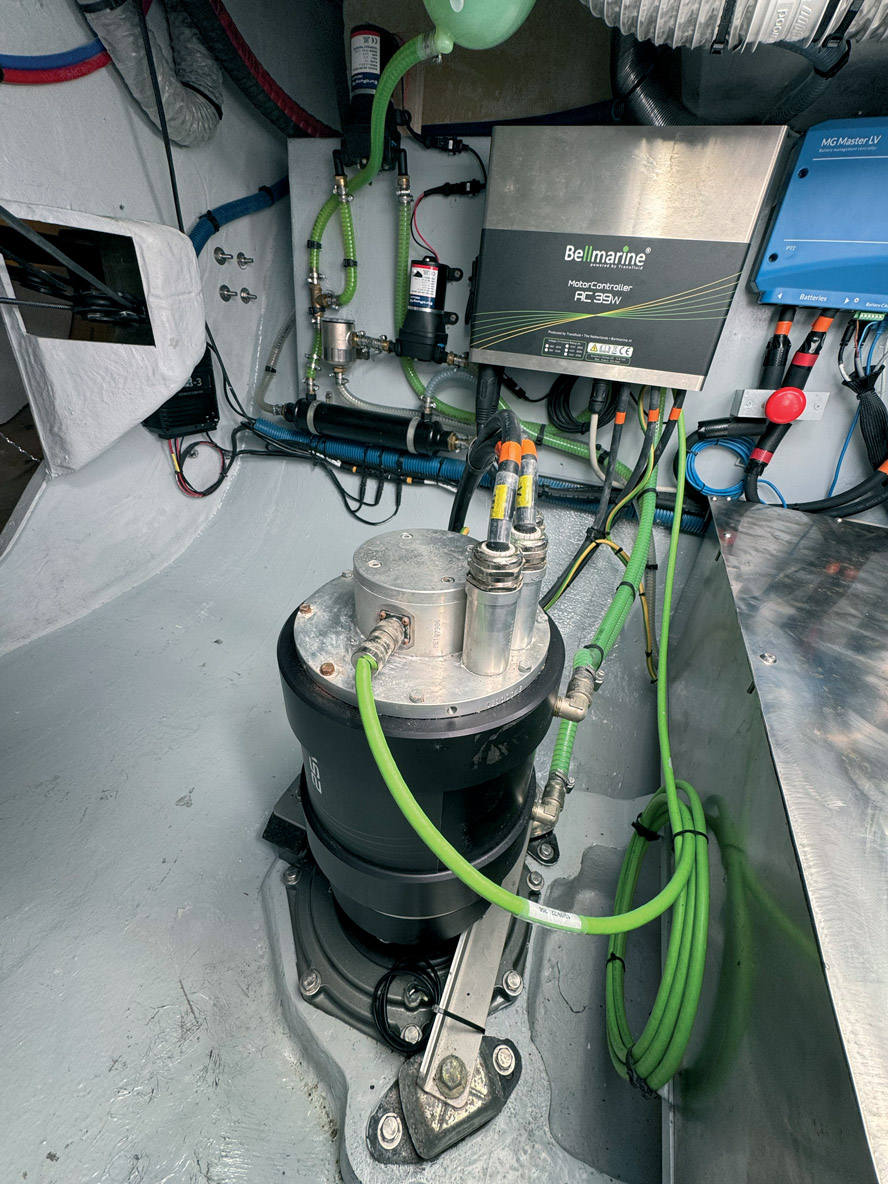
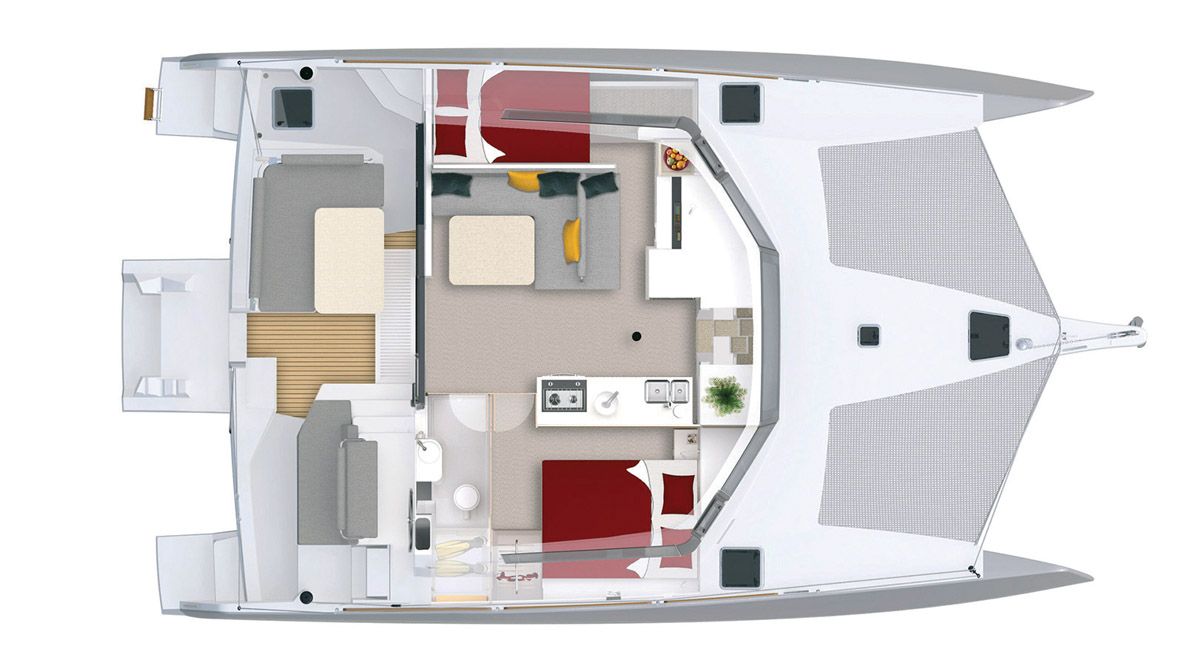
The Neel 43, with its voluminous central hull, lends itself perfectly to the integration of a complete electric propulsion system. “The advantage of a trimaran,” explains Jean-Noël Roux, director of Emeraude Multicoques, “Is that we can house all the technical equipment, including the motor, batteries, generator and interfaces, in the central hull, keeping the center of gravity low and without compromising the multihull’s seakeeping qualities.”
In this configuration, the internal combustion engine has been replaced by a 25-kW electric motor powered by 25 kWh of 96 V lithium batteries. The system guarantees smooth, quiet propulsion, sufficient for maneuvering in harbor and for coastal navigation at moderate speeds (around 5 to 6 knots). If necessary, the generator can be started to ensure safety when on longer passages or during extended stopovers.
5½ to 6 Knots at Half Power
On April 29, just after the International Multihull Show closed its doors, we were able to sail this boat in very calm conditions, with less than 8 knots of wind and a slight residual swell from the east. When running, the motor turns silently, without vibration and, above all, without exhaust fumes. At the helm, the sensation was disconcerting for a sailor accustomed to diesel engines: immediate response, no inertia, and very precise thrust control. The Neel moved forward with surprising ease in these conditions, effortlessly reaching 5½ to 6 knots at half power.
One of the most striking features of this test was the ability to motor-sail silently: by maintaining 800 rpm, the electric motor provides slight assistance to the sails, allowing a stable speed of 4 to 5 knots to be maintained, even in light and irregular winds. This energy-efficient mode allows for 7 to 8 hours of autonomy, without noise or vibration. It allows the boat to be “held” on course, maintained by the autopilot and allowing for comfortable sailing without the noise and smell of a diesel engine.
Under sail alone, the conditions on the day weren’t ideal for a proper test, but the absence of noise meant that every gust of wind and every change in the boat’s trim could be felt. This is also an excellent teaching tool for cruising with family or friends: you listen, you feel, you can really understand what’s happening on board.
A System Validated in a Demanding Operating Environment
Before this 43, Emeraude Multicoques had already installed the same electric drivetrain on a Neel 47, which was used in charter for several months before being sold. This boat validated the performance and reliability of the system in real-world conditions, including in a demanding operating environment. Feedback has been very positive, both from users and from the fleet managers, reinforcing the relevance of this solution in the charter and blue water cruising worlds.
The same question is always asked: How many miles can you cover with 25 kWh? The answer obviously depends on the rpm and on the sea state. At 5 knots, consumption is estimated at between 5 and 6 kW, which offers a range of 4 to 5 hours in pure electric propulsion (approximately 20 to 25 nautical miles) before recharging.
But it is with the generator running that the system reveals its full potential for cruising: “With a 12-kW generator,” explains Jean-Noël, “We can run for over a hundred hours at 5 knots. The electric motor then consumes what the generator produces, without discharging the battery. This gives a range of over 500 nautical miles at a reasonable speed, perfect for long passages when there is no wind.”
The lithium battery bank can also be fully recharged from shorepower in a few hours, by using the solar panels to maintain the auxiliary systems and recharge slowly at anchor, or by hydrogeneration: the electric motor can be switched to generator mode under sail. Depending on the speed of the boat and the efficiency of the prop, this mode can produce up to 500 to 700 W, thus extending the electric range when under way.
The Electric Solution for All Sailboats
In an emergency, the trimaran is capable of making at 9 knots with the “throttle hard down” for one hour on its batteries alone.
The hybrid system did not just appear on board the Neel 43 out of the blue - Emeraude has been developing this concept for more than three years, testing different combinations of motors, batteries, recharging systems, and on-board integration. This patient work, carried out far from the spotlight, now enables the integrator to offer reliable, scalable installations that are perfectly suited to the specific constraints of blue water cruising on a multihull.
The company has developed a partnership with AMC ETEC, a company based at Saint-Raphaël, also in the South of France, that specializes in electro-intensive circuits. Their EcoContact solution is used on board. In concrete terms, this is a 1.6 mm thick multi-metal foam composed of micro-points that pierce the natural oxide layers on aluminum or copper surfaces, whether bare or tin-plated. The use of this technology significantly reduces contact resistance, limits energy loss, and prevents hot spots, thereby contributing to the reliability and overall performance of the onboard electrical system.
For Jean-Noël, “What we’re looking for at Emeraude Multicoques is not to reinvent a solution, but to make it applicable and robust for as many people as possible. We are not a manufacturer but an integrator. We work on multihulls of all brands, on refits or on new boats, to install appropriate technical solutions.”
This pragmatic approach contrasts with the sometimes overly utopian or conservative visions of the sector. By focusing on the integration of proven systems and mastering interfaces, cabling, safety features, and real autonomy, Emeraude Multicoques is paving the way for a smooth and credible transition to clean, quiet, and realistic boating.
The Smart Refit According to Emeraude Multicoques
What sets Emeraude Multicoques apart, beyond its technical solutions, is its genuine refit philosophy, designed as a targeted improvement. Unlike a shipyard that starts from scratch, Emeraude Multicoques works on existing multihulls, respecting their architecture, their use, and their owners’ budgets. Electrification is never imposed, but proposed as a means of improving comfort, reliability, and sometimes even resale value. “The electric motor is often seen as an end in itself. For us, it is just one tool among many, serving to make a boat better suited to its use, better understood, and better enjoyed,” summarizes Jean-Noël. With more than three years of development, successful installations on several models, and a perfect understanding of the constraints of the boating world, Emeraude Multicoques is now one of the most credible players in the sector of multihull electrification.
Our Opinion: A Realistic Solution That’s Within Reach
With this Neel 43 Hybrid, Emeraude Multicoques has achieved much more than just a styling exercise. It is a convincing demonstration of what sensible electrification can be on board a cruising multihull: a reliable, quiet, modular solution that is well suited to coastal sailing, whether for boats in charter or in private ownership.
Sea trials confirm the system’s qualities: responsiveness, absolute silence, managed self- sufficiency and the option to motor sail at low revs for several hours. The integration of the system into the central hull preserves the ergonomics, balance and nautical qualities of the trimaran.
For a budget of around € 50,000 (excluding the cost of the generator), Emeraude Multicoques offers an efficient and serious alternative in the electric hybridization niche. As with any emerging technology, there are still some unknowns, particularly regarding the long-term durability of the batteries and also regulatory developments, but the direction is clear.
There is no doubt that this type of solution will become widespread over the coming years, particularly aboard cruising multihulls under 50 feet, where comfort, self-sufficiency and ease of use are priorities.
The Neel 43 Hybrid is not a technological Utopia. It is a coherent, well-executed vision that is more in tune with the times than ever before. Forever Green!
Technical Specifications
Architects: Marc Lombard Yacht Design Group
Length: 42’4” (12.9 m)
Beam: 24’3” (7.4 m)
Draft: 4’11” (1.5 m)
Air draft: 62’4” (19 m)
Light displacement: 18,740 or 19,850 lbs (8.5 or 9 t)
Fully-battened mainsail: 630 sq ft (58.6 m²)
Genoa: 467 sq ft (43.40 m²)
Water: 132 US gal (500 l)
Fuel: 79 US gal (300 l)
Original engine fitted: 50 HP Volvo
Who is this Type of Configuration Suitable For?
- Owners of multihulls under 50 feet who want to sail most of the time but with quiet propulsion for entering and leaving port, navigating channels, or anchoring in windy conditions.
- Fans of “slow cruising” who are willing to reduce their motor speed in exchange for unparalleled acoustic and environmental comfort.
- Owners of charter boats who want to stand out with a sustainable, reassuring product that is perfectly compatible with coastal sailing.
- Tech enthusiasts and electric boaters who are already equipped with high-performance solar panels and are keen to optimize their onboard energy consumption.
Please note: hybrid technology is not (yet) a solution for ocean passage-making under power, but it can reinvent local boating, in silence, with precise energy control.
Bellmarine: Electric and Hybrid Propulsion at the Heart of the Ecological Transition
In 2025, Bellmarine launched a new 22-kW 48V motor that’s perfectly suited to medium-sized boats operating with lower voltages. The brand also offers high-voltage versions up to 45 kW at 300 V, designed for cruising multihulls or demanding hybrid systems.
The partnership with Emeraude Multicoques has played a central role in the hybridization of multihulls. The French company, one of the first to believe in this technology, has even gone so far as to have a hybrid type-approved by the French Maritime governing body, proof of the maturity of the solution offered. This success has enabled Bellmarine to be integrated into recognized brands such as Neel and Leen Trimarans, Voyage Yachts, Catana, Windelo, and also by Chantier de l’Arsenal shipyard.
Technical specifications of the system installed
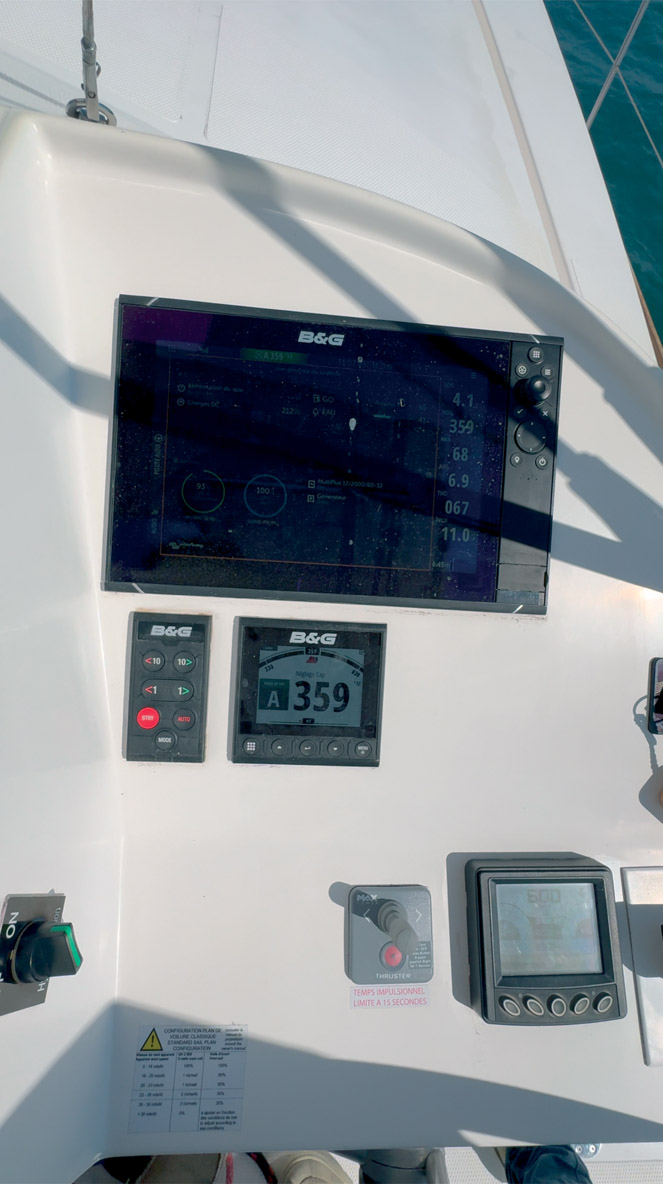
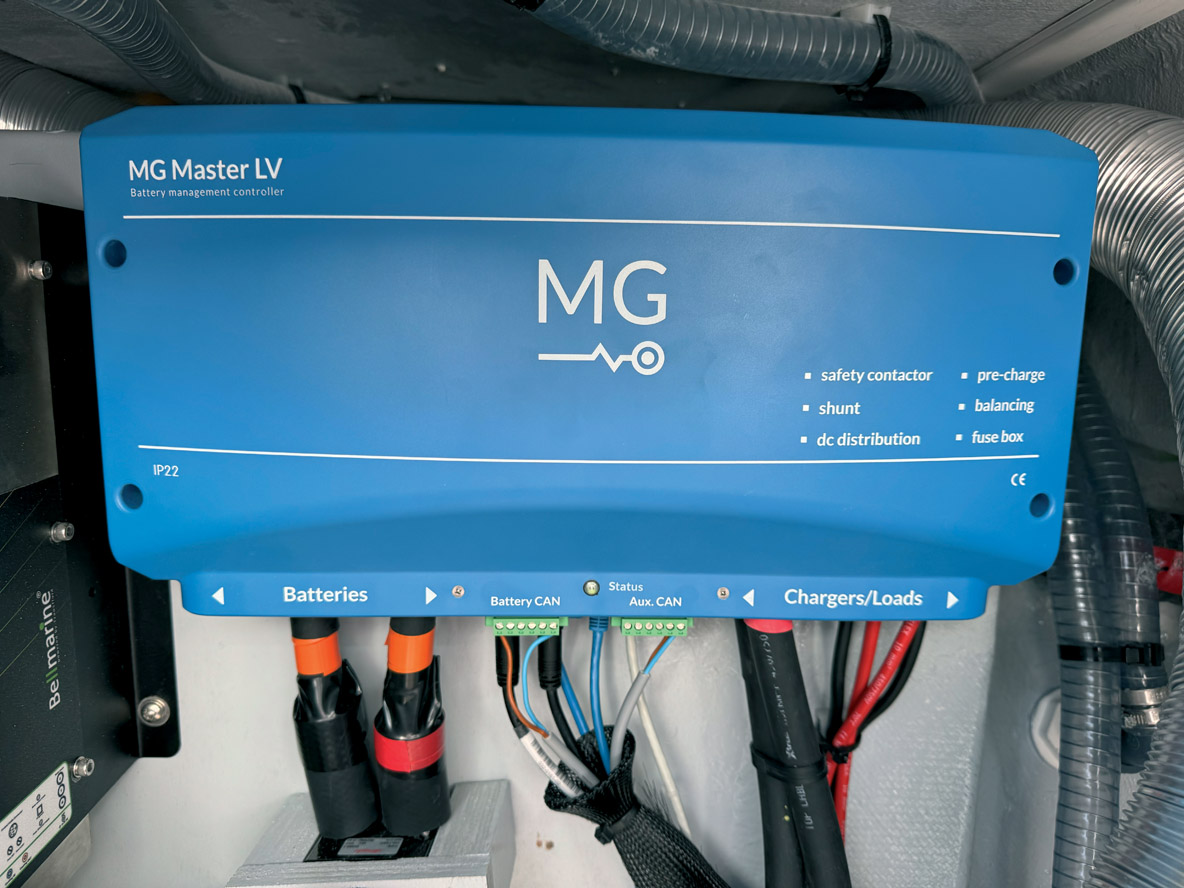
The Neel 43 Hybrid refitted by Emeraude Multicoques is based on a coherent and proven technical package:
- Bell Marine Brushless 25 kW electric motor (direct current, air-cooled)
- LiFePO4 lithium battery pack, 96 V – 25 kWh usable, integrated BMS system
- 4 to 5 hours at 5 knots in 100% electric mode
- 7 to 8 hours in motor-sailing mode (800 rpm)
- Range of nearly 1,000 miles at 4.5 knots with 6 kW generator running
- Shorepower (16 A or 32 A): full recharge in 4 to 6 hours
- Solar panels: slow recharge, auxiliaries maintained
- Hydrogeneration: up to 500–700 W at 6 knots
- 12 kW generator: continuous charge or intelligent backup
- Control screen with instant consumption management, battery status, charge/discharge history
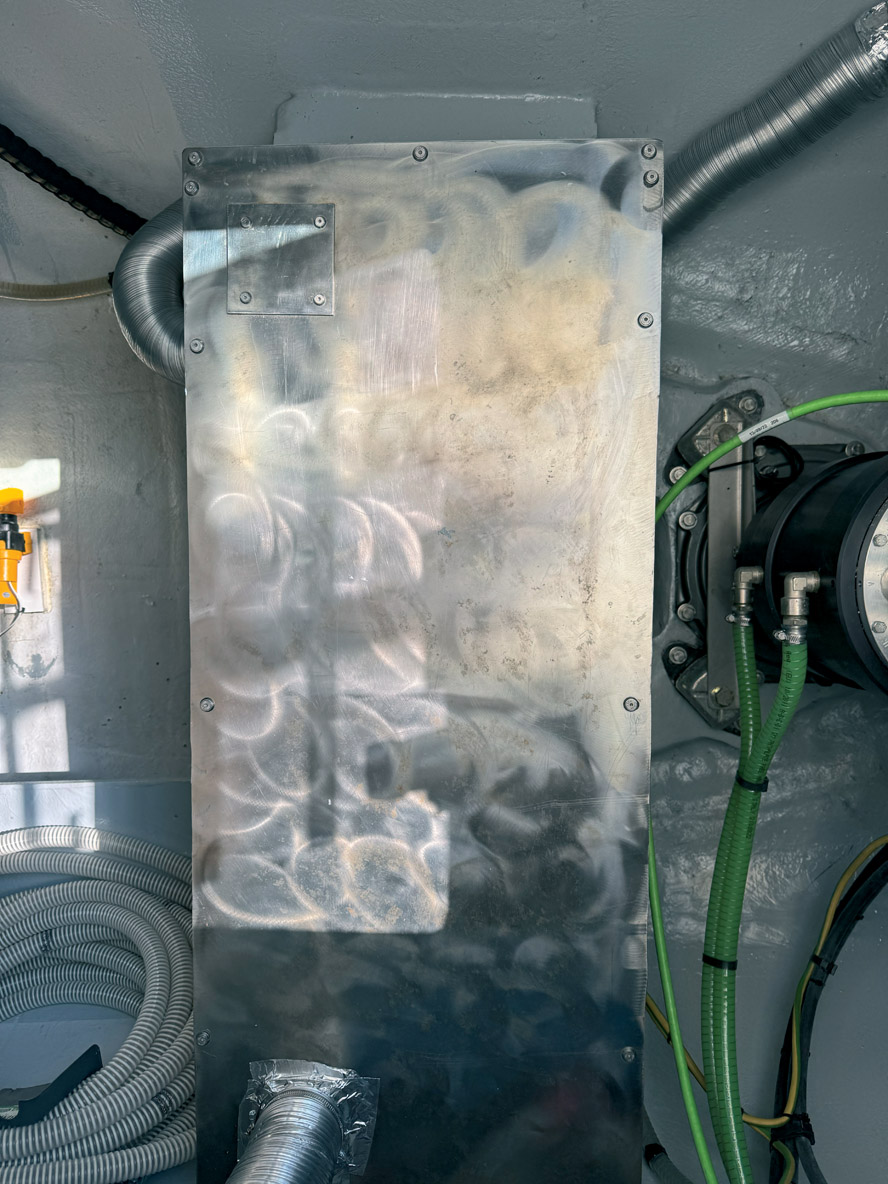
- Main circuit breaker, line circuit breakers, passive ventilation of the technical compartment, fireproof casing.