
Two years after having presented a resolutely innovative 50-foot trimaran at La Rochelle's Grand Pavois, the builder Neel is launching a brand new 45-footer, built on the same basic principle as its big sister.
Infos pratiques
- Le chantier : Neel 45 Evolution
- La fiche technique
-
 Découvrez notre vidéo exclusive
- Financez votre Neel 45
- Assuez votre Neel 45
- Articles autour du Neel 45
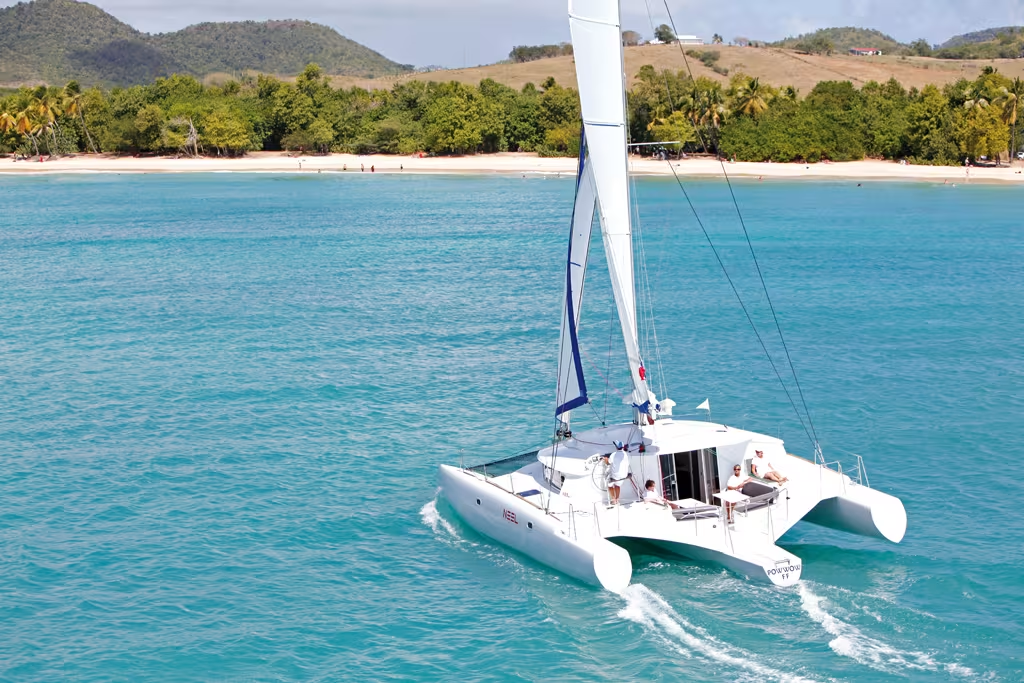
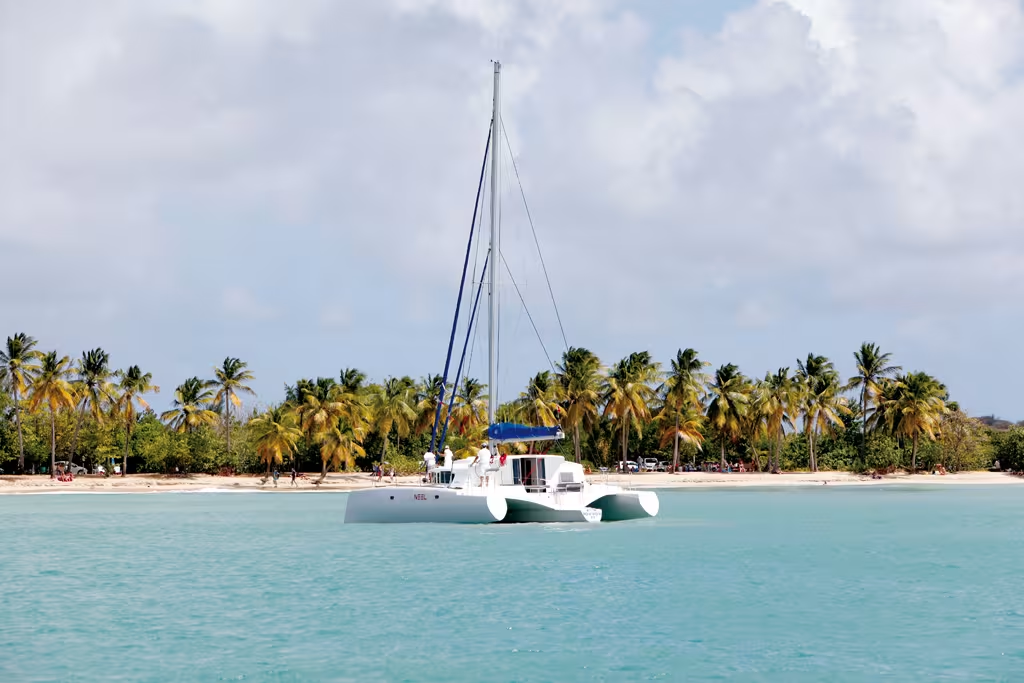
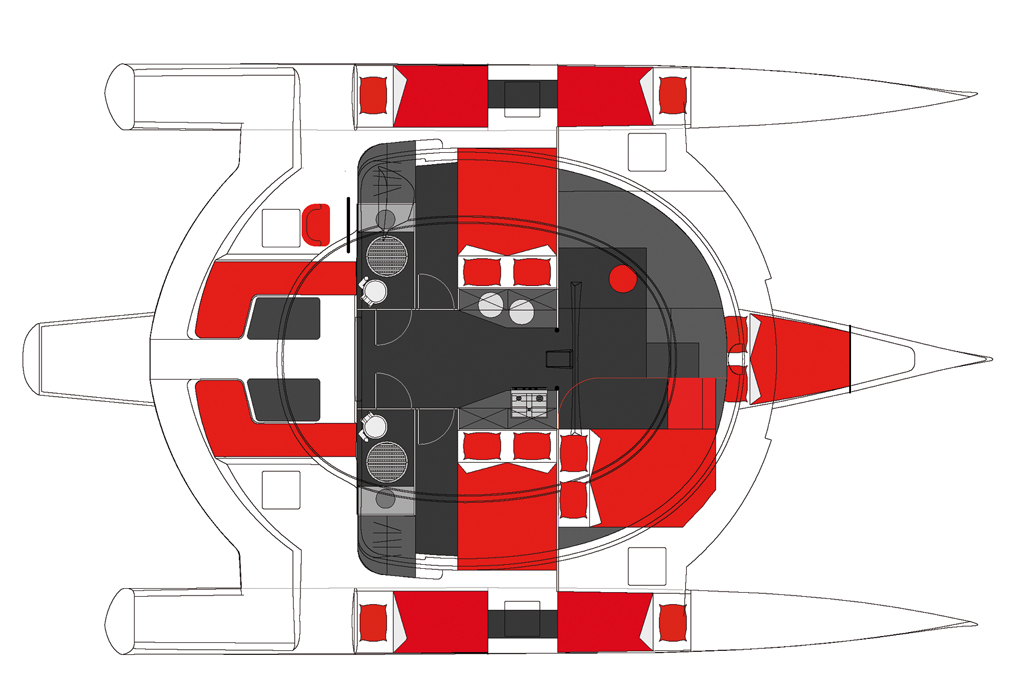
Here the hulls and floats are no longer dedicated to the liveable volume, but following the example of more performance-oriented boats, the whole boat is organised around hulls whose essential role is to support the boat's displacement. Here there is a living platform, as flat as a pancake (see the accommodation plan!), on the structure of a trimaran. The result is convincing, the object is beautiful (subjective view), successful and very modern, with its three inverted bows, just like Banque Populaire V or a MOD 70. But there is also the ridge, which marks on the hulls a slight 'longitudinal step', whose presence can only be justified as an accompaniment to the design of the cross beams, which are closer to the wing principle, so dear to Newick. Looking closely, moreover, there is a vague family connection with the American architect, with notably the stern of the central hull, which is completely open. The comparison stops there. On the Neel, unlike on a cruising catamaran, there is no chasing after liveable volume, as the builder considers it sufficient, with a saloon (convertible into a double berth), three double cabins, two heads and a galley. On our test model, (the first, destined for charter), there are in addition two single berths in each of the floats. Of course they can only be used at anchor, and beware of tropical squalls! The Neel 45 is a pretty trimaran, awaited by many sailing boat enthusiasts, because these three-hulled boats have the rare quality of reminding us of the advantages of the monohull - pleasure at the helm, as well as the satisfaction of sailing well to windward - and those of the catamaran - fast sailing, absence of heel, and of course the liveable area, which we find here, with the 60m² of the rigid platform and of course even more if we count the trampoline. We must remember that before the Neel, only Gérard Pesty and his mythical 'Architeutis' had dared to employ such architecture, using a large part of the available space. The other (too) rare cruising trimarans on the market make do with a liveable volume almost comparable to that of an equivalent-sized monohull.
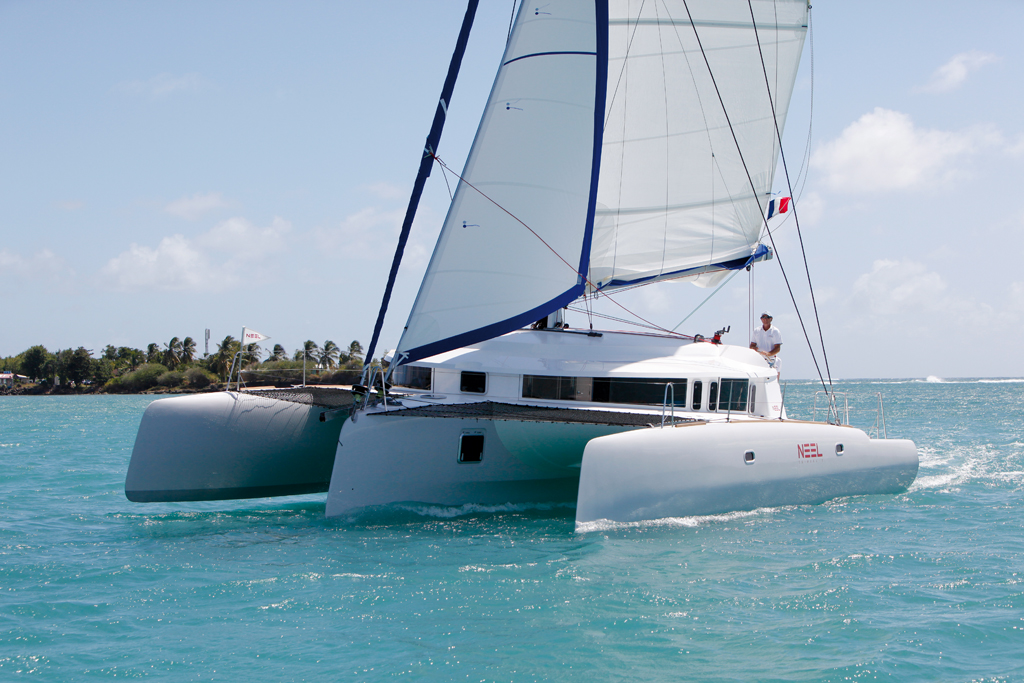
A trimaran for blue-water cruising, this is the Neel 45's wager.
An innovative sail plan
The sail plan deserves closer attention, as it differs in many ways from what we normally see on a cruising boat. The foretriangle is organised around a sail which can be described as a hybrid, on a roller, flown from the bow; a sail which is between a genoa and a gennaker (already the word 'gennaker is a cross between genoa and spinnaker, so what should we call it? A Geeker?), even though it is finally closer to the genoa, through its cloth, it shape and its cut. Just aft of it, there is the self-tacking staysail on a roller, attached to the mast at the same level as the lower shrouds, which guarantees proper support. This splitting of the sail area also allows the mast to be positioned further aft. The mainsail is square headed and has two reefs. Although the first one is situated at around the lower quarter of the sail, the second is almost in the middle, so your reefing habits will have to be revised: on a 'classic' fractional catamaran rig, you start by taking in one reef, then one or two turns in the genoa, before taking in the second reef, etc. Here on the Neel, when the wind freshens, the genoa is rolled up, leaving just the staysail (see box with the delivery skipper's report). There is therefore a lot of latitude before you have to take in a first reef, then a second. This innovative division of the sail plan allows you to sail always with a nice foresail: there is nothing more disastrous for sailing to windward than a rolled-up genoa. But it must be admitted, it is very practical… Note also that the mainsail reefing pendants do not pass through blocks, as is usually the case, but through friction rings.
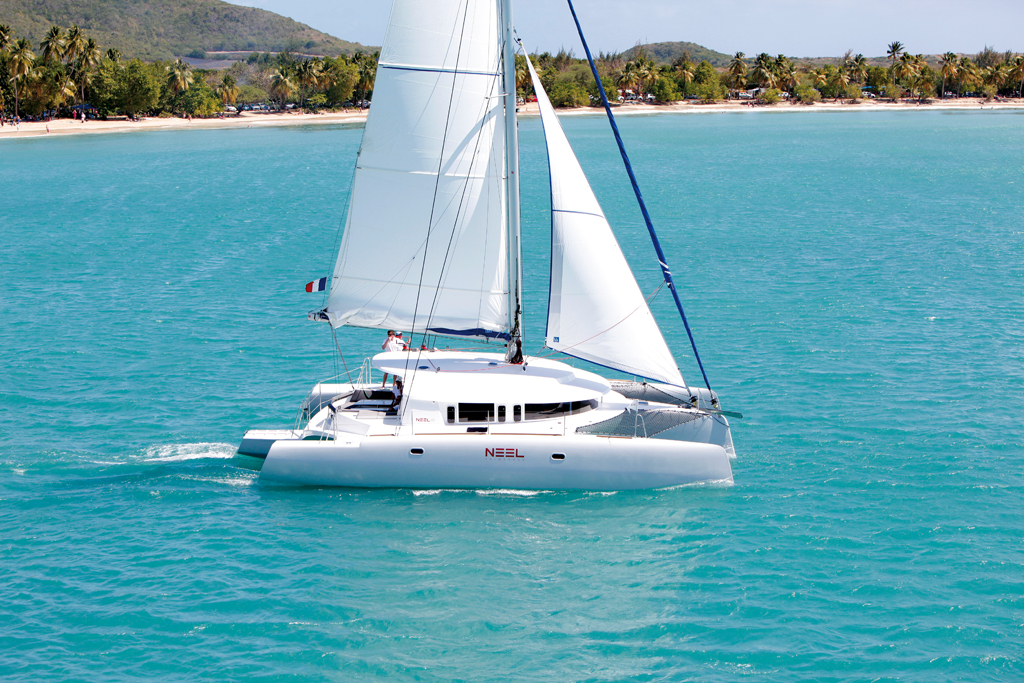
You either like this atypical boat's lines, or you don't…
The main halyard and reefing pendants are handled from the mastfoot. You can climb on to the coachroof from the front, via a step. Beware, however, the non-slip finish will perhaps not be enough, and you may have to add a few handholds and supports to have access serenely – a detail which also applies to the central sugar scoop. The other control lines return to the steering position, on the aft side of the coachroof. Compared to the Neel 50, certain points which in my opinion were questionable have been changed; this is the case for the mainsheet, which was made up of a single strand. It has been replaced by twin sheets, as on the Catanas, which are also returned to the helmsman, after passing via the mastfoot. They are attached to snap links, which allow them to be moved when sailing downwind to act as a barber hauler for the mainsail. Trimming is easy and with experience will be as precise as with a more classical traveller/mainsheet track setup. The advantage of this system is that it simplifies the deck plan. The headsails are hoisted on an all-or-nothing principle; thus the sheets don't pass via blocks on a track, but via a fixed block. On certain points of sailing, notably downwind, a barber will be needed. A pad eye on the coachroof will be useful for this.
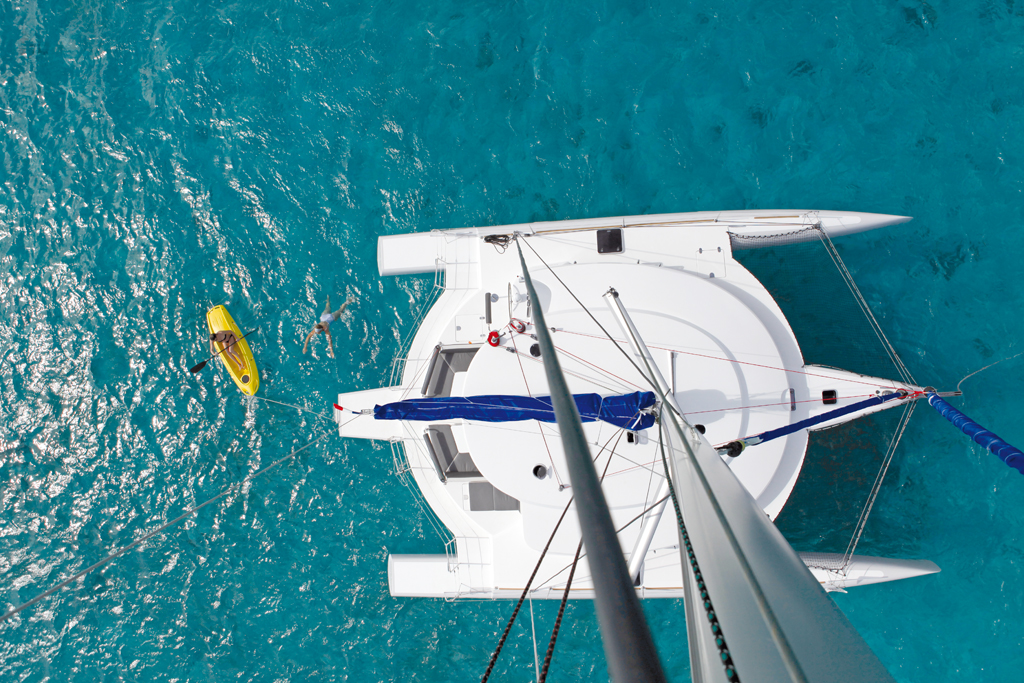
Three hulls for ocean cruising guarantees a giant platform.
The joys of cruising in a sailing boat
About ten days passed between the boat's launch and its departure on the delivery trip to the West Indies (where it is now available for charter from Autremer Concept, in Le Marin, Martinique). Between a winter storm and work to perfect the boat, the only free day was a rainy one. Not the best for sailing, even less so for the photos... Not to mention the wind, which did as it pleased, and during the afternoon finished at 8 knots. Not enough to get excited about, yet the boat responded rather well. The helm transmits good 'feel' via its (textile) lines. The position of the centre of effort and its good balance gives the boat slight weather helm, just enough to be able to feel the boat, and delight the helmsman. Purists might even consider it a shame that the configuration doesn't allow a tiller to be fitted... With such precision, keeping the genoa pennants parallel is child's play. And then extraordinary things happened. With 8 knots of wind, close hauled under the big genoa and full main, of course, the boat approached the wind speed; it sailed easily at over 6 knots, often exceeded 7, and even approached 8 knots. But in this configuration, the big genoa, more suited to points of sailing further from the wind (it's not a Code 0!) and handicapped by a slightly offset clew, does not allow good pointing. In addition, the fixed anti-leeway arrangements, made up of a small appendage, as well as the V-shaped floats, which is effective in strong winds, shows its limitations in light weather (as is the case for all multihulls with keels). Although to windward the boat can do without a Code 0, downwind, there should be no hesitation in boosting the available sail area with a big asymmetric spinnaker or a gennaker. Because with our 8 knots of wind, after bearing away, there was barely enough sail, and on a broad reach, we were a bit bored. It can clearly do better, all you have to do is give it the wherewithal. Of course, the Neel 45 has neither the capacities nor the pretension to compete with racing boats, but it sails well; it copes well with light weather, and promises fast passages downwind, in the trade winds, at average speeds which could reach 8 – 9 knots, giving daily distances of over 200 miles! But once again, beware of making a mistake concerning its programme: the Neel 45 is and remains a cruising boat. And aboard, there is no doubt – being on the water is a pleasure!
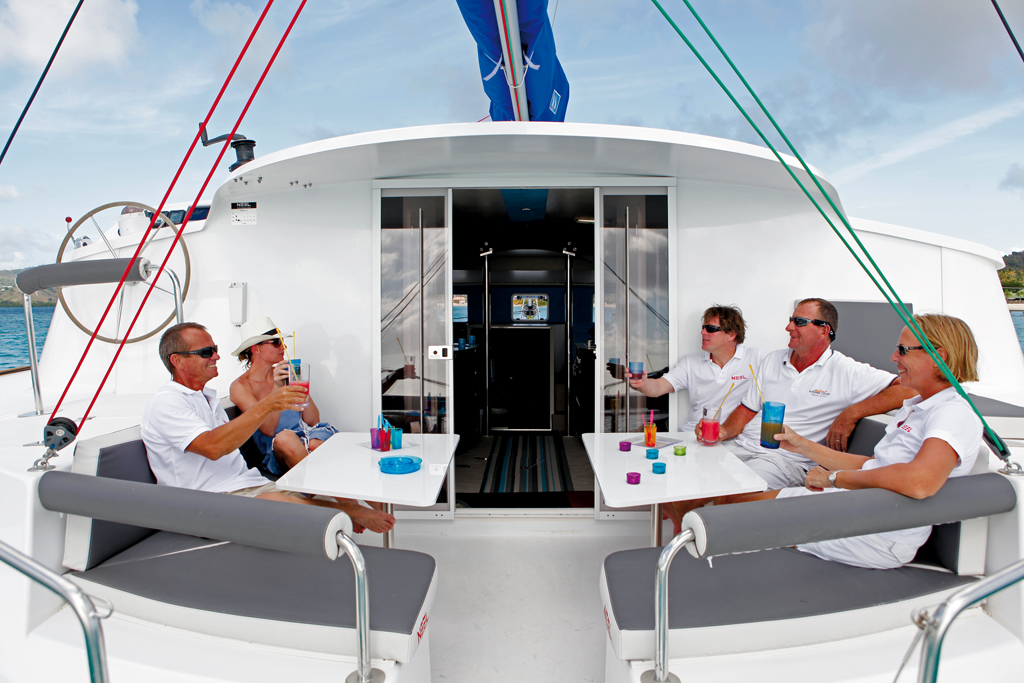
The cockpit is very nice, with its central passage and the two little tables.
We returned to the marina at Les Minimes, in La Rochelle. Performance under power is…impressive! The dihedral is small, which stops the boat dancing from one side to the other; even though this can be a disadvantage in rough seas. The compromise is interesting, and under power, the floats barely skim the surface of the water. Drag from the central hull is low. Propelled by the 50 hp Volvo, at 2,600 rpm, the Neel was doing a peaceful 9 knots; performance which would have several boats dreaming... As we came alongside, we had to take care at the back of the floats, which are finally a bit high when it comes to getting on to the pontoon. This is a shame, as it would have been easy to lower the sterns, and fit a small sugar scoop (which has been corrected on the n°2). On this model, coming alongside has been made easier by the presence of a bow thruster, which is no luxury, as once the wind freshens, the significant windage of this kind of boat can make the access channels between the crowded marina pontoons very tricky. When chartering or blue-water cruising, wild anchorages are of course the favourite stopovers; the anchor is raised by a vertical windlass. The length of the bow roller is surprising; it is carried well forward, with the aim of keeping the chain clear of the inverted bow to avoid damage to it. Through its configuration, a spreader seems essential, and when weighing anchor, with assistance from the engine, care has to be taken to align the boat with the chain, otherwise the bow roller will suffer. This point has also been corrected on the n° 2. Note that the chain disappears into the chain locker, but this is not accessible from the exterior, so in the case of a blockage (or more simply to check if the chain is stacking correctly), you have to go inside, to the forward cabin; not really practical.
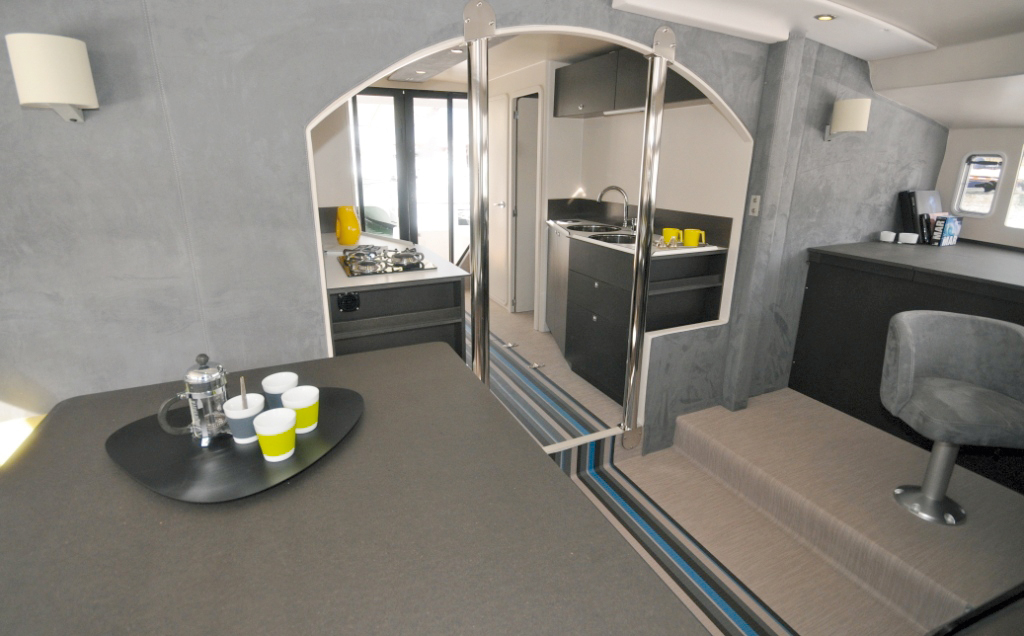
Welcome aboard the Neel 45, a real apartment on the water...
A nice living area
As far as the accommodation is concerned, the Neel again shows a real personality. This begins with the cockpit, which is characterized by a central passage and two small tables, one either side. Aft, we appreciated the path which allows a complete circuit of the boat without having to encroach on the peace of the cockpit's occupants. Movement around the boat is easy and reassuring, with triple lifelines at the stern and double forward. As for the interior: the Neel 45 is like nothing else known, apart from its big sister, the Neel 50. Once you pass through the twin large glazed doors, there is a WC/bathroom either side, equipped with electric WCs. Further forward, two other doors lead into the athwartships double cabins, with their large 'picture window' which looks out over the sea: a call to romantic lovers coming aboard for their honeymoon… Even further forward, the gangway reveals on either side the elements of the galley: two sinks to port, a double burner and oven to starboard. Still further forward is the chart table, to port, with a superb view over the sea, and next to it, the fridge and freezer. The saloon table is to starboard. The owner's tour is completed by the third double cabin, in the forepeak, which brings the number of berths to six, and ten with the berths fitted in the floats, plus two more in the saloon, which can be converted into a double berth. Last but not least, in the entrails of the central hull, there is the now traditional 'cellar', where enthusiasts can store their wine, of course(!) amongst other things. There is sufficient space for all the technical equipment, and you don't need to be a contortionist to maintain it. The same goes for the water and fuel tanks, the rudder segment and the autopilot ram, the charger and the hot water tank. Those who wish could add a diving compressor, generator, etc. One thing is certain, there is no lack of stowage volume. There are also two big lockers on either side of the cockpit, however you must be careful not to overload the boat.
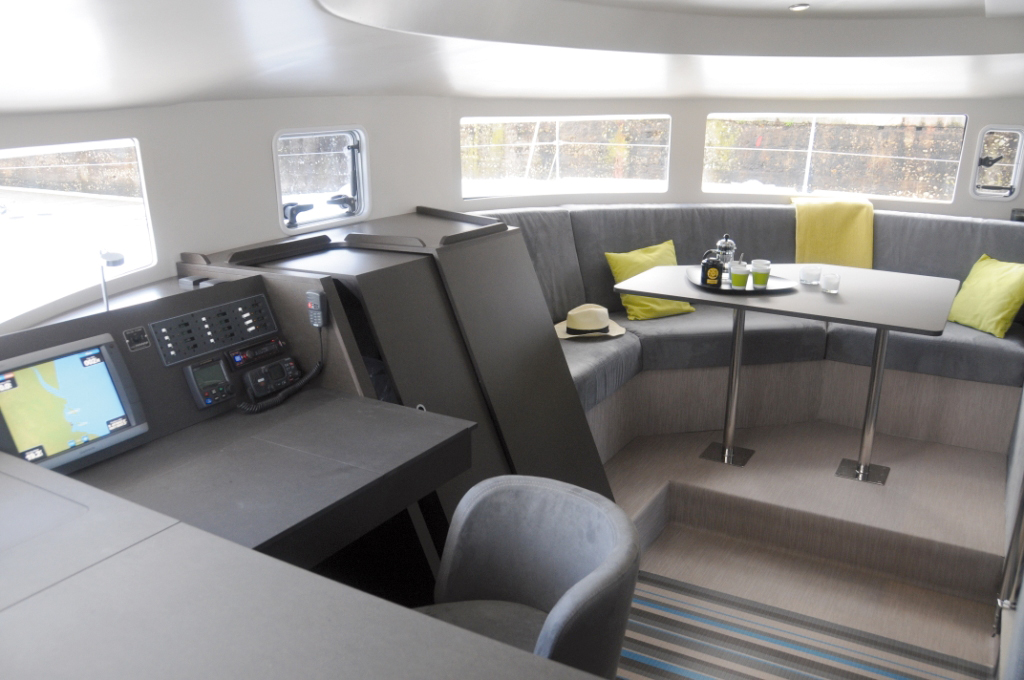
Up forward, we find the chart table and a nice saloon.
To conclude…
Although the Neel 50's aesthetics are debatable, it is hard not to find the Neel 45 beautiful. It offers a real alternative to the cruising catamarans. Of course the comfort is not exactly the same (the size of the saloon, notably, and the conviviality of the galley), but there is a real pleasure in sailing this kind of boat, which should appeal to pure sailing enthusiasts. A real dream, which nevertheless has a price: 440,000 euros exc. VAT…
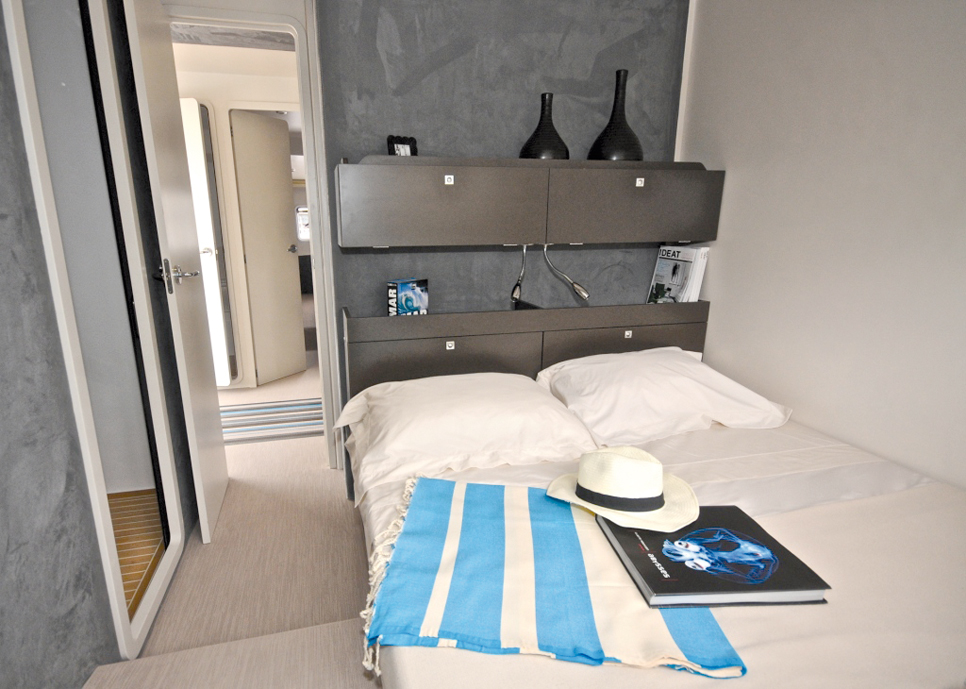
One of the two athwartships cabins: a real must in a 45-footer.
Postscript
Four months after the test aboard the n°1 of the series, we were lucky enough to sail on the n°2, in stronger winds, between 15 and 20 knots. In strong winds, the helm is particularly light, and the rudder is reactive and precise. Close-hauled (under staysail and full main), it reached ten knots or so, pointing high enough to make a potbellied cruising monohull envious. And when we bore away onto a reach, the Neel slipped along comfortably at 12 – 13 knots, still in 18 knots of wind. Not bad! Downwind, with the genoa unrolled, it sailed peacefully at 10 knots; obviously a big headsail will increase this performance. At these speeds, the Neel 45 offers us the pleasant impression of being aboard a real sailing boat. Inside this second boat, dedicated to a private owner, the starboard cabin has a private bathroom, with a separate shower. In any case, the builder is listening to its customers, and the accommodation is flexible. The few small faults noted during the test of the n°1 have been corrected, as has the access to the quay from the stern of the floats, which now has a step, or the addition of a delphiniere, which allows a gennaker or an asymmetric spinnaker to be attached, and above all keeps the anchor far enough forward, so the chain doesn't damage the hull.
The plusses
- An interesting sail plan.
- The joys of a trimaran, under sail.
- A nice view of the sea from the cabins.
The minuses
- The cockpit could offer a bit more comfort.
- The anchor chain can't be seen from the deck.
- Access to the coachroof and the mastfoot.
Technical specifications
- Overall length: 13.50 m
- Overall beam: 8.50 m
- Draft: 1.20 m
- Air draft: 19.15 m
- Unladen displacement: 6,500 kg
- Fully laden displacement: 9,000 kg
- Self-tacking jib: 20 m²
- Roller genoa: 46 m²
- Fully-battened, square-headed
- mainsail: 60 m²
- Engines: 55 hp Volvo inboards, saildrives
- Fresh water: 600 litres
- Diesel: 300 litres
- Price: 440,000 euros exc. VAT, including 3 sails, fridge/freezer, pressurised water system, etc.
The delivery skipper's report:
Yves German took charge of the Neel 45 at La Rochelle, and delivered it to Martinique, in the West Indies. He gave us his impressions. "First of all, I would like to explain that we didn't have very strong trade winds – at the very most, 25 knots. The boat is powerful, and equipped with a very nice mainsail, with a very wide square head – a bit like a racing machine. Downwind, with one reef in the main, you can twist it and when the boat accelerates, you don't lose power (a bit like on a windsurfer). The boat accelerates very nicely. Despite its light weight, I find it has a certain amount of inertia, as the mainsail compensates. Of course downwind, it needs a big headsail, an asymmetric or a gennaker, which we didn't have... With 15 knots of wind or more, you can start tacking downwind. With less, we had the sails goosewinged; the square head copes, even though you have to be careful with the cars, which hit the tracks. We also sailed with the genoa on one side and the staysail on the other. During the crossing, with just 15 knots of wind, we covered around 160 miles per day – a good average. It sails well; in light winds it is immediately at 8 knots - it goes really well in light weather. In trade winds which were a bit stronger, it maintained an average of 8.5 knots, regularly surfing at 10 – 12 knots, sometimes at 13 – 14. The record was 17.8 knots, but surfing, which isn't significant. It also sails well in strong winds, with two reefs in the main, and the staysail; as a general rule, we took in a reef from 18 knots of true wind. To windward in 25 knots of wind, it behaves a bit like a monohull; you control how it 'leans' on the float, it's quite amazing. This boat is incredibly simple; after 45 minutes aboard, you understand how it works. You have the impression you are sailing a dinghy; you forget the size."
The Neel 45 against a few competitors
| Model | Type | Length | Beam | Windward sail area | Unladen displacement | Price euros, exc. VAT |
| Neel 45 | Trimaran with keels | 13,50 m | 8,50 m | 106 m² | 6.500 kg | 440.000 |
| Outremer 45 | Catamaran with daggerboards | 13,70 m | 7,20 m | 106 m² | 7.250 kg | 410.480 |
| Fast Cat 445 | Catamaran with keels | 13,60 m | 7,49 m | 139 m² | 6.400 kg | 469.500 |
| Catana 47 | Catamaran with daggerboards | 14,03 m | 7,67 m | 119 m² | 10.900 kg | 578.867 |