Two years after presenting a resolutely innovative 50-foot cruising trimaran at the La Rochelle boat show, with a nacelle extending over practically the entire width of the platform, in 2012, NEEL Trimarans launched a brand new 45-footer at a much more attractive price - and success was not long in coming!


Infos pratiques
- Le chantier : Neel 45 Evolution
- La fiche technique
-
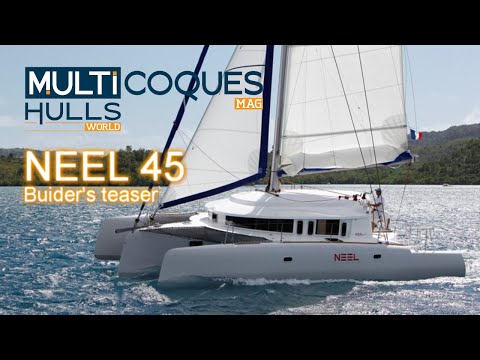 Découvrez notre vidéo exclusive
- Financez votre NEEL 45
- Assuez votre NEEL 45
- Articles autour du NEEL 45
While the Neel 50 took multihull enthusiasts by surprise back in 2010, it was undoubtedly for the better, clearing the way for the concept of this large cruising multihull with an imposing nacelle - worthy of a catamaran. The 45 benefits fully from the running-in period of the 50, and it is this model, which appeared in 2012, that launched the La Rochelle-based manufacturer on the road to success. The NEEL 45 has indeed been pretty successful, with 26 units built. In 2018, the manufacturer launched, in the wake of its new NEEL 51, a version called the Evolution. This 45 “plus” features sugarscoops at the rear of each float, making it very practical to step aboard from the dock. Until this point, only the central hull was fitted with one. The bimini was also extended aft to facilitate access to the boom. A “Performance” version with a central daggerboard and carbon rigging was also on offer.
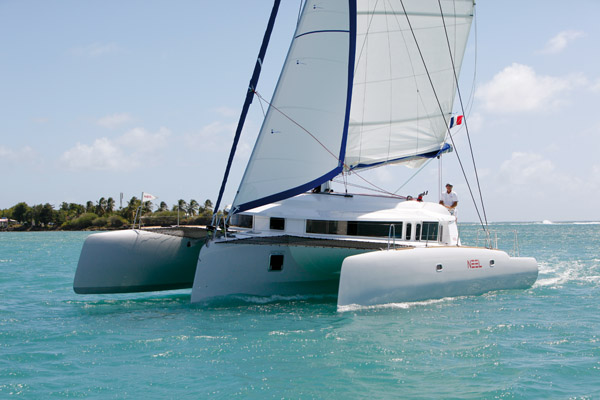
The rig of the NEEL 45 features an XXL-sized genoa and a 215 sq ft (20 m²) self-tacking staysail.
Simple and efficient!
The rig is a classic fully battened mainsail and a large genoa - almost a gennaker – backed up by a self-tacking staysail. You therefore operate on an “all or nothing” basis for the headsails, perfectly adapted to long-distance cruising - only tacking under genoa is more tedious. The deck fittings are simple and well thought out, with fixed sheeting points for the genoa and staysail and a split system for the mainsheet. The “shipyard setting” for the big genoa doesn’t allow for a great upwind course, but you can do much better with furling gear - or any other system for adjusting the sheeting angle. A bowsprit platform allows you to hoist a (proper) gennaker or an asymmetric spi.
The deck layout doesn’t involve massive areas of hardstanding: at the front, the trampolines occupy a good amount of the space, sitting between the relatively narrow hulls. Aft, the cockpit is rounded off, again leaving the hulls clear. Between the two, you’ve got fluid circular movement outside, with just two 4-inch (10 cm) steps under the feet before you’re in the cockpit. The objective, on this model, was above all to contain the weight. However, there are many exterior lockers, and the outer hulls still offer 530 cubic feet (15 m³) each. The raised helm station is on the port side. It offers a beautiful view over the water and all the sailing maneuvers are grouped there. The cockpit has a central passage between its two tables.
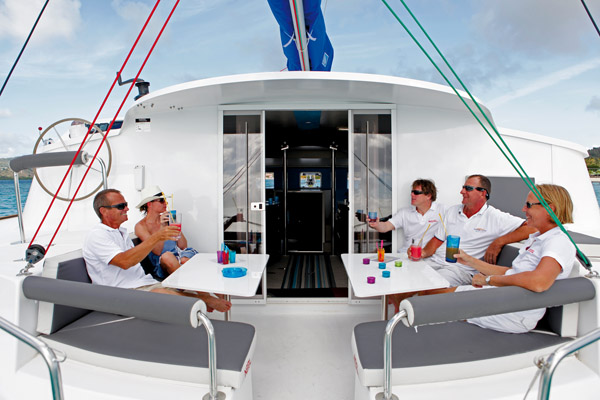
The cockpit is divided into two identical sections, keeping a clear central passage.
The nacelle explained….
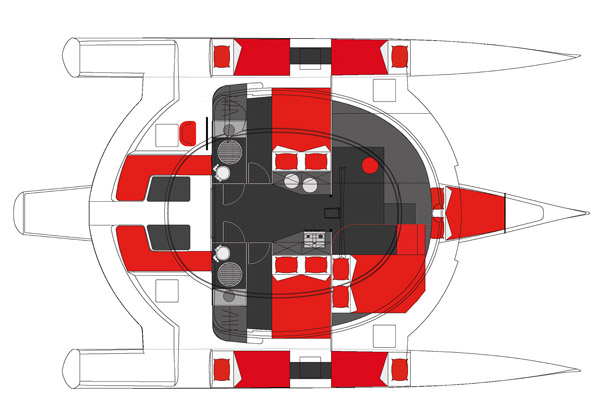
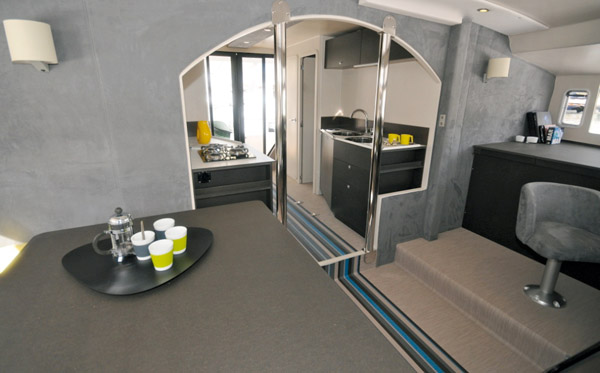
The platform provides 645 sq ft (60 m²), and the nacelle occupies three quarters of it. It is here that the living area is concentrated and even a good part of the night area with two heads compartments and two cabins with an unobstructed view of the sea. The honeycomb-structure floor has enough space beneath to allow for a very large volume in the lower part of the central hull for technical equipment. The entrance leads to an unusual passageway that serves as the galley - in the middle of this trimaran, with the longitudinal bulkheads separating the various features - sink area to port, cooking area opposite. You then pass through a stiffening section flanked by two support struts and one step to reach the widest area, where you find the saloon forward, to starboard (and the refrigerator and freezer), the navigation station forward, to port. The layout works perfectly, but at first glance seems relatively compartmentalized: it is no accident that the new NEEL 43 now has an open cabin on the port side and windows integrated into fixed panels... The third cabin, although rather narrow at the feet, manages to offer the regulatory 4½ feet (1.4 m) at the head, and occupies the forepeak of the central hull. The floats aren’t generally fitted out - some models are equipped with extra berths that can only be used at anchor. Note that the coachroof benefits from good insulation, with 20 mm (¾”) of foam.
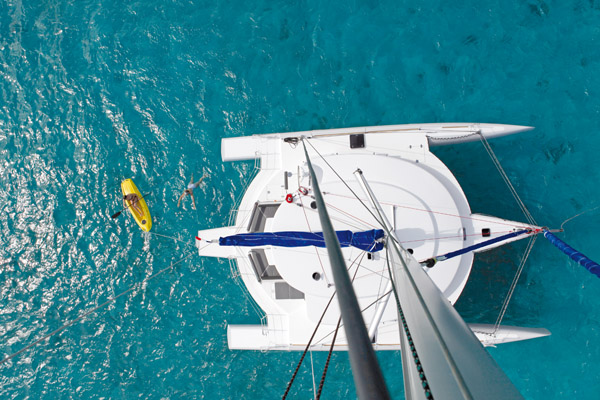
The principle of the platform spread across the three narrow hulls makes perfect sense when viewed from the mast!
Glide on the horizon
Under sail, the NEEL 45 has proven its potential on plenty of passages, including races - one example even won the ARC in 2015 in the multihull category against some much larger catamarans. This trimaran already performs very well in light airs: it will sail at 6 or 7 knots upwind in 8 knots of wind. In breezy conditions, 200-mile days are well within reach. Eric Bruneel, founder and CEO of the shipyard, even reports peak speeds of 21 knots. Compared to most cruising catamarans of equivalent budget, the NEEL 45 is a real pleasure to helm, with a very slight heel (the dihedral of the floats is not very pronounced). This excellent glide feeling is also found under power, where the NEEL 45 reaches 9 knots at 2,600 rpm thanks to the slenderness of the central hull. On the other hand, when in the marina and you’ve got a strong crosswind, maneuvers will require a certain amount of know-how - or a good bow thruster.
 |
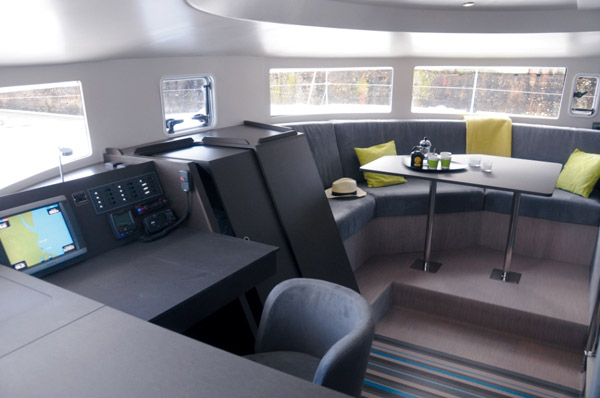 |
The central area with its two support struts separates the two cabins, the heads compartment and the galley from the saloon and the nav station.
Conclusion
When first launched, this model caused quite a stir – it’s not that easy to impose such an innovative concept. But two years after its launch, a dozen units had already been delivered. The NEEL 45 is certainly one of the rare cruising trimarans built (almost) in mass production. Admittedly, the number of examples built remains limited to less than thirty units – and at the time of writing, two examples are offered for sale.
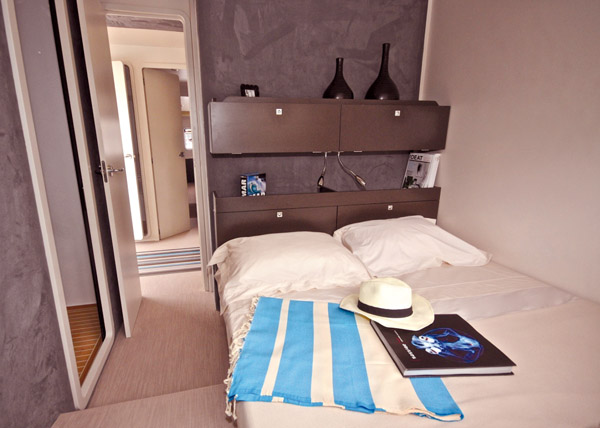
The cabins in the nacelle have large beds, plenty of storage space and wonderful sea views.
Points to check
This model is still very recent and doesn’t suffer from any particular defects. With the oldest examples being at most 10 years old, the NEEL 45s are young adults in terms of “boat age” and the equipment, with the exception of the sails and perhaps some of the electronics, remains functional. Some of the finishes were a bit hastily done, though most of these issues were sorted out during the running-in period. Some of them have been used in charter, and these are the ones that are likely to show some signs of age – higher engine hours being a typical situation. Generally speaking, the owners we’ve talked to are or were very satisfied with their boats.
THE PLUSES:
+ Attractive concept
+ Excellent performance
+ Efficient sail plan
THE MINUSES:
- Difficult to manage without a bow thruster
- Finish sometimes disappointing
FICHE TECHNIQUE
Constructeur : NEEL Trimarans
Architectes : Joubert, Nivelt et Mercier
Conception : Eric Bruneel
Longueur de coque : 13,40 m
Largeur : 7,84 m
Tirant d’eau : 1,20 m
Tirant d’air : 19,15 m
Déplacement : 8,50 t
Grand-voile : 60 m2
Génois : 46 m2
Trinquette : 20 m2
Motorisation : IB 55 CV Volvo
Carburant : 600 l
Eau : 300 l
Matériau : sandwich polyester
Production : 26 exemplaires de 2012 à 2020
Prix occasion : à partir de 300 000 € HT