When it was presented at La Rochelle during the Grand Pavois, then at Cannes, the Neel 50 left no one indifferent. A portrait of very original ocean cruising trimaran.
Infos pratiques
- Le chantier : Neel 50
- La fiche technique
- Découvrez notre vidéo exclusive
- Financez votre NEEL 50
- Assuez votre NEEL 50
- Articles autour du NEEL 50
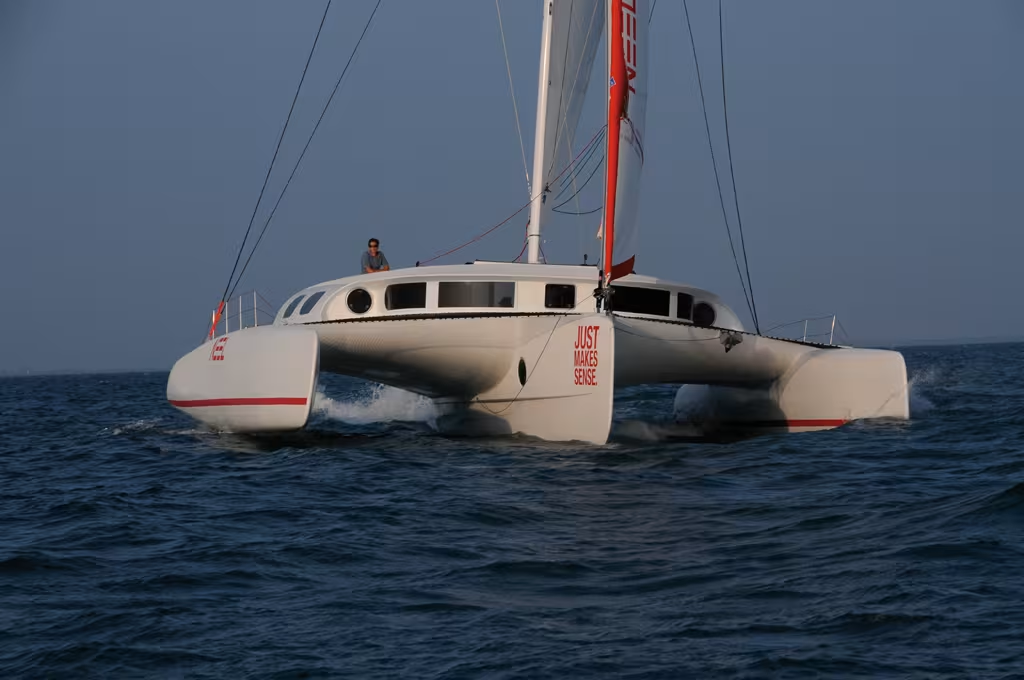
We might as well say it straight away: the Neel bears absolutely no resemblance to the other multihulls aboard which I have had the opportunity to sail until now. It offers more than one distinctive feature. Firstly, it is a trimaran. Everyone knows that trimarans are generally dedicated to performance and racing, rather than cruising, even if there are some notable exceptions; Multihulls World readers are very familiar with Callisto, the Morel family’s trimaran, which a few years ago sailed round the world at top speed. Paille en Queue is a nice Briand design, dedicated to cruising. But the true ancestor of the Neel was of course Architeuthis, Gérard Pesty’s boat (see box). The Neel has a very clear ambition, to offer trimaran lovers the advantages of a cat, namely its liveability, whilst conserving the seakeeping qualities of the trimaran, its ability to sail to windward and at the same time offer the very pleasant impression at the helm of sailing a boat which heels slightly, an impression specific to boats with one hull (monohulls, and trimarans with one hull and two floats), as against the two hulls of a catamaran. More than one person has been surprised by its volumes: seen from afar, it looks like a toy; it is hard to imagine that it is 15 metres long. We took advantage of a delivery trip from La Rochelle to Lorient to climb aboard and see for ourselves what it was capable of. We weren’t disappointed.
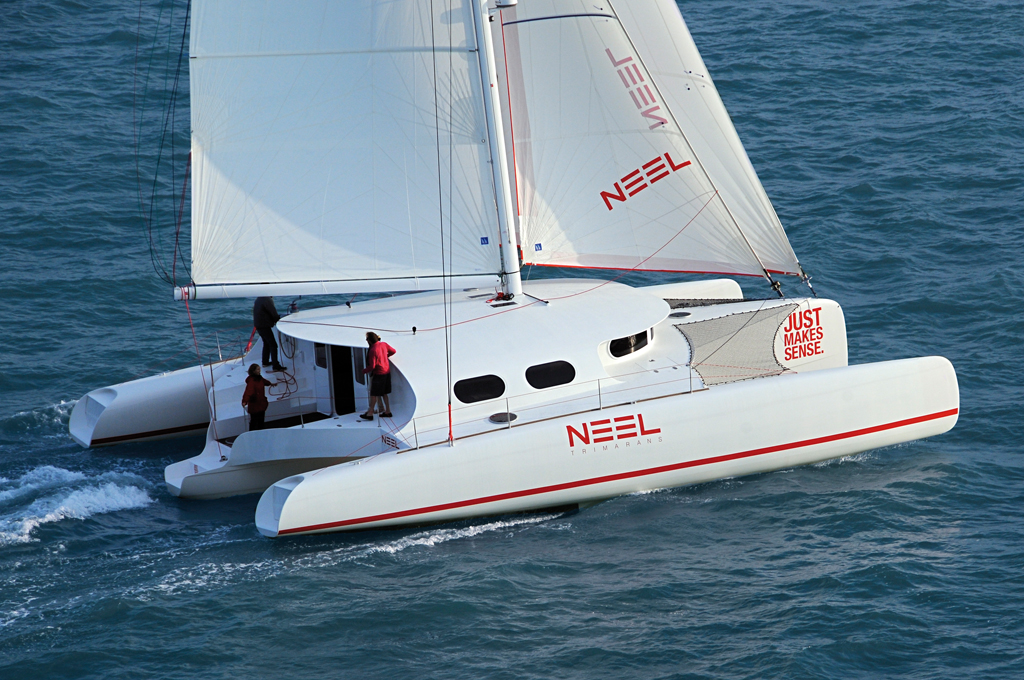
A real blue water trimaran, offering a living area of over 65m²... Magic!
Under sail.
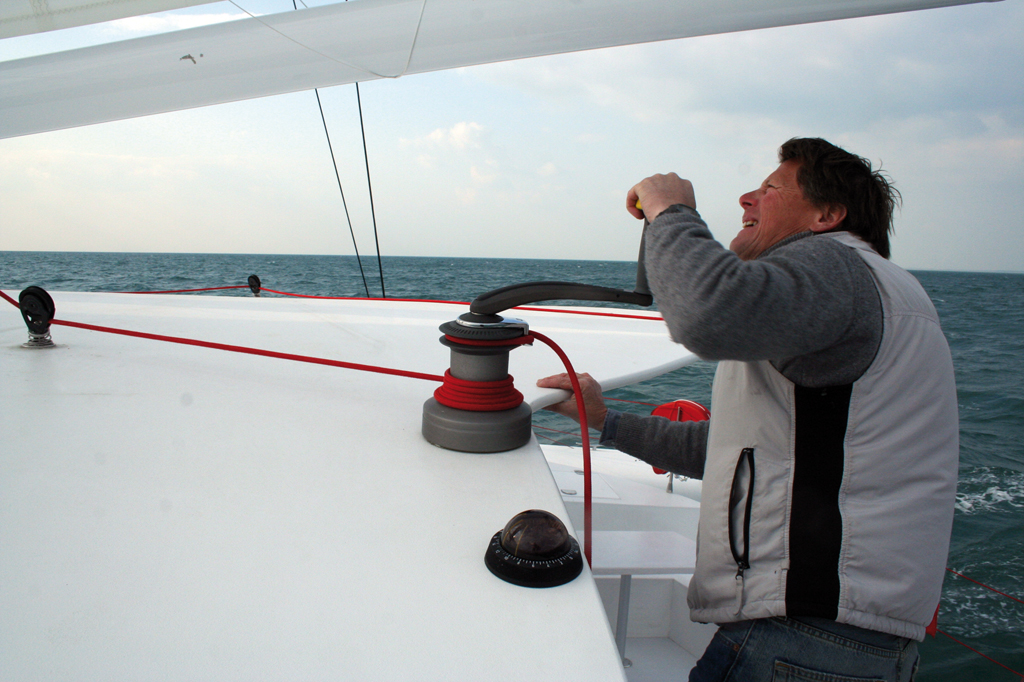
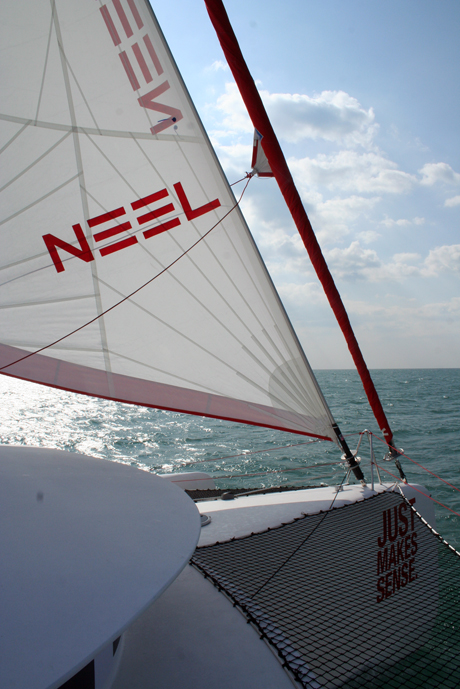
‘Just Make Sense’ (that’s its name) doesn’t have a bow thruster, yet despite its windage and the quite fresh easterly wind blowing in La Rochelle, an aft spring allowed us to leave the quay with no problems and circle in the ‘bassin des chalutiers’ whilst waiting for the bridge to open. We quickly headed towards the Ile de Ré bridge. Under engine, the boat had a tendency to ‘rear up’, making the sugar scoops look like a bath tub. Then came the moment to hoist the mainsail, and discover one of the boat’s most remarkable original features (and there are more than one!). This is of course the fact that all the control lines are positioned inside the boat, under the mast compression strut. “At sea, on long passages, you spend all your time protecting yourself so you don’t get too wet,” Eric Bruneel, the designer of this out-of-the-ordinary boat confided. “So I thought up this system, which allows everything to be done from a sheltered position, inside. You see, this is the start of our passage, everyone is outside, but we will quickly find ourselves inside, chatting comfortably. And we will be pleased we don’t have to go outside.” With 92m² of mainsail, the presence of an electric winch is justified; thanks to the magic of push-button sailing, a 5 year old child can hoist it to the masthead (seen with our own eyes!). Marine did it very well. On the other hand, the view of the mainsail deserves to be improved; you must be able to see if the square head has cleared the lazy jacks, either through the deck portlights next to the mast, or by entrusting the task to a crew member in the cockpit. This position receives all the essential control lines, such as: the mainsail halyard and sheet, the lazy jacks, the spinnaker halyard (which also serves to hoist someone up the mast), and the staysail sheet, which quickly unrolls it – the control line is also inside. Eric Bruneel brings up the philosophy of the sail plan again: “I know from experience that although you use the gennaker, racing or cruising, you have to admit that you don’t always want to hoist it.” Hence this original sail plan, with a huge mainsail, a 30m² staysail, and a jib which is more like a small, 75m², gennaker, flown from the hounds. We were already sailing to windward of the north headland of the Ile de Ré, with a little more than 20 knots of true wind, and saw a top speed of 16 knots. Although it is not too hard to make a cruising catamaran surf with the wind aft, it is not so easy to get it to reach such speeds with a beam wind; the Neel succeeds, as long as the wind is quite fresh. Our speed remained at between 11 and 13 knots, a bit less in the lulls, and often a bit more. With a displacement of around ten tonnes, (in cruising order), the Neel offers around 17m² of sail per tonne, which is generous, especially compared to the 10m² or slightly more of the cruising catamarans on the market.
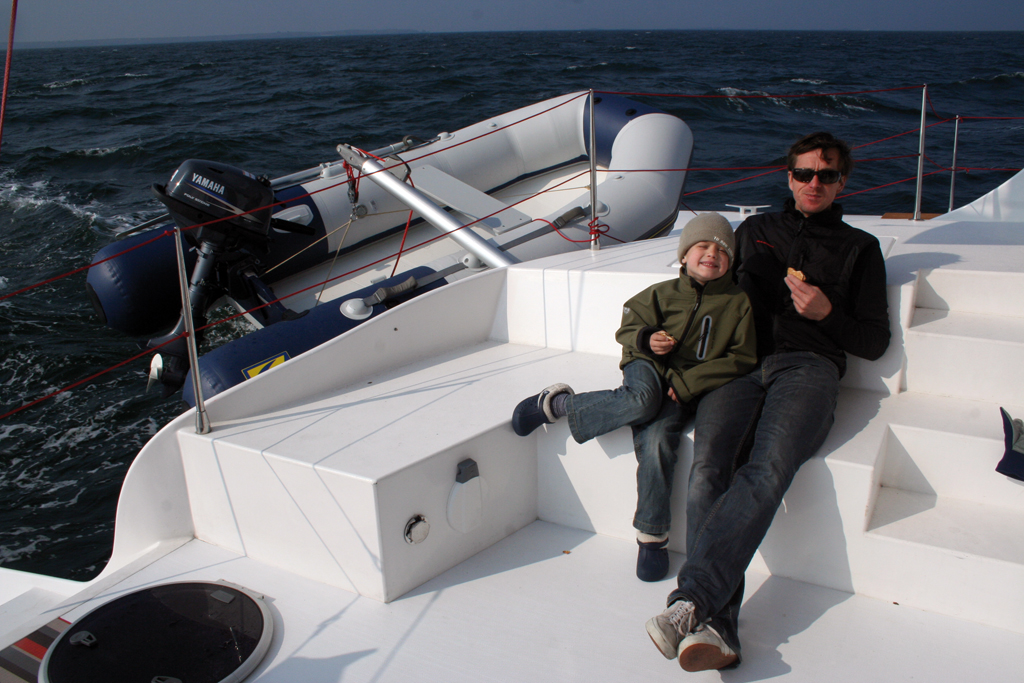
The cockpit appears small...but it isn’t, and it is comfortable!
A coherent platform
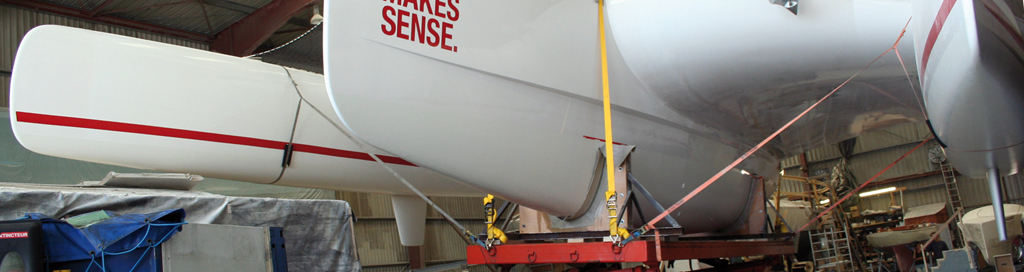
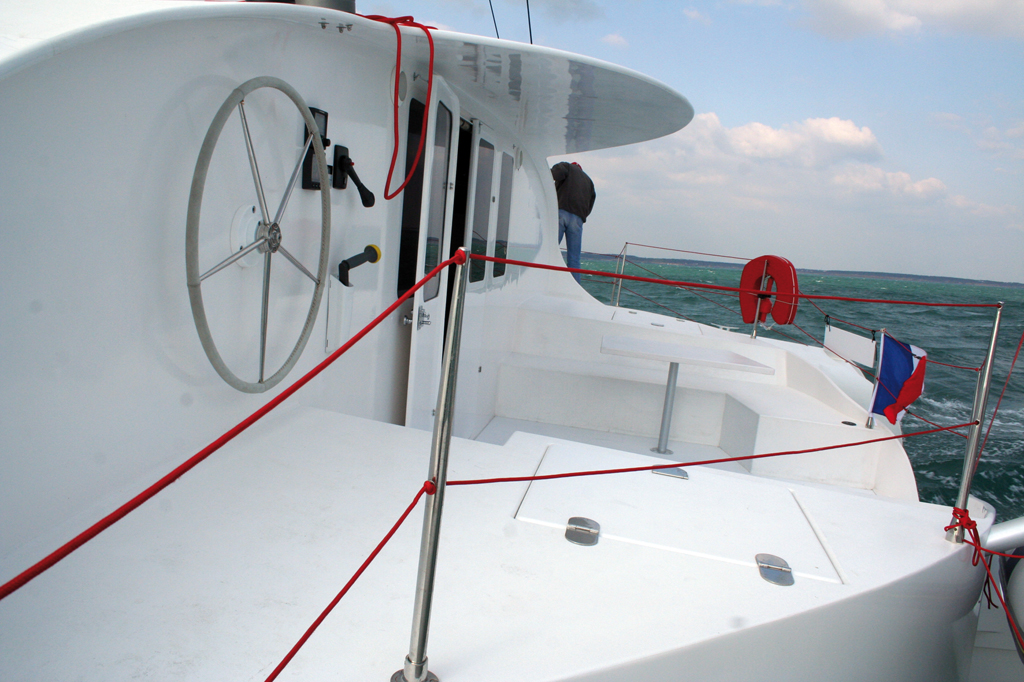
The volume of the floats seemed to me to be greater than necessary. “They are justified by the height of the bridgedeck,” Eric told me. On a racing boat, the crossed arms allow just the volume necessary to be used. “I wanted a flat platform, with no dihedral at all.” The central hull is rockered, the floats do not slow the boat, and when we arrived in the lee of the Ile d’Yeu, it managed tack after tack without us having to touch anything at all. After a few 25-knot gusts, the breeze settled down at around 20 knots, and this was felt in the speed, as it ‘dropped’ (it’s all relative) to around ten knots. In the absence of dihedral, the windward float only rarely comes out of the water; it doesn’t slam, but by remaining on the water, it inevitably causes hydrodynamic drag. The keels are fixed, one on each of the floats (they also serve to stabilise the boat when it is beached), and there is a small keel under the central hull. The floats have rather tight lines; although they remain flat aft, the forward part has been refined during a short return to the boatyard, as the first tests showed that the boat had a tendency to slam. The back of the floats opens, so that a kayak or a deflated semi-rigid dinghy can be stored there. Is the cockpit small? It is perhaps not small in the absolute (from backrest to backrest, it measures 410cm at its widest point and 260 cm at its longest), but it seems small, because it is stuck between the aft side of the coachroof on one hand and the central hull’s sugar scoop on the other, and on the sides it is limited by the coachroof, which extends back to the aft crossbeam (actually, the aft part of the ‘wing’), and thus leaves an inevitable tight access to the deck. This important detail should be improved, as at night, and even sometimes by day, it is easy to catch a foot on it, and the low guardrail will finally unbalance a careless crew member. The coachroof extension is so big (65m²) that it literally overwhelms the cockpit, which thus appears small. In any case, the boat was so comfortable on this flat sea, that we could have a good look at its accommodation.
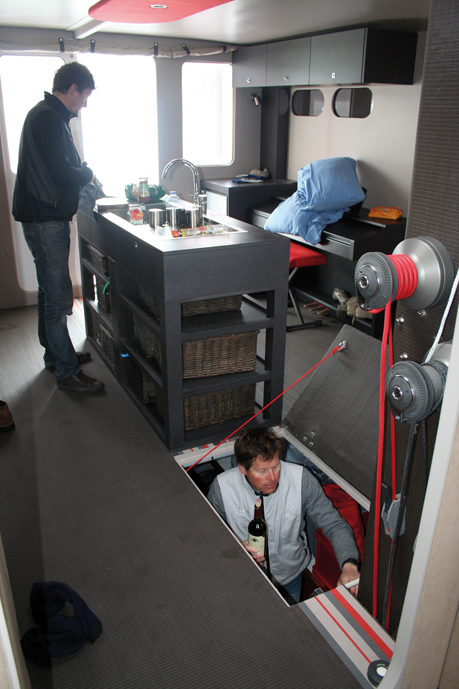
The interior is dealt with in an original way. It’s a success (and the ‘cellar’ is brilliant!)
A big living platform.
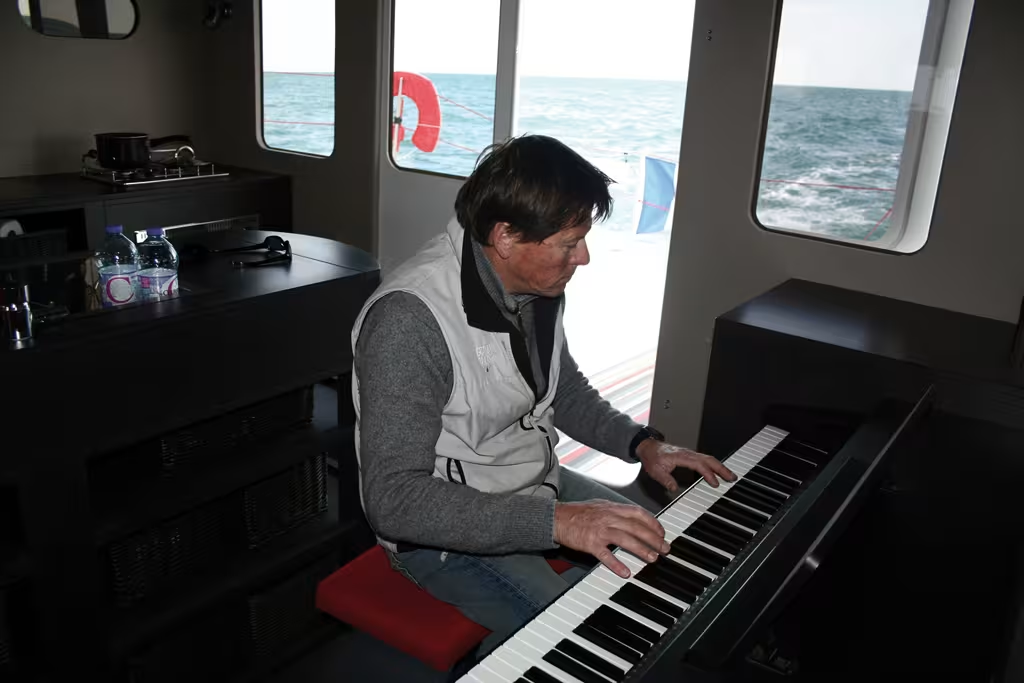
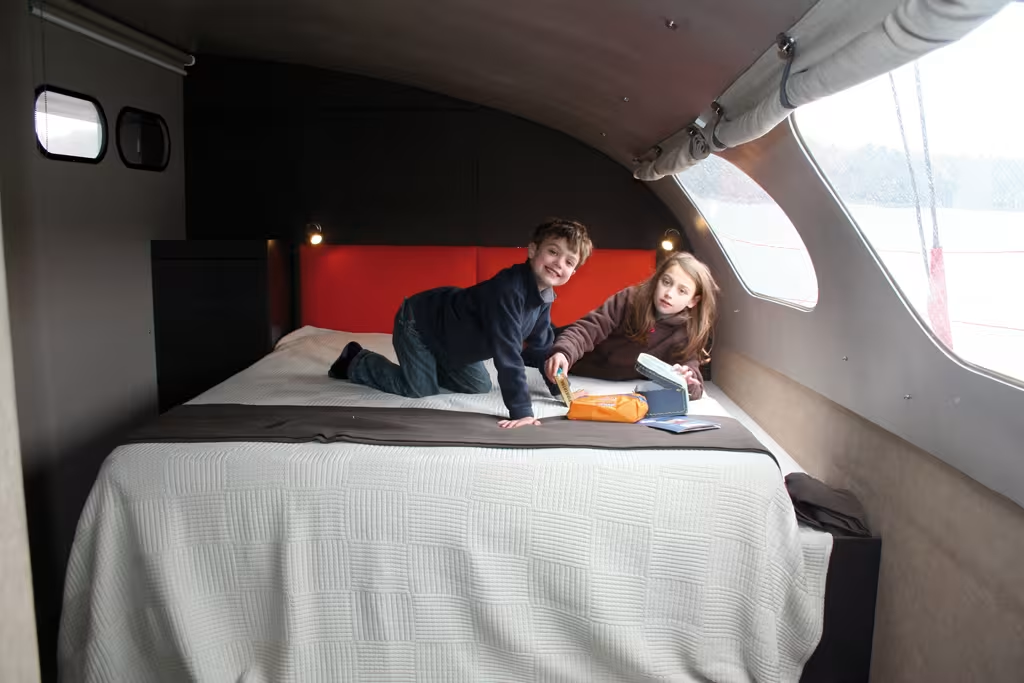
Going through the door, which opens wide in two panels, we find the central unit, which supports the single large sink; it is in varnished anthracite coloured MDF, and is very successful. It proved to be perfect for chatting, or having a drink at aperitif time. To starboard, longitudinally, there is the galley worktop, with the gas rings and underneath, a fitted oven. Stowage is made up of big baskets which fit on the shelves. They are not very voluminous, and with reason: the various stores are in the central hull, accessed via a trapdoor in the floor, in the style of a Parisian café-bar. Moreover, it’s here that the wine is stored; when fetching a bottle for dinner, we went down into ‘the cellar’... All the halyards and sheets also fall into this ‘cellar’. With one negative point, however: you have to get into the habit of coiling the halyards correctly, especially the main halyard, to avoid them turning into a pile of spaghetti at a moment when you have to furl the sail quickly, when taking a reef, for example. To port is the cupboard type fridge, and further forward, a real electric piano – later Eric demonstrated it to us. The starboard cabin is the owner’s (each one measures 9m²); there is access to a first heads from inside. Here there is no mechanical WC, but a simple ‘throne’, whose top is closed by a watertight hatch. This certainly won’t get blocked and will never break down. Otherwise, there is a wash basin and a shower head. The water from the shower drains directly into the sea, via scuppers drilled into the floor. It would be hard to design something simpler, whilst maintaining a minimum level of comfort. The port cabin is almost the twin, except that access to the heads is via the central corridor: and the WC here consists of a classic production toilet bowl, which can be connected to a black water reservoir where this is necessary. The forward part of the Neel is the living area. Its designer chose to fit the chart table here, as well as the saloon, from which there is visibility over about 300°, and at each side, a raised, comfortable, watchkeeping station... On condition that you are not sailing to windward and that the sea is not too rough. We were to find out later that to windward, this area is only just bearable. Forward, the pitching is more than noticeable. Eric Bruneel is working on the idea of offering a bare boat, without the accommodation that exists here, with a big cabin either side and another small cabin, accessible after descending a few steps, right in the bow. There is something of the ‘trawler’ in this boat, with its semblance of a ‘bridge’ at the front.
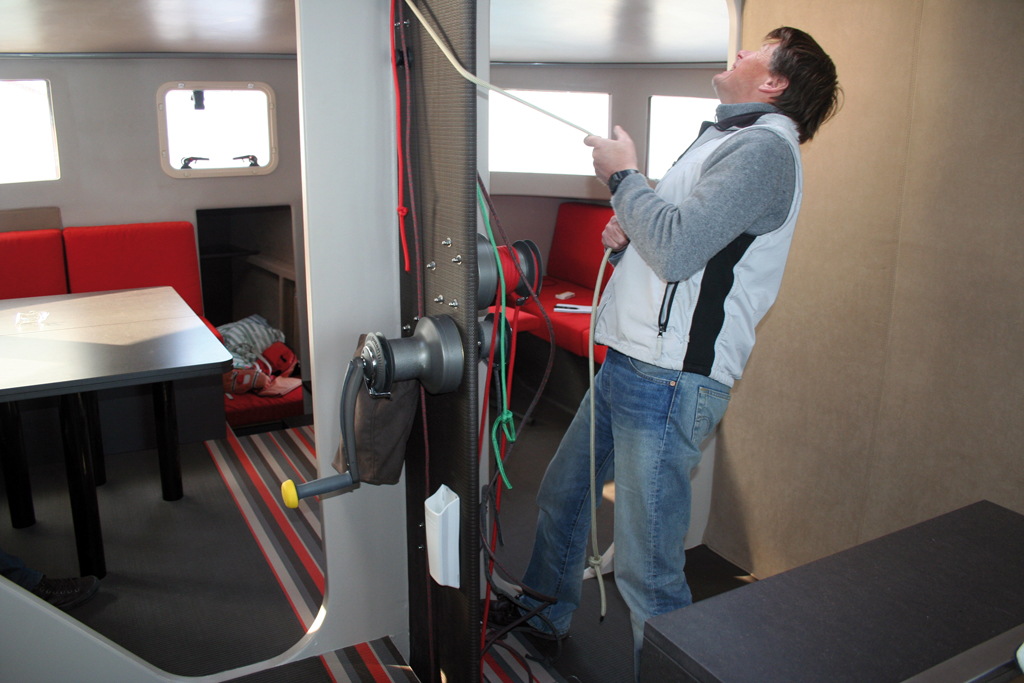
The manoeuvring position is inside. The dream of all long-term cruisers…
A quite surprising deck plan.
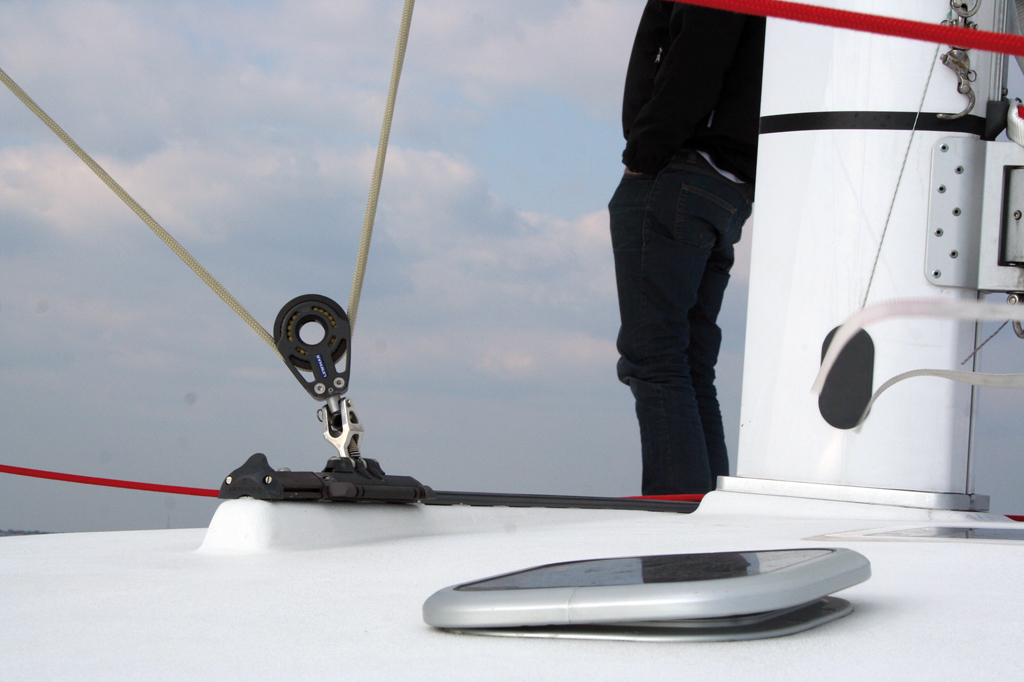
The deck plan will surprise quite a few people: from the helm, you have access to almost none of the control lines, apart from the big genoa’s sheets. Even the mainsheet is led inside. It is made up of a single strand in Dyneema, spliced around the boom, returned to a fixed block (there is therefore no mainsheet traveller or double tackle for fine trimming). This strand then crosses the central hull, before reappearing from the ‘entrails’ of the trimaran at the manoeuvring station, inside. On this kind of boat there is of course no kicking strap, “on downwind points of sailing, a barber allows the sail to be flattened,” Eric pointed out, “and the same goes for the foresails.” But the barber was not rigged, we were sailing with a beam wind on port tack, and the single sheet didn’t allow us to trim the mainsail properly; it spilt wind from the top. 15 knots, 16 knots, it’s nice sailing fast! We had been at sea for three hours, and Les Sables d’Olonne was already abeam. The children were sleeping; the four adults remained up forward, watching the sea. All you have to do is imagine yourself in the middle of the Pacific, on a voyage around the world, between Polynesia and Melanesia - what this boat was made for. We were approaching the Ile d’Yeu. Thanks to the magic of the single sheet and the self-tacking jib, the tacks were carried out from the warmth of the interior, without having to get out of our slippers. Night had not yet fallen when we anchored in the lee of Yeu. Once the right length of chain had been veered, a Dyneema line between the chain and the bow slackened the chain and avoided the shock loads on the windlass. At 4 am, the anchor was weighed. The bow roller showed its limits as we hauled in the chain: it was subject to ‘twisting’ once the chain and the boat were no longer perfectly aligned. The problem should be solved by reinforcing its cheeks. The mainsail was hoisted again, and the staysail unrolled. But the wind had headed us, we left close-hauled and very quickly had to reef the main. Although the halyard is inside, this is not the case for the reefing pendants and the tapes that have to be hooked on outside. Then, with a steady 25 knots, the second reef clearly balanced the boat better, in a choppy sea at the mouth of the Loire. Which didn’t stop us maintaining 10 knots.
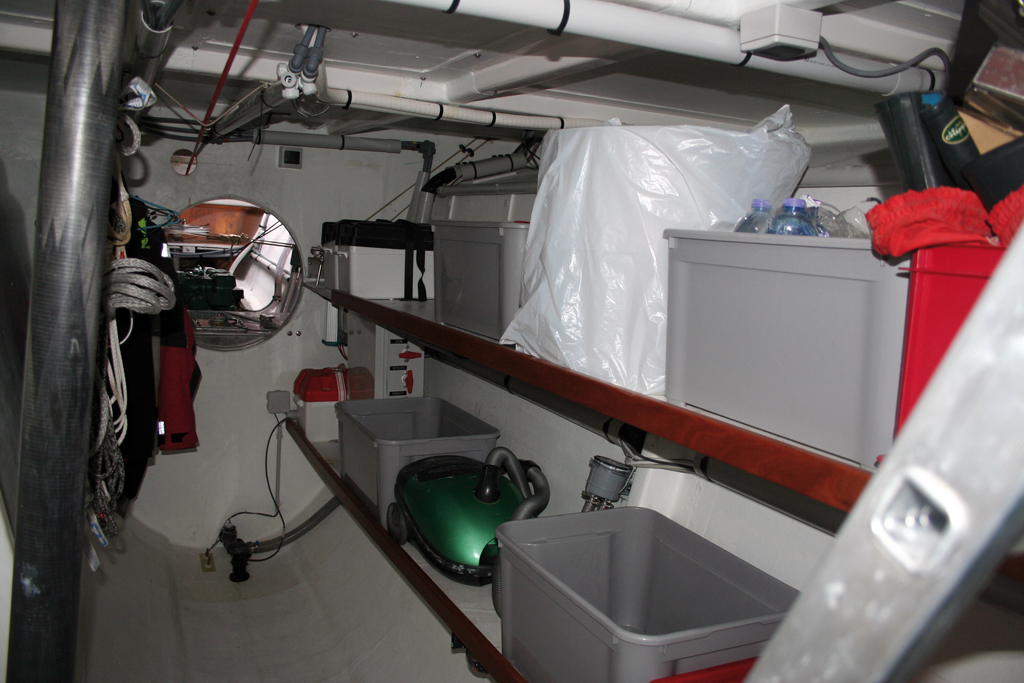
Finally, a blue water boat where the necessary supplies (and even much more) can be stowed in the central hull.
Conclusion
This trimaran cannot leave anyone who loves boats indifferent. It brings a breath of fresh air to the little world of cruising multihulls, and makes an opening in the hegemony of catamarans within the cruising multihull community, and so much the better. It is a real pleasure to sail. Of course, certain solutions adopted, real innovations, are open to debate, but they can be defended. You either like it or you don’t. Let’s wish this newcomer a long life.
Technical specifications of the Neel 50.
Length: 15.24 m Beam: 11.20 m Draft: 1.10 m Unladen displacement: 10 tonnes Mainsail area: 95 m² Genoa area: 75 m² Staysail area: 30 m² Diesel engine: 75hp Diesel tank: 500 litres Water tank: 700 litres Design: Eric Bruneel. Architects: Joubert/Nivelt. Price: from 777,000 euros exc. VAT
Eric Bruneel
After 26 years spent in management at Fountaine Pajot, firstly in the export department, before becoming managing director, Eric was notably responsible for the famous Corneel 26, a reference in small, fast catamarans. He also has a solid experience in racing: French sport catamaran champion in 1989, ‘Little America’s Cup’ semi-finalist in 1991, in Melbourne (Australia), in match racing aboard a C Class catamaran with a rigid wing, winner of the Ostar in 2004, the Fastnet in 2005, and finally second in the Route du Rhum in this same boat in 2006. What else?
Gérard Pesty’s Architeutis.
Architeuthis, the ancestor of the Neel? The family connection with the boat with which Gérard Pesty took sixth place in the 1976 Ostar is flagrant. It is simply from another era, built in plywood (the following models were in polyester sandwich) by Workboat Ltd., in Bristol. As for liveability, the two boats are about the same; Gérard’s trimaran had 1.8m headroom in the floats (which here are not fitted out), and 2m in the saloon, with an accommodation layout consisting of a huge saloon, 5 separate cabins, and 4 heads. For the Ostar, Architeutis was fitted with a daggerboard.
Caption
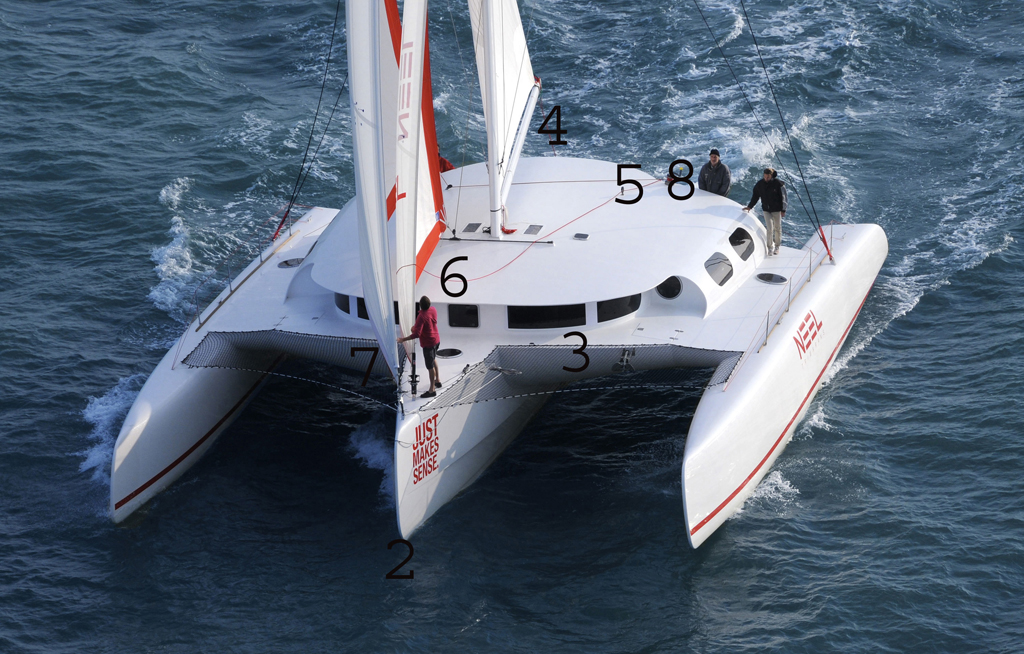
002: Note the two fixed keels, which are very short, but have a high aspect ratio (the keel under the central hull is hidden).
003: The coachroof extension, to reduce the greenhouse effect in the tropical sunshine.
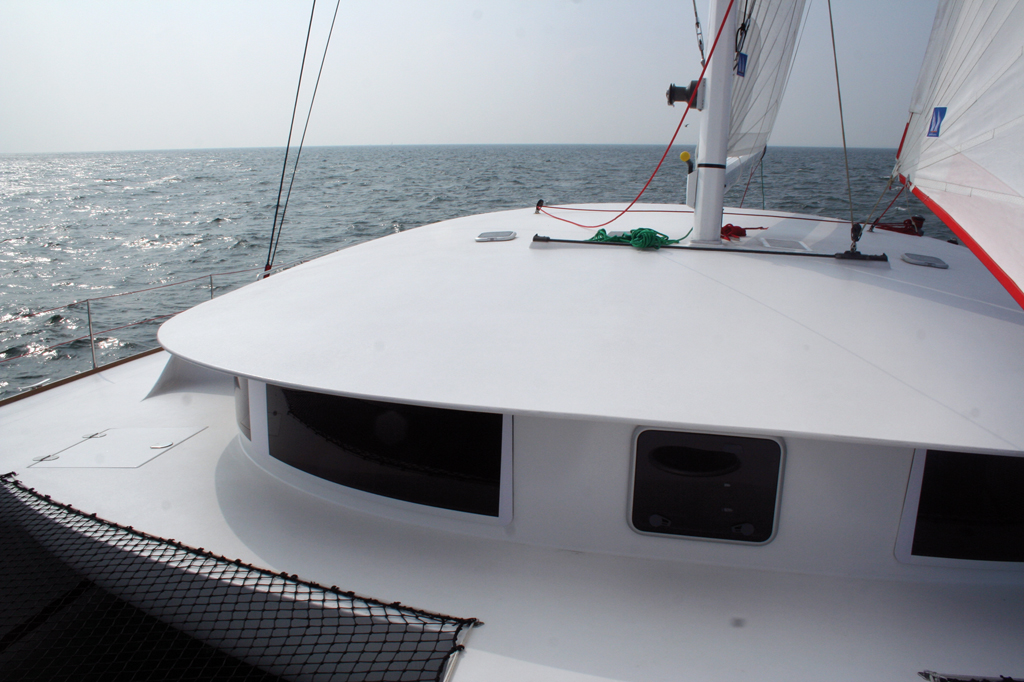
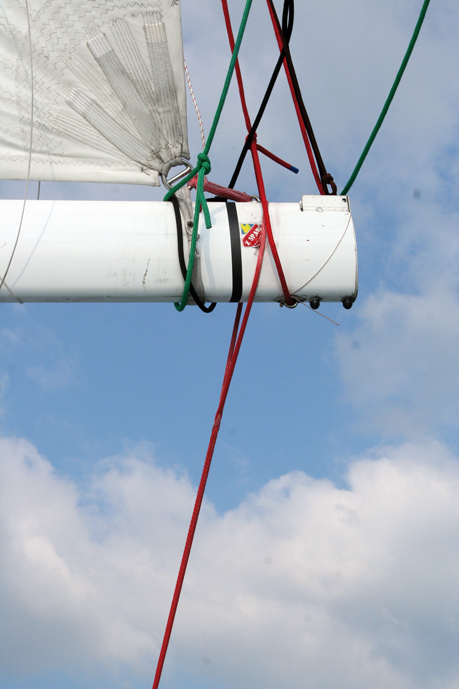
004: The mainsheet, which has no traveller, is made up of a single strand of Dyneema. Fine trimming is carried out with a barber.
005: The passage behind the coachroof extension to get on deck is a bit tight; and the guardwires here deserve to be higher.
006: No mainsheet traveller, and a self-tacking jib – the elements of problem-free tacking.
007: The sail plan is made up of a big staysail (or a small jib?) and a big genoa (or small gennaker?).
008: At the steering position, the only control lines accessible are those belonging to the gennaker.