
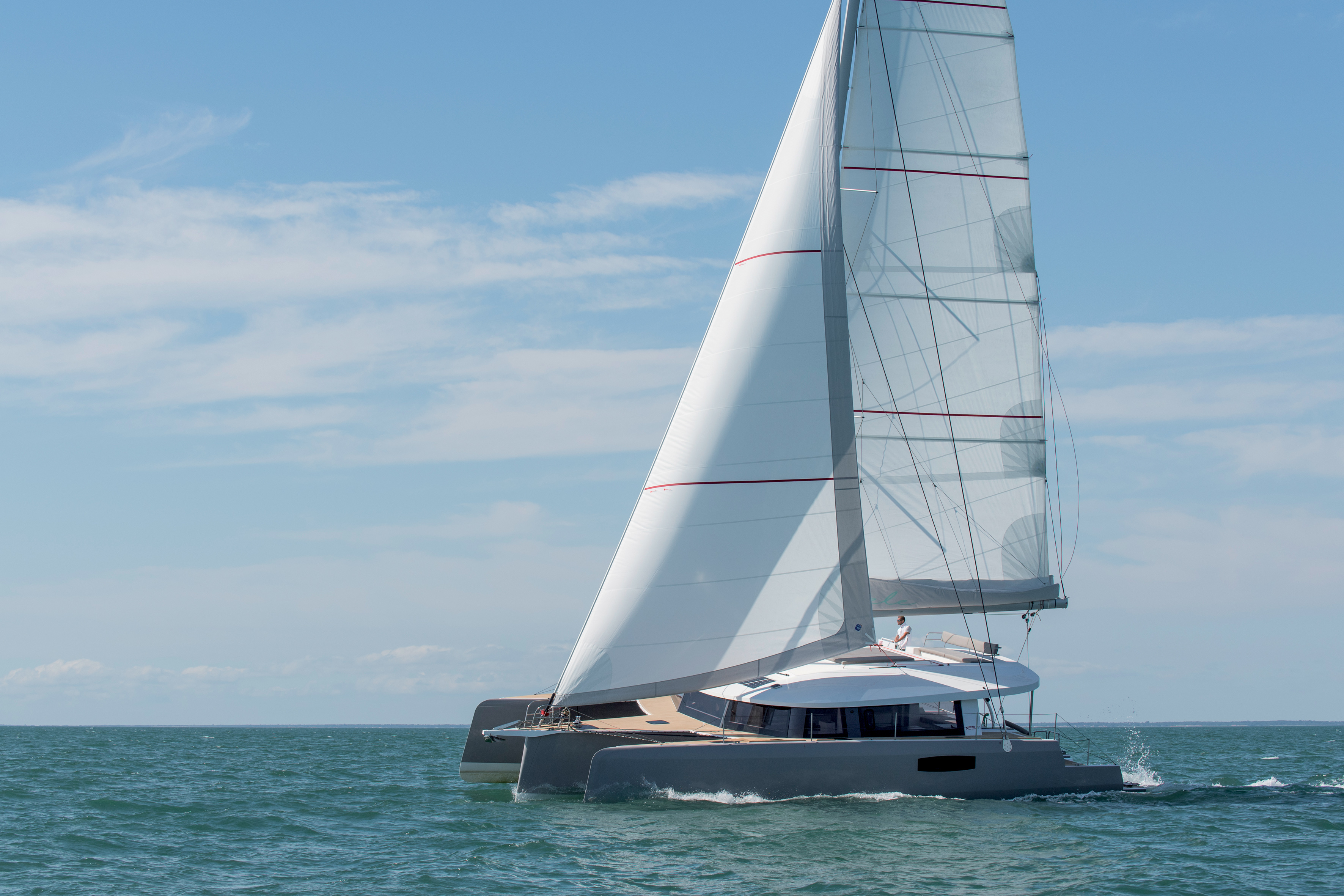
When the first Neel 50 prototype was displayed at the La Rochelle show in 2011, nobody could have predicted how this radical builder, who had only recently appeared in an already very competitive multihull market, would see such development. However, the twenty five Neel 45s already built demonstrate the significance of the formula. The 51 was completed in time for the latest show at La Grande Motte, and demand has indicated that an extension to the factory is required! We spent two days on board number 2 in the series, and here are our first impressions.
Infos pratiques
- Le chantier : Neel 51
- La fiche technique
-
 Découvrez notre vidéo exclusive
- Financez votre NEEL 51
- Assuez votre NEEL 51
- Articles autour du NEEL 51
A genuine background
The founder of Neel Trimarans is an experienced sailor/businessman. The French sports cat champion in 1987 and specialist in Class C, he joined Fountaine Pajot and launched the Corneel 26 - a French extrapolation of the American Stilleto. It was a small multihull which combined a sports cat with a cruising cat. It was an efficient and playful machine which introduced the concept to many future enthusiasts. After this success and for the following 25 years, Eric Bruneel was involved in the yard’s development. He became the export manager, then the deputy managing director. He took a little break during the 2000s and got involved in the new M50 class at the helm of his Trilogic, with which he won The Transat 2004 and was placed second in the 2006 Route du Rhum, before embarking on the adventure which has become Neel trimarans.
Back to the roots of the cruising trimaran
Although there is much evidence of proto-catamarans (since the 18th century in England), the Western rediscovery of trimaran geometry is quite recent (André Sandrin's inaugural crossing of the Atlantic aboard Amanda dates only from 1946!). If we look for precursors of the Neel brainwave (a catamaran coachroof on a trimaran platform), we must turn to Arthur Piver and the Victress (Golden Globe 1968); Jim Brown with the Searunner (although Brown softened the lines of the roof over the deck) and especially toward Louis Macouillard and Paul Weychan with the famous three: Tacitimu, Misty Law and Architeuthis (6th in the 1972 Transat with Gérard Pesty); big boats (more than 50 ') well-performing for the time, constructed in resorcinol/glass-sheathed plywood by the Workboat yard in Bristol. The Exception 52 (P.Briand / M.Pinta) made a notable breakthrough in 1986, but being rather too inspired by a "racing" silhouette, it did not exploit the volumes above the deck. In the late eighties the 52’ Lucas-designed Waarschip or Sylvestre Langevin's Triagoz 50 regenerated the idea, but these one-offs of great interest did not really re-awaken the trend, and the formula was abandoned until its rediscovery by Eric Bruneel.
A constantly evolving factory and construction method
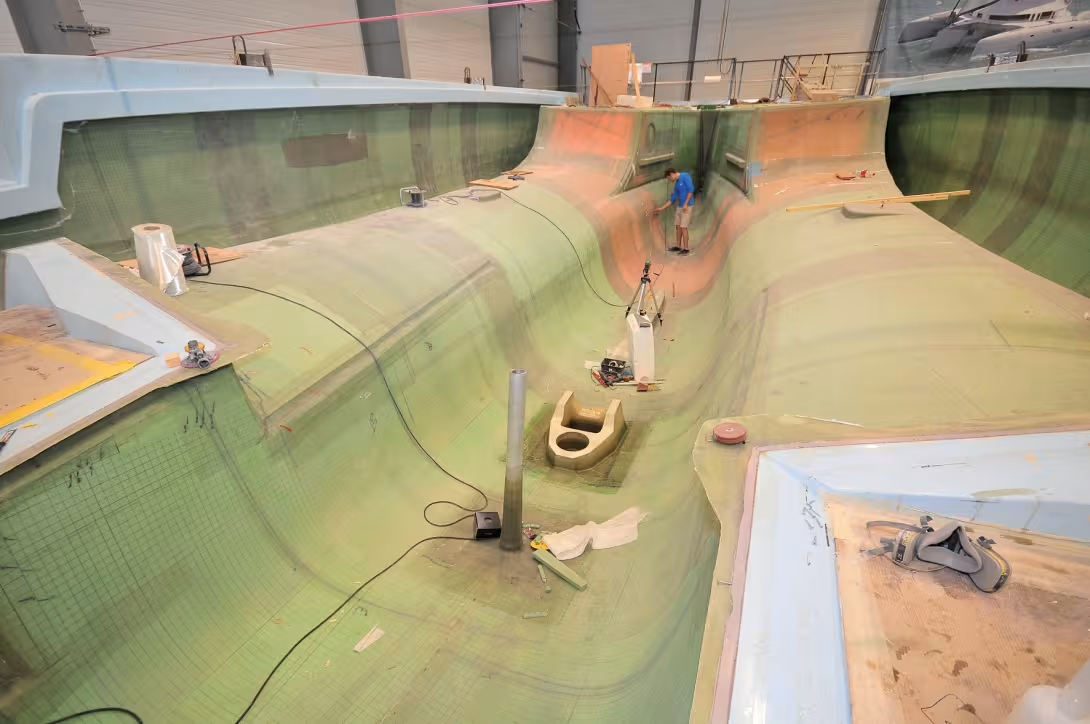
At present, the La Rochelle plant allows the simultaneous production of two 51s on the single assembly line (one in composite phase and the other in technical assembly). The doubling of the production area on the same site during the summer of 2017 will significantly increase this capacity. The build of the 51 is mainly done in-house, but certain parts (bulkheads) are sub-contracted, thanks to the quality of the players in the field locally (Pinta / Naval Force 3 ...). The infusion process is conventionally carried out, in 2 phases: first, the central hull with the wings and the inboard half-hulls of the floats (in one shot), then the outer half-hulls, subsequently joined by lamination along the line of the keel. The main, one-piece, transverse bulkheads follow the entire trimaran shape and are glued and the corners filleted by hand lamination. The installation of the deck and the secondary bulkheads will complete the homogeneous "mechanical box" effect. The structural calculations are carried out by Tensyl, from the usual critical data (boat catching a wave at high speed, sailing with a cross-sea...). Construction uses vinylester resin for the topsides, and anti-osmotic polyester resins with 80kg / m³ PVC foam and four-axial glass cloth. The mast support made up of a square-sectioned, aluminum beam backs onto a main bulkhead to prevent it bowing. The engine is mounted on a frame laminated to the central hull. The shaft tube is laminated to the bottom of the hull and above it is a substantial shelf housing the autopilot and turning blocks for the fiber steering lines. The hull has a marked curvature with fine-entry bows and harmoniously increasing volume; the sections fill out in the beam (this being necessary to carry the maximum displacement of such a luxurious boat!), and then level out generously aft to encourage planing. The high freeboard keeps the boat clear of spray. The profile of the semi-elliptical rudder is elegant and of good elongation, the fairly short skeg (in length) is reasonably deep in an attempt to find a balance between efficiency and draft.
Guided tour of a floating loft apartment
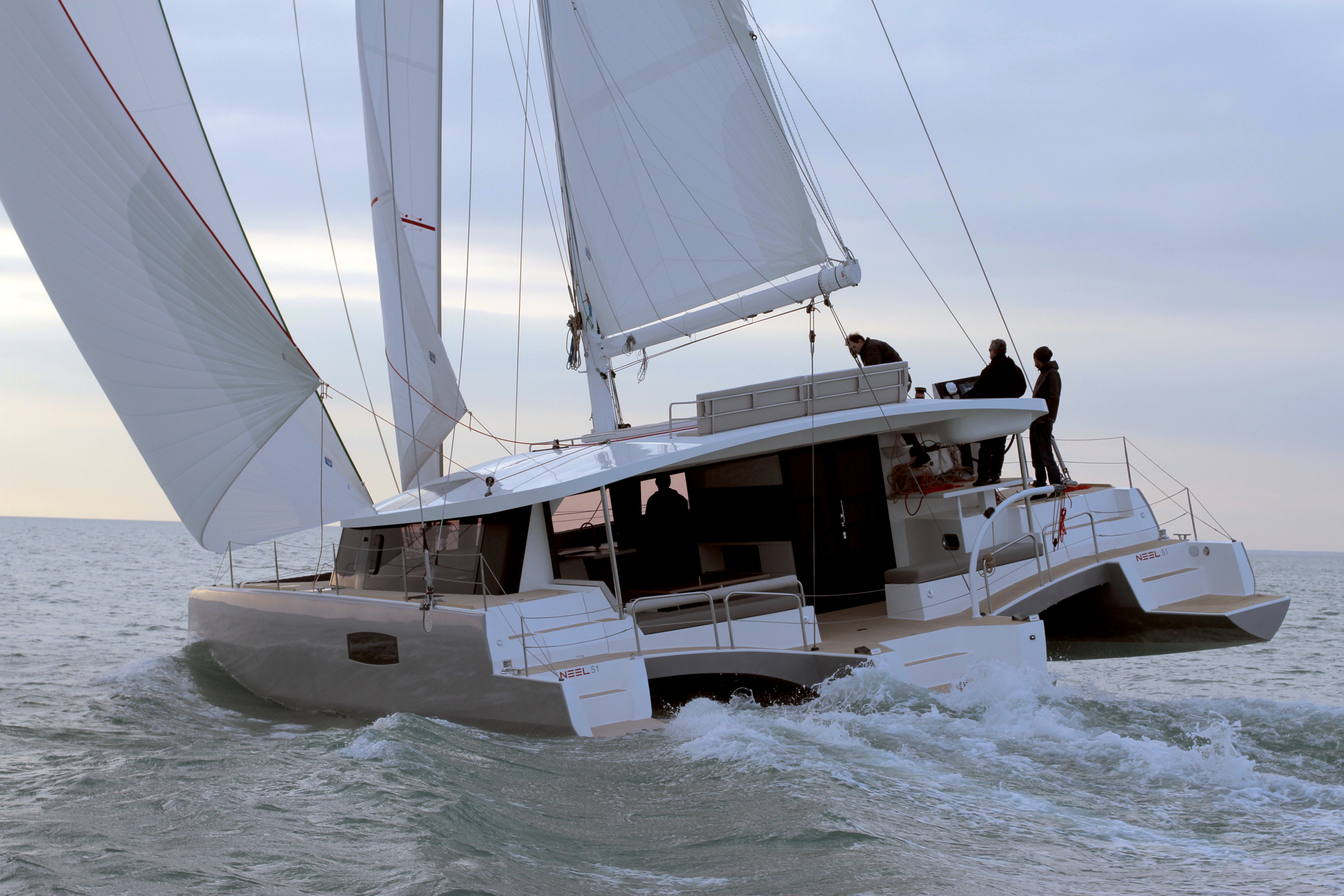
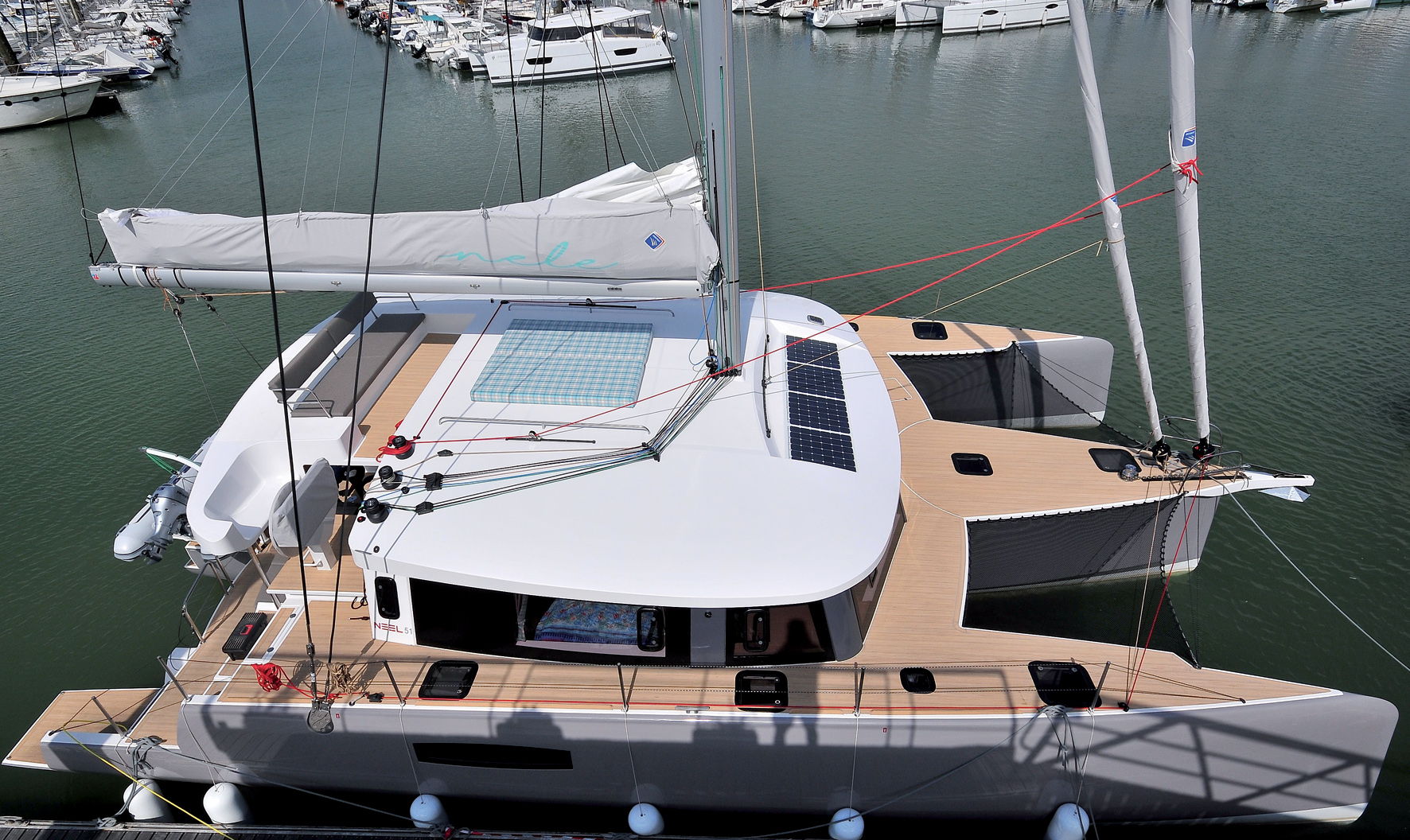
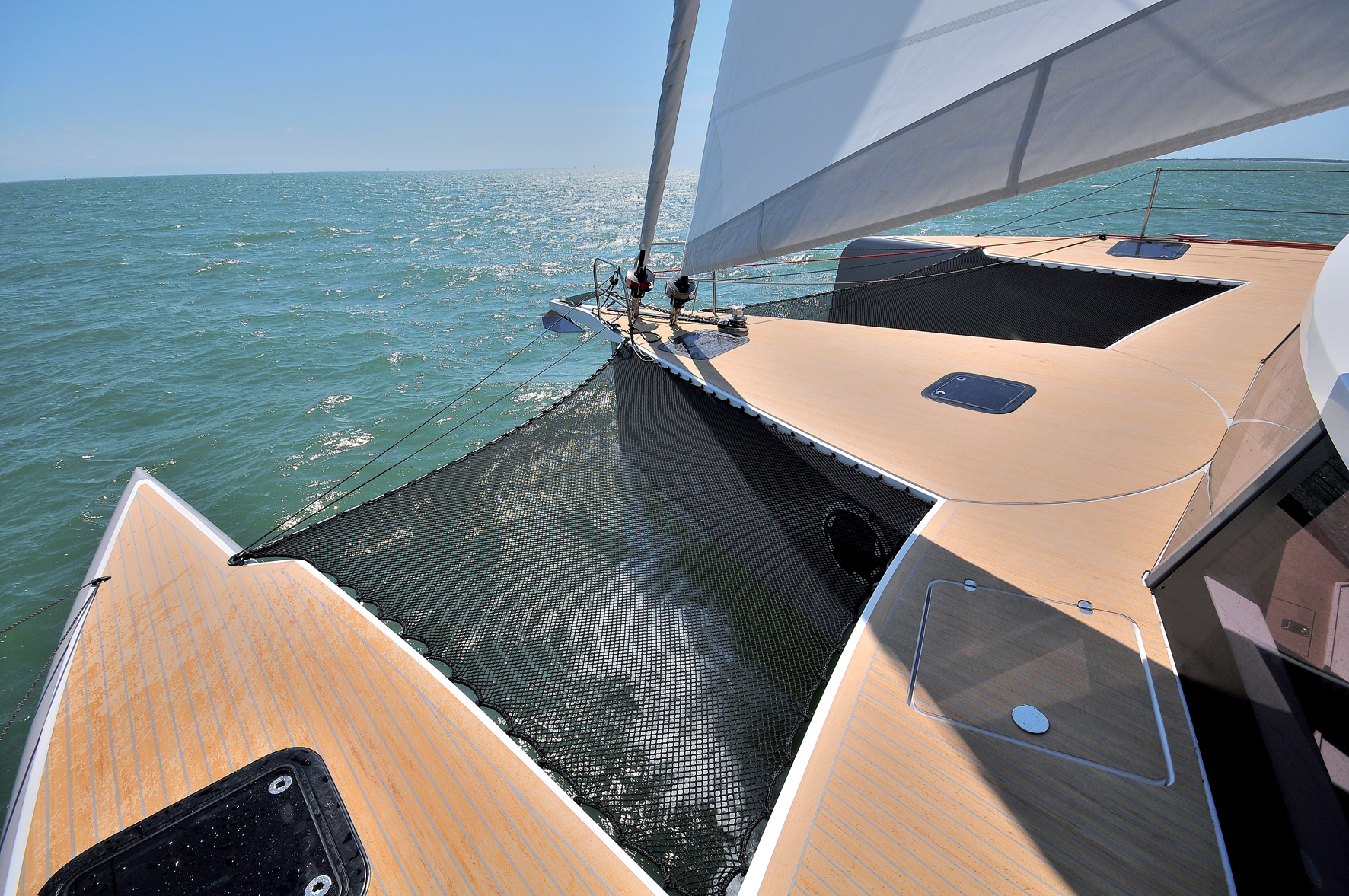
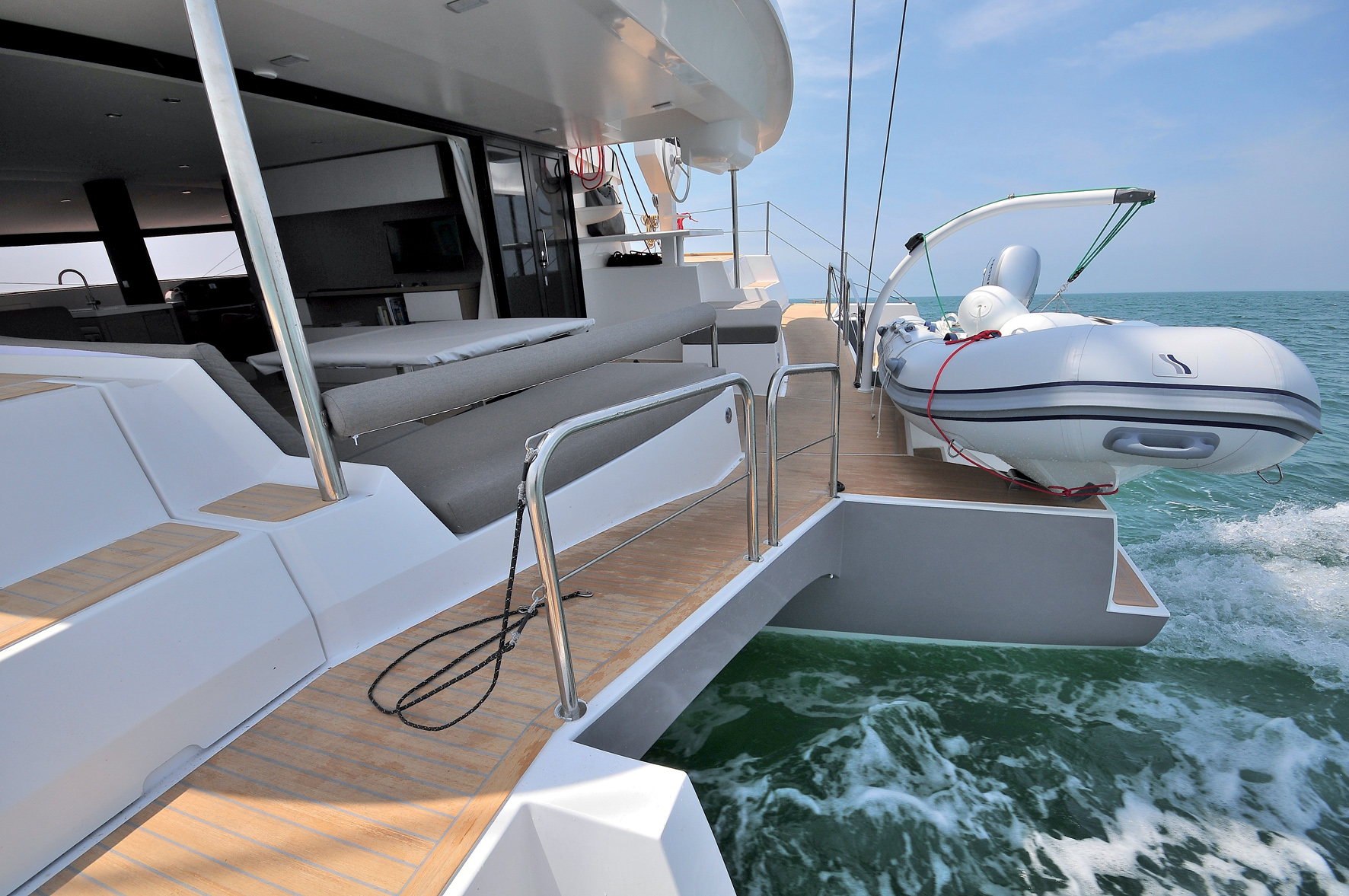
The Neel 51 did not invent the open space between the coachroof and the deck salon, nor flush-decked access, nor the lounge deck, helm station or full forward vision. These concepts from catamarans on a 3-hull geometry, positioning the main cabin on the bridgedeck, demonstrate a quite original and alluring management of the space. By combining the technical facets in a large single compartment (aft in the central hull) where there is headroom, it takes an extra step toward superlative clarity and standard-setting accessibility. A single motor, a single rudder and centered weight, placed much lower than on board a catamaran: this is one of the triumphs of this trimaran! Our trial version (4 cabins, with fitted-out hulls) is ready to go and is equipped for serious sailing, and our trip will be in a real situation of family use. As soon as you step aboard, the deck area is astonishing; safety is enhanced by the excellent grip of the new Flexiteek decking (optional) and double (fluorescent) Dyneema guardwires, perfectly stretched and supported by new Goïot stanchions in satin-finish stainless steel, whose sublime design gives a titanium appearance. The flush hatches also add to this agreeable feel underfoot; the handrails of the central hull are effective and the trampoline tension is perfect (everywhere the ropework is of a very good standard). From the helm, you can reach the Lounge Deck, where the view from the bench seating is a real success. When arriving in the “cockloon” (Neel’s terminology for the combined cockpit/saloon), the sensation of increased space is impressive, whereas the overall beam is only 16 to 25cm greater than some equivalent-sized catamarans!
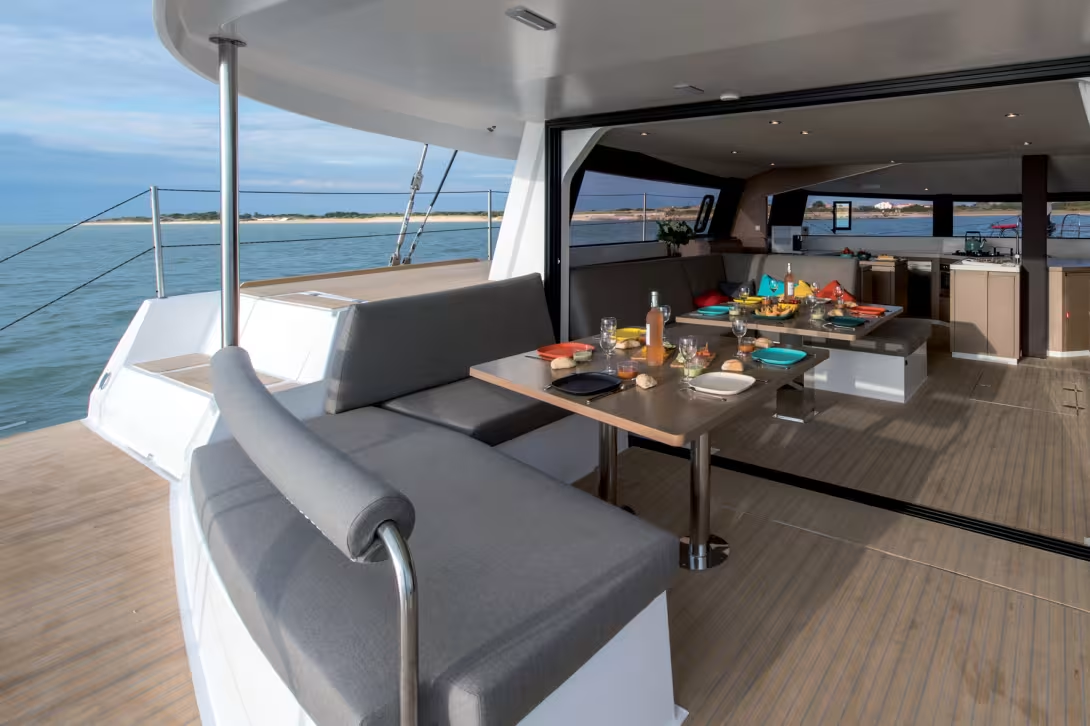
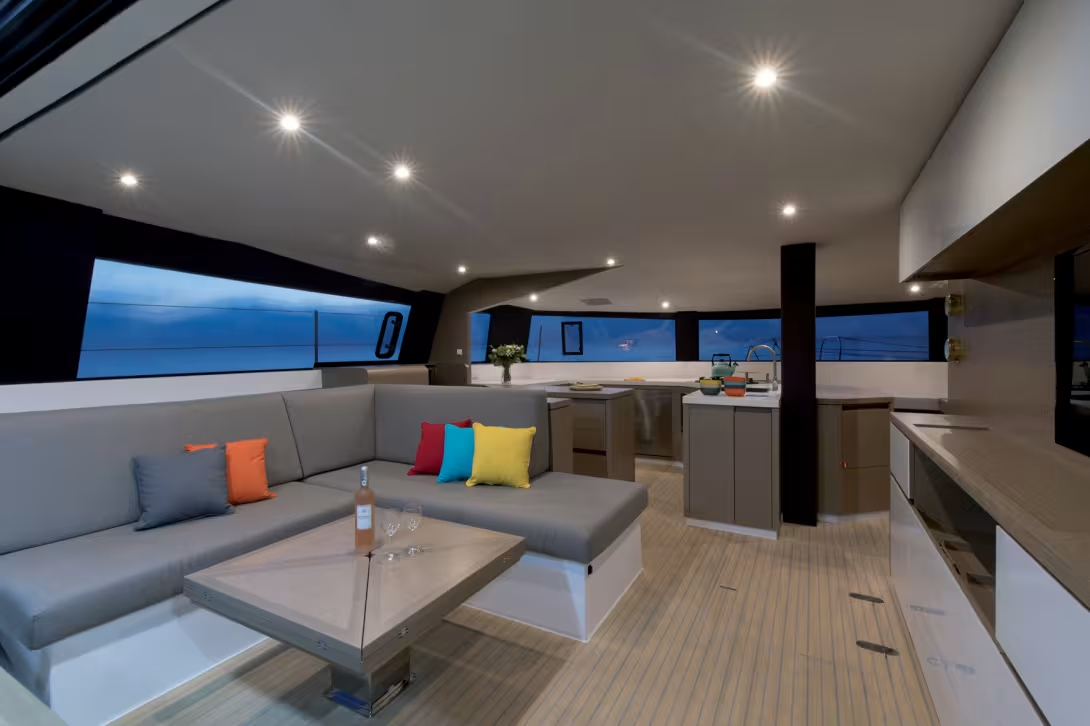
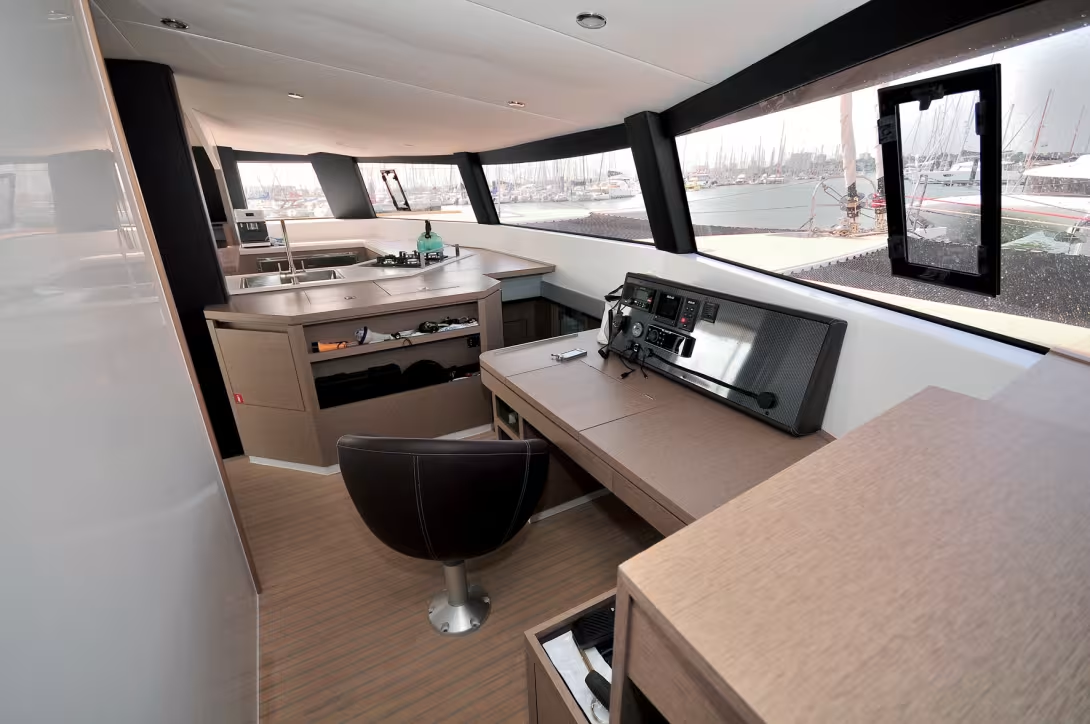
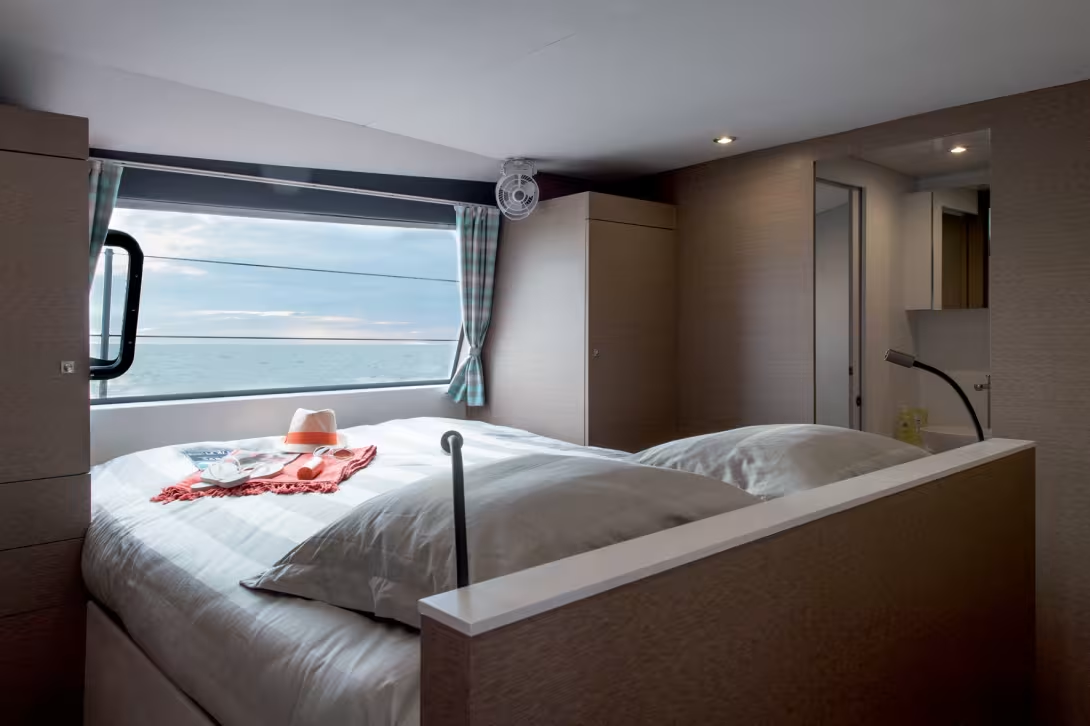
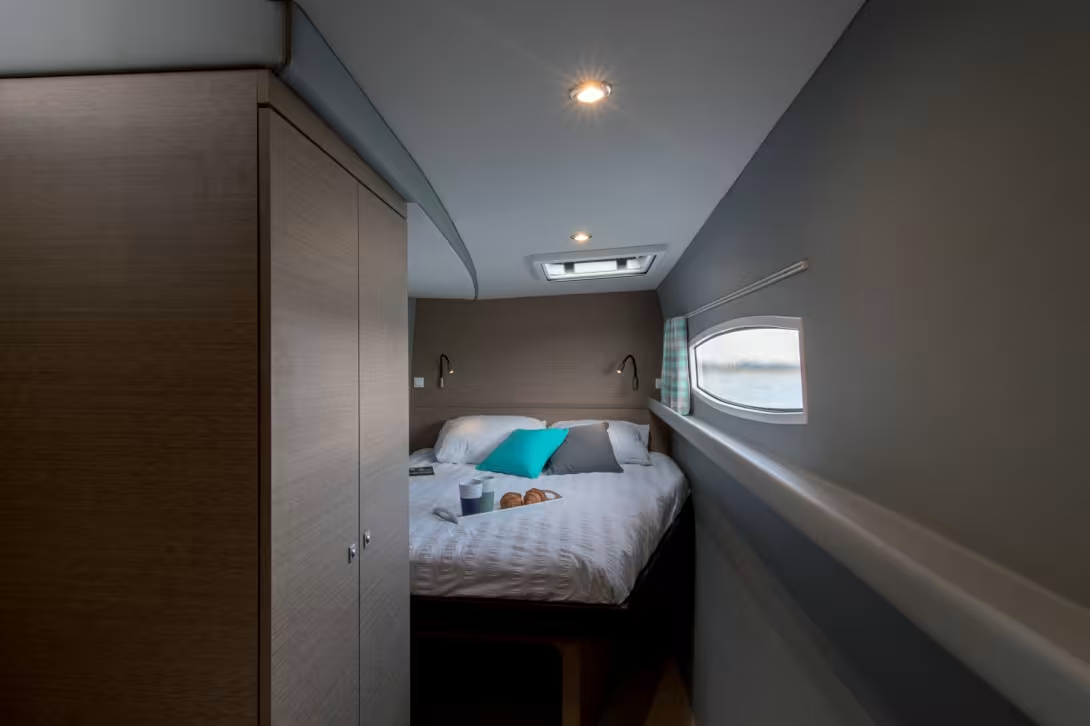
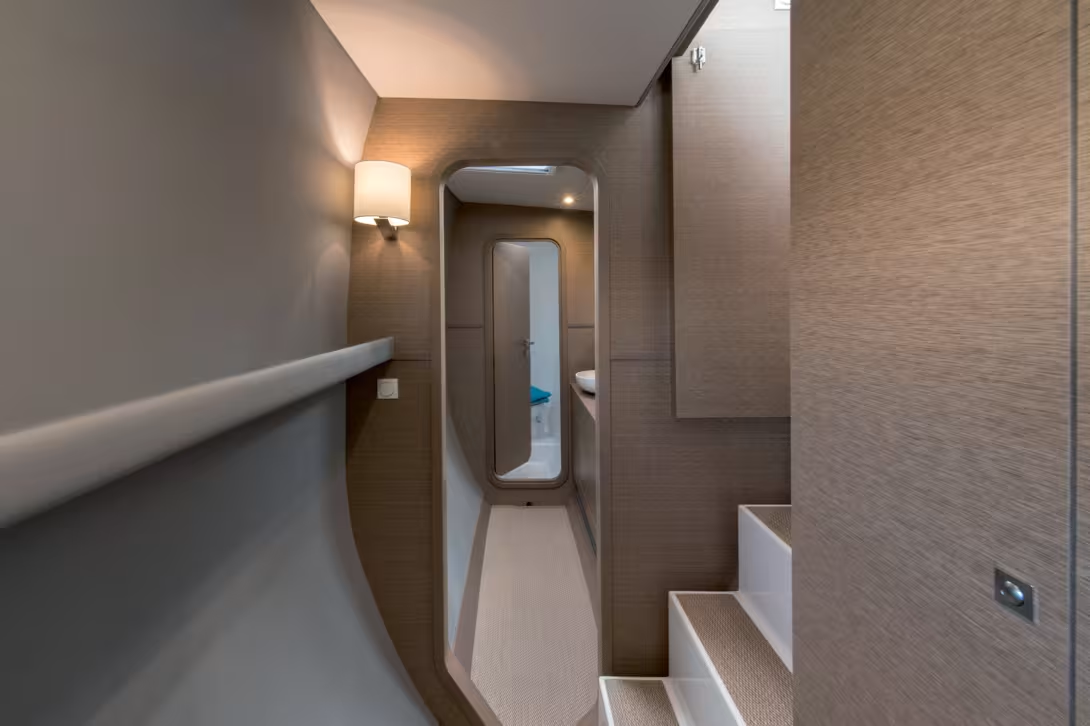
The movable bulkhead (in 3 sections) is retracted on the starboard side uncovering a unique perspective on this size of boat. One of the elements of the 2-section table is installed on a telescopic foot and can be transformed into a sensational cruising lounger. This “dining room” can comfortably seat ten. The galley is huge! It will delight any seafaring chef: I could be left here, with this view, and I assure you I would never feel the need to set foot on deck to trim the sheets. This “cooking console” is so seductive that it will be impossible for anyone to complain about being on galley duty ever again! The chart table is also remarkable. Large and cleverly arranged, its forward position makes it a formidable watchkeeping position, away from any bustling onboard activity. The master cabin, housed in the nacelle to starboard, is a Neel specialty, with an exceptional panoramic view. The forward cabin (with its private heads compartment) also reveals a beautiful intimate space, separated from the general traffic. The hull cabins (optional) look very similar to what you would find on an owner’s version 40’ catamaran! They offer bathrooms and a wc in the bows, comfortable double beds aft, and all the stowage space you could wish for when cruising. Unbelievable! The Alpi carpentry is neat, with precise fittings; the vanishing lines and the general urban-chic style are complemented by in-house produced headlinings and upholstery of a very high standard.
Mechanical and technical equipment
The engine compartment in the central hull which is accessed via a large hatch in the saloon floor, proves to be exemplary. It’s a very brave move. The connection of the electronics from the mast is clearly visible as well as the connection boxes (in the event of unstepping the mast). The two aluminum tanks (600 l each!) back on to the main bulkhead (good ease of access, for checking and cleaning); the plumbing manifolds and the pressure pump are accessible and grouped together; the battery bank is housed in the bottom of the hull. Double-height solid shelves are home to all the accessories (watermaker, water heater, charger, inverter, circuit-breaker cabinet and… workshop). The motor is separated from this technical area by a soundproofed door beyond which sits the 75hp Volvo with masterful accessibility. There will be no alibis for being slack about maintenance on board the 51, as the ergonomics make light work of it!
A living trimaran
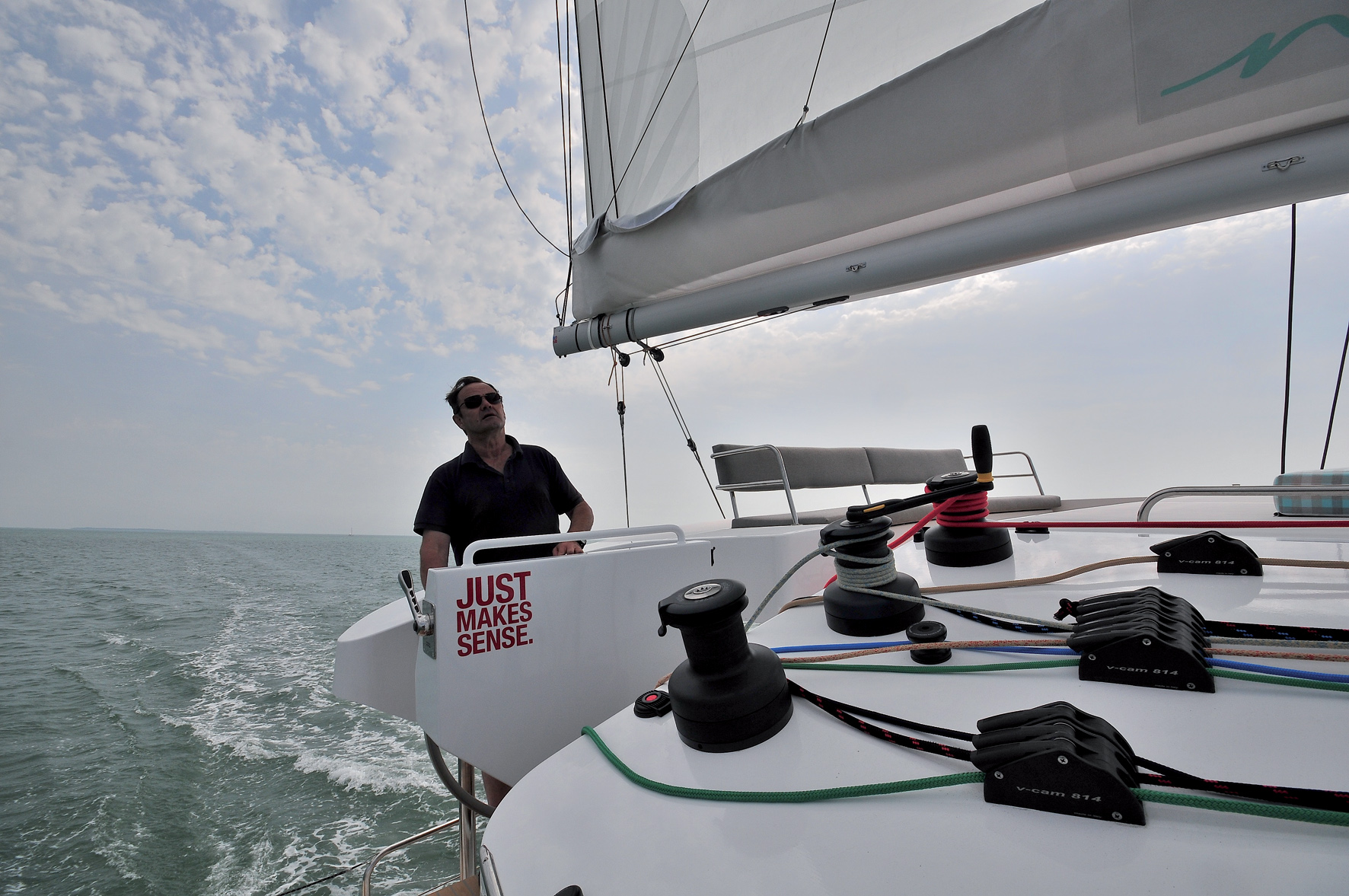
Our test boat is equipped with a high-inertia Z-Spars aluminum mast, a generous tube that inspires confidence. The stiffening is two-layer with the lateral aspect held by a pair of wire capshrouds and two lowers (acting against the forces of the forestay and staysail), which are sturdy! The cockpit architecture prohibits the use of a mainsheet track, so the two ends come back on a "German Sheet" system across the deck (via a turning block by the gooseneck and at the mastfoot). A purchase will be needed for tensioning the leech. We slip out easily from the dock in spite of a 12 knot crosswind, thanks to the bowthruster that allows us to orient the bow, and to the generous torque of the 75hp Volvo 75 coupled to a 4-bladed folding propeller. There is a nice feeling of function, and there is no vibration, and little noise. Outside the sea is calm, just covered by a light chop. The Neel 51 picks up quickly under mainsail and genoa, and goes upwind with conviction. The effect from the fixed anti-leeway design is excellent. The boat is well-balanced; the helm remains pleasant (Vectran lines on blocks and single rudder). It’s a joy to discover, and we have excellent first impressions!
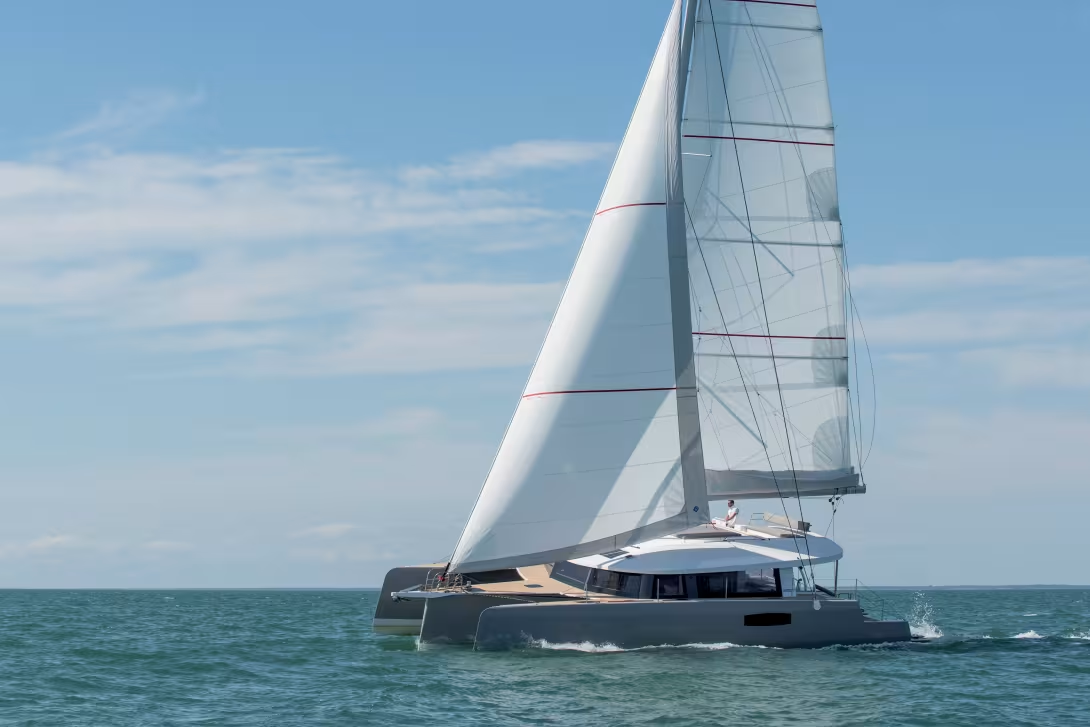
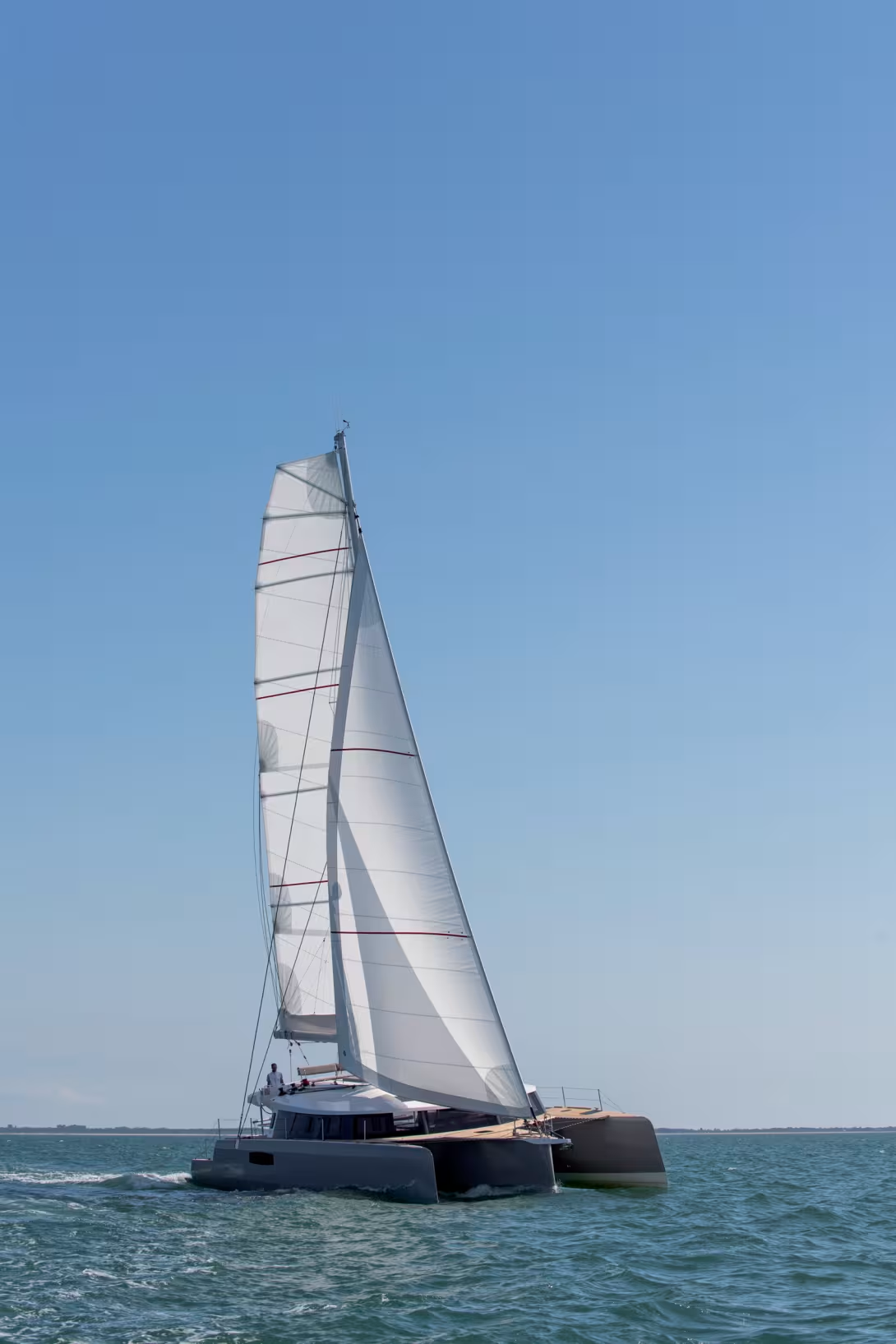
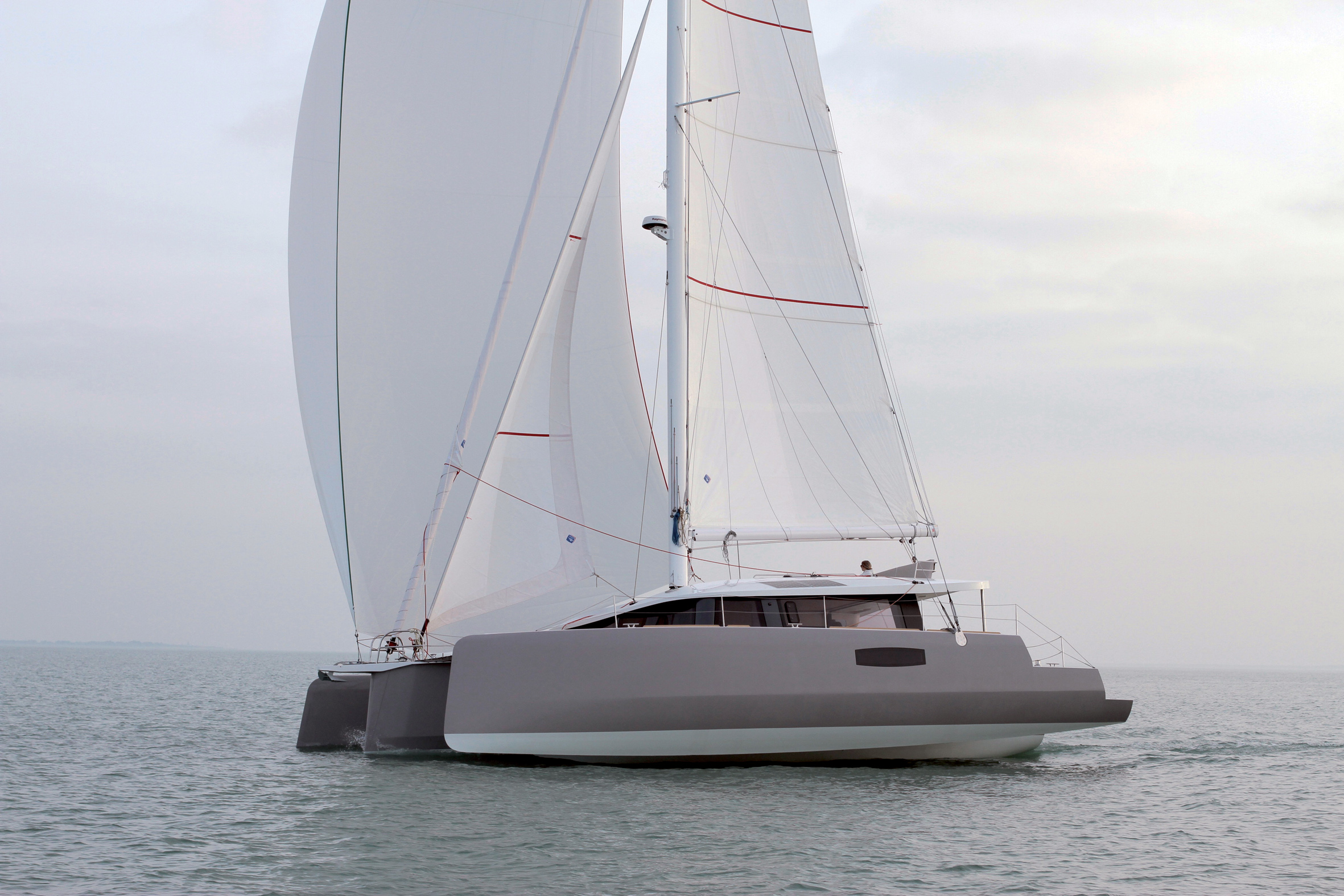
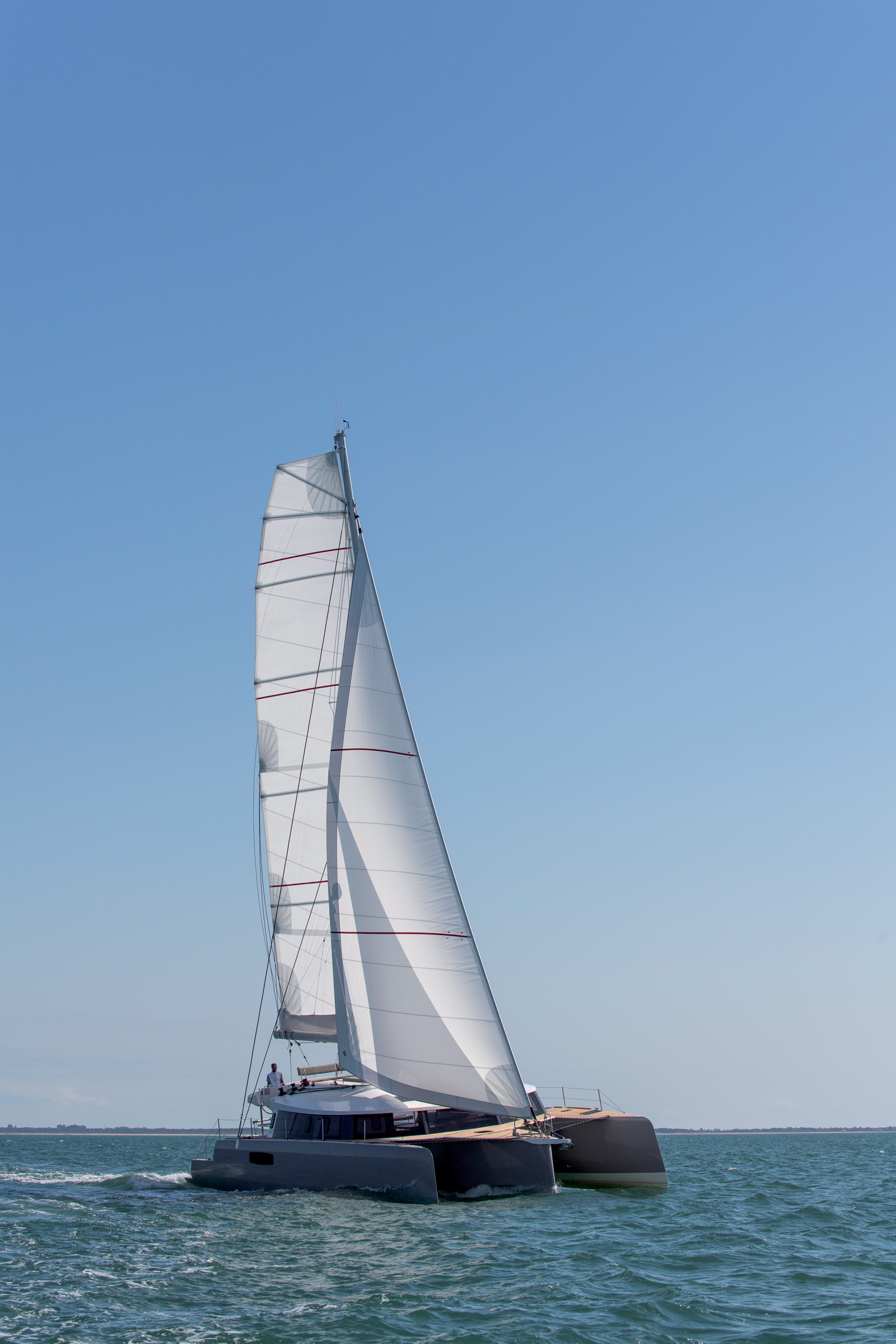
The genoa overlap, in conjunction with the 97 m² mainsail generates a dynamic flow that propels the boat well. I am pleasantly surprised to note the immediate lightening of the windward hull despite the absence of any dihedral angle. The fineness of the lower triangular sections allow instant support downwind. The upwind hull rises immediately and reduces its wetted area, increasing performance and comfort. The increasing hull volume generates a powerful vertical thrust which stabilizes the whole platform at an inclination of approximately 10°. With 10-12 knots of wind, we are really slipping across the water: the trimaran is alive and fun. We need to check the instruments to convince ourselves that we are doing 9 knots with 11.5 knots true on a close reach! An equivalent-sized monohull, being well-sailed, disappears in our wake. The record of the day will be 12.1 knots with a maximum of 15 knots true wind, and an insignificant amount of tide: impressive for such a big boat! The next day, the wind picked up, with gusts encouraging us to take in the first reef and hoist the staysail. We are using this magical configuration for a breeze when short-handed at the lower end of its range (20 knots) so we re-hoist the full main, and then go back to the genoa because we want a dynamic boat for the photos but wager that this first reef/staysail combination will be used extensively when cruising. I settle inside (at the chart table) and appreciate the view. The slight heel, far from being unpleasant provides a balance of trim that I appreciate and the longitudinal stability is really impressive. There is no sea to speak of, but the feel of the platform is quite convincing and the speed without pitching is confirmed on reading the GPS. We are often doing over 11 knots with peaks at 12 under spinnaker.
Conclusion
This new champion of living space is also a pleasant and dynamic multihull that works well in light and medium airs (7-12 knots). It doesn’t hang about in medium-strong conditions (15-18 knots) like a lightweight trimaran would, but it will prove agile and fast in a sustained breeze (25 knots) downwind with surprising performance capabilities added to the safety and ease of trimaran geometry in a cross sea. The delivery crew who brought hull number 1 to the La Grande Motte show covered 290 miles one day under 2 reefs and staysail with a top speed of 20.4 knots without really pushing the boat. A 2 cabin version, well-sailed with tanks at 50% full, will constitute an awesome blue water cruising limousine.
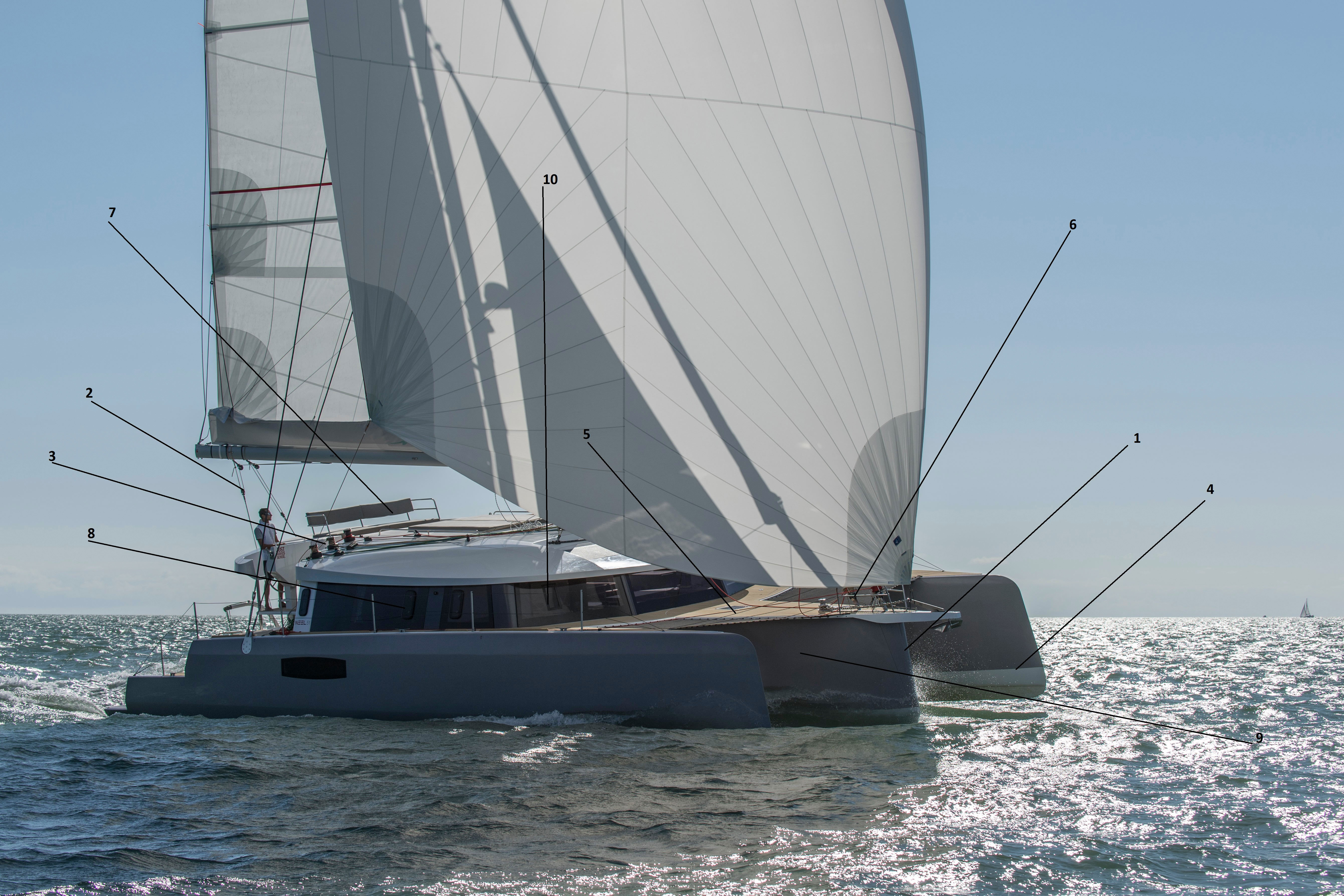
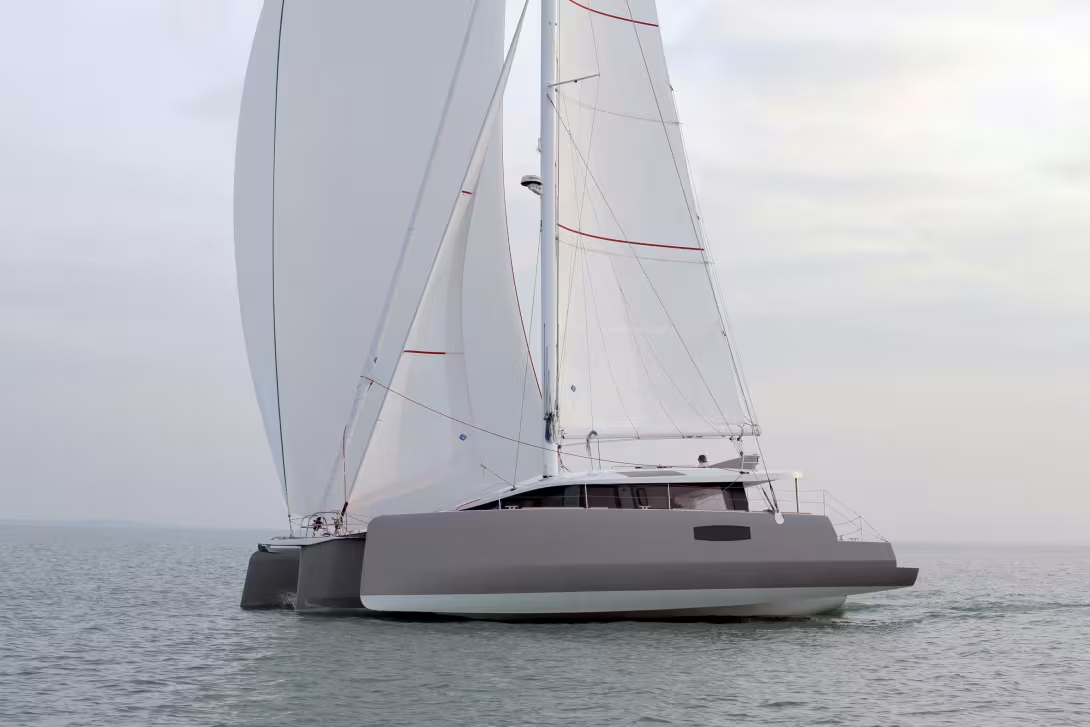
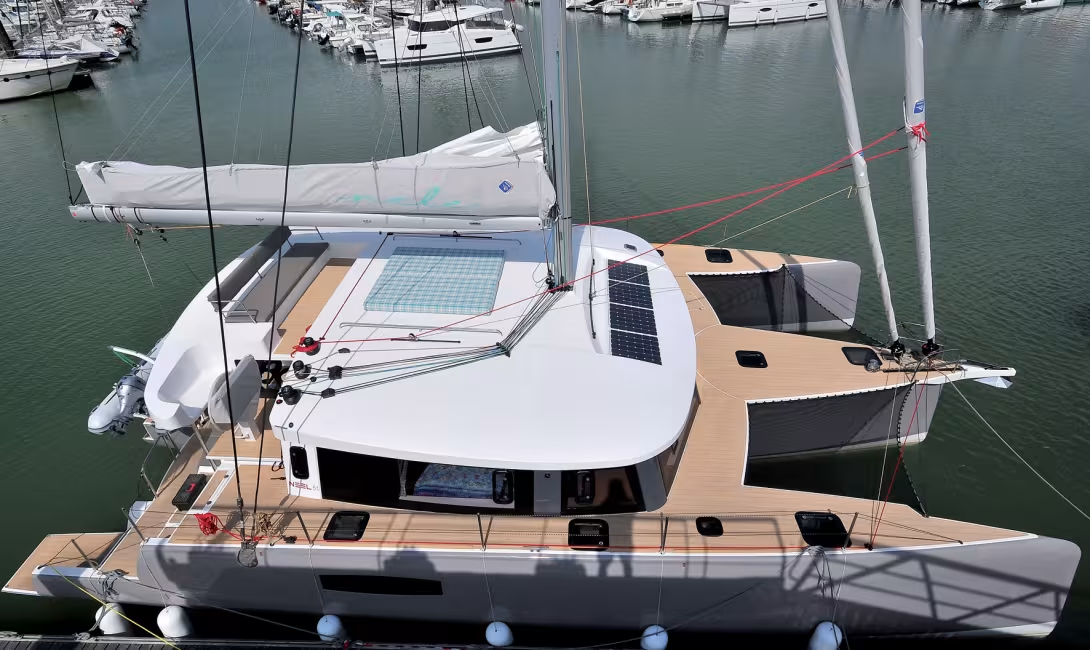
1: High freeboard and fine-entry bows protect from spray and give good bridgedeck clearance
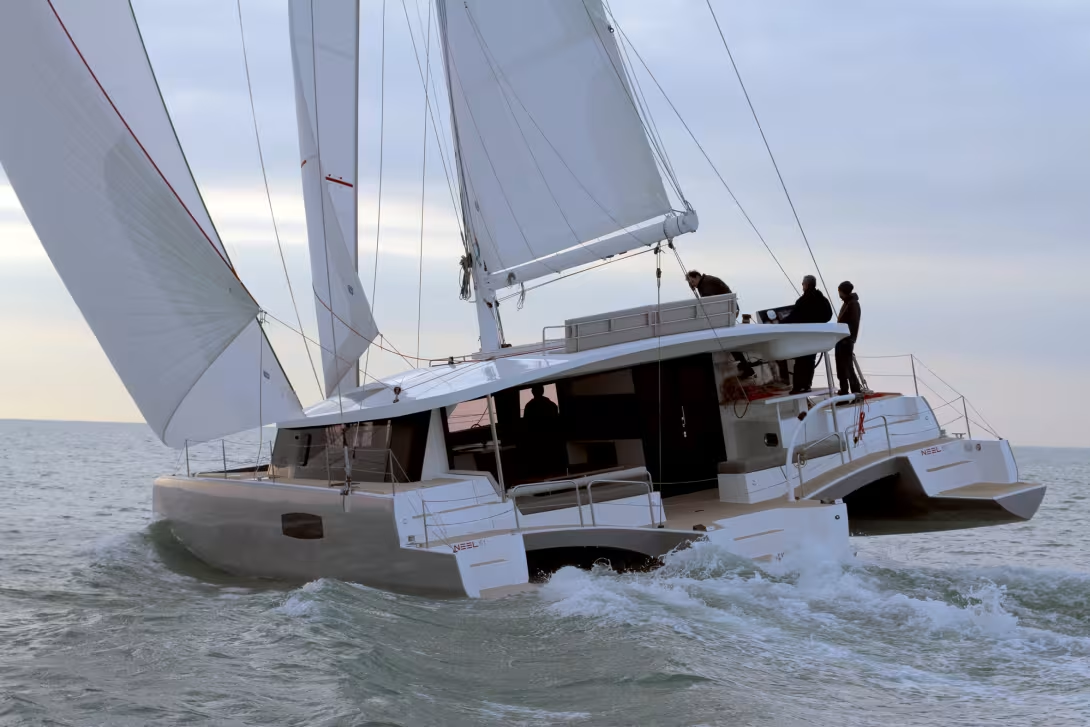
2: The twin mainsheet simplifies the deck layout, but the gap isn’t wide enough
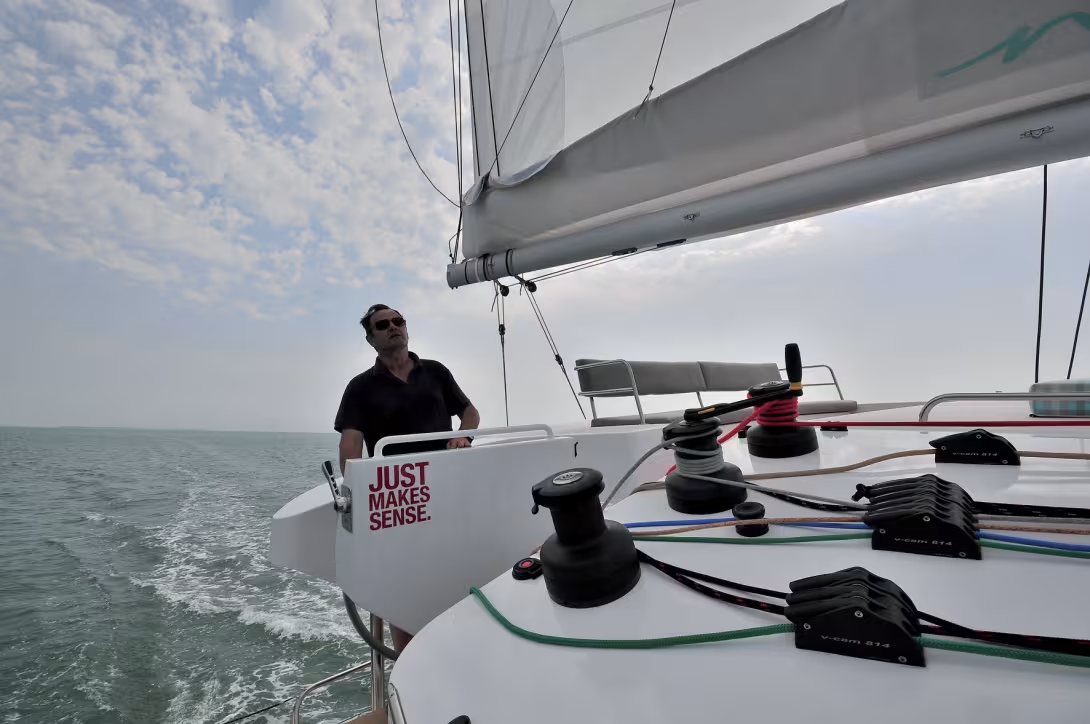
3: A simple and effective deck layout, split but close enough to the helm for use on one’s own
4: Clever hulls! With no static dihedral angle (to avoid the of tipping from one hull to the other at anchor), the windward hull lifts immediately with the slightest breeze in the sails
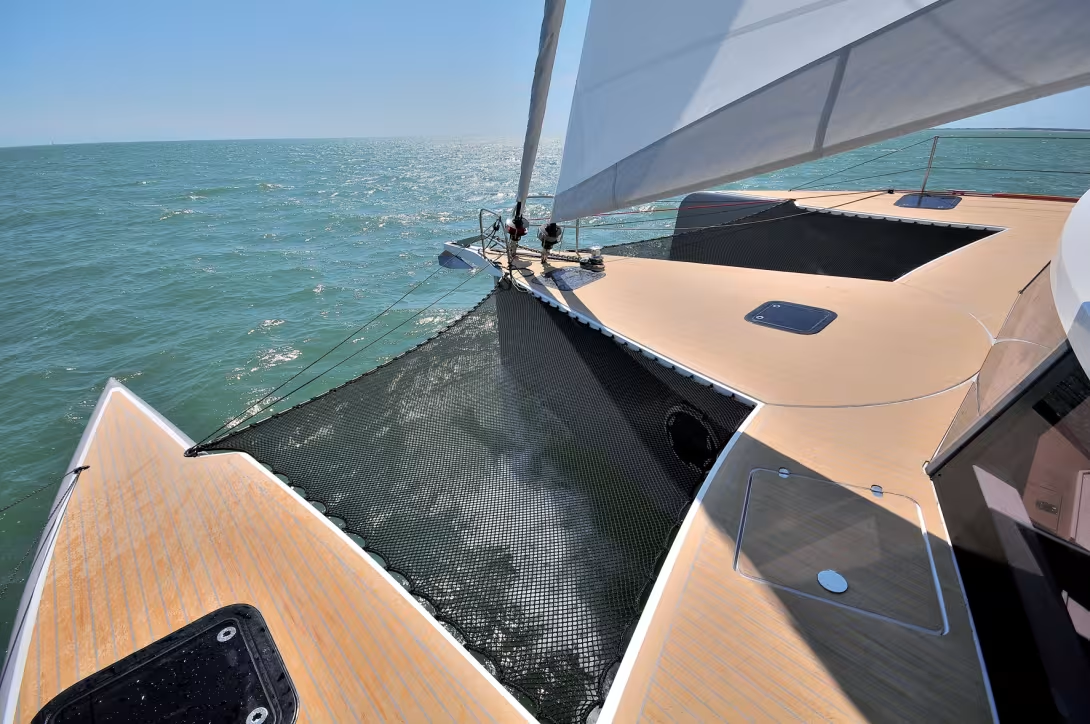
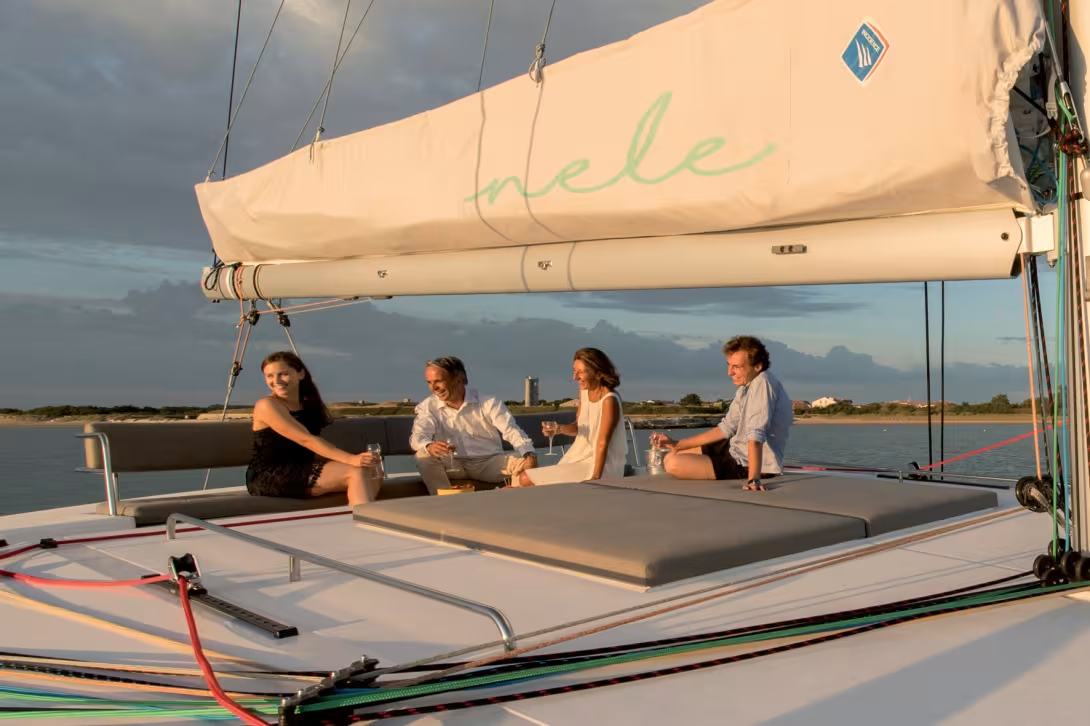
5: The deck area is breath-taking: the foredeck and the trampolines create an amazing space
6: Excellent cutter rig with two furlers
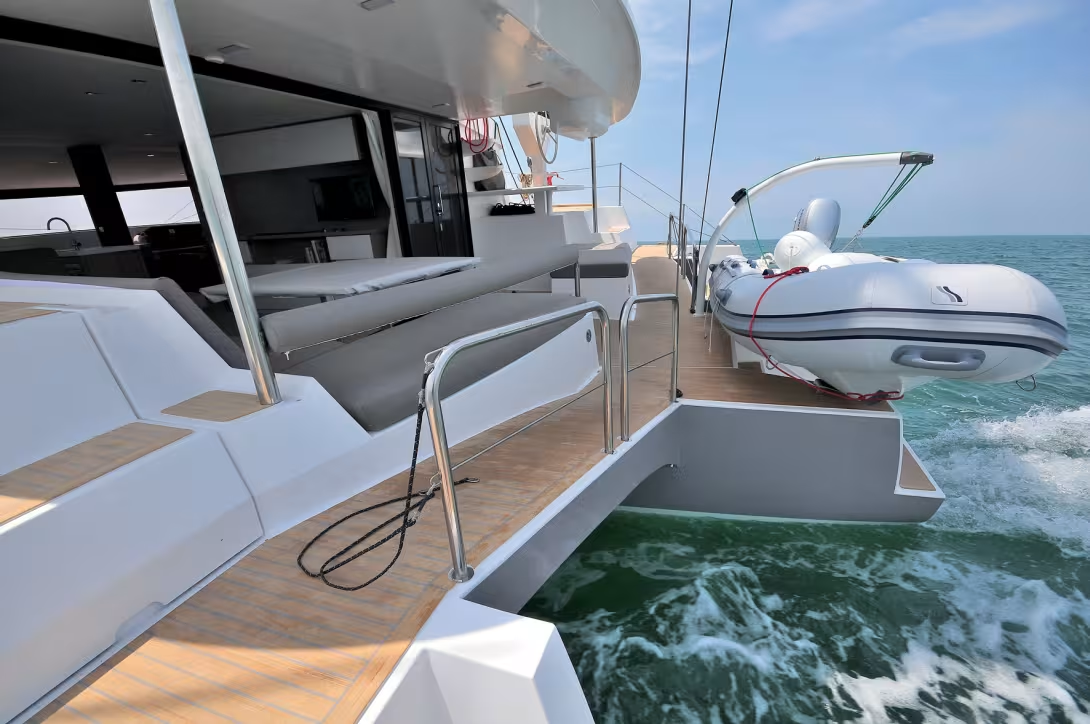
7: The lounge deck bench seat is an attractive vantage point
8: The master cabin with its sea view is exclusive to Neel
9: The central hull houses a double cabin forward, but also has room for all the technical elements to be grouped in a compartment with standing headroom!
10: The living space of the nacelle (38m²) is staggering and the clarity of the spaces is remarkable
TECHNICAL SPECIFICATIONS
Builder: Neel Trimarans
Naval Architects: Joubert/Nivelt/Muratet
Construction: Poly-Vinylester-PVC foam sandwich with quadraxial glass cloth
Length: 15.60m
Beam: 8.90m
Light displacement: 14t
Motor: 75hp Volvo
Transmission: Saildrive + Volvo four-bladed folding propeller
Mainsail area: 97m² (standard aluminum mast) or 105m² (carbon mast)
Genoa: 74.5m²/77m²
Self-tacking staysail: 31m²
Spinnaker: 188m²/205m²
Water: 600l
Diesel: 600l
CE Certification (ICNN): Category A for 10 persons
Basic price ex-tax for the Loft version (2 cabins/2 bathrooms): € 669,800
Principal options in € ex-tax:
One hull fitted out as a guest suite: 49,800
Essential Pack (3 Dacron sails, folding propeller, windlass, electric WC, holding tank, etc): 39,900
B&G Electronics pack with autopilot: 18,300
Carbon mast/fiber rigging/Hydranet sails: 84,500
Bowthruster: 8,350
One 52-size electric winch: 3,350
Epoxy primer + antifouling: 3,600
Launching: 5,900
Price of the boat we tested: € 855,455 ex-tax
Minuses
- Fixing for the turning blocks for steering cables needs reinforcing
- Mainsail halyard clutch needs upgrading
- Gap between mainsheet padeyes insufficient
- Why not a shaft-driven propeller?
- The forward perception is massive and draft is deep
Pluses
- Innovative use of space in the nacelle
- Layout and accessibility of the technical elements in the central hull
- Stability of movement
- Logic of trimaran geometry
- Good performance and cutter rig
Essentials
Awesome living space and ergonomics
Stability and stiffness of a trimaran
The competition
|
BUILDER |
RAPIDO TRIMARANS |
SWISSCAT |
Catana |
MARSAUDON |
TAG |
|
MODEL |
RAPIDO 60 |
SWISSCAT 48 |
Catana 53 |
EOS 54 |
TAG 50 |
|
UPWIND SAIL AREA IN m² |
195 |
93 |
165 |
165 |
155 |
|
WEIGHT IN TONNES |
8.6 |
10.5 |
14 |
12.5 |
11 |
|
PRICE IN € ex-tax |
1,277,000 |
830,000 |
1,140,000 |
999,500 |
970,000 |