Neel Trimarans is a young French company which broke new ground in 2009 with a prototype 50 footer and then managed to establish their 45 in a world where the catamaran occupies a predominant position. Now there’s a new challenge. Neel have just launched a 65 foot trimaran, shown for the first time at Cannes Boat Show. We took a trip on board in early June for an amazing test sail.
Infos pratiques
- Le chantier : Neel 65 Evolution
- La fiche technique
- Découvrez notre vidéo exclusive
- Financez votre NEEL 65
- Assuez votre NEEL 65
- Articles autour du NEEL 65
Éric Bruneel and Neel Trimarans
The founder of Neel Trimarans is an experienced sailor and businessman. Having become the French sports catamaran champion in 1987, a specialist in Class C, he started at Fountaine-Pajot and launched the Corneel 26. A French development, blending the American Stiletto and the Danish Mycat, this little cat was a combining of the cruising cat and the sports cat, and an efficient and playful little machine which introduced the concept to many future multihull enthusiasts. Following this commercial success, over the next 25 years Eric reinforced the development of the yard, being in charge of exports, and then becoming Vice Director-General. He took a bit of a step back in the early 2000s to get involved with the new M50 class at the helm of his Trilogic, in which he won The Transat in 2004 and came second in the 2006 Route du Rhum, before launching himself into the adventure that is Neel Trimarans.
1165
A pioneering and structural architectural concept
The production of a full set of molds confirmed the yard’s determination that they hadn’t designed this 19.8 meter trimaran as a prototype, but as a semi-custom production model. The vacuum sandwich composite phase (scored core foam/ quadraxial glass cloth / isophthalic polyester resin) is implemented in partnership with Marc Pinta, using carefully selected materials. Traditionally the frame of a trimaran is comprised of five major parts: the two floats, the central hull and the two beams: this faithful scheme is perfect for racing boats or for prototypes where the living space remains modest. But for the Neel, they needed to move up a level, devoting a large part of the central hull to technical matters (below the decks are to be found motor, generator, watermaker, tanks and so on) and to attach an XXL catamaran-style nacelle onto a three-hulled chassis! If the beams were to disappear, a new mechanical architecture would have to be invented. Here was where the naval architect duo Joubert-Nivelt designed a sort of synthesis between cat and tri: the main web-bulkheads are transverse, and marry up with the floats by merging into recesses. Closely fixed to the coachroof and to the wings by laminated angles, they thus create a very consistent structural box. Quadraxial cloth forms the essential part of composite skins, but much unidirectional cloth is used as reinforcing. The topside panels are stiffened internally by omega forms and generous joins. The hydrodynamic challenge consisted of ending up with a laterally balanced boat to avoid uncomfortable rolling (particularly when at anchor), yet allowing sufficient deepening support to generate a dihedral effect. To conserve the gentle transitions and to eliminate any noisy reminders of semi-circular racing shapes, triangular sections have appropriately been chosen. A step overhangs the underwater hull, opening out to give the desired volume. The length of the central hull (19.80m) is comfortable, the sections and the hollow of the hull have been designed to give a maximum theoretical load calculated at 30 tonnes, and 22.7t at half-load. The hull is rockered with a generous hollow midway which houses a neat fixed skeg and a carrying arch to help getting up on the plane.
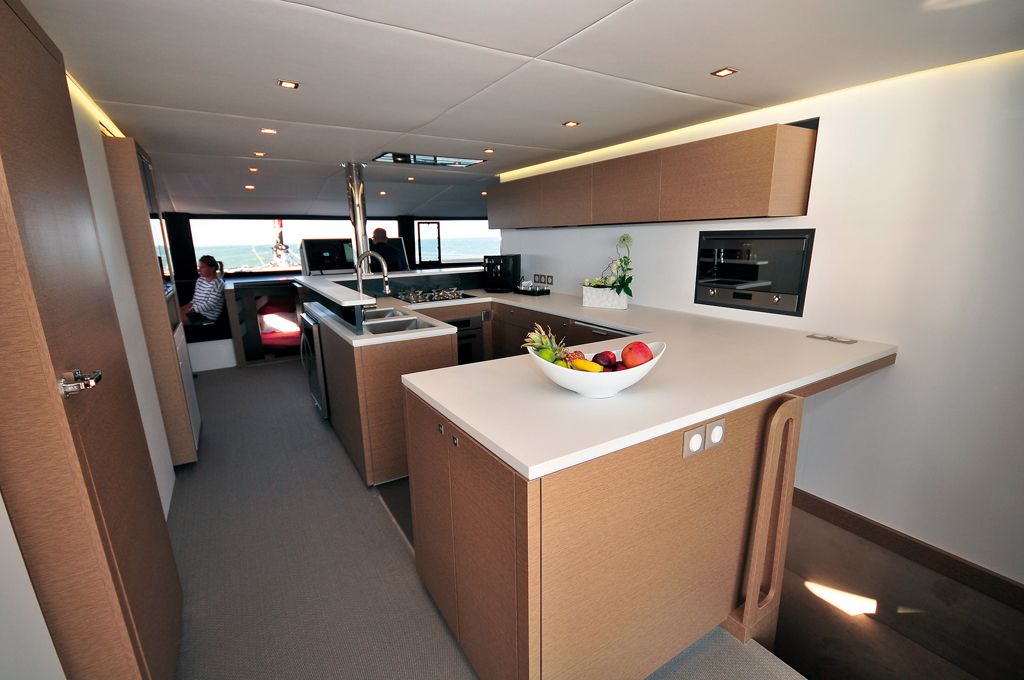
The Neel’s galley: perfectly suited for demanding service
A guided tour of a very big trimaran. Chapter 1: The Exterior
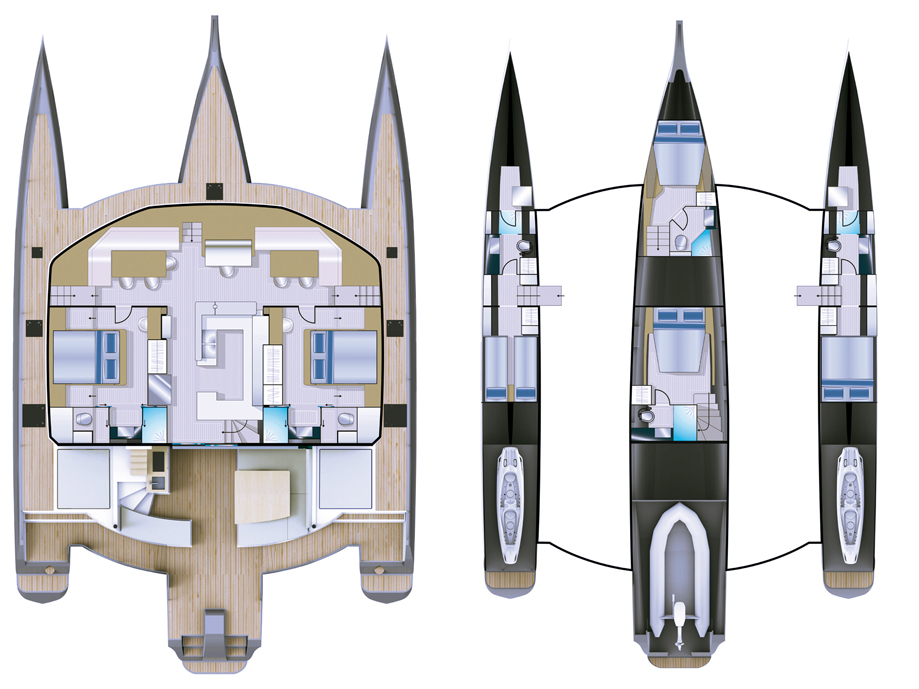
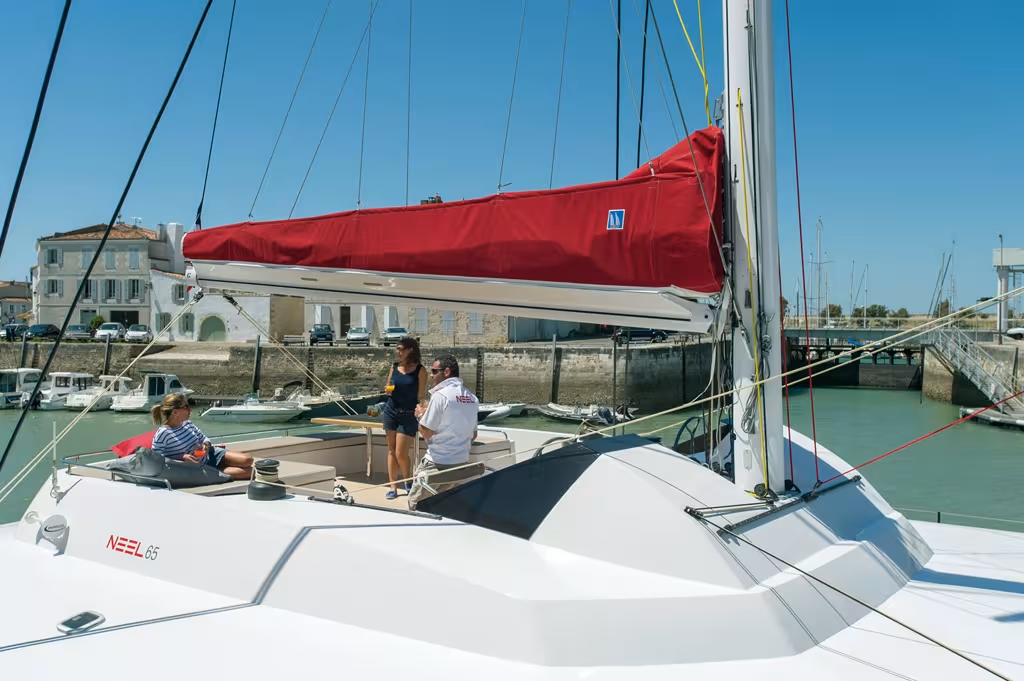
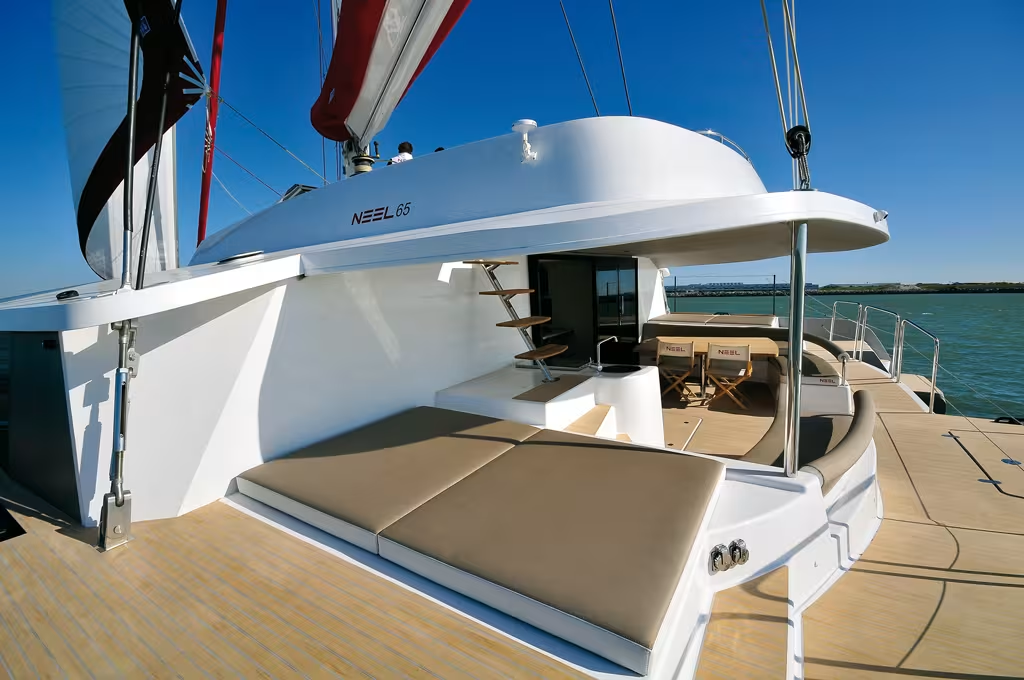
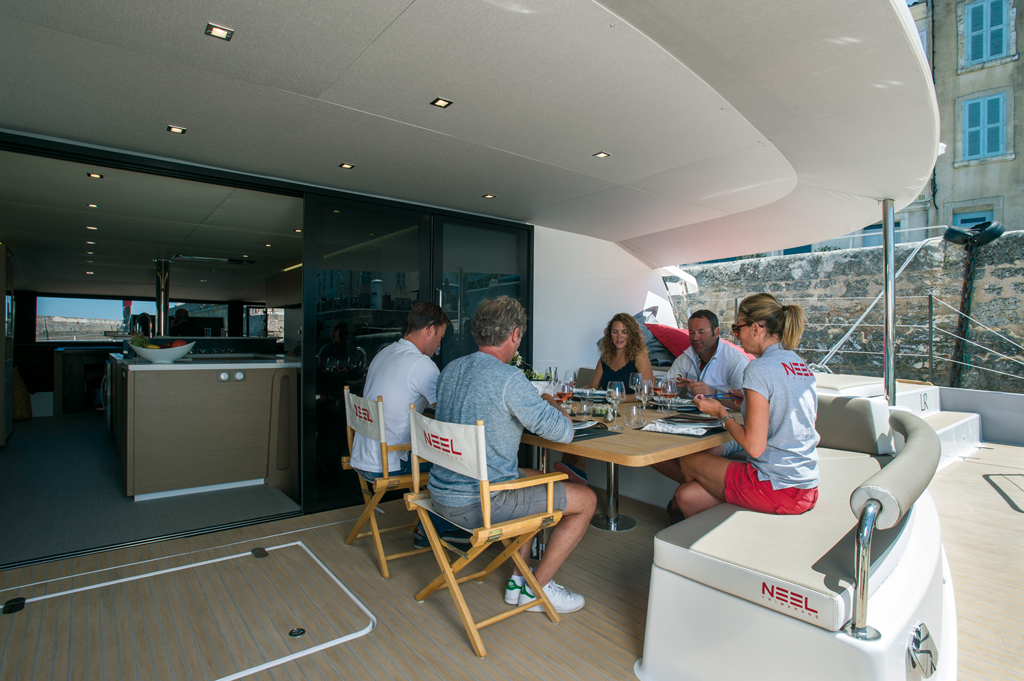
Access onboard is remarkable, with three sugar scoops welcoming you, and whether from the dock or from the dinghy, stepping aboard is easy and safe (despite the lack of handrails!). If you have arrived by canoe, paddleboard, kayak or inflatable sailing cat, the “garage” in the float will quickly accommodate it. The 3.80m tender with its 20hp outboard disappears into the sugar scoop of the main hull thanks to an ingenious two-way system (simple, based on a winch and rollers). Goodbye to davits, windage and weight up high! The dinghy garage is closed by hydraulic pistons, with the cover unveiling a superb aft sunbathing area, one where a handrail would integrate it totally into the cockpit area. So the toys are stowed away (and protected!), keeping a very fluid appearance to the deck lines, another of the Neel’s strong points. Well sheltered under the rigid bimini, the exterior dining room sits opposite a galley area with sink, grill, fridge and icemaker. Up to 10 guests can easily be accommodated on this superb marine patio and test their barbequing skills. Under way or at anchor, there will be no complaints from the flybridge crew either, with this upper deck capable of accommodating the same number of people.
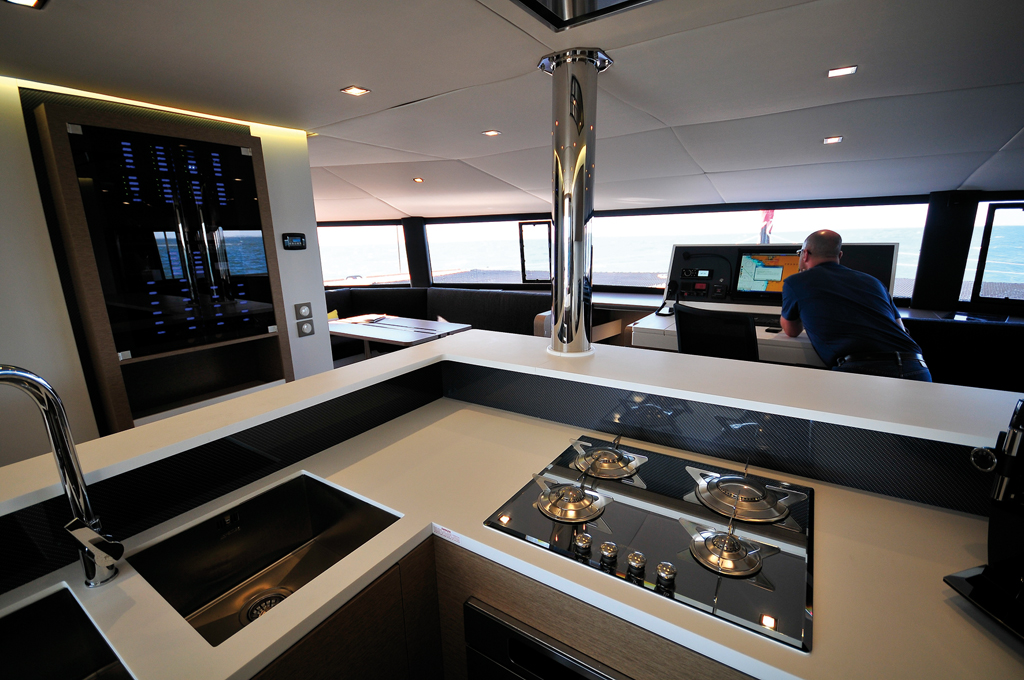
Galley, electric locker and nav station with a view!
Guided tour, next section: The interior layout
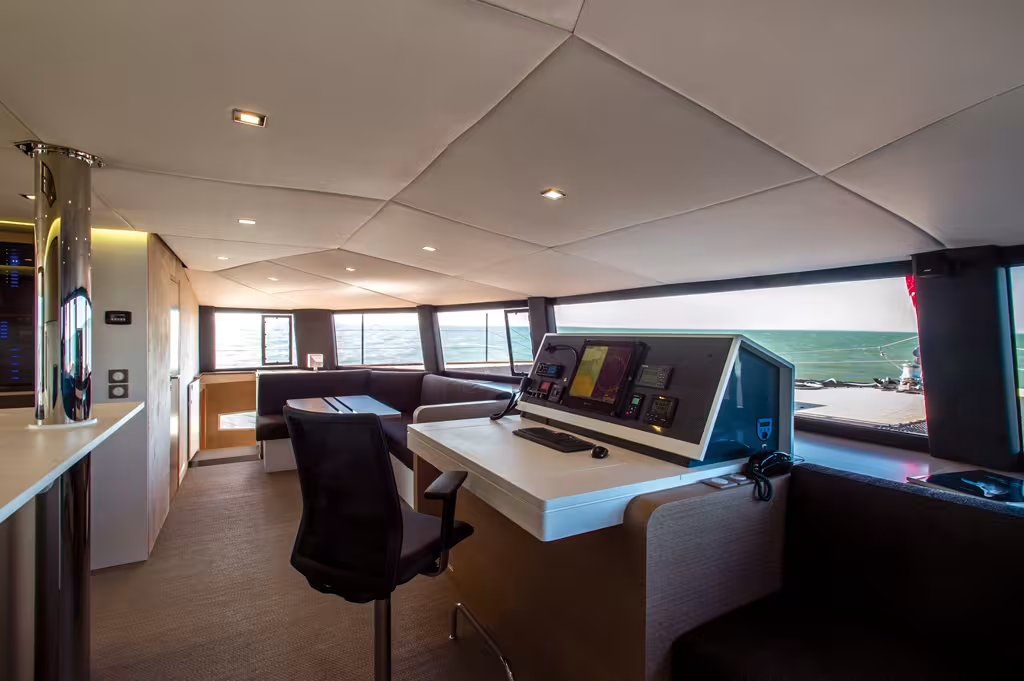
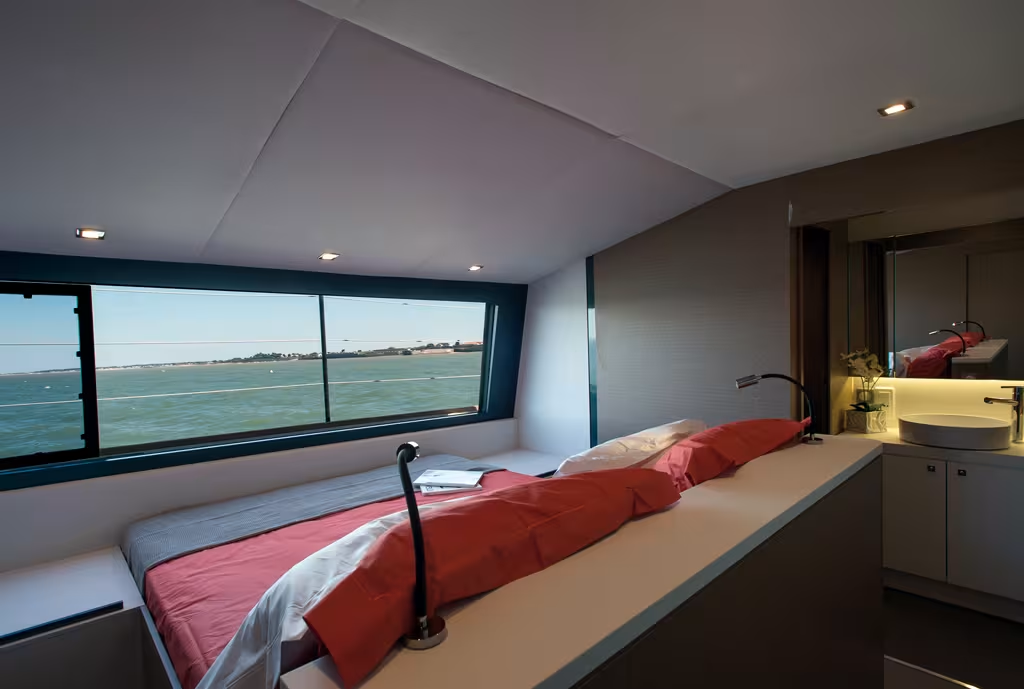
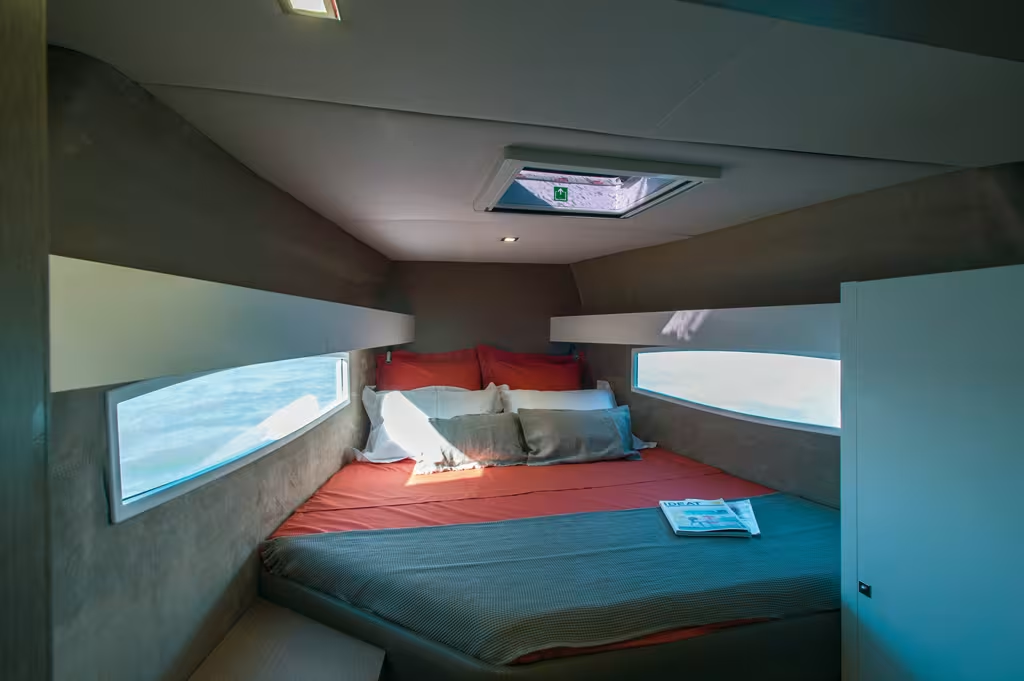
Coming into the salon from the deck, the galley is a real showpiece. Enormous, very practical and very well-equipped, it is centered around a bar and large serving island. The deep sinks, modern faucets, traditional oven (in line with the boat), the recessed microwave, the large refrigerator and secondary chilled cabinets make up one of the most efficient galleys to be found on a boat of this size. The four-burner cooktop is superb, but the surrounding carbon trim could do to be protected. The stairs down into the crew cabin are discretely located to the right of the entrance (a safety barrier avoids risk of accidentally falling down them) and lead to a superb domestic setup (air-conditioned). Perfectly insulated from the rest of the accommodation, the two beds and bathroom with WC offer a benchmark standard of comfort for this type boat. The adjacent systems area houses the utilities (washing machine and dryer), fuel tank and electronics compartment for the on-demand video/audio system (as well as the screen in the salon, each cabin has its own tablet and unlimited Wi fi access with up to 900 channels available via the KVH satellite system). The nav station takes pride of place, right next to the stairs down to the forward cabin on each side, with two dining areas around height-adjustable tables. So you can eat in these little salons if it’s a bit cooler, or if you need to be alone. The interior “sport-chic” atmosphere has been carefully designed, with the floor covering in Bolon vinyl making an elegant and practical choice. Opposite the club-salons are the cabin suites, which totally merit the name. Equipped with large bathroom and private toilet (as with all the sleeping compartments on board), these apartments offer unrivalled viewpoints: the berths go athwartships, offering an exceptional platform open to the exterior and well ventilated (in addition to the aircon). The tour finishes up in the two cabins in the floats. Made private by sliding doors, they are equipped to the same standard of comfort as the owner’s hull of a 42’ catamaran. Giant!
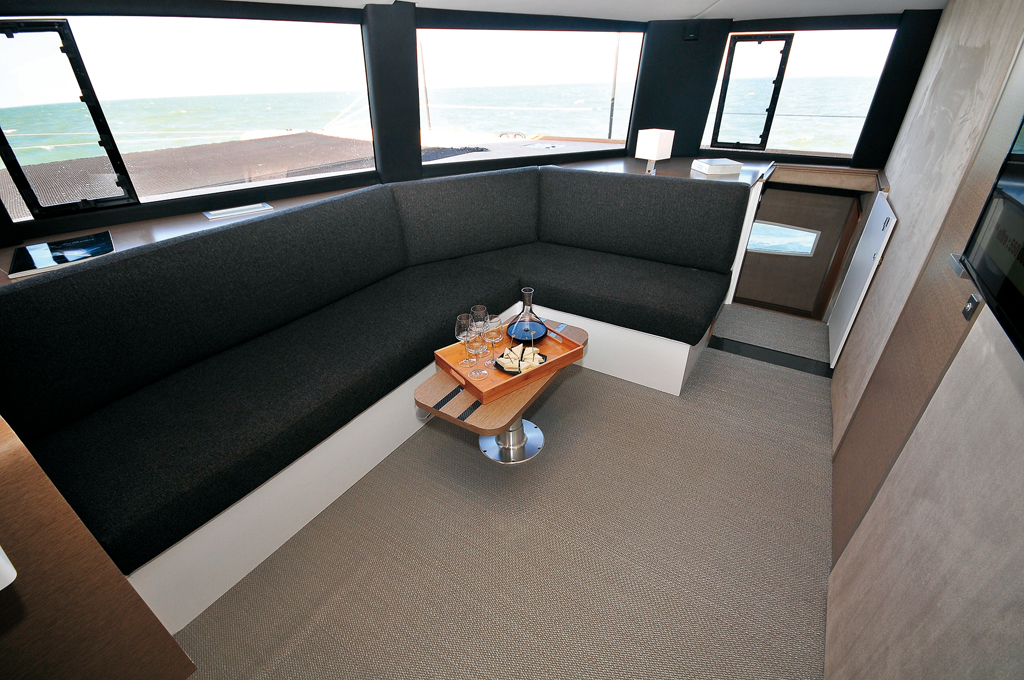
One of the two small salons. Panoramic view guaranteed!
Sea trial
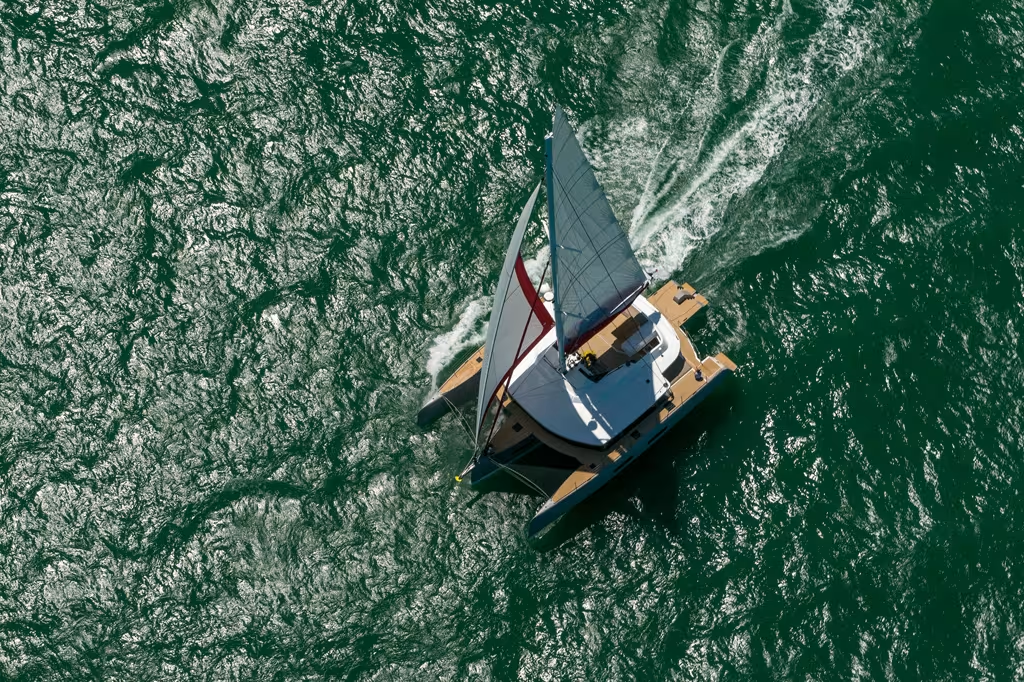
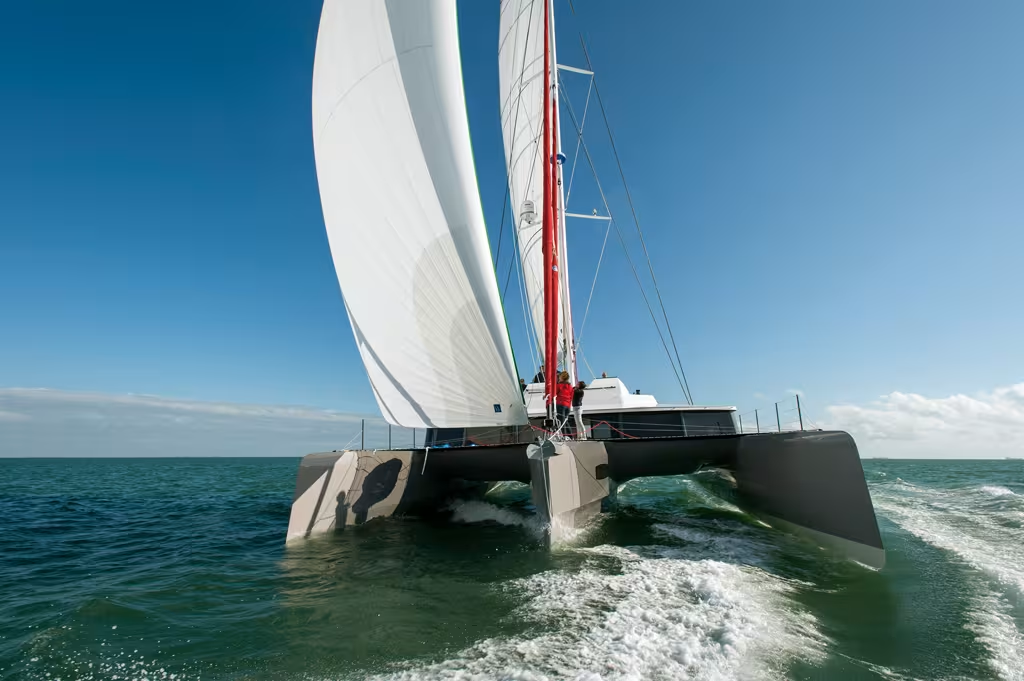
Firing up the motor reveals a rare secret: even with the generator running as well, there is no noise nuisance - the insulation is really well-done! The Volvo D3 chosen for the Neel is a five-cylinder, 20 valve turbo of 150hp with common rail injection and double overhead camshafts. The engine mounts really filter out vibration, which is virtually undetectable. This motor meets all the most demanding anti-pollution standards, and is linked to a four-bladed folding propeller by a propshaft. The engine compartment is both clear and welcoming, and the maintenance for this 150hp motor such as this will be easier than on two 75hp saildrives! The Neel is equipped as standard with a powerful thruster, combined with the generously powered main engine, making it just as easy to maneuver in port as an equivalent sized catamaran. We were able to enter the inner basin at St Martin de Ré, whose charm is only matched by its narrowness, and execute several 360° turns. I was impressed by the power of the motor, the maximum speed being around 11 knots, at half load (10.4 knots on the test without gunning it), with a cruising speed of 8 to 9 knots depending on the fuel consumption required. Silence, absence of vibration, positive power and robust transmission all combine to give a very positive result. For our test, there’s a fresh NE wind in the bottleneck which leads to the Pertuis Breton strait on France’s west coast. The mainsail is hoisted effortlessly thanks to the central electric winch. We have already taken in the first reef and are bowling along at 10-11 knots under staysail. The wind stays around 19-20 knots and we quickly unroll the genoa. The main and genoa sheet winches are manual but powerful and are well-placed for use, sheeting in the full genoa in 20 knots of wind posing no problem. When short-handed (probably most of the time!), it might be an idea to opt for all electric winches. Under genoa and single-reefed main, the Neel easily slips along at 13 knots off the wind. Then we need to harden up to get into the Pertuis, passing under the Ile de Ré bridge. We re-hoist the staysail upwind and the speed varies between 9 and 12 kts (as measured by my Garmin Quatix GPS) and the tack is easily achieved, without needing to dump the main, and the boat comes onto port tack at 4.2 knots in a nasty chop. The course towards St.Martin is clear, and the four miles are covered at an average of ten knots: “Spot on!” shouts the boss, deceptively modest and happy with the machine. The strait is very exposed to the NE wind which is lifting up a solid chop which our trimaran is unfazed by. In these conditions, the central hull cuts a path on all points of sail with admirable balance, pushing well on the leeward float, whose triangular sections give gentle contact with the water without banging or noise! Pitching only occurs in severe conditions, and its passage through the water is this trimaran limousine’s biggest asset. The Incidences Voiles suit of Dacron sails gives a superb profile, worthy of more sophisticated sailcloth. Management of the forward sails with two furlers is surprisingly easy (but you need to roll up the genoa to tack), and the self-tacking staysail works perfectly, maintaining its trim when changing tack without slamming against its stops when going through the wind, something which is not easy to achieve. Reducing sail with the main goes well thanks to low friction sliders (we made several sail alterations in the breeze, with the counter-halyard being great for getting it down!), the double purchase on the sheets don’t require huge effort, but the return of the “German” mainsheet to the console puts constant pressure on the gooseneck, but alas that’s the simplest solution. The Neel is a modern boat moderately canvassed so as to remain easy to use, and its power to weight ratio seems to me to be about right for its intended program. Coming back from offshore at the end of the afternoon, we picked up a mooring in 5m of open water opposite St.Martin. Looking at the neighboring monohull trying to sort out rigging and crew, I imagined an uncomfortable racket, but was surprised to spend an hour there in perfect comfort: amazing! When cruising, the anchorage is another area where the Neel gives remarkable comfort. Returning too La Rochelle we made between 9 and 11 knots in the slightly reducing wind under full main and staysail. The helm position (double wheels on the flybridge) is very good, with access for sail trimming being clear and reasonable, and the directional effect of the rudder blade effective despite the typically disagreeable hydraulics (vague and unresponsive feel). When are boat builders going to come up with a system equivalent to that found on any car, and honor their boats with it?
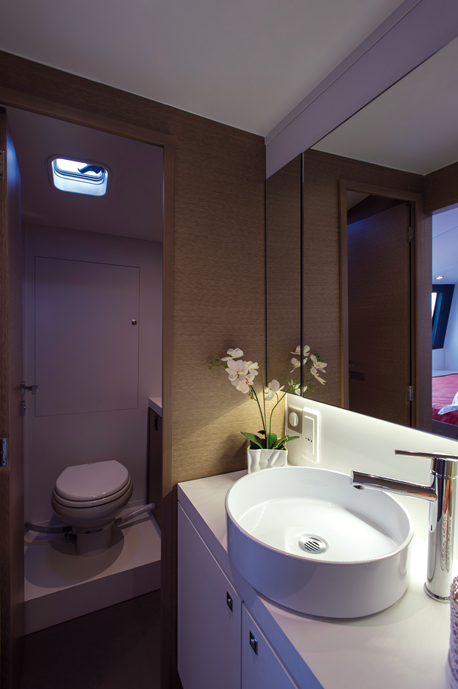
A contemporary style with good build quality
Conclusion
Having never tried the 45, sailing the 65 was going to be a real voyage of discovery for me. Beyond the exceptional living space and cabins which redesign the genre, I loved the easy handling at sea, the quietness both under sail and under motor, and the success of the architectural design. The model we tested, aimed for luxury charter, was fitted with every possible option and there were 10 of us on board with 1 tonne of water: the tri performed perfectly as intended and showed no signs of laziness. Average speeds ranged between 9 and 15 knots on all points of sail. I imagine the three or four cabin version (floats not fitted out) equipped with a carbon mast and fiber rigging would exceed this level of performance. The lines are skillfully drawn and are setting a trend, with half of the 15 Neel 45s built sailing under the US flag, we believe that the 65 will achieve equal success among this demanding clientele.
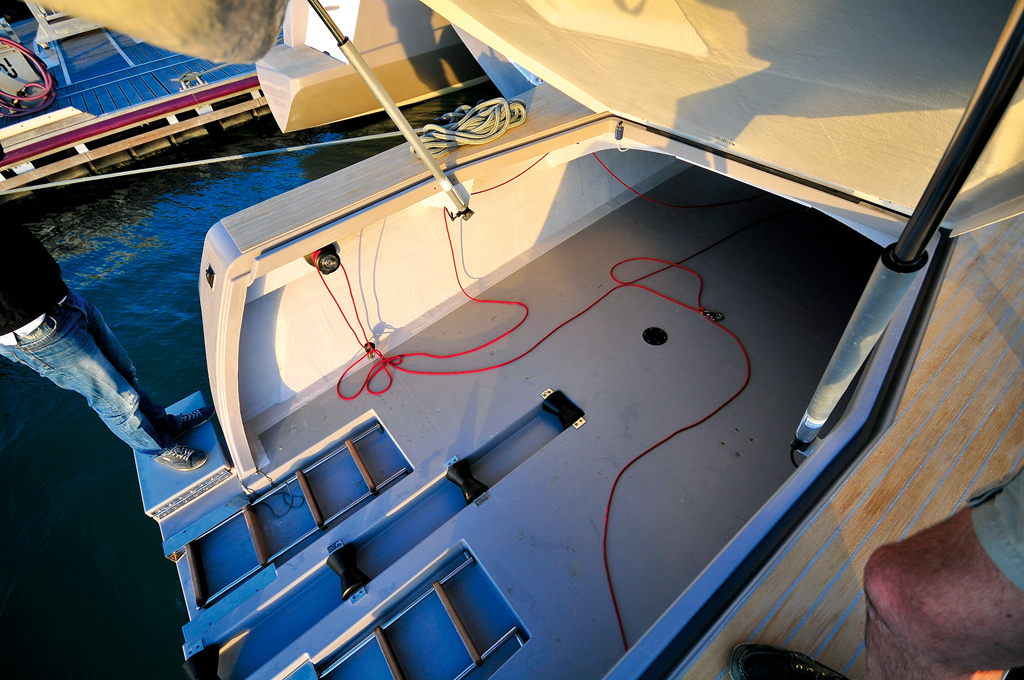
The dinghy garage does away with unsightly davits
The plusses
- Remarkable exterior space (flybridge, cockpit, aft deck)
- Comfortable ergonomics and safe for everyone
- Smoothness of motion and performance under power
- Consistency of the design
- Excellent view from the deck cabins
The minuses
- Absence of rails around the aft deck of the central hull
- Hydraulic steering could be improved
- A few little details of the furniture assembly
- No cowling over the alternator
- Watchkeeper’s seat needs upgrading
The competition
| Model | Basic price | Builder | Architect | Weight | Upwind sail area |
| OQS 60 | €3 M | OQS | G. Frers | 20 t | 199 m2 |
| CATANA 70 | €2,4 M | Catana | Catana/Lombard | 27 t | 215 m2 |
| PRIVILEGE S6 | €1,43 M | Privilège | LM.lombard | 28,3 t | 229 m2 |
| SUNREEF 60 | €1,36 M | Sunreef | Sunreef | 33 t | 182 m2 |
| LAGOON 620 | €1,45 M | Lagoon | VPLP | 30 t | 230 m2 |
| VICTORIA67 | €1,6 M | Fountaine Pajot | O. Racoupeau | 23,6 | 197 m2 |
TECHNICAL SPECIFICATIONS
- Naval architects: Michel Joubert/Bernard Nivelt
- Interior design: Franck Darnet
- Builder: Neel Trimarans
- Length: 19.80m
- Waterline length: 19m
- Beam: 12.05m
- Draft: 1.80m
- Displacement half-laden: 22.5t
- Mainsail area: 114m²
- Furling genoa: 93m²
- Furling self-tacking staysail: 40m²
- Gennaker: 160m²
- Motor: Volvo 150hp
- Transmission: Propshaft
- Anti-leeway: Skeg in central hull
- Basic price ex-tax in double suite + forward cabin version: €1,880,000
- Principal options in € ex-tax: Guest cabin in one hull with bathroom and WC: 58,000 Garage for kayak/paddleboard at aft of one float: 9,350 Brookes and Gatehouse electronics pack: 17,200 Gennaker and hardware: 15,200 200l/h watermaker: 15,500 17KWA generator: 23,000 Forced air heating: 13,450 Holding tank for 1 WC: 1,000 400W solar panels: 4,400 Exterior upholstery: 9,200 Performance rig (carbon mast with Harken bearing cars and track, fiber standing rigging, Hydranet sails and Harken Performa winches: 175,000 Antifouling with epoxy primer: 4,100 Launching and mast-stepping: 5,900
Caption
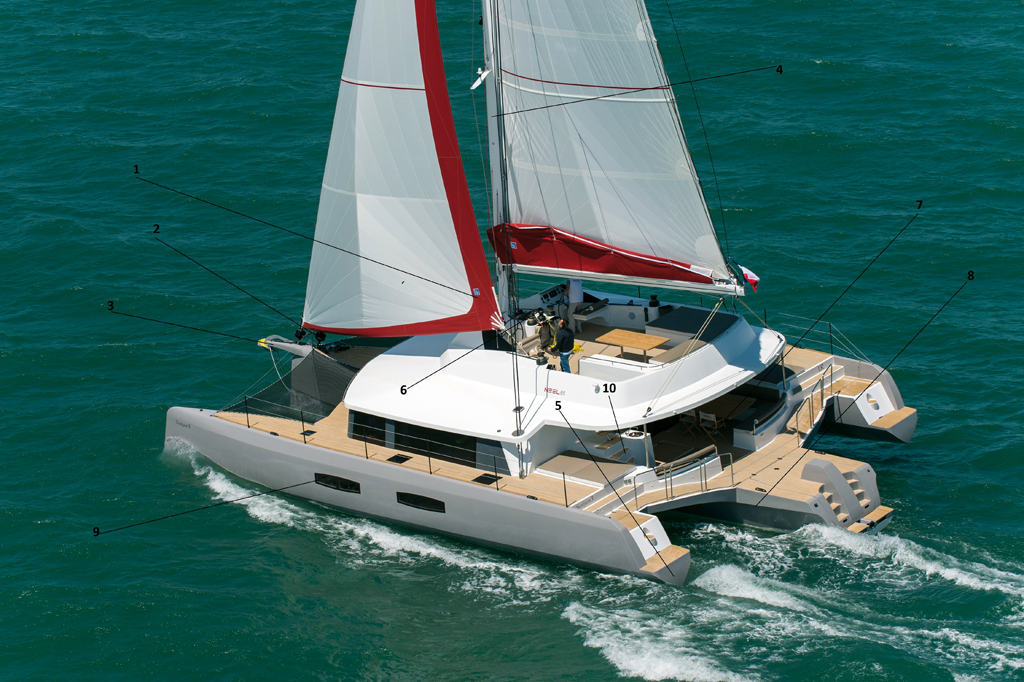
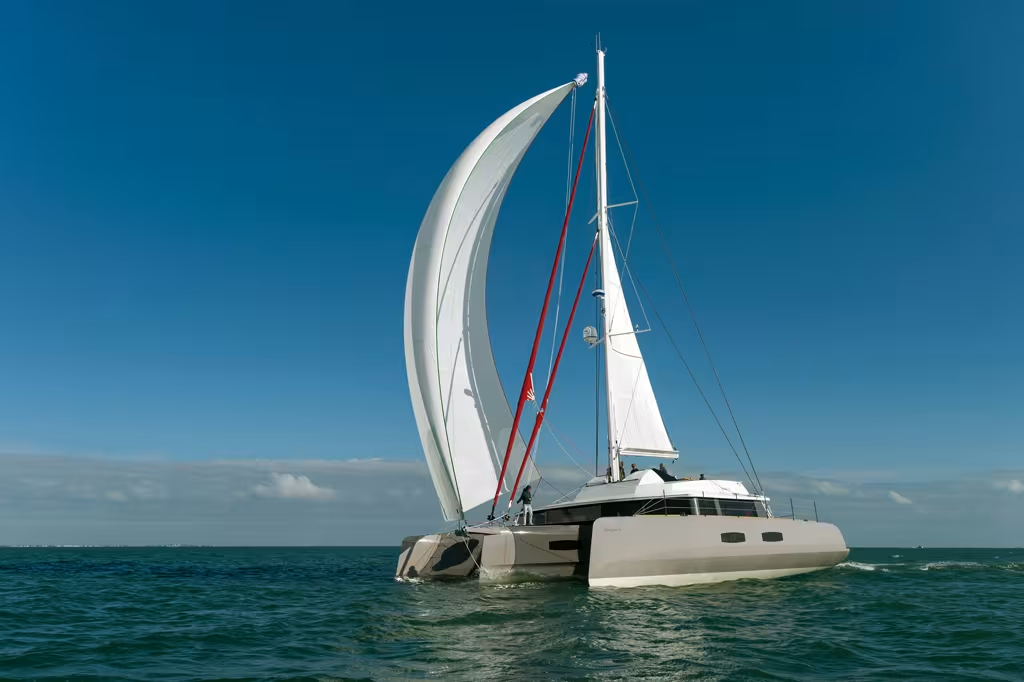
- : The slightly overlapping genoa is a powerful intermediate sail, fitted on a furler, it must be rolled up for tacking
- : Sail for everything in medium airs, the furling staysail is self-tacking
- : The composite bowsprit allows use of a spinnaker or gennaker, but doubles up as a bow roller for anchoring
- : The JPM aluminum mast with two sets of spreaders is lacquered. The rigging (forestay, capshrouds, staysail stay, lower shrouds) give the rig good stiffness with all sail configurations.
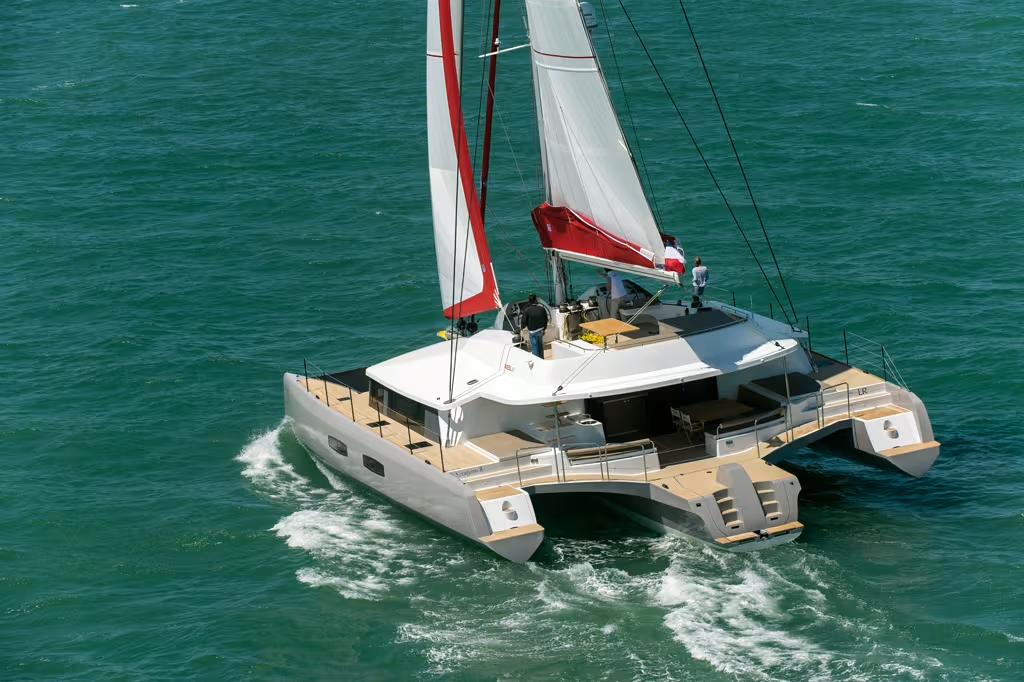
- : Inverted bows, pronounced steps and triangular underwater sections give the Neel’s floats a volume which can be comfortably fitted out, and also an exceptionally gentle and comfortable passage through the water
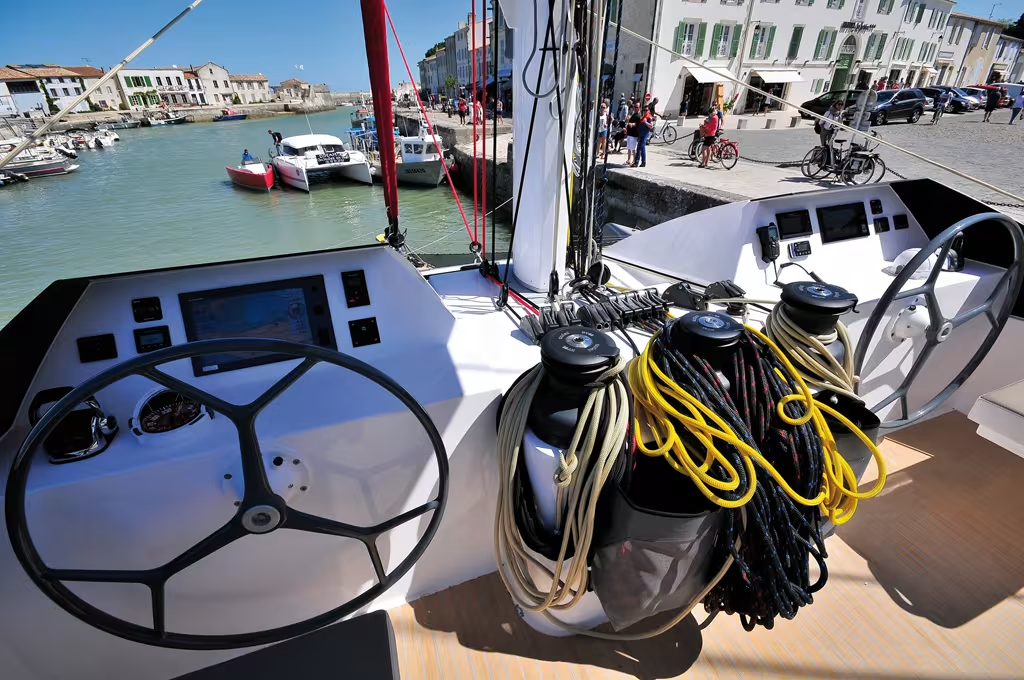
- : The flybridge is a great space for friends, one which houses the two beautiful carbon wheels at the helm stations on either side. In the center, the main console on the coachroof coaming, the very ergonomic genoa winches
- : The Neel’s fantastic terrace, including the outdoor dining area, a galley with grill, wide sunbeds, decks for access to the water, dinghy garage, also for other nautical equipment so nothing gets in the way. Truly ergonomic, but would be better with a handrail to the aft of the central hull
- : The central hull and the overall platform show remarkable balance and suppleness at sea
- : The geometry of the trimaran in this size allows the hulls to be comfortably fitted out and for two transverse suites with exceptional views to be fitted on the deck 10: Very good access to the flybridge, a handrail will ensure safety on the stairs
A word from the architect, Bernard Nivelt
In 1982, Jean-François Fountaine and Pierre Follenfant commissioned us for a catamaran for the magnificent La Rochelle to New Orleans race, which they won. This boat became the start of a close and fruitful collaboration with the Fountaine-Pajot yard. Thirty years later, Eric Bruneel commissioned us to design a 50 foot trimaran for the single-handed transatlantic race, in which he won his class. From there, the Neel Trimarans yard was born. You can’t help but draw parallels: racing experience is useful for designing cruising multihulls. Throughout all these years, racing trimarans have evolved enormously, superseding catamarans (though we are seeing a new revolution with the advent of foils), but for cruising, catamarans remain unchallenged. Eric Bruneel thought he had seen a niche to exploit there, and asked us to design a 45 foot tri. The main idea was to make the most of the wide beam to house a living space on one level: one cabin on each side, a salon using the full width and a galley between the two. A structural bulkhead to support the mast compression separates the salon area from the two cabins. Below the central hull is the technical systems area and the motor: this way the weight is centered and is as low as possible. Like on a monohull, the longitudinal rigging is perfectly stiff, with the central hull forming a structural beam. This combination of tight stays and centered weight allows for better upwind performance than would be found on a catamaran. The float shapes are very different to those you would see on a racing trimaran, the objective being to achieve gentler movement and avoid slamming. The first seatrials on the 45 showed that we had found the right formula. All that remained was to scale this design up to 65 feet. Obviously these multihulls are not destined for the mass market, and are only going to appeal to owners looking for performance with great comfort, and not too concerned with congestion in a marina.