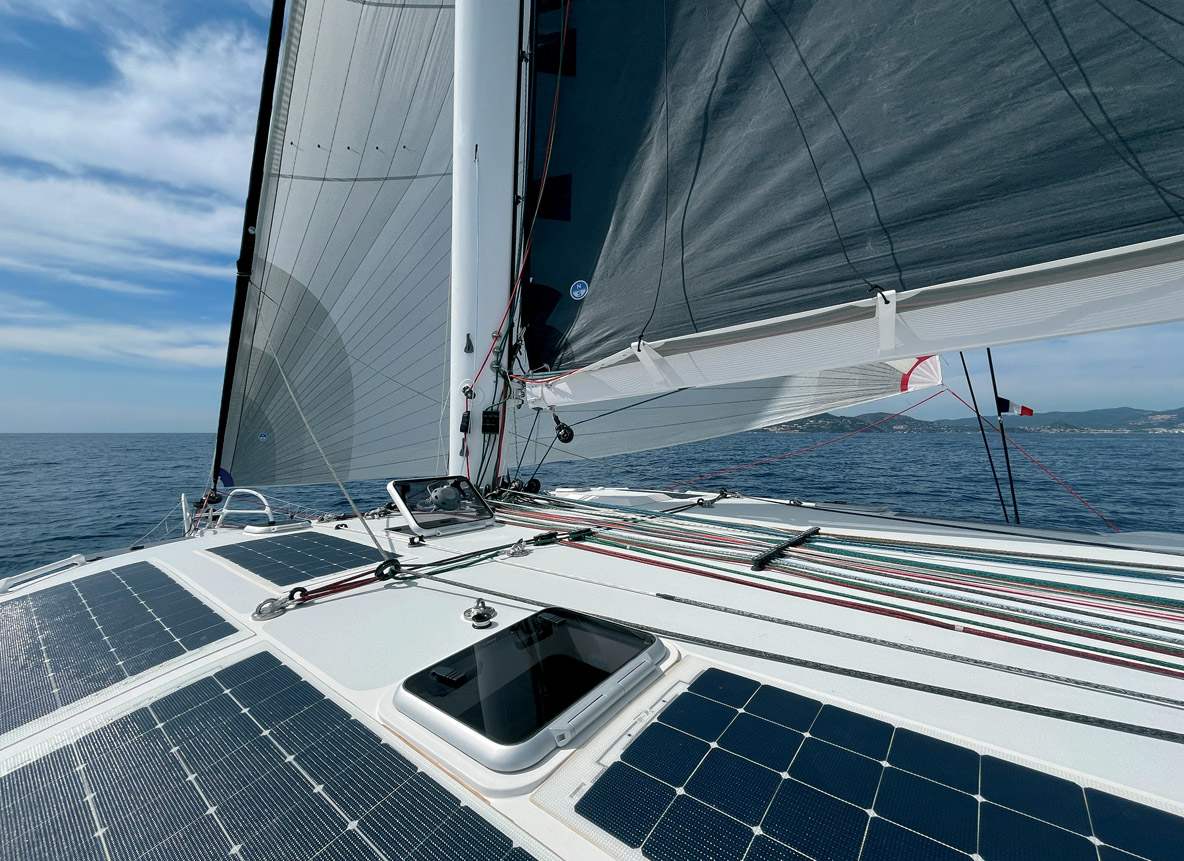
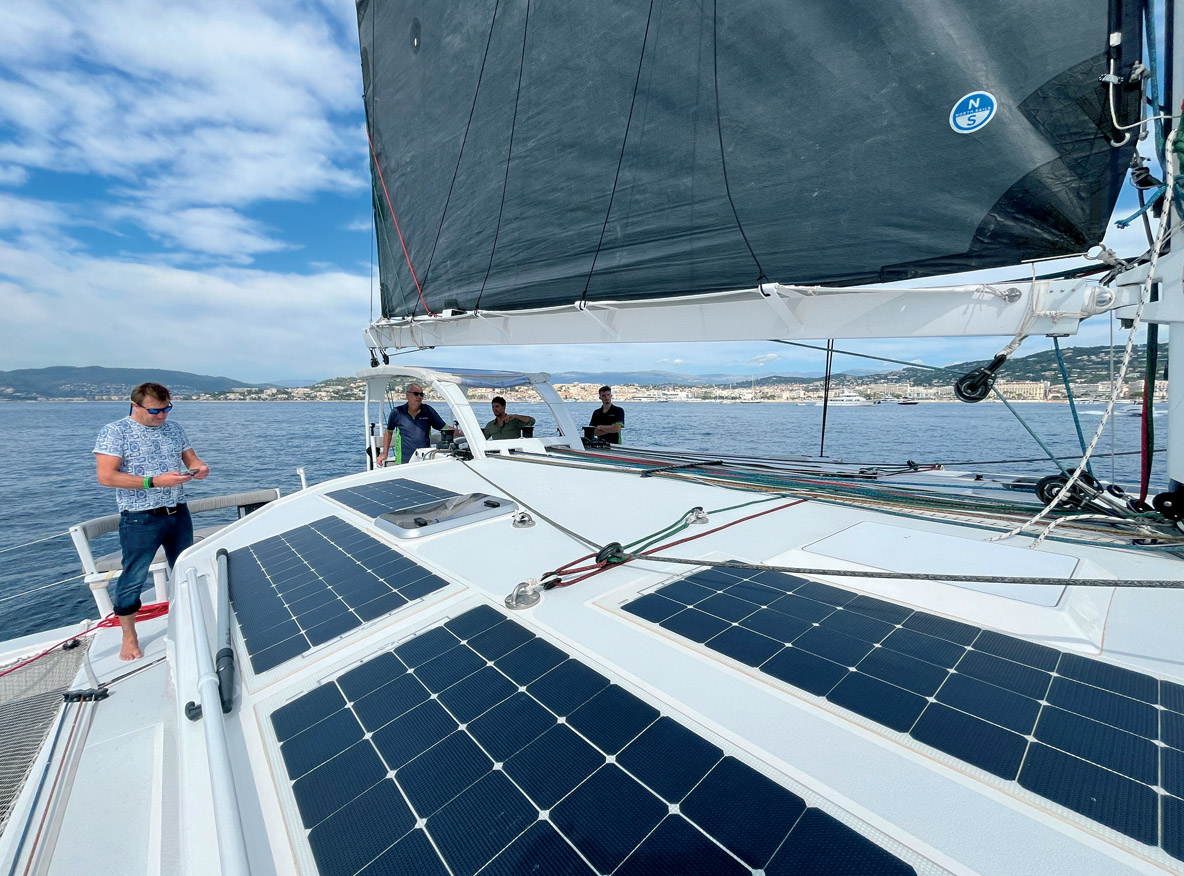
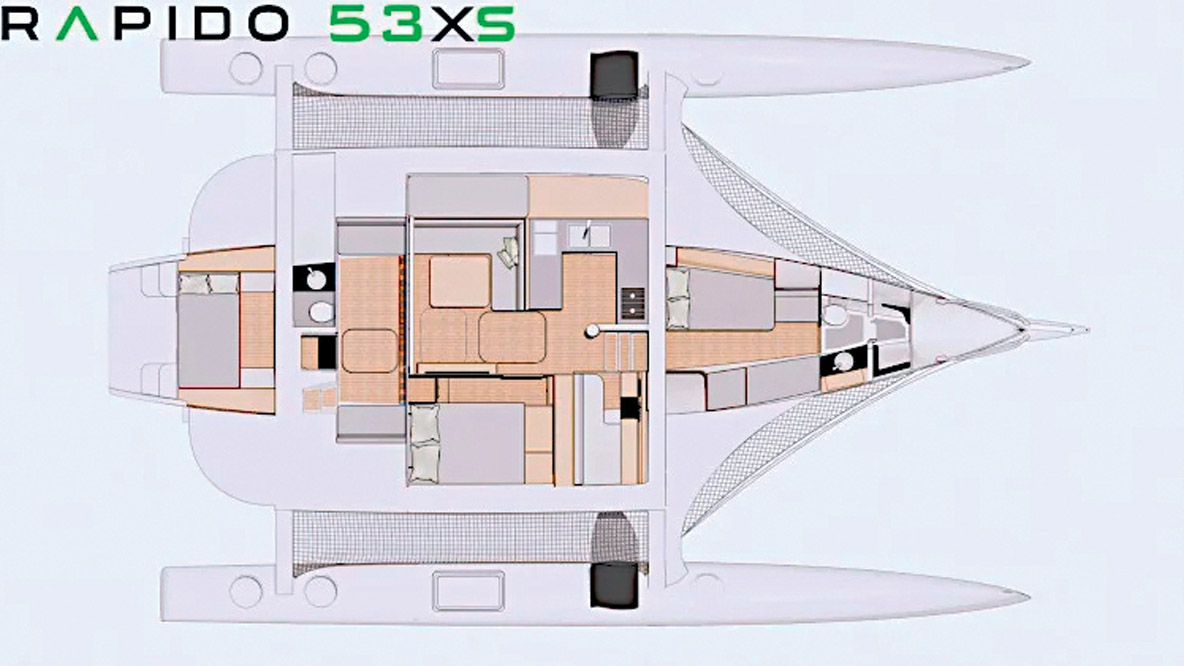
At the Cannes Yachting Festival, Rapido Trimarans presented a new model derived from the 50, but this time much more habitable. Like the Neels, the Rapido 53XS (which stands for Xtra Space) features an enlarged nacelle to provide a volume comparable to that of a cruising catamaran of the same size. We simply couldn’t resist testing this new boat!


Infos pratiques
- Le chantier : Rapido 53XS
- La fiche technique
-
 Découvrez notre vidéo exclusive
- Financez votre Rapido 53XS
- Assuez votre Rapido 53XS
- Articles autour du Rapido 53XS
Conditions: 8 to 10 knots of wind, slight sea
The concept of a large pod on three hulls is not new, the American Arthur Piver designed several “ superhabitable” trimarans as early as the 1960s. A little later, the English shipyard Sandwich Yacht Construction developed the complete Telstar range - 300 units were built. In France, we remember the Allegro and its questionable submersible floats... Today, it’s Neel from La Rochelle who has revived this market, offering a range from 43 to 65 feet. The wide nacelle trimaran offers a subtle compromise between helming comfort close to that of a monohull and record-breaking habitability like that offered by a catamaran - not to mention the absence of heel. Until now, Rapido Trimarans, the brand created by Paul Koch, had made headlines in the fast-cruising trimaran microcosm with a first, particularly high-performance 60. The Rapido 50 and 40 have taken up this super-fast cruiser concept, but with folding arms to allow access to a “standard” marina slip. Four 60s, three 50s and twelve 40s have come out of Triac Composites’ Vietnamese workshops, proving the formula’s success. The smaller wetted surface area of these models, combined with reduced displacement thanks to their meticulous composite construction, make for the fastest cruising yachts. The coachroofs, also very measured, offer sufficient space, but nothing too much.
But then a potential customer approached the shipyard with an unprecedented set of specifications: three double cabins - one of them panoramic - two bathrooms, and a large saloon, all without compromising speed, since the sailing schedule was to reach the Caribbean from Europe in just ten days! This is how Paul came up with the idea of transforming his folding 50 into a fixed 53XS. In practical terms, this means that the nacelle’s width is practically doubled, which is no mean feat!
Hand-crafted Engineering
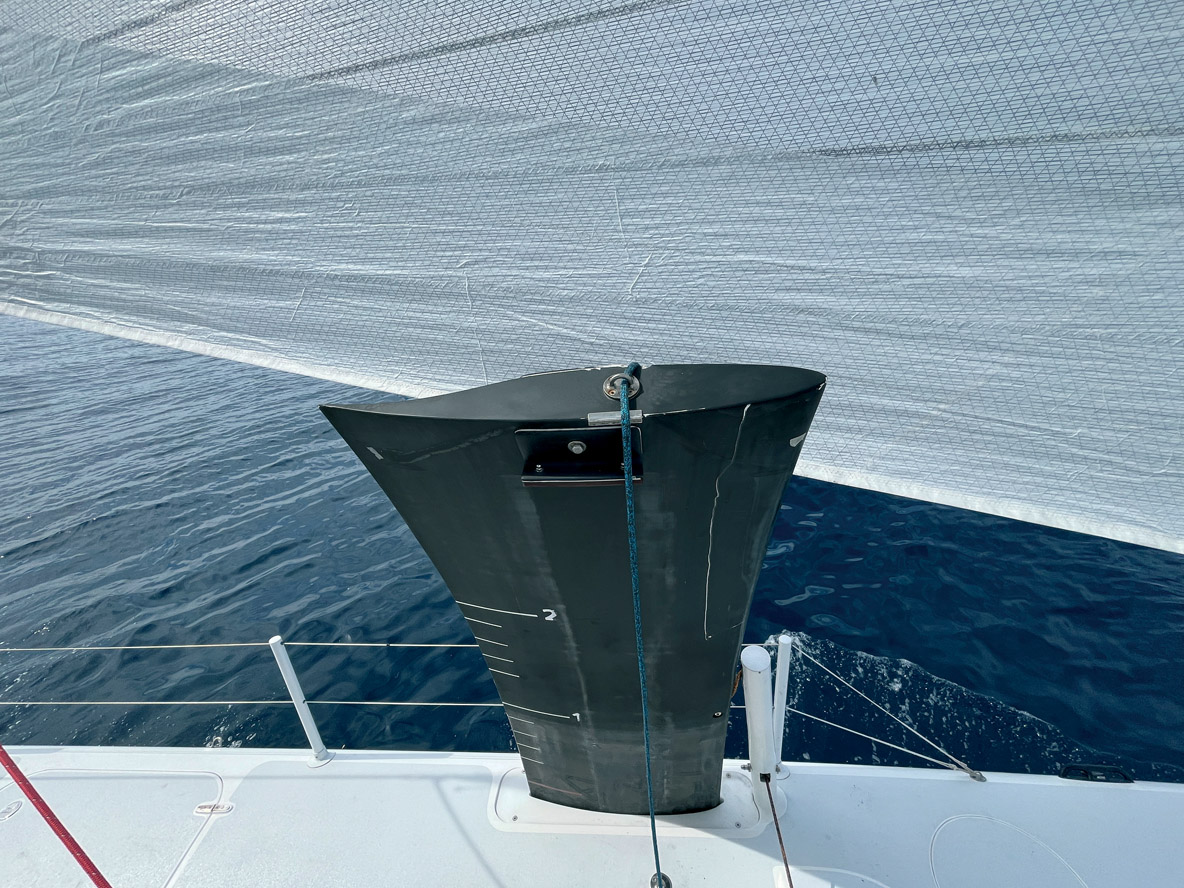
Paul welcomed us aboard hull #2 and made it clear from the outset that every effort has been made to ensure the XS project’s coherence. The design of the central hull retains the hull of the 50 - at least at waterline level and below. It is only above the water that the hull flares out, providing a surface area of 320 square feet (30 m²) in the central area between the arms connecting the hull to the two floats. Nonetheless, the boat’s great overall width means that there is still plenty of netting between the central deck and the floats, giving it the light, racy silhouette of a racer. In the end, this “stoutness” translates into 1,760 lbs (800 kg) of extra weight - to be put into perspective with the 18,850-lb (8.55 t) lightship figure for the Rapido 50. All parts, structural and otherwise, are in infused, pre-impregnated carbon cloth that’s then autoclave post-cured. Absolutely everything, from the rotating mast to the appendages, is made of carbon. Everything, including the front rail and every single storage drawer, is built by the shipyard using techniques derived from ocean racing. Triac Composites’ carbon composite workshops are also involved in industrial and domestic equipment, as well as subcontracting for other yacht builders. The tooling developed in-house - robotics, CNC machine, mastery of infusion and large autoclave for post-curing - contribute to the production of excellent units. When all is said and done, the 53XS weighs in at just 20,600 lbs (9.35 t). In contrast, the lightweight Neel 52 weighs in at 20,600 lbs (13.5 t), making the new Rapido’s weight-to-habitability ratio the best we’ve ever seen. But the designers weren’t content to rest on their laurels and have reworked the entire anti-leeway plan to enhance performance while preserving on-board comfort. For example, the manufacturer has dispensed with the central daggerboard and its prominent well, which obstructs panoramic vision. Instead, curved, asymmetrical daggerboards nearly thirteen feet (four meters) long have been integrated into the floats. The central rudder has been eliminated: two spade rudders have been installed on the floats, reducing the draught to less than 28 inches (70 cm), the same as that of the central hull. To optimize longitudinal trim and relieve the load on the bows, these profiles are fitted with horizontal fins developed by CAD at Morrelli & Melvin. The entire construction is carried out with the utmost expertise, and the quality of the assemblies - at least those that are visible - bodes well for rigidity and vibration-free sailing. Safety hasn’t been neglected, with a well-dimensioned crash box.
An Ultra-convivial Platform
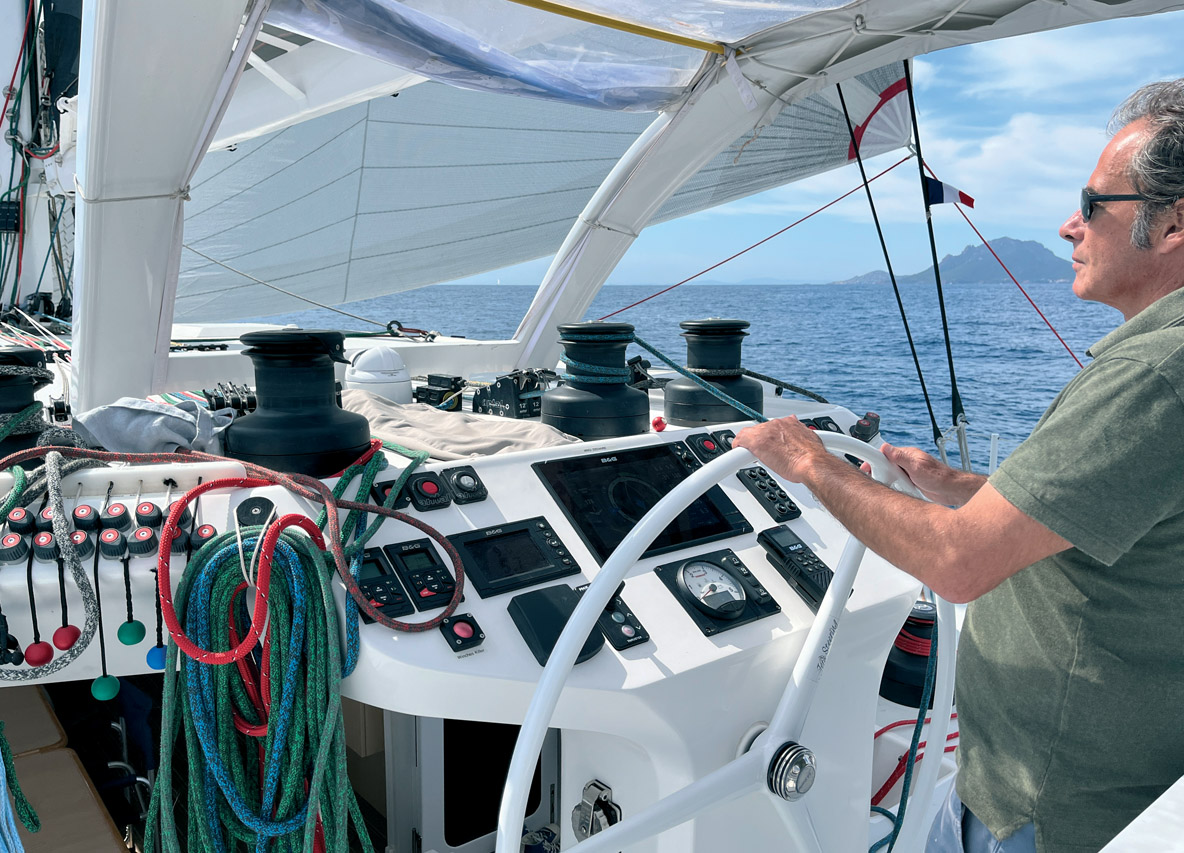
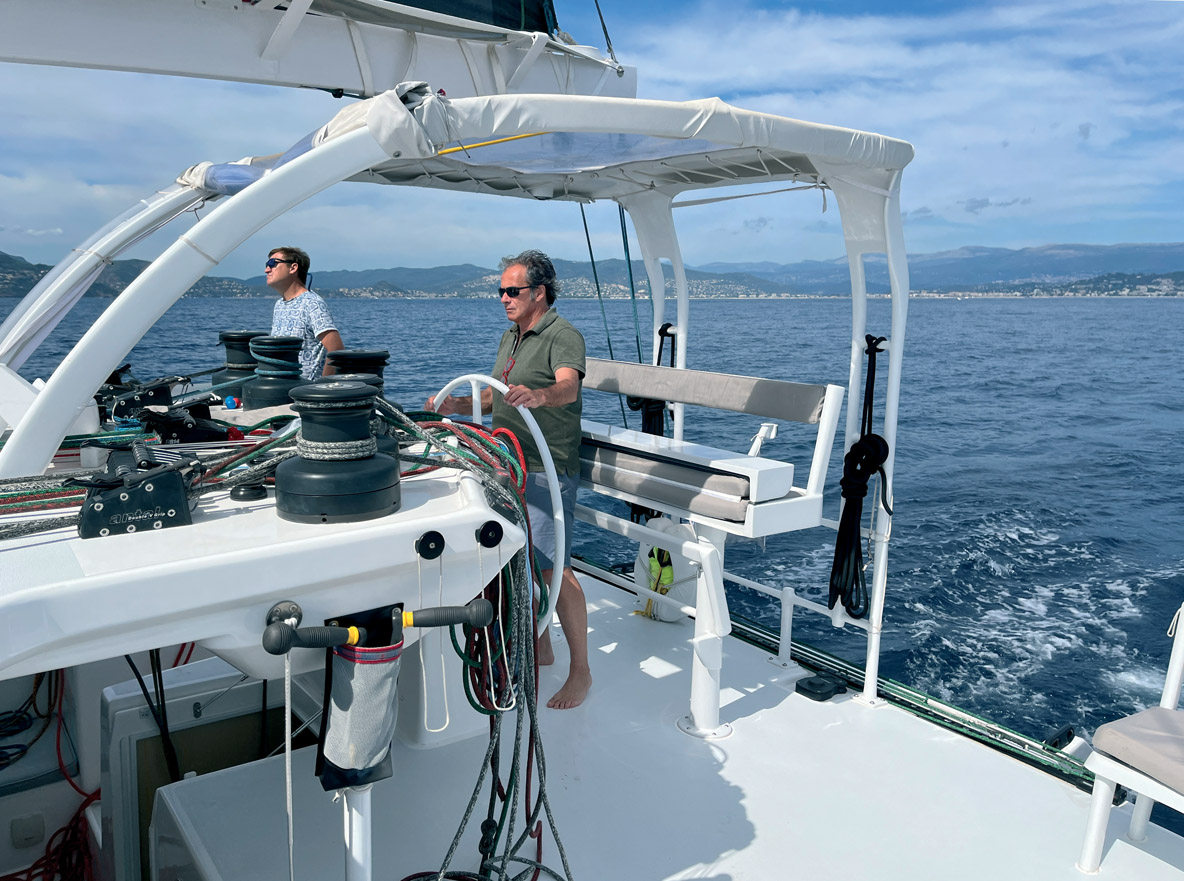
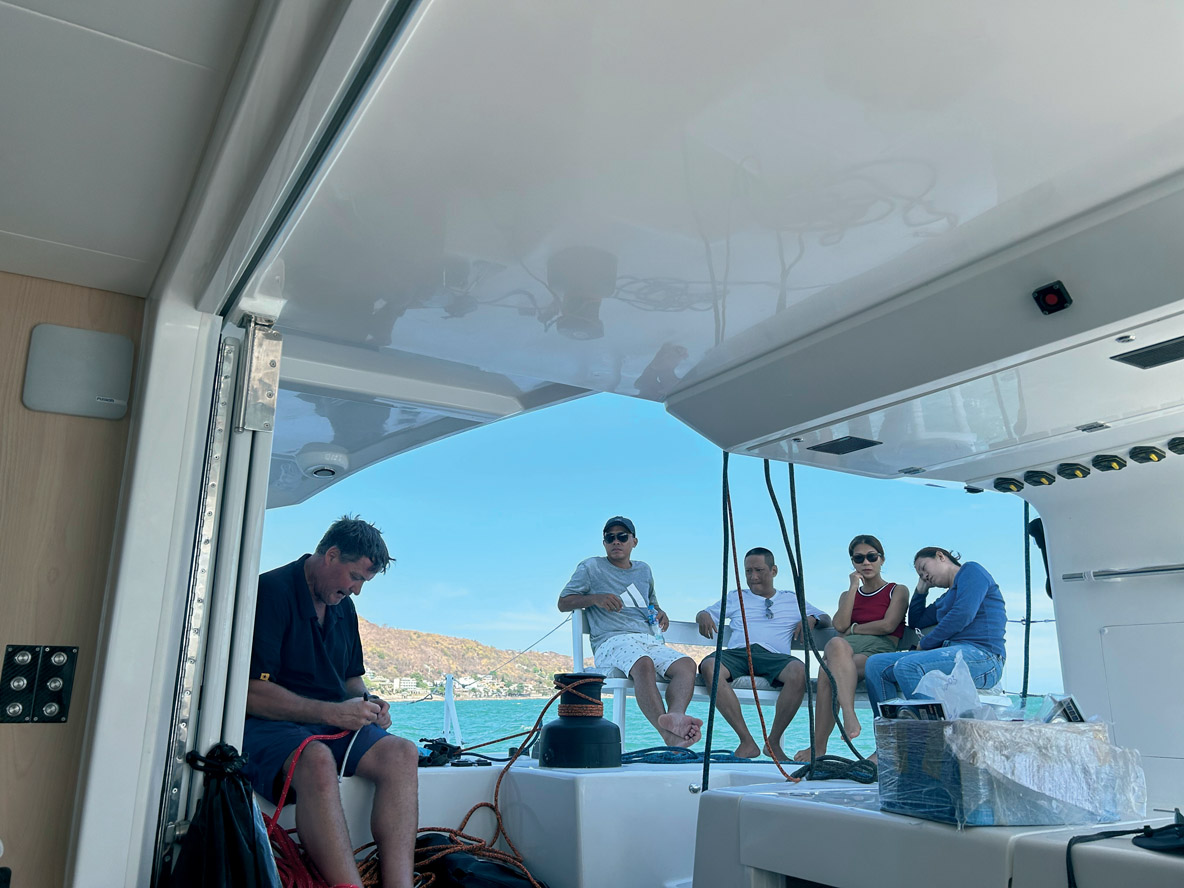
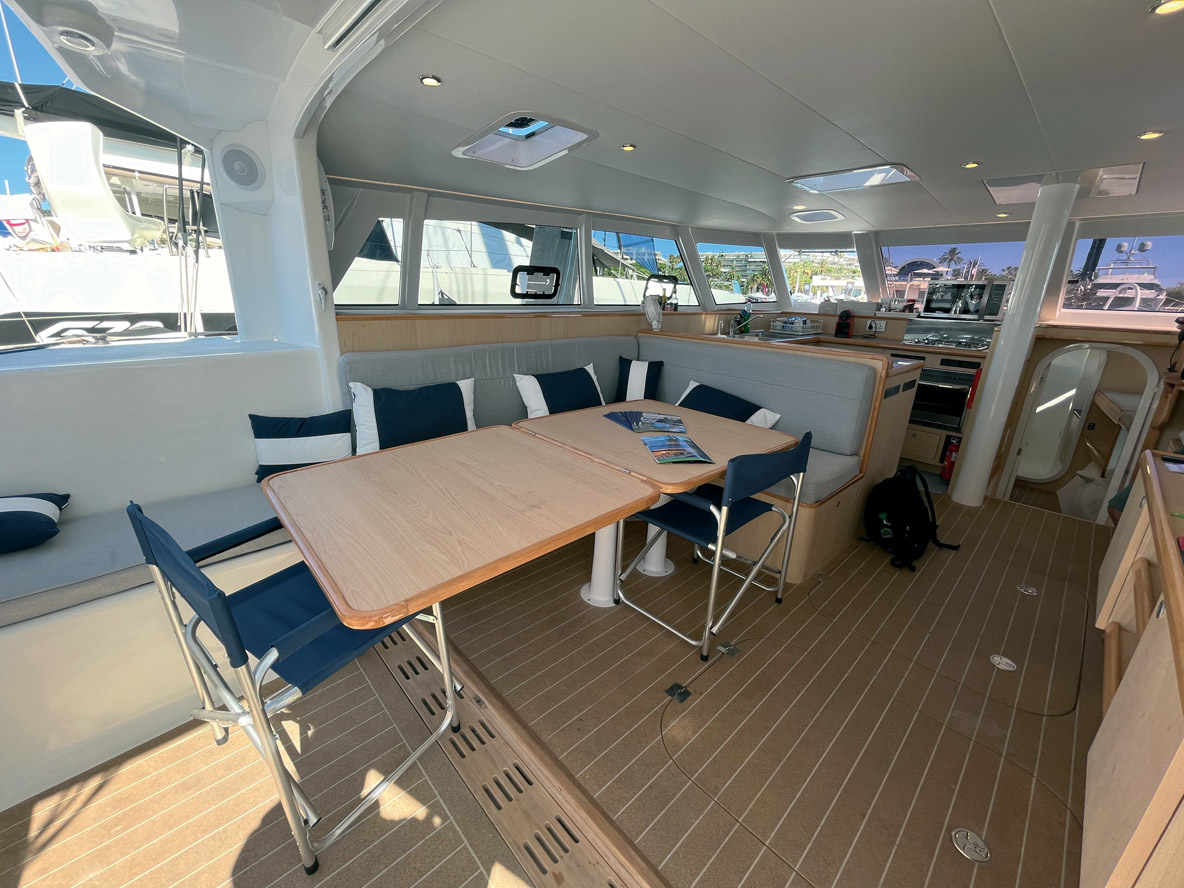
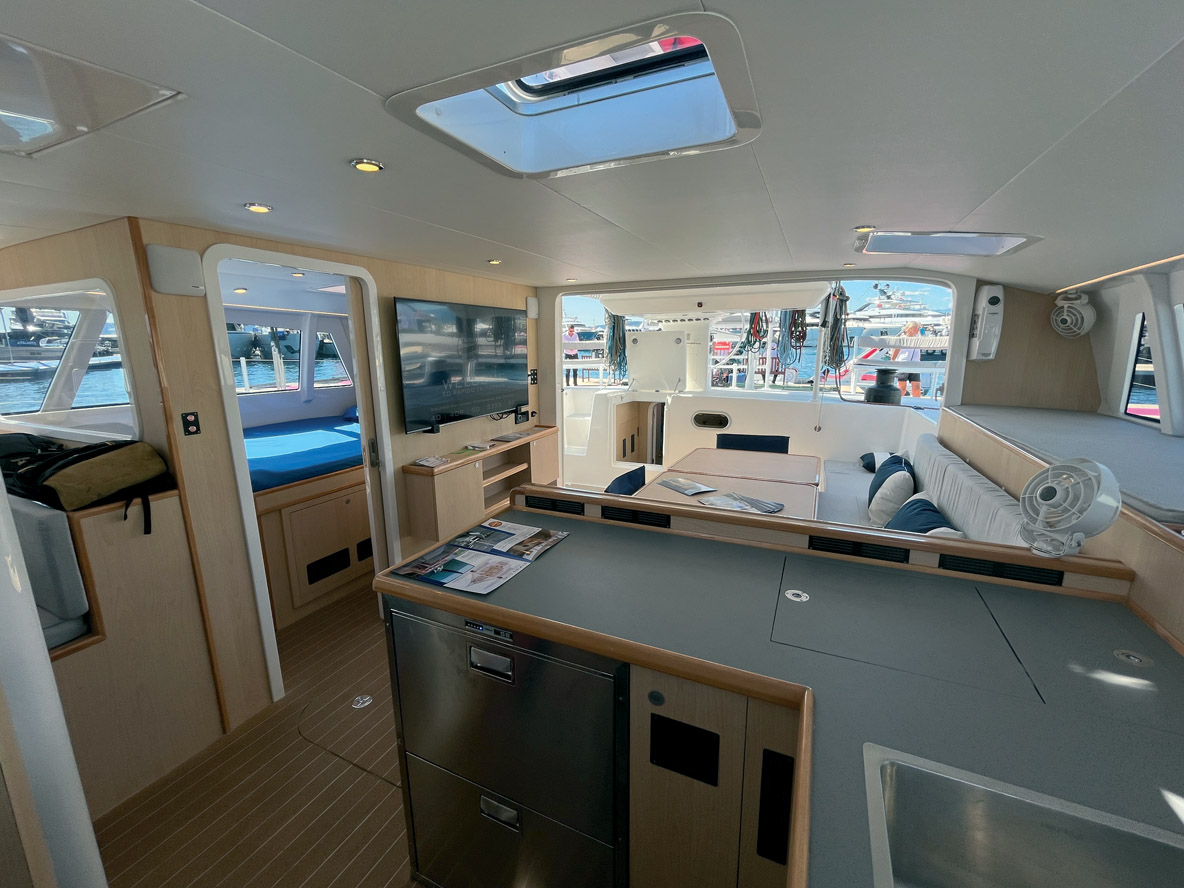
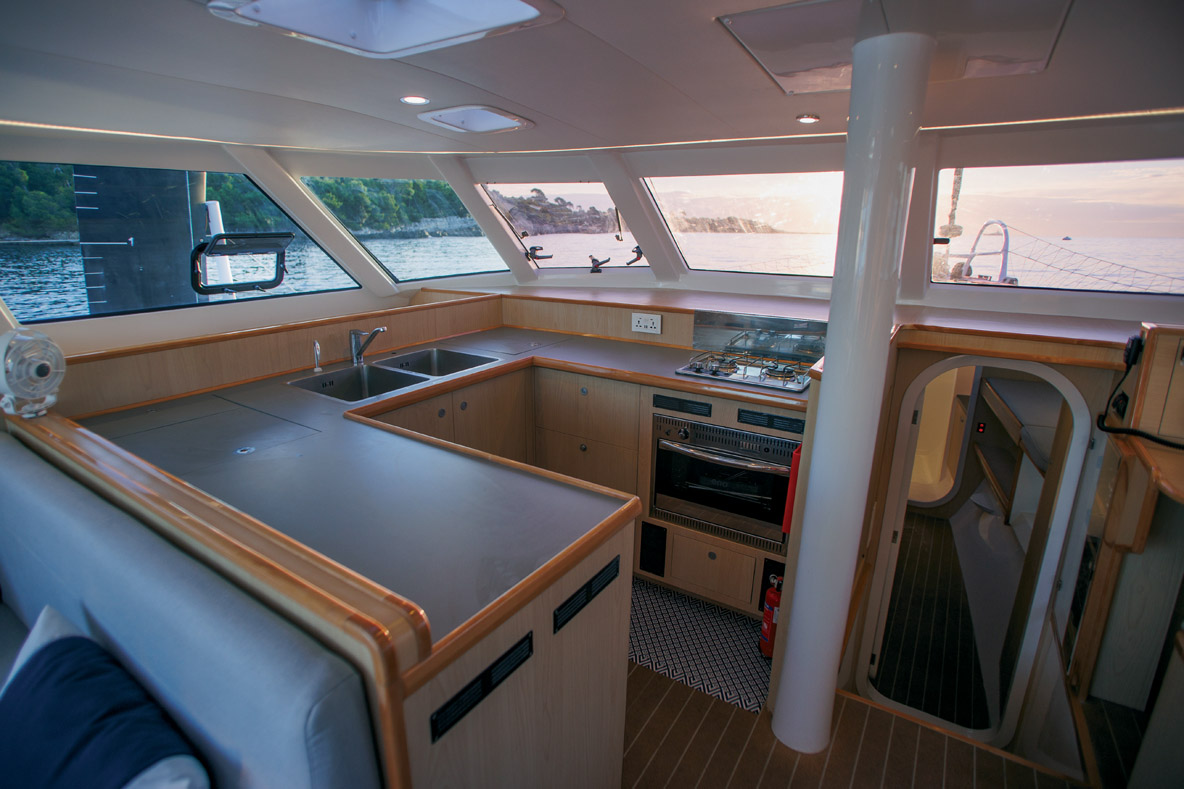
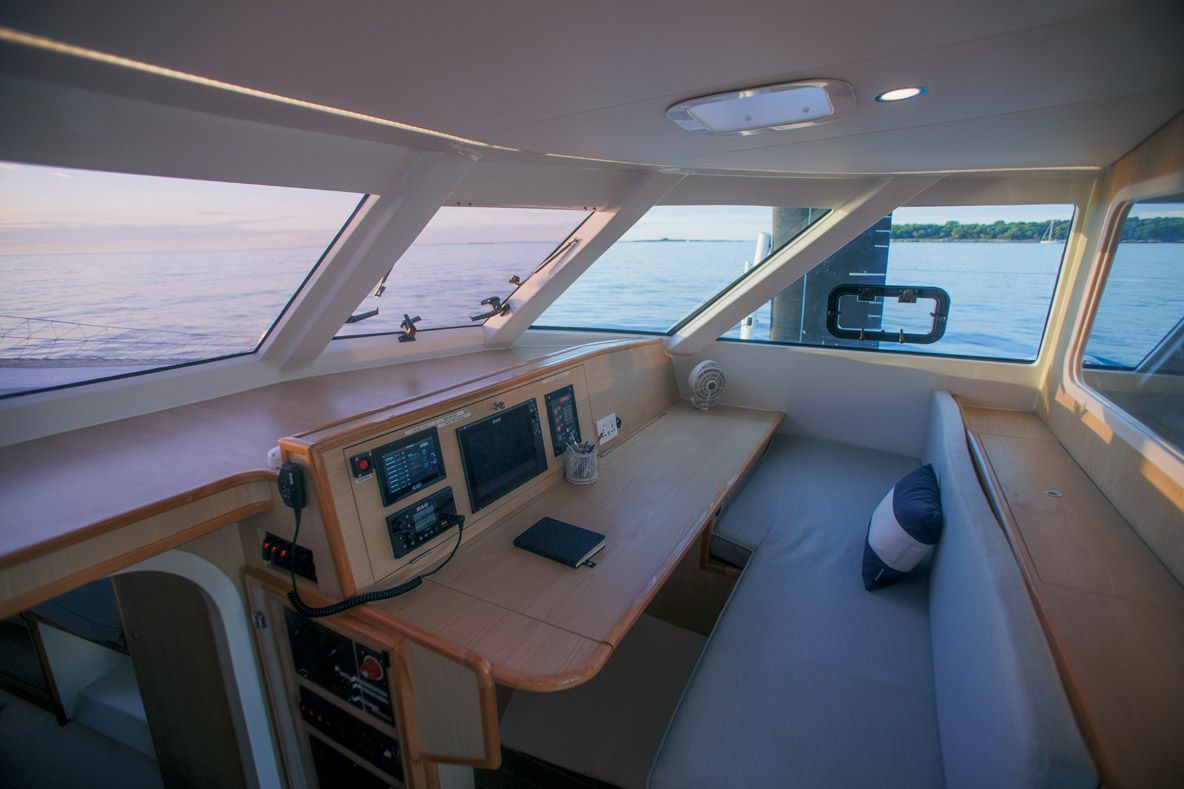
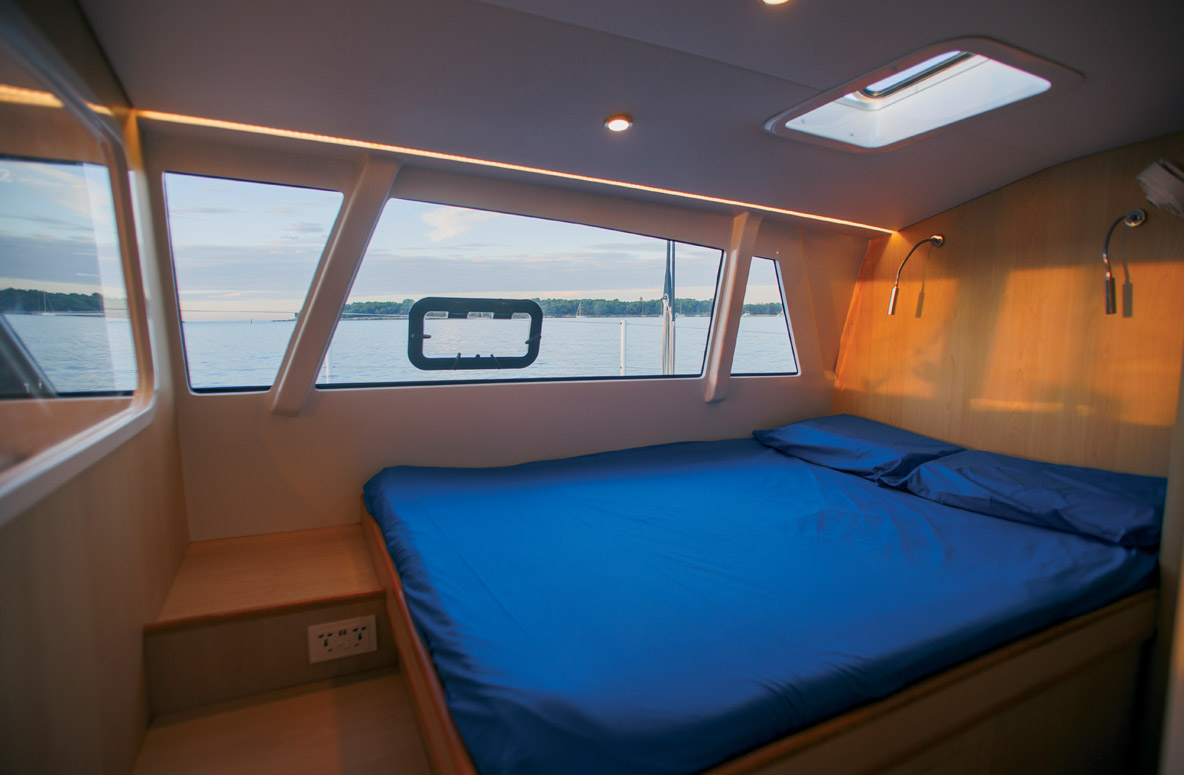
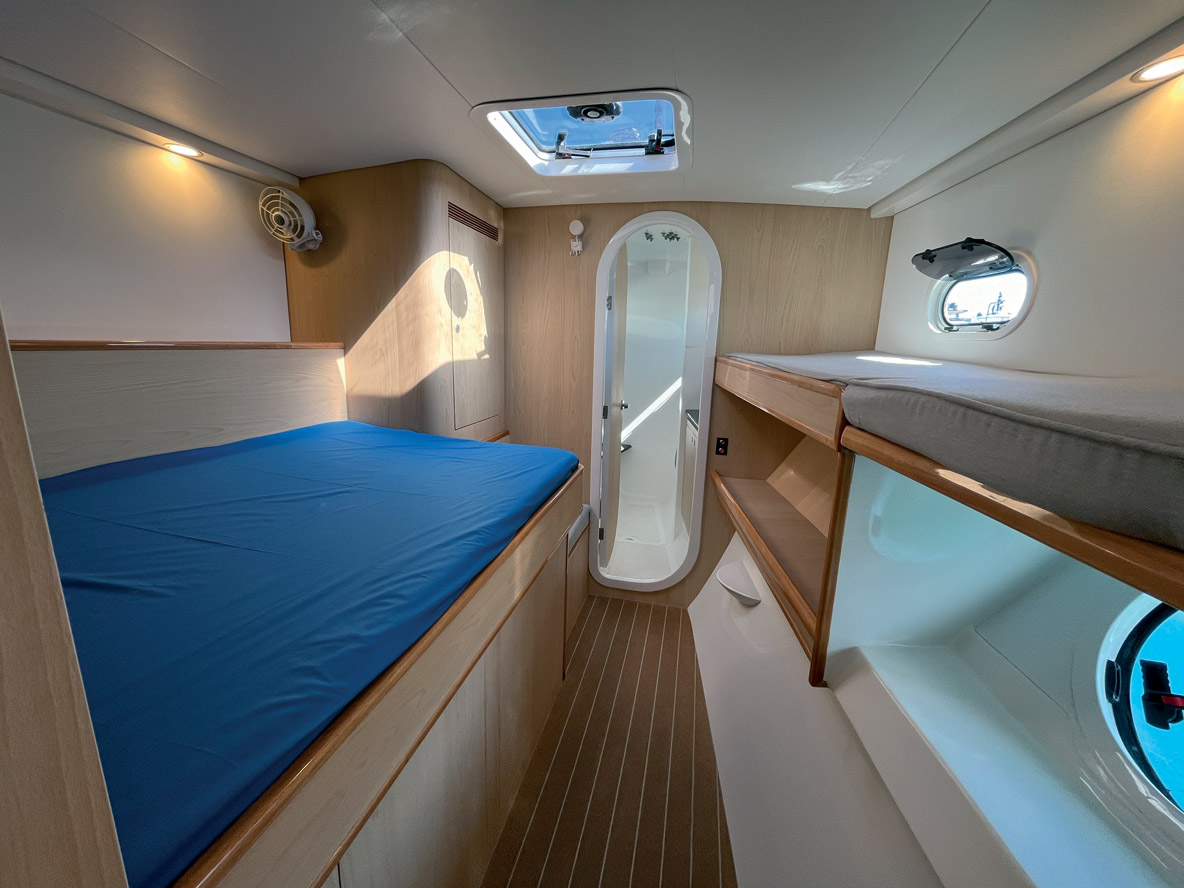
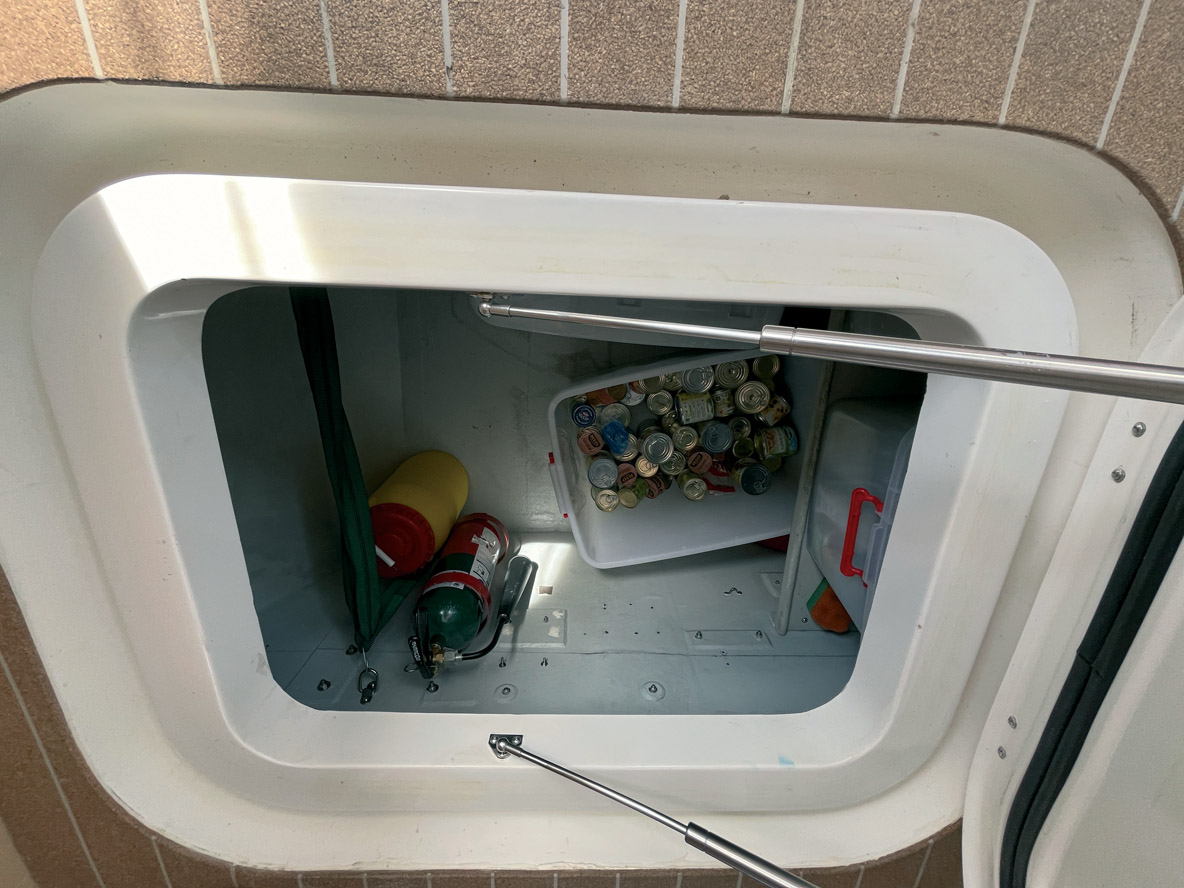
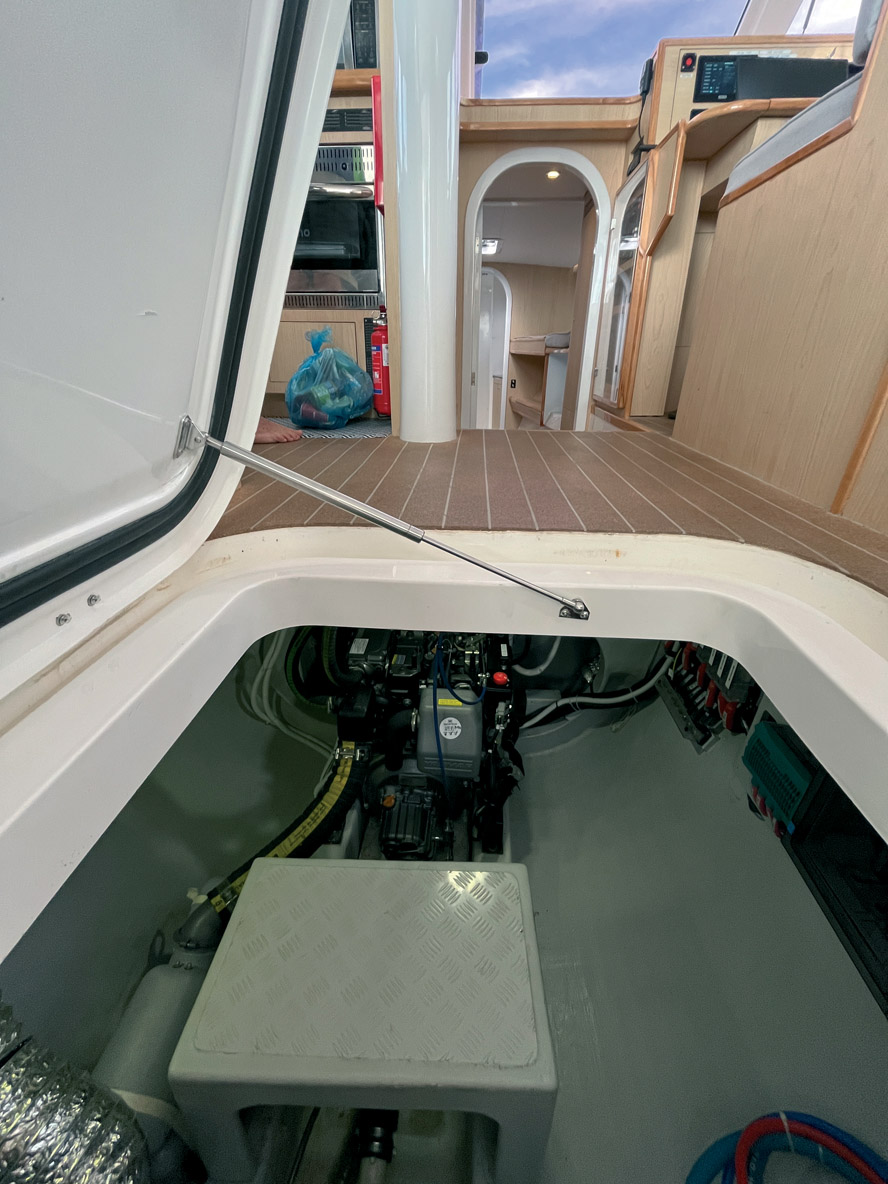
On each side of the helm station, the crew has access to two large, rounded bench seats, ideal for accompanying the skipper or watchman. This wide platform makes it possible to maneuver without disturbing those relaxing nearby, either seated or standing. Below, we can see the central part of the hull, which we access from starboard by descending two steps. And then, to my surprise, I’m reminded of being aboard a motor-sailer from the 1980s, with a sheltered central cockpit with its independent aft cabin aft and the saloon forward. We’ve already seen this with the 60 and 50, but here, once the full-width carbon doors are open, the open space resembles that of a large catamaran. A dining table, which can be extended into the cockpit if required, can seat ten or so guests. A large U-shaped forward galley adjoins the navigation stations, with double bench seating, all facing the sea. And on the starboard side, there’s a double cabin with sea view. This volume, sheltered by the bridgedeck that extends the coachroof, is as imposing as it is reassuring; it offers panoramic views as much as it preserves a certain intimacy, naturally creating a cozy atmosphere. The entire living area is grouped together here, protected from sea spray and view, with private access to the three cabins. You’ll feel right at home here straight away. Forward, the double cabin features a large head in the forepeak. The aft cabin, though smaller with its double berth set athwartships, also has its own bathroom - which can easily double as a day head, given its proximity to the cockpit. There’s no shortage of storage space, and likewise, the lockers are very deep, helping to keep the weight well centered. The engine is housed in one of these lockers under the mast step. Under the cockpit, the main locker can be used as a survival zone in the event of capsize. The cork decking is very pleasant to walk on, is light and provides very effective insulation. These features are really very convincing. It should be possible to do away with the deck cabin to further extend the day space, if the specifications allow.
Ocean Racer Performance
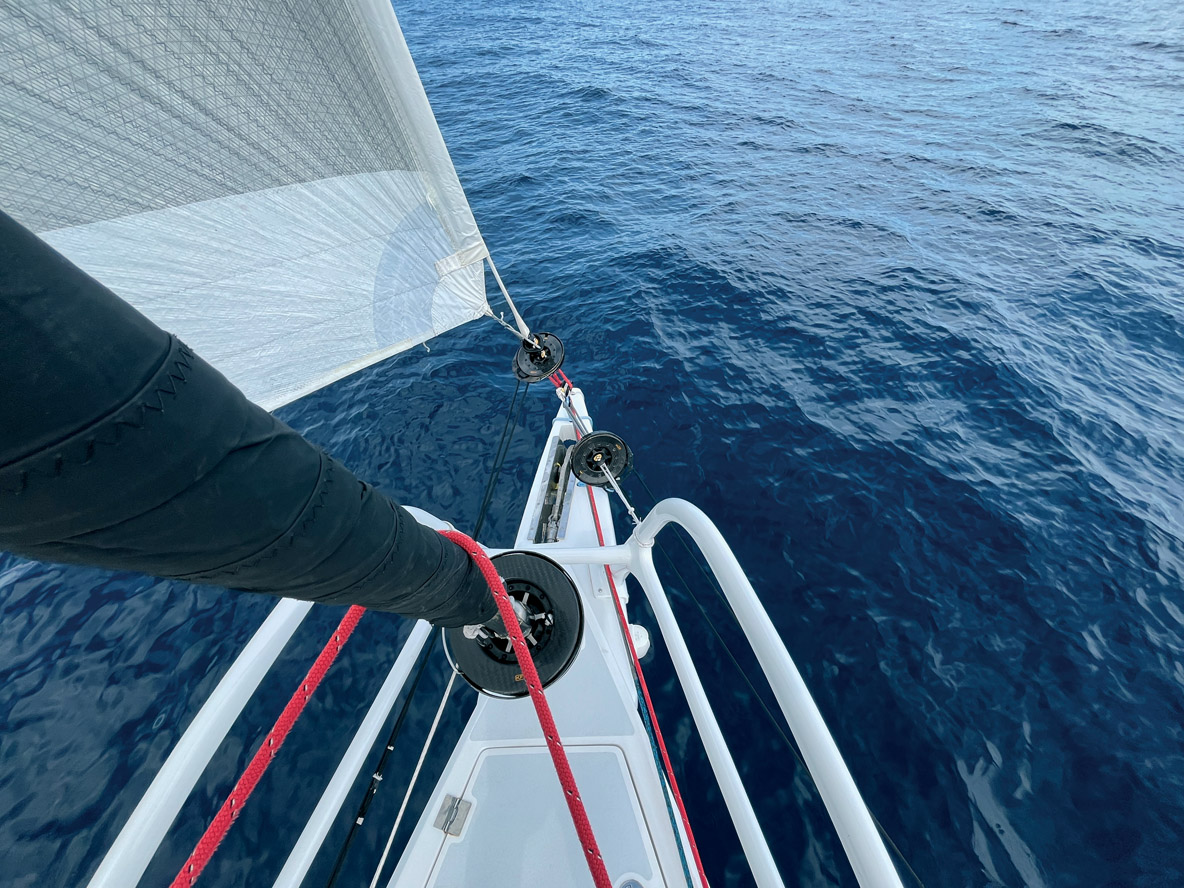
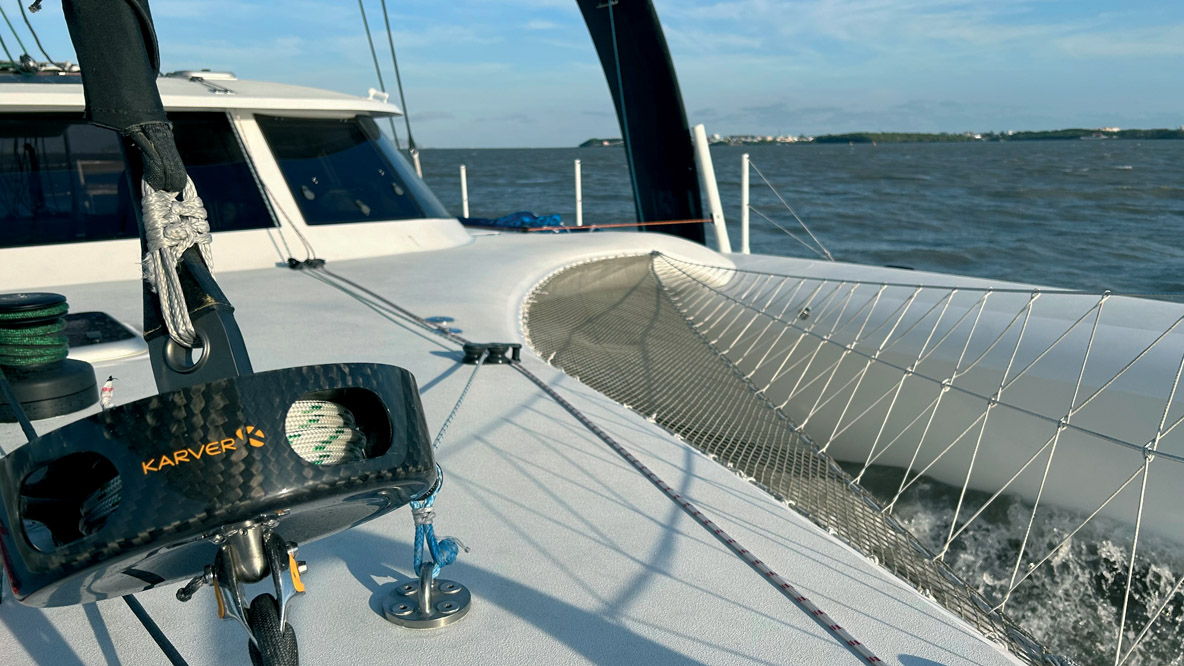
Access to the foredeck is easy via a side-deck along the coachroof. The mast is stepped on its ball-and-socket joint, ready to swivel to optimize laminar flow. The two furlers (staysail and solent) and two Karver furlers (reacher and spinnaker), all fitted with tension adjustment, set the scene for the pursuit of performance. North Sails’ 3Di sails (other options are available) confirm that there should be no boredom on the water. A burst of propulsion away from the pontoon and we were out of Port Canto. At 2,200 rpm, the Yanmar was propelling the trimaran at 7.5 knots. At 2,900 rpm, it can even reach 9 knots. Electric motors are also available, as on the 60, where a 15-kW Ocean Volt can be fitted as a complement. The laden displacement of our test trimaran at the time of departure was around 10.5 tons - it’s worth remembering that the Rapido 53XS must not be overloaded, otherwise its seakindliness will be seriously impaired. In more than clement weather, the sails were hoisted using the eight winches, no less, and we let the games begin. It’s hard to understate the size of the sail-handling console. No fewer than twenty-five maneuvers are involved, and a minimum of practice is required before you can effectively get to grips with it. The light breeze of 5 to 8 knots was a little frustrating - let’s face it, long runs at more than 20 knots weren’t going to be on the cards on the day, but these conditions gave us a glimpse of the 53XS’s potential with more air - which would be more typical in cruising conditions. Under gennaker, the Rapido easily reached eight knots (the wind speed) or a little more. Helm control is remarkably smooth and precise, the system having been optimized at the same time as the rudders. To sail upwind, you dip one of the curved daggerboards. The asymmetry of the profile means that the windward daggerboard must be raised when tacking, otherwise the effect of lift is cancelled. The pointing angle was around 35 degrees to the true wind, which is quite remarkable in these conditions. The trimaran shifted effortlessly in light airs, and a slight strengthening of the wind enabled us to get close to 10 knots. Suffice to say, we didn’t need to put many hours on the engine to cover the miles - that’s also what respect for the environment is all about!
Conclusion
This trimaran is as seductive as it is relevant: it combines the helming pleasure of a racing monohull, and the performance of one, the protection and privacy of a central cockpit, the flush-decked space of a nacelle equivalent to that of a large catamaran, and finally the draft of a Hobie Cat, or almost, to get close to the beach. This is the dream machine for a round-the-world trip. Admittedly, this all-carbon trimaran can be criticized for its high price (80% higher than the Neel 52), its wide beam which complicates access to a slip, and the need to control the payload... but one test sail is enough to get you hooked!
Superb on-board living spaces
Excellent build quality
Aft cabin a little cramped
Complex sail handling console for cruising
Technical specifications
Architect: Morrelli & Melvin
Interior design: Rapido Trimarans
Overall length: 52’10” (16.1 m)
Beam: 34’ (10.36 m)
Draft: 2’3”/13’ (0.67/3.94 m)
Air draft: 87’2” (26.56 m)
Light displacement: approx. 20,600 lbs (9.35 t)
Square-topped mainsail: 1,260 sq ft (117 m²)
Solent: 807 sq ft (75 m²)
Staysail: 269 sq ft (25 m²)
Gennaker: 1,615 sq ft (150 m²)
Spinnaker: 2,475 sq ft (230 m²)
Drivetrain: 57 HP Yanmar
Fuel: 79 US gal (300 l)
Water: 105 US gal (400 l)
Berths: 8
Prices in US$ ex-tax
Price standard version: 1,750,000
Price of the version we tested: approx. 2,000,000
Options
Race Stratis Carbon sail wardrobe: 117,000
Fast Crusing Liteskin sail wardrobe: 91,000
B&G electronics pack: 26,790
Retractable bow thruster: 11,380
Velair air conditioning: 29,000
Fisher Panda 6 kW generator: 28,500
C Zone electrical system: 22,500