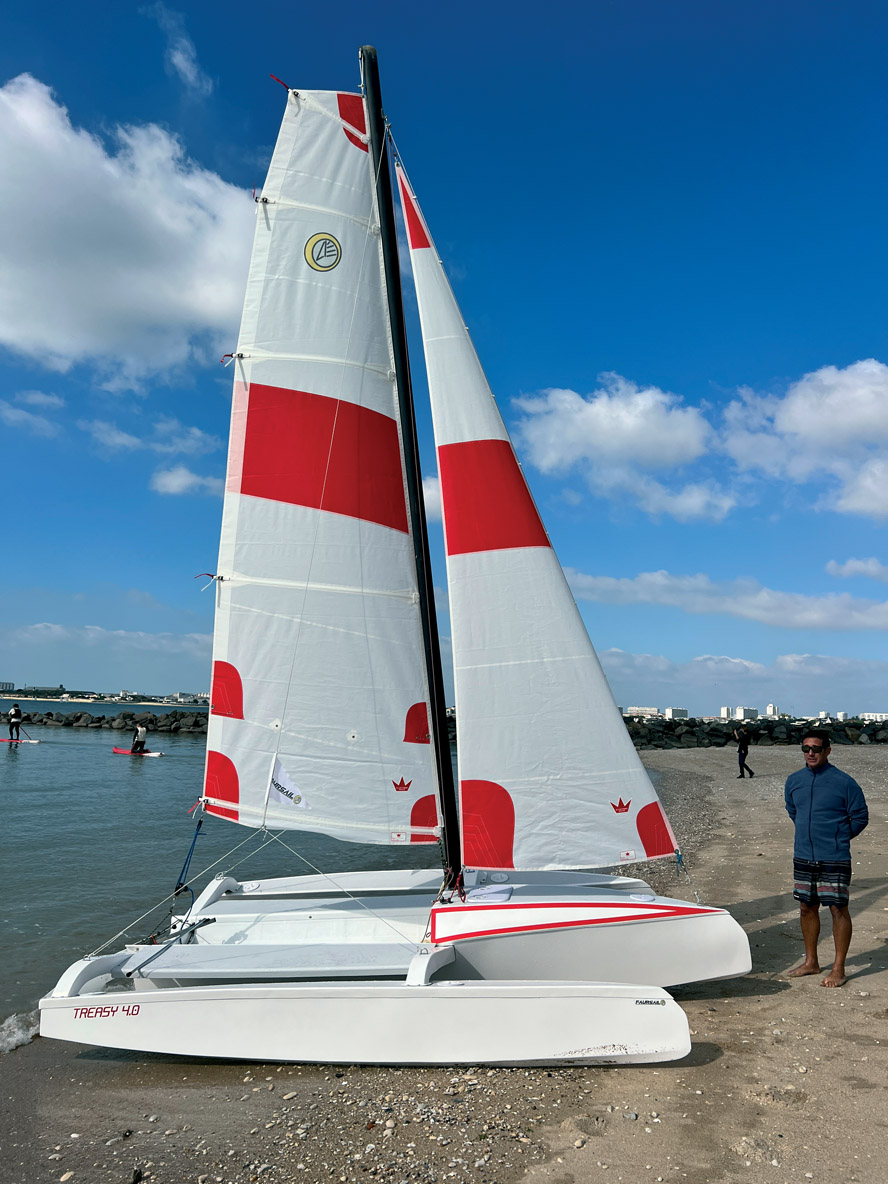
Seen in preview presentation at the La Rochelle Boat Show, the Treasy 4.0 made as big an impression as it is small. We were able to test this particularly accessible miniature... and fun multihull for you!
Infos pratiques
- Le chantier : Treasy 4.0
- La fiche technique
-
 Découvrez notre vidéo exclusive
- Financez votre Treasy 4.0
- Assuez votre Treasy 4.0
- Articles autour du Treasy 4.0
Conditions: 5 to 12 knots of wind, flat seas
We met up on the beach (the little machine we’re interested in today has no business in the nearby boat show port of Les Minimes) at the heart of the newly renamed “Grand Pavois Beach”. Here, everything that glides across the water rubs shoulders with the world of dinghy sailing.
The Treasy 4.0 promises to be easy to spot among the paddleboards, kitesurfers and other catamarans: trimarans like this one, weighing less than 100 kg (220 lbs), are not a dime a dozen! We should say “no longer”, because 20 years ago, the Magnum 21 sold 400 units. Since then, other manufacturers have tried their hand at the mini-trimaran, such as Astus Boats with its 14.5, which can be converted into a prao, but without recapturing the great success of the 2000s. In our opinion, the formula has been incorrectly ignored and deserves to be relaunched. So welcome to Treasy 4.0! This new model was designed and built by Emilien Faurens at his Faursail shipyard, based in La Tremblade. Usually, the architect/builder’s products are (small) one-off boats, but the multihull we’re interested in, made in GRP, is offered in series production: the chines common to all Faursail models are retained, but this time the hulls come out of molds. Emilien, keen to offer a rigid yet easy-to-repair sailboat, opted for a monolithic construction using biaxial glass cloth. In a move to take environmental impact into account, a 25% biosourced resin will be tested.
To keep costs down, Emilien has not hesitated to use components from production catamarans. The rudder and steering system are borrowed from the Topaz 12, as is a large part of the rigging - mast and mainsail (slightly enlarged). As for the jib, that comes from an SL15.5. The manufacturer also encourages the use of sailboard rigs available to customers.
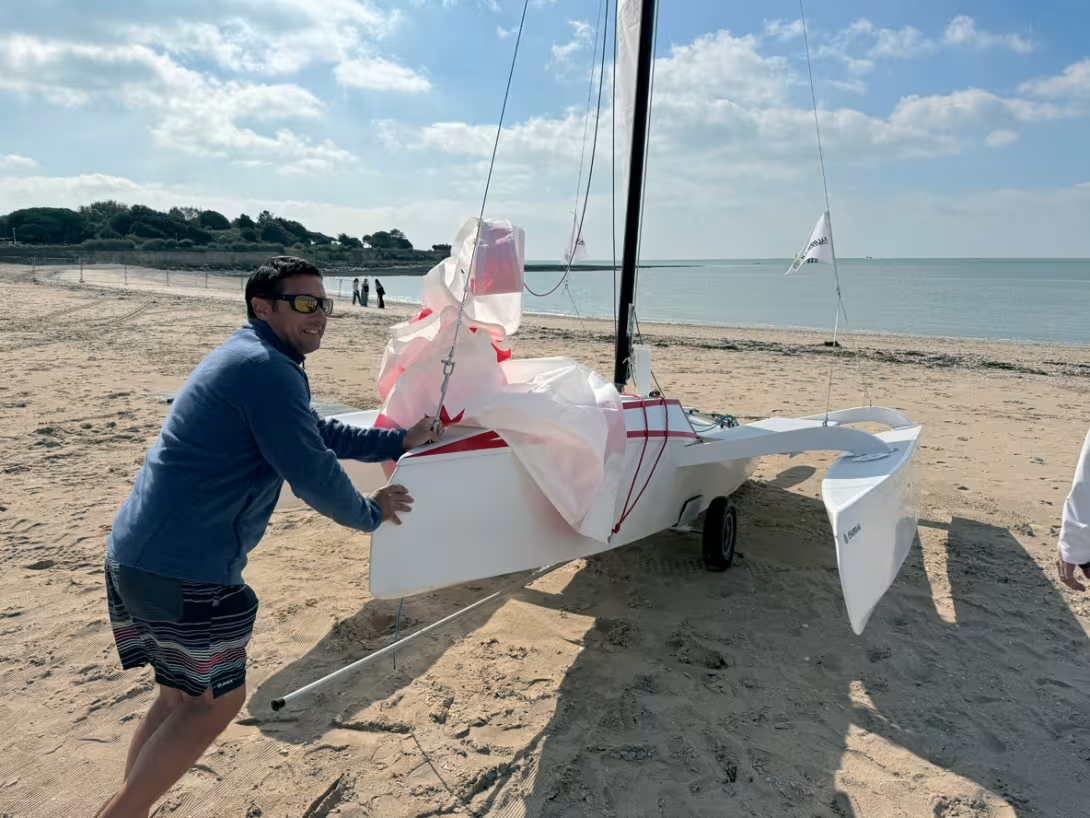
Dismantlable and Transportable
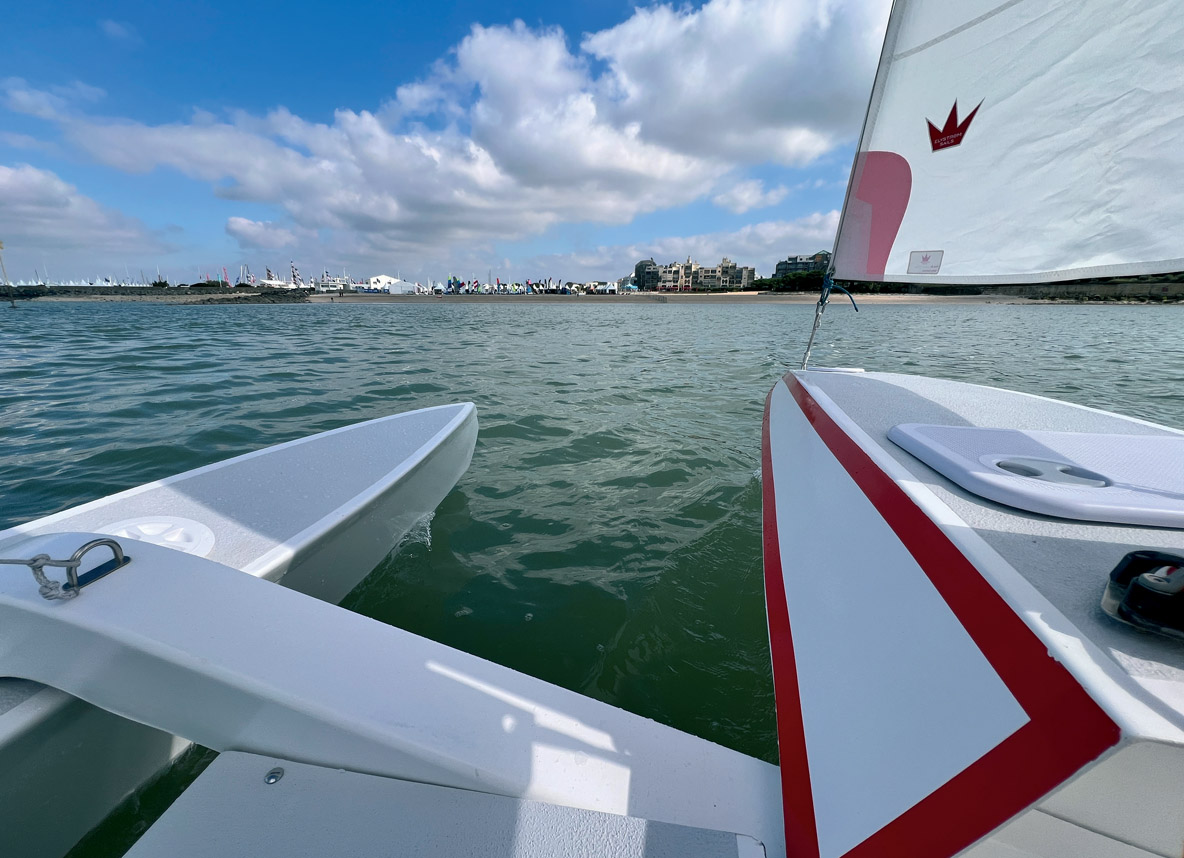
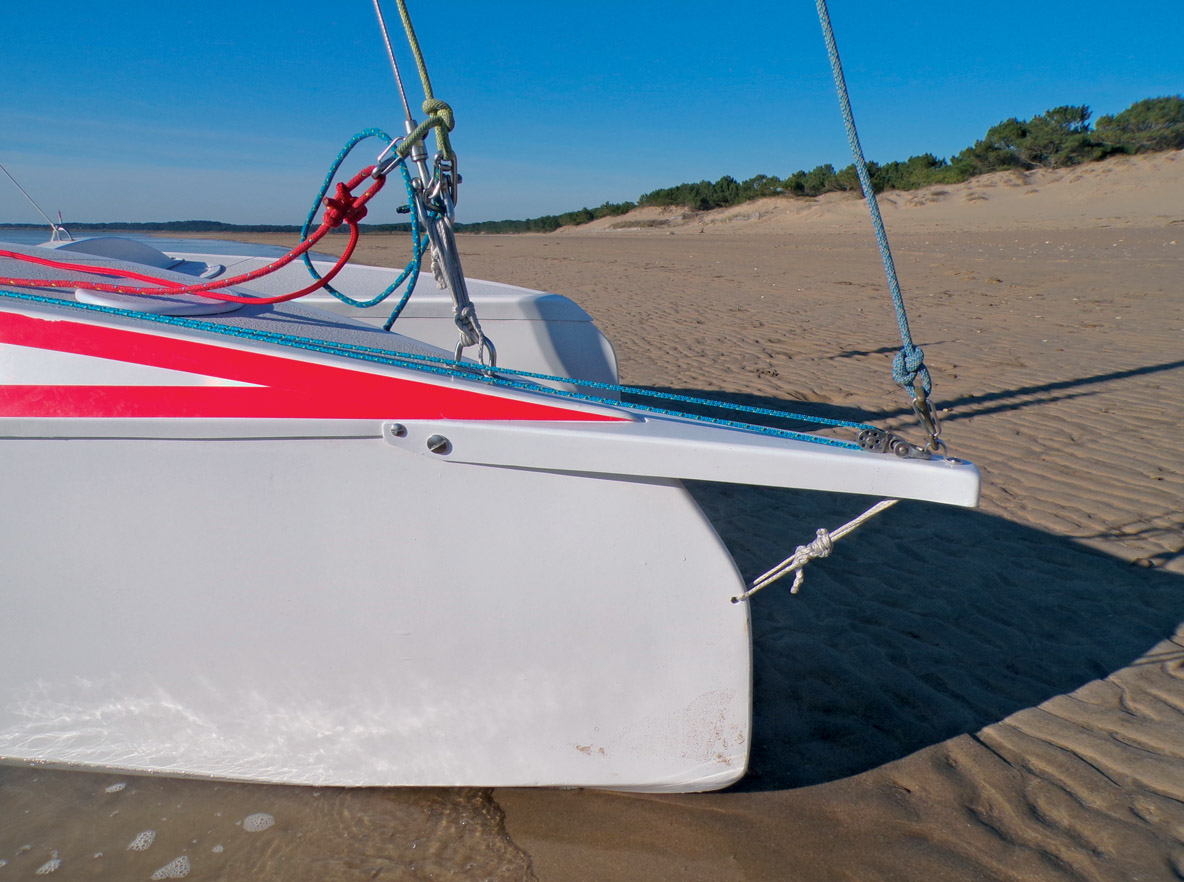
The Treasy 4.0 presents itself as a reduced version of a racing trimaran, with a pronounced deck sheer on all three hulls, straight and then inverted bows and, above all, raised crossbeams. From the outset, the design is seductive; only the stickers on the fore deck could do better. But let there be no mistake: while this compact, lightweight trimaran plays the sporty card, it has been designed by Emilien as a tolerant multihull that is perfectly suited to beginners. On the beach, the Treasy can be carried by 3 or 4 people. This isn’t necessary for us, as we have a beach cart that supports the central hull - so the multihull can easily be lifted onto a boat ramp or onto the sand. On the road, it can be towed without dismantling almost anywhere in the world - it respects the restrictive 2.55 m (8’4”) European road gauge - on a simple jet-ski trailer. The Treasy can also be disassembled: simply unstep the mast (which can be done solo), remove the cockpit wings and rear crossbeam, and then fit the square-section front linkage arms into the central hull. In “parts”, the little trimaran will just about fit into a van (the doors or tailgate remaining open, however).
For Beginners and Experienced Sailors Alike
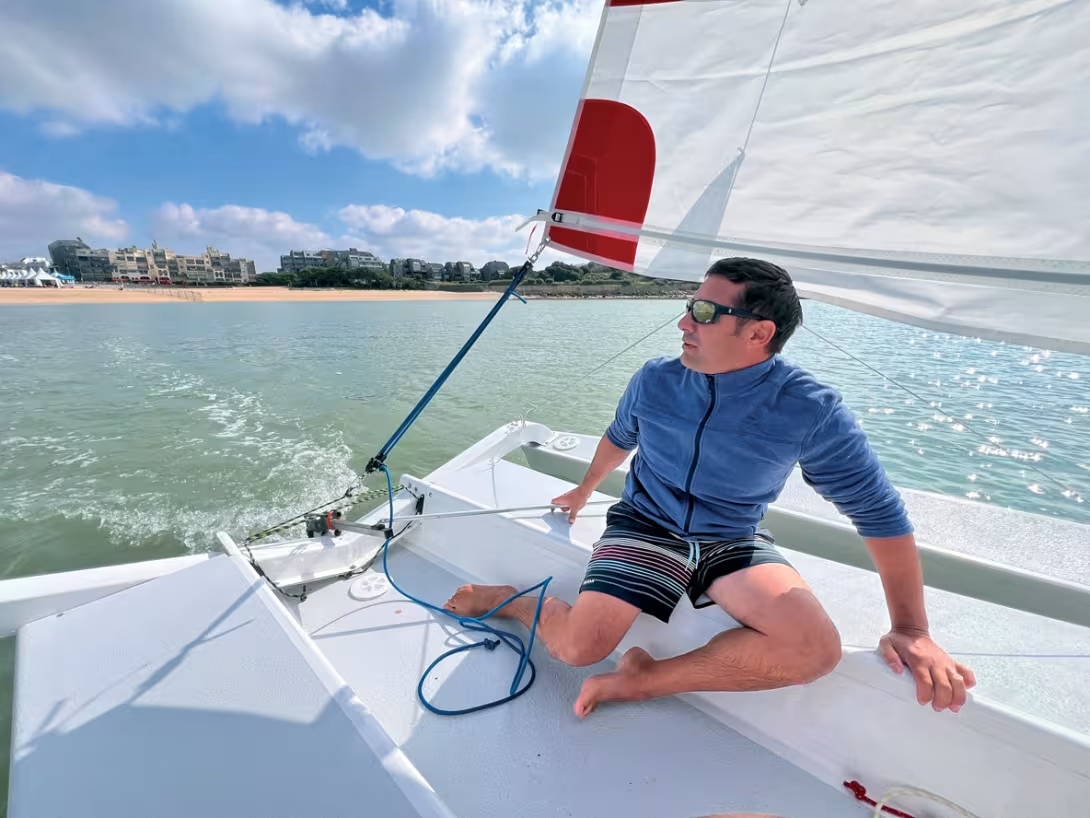
Rigging the boat is a simple formality; all maneuvers are concentrated at the mast foot, with the exception of the mainsheet, which is mounted on a bridle at the stern. Simple and tried and tested. To sail calmly away from the shore, all you have to do is manage the daggerboard function in the middle of the central hull. While the hull decking is narrow, the cockpit has plenty of room to stretch out, thanks to rigid wings - a little too soft, though - that replace the traditional trampolines. The ability to sit comfortably on the rigid wings is highly appreciated, especially as this position allows you to balance the boat - or to induce heel - very effectively.
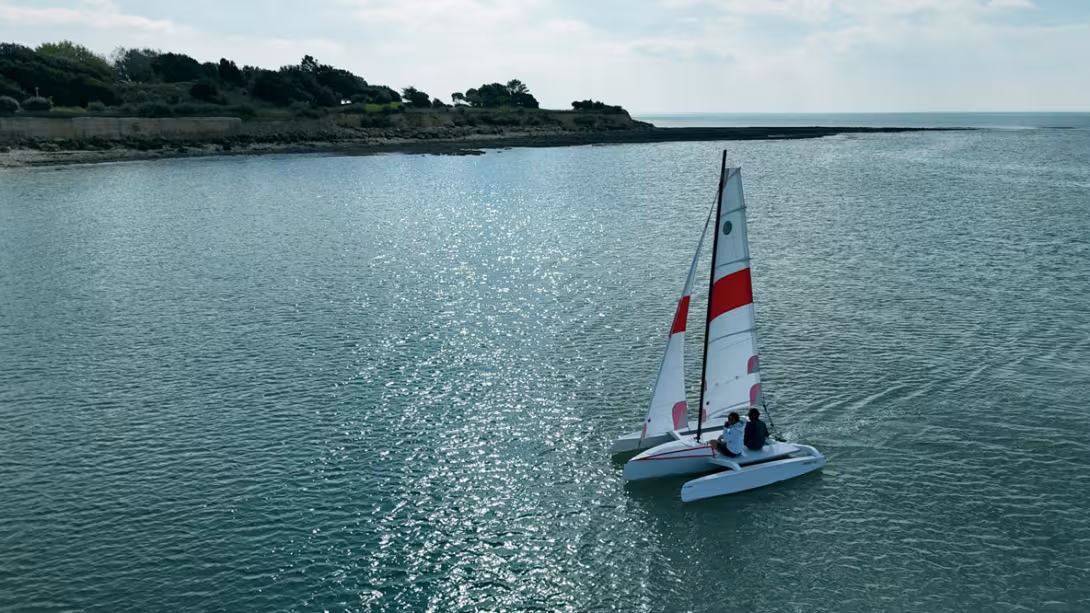
In terms of performance, the Treasy 4.0 is ideally sailed single-handed - but the trimaran easily supports two adults. Our test run in light airs confirmed that the real sensations of gliding were best reserved for a... solo crew. A rather logical observation, given the size of the boat. Thanks to a few good breezes, a little stronger than the others, I managed to keep close to 10 knots. As with all light sailboats, crew positioning is crucial - in light airs, it’s best to get as far forward as possible in the cockpit. In 10 to 15 knots of wind, we won’t exceed 15 knots of speed according to Emilien; but in a good breeze, the architect/designer promises us 12 knots upwind and flirting with 18/20 knots off the wind. And there’s more to come, as a bowsprit is currently being developed for rigging a small gennaker or asymmetric spinnaker.
Conclusion
This small trimaran will appeal not only to individual sailors, but also to sailing schools and seaside hotels looking to renew or diversify their fleet: in short, the Treasy 4.0 should appeal to everyone, offering thrills with ease. Beyond its obvious intrinsic qualities, this pocket-sized multihull has a striking argument in its favor: its particularly attractive price.
Easy to set up and to sail
Very attractive price
Cockpit wings need stiffening
Technical Specifications
Length: 13’1” (4 m)
Beam: 8’4” (2.55 m)
Displacement: 210 lbs (95 kg)
Mainsail: approx. 75 sq ft (7 m²)
Jib: approx. 43 sq ft (4 m²)
Spinnaker/gennaker: in test phase
CE Category: D2
Price:
€ 7,167 ex-tax without sails and rigging
€ 7,917 ex-tax with used sails and rigging
€ 9,167 ex-tax with new sails and rigging