
The idea of a folding, habitable trimaran is an attractive one: speed, fun to daysail, enjoyable semi-offshore cruising with minimum draft, shippable by container, and all these qualities in a compact format suitable for modern marinas. Until now, Dragonfly and Corsair have been the dominant players in this market, but the sector swarms with creative initiative (sadly not always winning commercial success!) Tricat, who have built 140 boats in 22’, 23.5’ and 25’ versions, are unveiled their Tricat 30. We took one for a test sail on a nice windy day in late fall.
Infos pratiques
- Le chantier : Tricat 30
- La fiche technique
-
 Découvrez notre vidéo exclusive
- Financez votre Tricat 30
- Assuez votre Tricat 30
- Articles autour du Tricat 30
A more diverse production than you might think
Beyond the two most well-known brands, several builders have taken up the challenge: there was the formidable Seaon 96cr with break-taking performance, but whose production halted after just a dozen superbly-built examples; the Trimax, which never got beyond prototype stage; the Bandit 870, which is struggling to get over confidentiality and logistical problems linked to relocated production in Asia; the very sharp T29 by Pauger; or the Challenge 30 by Naval Force 3. All these likeable multihulls have qualities which are becoming rare: ease of use and great fun to use. But they have several difficult obstacles: price (small and technical production runs are costly to build); the absence of much brand awareness, or mistrust beyond a select few connoisseurs; and the premium placed on interior space, much more favorable on a monohull especially secondhand), all of which limits their distribution.
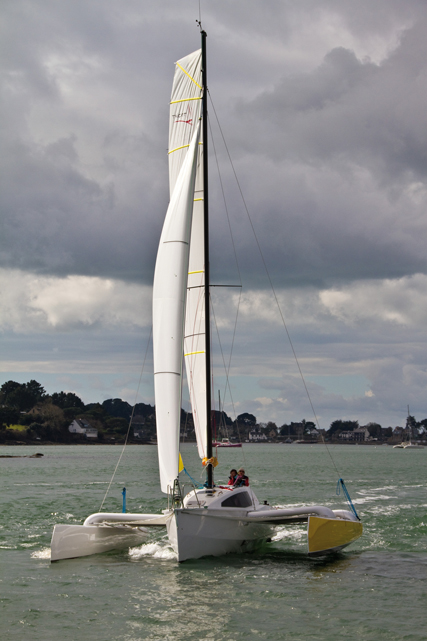
A modern, fast cruising trimaran with good living
Tricat, a committed craftsman and quality composite fabrication
Antoine Houdet he’s a very experienced sailor, racer, offshore competitor, big lover of multihulls and test pilot for everything he builds. For the fabrication of the hulls of the T30, Tricat delegated to Marsaudon Composites in Lorient, northwest France, as trusted sub-contractors in a yard renowned for many high-quality builds, and their rigorous respect for keeping weight down (including Paradox, a more civilized replica of an Orma 60, Idec II, the TS0 and 42, Eos 54, and more). The carbon arms are made by Tricat, as are all the ancillary elements and the appendages (also in carbon). Assembly and fitting out are done in the new workshop at Plescop, in Brittany. This trimaran is intended to be simple to use and not too fancy, though the yard is capable of exacting composite work. All the elements of the Tricat 30 are made by infusion (carbon epoxy for the arms and the appendages, glass polyester for the hulls).
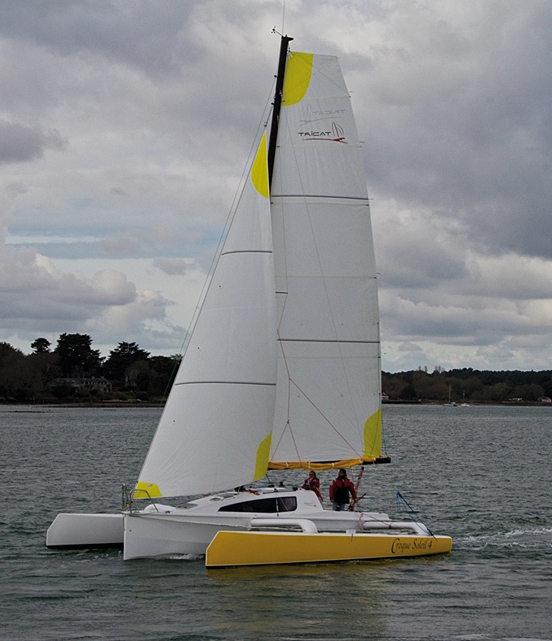
A well-balanced sailplan which produces good power without making the boat too sharp. Setting up the gennaker is made easy by the design of the triangular folding bowsprit
A clear, solid and efficient folding system
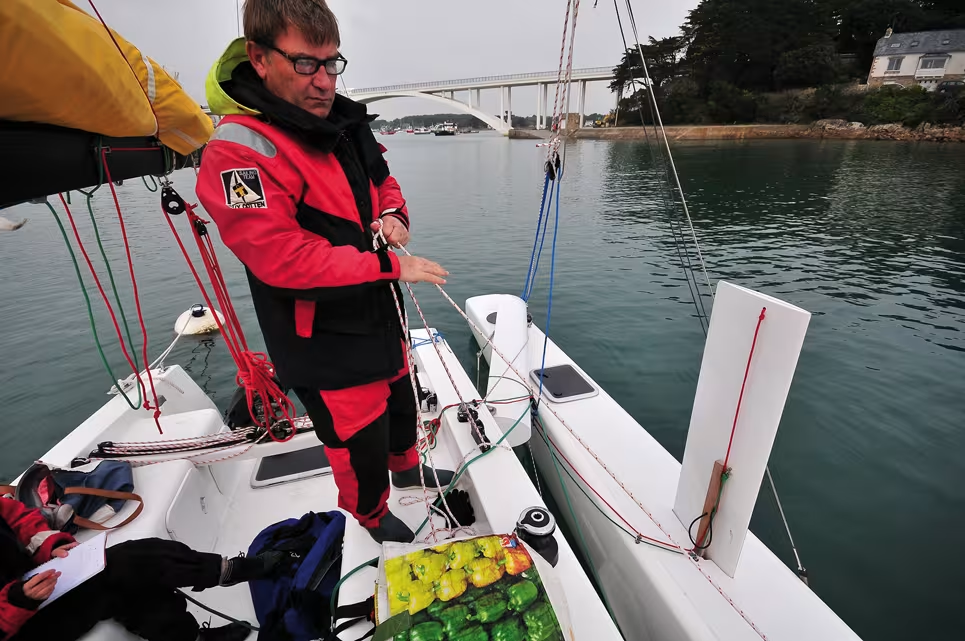
As with all the systems of folding along a horizontal axis, it’s the trampolines which maintain the parallelogram fixed in the open position: once tensioned, that’s enough. However, the rules demand an additional anti-folding safety system. On the Tricat 30, it’s the triangular forward trampoline fixed by a block and tackle which plays this role. The vertical forces are taken by of water stay cables which are at maximum tension when the arms are open (a fine adjustment is carried out by the yard which must not be modified, otherwise there is a risk of breaking the folding pins). These structural cables (I don’t know why they are not Dyform, 30% stronger for the same diameter) have to be changed every five years in normal use. This variable geometry may appear simple, but it is very precise and must be easy to understand (which is the case here) to clarify its use. The operation is performed by easing the capshrouds with the help of a block and tackle lashed to the aft of the float. There is no need to worry about the mast, as it is laterally held by the lower shrouds! Next, the forward trampoline is released, then the end of the main trampoline from the cockpit and the whole retracts almost by itself (a line attached diagonally to the forward beam helps pull it in). A word of warning: slip a fender between the hull and the float to avoid any chafe.
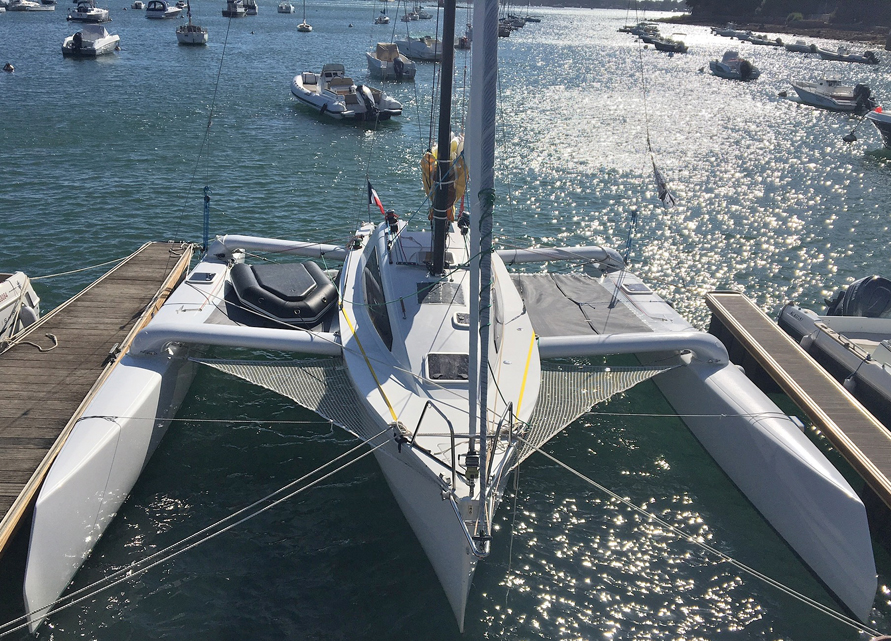
Note the width of the sidedecks and the safety provided by the forward trampolines. A great machine at an ideal size for intensive use
Generous interior volume
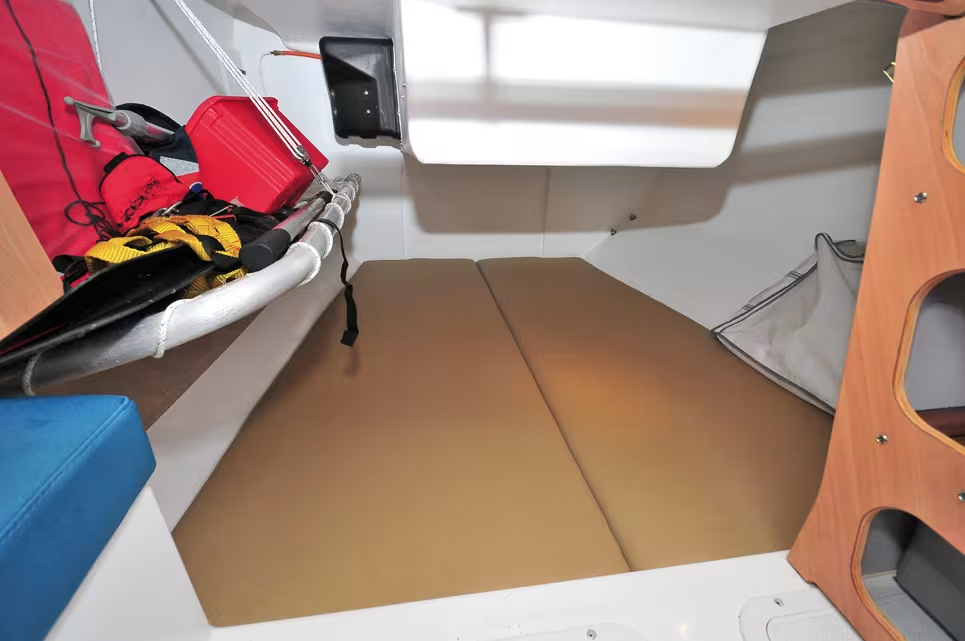
A headroom of 1.88 meters doesn’t just make it comfortable for tall people, it translates immediately into perceived volume, and allows for good-sized windows in the sides of the coachroof. This is a strong point in the boat’s favor. The removable companionway ladder folds away under the chart table, to reveal a really big double bunk aft, and a folding bunk which can be used either for sleeping or stowage. The forward cabin is not so wide at the feet end, but is still OK for a couple. The heads compartment (often not good on the size of boat) is welcoming and there is space to take a shower - a hot one, in port, if you have chosen to install an electric water heater, otherwise a kettle and a wash cloth can help you rediscover a self-sufficient level of comfort! The long galley far exceeds all the possibilities of a camping set up: there is a real two-burner cooktop, recessed with an anti-spill plate; large worktops; a round sink and pressurized water; a top-opening refrigerator (optional) as well as all the stowage space you could need. Very successful on the size of boat! The raised saloon is not dissimilar to that of a small catamaran, accommodating 3-4 people (five with a folding stool) with panoramic visibility across the water, this would need to be blocked off to ensure nighttime rest! The clever folding table can be transposed to the cockpit if the weather is nice. The central area of trimarans is tricky to deal with in terms of layout, but here, it’s faultless, with great conviviality complemented by the privacy of the two cabins. The choice of finishing materials felt a bit austere to me: a more stylish finish might be nicer.
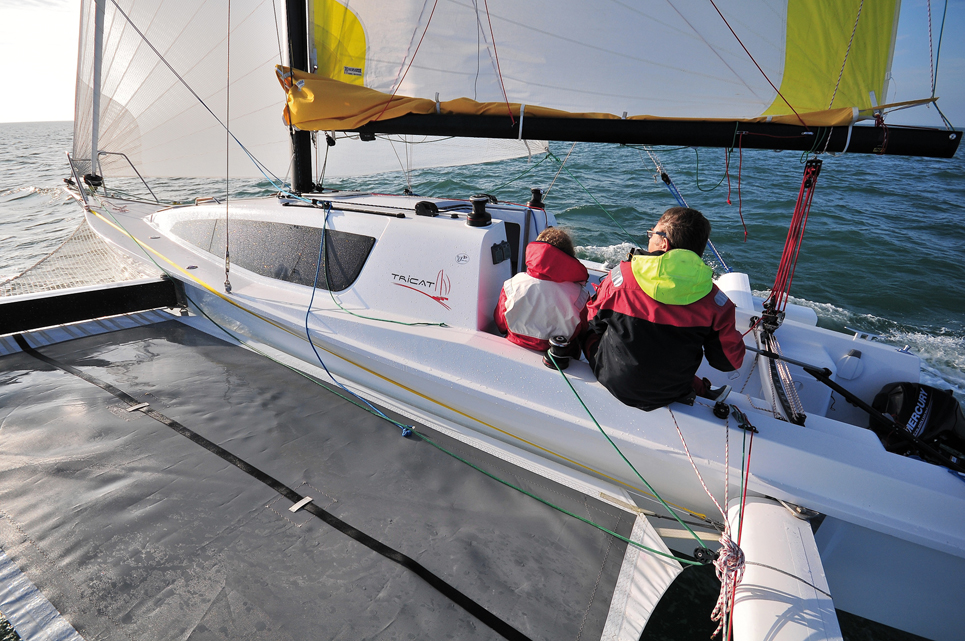
The Tricat 30 is designed for ease of use as well as ease of maintenance. The all-infused carbon construction of the arms gives great stiffness to the whole platform
Sea trial
With reassuring lines and welcoming interior, the T30 will appeal to a clientele put off by too-spartan volumes and who are not looking for such a level of comfort on a 9m trimaran. At 1,800 kg, she’s lighter than a Dragonfly 28, and carries the same weight as a Corsair F31, whose interior volume has nothing to compare. Approaching the mooring ball, at first sight there is a powerful multihull, well clear of the water, with the central hull having good freeboard. The design of the crossed arms is elegant and the modern, high-volume floats confirm they have been designed to offer safety at high speed or in a big sea. The inverted, fine-entry bows are high and progressive, and the rounded decks improve flow through the water, with a slightly ski-shaped effect. The sections flatten out toward the after ends, improving their slide across the surface. Arriving on board, the ergonomics are immediately apparent. The cockpit is vast and the sidedecks make it easy to get around the coachroof, a tricky problem, well resolved on the T30. We head into the channel at La Trinité sur Mer under motor, and meet the NE wind which has been blowing strongly for several days. The absence of any sunshine has meant the wind, and so the sea, has dropped away at night, leading to perfect conditions! We hoist the sails and the Tricat accelerates briskly, but the land breeze (8, 10 then 12 knots true) is cool. However, the gentle sun can just be felt and autumn light explodes across the Baie de Quiberon. On a close reach, the boat immediately reveals herself to be fun to helm under her Mylar gennaker (by Voilerie Aulona sailmakers): the sail is powerful and stable, without needing much adjustment to create a nice wake.
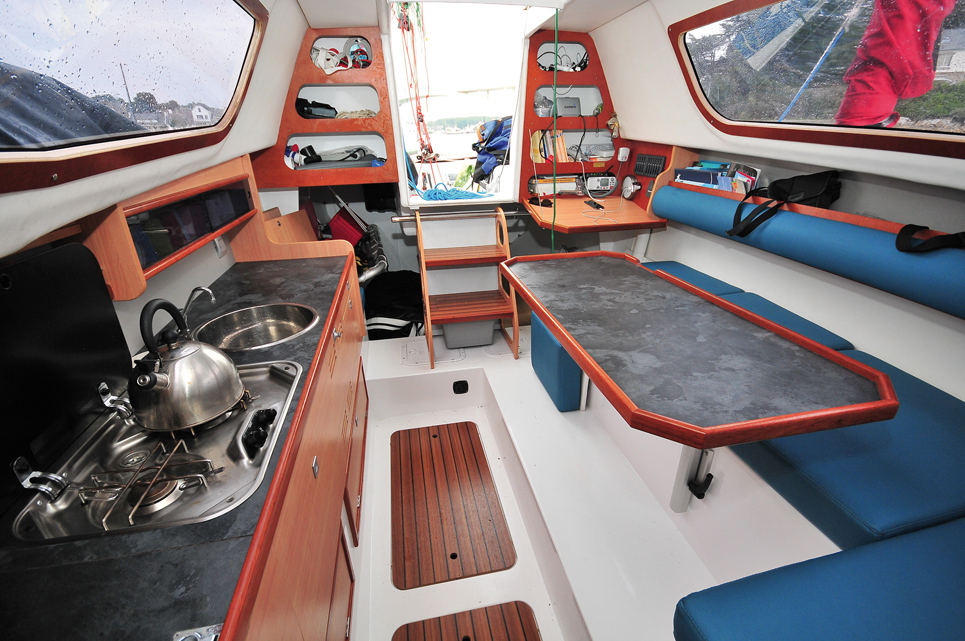
The interior volume and the visibility are a nice surprise on a boat of this size, as are the ergonomics
Our speed ranges between 9 and 11 knots, and the tiller is precise, enjoyable and doesn’t require much effort. The directional effect is as powerful as necessary, but the helm certainly lacks a dedicated seat, and micro-metric precision in the linkage between the tiller extension and the rudder blade to really make the most of this boat’s excellent handling. An offshore chop was now settling in, as we made for the Ile de Houat. The breeze maintained at 12-13 knots, with regular gusts to 15-16 knots - the ideal scenario for our catamaran! The T30 is not carried away by the gusts, being well-supported by her starboard hull. It’s easy to get her slipping along at 12-14 knots (the maximum we hit on the day was 14.5). The helm is precise and fun: the remarkable stiffness of the platform really contributes to the enjoyment of the exercise. There’s no worrying warning noises from the any of the joints, nor grinding or movement in the linkages. This is down to the carbon epoxy construction, but it’s a shame the material of the trampolines is not so perfectly adjusted (though, remember, this is hull number one). The balance of the helm is excellent and the interaction with the daggerboards feels perfect on this point of sail. Leaving the island of Houat to starboard, we find ourselves in a steady swell, and the Tricat 30 surfs these with ease and shows some nice acceleration. It’s time to furl the gennaker, and hoist the jib, as we will have to return to La Trinité upwind. In use, the folding bowsprit confirms that it is a neat idea, well made: folded up, it allows the sail to be kept on standby without being exposed, tidily stowed in its own bag along the sidedeck and ready to launch. With both daggerboards down, the trimaran holds a very good course through the water, which is now becoming choppier. With reduced wetted area, fineness and having been lengthened, they seem to really suit the boat: the helm remains almost neutral. Adjustments to the traveler are efficient and with a good, double purchase for the mainsheet. The jib is perfect, but I’m not convinced about the main. It is powerful, but I didn’t like the folds at the square top (doubtless needing adjustment). Coming back on the wind was fast, with the 30 miles around the islands of the Morbihan covered in barely three hours in ideal and spray-free conditions!
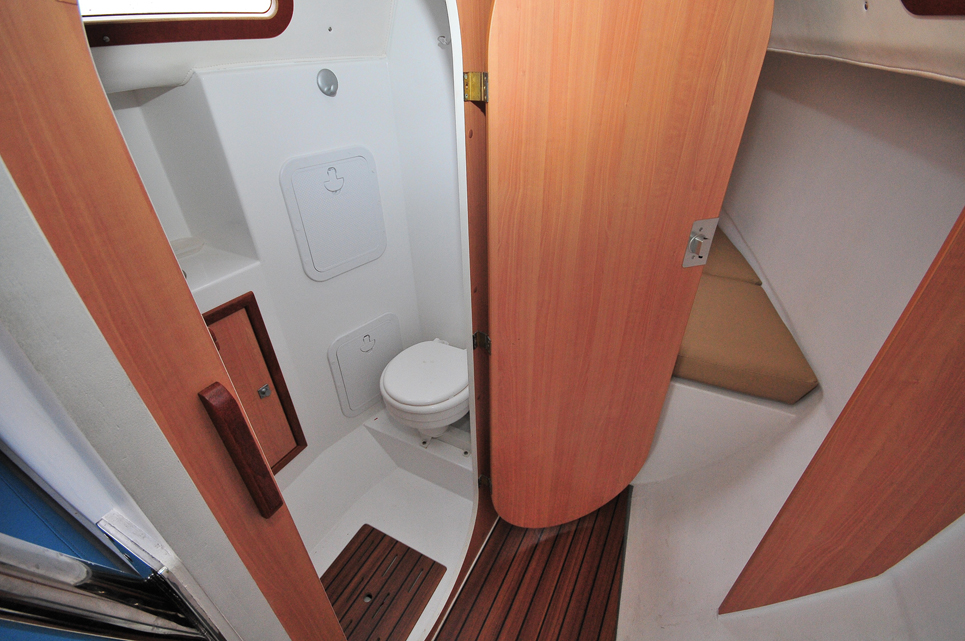
A proper heads compartment, nicely sized, adjacent to the forward cabin
Conclusion
The Tricat 30 is an easily accessible multihull, which is fun and well-built. At her best in medium airs, she achieves high speeds, yet remains perfectly calm. Enthusiastic crews will enjoy the stiffness of her structure, modern design and dynamic qualities, giving formidable performance in stronger conditions. The cruising version we tried has excellent potential to satisfy seasoned enthusiasts, yet seduce newcomers as well. A supercharged version is currently in build, with a taller, rotating carbon mast, and with carbon bulkheads, it will surely be flyer. Those looking to take a year’s sabbatical will find that while this doesn’t have the habitable space of a catamaran, but she is capable of good performances and gives you the option to explore far-off destinations by shipping the boat in a container. It’s worth a thought…
Technical specifications
- Naval Architects: Jack Michal and Antoine Houdet
- Builder: Tricat
- Construction: Foam/glass/polyester (infusion) for the three hulls; epoxy carbon(infusion) for the arms and the appendages
- Length: 9.20m
- Beam: 3.50/7m (the arms have to be removed for transport by road)
- Mast: Fixed AG aluminum as standard
- Upwind sail area: 60m²/ downwind: 75m²
- Mainsail: 38m2 Jib: 22m2
- Gennaker: 38m2 Draft: 0.42/1.60m
- Unladen weight: 1,850kg
- CE Category: B (5 persons)/ C (7 persons)
- Price: €152,830 ex-tax for the basic cruising version
Plusses
- Successful architectural design
- Surprising interior volume
- Rigorous construction
- Fun to sail
Minuses
- Interior styling
- No helm seat
- No rigid or folding cover as standard to protect the companionway
- Difference in level between the trampolines and the central hull
The competition
NAVAL FORCE 3 QUORNING CORSAIR MULTIDO CHALLENGE 30.2 DRAGONFLY 28 TOURING CRUZE 970 BANDIT 870 46 56 62 46 1500 1950 1814 1900 124 916 134 700 167 300 US$ 130 000
| BUILDER | MODEL | UPWIND SAIL AREA M² | UNLADEN WEIGHT KG | PRICE IN EUROS EX-TAX |
| NAVAL FORCE 3 | CHALLENGE 30.2 | 46 | 1500 | 124 916 |
| QUORNING | DRAGONFLY 28 TOURING | 56 | 1950 | 134 700 |
| CORSAIR | CRUZE 970 | 62 | 1814 | 167 300 |
| MULTIDO | BANDIT 870 | 46 | 1900 | US$ 130 000 |
Détails du bateau
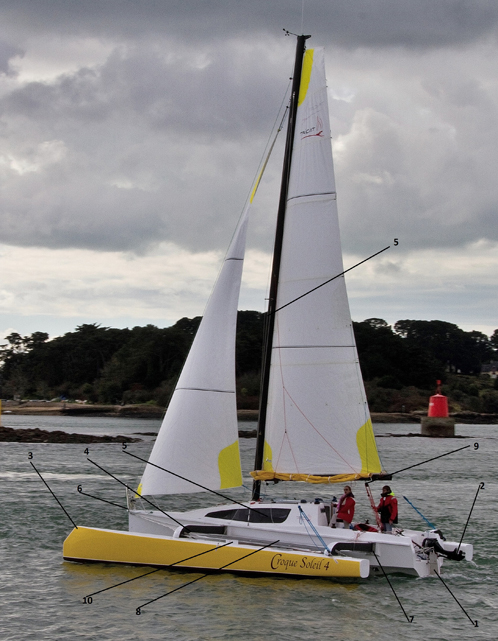
- : The lifting carbon rudder blade is held by an aluminum frame fixed to the sugarscoop
- : The 9.9hp Mercury outboard is well-suited and is one of the lightest on the market (38kg). It is connected to the helm via a linkage bar which considerably improves directional control
- : The long and voluminous hulls add considerable dynamic safety, and the truncated bows significantly reduce spray at higher speeds
- : The crossed arms are well clear of the water, the trim is balanced when stopped, but a dynamic dihedral angle emerges under load and allows the windward hull to lift
- : Jack Michal and Antoine Houdet have successfully integrated the coachroof, while providing amazing interior volume and good headroom. The size of the windows gives good light inside and allows you to see diagonally across the boat to leeward from the helm
- : The cleverly folding bowsprit! Triangulation avoids the need for a bridle or a costly telescopic system and makes preparing the gennaker or spinnaker a safe operation
- : The linkages of the arms to the central hull are generously-sized welded stainless steel with axis pins. The pivot (mechanical and horizontal, as on the Dragonfly) on the float works with a rotating carbon plate coming from the arm
- : On this first example, there is a step between the sidedecks and the trampolines. This height difference will be done away with on later models, with a change in the fixings for the trampoline on the central hull
- : Deck hardware is appropriately sized, and the multi-strand, double purchase on ball-bearing blocks really helps trimming
- : The daggerboard casings are in the floats. A solution which results in more space and less weight, which is great for the Tricat 30. The well-designed carbon daggerboards are light, efficient and discreet. The T30 can take the ground on her monolithic central hull.
