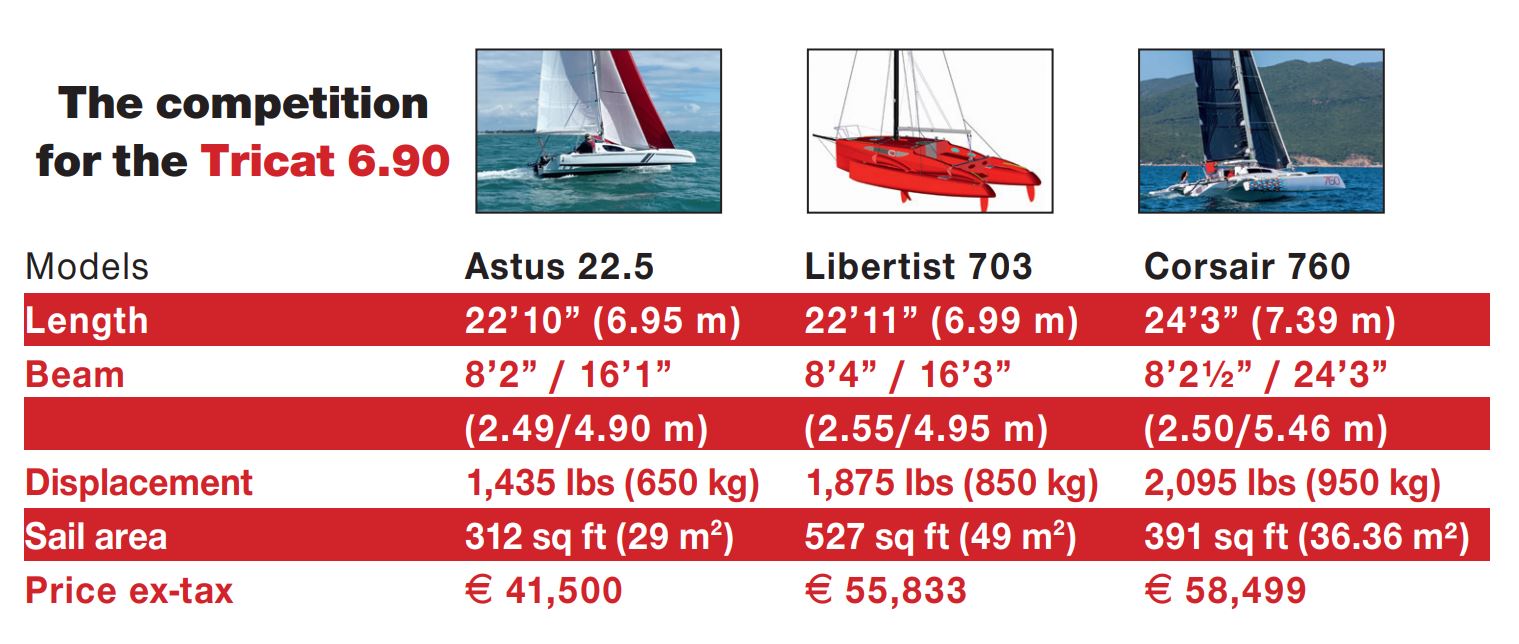
Specialists in folding trimarans since 2003, Tricat have just launched a new model which fits between the Tricat 20 and the 25. In order not to (re)tread on the toes of any former models from the shipyard in this category (the 22 and the 23.5), they decided to integrate the metric system: so now you have the Tricat 6.90! We had the opportunity to test this model in particularly heavy conditions...
Infos pratiques
- Le chantier : Tricat 6.90
- La fiche technique
-
 Découvrez notre vidéo exclusive
- Financez votre Tricat 6.90
- Assuez votre Tricat 6.90
- Articles autour du Tricat 6.90
Test location: Arradon, Brittany, France
Conditions: Wind, SW 20 to 25 knots, gusting to 30; Sea state, slight
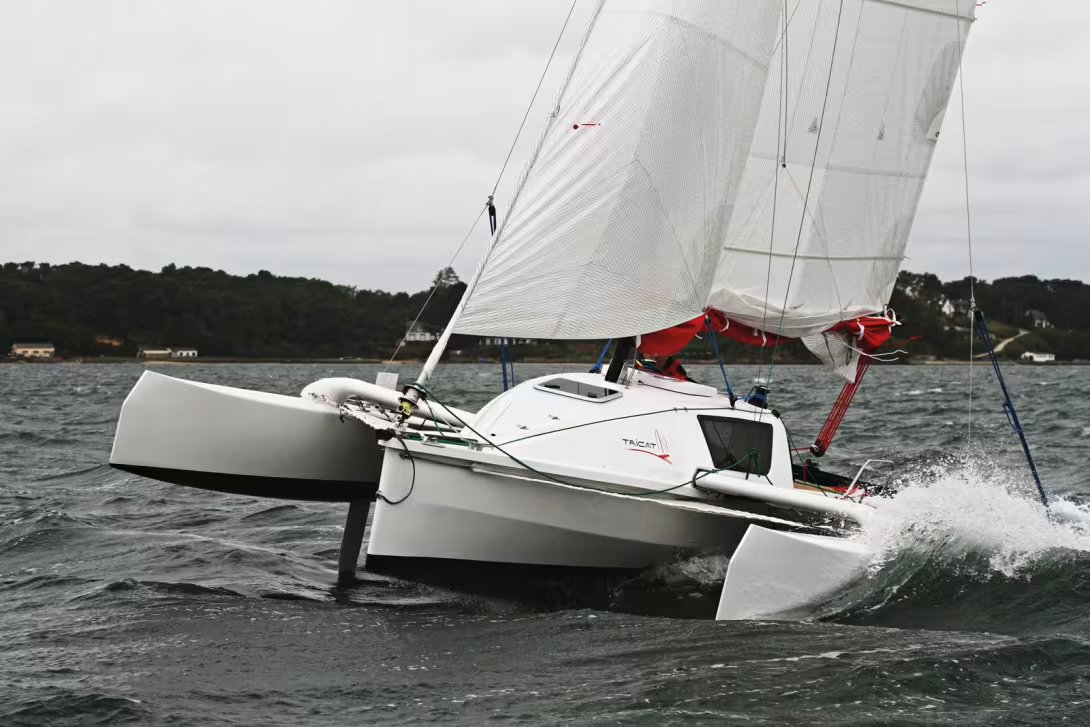
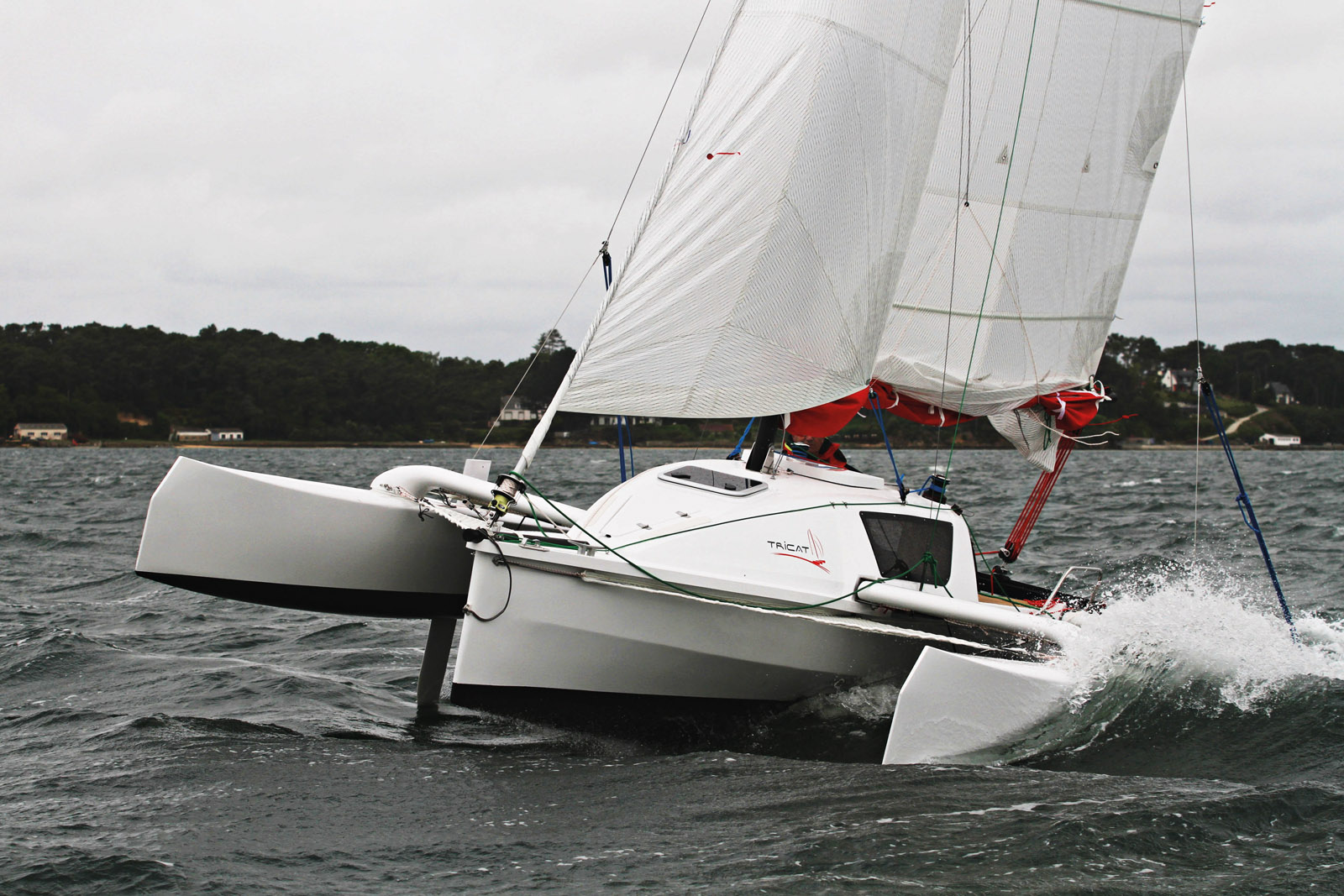
The weather of the day: 20 to 25 knots, gusting to 30... enough to put off more than one boater, but not Antoine Houdet, owner and founder of the Tricat shipyard. As a good Breton sailor, he is in no way fazed by the powerful gusts sweeping across our stretch of water today, the famous Gulf of Morbihan. At first glance, this 6.90 looks like a big Tricat 20, from which it borrows the folding linkage arms that fold aft. The central hull is relatively traditional with its almost plumb bow and its very high chines. The floats are more modern, with a flush gunwale and a broken and inverted bow in the upper section.
Simple and uncluttered deck plan
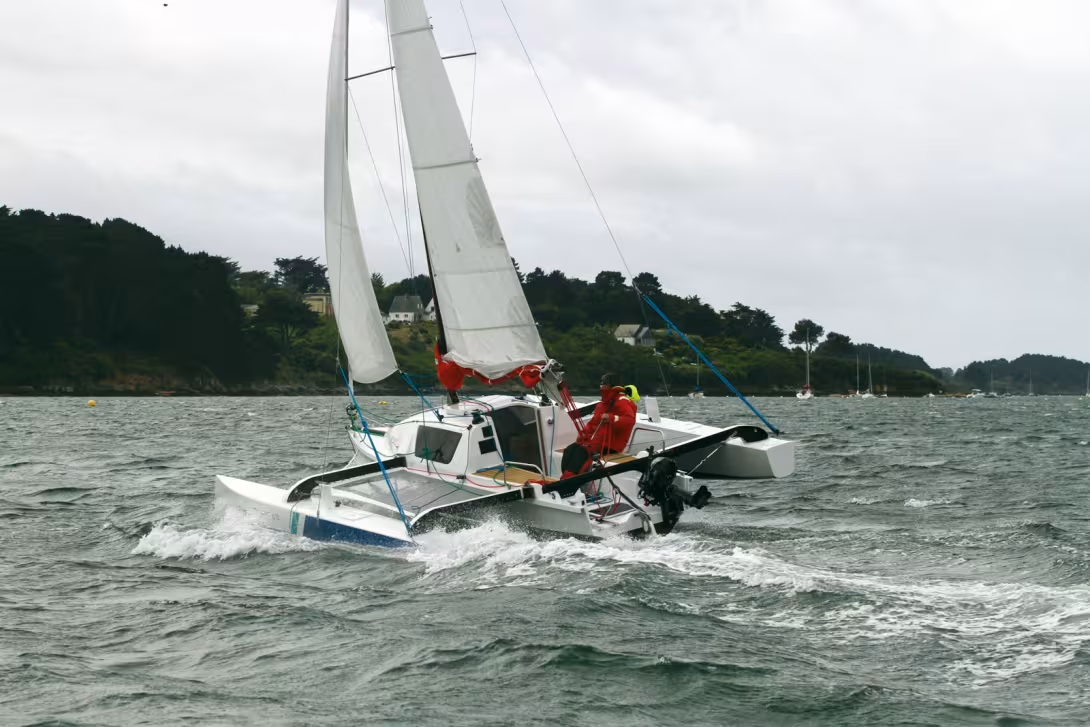
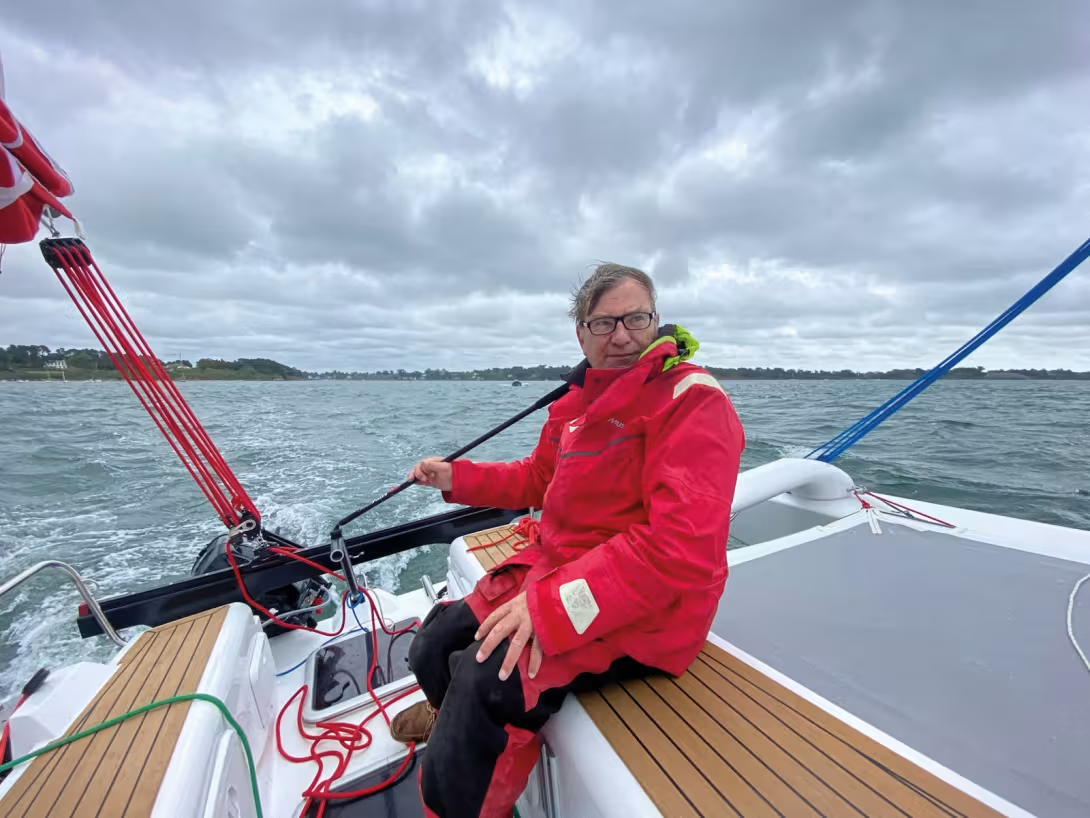
The main innovation of this new model is the new design of the cockpit. The removal of the traditional aft beam frees up circulation around the cockpit, especially for the helmsman. An optional full-carbon tiller can be fitted at the very after end of the 6’6” (1.80 m) long cockpit. It is this configuration, equipped with an 8-purchase mainsheet as opposed to the standard 6, that we were able enjoy aboard Tricat 6.90 #1. As we readied for casting off from the port of Arradon, we noted the access to the outboard motor is a bit more complicated, but not really an issue. The Sport rig is made civilized by a furling genoa, lazy bag and lazy jacks. A little less performance, of course, but easier maneuvering for a small crew or a single-hander! And that’s exactly how we are sailing today: solo or with two people. There’s no difficulty hoisting the sails: the autopilot equipped with two mounts does its job and the mesh trampolines secured to particularly rigid rails allow easy access to the mast foot. The helmsman can lean on the stainless steel pushpits. As for the two winches on the deckhouse, they are more than enough to handle all sailing maneuvers.
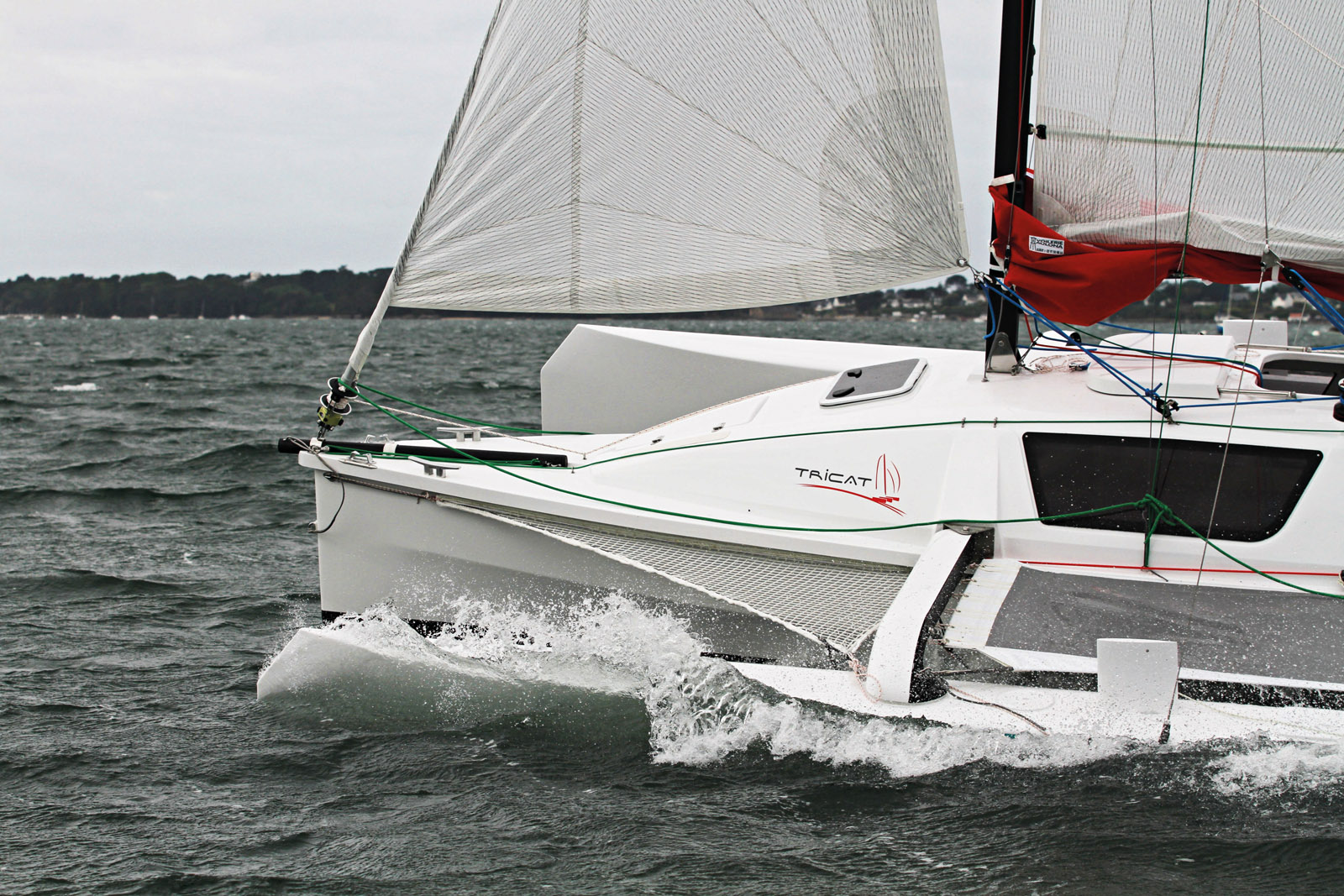
The strongest gusts and chop managed to push the leeward float down a bit, but the arms are high enough to never touch the water.
16 knots solo!
Antoine opted for one reef in the main and three rolls in the genoa, with the daggerboards lowered to two thirds. Our test began with a sail across to Port-Blanc, the departure port for ferries heading for Ile-aux-Moines, the largest island in the Gulf of Morbihan. With the coastal breeze, the wind was slowing down, then sometimes suddenly accelerating. The Tricat greeted the breeze when it kicked in, with wonderful accelerations to 10 and 11 knots. The strongest gusts manage to fly the windward float and even raise the central hull slightly. We weren’t forced to ease the jib sheet (which is on a purchase) or to play with the traveler, but it wasn’t far off... In “normal” operation, heeling won’t exceed 10°. Tacking happens cleanly: the trimaran never failed to pick up again immediately on going through the wind. Once off Larmor Baden, Antoine finally had the searoom, and was able ease the sheets. Onboard the RIB serving as our photo boat, we had to push the throttle a fair amount, to give us 12/13 knots so we could keep up. As the gusts kicked in, the Tricat’s leeward float barely buries any further, and the boat instantly rears up and accelerates to full speed – we recorded several peaks at 16 knots! Not bad for single-handed Antoine, who was only sailing this trimaran for the third time. He launched into a full-on gybe between the anchored monohulls; the Tricat slides round at such a speed that the mainsail passed across very smoothly. I then climbed aboard to actually sail the machine myself: immediate exhilaration! I bore away, looking for speed as if I were helming a Hobie Cat. Downwind, the leeward float was smoking with the spray, and the flying, windward float and raised central hull did nothing to slow us down at all. The weather on the day didn’t inspire us to go in search of a nice anchorage on the edge of the beach and the pine trees, but if we had, with the daggerboards and rudder raised, the Tricat draws less than a foot..
 |
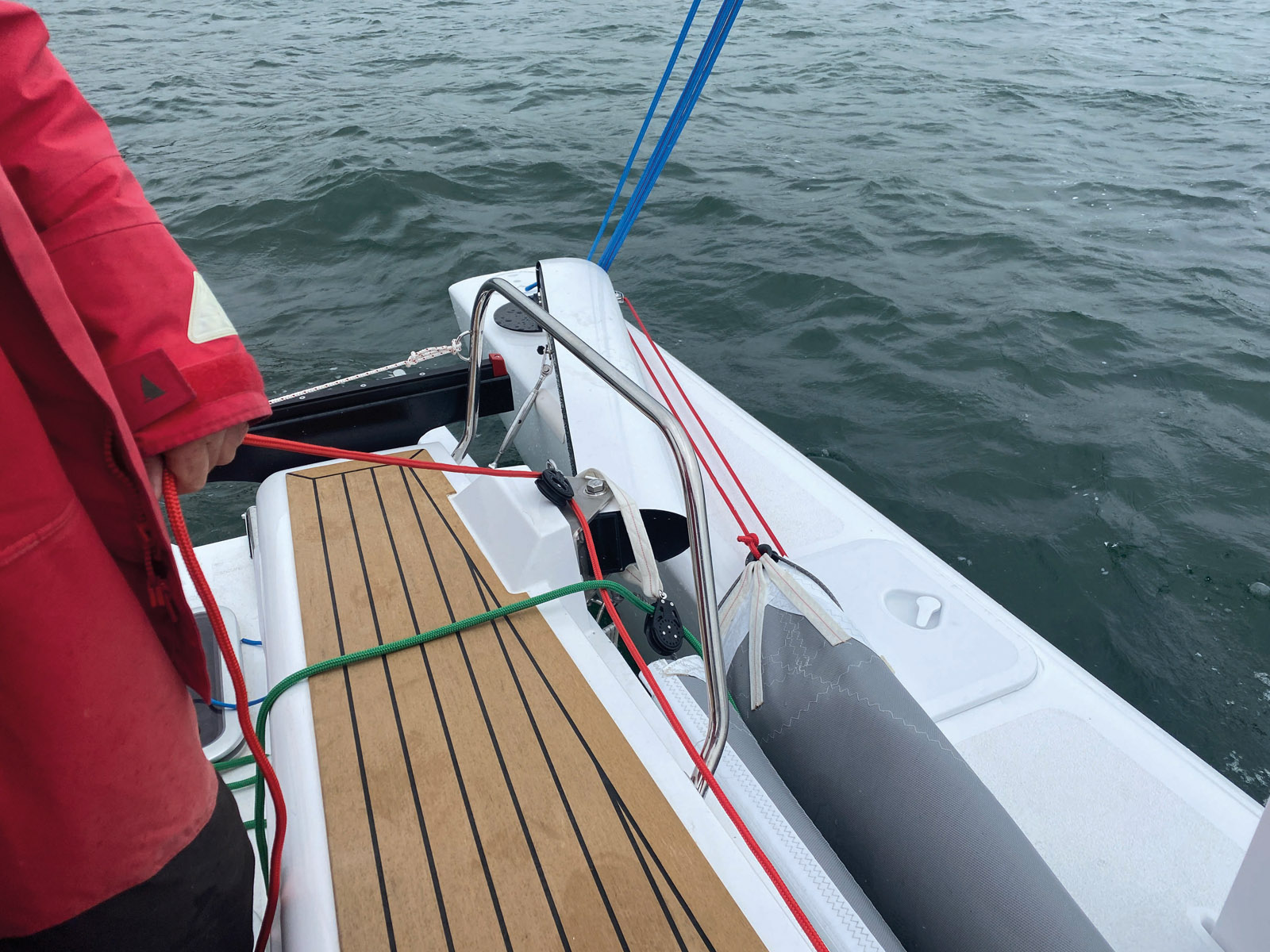 |
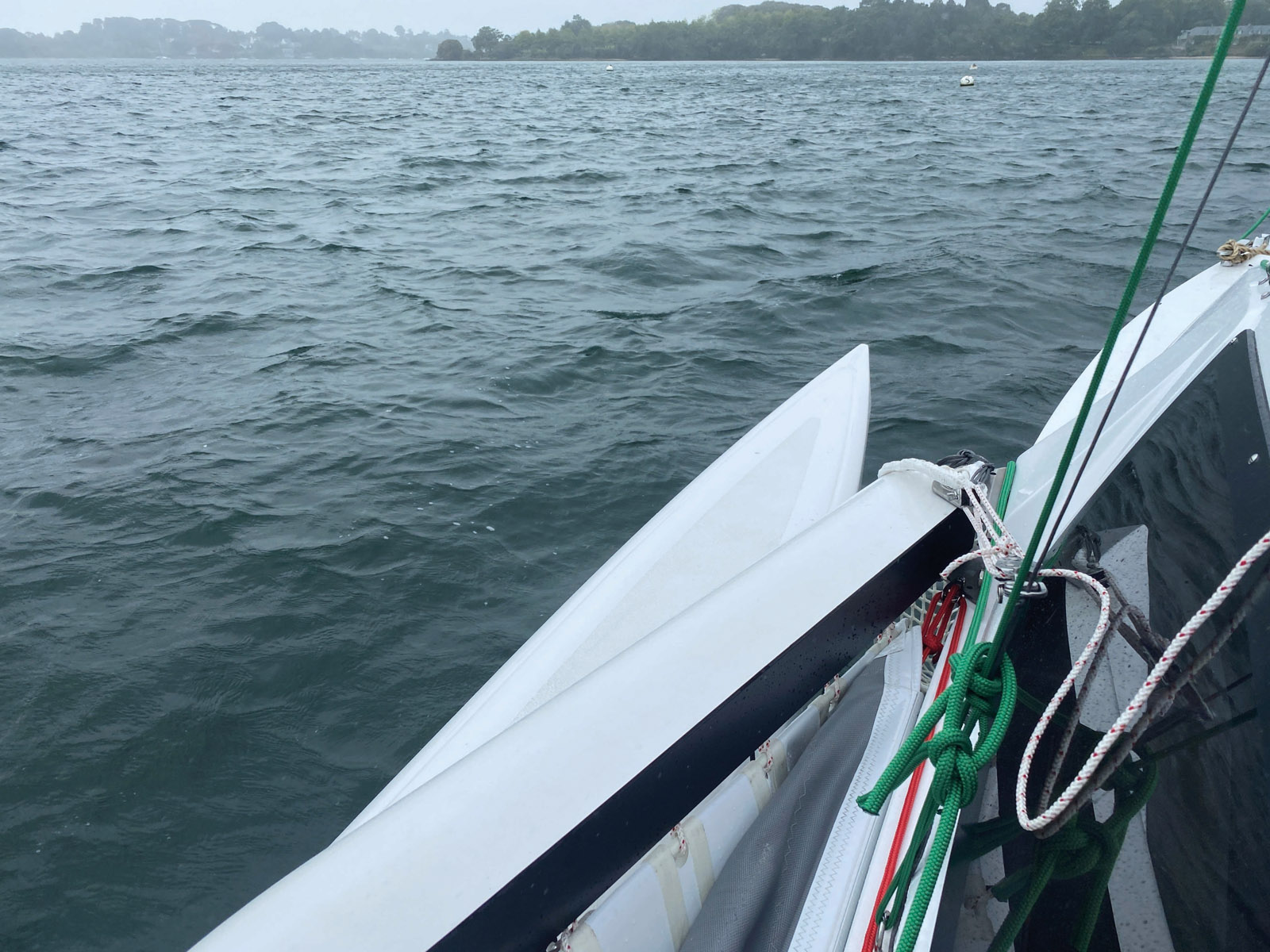
Folding in the arms, a perfectly tuned operation, is absolute child’s play!
A coast-hopping cruiser
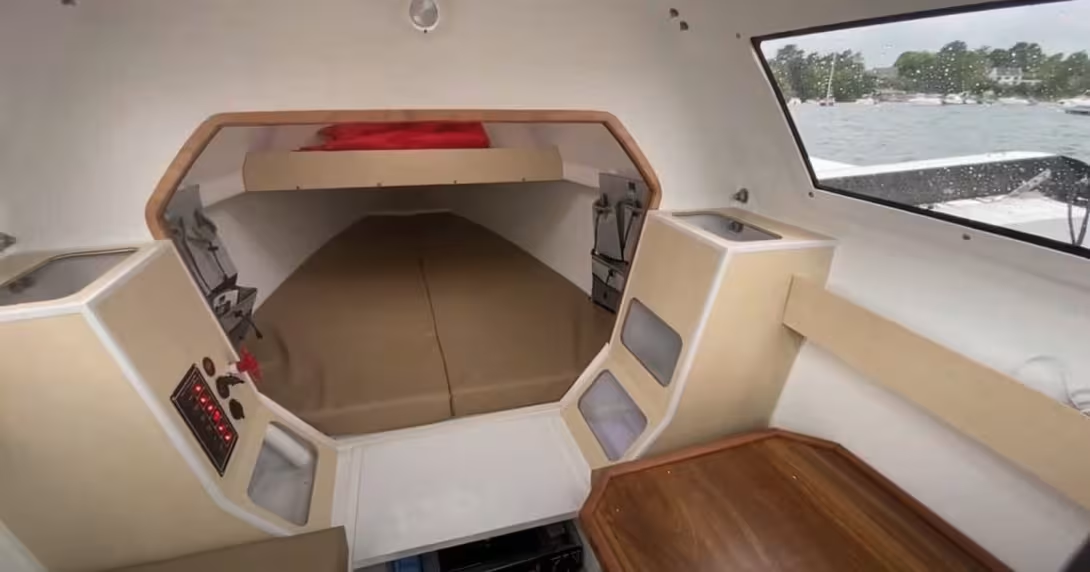
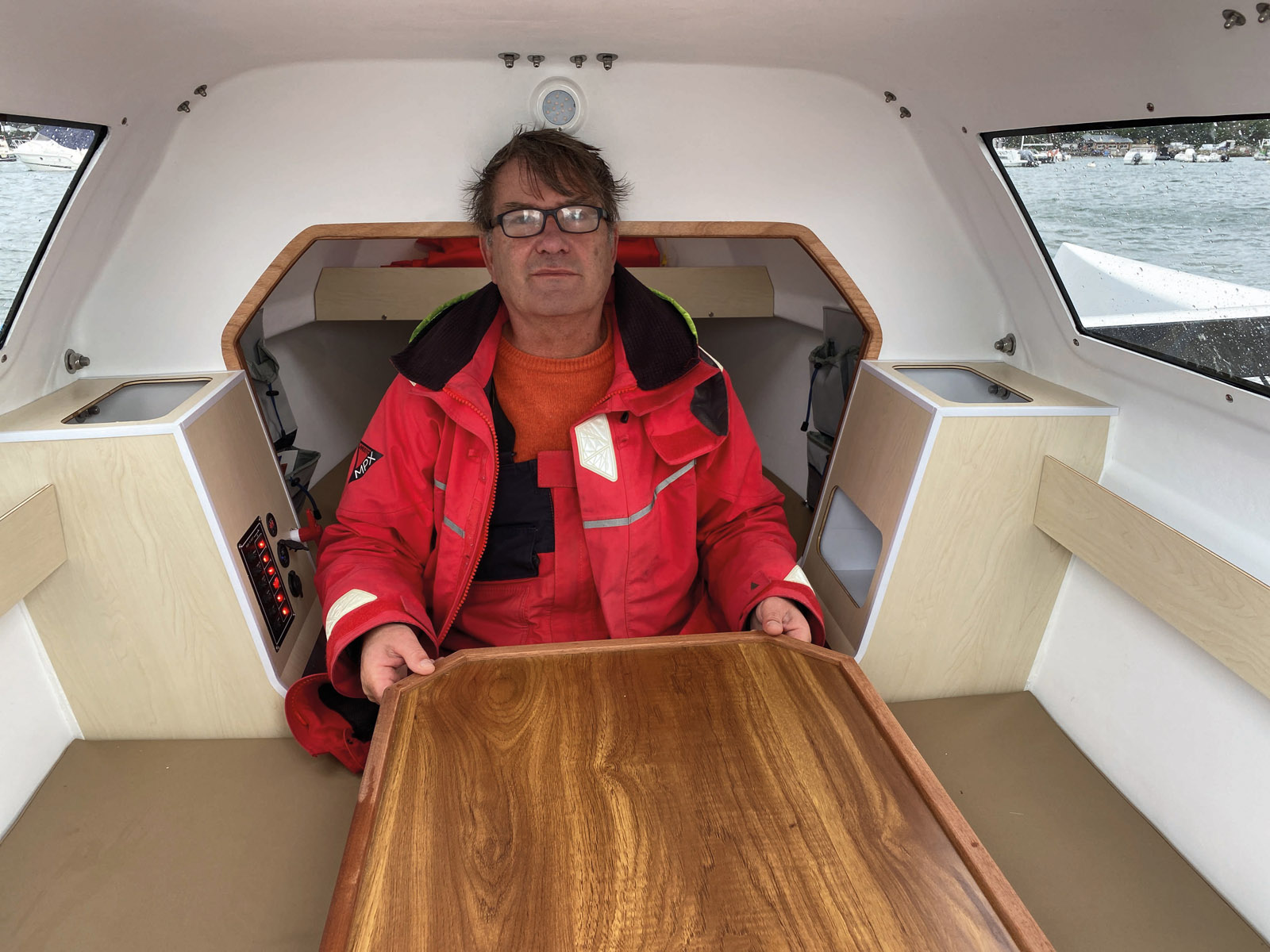
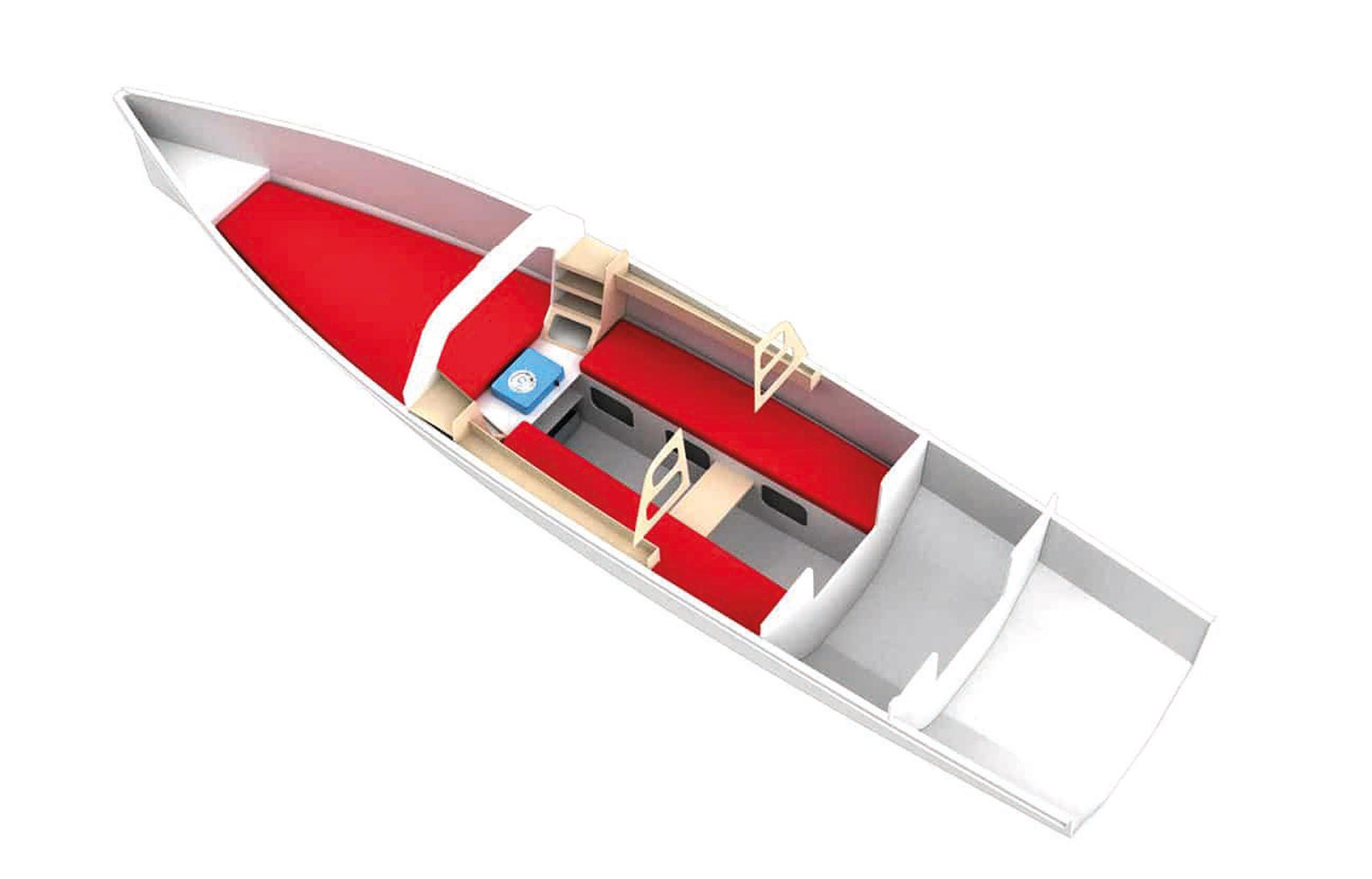
To say that the 6.90’s cabin is cozy might be a bit of an exaggeration; let’s rather say that it offers a quite acceptable level of comfort - especially considering the necessarily limited volume of the central hull. The companionway hood designed by the shipyard is clever: it can be adjusted and set in different positions to offer greater headroom - when closed, it’s 4’10” (1.48 m). Four bunks can be arranged: the two benches in the saloon, relatively narrow, at only 17” (0.43 m) in width, and the triangle of the forepeak. This too is a little slim – 6’5” (1.97 m) long, 4’1” (1.25 m) wide at the head and 2’7” (0.80 m) at the feet: this sleeping arrangement is suitable for a couple of kids, but maybe not so ideal for two adults. Antoine has invented a multi-position table: the 33½” x 21¼” (85 by 54 cm) tabletop can be used as a chart table or a saloon table... but also as a cockpit table thanks to the removable leg. The lateral hatches are big enough that you don’t feel shut in - the sea is always there! The storage space - lockers and cupboards - is very large for a boat of this size. Options available allow you to optimize the boat for cruising: solar panel, electrical installation, electronics, chemical toilet, etc
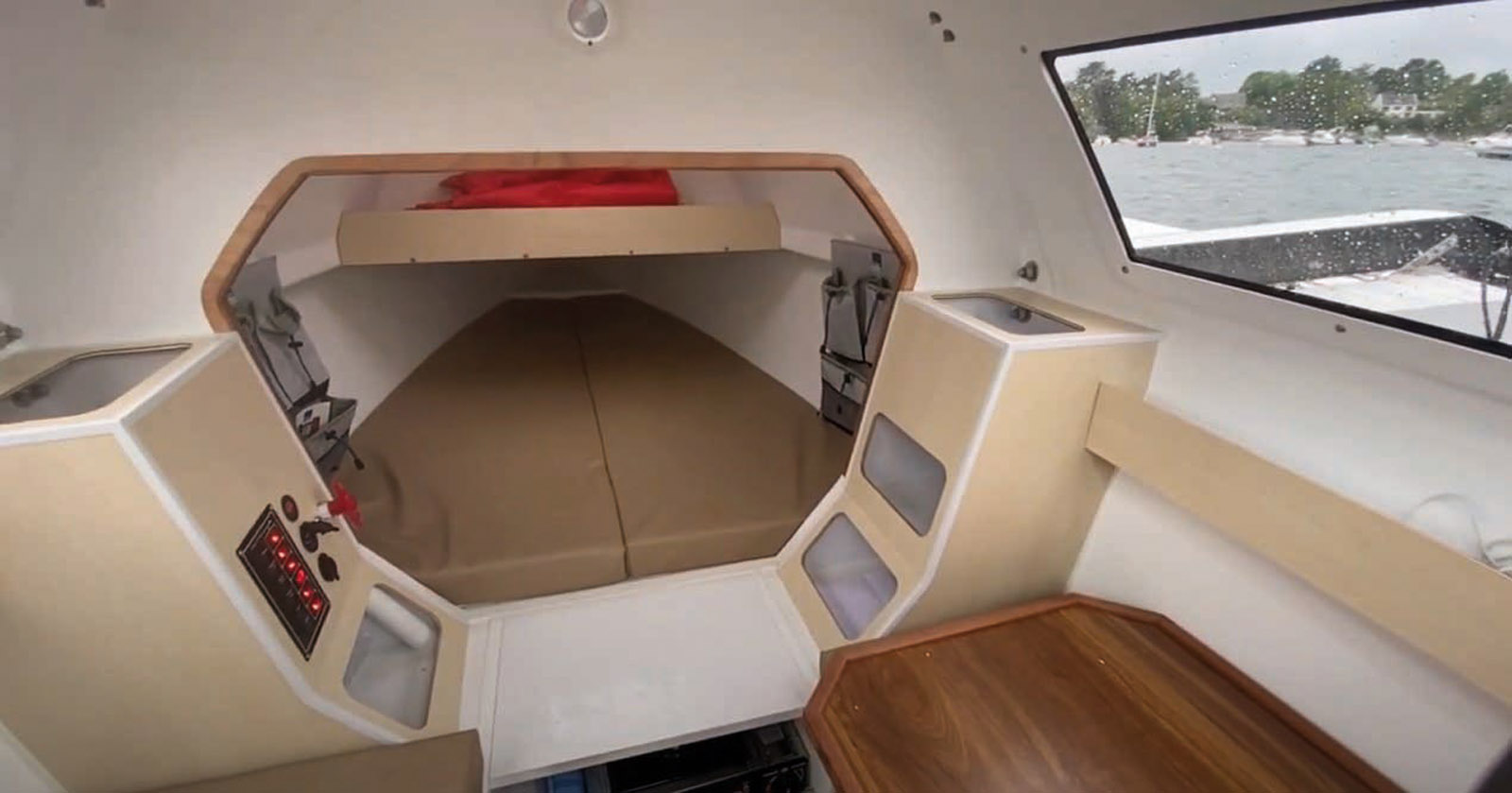
Slightly narrow bunks, but plenty of storage space everywhere!
An “à la carte” trimaran
In terms of price, note that the Family version offers a galley, canvas storages, 2” (50 mm) thick upholstery, a mini electrics pack, lazy jacks, a genoa furler and floats decorated with a color. As standard, you get a black anodized mast and boom, and carbon appendages. The Cruising version also includes the swiveling table, a double berth panel, wood storage shelves, 3” (80 mm) thick upholstery, a full electrics package, aft pulpits, additional cleats and lockers, an opening front hatch, two bow trampolines and two-color float decoration. The prices proposed for these options remain very reasonable - the Cruising version is only € 9,245 more than the Standard version, a 20% price difference. There is still an outboard engine, safety equipment, downwind sails – maybe even the Sport Pack - and finally the Electronics Pack. Ultimately, a fully-loaded Tricat 6.90 can come in at up to € 65,000 ex-tax. And then you might want to add a braked road trailer.
 |
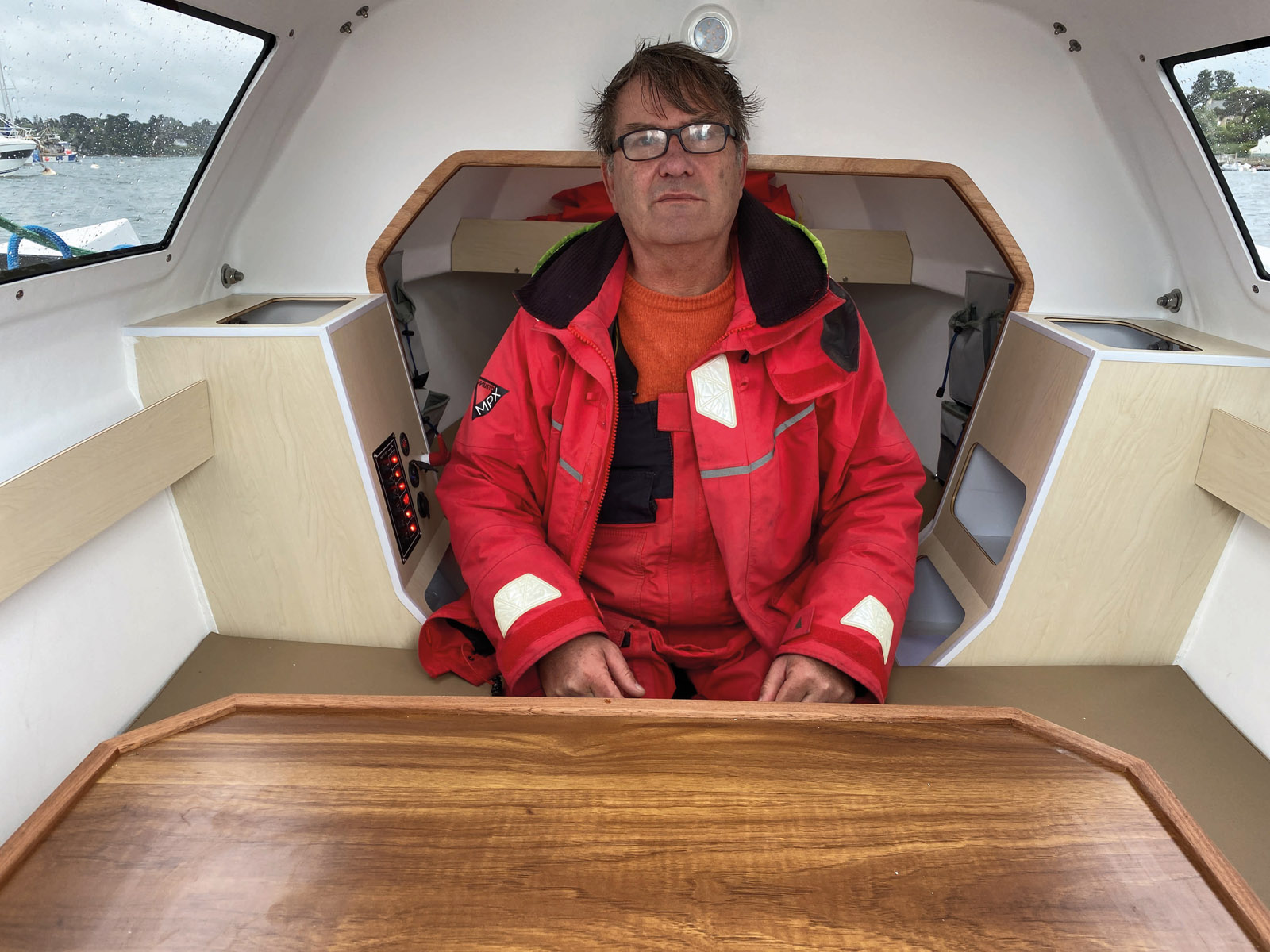 |
Antoine Houdet shows us his multi-position table - it can even be used outside in the cockpit.
Conclusion
We were barely alongside the pontoon, when we proceeded to do a test the folding floats. Two lines to let go, another to be pulled in, and the float pivoted backwards – it was just too easy! Only the bow net delayed – though you couldn’t really call it that - the operation. So, this is a trimaran you can fold up so that it fits into a monohull slip, or come out of the water on a yard dolly or on a road trailer. Be careful with the length: when folded, the 6.90 “grows” by 70 cm or nearly 28 inches! This new Tricat is definitely convincing: this is a nomad multihull, ready for any adventure!
Technical Specifications
Builder: Tricat
Architects: BE Tricat / Jack Michal
Material: polyester-infused GRP
Length unfolded/folded: 22’8” / 24’11” (6.90/7.60 m)
Beam unfolded/folded: 15’1” / 8’½” (4.60/2.45 m)
Draft: 12” / 3’11” (0.30/1.20 m)
Light displacement: 1,590 lbs (720 kg)
Fully-battened mainsail area: 205 / 237 sq ft (19/22 m²)
Solent: 104 / 116 sq ft (9.7/10.8 m²)
Gennaker: 258 sq ft (24 m²)
Spinnaker: 366 sq ft (34 m²)
Outboard motor: 3.5 to 6 HP
Berths: 3/4
Price Tricat 6.90 Standard: € 43,750 ex tax
Price Tricat 6.90 Family: € 49,057 ex-tax
Price Tricat 6.90 Cruising: € 52,995 ex-tax
Principal options ex-tax:
3.5 HP 4-stroke long-shaft Mercury outboard: € 1,080
Stainless steel bathing ladder: € 280
Safety equipment pack: € 580
Braked road trailer with mast stepping pole and rear mast support: € 4,850
Spinnaker hardware and bowsprit: € 790
Gennaker on furler: € 1,950
Asymmetric spinnaker: € 1,730
Sport Pack (Mylar sail + 43 sq ft / 4 m², Harken mainsheet track on carbon beam, 8-purchase mainsheet, more powerful winches, telescopic tiller extension): € 4,350
Electronics pack (autopilot, solar panel, wind instrument, chart plotter): € 2,995